

ISO 25353
(Main)Textiles — Qualitative proteomic analysis of protein fibres from leather — Peptide detection using matrix-assisted laser desorption/ionization time-of-flight mass spectrometry (MALDI-TOF MS)
- Abstract
This document specifies a qualitative procedure to qualifying leather animal species of (fibrous) protein from leather by MALDI-TOF mass spectrometer (MS). The composition of other fibres can be measured by methods described in the ISO 1833 series. Both results are then combined to determine the whole composition of fibres (see Annex C as an example of mixtures of (fibrous) protein from leather and polyester). The method is based on a preliminary identification, by light microscopy, of all fibres in a blend on the basis of their morphology, according to ISO/TR 11827.
- Status
- Not Published
- Technical Committee
- ISO/TC 38 - Textiles
- Drafting Committee
- ISO/TC 38/WG 22 - Composition and chemical testing
- Current Stage
- 6000 - International Standard under publication - 60 Publication
- Start Date
- 22-Oct-2026
Buy Documents
ISO/FDIS 25353 - Textiles — Qualitative proteomic analysis of protein fibres from leather — Peptide detection using matrix-assisted laser desorption/ionization time-of-flight mass spectrometry (MALDI-TOF MS)
REDLINE ISO/FDIS 25353 - Textiles — Qualitative proteomic analysis of protein fibres from leather — Peptide detection using matrix-assisted laser desorption/ionization time-of-flight mass spectrometry (MALDI-TOF MS)
ISO/FDIS 25353 - Textiles — Analyse protéomique qualitative de fibres protéiques issues du cuir — Détection des peptides par spectrométrie de masse à temps de vol avec ionisation/désorption laser assistée par matrice (MALDI-TOF MS)
ISO 25353 is an International Standard from ISO for identifying the animal species of protein fibres from leather using matrix-assisted laser desorption/ionization time-of-flight mass spectrometry (MALDI-TOF MS). It specifies a qualitative test method for leather-based protein fibres, so laboratories can determine which animal species are present in a sample. The document is aimed at textile and leather testing users who need a species identification result they can combine with fibre composition testing.
What does ISO 25353 specify?
ISO 25353 specifies a qualitative procedure for identifying the animal species of protein fibres from leather by MALDI-TOF MS. It also shows how this result fits into a broader fibre composition assessment when other fibres are present.
The scope places the method in a blended-material context. Other fibres are to be measured by methods from the ISO 1833 series, and the results are combined to determine the overall fibre composition. The document also uses preliminary light microscopy identification of all fibres in the blend, based on morphology in accordance with ISO/TR 11827.
The document is organized into:
- Clause 1 - Scope
- Clause 2 - Normative references
- Clause 3 - Terms and definitions
- Clause 4 - Symbols and abbreviated terms
- Clause 5 - Principle
- Clause 6 - Reagents
- Clause 7 - Apparatus
- Clause 8 - Preparation of test specimens
- Clause 9 - Procedure
- Clause 10 - Test report
- Annex A - Animal species-specific marker in MALDI-TOF-MS analysis
- Annex B - Animal species-specific peaks in MALDI-TOF-MS analysis
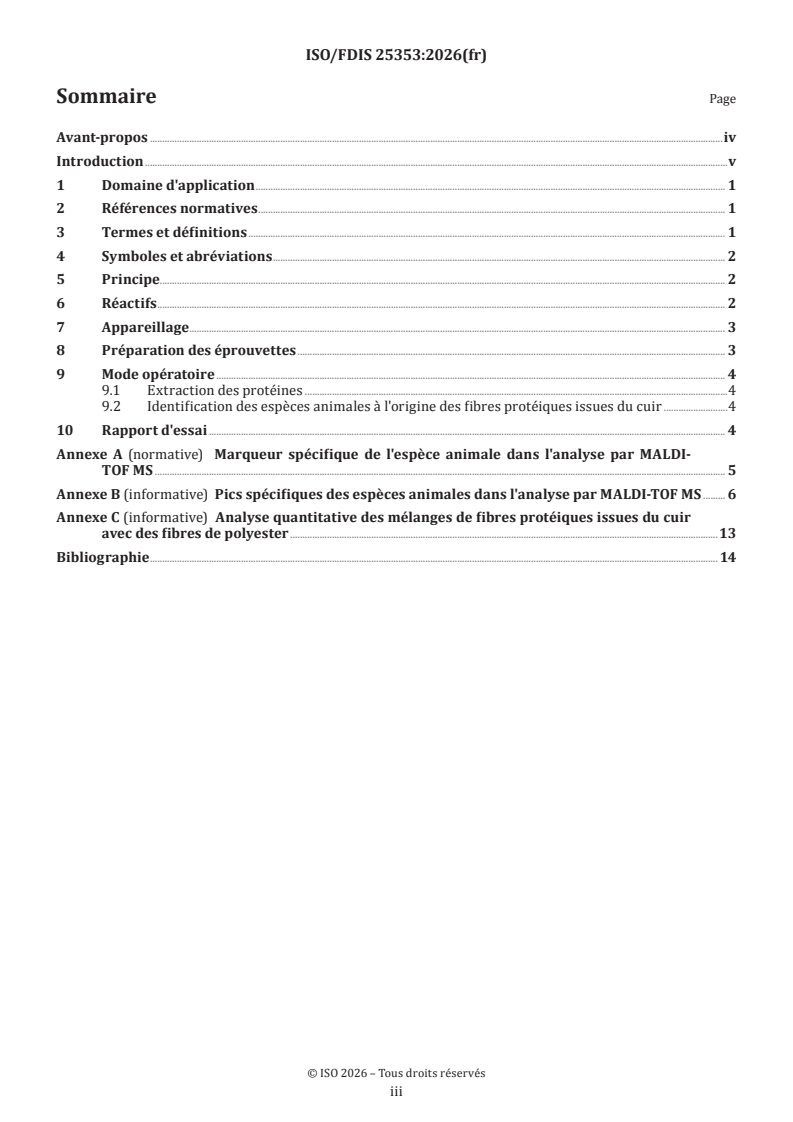
- Annex C - Quantitative analysis of mixtures of protein fibres from leather and polyester
What are the key requirements of ISO 25353?
ISO 25353 is built around extracting proteins from leather, digesting them into peptides, and checking the peptide pattern with MALDI-TOF MS. In practice, a lab must prepare the specimen correctly, follow the extraction and digestion conditions, and interpret the marker peaks for species identification.
Specimen preparation and extraction
Clause 8 requires the test specimen to be cut and dried according to ISO 4044, then weighed to the specified mass. Clause 9.1 then calls for repeated heating with buffer solution, followed by cooling and trypsin digestion. This matters because the method depends on getting peptides from the leather protein matrix in a controlled way.
Reagents and equipment
Clauses 6 and 7 specify the reagents and apparatus needed, including water of grade 3 per ISO 3696, ammonium bicarbonate, trypsin, 2-mercaptoethanol, acetonitrile, trifluoroacetic acid (TFA) and α-cyano-4-hydroxycinnamic acid (CHCA). The required equipment includes a MALDI-TOF mass spectrometer, heating and temperature-controlled devices, pipettes, an analytical balance and a spotting plate. This tells the user what must be available before the test can be run.
Species identification logic
Clause 9.2 says identification is based on the presence or absence of species-specific peaks, starting with the primary type-specific peak and then checking the secondary peak. Annex A gives species-specific marker m/z values for cow, water buffalo, goat, sheep, pig, horse and crocodile, and Annex B shows the corresponding peak examples. In practice, the analyst compares the measured peptide pattern with these markers to reach the species call.
Reporting
Clause 10 requires the test report to cite ISO 25353, describe the sample where possible, give the test date, report the results including mass spectra, state the animal species identified, note any quantitative identification where needed, and record deviations or unusual features. This is the record that allows another party to review how the result was obtained.
Combined fibre analysis
Annex C provides an example of how to handle mixtures of protein fibres from leather and polyester. It describes removing polyester with the phenol and tetrachloroethane method from ISO 1833-24, then collecting and drying the remaining leather fibres. That matters when the leather protein result has to be combined with the mass or composition of other fibres in a blend.
What terms does ISO 25353 define?
- Protein - Polymers of amino acids that are the material being analyzed from leather.
- Peptide - A small protein fragment, typically under about 50 amino acids, formed during digestion.
- Marker - A species-specific monoisotopic peak used for identification.
- MALDI - Matrix-assisted laser desorption/ionization, the ionization method used in the mass spectrometer.
- TOF-MS - Time-of-flight mass spectrometry, which separates ions by the time they take to reach the detector.
- m/z - The mass-to-charge ratio of an ion, used to read the peptide peaks.
Who uses ISO 25353?
ISO 25353 is used by textile and leather testing laboratories, especially where leather fibres are part of a spun yarn or blended textile. It is also relevant to quality control teams, inspectors and buyers who need to confirm the animal species origin of leather protein fibres. The method supports product identification and composition work in labs that already use microscopy and fibre analysis methods.
Which standards are used with ISO 25353?
- ISO 3696 - Provides the water quality needed for reagent preparation and laboratory use.
- ISO 4044 - Gives the specimen preparation method for leather chemical test samples.
- ISO 20418-2:2018 - Supplies related proteomic terminology and a closely connected MALDI-TOF MS approach for animal hair fibres.
- ISO/TR 11827 - Supports the preliminary microscopy-based identification of fibre morphology in blends.
- ISO 1833 series - Provides methods for measuring the other fibres in a blend so the full fibre composition can be calculated.
- ISO 17131:2020 - Is cited in the introduction as the microscopy method that is difficult to apply to leather species identification.
What does the ISO 25353 document contain?
ISO 25353 contains the full laboratory workflow for qualitative species identification of protein fibres from leather. It includes reagent preparation, apparatus requirements, specimen preparation, the protein extraction and trypsin digestion steps, MALDI-TOF MS measurement, and the reporting items to record.
Annex A gives the species-specific marker values, while Annex B shows example species-specific peaks. Annex C adds a worked approach for mixtures of leather protein fibres and polyester, using the polyester-removal method from ISO 1833-24 and then recovering the remaining leather fibres for further analysis.
Relations
- Effective Date
- 12-Feb-2026
- Effective Date
- 21-Jun-2025
Buy Documents
ISO/FDIS 25353 - Textiles — Qualitative proteomic analysis of protein fibres from leather — Peptide detection using matrix-assisted laser desorption/ionization time-of-flight mass spectrometry (MALDI-TOF MS)
REDLINE ISO/FDIS 25353 - Textiles — Qualitative proteomic analysis of protein fibres from leather — Peptide detection using matrix-assisted laser desorption/ionization time-of-flight mass spectrometry (MALDI-TOF MS)
ISO/FDIS 25353 - Textiles — Analyse protéomique qualitative de fibres protéiques issues du cuir — Détection des peptides par spectrométrie de masse à temps de vol avec ionisation/désorption laser assistée par matrice (MALDI-TOF MS)
Get Certified
Connect with accredited certification bodies for this standard

Control Union Certifications
Global certification for agriculture and sustainability.

Hohenstein Institut
Textile testing and certification.

Bureau Veritas Bangladesh
Bureau Veritas certification services in Bangladesh.
Sponsored listings
Frequently Asked Questions
ISO 25353 is a draft published by the International Organization for Standardization (ISO). Its full title is "Textiles — Qualitative proteomic analysis of protein fibres from leather — Peptide detection using matrix-assisted laser desorption/ionization time-of-flight mass spectrometry (MALDI-TOF MS)". This standard covers: This document specifies a qualitative procedure to qualifying leather animal species of (fibrous) protein from leather by MALDI-TOF mass spectrometer (MS). The composition of other fibres can be measured by methods described in the ISO 1833 series. Both results are then combined to determine the whole composition of fibres (see Annex C as an example of mixtures of (fibrous) protein from leather and polyester). The method is based on a preliminary identification, by light microscopy, of all fibres in a blend on the basis of their morphology, according to ISO/TR 11827.
This document specifies a qualitative procedure to qualifying leather animal species of (fibrous) protein from leather by MALDI-TOF mass spectrometer (MS). The composition of other fibres can be measured by methods described in the ISO 1833 series. Both results are then combined to determine the whole composition of fibres (see Annex C as an example of mixtures of (fibrous) protein from leather and polyester). The method is based on a preliminary identification, by light microscopy, of all fibres in a blend on the basis of their morphology, according to ISO/TR 11827.
ISO 25353 is classified under the following ICS (International Classification for Standards) categories: 59.060.01 - Textile fibres in general. The ICS classification helps identify the subject area and facilitates finding related standards.
ISO 25353 has the following relationships with other standards: It is inter standard links to FprEN ISO 25353, ISO/IEC 30118-14:2021. Understanding these relationships helps ensure you are using the most current and applicable version of the standard.
ISO 25353 is available in PDF format for immediate download after purchase. The document can be added to your cart and obtained through the secure checkout process. Digital delivery ensures instant access to the complete standard document.
Standards Content (Sample)
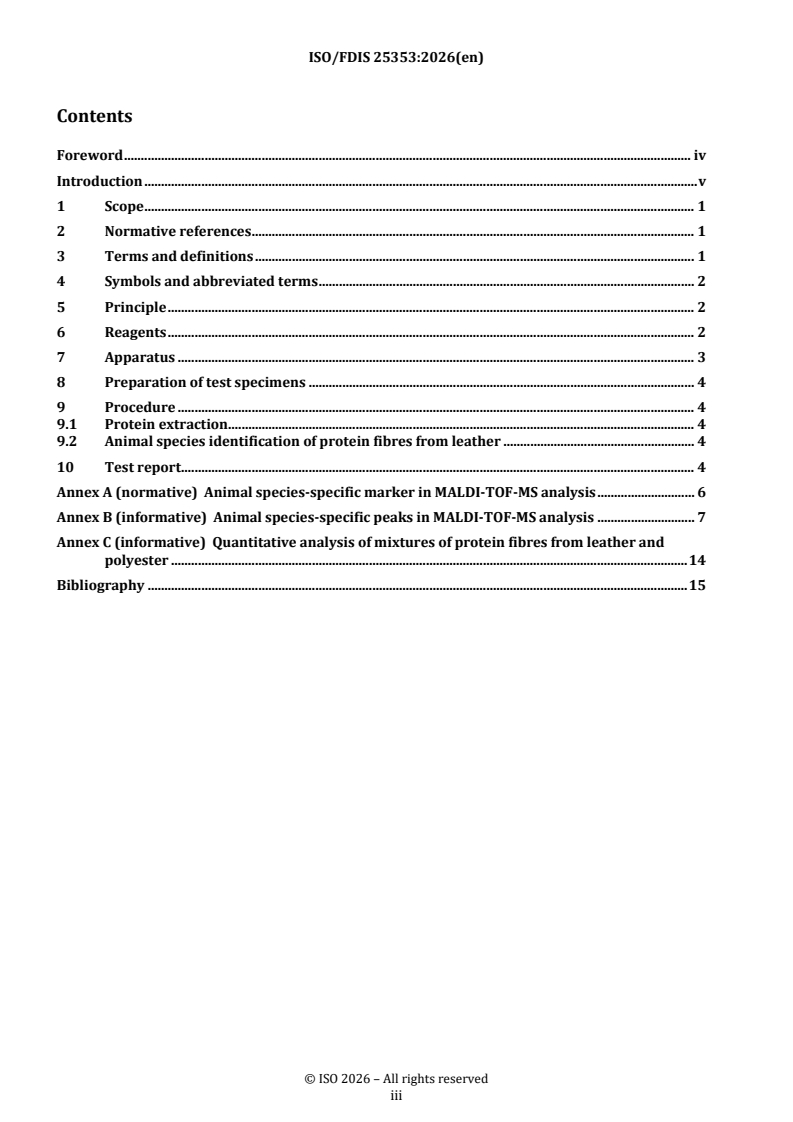
Contents
- Introduction
- 1 Scope
- 2 Normative references
- 3 Terms and definitions
- 3.1 protein
- 3.2 peptide
- 3.3 marker
- 4 Symbols and abbreviated terms
- 5 Principle
- 6 Reagents
- 7 Apparatus
- 8 Preparation of test specimens
- 9 Procedure
- 9.1 Protein extraction
- 9.2 Animal species identification of protein fibres from leather
- 10 Test report
- Annex A
- Annex B
- Annex C
- Bibliography
Introduction
Protein fibres from leather are staple fibres obtained by grinding leather scrap or shaving dust. A leather spun yarn can be produced by spinning these leather fibres with other fibres. In the protein fibres from leather industries, the identification of animal species is very important to guarantee the quality of leather products. However, it is difficult to apply the microscopy method (ISO 17131 [1] ) to identify the protein fibres from leather, since it is not able to observe the cross-section structure of [1] leather or its surface. In the case of ISO 17131 , it is necessary to compare the material structure with typical pictures of known samples by means of microscopy. For that reason, it can be difficult to absolutely determine animal species of protein fibres from leather.
In order to overcome the difficulties of the microscope method, a method of applying matrix-assisted laser desorption ionization-time of flight mass spectrometry mass spectrometer (MALDI-TOF MS) has been developed for the discrimination of animal species of protein fibres from leather. Since leather is mostly composed of protein, it utilizes enzymes to break down proteins into peptides and analyse their mass spectra.
The method solves the problem of difficulty in identifying species when leather is pulverized and used, and can be seen as an advanced technology in that it can be applied to various species as well as cowhide, which is widely used.
FINAL DRAFT International Standard ISO/FDIS 25353:2026(en) Textiles — Qualitative proteomic analysis of protein fibres from leather — Peptide detection using matrix-assisted laser desorption/ionization time-of-flight mass spectrometry (MALDI-TOF MS)
1 Scope
This document specifies a qualitative procedure for identifying the animal species of leather using protein fibres extracted from leather using matrix-assisted laser desorption/ionization time-of-flight mass spectrometry (MALDI-TOF MS).
This document does not cover the composition of other fibres. This can be measured by methods described in the ISO 1833 series. Both results are then combined to determine the whole composition of fibres (see Annex C as an example of mixtures of protein fibres from leather and polyester). The method is based on a preliminary identification, by light microscopy, of all fibres in a blend on the basis [2] of their morphology, according to ISO/TR 11827 .
2 Normative references
The following documents are referred to in the text in such a way that some or all of their content constitutes requirements of this document. For dated references, only the edition cited applies. For undated references, the latest edition of the referenced document (including any amendments) applies. ISO 3696, Water for analytical laboratory use — Specification and test methods ISO 4044, Leather — Chemical tests — Preparation of chemical test samples
3 Terms and definitions
For the purposes of this document, the following terms and definitions apply. ISO and IEC maintain terminology databases for use in standardization at the following addresses:
- ISO Online browsing platform: available at http:// www .iso .org/ obp
- IEC Electropedia: available at http:// www .electropedia .org/
3.1 protein
polymers of amino acids that play many critical roles in the body [3] [SOURCE: ISO 20418-2:2018 , 3.2]
3.2 peptide
small protein (3.1) consisting of approximately less than 50 amino acids [3] [SOURCE: ISO 20418-2:2018 , 3.3]
ISO/FDIS 25353:2026(en)
3.3 marker
mass to change ratio of animal species specific monoisotopic peak used for identification Note 1 to entry: See Clause 4 for an explanation of mass to change retion. [3] [SOURCE: ISO 20418-2:2018 , 3.5, modified — “and quantification” removed.]
4 Symbols and abbreviated terms
MALDI matrix-assisted laser desorption/ionization, a soft ionization method for mass spectrometry TOF-MS time of flight mass spectrometry, a type of mass spectrometry based on the time difference of ions to reach the target plate according to molecular mass m/z dimensionless quantity formed by division of the mass of an ion in u (unified atomic mass unit) by its charge number (regardless of sign)
5 Principle
Protein fibres from leather are extracted using 2-mercaptoethanol. The proteins in the gel are enzymatically digested by trypsin. The qualitative analysis of animal species-specific peptides is analysed by MALDI-TOF- MS.
...
Contents
- Introduction
- 1 Scope
- 2 Normative references
- 3 Terms and definitions
- 3.1 protein
- 3.2 peptide
- 3.3 marker
- 4 Symbols and abbreviated terms
- 5 Principle
- 6 Reagents
- 7 Apparatus
- 8 Preparation of test specimens
- 9 Procedure
- 9.1 Protein extraction
- 9.2 Animal species identification of protein fibres from leather
- 10 Test report
- Annex A
- Annex B
- Annex C
- Bibliography
Introduction
Protein fibres from leather are staple fibres obtained by grinding leather scrap or shaving dust. A leather spun yarn can be produced by spinning these leather fibres with other fibres. In the protein fibres from leather industries, the identification of animal species is very important to guarantee [1] the quality of leather products. However, it is difficult to apply the microscopy method (ISO 17131 (()) to identify the protein fibres from leather, since it is not able to observe the cross-section structure of leather or [1] its surface. In the case of ISO 17131 , it is necessary to compare the material structure with typical pictures of known samples by means of microscopy. For that reason, it can be difficult to absolutely determine animal species of protein fibres from leather.
In order to overcome the difficulties of the microscope method, a method of applying matrix-assisted laser desorption ionization-time of flight mass spectrometry mass spectrometer (MALDI-TOF MS) has been developed for the discrimination of animal species of protein fibres from leather. Since leather is mostly composed of protein, it utilizes enzymes to break down proteins into peptides and analyse their mass spectra.
The method solves the problem of difficulty in identifying species when leather is pulverized and used, and can be seen as an advanced technology in that it can be applied to various species as well as cowhide, which is widely used.
ISO/FDIS 25353:2026(en) Textiles — Qualitative proteomic analysis of protein fibres from leather — Peptide detection using MALDI-TOF MSmatrix-assisted laser desorption/ionization time-of-flight mass spectrometry (MALDI- TOF MS)
1 Scope
This document specifies a qualitative procedure for identifying the animal species of leather using protein fibres extracted from leather using matrix-assisted laser desorption/ionization time-of-flight mass spectrometry (MALDI-TOF MS).
This document does not cover the composition of other fibres. This can be measured by methods described in the ISO 1833 series. Both results are then combined to determine the whole composition of fibres (see Annex C as an example of mixtures of protein fibres from leather and polyester). The method is based on a preliminary identification, by light microscopy, of all fibres in a blend on the basis [2] of their morphology, according to ISO/TR 11827 ISO/TR 11827..
2 Normative references
The following documents are referred to in the text in such a way that some or all of their content constitutes requirements of this document. For dated references, only the edition cited applies. For undated references, the latest edition of the referenced document (including any amendments) applies. ISO 3696, Water for analytical laboratory use — Specification and test methods ISO 4044, Leather — Chemical tests — Preparation of chemical test samples ISO 20418-2:2018, Textiles — Qualitative and quantitative proteomic analysis of some animal hair fibres — Part 2: Peptide detection using MALDI-TOF MS
3 Terms and definitions
For the purposes of this document, the following terms and definitions apply. ISO and IEC maintain terminology databases for use in standardization at the following addresses:
- ISO Online browsing platform: available at http://www.iso.org/obphttp://www.iso.org/obp
- IEC Electropedia: available at http://www.electropedia.org/
3.1 protein
polymers of amino acids that play many critical roles in the body [3] [SOURCE: ISO 20418-2:2018 ISO 20418-2:2018, 3.2]
3.2 peptide
small protein (3.1) consisting of approximately less than 50 amino acids [3] [SOURCE: ISO 20418-2:2018 ISO 20418-2:2018,, 3.3]
ISO/FDIS 25353:2026(en)
3.3 marker
mass to change ratio of animal species specific monoisotopic peak used for identificationNote 1 to entry: See Clause 4 for an explanation of mass to change retion.identification Note 1 to entry: See Clause 4 for an explanation of mass to change retion. [3] [SOURCE: ISO 20418-2:2018 ISO 20418-2:2018,, 3.5 –, modified -— “and quantification” removed.]
...
Contents
- Introduction
- 1 Domaine d'application
- 2 Références normatives
- 3 Termes et définitions
- 3.1 protéines
- 3.2 peptides
- 3.3 marqueur
- 4 Symboles et abréviations
- 5 Principe
- 6 Réactifs
- 6.10 Acide α-cyano-4-hydroxycinnamique (CHCA), de pureté supérieure ou égale à 99,5 %, utilisé
- 7 Appareillage
- 8 Préparation des éprouvettes
- 9 Mode opératoire
- 9.1 Extraction des protéines
- 9.2 Identification des espèces animales à l'origine des fibres protéiques issues du cuir
- 10 Rapport d'essai
- Annexe A
- Annexe B
- Annexe C
- Bibliographie
Introduction
Les fibres protéiques issues du cuir sont des fibres discontinues obtenues par broyage de chutes de cuir ou de résidus de rasage. Un filé de fibres issues du cuir peut être produit en filant ces fibres issues du cuir avec d'autres fibres.
Dans les fibres protéiques provenant de l'industrie du cuir, l'identification des espèces animales est très importante pour garantir la qualité des produits en cuir. Cependant, il est difficile d'appliquer la méthode [1] de microscopie (ISO 17131 ) à l'identification des fibres protéiques issues du cuir, car cette méthode ne [1] permet pas d'observer la structure de la section du cuir ni sa surface. Dans le cas de l'ISO 17131, il est nécessaire de comparer par microscopie la structure du matériau avec des images types d'échantillons connus. Pour cette raison, il peut être difficile de déterminer avec certitude les espèces animales à l'origine des fibres protéiques issues du cuir.
Pour remédier aux lacunes de la méthode au microscope, une méthode utilisant la spectrométrie de masse à temps de vol avec ionisation/désorption laser assistée par matrice (MALDI-TOF MS) au moyen d'un spectromètre de masse a été élaborée pour discriminer les espèces animales à l'origine des fibres protéiques issues du cuir.
Le cuir étant principalement composé de protéines, ladite méthode utilise des enzymes pour décomposer les protéines en peptides et analyser leur spectre de masse.
Cette méthode résout les difficultés à identifier les espèces lorsque le cuir est pulvérisé et usagé. Elle peut être considérée comme une technologie avancée en ce sens qu'elle peut s'appliquer à diverses espèces, ainsi qu'au cuir de vache qui est largement utilisé.
PROJET FINAL Norme internationale ISO/FDIS 25353:2026(fr) Textiles — Analyse protéomique qualitative de fibres protéiques issues du cuir — Détection des peptides par spectrométrie de masse à temps de vol avec ionisation/ désorption laser assistée par matrice (MALDI-TOF MS)
1 Domaine d'application
Le présent document spécifie un mode opératoire qualitatif pour identifier à l'aide de fibres protéiques issues du cuir les espèces animales utilisées pour le cuir, par spectrométrie de masse à temps de vol avec ionisation/désorption laser assistée par matrice (MALDI-TOF MS). Le présent document ne couvre pas la composition des autres fibres. Elle peut être mesurée par les méthodes décrites dans la série ISO 1833. Les deux résultats sont ensuite combinés pour déterminer la composition totale des fibres (voir Annexe C pour un exemple de mélanges de fibres protéiques issues du cuir et de polyester).
La méthode repose sur une identification préliminaire, par microscopie optique, de toutes les fibres [2] contenues dans un mélange sur la base de leur morphologie, conformément à l'ISO/TR 11827 .
2 Références normatives
Les documents suivants sont cités dans le texte de sorte qu'ils constituent, pour tout ou partie de leur contenu, des exigences du présent document. Pour les références datées, seule l'édition citée s'applique. Pour les références non datées, la dernière édition du document de référence s'applique (y compris les éventuels amendements).
ISO 3696, Eau pour laboratoire à usage analytique — Spécification et méthodes d'essai ISO 4044, Cuir — Essais chimiques - Préparation des échantillons pour essais chimiques
3 Termes et définitions
Pour les besoins du présent document, les termes et définitions suivants s'appliquent. L'ISO et l'IEC tiennent à jour des bases de données terminologiques destinées à être utilisées en normalisation, consultables aux adresses suivantes:
- ISO Online browsing platform: disponible à l'adresse http:// www .iso .org/ obp
- IEC Electropedia: disponible à l'adresse http:// www .electropedia .org/
3.1 protéines
polymères d'acides aminés qui jouent de nombreux rôles essentiels dans le corps [3] [SOURCE: ISO 20418-2:2018, 3.2]
3.2 peptides
petites protéines (3h.1) composées de moins de 50 acides aminés environ [3] [SOURCE: ISO 20418-2:2018, 3.3]
ISO/FDIS 25353:2026(fr)
3.3 marqueur
rapport masse/charge d'un pic monoisotopique spécifique à une espèce animale utilisé pour l'identification Note 1 à l'article: Voir Article 4 pour une explication du rapport masse/charge. [3] [SOURCE: ISO 20418-2:2018, 3.5, modifié — suppression de “et quantification”]
4 Symboles et abréviations
MALDI ionisation/désorption laser assistée par matrice (acronyme issu de l'anglais matrix-assisted laser desorption/ionization), une méthode d'ionisation douce pour la spectrométrie de masse TOF-MS spectrométrie de masse à temps de vol, un type de spectrométrie de masse fondé sur la différence de temps entre les ions pour atteindre la boîte cible en fonction de la masse moléculaire m/z quantité sans dimension formée par la division de la masse d'un ion en u (unité de masse atomique unifiée) par son nombre de charges (quel que soit le signe)
5 Principe
Des fibres protéiques issues du cuir sont soumises à une extraction à l'aide de 2-mercaptoéthanol. Les protéines présentes dans le gel sont digérées enzymatiquement par la trypsine. L'analyse qualitative des peptides spécifiques des espèces animales est réalisée par MALDI-TOF MS.
...