


ISO/IEC 27035:2011
(Main)Information technology — Security techniques — Information security incident management
Information technology — Security techniques — Information security incident management
ISO/IEC 27035:2011 provides a structured and planned approach to: detect, report and assess information security incidents; respond to and manage information security incidents; detect, assess and manage information security vulnerabilities; and continuously improve information security and incident management as a result of managing information security incidents and vulnerabilities. ISO/IEC 27035:2011 provides guidance on information security incident management for large and medium-sized organizations. Smaller organizations can use a basic set of documents, processes and routines described in this International Standard, depending on their size and type of business in relation to the information security risk situation. It also provides guidance for external organizations providing information security incident management services.
Technologies de l'information — Techniques de sécurité — Gestion des incidents de sécurité de l'information
General Information
- Status
- Withdrawn
- Publication Date
- 16-Aug-2011
- Withdrawal Date
- 16-Aug-2011
- Drafting Committee
- ISO/IEC JTC 1/SC 27/WG 4 - Security controls and services
- Current Stage
- 9599 - Withdrawal of International Standard
- Start Date
- 28-Oct-2016
- Completion Date
- 12-Feb-2026
Relations
- Effective Date
- 16-Nov-2013
- Effective Date
- 16-Nov-2013
- Effective Date
- 02-Oct-2010


Get Certified
Connect with accredited certification bodies for this standard

BSI Group
BSI (British Standards Institution) is the business standards company that helps organizations make excellence a habit.

Bureau Veritas
Bureau Veritas is a world leader in laboratory testing, inspection and certification services.

DNV
DNV is an independent assurance and risk management provider.
Sponsored listings
Frequently Asked Questions
ISO/IEC 27035:2011 is a standard published by the International Organization for Standardization (ISO). Its full title is "Information technology — Security techniques — Information security incident management". This standard covers: ISO/IEC 27035:2011 provides a structured and planned approach to: detect, report and assess information security incidents; respond to and manage information security incidents; detect, assess and manage information security vulnerabilities; and continuously improve information security and incident management as a result of managing information security incidents and vulnerabilities. ISO/IEC 27035:2011 provides guidance on information security incident management for large and medium-sized organizations. Smaller organizations can use a basic set of documents, processes and routines described in this International Standard, depending on their size and type of business in relation to the information security risk situation. It also provides guidance for external organizations providing information security incident management services.
ISO/IEC 27035:2011 provides a structured and planned approach to: detect, report and assess information security incidents; respond to and manage information security incidents; detect, assess and manage information security vulnerabilities; and continuously improve information security and incident management as a result of managing information security incidents and vulnerabilities. ISO/IEC 27035:2011 provides guidance on information security incident management for large and medium-sized organizations. Smaller organizations can use a basic set of documents, processes and routines described in this International Standard, depending on their size and type of business in relation to the information security risk situation. It also provides guidance for external organizations providing information security incident management services.
ISO/IEC 27035:2011 is classified under the following ICS (International Classification for Standards) categories: 35.030 - IT Security; 35.040 - Information coding. The ICS classification helps identify the subject area and facilitates finding related standards.
ISO/IEC 27035:2011 has the following relationships with other standards: It is inter standard links to ISO/IEC 27035-1:2016, ISO/IEC 27035-2:2016, ISO/IEC TR 18044:2004. Understanding these relationships helps ensure you are using the most current and applicable version of the standard.
ISO/IEC 27035:2011 is available in PDF format for immediate download after purchase. The document can be added to your cart and obtained through the secure checkout process. Digital delivery ensures instant access to the complete standard document.
Standards Content (Sample)
INTERNATIONAL ISO/IEC
STANDARD 27035
First edition
2011-09-01
Information technology — Security
techniques — Information security
incident management
Technologies de l'information — Techniques de sécurité — Gestion des
incidents de sécurité de l'information
Reference number
©
ISO/IEC 2011
© ISO/IEC 2011
All rights reserved. Unless otherwise specified, no part of this publication may be reproduced or utilized in any form or by any means,
electronic or mechanical, including photocopying and microfilm, without permission in writing from either ISO at the address below or
ISO's member body in the country of the requester.
ISO copyright office
Case postale 56 CH-1211 Geneva 20
Tel. + 41 22 749 01 11
Fax + 41 22 749 09 47
E-mail copyright@iso.org
Web www.iso.org
Published in Switzerland
ii © ISO/IEC 2011 – All rights reserved
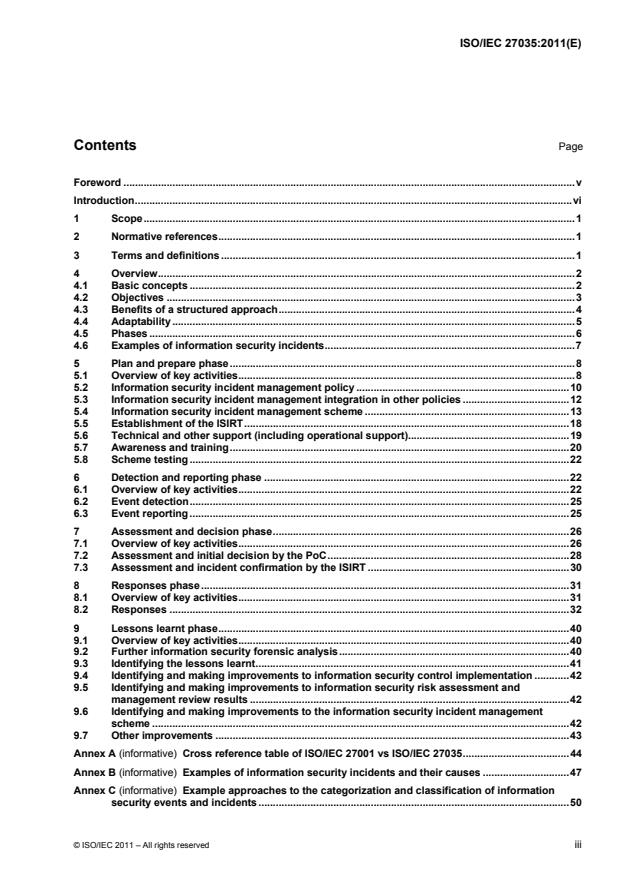
Contents Page
Foreword . v
Introduction . vi
1 Scope . 1
2 Normative references . 1
3 Terms and definitions . 1
4 Overview . 2
4.1 Basic concepts . 2
4.2 Objectives . 3
4.3 Benefits of a structured approach . 4
4.4 Adaptability . 5
4.5 Phases . 6
4.6 Examples of information security incidents . 7
5 Plan and prepare phase . 8
5.1 Overview of key activities . 8
5.2 Information security incident management policy . 10
5.3 Information security incident management integration in other policies . 12
5.4 Information security incident management scheme . 13
5.5 Establishment of the ISIRT . 18
5.6 Technical and other support (including operational support). 19
5.7 Awareness and training . 20
5.8 Scheme testing . 22
6 Detection and reporting phase . 22
6.1 Overview of key activities . 22
6.2 Event detection . 25
6.3 Event reporting . 25
7 Assessment and decision phase . 26
7.1 Overview of key activities . 26
7.2 Assessment and initial decision by the PoC . 28
7.3 Assessment and incident confirmation by the ISIRT . 30
8 Responses phase . 31
8.1 Overview of key activities . 31
8.2 Responses . 32
9 Lessons learnt phase . 40
9.1 Overview of key activities . 40
9.2 Further information security forensic analysis . 40
9.3 Identifying the lessons learnt . 41
9.4 Identifying and making improvements to information security control implementation . 42
9.5 Identifying and making improvements to information security risk assessment and
management review results . 42
9.6 Identifying and making improvements to the information security incident management
scheme . 42
9.7 Other improvements . 43
Annex A (informative) Cross reference table of ISO/IEC 27001 vs ISO/IEC 27035 . 44
Annex B (informative) Examples of information security incidents and their causes . 47
Annex C (informative) Example approaches to the categorization and classification of information
security events and incidents . 50
© ISO/IEC 2011 – All rights reserved iii
Annex D (informative) Example information security event, yncident and vulnerability reports
and forms .62
Annex E (informative) Legal and regulatory aspects .74
Bibliography .76
iv © ISO/IEC 2011 – All rights reserved
Foreword
ISO (the International Organization for Standardization) and IEC (the International Electrotechnical
Commission) form the specialized system for worldwide standardization. National bodies that are members of
ISO or IEC participate in the development of International Standards through technical committees
established by the respective organization to deal with particular fields of technical activity. ISO and IEC
technical committees collaborate in fields of mutual interest. Other international organizations, governmental
and non-governmental, in liaison with ISO and IEC, also take part in the work. In the field of information
technology, ISO and IEC have established a joint technical committee, ISO/IEC JTC 1.
International Standards are drafted in accordance with the rules given in the ISO/IEC Directives, Part 2.
The main task of the joint technical committee is to prepare International Standards. Draft International
Standards adopted by the joint technical committee are circulated to national bodies for voting. Publication as
an International Standard requires approval by at least 75 % of the national bodies casting a vote.
Attention is drawn to the possibility that some of the elements of this document may be the subject of patent
rights. ISO and IEC shall not be held responsible for identifying any or all such patent rights.
ISO/IEC 27035 was prepared by Joint Technical Committee ISO/IEC JTC 1, Information technology,
Subcommittee SC 27, IT Security techniques.
This first edition of ISO/IEC 27035 cancels and replaces ISO/IEC TR 18044:2004, which has been technically
revised.
© ISO/IEC 2011 – All rights reserved v
Introduction
In general, information security policies or controls alone will not guarantee total protection of information,
information systems, services or networks. After controls have been implemented, residual vulnerabilities are
likely to remain that can make information security ineffective and thus information security incidents possible.
This can potentially have both direct and indirect adverse impacts on an organization's business operations.
Further, it is inevitable that new instances of previously unidentified threats will occur. Insufficient preparation
by an organization to deal with such incidents will make any response less effective, and increase the degree
of potential adverse business impact. Therefore, it is essential for any organization serious about information
security to have a structured and planned approach to:
detect, report and assess information security incidents;
respond to information security incidents, including the activation of appropriate controls for the prevention
and reduction of, and recovery from, impacts (for example in the support of crisis management areas);
report information security vulnerabilities that have not yet been exploited to cause information security
events and possibly information security incidents, and assess and deal with them appropriately;
learn from information security incidents and vulnerabilities, institute preventive controls, and make
improvements to the overall approach to information security incident management.
This International Standard provides guidance on information security incident management in Clause 4 to
Clause 9. These clauses consist of several subclauses, which include a detailed description of each phase.
The term ‘information security incident management’ is used in this International Standard to encompass the
management of not just information security incidents but also information security vulnerabilities.
vi © ISO/IEC 2011 – All rights reserved
INTERNATIONAL STANDARD ISO/IEC 27035:2011(E)
Information technology — Security techniques — Information
security incident management
1 Scope
This International Standard provides a structured and planned approach to:
a) detect, report and assess information security incidents;
b) respond to and manage information security incidents;
c) detect, assess and manage information security vulnerabilities; and
d) continuously improve information security and incident management as a result of managing information
security incidents and vulnerabilities.
This International Standard provides guidance on information security incident management for large and
medium-sized organizations. Smaller organizations can use a basic set of documents, processes and routines
described in this International Standard, depending on their size and type of business in relation to the
information security risk situation. It also provides guidance for external organizations providing information
security incident management services.
2 Normative references
The following referenced documents are indispensable for the application of this document. For dated
references, only the edition cited applies. For undated references, the latest edition of the referenced
document (including any amendments) applies.
ISO/IEC 27000, Information technology — Security techniques — Information security management
systems — Overview and vocabulary
3 Terms and definitions
For the purposes of this document, the terms and definitions given in ISO/IEC 27000 and the following apply.
3.1
information security forensics
application of investigation and analysis techniques to capture, record and analyse information security
incidents
3.2
information security incident response team
ISIRT
team of appropriately skilled and trusted members of the organization that handles information security
incidents during their lifecycle
© ISO/IEC 2011 – All rights reserved 1
NOTE The ISIRT as described in this International Standard is an organizational function that covers the process for
information security incidents and is focused mainly on IT related incidents. Other common functions (with similar
abbreviations) within the incident handling may have a slightly different scope and purpose. The following commonly used
abbreviations have a meaning similar to that of ISIRT, though not exactly the same:
CERT: A Computer Emergency Response Team mainly focuses on Information and Communications Technology (ICT)
incidents. There may be other specific national definitions for CERT.
CSIRT: A Computer Security Incident Response Team is a service organization that is responsible for receiving,
reviewing, and responding to computer security incident reports and activity. These services are usually performed for
a defined constituency, which could be a parent entity such as a corporation, governmental organization, or educational
organization; a region or country; a research network; or a paid client.
3.3
information security event
identified occurrence of a system, service or network state indicating a possible breach of information security,
policy or failure of controls, or a previously unknown situation that may be security relevant
[ISO/IEC 27000:2009]
3.4
information security incident
single or a series of unwanted or unexpected information security events that have a significant probability of
compromising business operations and threatening information security
[ISO/IEC 27000:2009]
4 Overview
4.1 Basic concepts
An information security event is an identified occurrence of a system, service or network state indicating a
possible breach of information security policy or failure of controls, or a previously unknown situation that may
be security relevant. An information security incident is a single or a series of unwanted or unexpected
information security events that have a significant probability of compromising business operations and
threatening information security.
The occurrence of an information security event does not necessarily mean that an attempt has been
successful or that there are any implications on confidentiality, integrity and/or availability, i.e. not all
information security events are classified as information security incidents.
A threat acts in unwanted ways to exploit the vulnerabilities (weaknesses) of information systems, services or
networks, which is the occurrence of information security events and potentially causes unwanted incidents to
information assets exposed by the vulnerabilities. Figure 1 shows this relationship of objects in an information
security incident chain. The shaded objects are pre-existing, affected by the unshaded objects in the chain
that results in an information security incident.
2 © ISO/IEC 2011 – All rights reserved
Causes
Exploits
Threat Unwanted Information security
action vulnerability
Occurrence of
Information
Exposes
security event
Classified as
Information Information
Implications on
security incident asset
information security
The shaded objects are pre-existing, affected by the unshaded objects in the chain that results in an
information security incident.
Figure 1 — The relationship of objects in an information security incident chain
4.2 Objectives
As a key part of an organization's overall information security strategy, the organization should put controls
and procedures in place to enable a structured well-planned approach to the management of information
security incidents. From a business perspective, the prime objective is to avoid or contain the impact of
information security incidents to reduce the direct and indirect costs caused by the incidents.
The primary steps to minimize the direct negative impact of information security incidents are the following:
stop and contain,
eradicate,
analyse and report, and
follow up.
The objectives of a structured well-planned approach are more refined and should ensure the following:
a) Information security events are detected and dealt with efficiently, in particular in identifying whether they
need to be categorized and classified as information security incidents or not.
b) Identified information security incidents are assessed and responded to in the most appropriate and
efficient manner.
c) The adverse effects of information security incidents on the organization and its business operations are
minimized by appropriate controls as part of the incident response, possibly in conjunction with relevant
elements from a crisis management plan or plans.
d) Reported information security vulnerabilities are assessed and dealt with appropriately.
e) Lessons are learnt quickly from information security incidents, vulnerabilities and associated management.
This is to increase the chances of preventing future information security incidents from occurring, improve
the implementation and use of information security controls, and improve the overall information security
incident management scheme.
© ISO/IEC 2011 – All rights reserved 3
To help achieve this, organizations should ensure that information security incidents are documented in a
consistent manner, using appropriate standards for incident categorization and classification, and sharing, so
that metrics are created from aggregated data over a period of time. This provides valuable information to aid
the strategic decision making process when investing in information security controls.
It is re-iterated that another objective associated with this International Standard is to provide guidance to
organizations that aim to meet the requirements specified in ISO/IEC 27001 (and thus supported by guidance
from ISO/IEC 27002). This includes information security incident management related requirements. A table
that cross-references information security incident management related clauses in ISO/IEC 27001 and
ISO/IEC 27002, and clauses in this International Standard is shown in Annex A.
4.3 Benefits of a structured approach
An organization using a structured approach to information security incident management will accrue
significant benefits, which can be grouped under the followings.
a) Improving overall information security
A structured process for the detection, reporting and assessment of and decision-making related to
information security events and incidents will enable rapid identification and response. This will improve
overall security by helping to quickly identify and implement a consistent solution, and thus providing a
means of preventing future similar information security incidents. Further, there will be benefits facilitated
by metrics, sharing and aggregation. The credibility of the organization will be improved by the
demonstration of its implementation of best practices with respect to information security incident
management.
b) Reducing adverse business impacts
A structured approach to information security incident management can assist in reducing the level of
potential adverse business impacts associated with information security incidents. These impacts can
include immediate financial loss and longer-term loss arising from damaged reputation and credibility (for
guidance on business impact analysis, see ISO/IEC 27005:2008).
c) Strengthening the information security incident prevention focus
Using a structured approach to information security incident management helps to create a better focus
on incident prevention within an organization, including identification methods of new threats and
vulnerabilities. Analysis of incident related data would enable the identification of patterns and trends,
thereby facilitating a more accurate focus on incident prevention and thus identification of appropriate
actions to prevent incidents occurring.
d) Strengthening prioritization
A structured approach to information security incident management will provide a solid basis for
prioritization when conducting information security incident investigations, including the use of effective
categorization and classification scales. If there are no clear procedures, there is a risk that investigation
activities could be conducted in a reactive mode, by responding to incidents as they occur and
overlooking what activities are needed. This could prevent investigation activities from being directed to
areas where they may be a higher priority where they are really needed and in the ideal priority.
e) Strengthening evidence
Clear incident investigation procedures can help to ensure that data collection and handling are
evidentially sound and legally admissible. These are important considerations if legal prosecution or
disciplinary action might follow. It should be recognized, however, that there is a chance that the actions
necessary to recover from an information security incident might jeopardize the integrity of any such
collected evidence.
4 © ISO/IEC 2011 – All rights reserved
f) Contributing to budget and resource justifications
A well-defined and structured approach to information security incident management will help justify and
simplify the allocation of budgets and resources within involved organizational units. Further, benefit will
accrue for the information security incident management scheme itself, with the
- use of less skilled staff to identify and filter out the alarms of abnormality or anomaly,
- provision of better direction for the activities of skilled personnel, and
- engagement of skilled personnel only for those processes where their skills are needed and only at
the stage of the process where their contribution is needed.
Another useful approach to control and optimize budget and resources, is to add time tracking to
information security incident management to facilitate quantitative assessments of the organization's
handling of information security incidents. It should, for example, be possible to provide information on
how long it takes to resolve information security incidents of different priorities and on different platforms.
If there are bottlenecks in the information security incident management process, these should also be
identifiable.
g) Improving updates to information security risk assessment and management results
The use of a structured approach to information security incident management will facilitate the
- better collection of data for assisting in the identification and determination of the characteristics of the
various threat types and associated vulnerabilities, and
- provision of data on frequencies of occurrence of the identified threat types.
The data collected on the adverse impacts on business operations from information security incidents will
be useful in the business impact analysis. The data collected to identify the occurrence frequency of the
various threat types will greatly aid the quality of the threat assessment. Similarly, the data collected on
vulnerabilities will greatly aid the quality of future vulnerability assessments (for guidance on information
security risk assessment and management, see ISO/IEC 27005:2008).
h) Providing enhanced information security awareness and training program material
A structured approach to information security incident management will provide focused information for
information security awareness programs. This focused information will provide real examples
demonstrating that information security incidents happen to real organizations. It will also be possible to
demonstrate the benefits associated with the rapid availability of solution information. Furthermore, such
awareness helps to reduce a mistake or panic/confusion by an individual in the event of an information
security incident.
i) Providing input to information security policy and related documentation reviews
Data provided by an information security incident management scheme could provide valuable input to
reviews of the effectiveness and subsequent improvement of information security policies (and other
related information security documents). This applies to policies and other documents applicable both for
organization-wide and for individual systems, services and networks.
4.4 Adaptability
The guidance provided by this International Standard is extensive and if adopted in full, could require
significant resources to operate and manage. It is therefore important that an organization applying this
guidance should retain a sense of perspective and ensure that the resources applied to information security
incident management and the complexity of the mechanisms implemented, are kept in proportion to the
following:
a) size, structure and business nature of an organization,
b) scope of any information security management system within which incidents are handled,
c) potential for loss through unprevented incidents arising, and
d) the goals of the business.
© ISO/IEC 2011 – All rights reserved 5
An organization using this International Standard should therefore adopt its guidance in due proportion to the
scale and characteristics of their business.
4.5 Phases
To achieve the objectives outlined in Clause 4.2, information security incident management consists of the
following five distinct phases:
Plan and prepare,
Detection and reporting,
Assessment and decision,
Responses, and
Lessons learnt.
The first phase involves getting all that is required in place to operate successful information security incident
management. The other four phases involve the operational use of information security incident management.
A high-level view of these phases is shown in Figure 2.
6 © ISO/IEC 2011 – All rights reserved
PLAN AND PREPARE
information security incident management policy, and commitment of senior management
information security and risk management policies updated at both corporate level and system,
service and network level
information security incident management scheme
ISIRT establishment
technical and other support (including operations support)
information security incident management awareness briefings and training
information security incident management scheme testing
DETECTION AND REPORTING
information security event detecting and reporting
ASSESSMENT AND DECISION
assessment of information security event and decision on if it is information security incident
RESPONSES
responses to information security incident, including forensic analysis
recovery from information security incident
LESSONS LEARNT
further forensic analysis, if required
identification of lessons learnt
identification of and making improvements to information security
identification of and making improvements to information security risk assessment and
management review results
identification of and making improvements to information security incident management
scheme
Figure 2 — Information security incident management phases
4.6 Examples of information security incidents
Information security incidents may be deliberate or accidental (e.g. caused by error or acts of nature), and
may be caused by technical or physical means. Their consequences may include the disclosure, modification,
destruction, or unavailability of information in an unauthorized manner, or the damage or theft of
organizational assets. If unreported information security events are determined to be incidents, it becomes
difficult to investigate the incidents and to take control in order to prevent recurrence.
© ISO/IEC 2011 – All rights reserved 7
Annex B provides descriptions of selected example information security incidents and their causes for
informative purposes only. It is important to note that these examples are by no means exhaustive.
5 Plan and prepare phase
5.1 Overview of key activities
Effective information security incident management requires appropriate planning and preparation.For an
efficient and effective information security event, incident and vulnerability management scheme to be put into
operational use, an organization should complete a number of preparatory activities after the necessary
planning. The organization should ensure that the activities of the plan and prepare phase include the
following:
a) Activity to formulate and produce an information security event/incident/vulnerability management policy,
and gaining senior management commitment to that policy. This should be preceded by an information
security review of the organization's vulnerabilities, confirmation of the need for an information security
incident management scheme, and identification of the benefits to the organization as a whole and to its
departments (see Clause 5.2). Ensuring continued management commitment is vital for the acceptance
of a structured approach to information security incident management. Personnel need to recognize an
incident, know what to do and understand the benefits of the approach to the organization. Management
needs to be supportive of the management scheme to ensure that the organization commits to resourcing
and maintaining an incident response capability.
b) Activity to update information security and risk management policies at a corporate level and specific
system, service and network levels. This should include reference to information security event, incident
and vulnerability management. Policies need to be reviewed regularly in the context of output from the
information security incident management scheme (see Clause 5.3).
c) Activity to define and document a detailed information security incident management scheme. Overall, the
scheme documentation should encompass the forms, procedures, organizational elements and support
tools for the detection and reporting of, assessment and decision making related to, making responses to,
and learning lessons from, information security incidents. The topics for inclusion include:
1) An information security event/incident classification scale to be used to grade events/incidents. In any
event, the decision should be based on the actual or projected adverse impacts on the organization's
business operations.
NOTE Annex C shows an example approach to the categorization and classification of information security
events and incidents.
2) The information security event/incident/vulnerability forms:
i) completed by the person reporting an information security event (i.e. not an information security
incident management team member), with the information recorded in an information security
event/incident/vulnerability database,
ii) used by the information security incident management personnel to build on the initially reported
information security event information and enable a running record of the incident assessments,
etc. over time until the incident is fully resolved. At each stage, the update is recorded in the
information security event/incident/vulnerability database. The completed information security
event/incident/vulnerability database record is then used in post-incident resolution activities,
and
iii) completed by the person reporting an information security vulnerability (that has not yet been
exploited to cause an information security event, and possibly an information security incident),
with the information recorded in the information security event/incident/vulnerability database.
8 © ISO/IEC 2011 – All rights reserved
It is recommended that these forms are electronic (e.g. in secure web page), linking directly to the
electronic information security event/incident/vulnerability database. In today's world, the operation of
a paper-based scheme would be time consuming. However, a paper-based scheme may be needed
for a case where an electronic scheme can not be used.
NOTE Example forms are shown in Annex D.
3) The documented procedures and actions related to the use of the forms, i.e. associated with
information security event, incident and vulnerability detection, with links to the normal procedures for
the use of data and system, service and/or network backups and crisis management plans.
4) Operating procedures for the ISIRT, with documented processes and associated responsibilities, and
the allocation of roles to designated persons to conduct various activities (an individual may be
allocated more than one role, depending on the size, structure and business nature of an
organization), for example including:
i) shut down an affected system, service and/or network, in certain circumstances agreed by prior
arrangement with the relevant IT and/or business management,
ii) leave an affected system, service and/or network, connected and running,
iii) monitor data flowing from, to and within an affected system, service and/or network,
iv) activate normal back-up and crisis management procedures and actions in line with the system,
service and/or network security policy,
v) monitor and maintain the secure preservation of electronic evidence, in case it is required for
legal prosecution or internal disciplinary action, and
vi) communicate information security incident details to internal and external people or
organizations.
In some organizations, the scheme may be referred to as an information security incident response
plan (see Clause 5.4).
d) Activity to establish the ISIRT, with an appropriate training program designed, developed and provided to
its personnel. According to the size, structure and the nature of the business, an organization may have
an ISIRT of a dedicated team, a virtual team, or a mix of the two options. A dedicated team may have
virtual members identified in specific units/functions that should cooperate closely with the ISIRT during
the resolution of an information security incident (ICT, legal, public relations, outsourcing companies, etc.).
A virtual team may have a senior manager leading the team supported by groups of individuals
specialized in particular topics, e.g. in the handling of malicious code attacks, who will be called upon
depending on the type of incident concerned (see Clause 5.5).
e) Activity to establish and preserve appropriate relationships and connections with internal and external
organizations that are directly involved in information security event, incident and vulnerability
management.
f) Activity to establish, implement and operate technical and other support (including organizational)
mechanisms for supporting the information security incident management scheme (and thus the work of
the ISIRT), and in order to prevent information security incident occurrences or reduce the likelihood of
occurrences of information security incidents (see Clause 5.6). Such mechanisms could include the
following:
1) Internal information security audit mechanisms to assess the security level and track vulnerable
systems,
2) Vulnerability management (including security updates and security patching of vulnerable systems).
3) Technology watch to detect new kinds of threats and attacks.
© ISO/IEC 2011 – All rights reserved 9
4) Intrusion Detection Systems (for more details, see ISO/IEC 18043).
5) Network security devices, protections means and monitoring tools (for more details, see
ISO/IEC 27033).
6) Anti-malicious code software.
7) Audit log records, and log monitoring software.
8) Documented responsibilities and operating procedures for the operations support team.
g) Activity to design and develop an information security event, incident and vulnerability management
awareness and training program. All organizational personnel should be made aware through briefings
and/or other mechanisms, of the existence of the information security event, incident and vulnerability
management scheme, its benefits and how to report information security events and incidents (and
vulnerabilities). In parallel, appropriate training should be provided to those personnel responsible for
managing the information security event, incident and vulnerability management scheme, decision
makers involved in determining whether information security events are incidents, and those individuals
involved in the investigation of incidents. Awareness briefings and training sessions should be repeated
later to accommodate changes in personnel (see Clause 5.7).
h) Activity to test the use of the information security incident management scheme, its processes and
procedures. Tests should be organized periodically not only to test the scheme in a real situation, but also
to verify how the ISIRT behaves under the pressure of a severe complex incident. Particular attention
should be given to the creation of tests that focus on the evolving vulnerability, threat and risk scenarios
(see Clause 5.8). The scheme should include standards that support information sharing, both within the
organization and outside (if required by the organization). One of the benefits of sharing is the
aggregation of data into useful metrics to aid strategic business decisions. Membership of a trusted
information sharing community also provides early warning of attacks and should be encouraged in any
information security incident management scheme and associated policy.
With this phase completed, organizations should be fully prepared to properly manage information security
incidents. The following clauses describe each of the activities listed above, including the contents of each
document required.
5.2 Information security incident management policy
5.2.1 Introduction
An organization should document its policy for managing information security events, incidents and
vulnerabilities as a free-standing document, as part of its overall information security management system
policy (see Clause 4.2.1 b) of ISO/IEC 27001:2005), or as part of its Information Security Policy (see
Clause 5.1.1 of ISO/IEC 27002:2005). The size, structure and business nature of an organization and the
extent of its information security incident management program are deciding factors in determining which of
these options to adopt. Each organization should direct its information security incident management policy at
every person having legitimate access to its information systems and related locations.
Before the policy is formulated, the organization should conduct an information security review highlighting its
vulnerabilities, confirmation of the need for information security incident management, and identification of the
benefits to the organization as a whole and to its departments.
5.2.2 Involved parties
An organization should ensure that its information security incident management policy is approved by a
senior organization executive officer, with confirmed documented commitment from all of senior management.
It should be made available for every employee and contractor, and should also be addressed in information
security awareness briefings and training (see Clause 5.7).
10 © ISO/IEC 2011 – All rights reserved
5.2.3 Content
An organization should ensure that its information security incident management policy content addresses the
following topics:
a) The importance of information security incident management to the organization, and senior
management's commitment to it and the related scheme.
b) An overview of information security event detection, reporting and collection of relevant information, and
how this information should be used to determine information security incidents.
This overview should include a summary of possible types of information security events, how to report
them, what to report, where and to whom, and how to handle entirely new types of information security
events. It should also include a summary of information security vulnerability reporting and handling.
c) An overview of information security incident assessment, including a summary of who is responsible,
what has to be done, notification, and escalation.
d) A summary of the activities that follow the confirmation that an information security event is an information
security incident.
e) A reference to the need for ensuring that all information security incident management activities are
properly logged for later analysis, and that continuous monitoring is conducted to ensure the secure
preservation of electronic evidence, in case it is required for legal prosecution or internal disciplinary
action.
f) Post information security incident resolution activities, including learning from and improving the process,
following information security incidents.
g) An overview of information security vulnerability reporting and handling.
h) Details of where the scheme documentation, including procedures, is held.
i) An overview of the ISIRT, encompassing the following topics.
1) The ISIRT organizational structure, and the identity of the ISIRT manager and other key personnel,
including who is responsible for:
i) briefing senior management on incidents,
ii) dealing with enquiries, instigating follow up, etc., and
iii) the link with the external organizations (when necessary).
2) The information security management charter that specifies what the ISIRT is to do and the authority
under which it does it. At a minimum, the charter should include a mission statement, a definition of
the ISIRT's scope, and details of the ISIRT's board level sponsor and authority.
3) The ISIRT mission statement that focuses on the team's core activities. In order to be considered an
ISIRT, the team should support the assessing of, responding to, and managing of, information
security incidents, to a successful conclusion. The goals and purposes of the team are especially
important, and require clear, unambiguous definition.
4) A definition of the scope of the ISIRT activities. Normally, the scope of an or
...
Questions, Comments and Discussion
Ask us and Technical Secretary will try to provide an answer. You can facilitate discussion about the standard in here.
Loading comments...