


ISO 16065-1:2014
(Main)Pulps — Determination of fibre length by automated optical analysis — Part 1: Polarized light method
Pulps — Determination of fibre length by automated optical analysis — Part 1: Polarized light method
ISO 16065-1:2014 specifies a method for determining fibre length using polarized light. ISO 16065-1:2014 is applicable to all kinds of pulp. However, fibrous particles shorter than 0,2 mm are not regarded as fibres for the purposes of ISO 16065-1:2014 and, therefore, are not to be included in the results.
Pâtes — Détermination de la longueur de fibre par analyse optique automatisée — Partie 1: Méthode de la lumière polarisée
General Information
- Status
- Published
- Publication Date
- 18-Mar-2014
- Technical Committee
- ISO/TC 6 - Paper, board and pulps
- Drafting Committee
- ISO/TC 6 - Paper, board and pulps
- Current Stage
- 9093 - International Standard confirmed
- Start Date
- 19-Dec-2024
- Completion Date
- 12-Feb-2026
Relations
- Effective Date
- 03-Sep-2011
Overview
ISO 16065-1:2014 specifies an automated optical method for determining fibre length in pulps using the polarized light technique. Applicable to all kinds of pulp, the standard excludes fibrous particles shorter than 0.2 mm from results. The method uses a fibre orienting cell (FOC) and a crossed-polarizers setup to exploit birefringence of cellulosic fibres and to discriminate fibres from non-fibrous particles (e.g., air bubbles).
Key topics and requirements
- Principle: Fibres in water flow through an FOC; projected fibre lengths are measured by a photo sensor matrix while crossed polarizers transmit light only from birefringent fibres.
- Apparatus: Fibre-length analyser (FOC, uniform light source, photo sensor, polarizing optics), disintegrator, pipette, verification fibres, and reference pulp.
- Optical and detector specs:
- Analyzer resolution: ≤ 100 µm across 0–7 mm.
- Light extinction of crossed polarizers: >99%.
- Detection efficiency: 100% for fibres ≥ 0.100 mm.
- Flow path thickness: no thicker than 0.5 mm in light direction to ensure fibre straightening.
- Sampling & sample prep:
- Follow ISO 7213 for lot sampling.
- Disintegration procedures per ISO 5263 (with guidance on never-dried pulps and avoiding fibre shortening).
- Stock dilution ranges: 0.010–0.025% (softwood) and 0.004–0.010% (hardwood) mass fraction.
- Measurement protocol:
- Agitate suspension continuously; take 50 ml test portions with a 50 ml pipette (tip ≥5 mm).
- Minimum fibres measured: steady-state variance of 0.01 mm in average length, or at least 5 000 fibres if continuous monitoring not available.
- Verification & calibration:
- Calibration checks weekly with verification fibres (three lengths, ~0.5, 3.0, 7.0 mm).
- Monthly performance checks with a reference pulp; tolerance for length-weighted mean of chemical pulps: ±1.5%.
- Calculations: Number-, length- and mass-weighted mean lengths and fibre-length distributions are computed per the method.
Applications
- Quality control and process monitoring in pulp and paper production
- Comparative pulp characterization for mill-to-mill or supplier verification
- Research and development of pulping and refining processes
- Instrument performance verification and calibration
Who should use this standard
- Pulp and paper laboratory technicians and quality engineers
- Process engineers monitoring fibre quality
- Equipment manufacturers of fibre-length analysers
- Standards bodies, testing laboratories, and R&D teams
Related standards
- ISO 16065-2 - Unpolarized light method (complements Part 1)
- ISO 5263 series - Laboratory wet disintegration
- ISO 638, ISO 4119, ISO 7213, ISO/TR 24498 - normative references used in ISO 16065-1
Keywords: ISO 16065-1:2014, fibre length, polarized light, pulps, automated optical analysis, fibre orienting cell, birefringence, pulp testing.
Get Certified
Connect with accredited certification bodies for this standard

Control Union Certifications
Global certification for agriculture and sustainability.

Gozdarski inštitut Slovenije
Slovenian Forestry Institute. Forest management certification support, timber testing.
Sponsored listings
Frequently Asked Questions
ISO 16065-1:2014 is a standard published by the International Organization for Standardization (ISO). Its full title is "Pulps — Determination of fibre length by automated optical analysis — Part 1: Polarized light method". This standard covers: ISO 16065-1:2014 specifies a method for determining fibre length using polarized light. ISO 16065-1:2014 is applicable to all kinds of pulp. However, fibrous particles shorter than 0,2 mm are not regarded as fibres for the purposes of ISO 16065-1:2014 and, therefore, are not to be included in the results.
ISO 16065-1:2014 specifies a method for determining fibre length using polarized light. ISO 16065-1:2014 is applicable to all kinds of pulp. However, fibrous particles shorter than 0,2 mm are not regarded as fibres for the purposes of ISO 16065-1:2014 and, therefore, are not to be included in the results.
ISO 16065-1:2014 is classified under the following ICS (International Classification for Standards) categories: 85.040 - Pulps. The ICS classification helps identify the subject area and facilitates finding related standards.
ISO 16065-1:2014 has the following relationships with other standards: It is inter standard links to ISO 16065-1:2001. Understanding these relationships helps ensure you are using the most current and applicable version of the standard.
ISO 16065-1:2014 is available in PDF format for immediate download after purchase. The document can be added to your cart and obtained through the secure checkout process. Digital delivery ensures instant access to the complete standard document.
Standards Content (Sample)
INTERNATIONAL ISO
STANDARD 16065-1
Second edition
2014-04-01
Pulps — Determination of fibre length
by automated optical analysis —
Part 1:
Polarized light method
Pâtes — Détermination de la longueur de fibre par analyse optique
automatisée —
Partie 1: Méthode de la lumière polarisée
Reference number
©
ISO 2014
© ISO 2014
All rights reserved. Unless otherwise specified, no part of this publication may be reproduced or utilized otherwise in any form
or by any means, electronic or mechanical, including photocopying, or posting on the internet or an intranet, without prior
written permission. Permission can be requested from either ISO at the address below or ISO’s member body in the country of
the requester.
ISO copyright office
Case postale 56 • CH-1211 Geneva 20
Tel. + 41 22 749 01 11
Fax + 41 22 749 09 47
E-mail copyright@iso.org
Web www.iso.org
Published in Switzerland
ii © ISO 2014 – All rights reserved
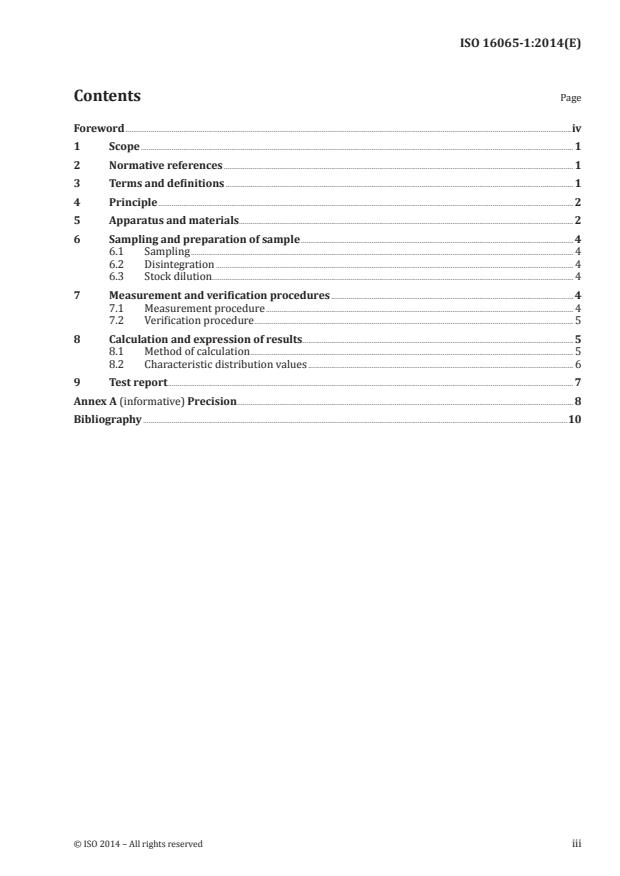
Contents Page
Foreword .iv
1 Scope . 1
2 Normative references . 1
3 Terms and definitions . 1
4 Principle . 2
5 Apparatus and materials. 2
6 Sampling and preparation of sample . 4
6.1 Sampling . 4
6.2 Disintegration . 4
6.3 Stock dilution. 4
7 Measurement and verification procedures . 4
7.1 Measurement procedure . 4
7.2 Verification procedure . 5
8 Calculation and expression of results . 5
8.1 Method of calculation . 5
8.2 Characteristic distribution values . 6
9 Test report . 7
Annex A (informative) Precision . 8
Bibliography .10
Foreword
ISO (the International Organization for Standardization) is a worldwide federation of national standards
bodies (ISO member bodies). The work of preparing International Standards is normally carried out
through ISO technical committees. Each member body interested in a subject for which a technical
committee has been established has the right to be represented on that committee. International
organizations, governmental and non-governmental, in liaison with ISO, also take part in the work.
ISO collaborates closely with the International Electrotechnical Commission (IEC) on all matters of
electrotechnical standardization.
The procedures used to develop this document and those intended for its further maintenance are
described in the ISO/IEC Directives, Part 1. In particular the different approval criteria needed for the
different types of ISO documents should be noted. This document was drafted in accordance with the
editorial rules of the ISO/IEC Directives, Part 2 (see www.iso.org/directives).
Attention is drawn to the possibility that some of the elements of this document may be the subject of
patent rights. ISO shall not be held responsible for identifying any or all such patent rights. Details of
any patent rights identified during the development of the document will be in the Introduction and/or
on the ISO list of patent declarations received (see www.iso.org/patents).
Any trade name used in this document is information given for the convenience of users and does not
constitute an endorsement.
For an explanation on the meaning of ISO specific terms and expressions related to conformity
assessment, as well as information about ISO’s adherence to the WTO principles in the Technical Barriers
to Trade (TBT) see the following URL: Foreword - Supplementary information
The committee responsible for this document is ISO/TC 6, Paper, board and pulps.
This second edition cancels and replaces the first edition (ISO 16065-1:2001), of which it constitutes a
minor revision with the following changes:
— a new precision statement that complies with the requirements of ISO/TR 24498 has been added.
ISO 16065 consists of the following parts, under the general title Pulps — Determination of fibre length
by automated optical analysis:
— Part 1: Polarized light method
— Part 2: Unpolarized light method
iv © ISO 2014 – All rights reserved
INTERNATIONAL STANDARD ISO 16065-1:2014(E)
Pulps — Determination of fibre length by automated
optical analysis —
Part 1:
Polarized light method
1 Scope
This part of ISO 16065 specifies a method for determining fibre length using polarized light.
This part of ISO 16065 is applicable to all kinds of pulp. However, fibrous particles shorter than 0,2 mm
are not regarded as fibres for the purposes of this part of ISO 16065 and, therefore, are not to be included
in the results.
NOTE ISO 16065-2 deals with the determination of fibre length using unpolarized light.
2 Normative references
The following documents, in whole or in part, are normatively referenced in this document and are
indispensable for its application. For dated references, only the edition cited applies. For undated
references, the latest edition of the referenced document (including any amendments) applies.
ISO 638, Paper, board and pulps — Determination of dry matter content — Oven-drying method
ISO 4119, Pulps — Determination of stock concentration
ISO 5263-1, Pulps — Laboratory wet disintegration — Part 1: Disintegration of chemical pulps
ISO 5263-2, Pulps — Laboratory wet disintegration — Part 2: Disintegration of mechanical pulps at 20
degrees C
ISO 5263-3, Pulps — Laboratory wet disintegration — Part 3: Disintegration of mechanical pulps at > 85
degrees C
ISO 7213, Pulps — Sampling for testing
ISO/TR 24498, Paper, board and pulps — Estimation of uncertainty for test methods
3 Terms and definitions
For the purposes of this document, the following terms and definitions apply.
3.1
unpolarized light
light composed of light waves whose planes of vibration are randomly oriented
3.2
polarizer
material which only transmits a component of a light wave which is vibrating in a particular direction,
which is the direction of polarization of the material
3.3
plane polarized light
light composed of light waves which all vibrate in the same plane
3.4
crossed polarizers
pair of polarizers placed in a light path, such that the direction of polarization of one is at right angles to
the direction of polarization of the other, thus resulting, ideally, in none of the light, which has passed
directly from one polarizer to the other, being transmitted
3.5
birefringence
property of certain materials, such as cellulose fibres, which have a crystalline
structure that results in the refractive index varying with the direction of polarization of the light
Note 1 to entry: This has the effect of rotating the direction of polarization of a plain polarized beam of light
resulting in light which has passed through this material being transmitted through the second polarizer of a
crossed pair.
3.6
mean length
L
total length of all fibres counted divided by the number of fibres
Note 1 to entry: See Formula (3).
3.7
length-weighted mean length
L
l
average of the length-weighted fibre-length distribution
Note 1 to entry: See Formula (4).
3.8
mass-weighted mean length
L
w
average of the mass-weighted fibre-length distribution
Note 1 to entry: See Formula (5).
Note 2 to entry: Mass-weighted mean length was formerly called weight-weighted mean length.
3.9
light extinction
difference, expressed as a percentage, in the maximum and minimum light level transmitted through
two axially aligned polarizers when one polarizer is rotated 90° about the axis
4 Principle
Fibres suspended in water are routed through a fibre orienting cell (FOC). The projected lengths of
individual fibres are measured automatically. A crossed-polarizers setup is used to discriminate
between fibres and other materials like air bubbles, which do not rotate the plane of polarization. The
numerical and weighted average fibre lengths and fibre-length distributions of pulp are calculated.
5 Apparatus and materials
Ordinary laboratory equipment and the following are required.
5.1 Fibre-length analyser, consisting of a measurement section and a sample transport system (see
Figure 1).
The measurement section consists of a fibre orienting cell (FOC), through which fibres in a liquid are
drawn. There is a uniform light source on one side of the FOC and a photo sensor matrix on the opposite
2 © ISO 2014 – All rights reserved
side. There are crossed polarizing filters, on either side of the FOC, between the light source and the
photo sensor matrix. The photo sensor matrix senses the length of the image of the fibre from the light
that due to the birefringence is transmitted through the second polarizer. The length of this image is
converted to fibre length. The flow orientates the fibres into a plane or tube normal to the light path and
no thicker than 0,5 mm in the direction of the light path. The resolution of the analyser shall be equal to
or better than 100 µm over the range 0 mm to 7 mm.
NOTE Fibres constrained to flow through a capillary no wider than 0,5 mm have been found to straighten
enough to be measured accurately with projected light.
At least 90 % of the transmitted light spectrum shall be within the spectral sensitivity of the detector.
The light extinction of the crossed polarizers shall exceed 99 %. The detection efficiency shall be 100 %
for all
...
Questions, Comments and Discussion
Ask us and Technical Secretary will try to provide an answer. You can facilitate discussion about the standard in here.
Loading comments...