

ISO/TS 21185:2019
(Main)Intelligent transport systems — Communication profiles for secure connections between trusted devices
General Information
- Abstract
This document specifies a methodology to define ITS-S communication profiles (ITS-SCPs) based on standardized communication protocols to interconnect trusted devices. These profiles enable secure information exchange between such trusted devices, including secure low-latency information exchange, in different configurations. The present document also normatively specifies some ITS-SCPs based on the methodology, yet without the intent of covering all possible cases, in order to exemplify the methodology. Configurations of trusted devices for which this document defines ITS-SCPs include: a) ITS station communication units (ITS-SCU) of the same ITS station unit (ITS-SU), i.e. station-internal communications; b) an ITS-SU and an external entity such as a sensor and control network (SCN), or a service in the Internet; c) ITS-SUs. Other ITS-SCPs can be specified at a later stage. The specifications given in this document can also be applied to unsecured communications and can be applied to groupcast communications as well.
- Status
- Published
- Publication Date
- 01-Oct-2019
- Technical Committee
- ISO/TC 204 - Intelligent transport systems
- Drafting Committee
- ISO/TC 204/WG 18 - Cooperative systems
- Current Stage
- 9093 - International Standard confirmed
- Start Date
- 01-Nov-2023
- Completion Date
- 29-Aug-2026
Buy Documents
ISO/TS 21185:2019 - Intelligent transport systems — Communication profiles for secure connections between trusted devices Released:10/2/2019
ISO/TS 21185:2019 - Intelligent transport systems — Communication profiles for secure connections between trusted devices/2/2019
Overview
ISO/TS 21185:2019 - Intelligent transport systems - Communication profiles for secure connections between trusted devices - defines a methodology to create ITS‑S communication profiles (ITS‑SCPs). These profiles are parameterized protocol stacks that enable secure, and where required low‑latency, information exchange between trusted devices (ITS‑SUs and ITS‑SCUs). The Technical Specification also normatively specifies several exemplar ITS‑SCPs (not intended to be exhaustive), plus object identifier (OID) conventions and an ASN.1 module for implementations.
Key topics and technical requirements
- Methodology for ITS‑SCP definition: a structured approach to select and parameterize standardized ITS communication protocols into interoperable stacks.
- Contexts covered:
- Station‑internal communications (ITS‑SCUs within the same ITS‑SU)
- ITS‑SU ↔ external entities (e.g., Sensor and Control Networks - SCNs, or Internet services)
- ITS‑SU ↔ ITS‑SU communications (vehicle‑to‑vehicle, roadside, central)
- Protocol layerization: identification and combination of access, networking & transport, facilities, security and management entities into ITS‑SCPS.
- Normative examples: initially identified ITS‑CPs and ITS‑SCPSs such as SCN‑access, service announcement, secure Internet sessions, and secure broadcast (e.g., ETSI ITS‑G5 stack example).
- Security and performance: supports secure sessions between trusted devices (SSTD) including low‑latency and time‑critical data exchange; profiles can also be used for unsecured or groupcast communications.
- Technical artifacts: OID conventions for identifying protocols and stacks, and an Annex A ASN.1 module for encoding.
Applications
ISO/TS 21185 is practical for systems that need interoperable, secure connections in ITS environments, such as:
- Time‑critical safety systems (collision avoidance, emergency electronic brake lights)
- Automated driving and cooperative automated transport
- Remote management and secure software updates for ITS stations
- Secure access to SCNs (in‑vehicle networks, infrastructure/roadside networks) and cloud services via cellular or fixed links
- Traffic management and emissions control applications requiring certified, real‑time data exchange
Who should use this standard
- ITS system architects and vehicle OEMs designing ITS‑SUs and ITS‑SCUs
- Infrastructure operators and roadside equipment vendors
- Cybersecurity engineers implementing secure ITS communications
- Standards bodies and solution integrators creating interoperable ITS services
Related standards
- ISO 21217 (CALM architecture), ISO 17423, ISO 17419, ISO/TS 21184 (SCN data), ISO/TS 21177 (SSTD cybersecurity), ISO 24102 series (management), IEEE 1609.2 (message security) - all referenced for complementary requirements and use‑case alignment.
Keywords: ISO/TS 21185, Intelligent Transport Systems, ITS‑SCP, secure connections, trusted devices, low‑latency, SCN, ITS‑SCU, ITS‑SU, communication profiles.
Relations
- Effective Date
- 09-Feb-2026
- Effective Date
- 12-Feb-2026
Buy Documents
ISO/TS 21185:2019 - Intelligent transport systems — Communication profiles for secure connections between trusted devices Released:10/2/2019
ISO/TS 21185:2019 - Intelligent transport systems — Communication profiles for secure connections between trusted devices/2/2019
Get Certified
Connect with accredited certification bodies for this standard

BSI Group
BSI (British Standards Institution) is the business standards company that helps organizations make excellence a habit.

Great Wall Tianjin Quality Assurance Center
Established 1993, first batch to receive national accreditation with IAF recognition.
Hong Kong Quality Assurance Agency (HKQAA)
Hong Kong's leading certification body.
Sponsored listings
Frequently Asked Questions
ISO/TS 21185:2019 is a technical specification published by the International Organization for Standardization (ISO). Its full title is "Intelligent transport systems — Communication profiles for secure connections between trusted devices". This standard covers: This document specifies a methodology to define ITS-S communication profiles (ITS-SCPs) based on standardized communication protocols to interconnect trusted devices. These profiles enable secure information exchange between such trusted devices, including secure low-latency information exchange, in different configurations. The present document also normatively specifies some ITS-SCPs based on the methodology, yet without the intent of covering all possible cases, in order to exemplify the methodology. Configurations of trusted devices for which this document defines ITS-SCPs include: a) ITS station communication units (ITS-SCU) of the same ITS station unit (ITS-SU), i.e. station-internal communications; b) an ITS-SU and an external entity such as a sensor and control network (SCN), or a service in the Internet; c) ITS-SUs. Other ITS-SCPs can be specified at a later stage. The specifications given in this document can also be applied to unsecured communications and can be applied to groupcast communications as well.
This document specifies a methodology to define ITS-S communication profiles (ITS-SCPs) based on standardized communication protocols to interconnect trusted devices. These profiles enable secure information exchange between such trusted devices, including secure low-latency information exchange, in different configurations. The present document also normatively specifies some ITS-SCPs based on the methodology, yet without the intent of covering all possible cases, in order to exemplify the methodology. Configurations of trusted devices for which this document defines ITS-SCPs include: a) ITS station communication units (ITS-SCU) of the same ITS station unit (ITS-SU), i.e. station-internal communications; b) an ITS-SU and an external entity such as a sensor and control network (SCN), or a service in the Internet; c) ITS-SUs. Other ITS-SCPs can be specified at a later stage. The specifications given in this document can also be applied to unsecured communications and can be applied to groupcast communications as well.
ISO/TS 21185:2019 is classified under the following ICS (International Classification for Standards) categories: 03.220.20 - Road transport; 35.240.60 - IT applications in transport. The ICS classification helps identify the subject area and facilitates finding related standards.
ISO/TS 21185:2019 has the following relationships with other standards: It is inter standard links to CEN/TS 17466:2020, CEN/TS 17496:2021. Understanding these relationships helps ensure you are using the most current and applicable version of the standard.
ISO/TS 21185:2019 is available in PDF format for immediate download after purchase. The document can be added to your cart and obtained through the secure checkout process. Digital delivery ensures instant access to the complete standard document.
Standards Content (Sample)
TECHNICAL ISO/TS
SPECIFICATION 21185
First edition
2019-10
Intelligent transport systems —
Communication profiles for secure
connections between trusted devices
Reference number
©
ISO 2019
© ISO 2019
All rights reserved. Unless otherwise specified, or required in the context of its implementation, no part of this publication may
be reproduced or utilized otherwise in any form or by any means, electronic or mechanical, including photocopying, or posting
on the internet or an intranet, without prior written permission. Permission can be requested from either ISO at the address
below or ISO’s member body in the country of the requester.
ISO copyright office
CP 401 • Ch. de Blandonnet 8
CH-1214 Vernier, Geneva
Phone: +41 22 749 01 11
Fax: +41 22 749 09 47
Email: copyright@iso.org
Website: www.iso.org
Published in Switzerland
ii © ISO 2019 – All rights reserved
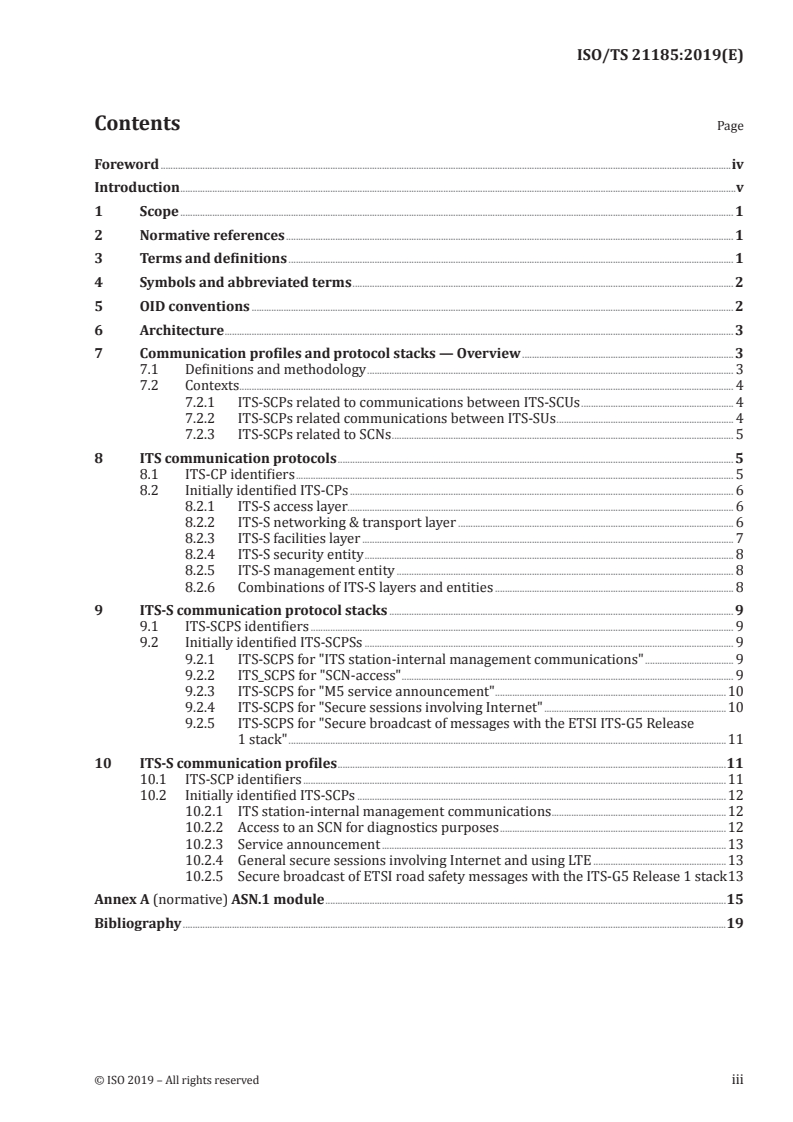
Contents Page
Foreword .iv
Introduction .v
1 Scope . 1
2 Normative references . 1
3 Terms and definitions . 1
4 Symbols and abbreviated terms . 2
5 OID conventions . 2
6 Architecture . 3
7 Communication profiles and protocol stacks — Overview . 3
7.1 Definitions and methodology . 3
7.2 Contexts . 4
7.2.1 ITS-SCPs related to communications between ITS-SCUs . 4
7.2.2 ITS-SCPs related communications between ITS-SUs . 4
7.2.3 ITS-SCPs related to SCNs . 5
8 ITS communication protocols . 5
8.1 ITS-CP identifiers . 5
8.2 Initially identified ITS-CPs . 6
8.2.1 ITS-S access layer. 6
8.2.2 ITS-S networking & transport layer . 6
8.2.3 ITS-S facilities layer . 7
8.2.4 ITS-S security entity . 8
8.2.5 ITS-S management entity . 8
8.2.6 Combinations of ITS-S layers and entities . 8
9 ITS-S communication protocol stacks . 9
9.1 ITS-SCPS identifiers . 9
9.2 Initially identified ITS-SCPSs . 9
9.2.1 ITS-SCPS for "ITS station-internal management communications" . 9
9.2.2 ITS_SCPS for "SCN-access" . 9
9.2.3 ITS-SCPS for "M5 service announcement" .10
9.2.4 ITS-SCPS for "Secure sessions involving Internet" .10
9.2.5 ITS-SCPS for "Secure broadcast of messages with the ETSI ITS-G5 Release
1 stack" .11
10 ITS-S communication profiles .11
10.1 ITS-SCP identifiers .11
10.2 Initially identified ITS-SCPs .12
10.2.1 ITS station-internal management communications .12
10.2.2 Access to an SCN for diagnostics purposes .12
10.2.3 Service announcement .13
10.2.4 General secure sessions involving Internet and using LTE .13
10.2.5 Secure broadcast of ETSI road safety messages with the ITS-G5 Release 1 stack 13
Annex A (normative) ASN.1 module .15
Bibliography .19
Foreword
ISO (the International Organization for Standardization) is a worldwide federation of national standards
bodies (ISO member bodies). The work of preparing International Standards is normally carried out
through ISO technical committees. Each member body interested in a subject for which a technical
committee has been established has the right to be represented on that committee. International
organizations, governmental and non-governmental, in liaison with ISO, also take part in the work.
ISO collaborates closely with the International Electrotechnical Commission (IEC) on all matters of
electrotechnical standardization.
The procedures used to develop this document and those intended for its further maintenance are
described in the ISO/IEC Directives, Part 1. In particular, the different approval criteria needed for the
different types of ISO documents should be noted. This document was drafted in accordance with the
editorial rules of the ISO/IEC Directives, Part 2 (see www .iso .org/directives).
Attention is drawn to the possibility that some of the elements of this document may be the subject of
patent rights. ISO shall not be held responsible for identifying any or all such patent rights. Details of
any patent rights identified during the development of the document will be in the Introduction and/or
on the ISO list of patent declarations received (see www .iso .org/patents).
Any trade name used in this document is information given for the convenience of users and does not
constitute an endorsement.
For an explanation of the voluntary nature of standards, the meaning of ISO specific terms and
expressions related to conformity assessment, as well as information about ISO's adherence to the
World Trade Organization (WTO) principles in the Technical Barriers to Trade (TBT) see www .iso
.org/iso/foreword .html.
This document was prepared by Technical Committee ISO/TC 204, Intelligent transport systems.
Any feedback or questions on this document should be directed to the user’s national standards body. A
complete listing of these bodies can be found at www .iso .org/members .html.
iv © ISO 2019 – All rights reserved
Introduction
ITS Station Communication Profiles (ITS-SCP) used in communications between trusted devices enable
— interoperability between ITS-SUs,
— and portability of ITS applications (that provide the ITS services).
Examples of trusted devices, i.e. ITS-secured communication nodes, are ITS-station units (ITS-
SU) specified in ISO 21217:2014. Four implementation contexts of communication nodes in ITS
communications networks are identified in ISO 21217:2014, each comprised of ITS-station units (ITS-
SU) taking on a particular role: personal, vehicular, roadside, or central. Such ITS-SUs participate in a
wide variety of ITS services related to, e.g. sustainability, road safety and transportation efficiency.
[27]
NOTE 1 ISO 21217:2014 fully covers the functionality of EN 302 665 , which is a predecessor of
ISO 21217:2014.
NOTE 2 An ITS-SU can be composed of ITS-SCUs from different vendors where each ITS-SCU is linked to a
[16]
different ITS-SCU configuration and management centre specified in ISO 24102-2 and ISO 17419. Station-
[17]
internal management communications between ITS-SCUs of the same ITS-SU are specified in ISO 24102-4 .
European C-ITS regulation refers to the "ITS-SCU configuration and management centre" as "C-ITS station
operator" meaning the entity responsible for the operation of a C-ITS station. The C-ITS station operator may be
responsible for the operation of one single C-ITS station (fixed or mobile), or a C-ITS infrastructure composed of a
number of fixed C-ITS stations, or a number of mobile ITS-Stations.
Such ITS-SCPs are essential for many ITS applications and services including time-critical safety
[16]
applications, automated driving, remote management of ITS-SUs (ISO 24102-2 ), and roadside/
infrastructure related services.
Over the last decade, ITS services have arisen that require secure access to data from Sensor and Control
Networks (SCN), e.g. from In-Vehicle Networks (IVNs) and from Infrastructure/Roadside Networks
(IRNs), some of which require secure local access to time-critical information, see Figures 1 and 2.
NOTE 3 Figures 1 and 2 are functional illustrations not describing or specifying a specific implementation.
Figure 1 — Example of a roadside ITS-SU connected to a secure proprietary IRN
Figure 2 — Example of a vehicle ITS-SU connected to a secure proprietary IVN
Related use cases of these ITS services have largely been derived from regulatory requirements and
urban operational needs, and they include:
— secure real-time access to time-critical vehicle-related data for safety of life and property
applications, e.g. collision avoidance, emergency electronic brake light and event determination;
— secure local access to detailed real-time data for efficiency applications (traffic management), e.g.
intersection interaction, congestion avoidance, dynamic priorities;
— local access to certified real-time data for sustainability applications, e.g. dynamic emission zones
(controlled zones as currently standardized in CEN TC 278 within the Project Team PT1705 funded
by the European Commission), intersection priorities based on emissions, interactive optimum
vehicle settings to minimize fuel consumption.
There are many use cases of ITS services currently identified where real-time exchange of time-critical
information between ITS-SUs in close proximity is essential, and the number will grow (see, e.g. the US
[30]
National ITS Reference Architecture ). It is critical that ultimately all ITS-SUs in a given area are able
to be engaged in these distributed services. This, in turn, requires vehicle ITS-SUs to have real-time
access to vehicle data, and roadside ITS-SUs to have real-time access to infrastructure data, and to be
capable of secure software updates.
Another use case involving connectivity between ITS-Ss involves access to ITS-secure SCNs by ITS-
SUs over the Internet, i.e. cloud connectivity. Functions and services described in this document and
accompanying standards for creating secure communication links can be used to implement such
connectivity. Examples include secure communications between a server in a cloud-based ITS-SU and
an ITS-SU in a vehicle using a cellular modem, and secure communications between server in an ITS-SU
in a traffic control center and a client in an ITS-SU in the roadside “furniture” which it controls using a
fibre optic and/or microwave link.
[9]
Data and message specifications related to SCNs are provided in ISO/TS 21184 .
Cyber security means related to "Secure Sessions between Trusted Devices" (SSTD) in general, and
[8]
particularly to SCNs, are specified in ISO/TS 21177 .
Cyber security means related to information dissemination (broadcast of messages) are specified in
[21]
IEEE Std. 1609.2™ .
vi © ISO 2019 – All rights reserved
TECHNICAL SPECIFICATION ISO/TS 21185:2019(E)
Intelligent transport systems — Communication profiles
for secure connections between trusted devices
1 Scope
This document specifies a methodology to define ITS-S communication profiles (ITS-SCPs) based on
standardized communication protocols to interconnect trusted devices. These profiles enable secure
information exchange between such trusted devices, including secure low-latency information
exchange, in different configurations. The present document also normatively specifies some ITS-SCPs
based on the methodology, yet without the intent of covering all possible cases, in order to exemplify
the methodology.
Configurations of trusted devices for which this document defines ITS-SCPs include:
a) ITS station communication units (ITS-SCU) of the same ITS station unit (ITS-SU), i.e. station-
internal communications;
b) an ITS-SU and an external entity such as a sensor and control network (SCN), or a service in the
Internet;
c) ITS-SUs.
Other ITS-SCPs can be specified at a later stage.
The specifications given in this document can also be applied to unsecured communications and can be
applied to groupcast communications as well.
2 Normative references
The following documents are referred to in the text in such a way that some or all of their content
constitutes requirements of this document. For dated references, only the edition cited applies. For
undated references, the latest edition of the referenced document (including any amendments) applies.
ISO/IEC 8825-1, Information technology — ASN.1 encoding rules: Specification of Basic Encoding Rules
(BER), Canonical Encoding Rules (CER) and Distinguished Encoding Rules (DER) — Part 1
ISO 17419, Intelligent transport systems — Cooperative systems — Globally unique identification
ISO 17423:2018, Intelligent transport systems — Cooperative systems — Application requirements and
objectives
ISO 21217:2014, Intelligent transport systems — Communications access for land mobiles (CALM) —
Architecture
3 Terms and definitions
For the purposes of this document, the following terms and definitions apply.
ISO and IEC maintain terminological databases for use in standardization at the following addresses:
— ISO Online browsing platform: available at https: //www .iso .org/obp
— IEC Electropedia: available at http: //www .electropedia .org/
3.1
ITS-S communication profile
parameterized ITS-S communication protocol stack
[SOURCE: ISO 17423:2018, 3.6]
3.2
ITS communication protocol
communication protocol applicable in ITS
3.3
ITS-S communication protocol stack
consistent set of ITS-S communication protocols enabling communications between an ITS-SCU and
other nodes which may be identified by a registered globally unique reference number
[SOURCE: ISO 17423:2018, 3.7]
4 Symbols and abbreviated terms
CSP communication service parameter
[SOURCE: ISO 17423:2018]
ITS-CP ITS communication protocol
ITS-SCP ITS station communication profile
[SOURCE: ISO 17423:2018]
ITS-SCPS ITS station communication protocol stack
[SOURCE: ISO 17423:2018]
ITS-SCU ITS station communication unit
[SOURCE: ISO 21217:2014]
ITS-SU ITS station unit
[SOURCE: ISO 21217:2014]
IRN infrastructure/roadside network
IVN in-vehicle network
SCN sensor and control network
SSTD secure session between trusted devices
OID object identifier
5 OID conventions
The following OIDs are specified and used in this document:
1) Identifying this document:
{ iso (1) standard (0) cptd21185 (21185) }
2) Identifying ASN.1 module specifications of this document:
{ iso (1) standard (0) cptd21185 (21185) asn1 (1) }
2 © ISO 2019 – All rights reserved
3) Identifying an ITS communications protocol:
{ iso (1) standard (0) cptd21185 (21185) commProtocol (2) }
4) Identifying an ITS-S communication protocol stack (ITS-SCPS):
{ iso (1) standard (0) cptd21185 (21185) its-scps (3) }
5) Identifying an ITS-S communications profile (ITS-SCP):
{ iso (1) standard (0) cptd21185 (21185) its-scp (4) }
6 Architecture
This document considers the ITS station and communication architecture specified in ISO 21217:2014
and specifies globally unique identifiers of ITS-S communication profiles (ITS-SCPs) for e.g.
— interconnecting ITS-SCUs in an ITS-SU,
— interconnecting ITS-SUs, and for,
— interconnecting an ITS-SU with a SCN,
using OIDs identifying
— ITS communication protocols,
— ITS-S communication protocol stacks (ITS-SCPS),
— ITS-S communication profiles (ITS-SCP),
also specified in this document. The approach is based on the methodology for protocol parameters
CSP_Protocol and CSP_SpecificCommsProts specified in ISO 17423:2018 and illustrated in 7.1.
7 Communication profiles and protocol stacks — Overview
7.1 Definitions and methodology
An ITS-SCP is defined in ISO 17423:2018 as a "parameterized ITS-S communication protocol stack".
ISO 17423:2018 further specifies how ITS-S application processes can present their communication
needs by means of "Communication Service Parameters" (CSP) to the ITS-S management, and how the
ITS-S management selects applicable ITS-S communication profiles. This document uses the following
two CSPs for specifying ITS-SCPs:
a) CSP_Protocol:
Identification of a complete non-parameterized communication protocol stack by means of a
globally unique registered communication protocol stack identifier of ASN.1 type ProtocolReq::=I
TSprotocolStackID, with ITSprotocolStackID specified in ISO 17419; see Clause 8.2.6.
NOTE 1 ISO 17419 specifies ITSprotocolStackID as an INTEGER.
b) CSP_SpecificCommsProts:
Identification of selected non-parameterized communications protocol stack elements by means
of a sequence of protocol identifiers of ASN.1 type SpecCommProts::=SEQUENCE OF ITSprotID,
with ITSprotID specified in ISO 17419 as a sequence of a ITS-S protocol location of ASN.1 type
ItssProtocolLocation followed by an ITS protocol identifier of ASN.1 type ItsProtocolIdentifier;
see Table 1 and Clause 8.
NOTE 2 ISO 17419 specifies ItsProtocolIdentifier as an INTEGER.
[14]
NOTE 3 ITSprotID is used in Service Announcement specified in ISO 22418 .
Table 1 — Named Integer values of ItsProtocolLocation as specified in ISO 17419
a
ItsProtocolLocation
ITS-S layer or entity (ISO 21217:2014)
Acronym Value
ITS-S access layer "acLayer" 1
ITS-S networking & transport layer "ntLayer" 2
ITS-S facilities layer "fcLayer" 4
ITS-S management entity "mgEntity" 8
ITS-S security entity "scEntity" 16
Other location "other" 32
a
For ITS protocols residing in more than one layer or entity, the acronym to be used in the context of this document is
"several" with a value given by the sum of the values of the respective layers and entities. Alternatively, the parts of such an
ITS protocol may be identified separately.
The methodology for specifying ITS-SCPs in this document is given by the following steps:
1) Identify ITS communication protocols (ITS-CPs) by means of an "Object Identifier" (OID)
reference to the standard or specification of the protocol based on the methodology for CSP_
SpecificCommsProts specified in ISO 17423:2018; see 8.1.
2) Identify ITS-SCPSs by means of an "Object Identifier" (OID) reference to a set of ITS-CPs based on
the methodology for CSP_Protocol specified in ISO 17423:2018; see 9.1.
3) Identify ITS-SCPs by means of an "Object Identifier" (OID) reference to an ITS-SCPS and
parameterization information, see 10.1.
7.2 Contexts
7.2.1 ITS-SCPs related to communications between ITS-SCUs
An example of an ITS-SCP for the links between ITS-SCUs of the same ITS-SU (see Figure 3) is presented
in 10.2.1.
Figure 3 — Interconnection of ITS-SCUs in an ITS-SU
7.2.2 ITS-SCPs related communications between ITS-SUs
An example of an ITS-SCP for the link between ITS-SUs (see Figure 4) is presented in 10.2.3.
4 © ISO 2019 – All rights reserved
Figure 4 — Interconnection of ITS-SUs
7.2.3 ITS-SCPs related to SCNs
An example of an ITS-SCP for the link between ITS-SUs (ITS-SCUs) and the interface towards sensor
and control networks (see Figure 5)is presented in 10.2.2.
Figure 5 — Interface between ITS-SU and sensor and control network
While the "Interface" in Figure 5 has to be ITS trusted and secured, the SCN may be ITS trusted and
secured or not. This document only considers the communications link between the ITS-SU and the
[8]
ITS-secured "Interface". Details on security are specified in ISO/TS 21177 .
8 ITS communication protocols
8.1 ITS-CP identifiers
ITS-CPs are identified by an "ITS protocol identifier" of type OID (see 7.1)pointing to a standard or
specification. Sub-clauses 8.2, 8.2.2, 8.2.3, 8.2.4, and 8.2.5 specify the OID value of ITS-CPs in the ITS-S
access layer, ITS-S networking & transport layer, ITS-S facilities layer, ITS-S security entity, and ITS-S
management entity, respectively. These layers and entities are specified in ISO 21217:2014.
The "ITS-CP identifier" OID values specified in Tables 2, 3, 4, 5, and 6 identify communication protocol
stack elements for the purpose of this document. Combinations of such protocols, i.e. ITS communication
protocol stacks, are specified in Clause 9.
Requirement 1: The generation of an OID for identifying an ITS-CP shall follow the following structure:
— {iso (1) standard (0) cptd21185 (21185) commProtocol (2)
(itssProtocolLocation) itsProtocolIdentifier-'n' ('n')}
with
— and itssProtocolLocation as specified in Table 1;
— itsProtocolIdentifier-'n': 'n: equals ItsProtocolIdentifier with values assigned in this document.
8.2 Initially identified ITS-CPs
8.2.1 ITS-S access layer
Table 2 presents ITS protocol identifiers of ITS-CPs residing in the ITS-S access layer.
NOTE 1 The ITS-S access layer covers the OSI layers one and two; see ISO 21217:2014.
Table 2 — Communication protocol stack elements — ITS-S access layer
Standard reference ITS communication Comment
protocol identifier
[7]
ISO 17515-1 {iso (1) standard (0) cptd21185 Networked communications, i.e. general access to
(21185) commProtocol (2) acLayer the Internet.
(1) itsProtocolIdentifier-1 (1)}
This standard reference is used in the general
meaning of "applying LTE cellular network technol-
ogy for accessing the Internet"
[11]
ISO 21214 {iso (1) standard (0) cptd21185 Localised communications using infrared light.
(21185) commProtocol (2) acLayer
(1) itsProtocolIdentifier-2 (2)}
[12]
ISO 21215 {iso (1) standard (0) cptd21185 Localised communications using microwaves. This
(21185) commProtocol (2) acLayer can be either ordinary WiFi mode or OCB mode in
(1) itsProtocolIdentifier-3 (3)} different frequency bands.
[13]
ISO 21218 {iso (1) standard (0) cptd21185 Hybrid communications support. This is an optional
(21185) commProtocol (2) acLayer station-internal support protocol. It may become
(1) itsProtocolIdentifier-4 (4)} mandatory for ITS station-internal communications.
[20]
IEEE Std. 802-3™ {iso (1) standard (0) cptd21185 Wired Ethernet communications.
(21185) commProtocol (2) acLayer
(1) itsProtocolIdentifier-5 (5)}
[2]
ISO 13400-3 {iso (1) standard (0) cptd21185 DoIP — Wired interface based on IEEE std. 802.3™
(21185) commProtocol (2) acLayer
(1) itsProtocolIdentifier-6 (6)}
[26]
ETSI EN 302 663 {iso (1) standard (0) cptd21185 Localised communications using microwaves at
(21185) commProtocol (2) acLayer 5,9 GHz in OCB mode with LPD.
(1) itsProtocolIdentifier-7 (7)}
NOTE 2 Further standard references can be identified and linked to an ITS protocol identifier at a later stage.
8.2.2 ITS-S networking & transport layer
Table 3 presents ITS protocol identifiers of ITS-CPs residing in the ITS-S networking & transport layer.
NOTE 1 The ITS-S networking & transport layer covers the OSI layers three and four; see ISO 21217:2014.
Table 3 — Communication protocol stack elements — ITS-S networking & transport layer
Standard reference ITS communication Comment
protocol identifier
[18]
ISO 29281-1 {iso (1) standard (0) cptd21185 Localised communications messaging protocol
(21185) commProtocol (2) ntLayer (FNTP) — partly interoperable with IEEE
a
(2) itsProtocolIdentifier-1 (1)} WSMP (IEEE Std. 1609.3™) .
[22]
IEEE Std. 1609-3™ {iso (1) standard (0) cptd21185 Localised communications messaging protocol
(21185) commProtocol (2) ntLayer (WSMP) — interoperable with ISO FNTP
a
(2) itsProtocolIdentifier-2 (2)} (ISO 29281-1) .
a
Interoperability is at least given for the information dissemination mode (broadcast communications), as
[22] [5] [18]
EEE Std. 1609-3™ only requires this mode out of the set of all modes identified in ISO/TS 16460 and ISO 29281-1 .
6 © ISO 2019 – All rights reserved
Table 3 (continued)
Standard reference ITS communication Comment
protocol identifier
[10]
ISO 21210 {iso (1) standard (0) cptd21185 Networked communications using IPv6.
(21185) commProtocol (2) ntLayer
(2) itsProtocolIdentifier-3 (3)}
[28]
EN 302 636-4-1 {iso (1) standard (0) cptd21185 Localised communications messaging protocol
(21185) commProtocol (2) ntLayer (GeoNetworking).
(2) itsProtocolIdentifier-4 (4)}
[29]
EN 302 636-5-1 {iso (1) standard (0) cptd21185 GeoNetworking Basic Transport Protocol.
(21185) commProtocol (2) ntLayer
(2) itsProtocolIdentifier-5 (5)}
a
Interoperability is at least given for the information dissemination mode (broadcast communications), as
[22] [5] [18]
EEE Std. 1609-3™ only requires this mode out of the set of all modes identified in ISO/TS 16460 and ISO 29281-1 .
NOTE 2 Further standard references can be identified and linked to an ITS protocol identifier at a later stage.
8.2.3 ITS-S facilities layer
Table 4 presents ITS protocol identifiers of ITS-CPs residing in the ITS-S facilities layer.
NOTE 1 The ITS-S facilities layer covers the OSI layers five, six and seven; see ISO 21217:2014.
Table 4 — Communication protocol stack elements — ITS-S facilities layer
Standard reference ITS communication Comment
protocol identifier
[1]
ISO 13185-2 {iso (1) standard (0) cptd21185 Universal gateway protocol
(21185) commProtocol (2) fcLayer (4)
itsProtocolIdentifier-1 (1)}
[3]
ISO 14229-2 {iso (1) standard (0) cptd21185 Unified diagnostic services - session
(21185) commProtocol (2) fcLayer (4) layer services
itsProtocolIdentifier-2 (2)}
[6]
ISO 17429 {iso (1) standard (0) cptd21185 "Communication profile handler" (CPH).
(21185) commProtocol (2) fcLayer (4) Various facility layer services
itsProtocolIdentifier-3 (3) }
[
...
TECHNICAL ISO/TS
SPECIFICATION 21185
First edition
2019-10
Intelligent transport systems —
Communication profiles for secure
connections between trusted devices
Reference number
©
ISO 2019
© ISO 2019
All rights reserved. Unless otherwise specified, or required in the context of its implementation, no part of this publication may
be reproduced or utilized otherwise in any form or by any means, electronic or mechanical, including photocopying, or posting
on the internet or an intranet, without prior written permission. Permission can be requested from either ISO at the address
below or ISO’s member body in the country of the requester.
ISO copyright office
CP 401 • Ch. de Blandonnet 8
CH-1214 Vernier, Geneva
Phone: +41 22 749 01 11
Fax: +41 22 749 09 47
Email: copyright@iso.org
Website: www.iso.org
Published in Switzerland
ii © ISO 2019 – All rights reserved
Contents Page
Foreword .iv
Introduction .v
1 Scope . 1
2 Normative references . 1
3 Terms and definitions . 1
4 Symbols and abbreviated terms . 2
5 OID conventions . 2
6 Architecture . 3
7 Communication profiles and protocol stacks — Overview . 3
7.1 Definitions and methodology . 3
7.2 Contexts . 4
7.2.1 ITS-SCPs related to communications between ITS-SCUs . 4
7.2.2 ITS-SCPs related communications between ITS-SUs . 4
7.2.3 ITS-SCPs related to SCNs . 5
8 ITS communication protocols . 5
8.1 ITS-CP identifiers . 5
8.2 Initially identified ITS-CPs . 6
8.2.1 ITS-S access layer. 6
8.2.2 ITS-S networking & transport layer . 6
8.2.3 ITS-S facilities layer . 7
8.2.4 ITS-S security entity . 8
8.2.5 ITS-S management entity . 8
8.2.6 Combinations of ITS-S layers and entities . 8
9 ITS-S communication protocol stacks . 9
9.1 ITS-SCPS identifiers . 9
9.2 Initially identified ITS-SCPSs . 9
9.2.1 ITS-SCPS for "ITS station-internal management communications" . 9
9.2.2 ITS_SCPS for "SCN-access" . 9
9.2.3 ITS-SCPS for "M5 service announcement" .10
9.2.4 ITS-SCPS for "Secure sessions involving Internet" .10
9.2.5 ITS-SCPS for "Secure broadcast of messages with the ETSI ITS-G5 Release
1 stack" .11
10 ITS-S communication profiles .11
10.1 ITS-SCP identifiers .11
10.2 Initially identified ITS-SCPs .12
10.2.1 ITS station-internal management communications .12
10.2.2 Access to an SCN for diagnostics purposes .12
10.2.3 Service announcement .13
10.2.4 General secure sessions involving Internet and using LTE .13
10.2.5 Secure broadcast of ETSI road safety messages with the ITS-G5 Release 1 stack 13
Annex A (normative) ASN.1 module .15
Bibliography .19
Foreword
ISO (the International Organization for Standardization) is a worldwide federation of national standards
bodies (ISO member bodies). The work of preparing International Standards is normally carried out
through ISO technical committees. Each member body interested in a subject for which a technical
committee has been established has the right to be represented on that committee. International
organizations, governmental and non-governmental, in liaison with ISO, also take part in the work.
ISO collaborates closely with the International Electrotechnical Commission (IEC) on all matters of
electrotechnical standardization.
The procedures used to develop this document and those intended for its further maintenance are
described in the ISO/IEC Directives, Part 1. In particular, the different approval criteria needed for the
different types of ISO documents should be noted. This document was drafted in accordance with the
editorial rules of the ISO/IEC Directives, Part 2 (see www .iso .org/directives).
Attention is drawn to the possibility that some of the elements of this document may be the subject of
patent rights. ISO shall not be held responsible for identifying any or all such patent rights. Details of
any patent rights identified during the development of the document will be in the Introduction and/or
on the ISO list of patent declarations received (see www .iso .org/patents).
Any trade name used in this document is information given for the convenience of users and does not
constitute an endorsement.
For an explanation of the voluntary nature of standards, the meaning of ISO specific terms and
expressions related to conformity assessment, as well as information about ISO's adherence to the
World Trade Organization (WTO) principles in the Technical Barriers to Trade (TBT) see www .iso
.org/iso/foreword .html.
This document was prepared by Technical Committee ISO/TC 204, Intelligent transport systems.
Any feedback or questions on this document should be directed to the user’s national standards body. A
complete listing of these bodies can be found at www .iso .org/members .html.
iv © ISO 2019 – All rights reserved
Introduction
ITS Station Communication Profiles (ITS-SCP) used in communications between trusted devices enable
— interoperability between ITS-SUs,
— and portability of ITS applications (that provide the ITS services).
Examples of trusted devices, i.e. ITS-secured communication nodes, are ITS-station units (ITS-
SU) specified in ISO 21217:2014. Four implementation contexts of communication nodes in ITS
communications networks are identified in ISO 21217:2014, each comprised of ITS-station units (ITS-
SU) taking on a particular role: personal, vehicular, roadside, or central. Such ITS-SUs participate in a
wide variety of ITS services related to, e.g. sustainability, road safety and transportation efficiency.
[27]
NOTE 1 ISO 21217:2014 fully covers the functionality of EN 302 665 , which is a predecessor of
ISO 21217:2014.
NOTE 2 An ITS-SU can be composed of ITS-SCUs from different vendors where each ITS-SCU is linked to a
[16]
different ITS-SCU configuration and management centre specified in ISO 24102-2 and ISO 17419. Station-
[17]
internal management communications between ITS-SCUs of the same ITS-SU are specified in ISO 24102-4 .
European C-ITS regulation refers to the "ITS-SCU configuration and management centre" as "C-ITS station
operator" meaning the entity responsible for the operation of a C-ITS station. The C-ITS station operator may be
responsible for the operation of one single C-ITS station (fixed or mobile), or a C-ITS infrastructure composed of a
number of fixed C-ITS stations, or a number of mobile ITS-Stations.
Such ITS-SCPs are essential for many ITS applications and services including time-critical safety
[16]
applications, automated driving, remote management of ITS-SUs (ISO 24102-2 ), and roadside/
infrastructure related services.
Over the last decade, ITS services have arisen that require secure access to data from Sensor and Control
Networks (SCN), e.g. from In-Vehicle Networks (IVNs) and from Infrastructure/Roadside Networks
(IRNs), some of which require secure local access to time-critical information, see Figures 1 and 2.
NOTE 3 Figures 1 and 2 are functional illustrations not describing or specifying a specific implementation.
Figure 1 — Example of a roadside ITS-SU connected to a secure proprietary IRN
Figure 2 — Example of a vehicle ITS-SU connected to a secure proprietary IVN
Related use cases of these ITS services have largely been derived from regulatory requirements and
urban operational needs, and they include:
— secure real-time access to time-critical vehicle-related data for safety of life and property
applications, e.g. collision avoidance, emergency electronic brake light and event determination;
— secure local access to detailed real-time data for efficiency applications (traffic management), e.g.
intersection interaction, congestion avoidance, dynamic priorities;
— local access to certified real-time data for sustainability applications, e.g. dynamic emission zones
(controlled zones as currently standardized in CEN TC 278 within the Project Team PT1705 funded
by the European Commission), intersection priorities based on emissions, interactive optimum
vehicle settings to minimize fuel consumption.
There are many use cases of ITS services currently identified where real-time exchange of time-critical
information between ITS-SUs in close proximity is essential, and the number will grow (see, e.g. the US
[30]
National ITS Reference Architecture ). It is critical that ultimately all ITS-SUs in a given area are able
to be engaged in these distributed services. This, in turn, requires vehicle ITS-SUs to have real-time
access to vehicle data, and roadside ITS-SUs to have real-time access to infrastructure data, and to be
capable of secure software updates.
Another use case involving connectivity between ITS-Ss involves access to ITS-secure SCNs by ITS-
SUs over the Internet, i.e. cloud connectivity. Functions and services described in this document and
accompanying standards for creating secure communication links can be used to implement such
connectivity. Examples include secure communications between a server in a cloud-based ITS-SU and
an ITS-SU in a vehicle using a cellular modem, and secure communications between server in an ITS-SU
in a traffic control center and a client in an ITS-SU in the roadside “furniture” which it controls using a
fibre optic and/or microwave link.
[9]
Data and message specifications related to SCNs are provided in ISO/TS 21184 .
Cyber security means related to "Secure Sessions between Trusted Devices" (SSTD) in general, and
[8]
particularly to SCNs, are specified in ISO/TS 21177 .
Cyber security means related to information dissemination (broadcast of messages) are specified in
[21]
IEEE Std. 1609.2™ .
vi © ISO 2019 – All rights reserved
TECHNICAL SPECIFICATION ISO/TS 21185:2019(E)
Intelligent transport systems — Communication profiles
for secure connections between trusted devices
1 Scope
This document specifies a methodology to define ITS-S communication profiles (ITS-SCPs) based on
standardized communication protocols to interconnect trusted devices. These profiles enable secure
information exchange between such trusted devices, including secure low-latency information
exchange, in different configurations. The present document also normatively specifies some ITS-SCPs
based on the methodology, yet without the intent of covering all possible cases, in order to exemplify
the methodology.
Configurations of trusted devices for which this document defines ITS-SCPs include:
a) ITS station communication units (ITS-SCU) of the same ITS station unit (ITS-SU), i.e. station-
internal communications;
b) an ITS-SU and an external entity such as a sensor and control network (SCN), or a service in the
Internet;
c) ITS-SUs.
Other ITS-SCPs can be specified at a later stage.
The specifications given in this document can also be applied to unsecured communications and can be
applied to groupcast communications as well.
2 Normative references
The following documents are referred to in the text in such a way that some or all of their content
constitutes requirements of this document. For dated references, only the edition cited applies. For
undated references, the latest edition of the referenced document (including any amendments) applies.
ISO/IEC 8825-1, Information technology — ASN.1 encoding rules: Specification of Basic Encoding Rules
(BER), Canonical Encoding Rules (CER) and Distinguished Encoding Rules (DER) — Part 1
ISO 17419, Intelligent transport systems — Cooperative systems — Globally unique identification
ISO 17423:2018, Intelligent transport systems — Cooperative systems — Application requirements and
objectives
ISO 21217:2014, Intelligent transport systems — Communications access for land mobiles (CALM) —
Architecture
3 Terms and definitions
For the purposes of this document, the following terms and definitions apply.
ISO and IEC maintain terminological databases for use in standardization at the following addresses:
— ISO Online browsing platform: available at https: //www .iso .org/obp
— IEC Electropedia: available at http: //www .electropedia .org/
3.1
ITS-S communication profile
parameterized ITS-S communication protocol stack
[SOURCE: ISO 17423:2018, 3.6]
3.2
ITS communication protocol
communication protocol applicable in ITS
3.3
ITS-S communication protocol stack
consistent set of ITS-S communication protocols enabling communications between an ITS-SCU and
other nodes which may be identified by a registered globally unique reference number
[SOURCE: ISO 17423:2018, 3.7]
4 Symbols and abbreviated terms
CSP communication service parameter
[SOURCE: ISO 17423:2018]
ITS-CP ITS communication protocol
ITS-SCP ITS station communication profile
[SOURCE: ISO 17423:2018]
ITS-SCPS ITS station communication protocol stack
[SOURCE: ISO 17423:2018]
ITS-SCU ITS station communication unit
[SOURCE: ISO 21217:2014]
ITS-SU ITS station unit
[SOURCE: ISO 21217:2014]
IRN infrastructure/roadside network
IVN in-vehicle network
SCN sensor and control network
SSTD secure session between trusted devices
OID object identifier
5 OID conventions
The following OIDs are specified and used in this document:
1) Identifying this document:
{ iso (1) standard (0) cptd21185 (21185) }
2) Identifying ASN.1 module specifications of this document:
{ iso (1) standard (0) cptd21185 (21185) asn1 (1) }
2 © ISO 2019 – All rights reserved
3) Identifying an ITS communications protocol:
{ iso (1) standard (0) cptd21185 (21185) commProtocol (2) }
4) Identifying an ITS-S communication protocol stack (ITS-SCPS):
{ iso (1) standard (0) cptd21185 (21185) its-scps (3) }
5) Identifying an ITS-S communications profile (ITS-SCP):
{ iso (1) standard (0) cptd21185 (21185) its-scp (4) }
6 Architecture
This document considers the ITS station and communication architecture specified in ISO 21217:2014
and specifies globally unique identifiers of ITS-S communication profiles (ITS-SCPs) for e.g.
— interconnecting ITS-SCUs in an ITS-SU,
— interconnecting ITS-SUs, and for,
— interconnecting an ITS-SU with a SCN,
using OIDs identifying
— ITS communication protocols,
— ITS-S communication protocol stacks (ITS-SCPS),
— ITS-S communication profiles (ITS-SCP),
also specified in this document. The approach is based on the methodology for protocol parameters
CSP_Protocol and CSP_SpecificCommsProts specified in ISO 17423:2018 and illustrated in 7.1.
7 Communication profiles and protocol stacks — Overview
7.1 Definitions and methodology
An ITS-SCP is defined in ISO 17423:2018 as a "parameterized ITS-S communication protocol stack".
ISO 17423:2018 further specifies how ITS-S application processes can present their communication
needs by means of "Communication Service Parameters" (CSP) to the ITS-S management, and how the
ITS-S management selects applicable ITS-S communication profiles. This document uses the following
two CSPs for specifying ITS-SCPs:
a) CSP_Protocol:
Identification of a complete non-parameterized communication protocol stack by means of a
globally unique registered communication protocol stack identifier of ASN.1 type ProtocolReq::=I
TSprotocolStackID, with ITSprotocolStackID specified in ISO 17419; see Clause 8.2.6.
NOTE 1 ISO 17419 specifies ITSprotocolStackID as an INTEGER.
b) CSP_SpecificCommsProts:
Identification of selected non-parameterized communications protocol stack elements by means
of a sequence of protocol identifiers of ASN.1 type SpecCommProts::=SEQUENCE OF ITSprotID,
with ITSprotID specified in ISO 17419 as a sequence of a ITS-S protocol location of ASN.1 type
ItssProtocolLocation followed by an ITS protocol identifier of ASN.1 type ItsProtocolIdentifier;
see Table 1 and Clause 8.
NOTE 2 ISO 17419 specifies ItsProtocolIdentifier as an INTEGER.
[14]
NOTE 3 ITSprotID is used in Service Announcement specified in ISO 22418 .
Table 1 — Named Integer values of ItsProtocolLocation as specified in ISO 17419
a
ItsProtocolLocation
ITS-S layer or entity (ISO 21217:2014)
Acronym Value
ITS-S access layer "acLayer" 1
ITS-S networking & transport layer "ntLayer" 2
ITS-S facilities layer "fcLayer" 4
ITS-S management entity "mgEntity" 8
ITS-S security entity "scEntity" 16
Other location "other" 32
a
For ITS protocols residing in more than one layer or entity, the acronym to be used in the context of this document is
"several" with a value given by the sum of the values of the respective layers and entities. Alternatively, the parts of such an
ITS protocol may be identified separately.
The methodology for specifying ITS-SCPs in this document is given by the following steps:
1) Identify ITS communication protocols (ITS-CPs) by means of an "Object Identifier" (OID)
reference to the standard or specification of the protocol based on the methodology for CSP_
SpecificCommsProts specified in ISO 17423:2018; see 8.1.
2) Identify ITS-SCPSs by means of an "Object Identifier" (OID) reference to a set of ITS-CPs based on
the methodology for CSP_Protocol specified in ISO 17423:2018; see 9.1.
3) Identify ITS-SCPs by means of an "Object Identifier" (OID) reference to an ITS-SCPS and
parameterization information, see 10.1.
7.2 Contexts
7.2.1 ITS-SCPs related to communications between ITS-SCUs
An example of an ITS-SCP for the links between ITS-SCUs of the same ITS-SU (see Figure 3) is presented
in 10.2.1.
Figure 3 — Interconnection of ITS-SCUs in an ITS-SU
7.2.2 ITS-SCPs related communications between ITS-SUs
An example of an ITS-SCP for the link between ITS-SUs (see Figure 4) is presented in 10.2.3.
4 © ISO 2019 – All rights reserved
Figure 4 — Interconnection of ITS-SUs
7.2.3 ITS-SCPs related to SCNs
An example of an ITS-SCP for the link between ITS-SUs (ITS-SCUs) and the interface towards sensor
and control networks (see Figure 5)is presented in 10.2.2.
Figure 5 — Interface between ITS-SU and sensor and control network
While the "Interface" in Figure 5 has to be ITS trusted and secured, the SCN may be ITS trusted and
secured or not. This document only considers the communications link between the ITS-SU and the
[8]
ITS-secured "Interface". Details on security are specified in ISO/TS 21177 .
8 ITS communication protocols
8.1 ITS-CP identifiers
ITS-CPs are identified by an "ITS protocol identifier" of type OID (see 7.1)pointing to a standard or
specification. Sub-clauses 8.2, 8.2.2, 8.2.3, 8.2.4, and 8.2.5 specify the OID value of ITS-CPs in the ITS-S
access layer, ITS-S networking & transport layer, ITS-S facilities layer, ITS-S security entity, and ITS-S
management entity, respectively. These layers and entities are specified in ISO 21217:2014.
The "ITS-CP identifier" OID values specified in Tables 2, 3, 4, 5, and 6 identify communication protocol
stack elements for the purpose of this document. Combinations of such protocols, i.e. ITS communication
protocol stacks, are specified in Clause 9.
Requirement 1: The generation of an OID for identifying an ITS-CP shall follow the following structure:
— {iso (1) standard (0) cptd21185 (21185) commProtocol (2)
(itssProtocolLocation) itsProtocolIdentifier-'n' ('n')}
with
— and itssProtocolLocation as specified in Table 1;
— itsProtocolIdentifier-'n': 'n: equals ItsProtocolIdentifier with values assigned in this document.
8.2 Initially identified ITS-CPs
8.2.1 ITS-S access layer
Table 2 presents ITS protocol identifiers of ITS-CPs residing in the ITS-S access layer.
NOTE 1 The ITS-S access layer covers the OSI layers one and two; see ISO 21217:2014.
Table 2 — Communication protocol stack elements — ITS-S access layer
Standard reference ITS communication Comment
protocol identifier
[7]
ISO 17515-1 {iso (1) standard (0) cptd21185 Networked communications, i.e. general access to
(21185) commProtocol (2) acLayer the Internet.
(1) itsProtocolIdentifier-1 (1)}
This standard reference is used in the general
meaning of "applying LTE cellular network technol-
ogy for accessing the Internet"
[11]
ISO 21214 {iso (1) standard (0) cptd21185 Localised communications using infrared light.
(21185) commProtocol (2) acLayer
(1) itsProtocolIdentifier-2 (2)}
[12]
ISO 21215 {iso (1) standard (0) cptd21185 Localised communications using microwaves. This
(21185) commProtocol (2) acLayer can be either ordinary WiFi mode or OCB mode in
(1) itsProtocolIdentifier-3 (3)} different frequency bands.
[13]
ISO 21218 {iso (1) standard (0) cptd21185 Hybrid communications support. This is an optional
(21185) commProtocol (2) acLayer station-internal support protocol. It may become
(1) itsProtocolIdentifier-4 (4)} mandatory for ITS station-internal communications.
[20]
IEEE Std. 802-3™ {iso (1) standard (0) cptd21185 Wired Ethernet communications.
(21185) commProtocol (2) acLayer
(1) itsProtocolIdentifier-5 (5)}
[2]
ISO 13400-3 {iso (1) standard (0) cptd21185 DoIP — Wired interface based on IEEE std. 802.3™
(21185) commProtocol (2) acLayer
(1) itsProtocolIdentifier-6 (6)}
[26]
ETSI EN 302 663 {iso (1) standard (0) cptd21185 Localised communications using microwaves at
(21185) commProtocol (2) acLayer 5,9 GHz in OCB mode with LPD.
(1) itsProtocolIdentifier-7 (7)}
NOTE 2 Further standard references can be identified and linked to an ITS protocol identifier at a later stage.
8.2.2 ITS-S networking & transport layer
Table 3 presents ITS protocol identifiers of ITS-CPs residing in the ITS-S networking & transport layer.
NOTE 1 The ITS-S networking & transport layer covers the OSI layers three and four; see ISO 21217:2014.
Table 3 — Communication protocol stack elements — ITS-S networking & transport layer
Standard reference ITS communication Comment
protocol identifier
[18]
ISO 29281-1 {iso (1) standard (0) cptd21185 Localised communications messaging protocol
(21185) commProtocol (2) ntLayer (FNTP) — partly interoperable with IEEE
a
(2) itsProtocolIdentifier-1 (1)} WSMP (IEEE Std. 1609.3™) .
[22]
IEEE Std. 1609-3™ {iso (1) standard (0) cptd21185 Localised communications messaging protocol
(21185) commProtocol (2) ntLayer (WSMP) — interoperable with ISO FNTP
a
(2) itsProtocolIdentifier-2 (2)} (ISO 29281-1) .
a
Interoperability is at least given for the information dissemination mode (broadcast communications), as
[22] [5] [18]
EEE Std. 1609-3™ only requires this mode out of the set of all modes identified in ISO/TS 16460 and ISO 29281-1 .
6 © ISO 2019 – All rights reserved
Table 3 (continued)
Standard reference ITS communication Comment
protocol identifier
[10]
ISO 21210 {iso (1) standard (0) cptd21185 Networked communications using IPv6.
(21185) commProtocol (2) ntLayer
(2) itsProtocolIdentifier-3 (3)}
[28]
EN 302 636-4-1 {iso (1) standard (0) cptd21185 Localised communications messaging protocol
(21185) commProtocol (2) ntLayer (GeoNetworking).
(2) itsProtocolIdentifier-4 (4)}
[29]
EN 302 636-5-1 {iso (1) standard (0) cptd21185 GeoNetworking Basic Transport Protocol.
(21185) commProtocol (2) ntLayer
(2) itsProtocolIdentifier-5 (5)}
a
Interoperability is at least given for the information dissemination mode (broadcast communications), as
[22] [5] [18]
EEE Std. 1609-3™ only requires this mode out of the set of all modes identified in ISO/TS 16460 and ISO 29281-1 .
NOTE 2 Further standard references can be identified and linked to an ITS protocol identifier at a later stage.
8.2.3 ITS-S facilities layer
Table 4 presents ITS protocol identifiers of ITS-CPs residing in the ITS-S facilities layer.
NOTE 1 The ITS-S facilities layer covers the OSI layers five, six and seven; see ISO 21217:2014.
Table 4 — Communication protocol stack elements — ITS-S facilities layer
Standard reference ITS communication Comment
protocol identifier
[1]
ISO 13185-2 {iso (1) standard (0) cptd21185 Universal gateway protocol
(21185) commProtocol (2) fcLayer (4)
itsProtocolIdentifier-1 (1)}
[3]
ISO 14229-2 {iso (1) standard (0) cptd21185 Unified diagnostic services - session
(21185) commProtocol (2) fcLayer (4) layer services
itsProtocolIdentifier-2 (2)}
[6]
ISO 17429 {iso (1) standard (0) cptd21185 "Communication profile handler" (CPH).
(21185) commProtocol (2) fcLayer (4) Various facility layer services
itsProtocolIdentifier-3 (3) }
[
...