

CEN/TS 17496:2021
(Main)Cooperative intelligent transport systems - Communication profiles
- Abstract
This document specifies a methodology to define ITS-S communication profiles (ITS-SCPs) based on standardized communication protocols to interconnect trusted devices. These profiles enable secure information exchange between such trusted devices, including secure low-latency information exchange, in different configurations. The present document, in order to exemplify the methodology, also normatively specifies some ITS-SCPs based on the methodology, yet without the intent of covering all possible cases. Further ITS-SCPs can be specified at a later stage.
Configurations of trusted devices for which this document defines ITS-SCP’s include:
a) ITS station communication units (ITS-SCU) of the same ITS station unit (ITS-SU), i.e. station-internal communications;
b) an ITS-SU and an external entity such as a sensor and control network (SCN), or a service in the Internet;
c) ITS-SUs.
The specifications given in this document can be equally applied to secured and unsecured communications, being groupcast and unicast communications, being localized or networked communications.
- Status
- Published
- Publication Date
- 16-Feb-2021
- Technical Committee
- CEN/TC 278 - Road transport and traffic telematics
- Drafting Committee
- CEN/TC 278/WG 16 - Co-operative systems
- Current Stage
- 9093 - Decision to confirm - Review Enquiry
- Start Date
- 27-May-2026
- Completion Date
- 14-Oct-2026



Overview
CEN/TS 17496:2021 - "Cooperative intelligent transport systems - Communication profiles" specifies a methodology to define ITS‑S communication profiles (ITS‑SCPs) for interconnecting trusted devices in Cooperative Intelligent Transport Systems (ITS). The Technical Specification explains how to map standardized communication protocols into parameterized protocol stacks to enable secure information exchange, including secure low‑latency, groupcast and unicast, localized or networked communications. The document also normatively registers a set of example ITS‑SCPs and associated identifiers (OIDs and an ASN.1 module) without claiming exhaustive coverage.
Key topics
- Methodology for ITS‑SCP definition: approach to create parameterized communication protocol stacks based on EN ISO 17423 concepts such as CSP_Protocol and CSP_SpecificCommsProts.
- Protocol stack mapping: identification of ITS protocols by layer/location (access, networking & transport, facilities, security, management) consistent with ISO 21217 architecture.
- Identifiers and encoding: assignment of globally unique Object Identifiers (OIDs) for protocols, ITS‑SCPS and ITS‑SCPs; inclusion of an ASN.1 module for machine‑readable profiles.
- Contexts covered: station‑internal ITS‑SCU communications, ITS‑SU to external entities (e.g., Sensor and Control Networks or Internet services), and inter‑ITS‑SU communications.
- Security and latency: applicability to secured and unsecured exchanges, with emphasis on enabling secure low‑latency sessions between trusted devices.
- Example profiles: normative examples include station‑internal management communications, SCN access, M5 service announcement, Internet secure sessions and ETSI ITS‑G5 compatible broadcasts (as illustrated in the specification).
Applications
CEN/TS 17496:2021 is practically useful for:
- ITS architects and system designers defining interoperable communication stacks for vehicles, roadside units and central services.
- Device manufacturers and firmware developers implementing ITS‑SCUs and ITS‑SUs who need standardized profile identifiers and ASN.1 encodings.
- Security engineers and integrators designing secure, low‑latency trusted‑device sessions (V2V, V2I, cloud connectivity).
- Test labs and certification bodies verifying conformance and interoperability across ITS implementations.
- Service operators (e.g., telematics/cloud providers) integrating ITS units with sensor/control networks or Internet services.
Related standards
This Technical Specification references and aligns with:
- EN ISO 17423 (Application requirements & communication service parameters)
- EN ISO 17419 (Globally unique identification)
- ISO 21217 (ITS station and communication architecture)
- ISO/IEC 8825‑1 (ASN.1 encoding rules)
Use keywords: CEN/TS 17496:2021, ITS‑SCP, cooperative intelligent transport systems, communication profiles, ITS protocol stack, OID, ASN.1, ITS‑G5, M5, secure low‑latency.
Relations
- Effective Date
- 03-Jun-2026
- Effective Date
- 03-Jun-2026
- Refers
EN ISO 17419:2025 - Intelligent transport systems - Globally unique identification (ISO 17419:2025) - Effective Date
- 28-Jan-2026
- Effective Date
- 28-Jan-2026
- Effective Date
- 28-Jan-2026
- Effective Date
- 28-Jan-2026
- Effective Date
- 28-Jan-2026
- Consolidated By
ISO/TS 21185:2019 - Intelligent transport systems — Communication profiles for secure connections between trusted devices - Effective Date
- 12-Feb-2026
Get Certified
Connect with accredited certification bodies for this standard

BSI Group
BSI (British Standards Institution) is the business standards company that helps organizations make excellence a habit.

NYCE
Mexican standards and certification body.
Sponsored listings
Frequently Asked Questions
CEN/TS 17496:2021 is a technical specification published by the European Committee for Standardization (CEN). Its full title is "Cooperative intelligent transport systems - Communication profiles". This standard covers: This document specifies a methodology to define ITS-S communication profiles (ITS-SCPs) based on standardized communication protocols to interconnect trusted devices. These profiles enable secure information exchange between such trusted devices, including secure low-latency information exchange, in different configurations. The present document, in order to exemplify the methodology, also normatively specifies some ITS-SCPs based on the methodology, yet without the intent of covering all possible cases. Further ITS-SCPs can be specified at a later stage. Configurations of trusted devices for which this document defines ITS-SCP’s include: a) ITS station communication units (ITS-SCU) of the same ITS station unit (ITS-SU), i.e. station-internal communications; b) an ITS-SU and an external entity such as a sensor and control network (SCN), or a service in the Internet; c) ITS-SUs. The specifications given in this document can be equally applied to secured and unsecured communications, being groupcast and unicast communications, being localized or networked communications.
This document specifies a methodology to define ITS-S communication profiles (ITS-SCPs) based on standardized communication protocols to interconnect trusted devices. These profiles enable secure information exchange between such trusted devices, including secure low-latency information exchange, in different configurations. The present document, in order to exemplify the methodology, also normatively specifies some ITS-SCPs based on the methodology, yet without the intent of covering all possible cases. Further ITS-SCPs can be specified at a later stage. Configurations of trusted devices for which this document defines ITS-SCP’s include: a) ITS station communication units (ITS-SCU) of the same ITS station unit (ITS-SU), i.e. station-internal communications; b) an ITS-SU and an external entity such as a sensor and control network (SCN), or a service in the Internet; c) ITS-SUs. The specifications given in this document can be equally applied to secured and unsecured communications, being groupcast and unicast communications, being localized or networked communications.
CEN/TS 17496:2021 is classified under the following ICS (International Classification for Standards) categories: 35.240.60 - IT applications in transport. The ICS classification helps identify the subject area and facilitates finding related standards.
CEN/TS 17496:2021 has the following relationships with other standards: It is inter standard links to ISO 21217:2020, ISO/IEC 8825-1:2015, EN ISO 17419:2025, EN ISO 17423:2025, prEN 12516-3, EN ISO 22418:2020, CEN ISO/TS 21184:2021, ISO/TS 21185:2019. Understanding these relationships helps ensure you are using the most current and applicable version of the standard.
CEN/TS 17496:2021 is associated with the following European legislation: EU Directives/Regulations: 2010/40/EU; Standardization Mandates: M/453. When a standard is cited in the Official Journal of the European Union, products manufactured in conformity with it benefit from a presumption of conformity with the essential requirements of the corresponding EU directive or regulation.
CEN/TS 17496:2021 is available in PDF format for immediate download after purchase. The document can be added to your cart and obtained through the secure checkout process. Digital delivery ensures instant access to the complete standard document.
Standards Content (Sample)
SLOVENSKI STANDARD
01-maj-2021
Kooperativni inteligentni transportni sistemi - Komunikacijski profili
Cooperative intelligent transport systems - Communication profiles
Intelligente Verkehrssysteme - Kommunikationsprofile für eine sichere Verbindung
zwischen zuverlässigen Geräten
Systèmes intelligents de transport - Interface véhicule sécurisée - Profils de
communication pour connexion sécurisée entre une station ITS et un véhicule
Ta slovenski standard je istoveten z: CEN/TS 17496:2021
ICS:
35.240.60 Uporabniške rešitve IT v IT applications in transport
prometu
2003-01.Slovenski inštitut za standardizacijo. Razmnoževanje celote ali delov tega standarda ni dovoljeno.
CEN/TS 17496
TECHNICAL SPECIFICATION
SPÉCIFICATION TECHNIQUE
February 2021
TECHNISCHE SPEZIFIKATION
ICS 35.240.60
English Version
Cooperative intelligent transport systems -
Communication profiles
Systèmes intelligents de transport - Profils de Kooperative intelligent Verkehrssysteme -
communication Kommunikationsprofile
This Technical Specification (CEN/TS) was approved by CEN on 30 November 2020 for provisional application.
The period of validity of this CEN/TS is limited initially to three years. After two years the members of CEN will be requested to
submit their comments, particularly on the question whether the CEN/TS can be converted into a European Standard.
CEN members are required to announce the existence of this CEN/TS in the same way as for an EN and to make the CEN/TS
available promptly at national level in an appropriate form. It is permissible to keep conflicting national standards in force (in
parallel to the CEN/TS) until the final decision about the possible conversion of the CEN/TS into an EN is reached.
CEN members are the national standards bodies of Austria, Belgium, Bulgaria, Croatia, Cyprus, Czech Republic, Denmark, Estonia,
Finland, France, Germany, Greece, Hungary, Iceland, Ireland, Italy, Latvia, Lithuania, Luxembourg, Malta, Netherlands, Norway,
Poland, Portugal, Republic of North Macedonia, Romania, Serbia, Slovakia, Slovenia, Spain, Sweden, Switzerland, Turkey and
United Kingdom.
EUROPEAN COMMITTEE FOR STANDARDIZATION
COMITÉ EUROPÉEN DE NORMALISATION
EUROPÄISCHES KOMITEE FÜR NORMUNG
CEN-CENELEC Management Centre: Rue de la Science 23, B-1040 Brussels
© 2021 CEN All rights of exploitation in any form and by any means reserved Ref. No. CEN/TS 17496:2021 E
worldwide for CEN national Members.
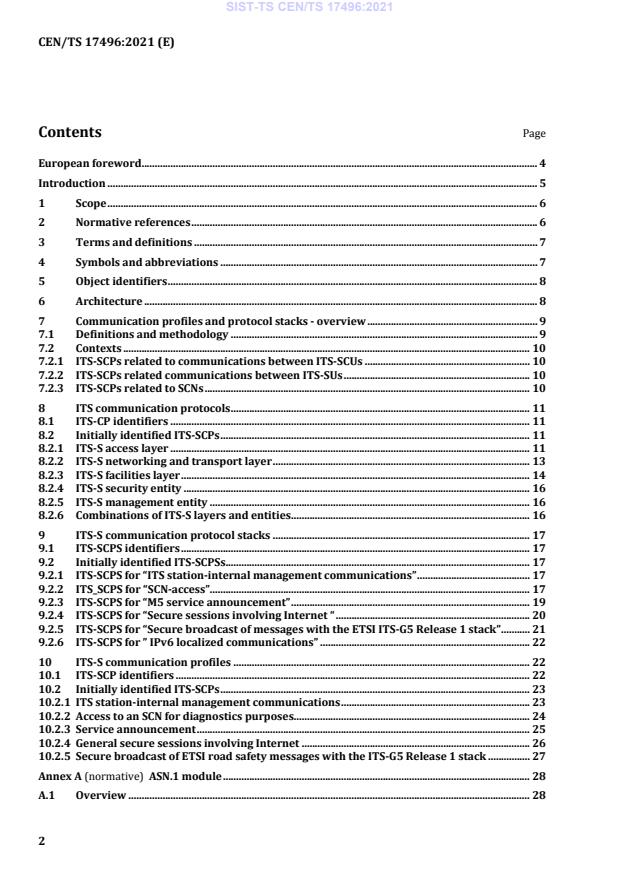
Contents Page
European foreword . 4
Introduction . 5
1 Scope . 6
2 Normative references . 6
3 Terms and definitions . 7
4 Symbols and abbreviations . 7
5 Object identifiers . 8
6 Architecture . 8
7 Communication profiles and protocol stacks - overview . 9
7.1 Definitions and methodology . 9
7.2 Contexts . 10
7.2.1 ITS-SCPs related to communications between ITS-SCUs . 10
7.2.2 ITS-SCPs related communications between ITS-SUs . 10
7.2.3 ITS-SCPs related to SCNs . 10
8 ITS communication protocols . 11
8.1 ITS-CP identifiers . 11
8.2 Initially identified ITS-SCPs . 11
8.2.1 ITS-S access layer . 11
8.2.2 ITS-S networking and transport layer . 13
8.2.3 ITS-S facilities layer . 14
8.2.4 ITS-S security entity . 16
8.2.5 ITS-S management entity . 16
8.2.6 Combinations of ITS-S layers and entities . 16
9 ITS-S communication protocol stacks . 17
9.1 ITS-SCPS identifiers . 17
9.2 Initially identified ITS-SCPSs. 17
9.2.1 ITS-SCPS for “ITS station-internal management communications” . 17
9.2.2 ITS_SCPS for “SCN-access”. 17
9.2.3 ITS-SCPS for “M5 service announcement” . 19
9.2.4 ITS-SCPS for “Secure sessions involving Internet “ . 20
9.2.5 ITS-SCPS for “Secure broadcast of messages with the ETSI ITS-G5 Release 1 stack” . 21
9.2.6 ITS-SCPS for ” IPv6 localized communications” . 22
10 ITS-S communication profiles . 22
10.1 ITS-SCP identifiers . 22
10.2 Initially identified ITS-SCPs . 23
10.2.1 ITS station-internal management communications . 23
10.2.2 Access to an SCN for diagnostics purposes . 24
10.2.3 Service announcement . 25
10.2.4 General secure sessions involving Internet . 26
10.2.5 Secure broadcast of ETSI road safety messages with the ITS-G5 Release 1 stack . 27
Annex A (normative) ASN.1 module . 28
A.1 Overview . 28
A.2 Module SISNprofiles . 28
Bibliography . 34
European foreword
This document (CEN/TS 17496:2021) has been prepared by Technical Committee CEN/TC 278
“Intelligent transport systems”, the secretariat of which is held by NEN.
Attention is drawn to the possibility that some of the elements of this document may be the subject of
patent rights. CEN shall not be held responsible for identifying any or all such patent rights.
This document has been prepared under a mandate given to CEN by the European Commission and the
European Free Trade Association.
According to the CEN/CENELEC Internal Regulations, the national standards organisations of the
following countries are bound to announce this Technical Specification: Austria, Belgium, Bulgaria,
Croatia, Cyprus, Czech Republic, Denmark, Estonia, Finland, France, Germany, Greece, Hungary, Iceland,
Ireland, Italy, Latvia, Lithuania, Luxembourg, Malta, Netherlands, Norway, Poland, Portugal, Republic of
North Macedonia, Romania, Serbia, Slovakia, Slovenia, Spain, Sweden, Switzerland, Turkey and the United
Kingdom.
Introduction
ITS Station Communication Profiles, see EN ISO 17423 and EN ISO 17419, used for communications
between (trusted) devices simplify achieving
— interoperability between ITS station units,
— and portability of ITS applications (that provide the ITS services).
Examples of trusted devices, i.e. ITS-secured communication nodes, are ITS-station units specified in
[32]
ISO 21217, which fully covers ETSI EN 302 665 . Four implementation contexts of communication
nodes in ITS communications networks are identified in ISO 21217, each comprised of ITS-station units
taking on a particular role; personal, vehicular, roadside, or central. Such ITS station units participate in
a wide variety of ITS services related to e.g. sustainability, road safety and transportation efficiency.
An ITS station unit can be composed of ITS station communication units from different vendors where
each ITS station communication unit is linked to a different configuration and management centre
[21]
specified in ISO 24102-2 and EN ISO 17419. Station-internal management communications between
[22]
ITS station communication units of the same ITS station unit is specified in ISO 24102-4 .
The identification of ITS station communication profiles specified in this document is generically
applicable to all kind of communications including broadcast information dissemination and sessions,
e.g. sessions between ITS station units, sessions between ITS station communication units of the same
ITS station unit, sessions between roadside ITS station units and a cloud platform, and between vehicle
ITS station units and a cloud platform, including communications sessions compatible with extended
[12]
vehicles standards developed by ISO TC 22 (ISO 20077 series ).
1 Scope
This document specifies a methodology to define ITS-S communication profiles (ITS-SCPs) based on
standardized communication protocols to interconnect trusted devices. These profiles enable secure
information exchange between such trusted devices, including secure low-latency information exchange,
in different configurations. The present document, in order to exemplify the methodology, also
normatively specifies some ITS-SCPs based on the methodology, yet without the intent of covering all
possible cases. Further ITS-SCPs can be specified at a later stage.
Configurations of trusted devices for which this document defines ITS-SCP’s include:
a) ITS station communication units (ITS-SCU) of the same ITS station unit (ITS-SU), i.e. station-internal
communications;
b) an ITS-SU and an external entity such as a sensor and control network (SCN), or a service in the
Internet;
c) ITS-SUs.
The specifications given in this document can be equally applied to secured and unsecured
communications, being groupcast and unicast communications, being localized or networked
communications.
2 Normative references
The following documents are referred to in the text in such a way that some or all of their content
constitutes requirements of this document. For dated references, only the edition cited applies. For
undated references, the latest edition of the referenced document (including any amendments) applies.
EN ISO 17419, Intelligent transport systems — Cooperative systems — Globally unique identification
(ISO 17419)
EN ISO 17423, Intelligent transport systems — Cooperative systems — Application requirements and
objectives (ISO 17423)
ISO 21217, Intelligent transport systems — Station and communication architecture
ISO/IEC 8825-1, Information technology — ASN.1 encoding rules: Specification of Basic Encoding Rules
(BER), Canonical Encoding Rules (CER) and Distinguished Encoding Rules (DER) — Part 1:
3 Terms and definitions
For the purposes of this document, the terms and definitions given in EN ISO 17419, EN ISO 17423,
ISO 21217, and the following, apply.
ISO and IEC maintain terminological databases for use in standardization at the following addresses:
• ISO Online browsing platform: available at https://www.iso.org/obp
• IEC Electropedia: available at http://www.electropedia.org/
3.1
ITS-S communication profile
parameterized ITS-S communication protocol stack
[SOURCE: EN ISO 17423:2018, definition 3.6]
3.2
ITS communication protocol
communication protocol applicable in ITS
3.3
ITS-S communication protocol stack
consistent set of ITS-S communication protocols enabling communications between an ITS-SCU and other
nodes which may be identified by a registered globally unique reference number
[SOURCE: EN ISO 17423:2018, definition 3.7]
4 Symbols and abbreviations
CSP communication service parameter
[SOURCE: EN ISO 17423]
ITS-CP ITS communication protocol
ITS-SCP ITS station communication profile
[SOURCE: EN ISO 17423]
ITS-SCPS ITS station communication protocol stack
[SOURCE: EN ISO 17423]
ITS-SCU ITS station communication unit
[SOURCE: ISO 21217]
ITS-SU ITS station unit
[SOURCE: ISO 21217]
IRN infrastructure/roadside network
IVN in-vehicle network
SCN sensor and control network
SSTD secure session between trusted devices
OID object identifier
5 Object identifiers
The following OIDs are used in this document and shall be as specified below:
1) Identifying this document:
{ iso(1) identified-organization(3) cen(162) cp17496 (17496) }
2) Identifying ASN.1 module specifications of this document
{ iso(1) identified-organization(3) cen(162) cp17496 (17496) asn1 (1) }
3) Identifying an ITS communications protocol:
{ iso(1) identified-organization(3) cen(162) cp17496 (17496) commProtocol (2) }
4) Identifying an ITS-S communication protocol stack (ITS-SCPS)
{ iso(1) identified-organization(3) cen(162) cp17496 (17496) its-scps (3) }
5) Identifying an ITS-S communications profile (ITS-SCP)
{ iso(1) identified-organization(3) cen(162) cp17496 (17496) its-scp (4) }
6 Architecture
This document considers the ITS station and communication architecture specified in ISO 21217, and
specifies globally unique identifiers of ITS-S communication profiles (ITS-SCPs), e.g.:
— interconnecting ITS-SCUs in an ITS-SU,
— interconnecting ITS-SUs, and for,
— interconnecting an ITS-SU with a SCN,
using OIDs identifying
— ITS communication protocols,
— ITS-S communication protocol stacks (ITS-SCPS),
— ITS-S communication profiles (ITS-SCP),
also specified in this document. The approach is based on the methodology for protocol parameters
CSP_Protocol and CSP_SpecificCommsProts specified in EN ISO 17423 and illustrated in 7.1.
7 Communication profiles and protocol stacks - overview
7.1 Definitions and methodology
An ITS-SCP is defined in EN ISO 17423 as a “parameterized ITS-S communication protocol stack”.
EN ISO 17423 further specifies how ITS-S application processes can present their communication needs
by means of “Communication Service Parameters” (CSP) to the ITS-S management, and how the ITS-S
management selects applicable ITS-S communication profiles. This document uses the following two
CSPs for specifying ITS-SCPs:
a) CSP_Protocol:
Identification of a complete non-parameterized communication protocol stack by means of a globally
unique registered communication protocol stack identifier of ASN.1 type
ProtocolReq:: = ITSprotocolStackID, with ITSprotocolStackID specified in
EN ISO 17419.
NOTE 1 EN 17419 specifies ITSprotocolStackID as an INTEGER.
b) CSP_SpecificCommsProts:
Identification of selected non-parameterized communications protocol stack elements by means of
a sequence of protocol identifiers of ASN.1 type SpecCommProts:: = SEQUENCE OF ITSprotID,
with ITSprotID specified in EN 17419 as a sequence of a ITS-S protocol location of ASN.1 type
ItssProtocolLocation followed by an ITS protocol identifier of ASN.1 type
ItsProtocolIdentifier; see Table 1 and Clause 8.
NOTE 2 EN ISO 17419 specifies ItsProtocolIdentifier as an INTEGER.
Table 1 — Named Integer values of ItsProtocolLocation as specified in EN ISO 17419
a
ITS-S layer or entity (ISO 21217:2014)
ItsProtocolLocation
Acronym Value
ITS-S access layer “acLayer” 1
ITS-S networking and transport layer “ntLayer” 2
ITS-S facilities layer “fcLayer” 4
ITS-S management entity “mgEntity” 8
ITS-S security entity “scEntity” 16
other location “other” 32
a
For ITS protocols residing in more than one layer or entity, the acronym to be used in the context of this
document is “several” with a value given by the sum of the values of the respective layers and entities.
Alternatively, the parts of such an ITS protocol may be identified separately.
The methodology for specifying ITS-SCPs in this document is given by the following steps:
1) Identify ITS communication protocols (ITS-CPs) by means of an OID reference to the standard or
specification of the protocol based on the methodology for CSP_SpecificCommsProts specified in
EN ISO 17423; see 8.1.
2) Identify ITS-SCPSs by means of an OID reference to a set of ITS-CPs based on the methodology for
CSP_Protocol specified in EN ISO 17423; see 9.1.
3) Identify ITS-SCPs by means of an OID reference to an ITS-SCPS and parameterization information,
see 10.1.
7.2 Contexts
7.2.1 ITS-SCPs related to communications between ITS-SCUs
An example of an ITS-SCP for the links between ITS-SCUs of the same ITS-SU, see Figure 1, is presented
in 10.2.1.
Figure 1 — Interconnection of ITS-SCUs in an ITS-SU
7.2.2 ITS-SCPs related communications between ITS-SUs
An example of an ITS-SCP for the link between ITS-SUs, see Figure 2, is presented in 10.2.3
Figure 2 — Interconnection of ITS-SUs
7.2.3 ITS-SCPs related to SCNs
An example of an ITS-SCP for the link between ITS-SUs (ITS-SCUs) and the interface towards sensor and
control networks, see Figure 3, is presented in 10.2.2.
Figure 3 — Interface between ITS-SU and sensor and control network
While the “Interface” in Figure 3 has to be ITS trusted and secured, the SCN may be ITS trusted and
secured or not. This document only considers the communications link between the ITS-SU and the ITS-
[13]
secured “Interface”. Details on security are specified in ISO 21177 .
8 ITS communication protocols
8.1 ITS-CP identifiers
ITS-CPs are identified by an “ITS protocol identifier” of type OID, see 7.1, pointing to a standard or
specification. Subclauses 8.2.1, 8.2.2, 8.2.3, 8.2.4, and 8.2.5 specify the OID value of ITS-CPs in the ITS-S
access layer, ITS-S networking and transport layer, ITS-S facilities layer, ITS-S security entity, and ITS-S
management entity, respectively; these layers and entities are specified in ISO 21217.
The “ITS-CP identifier” OID values specified in Tables 2, 3, 4, and 5 identify communication protocol stack
elements for the purpose of this document. Combinations of such protocols, i.e. ITS communication
protocol stacks, are specified in Clause 9.
Requirement 1: The generation of an OID for identifying an ITS-CP shall follow the following structure:
— {iso(1) identified-organization(3) cen(162) cp17496 (17496) commProtocol (2)
(itssProtocolLocation) itsProtocolIdentifier-'n' ('n')}
with
— and itssProtocolLocation as specified in Table 1;
— itsProtocolIdentifier-'n': 'n': equals ItsProtocolIdentifier with values assigned in this
document.
8.2 Initially identified ITS-SCPs
8.2.1 ITS-S access layer
Table 2 presents ITS protocol identifiers of ITS-CPs residing in the ITS-S access layer.
NOTE 1 The ITS-S access layer covers the OSI layers one and two; see ISO 21217.
Table 2 — Communication protocol stack elements — ITS-S access layer
Standard reference ITS communication protocol Comment
identifier
none {iso(1) identified-organization(3) Networked communications, i.e.
cen(162) cp17496 (17496) general access to the Internet.
commProtocol (2) acLayer (1)
This standard reference is used in the
a
itsProtocolIdentifier-1 (1)}
general meaning of “any access
technology providing access to
Internet”.
An example of a cellular access
technology is specified in ISO 17515-1
[9]
.
[16]
{iso(1) identified-organization(3) Localized communications using
ISO 21214
cen(162) cp17496 (17496) infrared light.
commProtocol (2) acLayer (1)
itsProtocolIdentifier-2 (2)}
[17]
{iso(1) identified-organization(3) Localized communications using
ISO 21215
cen(162) cp17496 (17496) microwaves. This can be either
commProtocol (2) acLayer (1) ordinary WiFi mode or OCB mode in
itsProtocolIdentifier-3 (3)} different frequency bands.
[18]
{iso(1) identified-organization(3) Common adaptation layer towards the
ISO 21218
cen(162) cp17496 (17496) ITS-S networking and transport layer
commProtocol (2) acLayer (1)
itsProtocolIdentifier-4 (4)}
[25]
{iso(1) identified-organization(3) Wired Ethernet communications.
IEEE Std. 802.3™
cen(162) cp17496 (17496)
commProtocol (2) acLayer (1)
itsProtocolIdentifier-5 (5)}
[2]
{iso(1) identified-organization(3) DoIP — Wired interface based on
ISO 13400-3
[25]
cen(162) cp17496 (17496)
IEEE Std. 802.3™ .
commProtocol (2) acLayer (1)
itsProtocolIdentifier-6 (6)}
[31]
{iso(1) identified-organization(3) Localized communications using
ETSI EN 302 663
cen(162) cp17496 (17496) microwaves at 5,9 GHz in OCB mode
commProtocol (2) acLayer (1) with LPD.
itsProtocolIdentifier-7 (7)}
a
This OID is used in ISO/TS 21185 to indicate Internet access with LTE.
NOTE 2 Further standard references can be identified and linked to an ITS protocol identifier at a later stage.
8.2.2 ITS-S networking and transport layer
Table 3 presents ITS protocol identifiers of ITS-CPs residing in the ITS-S networking and transport layer.
NOTE 1 The ITS-S networking and transport layer covers the OSI layers three and four; see ISO 21217.
Table 3 — Communication protocol stack elements — ITS-S networking and transport layer
Standard reference ITS communication protocol identifier Comment
[23]
{iso(1) identified-organization(3) cen(162) Localized
ISO 29281-1
cp17496 (17496) commProtocol (2) ntLayer communications
(2) itsProtocolIdentifier-1 (1)} messaging protocol
(FNTP) — partly
interoperable with
IEEE WSMP (IEEE
[27] a
Std. 1609.3™ )
[27]
{iso(1) identified-organization(3) cen(162) Localized
IEEE Std. 1609.3™
cp17496 (17496) commProtocol (2) ntLayer communications
(2) itsProtocolIdentifier-2 (2)} messaging protocol
(WSMP) —
interoperable with
ISO FNTP
[23] a
(ISO 29281-1 )
[15]
{iso(1) identified-organization(3) cen(162) Internet protocol
ISO 21210
cp17496 (17496) commProtocol (2) ntLayer version 6 (IPv6)
(2) itsProtocolIdentifier-3 (3)}
[33]
{iso(1) identified-organization(3) cen(162) Geo-location-based
ETSI EN 302 636–4-1
cp17496 (17496) commProtocol (2) ntLayer communications
(2) itsProtocolIdentifier-4 (4)} messaging protocol
(GeoNetworking).
[34]
{iso(1) identified-organization(3) cen(162) Basic Transport
ETSI EN 302 636–5-1
cp17496 (17496) commProtocol (2) ntLayer Protocol (BTP)
(2) itsProtocolIdentifier-5 (5)}
[36]
{iso(1) identified-organization(3) cen(162) User Datagram
RFC 768
cp17496 (17496) commProtocol (2) ntLayer Protocol (UDP)
(2) itsProtocolIdentifier-6 (6)}
[37]
{iso(1) identified-organization(3) cen(162) Transmission Control
RFC 793
cp17496 (17496) commProtocol (2) ntLayer Protocol (TCP)
(2) itsProtocolIdentifier-7 (7)}
[10]
{iso(1) identified-organization(3) cen(162) Low-bandwidth
ISO 19079
cp17496 (17496) commProtocol (2) ntLayer communications
(2) itsProtocolIdentifier-8 (8)} using 6LoWPAN
a
Interoperability is at least given for the information dissemination mode (broadcast communications), as
[27] [5]
IEEE Std. 1609.3™ only requires this mode out of the set of all modes identified in ISO/TS 16460 and
[23]
ISO 29281-1 .
NOTE 2 Further standard references can be identified and linked to an ITS protocol identifier at a later stage.
8.2.3 ITS-S facilities layer
Table 4 presents ITS protocol identifiers of ITS-CPs residing in the ITS-S facilities layer.
NOTE 1 The ITS-S facilities layer covers the OSI layers five, six and seven; see ISO 21217.
Table 4 — Communication protocol stack elements — ITS-S facilities layer
Standard reference ITS communication protocol Comment
identifier
[1]
{iso(1) identified- Universal gateway protocol
ISO 13185-2
organization(3) cen(162)
cp17496 (17496)
commProtocol (2) fcLayer (4)
itsProtocolIdentifier-1 (1)}
[3]
{iso(1) identified- Unified diagnostic services -
ISO 14229-2
organization(3) cen(162) session layer services
cp17496 (17496)
commProtocol (2) fcLayer (4)
itsProtocolIdentifier-2 (2)}
[8]
{iso(1) identified- Generic message transmission
ISO/TS 17429
organization(3) cen(162) using the “Facilities Service
cp17496 (17496) Handler” (FSH); managed by the
commProtocol (2) fcLayer (4) “Communication Profile Handler”
itsProtocolIdentifier-3 (3) } (CPH).
[14]
{iso(1) identified- Global Transport Data
FprCEN ISO/TS 21184
organization(3) cen(162) Management (GTDM) framework
cp17496 (17496)
commProtocol (2) fcLayer (4)
itsProtocolIdentifier-4 (4)}
[20]
{iso(1) identified- Application programming
ISO 22900-2
organization(3) cen(162) interface for diagnostic protocol
cp17496 (17496) data unit
commProtocol (2) fcLayer (4)
itsProtocolIdentifier-5 (5)}
[4]
{iso(1) identified- Unified diagnostic services on
ISO 14229-5
organization(3) cen(162) Internet Protocol implementation
cp17496 (17496) (UDSonIP)
commProtocol (2) fcLayer (4)
itsProtocolIdentifier-6 (6)}
[21]
{iso(1) identified- Remote ITS station management
ISO 24102-2
organization(3) cen(162) protocol:
cp17496 (17496)
Remote management
commProtocol (2) fcLayer (4)
communication handler (RMCH)
itsProtocolIdentifier-7 (7)}
Standard reference ITS communication protocol Comment
identifier
[19]
{iso(1) identified- Service announcement protocol:
EN ISO 22418
organization(3) cen(162)
FSAP communication manager
cp17496 (17496)
commProtocol (2) fcLayer (4)
itsProtocolIdentifier-8 (8)}
[22]
{iso(1) identified- Station-internal management
ISO 24102-4
organization(3) cen(162) communications protocol:
cp17496 (17496)
ITS station-internal management
commProtocol (2) fcLayer (4)
communication agent (IICA)
itsProtocolIdentifier-9 (9)}
[11]
{iso(1) identified- Constrained Application Protocol
ISO 19080
organization(3) cen(162) (CoAP)
cp17496 (17496)
commProtocol (2) fcLayer (4)
itsProtocolIdentifier-10 (10)}
NOTE 2 Further standard references can be identified and linked to an ITS protocol identifier at a later stage.
8.2.4 ITS-S security entity
Table 5 presents ITS protocol identifiers of ITS-CPs residing in the ITS-S security entity.
Table 5 — Communication protocol stack elements — ITS-S security entity support
Standard reference ITS communication protocol Comment
identifier
[26]
{iso(1) identified-organization(3) Basic security services
IEEE Std. 1609.2™
cen(162) cp17496 (17496)
commProtocol (2) scEntity (16)
itsProtocolIdentifier-1 (1)}
[13]
{iso(1) identified-organization(3) Security services for sessions
ISO 21177
cen(162) cp17496 (17496)
commProtocol (2) scEntity (16)
itsProtocolIdentifier-2 (2)}
[28]
{iso(1) identified-organization(3) Security of broadcast of road
ETSI TS 103 097
cen(162) cp17496 (17496) safety messages in the European
commProtocol (2) scEntity (16) Union (signing of messages)
itsProtocolIdentifier-3 (3)}
NOTE Further standard references can be identified and linked to an ITS protocol identifier at a later stage.
8.2.5 ITS-S management entity
Table 6 presents ITS protocol identifiers of ITS-CPs residing in the ITS-S management entity.
Table 6 — Communication protocol stack elements — ITS-S management entity support
Standard reference ITS communication protocol Comment
identifier
a
Not identified so far.
a
This empty table is maintained for completeness of the tool presentation.
NOTE Further standard references can be identified and linked to an ITS protocol identifier at a later stage.
8.2.6 Combinations of ITS-S layers and entities
Table 7 presents ITS protocol identifiers of ITS-CPs residing in several ITS-S layers and entities.
Table 7 — Communication protocol stack elements — Several layers and entities
Standard reference ITS communication protocol Comment
identifier
a
Not identified so far.
a
This empty table is maintained for completeness of the tool presentation.
9 ITS-S communication protocol stacks
9.1 ITS-SCPS identifiers
ITS-SCPSs specified in this document are referenced by an OID value of the following structure
— { iso(1) identified-organization(3) cen(162) cp17496 (17496) its-scps (3) its-scps-'n' ('n')}
with
— its-scps-'n': 'n' equals ITSprotocolStackID with values assigned in this document; see also 7.1.
Some ITS-SCPS specifications are presented in 9.2. Further ITS-SCPSs may be specified at a later stage
based on requirements from ITS stakeholders. Uniqueness of reference numbers of ITS-SCPSs will be
ensured by ISO TC204, e.g. by means of amendments to this document.
9.2 Initially identified ITS-SCPSs
9.2.1 ITS-SCPS for “ITS station-internal management communications”
Requirement 2: The OID iso(1) identified-organization(3) cen(162) cp17496 (17496) its-scps (3) its-
scps-1 (1)} shall be used to identify the ITS-SCPS specified in Table 8.
Table 8 — ITS-SCPS “ITS station-internal management communications secure sessions using
Ethernet and IPv6”
ITS communication protocol Comments
OID Standard reference
[25]
{iso(1) identified-organization(3) cen(162) Ethernet access technology.
IEEE Std. 802.3™
cp17496 (17496) commProtocol (2) acLayer
(1) itsProtocolIdentifier-5 (5)}
[18]
{iso(1) identified-organization(3) cen(162) Common adaptation layer
ISO 21218
cp17496 (17496) commProtocol (2) acLayer towards the ITS-S
(1) itsProtocolIdentifier-4 (4)} networking and transport
layer
[15]
{iso(1) identified-organization(3) cen(162) Internet Protocol version 6
ISO 21210
cp17496 (17496) commProtocol (2) ntLayer (IPv6)
(2) itsProtocolIdentifier-3 (3)}
[37]
{iso(1) identified-organization(3) cen(162) Transmission Control
RFC 793
cp17496 (17496) commProtocol (2) ntLayer Protocol (TCP)
(2) itsProtocolIdentifier-7 (7)}
[22]
{iso(1) identified-organization(3) cen(162) ITS station-internal
ISO 24102-4
cp17496 (17496) commProtocol (2) fcLayer management
(4) itsProtocolIdentifier-9 (9)} communication agent (IICA)
[13]
{iso(1) identified-organization(3) cen(162) Manages secure ITS station-
ISO 21177
cp17496 (17496) commProtocol (2) scEntity internal communications
(16) itsProtocolIdentifier-2 (2)} between IICMs
9.2.2 ITS_SCPS for “SCN-access”
Requirement 3: The OID { iso(1) identified-organization(3) cen(162) cp17496 (17496) its-scps (3) its-
scps-2 (2)} shall be used to identify the ITS-SCPS specified in Table 9.
Table 9 — ITS-SCPS “SCN-access for SCN diagnostic using Ethernet and IPv6”
ITS communication protocol Comments
OID Standard reference
[25]
{iso(1) identified-organization(3) cen(162) Ethernet access
IEEE Std. 802.3™
cp17496 (17496) commProtocol (2) technology
ntLayer (2) itsProtocolIdentifier-2 (2)}
[2]
{iso(1) identified-organization(3) cen(162) DoIP — Wired interface
ISO 13400-3
cp17496 (17496) commProtocol (2) based on IEEE Std.
acLayer (1) itsProtocolIdentifier-6 (6)} 802.3™
[15]
{iso(1) identified-organization(3) cen(162) Internet Protocol
ISO 21210
cp17496 (17496) commProtocol (2) version 6 (IPv6)
ntLayer (2) itsProtocolIdentifier-3 (3)}
[14]
{iso(1) identified-organization(3) cen(162) Global Transport Data
FprCEN ISO/TS 21184
cp17496 (17496) commProtocol (2) fcLayer Management (GTDM)
(4) itsProtocolIdentifier-4 (4)} framework
[20]
{iso(1) identified-organization(3) cen(162) Application
ISO 22900-2
cp17496 (17496) commProtocol (2) fcLayer programming interface
(4) itsProtocolIdentifier-5 (5)} for diagnostic protocol
data unit
[13]
{iso(1) identified-organization(3) cen(162) Manages secure
ISO 21177
cp17496 (17496) commProtocol (2) sessions between ITS
scEntity (16) itsProtocolIdentifier-2 (2)} trusted devices
9.2.3 ITS-SCPS for “M5 service announcement”
Requirement 4: The OID { iso(1) identified-organization(3) cen(162) cp17496 (17496) its-scps (3) its-
scps-3 (3)} shall be used to identify the ITS-SCPS specified in Table 10.
Table 10 — ITS-SCPS “General service announcement using ITS-M5 and FNTP”
ITS communication protocol Comments
OID Standard reference
[17]
{iso(1) identified-organization(3) IEEE 802.11 OCB @ 5,9 GHz.
ISO 21215
cen(162) cp17496 (17496) commProtocol
(2) acLayer (1) itsProtocolIdentifier-3 (3)}
[18]
{iso(1) identified-organization(3) Common adaptation layer
ISO 21218
cen(162) cp17496 (17496) commProtocol towards the ITS-S networking
(2) acLayer (1) itsProtocolIdentifier-4 (4)} and transport layer
[23]
{iso(1) identified-organization(3) FNTP general session mode
ISO 29281-1
cen(162) cp17496 (17496) commProtocol
(2) ntLayer (2) itsProtocolIdentifier-1 (1)}
[19]
{iso(1) identified-organization(3) FSAP communication
EN ISO 22418
cen(162) cp17496 (17496) commProtocol manager
(2) fcLayer (4) itsProtocolIdentifier-8 (8)}
[26]
{iso(1) identified-organization(3) Security services for signing
IEEE Std. 1609.2™
cen(162) cp17496 (17496) commProtocol the service announcement
(2) scEntity (16) itsProtocolIdentifier-1 message (broadcast)
(1)}
9.2.4 ITS-SCPS for “Secure sessions involving Internet “
Requirement 5: The OID { iso(1) identified-organization(3) cen(162) cp17496 (17496) its-scps (3) its-
scps-4 (4)} shall be used to identify the ITS-SCPS specified in Table 11.
NOTE This ITS-SCPS can be used for communications sessions between a vehicle and the cloud platform
[12]
compatible with extended vehicles standards (ISO 20077 series )
Table 11 — Profile “General secured sessions involving Internet “
ITS communication protocol Comments
OID Standard
reference
{iso(1) identified-organization(3) cen(162) cp17496 none Any technology
(17496) commProtocol (2) acLayer (1) providing access to
itsProtocolIdentifier-1 (1)} Internet
[15]
{iso(1) identified-organization(3) cen(162) cp17496 Internet Protocol
ISO 21210
(17496) commProtocol (2) ntLayer (2) version 6 (IPv6)
itsProtocolIdentifier-3 (3)}
[37]
{iso(1) identified-organization(3) cen(162) cp17496 Transmission Control
RFC 793
(17496) commProtocol (2) ntLayer (2) Protocol (TCP)
itsProtocolIdentifier-7 (7)}
[13]
{iso(1) identified-organization(3) cen(162) cp17496 Manages secure
ISO 21177
(17496) commProtocol (2) scEntity (16) sessions
itsProtocolIdentifier-2 (2)}
9.2.5 ITS-SCPS for “Secure broadcast of messages with the ETSI ITS-G5 Release 1 stack”
Requirement 6: The OID { iso(1) identified-organization(3) cen(162) cp17496 (17496) its-scps (3) its-
scps-5 (5)} shall be used to identify the ITS-SCPS specified in Table 12.
Table 12 — ITS-SCPS “Secure broadcast of messages with the ETSI ITS-G5 Release 1 stack”
ITS communication protocol Comments
OID Standard reference
[31]
{iso(1) identified-organization(3) Localized communications
ETSI EN 302 663 V1.2.1
cen(162) cp17496 (17496) using microwaves at
commProtocol (2) acLayer (1) 5,9 GHz in OCB mode with
itsProtocolIdentifier-7 (7)} LPD (ITS-G5 Release 1)
[33]
{iso(1) identified-organization(3) Geo-location-based
ETSI EN 302 636–4-1 V1.3.1
cen(162) cp17496 (17496) communications
commProtocol (2) ntLayer (2) messaging protocol
itsProtocolIdentifier-4 (4)} (GeoNetworking).
[34]
{iso(1) identified-organization(3) Basic Transport Protocol
ETSI EN 302 636–5-1 V2.1.1
cen(162) cp17496 (17496) (BTP).
commProtocol (2) ntLayer (2)
itsProtocolIdentifier-5 (5)}
[28]
{iso(1) identified-organization(3) Security of broadcast of
ETSI TS 103 097 V1.3.1
cen(162) cp17496 (17496) road safety messages in
commProtocol (2) scEntity (16) the European Union
itsProtocolIdentifier-3 (3)} (signing of messages)
9.2.6 ITS-SCPS for ” IPv6 localized communications”
Requirement 7: The OID { iso(1) identified-organization(3) cen(162) cp17496 (17496) its-scps (3) its-
scps-6 (6)} shall be used to identify the ITS-SCPS specified in Table 13.
Table 13 — ITS-SCPS “IPv6 localized communication with ITS-G5”
ITS communication protocol Comments
OID Standard reference
{iso(1) identified-organization(3) cen(162) ETSI EN 302 663 Localized communications
[31]
cp17496 (17496) commProtocol (2) using microwaves at 5,9 GHz
V1.2.1
acLayer (1) itsProtocolIdentifier-7 (7)} in OCB mode with LPD (ITS-
G5 Release 1)
[15]
{iso(1) identified-organization(3) cen(162) Internet Protocol version 6
ISO 21210
cp17496 (17496) commProtocol (2) (IPv6)
ntLayer (2) itsProtocolIdentifier-3 (3)}
[36]
{iso(1) identified-organization(3) cen(162) User Datagram Protocol
RFC 768
cp17496 (17496) commProtocol (2) (UDP)
ntLayer (2) itsProtocolIdentifier-6 (6)}
[13]
{iso(1) identified-organization(3) cen(162) Manages secure sessions
ISO 21177
cp17496 (17496) commProtocol (2)
scEntity (16) itsProtocolIdentifier-2 (2)}
10 ITS-S communication profiles
10.1 ITS-SCP identifiers
ITS-SCPs specified in this document are referenced by an OID value of the following structure
— { iso(1) identified-organization(3) cen(162) cp17496 (17496) its-scp (4) its-scp-'n' ('n') }
with
— its-scp-'n': 'n' being a unique unsigned Integer number with values assigned in this document.
Such an OID points to
a) the OID identifying an ITS-S communication protocol stack specified in 9.1 and 9.2, and
b) additional parameterization information, if applicable.
Assignments of ITS-SCPs for the various usage contexts are out of scope of this document. Normative
requirements on using specific ITS-SCPs are expected to be presented in standards on ITS-S application
processes, or as part of system specifications.
Some ITS-SCP specifications are presented in 10.2. Further ITS-SCPs may be specified at a later stage
based on requirements from ITS stakeholders. Uniqueness of reference numbers of ITS-SCPs will be
ensured by ISO TC204, e.g. by means of amendments to this document.
10.2 Initially identified ITS-SCPs
10.2.1 ITS station-internal management communications
Requirement 8: The OID { iso(1) identified-organization(3) cen(162) cp17496 (17496) its-scp (4) its-
scp-1 (1)} shall be used to identify the ITS-SCP specified in Table 14.
Table 14 — ITS-SCP for station-internal management communications secure sessions using
Ethernet and IPv6
ITS-SCPS: iso(1) identified-organization(3) cen(162) cp17496 (17496) its-scps (3) its-scps-1 (1)}
ITS communication protocol Parameterization
{iso(1) identified-organization(3) Standard wired Ethernet communications
cen(162) cp17496 (17496)
commProtocol (2) acLayer (1)
itsProtocolIdentifier-5 (5)}
{iso(1) identified-organization(3) None
cen(162) cp17496 (17496)
commProtocol (2) acLayer (1)
itsProtocolIdentifier-4 (4)}
{iso(1) identified-organization(3) None
cen(162) cp17496 (17496)
commProtocol (2) ntLayer (2)
itsProtocolIdentifier-3 (3)}
{iso(1) identified-organization(3) None
cen(162) cp17496 (17496)
commProtocol (2) ntLayer (2)
itsProtocolIdentifier-7 (7)}
{iso(1) identified-organization(3) None
cen(162) cp17496 (17496)
commProtocol (2) fcLayer (4)
itsProtocolIdentifier-9 (9)}
{iso(1) identified-organization(3) None
cen(162) cp17496 (17496)
commProtocol (2) scEntity (16)
itsProtocolIdentifier-2 (2)}
10.2.2 Access to an SCN for diagnostics purposes
Requirement 9: The OID {iso(1) identified-organization(3) cen(162) cp17496 (17496) its-scp (4) its-
scp-2 (2)} shall be used to identify the ITS-SCP specified in Table 15.
Table 15 — ITS-SCP for SCN diagnostics using Ethernet and IPv6
ITS-SCPS: { iso(1) identified-organization(3) cen(162) cp17496 (17496) its-scps (3) its-scps-2
(2)}
ITS communication protocol Parameterization
{iso(1) identified-organization(3) Standard Ethernet.
cen(162) cp17496 (17496)
commProtocol (2) ntLayer (2)
itsProtocolIdentifier-2 (2)}
{iso(1) identified-organization(
...