


ISO/IEC TR 15446:2017
(Main)Information technology — Security techniques — Guidance for the production of protection profiles and security targets
Information technology — Security techniques — Guidance for the production of protection profiles and security targets
ISO/IEC TR 15446 provides guidance relating to the construction of Protection Profiles (PPs) and Security Targets (STs) that are intended to be compliant with the third edition of ISO/IEC 15408 (all parts). It is also applicable to PPs and STs compliant with Common Criteria Version 3.1 Revision 4[6], a technically identical standard published by the Common Criteria Management Board, a consortium of governmental organizations involved in IT security evaluation and certification. NOTE ISO/IEC TR 15446 is not intended as an introduction to evaluation using ISO/IEC 15408 (all parts). Readers who seek such an introduction can read ISO/IEC 15408‑1. ISO/IEC TR 15446 does not deal with associated tasks beyond PP and ST specification such as PP registration and the handling of protected intellectual property.
Technologies de l'information — Techniques de sécurité — Guide pour la production de profils de protection et de cibles de sécurité
General Information
- Status
- Published
- Publication Date
- 09-Oct-2017
- Current Stage
- 6060 - International Standard published
- Start Date
- 10-Oct-2017
- Due Date
- 20-Apr-2018
- Completion Date
- 20-Apr-2018
Relations
- Effective Date
- 06-Jun-2022
- Effective Date
- 05-Nov-2015
Overview
ISO/IEC TR 15446:2017 - "Information technology - Security techniques - Guidance for the production of protection profiles and security targets" - is a technical report that provides practical guidance for producing Protection Profiles (PPs) and Security Targets (STs) intended to conform to the third edition of ISO/IEC 15408 (Common Criteria). It is also applicable to Common Criteria v3.1 Revision 4. The document explains structure, content and best-practice methods for specifying the security problem, objectives, and requirements for a Target of Evaluation (TOE). NOTE: it is not an introduction to evaluation; readers seeking that should consult ISO/IEC 15408‑1. The report does not cover PP registration or intellectual‑property handling.
Key topics and technical requirements
ISO/IEC TR 15446:2017 focuses on the practical production of PPs and STs and covers:
- Scope and audience: guidance for PP/ST authors, evaluators and procurement specialists.
- Structure and content: recommended organization of introductions, conformance claims, and the TOE overview.
- Security problem definition: methods for identifying and documenting threats, organizational policies, assumptions, and informal security requirements.
- Security objectives: defining objectives for the TOE and its operational environment and producing an objectives rationale.
- Security requirements:
- Guidance on selecting and tailoring Security Functional Requirements (SFRs) from ISO/IEC 15408-2.
- Guidance on selecting and tailoring Security Assurance Requirements (SARs) from ISO/IEC 15408-3.
- Advice on refinements, operations (assignment, selection, iteration), and rationales for SFRs/SARs.
- TOE summary specification: how to map requirements to TOE functionality.
- Composed and component TOEs: special guidance for composite systems and modular evaluations.
- Special cases: low-assurance PPs/STs, national interpretations, and optional/conditional requirement constructs.
- Practical tools: use of automated tools and example annexes for extended components and refinements.
Applications and users
This guidance is valuable for:
- PP and ST authors creating Common Criteria–compliant specifications.
- Security evaluators and testing laboratories preparing or reviewing evaluation documentation.
- Vendors and product teams preparing certification deliverables.
- Procurement officers and system integrators using PPs/STs in specification‑based and selection‑based purchasing.
- Certification bodies and government security agencies aligning evaluation artefacts with ISO/IEC 15408.
Practical benefits include improved clarity of security claims, consistent SFR/SAR selection, and reduced rework during evaluation and certification.
Related standards
- ISO/IEC 15408 (all parts) - Common Criteria for IT security evaluation
- Common Criteria v3.1 Revision 4 (technically identical to ISO/IEC 15408 third edition)
Keywords: ISO/IEC TR 15446:2017, Protection Profiles, Security Targets, Common Criteria, ISO/IEC 15408, security functional requirements, security assurance requirements, TOE, threat analysis, evaluation guidance.

Get Certified
Connect with accredited certification bodies for this standard

BSI Group
BSI (British Standards Institution) is the business standards company that helps organizations make excellence a habit.

Bureau Veritas
Bureau Veritas is a world leader in laboratory testing, inspection and certification services.

DNV
DNV is an independent assurance and risk management provider.
Sponsored listings
Frequently Asked Questions
ISO/IEC TR 15446:2017 is a technical report published by the International Organization for Standardization (ISO). Its full title is "Information technology — Security techniques — Guidance for the production of protection profiles and security targets". This standard covers: ISO/IEC TR 15446 provides guidance relating to the construction of Protection Profiles (PPs) and Security Targets (STs) that are intended to be compliant with the third edition of ISO/IEC 15408 (all parts). It is also applicable to PPs and STs compliant with Common Criteria Version 3.1 Revision 4[6], a technically identical standard published by the Common Criteria Management Board, a consortium of governmental organizations involved in IT security evaluation and certification. NOTE ISO/IEC TR 15446 is not intended as an introduction to evaluation using ISO/IEC 15408 (all parts). Readers who seek such an introduction can read ISO/IEC 15408‑1. ISO/IEC TR 15446 does not deal with associated tasks beyond PP and ST specification such as PP registration and the handling of protected intellectual property.
ISO/IEC TR 15446 provides guidance relating to the construction of Protection Profiles (PPs) and Security Targets (STs) that are intended to be compliant with the third edition of ISO/IEC 15408 (all parts). It is also applicable to PPs and STs compliant with Common Criteria Version 3.1 Revision 4[6], a technically identical standard published by the Common Criteria Management Board, a consortium of governmental organizations involved in IT security evaluation and certification. NOTE ISO/IEC TR 15446 is not intended as an introduction to evaluation using ISO/IEC 15408 (all parts). Readers who seek such an introduction can read ISO/IEC 15408‑1. ISO/IEC TR 15446 does not deal with associated tasks beyond PP and ST specification such as PP registration and the handling of protected intellectual property.
ISO/IEC TR 15446:2017 is classified under the following ICS (International Classification for Standards) categories: 35.030 - IT Security; 35.040 - Information coding. The ICS classification helps identify the subject area and facilitates finding related standards.
ISO/IEC TR 15446:2017 has the following relationships with other standards: It is inter standard links to ISO 3506-3:2025, ISO/IEC TR 15446:2009. Understanding these relationships helps ensure you are using the most current and applicable version of the standard.
ISO/IEC TR 15446:2017 is available in PDF format for immediate download after purchase. The document can be added to your cart and obtained through the secure checkout process. Digital delivery ensures instant access to the complete standard document.
Standards Content (Sample)
TECHNICAL ISO/IEC TR
REPORT 15446
Third edition
2017-10
Information technology — Security
techniques — Guidance for the
production of protection profiles and
security targets
Technologies de l'information — Techniques de sécurité — Guide
pour la production de profils de protection et de cibles de sécurité
Reference number
©
ISO/IEC 2017
© ISO/IEC 2017, Published in Switzerland
All rights reserved. Unless otherwise specified, no part of this publication may be reproduced or utilized otherwise in any form
or by any means, electronic or mechanical, including photocopying, or posting on the internet or an intranet, without prior
written permission. Permission can be requested from either ISO at the address below or ISO’s member body in the country of
the requester.
ISO copyright office
Ch. de Blandonnet 8 • CP 401
CH-1214 Vernier, Geneva, Switzerland
Tel. +41 22 749 01 11
Fax +41 22 749 09 47
copyright@iso.org
www.iso.org
ii © ISO/IEC 2017 – All rights reserved
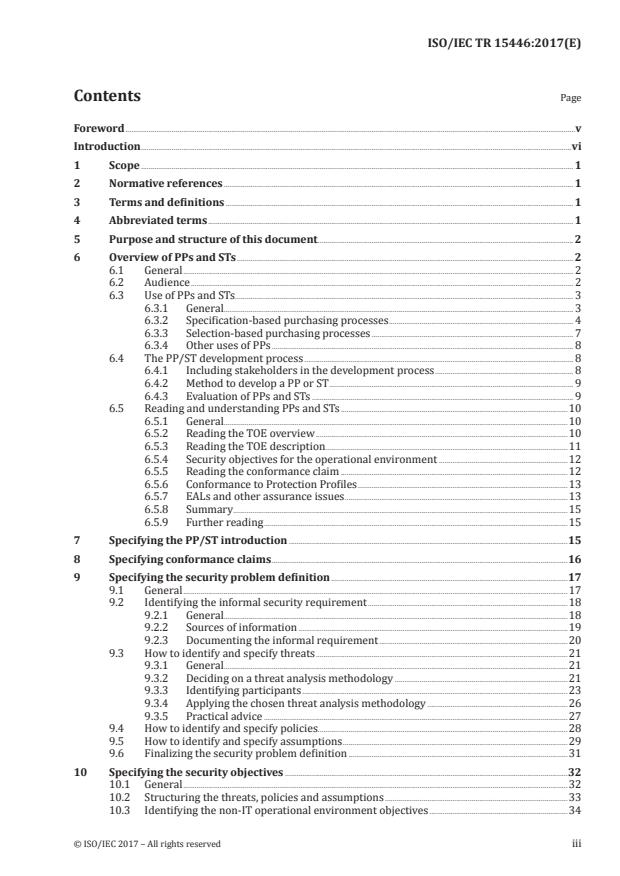
Contents Page
Foreword .v
Introduction .vi
1 Scope . 1
2 Normative references . 1
3 Terms and definitions . 1
4 Abbreviated terms . 1
5 Purpose and structure of this document . 2
6 Overview of PPs and STs . 2
6.1 General . 2
6.2 Audience . 2
6.3 Use of PPs and STs . 3
6.3.1 General. 3
6.3.2 Specification-based purchasing processes . 4
6.3.3 Selection-based purchasing processes . 7
6.3.4 Other uses of PPs . 8
6.4 The PP/ST development process . 8
6.4.1 Including stakeholders in the development process . 8
6.4.2 Method to develop a PP or ST . 9
6.4.3 Evaluation of PPs and STs . 9
6.5 Reading and understanding PPs and STs .10
6.5.1 General.10
6.5.2 Reading the TOE overview .10
6.5.3 Reading the TOE description .11
6.5.4 Security objectives for the operational environment .12
6.5.5 Reading the conformance claim .12
6.5.6 Conformance to Protection Profiles .13
6.5.7 EALs and other assurance issues .13
6.5.8 Summary .15
6.5.9 Further reading .15
7 Specifying the PP/ST introduction .15
8 Specifying conformance claims .16
9 Specifying the security problem definition .17
9.1 General .17
9.2 Identifying the informal security requirement .18
9.2.1 General.18
9.2.2 Sources of information .19
9.2.3 Documenting the informal requirement .20
9.3 How to identify and specify threats .21
9.3.1 General.21
9.3.2 Deciding on a threat analysis methodology .21
9.3.3 Identifying participants .23
9.3.4 Applying the chosen threat analysis methodology .26
9.3.5 Practical advice .27
9.4 How to identify and specify policies .28
9.5 How to identify and specify assumptions .29
9.6 Finalizing the security problem definition .31
10 Specifying the security objectives .32
10.1 General .32
10.2 Structuring the threats, policies and assumptions .33
10.3 Identifying the non-IT operational environment objectives .34
© ISO/IEC 2017 – All rights reserved iii
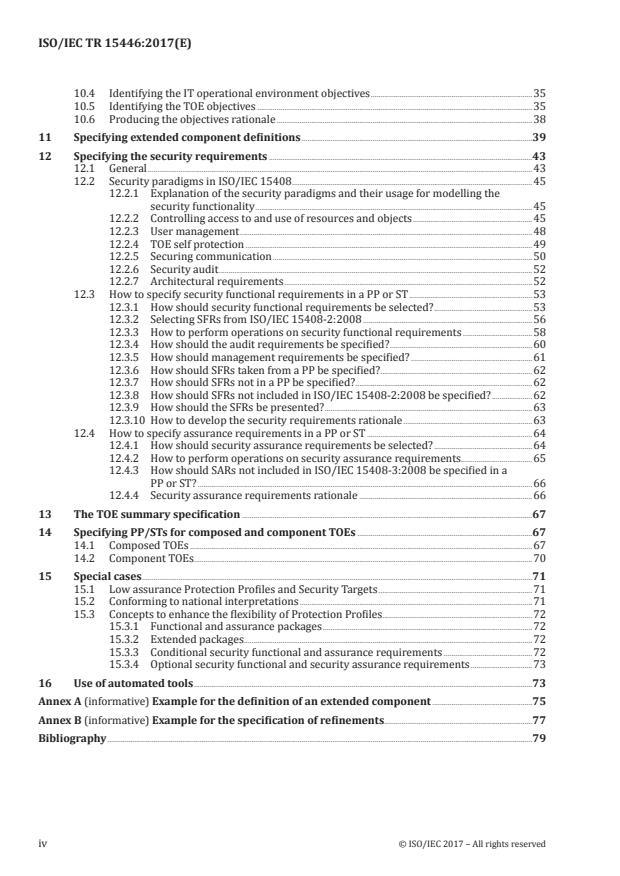
10.4 Identifying the IT operational environment objectives .35
10.5 Identifying the TOE objectives .35
10.6 Producing the objectives rationale .38
11 Specifying extended component definitions .39
12 Specifying the security requirements .43
12.1 General .43
12.2 Security paradigms in ISO/IEC 15408 .45
12.2.1 Explanation of the security paradigms and their usage for modelling the
security functionality .45
12.2.2 Controlling access to and use of resources and objects .45
12.2.3 User management .48
12.2.4 TOE self protection .49
12.2.5 Securing communication .50
12.2.6 Security audit .52
12.2.7 Architectural requirements .52
12.3 How to specify security functional requirements in a PP or ST .53
12.3.1 How should security functional requirements be selected? .53
12.3.2 Selecting SFRs from ISO/IEC 15408-2:2008 .56
12.3.3 How to perform operations on security functional requirements .58
12.3.4 How should the audit requirements be specified? .60
12.3.5 How should management requirements be specified? .61
12.3.6 How should SFRs taken from a PP be specified? .62
12.3.7 How should SFRs not in a PP be specified? .62
12.3.8 How should SFRs not included in ISO/IEC 15408-2:2008 be specified? .62
12.3.9 How should the SFRs be presented? .63
12.3.10 How to develop the security requirements rationale .63
12.4 How to specify assurance requirements in a PP or ST .64
12.4.1 How should security assurance requirements be selected? .64
12.4.2 How to perform operations on security assurance requirements .65
12.4.3 How should SARs not included in ISO/IEC 15408-3:2008 be specified in a
PP or ST? .66
12.4.4 Security assurance requirements rationale .66
13 The TOE summary specification .67
14 Specifying PP/STs for composed and component TOEs .67
14.1 Composed TOEs .67
14.2 Component TOEs.70
15 Special cases .71
15.1 Low assurance Protection Profiles and Security Targets .71
15.2 Conforming to national interpretations .71
15.3 Concepts to enhance the flexibility of Protection Profiles .72
15.3.1 Functional and assurance packages .72
15.3.2 Extended packages . .72
15.3.3 Conditional security functional and assurance requirements .72
15.3.4 Optional security functional and security assurance requirements .73
16 Use of automated tools .73
Annex A (informative) Example for the definition of an extended component .75
Annex B (informative) Example for the specification of refinements .77
Bibliography .79
iv © ISO/IEC 2017 – All rights reserved
Foreword
ISO (the International Organization for Standardization) and IEC (the International Electrotechnical
Commission) form the specialized system for worldwide standardization. National bodies that are
members of ISO or IEC participate in the development of International Standards through technical
committees established by the respective organization to deal with particular fields of technical
activity. ISO and IEC technical committees collaborate in fields of mutual interest. Other international
organizations, governmental and non-governmental, in liaison with ISO and IEC, also take part in the
work. In the field of information technology, ISO and IEC have established a joint technical committee,
ISO/IEC JTC 1.
The procedures used to develop this document and those intended for its further maintenance are
described in the ISO/IEC Directives, Part 1. In particular the different approval criteria needed for the
different types of ISO documents should be noted. This document was drafted in accordance with the
editorial rules of the ISO/IEC Directives, Part 2 (see www.iso.org/directives).
Attention is drawn to the possibility that some of the elements of this document may be the subject of
patent rights. ISO shall not be held responsible for identifying any or all such patent rights. Details of
any patent rights identified during the development of the document will be in the Introduction and/or
on the ISO list of patent declarations received (see www.iso.org/patents).
Any trade name used in this document is information given for the convenience of users and does not
constitute an endorsement.
For an explanation on the voluntary nature of standards, the meaning of ISO specific terms and
expressions related to conformity assessment, as well as information about ISO's adherence to the
World Trade Organization (WTO) principles in the Technical Barriers to Trade (TBT) see the following
URL: www.iso.org/iso/foreword.html.
This document was prepared by Technical Committee ISO/IEC JTC 1, Information technology, SC 27, IT
Security techniques.
This third edition cancels and replaces the second edition (ISO/IEC TR 15446:2009), which has been
technically revised.
© ISO/IEC 2017 – All rights reserved v
Introduction
This document is an adjunct to ISO/IEC 15408 (all parts). ISO/IEC 15408 introduces the concepts
of Protection Profiles (PPs) and Security Targets (STs). A Protection Profile is an implementation-
independent statement of security needs for a type of IT product that can then be evaluated against
ISO/IEC 15408, whereas a Security Target is a statement of security needs for a specific ISO/IEC 15408
target of evaluation (TOE).
Unlike previous editions, the third edition of ISO/IEC 15408 (all parts) provides a comprehensive
explanation of what needs to go into a PP or ST. However, the third edition of ISO/IEC 15408 still does
not provide any explanation or guidance of how to go about creating a PP or ST, or how to use a PP or ST
in practice when specifying, designing or implementing secure systems.
This document is intended to fill that gap. It represents the collective experience over many years from
leading experts in ISO/IEC 15408 evaluation and the development of secure IT products.
vi © ISO/IEC 2017 – All rights reserved
TECHNICAL REPORT ISO/IEC TR 15446:2017(E)
Information technology — Security techniques — Guidance
for the production of protection profiles and security targets
1 Scope
This document provides guidance relating to the construction of Protection Profiles (PPs) and Security
Targets (STs) that are intended to be compliant with the third edition of ISO/IEC 15408 (all parts). It is
[6]
also applicable to PPs and STs compliant with Common Criteria Version 3.1 Revision 4 , a technically
identical standard published by the Common Criteria Management Board, a consortium of governmental
organizations involved in IT security evaluation and certification.
NOTE This document is not intended as an introduction to evaluation using ISO/IEC 15408 (all parts).
Readers who seek such an introduction can read ISO/IEC 15408-1.
This document does not deal with associated tasks beyond PP and ST specification such as PP
registration and the handling of protected intellectual property.
2 Normative references
The following documents are referred to in the text in such a way that some or all of their content
constitutes requirements of this document. For dated references, only the edition cited applies. For
undated references, the latest edition of the referenced document (including any amendments) applies.
ISO/IEC 15408-1:2009, Information technology — Security techniques — Evaluation criteria for IT
security — Part 1: Introduction and general model
3 Terms and definitions
For the purposes of this document, the terms and definitions given in ISO/IEC 15408-1 apply.
ISO and IEC maintain terminological databases for use in standardization at the following addresses:
— ISO Online browsing platform: available at http://www.iso.org/obp
— IEC Electropedia: available at http://www.electropedia.org/
4 Abbreviated terms
For the purposes of this document, the abbreviated terms given in ISO/IEC 15408-1 and the
following apply.
COTS Commercial Off The Shelf
CRL Certificate Revocation List
LDAP Lightweight Directory Access Protocol
SPD Security Problem Definition
SSL Secure Sockets Layer
TLS Transport Layer Security
© ISO/IEC 2017 – All rights reserved 1
5 Purpose and structure of this document
This document is intended to help people who have to prepare Protection Profiles (PPs) or Security
Targets (STs) for use in evaluation against the third edition of ISO/IEC 15408 (all parts). It provides
detailed guidance relating to the various parts of a PP or ST, and how they interrelate.
This document applies only to the third edition of ISO/IEC 15408 (all parts). Earlier versions of
ISO/IEC 15408 have different and incompatible technical requirements. However, the strategies
proposed in this document will, in the main, also be applicable to earlier versions of ISO/IEC 15408.
This document is primarily aimed at those who are involved in the development of PPs and STs. It will
also be of interest to consumers and users of PPs and STs who wish to understand the contents of PPs
and STs developed by others, and wish to confirm the relevance and accuracy of the information that
they contain. It is also likely to be useful to evaluators of PPs and STs and to those who are responsible
for monitoring PP and ST evaluation.
It is assumed that readers of this document are familiar with ISO/IEC 15408-1:2009, and in particular,
Annexes A and B which describe STs and PPs, respectively. PP and ST authors will need to become
familiar with the other parts of ISO/IEC 15408 as described in this document, including introductory
materials such as the functional requirements paradigm described in ISO/IEC 15408-2:2008, Clause 5.
This document is intended for guidance only. It should not be cited as an International Standard on
the content or structure for the evaluation of PPs and STs. It is intended to be fully consistent with
ISO/IEC 15408 (all parts); however, in the event of any inconsistency between this document and
ISO/IEC 15408 (all parts), the latter as a normative International Standard takes precedence.
Clauses 1 to 4 contain introductory and reference material, and are followed by this overview clause
(Clause 5).
Clause 6 provides an introduction to Protection Profiles and Security Targets — what they are, when
and why they may be used. Clause 6 also discusses the relationship between PPs and STs and issues
relating to the PP/ST development process.
Clauses 7 to 13 provide information on how to specify the seven mandatory parts of the contents of a
PP or ST, following the order outlined in ISO/IEC 15408-1:2009, A.2 and B.2.
Clause 14 examines the issues specific to PPs and STs for composed TOEs, i.e. TOEs that are composed
of two or more component TOEs, each of which has its own PP or ST.
Clause 15 deals with some special cases, namely, low assurance reduced PP/ST contents, conforming
to national restrictions and interpretations and some new concepts for enhancing the flexibility and
usability of Protection Profiles.
Clause 16 discusses the topic of use of automated tools in PP/ST development.
6 Overview of PPs and STs
6.1 General
This clause provides an overview of the roles of PPs and STs in information security evaluation using
ISO/IEC 15408 (all parts).
6.2 Audience
This document is intended for use by two distinct audiences:
a) IT professionals with security knowledge (e.g. security officers/architects with an understanding
of a security requirement) but who are not experts in information security evaluation, and who
have no prior knowledge of ISO/IEC 15408 (all parts);
2 © ISO/IEC 2017 – All rights reserved
b) experts in information security with good knowledge of ISO/IEC 15408 (all parts), who are engaged
in developing PPs and STs as part of their professional activities.
If the reader falls into the former category, this clause should provide the information needed to
understand the purpose and structure of PPs and STs. It should also provide the background information
needed to read and understand PPs and STs, and to identify their relevance and correctness with
respect to the particular circumstances. Clauses 7 to 13 explain the contents of each part of PPs and
STs in detail, but are oriented towards the production of such documents and assume knowledge of
ISO/IEC 15408 (all parts).
If the reader is an expert, she/he should already be familiar with the contents of this clause. Subsequent
clauses will provide the methodologies, techniques and practical tips that can be used to prepare PPs
and STs in an efficient yet consistent manner.
If the reader is not an expert in information security, and needs to produce a PP or ST, this document
will help to do so. However, the reader will also need to find, read and understand published examples
of PPs or STs similar to the requirements she/he has. The reader should also consider calling on the
services of others who do have the necessary specialist knowledge and experience.
6.3 Use of PPs and STs
6.3.1 General
The main use of ISO/IEC 15408 (all parts) is to assess the security of IT products. The term “IT product”
is never actually defined in ISO/IEC 15408; however, it can be understood to cover any type of entity built
using information technology, whether a complete IT system used exclusively by one organization, or a
COTS package created by a product manufacturer for sale to many different and unrelated customers.
In this document, when this document talks about IT products, or just products, the advice is intended
to apply to all such entities. Where the scope of our advice is limited to a particular type of product, this
document talks about systems, or COTS products, or some other explicitly specific wording.
As IT products may be used in many ways, and in many types of environment, the notion of security
will vary with the product. The end result of an ISO/IEC 15408 evaluation is, therefore, never “this IT
product is secure”, but is always “this IT product meets this security specification”.
ISO/IEC 15408 has standardized security specifications to (among others):
— mandate-specific content needed to assess a product against the security specification;
— allow comparison of security specifications of different products.
ISO/IEC 15408 recognizes two different types of security specifications: Protection Profiles (PPs)
and Security Targets (STs). The difference between these two is best explained by the roles they are
intended to play in a typical product purchasing process, where a customer seeks to buy a product from
a developer.
The notions of customer, developer and product are deliberately kept abstract. A customer is someone
who wants to buy a product. It can be a single individual, an organization, a group of organizations, a
government department, etc. A developer is someone who wants to sell a product. It can be a single
programmer, a small company, a large company, a group of companies working together, etc. Finally,
a product could be anything from a small software application or a smart card to a large operating
system or a complete computer system containing hundreds of distinct components.
When our customer wishes to buy a product, he has essentially two possibilities.
— The customer contacts a developer, specifies his needs, and the developer creates a product that
is specifically targeted towards that customer and exactly fulfils the demands of that customer.
This may be expensive but the customer gets what he wants. In the remainder of this clause, this
document will call this a specification-based purchasing process.
© ISO/IEC 2017 – All rights reserved 3
— The customer selects a product from a number of existing products. This is probably cheaper, but
the resulting product may or may not exactly fulfil the customer’s needs. In the remainder of this
clause, this document will call this a selection-based purchasing process.
When IT security is important, these purchasing processes have an added difficulty. For the average
customer, it is
— hard to define what kind of IT security he needs,
— harder to determine whether the IT security that a given product claims to have is useful or sufficient
to meet his needs, and
— even harder to determine that if a product claims to have security properties, that these claims
are true.
To assist a customer through a purchasing process and address the difficulties listed above, an
evaluation of the product using ISO/IEC 15408 may be useful, and in this case, Protection Profiles and
Security Targets play an important role. In 6.3.2 and 6.3.3, this document shows how an evaluation may
assist each type of process: specification-based and selection-based.
Of course, IT products do not work in isolation. The product is used by the customer in an operational
environment, which may contain security measures of its own. Sometimes, the product will make
assumptions that certain types of security features exist within that operational environment. These
assumptions will also form part of the PP or ST.
6.3.2 Specification-based purchasing processes
6.3.2.1 Overview
In a specification-based purchasing process, a customer writes a specification, provides this
specification to a developer, and the developer then creates a product based on this specification. In
more detail, the following steps should be performed.
a) The customer has to determine his security requirements informally.
b) The customer has to transform these informal security requirements into a more formal
specification suitable for use by a developer.
c) The developer has to build a product based on this specification.
In the end, the customer wants to know that “this product is useful for me”. Therefore, the quality of
each of these steps is important.
6.3.2.2 Informal security requirements
The process of determining informal security requirements, that is determining “what is my security
problem, and how should I address it?” is outside the scope of ISO/IEC 15408 and therefore outside the
scope of this document. However, this does not mean that this is unimportant or easy by any means.
Nevertheless, ISO/IEC 15408 assumes that the customer is capable of defining his or her informal
security requirements. If this is done incorrectly, the product that is purchased in the end may not meet
the true security requirements.
Customer requirements, once written down, often have a number of problems associated with them,
especially in the area of security. Customer requirements are typically
a) incomplete (not all the requirements are present). For example, important threats that the product
should counter are missing;
b) not embedded. They are insufficiently tuned to the specific environment in which the product has
to function, or do not describe this environment clearly enough;
4 © ISO/IEC 2017 – All rights reserved
c) implicit. Some product requirements have consequences, but these consequences are not included
themselves. The developer may not take these implicit requirements into account;
d) not testable. The requirements are phrased ambiguously, so that it is not possible to verify whether
a product meets the requirement or not;
e) too detailed. The implementation has in fact already been written down but not the reason why
this was chosen. If, in a later stage, the requirements change, it is often unclear how these changes
should be made;
f) filled with ambiguous terms, like "the communication shall be secure", without defining what
"secure" means; and
g) inconsistent. The requirements are internally self-contradictory.
Providing these customer requirements to a developer in a raw form will generally lead to problems,
as the developer may misunderstand them. Security evaluation may lead to even more problems, since
evaluators may interpret requirements differently from both the customer and the developer.
For these reasons, an important step in the whole specification-based purchasing process is the
formalizing of customer requirements. For security requirements based on ISO/IEC 15408, this
formalization takes place using a so-called Protection Profile (PP). A PP is in essence a document that
defines the customer’s security requirements in a formalized, standardized way.
6.3.2.3 Using PPs as specifications
PPs are typically written as a collaborative effort by a group consisting of large organizations, groups
of organizations, government departments, as consumers and a group of developers. This collaboration
should ensure that the customer needs are not only addressed, but also the technical feasibility of the
requirements specified is given.
A PP contains many sections, but as a security specification, the most important is the “security
functional requirements”. Using ISO/IEC 15408, it is mandatory to write these requirements in a special
language, defined within that International Standard. Use of this language ensures that the Protection
Profile is
a) not ambiguous. The language contains well-defined terms, so that a developer can understand the
requirements and interpret them correctly;
b) testable. The language is defined to contain only testable terms. Thus, it will be possible to assess
in a later stage whether the product actually fulfils the PP;
c) not too detailed. The language enforces a certain level of abstraction. This closely follows what
should be the consumer requirements: the consumer wants something to be done but does not
want to worry how this is accomplished; and
d) more complete. The language contains several constructions ("if this functionality is required then
this other functionality is also required") to help ensure that implicit requirements are included.
A PP may also contain technology-specific refinements of the "security assurance requirements",
describing in detail how the correctness and effectiveness of specific security functions need to be
assessed. An example would be to demand the use of a defined test suite developed for testing the
correctness of the implementation of a cryptographic algorithm or cryptographic protocol.
6.3.2.4 Building a product from a PP
The customer can now give the PP, i.e. his formalized requirements, to one or more developers. Each
developer uses this PP as a starting point for the development of a product. As a first step in this process,
he writes a Security Target (ST).
© ISO/IEC 2017 – All rights reserved 5
An ST used for this purpose is very similar to a PP, but where a PP defines the customer requirements
and is in principle written by the customer, the ST is a product specification and written by the
developer.
The developer can of course not deliver an arbitrary ST as a reaction to the customer’s PP; his ST has to
conform to the PP. This means that the product has to cover all the customer requirements, but
— the ST may specify more than the PP. The product will offer more security functionality than the
customer requirements (note that this extra functionality is not allowed to be incompatible with
the PP), because, for example, the product will be sold to several customers, each with similar
but slightly different requirements, or because the product is derived from an existing, standard
product; and
— the ST contains more detail than the PP. While the PP explains “what” needs to be secured, the ST
also explains “how”. The developer points out, in general terms, how he will implement the customer
requirements.
A PP may permit the ST author flexibility to offer something that is equivalent but different in terms of
security functionality provided (see 6.5.6).
The ST defines for the developer the security functionality his product should deliver, and serves as a
“Specification of Security Requirements” for the rest of the development process.
The result of the development process should be a product that can be delivered to the customer, who in
turn can install it and use it. Naturally, this product should perform as described in the ST.
6.3.2.5 Role of evaluation in a specification-based purchasing process
Until now, this document has only described the role of the customer and the role of the developer in
this process. Based on this process, the developer could simply say to the customer (without further
evidence):
a) “my ST complies with your PP”;
b) “my product complies with my ST”;
c) “therefore, my product complies with your PP and meets your requirements”.
If the customer accepts these statements, the process ends here.
However, if a customer requires independent verification of these statements, he can enlist a third party
(an evaluation facility) to check these claims of compliance by performing an ISO/IEC 15408 security
evaluation. In this process, an evaluation facility uses the PP, the ST, the product and ISO/IEC 15408 to
assess two statements:
a) the ST complies with the PP;
b) the product complies with the ST.
Note that two issues are still left open, despite evaluation.
a) The translation of the customer's informal security requirements to a Protection Profile. As said
earlier, this process falls outside the scope of ISO/IEC 15408, but if this is not done correctly, the
PP will not match the customer's requirements and therefore the product will likely also not match
the customer's requirements.
b) Evaluation does not “prove” compliance. An ISO/IEC 15408 evaluation will never provide an absolute
guarantee that the product meets the PP. It can only deliver a certain degree of assurance depending
on the depth and scope of evaluation as specified in the PP or ST. If the PP requires compliance
testing for some functions by using a specific test procedure as part of the assurance activities, the
evaluation will ensure compliance for those functions as far as defined by the test procedure used.
6 © ISO/IEC 2017 – All rights reserved
6.3.3 Selection-based purchasing processes
6.3.3.1 Overview
6.3.2 discusses a customer delivering a specification and a developer implementing that specification.
This subclause discusses a situation where a customer does not have the luxury of having a product
made for him: he has to select from existing products. Therefore, the purchase is no longer based
on compliance to a formalized statement of customer requirements (i.e. a PP), but on comparison of
existing products by the customer.
In a selection-based purchasing process of an IT product,
a) a developer has to produce a product and a specification of this product and provide the specification
to the customer, and
b) the customer has to determine from the specification (perhaps by comparing the specification to
specifications from other developers) whether the specified product is the most suitable product
for him to purchase.
As the customer in the end wants to know that “this product is suitable for me”, the quality of each of
these steps is important.
6.3.3.2 Using a specification provided by the developer
In selection-based purchasing processes, the customer has to use a specification provided by the
developer.
If this specification is informal, the same potential disadvantages hold as for the informal customer
requirements discussed in 6.3.2.2. For this reason, this specification needs to be formalized as well.
For this purpose, ISO/IEC 15408 uses the Security Target (ST), as already discussed in 6.3.2.4. The ST
here is identical to the ST discussed in 6.3.2.4, with one obvious difference. Since it is not based on a
customer’s PP, it cannot claim compliance to such a PP [it may claim compliance to other types of PP
(see 6.3.4)].
Because the developer does not know a specific customer’s requirements, he will have to make an
estimate of what the market wants and codify this in the ST. This, therefore, does not necessarily match
with any customer’s specific requirements.
The developer builds his product according to the ST. This process is similar to that described for
specification-based purchasing processes.
6.3.3.3 Comparing Security Targets by the developer
The customer can now compare the STs of a number of products and select the one that best matches
his requirements (probably also considering non-security requirements such as price). This means that
he will still somehow have to find out what his informal security requirements are (see 6.3.2.2) and
compare these with the STs offered to him. If one or more products match his requirements, he is done.
If this is not the case, he will either have to choose the “closest” product or find some other solution (i.e.
change his requirements).
As already stated in 6.3.2, the process of deriving informal customer security requirements falls
outside the scope of ISO/IEC 15408 and this document. Comparing requirements and an ST also falls
outside the scope of ISO/IEC 15408, although guidance on this topic will be found in later clauses of this
document.
6.3.3.4 The role of evaluation in a selection-based purchasing process
Similar to the specification-based purchase process, the developer could simply claim that his product
meets the ST and if the customer accepts this claim, the process ends here.
© ISO/IEC 2017 – All rights reserved 7
ISO/I
...
Questions, Comments and Discussion
Ask us and Technical Secretary will try to provide an answer. You can facilitate discussion about the standard in here.
Loading comments...