


IEC TR 63515:2025
(Main)Conceptual framework of power system resilience
Conceptual framework of power system resilience
IEC TR 63515:2025 provides a conceptual framework for power system resilience. It covers the definition, evaluation metrics and methods, improvement strategies and uses cases of power system resilience. This document is applicable to developing resilient power system and implementing resilience improvement strategies.
This document is not exhaustive, and it is possible to consider other aspects, such as different application scenarios, evaluation methods, and improvement measures.
General Information
- Status
- Published
- Publication Date
- 10-Mar-2025
- Technical Committee
- SC 8C - Network Management in Interconnected Electric Power Systems
- Drafting Committee
- PT 4 - TC 8/SC 8C/PT 4
- Current Stage
- PPUB - Publication issued
- Start Date
- 11-Mar-2025
- Completion Date
- 21-Feb-2025
Overview - IEC TR 63515:2025 - Conceptual framework of power system resilience
IEC TR 63515:2025 defines a conceptual framework to understand, evaluate and improve power system resilience. The technical report sets out a common vocabulary and structured approach covering definitions, driving factors, resilience models, evaluation metrics and methods, improvement strategies, and practical use cases. It is intended to guide development of resilient power systems and help implement targeted resilience improvements against extreme events and high-impact low-probability (HILP) incidents.
Key topics and technical scope
- Definition and interpretation of power system resilience, including how it differs from related concepts such as reliability, vulnerability, flexibility and security.
- Driving factors that affect resilience: diversified threats (high winds, extreme heat/cold, earthquakes, hydrological events, other natural hazards) and complex system characteristics (high renewables penetration, power-electronics, diverse load profiles, infrastructure interdependencies).
- Resilience models: short-term and long-term modeling approaches and the resilience function/curve concept.
- Features of resilient systems: preparation, resistance, adaptation, restoration, perception, coordination and learning.
- Evaluation metrics and guidelines:
- Quantitative metrics (performance curves, resilience triangle concepts, Monte Carlo‑based methods - example procedures are given in Annex A).
- Qualitative metrics and multi-criteria approaches (e.g., AHP examples).
- Evaluation criteria and recommended evaluation methods.
- Improvement strategies: preventive actions, sustained-operation measures, recovery plans, and long-term resilience strategies.
- Use cases illustrating applications (examples include responses to ice events, earthquakes, hurricanes and urban resilient grid projects).
Note: IEC TR 63515:2025 contains no normative references and is explicitly non-exhaustive - alternative scenarios, metrics and measures may be considered.
Practical applications - who should use it
This technical report is directly useful to:
- Transmission and distribution system planners and operators for resilience assessment and operational preparedness.
- Utility asset managers and reliability engineers designing mitigation and restoration strategies.
- Grid architects and engineers integrating high shares of renewable generation and power-electronics.
- Regulators and policymakers developing resilience requirements, performance indicators and emergency planning.
- Consultants and researchers performing resilience modeling, quantification and cost–benefit analysis for adaptation investments.
- City planners and infrastructure agencies embedding grid resilience within broader critical‑infrastructure programs.
Related resources
- IEC Electropedia and ISO Online Browsing Platform for terminology and related vocabulary.
- Obtain the full publication and the latest edition via the IEC Webstore for implementation details and annexed evaluation examples.
Using IEC TR 63515:2025 helps organizations build a consistent, practical foundation for measuring, improving and governing power system resilience against extreme events and evolving system complexity.
Get Certified
Connect with accredited certification bodies for this standard

TL 9000 QuEST Forum
Telecommunications quality management system.

ANCE
Mexican certification and testing association.

Intertek Slovenia
Intertek testing, inspection, and certification services in Slovenia.
Sponsored listings
Frequently Asked Questions
IEC TR 63515:2025 is a technical report published by the International Electrotechnical Commission (IEC). Its full title is "Conceptual framework of power system resilience". This standard covers: IEC TR 63515:2025 provides a conceptual framework for power system resilience. It covers the definition, evaluation metrics and methods, improvement strategies and uses cases of power system resilience. This document is applicable to developing resilient power system and implementing resilience improvement strategies. This document is not exhaustive, and it is possible to consider other aspects, such as different application scenarios, evaluation methods, and improvement measures.
IEC TR 63515:2025 provides a conceptual framework for power system resilience. It covers the definition, evaluation metrics and methods, improvement strategies and uses cases of power system resilience. This document is applicable to developing resilient power system and implementing resilience improvement strategies. This document is not exhaustive, and it is possible to consider other aspects, such as different application scenarios, evaluation methods, and improvement measures.
IEC TR 63515:2025 is classified under the following ICS (International Classification for Standards) categories: 33.200 - Telecontrol. Telemetering. The ICS classification helps identify the subject area and facilitates finding related standards.
IEC TR 63515:2025 is available in PDF format for immediate download after purchase. The document can be added to your cart and obtained through the secure checkout process. Digital delivery ensures instant access to the complete standard document.
Standards Content (Sample)
IEC TR 63515 ®
Edition 1.0 2025-03
TECHNICAL
REPORT
Conceptual framework of power system resilience
All rights reserved. Unless otherwise specified, no part of this publication may be reproduced or utilized in any form
or by any means, electronic or mechanical, including photocopying and microfilm, without permission in writing from
either IEC or IEC's member National Committee in the country of the requester. If you have any questions about IEC
copyright or have an enquiry about obtaining additional rights to this publication, please contact the address below or
your local IEC member National Committee for further information.
IEC Secretariat Tel.: +41 22 919 02 11
3, rue de Varembé info@iec.ch
CH-1211 Geneva 20 www.iec.ch
Switzerland
About the IEC
The International Electrotechnical Commission (IEC) is the leading global organization that prepares and publishes
International Standards for all electrical, electronic and related technologies.
About IEC publications
The technical content of IEC publications is kept under constant review by the IEC. Please make sure that you have the
latest edition, a corrigendum or an amendment might have been published.
IEC publications search - webstore.iec.ch/advsearchform IEC Products & Services Portal - products.iec.ch
The advanced search enables to find IEC publications by a Discover our powerful search engine and read freely all the
variety of criteria (reference number, text, technical publications previews, graphical symbols and the glossary.
committee, …). It also gives information on projects, replaced With a subscription you will always have access to up to date
and withdrawn publications. content tailored to your needs.
IEC Just Published - webstore.iec.ch/justpublished
Electropedia - www.electropedia.org
Stay up to date on all new IEC publications. Just Published
The world's leading online dictionary on electrotechnology,
details all new publications released. Available online and once
containing more than 22 500 terminological entries in English
a month by email.
and French, with equivalent terms in 25 additional languages.
Also known as the International Electrotechnical Vocabulary
IEC Customer Service Centre - webstore.iec.ch/csc
(IEV) online.
If you wish to give us your feedback on this publication or need
further assistance, please contact the Customer Service
Centre: sales@iec.ch.
IEC TR 63515 ®
Edition 1.0 2025-03
TECHNICAL
REPORT
Conceptual framework of power system resilience
INTERNATIONAL
ELECTROTECHNICAL
COMMISSION
ICS 33.200 ISBN 978-2-8327-0255-0
– 2 – IEC TR 63515:2025 © IEC 2025
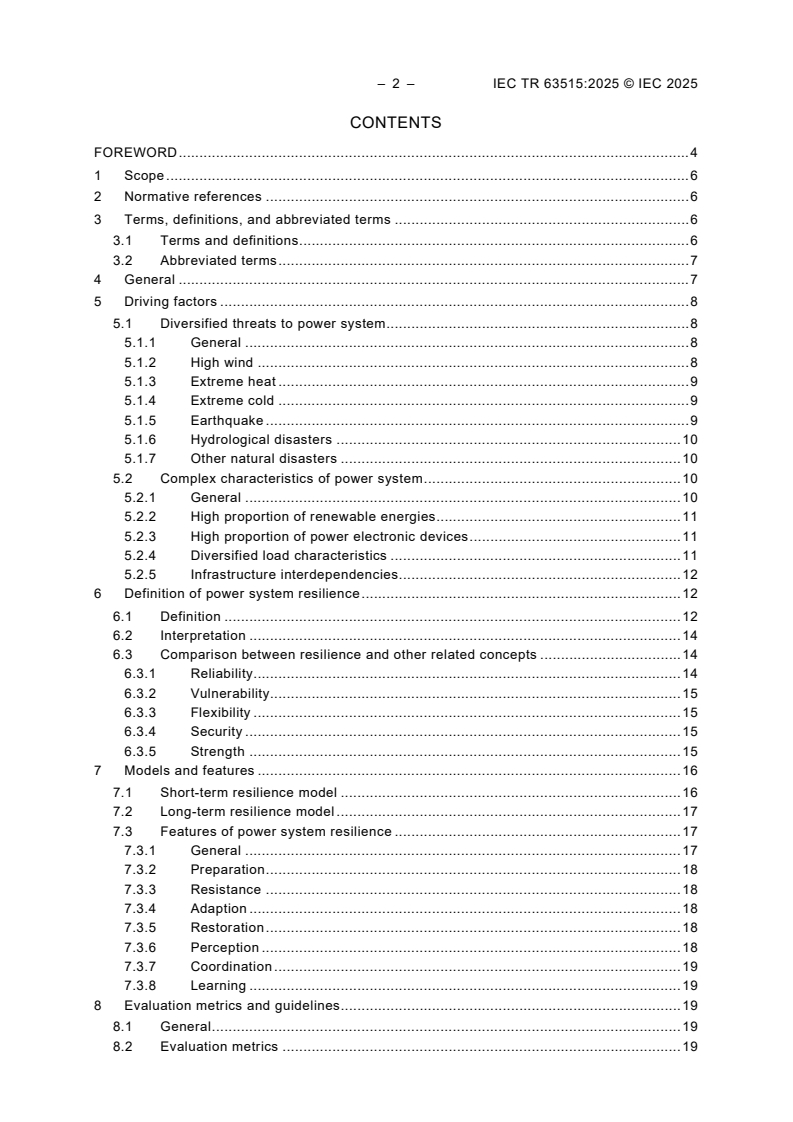
CONTENTS
FOREWORD . 4
1 Scope . 6
2 Normative references . 6
3 Terms, definitions, and abbreviated terms . 6
3.1 Terms and definitions . 6
3.2 Abbreviated terms . 7
4 General . 7
5 Driving factors . 8
5.1 Diversified threats to power system . 8
5.1.1 General . 8
5.1.2 High wind . 8
5.1.3 Extreme heat . 9
5.1.4 Extreme cold . 9
5.1.5 Earthquake . 9
5.1.6 Hydrological disasters . 10
5.1.7 Other natural disasters . 10
5.2 Complex characteristics of power system . 10
5.2.1 General . 10
5.2.2 High proportion of renewable energies. 11
5.2.3 High proportion of power electronic devices . 11
5.2.4 Diversified load characteristics . 11
5.2.5 Infrastructure interdependencies . 12
6 Definition of power system resilience . 12
6.1 Definition . 12
6.2 Interpretation . 14
6.3 Comparison between resilience and other related concepts . 14
6.3.1 Reliability. 14
6.3.2 Vulnerability. 15
6.3.3 Flexibility . 15
6.3.4 Security . 15
6.3.5 Strength . 15
7 Models and features . 16
7.1 Short-term resilience model . 16
7.2 Long-term resilience model . 17
7.3 Features of power system resilience . 17
7.3.1 General . 17
7.3.2 Preparation . 18
7.3.3 Resistance . 18
7.3.4 Adaption . 18
7.3.5 Restoration . 18
7.3.6 Perception . 18
7.3.7 Coordination . 19
7.3.8 Learning . 19
8 Evaluation metrics and guidelines . 19
8.1 General . 19
8.2 Evaluation metrics . 19
8.2.1 Quantitative metrics . 19
8.2.2 Qualitative metrics . 23
8.3 Evaluation guidelines . 26
8.3.1 Evaluation criteria . 26
8.3.2 Evaluation methods . 27
9 Improvement strategies . 27
9.1 General . 27
9.2 Preventive strategies . 28
9.3 Sustained operation strategies . 29
9.4 Recovery strategies . 29
9.5 Long-term resilience strategies . 30
10 Use cases . 31
10.1 General . 31
10.2 Resilience assessment and improvement against ice sleeves in Italy . 31
10.3 Sustained operation strategies during earthquakes applied in Japan . 31
10.4 Resilience improvement strategies against hurricanes applied in Florida . 32
10.5 Construction of the resilient city power grid in Shanghai . 33
11 Summary and perspectives . 34
Annex A (informative) Exemplary evaluation method of resilient power system . 36
A.1 Evaluation method of resilient power system based on Monte Carlo
simulation . 36
A.2 Evaluation method of power system resilience based on analytic hierarchy
process (AHP) . 37
Bibliography . 39
Figure 1 – Function curve of short-term resilience . 16
Figure 2 – Framework of long-term power system resilience . 17
Figure 3 – Features of power system resilience . 18
Figure 4 – The resilience triangle in the resilience curve . 20
Figure 5 – Resilience curve of the power system under extreme events . 20
Figure A.1 – Flowchart of power system resilience evaluation method based on Monte
Carlo simulation . 37
Figure A.2 – Flowchart of analytic hierarchy process (AHP) . 38
Table 1 – Comparison between resilience and other related concepts . 16
– 4 – IEC TR 63515:2025 © IEC 2025
INTERNATIONAL ELECTROTECHNICAL COMMISSION
____________
CONCEPTUAL FRAMEWORK OF POWER SYSTEM RESILIENCE
FOREWORD
1) The International Electrotechnical Commission (IEC) is a worldwide organization for standardization comprising
all national electrotechnical committees (IEC National Committees). The object of IEC is to promote international
co-operation on all questions concerning standardization in the electrical and electronic fields. To this end and
in addition to other activities, IEC publishes International Standards, Technical Specifications, Technical Reports,
Publicly Available Specifications (PAS) and Guides (hereafter referred to as "IEC Publication(s)"). Their
preparation is entrusted to technical committees; any IEC National Committee interested in the subject dealt with
may participate in this preparatory work. International, governmental and non-governmental organizations liaising
with the IEC also participate in this preparation. IEC collaborates closely with the International Organization for
Standardization (ISO) in accordance with conditions determined by agreement between the two organizations.
2) The formal decisions or agreements of IEC on technical matters express, as nearly as possible, an international
consensus of opinion on the relevant subjects since each technical committee has representation from all
interested IEC National Committees.
3) IEC Publications have the form of recommendations for international use and are accepted by IEC National
Committees in that sense. While all reasonable efforts are made to ensure that the technical content of IEC
Publications is accurate, IEC cannot be held responsible for the way in which they are used or for any
misinterpretation by any end user.
4) In order to promote international uniformity, IEC National Committees undertake to apply IEC Publications
transparently to the maximum extent possible in their national and regional publications. Any divergence between
any IEC Publication and the corresponding national or regional publication shall be clearly indicated in the latter.
5) IEC itself does not provide any attestation of conformity. Independent certification bodies provide conformity
assessment services and, in some areas, access to IEC marks of conformity. IEC is not responsible for any
services carried out by independent certification bodies.
6) All users should ensure that they have the latest edition of this publication.
7) No liability shall attach to IEC or its directors, employees, servants or agents including individual experts and
members of its technical committees and IEC National Committees for any personal injury, property damage or
other damage of any nature whatsoever, whether direct or indirect, or for costs (including legal fees) and
expenses arising out of the publication, use of, or reliance upon, this IEC Publication or any other IEC
Publications.
8) Attention is drawn to the Normative references cited in this publication. Use of the referenced publications is
indispensable for the correct application of this publication.
9) IEC draws attention to the possibility that the implementation of this document may involve the use of (a)
patent(s). IEC takes no position concerning the evidence, validity or applicability of any claimed patent rights in
respect thereof. As of the date of publication of this document, IEC had not received notice of (a) patent(s), which
may be required to implement this document. However, implementers are cautioned that this may not represent
the latest information, which may be obtained from the patent database available at https://patents.iec.ch. IEC
shall not be held responsible for identifying any or all such patent rights.
IEC TR 63515 has been prepared by subcommittee 8C: Network management in interconnected
electric power systems, of IEC technical committee 8: System aspects of electrical energy
supply. It is a Technical Report.
The text of this Technical Report is based on the following documents:
Draft Report on voting
8C/117/DTR 8C/126A/RVDTR
Full information on the voting for its approval can be found in the report on voting indicated in
the above table.
The language used for the development of this Technical Report is English.
This document was drafted in accordance with ISO/IEC Directives, Part 2, and developed in
accordance with ISO/IEC Directives, Part 1 and ISO/IEC Directives, IEC Supplement, available
at www.iec.ch/members_experts/refdocs. The main document types developed by IEC are
described in greater detail at www.iec.ch/publications.
The committee has decided that the contents of this document will remain unchanged until the
stability date indicated on the IEC website under webstore.iec.ch in the data related to the
specific document. At this date, the document will be
• reconfirmed,
• withdrawn, or
• revised.
– 6 – IEC TR 63515:2025 © IEC 2025
CONCEPTUAL FRAMEWORK OF POWER SYSTEM RESILIENCE
1 Scope
This document provides a conceptual framework for power system resilience. It covers the
definition, evaluation metrics and methods, improvement strategies and uses cases of power
system resilience. This document is applicable to developing resilient power system and
implementing resilience improvement strategies.
This document is not exhaustive, and it is possible to consider other aspects, such as different
application scenarios, evaluation methods, and improvement measures.
2 Normative references
There are no normative references in this document.
3 Terms, definitions, and abbreviated terms
For the purposes of this document, the following terms and definitions apply.
ISO and IEC maintain terminology databases for use in standardization at the following
addresses:
• IEC Electropedia: available at https://www.electropedia.org/
• ISO Online browsing platform: available at https://www.iso.org/obp
3.1 Terms and definitions
3.1.1
high-impact low-probability event
HILP event
event that occur with relatively low probability (or low frequency) but can have significant
impacts when it does occur
Note 1 to entry: The term "high-impact low-frequency" (HILF) events is also used for this concept.
3.1.2
extreme event
rare and severe event that can have significant impacts in contrast with the more common
conventional disturbances, including HILP events and unforeseen events
3.1.3
power system resilience
ability of a power system to perceive the operating state and potential threats, coordinate
internal and external resources, identify, prepare for, actively defend and rapidly recover from
disturbances caused by extreme events, and learn from events
3.1.4
resilient power system
power system with the characteristics or ability of resilience
3.1.5
resilient power grid
power grid with the characteristic or ability of resilience
3.1.6
short-term resilience
resilience performance of power systems in the short term, which mainly reflects their ability to
respond to an individual extreme event
3.1.7
long-term resilience
resilience performance of power systems in response to multiple types or numbers of extreme
events on a long-term scale
3.2 Abbreviated terms
The following abbreviated terms are always in capital and without dots.
AC alternating current
AHP analytic hierarchy process
ARERA Autorità di Regolazione per Energia Reti e Ambiente (in Italy)
DC direct current
DER distributed energy resource
EENS expected energy not supplied
EI energy internet
FACTS flexible AC transmission systems
FPSC Florida Public Service Commission
GIS geographic information system
HILF high-impact low-frequency
HILP high-impact low-probability
ICT information and communication technology
IEA International Energy Agency
IPS integrated power supply
LNG liquefied natural gas
MPQSS multi-power quality supply systems
MTTF mean operating time to failure
NEDO New Energy and Industrial Technology Development Organization
NTT Nippon Telegraph & Telephone
PAFC phosphoric acid fuel cell
PV photovoltaics
SMEPC State Grid Shanghai Municipal Electric Power Company
UNDRR United Nations Office for Disaster Risk Reduction
V2G vehicle to grid
4 General
Along with climate change, the impact of extreme events on public utilities has attracted
unprecedented attention. Enhancing the capabilities of infrastructure to cope with extreme
events has become a consensus among countries, as has the power system.
– 8 – IEC TR 63515:2025 © IEC 2025
Nowadays, the power system confronts rising threats from natural disasters, cyber-attacks,
physical attacks or cascading failures. Due to global warming and climate change,
weather-related events are likely to occur more frequently and severely. Extreme natural
catastrophes, such as floods, storms, hurricanes, tornadoes, tsunamis, landslides, avalanches,
extreme temperatures and earthquakes, have increasingly affected the power system.
Furthermore, with the increasing demand for decarbonization, interconnected electric power
systems are undergoing a series of changes, including the integration of more renewable
energy sources, the integration of additional power electronic devices, and closer
interdependence with other infrastructures. And the power system's ability to withstand extreme
events has got greater attention.
Therefore, concepts and applications related to power system resilience have prevailed in
academia and industry. Both power utilities and grid system operators have emphasized more
on resilience during the planning, designing, and operating phases so that the power system
can adapt to or recover from extreme events effectively and quickly, ensuring continuous power
supply and maintaining system core functions. However, even if many global research
institutions have already conducted research on power system resilience, many ambiguous
aspects still require further investigation.
Hence, this document attempts to provide a comprehensive and accurate interpretation of the
power system resilience conceptual framework. Clause 5 analyses the driving factors of
resilience development, including various threats and the needs of power systems. Clause 6
provides an applicable definition of resilience, relevant interpretations, and comparisons with
related concepts, such as reliability. Clause 7 presents short-term and long-term conceptual
frameworks for power system resilience and outlines several key features. Clause 8 provides
the metrics and methods for the evaluation of power system resilience. Clause 9 presents a list
of common measures to improve the power system resilience. Clause 10 analyses several
typical use cases of building resilient power system. Clause 11 discusses the unresolved issues
and the standardization needs related to power system resilience.
5 Driving factors
5.1 Diversified threats to power system
5.1.1 General
A report recently released by the United Nations Office for Disaster Risk Reduction (UNDRR)
has shown that the number of global disasters is rapidly increasing due to factors such as
climate change and human behaviour. According to current development trends, the annual
number of global disasters will increase to 560 in 2030 from 400 in 2015, just 90 to 100 in 1970
to 2000. Due to global warming and climate change, natural disasters like storms, floods, and
tornadoes have occurred more frequently than before. Moreover, the snowstorm and frost
damage caused by the extreme cold are more devastating and uncertain equally. Worse still,
the trend of intensifying natural disasters will continue for a long time in the foreseeable future.
5.1.2 High wind
High wind refers to the wind whose velocity exceeds the conventional protection level, causing
catastrophic damages, including super typhoons (hurricanes), high-intensity winds on a small
scale (squall lines, downbursts, tornadoes, etc.), strong winter storms, severe wind vibrations
and so on.
For the power grid, the high wind could induce flashovers, conductor galloping and lightning
strike-induced tripping of transmission lines. In severe cases, transmission towers even
collapse. Debris drifting in the air from high wind can also cause physical shocks to exposed
power infrastructure.
In July 2014, Super Typhoon Rammasun landed in Southern China, causing a great deal of
tower collapses and disconnections in transmission lines, extensive damage to power facilities,
and severe destruction to the power grid structure. On August 10, 2019, Typhoon Lekima landed
in Wenling City, China, destroying power facilities in many places. In particular, 72 substations,
3 753 lines, and 5 535 500 households suffered power failure. On October 28, 2013, the Danish
power grid was hit by Hurricane Allan, and several interconnecting lines tripped, leaving the
system in an unstable state.
5.1.3 Extreme heat
Extreme heat refers to exceptionally high temperatures that surpass the maximum threshold for
the protection of the power system and its components. In such scenarios, climate disturbances
contribute to the occurrence of heatwaves, which are characterized by prolonged periods of hot
weather, reduced rainfall, and elevated average temperatures, typically experienced during the
summer season. These climatic events result in abnormal operating conditions, particularly for
underground cables and their joints, posing significant challenges to their functionality and
performance.
For the power grid, extreme heat could cause the overload of lines, transformers, and other
equipment because of increased electricity use. It also could cause sagging power lines, cable
failures, shorted underground circuits and transformer overload, resulting in power outages.
In August 2020, a record heat wave in California caused a surge in power use for air
conditioning that overtaxed the grid. That caused two consecutive nights of rolling blackouts
due to the imbalance between supply and demand under extreme heat, affecting thousands of
residential and business customers. In July 2022, nearly 50 000 New York City residents lost
power on Sunday evening as the third day of an intense heat wave gripped the city, and roughly
33 000 customers in Brooklyn had their service cut in order to repair the damaged equipment.
5.1.4 Extreme cold
Extreme cold refers to extremely low temperature, icing, and snow that break through the
minimum protection level of the power system, such as glazed frost, mixed frost, rime, snow,
and hoarfrost, etc.
For the power grid, extreme cold, especially ice and snow disasters, could lead to the freezing
and blocking of switchgear, the flashover of transmission equipment covered with ice and snow,
and the breakage and damage of lines and towers. These disasters usually cause large-scale
power outages due to their wide coverage, long duration, and difficulty in repairing equipment.
The ice and snow disasters in 2008 severely damaged power facilities in 13 provinces and cities
in southern China, cut off 36 740 transmission lines and led to the collapse of 2 018 substations
and 563 236 towers due to the imbalance between supply and demand caused by extreme cold.
In mid-February 2021, extreme ice, snow, and cold weather hit Texas in the United States,
causing a severe blackout in the Texas power grid, during which nearly 5 million households
suffered power failure.
5.1.5 Earthquake
An earthquake refers to the vibrations caused by the rapid release of energy from the earth's
crust, leading to direct damages, including building damage, landslides, mudslides, tsunamis,
and earthquake light burns, as well as secondary damage like fires, floods, poisonous gas leaks,
and plagues.
More than 5 million earthquakes occur on the earth every year, namely, tens of thousands of
earthquakes every day. However, most are so weak that they cannot be felt. About 10 to 20
earthquakes cause serious harm to human beings every year worldwide. Earthquakes cannot
be predicted easily, as they occur infrequently and randomly.
– 10 – IEC TR 63515:2025 © IEC 2025
Strong earthquakes could lead to widespread power grid failures and devastating damage to
grid equipment. For example, on May 12, 2008, when an earthquake of magnitude 7,8 occurred
in Wenchuan County, China, the power system lost about 4 million kilowatts of load, and one
500 kV substation and twelve 220 kV substations were out of service. An earthquake of
magnitude 9,0 occurred in the Northeast Pacific region of Japan on March 11, 2011, followed
by a tsunami, which seriously affected Fukushima Daiichi nuclear power plant. This event
profoundly changed the energy strategy of Japan and even the world.
5.1.6 Hydrological disasters
Hydrological disasters refer to heavy rainfall, floods, storms, and tsunamis that break through
the conventional protection level of the power system. Over the past 20 years, the number of
global floods has more than doubled, from 1 389 to 3 254, averaging 163 per year.
Hydrological disasters exert a direct impact on the power infrastructure, causing damage to
transmission lines and power equipment. Moreover, tsunamis will also inflict direct physical
damage on coastal or offshore wind power infrastructure and other equipment.
In late July 2015, a series of heavy rains fell in Quang Ninh Province in Northeast Vietnam,
triggering the largest flood disaster in this region in 40 years. Due to the damage to many coal
mines and the increased difficulty of power transportation caused by the flood, all coal-fired
power plants in Quang Ninh province faced coal shortages, affecting the overall power supply
across Vietnam.
5.1.7 Other natural disasters
Other natural disasters also pose threats to the power system, such as thunderstorms, wildfires,
geomagnetic changes, and geological disasters. Take thunderstorms as an example. During
thunderstorms, power lines are commonly struck by lightning, causing a power surge that
overloads local transformers and causes major power issues.
On September 28, 2016, South Australia suffered a lightning strike once in 50 years, resulting
in a large-scale power outage, with a loss of 1 826 MW of load, affecting 1,7 million people.
On March 13, 1989, a geomagnetic storm caused a blackout of the 735 kV power grid in Quebec,
Canada. The power outage lasted for 9 h, and 6 million residents were directly affected.
In this context, power systems are facing increasing external and internal threats, including the
aforementioned natural disasters and other threats. These events, characterized by low
occurrence probability or extremely low predictability, can have significant impacts on the power
system once they occur. We refer to them extreme events, including "high-impact low-
probability" (HILP) events and unforeseen events. These extreme events have become the
focus of research on power system resilience.
5.2 Complex characteristics of power system
5.2.1 General
In order to cope with climate change and alleviate the dependence on fossil energy, many
countries have successively put forward sustainable development strategies in recent years,
intending to create a new green and low-carbon power system.
A sustainable energy supply system is expected to not only ensure the security of energy supply,
but also promote low-carbon energy development. However, in the process of low-carbon
energy development, especially the development of a zero-carbon power system, energy
security is adversely affected, especially in extreme situations.
The low-carbon power system is featured by the high proportion of renewable energy, the high
proportion of power electronic devices, diversified terminal loads, and the deep integration of
information and physical systems. The continuous integration of new elements promotes low-
carbon energy transformation and further complicates power systems, posing severe
challenges to the safe operations of power systems. On one hand, the renewable energy
generation and diversified loads increase the operational uncertainty of power system.
Environment changes and uncontrollable human behaviours can cause significant variation in
power injections at renewable energy generation nodes and power consumption nodes. On the
other hand, the vulnerability of the system is affected by power electronic devices and
interconnection grid structures. The cascading failure of devices could increase the operational
risk and lead to large-scale risk propagation across different systems. Therefore, it is important
to clarify the complex characteristics and demands of the power system.
5.2.2 High proportion of renewable energies
The low-carbon power system emphasizes the replacement by clean energy on the power
supply side. In the current technical environment, it is manifested by the rapid development of
renewable sources, such as wind power and photovoltaics (PVs).
The renewable energy power generation, such as wind and PVs is random and fluctuating,
posing a huge challenge to the power system steady state. That is, a high proportion of
renewable energy will lead to significantly increased fluctuations in power generation. Under
the operating condition that the power supply is adjusted with load changes, other conventional
power sources are expected to follow new energy fluctuations and make corresponding
adjustments. Introducing renewable energy into power balance in the dispatching operation is
crucial yet strenuous.
A high proportion of renewable energy access will induce higher risk in the safety and stability
of power systems. As many conventional power sources are replaced by renewable energy
sources, the power system's moment of inertia and ability to regulate frequency and voltage
continue to decrease, as well as the dynamic adjustment capabilities of power generation.
5.2.3 High proportion of power electronic devices
The continuous integration of renewable energy sources has led to the introduction of a large
number of power electronics at the source end, such as the converters for direct-drive wind
turbine and photovoltaic. On the grid side, DC transmission, FACTS and DC distribution
networks are developing rapidly. Load-side power electronics are also emerging. Consequently,
the components of energy generation, grid and loads in low-carbon power systems tend to be
highly electronic, presenting numerous challenges for their operation, analysis and control.
Power electronic devices are featured by low inertia, weak disturbance resistance, and
multi-time scale response. Unlike traditional synchronous units with rotational kinetic energy,
power electronic converters lack inertia response. Also, interaction among power electronic
devices and between power electronic devices and the AC grids can cause wideband oscillation.
The diversity of control methods for intermediate power conversion interface devices poses
significant challenges in conducting stability analysis and control of power systems.
5.2.4 Diversified load characteristics
The continuous increase in the proportion of power consumption and the development of multi-
energy-supplemented supply systems symbolizes that the power load continues to grow through
diversification. When various loads, which are featured by different power consumption needs,
transient characteristics, multi-time scale response, and spatial-temporal uncertainty, are
connected to the power grid. Power consumption on the load side becomes more
"individualized", which increases the adjustable resources of power systems to a certain extent
but poses new challenges to its safe operations.
– 12 – IEC TR 63515:2025 © IEC 2025
5.2.5 Infrastructure interdependencies
Along with the development of the energy internet (EI), energy coupling has become
increasingly intensified, and the electrification of various infrastructures has deepened. The
interdependency between infrastructures greatly increases the overall complexity of the energy
system. The power system, the water supply system, the transportation system, the natural gas
system, the oil system, and the cyber system are tightly interdependent. The complex
relationships among them are characterized by multiple connections, feedback, and
feedforward between infrastructures, as well as complex branch topology. In that case, a holistic
view takes into account the multiple coupled infrastructure systems and their interdependencies.
However, the interdependence between different infrastructure systems raises the risk of
cascading failures and increases the vulnerability of the infrastructure with power systems to
unconventional disaster events, resulting in increasingly significant economic and social
impacts stemming from power outages. Thus, risk management is required to improve the
resilience of interdependent systems. Furthermore, asset management could be integrated into
the operation and planning of interdependent systems. For the infrastructures, factors such as
asset value and alignment affect the strategic decisions made by operators, and managing
multiple assets within interdependent systems increases the regulatory complexity.
Based on the above characteristics, in order to ensure the safe operations of the low-carbon
power system, it is important to acknowledge the significant impact of extreme events on power
systems and to develop metrics, methods, and strategies for defining, evaluating, and improving
the power system resilience.
6 Definition of power system resilience
6.1 Definition
The concept of resilience was initially introduced to measure an ecosystem's ability to withstand
and absorb disturbances and maintain system stability. Over time, the concept has increasingly
become integrated into other fields, such as environmental science, sociology, and industry, to
evaluate the ability of individuals, groups, or systems to withstand and recover from external
disruptions.
The concept of resilience has also got significant attention from academic and industrial
communities in the field of electricity. Discussions and considerations regarding the planning,
design, and operation of power grids by power companies and system operators have received
widespread attention, enabling the power system to adapt to or recover from extreme events
effectively and promptly, ensuring continuous power supply for critical loads, and restoring the
system to normal as soon as possible.
Governments, businesses, and research institutions in different countries have published
various research reports providing their understandings and definitions of resilience.
In the United States, "Presidential Policy Directive 21: Critical Infrastructure Security and
Resilience" (PPD21) in 2013 focused on the security and resilience of critical infrastructure,
and provided a definition of resilience. The primary aim of PPD21 is to coordinate and integrate
government efforts in protecting and enhancing the resilience of these vital assets. Although
the directive does not explicitly address power systems, it encompasses critical infrastructure
sectors, including energy, making it applicable to discussions on power system resilience.
However, this definition does not mention the learning and continuous improvement of system
capabilities.
The Canadian government released the "Federal Policy for Emergency Management" in 2009,
and updated and revised it in 2017. Although the policy does not specifically address power or
energy system resilience, it does mention the definition of "resilience". The objective of this
policy framework is to enhance overall Canadian resilience in response to various emergencies.
And the definition does not mention the aspects of prior prevention and preparation, nor does
it address post-event recovery.
The UK Energy Research Centre released a research report "Building a Resilient UK Energy
System" in 2011, in which the definition of "energy system resilience" was introduced. This
definition primarily adopts a user-oriented perspective, offering a functional description of the
resilience concept in energy systems. However, it places greater emphasis on defensive
capabilities and lacks a detailed characterization of the requirements and features of energy
systems themselves during the prevention and recovery phases.
The International Energy Agency (IEA) released a report "Making the energy sector more
resilient to climate change" in 2020. The report highlights the significant risks climate change
poses to energy infrastructure and supply chains, emphasizing the importance of strengthening
the resilience of energy systems. Additionally, the report presents a definition of the resilience
of the energy sector. In IEA's definition, resilience addresses not only hazardous events but
also hazardous trends, and it incorporates learning and transformation aspects. However, it
does not mention preventive measures prior to such events or trends.
Due to varying development stages of power systems, types of disruptions, and focus areas,
the understanding and definition of resilience differ across different countries and organizations.
However, the fundamental starting point remains consistent. Resilience addresses aspects that
traditional concepts, such as reliability and safety, cannot cover, thus filling a gap in one aspect
of power system security.
Based on the research conducted by a group of SC C4, CIGRE provides a concise and accurate
definition of resilience, and described the characteristics including anticipation, preparation,
absorption, sustainment, recovery, adaptation and lessons learnt. The definition also offers
several key actionable measures that are relatively comprehensive and easy to understand.
The resilience attribute and organizational resilience are defined in ISO/TS 31050:2023, 3.1
and 3.4:
Resilience attribute: feature or characteristic of an organization's ability to absorb and adapt
to a changing context.
Organizational resilience: ability of an organization to absorb, recover and adapt in a
changing context.
Those definitions depict the importance of organizational resilience for an organization
operation in changing environment.
As various countries and research institutions delve deeper into the study of power system
resilience, the definition's connotations continue to expand, and the scenarios it addresses
become clearer. While there are some variations in the definitions provided by different parties
across various scenarios, the general consensus is that resilience refers to the ability of a power
system to prevent, resist, and recover from extreme events, including HILP events and
unforeseen events, which mainly refer to the events mentioned in Clause 5. More specifically,
"low-probability" indicates that the likelihood of extreme events occurring is much lower than
that of traditional power system disturbances or malfunctions, or these events are unlikely to
lead to large-scale impacts on the power system under conventional circumstances; "high-
impact" denotes that power system which is greatly affected by the extreme events will impose
a negative impact on the power supply of large areas and users, provoking huge indirect
economic losses and social disor
...
Questions, Comments and Discussion
Ask us and Technical Secretary will try to provide an answer. You can facilitate discussion about the standard in here.
Loading comments...