

IEC 62053-11:2003
(Main)Electricity metering equipment (a.c.) - Particular requirements - Part 11: Electromechanical meters for active energy (classes 0,5, 1 and 2)
General Information
- Abstract
IEC 62053-11:2003 Applies only to newly manufactured electromechanical watt-hour meters of accuracy classes 0,5, 1 and 2, for the measurement of alternating current electrical active energy in 50 Hz or 60 Hz networks and it applies to their type tests only. It applies only to electromechanical watt-hour meters for indoor and outdoor application consisting of a measuring element and register(s) enclosed together in a meter case. It also applies to operation indicator(s) and test output(s).
This publication is of high relevance for Smart Grid.
- Status
- Published
- Publication Date
- 17-Nov-2016
- Technical Committee
- TC 13 - Electrical energy measurement and control
- Drafting Committee
- WG 11 - TC 13/WG 11
- Current Stage
- PPUB - Publication issued
- Start Date
- 28-Jan-2003
- Completion Date
- 15-Feb-2003
Buy Documents
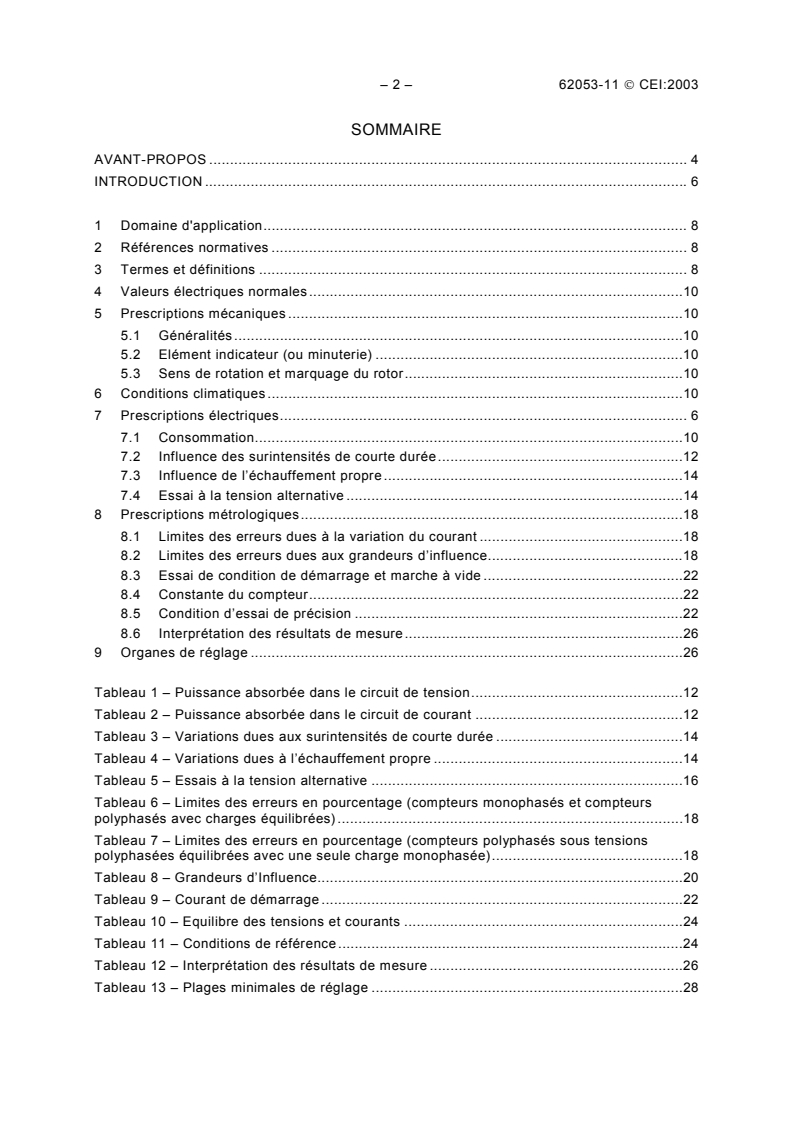
IEC 62053-11:2003 - Electricity metering equipment (a.c.) - Particular requirements - Part 11: Electromechanical meters for active energy (classes 0,5, 1 and 2) Released:1/28/2003

IEC 62053-11:2003+AMD1:2016 CSV - Electricity metering equipment (a.c.) - Particular requirements - Part 11: Electromechanical meters for active energy (classes 0,5, 1and 2) Released:11/18/2016
Overview
IEC 62053-11:2003 is a key international standard issued by the International Electrotechnical Commission (IEC) that specifies the particular requirements for electromechanical watt-hour meters used for measuring active energy (kWh) in alternating current (a.c.) networks. Focused on accuracy classes 0.5, 1, and 2, the standard applies to newly manufactured meters intended to monitor and record active energy in 50 Hz or 60 Hz electrical networks. It is relevant for both indoor and outdoor installations, covering the type testing of meters with integrated measuring elements and registers enclosed in a single case, including their operation indicators and test outputs. The document is an essential reference for ensuring reliable, safe, and interoperable energy metering equipment, supporting the needs of smart grid applications and modern energy management systems.
Key Topics
- Scope and Application: Specifies requirements for new electromechanical watt-hour meters within accuracy classes 0.5, 1, and 2 for a.c. electricity measurement.
- Meter Design: Requirements on enclosure, display (drum or pointer type registers), rotor markings, and arrangement for operational reliability.
- Electrical Requirements: Details on power consumption limits for voltage and current circuits, treatment of short-time overcurrents, self-heating effects, and a.c. voltage testing methodologies.
- Accuracy Classes: Defines error tolerances under varying conditions, consistent with each accuracy class, offering guidance for both direct-connected and transformer-operated meters.
- Testing and Compliance: Type test procedures-including climatic, mechanical, and electrical testing-ensure meters perform accurately and safely under prescribed conditions.
- Integration with Other Standards: Provides guidance on combined use with general requirements, safety, dependability, and acceptance test standards.
- Exclusions: The standard does not apply to meters with voltage ratings above 600 V, portable meters, or data interfaces for meter registers. Safety requirements are addressed separately in IEC 62052-31.
Applications
IEC 62053-11:2003 is applied in diverse sectors where accurate a.c. energy measurement is critical, including:
- Utility Energy Metering: Ensuring billing accuracy and network monitoring for both residential and commercial power consumers.
- Smart Grid Infrastructure: Supporting metering compatibility within smart grid systems by providing consistent data for energy management and load analysis.
- Industrial Facilities: Reliable energy tracking for internal cost allocation, energy efficiency programs, and process optimization.
- Meter Manufacturing and Certification: Used by manufacturers and testing labs to verify compliance and performance under standardized test conditions, ensuring products meet international expectations for metrology and safety.
Adoption of this standard facilitates the interoperability and reliability of critical energy infrastructure, aligning with regulatory and utility industry requirements, and is fundamental for countries and organizations participating in global electricity markets.
Related Standards
For comprehensive implementation and compliance, IEC 62053-11:2003 should be used in conjunction with the following standards:
- IEC 62052-11: General requirements, tests, and test conditions for a.c. metering equipment.
- IEC 62052-31: Product safety requirements and tests for electricity metering equipment.
- IEC 62053-21/22/23: Particular requirements for static meters for active and reactive energy.
- IEC 62059 Series: Dependability concepts and field data collection for metering equipment.
- IEC 60514, IEC 60736: Acceptance testing and test equipment specifications.
By integrating IEC 62053-11 with these related standards, stakeholders ensure that their electricity metering solutions achieve international benchmarks for performance, safety, and reliability-key factors in advancing smart grid and energy management initiatives.
Keywords: IEC 62053-11, electromechanical watt-hour meters, active energy measurement, accuracy classes, a.c. metering equipment, type testing, smart grid metering standards, electricity meter compliance.
Relations
- Effective Date
- 05-Sep-2023
Buy Documents
IEC 62053-11:2003 - Electricity metering equipment (a.c.) - Particular requirements - Part 11: Electromechanical meters for active energy (classes 0,5, 1 and 2) Released:1/28/2003
IEC 62053-11:2003+AMD1:2016 CSV - Electricity metering equipment (a.c.) - Particular requirements - Part 11: Electromechanical meters for active energy (classes 0,5, 1and 2) Released:11/18/2016
Get Certified
Connect with accredited certification bodies for this standard

BSMI (Bureau of Standards, Metrology and Inspection)
Taiwan's standards and inspection authority.
Sponsored listings
Frequently Asked Questions
IEC 62053-11:2003 is a standard published by the International Electrotechnical Commission (IEC). Its full title is "Electricity metering equipment (a.c.) - Particular requirements - Part 11: Electromechanical meters for active energy (classes 0,5, 1 and 2)". This standard covers: IEC 62053-11:2003 Applies only to newly manufactured electromechanical watt-hour meters of accuracy classes 0,5, 1 and 2, for the measurement of alternating current electrical active energy in 50 Hz or 60 Hz networks and it applies to their type tests only. It applies only to electromechanical watt-hour meters for indoor and outdoor application consisting of a measuring element and register(s) enclosed together in a meter case. It also applies to operation indicator(s) and test output(s). This publication is of high relevance for Smart Grid.
IEC 62053-11:2003 Applies only to newly manufactured electromechanical watt-hour meters of accuracy classes 0,5, 1 and 2, for the measurement of alternating current electrical active energy in 50 Hz or 60 Hz networks and it applies to their type tests only. It applies only to electromechanical watt-hour meters for indoor and outdoor application consisting of a measuring element and register(s) enclosed together in a meter case. It also applies to operation indicator(s) and test output(s). This publication is of high relevance for Smart Grid.
IEC 62053-11:2003 is classified under the following ICS (International Classification for Standards) categories: 17.220.20 - Measurement of electrical and magnetic quantities. The ICS classification helps identify the subject area and facilitates finding related standards.
IEC 62053-11:2003 has the following relationships with other standards: It is inter standard links to IEC 62053-11:2003/AMD1:2016. Understanding these relationships helps ensure you are using the most current and applicable version of the standard.
IEC 62053-11:2003 is available in PDF format for immediate download after purchase. The document can be added to your cart and obtained through the secure checkout process. Digital delivery ensures instant access to the complete standard document.
Standards Content (Sample)
NORME CEI
INTERNATIONALE IEC
62053-11
INTERNATIONAL
Première édition
STANDARD
First edition
2003-01
Equipement de comptage de l'électricité (c.a.) –
Prescriptions particulières –
Partie 11:
Compteurs électromécaniques d'énergie active
(classes 0,5, 1 et 2)
Electricity metering equipment (a.c.) –
Particular requirements –
Part 11:
Electromechanical meters for active energy
(classes 0,5, 1 and 2)
Numéro de référence
Reference number
CEI/IEC 62053-11:2003
Numérotation des publications Publication numbering
Depuis le 1er janvier 1997, les publications de la CEI As from 1 January 1997 all IEC publications are
sont numérotées à partir de 60000. Ainsi, la CEI 34-1 issued with a designation in the 60000 series. For
devient la CEI 60034-1. example, IEC 34-1 is now referred to as IEC 60034-1.
Editions consolidées Consolidated editions
Les versions consolidées de certaines publications de la The IEC is now publishing consolidated versions of its
CEI incorporant les amendements sont disponibles. Par publications. For example, edition numbers 1.0, 1.1
exemple, les numéros d’édition 1.0, 1.1 et 1.2 indiquent and 1.2 refer, respectively, to the base publication,
respectivement la publication de base, la publication de the base publication incorporating amendment 1 and
base incorporant l’amendement 1, et la publication de the base publication incorporating amendments 1
base incorporant les amendements 1 et 2. and 2.
Informations supplémentaires Further information on IEC publications
sur les publications de la CEI
Le contenu technique des publications de la CEI est The technical content of IEC publications is kept
constamment revu par la CEI afin qu'il reflète l'état under constant review by the IEC, thus ensuring that
actuel de la technique. Des renseignements relatifs à the content reflects current technology. Information
cette publication, y compris sa validité, sont dispo- relating to this publication, including its validity, is
nibles dans le Catalogue des publications de la CEI available in the IEC Catalogue of publications
(voir ci-dessous) en plus des nouvelles éditions, (see below) in addition to new editions, amendments
amendements et corrigenda. Des informations sur les and corrigenda. Information on the subjects under
sujets à l’étude et l’avancement des travaux entrepris consideration and work in progress undertaken by the
par le comité d’études qui a élaboré cette publication, technical committee which has prepared this
ainsi que la liste des publications parues, sont publication, as well as the list of publications issued,
également disponibles par l’intermédiaire de: is also available from the following:
• Site web de la CEI (www.iec.ch) • IEC Web Site (www.iec.ch)
• Catalogue des publications de la CEI • Catalogue of IEC publications
Le catalogue en ligne sur le site web de la CEI The on-line catalogue on the IEC web site
(www.iec.ch/catlg-f.htm) vous permet de faire des (www.iec.ch/catlg-e.htm) enables you to search
recherches en utilisant de nombreux critères, by a variety of criteria including text searches,
comprenant des recherches textuelles, par comité technical committees and date of publication. On-
d’études ou date de publication. Des informations line information is also available on recently
en ligne sont également disponibles sur les issued publications, withdrawn and replaced
nouvelles publications, les publications rempla- publications, as well as corrigenda.
cées ou retirées, ainsi que sur les corrigenda.
• IEC Just Published
• IEC Just Published
Ce résumé des dernières publications parues
This summary of recently issued publications
(www.iec.ch/JP.htm) est aussi disponible par
(www.iec.ch/JP.htm) is also available by email.
courrier électronique. Veuillez prendre contact
Please contact the Customer Service Centre (see
avec le Service client (voir ci-dessous) pour plus
below) for further information.
d’informations.
• Service clients
• Customer Service Centre
Si vous avez des questions au sujet de cette
If you have any questions regarding this
publication ou avez besoin de renseignements
publication or need further assistance, please
supplémentaires, prenez contact avec le Service
contact the Customer Service Centre:
clients:
Email: custserv@iec.ch
Email: custserv@iec.ch
Tél: +41 22 919 02 11
Tel: +41 22 919 02 11
Fax: +41 22 919 03 00
Fax: +41 22 919 03 00
.
NORME CEI
INTERNATIONALE IEC
62053-11
INTERNATIONAL
Première édition
STANDARD
First edition
2003-01
Equipement de comptage de l'électricité (c.a.) –
Prescriptions particulières –
Partie 11:
Compteurs électromécaniques d'énergie active
(classes 0,5, 1 et 2)
Electricity metering equipment (a.c.) –
Particular requirements –
Part 11:
Electromechanical meters for active energy
(classes 0,5, 1 and 2)
IEC 2003 Droits de reproduction réservés Copyright - all rights reserved
Aucune partie de cette publication ne peut être reproduite ni No part of this publication may be reproduced or utilized in any
utilisée sous quelque forme que ce soit et par aucun procédé, form or by any means, electronic or mechanical, including
électronique ou mécanique, y compris la photocopie et les photocopying and microfilm, without permission in writing from
microfilms, sans l'accord écrit de l'éditeur. the publisher.
International Electrotechnical Commission, 3, rue de Varembé, PO Box 131, CH-1211 Geneva 20, Switzerland
Telephone: +41 22 919 02 11 Telefax: +41 22 919 03 00 E-mail: inmail@iec.ch Web: www.iec.ch
CODE PRIX
N
Commission Electrotechnique Internationale PRICE CODE
International Electrotechnical Commission
Международная Электротехническая Комиссия
Pour prix, voir catalogue en vigueur
For price, see current catalogue
– 2 – 62053-11 CEI:2003
SOMMAIRE
AVANT-PROPOS . 4
INTRODUCTION .6
1 Domaine d'application. 8
2 Références normatives . 8
3 Termes et définitions . 8
4 Valeurs électriques normales.10
5 Prescriptions mécaniques .10
5.1 Généralités.10
5.2 Elément indicateur (ou minuterie) .10
5.3 Sens de rotation et marquage du rotor.10
6 Conditions climatiques .10
7 Prescriptions électriques. 6
7.1 Consommation.10
7.2 Influence des surintensités de courte durée.12
7.3 Influence de l’échauffement propre .14
7.4 Essai à la tension alternative .14
8 Prescriptions métrologiques.18
8.1 Limites des erreurs dues à la variation du courant .18
8.2 Limites des erreurs dues aux grandeurs d’influence.18
8.3 Essai de condition de démarrage et marche à vide .22
8.4 Constante du compteur.22
8.5 Condition d’essai de précision .22
8.6 Interprétation des résultats de mesure.26
9 Organes de réglage .26
Tableau 1 – Puissance absorbée dans le circuit de tension.12
Tableau 2 – Puissance absorbée dans le circuit de courant .12
Tableau 3 – Variations dues aux surintensités de courte durée .14
Tableau 4 – Variations dues à l’échauffement propre .14
Tableau 5 – Essais à la tension alternative .16
Tableau 6 – Limites des erreurs en pourcentage (compteurs monophasés et compteurs
polyphasés avec charges équilibrées).18
Tableau 7 – Limites des erreurs en pourcentage (compteurs polyphasés sous tensions
polyphasées équilibrées avec une seule charge monophasée).18
Tableau 8 – Grandeurs d’Influence.20
Tableau 9 – Courant de démarrage .22
Tableau 10 – Equilibre des tensions et courants .24
Tableau 11 – Conditions de référence.24
Tableau 12 – Interprétation des résultats de mesure .26
Tableau 13 – Plages minimales de réglage .28
62053-11 IEC:2003 – 3 –
CONTENTS
FOREWORD . 5
INTRODUCTION .7
1 Scope . 9
2 Normative references. 9
3 Terms and definitions . 9
4 Standard electrical values.11
5 Mechanical Requirements.11
5.1 General .11
5.2 Register (counting mechanism).11
5.3 Direction of rotation and marking of the rotor .11
6 Climatic conditions.11
7 Electrical requirements .11
7.1 Power consumption .11
7.2 Influence of short-time overcurrents.13
7.3 Influence of self-heating .15
7.4 AC voltage test .15
8 Accuracy requirements .19
8.1 Limits of error due to variation of the current .19
8.2 Limits of error due to influence quantities .19
8.3 Test of starting and no-load condition .23
8.4 Meter constant.23
8.5 Accuracy test conditions .23
8.6 Interpretation of test results .27
9 Adjustment .27
Table 1 – Power consumption in voltage circuits .13
Table 2 – Power consumption in current circuits.13
Table 3 – Variations due to short-time overcurrents .15
Table 4 – Variations due to self-heating .15
Table 5 – AC voltage tests .17
Table 6 – Percentage error limits (single-phase meters and polyphase meters with
balanced loads).19
Table 7 – Percentage error limits (polyphase meters carrying a single-phase load,
but with balanced polyphase voltages applied to voltage circuits).19
Table 8 – Influence quantities .21
Table 9 – Starting current.23
Table 10 – Voltage and current balance .25
Table 11 – Reference conditions .25
Table 12 – Interpretation of test results .27
Table 13 – Minimum range of adjustment .29
– 4 – 62053-11 CEI:2003
COMMISSION ÉLECTROTECHNIQUE INTERNATIONALE
___________
ÉQUIPEMENT DE COMPTAGE DE L'ÉLECTRICITÉ (CA) –
PRESCRIPTIONS PARTICULIÈRES –
Partie 11: Compteurs électromécaniques d'énergie active
(classes 0,5, 1 et 2)
AVANT-PROPOS
1) La CEI (Commission Electrotechnique Internationale) est une organisation mondiale de normalisation
composée de l'ensemble des comités électrotechniques nationaux (Comités nationaux de la CEI). La CEI a
pour objet de favoriser la coopération internationale pour toutes les questions de normalisation dans les
domaines de l'électricité et de l'électronique. A cet effet, la CEI, entre autres activités, publie des Normes
Internationales. Leur élaboration est confiée à des comités d'études, aux travaux desquels tout Comité national
intéressé par le sujet traité peut participer. Les organisations internationales, gouvernementales et non
gouvernementales, en liaison avec la CEI, participent également aux travaux. La CEI collabore étroitement
avec l'Organisation Internationale de Normalisation (ISO), selon des conditions fixées par accord entre les
deux organisations.
2) Les décisions ou accords officiels de la CEI concernant les questions techniques, represéntent, dans la mesure
du possible un accord international sur les sujets étudiés, étant donné que les Comités nationaux intéressés
sont représentés dans chaque comité d'études.
3) Les documents produits se présentent sous la forme de recommandations internationales. Ils sont publiés
comme normes, rapports techniques ou guides et agréées comme tels par les Comités nationaux.
4) Dans le but d'encourager l'unification internationale, les Comités nationaux de la CEI s'engagent à appliquer de
façon transparente, dans toute la mesure possible, les Normes Internationales de la CEI dans leurs normes
nationales et régionales. Toute divergence entre la recommandation de la CEI et la norme nationale
correspondante doit être indiquée en termes clairs dans cette dernière.
5) La CEI n'a fixé aucune procédure concernant le marquage comme indication d'approbation et sa responsabilité
n'est pas engagée quand un matériel est déclaré conforme à l'une de ses normes.
6) L'attention est attirée sur le fait que certains des éléments de la présente Norme internationale peuvent faire
l'objet de droits de propriété intellectuelle ou de droits analogues. La CEI ne saurait être tenue pour
responsable de ne pas avoir identifié de tels droits de propriété et de ne pas avoir signalé leur existence.
La Norme internationale CEI 62053-11 a été établie par le comité d'études 13 de la CEI:
Equipements de mesure de l'énergie électrique et de commande des charges.
Cette norme ainsi que la CEI 62052-11 annulent et remplacent la deuxième édition de la
CEI 60521 (1988), dont elles constituent une révision technique.
Le texte de cette norme est issu des documents suivants:
FDIS Rapport de vote
13/1287/FDIS 13/1293/RVD
Le rapport de vote indiqué dans le tableau ci-dessus donne toute information sur le vote ayant
abouti à l'approbation de cette norme.
Cette publication a été rédigée selon les Directives ISO/CEI, Partie 2.
Le comité a décidé que le contenu de cette publication ne sera pas modifié avant 2012.
A cette date, la publication sera
• reconduite;
• supprimée;
• remplacée par une édition révisée, ou
• amendée.
62053-11 IEC:2003 – 5 –
INTERNATIONAL ELECTROTECHNICAL COMMISSION
___________
ELECTRICITY METERING EQUIPMENT (AC) –
PARTICULAR REQUIREMENTS –
Part 11: Electromechanical meters for active energy
(classes 0,5, 1 and 2)
FOREWORD
1) The IEC (International Electrotechnical Commission) is a worldwide organization for standardization comprising
all national electrotechnical committees (IEC National Committees). The object of the IEC is to promote
international co-operation on all questions concerning standardization in the electrical and electronic fields. To
this end and in addition to other activities, the IEC publishes International Standards. Their preparation is
entrusted to technical committees; any IEC National Committee interested in the subject dealt with may
participate in this preparatory work. International, governmental and non-governmental organizations liaising
with the IEC also participate in this preparation. The IEC collaborates closely with the International
Organization for Standardization (ISO) in accordance with conditions determined by agreement between the
two organizations.
2) The formal decisions or agreements of the IEC on technical matters, express as nearly as possible, an
international consensus of opinion on the relevant subjects since each technical committee has representation
from all interested National Committees.
3) The documents produced have the form of recommendations for international use and are published in the form
of standards, technical specifications, technical reports or guides and they are accepted by the National
Committees in that sense.
4) In order to promote international unification, IEC National Committees undertake to apply IEC International
Standards transparently to the maximum extent possible in their national and regional standards. Any
divergence between the IEC Standard and the corresponding national or regional standard shall be clearly
indicated in the latter.
5) The IEC provides no marking procedure to indicate its approval and cannot be rendered responsible for any
equipment declared to be in conformity with one of its standards.
6) Attention is drawn to the possibility that some of the elements of this International Standard may be the subject
of patent rights. IEC shall not be held responsible for identifying any or all such patent rights.
International Standard IEC 62053-11 has been prepared by IEC technical committee 13:
Equipment for electrical energy measurement and load control.
This standard together with IEC 62052-11 cancels and replaces IEC 60521 second edition
published in1988 and constitutes a technical revision.
The text of this standard is based on the following documents:
FDIS Report on voting
13/1287/FDIS 13/1293/RVD
Full information on the voting for the approval of this standard can be found in the report on
voting indicated in the above table.
This publication has been drafted in accordance with the ISO/IEC Directives, Part 2.
The committee has decided that the contents of this publication will remain unchanged
until 2012. At this date, the publication will be
• reconfirmed;
• withdrawn;
• replaced by a revised edition, or
• amended.
– 6 – 62053-11 CEI:2003
INTRODUCTION
La présente partie de la CEI 62053 doit être utilisée avec les parties appropriées suivantes de
la série des normes CEI 62052, CEI 62053 et CEI 62059, Equipement de comptage de
l'électricité:
62052-11:2003, Equipement de comptage de l’électricité (c.a.) – Prescriptions générales,
essais et conditions d’essai – Partie 11: Equipement de comptage
62053-21:2003, Equipement de comptage de l’électricité (c.a.) – Prescriptions particulières
– Partie 21: Compteurs statiques d'énergie active (classes 1 et 2)
Remplace les prescriptions particulières de la CEI 61036 éd. 2, 2000
62053-22:2003, Equipement de comptage de l’électricité (c.a.) – Prescriptions particulières
– Partie 22: Compteurs statiques d'énergie active (classes 0,2S et 0,5S)
Remplace les prescriptions particulières de la CEI 60687 éd. 2, 1992
62053-23:2003, Equipement de comptage de l’électricité (c.a.) – Prescriptions particulières
– Partie 23: Compteurs statiques d'énergie réactive (classes 2 et 3)
Remplace les prescriptions particulières de la CEI 61268 éd. 1, 1995
62053-31:1998, Equipement de comptage de l’électricité (c.a.) – Prescriptions particulières
– Partie 31: Dispositifs de sortie d'impulsions pour compteurs électro-
mécaniques et électroniques (seulement deux fils)
62053-61:1998, Equipement de comptage de l’électricité (c.a.) – Prescriptions particulières
– Partie 61: Puissance absorbée et prescriptions de tension
62059-11:2002, Equipements de comptage de l'électricité – Sûreté de fonctionnement –
Partie 11: Concepts généraux
62059-21:2002, Equipements de comptage de l’électricité – Sûreté de fonctionnement –
Partie 21: Collecte des données de sûreté de fonctionnement des
compteurs à partir du terrain
Cette partie est une norme concernant les essais de type de compteurs d'électricité. Elle
couvre les prescriptions particulières valables pour les « compteurs normaux » utilisés à
l'intérieur et à l'extérieur, en grande quantité, dans le monde entier. Elle ne traite pas les
exécutions spéciales (élément de mesure et affichage dans des boîtiers séparés).
La présente norme est prévue pour être utilisée conjointement avec la CEI 62052-11. Chaque
exigence de cette norme prime sur celle de la CEI 62052-11, quand elle a déjà été traitée
dans la CEI 62052-11.
La présente norme fait la distinction:
– entre compteurs de classe de précision 0,5, de classe de précision 1 et de classe de
précision 2;
– entre compteurs avec classe de protection I et II;
– entre compteurs pour usage en réseaux équipés ou non de neutraliseurs de défauts
de terre.
Les niveaux d'essai sont considérés comme des valeurs minimales à respecter pour garantir
chaque fonction du compteur dans les conditions normales de fonctionnement. Pour une
application spéciale, d'autres niveaux de sévérité qui pourraient être nécessaires seront fixés
d'un commun accord entre l'utilisateur et le fabricant.
62053-11 IEC:2003 – 7 –
INTRODUCTION
This part of IEC 62053 is to be used with the following relevant parts of the IEC 62052,
IEC 62053 and IEC 62059 series, Electricity metering equipment:
IEC 62052-11:2003, Electricity metering equipment (a.c.) – General requirements, tests and
test conditions – Part 11: Metering equipment
IEC 62053-21:2003, Electricity metering equipment (a.c.) – Particular requirements – Part 21:
Static meters for active energy (classes 1 and 2)
nd
Replaces particular requirements of IEC 61036: 2000 (2 edition)
IEC 62053-22:2003, Electricity metering equipment (a.c.) – Particular requirements –
Part 22: Static meters for active energy (classes 0,2 S and 0,5 S)
nd
Replaces particular requirements of IEC 60687: 1992 (2 edition)
IEC 62053-23:2002, Electricity metering equipment (a.c.) – Particular requirements –
Part 23: Static meters for reactive energy (classes 2 and 3)
st
Replaces particular requirements of IEC 61268: 1995 (1 edition)
IEC 62053-31:1998, Electricity metering equipment (a.c.) – Particular requirements –
Part 31: Pulse output devices for electromechanical and electronic
meters (two wires only)
IEC 62053-61:1998, Electricity metering equipment (a.c.) – Particular requirements –
Part 61: Power consumption and voltage requirements
IEC 62059-11:2002, Electricity metering equipment (a.c.) – Dependability – Part 11: General
concepts
IEC 62059-21:2002, Electricity metering equipment (a.c.) – Dependability – Part 21:
Collection of meter dependability data from the field
This part is a standard for type testing electricity meters. It covers the particular requirements
for meters, being used indoors and outdoors in large quantities world-wide. It does not deal
with special implementations (such as metering-part and/or displays in separate housings).
This standard is intended to be used in conjunction with IEC 62052-11. When any requirement
in this standard concerns an item already covered in IEC 62052-11, the requirements of this
standard take precedence over the requirements of IEC 62052-11.
This standard distinguishes:
– between accuracy class index 0,5, accuracy class index 1 and accuracy class index 2
meters;
– between protective class I and protective class II meters;
– between meters for use in networks equipped with or without earth fault neutralizers.
The test levels are regarded as minimum values that provide for the proper functioning of the
meter under normal working conditions. For special application, other test levels might be
necessary and should be agreed on between the user and the manufacturer.
– 8 – 62053-11 CEI:2003
ÉQUIPEMENT DE COMPTAGE DE L'ÉLECTRICITÉ (CA) –
PRESCRIPTIONS PARTICULIÈRES –
Partie 11: Compteurs électromécaniques d'énergie active
(classes 0,5, 1 et 2)
1 Domaine d'application
La présente partie de la CEI 62053 est applicable uniquement aux compteurs électro-
mécaniques d'énergie active neufs des classes de précision 0,5, 1 et 2, destinés à la mesure
de l'énergie électrique active en courant alternatif sur les réseaux électriques en 50 Hz et
60 Hz, et à leurs essais de type.
Elle n'est applicable qu'aux compteurs électromécaniques d'énergie active de types intérieur et
extérieur constitués d'un élément de mesure et d'un (des) élément(s) indicateur(s) rassemblés
dans un même boîtier. Elle s'applique également à (aux) l'indicateur(s) de fonctionnement et
au(x) dispositif(s) de contrôle. Si le compteur a un élément de mesure pour plusieurs types
d’énergie (compteurs à énergie multiple), ou si d’autres éléments fonctionnels comme
indicateurs de maximum, éléments indicateurs tarifaires électroniques, horloges de contact,
récepteurs de télécommande centralisée, interfaces de communication de données etc. sont
encastrés dans le boîtier du compteur, les normes relatives à ces éléments sont applicables.
Elle n'est pas applicable:
a) aux compteurs d'énergie active dont la tension entre bornes de connexion dépasse 600 V
(entre phases dans le cas des compteurs polyphasés);
b) aux compteurs portatifs;
c) aux interfaces de communication avec l'élément indicateur du compteur.
En ce qui concerne les essais d'acceptation, la CEI 60514 en donne les éléments de base.
L’aspect d’endurance est l’objet des normes de la série CEI 62059.
2 Références normatives
Les documents de référence suivants sont indispensables pour l'application du présent
document. Pour les références datées, seule l'édition citée s'applique. Pour les références
non datées, la dernière édition du document de référence s'applique (y compris les éventuels
amendements).
CEI 60514:1975, Contrôle de réception des compteurs à courant alternatif de la classe 2
CEI 60736:1982, Equipement d'étalonnage de compteurs d'énergie électrique
CEI 62052-11:2003, Equipement de comptage de l'électricité (c.a.) – Prescriptions générales,
essais et conditions d’essai – Partie 11: Equipement de comptage
3 Termes et définitions
Pour les besoins du présent document, les termes et définitions donnés dans la CEI 62052-11
s’appliquent.
62053-11 IEC:2003 – 9 –
ELECTRICITY METERING EQUIPMENT (AC) –
PARTICULAR REQUIREMENTS –
Part 11: Electromechanical meters for active energy
(classes 0,5, 1 and 2)
1 Scope
This part of IEC 62053 applies only to newly manufactured electromechanical watt-hour
meters of accuracy classes 0,5, 1 and 2, for the measurement of alternating current electrical
active energy in 50 Hz or 60 Hz networks and it applies to their type tests only.
It applies only to electromechanical watt-hour meters for indoor and outdoor application
consisting of a measuring element and register(s) enclosed together in a meter case. It also
applies to operation indicator(s) and test output(s). If the meter has a measuring element for
more than one type of energy (multi-energy meters), or when other functional elements, like
maximum demand indicators, electronic tariff registers, time switches, ripple control receivers,
data communication interfaces, etc. are enclosed in the meter case, then the relevant
standards for these elements also apply.
It does not apply to:
– watt-hour meters where the voltage across the connection terminals exceeds 600 V (line-
to-line voltage for meters for polyphase systems);
– portable meters;
– data interfaces to the register of the meter.
Regarding acceptance tests, a basic guideline is given in IEC 60514.
The dependability aspect is covered by the documents of the IEC 62059 series.
2 Normative references
The following referenced documents are indispensable for the application of this document.
For dated references, only the edition cited applies. For undated references, the latest edition
of the referenced document (including any amendments) applies.
IEC 60514:1975, Acceptance inspection of Class 2 alternating-current watt-hour meters
IEC 60736:1982, Testing equipment for electrical energy meters
IEC 62052-11:2003, Electricity metering equipment (a.c.) – General requirements, tests and
test conditions – Part 11: Metering equipment
3 Terms and definitions
For the purposes of this document, the terms and definitions given in IEC 62052-11 apply.
– 10 – 62053-11 CEI:2003
4 Valeurs électriques normales
Les valeurs données dans la CEI 62052-11 s’appliquent.
5 Prescriptions mécaniques
En plus des prescriptions mécaniques de la CEI 62052-11, les compteurs électromécaniques
doivent satisfaire aux prescriptions suivantes.
5.1 Généralités
Le boîtier d'un compteur électromécanique d'énergie active doit être construit de telle façon
que si le compteur est mis en place conformément aux instructions du constructeur, sa
position soit définie à 0,5° près dans toutes les directions par rapport à sa position verticale
(voir aussi note 2 du Tableau 11).
5.2 Elément indicateur (ou minuterie)
L'élément indicateur peut être à rouleaux ou à aiguilles.
Dans les éléments indicateurs à rouleaux, l'unité principale doit être inscrite près de
l'ensemble des rouleaux.
Dans ce type d'indicateurs, seul le dernier rouleau, c'est-à-dire celui situé le plus à droite,
peut tourner d'une manière continue.
Dans les éléments indicateurs à aiguilles, l'unité de mesure doit être marquée près du cadran
des unités: 1 kWh/div, ou 1 MWh/div, et les multiples décimaux peuvent être marqués près
des autres cadrans. Par exemple, pour un compteur dont l'unité est le kilowattheure, on doit
marquer près du cadran des unités: 1 kWh/div et, près des cadrans placés à gauche du
cadran des unités: 10 – 100 – 1 000, etc.
5.3 Sens de rotation et marquage du rotor
La partie antérieure du rotor, pour un observateur placé devant le compteur et regardant
celui-ci, doit se déplacer de la gauche vers la droite pour l'indication positive, ce sens devant
être indiqué par une flèche fixe nettement visible.
La tranche et/ou le dessus du disque doivent porter une marque nettement visible permettant
de compter le nombre de tours. Le disque peut porter aussi des marques permettant des
essais stroboscopiques ou autres. Celles-ci doivent être placées de façon à ne pas gêner
l'emploi de la marque principale qui peut être utilisée pour le comptage photoélectrique du
nombre de tours.
6 Conditions climatiques
Les conditions données dans la CEI 62052-11 s’appliquent.
7 Prescriptions électriques
En plus des prescriptions électriques de la CEI 62052-11, les compteurs électromécaniques
doivent satisfaire aux prescriptions suivantes.
7.1 Consommation
La consommation dans le circuit de tension et le circuit de courant doit être déterminée aux
conditions de référence données en 8.5, à l'aide de toute méthode appropriée. L’erreur
maximale totale mesurée de la consommation ne doit pas excéder 5 %.
62053-11 IEC:2003 – 11 –
4 Standard electrical values
The values given in IEC 62052-11 apply.
5 Mechanical requirements
In addition to the mechanical requirements in IEC 62052-11, electromechanical meters shall
fullfil the following requirements.
5.1 General
The case of an electromechanical watt-hour meter shall be so constructed that, if mounted
according to the manufacturer’s instructions, the meter shall not deviate by more than 0,5° in
all directions from its vertical position (see also note 2 of Table 11).
5.2 Register (counting mechanism)
The register may be of the drum or the pointer type.
In drum-type registers, the principal unit in which the register records shall be marked
adjacent to the set of drums.
In this type of register, only the last drum, i.e. the drum on the extreme right, may be
continuously movable.
In pointer-type registers, the unit in which the register records shall be marked adjacent to the
units dial in the form: 1 kWh/div, or 1 MWh/div, and the decimal multiples may be marked
adjacent to the other dials. For example, in a meter registering in terms of kilowatthours, the
units dial shall be marked: 1 kWh/div and, adjacent to the other dials to the left of the units
dial, shall be marked: 10 – 100 – 1 000, etc.
5.3 Direction of rotation and marking of the rotor
The edge of the rotor nearest to an observer viewing a meter from the front shall move from
left to right for positive registration. The direction of rotation shall be marked by a clearly
visible arrow.
The edge and/or upper surface of the disk shall carry an easily visible mark to facilitate
revolution counting. Other marks may be added for stroboscopic or other tests, but such
marks shall be so placed as not to interfere with the use of the main visible mark for
photoelectric revolution counting.
6 Climatic conditions
The conditions given in IEC 62052-11 apply.
7 Electrical requirements
In addition to the electrical requirements in IEC 62052-11, meters shall fulfil the following
requirements.
7.1 Power consumption
The power consumption in the voltage and current circuit shall be determined at reference
conditions given in 8.5 by any suitable method. The overall maximum error of the
measurement of the power consumption shall not exceed 5 %.
– 12 – 62053-11 CEI:2003
7.1.1 Circuits de tension
La puissance active et la puissance apparente absorbées par chaque circuit de tension, sous
la tension de référence, à la fréquence de référence et à la température de référence, ne
doivent pas dépasser les valeurs indiquées dans le Tableau 1.
Tableau 1 – Puissance absorbée dans le circuit de tension
Classe du compteur
Compteurs
0,5 et 1 2
Monophasés et polyphasés 3 W et 12 VA 2 W et 10 VA
NOTE Pour adapter les transformateurs de tension aux compteurs, il convient que le constructeur de compteurs
précise si la charge est inductive ou capacitive (seulement pour compteurs alimentés par transformateurs).
7.1.2 Circuits de courant
La puissance apparente absorbée par chaque circuit de courant d'un compteur à
branchement direct, pour le courant de base, la fréquence de référence et la température de
référence, ne doit pas dépasser les valeurs indiquées dans le Tableau 2.
La puissance apparente absorbée par chaque circuit de courant d'un compteur alimenté par
un transformateur de courant ne doit pas dépasser la valeur indiquée dans le Tableau 2 pour
une valeur de courant égale à celle du courant secondaire assigné du transformateur
correspondant, à la température et à la fréquence de référence du compteur.
Tableau 2 – Puissance absorbée dans le circuit de courant
Courant de base Classe du compteur
Compteurs
I 0,5 1 2
b
<30 A 6,0 VA 4,0 VA 2,5 VA
Monophasés et
polyphasés
10,0 VA 6,0 VA 4,0 VA
≥30 A
NOTE 1 Le courant secondaire assigné est la valeur du courant secondaire d'un transformateur de courant qui
figure dans la désignation du transformateur et d'après laquelle sont déterminées ses conditions de
fonctionnement. Les valeurs normalisées des courants secondaires maximaux sont égales à 120 %, 150 % et
200 % du courant secondaire assigné.
NOTE 2 Pour adapter les transformateurs de courant aux compteurs, il convient que le constructeur de
compteurs précise si la charge est inductive ou capacitive (seulement pour compteurs alimentés par transfor-
mateurs).
7.2 Influence des surintensités de courte durée
Les surintensités de courte durée ne doivent pas détériorer le compteur. Dès le retour dans
les conditions initiales, le compteur doit fonctionner correctement et les variations d'erreur ne
doivent pas excéder les valeurs du Tableau 3. On doit laisser celui-ci au repos pendant le
temps suffisant pour qu'il puisse retrouver la température initiale avec le ou les circuits de
tension alimentés (environ 1 h).
Le circuit d'essai doit être pratiquement non inductif et l’essai doit être réalisé phase par
phase pour les compteurs polyphasés.
a) Compteurs à branchement direct
Ces compteurs doivent être capables de supporter une impulsion de courant dont la valeur
de crête est égale à 50 I avec une tolérance relative de +0 % à –10 % (ou au plus
max
7 000 A) et qui conserve une valeur supérieure à 25 I avec une tolérance relative de
max
+0 % à –10 % (ou au plus 3 500 A) pendant 1 ms.
NOTE 1 Un courant de choc peut être obtenu, par exemple, par une décharge de condensateur ou du réseau,
par une commande à thyristors.
NOTE 2 I est la valeur efficace du courant maximal du compteur.
max
62053-11 IEC:2003 – 13 –
7.1.1 Voltage circuits
The active and apparent power consumption in each voltage circuit of a meter at reference
voltage, reference temperature and reference frequency shall not exceed the values shown in
Table 1.
Table 1 – Power consumption in voltage circuits
Class of meter
Meters
0,5 and 1 2
Single-phase and polyphase 3 W and 12 VA 2 W and 10 VA
NOTE In order to match voltage transformers to meters, the meter manufacturer should state whether the burden
is inductive or capacitive (for transformer operated meters only).
7.1.2 Current circuits
The apparent power taken by each current circuit of a direct connected meter at basic current,
reference frequency and reference temperature shall not exceed the values shown in Table 2.
The apparent power taken by each current circuit of a meter connected through a current
transformer shall not exceed the value shown in Table 2 at a current value that equals the
rated secondary current of the corresponding transformer, at reference temperature and
reference frequency of the meter.
Table 2 – Power consumption in current circuits
Basic current Class of meter
Meters
I
0,5 1 2
b
<30 A 6,0 VA 4,0 VA 2,5 VA
Single-phase and
polyphase
10,0 VA 6,0 VA 4,0 VA
≥30 A
NOTE 1 The rated secondary current is the value of the secondary current indicated on the current transformer,
on which the performance of the transformer is based. Standard values of maximum secondary current are
120%, 150 % and 200 % of the rated secondary current.
NOTE 2 In order to match current transformers to meters, the meter manufacturer should state whether the
burden is inductive or capacitive (for transformer operated meters only).
7.2 Influence of short-time overcurrents
Short-time overcurrents shall not damage the meter. The meter shall perform correctly when
back to its initial working condition and the variation of error shall not exceed the values
shown in Table 3. The meter shall be allowed to return to the initial temperature with the
voltage circuit(s) energized (about 1 h).
The test circuit shall be practically non-inductive and the test shall be performed for
polyphase meters phase-by-phase.
a) Meter for direct connection
The meter shall be able to carry an impulse current whose peak value equals 50 I with
max
a relative tolerance of + 0 % to −10 % (or 7 000 A, whichever is less) and which remains
over 25 I with a relative tolerance of + 0 % to −10 % (or 3 500 A, whichever is less)
max
during 1 ms.
NOTE 1 An impulse current can be obtained, for example, by a capacitor discharge or thyristor control of the
mains supply.
NOTE 2 I is the r.m.s. value of the meter’s maximum current.
max
– 14 – 62053-11 CEI:2003
b) Compteurs alimentés par transformateurs d’intensité
Ces compteurs doivent être capables de supporter pendant 0,5 s un courant égal à
20 I avec une tolérance relative de +0 % à –10 %.
max
NOTE Pour l’essai aux compteurs ayant des contacts dans les circuits de courant, voir les normes
appropriées.
Tableau 3 – Variations dues aux surintensités de courte durée
Limites des variations d’erreur en pourcentage
Valeur Facteur de
pour compteurs de classe
Compteurs
du courant puissance
0,5 1 2
A branchement direct I 1– 1,5 1,5
b
Alimentés par trans-
I 1 0,3 0,5 1,0
n
formateurs de courant
7.3 Influence de l’échauffement propre
La variation de l’erreur due à l’échauffement propre ne doit pas dépasser les valeurs
indiquées dans le Tableau 4.
Tableau 4 – Variations dues à l’échauffement propre
Limites des variations d’erreur en pourcentage
pour compteurs de classe
Valeur du courant Facteur de puissance
0,5 1 2
1 0,5 0,7 1,0
I
max
0,5 inductif 0,7 1,0 1,5
L'essai doit être effectué comme suit: après que les circuits de tension aient été alimentés à
la tension de référence pendant au moins 4 h pour la classe 0,5, 2 h pour la classe 1 et 1 h
pour la classe 2, sans aucun courant dans les circuits de courant, le courant maximal doit être
appliqué sur les curcuits de courant. L'erreur du compteur doit être mesurée sous facteur de
puissance égal à l’unité, immédiatement après la mise en service et ensuite à intervalles
suffisamment courts afin de permettre un tracé correct de la courbe de variation d'erreur en
fonction du temps. L'essai doit être poursuivi pendant au moins 1 h et, en tout cas, jusqu'à ce
que la variation relevée sur une durée de 20 min ne dépasse pas 0,2 %.
Le même essai doit être ensuite effectué sous facteur de puissance 0,5 (inductif).
Le câble utilisé pour l'alimentation du compteur doit avoir une longueur d'1 m et une section
2 2
assurant une densité de
...
IEC 62053-11 ®
Edition 1.1 2016-11
CONSOLIDATED VERSION
INTERNATIONAL
STANDARD
NORME
INTERNATIONALE
colour
inside
Electricity metering equipment (a.c.) – Particular requirements –
Part 11: Electromechanical meters for active energy (classes 0,5, 1 and 2)
Equipement de comptage de l'électricité (c.a.) – Prescriptions particulières –
Partie 11: Compteurs électromécaniques d'énergie active (classes 0,5, 1 et 2)
All rights reserved. Unless otherwise specified, no part of this publication may be reproduced or utilized in any form
or by any means, electronic or mechanical, including photocopying and microfilm, without permission in writing from
either IEC or IEC's member National Committee in the country of the requester. If you have any questions about IEC
copyright or have an enquiry about obtaining additional rights to this publication, please contact the address below or
your local IEC member National Committee for further information.
Droits de reproduction réservés. Sauf indication contraire, aucune partie de cette publication ne peut être reproduite
ni utilisée sous quelque forme que ce soit et par aucun procédé, électronique ou mécanique, y compris la photocopie
et les microfilms, sans l'accord écrit de l'IEC ou du Comité national de l'IEC du pays du demandeur. Si vous avez des
questions sur le copyright de l'IEC ou si vous désirez obtenir des droits supplémentaires sur cette publication, utilisez
les coordonnées ci-après ou contactez le Comité national de l'IEC de votre pays de résidence.
IEC Central Office Tel.: +41 22 919 02 11
3, rue de Varembé Fax: +41 22 919 03 00
CH-1211 Geneva 20 info@iec.ch
Switzerland www.iec.ch
About the IEC
The International Electrotechnical Commission (IEC) is the leading global organization that prepares and publishes
International Standards for all electrical, electronic and related technologies.
About IEC publications
The technical content of IEC publications is kept under constant review by the IEC. Please make sure that you have the
latest edition, a corrigenda or an amendment might have been published.
IEC Catalogue - webstore.iec.ch/catalogue Electropedia - www.electropedia.org
The stand-alone application for consulting the entire The world's leading online dictionary of electronic and
bibliographical information on IEC International Standards, electrical terms containing 20 000 terms and definitions in
Technical Specifications, Technical Reports and other English and French, with equivalent terms in 15 additional
documents. Available for PC, Mac OS, Android Tablets and languages. Also known as the International Electrotechnical
iPad. Vocabulary (IEV) online.
IEC publications search - www.iec.ch/searchpub IEC Glossary - std.iec.ch/glossary
The advanced search enables to find IEC publications by a 65 000 electrotechnical terminology entries in English and
variety of criteria (reference number, text, technical French extracted from the Terms and Definitions clause of
committee,…). It also gives information on projects, replaced IEC publications issued since 2002. Some entries have been
and withdrawn publications. collected from earlier publications of IEC TC 37, 77, 86 and
CISPR.
IEC Just Published - webstore.iec.ch/justpublished
Stay up to date on all new IEC publications. Just Published IEC Customer Service Centre - webstore.iec.ch/csc
details all new publications released. Available online and If you wish to give us your feedback on this publication or
also once a month by email. need further assistance, please contact the Customer Service
Centre: csc@iec.ch.
A propos de l'IEC
La Commission Electrotechnique Internationale (IEC) est la première organisation mondiale qui élabore et publie des
Normes internationales pour tout ce qui a trait à l'électricité, à l'électronique et aux technologies apparentées.
A propos des publications IEC
Le contenu technique des publications IEC est constamment revu. Veuillez vous assurer que vous possédez l’édition la
plus récente, un corrigendum ou amendement peut avoir été publié.
Catalogue IEC - webstore.iec.ch/catalogue Electropedia - www.electropedia.org
Application autonome pour consulter tous les renseignements
Le premier dictionnaire en ligne de termes électroniques et
bibliographiques sur les Normes internationales,
électriques. Il contient 20 000 termes et définitions en anglais
Spécifications techniques, Rapports techniques et autres
et en français, ainsi que les termes équivalents dans 15
documents de l'IEC. Disponible pour PC, Mac OS, tablettes
langues additionnelles. Egalement appelé Vocabulaire
Android et iPad.
Electrotechnique International (IEV) en ligne.
Recherche de publications IEC - www.iec.ch/searchpub
Glossaire IEC - std.iec.ch/glossary
La recherche avancée permet de trouver des publications IEC
65 000 entrées terminologiques électrotechniques, en anglais
en utilisant différents critères (numéro de référence, texte,
et en français, extraites des articles Termes et Définitions des
comité d’études,…). Elle donne aussi des informations sur les
publications IEC parues depuis 2002. Plus certaines entrées
projets et les publications remplacées ou retirées.
antérieures extraites des publications des CE 37, 77, 86 et
CISPR de l'IEC.
IEC Just Published - webstore.iec.ch/justpublished
Restez informé sur les nouvelles publications IEC. Just Service Clients - webstore.iec.ch/csc
Published détaille les nouvelles publications parues. Si vous désirez nous donner des commentaires sur cette
Disponible en ligne et aussi une fois par mois par email. publication ou si vous avez des questions contactez-nous:
csc@iec.ch.
IEC 62053-11 ®
Edition 1.1 2016-11
CONSOLIDATED VERSION
INTERNATIONAL
STANDARD
NORME
INTERNATIONALE
colour
inside
Electricity metering equipment (a.c.) – Particular requirements –
Part 11: Electromechanical meters for active energy (classes 0,5, 1 and 2)
Equipement de comptage de l'électricité (c.a.) – Prescriptions particulières –
Partie 11: Compteurs électromécaniques d'énergie active (classes 0,5, 1 et 2)
INTERNATIONAL
ELECTROTECHNICAL
COMMISSION
COMMISSION
ELECTROTECHNIQUE
INTERNATIONALE
ICS 17.220.20 ISBN 978-2-8322-3788-5
IEC 62053-11 ®
Edition 1.1 2016-11
CONSOLIDATED VERSION
REDLINE VERSION
VERSION REDLINE
colour
inside
Electricity metering equipment (a.c.) – Particular requirements –
Part 11: Electromechanical meters for active energy (classes 0,5, 1 and 2)
Equipement de comptage de l'électricité (c.a.) – Prescriptions particulières –
Partie 11: Compteurs électromécaniques d'énergie active (classes 0,5, 1 et 2)
– 2 – IEC 62053-11:2003+AMD1:2016 CSV
IEC 2016
CONTENTS
FOREWORD . 4
INTRODUCTION . 6
INTRODUCTION TO AMENDMENT 1 . 7
1 Scope . 8
2 Normative references . 8
3 Terms and definitions . 9
4 Standard electrical values . 9
5 Mechanical requirements . 9
5.1 General . 9
5.2 Register (counting mechanism) . 9
5.3 Direction of rotation and marking of the rotor . 9
6 Climatic conditions . 9
7 Electrical requirements . 9
7.1 Power consumption . 10
7.1.1 Voltage circuits . 10
7.1.2 Current circuits . 10
7.2 Influence of short-time overcurrents . 10
7.3 Influence of self-heating . 11
7.4 AC voltage test . 12
8 Accuracy requirements . 13
8.1 Limits of error due to variation of the current . 13
8.2 Limits of error due to influence quantities . 14
8.3 Test of starting and no-load condition . 15
8.3.1 Test of no-load condition . 15
8.3.2 Starting . 15
8.4 Meter constant . 16
8.5 Accuracy test conditions . 16
8.6 Interpretation of test results . 17
9 Adjustment . 18
Bibliography . 19
Table 1 – Power consumption in voltage circuits . 10
Table 2 – Power consumption in current circuits . 10
Table 3 – Variations due to short-time overcurrents . 11
Table 4 – Variations due to self-heating . 11
Table 5 – AC voltage tests .
Table 6 – Percentage error limits (single-phase meters and polyphase meters with
balanced loads) . 13
Table 7 – Percentage error limits (polyphase meters carrying a single-phase load, but
with balanced polyphase voltages applied to voltage circuits) . 14
Table 8 – Influence quantities . 14
Table 9 – Starting current . 15
Table 10 – Voltage and current balance . 16
Table 11 – Reference conditions . 17
IEC 2016
Table 12 – Interpretation of test results . 17
Table 13 – Minimum range of adjustment . 18
– 4 – IEC 62053-11:2003+AMD1:2016 CSV
IEC 2016
INTERNATIONAL ELECTROTECHNICAL COMMISSION
___________
ELECTRICITY METERING EQUIPMENT (AC) –
PARTICULAR REQUIREMENTS –
Part 11: Electromechanical meters for active energy
(classes 0,5, 1 and 2)
FOREWORD
1) The International Electrotechnical Commission (IEC) is a worldwide organization for standardization comprising
all national electrotechnical committees (IEC National Committees). The object of IEC is to promote
international co-operation on all questions concerning standardization in the electrical and electronic fields. To
this end and in addition to other activities, IEC publishes International Standards, Technical Specifications,
Technical Reports, Publicly Available Specifications (PAS) and Guides (hereafter referred to as “IEC
Publication(s)”). Their preparation is entrusted to technical committees; any IEC National Committee interested
in the subject dealt with may participate in this preparatory work. International, governmental and non-
governmental organizations liaising with the IEC also participate in this preparation. IEC collaborates closely
with the International Organization for Standardization (ISO) in accordance with conditions determined by
agreement between the two organizations.
2) The formal decisions or agreements of IEC on technical matters express, as nearly as possible, an international
consensus of opinion on the relevant subjects since each technical committee has representation from all
interested IEC National Committees.
3) IEC Publications have the form of recommendations for international use and are accepted by IEC National
Committees in that sense. While all reasonable efforts are made to ensure that the technical content of IEC
Publications is accurate, IEC cannot be held responsible for the way in which they are used or for any
misinterpretation by any end user.
4) In order to promote international uniformity, IEC National Committees undertake to apply IEC Publications
transparently to the maximum extent possible in their national and regional publications. Any divergence
between any IEC Publication and the corresponding national or regional publication shall be clearly indicated in
the latter.
5) IEC itself does not provide any attestation of conformity. Independent certification bodies provide conformity
assessment services and, in some areas, access to IEC marks of conformity. IEC is not responsible for any
services carried out by independent certification bodies.
6) All users should ensure that they have the latest edition of this publication.
7) No liability shall attach to IEC or its directors, employees, servants or agents including individual experts and
members of its technical committees and IEC National Committees for any personal injury, property damage or
other damage of any nature whatsoever, whether direct or indirect, or for costs (including legal fees) and
expenses arising out of the publication, use of, or reliance upon, this IEC Publication or any other IEC
Publications.
8) Attention is drawn to the Normative references cited in this publication. Use of the referenced publications is
indispensable for the correct application of this publication.
9) Attention is drawn to the possibility that some of the elements of this IEC Publication may be the subject of
patent rights. IEC shall not be held responsible for identifying any or all such patent rights.
This consolidated version of the official IEC Standard and its amendment has been prepared
for user convenience.
IEC 62053-11 edition 1.1 contains the first edition (2003-01) [documents 13/1287/FDIS and
13/1293/RVD] and its amendment 1 (2016-11) [documents 13/1698/FDIS and 13/1712/RVD].
In this Redline version, a vertical line in the margin shows where the technical content is
modified by amendment 1. Additions are in green text, deletions are in strikethrough red text. A
separate Final version with all changes accepted is available in this publication.
© IEC 2016
International Standard IEC 62053-11 has been prepared by IEC technical committee
13: Equipment for electrical energy measurement and load control.
This publication has been drafted in accordance with the ISO/IEC Directives, Part 2.
The committee has decided that the contents of the base publication and its amendment
will remain unchanged until the stability date indicated on the IEC web site
under "http://webstore.iec.ch" in the data related to the specific publication. At this
date, the publication will be
• reconfirmed,
• withdrawn,
• replaced by a revised edition, or
• amended.
NOTE The attention of National Committees is drawn to the fact that equipment manufacturers and testing
organizations may need a transitional period following publication of a new, amended or revised IEC publication in
which to make products in accordance with the new requirements and to equip themselves for conducting new or
revised tests.
It is the recommendation of the committee that the content of this publication be adopted for implementation
nationally not earlier than 4 years from the date of publication.
The contents of the corrigendum of March 2018 have been included in this copy.
IMPORTANT – The 'colour inside' logo on the cover page of this publication indicates
that it contains colours which are considered to be useful for the correct
understanding of its contents. Users should therefore print this document using a
colour printer.
– 6 – IEC 62053-11:2003+AMD1:2016 CSV
IEC 2016
INTRODUCTION
This part of IEC 62053 is to be used with the following relevant parts of the IEC 62052,
IEC 62053 and IEC 62059 series, Electricity metering equipment:
IEC 62052-11:2003, Electricity metering equipment (AC) – General requirements, tests and
test conditions – Part 11: Metering equipment
Amendment 1 (2016)
IEC 62052-31:2015, Electricity metering equipment (AC) – General requirements, tests and
test conditions – Part 31: Product safety requirements and tests
IEC 62053-21:2003, Electricity metering equipment (a.c.) – Particular requirements – Part 21:
Static meters for active energy (classes 1 and 2) Replaces particular requirements of IEC
nd
61036: 2000 (2 edition)
IEC 62053-22:2003, Electricity metering equipment (a.c.) – Particular requirements – Part 22:
Static meters for active energy (classes 0,2 S and 0,5 S) Replaces particular requirements of
nd
IEC 60687: 1992 (2 edition)
IEC 62053-23:2002, Electricity metering equipment (a.c.) – Particular requirements – Part 23:
Static meters for reactive energy (classes 2 and 3) Replaces particular requirements of IEC
st
61268: 1995 (1 edition)
IEC 62053-31:1998, Electricity metering equipment (a.c.) – Particular requirements – Part 31:
Pulse output devices for electromechanical and electronic meters (two wires only)
IEC 62053-61:1998, Electricity metering equipment (a.c.) – Particular requirements – Part 61:
Power consumption and voltage requirements
IEC 62059-11:2002, Electricity metering equipment (a.c.) – Dependability – Part 11: General
concepts
IEC 62059-21:2002, Electricity metering equipment (a.c.) – Dependability – Part 21:
Collection of meter dependability data from the field
This part is a standard for type testing electricity meters. It covers the particular requirements
for meters, being used indoors and outdoors in large quantities world-wide. It does not deal
with special implementations (such as metering-part and/or displays in separate housings).
This standard is intended to be used in conjunction with IEC 62052-11. When any requirement
in this standard concerns an item already covered in IEC 62052-11, the requirements of this
standard take precedence over the requirements of IEC 62052-11.
This standard distinguishes:
– between accuracy class index 0,5, accuracy class index 1 and accuracy class index 2
meters;
– between protective class I and protective class II meters;
– between meters for use in networks equipped with or without earth fault neutralizers.
The test levels are regarded as minimum values that provide for the proper functioning of the
meter under normal working conditions. For special application, other test levels might be
necessary and should be agreed on between the user and the manufacturer.
IEC 2016
INTRODUCTION TO AMENDMENT 1
The purpose of this amendment is to identify and remove all safety related requirements and
tests of IEC 62053-11:2003 that are replaced and extended by the complete set of
requirements and tests in IEC 62052-31:2015.
– 8 – IEC 62053-11:2003+AMD1:2016 CSV
IEC 2016
ELECTRICITY METERING EQUIPMENT (AC) –
PARTICULAR REQUIREMENTS –
Part 11: Electromechanical meters for active energy
(classes 0,5, 1 and 2)
1 Scope
This part of IEC 62053 applies only to newly manufactured electromechanical watt-hour
meters of accuracy classes 0,5, 1 and 2, for the measurement of alternating current electrical
active energy in 50 Hz or 60 Hz networks and it applies to their type tests only.
It applies only to electromechanical watt-hour meters for indoor and outdoor application
consisting of a measuring element and register(s) enclosed together in a meter case. It also
applies to operation indicator(s) and test output(s). If the meter has a measuring element for
more than one type of energy (multi-energy meters), or when other functional elements, like
maximum demand indicators, electronic tariff registers, time switches, ripple control receivers,
data communication interfaces, etc. are enclosed in the meter case, then the relevant
standards for these elements also apply.
It does not apply to:
– watt-hour meters where the voltage across the connection terminals exceeds 600 V (line-
to-line voltage for meters for polyphase systems);
– portable meters;
– data interfaces to the register of the meter.
The safety aspect is covered by IEC 62052-31:2015.
Regarding acceptance tests, a basic guideline is given in IEC 60514 see IEC 62058-11:2008
and IEC 62058-21:2008.
The dependability aspect is covered by the documents of the IEC 62059 series.
2 Normative references
The following referenced documents are indispensable for the application of this document.
For dated references, only the edition cited applies. For undated references, the latest edition
of the referenced document (including any amendments) applies.
IEC 60514:1975, Acceptance inspection of Class 2 alternating-current watt-hour meters
IEC 60736:1982, Testing equipment for electrical energy meters
IEC 62052-11:2003, Electricity metering equipment (AC) – General requirements, tests and
test conditions – Part 11: Metering equipment
Amendment 1 (2016)
IEC 62052-31:2015, Electricity metering equipment (AC) – General requirements, tests and
test conditions – Part 31: Product safety requirements and tests
IEC 2016
3 Terms and definitions
For the purposes of this document, the terms and definitions given in IEC 62052-11 apply.
4 Standard electrical values
The values given in IEC 62052-11 apply.
5 Mechanical requirements
In addition to the mechanical requirements in IEC 62052-11, electromechanical meters shall
fullfil the following requirements.
5.1 General
The case of an electromechanical watt-hour meter shall be so constructed that, if mounted
according to the manufacturer’s instructions, the meter shall not deviate by more than 0,5° in
all directions from its vertical position (see also note 2 of Table 11).
5.2 Register (counting mechanism)
The register may be of the drum or the pointer type.
In drum-type registers, the principal unit in which the register records shall be marked
adjacent to the set of drums.
In this type of register, only the last drum, i.e. the drum on the extreme right, may be
continuously movable.
In pointer-type registers, the unit in which the register records shall be marked adjacent to the
units dial in the form: 1 kWh/div, or 1 MWh/div, and the decimal multiples may be marked
adjacent to the other dials. For example, in a meter registering in terms of kilowatthours, the
units dial shall be marked: 1 kWh/div and, adjacent to the other dials to the left of the units
dial, shall be marked: 10 – 100 – 1 000, etc.
5.3 Direction of rotation and marking of the rotor
The edge of the rotor nearest to an observer viewing a meter from the front shall move from
left to right for positive registration. The direction of rotation shall be marked by a clearly
visible arrow.
The edge and/or upper surface of the disk shall carry an easily visible mark to facilitate
revolution counting. Other marks may be added for stroboscopic or other tests, but such
marks shall be so placed as not to interfere with the use of the main visible mark for
photoelectric revolution counting.
6 Climatic conditions
The conditions given in IEC 62052-11 apply.
7 Electrical requirements
In addition to the electrical requirements in IEC 62052-11, meters shall fulfil the following
requirements.
– 10 – IEC 62053-11:2003+AMD1:2016 CSV
IEC 2016
7.1 Power consumption
The power consumption in the voltage and current circuit shall be determined at reference
conditions given in 8.5 by any suitable method. The overall maximum error of the
measurement of the power consumption shall not exceed 5 %.
7.1.1 Voltage circuits
The active and apparent power consumption in each voltage circuit of a meter at reference
voltage, reference temperature and reference frequency shall not exceed the values shown in
Table 1.
Table 1 – Power consumption in voltage circuits
Class of meter
Meters
0,5 and 1 2
Single-phase and polyphase 3 W and 12 VA 2 W and 10 VA
NOTE In order to match voltage transformers to meters, the meter manufacturer should state whether the burden
is inductive or capacitive (for transformer operated meters only).
7.1.2 Current circuits
The apparent power taken by each current circuit of a direct connected meter at basic current,
reference frequency and reference temperature shall not exceed the values shown in Table 2.
The apparent power taken by each current circuit of a meter connected through a current
transformer shall not exceed the value shown in Table 2 at a current value that equals the
rated secondary current of the corresponding transformer, at reference temperature and
reference frequency of the meter.
Table 2 – Power consumption in current circuits
Basic current Class of meter
Meters
I 0,5 1 2
b
<30 A 6,0 VA 4,0 VA 2,5 VA
Single-phase and
polyphase
10,0 VA 6,0 VA 4,0 VA
≥30 A
NOTE 1 The rated secondary current is the value of the secondary current indicated on the current transformer,
on which the performance of the transformer is based. Standard values of maximum secondary current are
120%, 150 % and 200 % of the rated secondary current.
NOTE 2 In order to match current transformers to meters, the meter manufacturer should state whether the
burden is inductive or capacitive (for transformer operated meters only).
7.2 Influence of short-time overcurrents
Short-time overcurrents shall not damage the meter. The meter shall perform correctly when
back to its initial working condition and the variation of error shall not exceed the values
shown in Table 3. The meter shall be allowed to return to the initial temperature with the
voltage circuit(s) energized (about 1 h).
The test circuit shall be practically non-inductive and the test shall be performed for
polyphase meters phase-by-phase.
a) Meter for direct connection
The meter shall be able to carry an impulse current whose peak value equals 50 I with
max
a relative tolerance of + 0 % to −10 % (or 7 000 A, whichever is less) and which remains
IEC 2016
with a relative tolerance of + 0 % to −10 % (or 3 500 A, whichever is less)
over 25 I
max
during 1 ms.
NOTE 1 An impulse current can be obtained, for example, by a capacitor discharge or thyristor control of the
mains supply.
NOTE 2 I is the r.m.s. value of the meter’s maximum current.
max
b) Meter for connection through current transformer
The meter shall be able to carry for 0,5 s a current equal to 20 I with a relative
max
tolerance of +0 % to –10 %.
NOTE For testing of meters having contacts in the current circuits, see appropriate standards.
Table 3 – Variations due to short-time overcurrents
Limits of variations in percentage error
Value of
for meters of class
Meters for Power factor
current
0,5 1 2
Direct connection I
1 – 1,5 1,5
b
Connection through
I
1 0,3 0,5 1,0
n
current transformers
In addition to the existing requirements and tests covering the metrology aspect, safety
related requirements specified in IEC 62052-31:2015, 6.9.8 and tests specified in 6.10.5 and
6.10.6 apply.
7.3 Influence of self-heating
The variation of error due to self-heating shall not exceed the values given in Table 4.
Table 4 – Variations due to self-heating
Limits of variations in percentage error
for meters of class
Value of current Power factor
0,5 1 2
1 0,5 0,7 1,0
I
max
0,5 inductive 0,7 1,0 1,5
The test shall be carried out as follows: after the voltage circuits have been energized at
reference voltage for at least 4 h for class 0,5, 2 h for class 1 and 1 h for class 2, without any
current in the current circuits, the maximum current shall be applied to the current circuits.
The meter error shall be measured at unity power factor immediately after the current is
applied and then at intervals short enough to allow a correct drawing to be made of the curve
of error variation as a function of time. The test shall be carried out for at least 1 h, and in any
event until the variation of error during 20 min does not exceed 0,2 %.
The same test shall then be carried out at 0,5 (inductive) power factor.
The cable to be used for energizing the meter shall have a length of 1 m and a cross-section
2 2
to ensure that the current density is between 3,2 A/mm and 4 A/mm .
Test cables shall be as specified in IEC 62052-31:2015, 4.3.2.11.
– 12 – IEC 62053-11:2003+AMD1:2016 CSV
IEC 2016
7.4 AC voltage test
The a.c. voltage test shall be carried out in accordance with Table 5.
The test voltage shall be substantially sinusoidal, having a frequency between 45 Hz and
65 Hz, and applied for 1 min. The power source shall be capable of supplying at least 500 VA.
For the tests relative to earth, the auxiliary circuits with reference voltage equal to or below
40 V shall be connected to earth.
During this test no flashover, disruptive discharge or puncture shall occur.
Table 5 – AC voltage tests
Test Test voltage r.m.s Points of application of the test voltage
A) Tests which may be carried out with the cover and terminal cover removed
- between, on the one hand, the frame and,
- on the other hand:
2kV for tests in Items a) each current circuit which, in normal service, is separated and suitably
1)
a), b), c), d) insulated from the other circuits ;
b) each voltage circuit, or set of voltage circuits having a common point
which, in normal service, is separated and suitably insulated from the
1)
other circuits ;
and
c) each auxiliary circuit or set of auxiliary circuits having a common point,
and whose reference voltage is over 40 V;
d) each assembly of current-voltage windings of one and the same driving
element which, in normal service, are connected together but separated
2)
and suitably insulated from the other circuits ;
500 V for test in Item
e) each auxiliary circuit whose reference voltage is equal to or below 40 V.
e)
B) 600 V or twice the Tests which may be carried out with the terminal cover removed, but with
voltage applied to the the cover in place when it is made of metal
voltage windings
between the current circuit and the voltage circuit of each driving element,
under reference
normally connected together, this connection being temporarily broken for
conditions, when this
3)
the purpose of the test .
voltage is greater than
300 V (the higher
value).
C) Tests to be carried out with the case closed, the cover and terminal cover in
place
2 kV between, on the one hand, all the current and voltage circuits as well as the
auxiliary circuits whose reference voltage is over 40 V, connected together,
and, on the other hand, earth.
D) Additional tests for insulating encased meters of protective-class II
4 kV for test in Item a) a) between on the one hand, all the current and voltage circuits as well as
the auxiliary circuits whose reference voltage is over 40 V, connected
together, and, on the other hand, earth;
2 kV for test in Item b) b) between the frame and earth;
c) a visual inspection for compliance with the conditions of IEC 62052-11,
Sub-clause 5.7;
40 V for test in Item d) d) between, on the one hand, all conductive parts inside the meter case
connected together and, on the other hand, all conductive parts, outside
the meter case that are accessible with the test finger, connected
4)
together .
IEC 2016
1) The simple breaking of the connection which is normally included between current and voltage windings is
not generally sufficient to ensure suitable insulation, which can withstand a test voltage of 2 kV.
Tests in part A) Items a) and b) generally apply to meters operated from instrument transformers and also to
certain special meters having separate current and voltage windings.
2) Circuits, which have been subjected to tests in part A) Items a) and b) are not subjected to the test in Item
d). When the voltage circuits of a polyphase meter have a common point in normal service, this common
point shall be maintained for the test and, in this case, all the circuits of the driving elements are subjected
to a single test.
3) It is not, strictly speaking, a dielectric strength test, but a means of verifying that the insulation distances
are sufficient when the connecting device is open.
4) The test in part D) Item d) is not necessary, if the test in Item c) leaves no doubt.
IEC 62052-31:2015, 6.10.4.3.4 and Annex G apply.
8 Accuracy requirements
Tests and test conditions given in IEC 62052-11 apply.
8.1 Limits of error due to variation of the current
When the meter is under the reference conditions given in 8.5, the percentage errors shall not
exceed the limits for the relevant accuracy class given in Tables 6 and 7. The percentage
error limits for meters of class 0,5 are only valid for transformer operated meters.
Table 6 – Percentage error limits
(single-phase meters and polyphase meters with balanced loads)
Value of current Percentage error limits for meters
Power factor
for direct connected for transformer
0,5 1 2
meters operated meters
0,05 I ≤ I < 0,1 I 0,02 I ≤ I < 0,05 I 1 ±1,0 ±1,5 ±2,5
b b n n
0,1 I ≤ I ≤ I 0,05 I ≤ I ≤ I 1 ±0,5 ±1,0 ±2,0
b max n max
0,5 inductive ±1,3 ±1,5 ±2,5
0,1 I ≤ I < 0,2 I 0,05 I ≤ I < 0,1 I
b b n n
0,8 capacitive ±1,3 ±1,5 -
0,5 inductive ±0,8 ±1,0 ±2,0
0,2 I ≤ I ≤ I 0,1 I ≤ I ≤ I
b max n max
0,8 capacitive ±0,8 ±1,0 –
When specially requested by the user: from
0,2 I ≤ I ≤ I 0,1 I ≤ I ≤ I 0,25 inductive ±2,5 ±3,5 –
b b n n
0,5 capacitive ±1,5 ±2,5 –
– 14 – IEC 62053-11:2003+AMD1:2016 CSV
IEC 2016
Table 7 – Percentage error limits
(polyphase meters carrying a single-phase load,
but with balanced polyphase voltages applied to voltage circuits)
Percentage error limits
Value of current
for meters of class
Power factor
for direct connected for transformer
0,5 1 2
meters operated meters
0,2 I ≤ I ≤ I 0,1 I ≤ I ≤ I 1 ±1,5 ±2,0 ±3,0
b b n n
0,5 I 0,2 I
0,5 inductive ±1,5 ±2,0 –
b n
I I
0,5 inductive ±1,5 ±2,0 ±3,0
b n
I ≤ I ≤ I I ≤ I ≤ I
1 – – ±4,0
b max n max
The difference between the percentage error when the meter is carrying a single-phase load and
a balanced polyphase load at basic current I and unity power factor for direct connected meters,
b
respectively at rated current I and unity power factor for transformer operated meters, shall
n
not exceed 1 %, 1,5 % and 2,5 % for meters of classes 0,5, 1 and 2 respectively.
NOTE When testing for compliance with Table 7, the test current should be applied to each measuring element in
sequence.
8.2 Limits of error due to influence quantities
The additional percentage error due to the change of influence quantities with respect to
reference conditions, as given in 8.5, shall not exceed the limits for the relevant accuracy
class given in Table 8. The limits of variation in percentage error for meters of class 0,5 are
only valid for transformer operated meters.
Table 8 – Influence quantities
Mean temperature
Value of current (balanced unless
coefficient %/K for meters
otherwise stated)
of class
Influence quantity Power factor
For direct For transformer-
0,5 1 2
connected meters operated meters
0,1 I ≤ I ≤ I 0,05 I ≤ I ≤ I
b max n max 1 0,03 0,05 0,10
Ambient temperature
6)
variation
0,5 inductive 0,05 0,07 0,15
0,2 I ≤ I ≤ I 0,1 I ≤ I ≤ I
b max n max
Limits of variation in
percentage error for
meters of class
0,5 1 2
0,1 I 0,1 I
b n 1 0,8 1,0 1,5
Voltage variation
0,5 I 0,5 I 1 0,5 0,7 1,0
max max
1)
±10 %
0,5 inductive 0,7 1,0 1,5
0,5 I 0,5 I
max max
0,1 I 0,1 I
b n 1 0,7 1,0 1,5
Frequency variation
0,5 I 0,5 I 1 0,6 0,8 1,3
max max
±2 %
0,5 inductive 0,8 1,0 1,5
0,5 I 0,5 I
max max
0,5 I ≤ I ≤ I 0,5 I ≤ I ≤ I
b max n max
1 1,5 1,5 1,5
Reversed phase
0,5 I 0,5 I
b n
sequence
1 2,0 2,0 2,0
(single phase load) (single phase load)
Waveform: 10 % of third
I I
1 0,5 0,6 0,8
b n
2)
harmonic in the current
Magnetic induction of
I I
1 1,5 2,0 3,0
b n
3)
external origin 0,5 mT
IEC 2016
Operation of
0,05 I 0,02 I
1 0,3 0,5 1,0
b n
4)
accessories
Mechanical load of
0,05 I 0,02 I
either single or multi-rate 1 0,8 1,5 2,0
b n
5)
register
0,05 I 0,02 I
b n 1 1,5 2,0 3,0
Oblique suspension 3°
I and I I and I 1 0,3 0,4 0,5
b max n max
1)
For the voltage ranges from –20 % to –10 % and +10 % to +15 % the limits of variation in percentage errors
are three times the values given in this table.
Below 0,8 U the error of the meter may vary between +10 % and –100 %.
n
2)
The distortion factor of the voltage shall be less than 1 %.
The variation in percentage error shall be measured under the most unfavourable phase displacement of the
third harmonic in the current compared with the fundamental current.
3)
A magnetic induction of external origin of 0,5 mT produced by a current of the same frequency as that of the
voltage applied to the meter and under the most unfavourable conditions of phase and direction shall not
cause a variation in the percentage error of the meter exceeding the values shown in this table.
The magnetic induction shall be obtained by placing the meter in the centre of a circular coil, 1 m in mean
diameter, of square section and of small radial thickness relative to the diameter, and having 400 At.
4)
Such an accessory, when enclosed in the meter case, is energized intermittently, for example the
electromagnet of a multi-rate register.
It is preferable that the connection to the auxiliary device(s) is marked to indicate the correct method of
connection. If these connections are made by means of plugs and sockets, they should be irreversible.
However, in the absence of those markings or irreversible connections, the variations of errors shall not
exceed those indicated in this table if the meter is tested with the connections giving the most unfavourable
condition.
5)
The effect is compensated when calibrating the meter.
6)
The mean temperature coefficient shall be determined for the whole operating range. The operating
temperature range shall be divided into 20 K wide ranges. The mean temperature coefficient shall then be
determined for these ranges, by taking measurements 10 K above and 10 K below the middle of the range.
During the test, the temperature shall be in no case outside the specified operating temperature range.
Tests for variation caused by influence quantities should be performed independently with all
other influence quantities at their reference conditions (see Table 11).
8.3 Test of starting and no-load condition
For these tests, the conditions and the values of the influence quantities shall be as stated in
8.5 except for any changes specified below.
8.3.1 Test of no-load condition
When the voltage is applied with no current flowing in the current circuit (current circuit shall
be open circuit), the rotor of the meter shall not make a complete revolution at any voltage
between 80 % and 110 % of the reference voltage.
For drum-type registers, these conditions shall apply with only one drum moving.
8.3.2 Starting
The rotor of the meter shall start and continue to register at the starting current values (and in
case of polyphase meters, with balanced load) shown in table 9.
Table 9 – Starting current
Class of meter
Meters for Power factor
0,5 1 2
– 16 – IEC 62053-11:2003+AMD1:2016 CSV
IEC 2016
Direct connection – 0,004 I 0,005 I 1
b b
Connection through current
0,002 I 0,002 I 0,003 I 1
n n n
transformers
It shall be verified that the rotor completes at least one revolution.
For meters with drum-type registers, the test shall be made with not more than two drums
moving.
8.4 Meter constant
It shall be verified that the ratio between the number of revolutions of the rotor of the meter
and the indication of the register is correct.
8.5 Accuracy test conditions
To test the accuracy requirements, the following test conditions shall be maintained:
a) the meter shall be tested in its case with the cover in position;
b) before any test is made, the voltage circuits shall have been energized for at least:
4 h for class 0,5 meters,
2 h for class 1 meters,
1 h for class 2 meters,
and the measuring currents shall be set progressively to increasing or decreasing values
and the current circuits shall be energized at each value for a sufficient time to obtain
thermal stability with corresponding constant speed of rotation;
c) in addition, for polyphase meters:
– the phase sequence shall be as marked on the diagram of connections;
– the voltages and currents shall be substantially balanced (see Table 10).
Table 10 – Voltage and current balance
Class of meter
Polyphase meters
0,5 1 2
Each of the voltages between phase and neutral and between any two
phases shall not differ from the average corresponding voltage by ±0,5 % ±1 % ±1 %
more than
Each of the currents in the conductors shall not differ from the average
...