

IEC 62057-3:2024
(Main)Electrical energy meters - Test equipment, techniques and procedures - Part 3: Automatic meter testing system (AMTS)
General Information
- Abstract
IEC 62057-3:2024 applies to an automatic meter testing system (AMTS) permanently installed in a controlled environment. It covers the functions, technical requirements and acceptance methods of an AMTS. It also applies to a newly manufactured AMTS to test static active or reactive energy meters on 50 Hz or 60 Hz networks with an AC voltage up to 600 V (phase to neutral).
This document defines the kind of AMTS that can continuously and automatically carry out all the test items specified in IEC 62058-31, including visual inspection, AC voltage test, no-load condition, starting current, accuracy and meter constant test.
This document does not apply to:
• data interfaces to the meter and test procedures of data interface;
• industrial controllers, industrial personal computers, and servers supplied along with the AMTS.
- Status
- Published
- Publication Date
- 22-Apr-2024
- Technical Committee
- TC 13 - Electrical energy measurement and control
- Drafting Committee
- PT 62057-3 - TC 13/PT 62057-3
- Current Stage
- PPUB - Publication issued
- Start Date
- 23-Apr-2024
- Completion Date
- 29-Mar-2024
Overview
IEC 62057-3:2024 is an international standard published by the International Electrotechnical Commission (IEC). It defines the specifications and technical requirements for Automatic Meter Testing Systems (AMTS) used to test electrical energy meters. This standard applies to AMTS permanently installed in controlled environments and designed for static active or reactive energy meters operating on 50 Hz or 60 Hz AC networks with voltages up to 600 V phase-to-neutral. The standard ensures consistent, automated testing procedures encompassing visual inspections, AC voltage tests, no-load conditions, starting current, accuracy, and meter constant testing according to IEC 62058-31 requirements.
Key Topics
Scope and Application
IEC 62057-3:2024 specifically addresses AMTS that conduct continuous and automatic testing for static energy meters in controlled environments. It excludes data interface procedures and the industrial computers or servers supplied with AMTS.Functional Requirements
The standard mandates that AMTS must carry out comprehensive tests including:- Visual inspection of devices under test (DUTs)
- AC voltage testing
- Accuracy validation and meter constant tests
- Measurement of starting current and no-load conditions
- Automated connection and disconnection procedures
Technical and Safety Specifications
The standard covers:- Electrical requirements for mains supply and AC voltage test units
- Climatic conditions for operation
- Electromagnetic compatibility requirements conforming to IEC 61326-1
- Safety protocols including insulation, protection against electric shock, and emergency operations
Software and Documentation
- AMTS software must support test program creation, storage, protection, and detailed logging of results and protocols.
- Identification and protection of software integrity are required to maintain reliable test outcomes.
Acceptance and Marking Requirements
Detailed acceptance criteria for AMTS ensure that test equipment meets performance and reliability standards before deployment.
Applications
IEC 62057-3:2024 is vital for entities involved in energy meter manufacturing, testing laboratories, and metrology organizations. Key applications include:
Meter Manufacturing Quality Control
Manufacturers utilize AMTS compliant with IEC 62057-3 to perform standardized, automated testing on static active and reactive energy meters, ensuring product accuracy and reliability before market release.Calibration and Compliance Testing
Testing laboratories deploy these systems to verify meter accuracy and conformity to national and international regulations, facilitating compliance with IEC 62053 series standards.Utility Meter Verification
Utilities and grid operators benefit from this standard by implementing AMTS for routine verification and periodic maintenance of electric meters, promoting accurate billing and grid management.Research and Development
Enables OEMs and technology providers to innovate meter testing techniques by adhering to a structured framework that supports continuous and automated testing.
Related Standards
IEC 62057-3:2024 aligns closely with several IEC standards governing energy meter testing and safety:
- IEC 62058-31 – Test procedures for electricity meters, referenced for defining the test items performed by AMTS.
- IEC 62053 Series – Specifications for static energy meters for active and reactive energy measurement.
- IEC 61010-1 & IEC 60204-1 – Safety requirements for electrical equipment to ensure operator and equipment protection during testing.
- IEC 61326-1 – EMC requirements to guarantee reliable AMTS operation in industrial environments.
- IEC 62052-31 – General product safety requirements applicable to metering equipment and related test apparatus.
Keywords
Automatic Meter Testing System, AMTS, IEC 62057-3, electrical energy meter testing, static energy meters, energy meter accuracy, meter testing procedures, electrical meter calibration, IEC standards for metering, automated electrical testing, meter testing automation, electrical safety in testing equipment, energy meter quality control.
Get Certified
Connect with accredited certification bodies for this standard

BSMI (Bureau of Standards, Metrology and Inspection)
Taiwan's standards and inspection authority.
Sponsored listings
Frequently Asked Questions
IEC 62057-3:2024 is a standard published by the International Electrotechnical Commission (IEC). Its full title is "Electrical energy meters - Test equipment, techniques and procedures - Part 3: Automatic meter testing system (AMTS)". This standard covers: IEC 62057-3:2024 applies to an automatic meter testing system (AMTS) permanently installed in a controlled environment. It covers the functions, technical requirements and acceptance methods of an AMTS. It also applies to a newly manufactured AMTS to test static active or reactive energy meters on 50 Hz or 60 Hz networks with an AC voltage up to 600 V (phase to neutral). This document defines the kind of AMTS that can continuously and automatically carry out all the test items specified in IEC 62058-31, including visual inspection, AC voltage test, no-load condition, starting current, accuracy and meter constant test. This document does not apply to: • data interfaces to the meter and test procedures of data interface; • industrial controllers, industrial personal computers, and servers supplied along with the AMTS.
IEC 62057-3:2024 applies to an automatic meter testing system (AMTS) permanently installed in a controlled environment. It covers the functions, technical requirements and acceptance methods of an AMTS. It also applies to a newly manufactured AMTS to test static active or reactive energy meters on 50 Hz or 60 Hz networks with an AC voltage up to 600 V (phase to neutral). This document defines the kind of AMTS that can continuously and automatically carry out all the test items specified in IEC 62058-31, including visual inspection, AC voltage test, no-load condition, starting current, accuracy and meter constant test. This document does not apply to: • data interfaces to the meter and test procedures of data interface; • industrial controllers, industrial personal computers, and servers supplied along with the AMTS.
IEC 62057-3:2024 is classified under the following ICS (International Classification for Standards) categories: 17.220.20 - Measurement of electrical and magnetic quantities. The ICS classification helps identify the subject area and facilitates finding related standards.
IEC 62057-3:2024 is available in PDF format for immediate download after purchase. The document can be added to your cart and obtained through the secure checkout process. Digital delivery ensures instant access to the complete standard document.
Standards Content (Sample)
IEC 62057-3 ®
Edition 1.0 2024-04
INTERNATIONAL
STANDARD
NORME
INTERNATIONALE
Electrical energy meters – Test equipment, techniques and procedures –
Part 3: Automatic meter testing system (AMTS)
Compteurs d'énergie électrique – Équipement, techniques et procédures d'essai –
Partie 3: Système d'essai automatisé des compteurs d'énergie électrique (AMTS)
All rights reserved. Unless otherwise specified, no part of this publication may be reproduced or utilized in any form
or by any means, electronic or mechanical, including photocopying and microfilm, without permission in writing from
either IEC or IEC's member National Committee in the country of the requester. If you have any questions about IEC
copyright or have an enquiry about obtaining additional rights to this publication, please contact the address below or
your local IEC member National Committee for further information.
Droits de reproduction réservés. Sauf indication contraire, aucune partie de cette publication ne peut être reproduite ni
utilisée sous quelque forme que ce soit et par aucun procédé, électronique ou mécanique, y compris la photocopie et
les microfilms, sans l'accord écrit de l'IEC ou du Comité national de l'IEC du pays du demandeur. Si vous avez des
questions sur le copyright de l'IEC ou si vous désirez obtenir des droits supplémentaires sur cette publication, utilisez
les coordonnées ci-après ou contactez le Comité national de l'IEC de votre pays de résidence.
IEC Secretariat Tel.: +41 22 919 02 11
3, rue de Varembé info@iec.ch
CH-1211 Geneva 20 www.iec.ch
Switzerland
About the IEC
The International Electrotechnical Commission (IEC) is the leading global organization that prepares and publishes
International Standards for all electrical, electronic and related technologies.
About IEC publications
The technical content of IEC publications is kept under constant review by the IEC. Please make sure that you have the
latest edition, a corrigendum or an amendment might have been published.
IEC publications search - webstore.iec.ch/advsearchform IEC Products & Services Portal - products.iec.ch
The advanced search enables to find IEC publications by a Discover our powerful search engine and read freely all the
variety of criteria (reference number, text, technical publications previews, graphical symbols and the glossary.
committee, …). It also gives information on projects, replaced With a subscription you will always have access to up to date
and withdrawn publications. content tailored to your needs.
IEC Just Published - webstore.iec.ch/justpublished
Electropedia - www.electropedia.org
Stay up to date on all new IEC publications. Just Published
The world's leading online dictionary on electrotechnology,
details all new publications released. Available online and once
containing more than 22 500 terminological entries in English
a month by email.
and French, with equivalent terms in 25 additional languages.
Also known as the International Electrotechnical Vocabulary
IEC Customer Service Centre - webstore.iec.ch/csc
(IEV) online.
If you wish to give us your feedback on this publication or need
further assistance, please contact the Customer Service
Centre: sales@iec.ch.
A propos de l'IEC
La Commission Electrotechnique Internationale (IEC) est la première organisation mondiale qui élabore et publie des
Normes internationales pour tout ce qui a trait à l'électricité, à l'électronique et aux technologies apparentées.
A propos des publications IEC
Le contenu technique des publications IEC est constamment revu. Veuillez vous assurer que vous possédez l’édition la
plus récente, un corrigendum ou amendement peut avoir été publié.
Recherche de publications IEC - IEC Products & Services Portal - products.iec.ch
webstore.iec.ch/advsearchform Découvrez notre puissant moteur de recherche et consultez
La recherche avancée permet de trouver des publications IEC gratuitement tous les aperçus des publications, symboles
en utilisant différents critères (numéro de référence, texte, graphiques et le glossaire. Avec un abonnement, vous aurez
comité d’études, …). Elle donne aussi des informations sur les toujours accès à un contenu à jour adapté à vos besoins.
projets et les publications remplacées ou retirées.
Electropedia - www.electropedia.org
IEC Just Published - webstore.iec.ch/justpublished
Le premier dictionnaire d'électrotechnologie en ligne au monde,
Restez informé sur les nouvelles publications IEC. Just
avec plus de 22 500 articles terminologiques en anglais et en
Published détaille les nouvelles publications parues.
français, ainsi que les termes équivalents dans 25 langues
Disponible en ligne et une fois par mois par email.
additionnelles. Egalement appelé Vocabulaire
Electrotechnique International (IEV) en ligne.
Service Clients - webstore.iec.ch/csc
Si vous désirez nous donner des commentaires sur cette
publication ou si vous avez des questions contactez-nous:
sales@iec.ch.
IEC 62057-3 ®
Edition 1.0 2024-04
INTERNATIONAL
STANDARD
NORME
INTERNATIONALE
Electrical energy meters – Test equipment, techniques and procedures –
Part 3: Automatic meter testing system (AMTS)
Compteurs d'énergie électrique – Équipement, techniques et procédures d'essai –
Partie 3: Système d'essai automatisé des compteurs d'énergie électrique (AMTS)
INTERNATIONAL
ELECTROTECHNICAL
COMMISSION
COMMISSION
ELECTROTECHNIQUE
INTERNATIONALE
ICS 17.220.20 ISBN 978-2-8322-8553-4
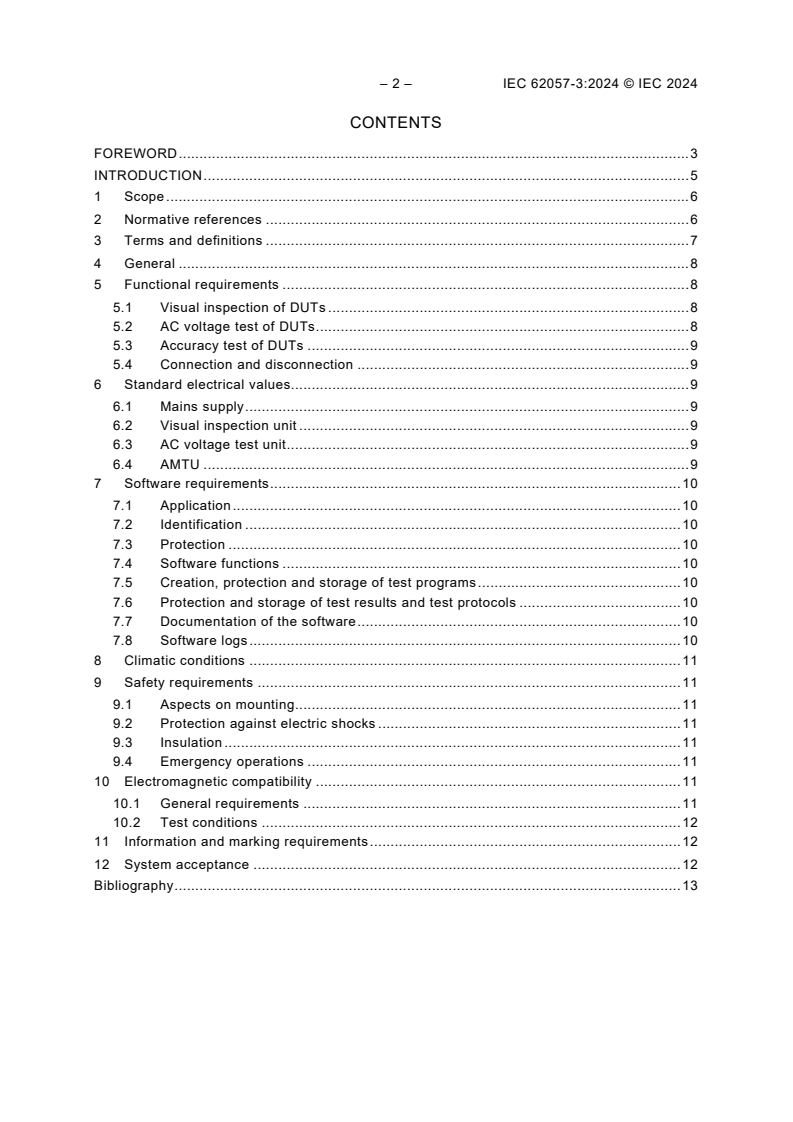
– 2 – IEC 62057-3:2024 © IEC 2024
CONTENTS
FOREWORD . 3
INTRODUCTION . 5
1 Scope . 6
2 Normative references . 6
3 Terms and definitions . 7
4 General . 8
5 Functional requirements . 8
5.1 Visual inspection of DUTs . 8
5.2 AC voltage test of DUTs . 8
5.3 Accuracy test of DUTs . 9
5.4 Connection and disconnection . 9
6 Standard electrical values. 9
6.1 Mains supply . 9
6.2 Visual inspection unit . 9
6.3 AC voltage test unit . 9
6.4 AMTU . 9
7 Software requirements . 10
7.1 Application . 10
7.2 Identification . 10
7.3 Protection . 10
7.4 Software functions . 10
7.5 Creation, protection and storage of test programs . 10
7.6 Protection and storage of test results and test protocols . 10
7.7 Documentation of the software . 10
7.8 Software logs . 10
8 Climatic conditions . 11
9 Safety requirements . 11
9.1 Aspects on mounting. 11
9.2 Protection against electric shocks . 11
9.3 Insulation . 11
9.4 Emergency operations . 11
10 Electromagnetic compatibility . 11
10.1 General requirements . 11
10.2 Test conditions . 12
11 Information and marking requirements . 12
12 System acceptance . 12
Bibliography . 13
INTERNATIONAL ELECTROTECHNICAL COMMISSION
____________
ELECTRICAL ENERGY METERS –
TEST EQUIPMENT, TECHNIQUES AND PROCEDURES –
Part 3: Automatic meter testing system (AMTS)
FOREWORD
1) The International Electrotechnical Commission (IEC) is a worldwide organization for standardization comprising
all national electrotechnical committees (IEC National Committees). The object of IEC is to promote international
co-operation on all questions concerning standardization in the electrical and electronic fields. To this end and
in addition to other activities, IEC publishes International Standards, Technical Specifications, Technical Reports,
Publicly Available Specifications (PAS) and Guides (hereafter referred to as “IEC Publication(s)”). Their
preparation is entrusted to technical committees; any IEC National Committee interested in the subject dealt with
may participate in this preparatory work. International, governmental and non-governmental organizations liaising
with the IEC also participate in this preparation. IEC collaborates closely with the International Organization for
Standardization (ISO) in accordance with conditions determined by agreement between the two organizations.
2) The formal decisions or agreements of IEC on technical matters express, as nearly as possible, an international
consensus of opinion on the relevant subjects since each technical committee has representation from all
interested IEC National Committees.
3) IEC Publications have the form of recommendations for international use and are accepted by IEC National
Committees in that sense. While all reasonable efforts are made to ensure that the technical content of IEC
Publications is accurate, IEC cannot be held responsible for the way in which they are used or for any
misinterpretation by any end user.
4) In order to promote international uniformity, IEC National Committees undertake to apply IEC Publications
transparently to the maximum extent possible in their national and regional publications. Any divergence between
any IEC Publication and the corresponding national or regional publication shall be clearly indicated in the latter.
5) IEC itself does not provide any attestation of conformity. Independent certification bodies provide conformity
assessment services and, in some areas, access to IEC marks of conformity. IEC is not responsible for any
services carried out by independent certification bodies.
6) All users should ensure that they have the latest edition of this publication.
7) No liability shall attach to IEC or its directors, employees, servants or agents including individual experts and
members of its technical committees and IEC National Committees for any personal injury, property damage or
other damage of any nature whatsoever, whether direct or indirect, or for costs (including legal fees) and
expenses arising out of the publication, use of, or reliance upon, this IEC Publication or any other IEC
Publications.
8) Attention is drawn to the Normative references cited in this publication. Use of the referenced publications is
indispensable for the correct application of this publication.
9) IEC draws attention to the possibility that the implementation of this document may involve the use of (a)
patent(s). IEC takes no position concerning the evidence, validity or applicability of any claimed patent rights in
respect thereof. As of the date of publication of this document, IEC had not received notice of (a) patent(s), which
may be required to implement this document. However, implementers are cautioned that this may not represent
the latest information, which may be obtained from the patent database available at https://patents.iec.ch. IEC
shall not be held responsible for identifying any or all such patent rights.
IEC 62057-3 has been prepared by IEC technical committee 13: Electrical energy measurement
and control. It is an International Standard.
The text of this International Standard is based on the following documents:
Draft Report on voting
13/1916/FDIS 13/1919/RVD
Full information on the voting for its approval can be found in the report on voting indicated in
the above table.
The language used for the development of this International Standard is English.
– 4 – IEC 62057-3:2024 © IEC 2024
This document was drafted in accordance with ISO/IEC Directives, Part 2, and developed in
accordance with ISO/IEC Directives, Part 1 and ISO/IEC Directives, IEC Supplement, available
at www.iec.ch/members_experts/refdocs. The main document types developed by IEC are
described in greater detail at www.iec.ch/publications.
A list of all parts in the IEC 62057 series, published under the general title Electrical energy
meters – Test equipment, techniques and procedures, can be found on the IEC website.
The committee has decided that the contents of this document will remain unchanged until the
stability date indicated on the IEC website under webstore.iec.ch in the data related to the
specific document. At this date, the document will be
• reconfirmed,
• withdrawn, or
• revised.
INTRODUCTION
This document aims to define the basic performance requirements for AMTS, while the
construction mode and the technical details depend on agreement between manufacturers and
users, so as not to limit or inhibit innovation and technological advancement;
This document refers to the existing standards to the maximum extent so that the consistency
in the IEC community can be ensured.
– 6 – IEC 62057-3:2024 © IEC 2024
ELECTRICAL ENERGY METERS –
TEST EQUIPMENT, TECHNIQUES AND PROCEDURES –
Part 3: Automatic meter testing system (AMTS)
1 Scope
This part of IEC 62057 applies to an automatic meter testing system (AMTS) permanently
installed in a controlled environment. It covers the functions, technical requirements and
acceptance methods of an AMTS. It also applies to a newly manufactured AMTS to test static
active or reactive energy meters on 50 Hz or 60 Hz networks with an AC voltage up to 600 V
(phase to neutral).
NOTE The controlled environment refers to places that meet the test requirements of meters.
This document defines the kind of AMTS that can continuously and automatically carry out all
the test items specified in IEC 62058-31, including visual inspection, AC voltage test, no-load
condition, starting current, accuracy and meter constant test.
This document does not apply to:
• data interfaces to the meter and test procedures of data interface;
• industrial controllers, industrial personal computers, and servers supplied along with the
AMTS.
2 Normative references
The following documents are referred to in the text in such a way that some or all of their content
constitutes requirements of this document. For dated references, only the edition cited applies.
For undated references, the latest edition of the referenced document (including any
amendments) applies.
IEC 60204-1:2016, Safety of machinery - Electrical equipment of machines - Part 1: General
requirements
IEC 60204-1:2016/AMD1:2021
IEC 61010-1:2010, Safety requirements for electrical equipment for measurement, control, and
laboratory use – Part 1: General requirements
IEC 61010-1:2010/AMD1:2016
IEC 61140, Protection against electric shock – Common aspects for installation and equipment
IEC 61180:2016, High-voltage test techniques for low-voltage equipment – Definitions, test and
procedure requirements, test equipment
IEC 61326-1:2020, Electrical equipment for measurement, control and laboratory use – EMC
requirements – Part 1: General requirements
IEC 62052-31:2015, Electricity metering equipment (AC) – General requirements, tests and test
conditions – Part 31: Product safety requirements and tests
IEC 62053-21:2020, Electricity metering equipment – Particular requirements – Part 21: Static
meters for AC active energy (classes 0,5, 1 and 2)
IEC 62053-22:2020, Electricity metering equipment – Particular requirements – Part 22: Static
meters for active energy (classes 0,1S, 0,2S and 0,5S)
IEC 62053-23:2020, Electricity metering equipment) – Particular requirements – Part 23: Static
meters for reactive energy (classes 2 and 3)
IEC 62053-24:2020, Electricity metering equipment – Particular requirements – Part 24: Static
meters for fundamental component reactive energy (classes 0,5S, 1S, 1, 2 and 3)
IEC 62054-21:2004, Electricity metering (a.c.) – Tariff and load control – Part 21: Particular
requirements for time switches
IEC 62054-21:2004/AMD1:2017
IEC 62057-1:2023, Electrical energy meters – Test equipment, techniques and procedures –
Part 1: Stationary meter test units (MTUs)
IEC 62058-31:2008, Electricity metering equipment (AC) – Acceptance inspection – Part 31:
Particular requirements for static meters for active energy (classes 0,2 S,0,5 S,1 and 2)
3 Terms and definitions
For the purposes of this document, the following terms and definitions apply.
ISO and IEC maintain terminology databases for use in standardization at the following
addresses:
• IEC Electropedia: available at https://www.electropedia.org/
• ISO Online browsing platform: available at https://www.iso.org/obp
3.1
device under test
DUT
meter intended to measure active/reactive/apparent energy by integrating
active/reactive/apparent power with respect to time
Note 1 to entry: For the definition of various types of energy meters and their elements, see IEC 62052-11,
IEC 62053-21, IEC 62053-22, IEC 62053-23, and IEC 62053-24.
[SOURCE: IEC 62057-1:2023, 3.1.1, modified – in the definition the term “active and/or reactive”
has been replaced with “active/reactive/apparent”.]
3.2
meter test unit
MTU
assembly of sources, frequency generator, reference or working standard, and error calculation
and indication system to supply the required test values to the DUT(s) and to measure, calculate
and display the error of the DUT(s)
[SOURCE: IEC 62057-1:2023, 3.1.2, modified – in the definition “signals” has been replaced
with “values”.]
– 8 – IEC 62057-3:2024 © IEC 2024
3.3
automatic meter testing unit
AMTU
MTU which conducts, controls and monitors the desired function(s) or activity(ies) of meter
testing through computer controlled software
[SOURCE: IEC 62057-1:2023, 3.1.3]
3.4
automatic meter testing system
AMTS
test system which consists of visual inspection unit(s), AC voltage test unit(s), AMTU(s), and
connecting and disconnecting unit(s), and continuously conducts preset DUT test items and
activities under computer controlled software without human intervention
3.5
connection and disconnection
process of electrical contact and separation between meter terminals and test equipment in
automatic manner
4 General
An AMTS has the basic functions of visual inspection, AC voltage test, accuracy test, ability to
move meters from one location to another, and connecting and disconnecting.
All test items specified in IEC 62058-31:2008, Clause 5, can be carried out by an AMTS
continuously and automatically, and all the information during the tests can be recorded.
The tests shall be carried out in accordance with the sequence defined in of IEC 62058-31:2008,
Table 4.
Measures shall be taken by the AMTS to deal with those DUTs detected as unqualified during
the test. No further tests shall be performed on unqualified DUTs.
When an abnormality occurs, the AMTS shall recover to its normal operation promptly.
To ensure the accuracy of test results, electromagnetic isolation measures such as sufficient
space or electromagnetic shielding should be taken between each test position.
The essential health and safety requirements relating to the design of the AMTS can be subject
to relevant laws and regulations.
5 Functional requirements
5.1 Visual inspection of DUTs
The AMTS shall automatically identify the DUTs’ marks and appearances and give results in
accordance with the requirements of IEC 62058-31:2008, 5.2.
5.2 AC voltage test of DUTs
The AMTS shall automatically carry out the AC voltage test on DUTs in accordance with
IEC 62052-31:2015, 6.10.4.3.4.
The requirements of an AC voltage generator shall be in accordance with IEC 61180:2016,
Clause 6.
During the tests, in case the leakage current of the DUT at a test position reaches the limits of
the tripping current, the test voltage at that position shall be automatically and promptly cut off,
without disrupting the tests at other positions.
5.3 Accuracy test of DUTs
The requirements, test conditions, and procedures of IEC 62057-1 apply.
The tests of no-load condition, starting current, accuracy and meter constant shall be carried
out automatically in accordance with the requirements of IEC 62053-21:2020, Clause 7, for
static meters for AC active energy (classes 0,5, 1 and 2), IEC 62053-22:2020, Clause 7, for
static meters for AC active energy (classes 0,1 S, 0,2 S and 0,5 S), IEC 62053-23:2020, Clause
7, for static meters for reactive energy (classes 2 and 3) or IEC 62053-24:2020, Clause 7, for
static meters for fundamental component reactive energy classes (0,5 S, 1 S, 1, 2 and 3).
The AMTS shall be able to detect the condition of the broken circuit occurring at a test position,
and then short that circuit and mark the condition.
For the DUTs with time switches, the time-keeping accuracy test shall be carried out in
accordance with IEC 62054-21:2004, 7.5.2.3.
5.4 Connection and disconnection
The voltage terminals, current terminals and auxiliary terminals (if any) of the DUTs shall be
automatically and reliably connected to the corresponding terminals of test positions, and the
connecting reliability shall be monitored in a timely way.
Measuring temperature, measuring impedance or mechanical means for monitoring of
connecting reliability can be used for the purpose of monitoring.
All current terminals shall be able to carry the maximum test currents continuously, without
forced cooling under the operating conditions specified.
The voltage terminals, current terminals and auxiliary terminals (if any) of the DUTs shall be
automatically and reliably disconnected from the corresponding terminals of test positions, and
the disconnecting reliability shall be monitored in a timely way.
6 Standard electrical values
6.1 Mains supply
The requirements of IEC 62057-1:2023, 6.1, apply.
6.2 Visual inspection unit
The main power supply to the DUTs, if necessary, shall be provided, and the values of voltage
and frequency shall match with those of the DUTs.
6.3 AC voltage test unit
At each test position, the output of the AC voltage test unit shall meet the requirements of
IEC 62052-31:2015, 6.10.2.5 and 6.10.4.3.4.
6.4 AMTU
The requirements of IEC 62057-1:2023, Clause 6 apply.
– 10 – IEC 62057-3:2024 © IEC 2024
7 Software requirements
7.1 Application
The following requirements apply to the software supplied along with the AMTS, including the
control and management software for the entire system, as well as the test software for each
test function. The software related to the AMTU shall comply with the requirements of
IEC 62057-1:2023, 13.1.
If necessary, the user and supplier may agree on other software requirements.
7.2 Identification
The requirements of identification given in IEC 62057-1:2023, 13.2, apply.
7.3 Protection
The requirements of protection given in IEC 62057-1:2023, 13.3, apply.
7.4 Software functions
The software of the AMTS shall support the following functions:
• scheduling and managing test tasks for the DUTs;
• generating test programs according to the tasks;
• executing the test programs:
– displaying the test parameters, operating status information and test results;
– storing test data and results;
• controlling and supervising the operation of the AMTS;
• monitoring the operating status of the AMTS, which includes at least the following:
– mechanical malfunctions and faults;
– abnormal measurement parameters and test results in the test process;
• recording in real time the critical operation data which is essential to system recovery;
• power failure function or system abnormality handling: the test shall be completely repeated.
The functional requirements of the AMTU shall comply with IEC 62057-1:2023, 13.4.
7.5 Creation, protection and storage of test programs
The requirements given in IEC 62057-1:2023, 13.6, apply.
7.6 Protection and storage of test results and test protocols
The requirements given in IEC 62057-1:2023, 13.7, apply.
7.7 Documentation of the software
The requirements given in IEC 62057-1:2023, 13.8, apply.
7.8 Software logs
The requirements given in IEC 62057-1:2023, 13.9, apply.
8 Climatic conditions
The requirements and values given in IEC 62057-1:2023, Clause 9, apply.
9 Safety requirements
9.1 Aspects on mounting
The safety requirements for the mounting of the AMTS shall be in accordance with IEC 60204-1.
9.2 Protection against electric shocks
Units with hazardous voltage shall be of protective class I in accordance with IEC 61140.
AMTU(s) shall also meet the requirements of IEC 62057-1:2023, 7.1.
9.3 Insulation
The dielectric strength of the AMTS can be verified by an AC voltage test.
The AC voltage test for the AMTU shall be carried out in accordance with IEC 62057-1:2023,
10.2.4.
The AC voltage tests for other hazardous live units of the AMTS shall be carried out in
accordance with IEC 62052-31:2015, 6.10.2.5. The test voltage shall be applied for 1 min. The
power source shall provide at least 500 VA capacity.
The following components of the AMTS shall be tested for insulation strength:
• AC voltage generator(s) and ancillary meter test rack(s);
• supply device of visual inspection unit(s) and ancillary meter test rack(s).
The AC voltage test parameters shall meet the requirements of IEC 61010-1:2010, Table K.8,
and the test voltage is applied as follows:
– between, on the one hand, all current and voltage circuits as well as all other circuits whose
reference voltage is above 33 V, connected together, and, on the other hand, earth;
– between, on the one hand, any circuit whose reference voltage is above 33 V and, on the
other hand, all other independent circuits whose reference voltage is above 33 V connected
together;
– between circuits not intended to be connected together in service.
During the tests, no flashover, disruptive discharge or puncture shall occur.
9.4 Emergency operations
The requirements given IEC 60204-1:2016 and IEC 60204-1:2016/AMD1:2021, 9.2.3.4, apply.
10 Electromagnetic compatibility
10.1 General requirements
The AMTS shall be designed in such a way that conducted or radiated electromagnetic
phenomena and electrostatic discharge neither damage nor subsequently influence the function
and the accuracy. The electromagnetic compatibility of AMTU(s) in the AMTS shall comply with
the requirements in IEC 62057-1:2023, Clause 11.
– 12 – IEC 62057-3:2024 © IEC 2024
10.2 Test conditions
Generally, the electromagnetic compatibility (EMC) tests cannot be performed on the whole
AMTS. Therefore, each component shall be treated and tested separately.
The standard meter, voltage and current source, multi secondary voltage transformer (MSVT)
and isolating current transformers (ICTs) in the AMTU shall be in accordance with the
requirements of IEC 62057-1. The immunity test requirements of other main components shall
meet the requirements of IEC 61326-1:2020, Table 2, and the electromagnetic interference
(EMI) test results shall co
...