

IEC 62053-21:2020
(Main)Electricity metering equipment - Particular requirements - Part 21: Static meters for AC active energy (classes 0,5, 1 and 2)
General Information
- Abstract
IEC 62053-21:2020 applies only to static watt-hour meters of accuracy classes 0,5, 1 and 2 for the measurement of alternating current electrical active energy in 50 Hz or 60 Hz networks and it applies to their type tests only.
This document applies to electricity metering equipment designed to:
• measure and control electrical energy on electrical networks (mains) with voltage up to 1 000 V AC;
• have all functional elements, including add-on modules, enclosed in, or forming a single meter case with exception of indicating displays;
• operate with integrated or detached indicating displays, or without an indicating display;
• be installed in a specified matching socket or rack;
• optionally, provide additional functions other than those for measurement of electrical energy.
Meters designed for operation with low power instrument transformers (LPITs as defined in the IEC 61869 series) may be tested for compliance with this document only if such meters and their LPITs are tested together and meet the requirements for directly connected meters.
This document does not apply to:
• meters for which the voltage line-to-neutral derived from nominal voltages exceeds 1 000 V AC;
• meters intended for connection with low power instrument transformers (LPITs as defined in the IEC 61869 series) when tested without such transformers;
• metering systems comprising multiple devices (except LPITs) physically remote from one another;
• portable meters;
• meters used in rolling stock, vehicles, ships and airplanes;
• laboratory and meter test equipment;
• reference standard meters;
• data interfaces to the register of the meter;
• matching sockets or racks used for installation of electricity metering equipment;
• any additional functions provided in electrical energy meters.
This document does not cover measures for the detection and prevention of fraudulent attempts to compromise a meter’s performance (tampering).
This second edition cancels and replaces the first edition published in 2003 and its amendment 1:2016. This edition constitutes a technical revision.
This edition includes the following significant technical changes with respect to the previous edition:
a) Removed all meter safety requirements; the meter safety requirements are covered in IEC 62052-31: 2015.
b) Replaced Ib with In; Ib is no longer used when referencing directly connected meters.
c) Moved the descriptions of all general requirements and test methods from IEC 62053-21: 2003, IEC 62053-22: 2003, IEC 62053-23: 2003, IEC 62053-24: 2003 to IEC 62052-11:2020; IEC 62053-21:2020, IEC 62053-22:2020, IEC 62053-23:2020, IEC 62053-24:2020 contain only accuracy class specific requirements.
d) Added new requirements and tests concerning:
1) measurement uncertainty and repeatability (7.3, 7.8);
2) influence of fast load current variations (9.4.12);
3) immunity to conducted differential current disturbances in the 2 kHz to 150 kHz frequency range (9.3.8).
e) Meters designed for operation with low power instrument transformers (LPITs) may be tested for compliance with this document as directly connected meters.
- Status
- Published
- Publication Date
- 16-Jun-2020
- Technical Committee
- TC 13 - Electrical energy measurement and control
- Drafting Committee
- WG 11 - TC 13/WG 11
- Current Stage
- PPUB - Publication issued
- Start Date
- 17-Jun-2020
- Completion Date
- 26-Jun-2020
Overview
IEC 62053-21:2020 is an international standard specifying the particular requirements for static watt-hour meters measuring alternating current (AC) active energy. It applies to meters of accuracy classes 0.5, 1, and 2, designed for use in 50 Hz or 60 Hz electrical networks. This standard focuses exclusively on type testing of static electricity meters intended for connection to AC electrical networks with voltages up to 1,000 V.
This edition replaces the 2003 version and incorporates key technical revisions aimed at improving measurement precision, repeatability, and immunity to electrical disturbances. The standard covers static meters with integrated or detachable indicating displays, single meter cases, and optional additional functions beyond basic energy measurement. Devices tested in conjunction with low power instrument transformers (LPITs) under the IEC 61869 series are also included.
Key Topics
Scope and Application
Applies specifically to static AC active energy meters for direct connection, intended for indoor and outdoor use in electrical distribution and industrial networks. Excludes portable meters, meters for rolling stock, vehicles, or maritime use, and multi-device metering systems.Accuracy Classes
Defines performance and error limits for accuracy classes 0.5, 1, and 2, ensuring reliable measurement aligned with international metering requirements.Testing and Measurement Requirements
Includes tests for no-load conditions, starting current thresholds, measurement uncertainty, repeatability, and response to fast load current variations.Environmental and External Influences
Specifies the meter’s ability to function accurately under varying climatic conditions and resist disturbances such as conducted differential current in the 2 kHz - 150 kHz range.Construction and Marking
Requires all components, including optional modules, to be enclosed within or form a single meter case, except for indicating displays. Clear meter markings and documentation standards are established.Exclusions
The standard does not cover safety requirements (addressed separately in IEC 62052-31), data interfaces, matching sockets/racks, tampering prevention, or metering systems containing physically remote elements.
Applications
IEC 62053-21:2020 standard meters are extensively used in:
- Residential, commercial, and light industrial electricity metering
- Electrical utilities for billing and monitoring energy consumption
- Grid management systems requiring accurate active energy measurement
- Integration with smart grid technologies where compliance to international accuracy is essential
- Testing and certification laboratories validating meter performance against international benchmarks
By conforming to this standard, manufacturers and utilities ensure meters provide consistent, precise readings critical for energy management, cost allocation, and regulatory compliance.
Related Standards
IEC 62053-21:2020 should be used in conjunction with other parts of the IEC 62053 series and related IEC metering standards to cover broader aspects of electricity metering equipment:
- IEC 62052-11:2020 - General requirements, tests, and test conditions for metering equipment
- IEC 62052-31:2015 - Product safety requirements and tests for AC electricity meters
- IEC 62053-22:2020 - Static meters for AC active energy with higher accuracy classes (0.1S, 0.2S, 0.5S)
- IEC 62053-23:2020 and IEC 62053-24:2020 - Reactive energy metering
- IEC 61869 Series - Low power instrument transformers used with meters
- IEC 62058 Series - Acceptance inspection procedures for electricity meters
Together, these standards provide comprehensive guidance covering accuracy, safety, dependability, and performance verification of electricity metering equipment.
Keywords: IEC 62053-21, static electricity meters, AC active energy meters, accuracy classes 0.5 1 2, type testing, electrical energy measurement, IEC standards, watt-hour meters, low power instrument transformers, energy metering equipment, metering accuracy, alternating current measurement.
Relations
- Effective Date
- 05-Sep-2023
- Effective Date
- 05-Sep-2023
- Effective Date
- 05-Sep-2023
Get Certified
Connect with accredited certification bodies for this standard

BSMI (Bureau of Standards, Metrology and Inspection)
Taiwan's standards and inspection authority.
Sponsored listings
Frequently Asked Questions
IEC 62053-21:2020 is a standard published by the International Electrotechnical Commission (IEC). Its full title is "Electricity metering equipment - Particular requirements - Part 21: Static meters for AC active energy (classes 0,5, 1 and 2)". This standard covers: IEC 62053-21:2020 applies only to static watt-hour meters of accuracy classes 0,5, 1 and 2 for the measurement of alternating current electrical active energy in 50 Hz or 60 Hz networks and it applies to their type tests only. This document applies to electricity metering equipment designed to: • measure and control electrical energy on electrical networks (mains) with voltage up to 1 000 V AC; • have all functional elements, including add-on modules, enclosed in, or forming a single meter case with exception of indicating displays; • operate with integrated or detached indicating displays, or without an indicating display; • be installed in a specified matching socket or rack; • optionally, provide additional functions other than those for measurement of electrical energy. Meters designed for operation with low power instrument transformers (LPITs as defined in the IEC 61869 series) may be tested for compliance with this document only if such meters and their LPITs are tested together and meet the requirements for directly connected meters. This document does not apply to: • meters for which the voltage line-to-neutral derived from nominal voltages exceeds 1 000 V AC; • meters intended for connection with low power instrument transformers (LPITs as defined in the IEC 61869 series) when tested without such transformers; • metering systems comprising multiple devices (except LPITs) physically remote from one another; • portable meters; • meters used in rolling stock, vehicles, ships and airplanes; • laboratory and meter test equipment; • reference standard meters; • data interfaces to the register of the meter; • matching sockets or racks used for installation of electricity metering equipment; • any additional functions provided in electrical energy meters. This document does not cover measures for the detection and prevention of fraudulent attempts to compromise a meter’s performance (tampering). This second edition cancels and replaces the first edition published in 2003 and its amendment 1:2016. This edition constitutes a technical revision. This edition includes the following significant technical changes with respect to the previous edition: a) Removed all meter safety requirements; the meter safety requirements are covered in IEC 62052-31: 2015. b) Replaced Ib with In; Ib is no longer used when referencing directly connected meters. c) Moved the descriptions of all general requirements and test methods from IEC 62053-21: 2003, IEC 62053-22: 2003, IEC 62053-23: 2003, IEC 62053-24: 2003 to IEC 62052-11:2020; IEC 62053-21:2020, IEC 62053-22:2020, IEC 62053-23:2020, IEC 62053-24:2020 contain only accuracy class specific requirements. d) Added new requirements and tests concerning: 1) measurement uncertainty and repeatability (7.3, 7.8); 2) influence of fast load current variations (9.4.12); 3) immunity to conducted differential current disturbances in the 2 kHz to 150 kHz frequency range (9.3.8). e) Meters designed for operation with low power instrument transformers (LPITs) may be tested for compliance with this document as directly connected meters.
IEC 62053-21:2020 applies only to static watt-hour meters of accuracy classes 0,5, 1 and 2 for the measurement of alternating current electrical active energy in 50 Hz or 60 Hz networks and it applies to their type tests only. This document applies to electricity metering equipment designed to: • measure and control electrical energy on electrical networks (mains) with voltage up to 1 000 V AC; • have all functional elements, including add-on modules, enclosed in, or forming a single meter case with exception of indicating displays; • operate with integrated or detached indicating displays, or without an indicating display; • be installed in a specified matching socket or rack; • optionally, provide additional functions other than those for measurement of electrical energy. Meters designed for operation with low power instrument transformers (LPITs as defined in the IEC 61869 series) may be tested for compliance with this document only if such meters and their LPITs are tested together and meet the requirements for directly connected meters. This document does not apply to: • meters for which the voltage line-to-neutral derived from nominal voltages exceeds 1 000 V AC; • meters intended for connection with low power instrument transformers (LPITs as defined in the IEC 61869 series) when tested without such transformers; • metering systems comprising multiple devices (except LPITs) physically remote from one another; • portable meters; • meters used in rolling stock, vehicles, ships and airplanes; • laboratory and meter test equipment; • reference standard meters; • data interfaces to the register of the meter; • matching sockets or racks used for installation of electricity metering equipment; • any additional functions provided in electrical energy meters. This document does not cover measures for the detection and prevention of fraudulent attempts to compromise a meter’s performance (tampering). This second edition cancels and replaces the first edition published in 2003 and its amendment 1:2016. This edition constitutes a technical revision. This edition includes the following significant technical changes with respect to the previous edition: a) Removed all meter safety requirements; the meter safety requirements are covered in IEC 62052-31: 2015. b) Replaced Ib with In; Ib is no longer used when referencing directly connected meters. c) Moved the descriptions of all general requirements and test methods from IEC 62053-21: 2003, IEC 62053-22: 2003, IEC 62053-23: 2003, IEC 62053-24: 2003 to IEC 62052-11:2020; IEC 62053-21:2020, IEC 62053-22:2020, IEC 62053-23:2020, IEC 62053-24:2020 contain only accuracy class specific requirements. d) Added new requirements and tests concerning: 1) measurement uncertainty and repeatability (7.3, 7.8); 2) influence of fast load current variations (9.4.12); 3) immunity to conducted differential current disturbances in the 2 kHz to 150 kHz frequency range (9.3.8). e) Meters designed for operation with low power instrument transformers (LPITs) may be tested for compliance with this document as directly connected meters.
IEC 62053-21:2020 is classified under the following ICS (International Classification for Standards) categories: 17.220.20 - Measurement of electrical and magnetic quantities. The ICS classification helps identify the subject area and facilitates finding related standards.
IEC 62053-21:2020 has the following relationships with other standards: It is inter standard links to IEC 62053-21:2003/AMD1:2016, IEC 62053-21:2003, IEC 62053-21:2003/AMD1:2016/COR1:2018. Understanding these relationships helps ensure you are using the most current and applicable version of the standard.
IEC 62053-21:2020 is available in PDF format for immediate download after purchase. The document can be added to your cart and obtained through the secure checkout process. Digital delivery ensures instant access to the complete standard document.
Standards Content (Sample)
IEC 62053-21 ®
Edition 2.0 2020-06
INTERNATIONAL
STANDARD
NORME
INTERNATIONALE
Electricity metering equipment – Particular requirements –
Part 21: Static meters for AC active energy (classes 0,5, 1 and 2)
Équipement de comptage de l'électricité – Exigences particulières –
Partie 21: Compteurs statiques d'énergie active en courant alternatif
(classes 0,5, 1 et 2)
All rights reserved. Unless otherwise specified, no part of this publication may be reproduced or utilized in any form
or by any means, electronic or mechanical, including photocopying and microfilm, without permission in writing from
either IEC or IEC's member National Committee in the country of the requester. If you have any questions about IEC
copyright or have an enquiry about obtaining additional rights to this publication, please contact the address below or
your local IEC member National Committee for further information.
Droits de reproduction réservés. Sauf indication contraire, aucune partie de cette publication ne peut être reproduite
ni utilisée sous quelque forme que ce soit et par aucun procédé, électronique ou mécanique, y compris la photocopie
et les microfilms, sans l'accord écrit de l'IEC ou du Comité national de l'IEC du pays du demandeur. Si vous avez des
questions sur le copyright de l'IEC ou si vous désirez obtenir des droits supplémentaires sur cette publication, utilisez
les coordonnées ci-après ou contactez le Comité national de l'IEC de votre pays de résidence.
IEC Central Office Tel.: +41 22 919 02 11
3, rue de Varembé info@iec.ch
CH-1211 Geneva 20 www.iec.ch
Switzerland
About the IEC
The International Electrotechnical Commission (IEC) is the leading global organization that prepares and publishes
International Standards for all electrical, electronic and related technologies.
About IEC publications
The technical content of IEC publications is kept under constant review by the IEC. Please make sure that you have the
latest edition, a corrigendum or an amendment might have been published.
IEC publications search - webstore.iec.ch/advsearchform Electropedia - www.electropedia.org
The advanced search enables to find IEC publications by a The world's leading online dictionary on electrotechnology,
variety of criteria (reference number, text, technical containing more than 22 000 terminological entries in English
committee,…). It also gives information on projects, replaced and French, with equivalent terms in 16 additional languages.
and withdrawn publications. Also known as the International Electrotechnical Vocabulary
(IEV) online.
IEC Just Published - webstore.iec.ch/justpublished
Stay up to date on all new IEC publications. Just Published IEC Glossary - std.iec.ch/glossary
details all new publications released. Available online and 67 000 electrotechnical terminology entries in English and
once a month by email. French extracted from the Terms and Definitions clause of
IEC publications issued since 2002. Some entries have been
IEC Customer Service Centre - webstore.iec.ch/csc collected from earlier publications of IEC TC 37, 77, 86 and
If you wish to give us your feedback on this publication or CISPR.
need further assistance, please contact the Customer Service
Centre: sales@iec.ch.
A propos de l'IEC
La Commission Electrotechnique Internationale (IEC) est la première organisation mondiale qui élabore et publie des
Normes internationales pour tout ce qui a trait à l'électricité, à l'électronique et aux technologies apparentées.
A propos des publications IEC
Le contenu technique des publications IEC est constamment revu. Veuillez vous assurer que vous possédez l’édition la
plus récente, un corrigendum ou amendement peut avoir été publié.
Recherche de publications IEC - Electropedia - www.electropedia.org
webstore.iec.ch/advsearchform Le premier dictionnaire d'électrotechnologie en ligne au
La recherche avancée permet de trouver des publications IEC monde, avec plus de 22 000 articles terminologiques en
en utilisant différents critères (numéro de référence, texte, anglais et en français, ainsi que les termes équivalents dans
comité d’études,…). Elle donne aussi des informations sur les 16 langues additionnelles. Egalement appelé Vocabulaire
projets et les publications remplacées ou retirées. Electrotechnique International (IEV) en ligne.
IEC Just Published - webstore.iec.ch/justpublished Glossaire IEC - std.iec.ch/glossary
Restez informé sur les nouvelles publications IEC. Just 67 000 entrées terminologiques électrotechniques, en anglais
Published détaille les nouvelles publications parues. et en français, extraites des articles Termes et Définitions des
Disponible en ligne et une fois par mois par email. publications IEC parues depuis 2002. Plus certaines entrées
antérieures extraites des publications des CE 37, 77, 86 et
Service Clients - webstore.iec.ch/csc CISPR de l'IEC.
Si vous désirez nous donner des commentaires sur cette
publication ou si vous avez des questions contactez-nous:
sales@iec.ch.
IEC 62053-21 ®
Edition 2.0 2020-06
INTERNATIONAL
STANDARD
NORME
INTERNATIONALE
Electricity metering equipment – Particular requirements –
Part 21: Static meters for AC active energy (classes 0,5, 1 and 2)
Équipement de comptage de l'électricité – Exigences particulières –
Partie 21: Compteurs statiques d'énergie active en courant alternatif
(classes 0,5, 1 et 2)
INTERNATIONAL
ELECTROTECHNICAL
COMMISSION
COMMISSION
ELECTROTECHNIQUE
INTERNATIONALE
ICS 17.220.20 ISBN 978-2-8322-8438-4
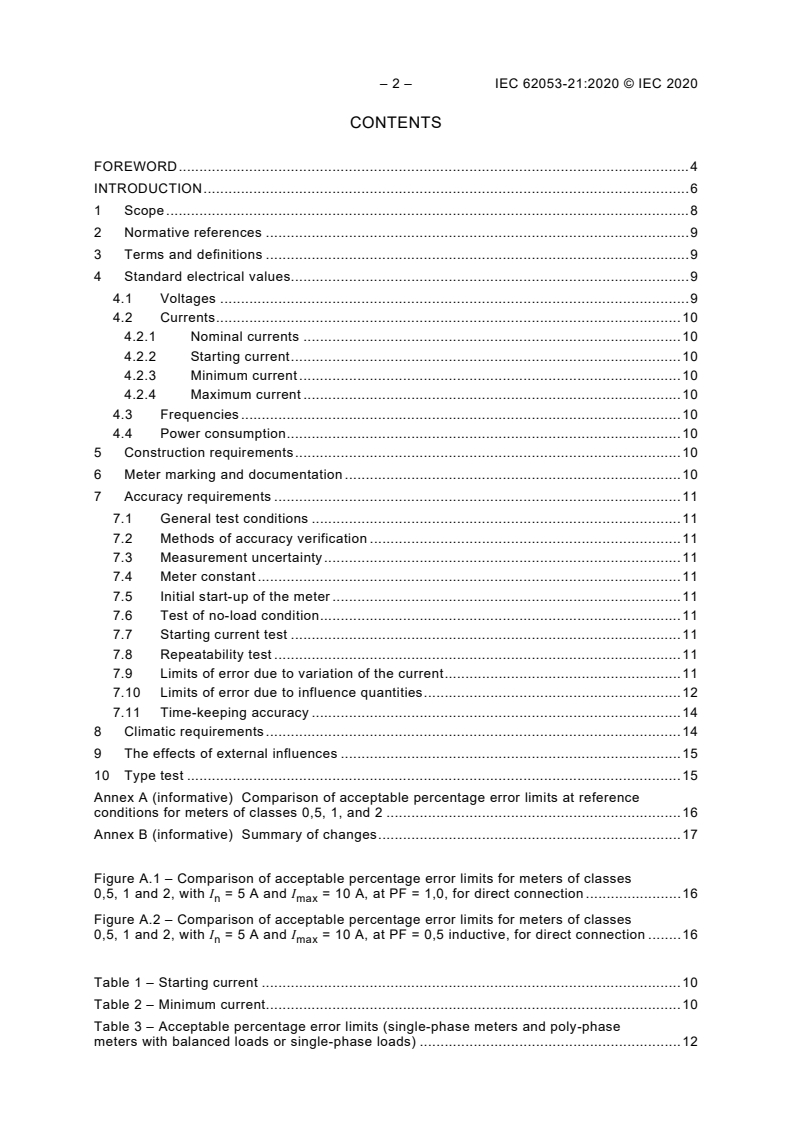
– 2 – IEC 62053-21:2020 © IEC 2020
CONTENTS
FOREWORD . 4
INTRODUCTION . 6
1 Scope . 8
2 Normative references . 9
3 Terms and definitions . 9
4 Standard electrical values. 9
4.1 Voltages . 9
4.2 Currents . 10
4.2.1 Nominal currents . 10
4.2.2 Starting current . 10
4.2.3 Minimum current . 10
4.2.4 Maximum current . 10
4.3 Frequencies . 10
4.4 Power consumption . 10
5 Construction requirements . 10
6 Meter marking and documentation . 10
7 Accuracy requirements . 11
7.1 General test conditions . 11
7.2 Methods of accuracy verification . 11
7.3 Measurement uncertainty . 11
7.4 Meter constant . 11
7.5 Initial start-up of the meter . 11
7.6 Test of no-load condition . 11
7.7 Starting current test . 11
7.8 Repeatability test . 11
7.9 Limits of error due to variation of the current . 11
7.10 Limits of error due to influence quantities . 12
7.11 Time-keeping accuracy . 14
8 Climatic requirements . 14
9 The effects of external influences . 15
10 Type test . 15
Annex A (informative) Comparison of acceptable percentage error limits at reference
conditions for meters of classes 0,5, 1, and 2 . 16
Annex B (informative) Summary of changes . 17
Figure A.1 – Comparison of acceptable percentage error limits for meters of classes
0,5, 1 and 2, with I = 5 A and I = 10 A, at PF = 1,0, for direct connection . 16
n max
Figure A.2 – Comparison of acceptable percentage error limits for meters of classes
0,5, 1 and 2, with I = 5 A and I = 10 A, at PF = 0,5 inductive, for direct connection . 16
n max
Table 1 – Starting current . 10
Table 2 – Minimum current. 10
Table 3 – Acceptable percentage error limits (single-phase meters and poly-phase
meters with balanced loads or single-phase loads) . 12
Table 4 – Acceptable limits of variation in percentage error due to influence quantities . 13
– 4 – IEC 62053-21:2020 © IEC 2020
INTERNATIONAL ELECTROTECHNICAL COMMISSION
____________
ELECTRICITY METERING EQUIPMENT –
PARTICULAR REQUIREMENTS –
Part 21: Static meters for AC active energy (classes 0,5, 1 and 2)
FOREWORD
1) The International Electrotechnical Commission (IEC) is a worldwide organization for standardization comprising
all national electrotechnical committees (IEC National Committees). The object of IEC is to promote international
co-operation on all questions concerning standardization in the electrical and electronic fields. To this end and
in addition to other activities, IEC publishes International Standards, Technical Specifications, Technical Reports,
Publicly Available Specifications (PAS) and Guides (hereafter referred to as “IEC Publication(s)”). Their
preparation is entrusted to technical committees; any IEC National Committee interested in the subject dealt with
may participate in this preparatory work. International, governmental and non-governmental organizations liaising
with the IEC also participate in this preparation. IEC collaborates closely with the International Organization for
Standardization (ISO) in accordance with conditions determined by agreement between the two organizations.
2) The formal decisions or agreements of IEC on technical matters express, as nearly as possible, an international
consensus of opinion on the relevant subjects since each technical committee has representation from all
interested IEC National Committees.
3) IEC Publications have the form of recommendations for international use and are accepted by IEC National
Committees in that sense. While all reasonable efforts are made to ensure that the technical content of IEC
Publications is accurate, IEC cannot be held responsible for the way in which they are used or for any
misinterpretation by any end user.
4) In order to promote international uniformity, IEC National Committees undertake to apply IEC Publications
transparently to the maximum extent possible in their national and regional publications. Any divergence between
any IEC Publication and the corresponding national or regional publication shall be clearly indicated in the latter.
5) IEC itself does not provide any attestation of conformity. Independent certification bodies provide conformity
assessment services and, in some areas, access to IEC marks of conformity. IEC is not responsible for any
services carried out by independent certification bodies.
6) All users should ensure that they have the latest edition of this publication.
7) No liability shall attach to IEC or its directors, employees, servants or agents including individual experts and
members of its technical committees and IEC National Committees for any personal injury, property damage or
other damage of any nature whatsoever, whether direct or indirect, or for costs (including legal fees) and
expenses arising out of the publication, use of, or reliance upon, this IEC Publication or any other IEC
Publications.
8) Attention is drawn to the Normative references cited in this publication. Use of the referenced publications is
indispensable for the correct application of this publication.
9) Attention is drawn to the possibility that some of the elements of this IEC Publication may be the subject of patent
rights. IEC shall not be held responsible for identifying any or all such patent rights.
International Standard IEC 62053-21 has been prepared by IEC technical committee 13:
Electrical energy measurement and control.
This second edition cancels and replaces the first edition published in 2003 and its
amendment 1:2016. This edition constitutes a technical revision.
This edition includes the following significant technical changes with respect to the previous
edition: see Annex B.
The text of this International Standard is based on the following documents:
FDIS Report on voting
13/1805A/FDIS 13/1813/RVD
Full information on the voting for the approval of this International Standard can be found in the
report on voting indicated in the above table.
This document has been drafted in accordance with the ISO/IEC Directives, Part 2.
A list of all parts in the IEC 62053 series, published under the general title Electricity metering
equipment – Particular requirements, can be found on the IEC website.
The committee has decided that the contents of this document will remain unchanged until the
stability date indicated on the IEC website under "http://webstore.iec.ch" in the data related to
the specific document. At this date, the document will be
• reconfirmed,
• withdrawn,
• replaced by a revised edition, or
• amended.
NOTE The attention of National Committees is drawn to the fact that equipment manufacturers and testing
organizations may need a transitional period following publication of a new, amended or revised IEC publication in
which to make products in accordance with the new requirements and to equip themselves for conducting new or
revised tests.
It is the recommendation of the committee that the content of this publication be adopted for implementation nationally
not earlier than 2 years from the date of publication.
– 6 – IEC 62053-21:2020 © IEC 2020
INTRODUCTION
This part of IEC 62053 is to be used with relevant parts of the IEC 62052, IEC 62058 and
IEC 62059 series, Electricity metering equipment, and with the IEC 62055 series, Electricity
metering – Payment systems:
IEC 62052‑11:2020, Electricity metering equipment – General requirements, tests
and test conditions – Part 11: Metering equipment
IEC 62052‑31:2015, Electricity metering equipment (AC) – General requirements,
tests and test conditions – Part 31: Product safety
requirements and tests
IEC 62053‑11:2003, Electricity metering equipment (AC) – Particular requirements
– Part 11: Electromechanical meters for active energy
(classes 0,5, 1 and 2)
IEC 62053‑22:2020, Electricity metering equipment – Particular requirements –
Part 22: Static meters for AC active energy (classes 0,1 S, 0,2
S and 0,5 S)
IEC 62053‑23:2020, Electricity metering equipment – Particular requirements –
Part 23: Static meters for reactive energy (classes 2 and 3)
IEC 62053‑24:2020, Electricity metering equipment – Particular requirements –
Part 24: Static meters for fundamental component reactive
energy (classes 0,5 S, 1S, 1, 2 and 3)
IEC 62053‑41: –, Electricity metering equipment– Particular requirements –
Part 41: Static meters for direct current energy (classes 0,5
and 1)
IEC 62055‑31:2005, Electricity metering – Payment systems – Part 31: Particular
requirements – Static payment meters for active energy
(classes 1 and 2)
IEC 62057‑1: – Test equipment, techniques and procedures for electrical
energy meters – Part 1: Stationary Meter Test Units (MTU)
IEC 62058‑11:2008, Electricity metering equipment (AC) – Acceptance inspection -
–Part 11: General acceptance inspection methods
IEC 62058‑21:2008, Electricity metering equipment (AC) – Acceptance inspection
– Part 21: Particular requirements for electromechanical
meters for active energy (classes 0,5, 1 and 2)
IEC 62058‑31:2008, Electricity metering equipment (AC) – Acceptance inspection
– Part 31: Particular requirements for static meters for active
energy (classes 0,2 S, 0,5 S, 1 and 2)
IEC 62059‑11:2002, Electricity metering equipment – Dependability – Part 11:
General concepts
IEC 62059‑21:2002, Electricity metering equipment – Dependability – Part 21:
Collection of meter dependability data from the field
IEC 62059‑32‑1:2011, Electricity metering equipment – Dependability – Part 32-1:
Durability – Testing of the stability of metrological
characteristics by applying elevated temperature
This part is a standard for type testing electricity meters. It covers the particular requirements
for meters, being used indoors and outdoors in large quantities worldwide. It does not deal with
special implementations (such as metering-part and/or displays in separate housings).
This document is intended to be used in conjunction with IEC 62052-11:2020 and with
IEC 62052-31: 2015. When any requirement in this document concerns an item already covered
in IEC 62052-11:2020 or in IEC 62052-31:2015, the requirements of this document take
precedence over the requirements of IEC 62052-11:2020 or of IEC 62052-31:2015.
The test levels are regarded as minimum values that provide for the proper functioning of the
meter under normal working conditions. For special applications, additional test levels might be
necessary and are subject to an agreement between the manufacturer and the purchaser.
– 8 – IEC 62053-21:2020 © IEC 2020
ELECTRICITY METERING EQUIPMENT –
PARTICULAR REQUIREMENTS –
Part 21: Static meters for AC active energy (classes 0,5, 1 and 2)
1 Scope
This part of IEC 62053 applies only to static watt-hour meters of accuracy classes 0,5, 1 and 2
for the measurement of alternating current electrical active energy in 50 Hz or 60 Hz networks
and it applies to their type tests only.
NOTE 1 For other general requirements, such as safety, dependability, etc., see the relevant IEC 62052 or
IEC 62059 standards.
This document applies to electricity metering equipment designed to:
• measure and control electrical energy on electrical networks (mains) with voltage up to
1 000 V;
NOTE 2 For AC electricity meters, the voltage mentioned above is the line-to-neutral voltage derived from nominal
voltages. See IEC 62052-31: 2015, Table 7.
• have all functional elements, including add-on modules, enclosed in, or forming a single
meter case with exception of indicating displays;
• operate with integrated or detached indicating displays, or without an indicating display;
• be installed in a specified matching socket or rack;
• optionally, provide additional functions other than those for measurement of electrical
energy.
Meters designed for operation with low power instrument transformers (LPITs as defined in the
IEC 61869 series) may be tested for compliance with this document only if such meters and
their LPITs are tested together and meet the requirements for directly connected meters.
NOTE 3 Modern electricity meters typically contain additional functions such as measurement of voltage magnitude,
current magnitude, power, frequency, power factor, etc.; measurement of power quality parameters; load control
functions; delivery, time, test, accounting, recording functions; data communication interfaces and associated data
security functions. The relevant standards for these functions may apply in addition to the requirements of this
document. However, the requirements for such functions are outside the scope of this document.
NOTE 4 Product requirements for power metering and monitoring devices (PMDs) and measurement functions such
as voltage magnitude, current magnitude, power, frequency, etc., are covered in IEC 61557-12. However, devices
compliant with IEC 61557-12 are not intended to be used as billing meters unless they are also compliant with
IEC 62052-11:2020 and one or more relevant IEC 62053-xx accuracy class standards.
NOTE 5 Product requirements for power quality instruments (PQIs) are covered in IEC 62586-1. Requirements for
power quality measurement techniques (functions) are covered in IEC 61000-4-30. Requirements for testing of the
power quality measurement functions are covered in IEC 62586-2.
This document does not apply to:
• meters for which the voltage line-to-neutral derived from nominal voltages exceeds 1 000 V
• meters intended for connection with low power instrument transformers (LPITs as defined
in the IEC 61869 series) when tested without such transformers;
• metering systems comprising multiple devices (except LPITs) physically remote from one
another;
• portable meters;
NOTE 6 Portable meters are meters that are not permanently connected.
• meters used in rolling stock, vehicles, ships and airplanes;
• laboratory and meter test equipment;
• reference standard meters;
• data interfaces to the register of the meter;
• matching sockets or racks used for installation of electricity metering equipment;
• any additional functions provided in electrical energy meters.
This document does not cover measures for the detection and prevention of fraudulent attempts
to compromise a meter’s performance (tampering).
NOTE 7 Nevertheless, specific tampering detection and prevention requirements, and test methods, as relevant for
a particular market are subject to the agreement between the manufacturer and the purchaser.
NOTE 8 Specifying requirements and test methods for fraud detection and prevention would be counterproductive,
as such specifications would provide guidance for potential fraudsters.
NOTE 9 There are many types of meter tampering reported from various markets; therefore, designing meters to
detect and prevent all types of tampering could lead to unjustified increase in costs of meter design, verification and
validation.
NOTE 10 Billing systems, such as, smart metering systems, are capable of detecting irregular consumption patterns
and irregular network losses which enable discovery of suspected meter tampering.
NOTE 11 For transformer operated meters paired with current transformers (CTs) according to IEC 61869-2:
– the standard CT measuring range is specified from 0,05 I to I for accuracy classes 0,1, 0,2, 0,5 and 1 and
n max
these CTs are used for meters of class 0,5, 1 and 2 according to this document;
– the special CT measuring range is specified from 0,01 I to I for accuracy classes 0,2 S and 0,5 S and these
n max
CTs are used for meters of class 0,1 S, 0,2 S and 0,5 S according to 62053-22:2020;
– combinations of standard CTs and meters of class 0,1 S, 0,2 S and 0,5 S are subject to an agreement between
manufacturers and purchasers.
NOTE 12 This document does not specify emission requirements, these are specified in IEC 62052-11:2020, 9.3.14.
2 Normative references
The following documents are referred to in the text in such a way that some or all of their content
constitutes requirements of this document. For dated references, only the edition cited applies.
For undated references, the latest edition of the referenced document (including any
amendments) applies.
IEC 62052-11:2020, Electricity metering equipment – General requirements, tests and test
conditions – Part 11: Metering equipment
3 Terms and definitions
For the purposes of this document, the terms and definitions given in IEC 62052-11:2020 apply.
ISO and IEC maintain terminological databases for use in standardization at the following
addresses:
• IEC Electropedia website: http://www.electropedia.org/
• ISO Online Browsing Platform website: http://www.iso.org/obp
4 Standard electrical values
4.1 Voltages
The values given in IEC 62052-11:2020 apply.
– 10 – IEC 62053-21:2020 © IEC 2020
4.2 Currents
4.2.1 Nominal currents
The values given in IEC 62052-11:2020 apply.
4.2.2 Starting current
The requirements and acceptance criteria of IEC 62052-11:2020 apply (see Table 1).
Table 1 – Starting current
Meters for Starting current I Power
st
factor
class 0,5 class 1 class 2 cos φ
Direct connection 0,004 I 0,004 I 0,005 I 1
n n n
Connection through current transformers 0,002 I 0,002 I 0,003 I 1
n n n
4.2.3 Minimum current
The requirements and acceptance criteria of IEC 62052-11:2020 apply (see Table 2).
Table 2 – Minimum current
Meters for Minimum current I
min
class 0,5, class 1 and class 2
Direct connection 0,05 I
n
Connection through current 0,02 I
n
transformers
4.2.4 Maximum current
The requirements and acceptance criteria of IEC 62052-11:2020 apply.
4.3 Frequencies
The values given in IEC 62052-11:2020 apply.
4.4 Power consumption
The requirements, test conditions and procedures, and acceptance criteria of IEC 62052-
11:2020 apply.
5 Construction requirements
The requirements, test conditions and procedures, and acceptance criteria of
IEC 62052-11:2020 apply.
6 Meter marking and documentation
The requirements of IEC 62052-11:2020 apply.
7 Accuracy requirements
7.1 General test conditions
The test conditions of IEC 62052-11:2020 apply.
7.2 Methods of accuracy verification
The requirements, test conditions and procedures, and acceptance criteria of
IEC 62052-11:2020 apply.
7.3 Measurement uncertainty
The requirements, test conditions and procedures, and acceptance criteria of
IEC 62052-11:2020 apply.
7.4 Meter constant
The requirements, test conditions and procedures, and acceptance criteria of
IEC 62052-11:2020 apply.
7.5 Initial start-up of the meter
The requirements, test conditions and procedures, and acceptance criteria of
IEC 62052-11:2020 apply.
7.6 Test of no-load condition
The requirements, test conditions and procedures, and acceptance criteria of
IEC 62052-11:2020 apply.
7.7 Starting current test
The requirements, test conditions and procedures, and acceptance criteria of
IEC 62052-11:2020 apply.
7.8 Repeatability test
The requirements, test conditions and procedures, and acceptance criteria of
IEC 62052-11:2020 apply.
7.9 Limits of error due to variation of the current
When the meter is operated under the reference conditions given in IEC 62052-11:2020, 7.1,
the percentage errors shall not exceed the limits for the relevant accuracy class given
in Table 3.
If the meter is designed for the measurement of energy in both directions, the values
in Table 3 shall apply for each direction.
If the meter is rated for multiple connection modes, the accuracy testing results are valid only
for the connection modes tested and cannot be used to claim accuracy for other, untested
connection modes.
– 12 – IEC 62053-21:2020 © IEC 2020
Table 3 – Acceptable percentage error limits
(single-phase meters and poly-phase meters with balanced loads or single-phase loads)
Value of current
Acceptable percentage error limits
Power factor
for meters of class
for directly connected for transformer
cos φ
meters operated meters
0,5 1 2
I ≤ I < 0,1 I I ≤ I < 0,05 I
1 ±1,0 ±1,5 ±2,5
min n min n
0,1 I ≤ I ≤ I 0,05 I ≤ I ≤ I
1 ±0,5 ±1,0 ±2,0
n max n max
0,5 inductive ±1,0 ±1,5 ±2,5
0,1 I ≤ I < 0,2 I 0,05 I ≤ I < 0,1 I
n n n n
0,8 capacitive ±1,0 ±1,5 -
0,5 inductive ±0,6 ±1,0 ±2,0
0,2 I ≤ I ≤ I 0,1 I ≤ I ≤ I
n max n max
0,8 capacitive ±0,6 ±1,0 -------
a a
0,25 inductive ±1,0 ±3,5
a a
0,2 I ≤ I ≤ I 0,1 I ≤ I ≤ I
0,5 capacitive -------
±1,0 ±2,5
n max n max
0,25 capacitive --------- ------- -------
a
When specially requested by the user.
NOTE 1 The current transformers under IEC 61869-2 have a lowest load point at 0,05 I .
n
NOTE 2 See Annex A for an informative comparison of percentage error limits for classes 0,5, 1 and 2.
When testing poly-phase meters for compliance with Table 3 requirements for single phase
loads, the test current shall be applied to each measuring element in sequence, while all the
phase voltages shall remain balanced.
7.10 Limits of error due to influence quantities
Tests and test conditions given in IEC 62052-11:2020, 7.1 apply.
If the meter is rated for multiple connection modes, the accuracy requirements apply for each
of the connection modes. All tests of effects of influence quantities shall be performed in one
connection mode selected to exercise the complete metrological capability of the meter.
When the current and the phase displacement (power factor) are held constant as specified in
Table 4, and any single influence quantity is applied one at a time, with the meter otherwise
operated at reference conditions as specified in IEC 62052-11:2020, 7.1, the variation in
percentage error relative to the intrinsic error shall not exceed the limits for the relevant class
indexes given in Table 4.
The variation in percentage error induced by the influence quantities may vary depending on
the value of the test current. The variation in percentage error in Table 4 is given for the
specified values or ranges of the test current, but the testing should be performed at the
recommended values of test current given in Table 4.
Table 4 – Acceptable limits of variation in percentage error due to influence quantities
Specified range or value
and recommended value of
Acceptable limits of variation
Test clause test current (balanced
in percentage error
Power
in unless otherwise stated)
for meters of class
factor
Influence quantity
IEC 62052‑11: for
c
for directly cos φ
transformer-
connected
operated
0,5 1 2
meters
meters
Radiated, radio-
frequency,
I
electromagnetic field 9.3.5 1 2,0 2,0 3,0
n
immunity test – test
with current
Electrical fast I
n
transient/burst 9.3.6 1 2,0 4,0 6,0
immunity test
Immunity to conducted
disturbances, induced
I
9.3.7 1 2,0 2,0 3,0
n
by radio-frequency
fields
Test for immunity to
conducted, differential
mode disturbances and
I
signalling in the 9.3.8 1 2,0 4,0 6,0
n
frequency range 2 kHz
to 150 kHz at AC power
ports
Damped oscillatory
I
9.3.11 --- 1 2,0 2,0 3,0
n
d
wave immunity test
External static
I
9.3.12 1 2,0 2,0 3,0
n
magnetic fields
Power frequency
I
magnetic field immunity 9.3.13 1 1,0 2,0 3,0
n
test
Harmonics in the
current and voltage
0,5 I
9.4.2.2 1 0,5 0,8 1,0
max
circuits – 5th harmonic
test
Interharmonics in the
0,5 I
current circuit – burst 9.4.2.3 1 1,5 3,0 6,0
n
fired waveform test
Odd harmonics in the
0,5 I
9.4.2.4 1 1,5 3,0 6,0
n
current circuit
DC and even 1
I
max
harmonics – half-wave
9.4.2.5 --- 1,5 3,0 6,0
f
0,5
rectified waveform test
I ≤ I ≤ I
min max
1 0,25 0,5 1,0
(I )
n
I I
Voltage variation 9.4.3
n n
0,5 0,5 1,0 1,5
0,1 I ≤ I ≤ 0,05 I ≤ I ≤
n n
I I
max max
I ≤ I ≤ I
min max
1 0,03 0,05 0,10
(I )
n
Ambient temperature
9.4.4
0,2 I ≤ I ≤ 0,1 I ≤ I ≤
b
n n
variation
I I
0,5 0,05 0,07 0,15
max max
(I ) (I )
n n
Interruption of phase
I
9.4.5 1 1,0 2,0 4,0
n
voltage
– 14 – IEC 62053-21:2020 © IEC 2020
Specified range or value
and recommended value of
Acceptable limits of variation
Test clause test current (balanced
in percentage error
Power
in unless otherwise stated)
for meters of class
factor
Influence quantity
IEC 62052‑11: for
c
for directly cos φ
2020 transformer-
connected
operated
0,5 1 2
meters
meters
I ≤ I ≤ I
min max
1 0,2 0,5 0,8
(I )
n
Frequency variation 9.4.6
0,1 I ≤ I ≤ 0,05 I ≤ I ≤
n n
I I
0,5 0,2 0,7 1,0
max max
(I ) (I )
n n
Reversed phase
0,1 I
9.4.7 1 0,1 0,5 1,0
n
sequence
Auxiliary voltage I
min
9.4.8 1 0,1 0,2 0,4
variation
Operation of auxiliary
I
9.4.9 1 0,1 0,2 0,4
min
devices
I
--- 1,0 1,5 1,5
n
Short-time
9.4.10 1
e
overcurrents
I
--- 0,2 0,5 1,0
n
1 0,5 0,7 1,0
a
I
9.4.11
Self-heating
max
0,5 0,7 1,0 1,5
Fast load current
I
9.4.12 1 1,0 2,0 3,0
n
variations
e
I
Earth fault 9.4.13 --- 1 0,25 0,5 1,0
n
e
I
8.3.3 1 0,25 0,5 1
Dry heat test
n
e
I
8.3.4 1 0,25 0,5 1
Cold test
n
e
I
Damp heat cyclic test 8.3.5 1 0,25 0,5 1
n
a
The test shall be carried out for at least 1 h, or until the variation of error during 20 min does not exceed 0,2 %.
b
These values shall be considered as mean temperature coefficients %/K for meters of class.
c
Inductive.
d
Voltage transformer operated meters only.
e
For these tests, the meter accuracy is measured before and after the test. The difference in percentage error
before and after the test shall not exceed the error limits specified in this table. These errors limits may be
interpreted as allowable meter accuracy drift induced by the specified test conditions.
f
The purpose of this test is to check for current sensor saturation only. This test does not apply to transformer-
operated meters.
7.11 Time-keeping accuracy
The requirements, test conditions and procedures, and acceptance criteria of
IEC 62052-11:2020 apply.
8 Climatic requirements
The requirements, test conditions and procedures, and acceptance criteria of
IEC 62052-11:2020 apply.
9 The effects of external influences
The requirements, test conditions and procedures, and acceptance criteria of
IEC 62052‑11:2020 apply. Table 13 in IEC 62052-11:2020 gives an overview of the
requirements. For tests with acceptance criteria A, Table 4 of this document shall be used.
10 Type test
The requirements given in IEC 62052-11:2020 apply.
– 16 – IEC 62053-21:2020 © IEC 2020
Annex A
(informative)
Comparison of acceptable percentage error limits at reference
conditions for meters of classes 0,5, 1, and 2
Figure A.1 – Comparison of acceptable percentage error limits for meters of classes
0,5, 1 and 2, with I = 5 A and I = 10 A, at PF = 1,0, for direct connection
n max
Figure A.2 – Comparison of acceptable percentage error limits for meters of classes
0,5, 1 and 2, with I = 5 A and I = 10 A, at PF = 0,5 inductive, for direct connection
n max
Annex B
(informative)
Summary of changes
This edition includes the following significant technical changes with respect to the previous
edition:
a) Removed all meter safety requirements; the meter safety requirements are covered in
IEC 62052-31:2015.
b) Replaced I with I ; I is no longer used when referencing directly connected meters.
b n b
c) Moved the descriptions of all general requirements and test methods from
IEC 62053-21:2003, IEC 62053-22:2003, IEC 62053-23:2003, IEC 62053-24:2003 to
IEC 62052-11:2020; IEC 62053-21:2020, IEC 62053-22:2020, IEC 62053-23:2020,
IEC 62053-24:2020 contain only accuracy class specific requirements.
d) Added new requirements and tests concerning:
1) measurement uncertainty and repeatability (7.3, 7.8);
2) influence of fast load current variations (7.10 table 4: see IEC 62052-11:2020, 9.4.12);
3) immunity to conducted differential current disturbances in the 2 kHz to 150 kHz
frequency range (7.10 table 4: see IEC 62052-11:2020, 9.3.8).
e) Meters designed for operation with low power instrument transformers (LPITs) may be
tested for compliance with this document as directly connected meters.
___________
– 18 – IEC 62053-21:2020 © IEC 2020
SOMMAIRE
AVANT-PROPOS . 20
INTRODUCTION . 22
1 Domaine d'application . 24
2 Références normatives . 25
3 Termes et définitions . 26
4 Valeurs électriques normales . 26
4.1 Tensions . 26
4.2 Courants . 26
4.2.1 Courants nominaux . 26
4.2.2 Courant de démarrage . 26
4.2.3 Courant minimal . 26
4.2.4 Courant maximal . 26
4.3 Fréquences . 26
4.4 Consommation . 27
5 Exigences de construction . 27
6 Marquage et documentation du compteur . 27
7 Exigences métrologiques . 27
7.1 Conditions générales des essais . 27
7.2 Méthodes de vérification de la précision . 27
7.3 Incertitude de mesure . 27
7.4 Constante du compteur . 27
7.5 Mise en fonctionnement du compteur . 27
7.6 Essai de condition de marche à vide . 27
7.7 Essai de courant de démarrage . 27
7.8 Essai de répétabilité . 27
7.9 Limites des erreurs dues à la variation du courant . 28
7.10 Limites des erreurs dues aux grandeurs d'influence . 28
7.11 Précision temporelle . 31
8 Exigences climatiques . 31
9 Effets des influences externes . 31
10 Essai de type . 31
Annexe A (informative) Comparaison des limites acceptables des erreurs en
pourcentage dans les conditions de référence pour les compteurs de
classes 0,5, 1 et 2 . 32
Annexe B (informative) Récapitulatif des modifications . 33
Figure A.1 – Comparaison des limites acceptables des erreurs en pourcentage pour
les compteurs à branchement direct de classes 0,5, 1 et 2, avec I = 5 A et
n
I = 10 A, à PF = 1,0 . 32
max
Figure A.2 – Comparaison des limites acceptables des erreurs en pourcentage pour
les compteurs à branchement direct de classes 0,5, 1 et 2, avec I = 5 A et
n
I = 10 A, à PF = 0,5 inductif . 32
max
Tableau 1 – Courant de démarrage . 26
Tableau 2 – Courant minimal . 26
Tableau 3 – Limites acceptables des erreurs en pourcentage (compteurs monophasés
et compteurs polyphasés avec charges équilibrées ou charges monophasées) . 28
Tableau 4 – Limites acceptables de variation des erreurs en pourcentage dues aux
grandeurs d'influence . 29
– 20 – IEC 62053-21:2020 © IEC 2020
COMMISSION ÉLECTROTECHNIQUE INTERNATIONALE
____________
ÉQUIPEMENT DE COMPTAGE DE L'ÉLECTRICITÉ –
EXIGENCES PARTICULIÈRES –
Partie 21: Compteurs statiques d'énergie active en courant alternatif
(classes 0,5, 1 et 2)
AVANT-PROPOS
1) La Commission Electrotechnique Internationale (IEC) est une organisation mondiale d
...