

IEC 60364-5-54:2002
(Main)Electrical installations of buildings - Part 5-54: Selection and erection of electrical equipment - Earthing arrangements, protective conductors and protective bonding conductors
General Information
- Abstract
Addresses the earthing arrangements, protective conductors and protective bonding conductors in order to satisfy the safety of the electrical installation. Has the status of a basic safety publication in accordance with IEC Guide 104.
- Status
- Published
- Publication Date
- 13-Jun-2002
- Technical Committee
- TC 64 - Electrical installations and protection against electric shock
- Current Stage
- DELPUB - Deleted Publication
- Start Date
- 23-Mar-2011
- Completion Date
- 28-Aug-2026
Buy Documents
IEC 60364-5-54:2002 - Electrical installations of buildings - Part 5-54: Selection and erection of electrical equipment - Earthing arrangements, protective conductors and protective bonding conductors Released:6/14/2002
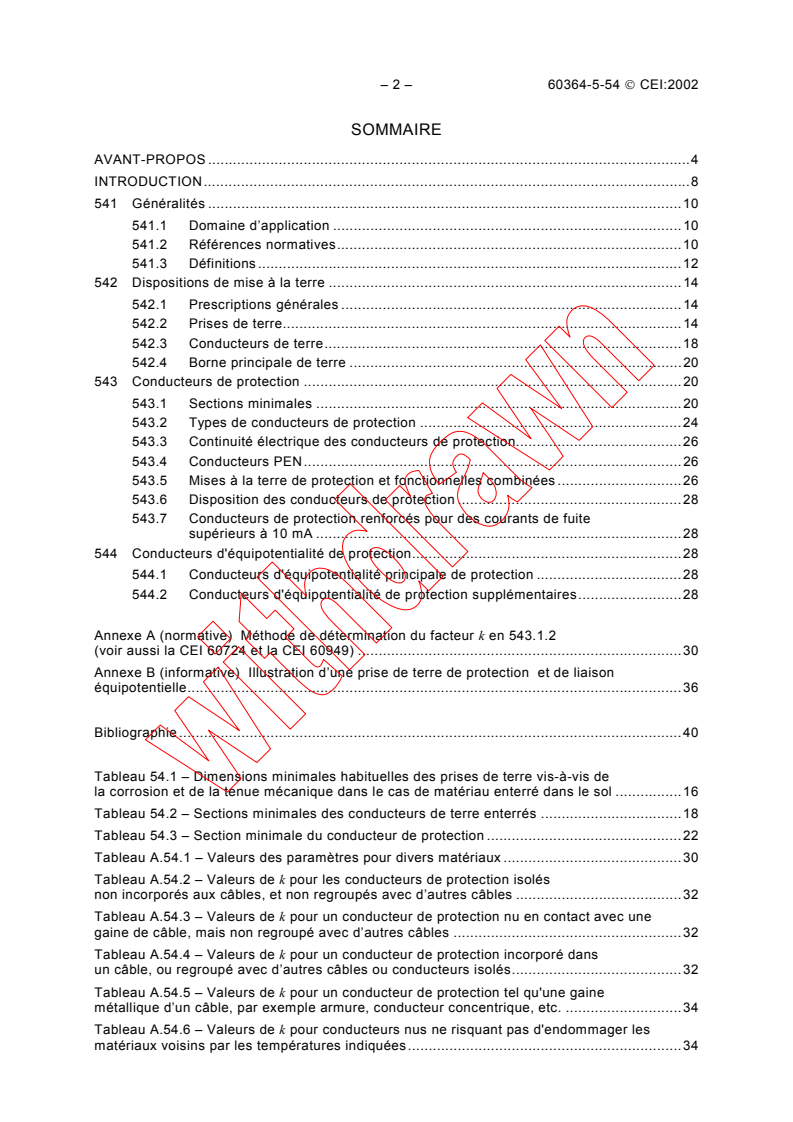
IEC 60364-5-54:2002 - Installations électriques des bâtiments - Partie 5-54: Choix et mise en oeuvre des matériels électriques - Mises a la terre, conducteurs de protection et conducteurs d'équipotentialité de protection Released:6/14/2002
IEC 60364-5-54:2002 - Electrical installations of buildings - Part 5-54: Selection and erection of electrical equipment - Earthing arrangements, protective conductors and protective bonding conductors Released:6/14/2002
Overview
IEC 60364-5-54:2002 specifies essential requirements for earthing arrangements, protective conductors, and protective bonding conductors in electrical installations of buildings. Published by the International Electrotechnical Commission (IEC), this standard is recognized as a basic safety publication according to IEC Guide 104. By providing guidelines for the selection and erection of electrical equipment, IEC 60364-5-54 plays a critical role in ensuring the safety, reliability, and effectiveness of building electrical systems by minimizing risks associated with electric shock, fire, and equipment damage.
Proper earthing and bonding are fundamental to the protection of both people and property. This standard is vital for electrical installers, designers, and maintenance personnel seeking compliance with international electrical safety regulations.
Key Topics
Earthing Arrangements
- Outlines methods and requirements for creating effective earthing systems
- Defines types and materials for earth electrodes (e.g., rods, strips, tapes, plates)
- Provides guidance on selecting electrodes based on soil conditions and corrosion resistance
- Emphasizes the importance of reliable connections and mechanical strength
Protective Conductors
- Specifies minimum cross-sectional areas for protective (PE) conductors depending on installation type and current carrying capacity
- Details acceptable types of protective conductors, including cable sheaths, enclosures, and metallic structures if continuity and integrity are assured
- Requires protective conductors to be properly marked, secured, and protected against mechanical and chemical damage
Protective Bonding Conductors
- Sets requirements for equipotential bonding to minimize voltage differences between exposed-conductive-parts and extraneous-conductive-parts
- Addresses sizing, connection, and disconnection of bonding conductors
- Ensures that all metal parts which might introduce a potential (such as pipework) are effectively bonded
Main Earthing Terminal
- Stipulates the provision and arrangement of a main earthing terminal in every installation
- All protective bonding, earthing, and functional conductors must be individually capable of disconnection for testing purposes
Definitions and Compliance
- Consolidates relevant definitions from IEC 61140 and IEC 60050 for clear interpretation
- Refers to supporting standards for related calculations and technical criteria
Applications
IEC 60364-5-54:2002 is applied in a wide range of building projects, ensuring the correct implementation of earthing and bonding practices across commercial, industrial, and residential environments. The standard is essential for:
- Design and installation of new electrical systems in buildings
- Upgrading or expanding existing electrical installations
- Inspections and assessments for safety compliance
- Specification in project documentation to meet international and national regulations
Proper implementation according to IEC 60364-5-54 helps prevent electrical shock hazards, equipment damage, and fire risks, supporting the overall electrical safety of building occupants and assets.
Related Standards
Compliance with IEC 60364-5-54 often involves reference to several companion and supporting documents, including:
- IEC 60364-4-41: Protection against electric shock
- IEC 60364-4-43: Protection against overcurrent
- IEC 60364-4-44: Protection against voltage and electromagnetic disturbances
- IEC 60364-5-52: Selection and erection of wiring systems
- IEC 60949: Calculation of thermally permissible short-circuit currents
- IEC 61024-1: Protection of structures against lightning
By aligning with these standards, practitioners ensure that their solutions are comprehensive, robust, and globally recognized, thereby achieving optimal safety and performance in electrical installations of buildings.
Keywords: IEC 60364-5-54, earthing arrangements, protective conductors, bonding conductors, electrical installations, building safety, international standard, electrical safety, equipotential bonding, earth electrodes.
Relations
- Effective Date
- 05-Sep-2023
- Effective Date
- 05-Sep-2023
- Effective Date
- 25-Aug-2026
- Effective Date
- 03-Jun-2026
- Effective Date
- 05-Sep-2023
Buy Documents
IEC 60364-5-54:2002 - Electrical installations of buildings - Part 5-54: Selection and erection of electrical equipment - Earthing arrangements, protective conductors and protective bonding conductors Released:6/14/2002
IEC 60364-5-54:2002 - Installations électriques des bâtiments - Partie 5-54: Choix et mise en oeuvre des matériels électriques - Mises a la terre, conducteurs de protection et conducteurs d'équipotentialité de protection Released:6/14/2002
IEC 60364-5-54:2002 - Electrical installations of buildings - Part 5-54: Selection and erection of electrical equipment - Earthing arrangements, protective conductors and protective bonding conductors Released:6/14/2002
Get Certified
Connect with accredited certification bodies for this standard

DIBt (Deutsches Institut für Bautechnik)
German Institute for Building Technology.
DIN CERTCO
DIN Group product certification.

IMQ S.p.A. (Certification)
Italian electrical product certification.
Sponsored listings
Frequently Asked Questions
IEC 60364-5-54:2002 is a standard published by the International Electrotechnical Commission (IEC). Its full title is "Electrical installations of buildings - Part 5-54: Selection and erection of electrical equipment - Earthing arrangements, protective conductors and protective bonding conductors". This standard covers: Addresses the earthing arrangements, protective conductors and protective bonding conductors in order to satisfy the safety of the electrical installation. Has the status of a basic safety publication in accordance with IEC Guide 104.
Addresses the earthing arrangements, protective conductors and protective bonding conductors in order to satisfy the safety of the electrical installation. Has the status of a basic safety publication in accordance with IEC Guide 104.
IEC 60364-5-54:2002 is classified under the following ICS (International Classification for Standards) categories: 29.020 - Electrical engineering in general; 91.140.50 - Electricity supply systems. The ICS classification helps identify the subject area and facilitates finding related standards.
IEC 60364-5-54:2002 has the following relationships with other standards: It is inter standard links to IEC 60364-5-548:1996/AMD1:1998, IEC 60364-5-548:1996, EN 1473:2007, EN 13814:2004, IEC 60364-5-54:2011. Understanding these relationships helps ensure you are using the most current and applicable version of the standard.
IEC 60364-5-54:2002 is available in PDF format for immediate download after purchase. The document can be added to your cart and obtained through the secure checkout process. Digital delivery ensures instant access to the complete standard document.
Standards Content (Sample)
INTERNATIONAL IEC
STANDARD
60364-5-54
Second edition
2002-06
BASIC SAFETY PUBLICATION
Electrical installations of buildings –
Part 5-54:
Selection and erection of electrical equipment –
Earthing arrangements, protective conductors
and protective bonding conductors
This English-language version is derived from the original
bilingual publication by leaving out all French-language
pages. Missing page numbers correspond to the French-
language pages.
Reference number
Publication numbering
As from 1 January 1997 all IEC publications are issued with a designation in the
60000 series. For example, IEC 34-1 is now referred to as IEC 60034-1.
Consolidated editions
The IEC is now publishing consolidated versions of its publications. For example,
edition numbers 1.0, 1.1 and 1.2 refer, respectively, to the base publication, the base
publication incorporating amendment 1 and the base publication incorporating
amendments 1 and 2.
Further information on IEC publications
The technical content of IEC publications is kept under constant review by the IEC,
thus ensuring that the content reflects current technology. Information relating to this
publication, including its validity, is available in the IEC Catalogue of publications
(see below) in addition to new editions, amendments and corrigenda. Information on
the subjects under consideration and work in progress undertaken by the technical
committee which has prepared this publication, as well as the list of publications
issued, is also available from the following:
• IEC Web Site (www.iec.ch)
• Catalogue of IEC publications
The on-line catalogue on the IEC web site (www.iec.ch/searchpub) enables you to
search by a variety of criteria including text searches, technical committees and
date of publication. On-line information is also available on recently issued
publications, withdrawn and replaced publications, as well as corrigenda.
• IEC Just Published
This summary of recently issued publications (www.iec.ch/online_news/ justpub) is
also available by email. Please contact the Customer Service Centre (see below)
for further information.
• Customer Service Centre
If you have any questions regarding this publication or need further assistance,
please contact the Customer Service Centre:
Email: custserv@iec.ch
Tel: +41 22 919 02 11
Fax: +41 22 919 03 00
INTERNATIONAL IEC
STANDARD
60364-5-54
Second edition
2002-06
BASIC SAFETY PUBLICATION
Electrical installations of buildings –
Part 5-54:
Selection and erection of electrical equipment –
Earthing arrangements, protective conductors
and protective bonding conductors
IEC 2002 Copyright - all rights reserved
No part of this publication may be reproduced or utilized in any form or by any means, electronic or mechanical,
including photocopying and microfilm, without permission in writing from the publisher.
International Electrotechnical Commission, 3, rue de Varembé, PO Box 131, CH-1211 Geneva 20, Switzerland
Telephone: +41 22 919 02 11 Telefax: +41 22 919 03 00 E-mail: inmail@iec.ch Web: www.iec.ch
PRICE CODE
S
Commission Electrotechnique Internationale
International Electrotechnical Commission
Международная Электротехническая Комиссия
For price, see current catalogue
60364-5-54 © IEC:2002 – 3 –
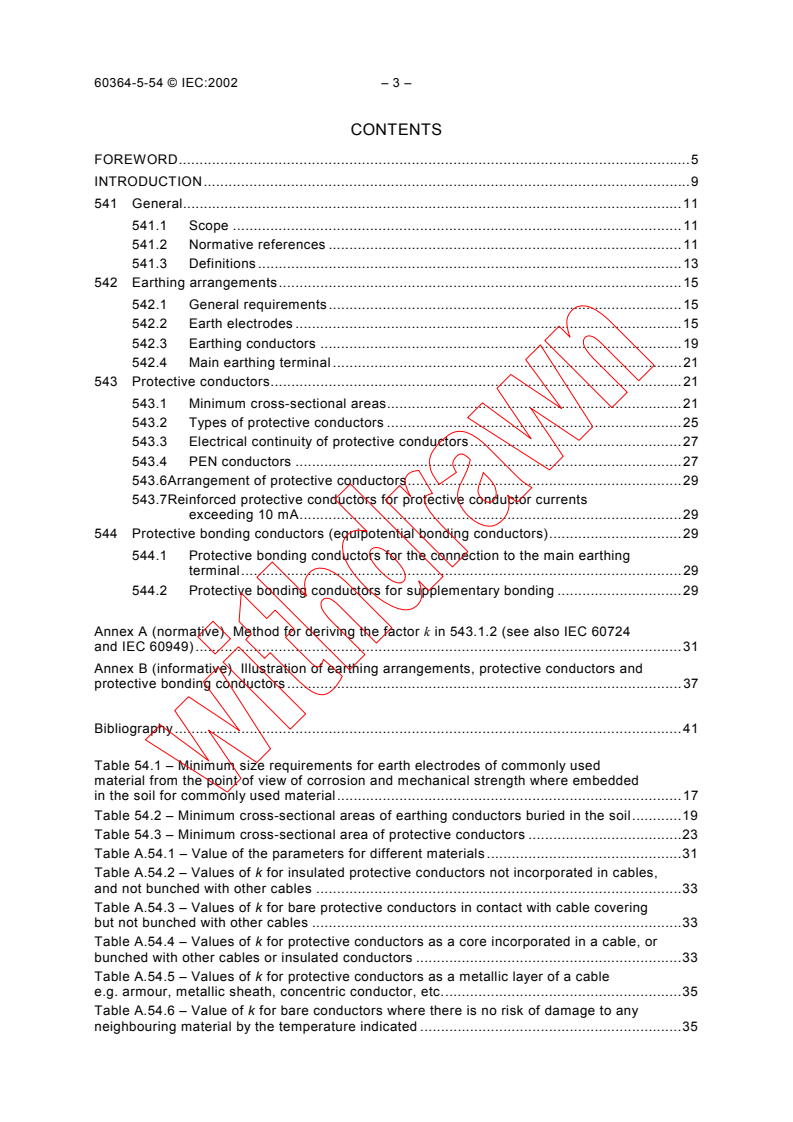
CONTENTS
FOREWORD.5
INTRODUCTION.9
541 General.11
541.1 Scope .11
541.2 Normative references .11
541.3 Definitions .13
542 Earthing arrangements.15
542.1 General requirements.15
542.2 Earth electrodes .15
542.3 Earthing conductors .19
542.4 Main earthing terminal .21
543 Protective conductors.21
543.1 Minimum cross-sectional areas.21
543.2 Types of protective conductors .25
543.3 Electrical continuity of protective conductors.27
543.4 PEN conductors .27
543.6Arrangement of protective conductors.29
543.7Reinforced protective conductors for protective conductor currents
exceeding 10 mA.29
544 Protective bonding conductors (equipotential bonding conductors).29
544.1 Protective bonding conductors for the connection to the main earthing
terminal.29
544.2 Protective bonding conductors for supplementary bonding .29
Annex A (normative) Method for deriving the factor k in 543.1.2 (see also IEC 60724
and IEC 60949).31
Annex B (informative) Illustration of earthing arrangements, protective conductors and
protective bonding conductors .37
Bibliography .41
Table 54.1 – Minimum size requirements for earth electrodes of commonly used
material from the point of view of corrosion and mechanical strength where embedded
in the soil for commonly used material.17
Table 54.2 – Minimum cross-sectional areas of earthing conductors buried in the soil.19
Table 54.3 – Minimum cross-sectional area of protective conductors .23
Table A.54.1 – Value of the parameters for different materials .31
Table A.54.2 – Values of k for insulated protective conductors not incorporated in cables,
and not bunched with other cables .33
Table A.54.3 – Values of k for bare protective conductors in contact with cable covering
but not bunched with other cables .33
Table A.54.4 – Values of k for protective conductors as a core incorporated in a cable, or
bunched with other cables or insulated conductors .33
Table A.54.5 – Values of k for protective conductors as a metallic layer of a cable
e.g. armour, metallic sheath, concentric conductor, etc.35
Table A.54.6 – Value of k for bare conductors where there is no risk of damage to any
neighbouring material by the temperature indicated .35
60364-5-54 © IEC:2002 – 5 –
INTERNATIONAL ELECTROTECHNICAL COMMISSION
___________
ELECTRICAL INSTALLATIONS OF BUILDINGS –
Part 5-54: Selection and erection of electrical equipment –
Earthing arrangements, protective conductors
and protective bonding conductors
FOREWORD
1) The IEC (International Electrotechnical Commission) is a worldwide organization for standardization comprising
all national electrotechnical committees (IEC National Committees). The object of the IEC is to promote
international co-operation on all questions concerning standardization in the electrical and electronic fields. To
this end and in addition to other activities, the IEC publishes International Standards. Their preparation is
entrusted to technical committees; any IEC National Committee interested in the subject dealt with may
participate in this preparatory work. International, governmental and non-governmental organizations liaising
with the IEC also participate in this preparation. The IEC collaborates closely with the International Organization
for Standardization (ISO) in accordance with conditions determined by agreement between the two
organizations.
2) The formal decisions or agreements of the IEC on technical matters express, as nearly as possible, an
international consensus of opinion on the relevant subjects since each technical committee has representation
from all interested National Committees.
3) The documents produced have the form of recommendations for international use and are published in the form
of standards, technical specifications, technical reports or guides and they are accepted by the National
Committees in that sense.
4) In order to promote international unification, IEC National Committees undertake to apply IEC International
Standards transparently to the maximum extent possible in their national and regional standards. Any
divergence between the IEC Standard and the corresponding national or regional standard shall be clearly
indicated in the latter.
5) The IEC provides no marking procedure to indicate its approval and cannot be rendered responsible for any
equipment declared to be in conformity with one of its standards.
6) Attention is drawn to the possibility that some of the elements of this International Standard may be the subject
of patent rights. The IEC shall not be held responsible for identifying any or all such patent rights.
IEC 60364-5-54 has been prepared by IEC technical committee 64, Electrical installations and
protection against electric shock.
This second edition replaces the first edition, published in 1980, its amendment 1 (1982), as
well as some clauses of IEC 60364-5-548, published in 1996, and its amendment (1998), and
constitutes a technical revision.
The text of this standard is based on the following documents:
FDIS Report on voting
64/1231/FDIS 64/1249/RVD
Full information on the voting for the approval of this standard can be found in the report on
voting indicated in the above table.
It has the status of a basic safety publication in accordance with IEC Guide 104.
This publication has been drafted, as close as possible, in accordance with the ISO/IEC
Directives, Part 3.
Annex A forms an integral part of this standard.
Annex B is for information only.
60364-5-54 © IEC:2002 – 7 –
The committee has decided that the contents of this publication will remain unchanged until
2007. At this date, the publication will be
• reconfirmed;
• withdrawn;
• replaced by a revised edition, or
• amended.
60364-5-54 © IEC:2002 – 9 –
INTRODUCTION
Clause numbering is sequential, preceded by the number of this part (e.g. 541). Numbering of
figures and tables takes the number of this part followed by a sequential number, i.e. Table
54.1, 54.2, etc. Numbering of figures and tables in annexes takes the letter of the annex,
followed by the number of the part, followed by a sequential number, e.g. A.54.1, A.54.2, etc.
60364-5-54 © IEC:2002 – 11 –
ELECTRICAL INSTALLATIONS OF BUILDINGS –
Part 5-54: Selection and erection of electrical equipment –
Earthing arrangements, protective conductors
and protective bonding conductors
541 General
541.1 Scope
This part of IEC 60364 addresses the earthing arrangements, protective conductors and
protective bonding conductors in order to satisfy the safety of the electrical installation.
541.2 Normative references
The following referenced documents are indispensable for the application of this document. For
dated references, only the edition cited applies. For undated references, the latest edition of
the referenced document (including any amendments) applies.
IEC 60050(195), International Electrotechnical Vocabulary (IEV) – Part 195: Earthing and
protection against electric shock
IEC 60287-1-1, Electric cables – Calculation of the current rating – Part 1-1: Current rating
equations (100 % load factor) and calculation of losses – General
IEC 60364-4-41, Electrical installations of buildings – Part 4-41: Protection for safety –
Protection against electric shock
IEC 60364-4-43, Electrical installations of buildings – Part 4-43: Protection for safety –
Protection against overcurrent
IEC 60364-4-44, Electrical installations of buildings – Part 4-44: Protection for safety –
Protection against voltage disturbances and electromagnetic disturbances
IEC 60364-5-52, Electrical installations of buildings – Part 5-52: Selection and erection of
electrical equipment – Wiring systems
IEC 60724, Short-circuit temperature limits of electric cables with rated voltages of 1 kV (U =
m
1,2 kV) and 3 kV (U = 3,6 kV)
m
IEC 60853-2, Calculation of the cyclic and emergency current rating of cables – Part 2: Cyclic
rating of cables greater than 18/30 (36) kV and emergency ratings for cables of all voltages
IEC 60909-0, Short-circuit currents in three-phase a.c. systems – Part 0: Calculation of
currents
IEC 60949, Calculation of thermally permissible short-circuit currents, taking into account non-
adiabatic heating effects
60364-5-54 © IEC:2002 – 13 –
IEC 61024-1, Protection of structures against lightning – Part 1: General principles
IEC 61140, Protection against electric shock – Common aspects for installation and equipment
IEC Guide 104, The preparation of safety publications and the use of basic safety publications
and group safety publications
541.3 Definitions
For the purposes of this part of IEC 60364, the definitions of IEC 61140, together with the
following definitions taken from IEC 60050(195), apply.
Definitions used for earthing arrangements, protective conductors and protective bonding
conductors are illustrated in annex B and listed here as follows:
541.3.1
exposed-conductive-part
conductive part of equipment which can be touched and which is not normally live, but which
can become live when basic insulation fails
[IEV 195-06-10]
541.3.2
main earthing terminal
(main earthing busbar)
terminal or busbar which is part of the earthing arrangement of an installation enabling the
electric connection of a number of conductors for earthing purposes
[IEV 195-02-33]
541.3.3
earth electrode
conductive part, which may be embedded in a specific conductive medium, e.g. concrete or
coke, in electric contact with the earth
[IEV 195-02-01]
541.3.4
protective conductor
conductor provided for purposes of safety, for example protection against electric shock
[IEV 195-02-09]
541.3.5
protective bonding conductor
protective conductor provided for protective-equipotential-bonding
[IEV 195-02-10]
60364-5-54 © IEC:2002 – 15 –
541.3.6
earthing conductor
conductor which provides a conductive path, or part of the conductive path, between a given
point in a system or in an installation or in equipment and an earth electrode
[IEV 195-02-03]
NOTE For the purposes of this part of IEC 60364, an earthing conductor is the conductor which connects the earth
electrode to a point in the equipotential bonding system, usually the main earthing terminal.
541.3.7
extraneous-conductive-part
conductive part not forming part of the electrical installation and liable to introduce an electric
potential, generally the electric potential of a local earth
[IEV 195-06-11]
542 Earthing arrangements
542.1 General requirements
542.1.1 The earthing arrangements may be used jointly or separately for protective and
functional purposes according to the requirements of the electrical installation. The
requirements for protective purposes shall always take precedence.
542.1.2 Where provided, earth electrodes within an installation shall be connected to the main
earthing terminal using an earthing conductor.
542.1.3 Consideration shall be given to the earthing arrangements which are used in high-
voltage and low-voltage systems (see IEC 60364-4-44, clause 442).
542.1.4 The requirements for earthing arrangements are intended to provide a connection to
earth:
– which is reliable and suitable for the protective requirements of the installation;
– which can carry earth fault currents and protective conductor currents to earth without
danger from thermal, thermo-mechanical and electromechanical stresses and from electric
shock arising from these currents;
– which, if relevant, is also suitable for functional requirements.
542.2 Earth electrodes
542.2.1 Materials and dimensions of the earth electrodes shall be selected to withstand
corrosion and to have adequate mechanical strength.
For commonly used materials, the common minimum sizes from the point of view of corrosion
and mechanical strength for earth electrodes where embedded in the soil are given in
table 54.1.
NOTE If a lightning protection system (LPS) is present, the IEC 61024-1 applies.
60364-5-54 © IEC:2002 – 17 –
Table 54.1 – Common minimum sizes for earth electrodes of commonly used material
from the point of view of corrosion and mechanical strength where embedded in the soil
Minimum size
Thickness of
Cross-
coating/sheathing
Material Surface Shape Diameter sectional Thickness
area Individual Average
mm mm
value value
mm
μm μm
c
Steel Hot-dip Strip 90 3 63 70
a
galvanized
or
a, b
Stainless
Sections 90 3 63 70
Round rod 16 63 70
for deep
earth
electrodes
e
Round wire 10 50
for surface
g
electrode
Pipe 25 2 47 55
Copper- Round rod 15 2 000
sheathed for deep
earth
electrode
With Round rod 14 90 100
electro- for deep
deposited earth
copper electrode
coating
a
Copper Bare Strip 50 2
f
Round wire 25
for surface
g
electrode
Rope 1,8 for 25
individual
strands of
wire
Pipe 20 2
Tin-coated Rope 1,8 for 25 1 5
individual
strands of
wire
d
Zinc-coated Strip 50 2 20 40
a
Can also be used for electrodes to be embedded in concrete.
b
No coating applied.
c
As rolled strip or slit strip with rounded edges.
d
Strip with rounded edges.
e
In the case of continuous bath-coating, only 50 μm thickness is technically feasible at present.
f
Where experience shows that the risk of corrosion and mechanical damage is extremely low, 16 mm² can
be used.
g
An earth electrode is considered to be a surface electrode when installed at a depth not exceeding 0,5 m.
60364-5-54 © IEC:2002 – 19 –
542.2.2 The efficacy of any earth electrode depends upon local soil conditions. One or more
earth electrodes suitable for the soil conditions and the value of resistance to earth required,
shall be selected.
542.2.3 The following are examples of earth electrodes which may be used:
– underground structural networks embedded in foundations (foundation earthing);
– plates;
– metal reinforcement of concrete (except pre-stressed concrete) embedded in the earth;
– rods or pipes;
– tapes or wires;
– metal sheaths and other metal coverings of cables according to local conditions or
requirements;
– other suitable underground metalwork according to local conditions or requirements.
NOTE 1 In Austria, Belgium, Finland, France, Germany, Sweden, Switzerland and the UK, water pipes are not
permitted as earth electrodes.
NOTE 2 In Italy it is permitted to use a water pipe system, but only with the consent of the water distributor.
542.2.4 When selecting type and embedded depth of earth electrode, consideration shall be
given to local conditions and regulations so that soil drying and freezing will be unlikely to
increase the earth resistance of the earth electrode to such a value that would impair the
protective measures against electric shock (see IEC 60364-4-41).
NOTE In Germany, there is an obligation to erect in every new building a foundation earth electrode according to
National Standard DIN 18014.
542.2.5 Consideration shall be given to electrolytic corrosion when using different materials in
an earthing arrangement.
542.2.6 A metallic pipe for flammable liquids or gases shall not be used as an earth
electrode.
NOTE This requirement does not preclude the protective bonding of such pipes for compliance with IEC 60364-4-41.
542.3 Earthing conductors
542.3.1 Earthing conductors shall comply with 543.1 and where buried in the soil, their cross-
sectional areas shall be in accordance with table 54.2.
In TN systems, where no noticeable fault current is expected to pass in the earth electrode, the
earthing conductor may be dimensioned according to 544.1.1
Table 54.2 – Minimum cross-sectional areas of earthing conductors buried in the soil
Mechanically protected Mechanically unprotected
Protected against corrosion 2,5 mm² Cu 16 mm² Cu
10 mm² Fe 16 mm² Fe
Not protected against corrosion 25 mm² Cu
50 mm² Fe
60364-5-54 © IEC:2002 – 21 –
542.3.2 The connection of an earthing conductor to an earth electrode shall be soundly made
and electrically satisfactory. The connection shall be by exothermic welding, pressure
connectors, clamps or other mechanical connectors. Mechanical connectors shall be installed
in accordance with the manufacturer’s instructions. Where a clamp is used, it shall not damage
the electrode or the earthing conductor.
NOTE Connection devices or fittings that depend solely on solder, do not reliably provide adequate mechanical
strength.
542.4 Main earthing terminal
542.4.1 In every installation where protective bonding is used, a main earthing terminal shall
be provided and the following shall be connected to it:
– protective bonding conductors;
– earthing conductors;
– protective conductors;
– functional earthing conductors, if relevant.
NOTE 1 It is not intended to connect every individual protective conductor directly to the main earthing terminal
when they are connect
...
NORME CEI
INTERNATIONALE
60364-5-54
Deuxième édition
2002-06
PUBLICATION FONDAMENTALE DE SÉCURITÉ
Installations électriques des bâtiments –
Partie 5-54:
Choix et mise en oeuvre des matériels électriques –
Mises à la terre, conducteurs de protection et
conducteurs d'équipotentialité de protection
Cette version française découle de la publication d’origine
bilingue dont les pages anglaises ont été supprimées.
Les numéros de page manquants sont ceux des pages
supprimées.
Numéro de référence
CEI 60364-5-54:2002(F)
Numérotation des publications
Depuis le 1er janvier 1997, les publications de la CEI sont numérotées à partir de
60000. Ainsi, la CEI 34-1 devient la CEI 60034-1.
Editions consolidées
Les versions consolidées de certaines publications de la CEI incorporant les
amendements sont disponibles. Par exemple, les numéros d’édition 1.0, 1.1 et 1.2
indiquent respectivement la publication de base, la publication de base incorporant
l’amendement 1, et la publication de base incorporant les amendements 1 et 2
Informations supplémentaires sur les publications de la CEI
Le contenu technique des publications de la CEI est constamment revu par la CEI
afin qu'il reflète l'état actuel de la technique. Des renseignements relatifs à cette
publication, y compris sa validité, sont disponibles dans le Catalogue des
publications de la CEI (voir ci-dessous) en plus des nouvelles éditions, amende-
ments et corrigenda. Des informations sur les sujets à l’étude et l’avancement des
travaux entrepris par le comité d’études qui a élaboré cette publication, ainsi que la
liste des publications parues, sont également disponibles par l’intermédiaire de:
• Site web de la CEI (www.iec.ch)
• Catalogue des publications de la CEI
Le catalogue en ligne sur le site web de la CEI (www.iec.ch/searchpub) vous permet
de faire des recherches en utilisant de nombreux critères, comprenant des
recherches textuelles, par comité d’études ou date de publication. Des informations
en ligne sont également disponibles sur les nouvelles publications, les publications
remplacées ou retirées, ainsi que sur les corrigenda.
• IEC Just Published
Ce résumé des dernières publications parues (www.iec.ch/online_news/justpub)
est aussi disponible par courrier électronique. Veuillez prendre contact avec le
Service client (voir ci-dessous) pour plus d’informations.
• Service clients
Si vous avez des questions au sujet de cette publication ou avez besoin de
renseignements supplémentaires, prenez contact avec le Service clients:
Email: custserv@iec.ch
Tél: +41 22 919 02 11
Fax: +41 22 919 03 00
NORME CEI
INTERNATIONALE
60364-5-54
Deuxième édition
2002-06
PUBLICATION FONDAMENTALE DE SÉCURITÉ
Installations électriques des bâtiments –
Partie 5-54:
Choix et mise en oeuvre des matériels électriques –
Mises à la terre, conducteurs de protection et
conducteurs d'équipotentialité de protection
IEC 2002 Droits de reproduction réservés
Aucune partie de cette publication ne peut être reproduite ni utilisée sous quelque forme que ce soit et par aucun
procédé, électronique ou mécanique, y compris la photocopie et les microfilms, sans l'accord écrit de l'éditeur.
International Electrotechnical Commission, 3, rue de Varembé, PO Box 131, CH-1211 Geneva 20, Switzerland
Telephone: +41 22 919 02 11 Telefax: +41 22 919 03 00 E-mail: inmail@iec.ch Web: www.iec.ch
CODE PRIX
S
Commission Electrotechnique Internationale
International Electrotechnical Commission
Международная Электротехническая Комиссия
Pour prix, voir catalogue en vigueur
– 2 – 60364-5-54 CEI:2002
SOMMAIRE
AVANT-PROPOS .4
INTRODUCTION.8
541 Généralités .10
541.1 Domaine d’application .10
541.2 Références normatives.10
541.3 Définitions .12
542 Dispositions de mise à la terre .14
542.1 Prescriptions générales .14
542.2 Prises de terre.14
542.3 Conducteurs de terre.18
542.4 Borne principale de terre .20
543 Conducteurs de protection .20
543.1 Sections minimales .20
543.2 Types de conducteurs de protection .24
543.3 Continuité électrique des conducteurs de protection.26
543.4 Conducteurs PEN.26
543.5 Mises à la terre de protection et fonctionnelles combinées .26
543.6 Disposition des conducteurs de protection .28
543.7 Conducteurs de protection renforcés pour des courants de fuite
supérieurs à 10 mA .28
544 Conducteurs d'équipotentialité de protection.28
544.1 Conducteurs d'équipotentialité principale de protection .28
544.2 Conducteurs d'équipotentialité de protection supplémentaires.28
Annexe A (normative) Méthode de détermination du facteur k en 543.1.2
(voir aussi la CEI 60724 et la CEI 60949) .30
Annexe B (informative) Illustration d’une prise de terre de protection et de liaison
équipotentielle.36
Bibliographie .40
Tableau 54.1 – Dimensions minimales habituelles des prises de terre vis-à-vis de
la corrosion et de la tenue mécanique dans le cas de matériau enterré dans le sol .16
Tableau 54.2 – Sections minimales des conducteurs de terre enterrés .18
Tableau 54.3 – Section minimale du conducteur de protection .22
Tableau A.54.1 – Valeurs des paramètres pour divers matériaux .30
Tableau A.54.2 – Valeurs de k pour les conducteurs de protection isolés
non incorporés aux câbles, et non regroupés avec d’autres câbles .32
Tableau A.54.3 – Valeurs de k pour un conducteur de protection nu en contact avec une
gaine de câble, mais non regroupé avec d’autres câbles .32
Tableau A.54.4 – Valeurs de k pour un conducteur de protection incorporé dans
un câble, ou regroupé avec d’autres câbles ou conducteurs isolés.32
Tableau A.54.5 – Valeurs de k pour un conducteur de protection tel qu'une gaine
métallique d’un câble, par exemple armure, conducteur concentrique, etc. .34
Tableau A.54.6 – Valeurs de k pour conducteurs nus ne risquant pas d'endommager les
matériaux voisins par les températures indiquées.34
– 4 – 60364-5-54 CEI:2002
COMMISSION ÉLECTROTECHNIQUE INTERNATIONALE
___________
INSTALLATIONS ÉLECTRIQUES DES BÂTIMENTS –
Partie 5-54: Choix et mise en oeuvre des matériels électriques –
Mises à la terre, conducteurs de protection et conducteurs
d’équipotentialité de protection
AVANT-PROPOS
1) La CEI (Commission Électrotechnique Internationale) est une organisation mondiale de normalisation composée
de l'ensemble des comités électrotechniques nationaux (Comités nationaux de la CEI). La CEI a pour objet de
favoriser la coopération internationale pour toutes les questions de normalisation dans les domaines de
l'électricité et de l'électronique. A cet effet, la CEI, entre autres activités, publie des Normes internationales.
Leur élaboration est confiée à des comités d'études, aux travaux desquels tout Comité national intéressé par le
sujet traité peut participer. Les organisations internationales, gouvernementales et non gouvernementales, en
liaison avec la CEI, participent également aux travaux. La CEI collabore étroitement avec l'Organisation
Internationale de Normalisation (ISO), selon des conditions fixées par accord entre les deux organisations.
2) Les décisions ou accords officiels de la CEI concernant les questions techniques représentent, dans la mesure
du possible, un accord international sur les sujets étudiés, étant donné que les Comités nationaux intéressés
sont représentés dans chaque comité d’études.
3) Les documents produits se présentent sous la forme de recommandations internationales. Ils sont publiés
comme normes, spécifications techniques, rapports techniques ou guides et agréés comme tels par les Comités
nationaux.
4) Dans le but d'encourager l'unification internationale, les Comités nationaux de la CEI s'engagent à appliquer de
façon transparente, dans toute la mesure possible, les Normes internationales de la CEI dans leurs normes
nationales et régionales. Toute divergence entre la norme de la CEI et la norme nationale ou régionale
correspondante doit être indiquée en termes clairs dans cette dernière.
5) La CEI n’a fixé aucune procédure concernant le marquage comme indication d’approbation et sa responsabilité
n’est pas engagée quand un matériel est déclaré conforme à l’une de ses normes.
6) L’attention est attirée sur le fait que certains des éléments de la présente Norme internationale peuvent faire
l’objet de droits de propriété intellectuelle ou de droits analogues. La CEI ne saurait être tenue pour
responsable de ne pas avoir identifié de tels droits .
La Norme internationale CEI 60364-5-54 a été établie par le comité d'études 64 de la CEI,
Installations électriques et protection contre les chocs électriques.
Cette deuxième édition annule et remplace la première édition, parue en 1980, l'amendement 1
(1982) ainsi que quelques articles de la CEI 60364-5-548, parue en 1996, et l'amendement 1
(1998) dont elle constitue une révision technique.
Le texte de cette norme est issu des documents suivants:
FDIS Rapport de vote
64/1231/FDIS 64/1249/RVD
Le rapport de vote indiqué dans le tableau ci-dessus donne toute information sur le vote ayant
abouti à l'approbation de cette norme.
Elle a le statut d'une publication fondamentale de sécurité conformément au Guide CEI 104.
Cette publication a été rédigée, autant que possible, selon les Directives ISO/CEI, Partie 3.
L'annexe A fait partie intégrante de cette norme.
L'annexe B est donnée uniquement à titre d'information.
– 6 – 60364-5-54 CEI:2002
Le comité a décidé que le contenu de cette publication ne sera pas modifié avant 2007. A cette
date, la publication sera
• reconduite;
• supprimée;
• remplacée par une édition révisée, ou
• amendée.
– 8 – 60364-5-54 CEI:2002
INTRODUCTION
La numérotation des articles est séquentielle, précédé par le numéro de la partie (par exemple,
541). La numérotation des figures et des tableaux reprend le numéro de la partie suivi d'un
chiffre dans l'ordre chronologique, c'est-à-dire tableau 54.1, tableau 54.2, etc. La numérotation
des tableaux et des figures dans les annexes reprend la lettre de l'annexe suivie par le numéro
de la partie et d'un chiffre ajouté dans l'ordre chronologique, par exemple A.54.1, A.54.2, etc.
– 10 – 60364-5-54 CEI:2002
INSTALLATIONS ÉLECTRIQUES DES BÂTIMENTS –
Partie 5-54: Choix et mise en oeuvre des matériels électriques –
Mises à la terre, conducteurs de protection et conducteurs
d’équipotentialité de protection
541 Généralités
541.1 Domaine d’application
La présente partie de la CEI 60364 concerne les mises à la terre, les conducteurs de
protection et les conducteurs d’équipotentialité de protection afin de satisfaire à la sécurité de
l’installation électrique.
541.2 Références normatives
Les documents de référence suivants sont indispensables pour l'application du présent
document. Pour les références datées, seule l'édition citée s'applique. Pour les références non
datées, la dernière édition du document de référence s'applique (y compris les éventuels
amendements).
CEI 60050(195), Vocabulaire Electrotechnique International (VEI) – Partie 195: Mise à la terre
et protection contre les chocs électriques
CEI 60287-1-1, Câbles électriques – Calcul du courant admissible – Partie 1-1: Equations de
l’intensité du courant admissible (facteur de charge 100 %) et calcul des pertes – Généralités
CEI 60364-4-41, Installations électriques des bâtiments – Partie 4-41: Protection pour assurer
la sécurité – Protection contre les chocs électriques
CEI 60364-4-43, Installations électriques des bâtiments – Partie 4-43: Protection pour assurer
la sécurité – Protection contre les surintensités
CEI 60364-4-44, Installations électriques des bâtiments – Partie 4-44: Protection pour assurer
la sécurité – Protection contre les perturbations de tension et les perturbations électro-
magnétiques
CEI 60364-5-52, Installations électriques des bâtiments – Partie 5-52: Choix et mise en œuvre
des matériels électriques – Canalisations
CEI 60724, Limites de température de court-circuit des câbles électriques de tensions
assignées de 1 kV (U = 1,2 kV) et 3 kV (U = 3,6 kV)
m m
CEI 60853-2, Calcul des capacités de transport des câbles pour les régimes de charge
cycliques et de surcharge de secours – Deuxième partie: Régime cyclique pour des câbles de
tension supérieures à 18/30 (36) kV et régimes de secours pour des câbles de toutes tensions
CEI 60909-0, Courants de court-circuit dans les réseaux triphasés à courant alternatif – Partie 0:
Calcul des courants
CEI 60949, Calcul des courants de court-circuit admissibles au plan thermique, tenant compte
des effets d'un échauffement non adiabatique
– 12 – 60364-5-54 CEI:2002
CEI 61024-1, Protection des structures contre la foudre – Première partie: Principes généraux
CEI 61140, Protection contre les chocs électriques – Aspects communs aux installations et aux
matériels
Guide CEI 104, Elaboration des publications de sécurité et utilisation des publications
fondamentales de sécurité et publications groupées de sécurité
541.3 Définitions
Pour les besoins de la présente partie de la CEI 60364, les définitions de la CEI 61140 ainsi
que les définitions suivantes, extraites de la CEI 60050(195) sont applicables.
Les définitions utilisées pour les mises à la terre, les conducteurs de protection et les
conducteurs d’équipotentialité de protection sont représentées par les figures de l'annexe B et
référencées ci-après:
541.3.1
partie conductrice accessible
partie conductrice d'un matériel, susceptible d'être touchée, et qui n'est pas normalement sous
tension, mais peut le devenir lorsque l'isolation principale est défaillante
[VEI 195-06-10]
541.3.2
borne principale de terre
borne ou barre faisant partie de l'installation de mise à la terre d'une installation, et assurant la
connexion électrique d'un certain nombre de conducteurs à des fins de mise à la terre
[VEI 195-02-33]
541.3.3
prise de terre
électrode de terre
partie conductrice pouvant être incorporée dans un milieu conducteur particulier, par exemple
béton ou coke, en contact électrique avec la terre
[VEI 195-02-01]
541.3.4
conducteur de protection
(identification: PE)
conducteur prévu à des fins de sécurité, par exemple protection contre les chocs électriques
[VEI 195-02-09]
541.3.5
conducteur de liaison de protection
conducteur d'équipotentialité
conducteur de protection prévu pour réaliser une liaison équipotentielle de protection
[VEI 195-02-10]
– 14 – 60364-5-54 CEI:2002
541.3.6
conducteur de (mise à la) terre
conducteur assurant un chemin conducteur, ou une partie du chemin conducteur, entre un
point donné d'un réseau, d'une installation, ou d'un matériel et une prise de terre
[VEI 195-02-03]
NOTE Dans le cadre de la présente partie de la CEI 60364, le conducteur de terre réalise la connexion entre la
terre et la liaison équipotentielle principale, généralement la borne principale de terre.
541.3.7
élément conducteur étranger
partie conductrice ne faisant pas partie de l'installation électrique et susceptible d'introduire un
potentiel électrique, généralement celui d’une terre locale
[VEI 195-06-11]
542 Dispositions de mise à la terre
542.1 Prescriptions générales
542.1.1 Les dispositions de mise à la terre peuvent être utilisées à la fois ou séparément pour
des raisons de protection et des raisons fonctionnelles suivant les exigences de l'installation
électrique. Les prescriptions relatives à la protection doivent toujours être prioritaires.
542.1.2 Si elles en sont pourvues les prises de terre présentes à l’intérieur d’une installation
doivent être connectées à la borne principale de terre par l’intermédiaire d’un conducteur de
terre.
542.1.3 Une attention particulière doit être portée aux dispositions de mise à la terre utilisées
en haute et en basse tension ( voir l'article 442 de la CEI 60364-4-44).
542.1.4 Les prescriptions concernant les dispositions de mise à la terre sont destinées
à réaliser une liaison à la terre:
– sûre et appropriée aux prescriptions de protection de l’installation;
– pouvant écouler des courants de défaut à la terre et des courants dans le conducteur de
protection à la terre sans risque de contraintes thermiques, thermomécaniques et électro-
mécaniques dangereuses et de chocs électriques dus à ces courants;
– si nécessaire, appropriée aussi aux prescriptions fonctionnelles.
542.2 Prises de terre
542.2.1 Les matériaux et les dimensions des prises de terre doivent être choisis de manière à
résister à la corrosion et à présenter une tenue mécanique appropriée.
Pour des matériaux couramment utilisés, les dimensions minimales habituelles vis-à-vis de la
corrosion et de la tenue mécanique dans le cas d’enfouissement direct dans le sol sont
données dans le tableau 54.1.
NOTE En présence d’un système de protection contre la foudre, la CEI 61024-1 s’applique.
– 16 – 60364-5-54 CEI:2002
Tableau 54.1 – Dimensions minimales habituelles des prises
de terre en matériaux couramment utilisés pour leur résistanceà la corrosion et leur
tenue mécanique appropriée dans le cas d'enfouissement dans le sol
Dimensions minimales
Epaisseur du
revêtement/gaine
Matériau Surface Forme
Diamètre Section Epaisseur
Valeur Valeur
mm mm mm
individuelle moyenne
μm μm
c
Acier Galvanisé Bande 90 3 63 70
a
à chaud
a b
et inox
Sections 90 3 63 70
Tige ronde 16 63 70
pour
électrodes
profondes
e
Fil rond 10 50
pour
électrode
g
de surface
Conduit 25 2 47 55
Cuivre gainé Tige ronde 15 2 000
pour
électrodes
profondes
Avec cuivre Tige ronde 14 90 100
déposé par pour
électrolyse électrodes
profondes
a
Cuivre Nu Bande 50 2
f
Fil rond
pour
électrode
g
de surface
Toron 1,8 pour 25
chaque brin
Conduit 20 2
Etamé Toron 1,8 pour 25 1 5
chaque brin
d
Etamé zinc Bande 50 2 20 40
a
Peut aussi être utilisé pour des prises de terre destinés à être enfouies dans du béton.
b
Pas de revêtement.
c
En bande enroulée ou bande fendue avec rebords arrondis.
d
Bande à bords arrondis.
e
Dans le cas de revêtement continu par bain, seule une épaisseur de 50 μm est techniquement réalisable
à présent.
f
Lorsque l’expérience montre que le risque de corrosion et de dommage mécanique est très faible, une
section de 16 mm peut être utilisée.
g
Une prise de terre est dite de surface si sa profondeur ne dépasse pas 0,5 m.
– 18 – 60364-5-54 CEI:2002
542.2.2 L'efficacité d'une prise de terre dépend des conditions locales du sol. Une ou
plusieurs prises de terre appropriées aux conditions du terrain et à la valeur de la résistance
de terre prescrite doivent être choisies.
542.2.3 Les exemples suivants de prises de terre peuvent être utilisés:
– structures enterrées dans les fondations (boucle à fond de fouille);
– plaques;
– armatures du béton (sauf pour béton précontraint) noyées dans le sol;
– piquets ou tubes;
– rubans ou fils;
– gaines métalliques ou autre revêtement métallique selon les conditions locales ou les règles;
– autres ouvrages métalliques enterrés selon les conditions locales ou les règles.
NOTE 1 En Allemagne, Autriche, Belgique, Finlande, France, Grande-Bretagne, Suède et Suisse, il n’est pas
permis que les canalisations d’eau servent de prise de terre.
NOTE 2 En Italie, il est permis que les canalisations d’eau servent de prise de terre mais seulement avec le
consentement du distributeur d’eau.
542.2.4 Lors du choix du type de la prise de terre et de sa profondeur d’enfouissement,
l’attention doit se porter sur les conditions locales et les règlements afin que l'assèchement et
le gel rendent improbable l'augmentation de la résistance de la prise de terre au-dessus d’une
valeur n’assurant plus les mesures de protection contre les chocs électriques (voir la CEI
60364-4-41).
NOTE En Allemagne, il est obligatoire de mettre en œuvre une boucle à fond de fouille pour tout nouveau
bâtiment conformément à la norme nationale DIN 18014.
542.2.5 L’attention doit se porter sur la corrosion électrolytique lors de l’utilisation de
matériaux différents dans une installation de mise à la terre.
542.2.6 Des canalisations métalliques de distribution de liquides inflammables ou de gaz ne
doivent pas être utilisées comme prises de terre.
NOTE Cette prescription n’exclut pas la liaison équipotentielle de protection de ces services conformément
à la CEI 60364-4-41.
542.3 Conducteurs de terre
542.3.1 Les conducteurs de terre doivent satisfaire aux prescriptions de 543.1 et, lorsqu’ils
sont enterrés, leur section doit être choisie conformément au tableau 54.2.
En schéma TN, si le courant de défaut présumé circulant dans la prise de terre est faible, le
conducteur de terre peut être dimensionné conformément à 544.1.1.
Tableau 54.2 – Sections minimales des conducteurs de terre enterrés
Protégés mécaniquement Non protégés mécaniquement
2 2
Protégés contre la corrosion 2,5 mm Cu 16 mm Cu
2 2
10 mm Fe 16 mm Fe
Non protégés contre la corrosion 25 mm Cu
50 mm Fe
– 20 – 60364-5-54 CEI:2002
542.3.2 La liaison d'un conducteur de terre à une prise de terre doit être soigneusement
réalisée et électriquement satisfaisante. Cette connexion doit être réalisée par soudure
exothermique, par connecteurs à pression, fixations ou autres connecteurs mécaniques.
Les connecteurs mécaniques doivent être mis en œuvre selon les instructions du
constructeur. Si une fixation est utilisée, elle ne doit pas endommager l'électrode de terre.
ou le conducteur de terre.
NOTE Les dispositifs de connexion ou de fixation reposant sur la seule soudure n’apportent pas une tenue
mécanique appropriée.
542.4 Borne principale de terre
542.4.1 Dans toute installation, où une liaison équipotentielle principale est prévue, une borne
principale de terre doit être prévue afin d’y connecter les conducteurs suivants:
– les conducteurs d’équipotentialité;
– les conducteurs de terre;
– les conducteurs de protection;
– les conducteurs de mise à la terre fonctionnelle éventuels.
NOTE 1 L’intention n’est pas de connecter chaque conducteur de protection individuellement à la borne principale
de terre lorsqu’ils sont connectés à cette borne par l’intermédiaire d’autres conducteurs de pr
...
IEC 60364-5-54
Edition 2.0 2002-06
INTERNATIONAL
STANDARD
NORME
INTERNATIONALE
BASIC SAFETY PUBLICATION
PUBLICATION FONDAMENTALE DE SÉCURITÉ
Electrical installations of buildings –
Part 5-54: Selection and erection of electrical equipment – Earthing
arrangements, protective conductors and protective bonding conductors
Installations électriques des bâtiments –
Partie 5-54: Choix et mise en oeuvre des matériels électriques – Mises à la terre,
conducteurs de protection et conducteurs d'équipotentialité de protection
All rights reserved. Unless otherwise specified, no part of this publication may be reproduced or utilized in any form or by
any means, electronic or mechanical, including photocopying and microfilm, without permission in writing from either IEC or
IEC's member National Committee in the country of the requester.
If you have any questions about IEC copyright or have an enquiry about obtaining additional rights to this publication,
please contact the address below or your local IEC member National Committee for further information.
Droits de reproduction réservés. Sauf indication contraire, aucune partie de cette publication ne peut être reproduite
ni utilisée sous quelque forme que ce soit et par aucun procédé, électronique ou mécanique, y compris la photocopie
et les microfilms, sans l'accord écrit de la CEI ou du Comité national de la CEI du pays du demandeur.
Si vous avez des questions sur le copyright de la CEI ou si vous désirez obtenir des droits supplémentaires sur cette
publication, utilisez les coordonnées ci-après ou contactez le Comité national de la CEI de votre pays de résidence.
IEC Central Office
3, rue de Varembé
CH-1211 Geneva 20
Switzerland
Email: inmail@iec.ch
Web: www.iec.ch
About the IEC
The International Electrotechnical Commission (IEC) is the leading global organization that prepares and publishes
International Standards for all electrical, electronic and related technologies.
About IEC publications
The technical content of IEC publications is kept under constant review by the IEC. Please make sure that you have the
latest edition, a corrigenda or an amendment might have been published.
ƒ Catalogue of IEC publications: www.iec.ch/searchpub
The IEC on-line Catalogue enables you to search by a variety of criteria (reference number, text, technical committee,…).
It also gives information on projects, withdrawn and replaced publications.
ƒ IEC Just Published: www.iec.ch/online_news/justpub
Stay up to date on all new IEC publications. Just Published details twice a month all new publications released. Available
on-line and also by email.
ƒ Electropedia: www.electropedia.org
The world's leading online dictionary of electronic and electrical terms containing more than 20 000 terms and definitions
in English and French, with equivalent terms in additional languages. Also known as the International Electrotechnical
Vocabulary online.
ƒ Customer Service Centre: www.iec.ch/webstore/custserv
If you wish to give us your feedback on this publication or need further assistance, please visit the Customer Service
Centre FAQ or contact us:
Email: csc@iec.ch
Tel.: +41 22 919 02 11
Fax: +41 22 919 03 00
A propos de la CEI
La Commission Electrotechnique Internationale (CEI) est la première organisation mondiale qui élabore et publie des
normes internationales pour tout ce qui a trait à l'électricité, à l'électronique et aux technologies apparentées.
A propos des publications CEI
Le contenu technique des publications de la CEI est constamment revu. Veuillez vous assurer que vous possédez
l’édition la plus récente, un corrigendum ou amendement peut avoir été publié.
ƒ Catalogue des publications de la CEI: www.iec.ch/searchpub/cur_fut-f.htm
Le Catalogue en-ligne de la CEI vous permet d’effectuer des recherches en utilisant différents critères (numéro de référence,
texte, comité d’études,…). Il donne aussi des informations sur les projets et les publications retirées ou remplacées.
ƒ Just Published CEI: www.iec.ch/online_news/justpub
Restez informé sur les nouvelles publications de la CEI. Just Published détaille deux fois par mois les nouvelles
publications parues. Disponible en-ligne et aussi par email.
ƒ Electropedia: www.electropedia.org
Le premier dictionnaire en ligne au monde de termes électroniques et électriques. Il contient plus de 20 000 termes et
définitions en anglais et en français, ainsi que les termes équivalents dans les langues additionnelles. Egalement appelé
Vocabulaire Electrotechnique International en ligne.
ƒ Service Clients: www.iec.ch/webstore/custserv/custserv_entry-f.htm
Si vous désirez nous donner des commentaires sur cette publication ou si vous avez des questions, visitez le FAQ du
Service clients ou contactez-nous:
Email: csc@iec.ch
Tél.: +41 22 919 02 11
Fax: +41 22 919 03 00
IEC 60364-5-54
Edition 2.0 2002-06
INTERNATIONAL
STANDARD
NORME
INTERNATIONALE
BASIC SAFETY PUBLICATION
PUBLICATION FONDAMENTALE DE SÉCURITÉ
Electrical installations of buildings –
Part 5-54: Selection and erection of electrical equipment – Earthing
arrangements, protective conductors and protective bonding conductors
Installations électriques des bâtiments –
Partie 5-54: Choix et mise en oeuvre des matériels électriques – Mises à la terre,
conducteurs de protection et conducteurs d'équipotentialité de protection
INTERNATIONAL
ELECTROTECHNICAL
COMMISSION
COMMISSION
ELECTROTECHNIQUE
PRICE CODE
INTERNATIONALE
S
CODE PRIX
ICS 29.020; 91.140.50 ISBN 2-8318-6409-7
– 2 – 60364-5-54 © IEC:2002
CONTENTS
FOREWORD.3
INTRODUCTION.5
541 General.6
541.1 Scope.6
541.2 Normative references.6
541.3 Definitions .7
542 Earthing arrangements.8
542.1 General requirements.8
542.2 Earth electrodes.8
542.3 Earthing conductors .10
542.4 Main earthing terminal .11
543 Protective conductors.11
543.1 Minimum cross-sectional areas.11
543.2 Types of protective conductors .13
543.3 Electrical continuity of protective conductors.14
543.4 PEN conductors.14
543.6 Arrangement of protective conductors.15
543.7 Reinforced protective conductors for protective conductor currents
exceeding 10 mA.15
544 Protective bonding conductors (equipotential bonding conductors).15
544.1 Protective bonding conductors for the connection to the main earthing
terminal.15
544.2 Protective bonding conductors for supplementary bonding .15
Annex A (normative) Method for deriving the factor k in 543.1.2 (see also IEC 60724
and IEC 60949).16
Annex B (informative) Illustration of earthing arrangements, protective conductors and
protective bonding conductors .19
Bibliography .21
Table 54.1 – Minimum size requirements for earth electrodes of commonly used
material from the point of view of corrosion and mechanical strength where embedded
in the soil for commonly used material.9
Table 54.2 – Minimum cross-sectional areas of earthing conductors buried in the soil.10
Table 54.3 – Minimum cross-sectional area of protective conductors .12
Table A.54.1 – Value of the parameters for different materials .16
Table A.54.2 – Values of k for insulated protective conductors not incorporated in cables,
and not bunched with other cables .17
Table A.54.3 – Values of k for bare protective conductors in contact with cable covering
but not bunched with other cables .17
Table A.54.4 – Values of k f
or protective conductors as a core incorporated in a cable, or
bunched with other cables or insulated conductors .17
Table A.54.5 – Values of k for protective conductors as a metallic layer of a cable
e.g. armour, metallic sheath, concentric conductor, etc.18
Table A.54.6 – Value of k for bare conductors where there is no risk of damage to any
neighbouring material by the temperature indicated .18
60364-5-54 © IEC:2002 – 3 –
INTERNATIONAL ELECTROTECHNICAL COMMISSION
___________
ELECTRICAL INSTALLATIONS OF BUILDINGS –
Part 5-54: Selection and erection of electrical equipment –
Earthing arrangements, protective conductors
and protective bonding conductors
FOREWORD
1) The IEC (International Electrotechnical Commission) is a worldwide organization for standardization comprising
all national electrotechnical committees (IEC National Committees). The object of the IEC is to promote
international co-operation on all questions concerning standardization in the electrical and electronic fields. To
this end and in addition to other activities, the IEC publishes International Standards. Their preparation is
entrusted to technical committees; any IEC National Committee interested in the subject dealt with may
participate in this preparatory work. International, governmental and non-governmental organizations liaising
with the IEC also participate in this preparation. The IEC collaborates closely with the International Organization
for Standardization (ISO) in accordance with conditions determined by agreement between the two
organizations.
2) The formal decisions or agreements of the IEC on technical matters express, as nearly as possible, an
international consensus of opinion on the relevant subjects since each technical committee has representation
from all interested National Committees.
3) The documents produced have the form of recommendations for international use and are published in the form
of standards, technical specifications, technical reports or guides and they are accepted by the National
Committees in that sense.
4) In order to promote international unification, IEC National Committees undertake to apply IEC International
Standards transparently to the maximum extent possible in their national and regional standards. Any
divergence between the IEC Standard and the corresponding national or regional standard shall be clearly
indicated in the latter.
5) The IEC provides no marking procedure to indicate its approval and cannot be rendered responsible for any
equipment declared to be in conformity with one of its standards.
6) Attention is drawn to the possibility that some of the elements of this International Standard may be the subject
of patent rights. The IEC shall not be held responsible for identifying any or all such patent rights.
IEC 60364-5-54 has been prepared by IEC technical committee 64, Electrical installations and
protection against electric shock.
This second edition replaces the first edition, published in 1980, its amendment 1 (1982), as
well as some clauses of IEC 60364-5-548, published in 1996, and its amendment (1998), and
constitutes a technical revision.
The text of this standard is based on the following documents:
FDIS Report on voting
64/1231/FDIS 64/1249/RVD
Full information on the voting for the approval of this standard can be found in the report on
voting indicated in the above table.
It has the status of a basic safety publication in accordance with IEC Guide 104.
This publication has been drafted, as close as possible, in accordance with the ISO/IEC
Directives, Part 3.
Annex A forms an integral part of this standard.
Annex B is for information only.
– 4 – 60364-5-54 © IEC:2002
The committee has decided that the contents of this publication will remain unchanged until
2007. At this date, the publication will be
• reconfirmed;
• withdrawn;
• replaced by a revised edition, or
• amended.
60364-5-54 © IEC:2002 – 5 –
INTRODUCTION
Clause numbering is sequential, preceded by the number of this part (e.g. 541). Numbering of
figures and tables takes the number of this part followed by a sequential number, i.e. Table
54.1, 54.2, etc. Numbering of figures and tables in annexes takes the letter of the annex,
followed by the number of the part, followed by a sequential number, e.g. A.54.1, A.54.2, etc.
– 6 – 60364-5-54 © IEC:2002
ELECTRICAL INSTALLATIONS OF BUILDINGS –
Part 5-54: Selection and erection of electrical equipment –
Earthing arrangements, protective conductors
and protective bonding conductors
541 General
541.1 Scope
This part of IEC 60364 addresses the earthing arrangements, protective conductors and
protective bonding conductors in order to satisfy the safety of the electrical installation.
541.2 Normative references
The following referenced documents are indispensable for the application of this document. For
dated references, only the edition cited applies. For undated references, the latest edition of
the referenced document (including any amendments) applies.
IEC 60050(195), International Electrotechnical Vocabulary (IEV) – Part 195: Earthing and
protection against electric shock
IEC 60287-1-1, Electric cables – Calculation of the current rating – Part 1-1: Current rating
equations (100 % load factor) and calculation of losses – General
IEC 60364-4-41, Electrical installations of buildings – Part 4-41: Protection for safety –
Protection against electric shock
IEC 60364-4-43, Electrical installations of buildings – Part 4-43: Protection for safety –
Protection against overcurrent
IEC 60364-4-44, Electrical installations of buildings – Part 4-44: Protection for safety –
Protection against voltage disturbances and electromagnetic disturbances
IEC 60364-5-52, Electrical installations of buildings – Part 5-52: Selection and erection of
electrical equipment – Wiring systems
IEC 60724, Short-circuit temperature limits of electric cables with rated voltages of 1 kV (U =
m
1,2 kV) and 3 kV (U = 3,6 kV)
m
IEC 60853-2, Calculation of the cyclic and emergency current rating of cables – Part 2: Cyclic
rating of cables greater than 18/30 (36) kV and emergency ratings for cables of all voltages
IEC 60909-0, Short-circuit currents in three-phase a.c. systems – Part 0: Calculation of
currents
IEC 60949, Calculation of thermally permissible short-circuit currents, taking into account non-
adiabatic heating effects
60364-5-54 © IEC:2002 – 7 –
IEC 61024-1, Protection of structures against lightning – Part 1: General principles
IEC 61140, Protection against electric shock – Common aspects for installation and equipment
IEC Guide 104, The preparation of safety publications and the use of basic safety publications
and group safety publications
541.3 Definitions
For the purposes of this part of IEC 60364, the definitions of IEC 61140, together with the
following definitions taken from IEC 60050(195), apply.
Definitions used for earthing arrangements, protective conductors and protective bonding
conductors are illustrated in annex B and listed here as follows:
541.3.1
exposed-conductive-part
conductive part of equipment which can be touched and which is not normally live, but which
can become live when basic insulation fails
[IEV 195-06-10]
541.3.2
main earthing terminal
(main earthing busbar)
terminal or busbar which is part of the earthing arrangement of an installation enabling the
electric connection of a number of conductors for earthing purposes
[IEV 195-02-33]
541.3.3
earth electrode
conductive part, which may be embedded in a specific conductive medium, e.g. concrete or
coke, in electric contact with the earth
[IEV 195-02-01]
541.3.4
protective conductor
conductor provided for purposes of safety, for example protection against electric shock
[IEV 195-02-09]
541.3.5
protective bonding conductor
protective conductor provided for protective-equipotential-bonding
[IEV 195-02-10]
– 8 – 60364-5-54 © IEC:2002
541.3.6
earthing conductor
conductor which provides a conductive path, or part of the conductive path, between a given
point in a system or in an installation or in equipment and an earth electrode
[IEV 195-02-03]
NOTE For the purposes of this part of IEC 60364, an earthing conductor is the conductor which connects the earth
electrode to a point in the equipotential bonding system, usually the main earthing terminal.
541.3.7
extraneous-conductive-part
conductive part not forming part of the electrical installation and liable to introduce an electric
potential, generally the electric potential of a local earth
[IEV 195-06-11]
542 Earthing arrangements
542.1 General requirements
542.1.1 The earthing arrangements may be used jointly or separately for protective and
functional purposes according to the requirements of the electrical installation. The
requirements for protective purposes shall always take precedence.
542.1.2 Where provided, earth electrodes within an installation shall be connected to the main
earthing terminal using an earthing conductor.
542.1.3 Consideration shall be given to the earthing arrangements which are used in high-
voltage and low-voltage systems (see IEC 60364-4-44, clause 442).
542.1.4 The requirements for earthing arrangements are intended to provide a connection to
earth:
– which is reliable and suitable for the protective requirements of the installation;
– which can carry earth fault currents and protective conductor currents to earth without
danger from thermal, thermo-mechanical and electromechanical stresses and from electric
shock arising from these currents;
– which, if relevant, is also suitable for functional requirements.
542.2 Earth electrodes
542.2.1 Materials and dimensions of the earth electrodes shall be selected to withstand
corrosion and to have adequate mechanical strength.
For commonly used materials, the common minimum sizes from the point of view of corrosion
and mechanical strength for earth electrodes where embedded in the soil are given in
table 54.1.
NOTE If a lightning protection system (LPS) is present, the IEC 61024-1 applies.
60364-5-54 © IEC:2002 – 9 –
Table 54.1 – Common minimum sizes for earth electrodes of commonly used material
from the point of view of corrosion and mechanical strength where embedded in the soil
Minimum size
Thickness of
Cross-
coating/sheathing
Material Surface Shape
Diameter sectional Thickness
area Individual Average
mm mm
value value
mm
μm μm
c
Steel Hot-dip Strip 90 3 63 70
a
galvanized
or
a, b
Stainless
Sections 90 3 63 70
Round rod 16 63 70
for deep
earth
electrodes
e
Round wire 10 50
for surface
g
electrode
Pipe 25 2 47 55
Copper- Round rod 15 2 000
sheathed for deep
earth
electrode
With Round rod 14 90 100
electro- for deep
deposited earth
copper electrode
coating
a
Copper Bare Strip 50 2
f
Round wire 25
for surface
g
electrode
Rope 1,8 for 25
individual
strands of
wire
Pipe 20 2
Tin-coated Rope 1,8 for 25 1 5
individual
strands of
wire
d
Zinc-coated Strip 50 2 20 40
a
Can also be used for electrodes to be embedded in concrete.
b
No coating applied.
c
As rolled strip or slit strip with rounded edges.
d
Strip with rounded edges.
e
In the case of continuous bath-coating, only 50 μm thickness is technically feasible at present.
f
Where experience shows that the risk of corrosion and mechanical damage is extremely low, 16 mm² can
be used.
g
An earth electrode is considered to be a surface electrode when installed at a depth not exceeding 0,5 m.
– 10 – 60364-5-54 © IEC:2002
542.2.2 The efficacy of any earth electrode depends upon local soil conditions. One or more
earth electrodes suitable for the soil conditions and the value of resistance to earth required,
shall be selected.
542.2.3 The following are examples of earth electrodes which may be used:
– underground structural networks embedded in foundations (foundation earthing);
– plates;
– metal reinforcement of concrete (except pre-stressed concrete) embedded in the earth;
– rods or pipes;
– tapes or wires;
– metal sheaths and other metal coverings of cables according to local conditions or
requirements;
– other suitable underground metalwork according to local conditions or requirements.
NOTE 1 In Austria, Belgium, Finland, France, Germany, Sweden, Switzerland and the UK, water pipes are not
permitted as earth electrodes.
NOTE 2 In Italy it is permitted to use a water pipe system, but only with the consent of the water distributor.
542.2.4 When selecting type and embedded depth of earth electrode, consideration shall be
given to local conditions and regulations so that soil drying and freezing will be unlikely to
increase the earth resistance of the earth electrode to such a value that would impair the
protective measures against electric shock (see IEC 60364-4-41).
NOTE In Germany, there is an obligation to erect in every new building a foundation earth electrode according to
National Standard DIN 18014.
542.2.5 Consideration shall be given to electrolytic corrosion when using different materials in
an earthing arrangement.
542.2.6 A metallic pipe for flammable liquids or gases shall not be used as an earth
electrode.
NOTE This requirement does not preclude the protective bonding of such pipes for compliance with IEC 60364-4-41.
542.3 Earthing conductors
542.3.1 Earthing conductors shall comply with 543.1 and where buried in the soil, their cross-
sectional areas shall be in accordance with table 54.2.
In TN systems, where no noticeable fault current is expected to pass in the earth electrode, the
earthing conductor may be dimensioned according to 544.1.1
Table 54.2 – Minimum cross-sectional areas of earthing conductors buried in the soil
Mechanically protected Mechanically unprotected
Protected against corrosion 2,5 mm² Cu 16 mm² Cu
10 mm² Fe 16 mm² Fe
Not protected against corrosion 25 mm² Cu
50 mm² Fe
60364-5-54 © IEC:2002 – 11 –
542.3.2 The connection of an earthing conductor to an earth electrode shall be soundly made
and electrically satisfactory. The connection shall be by exothermic welding, pressure
connectors, clamps or other mechanical connectors. Mechanical connectors shall be installed
in accordance with the manufacturer’s instructions. Where a clamp is used, it shall not damage
the electrode or the earthing conductor.
NOTE Connection devices or fittings that depend solely on solder, do not reliably provide adequate mechanical
strength.
542.4 Main earthing terminal
542.4.1 In every installation where protective bonding is used, a main earthing terminal shall
be provided and the following shall be connected to it:
– protective bonding conductors;
– earthing conductors;
– protective conductors;
– functional earthing conductors, if relevant.
NOTE 1 It is not intended to connect every individual protective conductor directly to the main earthing terminal
when they are connected to this terminal by other protective conductors.
NOTE 2 The main earthing terminal of the building can generally be used for functional earthing purposes. For
information technology purposes, it is then regarded as the connection point to the earth electrode network.
542.4.2 Each conductor connected to the main earthing terminal shall be able to be
disconnected individually. This connection shall be reliable and disconnectable only by means
of a tool.
NOTE Disconnection means may conveniently be combined with the main earthing terminal, to permit
measurement of the resistance of the earthing arrangements.
543 Protective conductors
543.1 Minimum cross-sectional areas
543.1.1 The cross-sectional area of every protective conductor shall satisfy the conditions for
automatic disconnection of supply required in clause 413.1 of IEC 60364-4-41 and be capable
of withstanding the prospective fault current.
The cross-sectional area of the protective conductor shall either be calculated in accordance
with 543.1.2, or selected in accordance with table 54.3. In either case, the requirements of
543.1.3 shall be taken into account.
Terminals for protective conductors shall be capable of accepting conductors of dimensions
required by this subclause.
– 12 – 60364-5-54 © IEC:2002
Table 54.3 – Minimum cross-sectional area of protective conductors
Minimum cross-sectional area of the corresponding
protective conductor
Cross-sectional area
mm²
of line conductor S
If the protective conductor is If the protective conductor
mm²
of the same material is not of the same material
as the line conductor as the line conductor
k
× S
S ≤ 16 S
k
k
a
×16
16 < S ≤ 35 16
k
a
k
S
S
S > 35
×
k 2
where
k is the value of k for the line conductor, selected from table A.54.1 or from the tables in IEC 60364-4-43,
according to the materials of the conductor and insulation;
k is the value of k for the protective conductor, selected from tables A.54.2 to A.54.6 as applicable.
a
For a PEN conductor, the reduction of the cross-sectional area is permitted only in accordance with the rules
for sizing of the neutral conductor (see IEC 60364-5-52).
543.1.2 The cross-sectional areas of protective conductors shall not be less than the value
determined either:
– in accordance with IEC 60949;
– or by the following formula applicable only for disconnection times not exceeding 5 s:
I t
S =
k
where
S is the cross-sectional area, in mm ;
I is the value (r.m.s) in A of prospective fault current for a fault of negligible impedance,
which can flow through the protective device (see IEC 60909-0);
t is the operating time of the protective device for automatic disconnection in s;
NOTE 1 Account should be taken of the current-limiting effect of the circuit impedances and the
limitation of I²t of the protective device.
k is the factor dependent on the material of the protective conductor, the insulation and
other parts and the initial and the final temperatures (for calculation of k, see annex A).
If application of the formula produces non-standard sizes, conductors of a higher standard
cross-sectional area shall be used.
NOTE 2 For limitations of temperatures for installations in potentially explosive atmospheres, see IEC 60079-0.
NOTE 3 As the metallic sheaths of mineral insulated cables according to IEC 60702-1 have an earth fault capacity
greater than that of the line conductors, it is not necessary to calculate the cross-sectional area of the metallic
sheaths when used as protective conductors.
60364-5-54 © IEC:2002 – 13 –
543.1.3 The cross-sectional area of every protective conductor which does not form part of
the cable or which is not in a common enclosure with the line conductor shall be not less than
2 2
– 2,5 mm Cu/16 mm Al if protection against mechanical damage is provided,
2 2
Cu/16 mm Al if protection against mechanical damage is not provided.
– 4 mm
543.1.4 Where a protective conductor is common to two or more circuits, its cross-sectional
area shall be dimensioned as follows:
– calculated in accordance with 543.1.1 for the most onerous prospective fault current and
operating time encountered in these circuits; or
– selected in accordance with table 54.3 so as to correspond to the cross-sectional area of
the largest line conductor of the circuits.
543.2 Types of protective conductors
543.2.1 Protective conductors may consist of one or more of the following:
– conductors in multicore cables;
– insulated or bare conductors in a common enclosure with live conductors;
– fixed installed bare or insulated conductors;
– metallic cable sheath, cable screen, cable armour, wirebraid, concentric conductor, metallic
conduit, subject to the conditions stated in 543.2.2. a) and b).
NOTE 1 In China, Italy, the UK and the USA, cable tray and cable ladder are permitted as protective conductors in
accordance with local or national regulations or standards.
NOTE 2 See 543.6 for their arrangement.
543.2.2 Where the installation contains equipment having metal enclosures such as low-
voltage switchgear and controlgear assemblies or busbar trunking systems, the metal
enclosures or frames may be used as protective conductors if they simultaneously satisfy the
following three requirements:
a) their electrical continuity shall be assured by construction or by suitable connection so as
to ensure protection against mechanical, chemical or electrochemical deterioration;
b) they comply with the requirement of clause 543.1;
c) they shall permit the connection of other protective conductors at every predetermined tap
off point.
543.2.3 The following metal parts are not permitted for use as protective conductor or as
protective bonding conductors:
– metallic water pipes;
– pipes containing flammable gases or liquids;
– constructional parts subject to mechanical stress in normal service;
– flexible or pliable metal conduits, unless designed for that purpose;
– flexible metal parts;
– support wires.
NOTE 1 In the UK, water pipes may be used as protective conductors. If water meters are bonded across, the
bonding conductor should be of appropriate cross-sectional area according to its use.
NOTE 2 In Switzerland, metallic water pipes may be used as an equipotential bonding conductor.
– 14 – 60364-5-54 © IEC:2002
543.3 Electrical continuity of protective conductors
543.3.1 Protective conductors shall be suitably protected against mechanical damage,
chemical or electrochemical deterioration, electrodynamic forces and thermodynamic forces.
543.3.2 Joints in protective conductors shall be accessible for inspection and testing
except for
– compound-filled joints,
– encapsulated joints,
– joints in metal conduits and trunking
– joints forming part of equipment, complying with equipment standards.
543.3.3 No switching device shall be inserted in the protective conductor, but joints which can
be disconnected for test purposes by use of a tool may be provided.
543.3.4 Where electrical monitoring of earthing is used, no dedicated devices (e.g. operating
sensors, coils) shall be connected in series in protective conductors.
543.3.5 Exposed-conductive-parts of apparatus shall not be used to form part of the
protective conductor for other equipment except as allowed by 543.2.2.
543.4 PEN conductors
543.4.1 A PEN conductor may only be used in fixed electrical installations and, for
mechanical reasons, shall have a cross-sectional area not less than 10 mm in copper or
16 mm² in aluminium.
543.4.2 The PEN conductor shall be insulated for the highest voltage to which it may be
subjected.
NOTE The use of insulation on the PEN conductor inside equipment should be considered by the relevant
equipment committee.
543.4.3 If, from any point of the installation, the neutral and protective functions are provided
by separate conductors, it is not permitted to connect the neutral conductor to any other
earthed part of the installation (e.g. protective conductor from the PEN conductor). However, it
is permitted to form more than one neutral conductor and more than one protective conductor
from the PEN conductor. Separate terminals or bars may be provided for the protective and
neutral conductors. In this case, the PEN conductor shall be connected to the terminal or bar
intended for the protective conductor.
543.4.4 Extraneous-conductive-parts shall not be used as PEN conductors.
543.5 Combined protective and functional earthing
543.5.1 Where a combined protective and functional earthing conductor is used, it shall
satisfy the requirements for a protective conductor. In addition, it shall also comply with the
relevant functional requirements (see IEC 60364-4-44, clause 444).
A d.c. return conductor PEL or PEM for an information technology power supply may also serve
as a combined functional earthing and protective conductor.
543.5.2 Extraneous-conductive-parts shall not be used as PEL or PEM.
60364-5-54 © IEC:2002 – 15 –
543.6 Arrangement of protective conductors
When overcurrent protective devices are used for protection against electric shock, the
protective conductor shall be incorporated in the same wiring system as the live conductors or
be located in their immediate proximity.
543.7 Reinforced protective conductors for protective conductor currents
exceeding 10 mA
For current using equipment intended for permanent connection and with a protective
conductor current exceeding 10 mA, reinforced protective conductors shall be designed as
follows:
– either the protective conductor shall have a cross-sectional area of at least 10 mm Cu or
16 mm Al, through its total run;
NOTE 1 PEN conductor in accordance with 543.4 complies with this requirement.
– or a second protective conductor of at least the same cross-sectional area as required for
protection against indirect contact shall be laid up to a point where the protective conductor
2 2
has a cross-sectional area not less than 10 mm Cu or 16 mm Al. This requires that the
appliance has a separate terminal for a second protective conductor;
NOTE 2 In TN-C systems where the neutral and protective conductors are combined in a single conductor (PEN
conductor) up to the equipment terminals, protective conductor current may be treated as load current.
NOTE 3 Current-using equipment normally having high protective conductor current may not be compatible with
installations incorporating residual current protective devices.
544 Protective bonding conductors (equipotential bonding conductors)
544.1 Protective bonding conductors for the connection to the main earthing terminal
544.1.1 The cross-sectional area of protective bonding conductors which are provided for the
main equipotential bonding according to 413.1.2.1 of IEC 60364-4-41 and which are connected
to the main earthing terminal according to 542.4 shall not be less than:
– 6 mm² copper; or
– 16 mm² aluminium; or
– 50 mm² steel.
544.2 Protective bonding conductors for supplementary bonding
544.2.1 A protective bonding conductor connecting two exposed-conductive-parts shall have
a conductance not less than that of the smaller protective conductor connected to the exposed
conductive parts.
544.2.2 A protective bonding conductor connecting exposed-conductive-parts to extraneous-
conductive-parts shall have a conductance not less than half of that of the cross-sectional area
of the corresponding protective conductor.
544.2.3 Subclause 543.1.3 shall be complied with.
– 16 – 60364-5-54 © IEC:2002
Annex A
(normative)
Method for deriving the factor k in 543.1.2
(see also IEC 60724 and IEC 60949)
The factor k is determined from the following formula:
⎛ ⎞
Q()β + 20 °C θ −θ
c f i
k = ln⎜1+ ⎟
⎜ ⎟
ρ β +θ
20 ⎝ i ⎠
where
Q is the volumetric heat capacity of conductor material (J/°C mm ) at 20 °C;
c
β is the reciprocal of temperature coefficient of resistivity at 0 °C for the conductor (°C);
ρ is the electrical resistivity of conductor material at 20 °C (Ω mm);
θ initial temperature of conductor (°C);
i
θ final temperature of conductor (°C).
f
Table A.54.1 – Value of parameters for different materials
Qc(β + 20°C)
a
b
β ρ
Q
c 20
ρ
Material
3 Ω mm
°C J/°C mm
A s/mm
–3 –6
Copper 234,5 3,45 × 10 17,241 × 10 226
–3 –6
Aluminium 228 148
2,5 × 10 28,264 × 10
Lead 230 –3 –6 41
1,45 × 10 214 × 10
Steel 202 78
–3 –6
3,8 × 10 138 × 10
a
Values taken from table 1 of IEC 60287-1-1.
b
Values taken from table E2 of IEC 60853-2.
60364-5-54 © IEC:2002 – 17 –
Table A.54.2 – Values of k for insulated protective conductors not incorporated in cables
and not bunched with other cables
Material of conductor
Temperature
b
°C
Conductor insulation Copper Aluminium Steel
c
Initial Final
Values for k
a a a a
70 °C PVC 30 160/140 143/133 95/88 52/49
a a a a
90 °C PVC 30 160/140 143/133 95/88 52/49
90 °C thermosetting 30 250 176 116 64
60 °C rubber 30 200 159 105 58
85 °C rubber 30 220 166 110 60
Silicone rubber 30 350 201 133 73
a 2
The lower value applies to PVC insulated conductors of cross-sectional area greater than 300 mm .
b
Temperature limits for various types of insulation are given in IEC 60724.
c
For the method of calculating k, see the formula at the beginning of this annex.
Table A.54.3 – Values of k for bare protective conductors in contact with cable covering
but not bunched with other cables
Material of conductor
Temperature
a
°C
Cable covering Copper Aluminium Steel
b
Initial Final Values for k
PVC 30 200 159 105 58
Polyethylene 30 150 138 91 50
CSP 30 220 166 110 60
a
Temperature limits for various types of insulation are given in IEC 60724.
b
For the method of calculating k, see the formula at the beginning of this annex.
Table A.54.4 – Values of k for protective conductors as a core incorporated in a cable or
bunched with other cables or insulated conductors
Material of conductor
Temperature
b
°C
Copper Aluminium Steel
Conductor insulation
c
Initial Final
Values for k
a a a a
70 °C PVC 70 160/140 115/103 76/68 42/37
a a a a
90 °C PVC 90 160/140 100/86 66/57 36/31
90 °C thermosetting 90 250 143 94 52
60 °C rubber 60 200 141 93 51
85 °C rubber 85 220 134 89 48
Silicone rubber 180 350 132 87 47
a 2
The lower value applies to PVC insulated conductors of cross-sectional area greater than 300 mm .
b
Temperature limits for various types of insulation are given in IEC 60724.
c
For the method of calculating k, see the formula at the beginning of this annex.
– 18 – 60364-5-54 © IEC:2002
Table A.54.5 – Values of k for protective conductors as a metallic layer of a cable e.g.
armour, metallic sheath, concentric conductor, etc.
Material of conductor
Temperature
a
°C
Cable insulation Copper Aluminium Lead Steel
c
Initial Final
Values for k
70 °C PVC 60 200 141 93 26 51
90 °C PVC 80 200 128 85 23 46
90 °C thermosetting 80 200 128 85 23 46
60 °C rubber 55 200 144 95 26 52
85 °C rubber 75 220 140 93 26 51
b
Mineral PVC covered 70 200 135 – – –
Mineral bare sheath 105 250 135 – – –
a
Temperature limits for various types of insulation are given in IEC 60724.
b
This value shall also be used for bare conductors exposed to touch or in contact with combustible material.
c
For the method of calculating k, see the formula at the beginning of this annex.
Table A.54.6 – Value of k for bare conductors where there is no risk of damage to any
neighbouring material by the temperature indicated
Material of conductor
Copper Aluminium Steel
Initial Maximum Maximum Maximum
Conditions temperature k value temperature k value temperature k value temperature
°C °C °C °C
Visible and in
30 228 500 125 300 82 500
restricted area
Normal
30 159 200 105 200 58 200
conditions
Fire risk 30 138 150 91 150 50 150
60364-5-54 © IEC:2002 – 19 –
Annex B
(informative)
Illustration of earthing arrangements, protective conductors and
protective bonding conductors
LPS
LPS
Bathroom
C6
Alternative
M
1 3
M
M 1
LV-Assembly
PE
<=2,5 m <=2,5 m
C7
st
1 floor with a bathroom
C4
LV-Assembly
M M PE
C5
B
Insulating insert
Ground floor
5 5
T1
T2
T2
C1 C2 C3
IEC 1389/02
Figure B.54.1 – Earthing arrangements, protective conductors
and protective bonding conductors
– 20 – 60364-5-54 © IEC:2002
Key
M Exposed-conductive-part
conductive part of equipment which can be touched and which is not
normally live, but which can become live when basic insulation fails
[IEV 195-06-10]
C Extraneous-conductive-part
conductive part not forming part of the electrical installation and liable to introduce an
electric potential, generally the electric potential of a local earth
[IEV 195-06-11]
C1 Waterpipe, metal from outside
C2 Waste, water, metal from outside
C3 Gas pipe with insulating inset, metal from outside
C4 Air-conditioning
C5 Heating-system
C6 Waterpipe, metal e.g. in a bathroom
C7 Extraneous-conductive-parts in arm's reach of exposed-conductive-parts
B Main earthing terminal (main earthing busbar)
terminal or busbar which is part of the earthing arrangement of an installation and
enabling the electric connection of a number of conductors for earthing purposes
[IEV 195-02-33]
T Earth electrode
conductive part, which may be embedded in a specific conductive medium, e.g. concrete
or coke, in electric contact with the earth
[IEV 195-02-01]
T1 Foundation earth
T2 Earth electrode for LPS if necessary
1 Protective conductor
conductor provided for purposes of safety, for example protection against electric shock
[IEV 195-02-09]
2 Protective bonding conductor
protective conductor provided for protective-equipotential-bonding
[IEV 195-02-10]
3 Protective bonding conductor for supplementary bonding
4 Down conductor of a lightning protection system (LPS)
5 Earthing conductor
conductor which provides a conductive path, or part of the conductive path, between a
given point in a system or in an installation or in equipment and an earth electrode
[IEV 195-02-03]
NOTE For the purpose of this standard, an earthing conductor is the conductor which connects the earth
electrode to a point of the common equipotential bonding system, usually the main earthing terminal.
...