

IEC 60092-360:2021
(Main)Electrical installations in ships - Part 360: Insulating and sheathing materials for shipboard and offshore units, power, control, instrumentation and telecommunication cables
General Information
- Abstract
IEC 60092:2021 specifies the requirements for electrical, mechanical and particular characteristics of insulating and sheathing materials intended for use in shipboard and fixed and mobile offshore unit power, control, instrumentation and telecommunication cables.
- Status
- Published
- Publication Date
- 03-Jan-2021
- Technical Committee
- SC 18A - Electric cables for ships and mobile and fixed offshore units
- Drafting Committee
- MT 2 - TC 18/SC 18A/MT 2
- Current Stage
- PPUB - Publication issued
- Start Date
- 04-Jan-2021
- Completion Date
- 29-Jan-2021
Buy Documents
IEC 60092-360:2021 - Electrical installations in ships - Part 360: Insulating and sheathing materials for shipboard and offshore units, power, control, instrumentation and telecommunication cables Released:1/4/2021
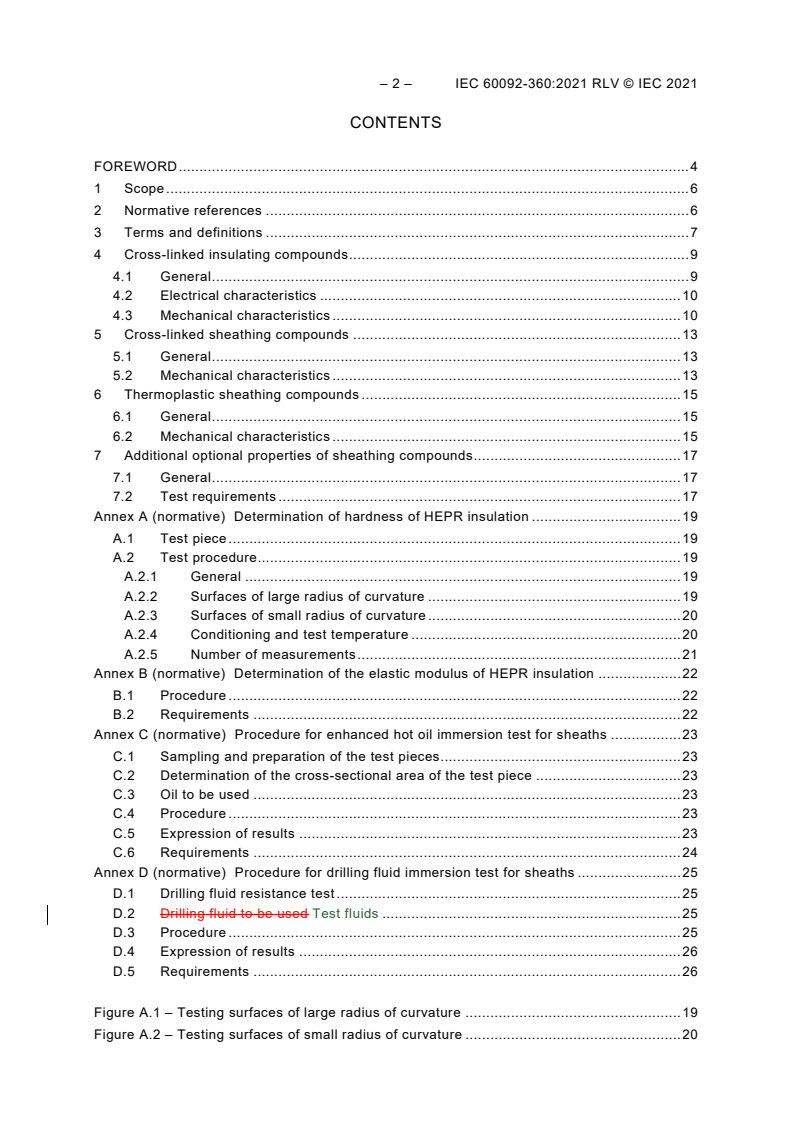
IEC 60092-360:2021 RLV - Electrical installations in ships - Part 360: Insulating and sheathing materials for shipboard and offshore units, power, control, instrumentation and telecommunication cables Released:1/4/2021
Overview
IEC 60092-360:2021 is an IEC international standard that specifies requirements for insulating and sheathing materials used in shipboard and offshore-unit cables - including power, control, instrumentation and telecommunication cables. It defines electrical, mechanical and particular characteristics for materials intended for fixed and mobile offshore units and ships, and groups materials into categories (cross‑linked insulating, cross‑linked sheathing, thermoplastic sheathing).
Key topics and requirements
- Material categories and types: The standard classifies compounds (e.g., EPR, HEPR, XLPE for insulation; SE/SH/SHF2 for cross‑linked sheaths; SHF1/ST2 for thermoplastic sheaths) and lists applicable test categories (see Table 1).
- Electrical and mechanical properties: Sets electrical performance limits and mechanical test requirements for insulation and sheath compounds (referenced in tables such as Table 3, Table 4, Table 6 and Table 8).
- Ageing and environmental resistance: Includes requirements and tests for thermal ageing, oil immersion and resistance to drilling fluids. Specific normative annexes provide methods for:
- Hardness determination of HEPR insulation (Annex A)
- Elastic modulus of HEPR insulation (Annex B)
- Enhanced hot oil immersion test for sheaths (Annex C)
- Drilling fluid (mud) immersion test for sheaths (Annex D)
- Test methods and references: Normative references to cable test standards (IEC 60811 series, IEC 60092-350, IEC 60754, etc.) define detailed test procedures for thickness, mechanical properties, ozone resistance, loss of mass, hot set, pressure/temperature behavior, and combustion gas analysis.
- Revisions and updates: 2021 edition includes updates such as volume swelling replacement for linear swelling, corrected calculations, and modified time‑under‑load test conditions.
Applications and who uses it
IEC 60092-360 is used by:
- Cable manufacturers specifying materials for shipboard and offshore cables.
- Shipyards and offshore EPCs selecting compliant cables for installations on vessels, platforms and mobile units.
- Design and procurement engineers ensuring material compatibility with marine and offshore environments (oil exposure, drilling fluids, temperature cycling).
- Test laboratories and classification societies performing type testing, qualification and conformity assessments.
- OEMs and system integrators involved in power, control, instrumentation and telecommunication systems for marine/offshore projects.
Practical benefits include improved material selection, predictable long‑term performance in harsh marine environments, and streamlined compliance with maritime electrical installation requirements.
Related standards
- IEC 60092 series - Electrical installations in ships (general context)
- IEC 60092-350 - General construction and test methods for shipboard/offshore cables
- IEC 60811 series - Test methods for non‑metallic cable materials
- IEC 60754 - Tests for gases evolved during combustion of cable materials
Keywords: IEC 60092-360, insulating and sheathing materials, shipboard cables, offshore units, cross‑linked sheathing, thermoplastic sheathing, cable testing, oil resistance, drilling fluid resistance.
Relations
- Effective Date
- 05-Sep-2023
Buy Documents
IEC 60092-360:2021 - Electrical installations in ships - Part 360: Insulating and sheathing materials for shipboard and offshore units, power, control, instrumentation and telecommunication cables Released:1/4/2021
IEC 60092-360:2021 RLV - Electrical installations in ships - Part 360: Insulating and sheathing materials for shipboard and offshore units, power, control, instrumentation and telecommunication cables Released:1/4/2021
Get Certified
Connect with accredited certification bodies for this standard

DNV
DNV is an independent assurance and risk management provider.

Lloyd's Register
Lloyd's Register is a global professional services organisation specialising in engineering and technology.

FSC International
Forest Stewardship Council certification.
Sponsored listings
Frequently Asked Questions
IEC 60092-360:2021 is a standard published by the International Electrotechnical Commission (IEC). Its full title is "Electrical installations in ships - Part 360: Insulating and sheathing materials for shipboard and offshore units, power, control, instrumentation and telecommunication cables". This standard covers: IEC 60092:2021 specifies the requirements for electrical, mechanical and particular characteristics of insulating and sheathing materials intended for use in shipboard and fixed and mobile offshore unit power, control, instrumentation and telecommunication cables.
IEC 60092:2021 specifies the requirements for electrical, mechanical and particular characteristics of insulating and sheathing materials intended for use in shipboard and fixed and mobile offshore unit power, control, instrumentation and telecommunication cables.
IEC 60092-360:2021 is classified under the following ICS (International Classification for Standards) categories: 47.020.60 - Electrical equipment of ships and of marine structures. The ICS classification helps identify the subject area and facilitates finding related standards.
IEC 60092-360:2021 has the following relationships with other standards: It is inter standard links to IEC 60092-360:2014. Understanding these relationships helps ensure you are using the most current and applicable version of the standard.
IEC 60092-360:2021 is available in PDF format for immediate download after purchase. The document can be added to your cart and obtained through the secure checkout process. Digital delivery ensures instant access to the complete standard document.
Standards Content (Sample)
IEC 60092-360 ®
Edition 2.0 2021-01
INTERNATIONAL
STANDARD
Electrical installations in ships –
Part 360: Insulating and sheathing materials for shipboard and offshore units,
power, control, instrumentation and telecommunication cables
All rights reserved. Unless otherwise specified, no part of this publication may be reproduced or utilized in any form
or by any means, electronic or mechanical, including photocopying and microfilm, without permission in writing from
either IEC or IEC's member National Committee in the country of the requester. If you have any questions about IEC
copyright or have an enquiry about obtaining additional rights to this publication, please contact the address below or
your local IEC member National Committee for further information.
IEC Central Office Tel.: +41 22 919 02 11
3, rue de Varembé info@iec.ch
CH-1211 Geneva 20 www.iec.ch
Switzerland
About the IEC
The International Electrotechnical Commission (IEC) is the leading global organization that prepares and publishes
International Standards for all electrical, electronic and related technologies.
About IEC publications
The technical content of IEC publications is kept under constant review by the IEC. Please make sure that you have the
latest edition, a corrigendum or an amendment might have been published.
IEC publications search - webstore.iec.ch/advsearchform IEC online collection - oc.iec.ch
The advanced search enables to find IEC publications by a Discover our powerful search engine and read freely all the
variety of criteria (reference number, text, technical publications previews. With a subscription you will always
committee, …). It also gives information on projects, replaced have access to up to date content tailored to your needs.
and withdrawn publications.
Electropedia - www.electropedia.org
IEC Just Published - webstore.iec.ch/justpublished
The world's leading online dictionary on electrotechnology,
Stay up to date on all new IEC publications. Just Published
containing more than 22 000 terminological entries in English
details all new publications released. Available online and
and French, with equivalent terms in 18 additional languages.
once a month by email.
Also known as the International Electrotechnical Vocabulary
(IEV) online.
IEC Customer Service Centre - webstore.iec.ch/csc
If you wish to give us your feedback on this publication or
need further assistance, please contact the Customer Service
Centre: sales@iec.ch.
IEC 60092-360 ®
Edition 2.0 2021-01
INTERNATIONAL
STANDARD
Electrical installations in ships –
Part 360: Insulating and sheathing materials for shipboard and offshore units,
power, control, instrumentation and telecommunication cables
INTERNATIONAL
ELECTROTECHNICAL
COMMISSION
ICS 47.020.60 ISBN 978-2-8322-9229-7
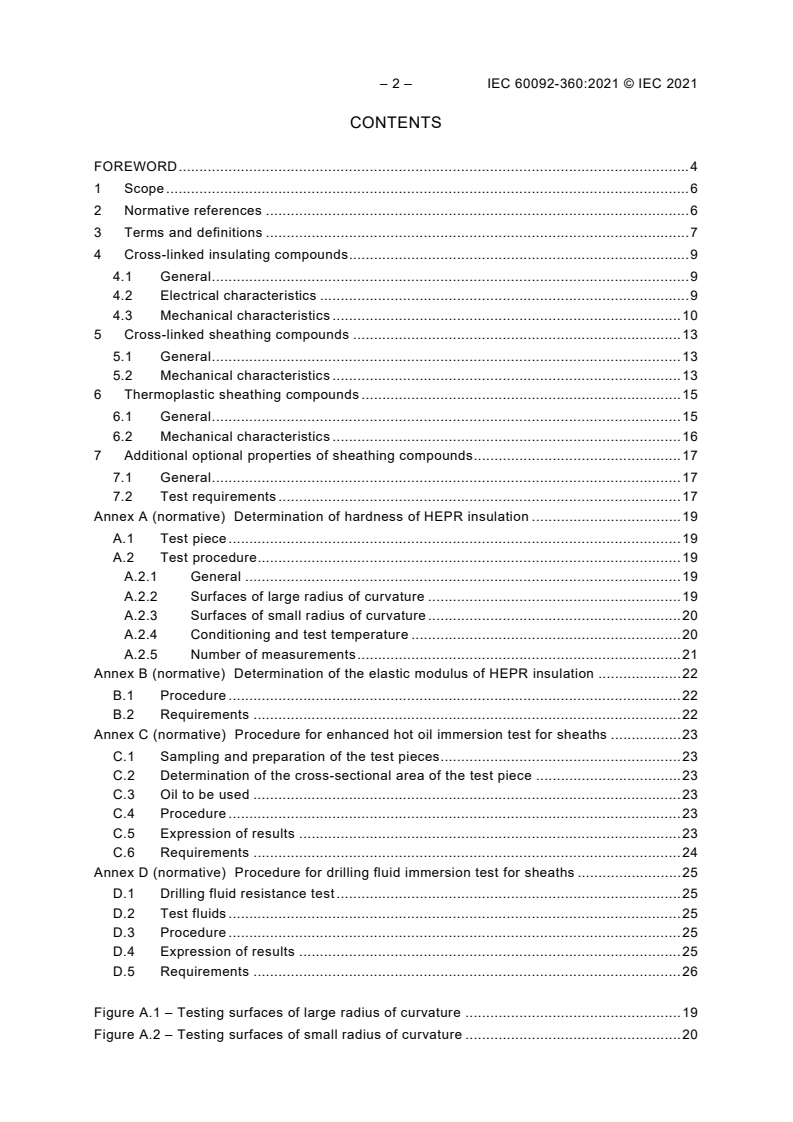
– 2 – IEC 60092-360:2021 © IEC 2021
CONTENTS
FOREWORD . 4
1 Scope . 6
2 Normative references . 6
3 Terms and definitions . 7
4 Cross-linked insulating compounds . 9
4.1 General . 9
4.2 Electrical characteristics . 9
4.3 Mechanical characteristics . 10
5 Cross-linked sheathing compounds . 13
5.1 General . 13
5.2 Mechanical characteristics . 13
6 Thermoplastic sheathing compounds . 15
6.1 General . 15
6.2 Mechanical characteristics . 16
7 Additional optional properties of sheathing compounds . 17
7.1 General . 17
7.2 Test requirements . 17
Annex A (normative) Determination of hardness of HEPR insulation . 19
A.1 Test piece . 19
A.2 Test procedure . 19
A.2.1 General . 19
A.2.2 Surfaces of large radius of curvature . 19
A.2.3 Surfaces of small radius of curvature . 20
A.2.4 Conditioning and test temperature . 20
A.2.5 Number of measurements . 21
Annex B (normative) Determination of the elastic modulus of HEPR insulation . 22
B.1 Procedure . 22
B.2 Requirements . 22
Annex C (normative) Procedure for enhanced hot oil immersion test for sheaths . 23
C.1 Sampling and preparation of the test pieces . 23
C.2 Determination of the cross-sectional area of the test piece . 23
C.3 Oil to be used . 23
C.4 Procedure . 23
C.5 Expression of results . 23
C.6 Requirements . 24
Annex D (normative) Procedure for drilling fluid immersion test for sheaths . 25
D.1 Drilling fluid resistance test . 25
D.2 Test fluids . 25
D.3 Procedure . 25
D.4 Expression of results . 25
D.5 Requirements . 26
Figure A.1 – Testing surfaces of large radius of curvature . 19
Figure A.2 – Testing surfaces of small radius of curvature . 20
Table 1 – Categories and types of materials . 6
Table 2 – Types of cross-linked insulating compounds . 9
Table 3 – Electrical requirements of insulation compounds . 10
Table 4 – Test requirements for cross-linked elastomeric insulating compounds . 11
Table 5 – Types of cross-linked sheathing compound . 13
Table 6 – Test requirements for cross-linked sheathing compounds . 14
Table 7 – Types of thermoplastic sheathing compound . 16
Table 8 – Test requirements for thermoplastic sheathing compounds . 16
Table 9 – Test requirements for sheathing compounds with enhanced oil resistance
properties . 18
Table 10 – Test requirements for sheathing compounds with drilling fluids resistance
properties (test for mud resistance). 18
– 4 – IEC 60092-360:2021 © IEC 2021
INTERNATIONAL ELECTROTECHNICAL COMMISSION
____________
ELECTRICAL INSTALLATIONS IN SHIPS –
Part 360: Insulating and sheathing materials for shipboard and offshore
units, power, control, instrumentation and telecommunication cables
FOREWORD
1) The International Electrotechnical Commission (IEC) is a worldwide organization for standardization comprising
all national electrotechnical committees (IEC National Committees). The object of IEC is to promote
international co-operation on all questions concerning standardization in the electrical and electronic fields. To
this end and in addition to other activities, IEC publishes International Standards, Technical Specifications,
Technical Reports, Publicly Available Specifications (PAS) and Guides (hereafter referred to as “IEC
Publication(s)”). Their preparation is entrusted to technical committees; any IEC National Committee interested
in the subject dealt with may participate in this preparatory work. International, governmental and non-
governmental organizations liaising with the IEC also participate in this preparation. IEC collaborates closely
with the International Organization for Standardization (ISO) in accordance with conditions determined by
agreement between the two organizations.
2) The formal decisions or agreements of IEC on technical matters express, as nearly as possible, an international
consensus of opinion on the relevant subjects since each technical committee has representation from all
interested IEC National Committees.
3) IEC Publications have the form of recommendations for international use and are accepted by IEC National
Committees in that sense. While all reasonable efforts are made to ensure that the technical content of IEC
Publications is accurate, IEC cannot be held responsible for the way in which they are used or for any
misinterpretation by any end user.
4) In order to promote international uniformity, IEC National Committees undertake to apply IEC Publications
transparently to the maximum extent possible in their national and regional publications. Any divergence
between any IEC Publication and the corresponding national or regional publication shall be clearly indicated in
the latter.
5) IEC itself does not provide any attestation of conformity. Independent certification bodies provide conformity
assessment services and, in some areas, access to IEC marks of conformity. IEC is not responsible for any
services carried out by independent certification bodies.
6) All users should ensure that they have the latest edition of this publication.
7) No liability shall attach to IEC or its directors, employees, servants or agents including individual experts and
members of its technical committees and IEC National Committees for any personal injury, property damage or
other damage of any nature whatsoever, whether direct or indirect, or for costs (including legal fees) and
expenses arising out of the publication, use of, or reliance upon, this IEC Publication or any other IEC
Publications.
8) Attention is drawn to the Normative references cited in this publication. Use of the referenced publications is
indispensable for the correct application of this publication.
9) Attention is drawn to the possibility that some of the elements of this IEC Publication may be the subject of
patent rights. IEC shall not be held responsible for identifying any or all such patent rights.
International Standard IEC 60092-360 has been prepared by Subcommittee 18A: Electric
cables for ships and mobile and fixed offshore units, of IEC Technical Committee 18:
Electrical installations of ships and of mobile and fixed offshore units.
This second edition cancels and replaces the first edition published in 2014. This edition
constitutes a technical revision.
This edition includes the following significant technical changes with respect to the previous
edition:
a) updates of normatives references;
b) replacement of linear swelling with volume swelling;
c) correction of a calculation mistake in Table 3;
d) change in Table 4 and Table 6 (treatment conditions) of time under load (from 15 min to
10 min);
e) addition of mechanical properties after aging in oil based test fluid in Table 10 (CAS
number 64742-46-7; EC number: 934-956-3).
The text of this document is based on the following documents:
FDIS Report on voting
18A/437/FDIS 18A/440/RVD
Full information on the voting for the approval of this International Standard can be found in
the report on voting indicated in the above table.
This document has been drafted in accordance with the ISO/IEC Directives, Part 2.
A list of all parts of the IEC 60092 series, published under the general title Electrical
installations in ships, can be found on the IEC website.
The committee has decided that the contents of this document will remain unchanged until the
stability date indicated on the IEC website under "http://webstore.iec.ch" in the data related to
the specific document. At this date, the document will be
• reconfirmed,
• withdrawn,
• replaced by a revised edition, or
• amended.
– 6 – IEC 60092-360:2021 © IEC 2021
ELECTRICAL INSTALLATIONS IN SHIPS –
Part 360: Insulating and sheathing materials for shipboard and offshore
units, power, control, instrumentation and telecommunication cables
1 Scope
This part of IEC 60092 specifies the requirements for electrical, mechanical and particular
characteristics of insulating and sheathing materials intended for use in shipboard and fixed
and mobile offshore unit power, control, instrumentation and telecommunication cables.
The different insulating and sheathing materials have been divided into three categories as
listed in Table 1.
Table 1 – Categories and types of materials
Title Compounds included
Cross-linked insulating compounds EPR; HEPR; XLPE; S 95; HF 90
Cross-linked sheathing compounds SE; SH; SHF 2
Thermoplastic sheathing compounds SHF 1; ST 2
2 Normative references
The following documents, in whole or in part, are normatively referenced in this document and
are indispensable for its application. For dated references, only the edition cited applies. For
undated references, the latest edition of the referenced document (including any
amendments) applies.
IEC 60092-350:2020, Electrical installations in ships – Part 350: General construction and test
methods of power, control and instrumentation cables for shipboard and offshore applications
IEC 60684-2:2011, Flexible insulating sleeving – Part 2: Methods of test
IEC 60754-1, Test on gases evolved during combustion of materials from cables – Part 1:
Determination of the halogen acid gas content
IEC 60754-2, Test on gases evolved during combustion of materials from cables – Part 2:
Determination of acidity (by pH measurement) and conductivity
IEC 60811-201:2012, Electric and optical fibre cables – Test methods for non-metallic
materials – Part 201: General tests – Measurement of insulation thickness
IEC 60811-201:2012/AMD1:2017
IEC 60811-202:2012, Electric and optical fibre cables – Test methods for non-metallic
materials – Part 202: General tests – Measurement of thickness of non-metallic sheath
IEC 60811-202:2012/AMD1:2017
IEC 60811-401:2012, Electric and optical fibre cables – Test methods for non-metallic
materials – Part 401: Miscellaneous tests – Thermal ageing methods – Ageing in an air oven
IEC 60811-401:2012/AMD1:2017
IEC 60811-403:2012, Electric and optical fibre cables – Test methods for non-metallic
materials – Part 403: Miscellaneous tests – Ozone resistance test on cross-linked compounds
IEC 60811-404:2012, Electric and optical fibre cables – Test methods for non-metallic
materials – Part 404: Miscellaneous tests – Mineral oil immersion tests for sheaths
IEC 60811-409:2012, Electric and optical fibre cables – Test methods for non-metallic
materials – Part 409: Miscellaneous tests – Loss of mass test for thermoplastic insulations
and sheaths
IEC 60811-501:2012, Electric and optical fibre cables – Test methods for non-metallic
materials – Part 501: Mechanical tests – Tests for determining the mechanical properties of
insulating and sheathing compounds
IEC 60811-501:2012/AMD1:2018
IEC 60811-505:2012, Electric and optical fibre cables – Test methods for non-metallic
materials – Part 505: Mechanical tests – Elongation at low temperature for insulations and
sheaths
IEC 60811-507:2012, Electric and optical fibre cables – Test methods for non-metallic
materials – Part 507: Mechanical tests – Hot set test for cross-linked materials
IEC 60811-508:2012, Electric and optical fibre cables – Test methods for non-metallic
materials – Part 508: Mechanical tests – Pressure test at high temperature for insulation and
sheaths
IEC 60811-508:2012/AMD1:2017
IEC 60811-509:2012, Electric and optical fibre cables – Test methods for non-metallic
materials – Part 509: Mechanical tests – Test for resistance of insulations and sheaths to
cracking (heat shock test)
IEC 60811-509:2012/AMD1:2017
ISO 48-2:2018, Rubber, vulcanised or thermoplastic – Determination of hardness – Part 2:
Hardness between 10 IRHD and 100 IRHD
ISO 1817, Rubber, vulcanised or thermoplastic – Determination of the effect of liquids
3 Terms and definitions
For the purposes of this document, the following terms and definitions apply.
ISO and IEC maintain terminological databases for use in standardization at the following
addresses:
• IEC Electropedia: available at http://www.electropedia.org/
http://www.iso.org/obp
• ISO Online browsing platform: available at
3.1
variation
difference between the median value after ageing and the median value without ageing
Note 1 to entry: Variation is expressed as a percentage between the median value before and after ageing.
– 8 – IEC 60092-360:2021 © IEC 2021
3.2
median value
middle value if the number of available values is odd and mean of the two middle values if the
number is even, when several test results have been obtained and ordered in an increasing or
decreasing succession
3.3
types of insulating compounds
3.3.1
EPR
ethylene-propylene rubber
cross-linked compound in which the elastomer is an ethylene-propylene, EPDM or an
equivalent synthetic elastomer providing a compound compliant with type EPR
3.3.2
HEPR
hard ethylene-propylene rubber
cross-linked high modulus or hard grade compound in which the elastomer is an ethylene-
propylene, EPDM or an equivalent synthetic elastomer providing a compound compliant with
type HEPR
3.3.3
XLPE
cross-linked polyethylene
cross-linked compound in which the polymer is a low density polyethylene or equivalent
synthetic polymer providing a compound compliant with type XLPE
3.3.4
HF 90
cross-linked polyolefin halogen-free
cross-linked compound in which the polymer is a polyolefin or equivalent synthetic polymer
not containing halogens providing a compound which is compliant with type HF 90
3.3.5
S 95
cross-linked silicone rubber
compound based on a polysiloxane elastomer which, when cross-linked, is compliant with
type S 95
3.4
types of sheathing compounds
3.4.1
SE
polychloroprene rubber
cross-linked compound in which the elastomer is a polychloroprene (PCP) or equivalent
synthetic elastomer providing a compound which is compliant with type SE
3.4.2
SH
chlorosulphonated polyethylene rubber
chlorinated polyethylene rubber
cross-linked compound in which the characteristic constituent is a synthetic chlorinated rubber
EXAMPLE Chlorosulphonated polyethylene (CSP) or chlorinated polyethylene (CPE), which is compliant with type
SH.
3.4.3
SHF 2
halogen-free rubber
cross-linked compound in which the polymer is a polyolefin or equivalent synthetic polymer,
not containing halogens, providing a compound which is compliant with type SHF 2
3.4.4
SHF 1
halogen-free thermoplastic
thermoplastic compound in which the polymer is a polyolefin or equivalent synthetic polymer
not containing halogens providing a compound which is compliant with type SHF 1
3.4.5
ST 2
polyvinyl chloride thermoplastic
thermoplastic compound based on plasticised polyvinyl chloride which is compliant with type
ST 2
3.5
halogen-free
compound that complies with the assessment of halogen requirements in Table 4, Table 6 or
Table 8
4 Cross-linked insulating compounds
4.1 General
The types of cross-linked insulating compound covered by this document are listed in Table 2
together with their abbreviated designations and maximum rated conductor temperatures
during normal operation and short-circuit.
Table 2 – Types of cross-linked insulating compounds
Abbreviated Maximum rated conductor temperature Type of insulating material
designation °C
Normal operation Short-circuit
EPR 90 250 Ethylene propylene rubber
HEPR 90 250 Hard grade ethylene propylene rubber
XLPE 90 250 Cross-linked polyethylene
HF 90 90 250 Cross-linked polyolefin halogen-free
a b
S 95 95 350 Cross-linked silicone rubber
a
The normal maximum rated conductor temperature for silicone is 180 °C but it is limited in view of the type of
sheathing material used.
b
This temperature is applicable only to power cables and is not appropriate for tinned conductors.
4.2 Electrical characteristics
The test requirements for electrical characteristics of insulating compounds are listed in
Table 3.
– 10 – IEC 60092-360:2021 © IEC 2021
Table 3 – Electrical requirements of insulation compounds
Designation of the EPR HEPR XLPE HF 90 S 95
insulating compound
Insulation resistance constant K (MΩ·km)
...
IEC 60092-360 ®
Edition 2.0 2021-01
REDLINE VERSION
INTERNATIONAL
STANDARD
colour
inside
Electrical installations in ships –
Part 360: Insulating and sheathing materials for shipboard and offshore units,
power, control, instrumentation and telecommunication cables
All rights reserved. Unless otherwise specified, no part of this publication may be reproduced or utilized in any form
or by any means, electronic or mechanical, including photocopying and microfilm, without permission in writing from
either IEC or IEC's member National Committee in the country of the requester. If you have any questions about IEC
copyright or have an enquiry about obtaining additional rights to this publication, please contact the address below or
your local IEC member National Committee for further information.
IEC Central Office Tel.: +41 22 919 02 11
3, rue de Varembé info@iec.ch
CH-1211 Geneva 20 www.iec.ch
Switzerland
About the IEC
The International Electrotechnical Commission (IEC) is the leading global organization that prepares and publishes
International Standards for all electrical, electronic and related technologies.
About IEC publications
The technical content of IEC publications is kept under constant review by the IEC. Please make sure that you have the
latest edition, a corrigendum or an amendment might have been published.
IEC publications search - webstore.iec.ch/advsearchform IEC online collection - oc.iec.ch
The advanced search enables to find IEC publications by a Discover our powerful search engine and read freely all the
variety of criteria (reference number, text, technical publications previews. With a subscription you will always
committee, …). It also gives information on projects, replaced have access to up to date content tailored to your needs.
and withdrawn publications.
Electropedia - www.electropedia.org
IEC Just Published - webstore.iec.ch/justpublished
The world's leading online dictionary on electrotechnology,
Stay up to date on all new IEC publications. Just Published
containing more than 22 000 terminological entries in English
details all new publications released. Available online and
and French, with equivalent terms in 18 additional languages.
once a month by email.
Also known as the International Electrotechnical Vocabulary
(IEV) online.
IEC Customer Service Centre - webstore.iec.ch/csc
If you wish to give us your feedback on this publication or
need further assistance, please contact the Customer Service
Centre: sales@iec.ch.
IEC 60092-360 ®
Edition 2.0 2021-01
REDLINE VERSION
INTERNATIONAL
STANDARD
colour
inside
Electrical installations in ships –
Part 360: Insulating and sheathing materials for shipboard and offshore units,
power, control, instrumentation and telecommunication cables
INTERNATIONAL
ELECTROTECHNICAL
COMMISSION
ICS 47.020.60 ISBN 978-2-8322-9246-4
– 2 – IEC 60092-360:2021 RLV © IEC 2021
CONTENTS
FOREWORD . 4
1 Scope . 6
2 Normative references . 6
3 Terms and definitions . 7
4 Cross-linked insulating compounds . 9
4.1 General . 9
4.2 Electrical characteristics . 10
4.3 Mechanical characteristics . 10
5 Cross-linked sheathing compounds . 13
5.1 General . 13
5.2 Mechanical characteristics . 13
6 Thermoplastic sheathing compounds . 15
6.1 General . 15
6.2 Mechanical characteristics . 15
7 Additional optional properties of sheathing compounds . 17
7.1 General . 17
7.2 Test requirements . 17
Annex A (normative) Determination of hardness of HEPR insulation . 19
A.1 Test piece . 19
A.2 Test procedure . 19
A.2.1 General . 19
A.2.2 Surfaces of large radius of curvature . 19
A.2.3 Surfaces of small radius of curvature . 20
A.2.4 Conditioning and test temperature . 20
A.2.5 Number of measurements . 21
Annex B (normative) Determination of the elastic modulus of HEPR insulation . 22
B.1 Procedure . 22
B.2 Requirements . 22
Annex C (normative) Procedure for enhanced hot oil immersion test for sheaths . 23
C.1 Sampling and preparation of the test pieces . 23
C.2 Determination of the cross-sectional area of the test piece . 23
C.3 Oil to be used . 23
C.4 Procedure . 23
C.5 Expression of results . 23
C.6 Requirements . 24
Annex D (normative) Procedure for drilling fluid immersion test for sheaths . 25
D.1 Drilling fluid resistance test . 25
D.2 Drilling fluid to be used Test fluids . 25
D.3 Procedure . 25
D.4 Expression of results . 26
D.5 Requirements . 26
Figure A.1 – Testing surfaces of large radius of curvature . 19
Figure A.2 – Testing surfaces of small radius of curvature . 20
Table 1 – Categories and types of materials . 6
Table 2 – Types of cross-linked insulating compounds . 9
Table 3 – Electrical requirements of insulation compounds . 10
Table 4 – Test requirements for cross-linked elastomeric insulating compounds . 11
Table 5 – Types of cross-linked sheathing compound . 13
Table 6 – Test requirements for cross-linked sheathing compounds . 14
Table 7 – Types of thermoplastic sheathing compound . 15
Table 8 – Test requirements for thermoplastic sheathing compounds . 16
Table 9 – Test requirements for sheathing compounds with enhanced oil resistance
properties . 17
Table 10 – Test requirements for sheathing compounds with drilling fluids resistance
properties (test for mud resistance). 18
– 4 – IEC 60092-360:2021 RLV © IEC 2021
INTERNATIONAL ELECTROTECHNICAL COMMISSION
____________
ELECTRICAL INSTALLATIONS IN SHIPS –
Part 360: Insulating and sheathing materials for shipboard and offshore
units, power, control, instrumentation and telecommunication cables
FOREWORD
1) The International Electrotechnical Commission (IEC) is a worldwide organization for standardization comprising
all national electrotechnical committees (IEC National Committees). The object of IEC is to promote international
co-operation on all questions concerning standardization in the electrical and electronic fields. To this end and
in addition to other activities, IEC publishes International Standards, Technical Specifications, Technical Reports,
Publicly Available Specifications (PAS) and Guides (hereafter referred to as “IEC Publication(s)”). Their
preparation is entrusted to technical committees; any IEC National Committee interested in the subject dealt with
may participate in this preparatory work. International, governmental and non-governmental organizations liaising
with the IEC also participate in this preparation. IEC collaborates closely with the International Organization for
Standardization (ISO) in accordance with conditions determined by agreement between the two organizations.
2) The formal decisions or agreements of IEC on technical matters express, as nearly as possible, an international
consensus of opinion on the relevant subjects since each technical committee has representation from all
interested IEC National Committees.
3) IEC Publications have the form of recommendations for international use and are accepted by IEC National
Committees in that sense. While all reasonable efforts are made to ensure that the technical content of IEC
Publications is accurate, IEC cannot be held responsible for the way in which they are used or for any
misinterpretation by any end user.
4) In order to promote international uniformity, IEC National Committees undertake to apply IEC Publications
transparently to the maximum extent possible in their national and regional publications. Any divergence between
any IEC Publication and the corresponding national or regional publication shall be clearly indicated in the latter.
5) IEC itself does not provide any attestation of conformity. Independent certification bodies provide conformity
assessment services and, in some areas, access to IEC marks of conformity. IEC is not responsible for any
services carried out by independent certification bodies.
6) All users should ensure that they have the latest edition of this publication.
7) No liability shall attach to IEC or its directors, employees, servants or agents including individual experts and
members of its technical committees and IEC National Committees for any personal injury, property damage or
other damage of any nature whatsoever, whether direct or indirect, or for costs (including legal fees) and
expenses arising out of the publication, use of, or reliance upon, this IEC Publication or any other IEC
Publications.
8) Attention is drawn to the Normative references cited in this publication. Use of the referenced publications is
indispensable for the correct application of this publication.
9) Attention is drawn to the possibility that some of the elements of this IEC Publication may be the subject of patent
rights. IEC shall not be held responsible for identifying any or all such patent rights.
This redline version of the official IEC Standard allows the user to identify the changes
made to the previous edition IEC 60092-360:2014. A vertical bar appears in the margin
wherever a change has been made. Additions are in green text, deletions are in
strikethrough red text.
International Standard IEC 60092-360 has been prepared by Subcommittee 18A: Electric
cables for ships and mobile and fixed offshore units, of IEC Technical Committee 18: Electrical
installations of ships and of mobile and fixed offshore units.
This second edition cancels and replaces the first edition published in 2014. This edition
constitutes a technical revision.
This edition includes the following significant technical changes with respect to the previous
edition:
a) updates of normatives references;
b) replacement of linear swelling with volume swelling;
c) correction of a calculation mistake in Table 3;
d) change in Table 4 and Table 6 (treatment conditions) of time under load (from 15 min to 10
min);
e) addition of mechanical properties after aging in oil based test fluid in Table 10 (CAS number
64742-46-7; EC number: 934-956-3).
The text of this document is based on the following documents:
FDIS Report on voting
18A/437/FDIS 18A/440/RVD
Full information on the voting for the approval of this International Standard can be found in the
report on voting indicated in the above table.
This document has been drafted in accordance with the ISO/IEC Directives, Part 2.
A list of all parts of the IEC 60092 series, published under the general title Electrical installations
in ships, can be found on the IEC website.
The committee has decided that the contents of this document will remain unchanged until the
stability date indicated on the IEC website under "http://webstore.iec.ch" in the data related to
the specific document. At this date, the document will be
• reconfirmed,
• withdrawn,
• replaced by a revised edition, or
• amended.
IMPORTANT – The 'colour inside' logo on the cover page of this publication indicates
that it contains colours which are considered to be useful for the correct understanding
of its contents. Users should therefore print this document using a colour printer.
– 6 – IEC 60092-360:2021 RLV © IEC 2021
ELECTRICAL INSTALLATIONS IN SHIPS –
Part 360: Insulating and sheathing materials for shipboard and offshore
units, power, control, instrumentation and telecommunication cables
1 Scope
This part of IEC 60092 specifies the requirements for electrical, mechanical and particular
characteristics of insulating and sheathing materials intended for use in shipboard and fixed
and mobile offshore unit power, control, instrumentation and telecommunication cables.
The different insulating and sheathing materials have been divided into three categories as
listed in Table 1.
Table 1 – Categories and types of materials
Title Compounds included
Cross-linked insulating compounds EPR; HEPR; XLPE; S 95; HF 90
Cross-linked sheathing compounds SE; SH; SHF 2
Thermoplastic sheathing compounds SHF 1; ST 2
2 Normative references
The following documents, in whole or in part, are normatively referenced in this document and
are indispensable for its application. For dated references, only the edition cited applies. For
undated references, the latest edition of the referenced document (including any amendments)
applies.
IEC 60092-350:— 2020, Electrical installations in ships – Part 350: General construction and
test methods of power, control and instrumentation cables for shipboard and offshore
applications
IEC 60684-2:2011, Flexible insulating sleeving – Part 2: Methods of test
IEC 60754-1, Test on gases evolved during combustion of materials from cables – Part 1:
Determination of the halogen acid gas content
IEC 60754-2, Test on gases evolved during combustion of materials from cables – Part 2:
Determination of acidity (by pH measurement) and conductivity
IEC 60811-201:2012, Electric and optical fibre cables – Test methods for non-metallic materials
– Part 201: General tests – Measurement of insulation thickness
IEC 60811-201:2012/AMD1:2017
IEC 60811-202:2012, Electric and optical fibre cables – Test methods for non-metallic materials
– Part 202: General tests – Measurement of thickness of non-metallic sheath
IEC 60811-202:2012/AMD1:2017
___________
To be published.
IEC 60811-401:2012, Electric and optical fibre cables – Test methods for non-metallic materials
– Part 401: Miscellaneous tests – Thermal ageing methods – Ageing in an air oven
IEC 60811-401:2012/AMD1:2017
IEC 60811-403:2012, Electric and optical fibre cables – Test methods for non-metallic materials
– Part 403: Miscellaneous tests – Ozone resistance test on cross-linked compounds
IEC 60811-404:2012, Electric and optical fibre cables – Test methods for non-metallic materials
– Part 404: Miscellaneous tests – Mineral oil immersion tests for sheaths
IEC 60811-409:2012, Electric and optical fibre cables – Test methods for non-metallic materials
– Part 409: Miscellaneous tests – Loss of mass test for thermoplastic insulations and sheaths
IEC 60811-501:2012, Electric and optical fibre cables – Test methods for non-metallic materials
– Part 501: Mechanical tests – Tests for determining the mechanical properties of insulating
and sheathing compounds
IEC 60811-501:2012/AMD1:2018
IEC 60811-505:2012, Electric and optical fibre cables – Test methods for non-metallic materials
– Part 505: Mechanical tests – Elongation at low temperature for insulations and sheaths
IEC 60811-507:2012, Electric and optical fibre cables – Test methods for non-metallic materials
– Part 507: Mechanical tests – Hot set test for cross-linked materials
IEC 60811-508:2012, Electric and optical fibre cables – Test methods for non-metallic materials
– Part 508: Mechanical tests – Pressure test at high temperature for insulation and sheaths
IEC 60811-508:2012/AMD1:2017
IEC 60811-509:2012, Electric and optical fibre cables – Test methods for non-metallic materials
– Part 509: Mechanical tests – Test for resistance of insulations and sheaths to cracking (heat
shock test)
IEC 60811-509:2012/AMD1:2017
ISO 48:2007, Rubber, vulcanised or thermoplastic – Determination of hardness (Hardness
between 10 IRHD and 100 IRHD)
ISO 48-2:2018, Rubber, vulcanised or thermoplastic – Determination of hardness – Part 2:
Hardness between 10 IRHD and 100 IRHD
ISO 1817, Rubber, vulcanised or thermoplastic – Determination of the effect of liquids
3 Terms and definitions
For the purposes of this document, the following terms and definitions apply.
ISO and IEC maintain terminological databases for use in standardization at the following
addresses:
• IEC Electropedia: available at http://www.electropedia.org/
• ISO Online browsing platform: available at http://www.iso.org/obp
– 8 – IEC 60092-360:2021 RLV © IEC 2021
3.1
variation
difference between the median value after ageing and the median value without ageing
Note 1 to entry: Variation is expressed as a percentage between the median value before and after ageing.
3.2
median value
middle value if the number of available values is odd andmean of the two middle values if the
number is even, when several test results have been obtained and ordered in an increasing or
decreasing succession
3.3
types of insulating compounds
3.3.1
EPR
ethylene-propylene rubber
cross-linked compound in which the elastomer is an ethylene-propylene, EPDM or an equivalent
synthetic elastomer providing a compound compliant with type EPR
Note 1 to entry: This note applies to the French language only.
3.3.2
HEPR
hard ethylene-propylene rubber
cross-linked high modulus or hard grade compound in which the elastomer is an ethylene-
propylene, EPDM or an equivalent synthetic elastomer providing a compound compliant with
type HEPR
Note 1 to entry: This note applies to the French language only.
3.3.3
XLPE
cross-linked polyethylene
cross-linked compound in which the polymer is a low density polyethylene or equivalent
synthetic polymer providing a compound compliant with type XLPE
Note 1 to entry: This note applies to the French language only.
3.3.4
HF 90
cross-linked polyolefin halogen-free
cross-linked compound in which the polymer is a polyolefin or equivalent synthetic polymer not
containing halogens providing a compound which is compliant with type HF 90
3.3.5
S 95
cross-linked silicone rubber
compound based on a polysiloxane elastomer which, when cross-linked, is compliant with type
S 95
3.4
types of sheathing compounds
3.4.1
SE
polychloroprene rubber
cross-linked compound in which the elastomer is a polychloroprene (PCP) or equivalent
synthetic elastomer providing a compound which is compliant with type SE
3.4.2
SH
chlorosulphonated polyethylene rubber
chlorinated polyethylene rubber
cross-linked compound in which the characteristic constituent is a synthetic chlorinated rubber
EXAMPLE Chlorosulphonated polyethylene (CSP) or chlorinated polyethylene (CPE), which is compliant with type
SH.
Note 1 to entry: This note applies to the French language only.
3.4.3
SHF 2
halogen-free rubber
cross-linked compound in which the polymer is a polyolefin or equivalent synthetic polymer, not
containing halogens, providing a compound which is compliant with type SHF 2
3.4.4
SHF 1
halogen-free thermoplastic
thermoplastic compound in which the polymer is a polyolefin or equivalent synthetic polymer
not containing halogens providing a compound which is compliant with type SHF 1
3.4.5
ST 2
polyvinyl chloride thermoplastic
thermoplastic compound based on plasticised polyvinyl chloride which is compliant with type
ST 2
3.5
halogen-free
compound that complies with the assessment of halogen requirements in Table 4, Table 6 or
Table 8
4 Cross-linked insulating compounds
4.1 General
The types of cross-linked insulating compound covered by this document are listed in Table 2
together with their abbreviated designations and maximum rated conductor temperatures during
normal operation and short-circuit.
Table 2 – Types of cross-linked insulating compounds
Abbreviated Maximum rated conductor temperature Type of insulating material
designation °C
Normal operation Short-circuit
EPR 90 250 Ethylene propylene rubber
HEPR 90 250 Hard grade ethylene propylene rubber
XLPE 90 250 Cross-linked polyethylene
HF 90 90 250 Cross-linked polyolefin halogen-free
a b
S 95 Cross-linked silicone rubber
95 350
a
The normal maximum rated conductor temperature for silicone is 180 °C but it is limited in view of the type of
sheathing material used.
b
This temperature is applicable only to power cables and is not appropriate for tinned conductors.
– 10 – IEC 60092-360:2021 RLV © IEC 2021
4.2 Electrical characteristics
The test requirements for electrical characteristics of insulating compounds are listed in
Table 3.
Table 3 – Electrical requirements of insulation compounds
Designation of the EPR HEPR XLPE HF 90 S 95
insulating compound
Insulation resistance constant K (MΩ·km)
i
(see 7.2 of IEC 60092-350:2020)
– at 20 °C, minimum, 3 670 3 670 3 670 550 1 850
– at maximum operating temperature, minimum. 3,67 3,67 3,67 0,55 1,85
Volume resistivity ρ(Ω·cm)
(see 7.2 of IEC 60092-350:2020)
– at 20 °C, minimum,
5,0 × 10
15 15 15 14
1,0 × 10 1,0 × 10 1,0 × 10 1,5 × 10
5,0 × 10
– at maximum operating temperature, minimum.
5,0 × 10
12 12 12 11
1,0 × 10 1,0 × 10 1,0 × 10 1,5 × 10
5,0 × 10
Increase in AC capacity after immersion in water
at 50 °C, (see 7.3 of IEC 60092-350:2020)
st
– between the end of the 1 and the end of the
15 15 – 15 15
th
14 day, maximum (%),
th
– between the end of the 7 and the end of the
5 5 – 5 5
th
14 day, maximum (%).
4.3 Mechanical characteristics
The test requirements for mechanical characteristics of cross-linked insulating compounds are
listed in Table 4.
Table 4 – Test requirements for cross-linked elastomeric insulating compounds
Test method Type of insulating compound
described in
Test description Unit
Std Reference EPR HEPR XLPE HF 90 S 95
Mechanical IEC 60811-501
properties in the
state as delivered
Values to be
obtained for the:
– tensile strength,
4,2 8,5 12,5 9,0 7,0
N/mm
min.
– elongation at
% 200 200 200 120 150
break, min.
Mechanical
IEC 60811-401
properties after
ageing in air oven
without conductor
Ageing conditions:
– temperature/
°C 135 ± 3 135 ± 3 135 ± 3 135 ± 3 200 ± 3
tolerance
– duration of
h 168 168 168 168 240
treatment
Value to be obtained
for the tensile
strength
– minimum value
- - - - 5,5
N/mm
– variation max.
% ±30 ±30 ±25 ±30 -
Value to be obtained
for the elongation at
break
– minimum value
% - - - 100 120
– variation max.
% ±30 ±30 ±25 ±30 -
Mechanical IEC 60811-401
properties after
ageing in air oven
with copper
conductor
Ageing conditions:
– temperature/
°C 135 ± 3 150 ± 3
tolerance
– duration of
h 168 168
treatment
Value to be obtained
for the tensile
strength
– variation max.
% ±30 ±30 - -
Value to be obtained
for the elongation at
break
– variation max.
% ±30 ±30 – –
Hot set test IEC 60811-507
Treatment
conditions:
– temperature/
°C 250 ± 3 250 ± 3 200 ± 3 200 ± 3 250 ± 3
tolerance
– time under load
min 15 10 15 10 15 10 15 10 15 10
min.
– mechanical stress
20 20 20 20 20
N/cm
– 12 – IEC 60092-360:2021 RLV © IEC 2021
Test method Type of insulating compound
described in
Test description Unit
Std Reference EPR HEPR XLPE HF 90 S 95
Test requirements:
– elongation max.
% 175 175 175 175 175
under load
– elongation max.
% 15 15 15 15 25
after unloading
Determination of IEC 60092-360 Annex A 80
hardness IRHD
minimum
Determination of IEC 60092-360 Annex B
elastic modulus
Modulus at 150 % 4,5
N/mm
elongation
(minimum)
Ozone resistance IEC 60811-403
test (method A or B)
Test conditions of – – – – –
method A
– temperature
°C 25 ± 2 25 ± 2 – 25 ± 2 –
– duration
h 30 30 – 30 –
– ozone
250-300 250-300 250-300
ppm – –
concentration
275 ± 25 275 ± 25 275 ± 25
No No cracks – No cracks –
Result to be obtained
cracks
Test conditions of – –
method B
– temperature
°C 40 ± 2 40 ± 2 – 40 ± 2 –
– duration
h 72 72 – 72 –
– ozone
% (200 ± (200 ± 50) – (200 ± 50) –
concentration, (by
50) x x x
volume)
–6 –6 –6
10 10 10
– relative humidity
% 55 ± 10 55 ± 10 – 55 ± 10 –
– minimum air speed
mm/s 500 500 – 500 –
at the level of the
test piece
No No cracks No cracks
Result to be obtained
cracks
Assessment of
a
halogens
pH IEC 60754-2 ≥4,3 ≥4,3 ≥4,3 ≥4,3 ≥4,3
–1
Conductivity ≤10 ≤10 ≤10 ≤10 ≤10
µS·mm
Amount of halogen
acid gas:
– HCl and HBr
% IEC 60754-1 0,5 0,5 0,5 0,5 0,5
(max.)
IEC 60684-2:
% 45 0,1 0,1 0,1 0,1 0,1
– HF (max.)
a
Test required when materials are used in halogen-free cables or identified as a halogen-free compound.
5 Cross-linked sheathing compounds
5.1 General
The types of cross-linked sheathing compound covered by this document are listed in Table 5
together with their abbreviated designations.
Table 5 – Types of cross-linked sheathing compound
Abbreviated designation Type of material and general application
SE Polychloroprene rubber
SH Chlorosulphonated polyethylene or chlorinated polyethylene rubber
SHF 2 Halogen-free rubber
SE and SH materials are suitable for use over the types of insulation given in Table 2 except for XLPE. Types SE
and SH may release are permitted even though it releases harmful fumes under fire conditions. SE and SH
materials should be avoided for installation in passenger vessels and in evacuation areas.
5.2 Mechanical characteristics
The test requirements for mechanical characteristics of cross-linked sheathing compounds are
given in Table 6. Additional requirements for enhanced types are given in Clause 7. To claim
enhanced performance, compounds shall comply with the relevant table or tables of Clause 7
in addition to the basic requirements in Table 6.
– 14 – IEC 60092-360:2021 RLV © IEC 2021
Table 6 – Test requirements for cross-linked sheathing compounds
Test method described
Type of cross-linked sheathing compound
in
Test description Unit
Std Clause SH SE SHF 2
Mechanical properties in IEC 60811-501
the state as delivered
Values to be obtained for:
– tensile strength, min. 10 10 9
N/mm
– elongation at break, % 250 300 120
min.
Mechanical properties IEC 60811-401
after ageing in air oven
Ageing conditions:
– temperature/tolerance °C 100 ± 2 100 ± 2 120 ± 3
– duration of treatment h 168 168 168
Tensile strength
– variation max. % ±30 ±30 ±30
Elongation at break
– value min. % 250 –
– variation max. % ±30 ±40 ±30
Mechanical properties IEC 60811-404
after immersion in mineral
oil IRM 902
Ageing conditions:
– temperature of oil °C 100 ± 2 100 ± 2 100 ± 2
– duration of treatment h 24 24 24
Values to be obtained for:
– tensile strength, % ±40 ±40 ±40
variation max.
– elongation at break, % ±40 ±40 ±40
variation max.
Hot set test IEC 60811-507
Treatment conditions: –
– temperature/tolerance °C 200 ± 3 200 ± 3 200 ± 3
– time under load min. min 15 10 15 10 15 10
– mechanical stress 20 20 20
N/cm
Test requirements:
– elongation max. under % 175 175 175
load
– elongation max. after % 15 15 15
unloading
Ozone resistance test IEC 60811-403
(method A or B)
Test conditions of
method A
– temperature °C 25 ± 2 25 ± 2 25 ±2
– duration h 24 24 24
– ozone concentration % (275 ± 25) x (275 ± 25) x (275 ± 25) x
–4 –4 –4
(by volume) 10 10 10
Result to be obtained No cracks No cracks No cracks
Test conditions of
method B
– temperature °C 40 ± 2 40 ± 2 40 ± 2
– duration h 72 72 72
Test method described
Type of cross-linked sheathing compound
in
Test description Unit
Std Clause SH SE SHF 2
– ozone concentration, % (200 ± 50) x (200 ± 50) x (200 ± 50) x
–6 –6 –6
(by volume)
10 10 10
– relative humidity % 55 ± 10 55 ± 10 55 ± 10
– minimum air speed at mm/s 500 500 500
the level of the test
piece
Result to be obtained No cracks No cracks No cracks
Behaviour at low
temperature
Elongation test (for IEC 60811-505
cables not subject to
bending test)
Test conditions:
– temperature: °C –15 ± 2 –15 ± 2 –15 ± 2
– duration h 16 16 16
Result to be obtained:
– elongation at break,
% 30 30 30
min.
a
Assessment of halogens
pH - IEC 60754-2 ≥4,3
–1
Conductivity IEC 60754-2 ≤10
µS·mm
Amount of halogen acid
gas:
– HCl and HBr % IEC 60754-1 0,5
(maximum)
– HF (maximum) % IEC 60684- 45 0,1
2:2011
a
Test required when materials used in halogen free cables or identified as halogen free compounds.
6 Thermoplastic sheathing compounds
6.1 General
The types of thermoplastic sheathing compounds covered by this document are listed in Table 7
together with their abbreviated designations.
Table 7 – Types of thermoplastic sheathing compound
Abbreviated Type of thermoplastic sheathing material
designation
ST 2 Polyvinyl chloride thermoplastic is permitted even though it releases harmful fumes under fire
conditions
SHF 1 Halogen-free thermoplastic for use over all types of insulation in Table 2
Type ST 2 is permitted even though it releases harmful fumes under fire conditions. ST 2 material should be
avoided for installation in passenger vessels and in evacuation areas.
6.2 Mechanical characteristics
The test requirements for mechanical characteristics of thermoplastic sheathing compounds are
listed in Table 8.
– 16 – IEC 60092-360:2021 RLV © IEC 2021
Table 8 – Test requirements for thermoplastic sheathing compounds
Test method described in Type of sheathing compound
Test description Unit
Std Clause ST 2 SHF 1
Mechanical properties in the state as
IEC 60811-501
delivered
Values to be obtained for:
– tensile strength, min. 12,5 9,0
N/mm
– elongation at break, min. % 150 120
Mechanical properties after ageing in
IEC 60811-401
air oven without conductor
Ageing conditions:
– temperature °C 100 ± 2 100 ± 2
– duration of treatment h 168 168
Value to be obtained for the tensile
strength
– minimum value 12,5 7,0
N/mm
– variation max. % ±25 ±30
Value to be obtained for the
elongation at break
– minimum value % 150 110
– variation max. % ±25 ±30
Pressure test at high temperature IEC 60811-508
Test conditions:
– temperature °C 80 ± 2 80 ± 2
– duration for cables having an outer h 4 4
diameter <12,5 mm
– duration for cables having an outer h 6 6
diameter >12,5 mm
Value to be obtained:
– maximum permissible deformation % 50 50
Heat shock IEC 60811-509
Test conditions:
– temperature °C 150 ± 3 150 ± 3
– duration h 1 1
Result to be obtained: No cracks No cracks
Loss of mass IEC 60811-409 Not applicable
Test conditions
– temperature °C 100 ± 2
– duration h 168
Result to be obtained:
mg/cm 1,5
Maximum loss of mass
Behaviour at low temperature
Elongation test (for cables not
IEC 60811-505
subject to bending test)
Test conditions:
– temperature: °C –15 ± 2 –15 ± 2
– duration h 4 4
Result to be obtained:
– elongation at break, min.
30 30
%
a
Not applicable
Assessment of halogens
pH IEC 60754-2 ≥4,3
–1
Conductivity IEC 60754-2 ≤10
µS·mm
Test method described in Type of sheathing compound
Test description Unit
Std Clause ST 2 SHF 1
Amount of halogen acid gas:
– HCl and HBr (maximum) % IEC 60754-1 0,5
– HF (maximum) % IEC 60684-2:2011 45 0,1
a
Test required when materials used in halogen free cables or identified as halogen-free compounds.
7 Additional optional properties of sheathing compounds
7.1 General
Additional optional requirements for enhanced oil resistance and drilling fluid resistance are
included in Clause 7.
7.2 Test requirements
The test requirements for enhanced characteristics of cross-linked sheathing compounds are
listed in Tables 9 and 10 hereinafter.
Enhanced oil resistant sheathing compounds shall comply with the tests according to Table 9.
Drilling fluid resistant sheathing compounds shall comply with the enhanced oil resistance tests
according to Table 9 and to all the tests according to Table 10.
Table 9 – Test requirements for sheathing compounds
with enhanced oil resistance properties
Require-
Test method described in
ment
Test description for enhanced oil resistant types Unit
Standard Reference
Mechanical properties after ageing in IRM 902 IEC 60092-360 Annex C
Test conditions:
– temperature/tolerance of oil °C 100 ± 2
– duration of treatment h 168
Result to be obtained:
– tensile strength, variation max. % ±40
– elongation at break, variation max. ±40
– linear volume swell, variation max. ±15 30
– 18 – IEC 60092-360:2021 RLV © IEC 2021
Table 10 – Test requirements for sheathing compounds
with drilling fluids resistance properties (test for mud resistance)
Require-
Test method described in
ment
Test description for drilling fluid resistant types Unit
Standard Reference
Mechanical properties after ageing in IRM 903 IEC 60092-360 Annex C
Test conditions:
– temperature/tolerance of oil °C 100 ± 2
– duration of treatment h 168
Result to be obtained:
– tensile strength, variation max. % ±30
– elongation at break, variation max. % ±30
– volume swelling, variation max. % ±30
– weight change, variation max. % ±30
Mechanical properties after ageing in calcium bromide
IEC 60092-360 Annex D
brine
Test conditions:
– temperature/tolerance of fluid °C 70 ± 2
– duration of treatment days 56
Result to be obtained:
– tensile strength, variation max. % ±25
– elongation at break, variation max. % ±25
– volume swelling, variation max. % ±20
– weight change, variation max. % ±15
Mechanical properties after aging in oil based test fluid IEC 60092-360 Annex D
a
(CAS number: 64742-46-7; EC number: 934-956-3)
Test conditions:
– temperature/tolerance of fluid °C 70 ± 2
– duration of treatment days 56
Result to be obtained:
– tensile strength, variation max. % ±30
– elongation at break, variation max. % ±30
– volume swelling, variation max. % ±25
– weight change, variation max. % ±25
a
The test fluid properties shall be according to CAS and EC numbers.
NOTE CAS (Chemical Abstracts Service) is a chemical substance category system.; EC number is a European
Community unique identification of a chemical material.
Annex A
(normative)
Determination of hardness of HEPR insulation
A.1 Test piece
The test piece shall be a sample of completed cable with all the coverings external to the rubber
surface to be measured carefully removed. Alternatively, a sample of insulated core may be
used.
A.2 Test procedure
A.2.1 General
Tests shall be made in accordance with ISO 48-2 with exceptions as indicated in A.2.2 to A.2.5.
A.2.2 Surfaces of large radius of curvature
The test instrument, in accordance with ISO 48-2, shall be constructed so as to rest firmly on
the rubber surface and permit the presser foot and indentor to make vertical contact with this
surface. This is done in one of the following ways:
a) the instrument is fitted with feet movable in universal joints so that they adjust themselves
to the curved surface;
b) the base of the instrument is fitted with two parallel rods A and A' at a distance apart
depending on the curvature of the surface (see Figure A.1).
Figure A.1 – Testing surfaces of large radius of curvature
These methods may be used on surfaces with a radius of curvature down to 20 mm.
– 20 – IEC 60092-360:2021 RLV © IEC 2021
When the thickness of rubber tested is less than 4 mm, an instrument as described in the
method in ISO 48-2 for thin and small test pieces shall be used.
A.2.3 Surfaces of small radius of curvature
On surfaces with too small a radius of curvature for the procedures described in A.2.2, the test
piece shall be supported on the same rigid base as the test instrument, in such a way as to
minimise bodily movement of the rubber surface when the indenting force increment is applied
to the indentor and so that the indentor is vertically above the axis of the test piece. Suitable
procedures are as follows:
a) by resting the test piece in a grove or trough in a metal jig – see Figure A.2 a);
b) by resting the ends of the conductor of the test piece in V-blocks – see Figure A.2 b).
a) Metal jig b) V blocks
Figure A.2 – Testing surfaces of small radius of curvature
The smallest radius of curvature of the surface to be measured by these methods shall be at
least 4 mm.
For smaller radii, an instrument as described in the method in ISO 48-2 for thin and small test
pieces shall be used.
A.2.4 Conditioning and test temperature
The minimum time between manufacture, i.e. vulcanisation, and testing shall be 16 h.
The test shall be carried out at a temperature of (20 ± 2) °C and the test pieces shall be
maintained at this temperature for at least 3 h immediately before testing.
A.2.5 Number of measurements
One measurement shall be made at each of three or five different points distributed around the
test piece. The median of the results shall be taken as the hardness of the test piece, reported
to the nearest whole number in International Rubber Hardness Degrees (IRHD).
– 22 – IEC 60092-360:2021 RLV © IEC 2021
Annex B
(normative)
Determination of the elastic modulus of HEPR insulation
B.1 Procedure
Sampling, preparation of the test pieces and the test procedure shall be carried out in
accordance with IEC 60811-201.
The loads required for 150 % elongation shall be measured. The corresponding stresses shall
be calculated by dividing the loads measured by the cross-sectional areas of the unstretched
test pieces. The ratios of the stresses to strains shall be determined to obtain the elastic
modulus at 150 % elongation.
The elastic modulus shall be the respective median values.
B.2 Requirements
The results of the test shall comply with the requirements given in Table 4.
Annex C
(normative)
Procedure for enhanced hot oil
immersion test for sheaths
C.1 Sampling and preparation of the test pieces
Five tests pieces shall be prepared in accordance with procedures described in 4.3 of
IEC 60811-202:2012.
The test of determination of linear volume swell shall be carried out on dumb-bell samples of
thickness (1,25 ± 0,25) mm.
C.2 Determination of the cross-sectional area of the test piece
See the test method in IEC 60811-202.
C.3 Oil to be used
Mineral oil type IRM 902 (in accordance with ISO 1817) for Table 9 or mineral oil IRM 903 (in
accordance with ISO 1817) for Table 10.
C.4 Procedure
Before immersion of each test piece, the weight to within 0,1 mg and linear dimension in
millimetres along the axis of the dumb-bell (to one decimal place) shall be measured at room
temperature.
Then, the test pieces shall be immersed in an oil bath previously heated to (100 ± 2) °C and
shall be maintained
...