

IEC 62766-3:2016
(Main)Consumer terminal function for access to IPTV and open internet multimedia services - Part 3: Content metadata
General Information
- Abstract
IEC 62766-3:2016 specifies the aspects concerning content metadata.
- Status
- Published
- Publication Date
- 14-Dec-2016
- Technical Committee
- TC 100 - Audio, video and multimedia systems and equipment
- Drafting Committee
- MT 62766 - TC 100/MT 62766
- Current Stage
- PPUB - Publication issued
- Start Date
- 15-Dec-2016
- Completion Date
- 28-Feb-2017
Overview
IEC 62766-3:2016 is an international standard developed by the International Electrotechnical Commission (IEC) that defines standardized metadata for consumer terminals accessing IPTV and open internet multimedia services. This standard, titled Consumer terminal function for access to IPTV and open internet multimedia services – Part 3: Content metadata, focuses specifically on the aspects related to content metadata to ensure interoperability, consistency, and efficient multimedia service delivery.
Content metadata describes the attributes, properties, and classification of multimedia content that consumers access via IPTV or internet platforms. By defining clear metadata standards, IEC 62766-3 supports service discovery, content classification, management, and user navigation across diverse multimedia services.
Key Topics
Metadata Content and Structure
- General metadata elements describing multimedia content properties.
- Schema extensions and validation methods to allow metadata adaptability and compliance.
- Specific extensions for Service Discovery & Signaling (SD&S) to enhance service announcements, provider details, and application signalling.
- Broadcast Content Guide (BCG) extensions covering signalling protocols, digital rights management (DRM) information, classification schemes, program and service information.
Metadata Delivery and Control
- Mechanisms for delivering metadata efficiently over networks.
- Integration of SD&S and BCG metadata to unify broadcast and internet content metadata platforms.
- Use of service discovery XML schemas to support dynamic service provider and content updates.
- Implementation of event information tables (EIT) to support metadata at the broadcast level.
- Content Reference Identifier (CRID) resolution for locating multimedia content across services.
Classification and Extensions
- Extensions for multimedia classification including audio, video coding formats, media formats, protocols, and region-specific classification schemes.
- Examples and guidelines for XML schema extensions used in IPTV contexts.
Practical Use and Implementation
- Methods to link service discovery metadata with broadcast content guide records for comprehensive user experience.
- Security and DRM metadata elements specifying content protection and rights control.
- Guidelines to enable metadata extensibility ensuring the standard remains relevant with evolving multimedia technologies.
Applications
IEC 62766-3:2016 has practical applications in various multimedia delivery platforms and consumer electronics:
- IPTV Service Providers: To standardize how content metadata is formatted, delivered, and interpreted, enabling interoperability among different IPTV platforms and terminals.
- Consumer Electronics Manufacturers: To integrate IPTV and internet multimedia services smoothly in devices like smart TVs, set-top boxes, and multimedia gateways.
- Content Aggregators and Middleware Developers: To enable consistent metadata-driven content discovery, recommendations, and navigation.
- Digital Rights Management Implementers: To manage protected content efficiently through standardized DRM metadata.
- Broadcast Networks and Hybrid Services: To synchronize broadcast content guides with internet multimedia services for an integrated user experience.
- Application Developers: To embed metadata-aware functions that support multimedia service announcements, program guides, and emergency notifications.
By using the standardized structures and schema extensions outlined in IEC 62766-3, stakeholders can ensure better content discovery, metadata management, and seamless service interaction in IPTV and open internet multimedia ecosystems.
Related Standards
IEC 62766-3 complements and interacts with several other standards and frameworks relevant to IPTV and multimedia services:
- IEC 62766 (Parts 1 & 2): Cover other consumer terminal functions such as service discovery and network signalling.
- Open IPTV Forum Specifications: Provide data models and discovery mechanisms referenced and extended in IEC 62766-3 metadata standards.
- Digital Video Broadcasting (DVB) Standards: Especially those dealing with EIT and broadcast metadata.
- International Organization for Standardization (ISO) Media Metadata Standards: For foundational metadata schemas and content description.
- Digital Rights Management (DRM) Standards: Related to how control information is embedded and conveyed via metadata.
- Internet Engineering Task Force (IETF) Protocols: For signaling and transport methods facilitating reliable metadata delivery.
Adopting IEC 62766-3 facilitates alignment with these related standards, ensuring a comprehensive and interoperable ecosystem for IPTV and internet multimedia consumer services.
Keywords: IEC 62766-3, IPTV metadata, content metadata standard, IPTV consumer terminal, multimedia metadata, digital rights management, service discovery, broadcast content guide, IPTV service provider, multimedia classification, schema extensions, multimedia service metadata, content navigation, IPTV interoperability.
Get Certified
Connect with accredited certification bodies for this standard

BSI Group
BSI (British Standards Institution) is the business standards company that helps organizations make excellence a habit.

NYCE
Mexican standards and certification body.

ANCE
Mexican certification and testing association.
Sponsored listings
Frequently Asked Questions
IEC 62766-3:2016 is a standard published by the International Electrotechnical Commission (IEC). Its full title is "Consumer terminal function for access to IPTV and open internet multimedia services - Part 3: Content metadata". This standard covers: IEC 62766-3:2016 specifies the aspects concerning content metadata.
IEC 62766-3:2016 specifies the aspects concerning content metadata.
IEC 62766-3:2016 is classified under the following ICS (International Classification for Standards) categories: 33.170 - Television and radio broadcasting; 35.240.95 - Internet applications. The ICS classification helps identify the subject area and facilitates finding related standards.
IEC 62766-3:2016 is available in PDF format for immediate download after purchase. The document can be added to your cart and obtained through the secure checkout process. Digital delivery ensures instant access to the complete standard document.
Standards Content (Sample)
IEC 62766-3 ®
Edition 1.0 2016-12
INTERNATIONAL
STANDARD
NORME
INTERNATIONALE
colour
inside
Consumer terminal function for access to IPTV and open internet multimedia
services –
Part 3: Content metadata
Fonction des terminaux grand public pour l'accès aux services IPTV et
multimédias de l'internet ouvert –
Partie 3: Métadonnées de contenu
All rights reserved. Unless otherwise specified, no part of this publication may be reproduced or utilized in any form
or by any means, electronic or mechanical, including photocopying and microfilm, without permission in writing from
either IEC or IEC's member National Committee in the country of the requester. If you have any questions about IEC
copyright or have an enquiry about obtaining additional rights to this publication, please contact the address below or
your local IEC member National Committee for further information.
Droits de reproduction réservés. Sauf indication contraire, aucune partie de cette publication ne peut être reproduite
ni utilisée sous quelque forme que ce soit et par aucun procédé, électronique ou mécanique, y compris la photocopie
et les microfilms, sans l'accord écrit de l'IEC ou du Comité national de l'IEC du pays du demandeur. Si vous avez des
questions sur le copyright de l'IEC ou si vous désirez obtenir des droits supplémentaires sur cette publication, utilisez
les coordonnées ci-après ou contactez le Comité national de l'IEC de votre pays de résidence.
IEC Central Office Tel.: +41 22 919 02 11
3, rue de Varembé Fax: +41 22 919 03 00
CH-1211 Geneva 20 info@iec.ch
Switzerland www.iec.ch
About the IEC
The International Electrotechnical Commission (IEC) is the leading global organization that prepares and publishes
International Standards for all electrical, electronic and related technologies.
About IEC publications
The technical content of IEC publications is kept under constant review by the IEC. Please make sure that you have the
latest edition, a corrigenda or an amendment might have been published.
IEC Catalogue - webstore.iec.ch/catalogue Electropedia - www.electropedia.org
The stand-alone application for consulting the entire The world's leading online dictionary of electronic and
bibliographical information on IEC International Standards, electrical terms containing 20 000 terms and definitions in
Technical Specifications, Technical Reports and other English and French, with equivalent terms in 15 additional
documents. Available for PC, Mac OS, Android Tablets and languages. Also known as the International Electrotechnical
iPad. Vocabulary (IEV) online.
IEC publications search - www.iec.ch/searchpub IEC Glossary - std.iec.ch/glossary
The advanced search enables to find IEC publications by a 65 000 electrotechnical terminology entries in English and
variety of criteria (reference number, text, technical French extracted from the Terms and Definitions clause of
committee,…). It also gives information on projects, replaced IEC publications issued since 2002. Some entries have been
and withdrawn publications. collected from earlier publications of IEC TC 37, 77, 86 and
CISPR.
IEC Just Published - webstore.iec.ch/justpublished
Stay up to date on all new IEC publications. Just Published IEC Customer Service Centre - webstore.iec.ch/csc
details all new publications released. Available online and If you wish to give us your feedback on this publication or
also once a month by email. need further assistance, please contact the Customer Service
Centre: csc@iec.ch.
A propos de l'IEC
La Commission Electrotechnique Internationale (IEC) est la première organisation mondiale qui élabore et publie des
Normes internationales pour tout ce qui a trait à l'électricité, à l'électronique et aux technologies apparentées.
A propos des publications IEC
Le contenu technique des publications IEC est constamment revu. Veuillez vous assurer que vous possédez l’édition la
plus récente, un corrigendum ou amendement peut avoir été publié.
Catalogue IEC - webstore.iec.ch/catalogue Electropedia - www.electropedia.org
Application autonome pour consulter tous les renseignements
Le premier dictionnaire en ligne de termes électroniques et
bibliographiques sur les Normes internationales,
électriques. Il contient 20 000 termes et définitions en anglais
Spécifications techniques, Rapports techniques et autres
et en français, ainsi que les termes équivalents dans 15
documents de l'IEC. Disponible pour PC, Mac OS, tablettes
langues additionnelles. Egalement appelé Vocabulaire
Android et iPad.
Electrotechnique International (IEV) en ligne.
Recherche de publications IEC - www.iec.ch/searchpub
Glossaire IEC - std.iec.ch/glossary
65 000 entrées terminologiques électrotechniques, en anglais
La recherche avancée permet de trouver des publications IEC
en utilisant différents critères (numéro de référence, texte, et en français, extraites des articles Termes et Définitions des
comité d’études,…). Elle donne aussi des informations sur les publications IEC parues depuis 2002. Plus certaines entrées
projets et les publications remplacées ou retirées. antérieures extraites des publications des CE 37, 77, 86 et
CISPR de l'IEC.
IEC Just Published - webstore.iec.ch/justpublished
Service Clients - webstore.iec.ch/csc
Restez informé sur les nouvelles publications IEC. Just
Published détaille les nouvelles publications parues. Si vous désirez nous donner des commentaires sur cette
Disponible en ligne et aussi une fois par mois par email. publication ou si vous avez des questions contactez-nous:
csc@iec.ch.
IEC 62766-3 ®
Edition 1.0 2016-12
INTERNATIONAL
STANDARD
NORME
INTERNATIONALE
colour
inside
Consumer terminal function for access to IPTV and open internet multimedia
services –
Part 3: Content metadata
Fonction des terminaux grand public pour l'accès aux services IPTV et
multimédias de l'internet ouvert –
Partie 3: Métadonnées de contenu
INTERNATIONAL
ELECTROTECHNICAL
COMMISSION
COMMISSION
ELECTROTECHNIQUE
INTERNATIONALE
ICS 33.170; 35.240.95 ISBN 978-2-8322-3690-1
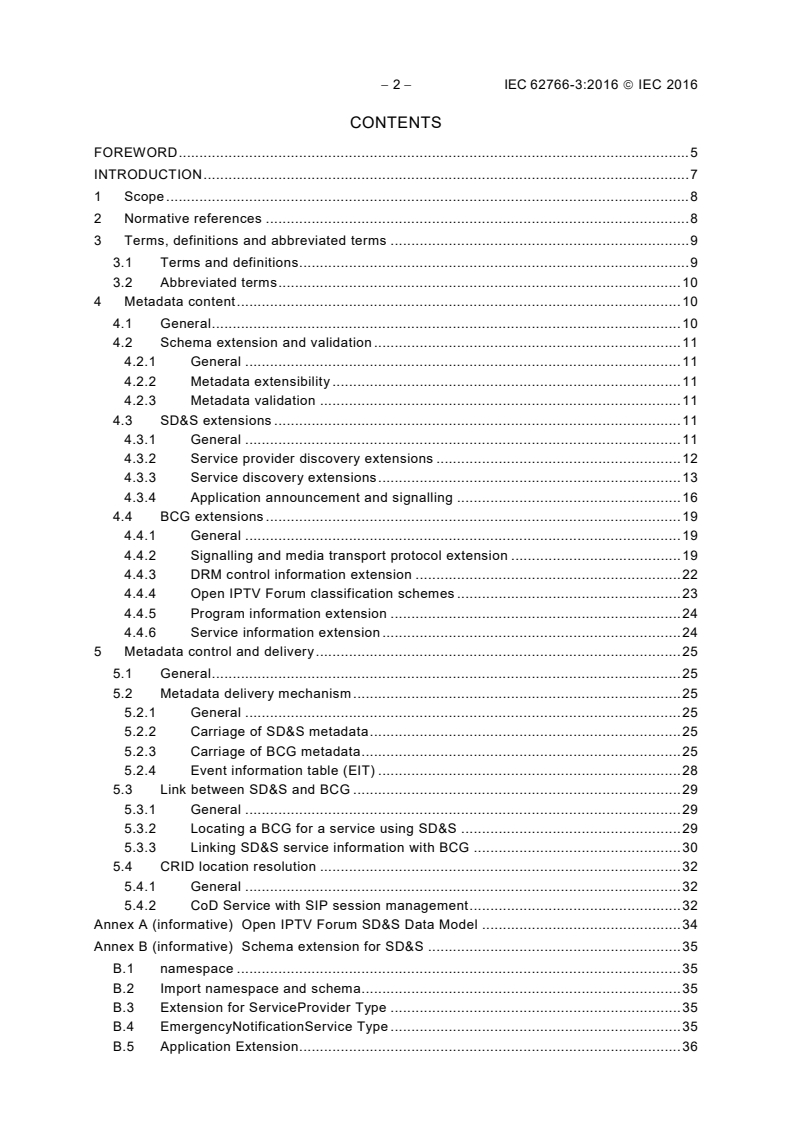
− 2 − IEC 62766-3:2016 IEC 2016
CONTENTS
FOREWORD . 5
INTRODUCTION . 7
1 Scope . 8
2 Normative references . 8
3 Terms, definitions and abbreviated terms . 9
3.1 Terms and definitions . 9
3.2 Abbreviated terms . 10
4 Metadata content . 10
4.1 General . 10
4.2 Schema extension and validation . 11
4.2.1 General . 11
4.2.2 Metadata extensibility . 11
4.2.3 Metadata validation . 11
4.3 SD&S extensions . 11
4.3.1 General . 11
4.3.2 Service provider discovery extensions . 12
4.3.3 Service discovery extensions . 13
4.3.4 Application announcement and signalling . 16
4.4 BCG extensions . 19
4.4.1 General . 19
4.4.2 Signalling and media transport protocol extension . 19
4.4.3 DRM control information extension . 22
4.4.4 Open IPTV Forum classification schemes . 23
4.4.5 Program information extension . 24
4.4.6 Service information extension . 24
5 Metadata control and delivery . 25
5.1 General . 25
5.2 Metadata delivery mechanism . 25
5.2.1 General . 25
5.2.2 Carriage of SD&S metadata . 25
5.2.3 Carriage of BCG metadata . 25
5.2.4 Event information table (EIT) . 28
5.3 Link between SD&S and BCG . 29
5.3.1 General . 29
5.3.2 Locating a BCG for a service using SD&S . 29
5.3.3 Linking SD&S service information with BCG . 30
5.4 CRID location resolution . 32
5.4.1 General . 32
5.4.2 CoD Service with SIP session management . 32
Annex A (informative) Open IPTV Forum SD&S Data Model . 34
Annex B (informative) Schema extension for SD&S . 35
B.1 namespace . 35
B.2 Import namespace and schema. 35
B.3 Extension for ServiceProvider Type . 35
B.4 EmergencyNotificationService Type . 35
B.5 Application Extension . 36
B.6 FLUTESessionDescriptor . 36
B.7 Extension for IPServiceType . 37
Annex C (informative) Schema extension for BCG . 38
C.1 namespace . 38
C.2 Import namespace and schema. 38
C.3 Include definitions . 38
C.4 Extension for PurchaseItem Type. 38
C.5 Extension for OnDemandProgram Type . 39
C.6 Extension for Programdescription Type . 39
C.7 Extension for ProgramInformation Type . 40
C.8 Extension for ServiceInformation Type . 40
Annex D (informative) Classification schemes' extensions . 41
D.1 Overview. 41
D.2 VisualCodingFormatCS . 41
D.3 AudioCodingFormatCS. 42
D.4 AVMediaFormatCS . 43
D.5 ProtocolCS . 44
D.6 GermanyFSKCS . 45
D.7 ApplicationUsageCS . 46
Annex E (informative) Service provider and service discovery XML examples . 47
E.1 Service provider discovery . 47
E.2 Broadcast discovery . 48
E.3 Package discovery . 50
E.4 Application discovery . 50
Bibliography . 53
Figure 1 – Outline of service provider record updates . 12
Figure 2 – Emergency notification structure . 13
Figure 3 – OnDemandProgramType extension for the Protocol element . 20
Figure 4 – ProgramDescriptionType extension for the notification information . 21
Figure 5 – PurchaseItemType extension for the DRMControlInformation . 23
Figure 6 – How to link a service in broadcast discovery with BCG discovery . 30
Figure 7 – How to find description information in BCG from SD&S metadata . 32
Figure A.1 – Open IPTV Forum SD&S data model . 34
Table 1 – Extract of EmergencyNotificationService type sementics . 13
Table 2 – Extract of Broadcast Discovery record indicating MaxBitrate extension . 14
Table 3 – Extract of Broadcast Discovery record indicating TimeToRenegotiate
extension . 14
Table 4 – Extract of Broadcast Discovery record indicating PurchaseItem extension . 15
Table 5 – Extract of broadcast discovery record indicating FileFormat extension . 15
Table 6 – Extract of broadcast discovery record indicating redefined FCC/RET
attributes . 16
Table 7 – Extract of OnDemandProgram type indicating protocol type extension . 19
Table 8 – Use of elements from RelatedMaterialType . 22
Table 9 – DRMControlInformation type semantics . 22
− 4 − IEC 62766-3:2016 IEC 2016
Table 10 – Use of DoNotBookmark element in program information . 24
Table 11 – Use of DoNotBookmark element in service information . 24
Table 12 – Methods of SOAP . 26
Table 13 – DVBTriplet ID . 29
INTERNATIONAL ELECTROTECHNICAL COMMISSION
____________
CONSUMER TERMINAL FUNCTION FOR ACCESS TO IPTV
AND OPEN INTERNET MULTIMEDIA SERVICES –
Part 3: Content metadata
FOREWORD
1) The International Electrotechnical Commission (IEC) is a worldwide organization for standardization comprising
all national electrotechnical committees (IEC National Committees). The object of IEC is to promote
international co-operation on all questions concerning standardization in the electrical and electronic fields. To
this end and in addition to other activities, IEC publishes International Standards, Technical Specifications,
Technical Reports, Publicly Available Specifications (PAS) and Guides (hereafter referred to as “IEC
Publication(s)”). Their preparation is entrusted to technical committees; any IEC National Committee interested
in the subject dealt with may participate in this preparatory work. International, governmental and non-
governmental organizations liaising with the IEC also participate in this preparation. IEC collaborates closely
with the International Organization for Standardization (ISO) in accordance with conditions determined by
agreement between the two organizations.
2) The formal decisions or agreements of IEC on technical matters express, as nearly as possible, an international
consensus of opinion on the relevant subjects since each technical committee has representation from all
interested IEC National Committees.
3) IEC Publications have the form of recommendations for international use and are accepted by IEC National
Committees in that sense. While all reasonable efforts are made to ensure that the technical content of IEC
Publications is accurate, IEC cannot be held responsible for the way in which they are used or for any
misinterpretation by any end user.
4) In order to promote international uniformity, IEC National Committees undertake to apply IEC Publications
transparently to the maximum extent possible in their national and regional publications. Any divergence
between any IEC Publication and the corresponding national or regional publication shall be clearly indicated in
the latter.
5) IEC itself does not provide any attestation of conformity. Independent certification bodies provide conformity
assessment services and, in some areas, access to IEC marks of conformity. IEC is not responsible for any
services carried out by independent certification bodies.
6) All users should ensure that they have the latest edition of this publication.
7) No liability shall attach to IEC or its directors, employees, servants or agents including individual experts and
members of its technical committees and IEC National Committees for any personal injury, property damage or
other damage of any nature whatsoever, whether direct or indirect, or for costs (including legal fees) and
expenses arising out of the publication, use of, or reliance upon, this IEC Publication or any other IEC
Publications.
8) Attention is drawn to the Normative references cited in this publication. Use of the referenced publications is
indispensable for the correct application of this publication.
9) Attention is drawn to the possibility that some of the elements of this IEC Publication may be the subject of
patent rights. IEC shall not be held responsible for identifying any or all such patent rights.
International Standard IEC 62766 has been prepared by IEC technical committee 100: Audio,
video and multimedia systems and equipment.
The text of this standard is based on the following documents:
CDV Report on voting
100/2489/CDV 100/2659/RVC
Full information on the voting for the approval of this International Standard can be found in
the report on voting indicated in the above table.
This document has been drafted in accordance with the ISO/IEC Directives, Part 2.
This International Standard is to be used in conjunction with IEC 62766-1.
− 6 − IEC 62766-3:2016 IEC 2016
A list of all parts in the IEC 62766 series, published under the general title Consumer terminal
function for access to IPTV and open internet multimedia services, can be found on the IEC
website.
The committee has decided that the contents of this document will remain unchanged until the
stability date indicated on the IEC website under "http://webstore.iec.ch" in the data related to
the specific document. At this date, the document will be
• reconfirmed,
• withdrawn,
• replaced by a revised edition, or
• amended.
IMPORTANT – The 'colour inside' logo on the cover page of this publication indicates
that it contains colours which are considered to be useful for the correct
understanding of its contents. Users should therefore print this document using a
colour printer.
INTRODUCTION
The IEC 62766 series is based on a series of specifications that was originally developed by
the OPEN IPTV FORUM (OIPF). They specify the user-to-network interface (UNI) for
consumer terminals to access IPTV and open internet multimedia services over managed or
non-managed networks as defined by OIPF.
− 8 − IEC 62766-3:2016 IEC 2016
CONSUMER TERMINAL FUNCTION FOR ACCESS TO IPTV
AND OPEN INTERNET MULTIMEDIA SERVICES –
Part 3: Content metadata
1 Scope
This part of IEC 62766 specifies the aspects concerning content metadata.
2 Normative references
The following documents are referred to in the text in such a way that some or all of their
content constitutes requirements of this document. For dated references, only the edition
cited applies. For undated references, the latest edition of the referenced document (including
any amendments) applies.
IEC 62766-1 , Consumer terminal function for access to IPTV and open Internet multimedia
services – Part 1: General
IEC 62766-2-1, Consumer terminal function for access to IPTV and open Internet multimedia
services – Part 2-1 – Media Formats
IEC 62766-4-1 , Consumer terminal function for access to IPTV and open Internet multimedia
services – Part 4-1 – Protocols
IEC 62766-5-1 , Consumer terminal function for access to IPTV and open Internet multimedia
services – Part 5 – Declarative application environment
IEC 62766-6 , Consumer terminal function for access to IPTV and open Internet multimedia
services – Part 6 – Procedural application environment
IEC 62766-7 , Consumer terminal function for access to IPTV and open Internet multimedia
services – Part 7 – Authentication, content protection and service protection
ISO/IEC 15938-5, May 2003, Multimedia Content description Interface – Part 5: Multimedia
description schemes
ETSI EN 300 468 V1.13.1 (2012-08), Digital Video Broadcasting: Specification for Service
Information (SI) in DVB systems
ETSI TS 102 034 V1.5.1 (2014-05), Digital Video Broadcasting: Transport of MPEG-2 Based
DVB Services over IP Based Networks
__________
Under preparation. Stage at the time of publication: IEC/CDV 62766-1:2015
Under preparation. Stage at the time of publication: IEC/CDV 62766-4-1:2015
Under preparation. Stage at the time of publication: IEC/CDV 62766-5-1:2015
Under preparation. Stage at the time of publication: IEC/CDV 62766-6:2015
Under preparation. Stage at the time of publication: IEC/CDV 62766-7:2015
ETSI TS 102 323 V1.2.1 (2005-11), Digital Video Broadcasting (DVB); Carriage and signalling
of TV-Anytime information in DVB transport streams
ETSI TS 102 539 V1.3.1 (2010-04), Digital Video Broadcasting: Carriage of Broadband
Content Guide (BCG) information over Internet Protocol
ETSI TS 102 728 V1.1.1 (2010-01), Digital Video Broadcasting (DVB); Globally Executable
MHP (GEM) Specification 1.2.2 (including IPTV)
ETSI TS 102 809 v1.2.1 (2013-07), Digital Video Broadcasting (DVB); Signalling and carriage
of interactive applications and services in hybrid broadcast/broadband environments
ETSI TS 102 822-3-1 V1.7.1 (2011-11), Broadcast and On-line Services: Search, select and
rightful use of content on personal storage systems (“TV-Anytime”); Part 3: Metadata; Sub-
part 1: Phase 1 – Metadata schemas
ETSI TS 102 822-3-2 V1.6.1 (2012-07), Broadcast and On-line Services: Search, select and
rightful use of content on personal storage systems (“TV-Anytime”); Part 3: Metadata; Sub-
part 2: System aspects in a uni-directional environment
ETSI TS 102 822-6-1 V1.7.1 (2011-11), Broadcast and On-line Services: Search, select, and
rightful use of content on personal storage systems ("TV-Anytime"); Part 6: Delivery of
metadata over a bi-directional network; Sub-part 1: Service and transport
DVB Services CA system identifiers, available at
3 Terms, definitions and abbreviated terms
3.1 Terms and definitions
For the purposes of this document, the terms and definitions given in IEC 62766-1 and the
following apply.
ISO and IEC maintain terminological databases for use in standardization at the following
addresses:
• IEC Electropedia: available at http://www.electropedia.org/
• ISO Online browsing platform: available at http://www.iso.org/obp
3.1.1
linear TV metadata
metadata that is associated with the content items provided in the scheduled content service
Note 1 to entry: In the scheduled content service the content playout time is determined by the service provider.
3.1.2
CoD metadata
metadata describing the attributes of content items available to the user on an on-demand
nature
Note 1 to entry: CoD metadata are typically organised as a catalog that may be presented in different
perspectives, such as alphabetical listing or grouped by genre.
3.1.3
interactive services metadata
metadata describing interactive applications that may be available to the user
− 10 − IEC 62766-3:2016 IEC 2016
3.1.4
stored content metadata
metadata describing scheduled content items that have been recorded by the user and are
available for playback either from network storage or local storage
3.1.5
file delivery metadata
metadata describing a file delivery session over the unidirectional network
3.2 Abbreviated terms
AV Audio/video
BCG Broadband Content Guide
CE-HTML Consumer equipment HTML
CRID Content Reference Identifier
CoD Content on Demand
DVBSTP DVB SD&S Transport Protocol
DVB Digital Video Broadcast
EIT Event Information Table
EIT P/F EIT Present/Following
EPG Electronic Program Guide
FCC Fast Channel Change
FDT File Delivery Table
FLUTE File delivery over unidirectional transport
HNED Home Network End Device
HTML Hypertext markup language
IMI Instance Metadata Identifier
NG Network Generated
OITF Open IPTV terminal function
RET Retransmission
SDT Service description Table
SI Service information
SOAP Simple Object Access Protocol
SPTS Single Program Transport Stream
SVG Scalable Vector Graphics
TS Transport Stream
XSD XML Schema Definition
4 Metadata content
4.1 General
The content metadata specified in the present standard are based on two ETSI specifications:
• Service discovery and selection (SD&S)
SD&S metadata are a set of data related to the service discovery and selection (SD&S)
mechanism as defined in ETSI TS 102 034. These metadata allow the OITF to retrieve
information to select linear TV services (i.e. multicast address, channel name, package,
etc.), BCG services (for linear TV or CoD) or other DVB services. For FCC/RET services,
the appropriate SD&S records are defined in Annex I of ETSI TS 102 034:2014.
• Broadband content guide (BCG)
The BCG is a set of data related to the description of linear TV events and services,
and/or CoD content as defined by ETSI TS 102 539.
This clause defines extensions to the SD&S and BCG schemas and the AV classification
schemes. Refer to the ETSI TS 102 034 and ETSI TS 102 539 specifications for the base
schemas.
4.2 Schema extension and validation
4.2.1 General
The metadata is in the form of an instance document which is validated against a schema
defined in the present document. The XML schema is obtained by extending the SD&S
schema defined in ETSI TS 102 034 and the BCG schema defined in ETSI TS 102 539.
4.2.2 Metadata extensibility
This document provides schema descriptions of those elements and attributes that are
extended from the original schema defined in ETSI TS 102 034 for SD&S, or ETSI TS 102 539
for BCG. The extension rule adopted in this standard follows the forward compatibility
constraints specified in order to be able to extend the BCG schema in ETSI TS 102 822-3-2.
4.2.3 Metadata validation
No specific XSD validation tool is mentioned in ETSI TS 102 034 for SD&S or in ETSI TS 102
539 for BCG. Content that is purported to conform to the extension specified in this document
shall pass a validation test using any widely-accepted XSD validation engine. In cases where
the narrative description of this standard conflicts with the extended schema, the narrative will
be considered authoritative. A companion schema (.xsd) document associated with the
present document provides the consolidated XML schema definition of SD&S and BCG
metadata extended as defined in the present document.
4.3 SD&S extensions
4.3.1 General
This subclause describes the extensions to the SD&S schema described in ETSI TS 102 034
in conjunction with the generic application signalling defined in ETSI TS 102 809. SD&S
records provide an XML-based description of service providers and their services. They
enable OITFs to discover and select appropriate services. In addition to ETSI TS 102 809,
extensions are defined in order to provide a means to signal web-based applications from
within SD&S records. Extensions are provided also for
• bandwidth renegotiation,
• purchasing a broadcast service,
• indicating container format.
For FCC/RET, no extensions are required, but the definition of one SD&S element is extended
in order to indicate to the OITF to use the cookie signalling method for FCC/RET services,
without breaking the interpretation of this SD&S element for non-OIPF deployments.
All schema extensions are described in Annex B. For details of the original SD&S schema,
see ETSI TS 102 034.
− 12 − IEC 62766-3:2016 IEC 2016
4.3.2 Service provider discovery extensions
4.3.2.1 General
Service provider discovery information contains information about service providers including
references to the service offerings as well as any OIPF-specific services they may provide
(e.g. emergency notification service). Further details of the service provider XML schema can
be found in 5.2.13.7 of ETSI TS 102 034:2014.
The service provider type is extended by the present standard to signal the access
information for the emergency notification service, see Figure 1.
The schema for the extension is provided in Clause B.3.
IEC
Figure 1 – Outline of service provider record updates
4.3.2.2 Emergency notification service
EmergencyNotificationService contains SDP-based session description that the terminal
needs in order to receive an emergency notification message. Two methods are used to carry
session information.
• Inline: where the SDP file is inlined in the service provider XML document as element
content. This is useful for situations where the contents of the SDP file are fixed.
• Out of band: where the SDP file is delivered independently of the service provider XML
document. This is useful for situations where the contents of the SDP file are not
necessarily fixed. In this case, the SDP file can be delivered via unicast or multicast. For
unicast, a URL is provided; for multicast, an SDPStream together with an SDPURI are
provided.
The schema for the extension is provided in Clause B.4. Table 1 provides a description of the
parameters and Figure 2 depicts an emergency notification structure.
Table 1 – Extract of EmergencyNotificationService type sementics
Element / attribute name Element / attribute description
EmergencyNotificationService A complex type to describe access information for an emergency notification
service of a specific service provider.
SDPURL An element specifying unicast location of SDP file describing the access
information for Emergency Notification Service.
inlineSDP An element specifying the embedding of the SDP file describing the access
information for the emergency notification service.
SDPRef A complex type to describe the multicast location for the SDP of the
emergency notification service.
SDPStream An element specifying the embedding of the SDP file describing the access
information of a multicast file delivery session.
SDPURI An element specifying URI of a SDP file.
IEC
Figure 2 – Emergency notification structure
4.3.3 Service discovery extensions
4.3.3.1 General
Service discovery records provide descriptive information about and access details to the
services (e.g. service name, service URL, etc.) offered by a service provider, for example,
linear TV broadcasts or BCG(s).
Three types of extension are defined by this document:
• bandwidth renegotiation;
• purchasing broadcast services;
• indicating container format.
4.3.3.2 Bandwidth renegotiation
The MaxBitrate element in the IPService record of SD&S (ETSI TS 102 034) shall be provided
in case of scheduled content services with SIP session management provided in managed
networks relying on IMS. It is used during session initiation or session modification to ensure
that the necessary bandwidth is available in the network. Table 2 shows this extension of the
Broadcast Discovery record.
− 14 − IEC 62766-3:2016 IEC 2016
Table 2 – Extract of Broadcast Discovery record indicating MaxBitrate extension
Element / attribute name Element / attribute description Mandatory/
a
Optional
BroadcastOffering type: /BroadcastDiscovery
IPService type (one entry per service): /BroadcastDiscovery/ServiceList/SingleService
MaxBitrate Specifies the maximum bitrate of the overall stream O
carrying the service.
a
M = Mandatory
O = Optional
The IPService record of SD&S ETSI TS 102 034 is extended for scheduled content services
with SIP session management with an optional TimeToRenegotiate element that, when
present, is used to determine when down-sizing of the reserved bandwidth for the content
session is performed. This extension is shown in Table 3.
See Clause B.7 for the IPServiceType schema extension.
Table 3 – Extract of Broadcast Discovery record indicating
TimeToRenegotiate extension
Element / attribute name Element / attribute description Mandatory/
a
Optional
BroadcastOffering type: /BroadcastDiscovery
IPService type (one entry per service): /BroadcastDiscovery/ServiceList/SingleService
TimeToRenegotiate This element provides the duration in seconds to be O
used in conjunction with MaxBitrate to determine
when renegotiation of network bandwidth shall
occur.
a
M = Mandatory
O = Optional
Each service is represented by an IPService structure in the Broadcast Discovery record.
When the service is changed, typically through a user-initiated channel change request, the
TimeToRenegotiate value will be used for scheduled content services with SIP session
management in conjunction with the MaxBitrate to determine how bandwidth re-negotiation
will be performed.
At every channel change, if there is a pending timeout for session modification due to a
previous service change it is cancelled. The OITF may initiate a new session modification as
described below.
The TimeToRenegotiate element should only be provided in an IPService structure
representing a scheduled content service with SIP session management. When the
TimeToRenegotiate element is provided with the IPService record then
• if the MaxBitrate of the new service is greater than the reserved bandwidth, network
bandwidth reservation using the MaxBitrate of the new service shall occur immediately, to
ensure sufficient bandwidth is made available for the new service;
• if the MaxBitrate of the new service is equal to the reserved bandwidth, network bandwidth
reservation procedures shall not be performed, as sufficient bandwidth is already available
for the new service;
• if the MaxBitrate of the new service is less than the reserved bandwidth, network
bandwidth reservation using the MaxBitrate of the new service shall occur after the period
(in seconds) provided by the TimeToRenegotiate element of the new service.
4.3.3.3 Purchasing broadcast services
The IPService record of SD&S ETSI TS 102 034 is extended to include an optional
PurchaseItem element, as shown in Table 4. The PurchaseItem element allows conditions to
be placed on the availability of purchased content.
See Clause B.7 for the IPServiceType schema extension.
Table 4 – Extract of Broadcast Discovery record indicating PurchaseItem extension
Element / attribute name Element / attribute description Mandatory/
a
Optional
BroadcastOffering type: /BroadcastDiscovery
IPService type (one entry per service): /BroadcastDiscovery/ServiceList/SingleService
PurchaseItem This element provides a means to purchase a O
service. This element has extended the
tva:PurchaseItemType in order to include DRM
control information.
a
M = Mandatory
O = Optional
For further details about PurchaseItem type, refer to 4.4.3.
4.3.3.4 Container format indication
The IPService record of SD&S ETSI TS 102 034 is extended to include an optional FileFormat
element as defined in “AVattributesType” defined in clause 6.3.5 of TV-Anytime specification
ETSI TS 102 822-3-1. This element provides a means to indicate file format. This extension is
shown in Table 5.
See Clause B.7 for the IPServiceType schema extension.
Table 5 – Extract of broadcast discovery record indicating FileFormat extension
Element / attribute name Element / attribute description Mandatory/
a
Optional
BroadcastOffering type: /BroadcastDiscovery
IPService type (one entry per service): /BroadcastDiscovery/ServiceList/SingleService
FileFormat This element provides a means to indicate file O
format.
a
M = Mandatory
O = Optional
The FileFormat element shall be provided in case of scheduled content services with SIP
session management provided in networks relying on IMS, to signal the use of SIP session
management.
4.3.3.5 FCC/RET attribute definition
The SD&S FCC/RET attributes are defined in Annex I of ETSI TS 102 034:2014. The relevant
extract of the broadcast discovery record is shown in Table 6.
− 16 − IEC 62766-3:2016 IEC 2016
Table 6 – Extract of broadcast discovery record indicating redefined FCC/RET attributes
Element / attribute name Element / attribute description Mandatory/
a
Optional
BroadcastOffering type: /BroadcastDiscovery
IPService type (one entry per service): /BroadcastDiscovery/ServiceList/SingleService/ServiceLocation/IPM
ulticastAddress/Server-based LMB Enhancement Service
Retransmission_session@ SourcePort See below Open IPTV Forum extended definition O
Retransmission_session@ DestinationPort See below Open IPTV Forum extended definition O
a
M = Mandatory
O = Optional
The Retransmission_session@DestinationPort SD&S attribute defined in Annex I of
ETSI TS 102 034:2014 shall be interpreted by an OITF as:
“UDP destination port of unicast RTP retransmission session packets.”
If the Retransmission_session@DestinationPort attribute is not present, and neither is the
Retransmission_session@SourcePort attribute, the destination port of unicast RTP
retransmission session packets matches the source port of the RTCP packets issued by the
OITF for RTCP reporting in the primary/original multicast session.
If the Retransmission_session@DestinationPort attribute is not present, but the
Retransmission_session@SourcePort attribute is present, the destination port for the
FCC/RET packets may be determined by means of an in-band RTCP port mapping request
message exchange of the OITF with the FCC/RET server on the port
Retransmission_session@SourcePort (using symmetrical RTP, with RTP and RTCP mixed on
a single port).
This means that when the OITF shall operate according to the cookie signalling method, the
Retransmission_session@DestinationPort attribute shall not be present, whereas the
Retransmission_session@SourcePort attribute shall be present, with the latter indicating the
destination port on which the OITF shall issue its port mapping request message.
4.3.4 Application announcement and signalling
4.3.4.1 General
This subclause describes how to signal applications with ETSI TS 102 809. Two types of
applications can be signalled; service provider related applications and broadcast related
applications. Those two types of applications shall be signalled either at the phase of service
provider discovery or service discovery record such as broadcast discovery record, package
discovery record, and application discovery record.
In the service provider discovery record, a service provider can only signal service provider
related applications. However, in the service discovery phase, both service provider-related
applications and broadcast-related applications can be signalled. The detailed description of
how to signal is described in the following subclauses.
The definition of XML schema for signalling applications is defined in ETSI TS 102 809.
4.3.4.2 Service provider related application signalling
There are two approaches to signal service provider related applications. One approach is to
use the AbstractService element at the service provider discovery record level. The other
approach is to use the application discovery record at the service discovery level.
For signalling service provider related applications with the AbstractService element, the
service provider discovery record shall embed applications information in the ApplicationList
element defined in TS 102 809 where they are referred to as
...