

IEC 62766-7:2017
(Main)Consumer terminal function for access to IPTV and open internet multimedia services - Part 7: Authentication, content protection and service protection
General Information
- Abstract
IEC 62766-7:2017(E) specifies functions for content protection, service protection, service access protection, user identification, user authentication, and user authorisation.
- Status
- Published
- Publication Date
- 25-Jul-2017
- Technical Committee
- TC 100 - Audio, video and multimedia systems and equipment
- Drafting Committee
- MT 62766 - TC 100/MT 62766
- Current Stage
- PPUB - Publication issued
- Start Date
- 26-Jul-2017
- Completion Date
- 09-Aug-2017
Overview
IEC 62766-7:2017 defines consumer terminal functions for secure access to IPTV and open‑internet multimedia services, focusing on authentication, content protection and service protection. The standard specifies terminal- and gateway-centric mechanisms for protecting content and services, and details user identification, authentication, authorisation and service access protection required for modern IPTV/OTT deployments.
Key topics and technical requirements
- Content and service protection
- Terminal-centric and gateway‑centric protection models, covering interfaces between Consumer Service Protection Gateways (CSPG/CSP-T) and client devices.
- Requirements for encrypted content delivery, licence acquisition and licence evaluation flows.
- Digital Rights Management (DRM) support
- Integration with DRM technologies (e.g., Marlin referenced in the document) and handling of DRM control information and DRM messages.
- Protected file formats, content encryption sequences and MPEG-2 transport stream protection considerations.
- Conditional access and transport protection
- Interfaces and examples for CI+ and DTCP‑IP based gateway deployments, including session setup and teardown examples.
- User identification, authentication and authorisation
- Authentication mechanisms such as HTTP basic/digest, network‑based and web‑based authentication, GBA and IMS/AKA flows for device/user registration.
- Session management and single sign‑on methods (cookies, URL parameters, SAML Web‑SSO).
- Service access protection architectures
- Co‑located vs standalone Service Access Agents (SAA), redirection flows and common interface requirements.
- Operational features
- Forced play‑out using media zones, parental control examples, VoD and live streaming workflows; informative XML schemas and message examples in annexes.
Practical applications and who uses this standard
IEC 62766-7:2017 is practical for organizations implementing secure IPTV and hybrid OTT services:
- Broadcasters and IPTV operators implementing content protection, subscriber authentication and pay‑per‑view/VoD security.
- Consumer device manufacturers (set‑top boxes, smart TVs, STB software vendors) ensuring interoperability with DRM, CI+ and DTCP‑IP gateways.
- Middleware and DRM vendors designing licence acquisition, content encryption/decryption and DRM data exchange.
- System integrators and network operators deploying service access protection, single sign‑on and IMS/GBA authentication flows.
Related standards
- Other parts of the IEC 62766 series (consumer terminal functions for IPTV/open internet multimedia).
- Industry protocols and technologies referenced for interoperability: CI+, DTCP‑IP, Marlin, SAML, IMS/AKA, HTTP authentication.
Keywords: IEC 62766-7:2017, IPTV security, content protection, DRM, authentication, service protection, CI+, DTCP‑IP, Marlin, service access protection.
Relations
- Effective Date
- 10-Feb-2026
- Effective Date
- 10-Feb-2026
- Effective Date
- 10-Feb-2026
Get Certified
Connect with accredited certification bodies for this standard

BSI Group
BSI (British Standards Institution) is the business standards company that helps organizations make excellence a habit.

NYCE
Mexican standards and certification body.

ANCE
Mexican certification and testing association.
Sponsored listings
Frequently Asked Questions
IEC 62766-7:2017 is a standard published by the International Electrotechnical Commission (IEC). Its full title is "Consumer terminal function for access to IPTV and open internet multimedia services - Part 7: Authentication, content protection and service protection". This standard covers: IEC 62766-7:2017(E) specifies functions for content protection, service protection, service access protection, user identification, user authentication, and user authorisation.
IEC 62766-7:2017(E) specifies functions for content protection, service protection, service access protection, user identification, user authentication, and user authorisation.
IEC 62766-7:2017 is classified under the following ICS (International Classification for Standards) categories: 33.170 - Television and radio broadcasting; 35.240.95 - Internet applications. The ICS classification helps identify the subject area and facilitates finding related standards.
IEC 62766-7:2017 has the following relationships with other standards: It is inter standard links to EN 62766-3:2017, EN 62766-2-2:2017, EN 62766-2-1:2017. Understanding these relationships helps ensure you are using the most current and applicable version of the standard.
IEC 62766-7:2017 is available in PDF format for immediate download after purchase. The document can be added to your cart and obtained through the secure checkout process. Digital delivery ensures instant access to the complete standard document.
Standards Content (Sample)
IEC 62766-7 ®
Edition 1.0 2017-07
INTERNATIONAL
STANDARD
colour
inside
Consumer terminal function for access to IPTV and open internet
multimedia services –
Part 7: Authentication, content protection and service protection
All rights reserved. Unless otherwise specified, no part of this publication may be reproduced or utilized in any form
or by any means, electronic or mechanical, including photocopying and microfilm, without permission in writing from
either IEC or IEC's member National Committee in the country of the requester. If you have any questions about IEC
copyright or have an enquiry about obtaining additional rights to this publication, please contact the address below or
your local IEC member National Committee for further information.
IEC Central Office Tel.: +41 22 919 02 11
3, rue de Varembé Fax: +41 22 919 03 00
CH-1211 Geneva 20 info@iec.ch
Switzerland www.iec.ch
About the IEC
The International Electrotechnical Commission (IEC) is the leading global organization that prepares and publishes
International Standards for all electrical, electronic and related technologies.
About IEC publications
The technical content of IEC publications is kept under constant review by the IEC. Please make sure that you have the
latest edition, a corrigenda or an amendment might have been published.
IEC Catalogue - webstore.iec.ch/catalogue Electropedia - www.electropedia.org
The stand-alone application for consulting the entire The world's leading online dictionary of electronic and
bibliographical information on IEC International Standards, electrical terms containing 20 000 terms and definitions in
Technical Specifications, Technical Reports and other English and French, with equivalent terms in 16 additional
documents. Available for PC, Mac OS, Android Tablets and languages. Also known as the International Electrotechnical
iPad. Vocabulary (IEV) online.
IEC publications search - www.iec.ch/searchpub IEC Glossary - std.iec.ch/glossary
The advanced search enables to find IEC publications by a 65 000 electrotechnical terminology entries in English and
variety of criteria (reference number, text, technical French extracted from the Terms and Definitions clause of
committee,…). It also gives information on projects, replaced IEC publications issued since 2002. Some entries have been
and withdrawn publications. collected from earlier publications of IEC TC 37, 77, 86 and
CISPR.
IEC Just Published - webstore.iec.ch/justpublished
Stay up to date on all new IEC publications. Just Published IEC Customer Service Centre - webstore.iec.ch/csc
details all new publications released. Available online and If you wish to give us your feedback on this publication or
also once a month by email. need further assistance, please contact the Customer Service
Centre: csc@iec.ch.
IEC 62766-7 ®
Edition 1.0 2017-07
INTERNATIONAL
STANDARD
colour
inside
Consumer terminal function for access to IPTV and open internet
multimedia services –
Part 7: Authentication, content protection and service protection
INTERNATIONAL
ELECTROTECHNICAL
COMMISSION
ISBN 978-2-8322-4555-2
ICS 33.170 35.240.95
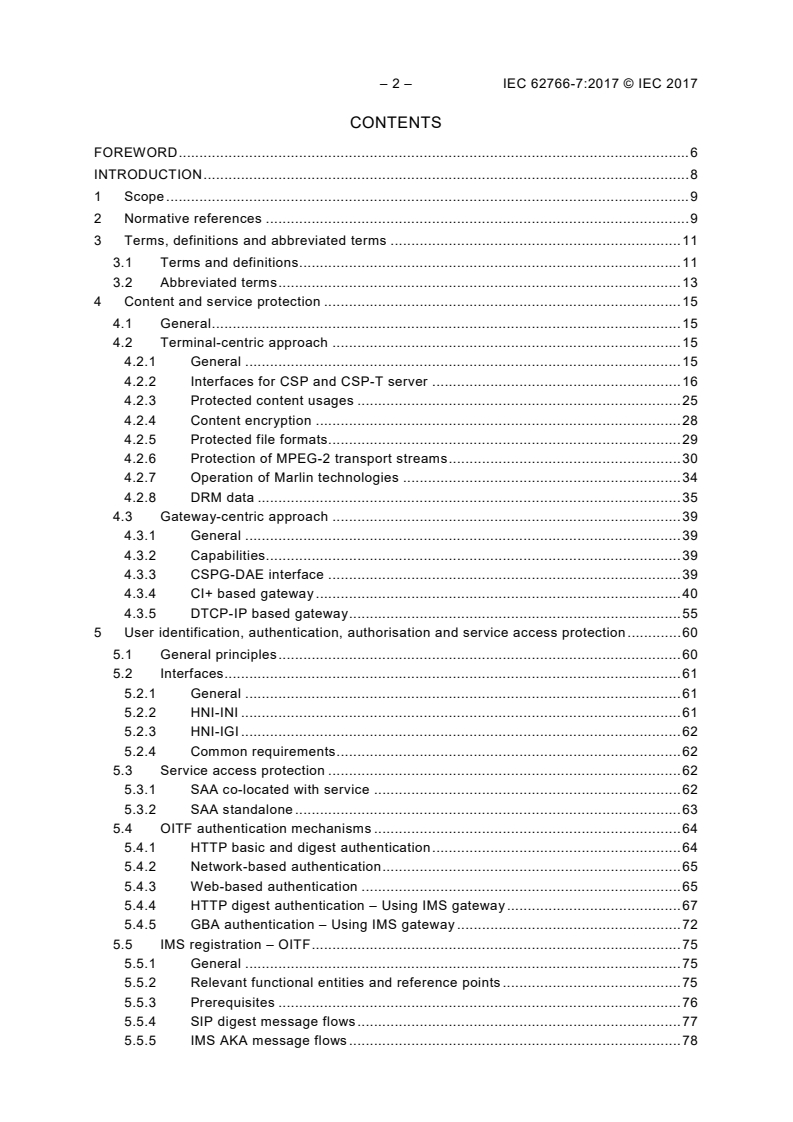
– 2 – IEC 62766-7:2017 © IEC 2017
CONTENTS
FOREWORD . 6
INTRODUCTION . 8
1 Scope . 9
2 Normative references . 9
3 Terms, definitions and abbreviated terms . 11
3.1 Terms and definitions . 11
3.2 Abbreviated terms . 13
4 Content and service protection . 15
4.1 General . 15
4.2 Terminal-centric approach . 15
4.2.1 General . 15
4.2.2 Interfaces for CSP and CSP-T server . 16
4.2.3 Protected content usages . 25
4.2.4 Content encryption . 28
4.2.5 Protected file formats. 29
4.2.6 Protection of MPEG-2 transport streams . 30
4.2.7 Operation of Marlin technologies . 34
4.2.8 DRM data . 35
4.3 Gateway-centric approach . 39
4.3.1 General . 39
4.3.2 Capabilities. 39
4.3.3 CSPG-DAE interface . 39
4.3.4 CI+ based gateway . 40
4.3.5 DTCP-IP based gateway . 55
5 User identification, authentication, authorisation and service access protection . 60
5.1 General principles . 60
5.2 Interfaces . 61
5.2.1 General . 61
5.2.2 HNI-INI . 61
5.2.3 HNI-IGI . 62
5.2.4 Common requirements . 62
5.3 Service access protection . 62
5.3.1 SAA co-located with service . 62
5.3.2 SAA standalone . 63
5.4 OITF authentication mechanisms . 64
5.4.1 HTTP basic and digest authentication . 64
5.4.2 Network-based authentication . 65
5.4.3 Web-based authentication . 65
5.4.4 HTTP digest authentication – Using IMS gateway . 67
5.4.5 GBA authentication – Using IMS gateway . 72
5.5 IMS registration – OITF . 75
5.5.1 General . 75
5.5.2 Relevant functional entities and reference points . 75
5.5.3 Prerequisites . 76
5.5.4 SIP digest message flows . 77
5.5.5 IMS AKA message flows . 78
5.6 Session management and single sign on . 80
5.6.1 General . 80
5.6.2 Cookie session . 80
5.6.3 URL parameters . 81
5.6.4 HTTP authentication session . 82
5.6.5 SAML Web-based SSO . 83
6 Forced play-out using media zones . 84
Annex A (informative) Link of user authentication and DRM device authentication . 86
Annex B (normative) XML schemas . 88
B.1 General . 88
B.2 XML schema for MarlinPrivateDataType structure . 88
B.3 XML schema for MIPPVControlMessage format . 89
B.4 XML schema for HexBinaryPrivateDataType structure . 89
Annex C (informative) DRM messages used in DAE. 90
Annex D (informative) CSPG-CI+ usage examples . 91
D.1 General . 91
D.2 CSPG-CI+ initial power-on . 91
D.3 CSPG-CI+ normal power-on . 91
D.4 Live session example . 92
D.5 Parental control management example . 93
D.6 No-rights event and purchase example . 94
D.7 VoD session example . 95
Annex E (informative) CSPG-DTCP session setup sequence examples . 96
E.1 General . 96
E.2 Multicast streaming with SIP session management . 96
E.3 Unicast streaming with SIP session management . 98
E.4 Unicast streaming with RTSP session management . 99
E.5 HTTP streaming and download . 100
Annex F (informative) Embedded CSPG . 101
F.1 General . 101
F.2 Application to simple and secure streaming . 103
Bibliography . 105
Figure 1 – CSP-T system overview . 16
Figure 2 – Node acquisition sequence . 18
Figure 3 – Link acquisition sequence . 20
Figure 4 – Deregistration sequence . 22
Figure 5 – Licence acquisition sequence . 24
Figure 6 – Licence evaluation sequence . 26
Figure 7 – Scramble key decryption sequence . 27
Figure 8 – Content on demand encryption sequence using content key (for (P)DCF
OMArlin or Marlin IPMP Marlin FF) . 28
Figure 9 – Content on demand encryption sequence using content key (for MPEG-2
TS) 28
Figure 10 – Scheduled content encryption sequence using scramble key (for MPEG-2
TS) 29
Figure 11 – Conditional access descriptors signalling ECM and EMM messages . 30
– 4 – IEC 62766-7:2017 © IEC 2017
Figure 12 – Outline of DRMControlInformationtype with MarlinPrivateData . 37
Figure 13 – Outline of MIPPVControlMessage . 38
Figure 14 – CSPG-CI+ overview . 40
Figure 15 – CSPG-CI+ context . 41
Figure 16 – CSPG-DTCP overview . 56
Figure 17 – Overview of involved reference points . 56
Figure 18 – General message flow for service access protection and user
authentication . 60
Figure 19 – SAA co-located with requested service . 63
Figure 20 – Standalone SAA, redirection mode . 63
Figure 21 – HTTP basic and digest authentication . 64
Figure 22 – Network-based authentication . 65
Figure 23 – Web-based authentication with form . 66
Figure 24 – Initial procedure . 68
Figure 25 – Authentication between an OITF and an SAA based on HTTP credentials
stored in IG . 69
Figure 26 – Authentication between an OITF and an SAA based on GBA credentials . 71
Figure 27 – Initial GBA registration . 73
Figure 28 – Authentication between an OITF and an SAA based on GBA keys . 74
Figure 29 – OIPF functional entities and reference points involved in IMS registration . 76
Figure 30 – SIP digest message flow interlaced into IMS registration . 77
Figure 31 – User identification and authentication based on the IMS AKA procedure . 79
Figure 32 – Session management using cookie. 81
Figure 33 – Session management using URL parameters . 82
Figure 34 – HTTP authentication session . 83
Figure 35 – SAML Web-based SSO . 84
Figure A.1 – User authentication for CSP, CSP-T server communication . 86
Figure D.1 – CSPG-CI+ first power-on . 91
Figure D.2 – CSPG-CI+ normal power-on . 92
Figure D.3 – CSPG-CI+ live session example . 92
Figure D.4 – Parental control management example . 93
Figure D.5 – No-rights event and purchase example . 94
Figure D.6 – VoD session example . 95
Figure E.1 – Session setup sequence for multicast streaming with SIP session
management . 97
Figure E.2 – CSPG-DTCP initiated teardown sequence for multicast streaming with SIP
session management . 98
Figure E.3 – Session setup sequence for unicast streaming with SIP session
management . 99
Figure E.4 – Session setup sequence for unicast streaming with RTSP session
management . 100
Figure E.5 – Session setup sequence for HTTP streaming and download . 100
Figure F.1 – Possible CSPG deployments . 101
Figure F.2 – CSPG embedded in the same device as OITF . 102
Figure F.3 – Simple and secure streaming with CSPG . 103
Table 1 – Recording Control access_criteria_descriptor . 32
Table 2 – Bit assignments of recording_control_information_byte . 32
Table 3 – DNR and DNTS combinations. 32
Table 4 – Parental_Control_URL parameter syntax . 33
Table 5 – DRMControlInformation mapping for Marlin . 35
Table 6 – DRMControlInformation mapping for Marlin simple secure streaming . 36
Table 7 – MarlinPrivateData structure . 37
Table 8 – MIPPVControlMessage format . 39
Table 9 – OIPF private_host_application_ID . 42
Table 10 – SAS_async_msg() APDU syntax . 42
Table 11 – Generic message_byte() syntax . 42
Table 12 – OIPF specific messages and command_id values. 43
Table 13 – OIPF specific datatype_id values . 43
Table 14 – Mapping to DAE API or events . 44
Table 15 – send_msg message data types . 45
Table 16 – reply_msg message data types . 45
Table 17 – resultCode and oipf_status mapping . 46
Table 18 – parental_control_info message data types . 47
Table 19 – oipf_access_status field and blocked attribute mapping . 48
Table 20 – rights_info message data types . 48
Table 21 – oipf_access_status field and errorStatte attribute mapping . 49
Table 22 – system_info message data types . 49
Table 23 – can_play_content_req message data types . 50
Table 24 – can_play_content_reply message data types . 50
Table 25 – can_record_content_req message data types . 51
Table 26 – can_record_content_reply message data types . 51
Table 27 – Scrambling modes . 53
Table 28 – DRMControlInformation mapping for CSPG-CI+ . 54
Table 29 – HexBinaryPrivateData structure . 55
Table 30 – CA_descriptor . 58
Table C.1 – DRM messages used in the DAE . 90
– 6 – IEC 62766-7:2017 © IEC 2017
INTERNATIONAL ELECTROTECHNICAL COMMISSION
____________
CONSUMER TERMINAL FUNCTION FOR ACCESS
TO IPTV AND OPEN INTERNET MULTIMEDIA SERVICES –
Part 7: Authentication, content protection and service protection
FOREWORD
1) The International Electrotechnical Commission (IEC) is a worldwide organization for standardization comprising
all national electrotechnical committees (IEC National Committees). The object of IEC is to promote
international co-operation on all questions concerning standardization in the electrical and electronic fields. To
this end and in addition to other activities, IEC publishes International Standards, Technical Specifications,
Technical Reports, Publicly Available Specifications (PAS) and Guides (hereafter referred to as “IEC
Publication(s)”). Their preparation is entrusted to technical committees; any IEC National Committee interested
in the subject dealt with may participate in this preparatory work. International, governmental and non-
governmental organizations liaising with the IEC also participate in this preparation. IEC collaborates closely
with the International Organization for Standardization (ISO) in accordance with conditions determined by
agreement between the two organizations.
2) The formal decisions or agreements of IEC on technical matters express, as nearly as possible, an international
consensus of opinion on the relevant subjects since each technical committee has representation from all
interested IEC National Committees.
3) IEC Publications have the form of recommendations for international use and are accepted by IEC National
Committees in that sense. While all reasonable efforts are made to ensure that the technical content of IEC
Publications is accurate, IEC cannot be held responsible for the way in which they are used or for any
misinterpretation by any end user.
4) In order to promote international uniformity, IEC National Committees undertake to apply IEC Publications
transparently to the maximum extent possible in their national and regional publications. Any divergence
between any IEC Publication and the corresponding national or regional publication shall be clearly indicated in
the latter.
5) IEC itself does not provide any attestation of conformity. Independent certification bodies provide conformity
assessment services and, in some areas, access to IEC marks of conformity. IEC is not responsible for any
services carried out by independent certification bodies.
6) All users should ensure that they have the latest edition of this publication.
7) No liability shall attach to IEC or its directors, employees, servants or agents including individual experts and
members of its technical committees and IEC National Committees for any personal injury, property damage or
other damage of any nature whatsoever, whether direct or indirect, or for costs (including legal fees) and
expenses arising out of the publication, use of, or reliance upon, this IEC Publication or any other IEC
Publications.
8) Attention is drawn to the Normative references cited in this publication. Use of the referenced publications is
indispensable for the correct application of this publication.
9) Attention is drawn to the possibility that some of the elements of this IEC Publication may be the subject of
patent rights. IEC shall not be held responsible for identifying any or all such patent rights.
International Standard IEC 62766 has been prepared by IEC technical committee 100: Audio,
video and multimedia systems and equipment.
The text of this standard is based on the following documents:
CDV Report on voting
100/2551/CDV 100/2665/RVC
Full information on the voting for the approval of this standard can be found in the report on
voting indicated in the above table.
This publication has been drafted in accordance with the ISO/IEC Directives, Part 2.
A list of all parts in the IEC 62766 series, published under the general title Consumer terminal
function for access to IPTV and open Internet multimedia services, can be found on the IEC
website.
The committee has decided that the contents of this publication will remain unchanged until
the stability date indicated on the IEC web site under "http://webstore.iec.ch" in the data
related to the specific publication. At this date, the publication will be
• reconfirmed,
• withdrawn,
• replaced by a revised edition, or
• amended.
A bilingual version of this publication may be issued at a later date.
IMPORTANT – The 'colour inside' logo on the cover page of this publication indicates
that it contains colours which are considered to be useful for the correct
understanding of its contents. Users should therefore print this document using a
colour printer.
– 8 – IEC 62766-7:2017 © IEC 2017
INTRODUCTION
The IEC 62766 series is based on a series of specifications that was originally developed by
the OPEN IPTV FORUM (OIPF). They specify the user-to-network interface (UNI) for
consumer terminals to access IPTV and open internet multimedia services over managed or
non-managed networks as defined by OIPF.
CONSUMER TERMINAL FUNCTION FOR ACCESS
TO IPTV AND OPEN INTERNET MULTIMEDIA SERVICES –
Part 7: Authentication, content protection and service protection
1 Scope
This part of IEC 62766 specifies functions for content protection, service protection, service
access protection, user identification, user authentication, and user authorisation.
The following clauses contain features for which the criteria that determine under which
circumstances these features are implemented are out of the scope of the present document
or contain conditional normative statements referring to other parts of IEC 62766:
• 4.2 Terminal-centric approach
• 4.2.5 Protected file formats
• 4.2.6 Protection of MPEG-2 transport streams
• 4.3.4 CI+ based gateway
• 4.3.4.7 Protected streaming and file formats
• 4.3.4.8 Personal video recorder
• 4.3.4.9 Time shifting
• 4.3.5 DTCP-IP based gateway
• 4.3.5.6 Protected streaming and file formats
• 5.4.4 HTTP digest authentication using IMS gateway
• 5.4.5 GBA authentication using IMS gateway
NOTE GBA authentication can be achieved using either the mechanism in 5.4.5 GBA authentication using IMS
gateway or the, more general, mechanism in 5.4.4 HTTP digest authentication using IMS gateway. 5.4.4 allows the
use of different authentication mechanisms in a way that is transparent to the OITF, including possible future
authentication mechanisms, and should preferably be used. It is expected that 5.4.5 GBA authentication using IMS
gateway will be deprecated and removed in future versions of this specification.
2 Normative references
The following documents are referred to in the text in such a way that some or all of their
content constitutes requirements of this document. For dated references, only the edition
cited applies. For undated references, the latest edition of the referenced document (including
any amendments) applies.
IEC 62455:2010, Internet protocol (IP) and transport stream (TS) based service access
IEC 62766-1:2017, Consumer terminal function for access to IPTV and open Internet
multimedia services – Part 1:General
IEC 62766-2-1:2016, Consumer terminal function for access to IPTV and open Internet
multimedia services – Part 2-1: Media Formats
IEC 62766-3:2016, Consumer terminal function for access to IPTV and open Internet
multimedia services – Part 3: Content Metadata
– 10 – IEC 62766-7:2017 © IEC 2017
IEC 62766-4-1:2017, Consumer terminal function for access to IPTV and open Internet
multimedia services – Part 4-1: Protocols
IEC 62766-5-1:2017, Consumer terminal function for access to IPTV and open Internet
multimedia services – Part 5-1: Declarative Application Environment
ISO/IEC 13818-1, Information technology – Generic coding of moving pictures and associated
audio information: Systems
3GPP TS 24.109, Bootstrapping interface (Ub) and network application function interface (Ua);
Protocol details
3GPP TS 24.229, IP Multimedia Call Control Protocol based on Session Initiation Protocol
(SIP) and Session Description Protocol (SDP) Stage 3 (Release 8)
3GPP TS 33.203, Technical Specification Group Services and System Aspects; 3G security;
Access security for IP-based services (Release 8)
3GPP TS 33.220, Generic Authentication Architecture (GAA); Generic bootstrapping
architecture
ATIS-0800006, IIF Default Scrambling Algorithm (IDSA)
Consumer Electronics Assoviation CEA-2014-A (including the August 2008 Errata), Web-
based Protocol Framework for Remote User Interface on UPnP Networks and the Internet
(Web4CE)
CI Plus LLP, CI Plus Specification V1.3 (2011-01), Content Security Extensions to the
Common Interface, available from:
http://www.CI Plus.com/data/CI Plus_specification_V1.3.1.pdf
DTLA, DTCP Adopter Agreement, Digital Transmission Protection License Agreement,
available from:
http://www.dtcp.com/agreements.aspx
ETSI ETR 289, Digital Video Broadcasting (DVB); Support for the use of scrambling and
Conditional Access (CA) within digital broadcasting systems
ETSI EN 50221, Common Interface Specification for Conditional Access and other Digital
Video Broadcasting Decoder Applications
ETSI TS 101 699 V1.1.1, Digital Video Broadcasting (DVB); Extensions to the Common
Interface Specification
ETSI TS 103 197 V1.5.1, Digital Video Broadcasting (DVB); Head-end implementation of DVB
SimulCrypt
ETSI EN 300 468 V1.13.1, Digital Video Broadcasting (DVB); Specification for Service
Information (SI) in DVB systems
ETSI TS 102 770 V1.1.1, Digital Video Broadcasting (DVB); System Renewability Messages
(SRM) in DVB Systems
Marlin Developer Community, Marlin Broadband Transport Stream Specification (BBTS),
Version 1.0, available from:
http://www.marlin-community.com/develop/downloads
Marlin Developer Community, Marlin – Broadband Network Service Profile Specification
(BNSP), Version 1.1, available from:
http://www.marlin-community.com/develop/downloads
Marlin Developer Community, Marlin – File Formats Specification (FF), Version 1.1, available
from: http://www.marlin-community.com/develop/downloads
Marlin Developer Community, Marlin –Simple Secure Streaming Specification (MS3), Version
1.1.1, available from:
http://www.marlin-community.com/develop/downloads
Marlin Developer Community, OMArlin Specification, Version 1.0, available from:
http://www.marlin-community.com/develop/downloads
IETF RFC 2109, HTTP State Management Mechanism
IETF RFC 2617, HTTP Authentication: Basic and Digest Access Authentication
IETF RFC 5746, Transport Layer Security (TLS) Renegotiation Indication Extension
OASIS, Assertions and Protocols for the OASIS Security Markup Language (SAML) V2.0,
available from:
https://www.oasis-open.org/standards#samlv2.0
OASIS, Profiles for the OASIS Security Assertion Markup Language (SAML) V2.0, available
from:
https://www.oasis-open.org/standards#samlv2.0
3 Terms, definitions and abbreviated terms
3.1 Terms and definitions
For the purposes of this document, the terms and definitions given in IEC 62766-1 and the
following apply.
ISO and IEC maintain terminological databases for use in standardization at the following
addresses:
• IEC Electropedia: available at http://www.electropedia.org/
• ISO Online browsing platform: available at http://www.iso.org/obp
3.1.1
business token
collection of information defined in BNSP that contains the service-specific information for a
given business model
3.1.2
content and service protection gateway
optional gateway function that provides a conversion from a (proprietary) content and service
protection solution in the network to one that is supported by an OITF, as defined in
IEC 62766-7
– 12 – IEC 62766-7:2017 © IEC 2017
3.1.3
content and service protection gateway
optional gateway function that provides a conversion from a (proprietary) content and service
protection solution in the network to one that is supported by an OITF, as defined in this
document
3.1.4
client function
function that interacts with the Marlin client function in a content and service protection
3.1.5
content and service key management function
entity responsible for storing and providing service, programme, content keys and ECM
attached information
Note 1 to entry: This function may be physically co-located with other functions (e.g. the content delivery network
controller for content on demand services), see Annex B of IEC 62766-1:2017.
Note 2 to entry: This entity has been identified to illustrate informatively the separation between content
encryption, which is part of content preparation, and content delivery.
3.1.6
content on demand encryption management function
back office content on demand function in charge of launching content on demand encryption
Note 1 to entry: This entity has been identified to illustrate informatively the separation between content
encryption, which is part of content preparation, and content delivery.
3.1.7
content and service protection
function that handles service protection and content protection for the client in the OITF
3.1.8
CSP-G server
functional entity in the network that handles content protection and service protection for the
content and service protection gateway (CSPG) in the residential network
3.1.9
CSP-T server
functional entity in the network that handles service protection and content protection for the
CSP-T client in the OITF
3.1.10
Marlin action token
token defined either in BNSP or in Marlin MS3 that is used to trigger the Marlin protocols from
the Marlin client function in CSP, and from which some information (e.g., business token) is
used in the Marlin protocols
Note 1 to entry: The mimeType attribute is used to qualify which Marlin token type is returned
3.1.11
Marlin client function
compliant implementation of the Marlin client that is defined in BNSP and that enables secure
communications (Marlin Protocols) with the Marlin server function in a CSP-T server
3.1.12
Marlin configuration token
token defined in BNSP that includes the location information of the Marlin server function in
CSP-T server with which the CSP communicates
3.1.13
Marlin server function
compliant implementation of the Marlin server that is defined in BNSP and that enables
secure communications (Marlin protocols) with the Marlin client function in a CSP
3.1.14
output control information
output control information as defined in BNSP and BBTS
3.1.15
programme key
symmetric key defined in IEC 62455 that encrypts an ECM
3.1.16
scramble key
symmetric key that is used to scramble the content
3.1.17
server function
function that interacts with the Marlin server function in a CSP-T server
3.1.18
serviceBaseCID
part of the content ID that is the same for all content in a service
3.1.19
service key
symmetric key defined in IEC 62455 that is used to encrypt an ECM or a programme key
3.1.20
single sign on
method of service access control that enables the user to authenticate once and gain access
to the resources of multiple services
3.2 Abbreviated terms
3GPP Third Generation Partnership Project
AES Advanced Encryption Standard
AKE Authentication and Key Exchange
APDU Application Protocol Data Unit
ATIS Alliance for Telecommunications Industry Solutions
BBTS Broadband Transport Stream – MPEG-2 transport stream as defined by
BBTS
BNS Broadband Network Service
BSF Bootstrapping Server Function
bslbf bit string, left bit first
B-TID Bootstrapping Transaction Identifier
CA Conditional Access
CAD Content Access Descriptor
CAM Conditional Access Module
CAT Conditional Access Table
CBC Cipher-Block Chaining
CE-HTML Consumer Electronics – HTML
– 14 – IEC 62766-7:2017 © IEC 2017
CI Common Interface
CSKMF Content and Service Key Management Function
CSPG Content and Service Protection Gateway
CSPG-CI+ CSPG based on CI+
CSPG-DTCP CSPG based on DTCP-IP
CSP-T Content and Service Protection – terminal-centric Approach
DCF DRM Content Format
DMZ Dynamic Media Zones
DNR Do Not Record
DNTS Do Not Time Shift
DTCP Digital Transmission Content Protection
DTLA Digital Transmission Licensing Administrator
DVB Digital Video Broadcasting
ECM Entitlement Control Message
EMM Entitlement Management Message
ETSI European Telecommunications Standards Institute
FF File Format
FQDN Fully Qualified Domain Name
GAA Generic Authentication Architecture
HDCP High-bandwidth Digital Content Protection
HDD Hard Disk Drive
HNI-AMNI Home Network Interface – Additional Managed Network Interface
HNI-CSP Home Network Interface – Content and Service Protection
HNI-IGI Home Network Interface – IMS Gateway Interface
HNI-INI Home Network Interface – ITF (IPTV Terminal Function) Network Interface
ID Identity
IDSA IIF Default Scrambling Algorithm
IETF Internet Engineering Task Force
IIF IPTV Interoperability Forum
IPMC IP Multicast
IPMP Intellectual Property Management Protocol
IV Initialization Vector
KDF Key Derivation Function
KSM Key Stream Message
M-CID Marlin Content ID
MIME Multipurpose Internet Mail Extensions
MP4 MPEG-4
MPEG Moving Pictures Experts Group
MS3 Marlin Simple Secure Streaming
NAF Network Application Function
NPI Network Provider Interface
OASIS Organization for the Advancement of Structured Information Standards
PCMCIA Personal Computer Memory Card International Association
PCP Protected Content Packet
PDCF Packetized DRM Content Format
PES Packetized Elementary Stream
PID Packet Identifier
PIN Personal Identification Number
PKI Public Key Infrastructure
PMT Programme Map Table
SAML Security Assertion Markup Language
SAS Specific Application Support
SRM System Renewability Message
TEK Traffic Encryption Key
TISPAN Telecoms & Internet converged Services & Protocols for Advanced
Networks
TLS Transport Layer Security
TLV Type Length Value
TS Transport Stream
uimsbf unsigned integer most significant bit first
UNIS-CSP-G User Network Interface Specific – Content and Service Protection Gateway
UPnP Universal Plug and Play
URI Usage Rules Information
4 Content and service protection
4.1 General
This clause specifies the content and service protection (CSP) functionality. It consists of a
specification of:
• the terminal-centric approach, see 4.2, and
• the gateway-Centric approach, see 4.3.
4.2 Terminal-centric approach
4.2.1 General
Subclause 4.2 specifies the functionality for the terminal-centric approach to content and
service protection. In order to do this, a mapping is provided from all relevant functions and
interfaces from Annex B of IEC 62766-1 to specific clauses of Marlin specifications BNSP and
Marlin MS3. The Marlin Core System Specification provides a specification for the parts of
Marlin DRM that are common for all Marlin delivery system specifications.
All normative statements in 4.2 apply only in case the terminal-centric approach is supported
by the OITF.
OITFs that support the OIPF terminal-centric approach to content and service protection shall
be compliant with BNSP and may be compliant with Marlin MS3.
NOTE 1 The criteria that determine under which circumstances the terminal-centric approach is implemented are
out of the scope of the present document.
NOTE 2 The criteria that determine under which circumstances the support for Marlin metering for content or
rights owner settlement is implemented in the OITF are out of the scope of the present document.
– 16 – IEC 62766-7:2017 © IEC 2017
4.2.2 Interfaces for CSP and CSP-T server
4.2.2.1 General
Subclause 4.2.2 describes the interfaces related to a CSP and CSP-T Server in the functional
architecture described in Annex B of IEC 62766-1:2017.
4.2.2.2 Overview
The main purpose of 4.2.2 is to describe CSP interfaces (CSP-1, UNIS-CSP-T) and CSP-T
Server interfaces (NPI-CSPTx, x = 1, 2, 3). CSP-1 is the interface between CSP and OITF
functions. NPI-CSPTx, x = 1, 2, 3, are the interfaces between the CSP-T server and providers
network functions. Subclause 4.2.2 informatively touches upon the Marlin licence evaluation
and content encryption.
Only the UNIS-CSP-T interface and the interface to DAE in CSP-1 are normative. The other
interfaces are informatively described for comprehension. Figure 1 shows the message flow
overview.
IEC
Figure 1 – CSP-T system overview
The four functional entities in Figure 1 are described below.
• CSP in this document consists of Marlin client function and a part of the client function
that deals with Marlin elements.
• CSP-T server in this document consists of Marlin server function and a part of the server
function that deals with M
...