

IEC 60534-2-1:2011
(Main)Industrial-process control valves - Part 2-1: Flow capacity - Sizing equations for fluid flow under installed conditions
General Information
- Abstract
IEC 60534-2-1:2011 includes equations for predicting the flow of compressible and incompressible fluids through control valves. The equations for incompressible flow are based on standard hydrodynamic equations for Newtonian incompressible fluids. They are not intended for use when non-Newtonian fluids, fluid mixtures, slurries or liquid-solid conveyance systems are encountered. The equations for incompressible flow may be used with caution for non-vaporizing multi-component liquid mixtures. This second edition cancels and replaces the first edition published in 1998. This edition constitutes a technical revision. It includes the following significant technical changes with respect to the previous edition:
- the same fundamental flow model, but changes the equation framework to simplify the use of the standard by introducing the notion of Δpsizing;
- changes to the non-turbulent flow corrections and means of computing results;
- multi-stage sizing as an Annex. The contents of the corrigendum of April 2015 have been included in this copy.
- Status
- Published
- Publication Date
- 29-Mar-2011
- Technical Committee
- SC 65B - Measurement and control devices
- Drafting Committee
- WG 9 - TC 65/SC 65B/WG 9
- Current Stage
- PPUB - Publication issued
- Start Date
- 30-Mar-2011
- Completion Date
- 15-Mar-2011
Overview
IEC 60534-2-1:2011 is an international standard developed by the International Electrotechnical Commission (IEC) that provides sizing equations for predicting fluid flow through industrial-process control valves under installed conditions. This second edition updates and supersedes the 1998 version with technical revisions aimed at simplifying the standard's application and improving calculation accuracy.
The standard covers both compressible and incompressible fluids, primarily focusing on Newtonian incompressible fluids and ideal gases or vapors. It excludes applications involving non-Newtonian fluids, fluid mixtures like slurries, and liquid-solid conveyance systems. IEC 60534-2-1:2011 introduces refined flow models and corrections that make it an essential guide for engineers and designers involved in valve sizing and flow capacity calculations within the process control industry.
Key Topics
Sizing Equations for Incompressible Fluids: Based on hydrodynamic equations applicable to Newtonian fluids, these equations predict flow capacity while highlighting limitations regarding non-Newtonian fluids and multi-component liquid mixtures.
Sizing Equations for Compressible Fluids: Provides specialized formulations incorporating factors such as specific heat ratio (γ), pressure drop ratios, compressibility, and expansion corrections to handle flows of ideal gases or vapors effectively.
Flow Models and Pressure Differentials: Introduction of the concept Δp_sizing simplifies calculation and addresses choked flow conditions, pressure recovery, and flow transition between turbulent and non-turbulent regimes.
Non-Turbulent Flow Corrections: Updated methods to handle laminar and transitional flows enhance prediction accuracy under diverse operating conditions.
Multi-Stage Valve Sizing: An annex dedicated to sizing equations for multi-stage and multipath control valves includes comprehensive guidelines for complex valve configurations.
Correction Factors: Incorporates piping geometry and pressure recovery factors to adjust calculations for real-world installation effects.
Reynolds Number Considerations: Use of Reynolds number (Re) to distinguish between turbulent and laminar flow domains for better sizing outcomes.
Applications
IEC 60534-2-1:2011 serves as a critical reference for:
Industrial Valve Sizing: Enabling accurate determination of flow capacity to optimize valve selection and performance in process industries such as oil and gas, chemical manufacturing, water treatment, and power generation.
Process Control Engineering: Assisting engineers in designing control loops that require precise valve sizing to maintain system stability and efficiency.
Flow Modeling and Simulation: Providing standardized equations for integration into computational fluid dynamics (CFD) models or control system simulations.
Product Development and Testing: Guiding valve manufacturers in designing and validating control valves for a wide range of fluid types and operating conditions.
Installation and Maintenance: Aiding technicians and system designers in accounting for installed conditions, including piping configurations and pressure drops, to ensure valves meet process specifications.
Related Standards
IEC 60534 Series: The overall series addresses industrial-process control valves, including testing methods, communication protocols, and quality assurance.
ISO/IEC Directives Part 2: Provides guidance on standardization processes and documentation formats referenced in IEC 60534-2-1.
Standards on Flow Measurement and Hydraulics: Related standards for fluid dynamics and flow metering complement the sizing equations presented.
Industry-Specific Valve Standards: Other IEC and ISO standards may cover specific valve types or application environments, useful alongside IEC 60534-2-1.
Keywords: IEC 60534-2-1, industrial process control valves, flow capacity standard, control valve sizing equations, incompressible fluids, compressible fluid flow, valve flow prediction, installed conditions, pressure differential sizing, multi-stage valve sizing, process control valve standards, piping correction factors, fluid flow equations, turbulent and laminar flow, industrial valve design.
Relations
- Effective Date
- 05-Sep-2023
- Effective Date
- 05-Sep-2023
- Effective Date
- 05-Sep-2023
Get Certified
Connect with accredited certification bodies for this standard

DVS-ZERT GmbH
German welding certification society.
Institut za varilstvo d.o.o. (Welding Institute)
Slovenia's leading welding institute since 1952. ISO 3834, EN 1090, pressure equipment certification, NDT personnel, welder qualification. Only IIW Au
CARES (UK Certification Authority for Reinforcing Steels)
UK certification for reinforcing steels and construction.
Sponsored listings
Frequently Asked Questions
IEC 60534-2-1:2011 is a standard published by the International Electrotechnical Commission (IEC). Its full title is "Industrial-process control valves - Part 2-1: Flow capacity - Sizing equations for fluid flow under installed conditions". This standard covers: IEC 60534-2-1:2011 includes equations for predicting the flow of compressible and incompressible fluids through control valves. The equations for incompressible flow are based on standard hydrodynamic equations for Newtonian incompressible fluids. They are not intended for use when non-Newtonian fluids, fluid mixtures, slurries or liquid-solid conveyance systems are encountered. The equations for incompressible flow may be used with caution for non-vaporizing multi-component liquid mixtures. This second edition cancels and replaces the first edition published in 1998. This edition constitutes a technical revision. It includes the following significant technical changes with respect to the previous edition: - the same fundamental flow model, but changes the equation framework to simplify the use of the standard by introducing the notion of Δpsizing; - changes to the non-turbulent flow corrections and means of computing results; - multi-stage sizing as an Annex. The contents of the corrigendum of April 2015 have been included in this copy.
IEC 60534-2-1:2011 includes equations for predicting the flow of compressible and incompressible fluids through control valves. The equations for incompressible flow are based on standard hydrodynamic equations for Newtonian incompressible fluids. They are not intended for use when non-Newtonian fluids, fluid mixtures, slurries or liquid-solid conveyance systems are encountered. The equations for incompressible flow may be used with caution for non-vaporizing multi-component liquid mixtures. This second edition cancels and replaces the first edition published in 1998. This edition constitutes a technical revision. It includes the following significant technical changes with respect to the previous edition: - the same fundamental flow model, but changes the equation framework to simplify the use of the standard by introducing the notion of Δpsizing; - changes to the non-turbulent flow corrections and means of computing results; - multi-stage sizing as an Annex. The contents of the corrigendum of April 2015 have been included in this copy.
IEC 60534-2-1:2011 is classified under the following ICS (International Classification for Standards) categories: 23.060.40 - Pressure regulators; 25.040.40 - Industrial process measurement and control. The ICS classification helps identify the subject area and facilitates finding related standards.
IEC 60534-2-1:2011 has the following relationships with other standards: It is inter standard links to IEC 60534-2-1:2011/COR1:2015, IEC 60534-2-1:1998/COR1:2000, IEC 60534-2-1:1998. Understanding these relationships helps ensure you are using the most current and applicable version of the standard.
IEC 60534-2-1:2011 is available in PDF format for immediate download after purchase. The document can be added to your cart and obtained through the secure checkout process. Digital delivery ensures instant access to the complete standard document.
Standards Content (Sample)
IEC 60534-2-1 ®
Edition 2.0 2011-03
INTERNATIONAL
STANDARD
NORME
INTERNATIONALE
Industrial-process control valves –
Part 2-1: Flow capacity – Sizing equations for fluid flow under installed
conditions
Vannes de régulation des processus industriels –
Partie 2-1: Capacité d'écoulement – Equations de dimensionnement pour
l'écoulement des fluides dans les conditions d'installation
All rights reserved. Unless otherwise specified, no part of this publication may be reproduced or utilized in any form or by
any means, electronic or mechanical, including photocopying and microfilm, without permission in writing from either IEC or
IEC's member National Committee in the country of the requester.
If you have any questions about IEC copyright or have an enquiry about obtaining additional rights to this publication,
please contact the address below or your local IEC member National Committee for further information.
Droits de reproduction réservés. Sauf indication contraire, aucune partie de cette publication ne peut être reproduite
ni utilisée sous quelque forme que ce soit et par aucun procédé, électronique ou mécanique, y compris la photocopie
et les microfilms, sans l'accord écrit de la CEI ou du Comité national de la CEI du pays du demandeur.
Si vous avez des questions sur le copyright de la CEI ou si vous désirez obtenir des droits supplémentaires sur cette
publication, utilisez les coordonnées ci-après ou contactez le Comité national de la CEI de votre pays de résidence.
IEC Central Office
3, rue de Varembé
CH-1211 Geneva 20
Switzerland
Email: inmail@iec.ch
Web: www.iec.ch
About the IEC
The International Electrotechnical Commission (IEC) is the leading global organization that prepares and publishes
International Standards for all electrical, electronic and related technologies.
About IEC publications
The technical content of IEC publications is kept under constant review by the IEC. Please make sure that you have the
latest edition, a corrigenda or an amendment might have been published.
Catalogue of IEC publications: www.iec.ch/searchpub
The IEC on-line Catalogue enables you to search by a variety of criteria (reference number, text, technical committee,…).
It also gives information on projects, withdrawn and replaced publications.
IEC Just Published: www.iec.ch/online_news/justpub
Stay up to date on all new IEC publications. Just Published details twice a month all new publications released. Available
on-line and also by email.
Electropedia: www.electropedia.org
The world's leading online dictionary of electronic and electrical terms containing more than 20 000 terms and definitions
in English and French, with equivalent terms in additional languages. Also known as the International Electrotechnical
Vocabulary online.
Customer Service Centre: www.iec.ch/webstore/custserv
If you wish to give us your feedback on this publication or need further assistance, please visit the Customer Service
Centre FAQ or contact us:
Email: csc@iec.ch
Tel.: +41 22 919 02 11
Fax: +41 22 919 03 00
A propos de la CEI
La Commission Electrotechnique Internationale (CEI) est la première organisation mondiale qui élabore et publie des
normes internationales pour tout ce qui a trait à l'électricité, à l'électronique et aux technologies apparentées.
A propos des publications CEI
Le contenu technique des publications de la CEI est constamment revu. Veuillez vous assurer que vous possédez
l’édition la plus récente, un corrigendum ou amendement peut avoir été publié.
Catalogue des publications de la CEI: www.iec.ch/searchpub/cur_fut-f.htm
Le Catalogue en-ligne de la CEI vous permet d’effectuer des recherches en utilisant différents critères (numéro de référence,
texte, comité d’études,…). Il donne aussi des informations sur les projets et les publications retirées ou remplacées.
Just Published CEI: www.iec.ch/online_news/justpub
Restez informé sur les nouvelles publications de la CEI. Just Published détaille deux fois par mois les nouvelles
publications parues. Disponible en-ligne et aussi par email.
Electropedia: www.electropedia.org
Le premier dictionnaire en ligne au monde de termes électroniques et électriques. Il contient plus de 20 000 termes et
définitions en anglais et en français, ainsi que les termes équivalents dans les langues additionnelles. Egalement appelé
Vocabulaire Electrotechnique International en ligne.
Service Clients: www.iec.ch/webstore/custserv/custserv_entry-f.htm
Si vous désirez nous donner des commentaires sur cette publication ou si vous avez des questions, visitez le FAQ du
Service clients ou contactez-nous:
Email: csc@iec.ch
Tél.: +41 22 919 02 11
Fax: +41 22 919 03 00
IEC 60534-2-1 ®
Edition 2.0 2011-03
INTERNATIONAL
STANDARD
NORME
INTERNATIONALE
Industrial-process control valves –
Part 2-1: Flow capacity – Sizing equations for fluid flow under installed
conditions
Vannes de régulation des processus industriels –
Partie 2-1: Capacité d'écoulement – Equations de dimensionnement pour
l'écoulement des fluides dans les conditions d'installation
INTERNATIONAL
ELECTROTECHNICAL
COMMISSION
COMMISSION
ELECTROTECHNIQUE
PRICE CODE
INTERNATIONALE
CODE PRIX XA
ICS 23.060.40; 25.040.40 ISBN 978-2-88912-399-5
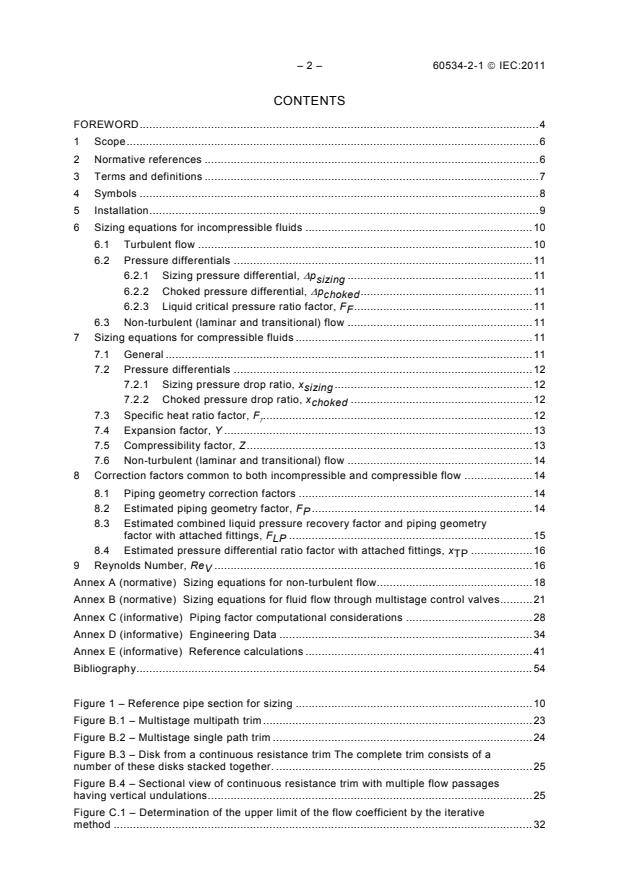
– 2 – 60534-2-1 IEC:2011
CONTENTS
FOREWORD . 4
1 Scope . 6
2 Normative references . 6
3 Terms and definitions . 7
4 Symbols . 8
5 Installation . 9
6 Sizing equations for incompressible fluids . 10
6.1 Turbulent flow . 10
6.2 Pressure differentials . 11
6.2.1 Sizing pressure differential, ∆p . 11
sizing
6.2.2 Choked pressure differential, ∆p . 11
choked
6.2.3 Liquid critical pressure ratio factor, F . 11
F
6.3 Non-turbulent (laminar and transitional) flow . 11
7 Sizing equations for compressible fluids . 11
7.1 General . 11
7.2 Pressure differentials . 12
7.2.1 Sizing pressure drop ratio, x . 12
sizing
7.2.2 Choked pressure drop ratio, x . 12
choked
7.3 Specific heat ratio factor, F . 12
γ
7.4 Expansion factor, Y . 13
7.5 Compressibility factor, Z . 13
7.6 Non-turbulent (laminar and transitional) flow . 14
8 Correction factors common to both incompressible and compressible flow . 14
8.1 Piping geometry correction factors . 14
8.2 Estimated piping geometry factor, F . 14
P
8.3 Estimated combined liquid pressure recovery factor and piping geometry
factor with attached fittings, F . 15
LP
8.4 Estimated pressure differential ratio factor with attached fittings, x . 16
TP
9 Reynolds Number, Re . 16
V
Annex A (normative) Sizing equations for non-turbulent flow . 18
Annex B (normative) Sizing equations for fluid flow through multistage control valves. 21
Annex C (informative) Piping factor computational considerations . 28
Annex D (informative) Engineering Data . 34
Annex E (informative) Reference calculations . 41
Bibliography . 54
Figure 1 – Reference pipe section for sizing . 10
Figure B.1 – Multistage multipath trim . 23
Figure B.2 – Multistage single path trim . 24
Figure B.3 – Disk from a continuous resistance trim The complete trim consists of a
number of these disks stacked together. . 25
Figure B.4 – Sectional view of continuous resistance trim with multiple flow passages
having vertical undulations . 25
Figure C.1 – Determination of the upper limit of the flow coefficient by the iterative
method . 32
60534-2-1 IEC:2011 – 3 –
Figure C.2 – Determination of the final flow coefficient by the iterative method . 33
Figure D.1 – Piping geometry factors . 37
Figure D.2 – Pressure recovery factors . 39
Figure D.3 – Liquid critical pressure ratio factor F . 40
F
Table 1 – Numerical constants N . 17
Table B.1 – Values of the stage interaction factors, k, and the reheat factors, r for
multistage single and multipath control valve trim . 27
Table B.2 – Values of the stage interaction factors, k, and the reheat factors, r for
continuous resistance control valve trim . 27
Table C.1 – Incompressible flow . 31
Table C.2 – Compressible flow . 31
Table D.1 – Typical values of valve style modifier F , liquid pressure recovery factor F
d L
a)
and pressure differential ratio factor x at full rated travel . 35
T
– 4 – 60534-2-1 IEC:2011
INTERNATIONAL ELECTROTECHNICAL COMMISSION
____________
INDUSTRIAL-PROCESS CONTROL VALVES –
Part 2-1: Flow capacity –
Sizing equations for fluid flow under installed conditions
FOREWORD
1) The International Electrotechnical Commission (IEC) is a worldwide organization for standardization comprising
all national electrotechnical committees (IEC National Committees). The object of IEC is to promote
international co-operation on all questions concerning standardization in the electrical and electronic fields. To
this end and in addition to other activities, IEC publishes International Standards, Technical Specifications,
Technical Reports, Publicly Available Specifications (PAS) and Guides (hereafter referred to as “IEC
Publication(s)”). Their preparation is entrusted to technical committees; any IEC National Committee interested
in the subject dealt with may participate in this preparatory work. International, governmental and non-
governmental organizations liaising with the IEC also participate in this preparation. IEC collaborates closely
with the International Organization for Standardization (ISO) in accordance with conditions determined by
agreement between the two organizations.
2) The formal decisions or agreements of IEC on technical matters express, as nearly as possible, an international
consensus of opinion on the relevant subjects since each technical committee has representation from all
interested IEC National Committees.
3) IEC Publications have the form of recommendations for international use and are accepted by IEC National
Committees in that sense. While all reasonable efforts are made to ensure that the technical content of IEC
Publications is accurate, IEC cannot be held responsible for the way in which they are used or for any
misinterpretation by any end user.
4) In order to promote international uniformity, IEC National Committees undertake to apply IEC Publications
transparently to the maximum extent possible in their national and regional publications. Any divergence
between any IEC Publication and the corresponding national or regional publication shall be clearly indicated in
the latter.
5) IEC itself does not provide any attestation of conformity. Independent certification bodies provide conformity
assessment services and, in some areas, access to IEC marks of conformity. IEC is not responsible for any
services carried out by independent certification bodies.
6) All users should ensure that they have the latest edition of this publication.
7) No liability shall attach to IEC or its directors, employees, servants or agents including individual experts and
members of its technical committees and IEC National Committees for any personal injury, property damage or
other damage of any nature whatsoever, whether direct or indirect, or for costs (including legal fees) and
expenses arising out of the publication, use of, or reliance upon, this IEC Publication or any other IEC
Publications.
8) Attention is drawn to the Normative references cited in this publication. Use of the referenced publications is
indispensable for the correct application of this publication.
9) Attention is drawn to the possibility that some of the elements of this IEC Publication may be the subject of
patent rights. IEC shall not be held responsible for identifying any or all such patent rights.
International Standard IEC 60534-2-1 has been prepared by subcommittee 65B: Measurement
and control devices, of IEC technical committee 65: Industrial-process measurement, control
and automation.
This second edition cancels and replaces the first edition published in 1998. This edition
constitutes a technical revision.
This edition includes the following significant technical changes with respect to the previous
edition:
• the same fundamental flow model, but changes the equation framework to simplify the
use of the standard by introducing the notion of ∆p ;
sizing
• changes to the non-turbulent flow corrections and means of computing results;
• multi-stage sizing as an Annex.
The text of this standard is based on the following documents:
60534-2-1 IEC:2011 – 5 –
FDIS Report on voting
65B/783/FDIS 65B/786/RVD
Full information on the voting for the approval of this standard can be found in the report on
voting indicated in the above table.
This publication has been drafted in accordance with the ISO/IEC Directives, Part 2.
A list of all the parts of the IEC 60534 series, under the general title Industrial-process control
valves, can be found on the IEC website.
The committee has decided that the contents of this publication will remain unchanged until
the stability date indicated on the IEC web site under "http://webstore.iec.ch" in the data
related to the specific publication. At this date, the publication will be
• reconfirmed,
• withdrawn,
• replaced by a revised edition, or
• amended.
The contents of the corrigendum of April 2015 have been included in this copy.
– 6 – 60534-2-1 IEC:2011
INDUSTRIAL-PROCESS CONTROL VALVES –
Part 2-1: Flow capacity –
Sizing equations for fluid flow under installed conditions
1 Scope
This part of IEC 60534 includes equations for predicting the flow of compressible and
incompressible fluids through control valves.
The equations for incompressible flow are based on standard hydrodynamic equations for
Newtonian incompressible fluids. They are not intended for use when non-Newtonian fluids,
fluid mixtures, slurries or liquid-solid conveyance systems are encountered. The equations for
incompressible flow may be used with caution for non-vaporizing multi-component liquid
mixtures. Refer to Clause 6 for additional information.
At very low ratios of pressure differential to absolute inlet pressure (∆p/p ), compressible
fluids behave similarly to incompressible fluids. Under such conditions, the sizing equations
for compressible flow can be traced to the standard hydrodynamic equations for Newtonian
incompressible fluids. However, increasing values of ∆p/p result in compressibility effects
which require that the basic equations be modified by appropriate correction factors. The
equations for compressible fluids are for use with ideal gas or vapor and are not intended for
use with multiphase streams such as gas-liquid, vapor-liquid or gas-solid mixtures.
Reasonable accuracy can only be maintained when the specific heat ratio, γ, is restricted to
the range 1,08 < γ < 1,65. Refer to Clause 7.2 for more information.
For compressible fluid applications, this standard is valid for valves with x ≤ 0,84 (see Table
T
D.2). For valves with x > 0,84 (e.g. some multistage valves), greater inaccuracy of flow
T
prediction can be expected.
Reasonable accuracy can only be maintained for control valves if:
C
< 0,047
N d
Note that while the equation structure utilized in this document departs radically from previous
versions of the standard, the basic technology is relatively unchanged. The revised equation
format was adopted to simplify presentation of the various equations and improve readability
of the document.
2 Normative references
The following referenced documents are indispensable for the application of this document.
For dated references, only the edition cited applies. For undated references, the latest edition
of the referenced document (including any amendments) applies.
IEC 60534-1:2005, Industrial-process control valves – Part 1: Control valve terminology and
general considerations
IEC 60534-2-3:1997, Industrial-process control valves – Part 2-3: Flow capacity – Test
procedures
60534-2-1 IEC:2011 – 7 –
3 Terms and definitions
For the purposes of this document, the terms and definitions given in IEC 60534-1, and the
following apply.
3.1
valve style modifier
the ratio of the hydraulic diameter of a single flow passage to the diameter of a circular
orifice, the area of which is equivalent to the sum of areas of all identical flow passages at a
given travel. It should be stated by the manufacturer as a function of travel (see Annex A).
3.2
standard volumetric flowrates
compressible fluid volumetric flow rates in cubic metres per hour, identified by the symbol Q ,
S
refer to either
a) Standard conditions, which is an absolute pressure of 1 013,25 mbar and a
temperature of 288,6 K, or
b) Normal conditions, which is an absolute pressure of 1 013,25 mbar and a temperature
of 273 K.
Numerical constants for the flow equations are provided for both conventions (see Table 1).
– 8 – 60534-2-1 IEC:2011
4 Symbols
Symbo Description Unit
l
C Flow coefficient (K , C ) Various (see IEC 60534-1)
v v
(see Note 4)
d Nominal valve size mm
D Internal diameter of the piping mm
D Internal diameter of upstream piping mm
D Internal diameter of downstream piping mm
D Orifice diameter mm
o
F Valve style modifier (see Annex A) Dimensionless
d
(see Note 4)
F Liquid critical pressure ratio factor Dimensionless
F
F Liquid pressure recovery factor of a control valve without attached fittings Dimensionless
L
(see Note 4)
F Combined liquid pressure recovery factor and piping geometry factor of a Dimensionless
LP
control valve with attached fittings
F Piping geometry factor Dimensionless
P
F Reynolds number factor Dimensionless
R
F Specific heat ratio factor Dimensionless
γ
M Molecular mass of flowing fluid kg/kmol
N Numerical constants (see Table 1) Various (see Note 1)
p Inlet absolute static pressure measured at point A (see Figure 1) kPa or bar (see Note 2)
p Outlet absolute static pressure measured at point B (see Figure 1) kPa or bar
p Absolute thermodynamic critical pressure kPa or bar
c
p Reduced pressure (p /p ) Dimensionless
r 1 c
p Absolute vapour pressure of the liquid at inlet temperature kPa or bar
v
∆p Differential pressure between upstream and downstream pressure taps kPa or bar
actual
(P – P )
1 2
Computed value of limiting pressure differential for incompressible flow kPa or bar
∆p
choked
∆p Value of pressure differential used in computing flow or required flow kPa or bar
sizing
coefficient for incompressible flows
Q Actual volumetric flow rate m /h
Q Standard volumetric flow rate (see definition 3.2) m /h
S
Re Valve Reynolds number Dimensionless
v
T Inlet absolute temperature K
T Absolute thermodynamic critical temperature K
c
T Reduced temperature (T /T ) Dimensionless
r 1 c
t Absolute reference temperature for standard cubic metre K
s
W Mass flow rate kg/h
x Dimensionless
Ratio of actual pressure differential to inlet absolute pressure (∆P/P )
x Choked pressure drop ratio for compressible flow Dimensionless
choked
x Value of pressure drop ratio used in computing flow or required flow Dimensionless
sizing
coefficient for compressible flows
60534-2-1 IEC:2011 – 9 –
Symbo Description Unit
l
x Pressure differential ratio factor of a control valve without attached fittings Dimensionless
T
at choked flow (see Note 4)
x Pressure differential ratio factor of a control valve with attached fittings at Dimensionless
TP
choked flow
Y Expansion factor Dimensionless
Z Compressibility factor at inlet conditions Dimensionless
ν Kinematic viscosity m /s (see Note 3)
Density of fluid at p and T kg/m
ρ
1 1
Dimensionless
ρ /ρ Relative density (ρ /ρ = 1,0 for water at 15 °C)
1 o 1 o
Specific heat ratio Dimensionless
γ
ζ Velocity head loss coefficient of a reducer, expander or other fitting Dimensionless
attached to a control valve or valve trim
Upstream velocity head loss coefficient of fitting Dimensionless
ζ
ζ Downstream velocity head loss coefficient of fitting Dimensionless
ζ Inlet Bernoulli coefficient Dimensionless
B1
Outlet Bernoulli coefficient Dimensionless
ζ
B2
NOTE 1 To determine the units for the numerical constants, dimensional analysis may be performed on the
appropriate equations using the units given in Table 1.
2 5
NOTE 2 1 bar = 10 kPa = 10 Pa
–6 2
NOTE 3 1 centistoke = 10 m /s
NOTE 4 These values are travel-related and should be stated by the manufacturer.
5 Installation
In many industrial applications, reducers or other fittings are attached to the control valves.
The effect of these types of fittings on the nominal flow coefficient of the control valve can be
significant. A correction factor is introduced to account for this effect. Additional factors are
introduced to take account of the fluid property characteristics that influence the flow capacity
of a control valve.
In sizing control valves, using the relationships presented herein, the flow coefficients calculated
are assumed to include all head losses between points A and B, as shown in Figure 1.
– 10 – 60534-2-1 IEC:2011
Flow
l l
1 2
Pressure tap Pressure tap
A B
Control valve with or without attached fittings
IEC 509/11
l = two nominal pipe diameters
l = six nominal pipe diameters
Figure 1 – Reference pipe section for sizing
6 Sizing equations for incompressible fluids
6.1 Turbulent flow
The fundamental flow model for incompressible fluids in the turbulent flow regime is given as:
∆p
sizing
Q = CN F (1)
1 P
ρ
ρ
o
NOTE 1 The numerical constant N depends on the units used in the general sizing equation and the type of flow
coefficient: K or C .
v v
NOTE 2 The piping geometry factor, F , reduces to unity when the valve size and adjoining pipe sizes are
P
identical. Refer to 8.1 for evaluation and additional information.
This model establishes the relationship between flow rate, flow coefficient, fluid properties,
related installation factors, and pertinent service conditions for control valves handling
incompressible fluids. Equation (1) may be used to compute the required flow coefficient, the
flow rate or applied pressure differential given any two of the three quantities.
This model rigorously applies only to single component, single phase fluids (i.e., no multi-
phase mixtures, no multi-component mixtures). However, this model may be used with caution
under certain conditions for multi-component mixtures in the liquid phase. The underlying
assumptions of the flow model would be satisfied for liquid-liquid fluid mixtures subject to the
following restrictions:
• the mixture is homogenous;
• the mixture is in chemical and thermodynamic equilibrium;
• the entire throttling process occurs well away from the multiphase region.
When these conditions are satisfied, the mixture density should be substituted for the fluid
density ρ in Equation (1).
60534-2-1 IEC:2011 – 11 –
6.2 Pressure differentials
6.2.1 Sizing pressure differential, ∆p
sizing
The value of the pressure differential used in Equation (1) to predict flow rate or compute a
required flow coefficient is the lesser of the actual pressure differential or the choked pressure
differential:
∆p if ∆p < ∆p
choked
∆p = (2)
sizing
∆p if ∆p ≥ ∆p
choked choked
6.2.2 Choked pressure differential, ∆p
choked
The condition where further increase in pressure differential at constant upstream pressure no
longer produces a corresponding increase in flow through the control valve is designated
“choked flow”. The pressure drop at which this occurs is known as the choked pressure
differential and is given by the following equation:
F
LP
∆p = (p − F p ) (3)
choked 1 F v
F
P
F
LP 2
NOTE The expression ( ) reduces to F when the valve size and adjoining pipe sizes are identical. Refer to
L
F
P
8.1 for more information.
6.2.3 Liquid critical pressure ratio factor, F
F
F is the liquid critical pressure ratio factor. This factor is the ratio of the apparent vena
F
contracta pressure at choked flow conditions to the vapour pressure of the liquid at inlet
temperature. At vapor pressures near zero, this factor is 0,96.
Values of F may be supplied by the user if known. For single component fluids it may be
F
determined from the curve in Figure D.3 or approximated from the following equation:
p
v
F = 0,96 − 0,28 (4)
F
p
c
Use of Equation (4) to describe the onset of choking of multi-component mixtures is subject to
the applicability of appropriate corresponding states parameters in the flashing model.
6.3 Non-turbulent (laminar and transitional) flow
The flow model embodied in Equation (1) is for fully developed, turbulent flow only. Non-
turbulent conditions may be encountered, especially when flow rates are quite low or fluid
viscosity is appreciable. To affirm the applicability of Equation (1), the value of the valve
Reynolds Number (see Equation (23)) should be computed. Equation (1) is applicable if
Re ≥ 10 000.
V
7 Sizing equations for compressible fluids
7.1 General
The fundamental flow model for compressible fluids in the turbulent flow regime is given as:
W = CN F Y x p ρ (5)
6 P sizing 1 1
– 12 – 60534-2-1 IEC:2011
This model establishes the relationship between flow rates, flow coefficients, fluid properties,
related installation factors and pertinent service conditions for control valves handling
compressible fluids.
Two equivalent forms of Equation (5) are presented to accommodate conventional available
data formats:
x M
sizing
W = CN F p Y (6)
8 P 1
T Z
1 1
x
sizing
Q = CN F p Y (7)
s 9 P 1
MT Z
1 1
NOTE See Annex D for values of M.
Equation (6) is derived by substituting the fluid density as computed from the ideal gas
equation-of-state into Equation (5). Equation (7) expresses the flow rate in standard
volumetric units. Equations (5) through (7) may be used to compute the required flow
coefficient, the flow rate or applied pressure differential given any two of the three quantities.
7.2 Pressure differentials
7.2.1 Sizing pressure drop ratio, x
sizing
The value of the pressure drop ratio used in Equations (5) through (7) to predict flow rate or
compute a required flow coefficient is the lesser of the actual pressure drop ratio or the
choked pressure drop ratio:
x if x < x
choked
x = (8)
sizing
x if x ≥ x
choked choked
where
∆p
x = (9)
p
7.2.2 Choked pressure drop ratio, x
choked
The pressure drop ratio at which flow no longer increases with increased value in pressure
drop ratio, is the choked pressure drop ratio, given by the following equation:
x = F x (10)
choked γ TP
NOTE The expression x reduces to x when the valve size and adjoining pipe sizes are identical. Refer to 8.1
TP T
for more information.
7.3 Specific heat ratio factor, F
γ
is based on air near atmospheric pressure as the flowing fluid with a specific
The factor x
T
heat ratio of 1,40. If the specific heat ratio for the flowing fluid is not 1,40, the factor F is used
γ
to adjust x . Use the following equation to calculate the specific heat ratio factor:
T
γ
F = (11)
γ
1,4
NOTE See Annex D for values of γ and F .
γ
60534-2-1 IEC:2011 – 13 –
Equation (11) evolved from assumption of perfect gas behaviour and extension of an orifice
plate model based on air and steam testing to control valves. Analysis of that model over a
range of 1,08 < γ < 1,65 leads to adoption of the current linear model embodied in Equation
(11). The difference between the original orifice model, other theoretical models and Equation
(11) is small within this range. However, the differences become significant outside of the
indicated range. For maximum accuracy, flow calculations based on this model should be
restricted to a specific heat ratio within this range and to ideal gas behaviour.
7.4 Expansion factor, Y
The expansion factor Y accounts for the change in density as the fluid passes from the valve
inlet to the vena contracta (the location just downstream of the orifice where the jet stream
area is a minimum). It also accounts for the change in the vena contracta area as the
pressure differential is varied.
Theoretically, Y is affected by all of the following:
a) ratio of port area to body inlet area;
b) shape of the flow path;
c) pressure differential ratio x;
d) Reynolds number;
e) specific heat ratio γ.
The influence of items a), b), c), and e) is accounted for by the pressure differential ratio
factor x , which may be established by air test and which is discussed in 8.4.
T
The Reynolds number is the ratio of inertial to viscous forces at the control valve orifice. In
the case of compressible flow, its value is beyond the range of influence since turbulent flow
almost always exists.
The pressure differential ratio x is influenced by the specific heat ratio of the fluid.
T
Y shall be calculated using Equation (12).
x
sizing
Y = 1− (12)
3x
choked
NOTE The expansion factor, Y, has a limiting value of under choked flow conditions.
7.5 Compressibility factor, Z
Several of the sizing equations do not contain a term for the actual density of the fluid at
upstream conditions. Instead, the density is inferred from the inlet pressure and temperature
based on the laws of ideal gases. Under some conditions, real gas behavior can deviate
markedly from the ideal. In these cases, the compressibility factor Z shall be introduced to
compensate for the discrepancy. Z is a function of both the reduced pressure and reduced
temperature. Reduced pressure p is defined as the ratio of the actual inlet absolute pressure
r
to the absolute thermodynamic critical pressure for the fluid in question. The reduced
temperature T is defined similarly. That is:
r
p
p =
r (13)
p
c
T
T =
r (14)
T
c
– 14 – 60534-2-1 IEC:2011
NOTE See Annex D for values of p and T .
c c
7.6 Non-turbulent (laminar and transitional) flow
The flow model embodied in Equations (5) through (7) is for fully developed, turbulent flow
only. Non-turbulent conditions may be encountered, especially when flow rates are quite low
or fluid viscosity is appreciable. To affirm the applicability of the flow model, the value of the
valve Reynolds Number (see Equation (23)) should be computed. The flow model is
applicable if Re ≥ 10 000.
V
8 Correction factors common to both incompressible and compressible flow
8.1 Piping geometry correction factors
The various piping geometry factors (F , F , x ) are necessary to account for fittings
P LP TP
attached upstream and/or downstream to a control valve body. The F factor is the ratio of the
P
flow rate through a control valve installed with attached fittings to the flow rate that would
result if the control valve was installed without attached fittings and tested under identical
conditions which will not produce choked flow in either installation (see Figure 1).
To meet the stated flow accuracy of ± 5 %, all piping geometry factors shall be determined by
test in accordance with IEC 60534-2-3.
When estimated values of the piping geometry factors are permissible, the following equations
should be used for concentric reducers and expanders directly coupled to the control valve.
These equations derive from an analytical accounting of the additional resistance and
interchange between the static and dynamic head introduced by the fittings.
The validity of this method is a function of the degree to which the control valve and attached
fittings remain hydraulically or aerodynamically independent of each other such that the
cumulative effects remain additive. This condition is likely to be satisfied for the majority of
practical applications. However, in certain styles of control valves, such as butterfly valves
and ball valves, pressure recovery is likely to occur principally in the downstream pipe as
rather than within the valve body. Replacement of the downstream pipe section with an
arbitrary pipe fitting may alter the recovery zone in some cases. Under this condition, it is
doubtful that the simple flow resistance method of correction will adequately account for these
effects.
8.2 Estimated piping geometry factor, F
P
The F factor is the ratio of the flow rate through a control valve installed with attached fittings
P
to the flow rate that would result if the control valve was installed without attached fittings and
tested under identical conditions which will not produce choked flow in either installation (see
Figure 1). When estimated values are permissible, the following equation shall be used:
F = (15)
P
Σζ C
1+
2
N
d
2
In this equation, the factor Σζ is the algebraic sum of all of the effective velocity head loss
coefficients of all fittings attached to the control valve. The velocity head loss coefficient of
the control valve itself is not included.
Σζ = ζ + ζ + ζ − ζ (16)
1 2 B1 B2
In cases where the piping diameters approaching and leaving the control valve are different,
the ζ coefficients are calculated as follows:
B
60534-2-1 IEC:2011 – 15 –
d
(17)
ζ = 1−
B
D
If the inlet and outlet fittings are short-length, commercially available, concentric reducers, the
ζ and ζ coefficients may be approximated as follows:
1 2
Inlet reducer:
d
ζ = 0,5 1− (18)
D
1
Outlet reducer (expander):
d
ζ = 1,0 1− (19)
D
2
Inlet and outlet reducers of equal size:
d
ζ + ζ = 1,5 1− (20)
1 2
D
The F values calculated with the above ζ factors generally lead to the selection of valve
P
capacities slightly larger than required. See Annex C for methods of solution.
For graphical approximations of F , refer to Figures D.2a) and D.2b) in Annex D.
P
8.3 Estimated combined liquid pressure recovery factor and piping geometry factor
with attached fittings, F
LP
F is the liquid pressure recovery factor of the valve without attached fittings. This factor
L
accounts for the influence of the valve internal geometry on the valve capacity at choked flow.
It is defined as the ratio of the actual maximum flow rate under choked flow conditions to a
theoretical, non-choked flow rate which would be calculated if the pressure differential
used was the difference between the valve inlet pressure and the apparent vena contracta
pressure at choked flow conditions. The factor F may be determined from tests in
L
accordance with IEC 60534-2-3. Typical values of F versus percent of rated flow coefficient
L
are shown in Figure D.3.
F is the combined liquid pressure recovery factor and piping geometry factor for a control
LP
valve with attached fittings. It is obtained in the same manner as F .
L
To meet a deviation of ± 5 % for F , F shall be determined by testing. When estimated
LP LP
values are permissible, Equation (21) shall be used:
F
L
F = (21)
LP
F C
L
1+ (Σζ )
2
N
d
Here Σζ is the velocity head loss coefficient, ζ + ζ , of the fitting attached upstream of the
1 1 B1
valve as measured between the upstream pressure tap and the control valve body inlet.
– 16 – 60534-2-1 IEC:2011
8.4 Estimated pressure differential ratio factor with attached fittings, x
TP
x is the pressure differential ratio factor of a control valve installed without reducers or other
T
fittings. If the inlet pressure p is held constant and the outlet pressure p is progressively
1 2
lowered, the mass flow rate through a valve will increase to a maximum limit, a condition
referred to as choked flow. Further reductions in p will produce no further increase in flow
rate.
This limit is reached when the pressure differential x reaches a value of F x . The limiting
γ T
value of x is defined as the critical differential pressure ratio. The value of x used in any of the
sizing equations and in the relationship for Y (Equation (12)) shall be held to this limit even
though the actual pressure differential ratio is greater. Thus, the numerical value of Y may
range from 0,667, when x = F x , to 1,0 for very low differential pressures.
γ T
The values of x may be established by air test. The test procedure for this determination is
T
covered in IEC 60534-2-3.
NOTE 1 Representative values of x for several types of control valves with full size trim and at full rated
T
openings are given in Table D.1. Caution should be exercised in the use of this information. When precise values
are required, they should be obtained by test.
If a control valve is installed with attached fittings, the value of x will be affected.
T
x is the pressure differential ratio factor of a control valve with attached fittings at choked
TP
flow. To meet a deviation of ±5 % for x , the valve and attached fittings shall be tested as a
TP
unit. When estimated values are permissible, the Equation (22) shall be used:
x
T
F
P
x = (22)
TP
x ζ C
T i
1+
N
d
NOTE 2 Values for N are given in Table 1 below.
In the above relationship, x is the pressure differential ratio factor for a control valve installed
T
without reducers or other fittings. ζ is the sum of the inlet velocity head loss coefficients
i
(ζ + ζ ) of the reducer or other fitting attached to the inlet face of the valve.
1 B1
If the inlet fitting is a short-length, commercially available reducer, the value of ζ may be
estimated using Equation (18).
9 Reynolds Number, Re
V
The incompressible and compressible flow models presented in the preceding clauses are for
fully developed turbulent flow. When non-turbulent flow conditions are established through a
control valve because of a low pressure differential, a high viscosity, a very small flow
coefficient, or a combination thereof, a different flow model is required.
The valve Reynolds Number, Re , is employed to determine whether the flow is fully
V
turbulent. Tests show that flow is fully turbulent when the valve Re ≥ 10 000. The valve
V
Reynolds Number is given by Equation (23):
1/ 4
N F Q F C
4 d
L
Re = +1 (23)
v
ν CF N d
L 2
NOTE 1 The flow rate in Equation (23) is in actual volumetric flow rate units for both incompressible and
compressible flows.
60534-2-1 IEC:2011 – 17 –
NOTE 2 The kinematic viscosity, ν, should be evaluated at flow conditions.
When Re < 10 000, the equations presented in Annex A should be used.
v
The valve Reynolds Number is a function of the flow rate and the valve flow coefficient.
Therefore, when solving the flow equations for either of these two variables it is necessary to
employ a solution technique that ensures that all instances of each variable are accounted
for.
NOTE 3 The dependency of the Reynolds Number on the flow rate and valve flow coefficient necessitates an
iterative solution.
The valve style modifier F converts the geometry of the orifice(s) to an equivalent circular
d
single flow passage. See Table D.2 for typical values and Annex A for details. To meet
a deviation of ± 5 % for F , the F factor shall be determined by test in accordance with
d d
IEC 60534-2-3.
NOTE 4 Equations involving F are not applicable.
P
Table 1 – Numerical constants N
Flow coefficient C Formulae unit
Constant K C W Q p × ∆p ρ T d, D ν
v v
3 3
–1 –2
N – m /h kPa kg/m – – –
1 × 10 8,65 × 10
3 3
–1
1 – m /h bar kg/m – – –
8,65 × 10
–3 –3
N 1,60 × 10 2,14 × 10 – – – – – mm –
3 2
–2 –2
N – m /h – – – – m /s
7,07 × 10 7,60 × 10
–3 –3
N – – – – – mm –
1,80 × 10 2,41 × 10
N 3,16 – – –
2,73 kg/h – kPa kg/m
1 1 3
3,16 × 10 2,73 × 10 kg/h – bar kg/m – – –
–1
N 1,10 kg/h – kPa – K – –
9,48 × 10
1 kg/h – bar – K – –
1,10 × 10
9,48 × 10
1 1 3
N 2,46 × 10 2,12 × 10 – m /h kPa – K – –
3 3
(t = 0 °C) – m /h bar – K – –
2,46 × 10 2,12 × 10
s
1 1
N – m /h
...