

IEC 62541-9:2015
(Main)OPC Unified Architecture - Part 9: Alarms and conditions
General Information
- Abstract
IEC 62541-9:2015 specifies the representation of Alarms and Conditions in the OPC Unified Architecture. Included is the Information Model representation of Alarms and Conditions in the OPC UA address space. This second edition cancels and replaces the first edition published in 2012 and constitutes a technical revision. This edition includes the following changes:
- added section to describe expect behaviour for A&C servers and the associated information model in the case of redundancy or communication faults;
- changed the DialogConditionType to be not abstract since it is expect that instance of this type will exist in the system;
- updated ConditionRefresh Method to allow the use of the well know NodeIds associated with the types for the MethodId and ConditionId instead of requiring the call to use only the MethodId and ConditionId that is part of an instance;
- Fixed ExclusiveLimitStateMachineType and ShelvedStatemachineType to be sub-types of FinitStateMachineType not StateMachineType.
- Status
- Published
- Publication Date
- 24-Mar-2015
- Technical Committee
- SC 65E - Devices and integration in enterprise systems
- Drafting Committee
- WG 8 - TC 65/SC 65E/WG 8
- Current Stage
- DELPUB - Deleted Publication
- Start Date
- 18-Jun-2020
- Completion Date
- 29-Sep-2017
Overview
IEC 62541-9:2015, titled "OPC Unified Architecture - Part 9: Alarms and Conditions", is an international standard published by the International Electrotechnical Commission (IEC). This standard specifies the representation of alarms and conditions within the OPC Unified Architecture (OPC UA) framework. OPC UA is a platform-independent service-oriented architecture used for industrial automation and other sectors requiring robust, interoperable communication.
The second edition of IEC 62541-9 updates the original 2012 version, introducing significant technical revisions, such as:
- Defining expected behavior for alarms and conditions (A&C) servers during redundancy or communication faults.
- Modifying the DialogConditionType to be instantiable.
- Enhancing the ConditionRefresh Method parameters for more flexible method invocation.
- Correcting subtype relationships in the state machine hierarchy for alarm states.
IEC 62541-9 focuses on a detailed, standardized information model for representing alarms and conditions in the OPC UA address space, ensuring consistent management, monitoring, and synchronization of alarm and condition states across industrial systems.
Key Topics
IEC 62541-9:2015 covers critical aspects of alarms and conditions in OPC UA systems:
- Condition Modeling: Defines base types such as ConditionType, AlarmConditionType, and AcknowledgeableConditionType that describe alarm and condition states, behaviors, and lifecycle.
- State Machines: Uses two-state and finite-state machines to represent the dynamics of alarms, including states like active, acknowledged, shelved, and confirmed.
- Condition Instances: Details how multiple condition instances are represented and managed within the OPC UA address space for accurate event tracking.
- Methods for Interaction: Standardizes methods such as Acknowledge, Confirm, AddComment, Disable, Enable, and Respond for client-server interactions related to alarms.
- Dialog and Alarm Models: Specifies dialog conditions that require user interaction and complex alarm types including limit alarms, discrete alarms, and rate-of-change alarms.
- Condition Refresh: Ensures clients can synchronize their condition state with servers reliably, including handling refresh sequences and event auditing.
- Audit Events: Defines audit events for alarm-related actions to support traceability and compliance.
- Server Behavior During Faults: Addresses expected server behaviors and model management during system redundancy or communication failures.
Applications
IEC 62541-9 is essential in industries requiring real-time monitoring and control through standardized alarms and conditions management:
- Industrial Automation: Integrates with SCADA, DCS, and PLC systems to provide unified alarm monitoring and diagnostics.
- Process Control: Ensures safe and reliable process monitoring by managing alarms for abnormal conditions or maintenance needs.
- Energy and Utilities: Implements alarms for critical infrastructure such as power plants and grid control where timely event handling is crucial.
- Manufacturing: Supports factory automation systems in conveying condition states for machinery health, safety incidents, and operational warnings.
- Building Automation: Enables condition monitoring for HVAC, security, and fire alarm integration in smart buildings.
- Redundant and Fault-Tolerant Systems: Facilitates alarm synchronization and consistent state management in systems with backup servers or communication redundancies.
By implementing IEC 62541-9, organizations achieve interoperability, standardization, and reliable event-driven communication using OPC UA across diverse platforms and applications.
Related Standards
IEC 62541-9 is part of the broader IEC 62541 series, which defines OPC Unified Architecture protocols and models:
- IEC 62541-1: Overview and Concepts of OPC UA
- IEC 62541-2: Security Model for OPC UA
- IEC 62541-3: Address Space Model, base for Alarms and Conditions modeling
- IEC 62541-8: UA Data Access specification, complementary to alarms in process monitoring
- IEC 62541-10: Programs, defining how methods and program executions relate to alarms and conditions
Additionally, IEC 62541-9 includes informative annexes mapping OPC UA alarms and conditions to:
- EEMUA (Engineering Equipment and Materials Users Association) alarm management guidelines
- Legacy OPC A&E (Alarms and Events) specifications to assist migration and compatibility
These linked standards and mappings help practitioners seamlessly incorporate IEC 62541-9 into existing OPC UA frameworks, improving overall alarm management and interoperability.
Adhering to IEC 62541-9:2015 ensures efficient and standardized alarm and condition handling in OPC UA systems, enabling safer and more reliable automation and control environments globally.
Relations
- Effective Date
- 05-Sep-2023
- Effective Date
- 05-Sep-2023
Get Certified
Connect with accredited certification bodies for this standard

BSI Group
BSI (British Standards Institution) is the business standards company that helps organizations make excellence a habit.

DVS-ZERT GmbH
German welding certification society.
CARES (UK Certification Authority for Reinforcing Steels)
UK certification for reinforcing steels and construction.
Sponsored listings
Frequently Asked Questions
IEC 62541-9:2015 is a standard published by the International Electrotechnical Commission (IEC). Its full title is "OPC Unified Architecture - Part 9: Alarms and conditions". This standard covers: IEC 62541-9:2015 specifies the representation of Alarms and Conditions in the OPC Unified Architecture. Included is the Information Model representation of Alarms and Conditions in the OPC UA address space. This second edition cancels and replaces the first edition published in 2012 and constitutes a technical revision. This edition includes the following changes: - added section to describe expect behaviour for A&C servers and the associated information model in the case of redundancy or communication faults; - changed the DialogConditionType to be not abstract since it is expect that instance of this type will exist in the system; - updated ConditionRefresh Method to allow the use of the well know NodeIds associated with the types for the MethodId and ConditionId instead of requiring the call to use only the MethodId and ConditionId that is part of an instance; - Fixed ExclusiveLimitStateMachineType and ShelvedStatemachineType to be sub-types of FinitStateMachineType not StateMachineType.
IEC 62541-9:2015 specifies the representation of Alarms and Conditions in the OPC Unified Architecture. Included is the Information Model representation of Alarms and Conditions in the OPC UA address space. This second edition cancels and replaces the first edition published in 2012 and constitutes a technical revision. This edition includes the following changes: - added section to describe expect behaviour for A&C servers and the associated information model in the case of redundancy or communication faults; - changed the DialogConditionType to be not abstract since it is expect that instance of this type will exist in the system; - updated ConditionRefresh Method to allow the use of the well know NodeIds associated with the types for the MethodId and ConditionId instead of requiring the call to use only the MethodId and ConditionId that is part of an instance; - Fixed ExclusiveLimitStateMachineType and ShelvedStatemachineType to be sub-types of FinitStateMachineType not StateMachineType.
IEC 62541-9:2015 is classified under the following ICS (International Classification for Standards) categories: 25.040.40 - Industrial process measurement and control; 35.100.05 - Multilayer applications. The ICS classification helps identify the subject area and facilitates finding related standards.
IEC 62541-9:2015 has the following relationships with other standards: It is inter standard links to IEC 62541-9:2012, IEC 62541-9:2020. Understanding these relationships helps ensure you are using the most current and applicable version of the standard.
IEC 62541-9:2015 is available in PDF format for immediate download after purchase. The document can be added to your cart and obtained through the secure checkout process. Digital delivery ensures instant access to the complete standard document.
Standards Content (Sample)
IEC 62541-9 ®
Edition 2.0 2015-03
INTERNATIONAL
STANDARD
NORME
INTERNATIONALE
colour
inside
OPC unified architecture –
Part 9: Alarms and conditions
Architecture unifiée OPC –
Partie 9: Alarmes et conditions
All rights reserved. Unless otherwise specified, no part of this publication may be reproduced or utilized in any form
or by any means, electronic or mechanical, including photocopying and microfilm, without permission in writing from
either IEC or IEC's member National Committee in the country of the requester. If you have any questions about IEC
copyright or have an enquiry about obtaining additional rights to this publication, please contact the address below or
your local IEC member National Committee for further information.
Droits de reproduction réservés. Sauf indication contraire, aucune partie de cette publication ne peut être reproduite
ni utilisée sous quelque forme que ce soit et par aucun procédé, électronique ou mécanique, y compris la photocopie
et les microfilms, sans l'accord écrit de l'IEC ou du Comité national de l'IEC du pays du demandeur. Si vous avez des
questions sur le copyright de l'IEC ou si vous désirez obtenir des droits supplémentaires sur cette publication, utilisez
les coordonnées ci-après ou contactez le Comité national de l'IEC de votre pays de résidence.
IEC Central Office Tel.: +41 22 919 02 11
3, rue de Varembé Fax: +41 22 919 03 00
CH-1211 Geneva 20 info@iec.ch
Switzerland www.iec.ch
About the IEC
The International Electrotechnical Commission (IEC) is the leading global organization that prepares and publishes
International Standards for all electrical, electronic and related technologies.
About IEC publications
The technical content of IEC publications is kept under constant review by the IEC. Please make sure that you have the
latest edition, a corrigenda or an amendment might have been published.
IEC Catalogue - webstore.iec.ch/catalogue Electropedia - www.electropedia.org
The stand-alone application for consulting the entire The world's leading online dictionary of electronic and
bibliographical information on IEC International Standards, electrical terms containing more than 30 000 terms and
Technical Specifications, Technical Reports and other definitions in English and French, with equivalent terms in 15
documents. Available for PC, Mac OS, Android Tablets and additional languages. Also known as the International
iPad. Electrotechnical Vocabulary (IEV) online.
IEC publications search - www.iec.ch/searchpub IEC Glossary - std.iec.ch/glossary
The advanced search enables to find IEC publications by a More than 60 000 electrotechnical terminology entries in
variety of criteria (reference number, text, technical English and French extracted from the Terms and Definitions
committee,…). It also gives information on projects, replaced clause of IEC publications issued since 2002. Some entries
and withdrawn publications. have been collected from earlier publications of IEC TC 37,
77, 86 and CISPR.
IEC Just Published - webstore.iec.ch/justpublished
Stay up to date on all new IEC publications. Just Published IEC Customer Service Centre - webstore.iec.ch/csc
details all new publications released. Available online and If you wish to give us your feedback on this publication or
also once a month by email. need further assistance, please contact the Customer Service
Centre: csc@iec.ch.
A propos de l'IEC
La Commission Electrotechnique Internationale (IEC) est la première organisation mondiale qui élabore et publie des
Normes internationales pour tout ce qui a trait à l'électricité, à l'électronique et aux technologies apparentées.
A propos des publications IEC
Le contenu technique des publications IEC est constamment revu. Veuillez vous assurer que vous possédez l’édition la
plus récente, un corrigendum ou amendement peut avoir été publié.
Catalogue IEC - webstore.iec.ch/catalogue Electropedia - www.electropedia.org
Application autonome pour consulter tous les renseignements
Le premier dictionnaire en ligne de termes électroniques et
bibliographiques sur les Normes internationales,
électriques. Il contient plus de 30 000 termes et définitions en
Spécifications techniques, Rapports techniques et autres
anglais et en français, ainsi que les termes équivalents dans
documents de l'IEC. Disponible pour PC, Mac OS, tablettes
15 langues additionnelles. Egalement appelé Vocabulaire
Android et iPad.
Electrotechnique International (IEV) en ligne.
Recherche de publications IEC - www.iec.ch/searchpub
Glossaire IEC - std.iec.ch/glossary
La recherche avancée permet de trouver des publications IEC Plus de 60 000 entrées terminologiques électrotechniques, en
en utilisant différents critères (numéro de référence, texte, anglais et en français, extraites des articles Termes et
comité d’études,…). Elle donne aussi des informations sur les Définitions des publications IEC parues depuis 2002. Plus
projets et les publications remplacées ou retirées. certaines entrées antérieures extraites des publications des
CE 37, 77, 86 et CISPR de l'IEC.
IEC Just Published - webstore.iec.ch/justpublished
Service Clients - webstore.iec.ch/csc
Restez informé sur les nouvelles publications IEC. Just
Published détaille les nouvelles publications parues. Si vous désirez nous donner des commentaires sur cette
Disponible en ligne et aussi une fois par mois par email. publication ou si vous avez des questions contactez-nous:
csc@iec.ch.
IEC 62541-9 ®
Edition 2.0 2015-03
INTERNATIONAL
STANDARD
NORME
INTERNATIONALE
colour
inside
OPC unified architecture –
Part 9: Alarms and conditions
Architecture unifiée OPC –
Partie 9: Alarmes et conditions
INTERNATIONAL
ELECTROTECHNICAL
COMMISSION
COMMISSION
ELECTROTECHNIQUE
INTERNATIONALE
ICS 25.040.40; 35.100 ISBN 978-2-8322-2382-6
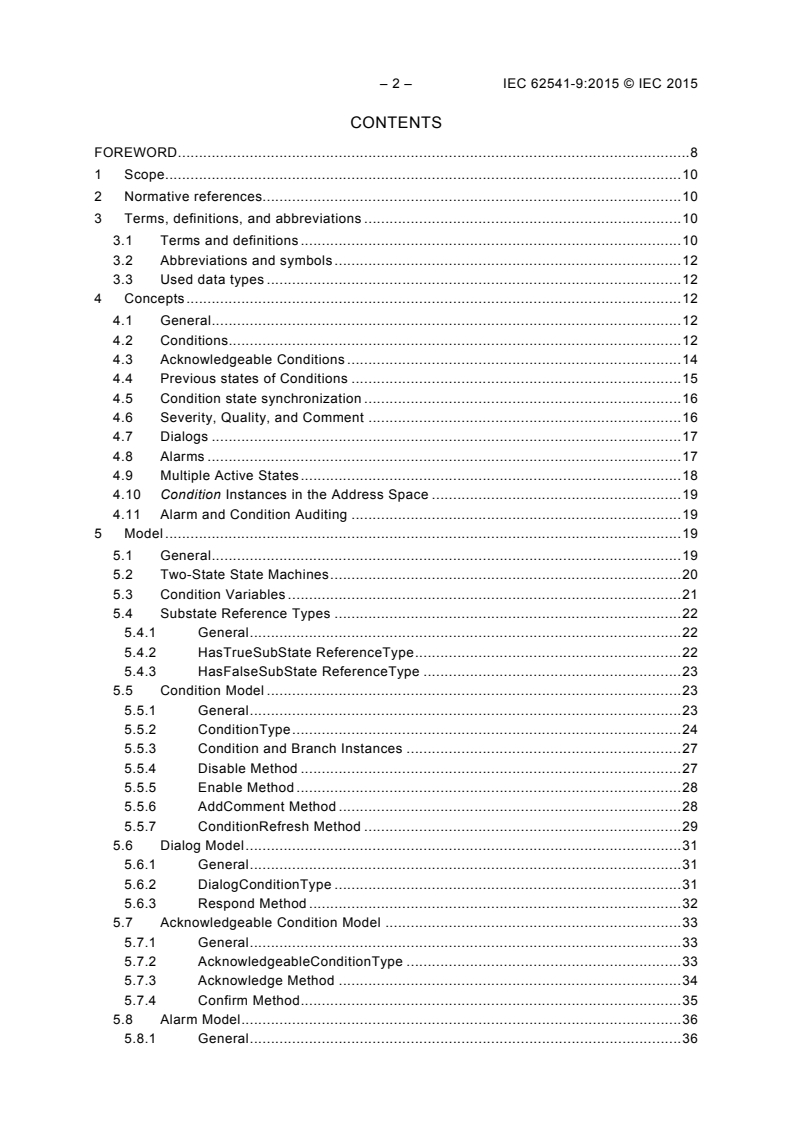
– 2 – IEC 62541-9:2015 © IEC 2015
CONTENTS
FOREWORD . 8
1 Scope . 10
2 Normative references. 10
3 Terms, definitions, and abbreviations . 10
3.1 Terms and definitions . 10
3.2 Abbreviations and symbols . 12
3.3 Used data types . 12
4 Concepts . 12
4.1 General . 12
4.2 Conditions. 12
4.3 Acknowledgeable Conditions . 14
4.4 Previous states of Conditions . 15
4.5 Condition state synchronization . 16
4.6 Severity, Quality, and Comment . 16
4.7 Dialogs . 17
4.8 Alarms . 17
4.9 Multiple Active States . 18
4.10 Condition Instances in the Address Space . 19
4.11 Alarm and Condition Auditing . 19
5 Model . 19
5.1 General . 19
5.2 Two-State State Machines . 20
5.3 Condition Variables . 21
5.4 Substate Reference Types . 22
5.4.1 General . 22
5.4.2 HasTrueSubState ReferenceType . 22
5.4.3 HasFalseSubState ReferenceType . 23
5.5 Condition Model . 23
5.5.1 General . 23
5.5.2 ConditionType . 24
5.5.3 Condition and Branch Instances . 27
5.5.4 Disable Method . 27
5.5.5 Enable Method . 28
5.5.6 AddComment Method . 28
5.5.7 ConditionRefresh Method . 29
5.6 Dialog Model . 31
5.6.1 General . 31
5.6.2 DialogConditionType . 31
5.6.3 Respond Method . 32
5.7 Acknowledgeable Condition Model . 33
5.7.1 General . 33
5.7.2 AcknowledgeableConditionType . 33
5.7.3 Acknowledge Method . 34
5.7.4 Confirm Method . 35
5.8 Alarm Model . 36
5.8.1 General . 36
5.8.2 AlarmConditionType . 37
5.8.3 ShelvedStateMachineType . 39
5.8.4 LimitAlarmType . 43
5.8.5 ExclusiveLimit Types . 44
5.8.6 NonExclusiveLimitAlarmType . 46
5.8.7 Level Alarm . 48
5.8.8 Deviation Alarm . 48
5.8.9 Rate of Change . 49
5.8.10 Discrete Alarms . 50
5.9 ConditionClasses . 52
5.9.1 Overview . 52
5.9.2 Base ConditionClassType . 52
5.9.3 ProcessConditionClassType . 53
5.9.4 MaintenanceConditionClassType . 53
5.9.5 SystemConditionClassType . 53
5.10 Audit Events . 53
5.10.1 Overview . 53
5.10.2 AuditConditionEventType . 54
5.10.3 AuditConditionEnableEventType . 55
5.10.4 AuditConditionCommentEventType . 55
5.10.5 AuditConditionRespondEventType . 55
5.10.6 AuditConditionAcknowledgeEventType . 55
5.10.7 AuditConditionConfirmEventType . 56
5.10.8 AuditConditionShelvingEventType . 56
5.11 Condition Refresh Related Events . 56
5.11.1 Overview . 56
5.11.2 RefreshStartEventType . 57
5.11.3 RefreshEndEventType . 57
5.11.4 RefreshRequiredEventType . 57
5.12 HasCondition Reference Type . 58
5.13 Alarm and Condition Status Codes . 58
5.14 Expected A&C Server Behaviours . 59
5.14.1 General . 59
5.14.2 Communication problems . 59
5.14.3 Redundant A&C Servers . 59
6 AddressSpace Organisation . 60
6.1 General . 60
6.2 Event Notifier and Source Hierarchy . 60
6.3 Adding Conditions to the Hierarchy . 61
6.4 Conditions in InstanceDeclarations . 61
6.5 Conditions in a VariableType . 62
Annex A (informative) Recommended localized names . 63
A.1 Recommended State Names for TwoState Variables . 63
A.1.1 LocaleId “en” . 63
A.1.2 LocaleId “de” . 63
A.1.3 LocaleId “fr” . 64
A.2 Recommended Dialog Response Options . 64
Annex B (informative) Examples . 65
B.1 Examples for Event sequences from Condition instances . 65
– 4 – IEC 62541-9:2015 © IEC 2015
B.1.1 Overview . 65
B.1.2 Server Maintains Current State Only . 65
B.1.3 Server Maintains Previous States . 65
B.2 Address Space Examples . 67
Annex C (informative) Mapping to EEMUA . 71
Annex D (informative) Mapping from OPC A&E to OPC UA A&C . 72
D.1 Overview. 72
D.2 Alarms and Events COM UA Wrapper . 72
D.2.1 Event Areas . 72
D.2.2 Event Sources . 73
D.2.3 Event Categories . 73
D.2.4 Event Attributes . 74
D.2.5 Event Subscriptions. 74
D.2.6 Condition Instances . 76
D.2.7 Condition Refresh . 76
D.3 Alarms and Events COM UA Proxy . 77
D.3.1 General . 77
D.3.2 Server Status Mapping . 77
D.3.3 Event Type Mapping . 77
D.3.4 Event Category Mapping . 78
D.3.5 Event Category Attribute Mapping . 79
D.3.6 Event Condition Mapping . 82
D.3.7 Browse Mapping. 82
D.3.8 Qualified Names . 83
D.3.9 Subscription Filters . 84
Bibliography . 86
Figure 1 – Base Condition State Model . 13
Figure 2 – AcknowledgeableConditions State Model . 14
Figure 3 – Acknowledge State Model . 15
Figure 4 – Confirmed Acknowledge State Model . 15
Figure 5 – Alarm State Machine Model . 17
Figure 6 – Multiple Active States Example . 18
Figure 7 – ConditionType Hierarchy . 20
Figure 8 – Condition Model . 24
Figure 9 – DialogConditionType Overview . 31
Figure 10 – AcknowledgeableConditionType Overview . 33
Figure 11 – AlarmConditionType Hierarchy Model . 37
Figure 12 – Alarm Model . 37
Figure 13 – Shelve state transitions . 39
Figure 14 – Shelved State Machine Model . 40
Figure 15 – LimitAlarmType . 43
Figure 16 – ExclusiveLimitStateMachine . 44
Figure 17 – ExclusiveLimitAlarmType . 46
Figure 18 – NonExclusiveLimitAlarmType . 47
Figure 19 – DiscreteAlarmType Hierarchy . 50
Figure 20 – ConditionClass Type Hierarchy . 52
Figure 21 – AuditEvent Hierarchy . 54
Figure 22 – Refresh Related Event Hierarchy . 57
Figure 23 – Typical Event Hierarchy . 60
Figure 24 – Use of HasCondition in an Event Hierarchy . 61
Figure 25 – Use of HasCondition in an InstanceDeclaration . 62
Figure 26 – Use of HasCondition in a VariableType . 62
Figure B.1 – Single State Example . 65
Figure B.2 – Previous State Example . 66
Figure B.3 – HasCondition used with Condition instances . 68
Figure B.4 – HasCondition reference to a Condition Type . 69
Figure B.5 – HasCondition used with an instance declaration . 70
Figure D.1 – The Type Model of a Wrapped COM AE Server . 74
Figure D.2 – Mapping UA Event Types to COM A&E Event Types . 78
Figure D.3 – Example Mapping of UA Event Types to COM A&E Categories . 79
Figure D.4 – Example Mapping of UA Event Types to A&E Categories with Attributes . 82
Table 1 – Parameter Types defined in IEC 62541-3 . 12
Table 2 – Parameter Types defined in IEC 62541-4 . 12
Table 3 – TwoStateVariableType Definition . 21
Table 4 – ConditionVariableType Definition . 22
Table 5 – HasTrueSubState ReferenceType . 22
Table 6 – HasFalseSubState ReferenceType . 23
Table 7 – ConditionType Definition . 25
Table 8 – Simple Attribute Operand . 27
Table 9 – Disable Result Codes . 28
Table 10 – Disable Method AddressSpace Definition . 28
Table 11 – Enable Result Codes . 28
Table 12 – Enable Method AddressSpace Definition . 28
Table 13 – AddComment Arguments . 29
Table 14 – AddComment result Codes . 29
Table 15 – AddComment Method AddressSpace Definition . 29
Table 16 – ConditionRefresh Parameters . 30
Table 17 – ConditionRefresh ReturnCodes . 30
Table 18 – ConditionRefresh Method AddressSpace Definition . 31
Table 19 – DialogConditionType Definition . 31
Table 20 – Repond Parameters . 32
Table 21 – Respond ResultCodes . 33
Table 22 – Respond Method AddressSpace Definition . 33
Table 23 – AcknowledgeableConditionType Definition . 34
Table 24 – Acknowledge Parameters . 34
Table 25 – Acknowledge result codes . 35
Table 26 – Acknowledge Method AddressSpace Definition . 35
– 6 – IEC 62541-9:2015 © IEC 2015
Table 27 – Confirm Method Parameters . 35
Table 28 – Confirm Result Codes . 36
Table 29 – Confirm Method AddressSpace Definition . 36
Table 30 – AlarmConditionType Definition . 38
Table 31 –ShelvedStateMachine Definition . 40
Table 32 – ShelvedStateMachine Transitions . 41
Table 33 – Unshelve Result Codes . 41
Table 34 – Unshelve Method AddressSpace Definition . 41
Table 35 – TimedShelve Parameters . 42
Table 36 – TimedShelve Result Codes . 42
Table 37 – TimedShelve Method AddressSpace Definition . 42
Table 38 – OneShotShelve Result Codes . 42
Table 39 – OneShotShelve Method AddressSpace Definition . 43
Table 40 – LimitAlarmType Definition . 43
Table 41 – ExclusiveLimitStateMachineType Definition . 44
Table 42 – ExclusiveLimitStateMachineType Transitions . 45
Table 43 – ExclusiveLimitAlarmType Definition . 46
Table 44 – NonExclusiveLimitAlarmType Definition . 47
Table 45 – NonExclusiveLevelAlarmType Definition . 48
Table 46 – ExclusiveLevelAlarmType Definition . 48
Table 47 – NonExclusiveDeviationAlarmType Definition . 49
Table 48 – ExclusiveDeviationAlarmType Definition . 49
Table 49 – NonExclusiveRateOfChangeAlarmType Definition . 50
Table 50 – ExclusiveRateOfChangeAlarmType Definition . 50
Table 51 – DiscreteAlarmType Definition . 51
Table 52 – OffNormalAlarmType Definition . 51
Table 53 – SystemOffNormalAlarmType Definition . 51
Table 54 – TripAlarmType Definition . 52
Table 55 – BaseConditionClassType Definition . 52
Table 56 – ProcessConditionClassType Definition . 53
Table 57 – MaintenanceConditionClassType Definition . 53
Table 58 – SystemConditionClassType Definition . 53
Table 59 – AuditConditionEventType Definition . 54
Table 60 – AuditConditionEnableEventType Definition . 55
Table 61 – AuditConditionCommentEventType Definition . 55
Table 62 – AuditConditionRespondEventType Definition . 55
Table 63 – AuditConditionAcknowledgeEventType Definition . 56
Table 64 – AuditConditionConfirmEventType Definition . 56
Table 65 – AuditConditionShelvingEventType Definition . 56
Table 66 – RefreshStartEventType Definition . 57
Table 67 – RefreshEndEventType Definition . 57
Table 68 – RefreshRequiredEventType Definition . 58
Table 69 – HasCondition ReferenceType . 58
Table 70 – Alarm and Condition Result Codes . 59
Table A.1 – Recommended state names for LocaleId “en” . 63
Table A.2 – Recommended display names for LocaleId “en” . 63
Table A.3 – Recommended state names for LocaleId “de” . 63
Table A.4 – Recommended display names for LocaleId “de” . 64
Table A.5 – Recommended state names for LocaleId “fr” . 64
Table A.6 – Recommended display names for LocaleId “fr” . 64
Table A.7 – Recommended Dialog Response Options. 64
Table B.1 – Example of a Condition that only keeps the latest state . 65
Table B.2 – Example of a Condition that maintains previous states via branches . 67
Table C.1 – EEMUA Terms . 71
Table D.1 – Mapping from Standard Event Categories to OPC UA Event Types . 73
Table D.2 – Mapping from ONEVENTSTRUCT fields to UA BaseEventType Variables . 75
Table D.3 – Mapping from ONEVENTSTRUCT fields to UA AuditEventType Variables. 75
Table D.4 – Mapping from ONEVENTSTRUCT fields to UA AlarmType Variables . 76
Table D.5 – Event Category Attribute Mapping Table . 80
– 8 – IEC 62541-9:2015 © IEC 2015
INTERNATIONAL ELECTROTECHNICAL COMMISSION
____________
OPC UNIFIED ARCHITECTURE –
Part 9: Alarms and conditions
FOREWORD
1) The International Electrotechnical Commission (IEC) is a worldwide organization for standardization comprising
all national electrotechnical committees (IEC National Committees). The object of IEC is to promote
international co-operation on all questions concerning standardization in the electrical and electronic fields. To
this end and in addition to other activities, IEC publishes International Standards, Technical Specifications,
Technical Reports, Publicly Available Specifications (PAS) and Guides (hereafter referred to as “IEC
Publication(s)”). Their preparation is entrusted to technical committees; any IEC National Committee interested
in the subject dealt with may participate in this preparatory work. International, governmental and non-
governmental organizations liaising with the IEC also participate in this preparation. IEC collaborates closely
with the International Organization for Standardization (ISO) in accordance with conditions determined by
agreement between the two organizations.
2) The formal decisions or agreements of IEC on technical matters express, as nearly as possible, an international
consensus of opinion on the relevant subjects since each technical committee has representation from all
interested IEC National Committees.
3) IEC Publications have the form of recommendations for international use and are accepted by IEC National
Committees in that sense. While all reasonable efforts are made to ensure that the technical content of IEC
Publications is accurate, IEC cannot be held responsible for the way in which they are used or for any
misinterpretation by any end user.
4) In order to promote international uniformity, IEC National Committees undertake to apply IEC Publications
transparently to the maximum extent possible in their national and regional publications. Any divergence
between any IEC Publication and the corresponding national or regional publication shall be clearly indicated in
the latter.
5) IEC itself does not provide any attestation of conformity. Independent certification bodies provide conformity
assessment services and, in some areas, access to IEC marks of conformity. IEC is not responsible for any
services carried out by independent certification bodies.
6) All users should ensure that they have the latest edition of this publication.
7) No liability shall attach to IEC or its directors, employees, servants or agents including individual experts and
members of its technical committees and IEC National Committees for any personal injury, property damage or
other damage of any nature whatsoever, whether direct or indirect, or for costs (including legal fees) and
expenses arising out of the publication, use of, or reliance upon, this IEC Publication or any other IEC
Publications.
8) Attention is drawn to the Normative references cited in this publication. Use of the referenced publications is
indispensable for the correct application of this publication.
9) Attention is drawn to the possibility that some of the elements of this IEC Publication may be the subject of
patent rights. IEC shall not be held responsible for identifying any or all such patent rights.
International Standard IEC 62541-9 has been prepared by subcommittee 65E: Devices and
integration in enterprise systems, of IEC technical committee 65: Industrial-process
measurement, control and automation.
This second edition cancels and replaces the first edition published in 2012. This edition
constitutes a technical revision.
This edition includes the following significant technical changes with respect to the previous
edition:
a) added section to describe expect behaviour for A&C servers and the associated
information model in the case of redundancy or communication faults, see 5.14 for
additional details.[ref 698 & 967];
b) changed the DialogConditionType to be not abstract since it is expect that instance of this
type will exist in the system, see Table 19 for additonal details [ref 1622];
c) updated ConditionRefresh Method to allow the use of the well know NodeIds associated
with the types for the MethodId and ConditionId instead of requiring the call to use only
the MethodId and ConditionId that is part of an instance. Without this change, servers that
do not expose instance may have problems with ConditionRefresh, see 5.5.7 for additional
details [ref 2091];
d) Fixed ExclusiveLimitStateMachineType and ShelvedStatemachineType to be sub-types of
FinitStateMachineType not StateMachineType. See 5.8.3 and 5.8.5.2 for additional details
[ref 2091].
The text of this standard is based on the following documents:
CDV Report on voting
65E/382/CDV 65E/408/RVC
Full information on the voting for the approval of this standard can be found in the report on
voting indicated in the above table.
This publication has been drafted in accordance with the ISO/IEC Directives, Part 2.
A list of all parts of the IEC 62541 series, published under the general title OPC Unified
Architecture, can be found on the IEC website.
The committee has decided that the contents of this publication will remain unchanged until
the stability date indicated on the IEC web site under "http://webstore.iec.ch" in the data
related to the specific publication. At this date, the publication will be
• reconfirmed,
• withdrawn,
• replaced by a revised edition, or
• amended.
IMPORTANT – The 'colour inside' logo on the cover page of this publication indicates
that it contains colours which are considered to be useful for the correct
understanding of its contents. Users should therefore print this document using a
colour printer.
– 10 – IEC 62541-9:2015 © IEC 2015
OPC UNIFIED ARCHITECTURE –
Part 9: Alarms and conditions
1 Scope
This part of IEC 62541 specifies the representation of Alarms and Conditions in the OPC
Unified Architecture. Included is the Information Model representation of Alarms and
Conditions in the OPC UA address space.
2 Normative references
The following documents, in whole or in part, are normatively referenced in this document and
are indispensable for its application. For dated references, only the edition cited applies. For
undated references, the latest edition of the referenced document (including any
amendments) applies.
IEC TR 62541-1, OPC Unified Architecture – Part 1: Overview and Concepts
IEC 62541-3, OPC Unified Architecture – Part 3: Address Space Model
IEC 62541-4, OPC Unified Architecture – Part 4: Services
IEC 62541-5, OPC Unified Architecture – Part 5: Information Model
IEC 62541-6, OPC Unified Architecture – Part 6: Mappings
IEC 62541-8, OPC Unified Architecture – Part 8: Data Access
EEMUA: 2nd Edition EEMUA 191 – Alarm System – A guide to design, management and
procurement (Appendixes 6, 7, 8, 9), available at http://www.eemua.co.uk/
3 Terms, definitions, and abbreviations
3.1 Terms and definitions
For the purposes of this document, the terms and definitions given in IEC TR 62541-1,
IEC 62541-3, IEC 62541-4, and IEC 62541-5 as well as the following apply.
3.1.1
acknowledge
operator action that indicates recognition of a new Alarm
Note 1 to entry: This definition is copied from EEMUA. The term “Accept” is another common term used to
describe Acknowledge. They can be used interchangeably. This standard will use Acknowledge.
3.1.2
active
state for an Alarm that indicates that the situation the Alarm is representing currently exists
Note 1 to entry: Other common terms defined by EEMUA are “Standing” for an Active Alarm and “Cleared” when
the Condition has returned to normal and is no longer Active.
3.1.3
ConditionClass
Condition grouping that indicates in which domain or for what purpose a certain Condition is
used
Note 1 to entry: Some top-level ConditionClasses are defined in this specification. Vendors or organisations may
derive more concrete classes or define different top-level classes.
3.1.4
ConditionBranch
specific state of a Condition
Note 1 to entry: The Server can maintain ConditionBranches for the current state as well as for previous states.
3.1.5
ConditionSource
element which a specific Condition is based upon or related to
Note 1 to entry: Typically, it will be a Variable representing a process tag (e.g. FIC101) or an Object representing
a device or subsystem.
In Events generated for Conditions, the SourceNode Property (inherited from the BaseEventType) will contain the
NodeId of the ConditionSource.
3.1.6
confirm
operator action informing the Server that a corrective action has been taken to address the
cause of the Alarm
3.1.7
disable
system is configured such that the Alarm will not be generated even though the base Alarm
Condition is present
Note 1 to entry: This definition is copied from EEMUA and is further described in EEMUA.
3.1.8
operator
special user who is assigned to monitor and control a portion of a process
Note 1 to entry: “A Member of the operations team who is assigned to monitor and control a portion of the
process and is working at the control system’s Console” as defined in EEMUA. In this standard an Operator is a
special user. All descriptions that apply to general users also apply to Operators.
3.1.9
refresh
act of providing an update to an Event Subscription that provides all Alarms which are
considered to be Retained
Note
...