

IEC 61196-4:2022
(Main)Coaxial communication cables - Part 4: Sectional specification for radiating cables
General Information
- Abstract
IEC 61196-4:2022 applies to radiating coaxial communication cables, and specifies the terms and definitions, material and construction, IEC type designation, standard rating and characteristics, identification, marking and labelling, requirements of finished cables, quality assessment, delivery and storage, etc.
This fourth edition cancels and replaces the third edition published in 2015 This edition includes the following significant technical changes with respect to the previous edition:
a. rewrote "1 Scope" to be consistent with other blank detail specifications of coaxial cables; b. updated different standards in "Clause 2 Normative references"; c. added the definitions of uniformly radiating type cable, stop frequency band and link loss; d. added different materials and constructions in 4.2 to 4.5; e. added "Clause 5 IEC type designation"; f. added a detailed rated temperature range of different materials in "6.2 Rated temperature range"; g. added detailed frequencies in "6.3 Operating frequency range"; h. added "6.4 Stop frequency band" and "6.5 Radiating characteristics"; i. added different detail requirements or typical values in 8.2.4, 8.2.7, 8.2.8, 8.4.3 to 8.4.8; j. deleted "7.4.4 Ovality of outer conductor"; k. added "8.2.11 Link loss", "8.4.9 Adhesion of dielectric", "8.4.10 Shrinkage for insulations", "8.4.11 Maximum pulling force of cable";
i. used IEC 61196-1-123 and IEC 61196-1-124 in the electrical requirements to replace Annex A and Annex B respectively and deleted Annex A and Annex B; m. added "Figure A.1 Example of testing coupling loss around circumferential orientation of radiating cable (Y-Z)" in Annex A.
- Status
- Published
- Publication Date
- 19-Sep-2022
- Technical Committee
- SC 46A - Coaxial cables
- Drafting Committee
- WG 3 - TC 46/SC 46A/WG 3
- Current Stage
- PPUB - Publication issued
- Start Date
- 20-Sep-2022
- Completion Date
- 14-Oct-2022
Buy Documents
REDLINE IEC 61196-4:2022 CMV - Coaxial communication cables - Part 4: Sectional specification for radiating cables Released:9/20/2022
IEC 61196-4:2022 - Coaxial communication cables - Part 4: Sectional specification for radiating cables Released:9/20/2022
Overview
IEC 61196-4:2022 - Coaxial communication cables, Part 4: sectional specification for radiating coaxial cables - defines terminology, materials, construction, IEC type designation, ratings, electrical/mechanical/environmental requirements, identification, testing and quality assessment for radiating (leaky) coaxial cables. This fourth edition (2022) replaces the 2015 edition and updates frequency, material and test provisions to reflect modern radiating cable design and verification practices.
Key topics and requirements
- Scope and definitions: Clarifies terms such as uniformly radiating type cable, stop frequency band, and link loss for consistent specification and testing.
- Materials and construction: Specifies permitted inner conductors, dielectrics, outer conductors and sheath materials and constructions tailored for radiating performance.
- IEC type designation: Introduces a clause for standardized naming and variant identification to aid procurement and documentation.
- Ratings and characteristics:
- Rated temperature range by material class
- Operating frequency range and defined stop frequency band
- Radiating characteristics (radiation pattern, coupling/attenuation behavior)
- Electrical, environmental and mechanical tests: Detailed test requirements are listed (see Tables 3–6), including:
- Electrical tests referencing IEC 61196‑1‑123 and IEC 61196‑1‑124
- Added measured parameters such as link loss, attenuation constant and coupling loss (far field)
- Mechanical tests including adhesion of dielectric, insulation shrinkage and maximum pulling force
- Identification, marking and labelling: Requirements for cable marking and labelling to ensure traceability and correct deployment.
- Quality assessment, delivery and storage: Guidance to ensure consistent production and protected logistics.
Notable technical updates in this edition include new material/construction options, expanded temperature and frequency detail, additional test items (link loss, adhesion, shrinkage, pulling force), and a new example for coupling-loss orientation testing.
Applications and who uses this standard
IEC 61196-4 is intended for:
- Cable manufacturers designing and certifying radiating (leaky) coaxial cables for communications and distributed antenna systems (DAS)
- Test laboratories performing electrical, environmental and mechanical verification
- System integrators and installers specifying cables for tunnels, subways, buildings and industrial corridors where controlled RF leakage is required
- Procurement/spec writers who need standardized type designations and acceptance criteria
- Regulatory bodies and safety/quality assessors evaluating compliance and performance
By following IEC 61196-4 organizations ensure predictable radiating performance, reliable installation characteristics and transparent product specification.
Related standards
- IEC 61196 series (coaxial communication cables)
- IEC 61196-1-123 and IEC 61196-1-124 (referenced for electrical requirements and test methods)
Keywords: IEC 61196-4, radiating coaxial cables, radiating cables, sectional specification, link loss, stop frequency band, operating frequency range, rated temperature range, coupling loss, attenuation, cable testing.
Relations
- Effective Date
- 05-Sep-2023
Buy Documents
REDLINE IEC 61196-4:2022 CMV - Coaxial communication cables - Part 4: Sectional specification for radiating cables Released:9/20/2022
IEC 61196-4:2022 - Coaxial communication cables - Part 4: Sectional specification for radiating cables Released:9/20/2022
Get Certified
Connect with accredited certification bodies for this standard

ANCE
Mexican certification and testing association.

Intertek Slovenia
Intertek testing, inspection, and certification services in Slovenia.

LNE (Laboratoire National de Métrologie et d'Essais)
French national laboratory for metrology and testing.
Sponsored listings
Frequently Asked Questions
IEC 61196-4:2022 is a standard published by the International Electrotechnical Commission (IEC). Its full title is "Coaxial communication cables - Part 4: Sectional specification for radiating cables". This standard covers: IEC 61196-4:2022 applies to radiating coaxial communication cables, and specifies the terms and definitions, material and construction, IEC type designation, standard rating and characteristics, identification, marking and labelling, requirements of finished cables, quality assessment, delivery and storage, etc. This fourth edition cancels and replaces the third edition published in 2015 This edition includes the following significant technical changes with respect to the previous edition: a. rewrote "1 Scope" to be consistent with other blank detail specifications of coaxial cables; b. updated different standards in "Clause 2 Normative references"; c. added the definitions of uniformly radiating type cable, stop frequency band and link loss; d. added different materials and constructions in 4.2 to 4.5; e. added "Clause 5 IEC type designation"; f. added a detailed rated temperature range of different materials in "6.2 Rated temperature range"; g. added detailed frequencies in "6.3 Operating frequency range"; h. added "6.4 Stop frequency band" and "6.5 Radiating characteristics"; i. added different detail requirements or typical values in 8.2.4, 8.2.7, 8.2.8, 8.4.3 to 8.4.8; j. deleted "7.4.4 Ovality of outer conductor"; k. added "8.2.11 Link loss", "8.4.9 Adhesion of dielectric", "8.4.10 Shrinkage for insulations", "8.4.11 Maximum pulling force of cable"; i. used IEC 61196-1-123 and IEC 61196-1-124 in the electrical requirements to replace Annex A and Annex B respectively and deleted Annex A and Annex B; m. added "Figure A.1 Example of testing coupling loss around circumferential orientation of radiating cable (Y-Z)" in Annex A.
IEC 61196-4:2022 applies to radiating coaxial communication cables, and specifies the terms and definitions, material and construction, IEC type designation, standard rating and characteristics, identification, marking and labelling, requirements of finished cables, quality assessment, delivery and storage, etc. This fourth edition cancels and replaces the third edition published in 2015 This edition includes the following significant technical changes with respect to the previous edition: a. rewrote "1 Scope" to be consistent with other blank detail specifications of coaxial cables; b. updated different standards in "Clause 2 Normative references"; c. added the definitions of uniformly radiating type cable, stop frequency band and link loss; d. added different materials and constructions in 4.2 to 4.5; e. added "Clause 5 IEC type designation"; f. added a detailed rated temperature range of different materials in "6.2 Rated temperature range"; g. added detailed frequencies in "6.3 Operating frequency range"; h. added "6.4 Stop frequency band" and "6.5 Radiating characteristics"; i. added different detail requirements or typical values in 8.2.4, 8.2.7, 8.2.8, 8.4.3 to 8.4.8; j. deleted "7.4.4 Ovality of outer conductor"; k. added "8.2.11 Link loss", "8.4.9 Adhesion of dielectric", "8.4.10 Shrinkage for insulations", "8.4.11 Maximum pulling force of cable"; i. used IEC 61196-1-123 and IEC 61196-1-124 in the electrical requirements to replace Annex A and Annex B respectively and deleted Annex A and Annex B; m. added "Figure A.1 Example of testing coupling loss around circumferential orientation of radiating cable (Y-Z)" in Annex A.
IEC 61196-4:2022 is classified under the following ICS (International Classification for Standards) categories: 33.120.10 - Coaxial cables. Waveguides. The ICS classification helps identify the subject area and facilitates finding related standards.
IEC 61196-4:2022 has the following relationships with other standards: It is inter standard links to IEC 61196-4:2015. Understanding these relationships helps ensure you are using the most current and applicable version of the standard.
IEC 61196-4:2022 is available in PDF format for immediate download after purchase. The document can be added to your cart and obtained through the secure checkout process. Digital delivery ensures instant access to the complete standard document.
Standards Content (Sample)
IEC 61196-4 ®
Edition 4.0 2022-09
COMMENTED VERSION
INTERNATIONAL
STANDARD
colour
inside
Coaxial communication cables –
Part 4: Sectional specification for radiating cables
All rights reserved. Unless otherwise specified, no part of this publication may be reproduced or utilized in any form
or by any means, electronic or mechanical, including photocopying and microfilm, without permission in writing from
either IEC or IEC's member National Committee in the country of the requester. If you have any questions about IEC
copyright or have an enquiry about obtaining additional rights to this publication, please contact the address below or
your local IEC member National Committee for further information.
IEC Secretariat Tel.: +41 22 919 02 11
3, rue de Varembé info@iec.ch
CH-1211 Geneva 20 www.iec.ch
Switzerland
About the IEC
The International Electrotechnical Commission (IEC) is the leading global organization that prepares and publishes
International Standards for all electrical, electronic and related technologies.
About IEC publications
The technical content of IEC publications is kept under constant review by the IEC. Please make sure that you have the
latest edition, a corrigendum or an amendment might have been published.
IEC publications search - webstore.iec.ch/advsearchform IEC Products & Services Portal - products.iec.ch
The advanced search enables to find IEC publications by a
Discover our powerful search engine and read freely all the
variety of criteria (reference number, text, technical publications previews. With a subscription you will always
committee, …). It also gives information on projects, replaced have access to up to date content tailored to your needs.
and withdrawn publications.
Electropedia - www.electropedia.org
IEC Just Published - webstore.iec.ch/justpublished
The world's leading online dictionary on electrotechnology,
Stay up to date on all new IEC publications. Just Published
containing more than 22 300 terminological entries in English
details all new publications released. Available online and
and French, with equivalent terms in 19 additional languages.
once a month by email.
Also known as the International Electrotechnical Vocabulary
(IEV) online.
IEC Customer Service Centre - webstore.iec.ch/csc
If you wish to give us your feedback on this publication or
need further assistance, please contact the Customer Service
Centre: sales@iec.ch.
IEC 61196-4 ®
Edition 4.0 2022-09
COMMENTED VERSION
INTERNATIONAL
STANDARD
colour
inside
Coaxial communication cables –
Part 4: Sectional specification for radiating cables
INTERNATIONAL
ELECTROTECHNICAL
COMMISSION
ICS 33.120.10 ISBN 978-2-8322-5733-3
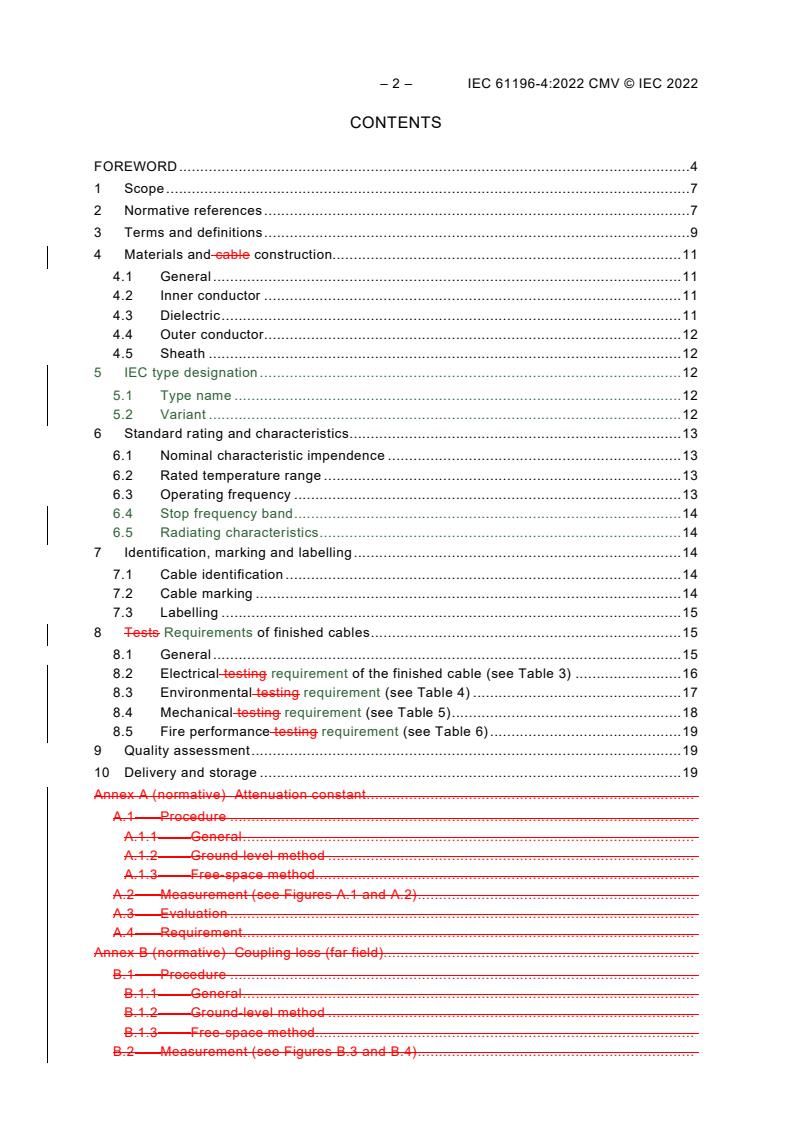
– 2 – IEC 61196-4:2022 CMV © IEC 2022
CONTENTS
FOREWORD .4
1 Scope .7
2 Normative references .7
3 Terms and definitions .9
4 Materials and cable construction. 11
4.1 General . 11
4.2 Inner conductor . 11
4.3 Dielectric . 11
4.4 Outer conductor . 12
4.5 Sheath . 12
5 IEC type designation . 12
5.1 Type name . 12
5.2 Variant . 12
6 Standard rating and characteristics . 13
6.1 Nominal characteristic impendence . 13
6.2 Rated temperature range . 13
6.3 Operating frequency . 13
6.4 Stop frequency band . 14
6.5 Radiating characteristics . 14
7 Identification, marking and labelling . 14
7.1 Cable identification . 14
7.2 Cable marking . 14
7.3 Labelling . 15
8 Tests Requirements of finished cables . 15
8.1 General . 15
8.2 Electrical testing requirement of the finished cable (see Table 3) . 16
8.3 Environmental testing requirement (see Table 4) . 17
8.4 Mechanical testing requirement (see Table 5) . 18
8.5 Fire performance testing requirement (see Table 6) . 19
9 Quality assessment . 19
10 Delivery and storage . 19
Annex A (normative) Attenuation constant .
A.1 Procedure .
A.1.1 General .
A.1.2 Ground-level method .
A.1.3 Free-space method.
A.2 Measurement (see Figures A.1 and A.2) .
A.3 Evaluation .
A.4 Requirement .
Annex B (normative) Coupling loss (far field).
B.1 Procedure .
B.1.1 General .
B.1.2 Ground-level method .
B.1.3 Free-space method.
B.2 Measurement (see Figures B.3 and B.4) .
B.3 Evaluation .
B.4 Requirement .
B.5 Test report .
Annex A (informative) The coupling loss around circumferential orientation of radiating
cable . 26
A.1 General . 26
A.2 Terms and definitions . 26
A.3 Test method . 26
A.4 Calculation . 27
A.5 Requirements . 28
A.6 Test report . 28
Annex B (under study) (informative) Radiating Radiation intensity around
circumferential orientation of radiating . 29
B.1 General . 29
B.2 Terms and definitions . 29
B.3 Test method . 30
B.4 Calculation . 30
B.5 Requirements . 32
B.6 Test report . 32
Bibliography . 34
List of comments . 35
Figure A.1 – Attenuation constant with ground-level method .
Figure A.2 – Attenuation constant with free-space method .
Figure B.1 – Antenna orientations with ground-level method .
Figure B.2 – Antenna orientations with free-space method .
Figure B.3 – Coupling loss with ground-level method .
Figure B.4 – Coupling loss with free-space method .
Figure A.1 – Example of testing coupling loss around circumferential orientation of
radiating cable (Y-Z) . 27
Figure A.2 – Example of coupling loss chart around circumferential orientation of
radiating cable . 28
Figure B.1 – Example of testing arrangement of radiation intensity chart around
circumferential orientation of radiating cable . 30
Figure B.2 – Example of radiation intensity chart around circumferential orientation of
radiating cable . 32
Table 1 – Rated temperature . 13
Table 2 – Operating frequency . 14
Table 3 – Electrical testing requirement . 16
Table 4 – Environmental testing requirement. 17
Table 5 – Mechanical testing requirement . 18
Table 6 – Fire performance testing requirement . 19
– 4 – IEC 61196-4:2022 CMV © IEC 2022
INTERNATIONAL ELECTROTECHNICAL COMMISSION
____________
COAXIAL COMMUNICATION CABLES –
Part 4: Sectional specification for radiating cables
FOREWORD
1) The International Electrotechnical Commission (IEC) is a worldwide organization for standardization comprising
all national electrotechnical committees (IEC National Committees). The object of IEC is to promote
international co-operation on all questions concerning standardization in the electrical and electronic fields. To
this end and in addition to other activities, IEC publishes International Standards, Technical Specifications,
Technical Reports, Publicly Available Specifications (PAS) and Guides (hereafter referred to as “IEC
Publication(s)”). Their preparation is entrusted to technical committees; any IEC National Committee interested
in the subject dealt with may participate in this preparatory work. International, governmental and non-
governmental organizations liaising with the IEC also participate in this preparation. IEC collaborates closely
with the International Organization for Standardization (ISO) in accordance with conditions determined by
agreement between the two organizations.
2) The formal decisions or agreements of IEC on technical matters express, as nearly as possible, an international
consensus of opinion on the relevant subjects since each technical committee has representation from all
interested IEC National Committees.
3) IEC Publications have the form of recommendations for international use and are accepted by IEC National
Committees in that sense. While all reasonable efforts are made to ensure that the technical content of IEC
Publications is accurate, IEC cannot be held responsible for the way in which they are used or for any
misinterpretation by any end user.
4) In order to promote international uniformity, IEC National Committees undertake to apply IEC Publications
transparently to the maximum extent possible in their national and regional publications. Any divergence
between any IEC Publication and the corresponding national or regional publication shall be clearly indicated in
the latter.
5) IEC itself does not provide any attestation of conformity. Independent certification bodies provide conformity
assessment services and, in some areas, access to IEC marks of conformity. IEC is not responsible for any
services carried out by independent certification bodies.
6) All users should ensure that they have the latest edition of this publication.
7) No liability shall attach to IEC or its directors, employees, servants or agents including individual experts and
members of its technical committees and IEC National Committees for any personal injury, property damage or
other damage of any nature whatsoever, whether direct or indirect, or for costs (including legal fees) and
expenses arising out of the publication, use of, or reliance upon, this IEC Publication or any other IEC
Publications.
8) Attention is drawn to the Normative references cited in this publication. Use of the referenced publications is
indispensable for the correct application of this publication.
9) Attention is drawn to the possibility that some of the elements of this IEC Publication may be the subject of
patent rights. IEC shall not be held responsible for identifying any or all such patent rights.
This commented version (CMV) of the official standard IEC 61196-4:2022 edition 4.0
allows the user to identify the changes made to the previous IEC 61196-4:2015 edition
3.0. Furthermore, comments from IEC SC 46A experts are provided to explain the
reasons of the most relevant changes, or to clarify any part of the content.
A vertical bar appears in the margin wherever a change has been made. Additions are in
green text, deletions are in strikethrough red text. Experts' comments are identified by
a blue-background number. Mouse over a number to display a pop-up note with the
comment.
This publication contains the CMV and the official standard. The full list of comments is
available at the end of the CMV.
IEC 61196-4 has been prepared by subcommittee 46A: Coaxial cables, of IEC technical
committee 46: Cables, wires, waveguides, RF connectors, RF and microwave passive
components and accessories. It is an International Standard.
This fourth edition cancels and replaces the third edition published in 2015. This edition
constitutes a technical revision.
This edition includes the following significant technical changes with respect to the previous
edition:
a) rewrote "1 Scope" to be consistent with other blank detail specifications of coaxial cables;
b) updated different standards in "Clause 2 Normative references";
c) added the definitions of uniformly radiating type cable, stop frequency band and link loss;
d) added different materials and constructions in 4.2 to 4.5;
e) added "Clause 5 IEC type designation";
f) added a detailed rated temperature range of different materials in "6.2 Rated temperature
range";
g) added detailed frequencies in "6.3 Operating frequency range";
h) added "6.4 Stop frequency band" and "6.5 Radiating characteristics";
i) added different detail requirements or typical values in 8.2.4, 8.2.7, 8.2.8, 8.4.3 to 8.4.8;
j) deleted "7.4.4 Ovality of outer conductor";
k) added "8.2.11 Link loss", "8.4.9 Adhesion of dielectric", "8.4.10 Shrinkage for insulations",
"8.4.11 Maximum pulling force of cable";
l) used IEC 61196-1-123 and IEC 61196-1-124 in the electrical requirements to replace
Annex A and Annex B respectively and deleted Annex A and Annex B;
m) added "Figure A.1 Example of testing coupling loss around circumferential orientation of
radiating cable (Y-Z)" in Annex A.
The text of this International Standard is based on the following documents:
Draft Report on voting
46A/1583/FDIS 46A/1598/RVD
Full information on the voting for its approval can be found in the report on voting indicated in
the above table.
The language used for the development of this International Standard is English.
This document was drafted in accordance with ISO/IEC Directives, Part 2, and developed in
accordance with ISO/IEC Directives, Part 1 and ISO/IEC Directives, IEC Supplement,
available at www.iec.ch/members_experts/refdocs. The main document types developed by
IEC are described in greater detail at www.iec.ch/publications.
This part of IEC 61196 is to be read in conjunction with IEC 61196-1:2005.
A list of all parts in the IEC 61196 series, published under the general title Coaxial
communication cables, can be found on the IEC website.
– 6 – IEC 61196-4:2022 CMV © IEC 2022
The committee has decided that the contents of this document will remain unchanged until the
stability date indicated on the IEC website under webstore.iec.ch in the data related to the
specific document. At this date, the document will be
• reconfirmed,
• withdrawn,
• replaced by a revised edition, or
• amended.
IMPORTANT – The "colour inside" logo on the cover page of this document indicates
that it contains colours which are considered to be useful for the correct
understanding of its contents. Users should therefore print this document using a
colour printer.
COAXIAL COMMUNICATION CABLES –
Part 4: Sectional specification for radiating cables
1 Scope
This part of IEC 61196 applies to radiating coaxial communication cables. These cables are
intended for use in wireless communication systems, such as tunnels, railways, highways,
subways, elevators and other installations in which conventional antenna transmission is not
satisfactory or even impossible.
It is to be read in conjunction with IEC 61196-1:2005.
This part of IEC 61196 applies to radiating coaxial communication cables, and specifies the
terms and definitions, material and construction, IEC type designation, standard rating and
characteristics, identification, marking and labelling, requirements of finished cables, quality
assessment, delivery and storage, etc. Radiating coaxial communication cables are widely
used in wireless communication systems for long, narrow, semi-enclosed and indoor
environments, such as high-speed railways, subways, tunnels, and indoor environments.
2 Normative references
The following documents are referred to in the text in such a way that some or all of their
content constitutes requirements of this document. For dated references, only the edition
cited applies. For undated references, the latest edition of the referenced document (including
any amendments) applies.
IEC 60068-1:2013, Environmental testing – Part 1: General and guidance
IEC 60068-2-61, Environmental testing – Part 2-61: Test methods: Test Z/ABDM: Climatic
sequence
IEC 60332-1-2, Tests on electric and optical fibre cables under fire conditions – Part 1-2: Test
for vertical flame propagation for a single insulated wire or cable – Procedure for 1 kW
pre-mixed flame
IEC 60754-1, Test on gases evolved during combustion of materials from cables – Part 1:
Determination of the halogen acid gas content
IEC TS 60695-7-50 , Fire hazard testing – Part 7-50: Toxicity of fire effluent – Estimation of
toxic potency – Apparatus and test method
IEC TS 60695-7-51 , Fire hazard testing – Part 7-51: Toxicity of fire effluent – Estimation of
toxic potency – Calculation and interpretation of test results
IEC 60811-406, Electric and optical fibre cables – Test methods for non-metallic materials –
Part 406: Miscellaneous tests – Resistance to stress cracking of polyethylene and
polypropylene compounds
___________
Withdrawn.
Withdrawn.
– 8 – IEC 61196-4:2022 CMV © IEC 2022
IEC 60811-502, Electric and optical fibre cables – Test methods for non-metallic materials –
Part 502: Mechanical tests − Shrinkage test for insulations
IEC 61034-2:2005, Measurement of smoke density of cables burning under defined conditions
– Part 2: Test procedure and requirements
IEC 61196-1:2005, Coaxial communication cables – Part 1: Generic specification – General,
definitions and requirements
IEC 61196-1-1, Coaxial communication cables – Part 1-1: Capability approval for coaxial
cables
IEC 61196-1-100, Coaxial communication cables – Part 1-100: Electrical test methods –
General requirements
IEC 61196-1-101, Coaxial communication cables – Part 1-101: Electrical test methods – Test
for conductor d.c. resistance of cable
IEC 61196-1-102, Coaxial communication cables – Part 1-102: Electrical test methods – Test
for insulation resistance of cable dielectric
IEC 61196-1-103, Coaxial communication cables – Part 1-103: Electrical test methods – Test
for capacitance of cable
IEC 61196-1-105, Coaxial communication cables – Part 1-105: Electrical test methods – Test
for withstand voltage of cable dielectric
IEC 61196-1-106, Coaxial communication cables – Part 1-106: Electrical test methods – Test
for withstand voltage of cable sheath
IEC 61196-1-108, Coaxial communication cables – Part 1-108: Electrical test methods – Test
for characteristic impedance, phase and group delay, electrical length and propagation
velocity
IEC 61196-1-110, Coaxial communication cables – Part 1-110: Electrical test methods – Test
for continuity
IEC 61196-1-112, Coaxial communication cables – Part 1-112: Electrical test methods – Test
for return loss (uniformity of impedance)
IEC 61196-1-115, Coaxial communication cables – Part 1-115: Electrical test methods – Test
for regularity of impedance (pulse/step function return loss)
IEC 61196-1-123 , Coaxial communication cables – Part 1-123: Electrical test methods – Test
for attenuation constant of radiating cable
IEC 61196-1-124, Coaxial communication cables – Part 1-124: Electrical test methods – Test
for coupling loss of radiating cable
IEC 61196-1-200, Coaxial communication cables – Part 1-200: Environmental test methods –
General requirements
___________
Under preparation. Stage at the time of publication: IEC/CDV 61196-1-123:2022.
IEC 61196-1-201, Environmental test methods Coaxial communication cables – Part 1-201:
Environmental test methods – Test for cold bend performance of cable
IEC 61196-1-215, Coaxial communication cables – Part 1-215: Environmental test methods –
High temperature cable ageing
IEC 61196-1-300, Coaxial communication cables – Part 1-300: Mechanical test methods –
General requirements
IEC 61196-1-301, Coaxial communication cables – Part 1-301: Mechanical test methods –
Test for ovality
IEC 61196-1-302, Coaxial communication cables – Part 1-302: Mechanical test methods –
Test for eccentricity
IEC 61196-1-313, Coaxial communication cables – Part 1-313: Mechanical test methods –
Adhesion of dielectric and sheath
IEC 61196-1-314:20062015, Coaxial communication cables – Part 1-314: Mechanical test
methods – Test for bending
IEC 61196-1-316, Coaxial communication cables – Part 1-316: Mechanical test methods –
Test of maximum pulling force of cable
IEC 61196-1-317, Coaxial communication cables – Part 1-317: Mechanical test methods –
Test for crush resistance of cable
IEC TR 62222, Fire performance of communication cables installed in buildings
IEC 62230:2006, Electric cables – Spark-test method
3 Terms and definitions
For the purposes of this document, the terms and definitions given in IEC 61196-1:2005 and
the following apply.
ISO and IEC maintain terminological databases for use in standardization at the following
addresses:
• IEC Electropedia: available at http://www.electropedia.org/
• ISO Online browsing platform: available at http://www.iso.org/obp
3.1
radiating (coaxial) cable
coaxial communication cable with outer conductor that is intentionally not completely closed,
so that part of the electromagnetic wave energy transmitted or received through the cable is
coupled by a bidirectional transmission system formed by the outer conductor of the cable and
the external environment
Note 1 to entry: The coupling intensity between the cable and mobile equipment depends on:
– the construction of the cable;
– the characteristics of the antenna (such as the type, the orientation, gain, etc.);
– the distance and orientation of the mobile antenna from the cable;
– the nature of ambient atmosphere;
– the operating frequency range;
– 10 – IEC 61196-4:2022 CMV © IEC 2022
– the manner of installation of the cable;
– the shape, material and size of surrounding buildings.
3.2
uniformly radiating type cable 1
radiating cable with its outer conductor intentionally slotted in different slots along the cable,
so that electromagnetic energy radiating along the cable is uniform in a specific frequency
range
Note 1 to entry: According to the design, the end of the input signal is the transceiver end, and the other is the
load end.
3.3
stop frequency band 2
frequency band at which the peak of attenuation or standing wave appears due the cable
construction, such as the slot pitch
Note 1 to entry: Stop frequency band cannot be used to transmit signals.
3.4
coupling loss
L
c
ratio of the power P transmitted into the radiating cable at one point to the power P received
t r
by a half-wavelength dipole antenna located at a distance from the radiating cable at the
same point (see formula (1))
P
t
L =10log
(1)
c 10
P
r
where
L is coupling loss, in dB;
c
P is the transmission power in the radiating cable at one point, in W;
t
P is the receiving power of the half-wavelength dipole antenna at a distance from the
r
radiating cable at the same point, in W.
Note 1 to entry: Coupling loss is an important parameter of radiating coaxial cables to distinguish them from
general coaxial communications cables.
3.5
link loss 3
ratio of the input power P transmitted into the transceiver end of the radiating cable from the
in
signal source to the power P received by a half-wavelength dipole antenna located at a
r
distance from the radiating cable, expressed by formula (2):
P
in
L =10 log
(2)
L 10
P
r
where
L is the link loss, in dB;
L
P is the input power transmitted into the transceiver end of the radiating cable from the
in
signal source, in W;
P is the receiving power of the half-wavelength dipole antenna at a distance from the
r
radiating cable, in W.
4 Materials and cable construction
4.1 General
4.1 Cable construction
The cable is composed of the inner conductor, dielectric, outer conductor and sheath; its
construction shall be in accordance with 4.2 to 4.5 of this document and the requirements
stated in the detail specification.
4.2 Inner conductor
4.2.1 Conductor material
Subclauses 4.4.1 to 4.4.3 of IEC 61196-1:2005 apply.
The conductor material shall be as stated in the relevant cable detail specification.
4.2.2 Conductor construction
IEC 61196-1:2005, 4.4.1 to 4.4.3 apply.
The conductor material shall be copper-clad aluminium copper tube or as stated in the detail
specification.
The conductor shall consist of a solid wire, corrugated or smooth tube, etc or as stated in the
detail specification.
In addition, IEC 61196-1:2005, 4.4.4 applies.
The inner conductor diameter (and thickness for smooth tube inner conductor) shall be stated
in the detail specification.
For the corrugated inner conductor, the peak diameter and root diameter and pitch shall be
specified in the detail specification.
The tolerance on the inner conductor shall be specified in the detail specification.
4.3 Dielectric
The dielectric material shall be as stated in the detail specification.
The construction of the dielectric shall be one of the following:
– solid dielectric;
– air spaced dielectric;
– semi air spaced dielectric (e.g. cellular polymer dielectric).
The diameter and tolerance shall be stated in the detail specification.
The recommended outer diameter ratings of the dielectric (the rounded value of the
approximate outer diameter of the dielectric) should be as follows:
– 12 – IEC 61196-4:2022 CMV © IEC 2022
9 mm (3/8"), 12 mm (1/2"), 22 mm (7/8"), 32 mm (1 1/4"), 42 mm (1 5/8") or as stated in the
detail specification.
4.4 Outer conductor
The outer conductor material shall be plain or coated copper wire, metallic tape with or
without slots as stated in the detail specification.
onstruction of the outer conductor shall be braid with lower coverage, or
The typical structure c
slotted tape(s) rounding, or slotted corrugated tube, or slotted smooth tube, etc or as stated in
the detail specification.
For the corrugated outer conductor, the peak diameter and root diameter and pitch shall be as
specified in the detail specification.
The diameter and thickness of the outer conductor shall be specified in the detail specification.
The tolerance on the outer conductor shall be specified in the detail specification.
4.5 Sheath
The sheath of a cable shall be in accordance with IEC 61196-1:2005, 4.7 with the following
amendments and additions:
a) The outer sheath of the cable shall be as specified in the detail specification.
b) The typical material of sheath shall be PE, LSZH, PVC, etc.
c) The diameter and thickness and tolerance of sheath shall be as stated in the detail
specification.
d) For self-supporting cables, the cable design will be an 8-figure design including a
messenger wire. The messenger wire position versus the coupling holes will be such that
it favours the foreseen radiating pattern.
e) For cables intended for outdoor use or exposed to sunlight, the cable shall pass the UV
stability test according to IEC specification. (A respective UV test procedure is under
consideration.)
e) A non-conductive ribbon or tape under the sheath may be permitted.
f) Under the sheath, strips that meet product performance requirements can be permitted,
such as non-conductive strips, flame-retardant strips, etc.
5 IEC type designation 4
5.1 Type name
The type name of the cable includes the nominal characteristic impedance and the dielectric
outer diameter rating, expressed as follows:
a) the nominal characteristic impedance, in ohms, such as "50";
a) the outer diameter ratings of the dielectric, in millimetres (inch). See Subclause 4.3.
Example: 50-22 (7/8") is a cable, its nominal characteristic impedance is 50 Ω, and its outer
diameter rating of dielectric is 22 mm (7/8").
5.2 Variant
The variant of the cable includes type, sheath material, outer conductor material and its
construction, expressed as follows:
a) Type
U – uniformly radiating type cable
The type of non-uniformly radiating type cable is omitted.
b) a dash symbol
c) Sheath material
PE – polyethylene
LSZH – low smoke zero halogen polyolefin
PVC – polyvinyl chloride
d) a dash symbol
e) Outer conductor material and construction
C – copper tape wrapped longitudinally with slots or wrapped helically with gaps
AL – aluminium tape wrapped longitudinally with slots or wrapped helically with gaps
CT – copper corrugated tube with slots
ALT – aluminium corrugated tube with slots
W – copper wires wrapped helically with gaps or braided with low coverage factor
Example: 50-42 (1 5/8") U—LSZH-C is one variant of type 50-42 (1 5/8") radiating cable. It is a
uniformly radiating type cable, its sheath material is low smoke zero halogen polyolefin, and
its outer conductor is copper tape wrapped longitudinally with slots.
6 Standard rating and characteristics
6.1 Nominal characteristic impendence
The nominal characteristic impedance shall be specified in the detail specification. Typical
impedance should be 50 Ω and 75 Ω.
6.2 Rated temperature range
The operational, storage, and installation rating temperature range shall be specified in
Table 1 or in the detail specification.
Table 1 – Rated temperature
LSZH sheath PE sheath PVC sheath
Parameter
°C °C °C
Operational temperature range −25 to 70 −40 to 70 −15 to 70
Storage temperature range −25 to 70 −40 to 70 −15 to 70
Installation temperature range −15 to 60 −30 to 60 0 to 60
6.3 Operating frequency
The maximum operating frequency range shall be is specified in Table 2 or in the detail
specification.
– 14 – IEC 61196-4:2022 CMV © IEC 2022
Table 2 – Operating frequency
Maximum recommended frequency Cut-off frequency
Type
GHz GHz
50-9 6,00 12,79
50-12 6,00 9,14
50-22 4,80 5,18
50-32 3,60 3,71
50-42 2,70 2,78
NOTE The cut-off frequency is calculated under the condition that the effective dielectric constant of the
dielectric is 1,25. The change of the product structure dimension in the manufacturing process will also affect
the change of the cut-off frequency.
6.4 Stop frequency band
The stop frequency band shall be specified in the detail specification and shall not be used.
6.5 Radiating characteristics 5
Except for uniformly radiating type cables, the radiating characteristics of cables are
evaluated by the coupling loss; when required, radiating characteristics can also be evaluated
by the coupling loss or radiation intensity around circumferential orientation of radiating
cables, see Annex A and Annex B.
The coupling loss measured by the three orthogonal antenna orientations L , L , L , and
c, x c, y c, z
their average value can also evaluate the electromagnetic field radiation characteristics of the
radiating cable.
The radiation characteristics of the uniformly radiating type cable shall be evaluated by cable
link loss.
The coupling characteristics between the radiating cable and the mobile terminal also depend
on the distance between them (if not 2 m). It characterizes the decline degree of the radiation
field intensity with distance.
7 Identification, marking and labelling
7.1 Cable identification
IEC 61196-1:2005, 6.1 applies.
7.2 Cable marking
The cable marking shall be applied to the sheath. The marking shall consist of the IEC cable
type number as given in 6.1.1 of IEC 61196-1:2005, 6.2 and/or the manufacturer’s designated
marking when specified in the detail specification.
When applicable, the marking of the installation or radiating direction shall be specified in the
detail specification.
The uniformly distributing radiation cable should be provided with an indicator that can
indicate the direction of the signal transmission, from the transceiver end of the cable to the
load end. 6
7.3 Labelling
Labelling shall be provided in accordance with IEC 61196-1:2005, 6.3 and the detail
specification.
8 Tests Requirements of finished cables
8.1 General
When tested in accordance with the IEC 61196-1 series, the requirements given below shall
apply.
Unless otherwise specified, all measurements shall be carried out under standard
atmospheric conditions for testing in accordance with Clause 5 of IEC 60068-1:2013, Clause
4.
Applicable test methods shall be in accordance with IEC 61196-1-100, IEC 61196-1-200,
IEC 61196-1-300 according to Clause 2 and other test methods specified herein.
– 16 – IEC 61196-4:2022 CMV © IEC 2022
8.2 Electrical testing requirement of the finished cable (see Table 3)
Table 3 – Electrical testing requirement
No. Test procedure Parameter Requirements/Remarks
IEC 61196-1-110
Inner conductor shall be continuous.
8.2.1 (Under Continuity
Outer conductor shall be continuous.
consideration)
Inner and outer conductor direct When required, value in accordance with
8.2.2 IEC 61196-1-101
current resistance the detail specification.
Test for capacitance When required, value in accordance with
8.2.3 IEC 61196-1-103
Capacitance the detail specification.
Value in accordance with the detail
specification
Unless otherwise specified in the
detailed specification,
8.2.4 IEC 61196-1-105 Withstand voltage of dielectric
3/8",1/2": DC 6 kV,1 min;
7/8",1 1/4": DC 10 kV,1 min;
1 5/8": DC 15 kV,1 min;
Withstand voltage of sheath (or
IEC 61196-1-106
Value in accordance with the detail
8.2.5 spark test) Spark voltage of
specification.
(or IEC 62230)
sheath
Unless specified in detail specification,
8.2.6 IEC 61196-1-102 Insulation resistance
≥ 10 MΩ·km
Value in accordance with the detail
8.2.7 IEC 61196-1-108 Mean characteristic impedance
specification (50 ± 2) Ω or (75 ± 2) Ω
Value in accordance with the detail
specification. Return loss shall be
measured on an uncoiled cable (see
Annex A).
Specimen length:50 m. During the test,
the cable should be uncoiled and
installed on a test setup according to
IEC 61196-1-124.
8.2.8 IEC 61196-1-112 Return loss
If not otherwise specified, the return loss
should meet the following requirements
in the actual working frequency band of
the cable.
≥17,7 dB (10 MHz to 2 200 MHz)
≥14,9 dB (2 200 MHz to 4 000 MHz)
≥14,0 dB (4 000 MHz to 6 000 MHz)
For a non-uniformly radiating type cable,
its attenuation constant shall be in
Attenuation constant/ insertion
Annex A
accordance with the detail specification.
8.2.9
IEC 61196-1-123 loss 7
Value in accordance with the detail
specification.
Annex B Coupling loss (not applicable to Value in accordance with the detail
8.2.10
IEC 61196-1-124 uniformly radiating type cable) specification
In addition to the coupling loss specified
in Annex B, when required, radiating
Radiating characteristics
characteristics may also be evaluated by
7.2.10 Annexes C and D
testing the cable according to Annexes C
and D, for assessing the radiating
pattern.
IEC 61196-1-
Value in accordance with the detail
8.2.11 Link loss
specification
___________
Under consideration.
8.3 Environmental testing requirement (see Table 4)
Table 4 – Environmental testing requirement
No. Test procedure Parameter Requirements/remarks
Unless otherwise specified When applicable, the
temperature value is:
200 °C ± 5 °C (FEP sheath)
98 °C ± 2 °C (PVC sheath)
IEC 61196-1-215
90 °C ± 2 °C (LSZH and PE sheath)
8.3.1 Ageing
(Under
Duration:168 h or specified in the detail
consideration)
specification.
Requirements after ageing and cooling down to
room temperature:
a) No cracks in the elements of cable.
b) No black spots in the outer conductor.
No physical damages of conductors, dielectric
and sheaths.
8.3.2 IEC 61196-1-201 Cold bend performance
The return loss shall remain within the specified
limits in Table 3 after the cable returns to room
temperature.
When required, CUT shall be specified in the
detail specification.
T = minimum environmental rated temperature
A
T = maximum environmental rated temperature
B
t = 16 h, unless otherwise specified in the detail
specification.
Humidity: 55 °C, 93 % RH 1 day (after cold and
Climatic sequence –
heat)
8.3.3 IEC 60068-2-61
method 1
No. of cycles: 2, unless otherwise specified in the
detail specification.
No physical damages shall be visible in the
cable.
The return loss shall remain within the specified
limits in Table 3.
Insulation resistance shall be within specified
limits in Table 3.
Resistance to
No physical damages shall be visible in the
8.3.4 IEC 60811-406 Environmental stress
cable.
cracking
– 18 – IEC 61196-4:2022 CMV © IEC 2022
8.4 Mechanical testing requirement (see Table 5)
Table 5 – Mechanical testing requirement
No. Test methods Parameter Requirements/remarks
The sheath shall be free of cracks, splits,
irregularities, and imbedded foreign material, burrs,
IEC 61196-
impurities, or other defects that can affect life,
8.4.1 1:2005, Visual examination
serviceability and appearance.
Subclause 4.2
The outer conductor shall be free of black spots or
cracks.
IEC 61196-1:2005 Dimensional
8.4.2 Value in accordance with the detail specification
Subclause 4.3 examination
Ovality of inner When applicable, value in accordance with the detail
8.4.3 IEC 61196-1-301
conductor specification ≤ 7 %
Ovality of outer When applicable, value in accordance with the detail
7.4.4 IEC 61196-1-301
conductor specification
8.4.4 IEC 61196-1-301 Ovality of dielectric Value in accordance with the detail specification ≤ 7 %
Eccentricity of
8.4.5 IEC 61196-1-302 Value in accordance with the detail specification ≤ 8 %
dielectric
Eccentricity of When applicable, value in accordanc
...
IEC 61196-4 ®
Edition 4.0 2022-09
INTERNATIONAL
STANDARD
NORME
INTERNATIONALE
Coaxial communication cables –
Part 4: Sectional specification for radiating cables
Câbles coaxiaux de communication –
Partie 4: Spécification intermédiaire pour câbles rayonnants
All rights reserved. Unless otherwise specified, no part of this publication may be reproduced or utilized in any form
or by any means, electronic or mechanical, including photocopying and microfilm, without permission in writing from
either IEC or IEC's member National Committee in the country of the requester. If you have any questions about IEC
copyright or have an enquiry about obtaining additional rights to this publication, please contact the address below or
your local IEC member National Committee for further information.
Droits de reproduction réservés. Sauf indication contraire, aucune partie de cette publication ne peut être reproduite ni
utilisée sous quelque forme que ce soit et par aucun procédé, électronique ou mécanique, y compris la photocopie et
les microfilms, sans l'accord écrit de l'IEC ou du Comité national de l'IEC du pays du demandeur. Si vous avez des
questions sur le copyright de l'IEC ou si vous désirez obtenir des droits supplémentaires sur cette publication, utilisez
les coordonnées ci-après ou contactez le Comité national de l'IEC de votre pays de résidence.
IEC Secretariat Tel.: +41 22 919 02 11
3, rue de Varembé info@iec.ch
CH-1211 Geneva 20 www.iec.ch
Switzerland
About the IEC
The International Electrotechnical Commission (IEC) is the leading global organization that prepares and publishes
International Standards for all electrical, electronic and related technologies.
About IEC publications
The technical content of IEC publications is kept under constant review by the IEC. Please make sure that you have the
latest edition, a corrigendum or an amendment might have been published.
IEC publications search - webstore.iec.ch/advsearchform IEC Products & Services Portal - products.iec.ch
The advanced search enables to find IEC publications by a Discover our powerful search engine and read freely all the
variety of criteria (reference number, text, technical publications previews. With a subscription you will always have
committee, …). It also gives information on projects, replaced access to up to date content tailored to your needs.
and withdrawn publications.
Electropedia - www.electropedia.org
IEC Just Published - webstore.iec.ch/justpublished
The world's leading online dictionary on electrotechnology,
Stay up to date on all new IEC publications. Just Published
containing more than 22 300 terminological entries in English
details all new publications released. Available online and once
and French, with equivalent terms in 19 additional languages.
a month by email.
Also known as the International Electrotechnical Vocabulary
(IEV) online.
IEC Customer Service Centre - webstore.iec.ch/csc
If you wish to give us your feedback on this publication or need
further assistance, please contact the Customer Service
Centre: sales@iec.ch.
A propos de l'IEC
La Commission Electrotechnique Internationale (IEC) est la première organisation mondiale qui élabore et publie des
Normes internationales pour tout ce qui a trait à l'électricité, à l'électronique et aux technologies apparentées.
A propos des publications IEC
Le contenu technique des publications IEC est constamment revu. Veuillez vous assurer que vous possédez l’édition la
plus récente, un corrigendum ou amendement peut avoir été publié.
Recherche de publications IEC - Découvrez notre puissant moteur de recherche et consultez
webstore.iec.ch/advsearchform gratuitement tous les aperçus des publications. Avec un
La recherche avancée permet de trouver des publications IEC abonnement, vous aurez toujours accès à un contenu à jour
en utilisant différents critères (numéro de référence, texte, adapté à vos besoins.
comité d’études, …). Elle donne aussi des informations sur les
projets et les publications remplacées ou retirées. Electropedia - www.electropedia.org
Le premier dictionnaire d'électrotechnologie en ligne au monde,
IEC Just Published - webstore.iec.ch/justpublished
avec plus de 22 300 articles terminologiques en anglais et en
Restez informé sur les nouvelles publications IEC. Just
français, ainsi que les termes équivalents dans 19 langues
Published détaille les nouvelles publications parues.
additionnelles. Egalement appelé Vocabulaire
Disponible en ligne et une fois par mois par email.
Electrotechnique International (IEV) en ligne.
Service Clients - webstore.iec.ch/csc
Si vous désirez nous donner des commentaires sur cette
publication ou si vous avez des questions contactez-nous:
sales@iec.ch.
IEC Products & Services Portal - products.iec.ch
IEC 61196-4 ®
Edition 4.0 2022-09
INTERNATIONAL
STANDARD
NORME
INTERNATIONALE
Coaxial communication cables –
Part 4: Sectional specification for radiating cables
Câbles coaxiaux de communication –
Partie 4: Spécification intermédiaire pour câbles rayonnants
INTERNATIONAL
ELECTROTECHNICAL
COMMISSION
COMMISSION
ELECTROTECHNIQUE
INTERNATIONALE
ICS 33.120.10 ISBN 978-2-8322-5668-8
– 2 – IEC 61196-4:2022 © IEC 2022
CONTENTS
FOREWORD . 4
1 Scope . 6
2 Normative references . 6
3 Terms and definitions . 8
4 Materials and construction . 9
4.1 General . 9
4.2 Inner conductor . 10
4.3 Dielectric . 10
4.4 Outer conductor . 10
4.5 Sheath . 11
5 IEC type designation . 11
5.1 Type name . 11
5.2 Variant . 11
6 Standard rating and characteristics . 12
6.1 Nominal characteristic impendence . 12
6.2 Rated temperature range . 12
6.3 Operating frequency . 12
6.4 Stop frequency band . 12
6.5 Radiating characteristics . 12
7 Identification, marking and labelling . 13
7.1 Cable identification . 13
7.2 Cable marking . 13
7.3 Labelling . 13
8 Requirements of finished cables . 13
8.1 General . 13
8.2 Electrical requirement of the finished cable (see Table 3) . 14
8.3 Environmental requirement (see Table 4) . 15
8.4 Mechanical requirement (see Table 5) . 16
8.5 Fire performance requirement (see Table 6) . 16
9 Quality assessment . 17
10 Delivery and storage . 17
Annex A (informative) The coupling loss around circumferential orientation of radiating
cable. 18
A.1 General . 18
A.2 Terms and definitions . 18
A.3 Test method . 18
A.4 Calculation . 19
A.5 Requirements . 20
A.6 Test report . 20
Annex B (informative) Radiation intensity around circumferential orientation of
radiating cable . 21
B.1 General . 21
B.2 Terms and definitions . 21
B.3 Test method . 21
B.4 Calculation . 22
B.5 Requirements . 23
B.6 Test report . 23
Bibliography . 24
Figure A.1 – Example of testing coupling loss around circumferential orientation of
radiating cable (Y-Z) . 19
Figure A.2 – Example of coupling loss chart around circumferential orientation of
radiating cable . 20
Figure B.1 – Example of testing arrangement of radiation intensity chart around
circumferential orientation of radiating cable . 22
Figure B.2 – Example of radiation intensity chart around circumferential orientation of
radiating cable . 23
Table 1 – Rated temperature . 12
Table 2 – Operating frequency . 12
Table 3 – Electrical requirement . 14
Table 4 – Environmental requirement . 15
Table 5 – Mechanical requirement . 16
Table 6 – Fire performance requirement . 17
– 4 – IEC 61196-4:2022 © IEC 2022
INTERNATIONAL ELECTROTECHNICAL COMMISSION
____________
COAXIAL COMMUNICATION CABLES –
Part 4: Sectional specification for radiating cables
FOREWORD
1) The International Electrotechnical Commission (IEC) is a worldwide organization for standardization comprising
all national electrotechnical committees (IEC National Committees). The object of IEC is to promote
international co-operation on all questions concerning standardization in the electrical and electronic fields. To
this end and in addition to other activities, IEC publishes International Standards, Technical Specifications,
Technical Reports, Publicly Available Specifications (PAS) and Guides (hereafter referred to as “IEC
Publication(s)”). Their preparation is entrusted to technical committees; any IEC National Committee interested
in the subject dealt with may participate in this preparatory work. International, governmental and non-
governmental organizations liaising with the IEC also participate in this preparation. IEC collaborates closely
with the International Organization for Standardization (ISO) in accordance with conditions determined by
agreement between the two organizations.
2) The formal decisions or agreements of IEC on technical matters express, as nearly as possible, an international
consensus of opinion on the relevant subjects since each technical committee has representation from all
interested IEC National Committees.
3) IEC Publications have the form of recommendations for international use and are accepted by IEC National
Committees in that sense. While all reasonable efforts are made to ensure that the technical content of IEC
Publications is accurate, IEC cannot be held responsible for the way in which they are used or for any
misinterpretation by any end user.
4) In order to promote international uniformity, IEC National Committees undertake to apply IEC Publications
transparently to the maximum extent possible in their national and regional publications. Any divergence
between any IEC Publication and the corresponding national or regional publication shall be clearly indicated in
the latter.
5) IEC itself does not provide any attestation of conformity. Independent certification bodies provide conformity
assessment services and, in some areas, access to IEC marks of conformity. IEC is not responsible for any
services carried out by independent certification bodies.
6) All users should ensure that they have the latest edition of this publication.
7) No liability shall attach to IEC or its directors, employees, servants or agents including individual experts and
members of its technical committees and IEC National Committees for any personal injury, property damage or
other damage of any nature whatsoever, whether direct or indirect, or for costs (including legal fees) and
expenses arising out of the publication, use of, or reliance upon, this IEC Publication or any other IEC
Publications.
8) Attention is drawn to the Normative references cited in this publication. Use of the referenced publications is
indispensable for the correct application of this publication.
9) Attention is drawn to the possibility that some of the elements of this IEC Publication may be the subject of
patent rights. IEC shall not be held responsible for identifying any or all such patent rights.
IEC 61196-4 has been prepared by subcommittee 46A: Coaxial cables, of IEC technical
committee 46: Cables, wires, waveguides, RF connectors, RF and microwave passive
components and accessories. It is an International Standard.
This fourth edition cancels and replaces the third edition published in 2015. This edition
constitutes a technical revision.
This edition includes the following significant technical changes with respect to the previous
edition:
a) rewrote "1 Scope" to be consistent with other blank detail specifications of coaxial cables;
b) updated different standards in "Clause 2 Normative references";
c) added the definitions of uniformly radiating type cable, stop frequency band and link loss;
d) added different materials and constructions in 4.2 to 4.5;
e) added "Clause 5 IEC type designation";
f) added a detailed rated temperature range of different materials in "6.2 Rated temperature
range";
g) added detailed frequencies in "6.3 Operating frequency range";
h) added "6.4 Stop frequency band" and "6.5 Radiating characteristics";
i) added different detail requirements or typical values in 8.2.4, 8.2.7, 8.2.8, 8.4.3 to 8.4.8;
j) deleted "7.4.4 Ovality of outer conductor";
k) added "8.2.11 Link loss", "8.4.9 Adhesion of dielectric", "8.4.10 Shrinkage for insulations",
"8.4.11 Maximum pulling force of cable";
l) used IEC 61196-1-123 and IEC 61196-1-124 in the electrical requirements to replace
Annex A and Annex B respectively and deleted Annex A and Annex B;
m) added "Figure A.1 Example of testing coupling loss around circumferential orientation of
radiating cable (Y-Z)" in Annex A.
The text of this International Standard is based on the following documents:
Draft Report on voting
46A/1583/FDIS 46A/1598/RVD
Full information on the voting for its approval can be found in the report on voting indicated in
the above table.
The language used for the development of this International Standard is English.
This document was drafted in accordance with ISO/IEC Directives, Part 2, and developed in
accordance with ISO/IEC Directives, Part 1 and ISO/IEC Directives, IEC Supplement,
available at www.iec.ch/members_experts/refdocs. The main document types developed by
IEC are described in greater detail at www.iec.ch/publications.
This part of IEC 61196 is to be read in conjunction with IEC 61196-1:2005.
A list of all parts in the IEC 61196 series, published under the general title Coaxial
communication cables, can be found on the IEC website.
The committee has decided that the contents of this document will remain unchanged until the
stability date indicated on the IEC website under webstore.iec.ch in the data related to the
specific document. At this date, the document will be
• reconfirmed,
• withdrawn,
• replaced by a revised edition, or
• amended.
IMPORTANT – The "colour inside" logo on the cover page of this document indicates that it
contains colours which are considered to be useful for the correct understanding of its
contents. Users should therefore print this document using a colour printer.
– 6 – IEC 61196-4:2022 © IEC 2022
COAXIAL COMMUNICATION CABLES –
Part 4: Sectional specification for radiating cables
1 Scope
This part of IEC 61196 applies to radiating coaxial communication cables, and specifies the
terms and definitions, material and construction, IEC type designation, standard rating and
characteristics, identification, marking and labelling, requirements of finished cables, quality
assessment, delivery and storage, etc. Radiating coaxial communication cables are widely
used in wireless communication systems for long, narrow, semi-enclosed and indoor
environments, such as high-speed railways, subways, tunnels, and indoor environments.
2 Normative references
The following documents are referred to in the text in such a way that some or all of their
content constitutes requirements of this document. For dated references, only the edition
cited applies. For undated references, the latest edition of the referenced document (including
any amendments) applies.
IEC 60068-1:2013, Environmental testing – Part 1: General and guidance
IEC 60068-2-61, Environmental testing – Part 2-61: Test methods: Test Z/ABDM: Climatic
sequence
IEC 60332-1-2, Tests on electric and optical fibre cables under fire conditions – Part 1-2: Test
for vertical flame propagation for a single insulated wire or cable – Procedure for 1 kW
pre-mixed flame
IEC 60754-1, Test on gases evolved during combustion of materials from cables – Part 1:
Determination of the halogen acid gas content
IEC TS 60695-7-50 , Fire hazard testing – Part 7-50: Toxicity of fire effluent – Estimation of
toxic potency – Apparatus and test method
IEC TS 60695-7-51 , Fire hazard testing – Part 7-51: Toxicity of fire effluent – Estimation of
toxic potency – Calculation and interpretation of test results
IEC 60811-406, Electric optical fibre cables – Test methods for non-metallic materials –
Part 406: Miscellaneous tests – Resistance to stress cracking of polyethylene and
polypropylene compounds
IEC 60811-502, Electric and optical fibre cables – Test methods for non-metallic materials –
Part 502: Mechanical tests − Shrinkage test for insulations
IEC 61034-2, Measurement of smoke density of cables burning under defined conditions –
Part 2: Test procedure and requirements
___________
Withdrawn.
Withdrawn.
IEC 61196-1:2005, Coaxial communication cables – Part 1: Generic specification – General,
definitions and requirements
IEC 61196-1-1, Coaxial communication cables – Part 1-1: Capability approval for coaxial
cables
IEC 61196-1-100, Coaxial communication cables – Part 1-100: Electrical test methods –
General requirements
IEC 61196-1-101, Coaxial communication cables – Part 1-101: Electrical test methods – Test
for conductor d.c. resistance of cable
IEC 61196-1-102, Coaxial communication cables – Part 1-102: Electrical test methods – Test
for insulation resistance of cable dielectric
IEC 61196-1-103, Coaxial communication cables – Part 1-103: Electrical test methods – Test
for capacitance of cable
IEC 61196-1-105, Coaxial communication cables – Part 1-105: Electrical test methods – Test
for withstand voltage of cable dielectric
IEC 61196-1-108, Coaxial communication cables – Part 1-108: Electrical test methods – Test
for characteristic impedance, phase and group delay, electrical length and propagation
velocity
IEC 61196-1-110, Coaxial communication cables – Part 1-110: Electrical test methods – Test
for continuity
IEC 61196-1-112, Coaxial communication cables – Part 1-112: Electrical test methods – Test
for return loss (uniformity of impedance)
IEC 61196-1-123 , Coaxial communication cables – Part 1-123: Electrical test methods – Test
for attenuation constant of radiating cable
IEC 61196-1-124, Coaxial communication cables – Part 1-124: Electrical test methods – Test
for coupling loss of radiating cable
IEC 61196-1-200, Coaxial communication cables – Part 1-200: Environmental test methods –
General requirements
IEC 61196-1-201, Coaxial communication cables – Part 1-201: Environmental test methods –
Test for cold bend performance of cable
IEC 61196-1-215, Coaxial communication cables – Part 1-215: Environmental test methods –
High temperature cable ageing
IEC 61196-1-300, Coaxial communication cables – Part 1-300: Mechanical test methods –
General requirements
IEC 61196-1-301, Coaxial communication cables – Part 1-301: Mechanical test methods –
Test for ovality
___________
Under preparation. Stage at the time of publication: IEC/CDV 61196-1-123:2022.
– 8 – IEC 61196-4:2022 © IEC 2022
IEC 61196-1-302, Coaxial communication cables – Part 1-302: Mechanical test methods –
Test for eccentricity
IEC 61196-1-313, Coaxial communication cables – Part 1-313: Mechanical test methods –
Adhesion of dielectric and sheath
IEC 61196-1-314:2015, Coaxial communication cables – Part 1-314: Mechanical test methods
– Test for bending
IEC 61196-1-316, Coaxial communication cables – Part 1-316: Mechanical test methods –
Test of maximum pulling force of cable
IEC 61196-1-317, Coaxial communication cables – Part 1-317: Mechanical test methods –
Test for crush resistance of cable
IEC TR 62222, Fire performance of communication cables installed in buildings
IEC 62230, Electric cables – Spark-test method
3 Terms and definitions
For the purposes of this document, the terms and definitions given in IEC 61196-1:2005 and
the following apply.
ISO and IEC maintain terminological databases for use in standardization at the following
addresses:
• IEC Electropedia: available at http://www.electropedia.org/
• ISO Online browsing platform: available at http://www.iso.org/obp
3.1
radiating cable
coaxial communication cable with outer conductor that is intentionally not completely closed,
so that part of the electromagnetic wave energy transmitted or received through the cable is
coupled by a bidirectional transmission system formed by the outer conductor of the cable and
the external environment
Note 1 to entry: The coupling intensity between the cable and mobile equipment depends on:
– the construction of the cable;
– the characteristics of the antenna (such as the type, the orientation, gain, etc.);
– the distance and orientation of the mobile antenna from the cable;
– the nature of ambient atmosphere;
– the operating frequency range;
– the manner of installation of the cable;
– the shape, material and size of surrounding buildings.
3.2
uniformly radiating type cable
radiating cable with its outer conductor intentionally slotted in different slots along the cable,
so that electromagnetic energy radiating along the cable is uniform in a specific frequency
range
Note 1 to entry: According to the design, the end of the input signal is the transceiver end, and the other is the
load end.
3.3
stop frequency band
frequency band at which the peak of attenuation or standing wave appears due the cable
construction, such as the slot pitch
Note 1 to entry: Stop frequency band cannot be used to transmit signals.
3.4
coupling loss
L
c
ratio of the power P transmitted into the radiating cable at one point to the power P received
t r
by a half-wavelength dipole antenna located at a distance from the radiating cable at the
same point (see formula (1))
P
t
L =10log
(1)
c 10
P
r
where
L is coupling loss, in dB;
c
P is the transmission power in the radiating cable at one point, in W;
t
P is the receiving power of the half-wavelength dipole antenna at a distance from the
r
radiating cable at the same point, in W.
Note 1 to entry: Coupling loss is an important parameter of radiating coaxial cables to distinguish them from
general coaxial communications cables.
3.5
link loss
ratio of the input power P transmitted into the transceiver end of the radiating cable from the
in
signal source to the power P received by a half-wavelength dipole antenna located at a
r
distance from the radiating cable, expressed by formula (2):
P
in
L =10 log
(2)
L 10
P
r
where
is the link loss, in dB;
L
L
P is the input power transmitted into the transceiver end of the radiating cable from the
in
signal source, in W;
P is the receiving power of the half-wavelength dipole antenna at a distance from the
r
radiating cable, in W.
4 Materials and construction
4.1 General
The cable is composed of the inner conductor, dielectric, outer conductor and sheath; its
construction shall be in accordance with 4.2 to 4.5 of this document and the requirements
stated in the detail specification.
– 10 – IEC 61196-4:2022 © IEC 2022
4.2 Inner conductor
IEC 61196-1:2005, 4.4.1 to 4.4.3 apply.
The conductor material shall be copper-clad aluminium copper tube or as stated in the detail
specification.
The conductor shall consist of a solid wire, corrugated or smooth tube, or as stated in the
detail specification.
In addition, IEC 61196-1:2005, 4.4.4 applies.
The inner conductor diameter (and thickness for smooth tube inner conductor) shall be stated
in the detail specification.
For the corrugated inner conductor, the peak diameter and root diameter and pitch shall be
specified in the detail specification.
The tolerance on the inner conductor shall be specified in the detail specification.
4.3 Dielectric
The dielectric material shall be as stated in the detail specification.
The construction of the dielectric shall be one of the following:
– solid dielectric;
– air spaced dielectric;
– semi air spaced dielectric (e.g. cellular polymer dielectric).
The diameter and tolerance shall be stated in the detail specification.
The recommended outer diameter ratings of the dielectric (the rounded value of the
approximate outer diameter of the dielectric) should be as follows:
9 mm (3/8"), 12 mm (1/2"), 22 mm (7/8"), 32 mm (1 1/4"), 42 mm (1 5/8") or as stated in the
detail specification.
4.4 Outer conductor
The outer conductor material shall be plain or coated copper wire, metallic tape with or
without slots as stated in the detail specification.
The typical construction of the outer conductor shall be braid with low coverage, or slotted
tape(s) rounding, or slotted corrugated tube, or slotted smooth tube, or as stated in the detail
specification.
For the corrugated outer conductor, the peak diameter and root diameter and pitch shall be as
specified in the detail specification.
The diameter and thickness of the outer conductor shall be specified in the detail specification.
The tolerance on the outer conductor shall be specified in the detail specification.
4.5 Sheath
The sheath of a cable shall be in accordance with IEC 61196-1:2005, 4.7 with the following
amendments and additions:
a) The outer sheath of the cable shall be as specified in the detail specification.
b) The typical material of sheath shall be PE, LSZH, PVC, etc.
c) The diameter and thickness and tolerance of sheath shall be as stated in the detail
specification.
d) For self-supporting cables, the cable design will be an 8-figure design including a
messenger wire. The messenger wire position versus the coupling holes will be such that
it favours the foreseen radiating pattern.
e) For cables intended for outdoor use or exposed to sunlight, the cable shall pass the UV
stability test according to IEC specification.
f) Under the sheath, strips that meet product performance requirements can be permitted,
such as non-conductive strips, flame-retardant strips, etc.
5 IEC type designation
5.1 Type name
The type name of the cable includes the nominal characteristic impedance and the dielectric
outer diameter rating, expressed as follows:
a) the nominal characteristic impedance, in ohms, such as "50";
b) the outer diameter ratings of the dielectric, in millimetres (inch). See Subclause 4.3.
Example: 50-22 (7/8") is a cable, its nominal characteristic impedance is 50 Ω, and its outer
diameter rating of dielectric is 22 mm (7/8").
5.2 Variant
The variant of the cable includes type, sheath material, outer conductor material and its
construction, expressed as follows:
a) Type
U – uniformly radiating type cable
The type of non-uniformly radiating type cable is omitted.
b) a dash symbol
c) Sheath material
PE – polyethylene
LSZH – low smoke zero halogen polyolefin
PVC – polyvinyl chloride
d) a dash symbol
e) Outer conductor material and construction
C – copper tape wrapped longitudinally with slots or wrapped helically with gaps
AL – aluminium tape wrapped longitudinally with slots or wrapped helically with gaps
CT – copper corrugated tube with slots
ALT – aluminium corrugated tube with slots
W – copper wires wrapped helically with gaps or braided with low coverage factor
– 12 – IEC 61196-4:2022 © IEC 2022
Example: 50-42 (1 5/8") U—LSZH-C is one variant of type 50-42 (1 5/8") radiating cable. It is a
uniformly radiating type cable, its sheath material is low smoke zero halogen polyolefin, and
its outer conductor is copper tape wrapped longitudinally with slots.
6 Standard rating and characteristics
6.1 Nominal characteristic impendence
The nominal characteristic impedance shall be specified in the detail specification. Typical
impedance should be 50 Ω and 75 Ω.
6.2 Rated temperature range
The rating temperature range shall be specified in Table 1 or in the detail specification.
Table 1 – Rated temperature
LSZH sheath PE sheath PVC sheath
Parameter
°C °C °C
Operational temperature range −25 to 70 −40 to 70 −15 to 70
Storage temperature range −25 to 70 −40 to 70 −15 to 70
Installation temperature range −15 to 60 −30 to 60 0 to 60
6.3 Operating frequency
The maximum operating frequency range is specified in Table 2 or in the detailed
specification.
Table 2 – Operating frequency
Maximum recommended frequency Cut-off frequency
Type
GHz GHz
50-9 6,00 12,79
50-12 6,00 9,14
50-22 4,80 5,18
50-32 3,60 3,71
50-42 2,70 2,78
NOTE The cut-off frequency is calculated under the condition that the effective dielectric constant of the
dielectric is 1,25. The change of the product structure dimension in the manufacturing process will also affect
the change of the cut-off frequency.
6.4 Stop frequency band
The stop frequency band shall be specified in the detail specification and shall not be used.
6.5 Radiating characteristics
Except for uniformly radiating type cables, the radiating characteristics of cables are
evaluated by the coupling loss; when required, radiating characteristics can also be evaluated
by the coupling loss or radiation intensity around circumferential orientation of radiating
cables, see Annex A and Annex B.
The coupling loss measured by the three orthogonal antenna orientations L , L , L , and
c, x c, y c, z
their average value can also evaluate the electromagnetic field radiation characteristics of the
radiating cable.
The radiation characteristics of the uniformly radiating type cable shall be evaluated by cable
link loss.
The coupling characteristics between the radiating cable and the mobile terminal also depend
on the distance between them (if not 2 m). It characterizes the decline degree of the radiation
field intensity with distance.
7 Identification, marking and labelling
7.1 Cable identification
IEC 61196-1:2005, 6.1 applies.
7.2 Cable marking
The cable marking shall be applied to the sheath. The marking shall consist of the IEC cable
type number as given in IEC 61196-1:2005, 6.2 and/or the manufacturer’s designated marking
when specified in the detail specification.
When applicable, the marking of the installation or radiating direction shall be specified in the
detail specification.
The uniformly distributing radiation cable should be provided with an indicator that can
indicate the direction of the signal transmission, from the transceiver end of the cable to the
load end.
7.3 Labelling
Labelling shall be provided in accordance with IEC 61196-1:2005, 6.3 and the detail
specification.
8 Requirements of finished cables
8.1 General
When tested in accordance with the IEC 61196-1 series, the requirements given below shall
apply.
Unless otherwise specified, all measurements shall be carried out under standard
atmospheric conditions for testing in accordance with IEC 60068-1:2013, Clause 4.
Applicable test methods shall be in accordance with IEC 61196-1-100, IEC 61196-1-200,
IEC 61196-1-300 according to Clause 2 and other test methods specified herein.
– 14 – IEC 61196-4:2022 © IEC 2022
8.2 Electrical requirement of the finished cable (see Table 3)
Table 3 – Electrical requirement
No. Test procedure Parameter Requirements/Remarks
Inner conductor shall be continuous.
8.2.1 IEC 61196-1-110 Continuity
Outer conductor shall be continuous.
Inner and outer conductor direct When required, value in accordance with
8.2.2 IEC 61196-1-101
current resistance the detail specification.
When required, value in accordance with
8.2.3 IEC 61196-1-103 Capacitance
the detail specification.
Unless otherwise specified in the
detailed specification,
3/8",1/2": DC 6 kV,1 min;
8.2.4 IEC 61196-1-105 Withstand voltage of dielectric
7/8",1 1/4": DC 10 kV,1 min;
1 5/8": DC 15 kV,1 min;
Value in accordance with the detail
8.2.5 IEC 62230 Spark voltage of sheath
specification.
Unless specified in detail specification,
8.2.6 IEC 61196-1-102 Insulation resistance
≥ 10 MΩ·km
8.2.7 IEC 61196-1-108 Mean characteristic impedance (50 ± 2) Ω or (75 ± 2) Ω
Specimen length:50 m. During the test,
the cable should be uncoiled and
installed on a test setup according to
IEC 61196-1-124.
If not otherwise specified, the return loss
should meet the following requirements
8.2.8 IEC 61196-1-112 Return loss
in the actual working frequency band of
the cable.
≥17,7 dB (10 MHz to 2 200 MHz)
≥14,9 dB (2 200 MHz to 4 000 MHz)
≥14,0 dB (4 000 MHz to 6 000 MHz)
For a non-uniformly radiating type cable,
its attenuation constant shall be in
Attenuation constant/ insertion
accordance with the detail specification.
8.2.9 IEC 61196-1-123
loss
Value in accordance with the detail
specification.
Coupling loss (not applicable to Value in accordance with the detail
8.2.10 IEC 61196-1-124
uniformly radiating type cable) specification
IEC 61196-1-
Value in accordance with the detail
8.2.11 Link loss
specification
___________
Under consideration.
8.3 Environmental requirement (see Table 4)
Table 4 – Environmental requirement
No. Test procedure Parameter Requirements/remarks
When applicable, the temperature value is:
98 °C ± 2 °C (PVC sheath)
90 °C ± 2 °C (LSZH and PE sheath)
Duration:168 h or specified in the detail
8.3.1 IEC 61196-1-215 Ageing
specification.
Requirements after ageing and cooling down to
room temperature:
a) No cracks in the elements of cable.
b) No black spots in the outer conductor.
No physical damages of conductors, dielectric
and sheaths.
8.3.2 IEC 61196-1-201 Cold bend performance
The return loss shall remain within the specified
limits in Table 3 after the cable returns to room
temperature.
When required, CUT shall be specified in the
detail specification.
T = minimum environmental rated temperature
A
T = maximum environmental rated temperature
B
t = 16 h, unless otherwise specified in the detail
specification.
Humidity: 55 °C, 93 % RH 1 day (after cold and
Climatic sequence –
heat)
8.3.3 IEC 60068-2-61
method 1
No. of cycles: 2, unless otherwise specified in the
detail specification.
No physical damages shall be visible in the
cable.
The return loss shall remain within the specified
limits in Table 3.
Insulation resistance shall be within specified
limits in Table 3.
Environmental stress No physical damages shall be visible in the
8.3.4 IEC 60811-406
cracking cable.
– 16 – IEC 61196-4:2022 © IEC 2022
8.4 Mechanical requirement (see Table 5)
Table 5 – Mechanical requirement
No. Test methods Parameter Requirements/remarks
The sheath shall be free of cracks, burrs,
impurities, or other defects that can affect life,
IEC 61196-
serviceability and appearance.
8.4.1 1:2005, Visual examination
Subclause 4.2
The outer conductor shall be free of black spots
or cracks.
IEC 61196-1:2005
8.4.2
Dimensional examination Value in accordance with the detail specification
Subclause 4.3
8.4.3 IEC 61196-1-301 Ovality of inner conductor ≤ 7 %
8.4.4 IEC 61196-1-301 Ovality of dielectric ≤ 7 %
8.4.5 IEC 61196-1-302 Eccentricity of dielectric ≤ 8 %
8.4.6 IEC 61196-1-302 Eccentricity of sheath ≤ 43 %
Subclause 4.3.2 and 4.3.3, procedure 2 shall be
used with the details specified herein or in the
detail specification:
1) radius, R, of mandrel: 10 times the maximum
outer diameter of the cable;
IEC 61196-1-
8.4.7 Cable bending
2) number of cycles: 3.
314:2015
Requirements:
• The return loss shall remain within the
specified limits in Table 3.
• No physical damage in cable elements
When applicable, the load shall be specified in
the detail specification, applied for 2 min.
After a 2 min recovery time:
8.4.8 IEC 61196-1-317 Crush resistance of cable
• The return loss shall remain within the
specified limits in Table 3.
• No physical damage in cable elements.
≥ 98 N,or specify the required value in the
detailed specification.
8.4.9 IEC 61196-1-313 Adhesion of dielectric
L = 75 mm ± 2 mm
≤ 6,4 mm
a) Test temperature:115 °C ± 2 °C;
8.4.10 IEC 60811-502 Shrinkage for insulations
b) Time:4 h, cooling down to standard
atmospheric conditions
The maximum pulling force applied shall be
specified in the detailed specification.
Maximum pulling force of Requirements:
8.4.11 IEC 61196-1-316
cable
• The return loss shall remain within the
specified limits in Table 3.
• No physical damage in cable elements.
8.5 Fire performance requirement (see Table 6)
8.5.1 When intended to be installed in buildings, these cables can be separately subject to
the requirements of local, regional or governmental regulations for fire and safety standards.
8.5.2 When not subject to regulation, fire performance testing can be performed according
to Table 6.
Table 6 – Fire performance requirement
No. Test procedure Parameter Requirements/Remarks
When required, according to the detail
8.5.2.1 IEC 60332-1-2 Flame propagation
specification.
Halogen acid gas When required, according to the detail
8.5.2.2 IEC 60754-1
emission specification.
IEC TS 60695-7-50 When required, according to the detail
8.5.2.3 Toxic gas emission
IEC TS 60695-7-51 specification.
When required, according to the detail
8.5.2.4 IEC 61034-2 Smoke density
specification.
NOTE For more information on fire performance testing, refer to IEC TR 62222.
9 Quality assessment
When specified in the detail specifications, capability approval shall be in accordance with
IEC 61196-1-1.
10 Delivery and storage
Delivery of cables shall be in accordance with IEC 61196-1:2005, Clause 9.
– 18 – IEC 61196-4:2022 © IEC 2022
Annex A
(informative)
The coupling loss around circumferential orientation of radiating cable
A.1 General
If required, the radiation characteristics of radiating cable around the circumferential
orientation (Y-Z) can be evaluated in addition to the coupling loss. Annex A gives a method
for evaluating radiating characteristics by the coupling loss around circumferential orientation
of radiating cables.
A.2 Terms and definitions
A.2.1
coupling loss chart around circumferential orientation of rad
...