

IEC 61196-4:2015
(Main)Coaxial communication cables - Part 4: Sectional specification for radiating cables
General Information
- Abstract
IEC 61196-4:2015(E) applies to radiating coaxial communication cables. These cables are intended for use in wireless communication systems, such as tunnels, railways, highways, subways, elevators and other installations in which conventional antenna transmission is not satisfactory or even impossible. This third edition cancels and replaces the second edition published in 2004. This edition constitutes a technical revision. The main changes with respect to the previous edition are as follows:
- a definition for coupling loss was added,
- Clause 4 "Materials and cable construction" was added,
- rated temperature range, operating frequency and radiating characteristics as standard rating and characteristics were added,
- identification, marking and labeling was added,
- the tables of test procedures were revised,
- quality assessment and packaging was added,
- Annex C, "Coupling loss around circumferential orientation of radiating cable" was added,
- Annex D "Radiating intensity around circumferential orientation of radiating cable" was added.
This publication is to be read in conjunction with IEC 61196-1:2005.
- Status
- Published
- Publication Date
- 07-Sep-2015
- Technical Committee
- SC 46A - Coaxial cables
- Drafting Committee
- WG 3 - TC 46/SC 46A/WG 3
- Current Stage
- DELPUB - Deleted Publication
- Start Date
- 20-Sep-2022
- Completion Date
- 15-Jan-2021
Overview
IEC 61196-4:2015 - Coaxial communication cables - Part 4: Sectional specification for radiating cables - specifies requirements and test procedures for radiating coaxial communication cables used in wireless communication systems where conventional antennas are impractical. Typical installations include tunnels, railways, highways, subways, elevators and similar confined or elongated environments. This third edition (2015) cancels and replaces the 2004 edition and is a technical revision that expands definitions, construction requirements, ratings and test methods.
Key topics and requirements
- Scope and intended use: Applies to radiating coaxial cables designed to provide distributed radio coverage in constrained environments.
- Materials and cable construction: New Clause 4 defines inner conductor, dielectric, outer conductor and sheath construction requirements to ensure consistent radiating performance.
- Standard ratings and characteristics: Includes nominal characteristic impedance, rated temperature range, operating frequency and radiating characteristics as standard ratings.
- Performance metrics:
- Attenuation constant (Annex A) - procedures for measuring cable loss.
- Coupling loss (Annex B) - definition and far-field measurement methods; coupling loss around circumferential orientation is covered in Annex C.
- Radiating intensity around circumferential orientation is addressed in Annex D (under study).
- Identification, marking and labeling: Mandatory requirements for cable identification, marking and labeling to support installation and maintenance.
- Test procedures: Revised tables for electrical, environmental, mechanical and fire performance testing of finished cables (Tables 1–4).
- Quality assessment and packaging: New requirements for quality control, acceptance testing and packaging for delivery and storage.
- Measurement methods: Ground-level and free-space measurement methods are described for attenuation and coupling loss testing.
Practical applications and users
Who uses IEC 61196-4:2015:
- Cable manufacturers designing and certifying radiating coaxial cables.
- System integrators and RF engineers deploying distributed antenna systems (DAS) in tunnels, metros, rail systems and buildings.
- Test laboratories performing electrical, environmental, mechanical and fire tests on radiating cables.
- Specifiers and procurement teams requiring standardized performance, marking and quality assessment for safety- and mission-critical installations.
Practical benefits:
- Ensures consistent radiating performance and predictable coupling loss for system planning.
- Facilitates interoperability and traceability through standardized marking and test reports.
- Supports compliance and risk reduction in challenging RF environments.
Related standards
- Read in conjunction with IEC 61196-1:2005 (general requirements for coaxial communication cables).
- Refer to other IEC 61196 series parts for broader coaxial cable specifications and testing methods.
Relations
- Effective Date
- 05-Sep-2023
- Effective Date
- 05-Sep-2023
Get Certified
Connect with accredited certification bodies for this standard

ANCE
Mexican certification and testing association.

Intertek Slovenia
Intertek testing, inspection, and certification services in Slovenia.

LNE (Laboratoire National de Métrologie et d'Essais)
French national laboratory for metrology and testing.
Sponsored listings
Frequently Asked Questions
IEC 61196-4:2015 is a standard published by the International Electrotechnical Commission (IEC). Its full title is "Coaxial communication cables - Part 4: Sectional specification for radiating cables". This standard covers: IEC 61196-4:2015(E) applies to radiating coaxial communication cables. These cables are intended for use in wireless communication systems, such as tunnels, railways, highways, subways, elevators and other installations in which conventional antenna transmission is not satisfactory or even impossible. This third edition cancels and replaces the second edition published in 2004. This edition constitutes a technical revision. The main changes with respect to the previous edition are as follows: - a definition for coupling loss was added, - Clause 4 "Materials and cable construction" was added, - rated temperature range, operating frequency and radiating characteristics as standard rating and characteristics were added, - identification, marking and labeling was added, - the tables of test procedures were revised, - quality assessment and packaging was added, - Annex C, "Coupling loss around circumferential orientation of radiating cable" was added, - Annex D "Radiating intensity around circumferential orientation of radiating cable" was added. This publication is to be read in conjunction with IEC 61196-1:2005.
IEC 61196-4:2015(E) applies to radiating coaxial communication cables. These cables are intended for use in wireless communication systems, such as tunnels, railways, highways, subways, elevators and other installations in which conventional antenna transmission is not satisfactory or even impossible. This third edition cancels and replaces the second edition published in 2004. This edition constitutes a technical revision. The main changes with respect to the previous edition are as follows: - a definition for coupling loss was added, - Clause 4 "Materials and cable construction" was added, - rated temperature range, operating frequency and radiating characteristics as standard rating and characteristics were added, - identification, marking and labeling was added, - the tables of test procedures were revised, - quality assessment and packaging was added, - Annex C, "Coupling loss around circumferential orientation of radiating cable" was added, - Annex D "Radiating intensity around circumferential orientation of radiating cable" was added. This publication is to be read in conjunction with IEC 61196-1:2005.
IEC 61196-4:2015 is classified under the following ICS (International Classification for Standards) categories: 33.120.10 - Coaxial cables. Waveguides. The ICS classification helps identify the subject area and facilitates finding related standards.
IEC 61196-4:2015 has the following relationships with other standards: It is inter standard links to IEC 61196-4:2004, IEC 61196-4:2022. Understanding these relationships helps ensure you are using the most current and applicable version of the standard.
IEC 61196-4:2015 is available in PDF format for immediate download after purchase. The document can be added to your cart and obtained through the secure checkout process. Digital delivery ensures instant access to the complete standard document.
Standards Content (Sample)
IEC 61196-4 ®
Edition 3.0 2015-09
INTERNATIONAL
STANDARD
colour
inside
Coaxial communication cables –
Part 4: Sectional specification for radiating cables
All rights reserved. Unless otherwise specified, no part of this publication may be reproduced or utilized in any form
or by any means, electronic or mechanical, including photocopying and microfilm, without permission in writing from
either IEC or IEC's member National Committee in the country of the requester. If you have any questions about IEC
copyright or have an enquiry about obtaining additional rights to this publication, please contact the address below or
your local IEC member National Committee for further information.
IEC Central Office Tel.: +41 22 919 02 11
3, rue de Varembé Fax: +41 22 919 03 00
CH-1211 Geneva 20 info@iec.ch
Switzerland www.iec.ch
About the IEC
The International Electrotechnical Commission (IEC) is the leading global organization that prepares and publishes
International Standards for all electrical, electronic and related technologies.
About IEC publications
The technical content of IEC publications is kept under constant review by the IEC. Please make sure that you have the
latest edition, a corrigenda or an amendment might have been published.
IEC Catalogue - webstore.iec.ch/catalogue Electropedia - www.electropedia.org
The stand-alone application for consulting the entire The world's leading online dictionary of electronic and
bibliographical information on IEC International Standards, electrical terms containing more than 30 000 terms and
Technical Specifications, Technical Reports and other definitions in English and French, with equivalent terms in 15
documents. Available for PC, Mac OS, Android Tablets and additional languages. Also known as the International
iPad. Electrotechnical Vocabulary (IEV) online.
IEC publications search - www.iec.ch/searchpub IEC Glossary - std.iec.ch/glossary
The advanced search enables to find IEC publications by a More than 60 000 electrotechnical terminology entries in
variety of criteria (reference number, text, technical English and French extracted from the Terms and Definitions
committee,…). It also gives information on projects, replaced clause of IEC publications issued since 2002. Some entries
and withdrawn publications. have been collected from earlier publications of IEC TC 37,
77, 86 and CISPR.
IEC Just Published - webstore.iec.ch/justpublished
Stay up to date on all new IEC publications. Just Published IEC Customer Service Centre - webstore.iec.ch/csc
details all new publications released. Available online and If you wish to give us your feedback on this publication or
also once a month by email. need further assistance, please contact the Customer Service
Centre: csc@iec.ch.
IEC 61196-4 ®
Edition 3.0 2015-09
INTERNATIONAL
STANDARD
colour
inside
Coaxial communication cables –
Part 4: Sectional specification for radiating cables
INTERNATIONAL
ELECTROTECHNICAL
COMMISSION
ICS 33.120.10 ISBN 978-2-8322-2892-0
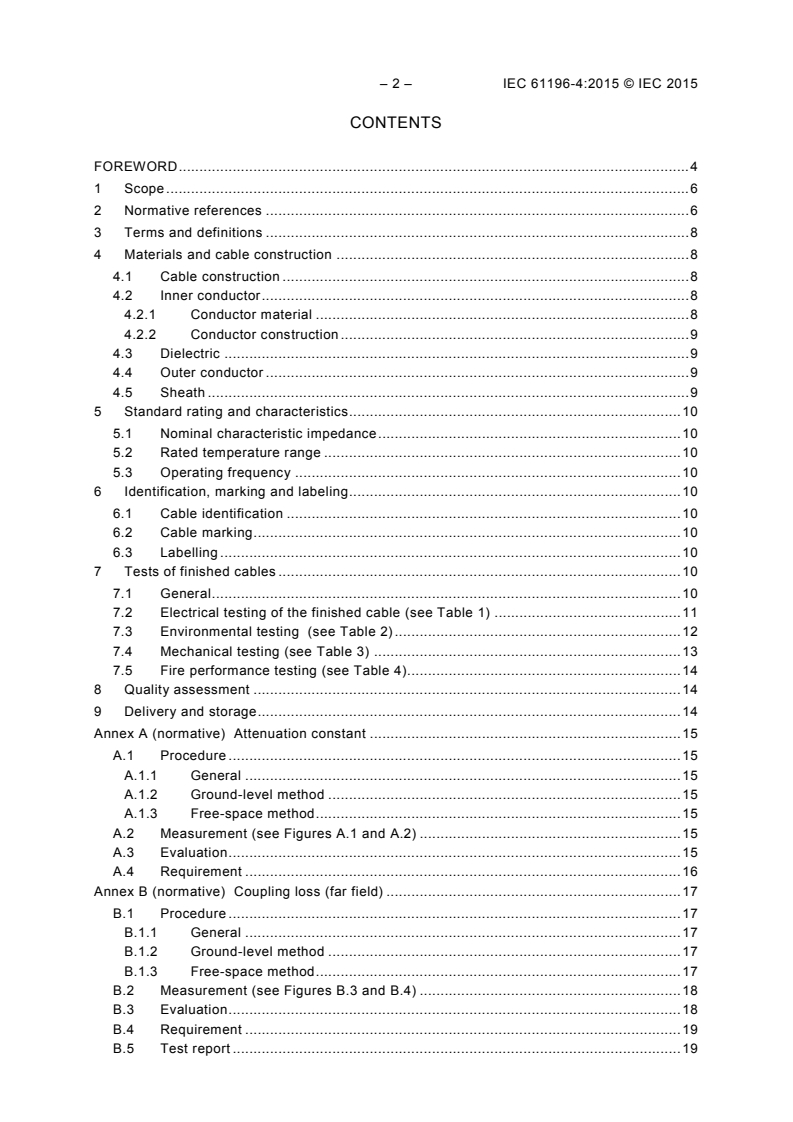
– 2 – IEC 61196-4:2015 © IEC 2015
CONTENTS
FOREWORD . 4
1 Scope . 6
2 Normative references . 6
3 Terms and definitions . 8
4 Materials and cable construction . 8
4.1 Cable construction . 8
4.2 Inner conductor . 8
4.2.1 Conductor material . 8
4.2.2 Conductor construction . 9
4.3 Dielectric . 9
4.4 Outer conductor . 9
4.5 Sheath . 9
5 Standard rating and characteristics . 10
5.1 Nominal characteristic impedance . 10
5.2 Rated temperature range . 10
5.3 Operating frequency . 10
6 Identification, marking and labeling . 10
6.1 Cable identification . 10
6.2 Cable marking . 10
6.3 Labelling . 10
7 Tests of finished cables . 10
7.1 General . 10
7.2 Electrical testing of the finished cable (see Table 1) . 11
7.3 Environmental testing (see Table 2) . 12
7.4 Mechanical testing (see Table 3) . 13
7.5 Fire performance testing (see Table 4). 14
8 Quality assessment . 14
9 Delivery and storage . 14
Annex A (normative) Attenuation constant . 15
A.1 Procedure . 15
A.1.1 General . 15
A.1.2 Ground-level method . 15
A.1.3 Free-space method . 15
A.2 Measurement (see Figures A.1 and A.2) . 15
A.3 Evaluation . 15
A.4 Requirement . 16
Annex B (normative) Coupling loss (far field) . 17
B.1 Procedure . 17
B.1.1 General . 17
B.1.2 Ground-level method . 17
B.1.3 Free-space method . 17
B.2 Measurement (see Figures B.3 and B.4) . 18
B.3 Evaluation . 18
B.4 Requirement . 19
B.5 Test report . 19
Annex C (informative) Coupling loss around circumferential orientation of radiating
cable. 21
C.1 General . 21
C.2 Definitions. 21
C.2.1 Coupling loss chart around circumferential orientation of radiating cable
(Y-Z) . 21
C.2.2 Out-of roundness of coupling loss chart around circumferential
orientation of radiating cable. 21
C.3 Test method . 21
C.4 Calculation . 22
C.5 Requirements . 22
C.6 Test report . 22
Annex D (under study) Radiating intensity around circumferential orientation of
radiating cable . 24
D.1 General . 24
D.2 Definitions. 24
D.2.1 Radiation intensity chart around circumferential orientation of radiating
cable (Y-Z) . 24
D.2.2 Out-of roundness of radiation intensity chart around circumferential
orientation of radiating cable. 24
D.3 Test method . 25
D.4 Calculation . 25
D.5 Requirements . 26
D.6 Test report . 27
Bibliography . 28
Figure A.1 – Attenuation constant with ground-level method . 16
Figure A.2 – Attenuation constant with free-space method . 16
Figure B.1 – Antenna orientations with ground-level method . 17
Figure B.2 – Antenna orientations with free-space method . 18
Figure B.3 – Coupling loss with ground-level method . 20
Figure B.4 – Coupling loss with free-space method . 20
Figure C.1 – Example of coupling loss chart around circumferential orientation of
radiating cable . 22
Figure D.1 – Example of testing arrangement of radiation intensity chart around
circumferential orientation of radiating cable . 25
Figure D.2 – Example of radiation intensity chart around circumferential orientation of
radiating cable . 26
Table 1 – Electrical testing . 11
Table 2 – Environmental testing . 12
Table 3 – Mechanical testing . 13
Table 4 – Fire performance testing . 14
– 4 – IEC 61196-4:2015 © IEC 2015
INTERNATIONAL ELECTROTECHNICAL COMMISSION
_______________
COAXIAL COMMUNICATION CABLES –
Part 4: Sectional specification for radiating cables
FOREWORD
1) The International Electrotechnical Commission (IEC) is a worldwide organization for standardization comprising
all national electrotechnical committees (IEC National Committees). The object of IEC is to promote
international co-operation on all questions concerning standardization in the electrical and electronic fields. To
this end and in addition to other activities, IEC publishes International Standards, Technical Specifications,
Technical Reports, Publicly Available Specifications (PAS) and Guides (hereafter referred to as “IEC
Publication(s)”). Their preparation is entrusted to technical committees; any IEC National Committee interested
in the subject dealt with may participate in this preparatory work. International, governmental and non-
governmental organizations liaising with the IEC also participate in this preparation. IEC collaborates closely
with the International Organization for Standardization (ISO) in accordance with conditions determined by
agreement between the two organizations.
2) The formal decisions or agreements of IEC on technical matters express, as nearly as possible, an international
consensus of opinion on the relevant subjects since each technical committee has representation from all
interested IEC National Committees.
3) IEC Publications have the form of recommendations for international use and are accepted by IEC National
Committees in that sense. While all reasonable efforts are made to ensure that the technical content of IEC
Publications is accurate, IEC cannot be held responsible for the way in which they are used or for any
misinterpretation by any end user.
4) In order to promote international uniformity, IEC National Committees undertake to apply IEC Publications
transparently to the maximum extent possible in their national and regional publications. Any divergence
between any IEC Publication and the corresponding national or regional publication shall be clearly indicated in
the latter.
5) IEC itself does not provide any attestation of conformity. Independent certification bodies provide conformity
assessment services and, in some areas, access to IEC marks of conformity. IEC is not responsible for any
services carried out by independent certification bodies.
6) All users should ensure that they have the latest edition of this publication.
7) No liability shall attach to IEC or its directors, employees, servants or agents including individual experts and
members of its technical committees and IEC National Committees for any personal injury, property damage or
other damage of any nature whatsoever, whether direct or indirect, or for costs (including legal fees) and
expenses arising out of the publication, use of, or reliance upon, this IEC Publication or any other IEC
Publications.
8) Attention is drawn to the Normative references cited in this publication. Use of the referenced publications is
indispensable for the correct application of this publication.
9) Attention is drawn to the possibility that some of the elements of this IEC Publication may be the subject of
patent rights. IEC shall not be held responsible for identifying any or all such patent rights.
International Standard IEC 61196-4 has been prepared by subcommittee 46A: Coaxial cables,
of IEC technical committee 46: Cables, wires, waveguides, R.F. connectors, R.F. and
microwave passive components and accessories.
This third edition cancels and replaces the second edition published in 2004. This edition
constitutes a technical revision.
The main changes with respect to the previous edition are as follows:
– a definition for coupling loss was added,
– Clause 4 "Materials and cable construction" was added,
– rated temperature range, operating frequency and radiating characteristics as standard
rating and characteristics were added,
– identification, marking and labeling was added,
– the tables of test procedures were revised,
– quality assessment and packaging was added,
– Annex C, “Coupling loss around circumferential orientation of radiating cable” was added
– Annex D “Radiating intensity around circumferential orientation of radiating cable” was
added.
The text of this standard is based on the following documents:
FDIS Report on voting
46A/1256/FDIS 46A/1273/RVD
Full information on the voting for the approval of this standard can be found in the report on
voting indicated in the above table.
This publication has been drafted in accordance with the ISO/IEC Directives, Part 2.
This publication is to be read in conjunction with IEC 61196-1:2005.
A list of all the parts in the IEC 61196 series published under the general title Coaxial
communication cables can be found on the IEC website.
The committee has decided that the contents of this publication will remain unchanged until
the stability date indicated on the IEC website under "http://webstore.iec.ch" in the data
related to the specific publication. At this date, the publication will be
• reconfirmed,
• withdrawn,
• replaced by a revised edition, or
• amended.
A bilingual version of this publication may be issued at a later date.
IMPORTANT – The 'colour inside' logo on the cover page of this publication indicates
that it contains colours which are considered to be useful for the correct
understanding of its contents. Users should therefore print this document using a
colour printer.
– 6 – IEC 61196-4:2015 © IEC 2015
COAXIAL COMMUNICATION CABLES –
Part 4: Sectional specification for radiating cables
1 Scope
This part of IEC 61196 applies to radiating coaxial communication cables. These cables are
intended for use in wireless communication systems, such as tunnels, railways, highways,
subways, elevators and other installations in which conventional antenna transmission is not
satisfactory or even impossible.
It is to be read in conjunction with IEC 61196-1:2005.
2 Normative references
The following documents, in whole or in part, are normatively referenced in this document and
are indispensable for its application. For dated references, only the edition cited applies. For
undated references, the latest edition of the referenced document (including any
amendments) applies.
IEC 60068-1:2013, Environmental testing – Part 1: General and guidance
IEC 60068-2-61, Environmental testing – Part 2-61: Test methods: Test Z/ABDM: Climatic
sequence
IEC 60332-1-2, Tests on electric and optical fibre cables under fire conditions – Part 1-2: Test
for vertical flame propagation for a single insulated wire or cable – Procedure for 1 kW pre-
mixed flame
IEC TS 60695-7-50, Fire hazard testing – Part 7-50: Toxicity of fire effluent – Estimation of
toxic potency – Apparatus and test method
IEC TS 60695-7-51, Fire hazard testing – Part 7-51: Toxicity of fire effluent – Estimation of
toxic potency: Calculation and interpretation of test results
IEC 60754-1, Test on gases evolved during combustion of materials from cables – Part 1:
Determination of the halogen acid gas content
IEC 60811-406, Electric and optical fibre cables – Test methods for non-metallic materials –
Part 406: Miscellaneous tests – Resistance to stress cracking of polyethylene and
polypropylene compounds
IEC 61034-2:2005, Measurement of smoke density of cables burning under defined conditions
– Part 2: Test procedure and requirements
IEC 61196-1:2005, Coaxial communication cables – Part 1: Generic specification – General,
definitions and requirements
IEC 61196-1-1, Coaxial communication cables – Part 1-1: Capability approval for coaxial
cables
IEC 61196-1-100, Coaxial communication cables – Part 1-100: Electrical test methods –
General requirements
IEC 61196-1-101, Coaxial communication cables – Part 1-101: Electrical test methods – Test
for conductor d.c. resistance of cable
IEC 61196-1-102, Coaxial communication cables – Part 1-102: Electrical test methods – Test
for insulation resistance of cable dielectric
IEC 61196-1-103, Coaxial communication cables – Part 1-103: Electrical test methods – Test
for capacitance of cable
IEC 61196-1-105, Coaxial communication cables – Part 1-105: Electrical test methods – Test
for withstand voltage of cable dielectric
IEC 61196-1-106, Coaxial communication cables – Part 1-106: Electrical test methods – Test
for withstand voltage of cable sheath
IEC 61196-1-108, Coaxial communication cables – Part 1-108: Electrical test methods – Test
for characteristic impedance, phase and group delay, electrical length and propagation
velocity
IEC 61196-1-112, Coaxial communication cables – Part 1-112: Electrical test methods – Test
for return loss (uniformity of impedance)
IEC 61196-1-115, Coaxial communication cables – Part 1-115: Electrical test methods – Test
for regularity of impedance (pulse/step function return loss)
IEC 61196-1-200, Coaxial communication cables – Part 1-200: Environmental test methods –
General requirements
IEC 61196-1-201, Environmental test methods – Part 1-201: Environmental test methods –
Test for cold bend performance of cable
IEC 61196-1-300, Coaxial communication cables – Part 1-300: Mechanical test methods –
General requirements
IEC 61196-1-301, Coaxial communication cables – Part 1-301: Mechanical test methods –
Test for ovality
IEC 61196-1-302, Coaxial communication cables – Part 1-302: Mechanical test methods –
Test for eccentricity
IEC 61196-1-314:2006, Coaxial communication cables – Part 1-314: Mechanical test methods
– Test for bending
IEC 61196-1-317, Coaxial communication cables – Part 1-317: Mechanical test methods –
Test for crush resistance of cable
IEC TR 62222, Fire performance of communication cables installed in buildings
IEC 62230:2006, Electric cables – Spark-test method
– 8 – IEC 61196-4:2015 © IEC 2015
3 Terms and definitions
For the purposes of this document, the terms and definitions given in IEC 61196-1 and the
following definitions apply.
3.1
radiating (coaxial) cable
coaxial communication cable with outer conductors that are intentionally not completely
closed, so that part of the electromagnetic wave energy transmitted or received through the
cable is coupled by a bidirectional transmission system formed by the outer conductor of the
cable and the external environment
Note 1 to entry: The coupling intensity between cable and mobile equipment depends on:
– construction of the cable;
– characteristics of antenna (such as the type, the orientation, gain, etc.);
– distance and orientation of the mobile antenna from the cable;
– nature of ambient atmosphere;
– operating frequency range;
– manner of installation of the cable;
– shape, material and size of surrounding buildings.
3.2
coupling loss
L
c
ratio of the power P transmitted into the radiating cable at one point to the power P received
t r
by a half-wavelength dipole antenna located at a distance from the radiating cable at the
same point (see formula 1)
Note 1 to entry: It is an important parameter of radiating coaxial cables to distinguish it from general coaxial
communications cables.
P
t
L = 10 log (1)
c 10
P
r
where
L is the coupling loss, in dB;
c
P is the transmission power in the radiating cable at one point, in W;
t
P is the receiving power of the half-wavelength dipole antenna at a distance from the
r
radiating cable at the same point, in W.
4 Materials and cable construction
4.1 Cable construction
The cable construction shall be in accordance with 4.2 to 4.5 of this standard and the
requirements stated in the detail specification.
4.2 Inner conductor
4.2.1 Conductor material
Subclauses 4.4.1 to 4.4.3 of IEC 61196-1:2005 apply.
The conductor material shall be as stated in the relevant cable detail specification.
4.2.2 Conductor construction
The conductor shall consist of a solid wire or corrugated or smooth tube, etc.
In addition, 4.4.4 of IEC 61196-1:2005 applies.
The inner conductor diameter (and thickness for smooth tube inner conductor) shall be stated
in the detail specification.
For corrugated inner conductor, peak diameter and root diameter and pitch shall be specified
in the detail specification.
The tolerance on the inner conductor shall be specified in the detail specification.
4.3 Dielectric
The dielectric material shal
...