

IEC TR 63145-1-1:2018
(Main)Eyewear display - Part 1-1: Generic introduction
General Information
- Abstract
IEC TR 63145-1-1:2018(E), which is a Technical Report, provides general information for the standardization of eyewear displays. This document includes an overview of the technology, critical performance characteristics, issues of optical measurements, and other information.
- Status
- Published
- Publication Date
- 25-Sep-2018
- Technical Committee
- TC 110 - Electronic displays
- Drafting Committee
- WG 12 - TC 110/WG 12
- Current Stage
- PPUB - Publication issued
- Start Date
- 26-Sep-2018
- Completion Date
- 21-Sep-2018

Overview
IEC TR 63145-1-1:2018 - Eyewear display: Part 1-1 Generic introduction is a Technical Report from the International Electrotechnical Commission (IEC) that collects and explains foundational information for the standardization of eyewear displays (also called near‑eye displays). It is an informational, non‑normative document that gives an overview of eyewear display technology, identifies critical performance characteristics, and summarizes issues and approaches for optical measurements.
Key topics covered
- Technology overview: taxonomy and classifications of eyewear/near‑eye displays (e.g., head‑mounts, glasses, visors, goggles; virtual, transparent, monocular vs binocular systems).
- Optical principles: explanation of virtual image optics (pupil‑forming vs non‑pupil‑forming), transparency modes, and how these affect perceived image size and coupling to the eye.
- Performance characteristics: essential parameters such as field of view (FOV), eye‑box, eye point / eye relief, virtual image distance, luminance, contrast, chromaticity, distortion, colour registration (chromatic aberration) and binocular properties.
- Measurement methods and instrumentation: guidance on optical measurement conditions and common equipment (e.g., goniometer, light measuring devices (LMD) - spot and 2‑D), alignment practices, and measurement considerations for both virtual image and transparent optics.
- Mechanical and electro‑optical aspects: overview of mechanical performance and electro‑optical issues relevant to eyewear displays.
- Standardization scope: outlines possible items for future standardization within the IEC 63145 series.
Note: IEC TR 63145-1-1 is informational and contains no normative references.
Practical applications and who uses this
This Technical Report is useful to:
- Product designers and optical engineers developing AR, VR and MR eyewear who need to understand critical optical performance concepts.
- Test and calibration laboratories establishing measurement setups for near‑eye displays.
- Standards committees and compliance teams planning normative requirements in follow‑on parts of the IEC 63145 series.
- Manufacturers and integrators defining product specifications (FOV, eye‑box, luminance/contrast targets).
- Researchers and system architects evaluating trade‑offs between transparency, virtual image properties, and ergonomics.
Relevant application areas include augmented reality (AR), virtual reality (VR), mixed reality (MR), head‑up displays, wearable HUDs, smart glasses, and other near‑eye systems.
Related standards
- Part of the IEC 63145 series on eyewear displays (see IEC webstore for other parts).
- Cross‑references informative standards such as ISO 9241‑302 regarding near‑eye and human factors considerations.
Keywords: IEC TR 63145-1-1:2018, eyewear display standard, near‑eye display, optical measurement methods, field of view, eye‑box, virtual image optics, AR headset, VR goggles.
Frequently Asked Questions
IEC TR 63145-1-1:2018 is a technical report published by the International Electrotechnical Commission (IEC). Its full title is "Eyewear display - Part 1-1: Generic introduction". This standard covers: IEC TR 63145-1-1:2018(E), which is a Technical Report, provides general information for the standardization of eyewear displays. This document includes an overview of the technology, critical performance characteristics, issues of optical measurements, and other information.
IEC TR 63145-1-1:2018(E), which is a Technical Report, provides general information for the standardization of eyewear displays. This document includes an overview of the technology, critical performance characteristics, issues of optical measurements, and other information.
IEC TR 63145-1-1:2018 is classified under the following ICS (International Classification for Standards) categories: 31.120 - Electronic display devices. The ICS classification helps identify the subject area and facilitates finding related standards.
IEC TR 63145-1-1:2018 is available in PDF format for immediate download after purchase. The document can be added to your cart and obtained through the secure checkout process. Digital delivery ensures instant access to the complete standard document.
Standards Content (Sample)
IEC TR 63145-1-1 ®
Edition 1.0 2018-09
TECHNICAL
REPORT
colour
inside
Eyewear display –
Part 1-1: Generic introduction
All rights reserved. Unless otherwise specified, no part of this publication may be reproduced or utilized in any form
or by any means, electronic or mechanical, including photocopying and microfilm, without permission in writing from
either IEC or IEC's member National Committee in the country of the requester. If you have any questions about IEC
copyright or have an enquiry about obtaining additional rights to this publication, please contact the address below or
your local IEC member National Committee for further information.
IEC Central Office Tel.: +41 22 919 02 11
3, rue de Varembé info@iec.ch
CH-1211 Geneva 20 www.iec.ch
Switzerland
About the IEC
The International Electrotechnical Commission (IEC) is the leading global organization that prepares and publishes
International Standards for all electrical, electronic and related technologies.
About IEC publications
The technical content of IEC publications is kept under constant review by the IEC. Please make sure that you have the
latest edition, a corrigenda or an amendment might have been published.
IEC Catalogue - webstore.iec.ch/catalogue Electropedia - www.electropedia.org
The stand-alone application for consulting the entire The world's leading online dictionary of electronic and
bibliographical information on IEC International Standards, electrical terms containing 21 000 terms and definitions in
Technical Specifications, Technical Reports and other English and French, with equivalent terms in 16 additional
documents. Available for PC, Mac OS, Android Tablets and languages. Also known as the International Electrotechnical
iPad. Vocabulary (IEV) online.
IEC publications search - webstore.iec.ch/advsearchform IEC Glossary - std.iec.ch/glossary
The advanced search enables to find IEC publications by a 67 000 electrotechnical terminology entries in English and
variety of criteria (reference number, text, technical French extracted from the Terms and Definitions clause of
committee,…). It also gives information on projects, replaced IEC publications issued since 2002. Some entries have been
and withdrawn publications. collected from earlier publications of IEC TC 37, 77, 86 and
CISPR.
IEC Just Published - webstore.iec.ch/justpublished
Stay up to date on all new IEC publications. Just Published IEC Customer Service Centre - webstore.iec.ch/csc
details all new publications released. Available online and If you wish to give us your feedback on this publication or
also once a month by email. need further assistance, please contact the Customer Service
Centre: sales@iec.ch.
IEC TR 63145-1-1 ®
Edition 1.0 2018-09
TECHNICAL
REPORT
colour
inside
Eyewear display –
Part 1-1: Generic introduction
INTERNATIONAL
ELECTROTECHNICAL
COMMISSION
ICS 31.120 ISBN 978-2-8322-6064-7
– 2 – IEC TR 63145-1-1:2018 © IEC 2018
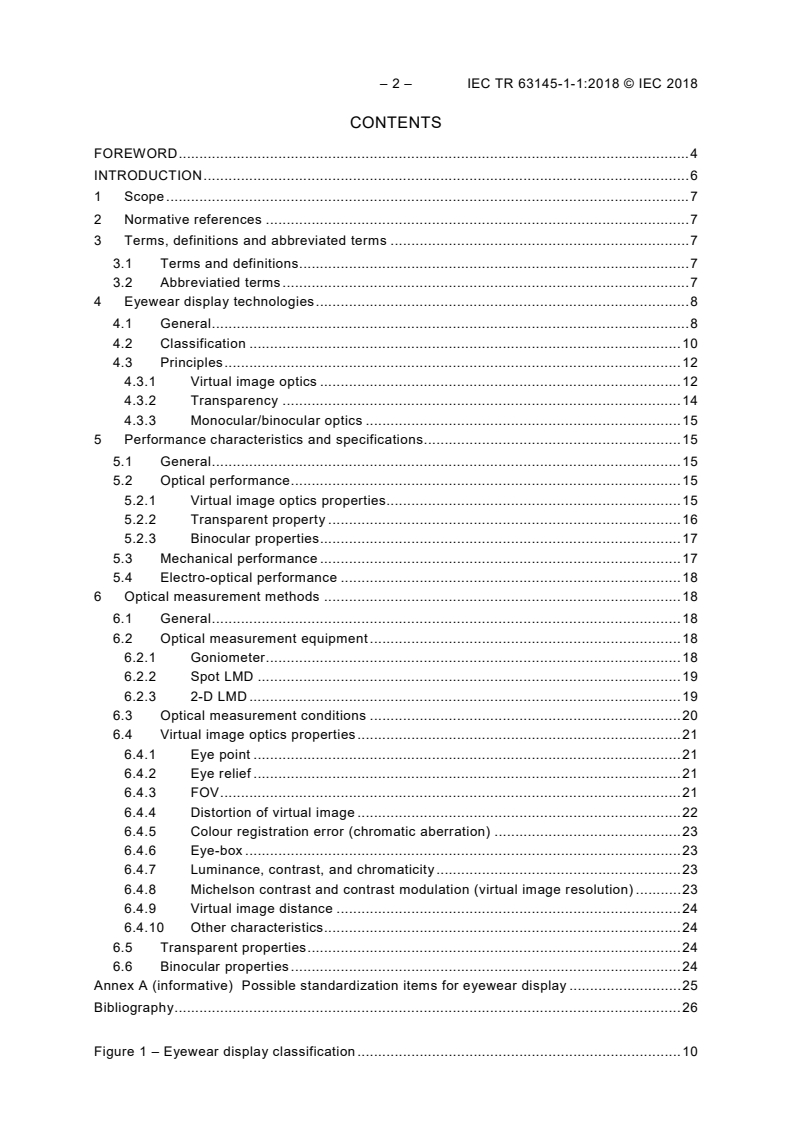
CONTENTS
FOREWORD . 4
INTRODUCTION . 6
1 Scope . 7
2 Normative references . 7
3 Terms, definitions and abbreviated terms . 7
3.1 Terms and definitions . 7
3.2 Abbreviatied terms . 7
4 Eyewear display technologies . 8
4.1 General . 8
4.2 Classification . 10
4.3 Principles . 12
4.3.1 Virtual image optics . 12
4.3.2 Transparency . 14
4.3.3 Monocular/binocular optics . 15
5 Performance characteristics and specifications . 15
5.1 General . 15
5.2 Optical performance . 15
5.2.1 Virtual image optics properties. 15
5.2.2 Transparent property . 16
5.2.3 Binocular properties . 17
5.3 Mechanical performance . 17
5.4 Electro-optical performance . 18
6 Optical measurement methods . 18
6.1 General . 18
6.2 Optical measurement equipment . 18
6.2.1 Goniometer . 18
6.2.2 Spot LMD . 19
6.2.3 2-D LMD . 19
6.3 Optical measurement conditions . 20
6.4 Virtual image optics properties . 21
6.4.1 Eye point . 21
6.4.2 Eye relief . 21
6.4.3 FOV . 21
6.4.4 Distortion of virtual image . 22
6.4.5 Colour registration error (chromatic aberration) . 23
6.4.6 Eye-box . 23
6.4.7 Luminance, contrast, and chromaticity . 23
6.4.8 Michelson contrast and contrast modulation (virtual image resolution) . 23
6.4.9 Virtual image distance . 24
6.4.10 Other characteristics . 24
6.5 Transparent properties . 24
6.6 Binocular properties . 24
Annex A (informative) Possible standardization items for eyewear display . 25
Bibliography . 26
Figure 1 – Eyewear display classification . 10
Figure 2 – Alternative classification . 11
Figure 3 – Principle of virtual image optics . 12
Figure 4 – Dimensions of a typical adult eye . 12
Figure 5 – Principle of transparency . 14
Figure 6 – Three types of transparent optics . 14
Figure 7 – Field of view . 16
Figure 8 – Eye-box . 16
Figure 9 – Example of binocular eye-box . 16
Figure 10 – Goniometer rotation and eye point . 18
Figure 11 – Proper positioning of LMD entrance pupil to eye point . 20
Figure 12 – Example of alignment of entrance pupil within the eye-box . 21
Figure 13 – Example of binocular FOV . 22
– 4 – IEC TR 63145-1-1:2018 © IEC 2018
INTERNATIONAL ELECTROTECHNICAL COMMISSION
____________
EYEWEAR DISPLAY –
Part 1-1: Generic introduction
FOREWORD
1) The International Electrotechnical Commission (IEC) is a worldwide organization for standardization comprising
all national electrotechnical committees (IEC National Committees). The object of IEC is to promote
international co-operation on all questions concerning standardization in the electrical and electronic fields. To
this end and in addition to other activities, IEC publishes International Standards, Technical Specifications,
Technical Reports, Publicly Available Specifications (PAS) and Guides (hereafter referred to as “IEC
Publication(s)”). Their preparation is entrusted to technical committees; any IEC National Committee interested
in the subject dealt with may participate in this preparatory work. International, governmental and non-
governmental organizations liaising with the IEC also participate in this preparation. IEC collaborates closely
with the International Organization for Standardization (ISO) in accordance with conditions determined by
agreement between the two organizations.
2) The formal decisions or agreements of IEC on technical matters express, as nearly as possible, an international
consensus of opinion on the relevant subjects since each technical committee has representation from all
interested IEC National Committees.
3) IEC Publications have the form of recommendations for international use and are accepted by IEC National
Committees in that sense. While all reasonable efforts are made to ensure that the technical content of IEC
Publications is accurate, IEC cannot be held responsible for the way in which they are used or for any
misinterpretation by any end user.
4) In order to promote international uniformity, IEC National Committees undertake to apply IEC Publications
transparently to the maximum extent possible in their national and regional publications. Any divergence
between any IEC Publication and the corresponding national or regional publication shall be clearly indicated in
the latter.
5) IEC itself does not provide any attestation of conformity. Independent certification bodies provide conformity
assessment services and, in some areas, access to IEC marks of conformity. IEC is not responsible for any
services carried out by independent certification bodies.
6) All users should ensure that they have the latest edition of this publication.
7) No liability shall attach to IEC or its directors, employees, servants or agents including individual experts and
members of its technical committees and IEC National Committees for any personal injury, property damage or
other damage of any nature whatsoever, whether direct or indirect, or for costs (including legal fees) and
expenses arising out of the publication, use of, or reliance upon, this IEC Publication or any other IEC
Publications.
8) Attention is drawn to the Normative references cited in this publication. Use of the referenced publications is
indispensable for the correct application of this publication.
9) Attention is drawn to the possibility that some of the elements of this IEC Publication may be the subject of
patent rights. IEC shall not be held responsible for identifying any or all such patent rights.
The main task of IEC technical committees is to prepare International Standards. However, a
technical committee may propose the publication of a technical report when it has collected
data of a different kind from that which is normally published as an International Standard, for
example "state of the art".
IEC TR 63145-1-1, which is a Technical Report, has been prepared by IEC technical
committee 110: Electronic display devices.
The text of this Technical Report is based on the following documents:
Enquiry draft Report on voting
110/966/DTR 110/982A/RVDTR
Full information on the voting for the approval of this technical report can be found in the
report on voting indicated in the above table.
This document has been drafted in accordance with the ISO/IEC Directives, Part 2.
A list of all parts in the IEC 63145 series, published under the general title Eyewear display,
can be found on the IEC website.
The committee has decided that the contents of this document will remain unchanged until the
stability date indicated on the IEC website under "http://webstore.iec.ch" in the data related to
the specific document. At this date, the document will be
• reconfirmed,
• withdrawn,
• replaced by a revised edition, or
• amended.
A bilingual version of this publication may be issued at a later date.
IMPORTANT – The 'colour inside' logo on the cover page of this publication indicates
that it contains colours which are considered to be useful for the correct
understanding of its contents. Users should therefore print this document using a
colour printer.
– 6 – IEC TR 63145-1-1:2018 © IEC 2018
INTRODUCTION
This document intends to gather technical information on eyewear displays, and to clarify the
relationship to normative aspects of the standardization in this technology area.
EYEWEAR DISPLAY –
Part 1-1: Generic introduction
1 Scope
This part of IEC 63145, which is a Technical Report, provides general information for the
standardization of eyewear displays. This document includes an overview of the technology,
critical performance characteristics, issues of optical measurements, and other information.
2 Normative references
There are no normative references in this document.
3 Terms, definitions and abbreviated terms
3.1 Terms and definitions
For the purposes of this document, the following terms and definitions apply.
ISO and IEC maintain terminological databases for use in standardization at the following
addresses:
• IEC Electropedia: available at http://www.electropedia.org/
• ISO Online browsing platform: available at http://www.iso.org/obp
3.1.1
eyewear display
display worn on the user’s eye or worn close to the eye in order to provide information to the
user
Note 1 to entry: See 4.1.
3.1.2
pupil forming
virtual image optics that are equipped with a magnifier and the optical elements which act as
an aperture stop, and where the magnifier forms a real image of the aperture stop
3.1.3
non-pupil forming
virtual image optics where the magnifier does not form a real image of the aperture stop
Note 1 to entry: See 3.1.2.
3.2 Abbreviatied terms
AR augmented reality
CAVE cave automatic virtual environment
CRT cathode ray tube
FOV field of view
FPD flat panel display
HMD head mounted display
– 8 – IEC TR 63145-1-1:2018 © IEC 2018
HUD head up display
IPD interpupillary distance
LMD light measuring device
MR mixed reality
QVS qualified viewing space
VR virtual reality
WFOV wide field of view
2-D two-dimensional
4 Eyewear display technologies
4.1 General
The advancement of display technology has enabled the creation of compact displays that
can be placed close to or on a viewer’s eye. This miniaturization enables the user to wear the
display in a comfortable form factor (such as eye glasses), and allows an individual to render
information of interest for their personal use. Some of the benefits of this display technology
include:
• good portability, such as hands-free, like eye glasses;
• large perceived image size, despite small structure; and
• link with user’s behaviour or external world, for virtual reality/augmented reality/mixed
reality.
There have been several designs proposed for wearing the display:
• head mount;
• helmet mount;
• headset;
• glasses mount;
• goggle;
• visor;
• contact lens.
The term “eyewear” is defined as follows in several sources:
a) things worn on the eyes, such as spectacles and contact lenses [1] ; and
b) devices worn to protect the eyes or improve the vision, such as eyeglasses, sunglasses,
safety goggles, etc. [2].
The eyewear includes things to cover the user’s eye, and contact lenses are also included.
How the display is mounted near the eye affects the display optics, the performance, and how
it is measured. There are other kinds of displays which do not have a mount structure or do
not attach to the eye:
• electronic view finder;
• telescope;
• microscope;
___________
Numbers in square brackets refer to the Bibliography.
• binoculars;
• opera glasses; and
• ophthalmic instruments, such as an auto-refractometer.
These cover the user’s eye, but are not included in the eyewear display because they are not
worn.
The term “near-eye display” is often used because, compared to an ordinary display, such as
a TV or PC monitor, the display is positioned closer to the user’s eye. In ISO 9241-302:2008
[3], Figure 11, “NTE (near to the eye) display” is used to explain the term "virtual image
display". In ISO 9241-305:2008 [4], 6.11.1, the terms “near-to-eye display” and “NED” are
used. These four terms are slightly different, but are considered to have the same meaning.
For near-eye displays, the proximity of the display to the eye makes it difficult to focus on the
display directly. Therefore, it is necessary to include optics between the display and eye for
the viewer to focus on the display image. Generally, the optics forming a virtual image are
used.
Eyewear displays are typically used in virtual reality (VR) and augmented reality (AR)
applications. When the application of displays is considered, “VR” or “AR” is frequently used
in academic conferences and even in newspapers to describe them. Mixed reality (MR) is also
used when physical and digital (visual) objects co-exist and interact in real time. Some
common dictionary definitions of VR are:
• the computer-generated simulation of three-dimensional images of an environment or
sequence of events that someone using special electronic equipment may view, as on a
video screen, and interact with in a seemingly physical way [2]; and
• a computer-generated environment that, to the person experiencing it, closely resembles
reality [5].
It is noted that VR is not limited to eyewear displays. There are other ways to implement VR,
such as a multi-screen CAVE (cave automatic virtual environment) [6][7] using image
projection. Compared with these VR displays, where the user directly observes the images
shown on the display screen, VR eyewear displays are worn and need special optics to see
an image. Without the optics, it is difficult for the human eye to focus on the displayed image,
or the observed image is too small. The use of eyewear displays for VR has become very
popular, with many companies offering non-see-through goggles in the marketplace.
Compared to VR, AR is a relatively new term and technology. AR allows for a live direct or
indirect view of a physical, real-world environment whose elements are augmented (or
supplemented) by computer-generated sensory input such as sound, video, graphics or GPS
data. It is related to a more general concept called mediated reality, in which a view of reality
is modified (possibly even diminished rather than augmented) by a computer. As a result, the
technology functions by enhancing one’s current perception of reality. In contrast, virtual
reality replaces the real world with a simulated one. Many AR displays are designed in the
form of eye glasses or visors. It is important that the AR/VR term be used with the form factor,
such as “VR goggles” and “AR glasses”, otherwise AR/VR just identifies the application, not
the device type.
The popular use of the term “virtual” has caused some confusion in how it is used for AR/VR
applications. In the technical field of optics, the term “virtual”, such as “virtual image”, has a
specific meaning [8]. In optics, the virtual image is defined as an image formed when the
outgoing rays from a point on an object always diverge. Therefore, it is more precise to use
the term “virtual” in combination with other attributes, such as “virtual reality”, “VR”, or “virtual
image”. In ISO 9241-302:2008 [3], 3.4.52, “virtual-image display” is defined as a device that
optically or holographically forms a virtual image. Instead of “virtual-image display”, “virtual
display” is used in ISO 9241-303:2011 [9], Annex E, and “virtual image display” appears in
ISO 9241-305:2008 [4], 6.11. These terms are considered to have the same meaning, that is,
a display with optics that creates a virtual image. However, the term "virtual display" is
confusing, and should be avoided. For example, a projection display with a cave shape
screen is often called a “virtual display” because it can produce a virtual reality scene, but it
does not use virtual-image optics.
– 10 – IEC TR 63145-1-1:2018 © IEC 2018
A “head up display (HUD)” is considered as one type of virtual image display, but it is not
considered as an eyewear display because it is not worn close to the eye.
To establish the classification of eyewear displays, the above-mentioned points need to be
considered.
4.2 Classification
To classify the eyewear displays, as shown in Figure 1, there are some key points to consider
as follows:
• virtual image optics, or retina direct projection;
• optical see-through or video see-through (optical non-see-through);
• monocular or binocular;
• near or contact.
AR video see-through is also possible.
Eyewear display
Augmented reality (AR) Virtual reality (VR)
Non-contact Contact
Non- Video see-
transparent through
Imaging Retinal Imaging Retinal
optics scanning optics scanning
IEC
Figure 1 – Eyewear display classification
When application, interface, and design are considered, an alternative classification can be
considered as shown in Figure 2. In this classification, the key points are as follows:
– see-through or non-see-through from an application stand point;
– mounting method base by human physical interface;
– monocular, bi-ocular or binocular for human optical interface;
– pupil forming or non-pupil forming from an optical design stand point;
– display source driving method.
Eyewear display
See-through Non-see-through
Application level
(e.g. AR) (e.g. VR)
Human physical
Eyewear Head wear Body
interface level
mounted mounted
mounted
Human optical Monocular Bi-ocular Binocular
interface level
Optical design
Pupil Non-pupil
approach
forming forming
Full frame Line-at-a-time Point raster Point Random pixel
Display source
refresh refresh 1D scan refresh 2D refresh addressing (NO
approach
scan vector scan continuous refresh
required)
IEC
Figure 2 – Alternative classification
The use of eyewear displays with binocular vision and video see-through capability is very
popular. Monocular and binocular optical see-through eyewear displays have also recently
been developed. Therefore, considering the current market situation, the following two types
of devices are needed for standardization:
1) non see-through type using virtual image optics;
2) see-through type using virtual image optics.
The essential performance of eyewear displays can be characterized by measuring the left or
right eyepiece separately. When the users use a binocular system, there can be a difference
between the left and right images for various reasons. This difference can be intentionally
generated to induce the perception of binocular depth. It can also be affected by the
difference between the interpupillary distance (IPD) of the user and the distance between the
virtual image optics of the user’s eyes. When this difference is large it can induce visual
discomfort. More advanced measurements can then be conducted for binocular vision. This
will be important for conformity purposes.
In the case of “retina direct projection”, laser optics are used to implement the Maxwellian
view principle. Its standardization can be addressed separately from that of virtual image
optics devices.
– 12 – IEC TR 63145-1-1:2018 © IEC 2018
4.3 Principles
4.3.1 Virtual image optics
Figure 3 shows the principle of virtual image optics, which contain an optical component, such
as a convex lens or a concave mirror, located between an imager (i.e., a small size display)
and a user’s eye. For example, in this convex lens case, the lens magnifies the image shown
on the imager like an eye loupe. The imager is located nearer than the front focal distance of
the lens, and therefore after going through the lens the light rays from each pixel diverge, as if
originating from a (virtual) source far in front of the lens. The light rays do not converge
without an additional lens, which means that a real image cannot be projected onto a screen
directly. Instead, when these light rays enter into the human eye, the lens of the eye focuses
the light rays on the retina, and as a result, the virtual images can be perceived.
Convex lens
Imager
Lens
(FPD)
Eye
Retina
Front focal point
Eye relief
Virtual image
IEC
Figure 3 – Principle of virtual image optics
In the actual implementation of eyewear displays, this optical configuration is designed so that
an eye is located at a specific eye-position, called “eye point”. This means that the eye point
is the centre position of the eyewear display’s exit pupil and is aligned with the viewer’s pupil
position. Instead of the eye pupil, the centre of the cornea is sometimes used, but these are
not the same. There is difference of a few millimetres (i.e., 3 mm) between these positions, as
shown in Figure 4. This difference is important when evaluating optical performance. It is
noted that the eye point is the origin for most optical measurements and is generally defined
by the manufacturer or supplier. A suitable eye point (eye position) is very much dependent
on the display configuration and system design. If the manufacturer does not specify the eye
point, experimentally finding the eye point can be ambiguous and difficult to determine without
proper metrology [10][11].
Cornea
Iris
Cornea centre
Eye centre
Lens
Eye pupil
IEC
Figure 4 – Dimensions of a typical adult eye
“Eye relief” is generally the distance from the exit pupil of the eyewear display to the nearest
physical surface (the reference point) of the virtual image optics. The reference point is
sometimes specified by the manufacturer or supplier to be at a different position.
The eye-box is shown as the three-dimensional size of the eyewear display’s exit pupil. The
eye-box size is generally restricted due to the limitations of the optical design. If the eye is not
positioned within the eye-box, some or all of the displayed images can be degraded below a
predetermined set of performance characteristics that can include, but not necessarily be
limited to, luminance, field of view, resolution or distortion.
In the eyewear display, the field of view (FOV) is the angular size of the virtual image
projected by the eyewear display to the human retina. The width and height of the virtual
image are normally described in terms of their horizontal and vertical FOV. However, some
recent head mounted displays (HMDs) do not have rectangular screens. In those cases, the
new FOV specifications need to be considered.
Eyewear display designs can often be described as either pupil forming or non-pupil forming.
A pupil forming optical magnifier is a magnifier in which a physical aperture stop exists within
the optical design, and the optical elements that are between the aperture stop and the user
form a real image of the aperture stop at a defined plane. The aperture stop in this system
limits only the numerical aperture of the magnifier but not the field of view. The eye-box of
this system has its maximum two-dimensional area at the plane of the real image of the
aperture stop and the two-dimensional area of the eye-box decreases in size on either side of
this aperture image plane.
A non-pupil forming optical magnifier or “simple magnifier” is a magnifier in which a) the
image of the aperture stop is virtual, or b) the magnifier has no clearly defined aperture stop
within the optical design. Sometimes, the aperture stop is outside the system, or there is no
“real” image conjugate.
ISO 9241-302:2008 [3], 3.5, explains several aspects of virtual-image displays. The topics
include the operating principle, visual ergonomics, performance characteristics, and so on,
which are especially important for designing HMDs. The operating principle part in 3.5 of
ISO 9241-302:2008 [3] (and Figure 11) is particularly valuable when considering the
standardization of virtual image optics. In Figure 11 of ISO 9241-302:2008 [3], five key
elements are mentioned: field of view, micro display as the imager, imaging optics (a convex
lens in the figure), exit pupil, and eye relief. The concepts described in that document are
almost the same, except for the exit pupil. Figure 11 shows the exit pupil as the width of light
across a section, while in 3.5.20 it is defined as the “vertical/horizontal dimension of the QVS
(qualified viewing space)". The exit pupil of Figure 11 is shown as “minimum exit pupil size
needed” in Figure 13 of ISO 9241-302:2008 [3]. The definition seems to be ambiguous, and
needs to be clarified.
In ISO 9241-302:2008 [3], 3.5.42, QVS is defined as the “space (volume, centre of volume)
from where the image is perceived at an acceptable level”. But the details are not shown in
ISO 9241-302 [3] and ISO 9241-303 [9]. Instead, the details are shown in ISO 9241-305:2008
[4], 6.11.11. In ISO 9241-305:2008 [4], 6.11.11, the QVS is defined as the “physical, 3-
dimensional volume within which the centre of rotation of the eye must be placed in order to
be able to observe the entire virtual image by only rotating the eyeball”. In ISO 9241-305:2008
[4], Figure 74 shows the QVS represented by a triangular shape. Generally, the QVS
corresp
...