

IEC 62595-2-3:2018
(Main)Display lighting unit - Part 2-3: Electro-optical measuring methods for LED frontlight unit
General Information
- Abstract
IEC 62595-2-3:2018(E) specifies the standard measurement conditions and measuring methods for determining electrical, optical, and electro-optical properties of LED frontlight units (FLUs) for reflective displays.
- Status
- Published
- Publication Date
- 07-Feb-2018
- Technical Committee
- TC 110 - Electronic displays
- Drafting Committee
- WG 19 - TC 110/WG 19
- Current Stage
- PPUB - Publication issued
- Start Date
- 08-Feb-2018
- Completion Date
- 12-Mar-2018
Overview
IEC 62595-2-3:2018 is an international standard published by the International Electrotechnical Commission (IEC). It specifies standardized measurement conditions and methods for determining the electrical, optical, and electro-optical properties of LED frontlight units (FLUs) designed for use in reflective displays. LED frontlight units significantly enhance the visibility and readability of reflective displays under diverse lighting environments, making their consistent characterization crucial for display device development and quality assurance.
This standard provides a framework for accurate and repeatable measurements, supporting manufacturers, developers, and quality control professionals in achieving reliable performance benchmarks for LED FLUs across various reflective display applications.
Key Topics
Measurement Conditions
- Defines standard environmental conditions (temperature, humidity, pressure) and warm-up requirements for accurate testing.
- Specifies arrangement and calibration of measuring devices, including luminance meters, spectroradiometers, conoscopic systems, and image sensors.
Electro-Optical Measuring Methods
- Outlines procedures to determine crucial FLU parameters such as current, voltage, and power consumption.
- Details optical measurement methods for luminance, angular luminance distribution (ALD), luminance uniformity, spectral power distribution, chromaticity, and colour uniformity.
Reflective Display Considerations
- Incorporates measurement methods specific to reflective display integration, including bi-directional reflectance distribution function (BRDF), bi-directional transmittance distribution function (BTDF), and bi-directional polarization distribution function (BPDF).
- Addresses evaluation under both external (ambient) and internal (LED-based) illumination conditions.
Optical Performance Metrics
- Defines key metrics such as optical signal-to-noise ratio (SNR), optical transfer function (OTF), and perceptual visual quality.
- Includes methods for assessing cosmetic and visual defects, optical noise, and illumination uniformity.
Applications
Adherence to IEC 62595-2-3:2018 ensures that measurements of LED frontlight units in reflective display devices are consistent, repeatable, and internationally recognized. Typical applications include:
Product Development and Testing
- Supports R&D teams in benchmarking frontlight technologies and optimizing display integration with reflective panels (e.g., e-paper, reflective LCDs).
- Enables comparative analysis of electrical and optical performance for design improvements.
Quality Assurance
- Offers uniform procedures for verifying product compliance with industry standards, reducing variability and enhancing product reliability.
- Facilitates accurate reporting of luminance, energy consumption, and uniformity critical for device certifications.
Display Manufacturing
- Essential for manufacturers of display modules to validate the quality of LED FLUs before integration into reflective display assemblies.
- Helps to identify and address issues such as non-uniform lighting, color inconsistency, and unwanted optical noise.
Compliance and Standardization
- Establishes a reference for regulatory compliance and for procurement specifications across global markets.
- Promotes interoperability and harmonization among suppliers, integrators, and end users.
Related Standards
IEC 62595-1-2: Display lighting unit - Terminology and letter symbols
Provides key definitions and symbols utilized in FLU standards.IEC 62595-2-1: Display lighting unit - Electro-optical measuring methods of LED backlight unit
Specifies methods for LED backlight units, complementary to frontlight measurements.IEC 61747-6-2: Liquid crystal display devices - Measuring methods for reflective modules
Guidelines for measuring performance of reflective LCD modules.IEC 62679-3-3: Electronic paper displays - Optical measuring methods for displays with integrated lighting units
Focuses on optical measurement procedures for e-paper and similar reflective displays.
By following IEC 62595-2-3:2018, industry stakeholders can ensure precise characterization of LED frontlight units, supporting the production of high-quality reflective displays suitable for a wide range of technological applications. This standard plays a vital role in enhancing the competitiveness and reliability of modern display technologies.
Frequently Asked Questions
IEC 62595-2-3:2018 is a standard published by the International Electrotechnical Commission (IEC). Its full title is "Display lighting unit - Part 2-3: Electro-optical measuring methods for LED frontlight unit". This standard covers: IEC 62595-2-3:2018(E) specifies the standard measurement conditions and measuring methods for determining electrical, optical, and electro-optical properties of LED frontlight units (FLUs) for reflective displays.
IEC 62595-2-3:2018(E) specifies the standard measurement conditions and measuring methods for determining electrical, optical, and electro-optical properties of LED frontlight units (FLUs) for reflective displays.
IEC 62595-2-3:2018 is classified under the following ICS (International Classification for Standards) categories: 31.120 - Electronic display devices; 31.260 - Optoelectronics. Laser equipment. The ICS classification helps identify the subject area and facilitates finding related standards.
IEC 62595-2-3:2018 is available in PDF format for immediate download after purchase. The document can be added to your cart and obtained through the secure checkout process. Digital delivery ensures instant access to the complete standard document.
Standards Content (Sample)
IEC 62595-2-3 ®
Edition 1.0 2018-02
INTERNATIONAL
STANDARD
Display lighting unit –
Part 2-3: Electro-optical measuring methods for LED frontlight unit
All rights reserved. Unless otherwise specified, no part of this publication may be reproduced or utilized in any form
or by any means, electronic or mechanical, including photocopying and microfilm, without permission in writing from
either IEC or IEC's member National Committee in the country of the requester. If you have any questions about IEC
copyright or have an enquiry about obtaining additional rights to this publication, please contact the address below or
your local IEC member National Committee for further information.
IEC Central Office Tel.: +41 22 919 02 11
3, rue de Varembé info@iec.ch
CH-1211 Geneva 20 www.iec.ch
Switzerland
About the IEC
The International Electrotechnical Commission (IEC) is the leading global organization that prepares and publishes
International Standards for all electrical, electronic and related technologies.
About IEC publications
The technical content of IEC publications is kept under constant review by the IEC. Please make sure that you have the
latest edition, a corrigenda or an amendment might have been published.
IEC Catalogue - webstore.iec.ch/catalogue Electropedia - www.electropedia.org
The stand-alone application for consulting the entire The world's leading online dictionary of electronic and
bibliographical information on IEC International Standards, electrical terms containing 21 000 terms and definitions in
Technical Specifications, Technical Reports and other English and French, with equivalent terms in 16 additional
documents. Available for PC, Mac OS, Android Tablets and languages. Also known as the International Electrotechnical
iPad. Vocabulary (IEV) online.
IEC publications search - webstore.iec.ch/advsearchform IEC Glossary - std.iec.ch/glossary
The advanced search enables to find IEC publications by a 67 000 electrotechnical terminology entries in English and
variety of criteria (reference number, text, technical French extracted from the Terms and Definitions clause of
committee,…). It also gives information on projects, replaced IEC publications issued since 2002. Some entries have been
and withdrawn publications. collected from earlier publications of IEC TC 37, 77, 86 and
CISPR.
IEC Just Published - webstore.iec.ch/justpublished
Stay up to date on all new IEC publications. Just Published IEC Customer Service Centre - webstore.iec.ch/csc
details all new publications released. Available online and If you wish to give us your feedback on this publication or
also once a month by email. need further assistance, please contact the Customer Service
Centre: sales@iec.ch.
IEC 62595-2-3 ®
Edition 1.0 2018-02
INTERNATIONAL
STANDARD
Display lighting unit –
Part 2-3: Electro-optical measuring methods for LED frontlight unit
INTERNATIONAL
ELECTROTECHNICAL
COMMISSION
ICS 31.120; 31.260 ISBN 978-2-8322-5360-1
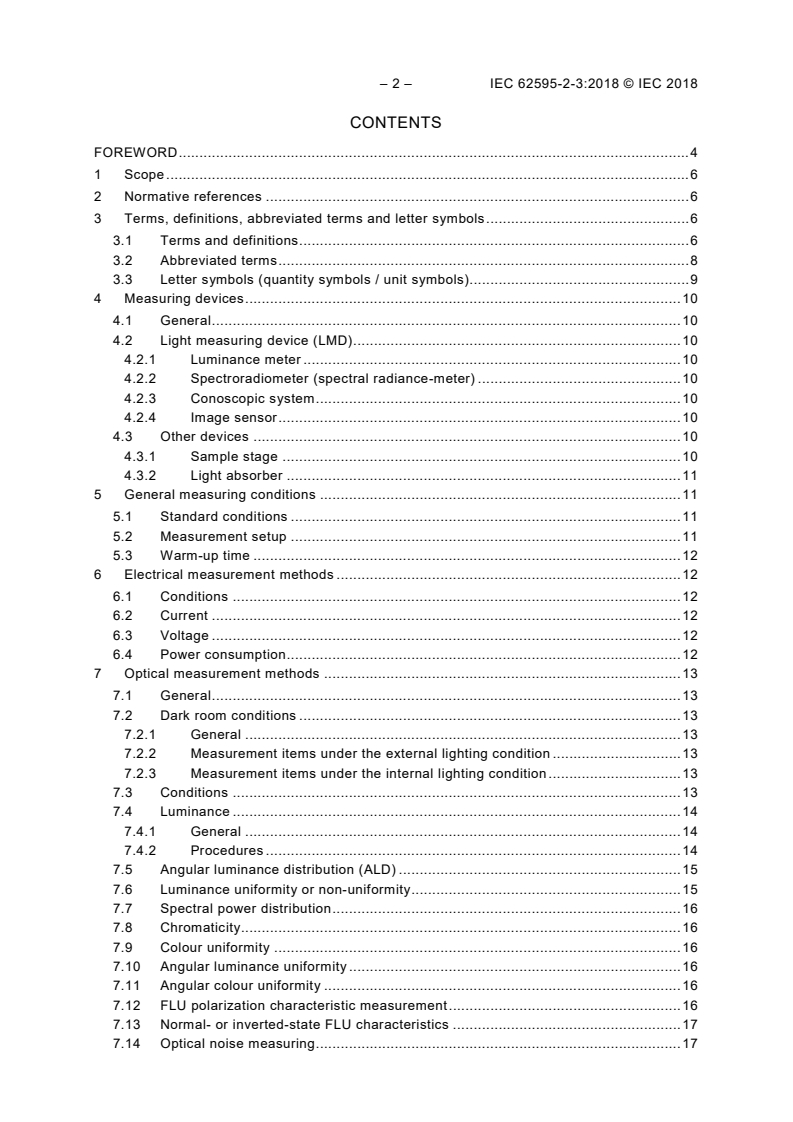
– 2 – IEC 62595-2-3:2018 © IEC 2018
CONTENTS
FOREWORD . 4
1 Scope . 6
2 Normative references . 6
3 Terms, definitions, abbreviated terms and letter symbols . 6
3.1 Terms and definitions . 6
3.2 Abbreviated terms . 8
3.3 Letter symbols (quantity symbols / unit symbols). 9
4 Measuring devices . 10
4.1 General . 10
4.2 Light measuring device (LMD) . 10
4.2.1 Luminance meter . 10
4.2.2 Spectroradiometer (spectral radiance-meter) . 10
4.2.3 Conoscopic system . 10
4.2.4 Image sensor . 10
4.3 Other devices . 10
4.3.1 Sample stage . 10
4.3.2 Light absorber . 11
5 General measuring conditions . 11
5.1 Standard conditions . 11
5.2 Measurement setup . 11
5.3 Warm-up time . 12
6 Electrical measurement methods . 12
6.1 Conditions . 12
6.2 Current . 12
6.3 Voltage . 12
6.4 Power consumption . 12
7 Optical measurement methods . 13
7.1 General . 13
7.2 Dark room conditions . 13
7.2.1 General . 13
7.2.2 Measurement items under the external lighting condition . 13
7.2.3 Measurement items under the internal lighting condition . 13
7.3 Conditions . 13
7.4 Luminance . 14
7.4.1 General . 14
7.4.2 Procedures . 14
7.5 Angular luminance distribution (ALD) . 15
7.6 Luminance uniformity or non-uniformity . 15
7.7 Spectral power distribution . 16
7.8 Chromaticity . 16
7.9 Colour uniformity . 16
7.10 Angular luminance uniformity . 16
7.11 Angular colour uniformity . 16
7.12 FLU polarization characteristic measurement . 16
7.13 Normal- or inverted-state FLU characteristics . 17
7.14 Optical noise measuring . 17
7.15 Cosmetic quality or perceptual visual quality . 17
Annex A (informative) Optical structure of an FLU. 19
Annex B (informative) Normal-state FLU and inverted-state FLU . 20
Annex C (informative) Angular measurement system . 21
Annex D (informative) Measurement parameters for BRDF and BTDF. 22
D.1 BRDF . 22
D.2 BTDF . 22
Annex E (informative) Determining the polarization state of reflected light on the front
surface of an FLU or transmitted light through the FLU . 24
Annex F (informative) Optical transfer function (OTF) of an FLU . 25
F.1 Optical transfer function evaluation chart . 25
F.2 Example of optical transfer function . 25
Annex G (informative) Sources of optical noise in a normal-state FLU with a reflective
display . 27
Annex H (informative) Formulation of contrast ratio for a reflective display with an
integrated FLU . 28
H.1 Contrast ratio for a reflective display without FLU integration . 28
H.2 Contrast ratio for a reflective display with FLU integration . 28
Annex I (informative) Example of optical noise of an FLU . 29
Bibliography . 30
Figure 1 – Example of light absorber (optical trap) . 11
Figure 2 – Example of measurement setup for a LED FLU . 12
Figure 3 – Illustration of zenith angle θ and azimuth angle ϕ (normal-state FLU) . 14
Figure 4 – Polar coordinate system for frontlight unit measurement . 15
Figure 5 – Example of light polarizing characteristics of an FLU in inverted state . 17
Figure A.1 – Direct edge-lit FLU and indirect edge-lit FLU. 19
Figure B.1 – Normal-state FLU . 20
Figure B.2 – Inverted-state FLU . 20
Figure C.1 –Standard goniometric system . 21
Figure C.2 – Conoscopic system . 21
Figure D.1 – System for measuring the BRDF . 22
Figure D.2 – Measuring the BRDF of an LGP for an FLU . 22
Figure D.3 – System for measuring the BTDF . 23
Figure E.1 – Geometry of a reflected or transmitted polarized light . 24
Figure F.1 – Printed charts on photographic paper for measuring the OTF of the FLU . 25
Figure F.2 – Example of OTF . 26
Figure G.1 – Light rays of an FLU with a reflective LC display . 27
Figure G.2 – Sources of noises in a normal-state FLU with a reflective display . 27
Figure I.1 – Optical signal and noise in a normal-state FLU . 29
Table 1 – Letter symbols (quantity symbols / unit symbols) . 9
– 4 – IEC 62595-2-3:2018 © IEC 2018
INTERNATIONAL ELECTROTECHNICAL COMMISSION
____________
DISPLAY LIGHTING UNIT –
Part 2-3: Electro-optical measuring methods for LED frontlight unit
FOREWORD
1) The International Electrotechnical Commission (IEC) is a worldwide organization for standardization comprising
all national electrotechnical committees (IEC National Committees). The object of IEC is to promote
international co-operation on all questions concerning standardization in the electrical and electronic fields. To
this end and in addition to other activities, IEC publishes International Standards, Technical Specifications,
Technical Reports, Publicly Available Specifications (PAS) and Guides (hereafter referred to as “IEC
Publication(s)”). Their preparation is entrusted to technical committees; any IEC National Committee interested
in the subject dealt with may participate in this preparatory work. International, governmental and
non-governmental organizations liaising with the IEC also participate in this preparation. IEC collaborates
closely with the International Organization for Standardization (ISO) in accordance with conditions determined
by agreement between the two organizations.
2) The formal decisions or agreements of IEC on technical matters express, as nearly as possible, an international
consensus of opinion on the relevant subjects since each technical committee has representation from all
interested IEC National Committees.
3) IEC Publications have the form of recommendations for international use and are accepted by IEC National
Committees in that sense. While all reasonable efforts are made to ensure that the technical content of IEC
Publications is accurate, IEC cannot be held responsible for the way in which they are used or for any
misinterpretation by any end user.
4) In order to promote international uniformity, IEC National Committees undertake to apply IEC Publications
transparently to the maximum extent possible in their national and regional publications. Any divergence
between any IEC Publication and the corresponding national or regional publication shall be clearly indicated in
the latter.
5) IEC itself does not provide any attestation of conformity. Independent certification bodies provide conformity
assessment services and, in some areas, access to IEC marks of conformity. IEC is not responsible for any
services carried out by independent certification bodies.
6) All users should ensure that they have the latest edition of this publication.
7) No liability shall attach to IEC or its directors, employees, servants or agents including individual experts and
members of its technical committees and IEC National Committees for any personal injury, property damage or
other damage of any nature whatsoever, whether direct or indirect, or for costs (including legal fees) and
expenses arising out of the publication, use of, or reliance upon, this IEC Publication or any other IEC
Publications.
8) Attention is drawn to the Normative references cited in this publication. Use of the referenced publications is
indispensable for the correct application of this publication.
9) Attention is drawn to the possibility that some of the elements of this IEC Publication may be the subject of
patent rights. IEC shall not be held responsible for identifying any or all such patent rights.
International Standard IEC 62595-2-3 has been prepared by IEC technical committee TC 110:
Electronic display devices.
The text of this International Standard is based on the following documents:
CDV Report on voting
110/891/CDV 110/933A/RVC
Full information on the voting for the approval of this International Standard can be found in
the report on voting indicated in the above table.
This document has been drafted in accordance with the ISO/IEC Directives, Part 2.
A list of all parts in the IEC 62595 series, published under the general title Display lighting
unit, can be found on the IEC website.
Future standards in this series will carry the new general title as cited above. Titles of existing
standards in this series will be updated at the time of the next edition.
The committee has decided that the contents of this document will remain unchanged until the
stability date indicated on the IEC website under "http://webstore.iec.ch" in the data related to
the specific document. At this date, the document will be
• reconfirmed,
• withdrawn,
• replaced by a revised edition, or
• amended.
A bilingual version of this publication may be issued at a later date.
– 6 – IEC 62595-2-3:2018 © IEC 2018
DISPLAY LIGHTING UNIT –
Part 2-3: Electro-optical measuring methods for LED frontlight unit
1 Scope
This part of IEC 62595 specifies the standard measurement conditions and measuring
methods for determining electrical, optical, and electro-optical properties of LED frontlight
units (FLUs) for reflective displays.
NOTE: See 3.1.1 for a definition of reflective display.
2 Normative references
The following documents are referred to in the text in such a way that some or all of their
content constitutes requirements of this document. For dated references, only the edition
cited applies. For undated references, the latest edition of the referenced document (including
any amendments) applies.
IEC 61747-6-2, Liquid crystal display devices – Part 6-2: Measuring methods for liquid crystal
display modules – Reflective type
IEC 62595-1-2, Display lighting unit – Part 1-2: Terminology and letter symbols
IEC 62595-2-1, Display lighting unit – Part 2-1: Electro-optical measuring methods of LED
backlight unit
IEC 62679-3-3, Electronic paper displays – Part 3-3: Optical measuring methods for displays
with integrated lighting units
3 Terms, definitions, abbreviated terms and letter symbols
For the purposes of this document, the terms, definitions, abbreviated terms and letter
symbols given in IEC 62595-1-2 and the following apply.
ISO and IEC maintain terminological databases for use in standardization at the following
addresses:
• IEC Electropedia: available at http://www.electropedia.org/
• ISO Online browsing platform: available at http://www.iso.org/obp
3.1 Terms and definitions
3.1.1
reflective display
display whose function is based on the light reflection of a reflective layer in its structure
EXAMPLE A reflective LCD, an electronic paper display, a micro electro-mechanical system (MEMS) and a micro
electro-opto-mechanical system (MEOMS) display device. See IEC 62679-3-3.
3.1.2
normal state
normal-state FLU
state of an FLU in which the light emerges from its front surface that faces toward the
reflective display
Note 1 to entry: For an example, see Annex A, Annex B, Figure A.1 and Figure B.1, [1] to [8] .
3.1.3
inverted state
inverted-state FLU
FLU with an illuminating surface toward a viewer
Note 1 to entry: For an example, see Figure B.2.
3.1.4
optical trap
optical device that is used in FLU measurements for trapping or absorbing the emergent light
from the opposite surface of the FLU under measurement device, whether the FLU is in a
normal state or in inverted state
Note 1 to entry: For examples, see Figure 1.
3.1.5
optical absorbing sheet
optical absorbing plate
plane sheet or plate that is used beneath an FLU under measurement to absorb the emergent
light
3.1.6
BRDF
bi-directional reflectance distribution function
variation of reflected luminance (L (θ ,φ θ ,φ ,λ )) due to the change of non-polarized
vR r r; i i i
illumination (E (θ ,φ ,λ )) of an infinitesimal uniform area on an FLU
v i i i
Note 1 to entry: See Annex C and Annex D. In case of an equal reflection factor of the FLU surface, the BRDF is
a space invariant characteristic, and the eigen value of the FLU is expressed in solid angle (Ω) unit, i.e., in terms of
steradian.
3.1.7
BTDF
bi-directional transmittance distribution function
variation of transmitted luminance (L (θ ,φ θ ,φ ,λ )) due to non-polarized illuminating
vT r r; i i i
variation (E (θ ,φ ,λ )) of an infinitesimal area on an FLU
v i i i
Note 1 to entry: See Annex C and Annex D. In case of an equal transmittance factor on each point of the FLU
surface, the BTDF is a space invariant characteristic, and the eigen value of the BRDF of the FLU is expressed in
solid angle (Ω) unit, i.e., in terms of steradian.
3.1.8
BPDF
bi-directional polarization distribution function
variation of luminance with polarization of the reflected light (L (θ ,φ θ ,φ ,λ )) due to a
vP r r; i i i
change of non-polarized illumination (E (θ ,φ ,λ )) of an infinitesimal uniform area on an FLU
v i i i
Note 1 to entry: See Annex C, Annex D and Annex E. In case of an equal reflection factor on each point of the
FLU surface, the BPDF is a space invariant characteristic, and the eigen value of the BTDF of the FLU is
expressed in solid angle (Ω) unit, i.e., in terms of steradian.
___________
Numbers in square brackets refer to the Bibliography.
– 8 – IEC 62595-2-3:2018 © IEC 2018
3.1.9
OTF
optical transfer function
contrast of transmitted line pairs through an FLU versus line pairs periodicities and
orientations
Note 1 to entry: See Annex F.
3.1.10
optical transfer function evaluation chart
OTF evaluation chart
printed charts of straight black and white line pairs with different widths (line pairs per
millimeter) and periodicities for use beneath a normal-state FLU to measure and plot the
observed light intensity versus line pairs per millimeter
Note 1 to entry: An example of the resolution test chart can be obtained based on ISO 12233 [9].
Note 2 to entry: See Annex F.
3.1.11
optical signal-to-noise ratio
optical SNR
ratio of the luminance of the illuminating directed light, L (x ,y , θ ,φ), toward the
v,signal i i j j
reflective display in a predefined direction in the spherical coordinate system, (θ, φ), and the
(x ,y ,θ ,φ ), i.e. besides the directed illuminating light, expressed
luminance of noise, L
v,noise i i j j
as
L (x , y ,θ ,φ)
v,signal i i j j
SNR= (1)
L (x , y ,θ ,φ)
v,noise i i j j
3.1.12
aliasing interference fringe
moiré pattern
periodic interference pattern that appears between the spatial distribution of the sub-micro or
micro-optical structures on the front surface (non-illuminating surface) of a normal-state FLU
and the spatial pixel structure of the reflective display
Note 1 to entry: See [1] to [8].
3.1.13
visual inspection
act of checking defects such as distraction of the transparency caused by flaws in the
LGP/LGF of the non-lit FLU or scratches on either side of an FLU that can been seen under
high white illumination by turning over in various directions
3.1.14
perceptual visual quality
cosmetic quality
image fidelity performance of the lit FLU when the images of the reflective display are viewed
through the FLU
Note 1 to entry: It is also the performance of a normal-state FLU in an integration or in combination with a
reflective display that indicates the no-distraction of a displayed image.
Note 2 to entry: See 7.15.
3.2 Abbreviated terms
ACU - angular colour uniformity
ALD - angular luminance distribution
BPDF - bi-directional polarization distribution function
BRDF - bi-directional reflectance distribution function
BTDF - bi-directional transmittance distribution function
CCD – charge coupled device
CMOS - complementary metal oxide semiconductor
DUT - device under test
FLU - frontlight unit
FOS - front-of-screen
LCD - liquid crystal display
LED - light emitting diode
lp - line pairs
LGF - light-guide film
LGP - light-guide plate
LMD - light measuring device
OTF - optical transfer function
SLG - stick-light guide
3.3 Letter symbols (quantity symbols / unit symbols)
The letter symbols for FLUs are shown in Table 1.
Table 1 – Letter symbols (quantity symbols / unit symbols)
Arbitrary luminance of a point (x , y ) on an
i i
L (cd/m )
vi
FLU
Maximum luminance on an FLU L (cd/m )
vM
Minimum luminance on an FLU L (cd/m )
vm
Average luminance on an FLU L (cd/m )
va
L (cd/m )
Centre luminance on FLU
vc
Spatial luminance uniformity U (%)
Spatial luminance non-uniformity NU (%)
Angular luminance in an arbitrary direction L (x, y; θ,φ) (cd/m )
v
Solid angle
Ω (sr)
Colour uniformity
∆u’v’
(chromaticity difference)
Spectral power distribution of a display
S (λ)
FLU
lighting unit
Angular luminance distribution of transmitted
L (x ,y ,θ,φ) (cd/m )
vT i i
light at an arbitrary point (x ,y )
i i
Angular luminance distribution of reflected
L (x ,y ,θ,φ) (cd/m )
vR i i
light at an arbitrary point (x ,y )
i i
Angular luminance distribution of a polarized
L (x ,y ,θ,φ) (cd/m )
vP i i
light at an arbitrary point (x ,y )
i i
Angular colour uniformity ∆u’v’(θ,φ;x ,y ,)
i i
BRDF L (θ ,φ ;θ ,φ ,λ ) / E (θ ,φ ,λ ) (1/sr)
vR r r i i i v i i i
BTDF L (θ ,φ ;θ ,φ ,λ ) / E (θ ,φ ,λ ) (1/sr)
vT r r i i i v i i i
BPDF L (θ ,φ ;θ ,φ ,λ ) / E (θ ,φ ,λ ) (1/sr)
vP r r i i i v i i i
OTF C
R
– 10 – IEC 62595-2-3:2018 © IEC 2018
4 Measuring devices
4.1 General
The following measuring devices shall be used in this document. The LMD shall be calibrated
with the appropriate photometric or spectrometric standards.
4.2 Light measuring device (LMD)
4.2.1 Luminance meter
The luminance meter (a spot meter or an imaging meter) shall be equivalent to the human eye.
The equipment shall be calibrated with the luminance standards, and should be carefully
checked before measurement, considering the following elements:
– sensitivity of the measured quantity to measuring light;
– errors caused by veiling glare and lens flare (i.e., stray light in optical system);
– timing of data-acquisition, low-pass filtering and aliasing interference fringe effects;
– linearity of detection and data-conversion.
NOTE: ISO/CIE 19476 [10] is available asreference for the LMD evaluation procedures.
4.2.2 Spectroradiometer (spectral radiance-meter)
The wavelength range shall be at least 380 nm to 780 nm and the spectral bandwidth shall be
5 nm or less. The wavelength accuracy shall be 0,3 nm or less. The equipment shall be
calibrated with the with the spectrometric standards. The performance should be carefully
checked before measurement, considering the same elements as in 4.2.1.
4.2.3 Conoscopic system
The conoscopic system is the angular optical distribution measurement system with Fourier
optics. The photometric values, such as luminance, which are obtained by the equipment
without any photometric standard calibration shall not be used. The relative values, such as
an angular optical distribution and colour uniformity, shall be applied.
4.2.4 Image sensor
The image sensor is constructed from a one-dimensional CCD (CMOS) line sensor or a
two-dimensional CCD (CMOS). The image sensor shall be applied for measuring the OTF
property of the DUT. The spatial resolution of the image sensor shall be at least twice as high
as that of the DUT.
NOTE Sampling frequency or resolution is double or more that of the chart under measurement to prevent the
aliasing interference fringe phenomenon or any countermeasure from eliminating aliasing interference fringe in the
measurement.
4.3 Other devices
4.3.1 Sample stage
The orthogonal three axes stage should be used to adjust the measurement points of the DUT.
The biaxial goniometer should be used to adjust the measurement direction (the zenith angle
and azimuth angle) of the DUT. The positioning accuracy of these devices shall be enough to
make the specified repeatability.
NOTE See Figure 2 and Figure 3.
4.3.2 Light absorber
The light absorber shall be an optical trap (Figure 1), an optical absorbing sheet or an optical
absorbing plate. The reflection of the light absorber shall have a reflection factor as low as
possible (less than 12 %) in all optical measurements including reflection, transmission and
polarization. The light acceptance area of the li
...