

IEC 60939-1:2010
(Main)Passive filter units for electromagnetic interference suppression - Part 1: Generic specification
General Information
- Abstract
IEC 60939-1:2010 relates to passive filter units for electromagnetic interference suppression for use within, or associated with, electronic or electrical equipment and machines. Both single and multi-channel filters within one enclosure are included within the scope of this generic specification. This generic specification establishes standard terms, inspection procedures and methods of test for use in sectional and detail specifications within the IECQ-CECC system for electronic components. This edition includes the following significant technical changes with respect to the previous edition:
a) table 3 has been updated, specifying how to handle the Neutral by 3-phase filter with Neutral;
b) all details about "Quality assessment" have been deleted in this edition, because this standard is a safety standard;
c) filters shall be subjected to Test Aa of IEC 60068-2-1 for 16 h, using the degree of severity of the lower category temperature as prescribed in the relevant specification;
d) since IEC 60068-2-20 does no longer make a difference between Method 1A and 1B, but only describes Method 1, references to the method to be used are updated.
- Status
- Published
- Publication Date
- 28-Jul-2010
- Technical Committee
- TC 40 - Capacitors and resistors for electronic equipment
- Current Stage
- PPUB - Publication issued
- Start Date
- 29-Jul-2010
- Completion Date
- 31-Aug-2010
Overview
IEC 60939-1:2010 is an international standard developed by the International Electrotechnical Commission (IEC) that defines generic specifications for passive filter units designed for electromagnetic interference (EMI) suppression. These filters are critical components used within or in association with electronic and electrical equipment and machinery to reduce interference caused by electromagnetic disturbances. The standard covers both single and multi-channel passive filters housed in a single enclosure.
The 2010 edition introduces significant updates such as refined test methods and procedures, including the handling of the neutral conductor in three-phase filters, and eliminates quality assessment details to focus on safety. It aligns test procedures with related IEC standards like IEC 60068 series for environmental testing and specifies rigorous inspection and testing protocols.
Key Topics
Scope and application: The standard applies to passive EMI suppression filters used in electronic and electrical systems, emphasizing single and multi-channel units.
Technical definitions and terminology: Clear, standardized terms and symbols ensure uniform understanding and specification of filter characteristics.
Test and measurement procedures: The document outlines comprehensive methods for evaluating filter performance, including:
- Visual inspection and dimensional checks
- Insulation resistance and voltage proof tests (both AC and DC)
- Mechanical robustness (tensile, bending, torsion, and torque tests)
- Resistance to environmental stresses such as soldering heat, temperature changes, vibration, and humidity
- Climatic sequence testing to verify filter durability under varied conditions
Safety and reliability: Emphasizing safety, the standard mandates testing in accordance with IEC safety norms and removes prior quality assessment clauses to align with safety-critical applications.
Marking and coding: Requirements for clear marking and coding on filter units to facilitate identification and compliance verification.
Applications
Passive filter units complying with IEC 60939-1:2010 are widely used across industries where electromagnetic interference could impact equipment functionality or safety. Typical applications include:
Industrial machinery and automation: Protecting control circuits from EMI that could cause malfunctions or downtime.
Consumer electronics: Ensuring devices meet regulatory requirements for electromagnetic compatibility and do not interfere with other equipment.
Medical equipment: Maintaining the operational integrity of sensitive diagnostics and therapeutic devices.
Renewable energy systems: Suppressing interference in inverters and power converters used in solar or wind energy applications.
Telecommunications: Guaranteeing clear signal transmission without noise introduced by EMI.
Adhering to this standard supports manufacturers and engineers in designing reliable, compliant, and durable passive EMI filters for diverse electronic environments.
Related Standards
IEC 60939-1:2010 references and coordinates with several other important international standards, including:
IEC 60068 series – Environmental testing procedures covering climatic, mechanical, and thermal stress tests relevant to filter durability.
IEC 60939-2 – Sectional and detail specifications for various types of passive EMI filters, building upon the generic specifications.
IEC Q/CECC system – Quality and conformity assessment framework for electronic components.
Other IEC Electrotechnical Vocabulary publications (Electropedia) – Ensures consistent definitions and interpretation of electrical and electronic terms related to EMI and filters.
Utilizing IEC 60939-1 alongside these standards helps achieve comprehensive compliance, product safety, and performance in electromagnetic interference suppression.
By implementing IEC 60939-1:2010 guidelines, organizations can develop and certify passive EMI filters that effectively reduce interference, meet international safety norms, and maintain high reliability in demanding electrical and electronic environments. This standard plays a crucial role in advancing electromagnetic compatibility (EMC) and ensuring the smooth operation of modern technology systems.
Relations
- Effective Date
- 05-Sep-2023
- Effective Date
- 05-Sep-2023
Frequently Asked Questions
IEC 60939-1:2010 is a standard published by the International Electrotechnical Commission (IEC). Its full title is "Passive filter units for electromagnetic interference suppression - Part 1: Generic specification". This standard covers: IEC 60939-1:2010 relates to passive filter units for electromagnetic interference suppression for use within, or associated with, electronic or electrical equipment and machines. Both single and multi-channel filters within one enclosure are included within the scope of this generic specification. This generic specification establishes standard terms, inspection procedures and methods of test for use in sectional and detail specifications within the IECQ-CECC system for electronic components. This edition includes the following significant technical changes with respect to the previous edition: a) table 3 has been updated, specifying how to handle the Neutral by 3-phase filter with Neutral; b) all details about "Quality assessment" have been deleted in this edition, because this standard is a safety standard; c) filters shall be subjected to Test Aa of IEC 60068-2-1 for 16 h, using the degree of severity of the lower category temperature as prescribed in the relevant specification; d) since IEC 60068-2-20 does no longer make a difference between Method 1A and 1B, but only describes Method 1, references to the method to be used are updated.
IEC 60939-1:2010 relates to passive filter units for electromagnetic interference suppression for use within, or associated with, electronic or electrical equipment and machines. Both single and multi-channel filters within one enclosure are included within the scope of this generic specification. This generic specification establishes standard terms, inspection procedures and methods of test for use in sectional and detail specifications within the IECQ-CECC system for electronic components. This edition includes the following significant technical changes with respect to the previous edition: a) table 3 has been updated, specifying how to handle the Neutral by 3-phase filter with Neutral; b) all details about "Quality assessment" have been deleted in this edition, because this standard is a safety standard; c) filters shall be subjected to Test Aa of IEC 60068-2-1 for 16 h, using the degree of severity of the lower category temperature as prescribed in the relevant specification; d) since IEC 60068-2-20 does no longer make a difference between Method 1A and 1B, but only describes Method 1, references to the method to be used are updated.
IEC 60939-1:2010 is classified under the following ICS (International Classification for Standards) categories: 31.160 - Electric filters. The ICS classification helps identify the subject area and facilitates finding related standards.
IEC 60939-1:2010 has the following relationships with other standards: It is inter standard links to IEC 60939-1:2005/COR1:2005, IEC 60939-1:2005. Understanding these relationships helps ensure you are using the most current and applicable version of the standard.
IEC 60939-1:2010 is available in PDF format for immediate download after purchase. The document can be added to your cart and obtained through the secure checkout process. Digital delivery ensures instant access to the complete standard document.
Standards Content (Sample)
IEC 60939-1 ®
Edition 3.0 2010-07
INTERNATIONAL
STANDARD
NORME
INTERNATIONALE
Passive filter units for electromagnetic interference suppression –
Part 1: Generic specification
Filtres passifs d’antiparasitage –
Partie 1: Spécification générique
All rights reserved. Unless otherwise specified, no part of this publication may be reproduced or utilized in any form or by
any means, electronic or mechanical, including photocopying and microfilm, without permission in writing from either IEC or
IEC's member National Committee in the country of the requester.
If you have any questions about IEC copyright or have an enquiry about obtaining additional rights to this publication,
please contact the address below or your local IEC member National Committee for further information.
Droits de reproduction réservés. Sauf indication contraire, aucune partie de cette publication ne peut être reproduite
ni utilisée sous quelque forme que ce soit et par aucun procédé, électronique ou mécanique, y compris la photocopie
et les microfilms, sans l'accord écrit de la CEI ou du Comité national de la CEI du pays du demandeur.
Si vous avez des questions sur le copyright de la CEI ou si vous désirez obtenir des droits supplémentaires sur cette
publication, utilisez les coordonnées ci-après ou contactez le Comité national de la CEI de votre pays de résidence.
IEC Central Office
3, rue de Varembé
CH-1211 Geneva 20
Switzerland
Email: inmail@iec.ch
Web: www.iec.ch
About the IEC
The International Electrotechnical Commission (IEC) is the leading global organization that prepares and publishes
International Standards for all electrical, electronic and related technologies.
About IEC publications
The technical content of IEC publications is kept under constant review by the IEC. Please make sure that you have the
latest edition, a corrigenda or an amendment might have been published.
ƒ Catalogue of IEC publications: www.iec.ch/searchpub
The IEC on-line Catalogue enables you to search by a variety of criteria (reference number, text, technical committee,…).
It also gives information on projects, withdrawn and replaced publications.
ƒ IEC Just Published: www.iec.ch/online_news/justpub
Stay up to date on all new IEC publications. Just Published details twice a month all new publications released. Available
on-line and also by email.
ƒ Electropedia: www.electropedia.org
The world's leading online dictionary of electronic and electrical terms containing more than 20 000 terms and definitions
in English and French, with equivalent terms in additional languages. Also known as the International Electrotechnical
Vocabulary online.
ƒ Customer Service Centre: www.iec.ch/webstore/custserv
If you wish to give us your feedback on this publication or need further assistance, please visit the Customer Service
Centre FAQ or contact us:
Email: csc@iec.ch
Tel.: +41 22 919 02 11
Fax: +41 22 919 03 00
A propos de la CEI
La Commission Electrotechnique Internationale (CEI) est la première organisation mondiale qui élabore et publie des
normes internationales pour tout ce qui a trait à l'électricité, à l'électronique et aux technologies apparentées.
A propos des publications CEI
Le contenu technique des publications de la CEI est constamment revu. Veuillez vous assurer que vous possédez
l’édition la plus récente, un corrigendum ou amendement peut avoir été publié.
ƒ Catalogue des publications de la CEI: www.iec.ch/searchpub/cur_fut-f.htm
Le Catalogue en-ligne de la CEI vous permet d’effectuer des recherches en utilisant différents critères (numéro de référence,
texte, comité d’études,…). Il donne aussi des informations sur les projets et les publications retirées ou remplacées.
ƒ Just Published CEI: www.iec.ch/online_news/justpub
Restez informé sur les nouvelles publications de la CEI. Just Published détaille deux fois par mois les nouvelles
publications parues. Disponible en-ligne et aussi par email.
ƒ Electropedia: www.electropedia.org
Le premier dictionnaire en ligne au monde de termes électroniques et électriques. Il contient plus de 20 000 termes et
définitions en anglais et en français, ainsi que les termes équivalents dans les langues additionnelles. Egalement appelé
Vocabulaire Electrotechnique International en ligne.
ƒ Service Clients: www.iec.ch/webstore/custserv/custserv_entry-f.htm
Si vous désirez nous donner des commentaires sur cette publication ou si vous avez des questions, visitez le FAQ du
Service clients ou contactez-nous:
Email: csc@iec.ch
Tél.: +41 22 919 02 11
Fax: +41 22 919 03 00
IEC 60939-1 ®
Edition 3.0 2010-07
INTERNATIONAL
STANDARD
NORME
INTERNATIONALE
Passive filter units for electromagnetic interference suppression –
Part 1: Generic specification
Filtres passifs d’antiparasitage –
Partie 1: Spécification générique
INTERNATIONAL
ELECTROTECHNICAL
COMMISSION
COMMISSION
ELECTROTECHNIQUE
PRICE CODE
INTERNATIONALE
V
CODE PRIX
ICS 31.160 ISBN 978-2-88912-102-1
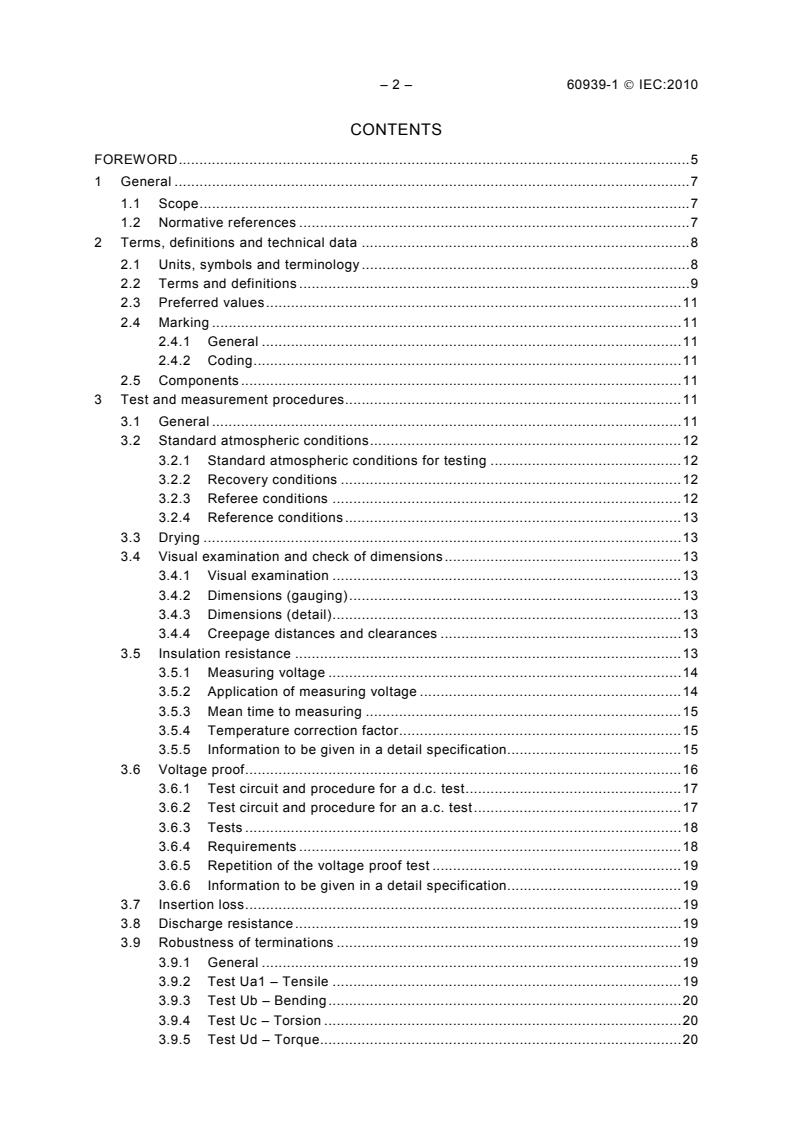
– 2 – 60939-1 © IEC:2010
CONTENTS
FOREWORD.5
1 General .7
1.1 Scope.7
1.2 Normative references .7
2 Terms, definitions and technical data .8
2.1 Units, symbols and terminology .8
2.2 Terms and definitions .9
2.3 Preferred values.11
2.4 Marking .11
2.4.1 General .11
2.4.2 Coding.11
2.5 Components .11
3 Test and measurement procedures.11
3.1 General .11
3.2 Standard atmospheric conditions.12
3.2.1 Standard atmospheric conditions for testing .12
3.2.2 Recovery conditions .12
3.2.3 Referee conditions .12
3.2.4 Reference conditions.13
3.3 Drying .13
3.4 Visual examination and check of dimensions.13
3.4.1 Visual examination .13
3.4.2 Dimensions (gauging).13
3.4.3 Dimensions (detail).13
3.4.4 Creepage distances and clearances .13
3.5 Insulation resistance .13
3.5.1 Measuring voltage .14
3.5.2 Application of measuring voltage .14
3.5.3 Mean time to measuring .15
3.5.4 Temperature correction factor.15
3.5.5 Information to be given in a detail specification.15
3.6 Voltage proof.16
3.6.1 Test circuit and procedure for a d.c. test.17
3.6.2 Test circuit and procedure for an a.c. test.17
3.6.3 Tests .18
3.6.4 Requirements .18
3.6.5 Repetition of the voltage proof test .19
3.6.6 Information to be given in a detail specification.19
3.7 Insertion loss.19
3.8 Discharge resistance.19
3.9 Robustness of terminations .19
3.9.1 General .19
3.9.2 Test Ua1 – Tensile .19
3.9.3 Test Ub – Bending.20
3.9.4 Test Uc – Torsion .20
3.9.5 Test Ud – Torque.20
60939-1 © IEC:2010 – 3 –
3.9.6 Visual examination .20
3.10 Resistance to soldering heat .21
3.10.1 Applicability of the test .21
3.10.2 The measurements prescribed in the relevant specification shall be
made .21
3.10.3 The filters shall undergo Test Tb of IEC 60068-2-20 with the
following requirements:.21
3.10.4 When the test has been carried out, the filters shall be visually
examined.21
3.11 Solderability .21
3.11.1 Applicability of the test .21
3.12 Rapid change of temperature .22
3.12.1 The measurement prescribed in the relevant specification shall be
made .22
3.12.2 The filters shall be subjected to Test Na of IEC 60068-2-14 using the
degree of severity as prescribed in the relevant specification .22
3.12.3 After recovery, the filters shall be visually examined. There shall be
no visible damage.22
3.13 Vibration.22
3.14 Bump .22
3.15 Shock.22
3.16 Container sealing .23
3.17 Climatic sequence .23
3.17.1 Initial measurements .23
3.17.2 Dry heat .23
3.17.3 Damp heat, cyclic, first cycle .23
3.17.4 Cold .23
3.17.5 Low air pressure.23
3.17.6 Damp heat, cyclic, remaining cycles .24
3.17.7 Final measurements .24
3.18 Damp heat, steady state.24
3.19 Temperature rise.24
3.20 Current overload .25
3.21 Endurance.25
3.22 Charge and discharge test.25
3.22.4 The following information shall be given in the relevant specification:.27
3.23 Passive flammability.27
3.24 Active flammability .28
3.25 Solvent resistance of marking.28
3.26 Component solvent resistance.29
3.26.1 Initial measurements .29
3.27 Leakage current .29
3.28 Impedance of protective conductor .29
Annex A (informative) Calculation of leakage current .30
Bibliography.34
Figure 1 – Asymmetrical and symmetrical test circuit .10
Figure 2 – Examples of the application of Table 3.16
Figure 3 – Test circuit for d.c. test .17
– 4 – 60939-1 © IEC:2010
Figure 4 – Relay circuit .26
Figure 5 – Thyristor circuit .26
Figure 6 – Voltage and current waveforms .27
Figure A.1 – Leakage current for 1-line filters .30
Figure A.2 – Leakage current for 2-line filters .31
Figure A.3 – Leakage current for 3-line filters .32
Figure A.4 – Leakage current for 4-line filters .33
Table 1 – Standard atmospheric conditions.12
Table 2 – DC voltage for insulation resistance .14
Table 3 – Measuring points.16
Table 4 – Force for wire terminations .20
Table 5 – Torque .20
Table 6 – Number of cycles .24
Table 7 – Categories of flammability .28
60939-1 © IEC:2010 – 5 –
INTERNATIONAL ELECTROTECHNICAL COMMISSION
____________
PASSIVE FILTER UNITS FOR ELECTROMAGNETIC
INTERFERENCE SUPPRESSION –
Part 1: Generic specification
FOREWORD
1) The International Electrotechnical Commission (IEC) is a worldwide organization for standardization comprising
all national electrotechnical committees (IEC National Committees). The object of IEC is to promote
international co-operation on all questions concerning standardization in the electrical and electronic fields. To
this end and in addition to other activities, IEC publishes International Standards, Technical Specifications,
Technical Reports, Publicly Available Specifications (PAS) and Guides (hereafter referred to as “IEC
Publication(s)”). Their preparation is entrusted to technical committees; any IEC National Committee interested
in the subject dealt with may participate in this preparatory work. International, governmental and non-
governmental organizations liaising with the IEC also participate in this preparation. IEC collaborates closely
with the International Organization for Standardization (ISO) in accordance with conditions determined by
agreement between the two organizations.
2) The formal decisions or agreements of IEC on technical matters express, as nearly as possible, an international
consensus of opinion on the relevant subjects since each technical committee has representation from all
interested IEC National Committees.
3) IEC Publications have the form of recommendations for international use and are accepted by IEC National
Committees in that sense. While all reasonable efforts are made to ensure that the technical content of IEC
Publications is accurate, IEC cannot be held responsible for the way in which they are used or for any
misinterpretation by any end user.
4) In order to promote international uniformity, IEC National Committees undertake to apply IEC Publications
transparently to the maximum extent possible in their national and regional publications. Any divergence
between any IEC Publication and the corresponding national or regional publication shall be clearly indicated in
the latter.
5) IEC itself does not provide any attestation of conformity. Independent certification bodies provide conformity
assessment services and, in some areas, access to IEC marks of conformity. IEC is not responsible for any
services carried out by independent certification bodies.
6) All users should ensure that they have the latest edition of this publication.
7) No liability shall attach to IEC or its directors, employees, servants or agents including individual experts and
members of its technical committees and IEC National Committees for any personal injury, property damage or
other damage of any nature whatsoever, whether direct or indirect, or for costs (including legal fees) and
expenses arising out of the publication, use of, or reliance upon, this IEC Publication or any other IEC
Publications.
8) Attention is drawn to the Normative references cited in this publication. Use of the referenced publications is
indispensable for the correct application of this publication.
9) Attention is drawn to the possibility that some of the elements of this IEC Publication may be the subject of
patent rights. IEC shall not be held responsible for identifying any or all such patent rights.
International Standard IEC 60939-1 has been prepared by IEC technical committee 40:
Capacitors and resistors for electronic equipment.
This third edition cancels and replaces the second edition published in 2005. It constitutes a
technical revision.
This edition includes the following significant technical changes with respect to the previous
edition:
a) table 3 has been updated, specifying how to handle the Neutral by 3-phase filter with
Neutral;
b) all details about “Quality assessment” have been deleted in this edition, because this
standard is a safety standard;
c) filters shall be subjected to Test Aa of IEC 60068-2-1 for 16 h, using the degree of severity
of the lower category temperature as prescribed in the relevant specification;
– 6 – 60939-1 © IEC:2010
d) since IEC 60068-2-20 does no longer make a difference between Method 1A and 1B, but
only describes Method 1, references to the method to be used are updated.
The text of this standard is based on the following documents:
FDIS Report on voting
40/2046/FDIS 40/2061/RVD
Full information on the voting for the approval of this standard can be found in the report on
voting indicated in the above table.
This publication has been drafted in accordance with the ISO/IEC Directives, Part 2.
A list of all parts of the IEC 60939 series, under the general title Passive filter units for
electromagnetic interference suppression, can be found on the IEC website.
The committee has decided that the contents of this publication will remain unchanged until
the stability date indicated on the IEC web site under "http://webstore.iec.ch" in the data
related to the specific publication. At this date, the publication will be
• reconfirmed,
• withdrawn,
• replaced by a revised edition, or
• amended.
60939-1 © IEC:2010 – 7 –
PASSIVE FILTER UNITS FOR ELECTROMAGNETIC
INTERFERENCE SUPPRESSION –
Part 1: Generic specification
1 General
1.1 Scope
This generic specification relates to passive filter units for electromagnetic interference sup-
pression for use within, or associated with, electronic or electrical equipment and machines.
Both single and multi-channel filters within one enclosure are included within the scope of this
generic specification.
Filters constructed of capacitive elements where the inductance is inherent in the construction
of the filter are within the scope of this specification. Similarly, filters constructed of inductive
elements where the capacitance is inherent in the construction of the filter are also within the
scope of this generic specification. The manufacturer should state whether a given component
is to be designed as a capacitor, an inductor or a filter.
The filter units within the scope of this generic specification are further distinguished as those
for which safety tests are appropriate (e.g. those connected to mains supplies) and those for
which such tests are not appropriate. A separate sectional specification covers the passive
filter units for which safety tests are appropriate.
This generic specification establishes standard terms, inspection procedures and methods of
test for use in sectional and detail specifications within the IECQ-CECC system for electronic
components.
1.2 Normative references
The following referenced documents are indispensable for the application of this document.
For dated references, only the edition cited applies. For undated references, the latest edition
of the referenced document (including any amendments) applies.
IEC 60027 (all parts), Letter symbols to be used in electrical technology
IEC 60050 (all parts), International Electrotechnical Vocabulary (IEV)
IEC 60062, Marking codes for resistors and capacitors
IEC 60068-1:1988, Environmental testing – Part 1: General and guidance
IEC 60068-2-1, Environmental testing – Part 2-1: Tests – Test A: Cold
IEC 60068-2-2, Environmental testing – Part 2-2: Tests – Test B: Dry Heat
IEC 60068-2-6, Environmental testing – Part 2-6: Tests – Test Fc: Vibration (sinusoidal)
IEC 60068-2-13, Environmental testing – Part 2-13: Tests – Test M: Low air pressure
IEC 60068-2-14, Environmental testing – Part 2-14: Tests – Test N: Change of temperature
– 8 – 60939-1 © IEC:2010
IEC 60068-2-17, Basic environmental testing procedures – Part 2-17: Tests – Test Q: Sealing
IEC 60068-2-20, Environmental testing – Part 2-20: Tests – Test T: Soldering
IEC 60068-2-21, Environmental testing – Part 2-21: Tests – Test U: Robustness of termina-
tions and integral mounting devices
IEC 60068-2-27, Environmental testing – Part 2-27: Tests – Test Ea and guidance: Shock
IEC 60068-2-29, Environmental testing – Part 2-29: Tests – Test Eb and guidance: Bump
IEC 60068-2-30:2005, Environmental testing – Part 2-30: Tests – Test Db: Damp heat, cyclic
(12 + 12 h cycle)
IEC 60068-2-45:1980, Basic environmental testing procedures – Part 2-45: Tests – Test XA
and guidance: Immersion in cleaning solvents
IEC 60068-2-78, Environmental testing – Part 2-78: Tests – Test Cab: Damp heat, steady
state
IEC 60085, Electrical insulation – Thermal evaluation and designation
IEC 60294, Measurement of the dimensions of a cylindrical component having two axial
terminations.
IEC 60384-14:2005, Fixed capacitors for use in electronic equipment – Part 14: Sectional
specification: Fixed capacitors for electromagnetic interference suppression and connection to
the supply mains
IEC 60410, Sampling plans and procedures for inspection by attributes
IEC 60695-11-5, Fire hazard testing – Part 11-5: Test flames – Needle-flame test method –
Apparatus, confirmatory test arrangement and guidance
CISPR 17, Methods of measurement of the suppression characteristics of passive radio
interference filters and suppression components
ISO 1000, SI units and recommendations for the use of their multiples and of certain other
units
2 Terms, definitions and technical data
2.1 Units, symbols and terminology
Units, graphical symbols, letter symbols and terminology shall, whenever possible, be taken
from the following publications:
– IEC 60027
– IEC 60050
– ISO 1000
When further items are required they shall be derived in accordance with the principles of the
publications listed above.
60939-1 © IEC:2010 – 9 –
2.2 Terms and definitions
For the purposes of the IEC 60939 series, the following terms and definitions apply.
2.2.1
type
group of components having similar design features, the similarity of their manufacturing
techniques enabling them to be grouped together either for qualification approval or for quality
conformance inspection, and generally covered by a single detail specification
NOTE Components described in several detail specifications may, in some cases, be considered as belonging to
the same type and may therefore be grouped together for approval and quality conformance inspection.
2.2.2
style
subdivision of a type, generally based on dimensional factors; a style may include several
variants, generally of a mechanical order
2.2.3
electromagnetic interference suppression filter unit (filter)
radio interference suppression filter unit
assembly of piece-parts and inductive, capacitive and resistive elements to be used for the
reduction of electromagnetic interference caused by electrical or electronic equipment, or
other sources
2.2.4
rated voltage
U
R
maximum r.m.s. operating voltage at rated frequency or the maximum d.c. operating voltage
which may be applied continuously to the terminations of the filter unit at any temperature
between the lower and the upper category temperatures
2.2.5
rated frequency
maximum frequency at which maximum r.m.s. operating voltage may be applied to
terminations of the filter
2.2.6
category voltage
U
C
maximum voltage which may be applied to a filter at its upper category temperature
2.2.7
lower category temperature
minimum ambient temperature for which the filter has been designed to operate continuously
2.2.8
upper category temperature
maximum ambient temperature for which the filter unit has been designed to operate
continuously
2.2.9
rated temperature
maximum ambient temperature at which a filter can carry its rated current
2.2.10
rated current
maximum r.m.s. operating current through input and output filter terminations at rated
frequency or maximum d.c. rating current which allows continuous operation of the filter at the
rated temperature, assigned by the manufacturer for one or both of the following conditions:
– 10 – 60939-1 © IEC:2010
a) free air (I );
RO
b) with a specified heat sink (I )
RH
2.2.11
rated capacitance
C
R
capacitance value of capacitive elements of the filter for which a filter has been designed and
which may be indicated upon it
2.2.12
rated inductance
L
R
inductance value for which the inductor has been designed and which may be indicated upon it
2.2.13
insertion loss
ratio of the voltage before and after the insertion of the filter in the circuit as measured at the
terminations either with a symmetrical or an asymmetrical test circuit
NOTE It is normally expressed in decibels, when the insertion loss is 20 times the logarithm to base 10 of this
ratio.
2.2.14
asymmetrical test circuit
test circuit in which the filter under test is connected as a 3-terminal network, one terminal of
which is connected to earth
NOTE The signal is applied between the input terminal and earth, and the output is measured between the output
terminal and earth. There is a common (earth) connection between generator, filter and receiver (see Figure 1).
2.2.15
symmetrical test circuit
test circuit in which the filter under test is connected as a 4-terminal network
NOTE 1 The test signal applied to the two input terminals symmetrically about earth, i.e. equal in magnitude but
of opposite phase on the two terminals (see Figure 1). The output is measured between the other two terminals.
NOTE 2 It is usual to perform symmetrical tests using an asymmetrical generator and receiver with suitable
balance-to-unbalance transformers connected between them and the filter under test.
Filter Filter
under under
R
test test
R
Asymmetrical test circuit Symmetrical test circuit
IEC 1882/10 IEC 1883/10
Figure 1 – Asymmetrical and symmetrical test circuit
2.2.16
visible damage
visible damage which reduces the usability of the filter for its intended purpose
2.2.17
passive flammability
ability of a filter to burn with a flame as a consequence of the application of an external
source of heat
60939-1 © IEC:2010 – 11 –
2.2.18
active flammability
ability of a filter to burn with a flame as a consequence of electrical loading
2.2.19
impedance of protective conductor
impedance of the protective conductor is the impedance measured between the conductor
input and the conductor output of the filter for a specified current overload
2.2.20
leakage current
I
LK
current at rated frequency flowing to earth or to an extraneous-conductive-part in a faultless
circuit. This current can have a capacitive component, especially caused by the use of
capacitors.
It is a theoretically calculated value for uniform indications, such as in catalogues. The
calculation is based on the provisions detailed in the Annex A.
The actual leakage current cannot be stated in the individual case.
NOTE Other leakage currents such as touch currents and protective conductor currents shall be determined
according to the relevant standard (e.g. IEC 60990).
2.3 Preferred values
Each sectional specification shall prescribe the preferred values appropriate to the subfamily
covered by that sectional specification.
2.4 Marking
2.4.1 General
The sectional specification shall indicate the identification criteria and other information to be
shown on the filters and the packing.
2.4.2 Coding
When coding is used for tolerance or date of manufacture, the method shall be selected from
those given in IEC 60062.
2.5 Components
Components other than inductors and capacitors in the filter unit shall fulfill requirements in
the relevant IEC standard.
3 Test and measurement procedures
3.1 General
The sectional and/or blank detail specification shall contain tables showing the tests to be
made, which measurements are to be made before and after each test or subgroup of tests,
and the sequence in which they shall be carried out. The stages of each test shall be carried
out in the order written. The measuring conditions shall be the same for initial and final
measurements.
If national specifications within any quality assessment system include methods other than
those specified in the above documents, they shall be fully described.
– 12 – 60939-1 © IEC:2010
3.2 Standard atmospheric conditions
3.2.1 Standard atmospheric conditions for testing
Unless otherwise specified, all tests and measurements shall be made under standard
atmospheric conditions for testing as given in 5.3 of IEC 60068-1:1988.
– temperature: 15 °C to 35 °C;
– relative humidity: 45 % to 75 %;
– air pressure: 86 kPa to 106 kPa.
Before the measurements are made, the filter shall be stored at the measuring temperature
for a time sufficient to allow the entire filter to reach this temperature. The period prescribed
for recovery at the end of a test is normally sufficient for this purpose.
When measurements are made at a temperature other than the specified temperature, the
results shall, where necessary, be corrected to the specified temperature. The ambient
temperature during the measurements shall be stated in the test report. In the event of a
dispute, the measurements shall be repeated, using one of the referee temperatures (as given
in 3.2.3) and such other conditions as are prescribed in this generic specification.
When tests are conducted in a sequence, the final measurements of one test may be taken as
the initial measurements for the succeeding test.
During measurements, the filter shall not be exposed to draughts, direct sunrays or other
influences likely to cause error.
3.2.2 Recovery conditions
Unless otherwise specified, recovery shall take place under the standard atmospheric
conditions for testing (see 3.2.1).
If recovery has to be made under closely controlled conditions, the controlled recovery
conditions of 5.4.1 of IEC 60068-1:1988 shall be used.
Unless otherwise specified in the relevant sectional or detail specification, a duration of 1 h to
2 h shall be used.
3.2.3 Referee conditions
For referee purposes, one of the standard atmospheric conditions for referee tests taken from
5.2 of IEC 60068-1:1988, as given in Table 1, shall be chosen.
Table 1 – Standard atmospheric conditions
Temperature Relative humidity Air pressure
°C % kPa
63 to 67 86 to 106
20 ± 1
48 to 52 86 to 106
23 ± 1
25 ± 1 48 to 52 86 to 106
63 to 67 86 to 106
27 ± 1
60939-1 © IEC:2010 – 13 –
3.2.4 Reference conditions
For reference purposes, the standard atmospheric conditions for reference given in 5.1 of
IEC 60068-1:1988 apply:
– temperature: 20 °C;
– air pressure: 101,3 kPa.
3.3 Drying
Unless otherwise specified in the relevant specification, the filter shall be conditioned for
(96 ± 4) h by heating in a circulating air oven at a temperature of (55 ± 2) °C and a relative
humidity not exceeding 20 %.
The filter shall then be allowed to cool in a desiccator using a suitable desiccant, such as
activated alumina or silica gel, and shall be kept therein from the time of removal from the
oven to the beginning of the specified tests.
3.4 Visual examination and check of dimensions
3.4.1 Visual examination
The condition, workmanship and finish shall be satisfactory, as checked by visual examination
(see 2.2.15).
Marking shall be legible, as checked by visual examination. It shall conform to the
requirements of the detail specification.
3.4.2 Dimensions (gauging)
The dimensions indicated in the detail specification as being suitable for gauging shall be
checked, and shall comply with the values prescribed in the detail specification.
When applicable, measurements shall be made in accordance with IEC 60294.
3.4.3 Dimensions (detail)
All dimensions prescribed in the detail specification shall be checked and shall comply with
the values prescribed.
3.4.4 Creepage distances and clearances
For those filters for which safety tests are appropriate, creepage distances and clearances on
the outside of the filter between live parts of different polarity or between live parts and a
metal case shall be not less than the appropriate values prescribed in the relevant
specification.
3.5 Insulation resistance
For filters fitted with a discharge resistor or varistor, this measurement can only be made with
the discharge resistor or varistor disconnected. If the discharge resistor cannot be
disconnected without the filter being destroyed, the test shall be omitted for lot-by-lot tests; for
qualification approval and periodic tests, where the discharge resistor cannot be disconnected
without the filter being destroyed, the sample shall consist of filters specially made without
discharge resistors.
– 14 – 60939-1 © IEC:2010
3.5.1 Measuring voltage
Before the measurement is made, the filters shall be fully discharged. Unless otherwise
specified in the relevant specification, the insulation resistance shall be measured, at the d.c.
voltage specified in Table 2.
Table 2 – DC voltage for insulation resistance
Voltage rating of the filter Measuring voltage
U or U < 10 V U or U ± 10 %
R C C R
a
10 V ≤ U or U < 100 V (10 ± 1) V
R C
100 V ≤ U or U < 500 V (100 ± 15) V
R C
500 V ≤ U or U (500 ± 50) V
R C
a
When it can be demonstrated that the voltage has no influence on
the measuring result, or that a known relationship exists,
measurement can be performed at voltages up to the rated or
category voltage (10 V shall be used in case of dispute).
U is the rated voltage for use in defining the measuring voltage to be used under standard
R
atmospheric conditions for testing.
U is the category voltage for use in defining the measuring voltage to be used at the upper
C
category temperature.
3.5.2 Application of measuring voltage
The insulation resistance shall be measured between the measuring points defined in Table 3,
specified in the relevant specification.
Test A, between terminations, applies to all filters, whether insulated or not. See Test A of
Table 3.
Test B, internal insulation, applies to insulated filters in uninsulated metal cases. This test is
not applicable to coaxial filters. See Test B of Table 3.
Test C, external insulation, applies to insulated filters in non-metallic cases or in insulated
metal cases. For this test, the measuring voltage shall be applied using one of the three
following methods as specified in the relevant specification. This test is not applicable to
coaxial filters; it is applicable only to insulated filters in a non-metallic case or in an insulated
metal case. See Test C of Table 3.
3.5.2.1 Foil method
A metal foil shall be closely wrapped around the body of the filter.
For filters with axial terminations, this foil shall extend beyond each end by not less than
5 mm, provided that a minimum distance of 1 mm/kV, or 1 mm, whichever is greater, can be
maintained between the foil and the terminations. If this minimum distance cannot be
maintained, the extension of the foil shall be reduced by as much as is necessary to establish
the distance of 1 mm/kV, or 1 mm whichever is greater.
For filters with unidirectional terminations, a minimum distance of 1 mm/kV, or 1 mm,
whichever is greater, shall be maintained between the edge of the foil and each termination.
60939-1 © IEC:2010 – 15 –
3.5.2.2 Method for filters with mounting devices
The filter shall be mounted in its normal manner on a metal plate, which extends at least
12,7 mm in all directions beyond the mounting face of the filter.
3.5.2.3 V-block method
The filter shall be clamped in the trough of a 90° metallic V-block of such size that the filter
body does not extend beyond the extremities of the block.
The clamping force shall be such as to guarantee adequate physical contact between the filter
and the block. The clamping force shall be chosen in such a way that no destruction or
damage of the filter occurs.
The filter shall be positioned in accordance with the following:
a) for cylindrical filters: the filter shall be positioned in the block so that the termination
furthest from the axis of the filter is nearest to one of the faces of the block;
b) for rectangular filters: the filter shall be positioned in the block so that the termination
nearest the edge of the filter is nearest to one of the faces of the block.
For cylindrical and rectangular filters having axial terminations, any out-of-centre positioning
of the termination at its emergence from the filter body shall be ignored.
3.5.3 Mean time to measuring
The insulation resistance shall be measured after the voltage has been applied for 60 s ± 5 s
unless otherwise prescribed in the detail specification.
3.5.4 Temperature correction factor
When prescribed by the detail specification, the temperature at which the measurement is
made shall be noted. If this temperature differs from 20 °C, a correction shall be made to the
measured value by multiplying the value by the appropriate correction factor prescribed in the
sectional specification.
3.5.5 Information to be given in a detail specification
The relevant specification shall prescribe:
a) the tests and the measuring voltage corresponding to each of these tests (see Table 3);
b) the method of applying the voltage (one of the methods described in 3.5.2.1, 3.5.2.2 or
3.5.2.3);
c) time of electrification if other than 1 min;
d) any special precautions to be taken during measurements;
e) any correction factors required for measurement over the range of temperatures covered
by the standard atmospheric conditions for testing;
f) the temperature of measurement if other than the standard atmospheric conditions for
testing;
g) the minimum value of insulation resistance for the various tests.
– 16 – 60939-1 © IEC:2010
Table 3 – Measuring points
Tests Description
A Between terminations Between pairs of lines carrying the load current through the suppression components
e.g. line-line or line-neutral.
B Internal insulation Between the load current terminations connected together and the case (except
where the case is one termination) (metal cased types only)
or
between the load current termination and the earth terminat
...