

IEC 60939-2:2005
(Main)Passive filter units for electromagnetic interference suppression - Part 2: Sectional specification - Passive filter units for which safety tests are appropriate - Test methods and general requirements
General Information
- Abstract
IEC 60939-2:2005 applies to passive filter units for electromagnetic interference suppression which fall within the scope of the Generic Specification IEC 60939-1. The scope of this Sectional specification is restricted to passive filter units for which safety tests are appropriate. This implies that filters specified according to this Sectional specification will either be connected to mains supplies, when compliance with the mandatory tests of Table 3 is necessary, or used in other circuit positions where the equipment specification prescribes that some or all of these safety tests are required. The contents of the corrigendum of November 2005 have been included in this copy.
- Status
- Published
- Publication Date
- 16-Aug-2023
- Technical Committee
- TC 40 - Capacitors and resistors for electronic equipment
- Current Stage
- PPUB - Publication issued
- Start Date
- 10-Feb-2005
- Completion Date
- 15-Apr-2005
Buy Documents
IEC 60939-2:2005 - Passive filter units for electromagnetic interference suppression - Part 2: Sectional specification - Passive filter units for which safety tests are appropriate - Test methods and general requirements Released:2/10/2005
IEC 60939-2:2005 - Passive filter units for electromagnetic interference suppression - Part 2: Sectional specification - Passive filter units for which safety tests are appropriate - Test methods and general requirements Released:2/10/2005

IEC 60939-2:2005+AMD1:2023 CSV - Passive filter units for electromagnetic interference suppression - Part 2: Sectional specification - Passive filter units for which safety tests are appropriate - Test methods and general requirements Released:8/17/2023
Overview - IEC 60939-2:2005 (Passive filter units for EMI suppression)
IEC 60939-2:2005 is the sectional specification that defines test methods and general requirements for passive filter units used for electromagnetic interference (EMI) suppression when safety tests are appropriate. It supplements the Generic Specification IEC 60939-1 and applies to passive filters that will be connected to mains or other circuit positions where safety testing is required. The standard covers units intended for service at nominal voltages up to 1 000 V a.c. or d.c. and nominal frequencies up to 400 Hz. This edition (2005) incorporates the November 2005 corrigendum.
Key topics and technical requirements
- Scope & applicability: Filters within IEC 60939-1 scope that require safety testing (mains-connected or as specified by equipment standards).
- Test methods: Detailed procedures for safety and performance tests including (but not limited to) voltage proof, insulation resistance, insertion loss, capacitance and tan δ, temperature rise, impulse voltage, endurance, charge/discharge behavior, solderability, robustness of terminations and various environmental stress tests (vibration, shock, climatic sequences).
- Quality assessment: Requirements for qualification approval, sampling plans, lot-by-lot tests, periodic testing and approved records for production control.
- Preferred ratings & characteristics: Guidance on preferred values and ratings to harmonize specification and procurement.
- Annex material: Normative annexes include test schedules for qualification approval and safety-only regimes, circuit diagrams for impulse and endurance testing, and a declaration of design.
Practical applications - who uses IEC 60939-2:2005
- Manufacturers of passive EMI filter units who need to design and type-test products for safety and EMC compliance.
- Test laboratories performing qualification, routine and safety tests on mains-connected filters.
- Compliance and safety engineers specifying filters for equipment, ensuring filters meet required safety and performance criteria.
- Purchasing/specification teams seeking harmonized preferred ratings and documented quality assessment procedures.
- Regulatory and certification bodies assessing conformity with IEC requirements for EMI suppression components.
Related standards
This sectional specification is intended to be used with IEC 60939-1 and references several relevant IEC publications for test techniques and safety coordination, for example:
- IEC 60939-1 (Generic specification)
- IEC 60060-1 (High-voltage test techniques)
- IEC 60664 (Insulation coordination)
- IEC 60068 series (Environmental testing)
- IEC 60335-1 and IEC 60384-14 (equipment and capacitor sectional specs)
IEC 60939-2:2005 is a practical, prescriptive resource for ensuring passive EMI filter units meet both performance and safety test requirements in mains and safety-critical applications.
Relations
- Effective Date
- 05-Sep-2023
- Effective Date
- 05-Sep-2023
Buy Documents
IEC 60939-2:2005 - Passive filter units for electromagnetic interference suppression - Part 2: Sectional specification - Passive filter units for which safety tests are appropriate - Test methods and general requirements Released:2/10/2005
IEC 60939-2:2005 - Passive filter units for electromagnetic interference suppression - Part 2: Sectional specification - Passive filter units for which safety tests are appropriate - Test methods and general requirements Released:2/10/2005
IEC 60939-2:2005+AMD1:2023 CSV - Passive filter units for electromagnetic interference suppression - Part 2: Sectional specification - Passive filter units for which safety tests are appropriate - Test methods and general requirements Released:8/17/2023
Frequently Asked Questions
IEC 60939-2:2005 is a standard published by the International Electrotechnical Commission (IEC). Its full title is "Passive filter units for electromagnetic interference suppression - Part 2: Sectional specification - Passive filter units for which safety tests are appropriate - Test methods and general requirements". This standard covers: IEC 60939-2:2005 applies to passive filter units for electromagnetic interference suppression which fall within the scope of the Generic Specification IEC 60939-1. The scope of this Sectional specification is restricted to passive filter units for which safety tests are appropriate. This implies that filters specified according to this Sectional specification will either be connected to mains supplies, when compliance with the mandatory tests of Table 3 is necessary, or used in other circuit positions where the equipment specification prescribes that some or all of these safety tests are required. The contents of the corrigendum of November 2005 have been included in this copy.
IEC 60939-2:2005 applies to passive filter units for electromagnetic interference suppression which fall within the scope of the Generic Specification IEC 60939-1. The scope of this Sectional specification is restricted to passive filter units for which safety tests are appropriate. This implies that filters specified according to this Sectional specification will either be connected to mains supplies, when compliance with the mandatory tests of Table 3 is necessary, or used in other circuit positions where the equipment specification prescribes that some or all of these safety tests are required. The contents of the corrigendum of November 2005 have been included in this copy.
IEC 60939-2:2005 is classified under the following ICS (International Classification for Standards) categories: 31.160 - Electric filters. The ICS classification helps identify the subject area and facilitates finding related standards.
IEC 60939-2:2005 has the following relationships with other standards: It is inter standard links to IEC 60939-2:2005/AMD1:2023, IEC 60939-2:2005/COR1:2005. Understanding these relationships helps ensure you are using the most current and applicable version of the standard.
IEC 60939-2:2005 is available in PDF format for immediate download after purchase. The document can be added to your cart and obtained through the secure checkout process. Digital delivery ensures instant access to the complete standard document.
Standards Content (Sample)
INTERNATIONAL IEC
STANDARD 60939-2
Second edition
2005-02
Passive filter units for electromagnetic
interference suppression –
Part 2:
Sectional specification –
Passive filter units for which safety
tests are appropriate –
Test methods and general requirements
Reference number
Publication numbering
As from 1 January 1997 all IEC publications are issued with a designation in the
60000 series. For example, IEC 34-1 is now referred to as IEC 60034-1.
Consolidated editions
The IEC is now publishing consolidated versions of its publications. For example,
edition numbers 1.0, 1.1 and 1.2 refer, respectively, to the base publication, the
base publication incorporating amendment 1 and the base publication incorporating
amendments 1 and 2.
Further information on IEC publications
The technical content of IEC publications is kept under constant review by the IEC,
thus ensuring that the content reflects current technology. Information relating to
this publication, including its validity, is available in the IEC Catalogue of
publications (see below) in addition to new editions, amendments and corrigenda.
Information on the subjects under consideration and work in progress undertaken
by the technical committee which has prepared this publication, as well as the list
of publications issued, is also available from the following:
• IEC Web Site (www.iec.ch)
• Catalogue of IEC publications
The on-line catalogue on the IEC web site (www.iec.ch/searchpub) enables you to
search by a variety of criteria including text searches, technical committees
and date of publication. On-line information is also available on recently issued
publications, withdrawn and replaced publications, as well as corrigenda.
• IEC Just Published
This summary of recently issued publications (www.iec.ch/online_news/ justpub)
is also available by email. Please contact the Customer Service Centre (see
below) for further information.
• Customer Service Centre
If you have any questions regarding this publication or need further assistance,
please contact the Customer Service Centre:
Email: custserv@iec.ch
Tel: +41 22 919 02 11
Fax: +41 22 919 03 00
INTERNATIONAL IEC
STANDARD 60939-2
Second edition
2005-02
Passive filter units for electromagnetic
interference suppression –
Part 2:
Sectional specification –
Passive filter units for which safety
tests are appropriate –
Test methods and general requirements
© IEC 2005 ⎯ Copyright - all rights reserved
No part of this publication may be reproduced or utilized in any form or by any means, electronic or
mechanical, including photocopying and microfilm, without permission in writing from the publisher.
International Electrotechnical Commission, 3, rue de Varembé, PO Box 131, CH-1211 Geneva 20, Switzerland
Telephone: +41 22 919 02 11 Telefax: +41 22 919 03 00 E-mail: inmail@iec.ch Web: www.iec.ch
PRICE CODE
Commission Electrotechnique Internationale
X
International Electrotechnical Commission
Международная Электротехническая Комиссия
For price, see current catalogue
– 2 – 60939-2 IEC:2005(E)
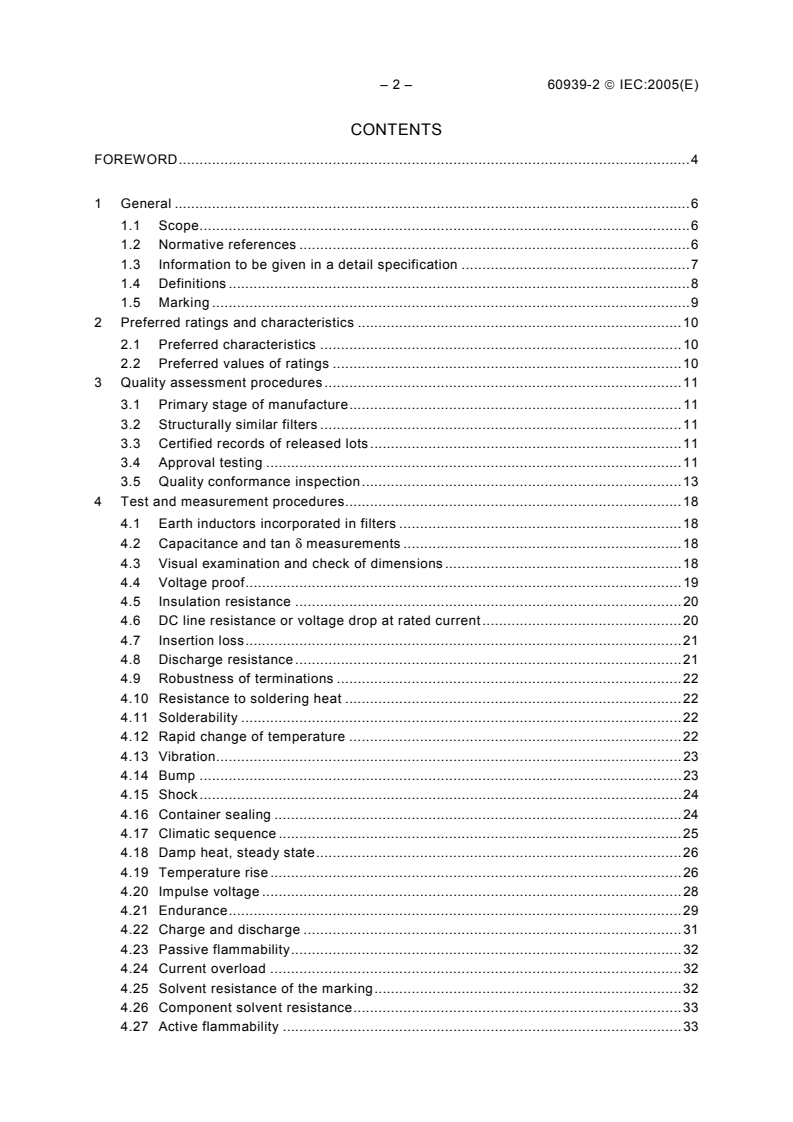
CONTENTS
FOREWORD.4
1 General .6
1.1 Scope.6
1.2 Normative references .6
1.3 Information to be given in a detail specification .7
1.4 Definitions .8
1.5 Marking .9
2 Preferred ratings and characteristics .10
2.1 Preferred characteristics .10
2.2 Preferred values of ratings .10
3 Quality assessment procedures.11
3.1 Primary stage of manufacture.11
3.2 Structurally similar filters .11
3.3 Certified records of released lots.11
3.4 Approval testing .11
3.5 Quality conformance inspection.13
4 Test and measurement procedures.18
4.1 Earth inductors incorporated in filters .18
4.2 Capacitance and tan δ measurements .18
4.3 Visual examination and check of dimensions.18
4.4 Voltage proof.19
4.5 Insulation resistance .20
4.6 DC line resistance or voltage drop at rated current.20
4.7 Insertion loss.21
4.8 Discharge resistance.21
4.9 Robustness of terminations .22
4.10 Resistance to soldering heat .22
4.11 Solderability .22
4.12 Rapid change of temperature .22
4.13 Vibration.23
4.14 Bump .23
4.15 Shock.24
4.16 Container sealing .24
4.17 Climatic sequence .25
4.18 Damp heat, steady state.26
4.19 Temperature rise.26
4.20 Impulse voltage .28
4.21 Endurance.29
4.22 Charge and discharge .31
4.23 Passive flammability.32
4.24 Current overload .32
4.25 Solvent resistance of the marking.32
4.26 Component solvent resistance.33
4.27 Active flammability .33
60939-2 IEC:2005(E) – 3 –
Annex A (normative) Test schedule for qualification approval – Assessment level D / DZ .34
Annex B (normative) Test schedule for safety requirements only .38
Annex C (normative) Circuit for the impulse voltage test .40
Annex D (normative) Circuit for the endurance test .42
Annex E (normative) Declaration of design .43
Figure 1 – Impulse wave form .29
Figure C.1 – Impulse voltage test circuit .40
Table 1 – Classification of class X capacitors .8
Table 2 – Classification of class Y capacitors .9
Table 3 – Tests concerning safety requirements only.14
Table 4 – Sampling plan – Safety and performance tests qualification approval –
Assessment level D / DZ.15
Table 5 – Lot-by-lot-tests – Assessment level D / DZ .16
Table 6 – Lot-by-lot test – Safety tests only approval .16
Table 7 – Periodic tests – Assessment level D / DZ .17
Table 8 – Creepage distances and clearances .18
Table 9 – Voltage proof.19
Table 10 – Insulation resistance .20
Table 11 – Preferred severities .24
Table 12 – Measurements and requirements after charge and discharge .31
Table A.1 – Test schedule for qualification approval – Assessment level D / DZ .34
Table B.1 – Test schedule for safety requirements only .38
Table C.1 – Values of C , C , R , R , C .40
X T P S P
Table C.2 – Values and tolerances of C , t , t .41
x r d
– 4 – 60939-2 IEC:2005(E)
INTERNATIONAL ELECTROTECHNICAL COMMISSION
___________
PASSIVE FILTER UNITS FOR ELECTROMAGNETIC
INTERFERENCE SUPPRESSION –
Part 2: Sectional specification –
Passive filter units for which safety tests are appropriate –
Test methods and general requirements
FOREWORD
1) The International Electrotechnical Commission (IEC) is a worldwide organization for standardization comprising
all national electrotechnical committees (IEC National Committees). The object of IEC is to promote
international co-operation on all questions concerning standardization in the electrical and electronic fields. To
this end and in addition to other activities, IEC publishes International Standards, Technical Specifications,
Technical Reports, Publicly Available Specifications (PAS) and Guides (hereafter referred to as “IEC
Publication(s)”). Their preparation is entrusted to technical committees; any IEC National Committee interested
in the subject dealt with may participate in this preparatory work. International, governmental and non-
governmental organizations liaising with the IEC also participate in this preparation. IEC collaborates closely
with the International Organization for Standardization (ISO) in accordance with conditions determined by
agreement between the two organizations.
2) The formal decisions or agreements of IEC on technical matters express, as nearly as possible, an international
consensus of opinion on the relevant subjects since each technical committee has representation from all
interested IEC National Committees.
3) IEC Publications have the form of recommendations for international use and are accepted by IEC National
Committees in that sense. While all reasonable efforts are made to ensure that the technical content of IEC
Publications is accurate, IEC cannot be held responsible for the way in which they are used or for any
misinterpretation by any end user.
4) In order to promote international uniformity, IEC National Committees undertake to apply IEC Publications
transparently to the maximum extent possible in their national and regional publications. Any divergence
between any IEC Publication and the corresponding national or regional publication shall be clearly indicated in
the latter.
5) IEC provides no marking procedure to indicate its approval and cannot be rendered responsible for any
equipment declared to be in conformity with an IEC Publication.
6) All users should ensure that they have the latest edition of this publication.
7) No liability shall attach to IEC or its directors, employees, servants or agents including individual experts and
members of its technical committees and IEC National Committees for any personal injury, property damage or
other damage of any nature whatsoever, whether direct or indirect, or for costs (including legal fees) and
expenses arising out of the publication, use of, or reliance upon, this IEC Publication or any other IEC
Publications.
8) Attention is drawn to the Normative references cited in this publication. Use of the referenced publications is
indispensable for the correct application of this publication.
9) Attention is drawn to the possibility that some of the elements of this IEC Publication may be the subject of
patent rights. IEC shall not be held responsible for identifying any or all such patent rights.
International Standard IEC 60939-2 has been prepared by IEC technical committee 40:
Capacitors and resistors for electronic equipment.
This second edition cancels and replaces the first edition published in 1988. This second
edition constitutes a technical revision.
The major changes that have been made between the first and the second edition are :
– Capacitance and tan δ measurements, d.c. line resistance or voltage drop at rated current,
impulse voltage, passive flammability, current overload, solvent resistance of marking,
component solvent resistance and active flammability have been added to Clause 4, test
and measurement procedures.
60939-2 IEC:2005(E) – 5 –
The text of this standard is based on the following documents:
FDIS Report on voting
40/1510/FDIS 40/1537/RVD
Full information on the voting for the approval of this standard can be found in the report on
voting indicated in the above table.
This publication has been drafted in accordance with the ISO/IEC Directives, Part 2.
IEC 60939 consists of the following parts, under the general title Passive filter units for
electromagnetic interference suppression
Part 1: Generic specification
Part 2: Sectional specification: Test methods and general requirements
Part 2-1: Blank detail specification – Passive filter units for electromagnetic interference
suppression – Filters for which safety tests are required (Assessment level D / DZ)
Part 2-2: Blank detail specification – Passive filter units for electromagnetic interference
suppression – Filters for which safety tests are required (Safety tests only)
The committee has decided that the contents of this publication will remain unchanged until
the maintenance result date indicated on the IEC web site under "http://webstore.iec.ch" in
the data related to the specific publication. At this date, the publication will be
• reconfirmed;
• withdrawn;
• replaced by a revised edition, or
• amended.
The contents of the corrigendum of November 2005 have been included in this copy.
A bilingual version of this publication may be issued at a later date.
– 6 – 60939-2 IEC:2005(E)
PASSIVE FILTER UNITS FOR ELECTROMAGNETIC
INTERFERENCE SUPPRESSION –
Part 2: Sectional specification –
Passive filter units for which safety tests are appropriate –
Test methods and general requirements
1 General
1.1 Scope
This Sectional specification applies to passive filter units for electromagnetic interference
suppression which fall within the scope of the Generic Specification IEC 60939-1.
The scope of this Sectional specification is restricted to passive filter units for which safety
tests are appropriate. This implies that filters specified according to this Sectional
specification will either be connected to mains supplies, when compliance with the mandatory
tests of Table 3 is necessary, or used in other circuit positions where the equipment
specification prescribes that some or all of these safety tests are required.
This Sectional specification applies to passive filter units which will be connected to an a.c.
mains or other supply with a nominal voltage not exceeding 1 000 V a.c., with a nominal
frequency not exceeding 400 Hz, or 1 000 V d.c.
1.2 Normative references
The following referenced documents are indispensable for the application of this document.
For dated references, only the edition cited applies. For undated references, the latest edition
of the referenced document (including any amendments) applies.
NOTE Components other than inductors and capacitors in the filter unit should fulfil requirements in the relevant
IEC Standard.
IEC 60060-1, High-voltage test techniques – Part 1: General definitions and test requirements
IEC 60062, Marking codes for resistors and capacitors
IEC 60068-1, Environmental testing – Part 1: General and guidance
IEC 60068-2-17, Basic environmental testing procedures – Part 2: Tests – Test Q: Sealing
IEC 60085, Thermal evaluation and classification of electrical insulation
IEC 60335-1, Safety of household and similar electrical appliances – Part 1: General
requirements
IEC 60384-9, Fixed capacitors for use in electronic equipment – Part 9: Sectional
specification: Fixed capacitors of ceramic dielectric, Class 2
IEC 60384-14, Fixed capacitors for use in electronic equipment – Part 14: Sectional
specification: Fixed capacitors for electromagnetic interference suppression and connection to
the supply mains
60939-2 IEC:2005(E) – 7 –
IEC 60664 (all parts), Insulation coordination for equipment within low-voltage systems
IEC 60938-1, Fixed inductors for electromagnetic interference suppression – Part 1: Generic
specification
IEC 60939-1, Passive filter units for electromagnetic interference suppression – Part 1:
Generic specification
IEC 60940, Guidance information on the application of capacitors, resistors, inductors and
complete filter units for radio interference suppression
IEC 61140, Protection against electric shock – Common aspects for installation and
equipment
1.3 Information to be given in a detail specification
1.3.1 General
The detail specifications shall be derived from the relevant blank detail specification.
Detail specifications shall not specify requirements inferior to those of the generic, sectional
or blank detail specification. When more severe requirements are included, they shall be
listed in 1.9 of the detail specification, and indicated in the test schedules, for example by an
asterisk.
NOTE The information given in 1.3.2 may, for convenience, be presented in tabular form.
The following information shall be given in each detail specification and the values quoted
shall preferably be selected from the appropriate clause of this sectional specification.
1.3.2 Outline drawing and dimensions
There shall be an illustration of the filter as an aid to easy recognition and for comparison of
the filter with others. Dimensions and their associated tolerances, which affect inter-
changeability and mounting, shall be given in the detail specification. All dimensions shall
preferably be stated in millimetres.
Normally, the numerical values shall be given for the length of the body, the width and height
of the body and the wire spacing, or for cylindrical types, the body diameter and the length
and diameter of the terminations. When necessary, for example when a range of filters is
covered by a single detail specification, their dimensions and their associated tolerances shall
be placed in a table following the drawing.
In addition, the detail specification shall state such other dimensional information as will
adequately describe the filter outline.
1.3.3 Mounting
The detail specification shall specify the method of mounting recommended for normal use
and the method which is mandatory for the application of the vibration, bump, shock and
endurance tests. The design of the filter may be such that special mounting fixtures or heat
sinks are required in its use. In this case, the detail specification shall describe the mounting
fixtures and they shall be used in the application of the vibration, bump or shock tests. The
specified heat sink shall be used in the application of the endurance test.
– 8 – 60939-2 IEC:2005(E)
If recommendations for mounting for "normal" use are made, they shall be included in the
detail specification under 1.8 "Additional information (not for inspection purposes)". If they are
included, a warning can be given that the full vibration, bump and shock performance may not
be available if mounting methods other than those specified in 1.1 of the detail specification
are used.
1.3.4 Ratings and characteristics
1.3.4.1 General
The ratings and characteristics shall be in accordance with the relevant clauses of this
specification.
1.3.4.2 Particular characteristics
Additional characteristics may be listed when they are considered necessary to specify
adequately the filter for design or application purposes.
1.3.5 Marking
The detail specification shall specify the content of the marking on the filter and the package.
1.4 Terms and definitions
For the purposes of this Sectional specification, the terms and definitions given in 2.2 of
IEC 60939-1, as well as the following apply.
1.4.1
a.c. mains filter (or mains filter)
passive filter unit designed essentially for application with a power-frequency alternating
voltage supplied from the mains
1.4.2
class X capacitor
capacitor of a type suitable for use in situations where failure of the capacitor would not lead
to danger of electric shock but could result in a risk of fire.
Class X capacitors are divided into three subclasses (see Table 1) according to the peak
voltage of the impulses superimposed on the mains voltage to which they may be subjected in
service. Such impulses may arise from lightning strikes on outside lines, from switching in
neighbouring equipment, or switching in the equipment in which the capacitor is used.
Table 1 – Classification of class X capacitors
Subclass Peak pulse IEC 60664 Application Peak impulse voltage U
p
voltage in service insulation applied before endurance test
category
X1 > 2,5 kV III High pulse when C ≤ 1,0 µF : U = 4,0 kV
R P
application
≤ 4,0 kV
when C > 1,0 µF : U = kV
R P
C × 10
R
X2 II General
≤ 2,5 kV when C ≤ 1,0 µF : U = 2,5 kV
R P
purpose
2,5
when C > 1,0 µF : U = kV
R P
C × 10
R
X3 ≤ 1,2 kV - General none
purpose
60939-2 IEC:2005(E) – 9 –
1.4.3
class Y capacitor
capacitor or RC-unit of a type suitable for use in situations where failure of the capacitor could
lead to danger of electric shock.
Class Y capacitors are further divided into four subclasses Y1, Y2, Y3 and Y4, as shown in
Table 2.
(IEC 60384-14, 1.5.4)
Table 2 – Classification of class Y capacitors
Subclass Type of insulation bridged Range of rated voltages Peak impulse voltage
before endurance test
Y1 Double insulation or reinforced 8,0 kV
≤ 500 V
insulation
Y2 ≥ 150 V
5,0 kV
≤ 300 V
Basic insulation or supplementary
Y3
≥ 150 V
insulation
none
≤ 250 V
Y4 < 150 V 2,5 kV
NOTE For definitions of basic, supplementary, double and reinforced insulation, see IEC 61140.
One Y-capacitor may bridge basic insulation. One Y-capacitor may bridge supplementary
insulation. If combined basic and supplementary insulations are bridged by two Y2-, Y3- or
Y4-capacitors in series, they must have the same nominal value.
For guidance on the application of capacitors bridging basic insulation, see 6.1 of IEC 60940.
1.4.4
earth inductor
inductor that forms part of the earth lead of a filter
1.5 Marking
1.5.1 See 2.4 of IEC 60939-1 with the following details:
The information given in the marking is normally selected from the following list; the relative
importance of each item is indicated by its position in the list:
a) manufacturer's name or trademark;
b) manufacturer's type designation or the type designation given in the detail specification;
c) recognised approval mark;
d) rated voltage and rated frequency;
e) identification of terminations and/or circuit diagram;
f) rated current;
g) rated temperature;
h) climatic category;
i) year and month (or week) of manufacture (if the indication is in code, it shall be the code
given in IEC 60062);
j) reference to the detail specification.
– 10 – 60939-2 IEC:2005(E)
1.5.2 The filter shall be clearly marked with the information in 1.5.1 a), b), c), d) and f), and
also e) if this is not implied by b).
1.5.3 The package containing the filter(s) shall be clearly marked with all the information
listed in 1.5.1.
National approvals may be indicated by lettering as an alternative to the approval mark.
1.5.4 Any additional marking shall be so applied that no confusion can arise.
2 Preferred ratings and characteristics
2.1 Preferred characteristics
2.1.1 General
The values given in detail specifications should preferably be selected from the following:
2.1.2 Preferred climatic categories
The filters covered by this specification are classified into climatic categories according to the
general rules given in IEC 60068-1.
The lower and upper category temperature and the duration of the damp heat, steady state
test should be chosen from the following:
Lower category temperature: –65 °C, –55 °C, –40 °C, –25 °C or –10 °C;
Upper category temperature: +70 °C, +85 °C, +100 °C, +125 °C or +155 °C;
Duration of the damp heat, steady state test: 21 or 56 days.
The severities for the cold and dry heat tests are the lower and upper category temperatures
respectively.
For guidance on the application of the categories described above, see IEC 60940.
2.2 Preferred values of ratings
2.2.1 Rated voltage (U )
R
The preferred values of rated voltage are:
115 V, 125 V, 250 V, 400 V, 440 V, 500 V and 760 V.
Electromagnetic interference suppression filters shall be chosen to have a rated voltage equal
to or greater than the nominal voltage of the supply system to which they are connected. The
design of the filters shall take into account the possibility that the voltage of the system may
rise by up to 10 % above its nominal voltage.
NOTE X-capacitors can be used in a star connect.
2.2.2 Category voltage (U )
C
The category voltage is equal to the rated voltage unless otherwise stated in the detail
specification.
60939-2 IEC:2005(E) – 11 –
2.2.3 Rated temperature
The rated temperature shall not be less than +40 °C.
2.2.4 Passive flammability
When specified, the minimum category of passive flammability permitted is category C.
3 Quality assessment procedures
3.1 Primary stage of manufacture
See 3.2 of IEC 60939-1.
3.2 Structurally similar filters
See 3.4 of IEC 60939-1.
In addition to these provisions, filters may be considered as structurally similar only when for
their range of component values they have the same capacitor, inductor and resistor
technologies and corresponding capacitive elements are of the same subclass.
3.3 Certified records of released lots
The information required in 3.5.1 of IEC 60939-1 shall be made available when prescribed in
the detail specification and when requested by a customer. After the endurance test, the
parameters for which variables information is required are insertion loss change and
insulation resistance.
3.4 Approval testing
3.4.1 Safety tests only approval
Table 3 and Annex B form a schedule limited to tests concerning safety only requirements.
The schedule to be used for safety only approval will be on the basis of fixed sample sizes
according to 3.4 of IEC 60939-1 as given in 3.4.3 and Table 3 of this Sectional specification.
Prior to the approval testing being carried out, it is necessary to submit to the certification
body a declaration of design (Annex E) registering essential data and basic design details of
the passive filters for which approval is sought.
If subsequent to the granting of approval, any component is changed, the certification body
shall be informed (see Annex E). Extension of approval to include changed component(s) is at
the discretion of the certification body.
3.4.2 Qualification approval
Tables 4, 5, 6 and 7 are to be used when qualification approval is sought.
The procedures for qualification approval testing are given in 3.5 of IEC 60939-1. The
schedule to be used for qualification approval testing on the basis of lot-by-lot and periodic
tests is given in 3.5 and Tables 5, 6 and 7 of this Sectional specification. The procedure using
a fixed sample size schedule is given in 3.4.3 and Table 4. For the two procedures, the
sample sizes and the number of non-conforming items shall be of comparable order. The test
conditions and requirements shall be the same. Qualification approval according to the fixed
sample sizes of Table 4 is preferred.
– 12 – 60939-2 IEC:2005(E)
3.4.3 Sampling
Filter types to be qualified together shall have the same rated voltage, and combination of
component technologies; in addition, the corresponding capacitive elements shall be of the
same subclass. The numbers of filters required for each qualification in each group are given
in Tables 3 and 4.
For each qualification, the sample shall contain equal numbers of specimens of the highest
and lowest total capacitance values in the range to be qualified. Where only one total
capacitance value is involved, the total number of filters as stated in Tables 3 and 4 shall be
tested.
If, for a given value of total capacitance, there is more than one rated current available in the
range, then filters with the highest rated current shall be chosen. If at this rated current more
than one inductance value is available in the range, then filters with the highest inductance
value shall be chosen.
NOTE "Total capacitance" in the paragraph above means the capacitance between the input terminations of the
filter.
Spare specimens are permitted as follows:
a) one per value which may be used to replace the non-conforming item in group 0;
b) one per value which may be used as replacements for non-conforming specimens
because of incidents not attributable to the manufacturer;
c) sufficient specimens to enable the repeat test of Note 8 to Tables 7 to be carried out.
The numbers given in Group 0 assume that all further groups are applicable. If this is not so,
the numbers may be reduced accordingly. The numbers given in Group 0 may also be
reduced if, for example for expensive filters, the manufacturer chooses to carry out the tests
of a number of groups in sequence on the same specimens. The numbers given for Group 0
do not include the specimens required for Groups 7 and 8.
When additional groups are introduced into the qualification approval test schedule, the
number of specimens required for Group 0 shall be increased by the same number as that
required for the additional groups.
Table 3 or 4 gives the number of specimens to be tested in each group together with the
permissible number of non-conforming for qualification approval tests.
3.4.4 Tests
Before submission to qualification approval testing, an appropriate 100 % voltage proof test
between terminations according to Table 9 shall be made. The details of this test are the
prerogative of the manufacturer, but the time shall not be less than 1 s. If a d.c. test voltage is
used instead of a.c. for filters containing class Y capacitors and the time is less than 2 s, it
shall not be less than 1,8 times the a.c. test voltage in Table 9. All non-conforming items shall
be removed from the lot prior to qualification approval testing.
One or more of the complete series of tests indicated in Table 3 or Table 4 may be required
for the approval of filters covered by one detail specification. The tests of each group shall be
carried out in the order given.
The whole sample with the exception of those specimens to be submitted to the tests of
Groups 7 and 8 shall be subjected to the tests of Group 0 and then subdivided for the other
groups.
60939-2 IEC:2005(E) – 13 –
A specimen found to be defective during the tests of group 0 shall not be used for the other
groups.
"One defective" is counted when a filter has not satisfied the whole or part of the tests of a
group.
The approval is granted when the number of non-conforming items does not exceed the
specified number of permissible non-conforming items for each group and the total number of
permissible non-conforming items.
NOTE Table 3 and Annex B or Table 4 and Annex A form the fixed sample size test schedule, where Table 3 or
Table 4 includes the details for the sampling and permissible defectives for the different tests or groups of tests,
whereas Annex A and Annex B together with the details of test contained in Clause 4 give a complete summary of
the test conditions and performance requirements and indicate where for test methods or conditions of test a
choice has to be made in the detail specification.
The conditions of test and performance requirements for the fixed sample size schedule shall
be identical to those prescribed in the detail specification for the quality conformance
inspection.
3.5 Quality conformance inspection
3.5.1 General
Before submission to the quality conformance inspection an appropriate 100 % voltage proof
test between terminations according to Table 9 shall be made. The details of this test are the
prerogative of the manufacturer, but the time shall not be less than 1 s. If a d.c. test voltage is
used instead of a.c. for filters containing class Y capacitors and the time is less than 2 s, it
shall not be less than 1,8 times the a.c. test voltage in Table 9. All non-conforming items shall
be removed from the lot prior to lot-by-lot testing.
3.5.2 Formation of inspection lots
a) Groups A and B inspection
These tests shall be carried out on a lot-by-lot basis using sampling plans appropriate to
the given assessment level specified in Table 5 and Table 6.
Manufactured lots of separately identified filter units may be aggregated into inspection
lots formed for such tests as are relevant to structural similarities between those
manufactured lots.
b) Group C inspection
These tests shall be carried out on a periodic basis.
Qualification approval:
These tests shall be carried out on the number of specimens appropriate to the given
assessment level specified in Table 7. In order to reduce the number of specimens required to
carry out any single complete periodic test, the manufacturer may elect to have the tests of
more than one group carried out sequentially on the same specimens. The specimens shall be
representative of the filters manufactured during each period. In subsequent periods, other
filters in the approved range in production shall be tested with the aim of covering the whole
range of the approval.
Safety tests only approval:
Requalification tests according to Annex B may be required by the certification body when a
change of the declared design as given in Annex E is intended. The certification body will be
informed about the intended change(s) and decide whether requalification tests have to be
performed.
– 14 – 60939-2 IEC:2005(E)
3.5.3 Test schedule
Qualification approval:
The schedule for the lot-by-lot and periodic tests for quality conformance inspection is given
in Table 4a and 4b of IEC 60939-2-1.
Safety tests only approval:
The schedule for the lot-by-lot tests and criteria for requalification are given in Annex A and
Annex B of IEC 60939-2-2.
3.5.4 Delayed delivery
When according to the procedures in 3.10 of IEC 60939-1, re-inspection has to be made,
insulation resistance shall be checked as specified in Group A inspection and solderability
shall be checked according to Group B inspection.
Table 3 – Tests concerning safety requirements only
Number of permissible
non-conforming items
Number of
per qualification
Group Subclauses and test specimens tested
4)
per qualification
Per Total
8)
group
4.3 Visual examinations 20/10/5
4.6 DC line resistance
4.7 Insertion loss (no load)
1/1/0
0 4.4 Voltage proof
4.5 Insulation resistance
1)
4.8 Discharge resistance
Spares 5/3/2
4.3.2 Creepage distances and clearances
4/2/1
4.9 Robustness of terminations
1A 0 0
1)
4.10 Resistance to soldering heat
2)
4.25 Solvent resistance of the marking
2 4.18 Damp heat, steady state 4/2/1 0 0
5)
4.19 Temperature rise or
3A 4/2/1 0 0
6) 7)
4.21.1 Endurance current
10) 11)
4.20 Impulse voltage
3B 4/2/1 0 0
4.21.2 Endurance – voltage line
1)
terminations/case
10) 11)
4.20 Impulse voltage
3C 4/2/1 0 0
4.21.3 Endurance voltage between line
7)
terminations
2)
7 4.23 Passive flammability see 4.23 0 0
2)
9 4.27 Active flammability see 4.27 0 0
Footnotes: see end of Table 7.
60939-2 IEC:2005(E) – 15 –
Table 4 – Sampling plan – Safety and performance tests qualification approval –
Assessment level D / DZ
Number of permissible
non-conforming items
Number of
4)
per qualification
specimens tested
Group Subclauses and tests
per qualification
8)
Per group Total
4)
D DZ D DZ
4.3 Dimensions (gauging)
0 4.3 Visual examination
4.6 DC line resistance or voltage drop 36/16/9 2/1/1 0
4.7 Insertion loss (no load)
4.4 Voltage proof
4.5 Insulation resistance
1)
4.8 Discharge resistance
Spares 8/3/2
4.3 Dimensions (detail)
4.3.2 Creepage distances and clearances
1A 4.9 Robustness of terminations 4/1/1 0 0
1)
4.10 Resistance to soldering heat
2)
4.25 Solvent resistance of the marking
2)
4.26 Component solvent resistance
4.12 Rapid change of temperature
1B 4.13 Vibration 4/1/1 0
3)
4.14 Bump or
4.15 Shock
12)
2)
1 4.16 Container sealing 8/2/2 1/0/0 0 1/0/0 0
4.17 Climatic sequence
2 4.18 Damp heat, steady state 4/2/1 0 0
5)
3A 4.19 Temperature rise or 4/2/1
6) 7)
4.21.1 Endurance – current 0 0
10) 11)
4.20 Impulse voltage 4/2/1 0 0
3B 4.21.2 Endurance-voltage line
1)
terminations/case
10) 11)
4.20 Impulse voltage 4/2/1 0 0
3C 4.21.3 Endurance – voltage between line
7)
terminations
1) 11)
4 4.22 Charge/discharge 4/2/1 0 0
2)
5 4.7 Insertion loss (load/temperature) 4/2/1 0 0
2)
6 4.24 Current overload 4/2/1 0 0
2)
7 4.23 Passive flammability see 4.23 0 0
1) 9)
8 4.11 Solderability 4/2/1 0 0
2)
9 4.27 Active flammability 4/2/1 0 0
Footnotes: see end of Table 7.
1/0/0
– 16 – 60939-2 IEC:2005(E)
Table 5 – Lot-by-lot-tests – Assessment level D / DZ
Assessment level D
Group Subclauses and tests Inspection AQL
level IL %
4.3 Visual examination
A1 4.3 Marking S-4 2,5
4.3 Dimensions (gauging)
4.6 DC line resistance
4.7 Insertion loss (no load)
A2 4.4 Voltage proof (test A only) II 1,0
4.5 Insulation resistance (test A only)
1)
4.8 Discharge resistance
1) 9)
B1 4.11 Solderability S-3 2,5
Assessment level DZ
Group Subclauses and tests Inspection Acceptance
level IL number
4.3 Visual examination
A1 4.3 Marking S-3 0
4.3 Dimensions (gauging)
4.6 DC line resistance
4.7 Insertion loss (no load)
A2 4.4 Voltage proof (Test A only) S-4 0
4.5 Insulation resistance (Test A only)
1)
4.8 Discharge resistance
1) 9)
B1 4.11 Solderability S-3 0
Footnotes: see end of Table 7.
Table 6 – Lot-by-lot test – Safety tests only approval
13) 13) 13)
Subclause and test Conditions of test Sample Requirements
size
Non destructive
14)
4.3 Visual examination 100 % Any marking on the filter shall
be legible and correct
16)
4.4 Voltage proof Method for test C: No permanent breakdown or
15)
(Test A, B and C ) flashover
Footnotes: see end of Table 7.
60939-2 IEC:2005(E) – 17 –
Table 7 – Periodic tests – Assessment level D / DZ
Group Periodicity Subclauses and tests Total Number of non-
4) 8)
sample conforming items
Months
D DZ
4.3 Dimensions (detail)
4.3.2 Creepage distances and clearances
4.9 Robustness of terminations 2/1/1 0 0
1)
C1A 4.10 Resistance to soldering heat
2)
6 4.25 Solvent resistance of the marking
2)
4.26 Component solvent resistance
4.12 Rapid change of temperature
C1B 4.13 Vibration 4/1/1 0 0
3)
4.14 Bump or
4.15 Shock
2)
C1 4.16 Container sealing 6/2/2 1/0/0 0
4.17 Climatic sequence
C2 12 4.18 Damp heat, steady state 4/2/1 0 0
5)
C3A 3 4.19 Temperature rise or 2/2/1 0 0
6) 7)
4.21.1 Endurance – current
11)
C3B 3 4.20 Impulse voltage 2/2/1 0 0
4.21.2 Endurance – voltage line terminations/case
11)
4.20 Impulse voltage
C3C 3 4.21.3 Endurance – voltage between line 4/2/1 0 0
7)
terminations
1)
C4 12 4.22 Charge/discharge 2/2/1 0 0
2)
C5 12 2/2/1 0 0
4.7 Insertion loss
(load/temperature)
C6 12 4.24 Current overload 2/2/1 0 0
2)
C7 12 4.23 Passive flammability see 4.23 0 0
2)
C9 12 4.27 Active flammability see 4.27 0 0
Footnotes to Tables 3, 4, 5, 6 and 7:
1)
If applicable.
2)
If required in the detail specification.
3)
Whichever is required in the detail specification.
4)
See 3.4.3 for the structural similarities which are necessary before filters may be qualified together.
The three numbers in each box of the table indicate in descending order the numbers applicable for specimens
within the following current limits:
< 16 A
≥ 16 A . ≤ 80 A
> 80 A
”Current” in this context is the sum of the rated current(s) carried by the leads for the individual phases, N
excluded.
Where a range is qualified which contains filters within more than one of the current classifications listed above,
the number of specimens selected shall be that for the classification in which the majority of the values in the
range fall.
The numbers in Group 0 exclude the numbers of specimens required for Groups 7 and 8.
5)
For filters with rated current > 0,5 A only.
6)
For filters with rated current ≤ 0,5 A.
7)
See 4.21.4 for the option of combining the tests of Groups 3A and 3C.
8)
When zero non-conforming items are required and
...
IEC 60939-2 ®
Edition 2.0 2005-02
INTERNATIONAL
STANDARD
NORME
INTERNATIONALE
Passive filter units for electromagnetic interference suppression –
Part 2: Sectional specification – Passive filter units for which safety tests are
appropriate – Test methods and general requirements
Filtres passifs d'antiparasitage –
Partie 2: Spécification intermédiaire – Filtres passifs pour lesquels des essais de
sécurité sont appropriés – Méthodes d’essai et exigences générales
All rights reserved. Unless otherwise specified, no part of this publication may be reproduced or utilized in any form
or by any means, electronic or mechanical, including photocopying and microfilm, without permission in writing from
either IEC or IEC's member National Committee in the country of the requester. If you have any questions about IEC
copyright or have an enquiry about obtaining additional rights to this publication, please contact the address below or
your local IEC member National Committee for further information.
Droits de reproduction réservés. Sauf indication contraire, aucune partie de cette publication ne peut être reproduite ni
utilisée sous quelque forme que ce soit et par aucun procédé, électronique ou mécanique, y compris la photocopie et
les microfilms, sans l'accord écrit de l'IEC ou du Comité national de l'IEC du pays du demandeur. Si vous avez des
questions sur le copyright de l'IEC ou si vous désirez obtenir des droits supplémentaires sur cette publication, utilisez
les coordonnées ci-après ou contactez le Comité national de l'IEC de votre pays de résidence.
IEC Secretariat Tel.: +41 22 919 02 11
3, rue de Varembé info@iec.ch
CH-1211 Geneva 20 www.iec.ch
Switzerland
About the IEC
The International Electrotechnical Commission (IEC) is the leading global organization that prepares and publishes
International Standards for all electrical, electronic and related technologies.
About IEC publications
The technical content of IEC publications is kept under constant review by the IEC. Please make sure that you have the
latest edition, a corrigendum or an amendment might have been published.
IEC publications search - webstore.iec.ch/advsearchform IEC Products & Services Portal - products.iec.ch
The advanced search enables to find IEC publications by a Discover our powerful search engine and read freely all the
variety of criteria (reference number, text, technical publications previews. With a subscription you will always have
committee, …). It also gives information on projects, replaced access to up to date content tailored to your needs.
and withdrawn publications.
Electropedia - www.electropedia.org
IEC Just Published - webstore.iec.ch/justpublished
The world's leading online dictionary on electrotechnology,
Stay up to date on all new IEC publications. Just Published
containing more than 22 300 terminological entries in English
details all new publications released. Available online and once
and French, with equivalent terms in 19 additional languages.
a month by email.
Also known as the International Electrotechnical Vocabulary
(IEV) online.
IEC Customer Service Centre - webstore.iec.ch/csc
If you wish to give us your feedback on this publication or need
further assistance, please contact the Customer Service
Centre: sales@iec.ch.
A propos de l'IEC
La Commission Electrotechnique Internationale (IEC) est la première organisation mondiale qui élabore et publie des
Normes internationales pour tout ce qui a trait à l'électricité, à l'électronique et aux technologies apparentées.
A propos des publications IEC
Le contenu technique des publications IEC est constamment revu. Veuillez vous assurer que vous possédez l’édition la
plus récente, un corrigendum ou amendement peut avoir été publié.
Recherche de publications IEC - IEC Products & Services Portal - products.iec.ch
webstore.iec.ch/advsearchform Découvrez notre puissant moteur de recherche et consultez
La recherche avancée permet de trouver des publications IEC gratuitement tous les aperçus des publications. Avec un
en utilisant différents critères (numéro de référence, texte, abonnement, vous aurez toujours accès à un contenu à jour
comité d’études, …). Elle donne aussi des informations sur les adapté à vos besoins.
projets et les publications remplacées ou retirées.
Electropedia - www.electropedia.org
IEC Just Published - webstore.iec.ch/justpublished
Le premier dictionnaire d'électrotechnologie en ligne au monde,
Restez informé sur les nouvelles publications IEC. Just
avec plus de 22 300 articles terminologiques en anglais et en
Published détaille les nouvelles publications parues.
français, ainsi que les termes équivalents dans 19 langues
Disponible en ligne et une fois par mois par email.
additionnelles. Egalement appelé Vocabulaire
Electrotechnique International (IEV) en ligne.
Service Clients - webstore.iec.ch/csc
Si vous désirez nous donner des commentaires sur cette
publication ou si vous avez des questions contactez-nous:
sales@iec.ch.
IEC 60939-2 ®
Edition 2.0 2005-02
INTERNATIONAL
STANDARD
NORME
INTERNATIONALE
Passive filter units for electromagnetic interference suppression –
Part 2: Sectional specification – Passive filter units for which safety tests are
appropriate – Test methods and general requirements
Filtres passifs d'antiparasitage –
Partie 2: Spécification intermédiaire – Filtres passifs pour lesquels des essais
de sécurité sont appropriés – Méthodes d’essai et exigences générales
INTERNATIONAL
ELECTROTECHNICAL
COMMISSION
COMMISSION
ELECTROTECHNIQUE
INTERNATIONALE
ICS 31.160 ISBN 978-2-8322-6686-1
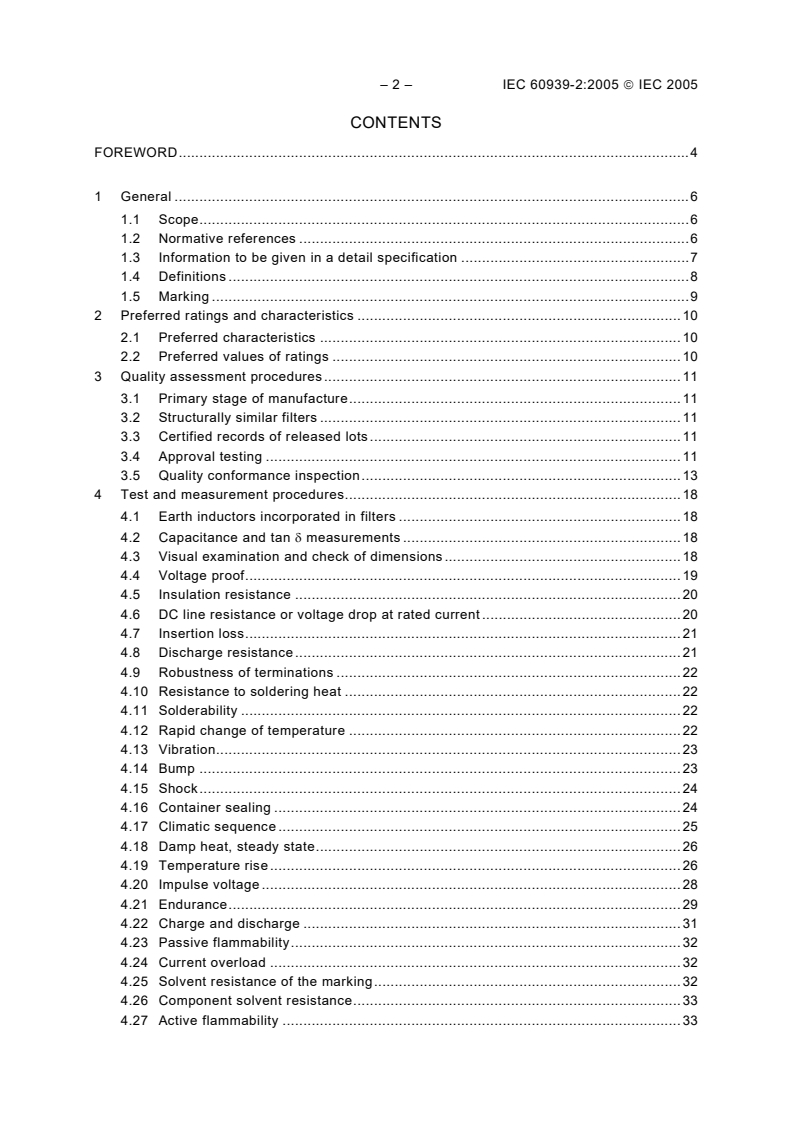
– 2 – IEC 60939-2:2005 IEC 2005
CONTENTS
FOREWORD . 4
1 General . 6
1.1 Scope . 6
1.2 Normative references . 6
1.3 Information to be given in a detail specification . 7
1.4 Definitions . 8
1.5 Marking . 9
2 Preferred ratings and characteristics . 10
2.1 Preferred characteristics . 10
2.2 Preferred values of ratings . 10
3 Quality assessment procedures . 11
3.1 Primary stage of manufacture . 11
3.2 Structurally similar filters . 11
3.3 Certified records of released lots . 11
3.4 Approval testing . 11
3.5 Quality conformance inspection . 13
4 Test and measurement procedures . 18
4.1 Earth inductors incorporated in filters . 18
4.2 Capacitance and tan δ measurements . 18
4.3 Visual examination and check of dimensions . 18
4.4 Voltage proof . 19
4.5 Insulation resistance . 20
4.6 DC line resistance or voltage drop at rated current . 20
4.7 Insertion loss . 21
4.8 Discharge resistance . 21
4.9 Robustness of terminations . 22
4.10 Resistance to soldering heat . 22
4.11 Solderability . 22
4.12 Rapid change of temperature . 22
4.13 Vibration. 23
4.14 Bump . 23
4.15 Shock . 24
4.16 Container sealing . 24
4.17 Climatic sequence . 25
4.18 Damp heat, steady state . 26
4.19 Temperature rise . 26
4.20 Impulse voltage . 28
4.21 Endurance . 29
4.22 Charge and discharge . 31
4.23 Passive flammability . 32
4.24 Current overload . 32
4.25 Solvent resistance of the marking . 32
4.26 Component solvent resistance . 33
4.27 Active flammability . 33
Annex A (normative) Test schedule for qualification approval – Assessment level D / DZ . 34
Annex B (normative) Test schedule for safety requirements only . 38
Annex C (normative) Circuit for the impulse voltage test . 40
Annex D (normative) Circuit for the endurance test . 42
Annex E (normative) Declaration of design . 43
Figure 1 – Impulse wave form . 29
Figure C.1 – Impulse voltage test circuit . 40
Figure D.1 – Endurance test circuit . 42
Table 1 – Classification of class X capacitors . 8
Table 2 – Classification of class Y capacitors . 9
Table 3 – Tests concerning safety requirements only . 14
Table 4 – Sampling plan – Safety and performance tests qualification approval –
Assessment level D / DZ . 15
Table 5 – Lot-by-lot-tests – Assessment level D / DZ . 16
Table 6 – Lot-by-lot test – Safety tests only approval . 16
Table 7 – Periodic tests – Assessment level D / DZ . 17
Table 8 – Creepage distances and clearances . 18
Table 9 – Voltage proof. 19
Table 10 – Insulation resistance . 20
Table 11 – Preferred severities . 24
Table 12 – Measurements and requirements after charge and discharge . 31
Table A.1 – Test schedule for qualification approval – Assessment level D / DZ . 34
Table B.1 – Test schedule for safety requirements only . 38
Table C.1 – Values of C , C , R , R , C . 40
X T P S P
Table C.2 – Values and tolerances of C , t , t . 41
x r d
– 4 – IEC 60939-2:2005 IEC 2005
INTERNATIONAL ELECTROTECHNICAL COMMISSION
___________
PASSIVE FILTER UNITS FOR ELECTROMAGNETIC
INTERFERENCE SUPPRESSION –
Part 2: Sectional specification –
Passive filter units for which safety tests are appropriate –
Test methods and general requirements
FOREWORD
1) The International Electrotechnical Commission (IEC) is a worldwide organization for standardization comprising
all national electrotechnical committees (IEC National Committees). The object of IEC is to promote
international co-operation on all questions concerning standardization in the electrical and electronic fields. To
this end and in addition to other activities, IEC publishes International Standards, Technical Specifications,
Technical Reports, Publicly Available Specifications (PAS) and Guides (hereafter referred to as “IEC
Publication(s)”). Their preparation is entrusted to technical committees; any IEC National Committee interested
in the subject dealt with may participate in this preparatory work. International, governmental and non-
governmental organizations liaising with the IEC also participate in this preparation. IEC collaborates closely
with the International Organization for Standardization (ISO) in accordance with conditions determined by
agreement between the two organizations.
2) The formal decisions or agreements of IEC on technical matters express, as nearly as possible, an international
consensus of opinion on the relevant subjects since each technical committee has representation from all
interested IEC National Committees.
3) IEC Publications have the form of recommendations for international use and are accepted by IEC National
Committees in that sense. While all reasonable efforts are made to ensure that the technical content of IEC
Publications is accurate, IEC cannot be held responsible for the way in which they are used or for any
misinterpretation by any end user.
4) In order to promote international uniformity, IEC National Committees undertake to apply IEC Publications
transparently to the maximum extent possible in their national and regional publications. Any divergence
between any IEC Publication and the corresponding national or regional publication shall be clearly indicated in
the latter.
5) IEC provides no marking procedure to indicate its approval and cannot be rendered responsible for any
equipment declared to be in conformity with an IEC Publication.
6) All users should ensure that they have the latest edition of this publication.
7) No liability shall attach to IEC or its directors, employees, servants or agents including individual experts and
members of its technical committees and IEC National Committees for any personal injury, property damage or
other damage of any nature whatsoever, whether direct or indirect, or for costs (including legal fees) and
expenses arising out of the publication, use of, or reliance upon, this IEC Publication or any other IEC
Publications.
8) Attention is drawn to the Normative references cited in this publication. Use of the referenced publications is
indispensable for the correct application of this publication.
9) Attention is drawn to the possibility that some of the elements of this IEC Publication may be the subject of
patent rights. IEC shall not be held responsible for identifying any or all such patent rights.
International Standard IEC 60939-2 has been prepared by IEC technical committee 40:
Capacitors and resistors for electronic equipment.
This second edition cancels and replaces the first edition published in 1988. This second
edition constitutes a technical revision.
The major changes that have been made between the first and the second edition are :
– Capacitance and tan δ measurements, d.c. line resistance or voltage drop at rated current,
impulse voltage, passive flammability, current overload, solvent resistance of marking,
component solvent resistance and active flammability have been added to Clause 4, test
and measurement procedures.
The text of this standard is based on the following documents:
FDIS Report on voting
40/1510/FDIS 40/1537/RVD
Full information on the voting for the approval of this standard can be found in the report on
voting indicated in the above table.
This publication has been drafted in accordance with the ISO/IEC Directives, Part 2.
IEC 60939 consists of the following parts, under the general title Passive filter units for
electromagnetic interference suppression
Part 1: Generic specification
Part 2: Sectional specification: Test methods and general requirements
Part 2-1: Blank detail specification – Passive filter units for electromagnetic interference
suppression – Filters for which safety tests are required (Assessment level D / DZ)
Part 2-2: Blank detail specification – Passive filter units for electromagnetic interference
suppression – Filters for which safety tests are required (Safety tests only)
The committee has decided that the contents of this publication will remain unchanged until
the maintenance result date indicated on the IEC web site under "http://webstore.iec.ch" in
the data related to the specific publication. At this date, the publication will be
• reconfirmed;
• withdrawn;
• replaced by a revised edition, or
• amended.
The contents of the corrigendum of November 2005 have been included in this copy.
– 6 – IEC 60939-2:2005 IEC 2005
PASSIVE FILTER UNITS FOR ELECTROMAGNETIC
INTERFERENCE SUPPRESSION –
Part 2: Sectional specification –
Passive filter units for which safety tests are appropriate –
Test methods and general requirements
1 General
1.1 Scope
This Sectional specification applies to passive filter units for electromagnetic interference
suppression which fall within the scope of the Generic Specification IEC 60939-1.
The scope of this Sectional specification is restricted to passive filter units for which safety
tests are appropriate. This implies that filters specified according to this Sectional
specification will either be connected to mains supplies, when compliance with the mandatory
tests of Table 3 is necessary, or used in other circuit positions where the equipment
specification prescribes that some or all of these safety tests are required.
This Sectional specification applies to passive filter units which will be connected to an a.c.
mains or other supply with a nominal voltage not exceeding 1 000 V a.c., with a nominal
frequency not exceeding 400 Hz, or 1 000 V d.c.
1.2 Normative references
The following referenced documents are indispensable for the application of this document.
For dated references, only the edition cited applies. For undated references, the latest edition
of the referenced document (including any amendments) applies.
NOTE Components other than inductors and capacitors in the filter unit should fulfil requirements in the relevant
IEC Standard.
IEC 60060-1, High-voltage test techniques – Part 1: General definitions and test requirements
IEC 60062, Marking codes for resistors and capacitors
IEC 60068-1, Environmental testing – Part 1: General and guidance
IEC 60068-2-17, Basic environmental testing procedures – Part 2: Tests – Test Q: Sealing
IEC 60085, Thermal evaluation and classification of electrical insulation
IEC 60335-1, Safety of household and similar electrical appliances – Part 1: General
requirements
IEC 60384-9, Fixed capacitors for use in electronic equipment – Part 9: Sectional
specification: Fixed capacitors of ceramic dielectric, Class 2
IEC 60384-14, Fixed capacitors for use in electronic equipment – Part 14: Sectional
specification: Fixed capacitors for electromagnetic interference suppression and connection to
the supply mains
IEC 60664 (all parts), Insulation coordination for equipment within low-voltage systems
IEC 60938-1, Fixed inductors for electromagnetic interference suppression – Part 1: Generic
specification
IEC 60939-1, Passive filter units for electromagnetic interference suppression – Part 1:
Generic specification
IEC 60940, Guidance information on the application of capacitors, resistors, inductors and
complete filter units for radio interference suppression
IEC 61140, Protection against electric shock – Common aspects for installation and
equipment
1.3 Information to be given in a detail specification
1.3.1 General
The detail specifications shall be derived from the relevant blank detail specification.
Detail specifications shall not specify requirements inferior to those of the generic, sectional
or blank detail specification. When more severe requirements are included, they shall be
listed in 1.9 of the detail specification, and indicated in the test schedules, for example by an
asterisk.
NOTE The information given in 1.3.2 may, for convenience, be presented in tabular form.
The following information shall be given in each detail specification and the values quoted
shall preferably be selected from the appropriate clause of this sectional specification.
1.3.2 Outline drawing and dimensions
There shall be an illustration of the filter as an aid to easy recognition and for comparison of
the filter with others. Dimensions and their associated tolerances, which affect inter-
changeability and mounting, shall be given in the detail specification. All dimensions shall
preferably be stated in millimetres.
Normally, the numerical values shall be given for the length of the body, the width and height
of the body and the wire spacing, or for cylindrical types, the body diameter and the length
and diameter of the terminations. When necessary, for example when a range of filters is
covered by a single detail specification, their dimensions and their associated tolerances shall
be placed in a table following the drawing.
In addition, the detail specification shall state such other dimensional information as will
adequately describe the filter outline.
1.3.3 Mounting
The detail specification shall specify the method of mounting recommended for normal use
and the method which is mandatory for the application of the vibration, bump, shock and
endurance tests. The design of the filter may be such that special mounting fixtures or heat
sinks are required in its use. In this case, the detail specification shall describe the mounting
fixtures and they shall be used in the application of the vibration, bump or shock tests. The
specified heat sink shall be used in the application of the endurance test.
– 8 – IEC 60939-2:2005 IEC 2005
If recommendations for mounting for "normal" use are made, they shall be included in the
detail specification under 1.8 "Additional information (not for inspection purposes)". If they are
included, a warning can be given that the full vibration, bump and shock performance may not
be available if mounting methods other than those specified in 1.1 of the detail specification
are used.
1.3.4 Ratings and characteristics
1.3.4.1 General
The ratings and characteristics shall be in accordance with the relevant clauses of this
specification.
1.3.4.2 Particular characteristics
Additional characteristics may be listed when they are considered necessary to specify
adequately the filter for design or application purposes.
1.3.5 Marking
The detail specification shall specify the content of the marking on the filter and the package.
1.4 Terms and definitions
For the purposes of this Sectional specification, the terms and definitions given in 2.2 of
IEC 60939-1, as well as the following apply.
1.4.1
a.c. mains filter (or mains filter)
passive filter unit designed essentially for application with a power-frequency alternating
voltage supplied from the mains
1.4.2
class X capacitor
capacitor of a type suitable for use in situations where failure of the capacitor would not lead
to danger of electric shock but could result in a risk of fire.
Class X capacitors are divided into three subclasses (see Table 1) according to the peak
voltage of the impulses superimposed on the mains voltage to which they may be subjected in
service. Such impulses may arise from lightning strikes on outside lines, from switching in
neighbouring equipment, or switching in the equipment in which the capacitor is used.
Table 1 – Classification of class X capacitors
Peak pulse IEC 60664 Peak impulse voltage U
Subclass Application
p
voltage in service insulation applied before endurance test
category
X1 > 2,5 kV III High pulse when C ≤ 1,0 µF : U = 4,0 kV
R P
application
≤ 4,0 kV
when C > 1,0 µF : U = kV
R P
C × 10
R
X2 II General
≤ 2,5 kV when C ≤ 1,0 µF : U = 2,5 kV
R P
purpose
2,5
when C > 1,0 µF : U = kV
R P
C × 10
R
X3 ≤ 1,2 kV - General none
purpose
1.4.3
class Y capacitor
capacitor or RC-unit of a type suitable for use in situations where failure of the capacitor could
lead to danger of electric shock.
Class Y capacitors are further divided into four subclasses Y1, Y2, Y3 and Y4, as shown in
Table 2.
(IEC 60384-14, 1.5.4)
Table 2 – Classification of class Y capacitors
Peak impulse voltage
Subclass Type of insulation bridged Range of rated voltages
before endurance test
Y1 Double insulation or reinforced ≤ 500 V 8,0 kV
insulation
Y2 ≥ 150 V
5,0 kV
≤ 300 V
Basic insulation or supplementary
Y3
≥ 150 V
insulation
none
≤ 250 V
Y4 < 150 V 2,5 kV
NOTE For definitions of basic, supplementary, double and reinforced insulation, see IEC 61140.
One Y-capacitor may bridge basic insulation. One Y-capacitor may bridge supplementary
insulation. If combined basic and supplementary insulations are bridged by two Y2-, Y3- or
Y4-capacitors in series, they must have the same nominal value.
For guidance on the application of capacitors bridging basic insulation, see 6.1 of IEC 60940.
1.4.4
earth inductor
inductor that forms part of the earth lead of a filter
1.5 Marking
1.5.1 See 2.4 of IEC 60939-1 with the following details:
The information given in the marking is normally selected from the following list; the relative
importance of each item is indicated by its position in the list:
a) manufacturer's name or trademark;
b) manufacturer's type designation or the type designation given in the detail specification;
c) recognised approval mark;
d) rated voltage and rated frequency;
e) identification of terminations and/or circuit diagram;
f) rated current;
g) rated temperature;
h) climatic category;
i) year and month (or week) of manufacture (if the indication is in code, it shall be the code
given in IEC 60062);
j) reference to the detail specification.
– 10 – IEC 60939-2:2005 IEC 2005
1.5.2 The filter shall be clearly marked with the information in 1.5.1 a), b), c), d) and f), and
also e) if this is not implied by b).
1.5.3 The package containing the filter(s) shall be clearly marked with all the information
listed in 1.5.1.
National approvals may be indicated by lettering as an alternative to the approval mark.
1.5.4 Any additional marking shall be so applied that no confusion can arise.
2 Preferred ratings and characteristics
2.1 Preferred characteristics
2.1.1 General
The values given in detail specifications should preferably be selected from the following:
2.1.2 Preferred climatic categories
The filters covered by this specification are classified into climatic categories according to the
general rules given in IEC 60068-1.
The lower and upper category temperature and the duration of the damp heat, steady state
test should be chosen from the following:
Lower category temperature: –65 °C, –55 °C, –40 °C, –25 °C or –10 °C;
Upper category temperature: +70 °C, +85 °C, +100 °C, +125 °C or +155 °C;
Duration of the damp heat, steady state test: 21 or 56 days.
The severities for the cold and dry heat tests are the lower and upper category temperatures
respectively.
For guidance on the application of the categories described above, see IEC 60940.
2.2 Preferred values of ratings
2.2.1 Rated voltage (U )
R
The preferred values of rated voltage are:
115 V, 125 V, 250 V, 400 V, 440 V, 500 V and 760 V.
Electromagnetic interference suppression filters shall be chosen to have a rated voltage equal
to or greater than the nominal voltage of the supply system to which they are connected. The
design of the filters shall take into account the possibility that the voltage of the system may
rise by up to 10 % above its nominal voltage.
NOTE X-capacitors can be used in a star connect.
2.2.2 Category voltage (U )
C
The category voltage is equal to the rated voltage unless otherwise stated in the detail
specification.
2.2.3 Rated temperature
The rated temperature shall not be less than +40 °C.
2.2.4 Passive flammability
When specified, the minimum category of passive flammability permitted is category C.
3 Quality assessment procedures
3.1 Primary stage of manufacture
See 3.2 of IEC 60939-1.
3.2 Structurally similar filters
See 3.4 of IEC 60939-1.
In addition to these provisions, filters may be considered as structurally similar only when for
their range of component values they have the same capacitor, inductor and resistor
technologies and corresponding capacitive elements are of the same subclass.
3.3 Certified records of released lots
The information required in 3.5.1 of IEC 60939-1 shall be made available when prescribed in
the detail specification and when requested by a customer. After the endurance test, the
parameters for which variables information is required are insertion loss change and
insulation resistance.
3.4 Approval testing
3.4.1 Safety tests only approval
Table 3 and Annex B form a schedule limited to tests concerning safety only requirements.
The schedule to be used for safety only approval will be on the basis of fixed sample sizes
according to 3.4 of IEC 60939-1 as given in 3.4.3 and Table 3 of this Sectional specification.
Prior to the approval testing being carried out, it is necessary to submit to the certification
body a declaration of design (Annex E) registering essential data and basic design details of
the passive filters for which approval is sought.
If subsequent to the granting of approval, any component is changed, the certification body
shall be informed (see Annex E). Extension of approval to include changed component(s) is at
the discretion of the certification body.
3.4.2 Qualification approval
Tables 4, 5, 6 and 7 are to be used when qualification approval is sought.
The procedures for qualification approval testing are given in 3.5 of IEC 60939-1. The
schedule to be used for qualification approval testing on the basis of lot-by-lot and periodic
tests is given in 3.5 and Tables 5, 6 and 7 of this Sectional specification. The procedure using
a fixed sample size schedule is given in 3.4.3 and Table 4. For the two procedures, the
sample sizes and the number of non-conforming items shall be of comparable order. The test
conditions and requirements shall be the same. Qualification approval according to the fixed
sample sizes of Table 4 is preferred.
– 12 – IEC 60939-2:2005 IEC 2005
3.4.3 Sampling
Filter types to be qualified together shall have the same rated voltage, and combination of
component technologies; in addition, the corresponding capacitive elements shall be of the
same subclass. The numbers of filters required for each qualification in each group are given
in Tables 3 and 4.
For each qualification, the sample shall contain equal numbers of specimens of the highest
and lowest total capacitance values in the range to be qualified. Where only one total
capacitance value is involved, the total number of filters as stated in Tables 3 and 4 shall be
tested.
If, for a given value of total capacitance, there is more than one rated current available in the
range, then filters with the highest rated current shall be chosen. If at this rated current more
than one inductance value is available in the range, then filters with the highest inductance
value shall be chosen.
NOTE "Total capacitance" in the paragraph above means the capacitance between the input terminations of the
filter.
Spare specimens are permitted as follows:
a) one per value which may be used to replace the non-conforming item in group 0;
b) one per value which may be used as replacements for non-conforming specimens
because of incidents not attributable to the manufacturer;
c) sufficient specimens to enable the repeat test of Note 8 to Tables 7 to be carried out.
The numbers given in Group 0 assume that all further groups are applicable. If this is not so,
the numbers may be reduced accordingly. The numbers given in Group 0 may also be
reduced if, for example for expensive filters, the manufacturer chooses to carry out the tests
of a number of groups in sequence on the same specimens. The numbers given for Group 0
do not include the specimens required for Groups 7 and 8.
When additional groups are introduced into the qualification approval test schedule, the
number of specimens required for Group 0 shall be increased by the same number as that
required for the additional groups.
Table 3 or 4 gives the number of specimens to be tested in each group together with the
permissible number of non-conforming for qualification approval tests.
3.4.4 Tests
Before submission to qualification approval testing, an appropriate 100 % voltage proof test
between terminations according to Table 9 shall be made. The details of this test are the
prerogative of the manufacturer, but the time shall not be less than 1 s. If a d.c. test voltage is
used instead of a.c. for filters containing class Y capacitors and the time is less than 2 s, it
shall not be less than 1,8 times the a.c. test voltage in Table 9. All non-conforming items shall
be removed from the lot prior to qualification approval testing.
One or more of the complete series of tests indicated in Table 3 or Table 4 may be required
for the approval of filters covered by one detail specification. The tests of each group shall be
carried out in the order given.
The whole sample with the exception of those specimens to be submitted to the tests of
Groups 7 and 8 shall be subjected to the tests of Group 0 and then subdivided for the other
groups.
A specimen found to be defective during the tests of group 0 shall not be used for the other
groups.
"One defective" is counted when a filter has not satisfied the whole or part of the tests of a
group.
The approval is granted when the number of non-conforming items does not exceed the
specified number of permissible non-conforming items for each group and the total number of
permissible non-conforming items.
NOTE Table 3 and Annex B or Table 4 and Annex A form the fixed sample size test schedule, where Table 3 or
Table 4 includes the details for the sampling and permissible defectives for the different tests or groups of tests,
whereas Annex A and Annex B together with the details of test contained in Clause 4 give a complete summary of
the test conditions and performance requirements and indicate where for test methods or conditions of test a
choice has to be made in the detail specification.
The conditions of test and performance requirements for the fixed sample size schedule shall
be identical to those prescribed in the detail specification for the quality conformance
inspection.
3.5 Quality conformance inspection
3.5.1 General
Before submission to the quality conformance inspection an appropriate 100 % voltage proof
test between terminations according to Table 9 shall be made. The details of this test are the
prerogative of the manufacturer, but the time shall not be less than 1 s. If a d.c. test voltage is
used instead of a.c. for filters containing class Y capacitors and the time is less than 2 s, it
shall not be less than 1,8 times the a.c. test voltage in Table 9. All non-conforming items shall
be removed from the lot prior to lot-by-lot testing.
3.5.2 Formation of inspection lots
a) Groups A and B inspection
These tests shall be carried out on a lot-by-lot basis using sampling plans appropriate to
the given assessment level specified in Table 5 and Table 6.
Manufactured lots of separately identified filter units may be aggregated into inspection
lots formed for such tests as are relevant to structural similarities between those
manufactured lots.
b) Group C inspection
These tests shall be carried out on a periodic basis.
Qualification approval:
These tests shall be carried out on the number of specimens appropriate to the given
assessment level specified in Table 7. In order to reduce the number of specimens required to
carry out any single complete periodic test, the manufacturer may elect to have the tests of
more than one group carried out sequentially on the same specimens. The specimens shall be
representative of the filters manufactured during each period. In subsequent periods, other
filters in the approved range in production shall be tested with the aim of covering the whole
range of the approval.
Safety tests only approval:
Requalification tests according to Annex B may be required by the certification body when a
change of the declared design as given in Annex E is intended. The certification body will be
informed about the intended change(s) and decide whether requalification tests have to be
performed.
– 14 – IEC 60939-2:2005 IEC 2005
3.5.3 Test schedule
Qualification approval:
The schedule for the lot-by-lot and periodic tests for quality conformance inspection is given
in Table 4a and 4b of IEC 60939-2-1.
Safety tests only approval:
The schedule for the lot-by-lot tests and criteria for requalification are given in Annex A and
Annex B of IEC 60939-2-2.
3.5.4 Delayed delivery
When according to the procedures in 3.10 of IEC 60939-1, re-inspection has to be made,
insulation resistance shall be checked as specified in Group A inspection and solderability
shall be checked according to Group B inspection.
Table 3 – Tests concerning safety requirements only
Number of permissible
non-conforming items
Number of
per qualification
Group Subclauses and test specimens tested
4)
per qualification
Per Total
8)
group
4.3 Visual examinations 20/10/5
4.6 DC line resistance
4.7 Insertion loss (no load)
0 4.4 Voltage proof 1/1/0
4.5 Insulation resistance
1)
4.8 Discharge resistance
Spares 5/3/2
4.3.2 Creepage distances and clearances
4/2/1
4.9 Robustness of terminations
1A
0 0
1)
4.10 Resistance to soldering heat
2)
4.25 Solvent resistance of the marking
2 4.18 Damp heat, steady state 4/2/1 0 0
5)
4.19 Temperature rise or
3A 4/2/1 0 0
6) 7)
4.21.1 Endurance current
10) 11)
4.20 Impulse voltage
3B 4/2/1 0 0
4.21.2 Endurance – voltage line
1)
terminations/case
10) 11)
4.20 Impulse voltage
3C 4/2/1 0 0
4.21.3 Endurance voltage between line
7)
terminations
2)
7 4.23 Passive flammability see 4.23 0 0
2)
9 4.27 Active flammability see 4.27 0 0
Footnotes: see end of Table 7.
Table 4 – Sampling plan – Safety and performance tests qualification approval –
Assessment level D / DZ
Number of permissible
non-conforming items
Number of
4)
per qualification
specimens tested
Group Subclauses and tests
per qualification
8)
Per group Total
4)
D DZ D DZ
4.3 Dimensions (gauging)
0 4.3 Visual examination
4.6 DC line resistance or voltage drop 36/16/9 2/1/1 0
4.7 Insertion loss (no load)
4.4 Voltage proof
4.5 Insulation resistance
1)
4.8 Discharge resistance
Spares 8/3/2
4.3 Dimensions (detail)
4.3.2 Creepage distances and clearances
1A 4.9 Robustness of terminations 4/1/1 0 0
1)
4.10 Resistance to soldering heat
2)
4.25 Solvent resistance of the marking
2)
4.26 Component solvent resistance
4.12 Rapid change of temperature
1B 4.13 Vibration 4/1/1 0
3)
4.14 Bump or
4.15 Shock
12)
2)
1 4.16 Container sealing 8/2/2 1/0/0 0 1/0/0 0
4.17 Climatic sequence
2 4.18 Damp heat, steady state 4/2/1 0 0
5)
3A 4.19 Temperature rise or 4/2/1
6) 7)
4.21.1 Endurance – current 0 0
10) 11)
4.20 Impulse voltage 4/2/1 0 0
3B 4.21.2 Endurance-voltage line
1)
terminations/case
10) 11)
4.20 Impulse voltage 4/2/1 0 0
3C 4.21.3 Endurance – voltage between line
7)
terminations
1) 11)
4 4.22 Charge/discharge 4/2/1 0 0
2)
5 4.7 Insertion loss (load/temperature) 4/2/1 0 0
2)
6 4.24 Current overload 4/2/1 0 0
2)
7 4.23 Passive flammability see 4.23 0 0
1) 9)
8 4.11 Solderability 4/2/1 0 0
2)
9 4.27 Active flammability 4/2/1 0 0
Footnotes: see end of Table 7.
1/0/0
– 16 – IEC 60939-2:2005 IEC 2005
Table 5 – Lot-by-lot-tests – Assessment level D / DZ
Assessment level D
Group Subclauses and tests Inspection AQL
level IL %
4.3 Visual examination
A1 4.3 Marking S-4 2,5
4.3 Dimensions (gauging)
4.6 DC li
...
IEC 60939-2 ®
Edition 2.1 2023-08
CONSOLIDATED VERSION
INTERNATIONAL
STANDARD
NORME
INTERNATIONALE
colour
inside
Passive filter units for electromagnetic interference suppression –
Part 2: Sectional specification – Passive filter units for which safety tests are
appropriate – Test methods and general requirements
Filtres passifs d’antiparasitage –
Partie 2: Spécification intermédiaire – Filtres passifs pour lesquels des essais de
sécurité sont appropriés – Méthodes d’essai et exigences générales
All rights reserved. Unless otherwise specified, no part of this publication may be reproduced or utilized in any form
or by any means, electronic or mechanical, including photocopying and microfilm, without permission in writing from
either IEC or IEC's member National Committee in the country of the requester. If you have any questions about IEC
copyright or have an enquiry about obtaining additional rights to this publication, please contact the address below or
your local IEC member National Committee for further information.
Droits de reproduction réservés. Sauf indication contraire, aucune partie de cette publication ne peut être reproduite ni
utilisée sous quelque forme que ce soit et par aucun procédé, électronique ou mécanique, y compris la photocopie et
les microfilms, sans l'accord écrit de l'IEC ou du Comité national de l'IEC du pays du demandeur. Si vous avez des
questions sur le copyright de l'IEC ou si vous désirez obtenir des droits supplémentaires sur cette publication, utilisez
les coordonnées ci-après ou contactez le Comité national de l'IEC de votre pays de résidence.
IEC Secretariat Tel.: +41 22 919 02 11
3, rue de Varembé info@iec.ch
CH-1211 Geneva 20 www.iec.ch
Switzerland
About the IEC
The International Electrotechnical Commission (IEC) is the leading global organization that prepares and publishes
International Standards for all electrical, electronic and related technologies.
About IEC publications
The technical content of IEC publications is kept under constant review by the IEC. Please make sure that you have the
latest edition, a corrigendum or an amendment might have been published.
IEC publications search - webstore.iec.ch/advsearchform IEC Products & Services Portal - products.iec.ch
The advanced search enables to find IEC publications by a Discover our powerful search engine and read freely all the
variety of criteria (reference number, text, technical publications previews. With a subscription you will always have
committee, …). It also gives information on projects, replaced access to up to date content tailored to your needs.
and withdrawn publications.
Electropedia - www.electropedia.org
IEC Just Published - webstore.iec.ch/justpublished
The world's leading online dictionary on electrotechnology,
Stay up to date on all new IEC publications. Just Published
containing more than 22 300 terminological entries in English
details all new publications released. Available online and once
and French, with equivalent terms in 19 additional languages.
a month by email.
Also known as the International Electrotechnical Vocabulary
(IEV) online.
IEC Customer Service Centre - webstore.iec.ch/csc
If you wish to give us your feedback on this publication or need
further assistance, please contact the Customer Service
Centre: sales@iec.ch.
A propos de l'IEC
La Commission Electrotechnique Internationale (IEC) est la première organisation mondiale qui élabore et publie des
Normes internationales pour tout ce qui a trait à l'électricité, à l'électronique et aux technologies apparentées.
A propos des publications IEC
Le contenu technique des publications IEC est constamment revu. Veuillez vous assurer que vous possédez l’édition la
plus récente, un corrigendum ou amendement peut avoir été publié.
Recherche de publications IEC - Découvrez notre puissant moteur de recherche et consultez
webstore.iec.ch/advsearchform gratuitement tous les aperçus des publications. Avec un
La recherche avancée permet de trouver des publications IEC abonnement, vous aurez toujours accès à un contenu à jour
en utilisant différents critères (numéro de référence, texte, adapté à vos besoins.
comité d’études, …). Elle donne aussi des informations sur les
projets et les publications remplacées ou retirées. Electropedia - www.electropedia.org
Le premier dictionnaire d'électrotechnologie en ligne au monde,
IEC Just Published - webstore.iec.ch/justpublished
avec plus de 22 300 articles terminologiques en anglais et en
Restez informé sur les nouvelles publications IEC. Just
français, ainsi que les termes équivalents dans 19 langues
Published détaille les nouvelles publications parues.
additionnelles. Egalement appelé Vocabulaire
Disponible en ligne et une fois par mois par email.
Electrotechnique International (IEV) en ligne.
Service Clients - webstore.iec.ch/csc
Si vous désirez nous donner des commentaires sur cette
publication ou si vous avez des questions contactez-nous:
sales@iec.ch.
IEC Products & Services Portal - products.iec.ch
IEC 60939-2 ®
Edition 2.1 2023-08
CONSOLIDATED VERSION
INTERNATIONAL
STANDARD
NORME
INTERNATIONALE
colour
inside
Passive filter units for electromagnetic interference suppression –
Part 2: Sectional specification – Passive filter units for which safety tests are
appropriate – Test methods and general requirements
Filtres passifs d’antiparasitage –
Partie 2: Spécification intermédiaire – Filtres passifs pour lesquels des essais de
sécurité sont appropriés – Méthodes d’essai et exigences générales
INTERNATIONAL
ELECTROTECHNICAL
COMMISSION
COMMISSION
ELECTROTECHNIQUE
INTERNATIONALE
ICS 31.160 ISBN 978-2-8322-7417-0
IEC 60939-2 ®
Edition 2.1 2023-08
CONSOLIDATED VERSION
REDLINE VERSION
VERSION REDLINE
colour
inside
Passive filter units for electromagnetic interference suppression –
Part 2: Sectional specification – Passive filter units for which safety tests are
appropriate – Test methods and general requirements
Filtres passifs d’antiparasitage –
Partie 2: Spécification intermédiaire – Filtres passifs pour lesquels des essais de
sécurité sont appropriés – Méthodes d’essai et exigences générales
– 2 – IEC 60939-2:2005+AMD1:2023 CSV
IEC 2023
CONTENTS
FOREWORD . 4
1 General . 6
1.1 Scope . 6
1.2 Normative references . 6
1.3 Information to be given in a detail specification . 7
1.4 Terms and definitions . 8
1.5 Marking . 10
2 Preferred ratings and characteristics . 10
2.1 Preferred characteristics . 10
2.2 Preferred values of ratings . 11
3 Quality assessment procedures . 11
3.1 Primary stage of manufacture . 11
3.2 Structurally similar filters . 11
3.3 Certified records of released lots . 11
3.4 Approval testing . 11
3.5 Quality conformance inspection . 13
4 Test and measurement procedures . 19
4.1 Earth inductors incorporated in filters . 19
4.2 Capacitance and tan δ measurements . 19
4.3 Visual examination and check of dimensions . 19
4.4 Voltage proof . 20
4.5 Insulation resistance . 21
4.6 DC line resistance or voltage drop at rated current . 22
4.7 Insertion loss . 22
4.8 Discharge resistance . 23
4.9 Robustness of terminations . 23
4.10 Resistance to soldering heat . 23
4.11 Solderability . 24
4.12 Rapid change of temperature . 24
4.13 Vibration. 24
4.14 Bump . 24
4.15 Shock . 25
4.16 Container sealing . 26
4.17 Climatic sequence . 26
4.18 Damp heat, steady state . 27
4.19 Temperature rise . 28
4.20 Impulse voltage . 29
4.21 Endurance . 30
4.22 Charge and discharge . 32
4.23 Passive flammability . 33
4.24 Current overload . 33
4.25 Solvent resistance of the marking . 33
4.26 Component solvent resistance . 34
4.27 Active flammability . 34
Annex A (normative) Test schedule for qualification approval –
Assessment level D / DZ . 35
Annex B (normative) Test schedule for safety requirements only . 39
IEC 2023
Annex C (normative) Circuit for the impulse voltage test . 41
Annex D (normative) Circuit for the endurance test . 43
Annex E (normative) Declaration of design . 44
Bibliography . 45
Figure 1 – Impulse wave form . 30
Figure C.1 – Impulse voltage test circuit . 41
Figure D.1 – Endurance test circuit . 43
Table 1 – Classification of class X capacitors . 8
Table 2 – Classification of class Y capacitors . 9
Table 3 – Tests concerning safety requirements only . 15
Table 4 – Sampling plan – Safety and performance tests qualification approval –
Assessment level D / DZ . 16
Table 5 – Lot-by-lot-tests – Assessment level D / DZ . 17
Table 6 – Lot-by-lot test – Safety tests only approval . 17
Table 7 – Periodic tests – Assessment level D / DZ . 18
Table 13 – Minimum copper cross-sectional area of earth inductor’s winding . 19
Table 8 – Creepage distances and clearances . 20
Table 9 – Voltage proof. 21
Table 10 – Insulation resistance . 22
Table 11 – Preferred severities . 25
Table 12 – Measurements and requirements after charge and discharge . 32
Table A.1 – Test schedule for qualification approval – Assessment level D / DZ . 35
Table B.1 – Test schedule for safety requirements only . 39
Table C.1 – Values of C , C , R , R , C . 41
X T P S P
Table C.2 – Values and tolerances of C , t , t . 42
x r d
– 4 – IEC 60939-2:2005+AMD1:2023 CSV
IEC 2023
INTERNATIONAL ELECTROTECHNICAL COMMISSION
___________
PASSIVE FILTER UNITS FOR ELECTROMAGNETIC
INTERFERENCE SUPPRESSION –
Part 2: Sectional specification –
Passive filter units for which safety tests are appropriate –
Test methods and general requirements
FOREWORD
1) The International Electrotechnical Commission (IEC) is a worldwide organization for standardization comprising
all national electrotechnical committees (IEC National Committees). The object of IEC is to promote
international co-operation on all questions concerning standardization in the electrical and electronic fields. To
this end and in addition to other activities, IEC publishes International Standards, Technical Specifications,
Technical Reports, Publicly Available Specifications (PAS) and Guides (hereafter referred to as “IEC
Publication(s)”). Their preparation is entrusted to technical committees; any IEC National Committee interested
in the subject dealt with may participate in this preparatory work. International, governmental and non-
governmental organizations liaising with the IEC also participate in this preparation. IEC collaborates closely
with the International Organization for Standardization (ISO) in accordance with conditions determined by
agreement between the two organizations.
2) The formal decisions or agreements of IEC on technical matters express, as nearly as possible, an international
consensus of opinion on the relevant subjects since each technical committee has representation from all
interested IEC National Committees.
3) IEC Publications have the form of recommendations for international use and are accepted by IEC National
Committees in that sense. While all reasonable efforts are made to ensure that the technical content of IEC
Publications is accurate, IEC cannot be held responsible for the way in which they are used or for any
misinterpretation by any end user.
4) In order to promote international uniformity, IEC National Committees undertake to apply IEC Publications
transparently to the maximum extent possible in their national and regional publications. Any divergence
between any IEC Publication and the corresponding national or regional publication shall be clearly indicated in
the latter.
5) IEC provides no marking procedure to indicate its approval and cannot be rendered responsible for any
equipment declared to be in conformity with an IEC Publication.
6) All users should ensure that they have the latest edition of this publication.
7) No liability shall attach to IEC or its directors, employees, servants or agents including individual experts and
members of its technical committees and IEC National Committees for any personal injury, property damage or
other damage of any nature whatsoever, whether direct or indirect, or for costs (including legal fees) and
expenses arising out of the publication, use of, or reliance upon, this IEC Publication or any other IEC
Publications.
8) Attention is drawn to the Normative references cited in this publication. Use of the referenced publications is
indispensable for the correct application of this publication.
9) Attention is drawn to the possibility that some of the elements of this IEC Publication may be the subject of
patent rights. IEC shall not be held responsible for identifying any or all such patent rights.
This consolidated version of the official IEC Standard and its amendment has been
prepared for user convenience.
IEC 60939-2 edition 2.1 contains the second edition (2005-02) [documents 40/1510/FDIS
and 40/1537/RVD], its corrigendum (2005-11) and its amendment 1 (2023-08) [documents
40/3059/FDIS and 40/3072/RVD].
In this Redline version, a vertical line in the margin shows where the technical content
is modified by amendment 1. Additions are in green text, deletions are in strikethrough
red text. A separate Final version with all changes accepted is available in this
publication.
IEC 2023
International Standard IEC 60939-2 has been prepared by IEC technical committee 40:
Capacitors and resistors for electronic equipment.
This second edition constitutes a technical revision.
The major changes that have been made between the first and the second edition are :
– Capacitance and tan δ measurements, d.c. line resistance or voltage drop at rated current,
impulse voltage, passive flammability, current overload, solvent resistance of marking,
component solvent resistance and active flammability have been added to Clause 4, test
and measurement procedures.
This publication has been drafted in accordance with the ISO/IEC Directives, Part 2.
IEC 60939 consists of the following parts, under the general title Passive filter units for
electromagnetic interference suppression
Part 1: Generic specification
Part 2: Sectional specification: Test methods and general requirements
Part 2-1: Blank detail specification – Passive filter units for electromagnetic interference
suppression – Filters for which safety tests are required (Assessment level D / DZ)
Part 2-2: Blank detail specification – Passive filter units for electromagnetic interference
suppression – Filters for which safety tests are required (Safety tests only)
The committee has decided that the contents of this document and its amendment will remain
unchanged until the stability date indicated on the IEC website under webstore.iec.ch in the
data related to the specific document. At this date, the document will be
• reconfirmed,
• withdrawn,
• replaced by a revised edition, or
• amended.
IMPORTANT – The 'colour inside' logo on the cover page of this publication indicates
that it contains colours which are considered to be useful for the correct
understanding of its contents. Users should therefore print this document using a
colour printer.
– 6 – IEC 60939-2:2005+AMD1:2023 CSV
IEC 2023
PASSIVE FILTER UNITS FOR ELECTROMAGNETIC
INTERFERENCE SUPPRESSION –
Part 2: Sectional specification –
Passive filter units for which safety tests are appropriate –
Test methods and general requirements
1 General
1.1 Scope
This Sectional specification applies to passive filter units for electromagnetic interference
suppression which fall within the scope of the Generic Specification IEC 60939-1:2010.
The scope of this Sectional specification is restricted to passive filter units for which safety
tests are appropriate. This implies that filters specified according to this Sectional
specification will either be connected to mains supplies, when compliance with the mandatory
tests of Table 3 is necessary, or used in other circuit positions where the equipment
specification prescribes that some or all of these safety tests are required.
This Sectional specification applies to passive filter units which will be connected to an a.c.
mains or other supply with a nominal voltage not exceeding 1 000 V a.c., with a nominal
frequency not exceeding 400 Hz, or 1 000 V d.c.
1.2 Normative references
The following referenced documents are indispensable for the application of this document.
For dated references, only the edition cited applies. For undated references, the latest edition
of the referenced document (including any amendments) applies.
NOTE Components other than inductors and capacitors in the filter unit should fulfil requirements in the relevant
IEC Standard.
IEC 60060-1, High-voltage test techniques – Part 1: General definitions and test requirements
IEC 60062, Marking codes for resistors and capacitors
IEC 60068-1, Environmental testing – Part 1: General and guidance
IEC 60068-2-17, Basic environmental testing procedures – Part 2: Tests – Test Q: Sealing
IEC 60085, Thermal evaluation and classification of electrical insulation
IEC 60335-1:2020, Safety of Household and similar electrical appliances – Safety – Part 1:
General requirements
IEC 60384-14:2023, Fixed capacitors for use in electronic equipment – Part 14: Sectional
specification: Fixed capacitors for electromagnetic interference suppression and connection to
the supply mains
IEC 60664 (all parts), Insulation coordination for equipment within low-voltage systems
IEC 60939-1:2010, Passive filter units for electromagnetic interference suppression – Part 1:
Generic specification
IEC 2023
IEC 60940, Guidance information on the application of capacitors, resistors, inductors and
complete filter units for radio interference suppression
IEC 61140, Protection against electric shock – Common aspects for installation and
equipment
1.3 Information to be given in a detail specification
1.3.1 General
The detail specifications shall be derived from the relevant blank detail specification.
Detail specifications shall not specify requirements inferior to those of the generic, sectional
or blank detail specification. When more severe requirements are included, they shall be
listed in 1.9 of the detail specification, and indicated in the test schedules, for example by an
asterisk.
NOTE The information given in 1.3.2 may, for convenience, be presented in tabular form.
The following information shall be given in each detail specification and the values quoted
shall preferably be selected from the appropriate clause of this sectional specification.
1.3.2 Outline drawing and dimensions
There shall be an illustration of the filter as an aid to easy recognition and for comparison of
the filter with others. Dimensions and their associated tolerances, which affect inter-
changeability and mounting, shall be given in the detail specification. All dimensions shall
preferably be stated in millimetres.
Normally, the numerical values shall be given for the length of the body, the width and height
of the body and the wire spacing, or for cylindrical types, the body diameter and the length
and diameter of the terminations. When necessary, for example when a range of filters is
covered by a single detail specification, their dimensions and their associated tolerances shall
be placed in a table following the drawing.
In addition, the detail specification shall state such other dimensional information as will
adequately describe the filter outline.
1.3.3 Mounting
The detail specification shall specify the method of mounting recommended for normal use
and the method which is mandatory for the application of the vibration, bump, shock and
endurance tests. The design of the filter may be such that special mounting fixtures or heat
sinks are required in its use. In this case, the detail specification shall describe the mounting
fixtures and they shall be used in the application of the vibration, bump or shock tests. The
specified heat sink shall be used in the application of the endurance test.
If recommendations for mounting for "normal" use are made, they shall be included in the
detail specification under 1.8 "Additional information (not for inspection purposes)". If they are
included, a warning can be given that the full vibration, bump and shock performance may not
be available if mounting methods other than those specified in 1.1 of the detail specification
are used.
1.3.4 Ratings and characteristics
1.3.4.1 General
The ratings and characteristics shall be in accordance with the relevant clauses of this
specification.
– 8 – IEC 60939-2:2005+AMD1:2023 CSV
IEC 2023
1.3.4.2 Particular characteristics
Additional characteristics may be listed when they are considered necessary to specify
adequately the filter for design or application purposes.
1.3.5 Marking
The detail specification shall specify the content of the marking on the filter and the package.
1.4 Terms and definitions
For the purposes of this Sectional specification, the terms and definitions given in 2.2 of
IEC 60939-1:2010, as well as the following apply.
1.4.1
a.c. mains filter (or mains filter)
passive filter unit designed essentially for application with a power-frequency alternating
voltage supplied from the mains
1.4.2
class X capacitor
capacitor of a type suitable for use in situations where failure of the capacitor would not lead
to danger of electric shock but could result in a risk of fire.
Class X capacitors are divided into three subclasses (see Table 1) according to the peak
voltage of the impulses superimposed on the mains voltage to which they may be subjected in
service. Such impulses may arise from lightning strikes on outside lines, from switching in
neighbouring equipment, or switching in the equipment in which the capacitor is used.
Table 1 – Classification of class X capacitors
Subclass Peak pulse IEC 60664 Application Peak impulse voltage U
p
voltage in service insulation applied before endurance test
category
X1 > 2,5 kV III High pulse
when C ≤ 1,0 µF : U = 4,0 kV
R P
application
≤ 4,0 kV
when C > 1,0 µF : U = kV
R P
C × 10
R
X2 ≤ 2,5 kV II General when C ≤ 1,0 µF : U = 2,5 kV
R P
purpose
2,5
when C > 1,0 µF : U = kV
R P
C × 10
R
General
X3 ≤ 1,2 kV - none
purpose
1.4.3
class Y capacitor
capacitor or RC-unit of a type suitable for use in situations where failure of the capacitor could
lead to danger of electric shock.
Class Y capacitors are further divided into four three subclasses, Y1, Y2, Y3 and Y4, as
shown in Table 2.
(IEC 60384-14, 1.5.4)
IEC 2023
Table 2 – Classification of class Y capacitors
Subclass Type of insulation bridged Range of rated voltages Peak impulse voltage
before endurance test
Y1 Double insulation or reinforced 8,0 kV
≤ 500 V
insulation
Y2
≥ 150 V
5,0 kV
≤ 300 V
Basic insulation or supplementary
Y3 ≥ 150 V
insulation
none
≤ 250 V
Y4 < 150 V 2,5 kV
NOTE For definitions of basic, supplementary, double and reinforced insulation, see IEC 61140.
Subclass Type of insulation bridged Range of rated Peak impulse voltage
voltages
U applied before endurance test
P
Y1 Double insulation or reinforced ≤500 V 8,0 kV
insulation
Y2 Basic insulation or ≥150 V C ≤ 1,0 µF C > 1,0 µF
N N
supplementary insulation ≤500 V
5 kV 5
U
= kV
P
C
N
−6
10 F
Y4 Basic insulation or <150 V 2,5 kV
supplementary insulation
Y2 capacitors may be substituted by Y1 capacitors of the same or higher U
R
NOTE 1 For definitions of basic, supplementary, double, and reinforced insulation, see IEC 61140.
NOTE 2 The factor used for the reduction of U for capacitance values above 1,0 µF maintains 0,5 × C U
P N P
constant for these capacitance values; C is in F.
N
NOTE 3 Overvoltage categories in association with rated impulse voltage and rated mains voltage are found
in IEC 60664-1.
One Y1-capacitor may bridge double insulation or reinforced insulation.
The enclosure of a Y1-capacitor shall not contain other components.
Assemblies, like Delta by-pass or T-connected by-pass capacitors, may be constructed from
Y-capacitors and X-capacitors provided these capacitors fulfil the requirements for the
relevant X and Y subclasses.
One Y-capacitor may bridge basic insulation. One Y-capacitor may bridge supplementary
insulation. If combined basic and supplementary insulations are bridged by two or more Y2-,
Y3- or Y4-capacitors in series, they must shall have the same class and sub-class, the same
rated voltage, and the same nominal capacitance value.
For guidance on the application of capacitors bridging basic insulation, see 6.1 of IEC 60940.
1.4.4
earth inductor
inductor that forms part of the earth lead of a filter
– 10 – IEC 60939-2:2005+AMD1:2023 CSV
IEC 2023
1.5 Marking
1.5.1 See 2.4 of IEC 60939-1:2010 with the following details:
The information given in the marking is normally selected from the following list; the relative
importance of each item is indicated by its position in the list:
a) manufacturer's name or trademark;
b) manufacturer's type designation or the type designation given in the detail specification;
c) recognised approval mark;
d) rated voltage and rated frequency;
e) identification of terminations and/or circuit diagram;
f) rated current;
g) rated temperature;
h) climatic category;
i) year and month (or week) of manufacture (if the indication is in code, it shall be the code
given in IEC 60062);
j) reference to the detail specification.
1.5.2 The filter shall be clearly marked with the information in 1.5.1 a), b), c), d) and f), and
also e) if this is not implied by b).
1.5.3 The package containing the filter(s) shall be clearly marked with all the information
listed in 1.5.1.
National approvals may be indicated by lettering as an alternative to the approval mark.
1.5.4 Any additional marking shall be so applied that no confusion can arise.
2 Preferred ratings and characteristics
2.1 Preferred characteristics
2.1.1 General
The values given in detail specifications should preferably be selected from the following:
2.1.2 Preferred climatic categories
The filters covered by this specification are classified into climatic categories according to the
general rules given in IEC 60068-1.
The lower and upper category temperature and the duration of the damp heat, steady state
test should be chosen from the following:
Lower category temperature: –65 °C, –55 °C, –40 °C, –25 °C or –10 °C;
Upper category temperature: +70 °C, +85 °C, +100 °C, +125 °C or +155 °C;
Duration of the damp heat, steady state test: 21 or 56 days.
The severities for the cold and dry heat tests are the lower and upper category temperatures
respectively.
For guidance on the application of the categories described above, see IEC 60940.
IEC 2023
2.2 Preferred values of ratings
2.2.1 Rated voltage (U )
R
The preferred values of rated voltage are:
115 V, 125 V, 250 V, 400 V, 440 V, 500 V and 760 V.
Electromagnetic interference suppression filters shall be chosen to have a rated voltage equal
to or greater than the nominal voltage of the supply system to which they are connected. The
design of the filters shall take into account the possibility that the voltage of the system may
rise by up to 10 % above its nominal voltage.
NOTE X-capacitors can be used in a star connect.
2.2.2 Category voltage (U )
C
The category voltage is equal to the rated voltage unless otherwise stated in the detail
specification.
2.2.3 Rated temperature
The rated temperature shall not be less than +40 °C.
2.2.4 Passive flammability
When specified, the minimum category of passive flammability permitted is category C.
3 Quality assessment procedures
3.1 Primary stage of manufacture
See 3.2 of IEC 60939-1:2010.
3.2 Structurally similar filters
See 3.4 of IEC 60939-1:2010.
In addition to these provisions, filters may be considered as structurally similar only when for
their range of component values they have the same capacitor, inductor and resistor
technologies and corresponding capacitive elements are of the same subclass.
3.3 Certified records of released lots
The information required in 3.5.1 of IEC 60939-1:2010 shall be made available when
prescribed in the detail specification and when requested by a customer. After the endurance
test, the parameters for which variables information is required are insertion loss change and
insulation resistance.
3.4 Approval testing
3.4.1 Safety tests only approval
Table 3 and Annex B form a schedule limited to tests concerning safety only requirements.
The schedule to be used for safety only approval will be on the basis of fixed sample sizes
according to 3.4 of IEC 60939-1:2010 as given in 3.4.3 and Table 3 of this Sectional
specification. Prior to the approval testing being carried out, it is necessary to submit to the
certification body a declaration of design (Annex E) registering essential data and basic
design details of the passive filters for which approval is sought.
– 12 – IEC 60939-2:2005+AMD1:2023 CSV
IEC 2023
If subsequent to the granting of approval, any component is changed, the certification body
shall be informed (see Annex E). Extension of approval to include changed component(s) is at
the discretion of the certification body.
3.4.2 Qualification approval
Tables 4, 5, 6 and 7 are to be used when qualification approval is sought.
The procedures for qualification approval testing are given in 3.5 of IEC 60939-1:2010. The
schedule to be used for qualification approval testing on the basis of lot-by-lot and periodic
tests is given in 3.5 and Tables 5, 6 and 7 of this Sectional specification. The procedure using
a fixed sample size schedule is given in 3.4.3 and Table 4. For the two procedures, the
sample sizes and the number of non-conforming items shall be of comparable order. The test
conditions and requirements shall be the same. Qualification approval according to the fixed
sample sizes of Table 4 is preferred.
3.4.3 Sampling
Filter types to be qualified together shall have the same rated voltage, and combination of
component technologies; in addition, the corresponding capacitive elements shall be of the
same subclass. The numbers of filters required for each qualification in each group are given
in Tables 3 and 4.
For each qualification, the sample shall contain equal numbers of specimens of the highest
and lowest total capacitance values in the range to be qualified. Where only one total
capacitance value is involved, the total number of filters as stated in Tables 3 and 4 shall be
tested.
If, for a given value of total capacitance, there is more than one rated current available in the
range, then filters with the highest rated current shall be chosen. If at this rated current more
than one inductance value is available in the range, then filters with the highest inductance
value shall be chosen.
NOTE "Total capacitance" in the paragraph above means the capacitance between the input terminations of the
filter.
Spare specimens are permitted as follows:
a) one per value which may be used to replace the non-conforming item in group 0;
b) one per value which may be used as replacements for non-conforming specimens
because of incidents not attributable to the manufacturer;
c) sufficient specimens to enable the repeat test of Note 8 to Tables 7 to be carried out.
The numbers given in Group 0 assume that all further groups are applicable. If this is not so,
the numbers may be reduced accordingly. The numbers given in Group 0 may also be
reduced if, for example for expensive filters, the manufacturer chooses to carry out the tests
of a number of groups in sequence on the same specimens. The numbers given for Group 0
do not include the specimens required for Groups 7 and 8.
When additional groups are introduced into the qualification approval test schedule, the
number of specimens required for Group 0 shall be increased by the same number as that
required for the additional groups.
Table 3 or 4 gives the number of specimens to be tested in each group together with the
permissible number of non-conforming for qualification approval tests.
3.4.4 Tests
Before submission to qualification approval testing, an appropriate 100 % voltage proof test
between terminations according to Table 9 shall be made. The details of this test are the
IEC 2023
prerogative of the manufacturer, but the time shall not be less than 1 s. If a d.c. test voltage is
used instead of a.c. for filters containing class Y capacitors and the time is less than 2 s, it
shall not be less than 1,8 times the a.c. test voltage in Table 9. All non-conforming items shall
be removed from the lot prior to qualification approval testing.
One or more of the complete series of tests indicated in Table 3 or Table 4 may be required
for the approval of filters covered by one detail specification. The tests of each group shall be
carried out in the order given.
The whole sample with the exception of those specimens to be submitted to the tests of
Groups 7 and 8 shall be subjected to the tests of Group 0 and then subdivided for the other
groups.
A specimen found to be defective during the tests of group 0 shall not be used for the other
groups.
"One defective" is counted when a filter has not satisfied the whole or part of the tests of a
group.
The approval is granted when the number of non-conforming items does not exceed the
specified number of permissible non-conforming items for each group and the total number of
permissible non-conforming items.
NOTE Table 3 and Annex B or Table 4 and Annex A form the fixed sample size test schedule, where Table 3 or
Table 4 includes the details for the sampling and permissible defectives for the different tests or groups of tests,
whereas Annex A and Annex B together with the details of test contained in Clause 4 give a complete summary of
the test conditions and performance requirements and indicate where for test methods or conditions of test a
choice has to be made in the detail specification.
The conditions of test and performance requirements for the fixed sample size schedule shall
be identical to those prescribed in the detail specification for the quality conformance
inspection.
3.5 Quality conformance inspection
3.5.1 General
Before submission to the quality conformance inspection an appropriate 100 % voltage proof
test between terminations according to Table 9 shall be made. The details of this test are the
prerogative of the manufacturer, but the time shall not be less than 1 s. If a d.c. test voltage is
used instead of a.c. for filters containing class Y capacitors and the time is less than 2 s, it
shall not be less than 1,8 times the a.c. test voltage in Table 9. All non-conforming items shall
be removed from the lot prior to lot-by-lot testing.
3.5.2 Formation of inspection lots
a) Groups A and B inspection
These tests shall be carried out on a lot-by-lot basis using sampling plans appropriate to
the given assessment level specified in Table 5 and Table 6.
Manufactured lots of separately identified filter units may be aggregated into inspection
lots formed for such tests as are relevant to structural similarities between those
manufactured lots.
b) Group C inspection
These tests shall be carried out on a periodic basis.
Qualification approval:
These tests shall be carried out on the number of specimens appropriate to the given
assessment level specified in Table 7. In order to reduce the number of specimens required to
carry out any single complete periodic test, the manufacturer may elect to have the tests of
– 14 – IEC 60939-2:2005+AMD1:2023 CSV
IEC 2023
more than one group carried out sequentially on the same specimens. The specimens shall be
representative of the filters manufactured during each period. In subsequent periods, other
filters in the approved range in production shall be tested with the aim of covering the whole
range of the approval.
Safety tests only approval:
Requalification tests according to Annex B may be required by the certification body when a
change of the declared design as given in Annex E is intended. The certification body will be
informed about the intended change(s) and decide whether requalification tests have to be
performed.
3.5.3 Test schedule
Qualification approval:
The schedule for the lot-by-lot and periodic tests for quality conformance inspection is given
in Table 4a and 4b of IEC 60939-2-1.
Safety tests only approval:
The schedule for the lot-by-lot tests and criteria for requalification are given in Annex A and
Annex B of IEC 60939-2-2.
3.5.4 Delayed delivery
When according to the procedures in 3.10 of IEC 60939-1:2010, re-inspection has to be made,
insulation resistance shall be checked as specified in Group A inspection and solderability
shall be checked according to Group B inspection.
IEC 2023
Table 3 – Tests concerning safety requirements only
Number of permissible
non-conforming items
Number of
per qualification
Group Subclauses and test specimens tested
4)
per qualification
Per Total
8)
group
4.3 Visual examinations 20/10/5
4.6 DC line resistance
4.7 Insertion loss (no load)
0 4.4 Voltage proof 1/
...