

IEC 60598-2-22:1997
(Main)Luminaires - Part 2-22: Particular requirements - Luminaires for emergency lighting
General Information
- Abstract
Specifies requirements for emergency lighting luminaires for use with tungsten filament fluorescent and other discharge lamps on energency power supplies not exceeding 1 000 V.
- Status
- Published
- Publication Date
- 13-Apr-2008
- Technical Committee
- SC 34D - Luminaires
- Current Stage
- DELPUB - Deleted Publication
- Start Date
- 19-Jun-2014
- Completion Date
- 28-Aug-2026
Buy Documents
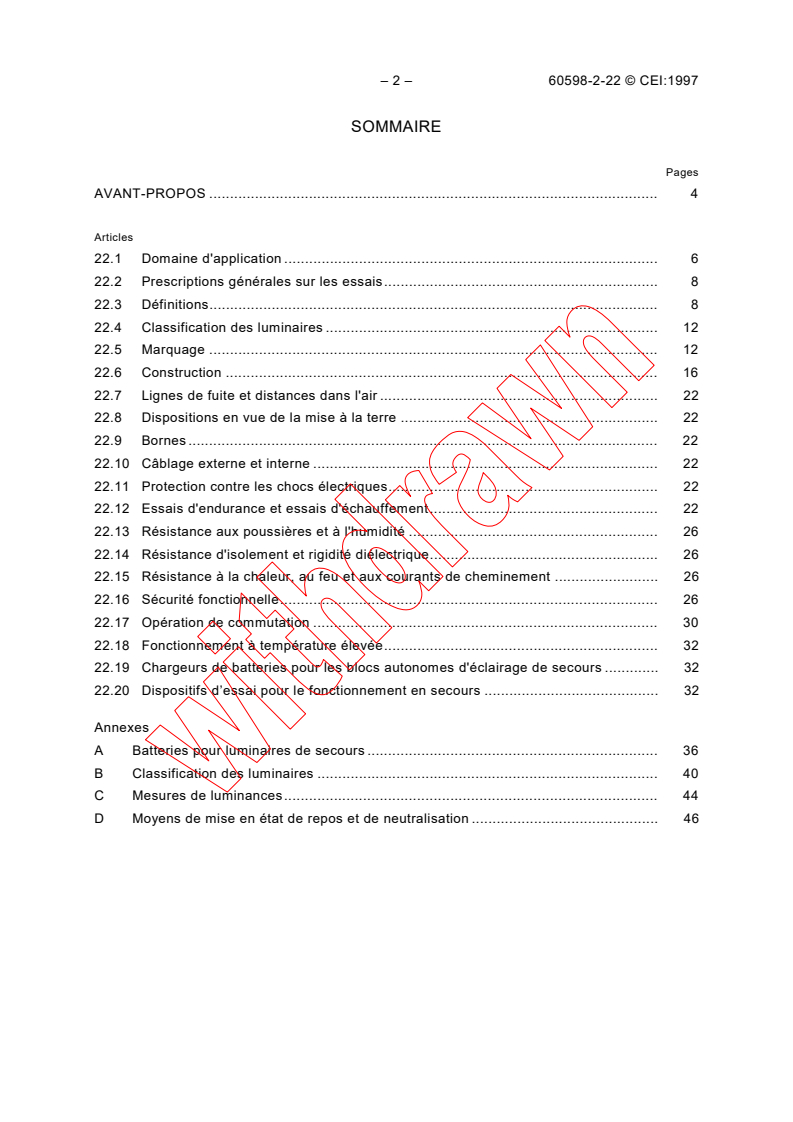
IEC 60598-2-22:1997 - Luminaires - Part 2-22: Particular requirements - Luminaires for emergency lighting Released:8/20/1997
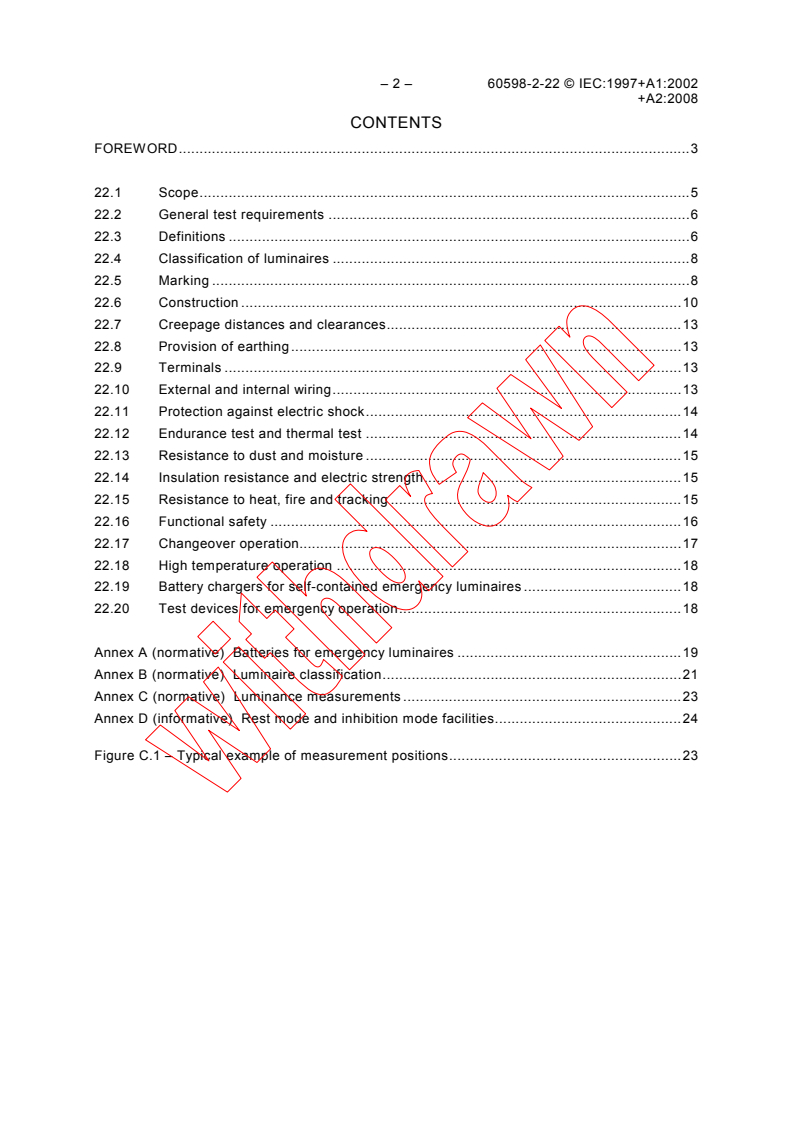
IEC 60598-2-22:1997+AMD1:2002+AMD2:2008 CSV - Luminaires - Part 2-22: Particular requirements - Luminaires for emergency lighting Released:4/14/2008
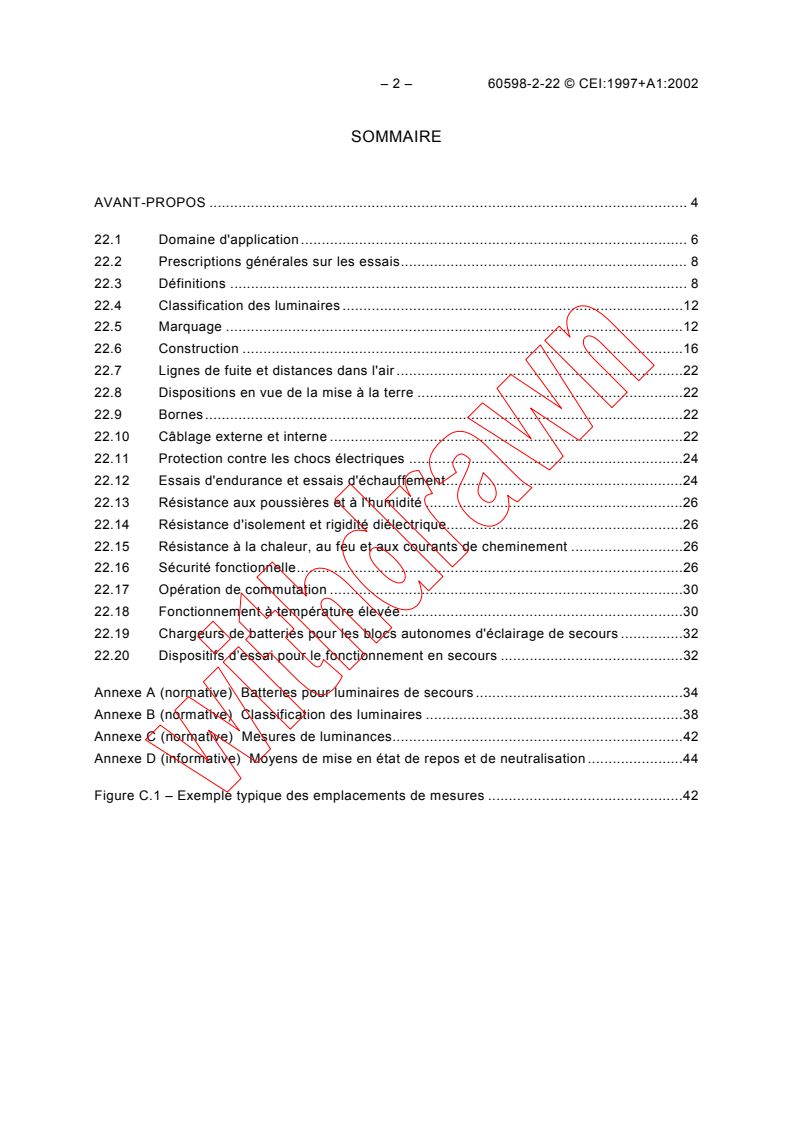
IEC 60598-2-22:1997+AMD1:2002 CSV - Luminaires - Part 2-22: Particular requirements - Luminaires for emergency lighting Released:8/22/2002
Overview
IEC 60598-2-22:1997 defines the particular requirements for luminaires used in emergency lighting systems. This international standard by the International Electrotechnical Commission (IEC) sets out comprehensive specifications for emergency lighting luminaires powered by electrical light sources, including tungsten filament, fluorescent, and other discharge lamps, connected to emergency power supplies not exceeding 1,000 V. It applies to luminaires designed to provide illumination during power failures ensuring safety and continuity in buildings and facilities.
This standard supplements the general requirements outlined in IEC 60598-1 and focuses specifically on the additional safety, performance, and functional criteria needed for emergency lighting luminaires. Emergency lighting covered includes emergency escape lighting, high-risk task-area lighting, and standby lighting, vital for occupant safety in emergencies.
Key Topics
Scope and Application:
- Covers emergency luminaires with lamps powered by emergency supplies ≤ 1,000 V.
- Includes control gears with additional features such as remote controls, indicators, and changeover devices.
Definitions:
- Emergency lighting types such as maintained and non-maintained luminaires, combined luminaires (normal and emergency lamps), self-contained, centrally supplied, compound self-contained, and satellite emergency luminaires.
- Differentiation among emergency lighting roles: escape lighting, standby lighting, high-risk task-area lighting.
Construction Requirements:
- Protection against electric shock, dust, moisture, heat, fire, and mechanical stress.
- Specifics on creepage distances, clearances, earthing provisions, terminals, wiring, and functional safety.
Testing Procedures:
- Endurance, thermal, insulation resistance, electric strength, and resistance to environmental factors.
- Functional testing of changeover operations between normal and emergency supplies.
- Performance measurements such as luminance and battery performance.
Control Units & Batteries:
- Control units integrating supply changeover, battery charging, and test functions must comply with IEC 60924.
- Normative annexes cover battery types, classification schemes, and luminaire luminance measurement methods.
Applications
IEC 60598-2-22 is essential for manufacturers, designers, and safety engineers involved with:
- Emergency lighting systems in commercial, industrial, and public buildings ensuring safe evacuation routes during power outages.
- High-risk task environment lighting where continuity of illumination is critical to safely shut down machinery or processes.
- Installation and maintenance of self-contained and centrally supplied emergency luminaires, including integration with building safety and fire alarm systems.
- Quality control and certification procedures to verify compliance with international safety and performance benchmarks.
- Development of lighting products with remote monitoring and test capabilities to maintain emergency readiness at all times.
This standard ensures luminaires meet stringent safety and durability requirements, conforming to global electrical safety practices, thereby helping reduce risks during emergencies and support life-saving illumination.
Related Standards
- IEC 60598-1: General requirements and tests for luminaires.
- IEC 60924: Requirements for DC supplied electronic ballasts in fluorescent lamps.
- IEC 60073: Man-machine interface coding for marking and indication.
- IEC 60364-5-56: Electrical installations of buildings - Safety services.
- IEC 60742: Isolation transformers including safety transformers.
- ISO 3864: Safety colours and safety signs for visual safety communication.
- Additional related standards cover components like batteries (IEC 60896, IEC 61056) and starters for lamps (IEC 60155).
Together, these standards form a comprehensive framework that supports the design, testing, and application of emergency lighting luminaires to ensure enhanced safety and compliance with international regulations.
Keywords: IEC 60598-2-22, emergency lighting luminaires, emergency lighting standards, safety lighting, maintained emergency lighting, non-maintained luminaires, emergency power supply, lamp controlgear, luminaires for emergency use, electrical safety standards, IEC luminaires, emergency lighting test requirements, luminaires design, lighting for evacuation.
Relations
- Effective Date
- 05-Sep-2023
- Effective Date
- 05-Sep-2023
- Effective Date
- 05-Sep-2023
Buy Documents
IEC 60598-2-22:1997 - Luminaires - Part 2-22: Particular requirements - Luminaires for emergency lighting Released:8/20/1997
IEC 60598-2-22:1997+AMD1:2002+AMD2:2008 CSV - Luminaires - Part 2-22: Particular requirements - Luminaires for emergency lighting Released:4/14/2008
IEC 60598-2-22:1997+AMD1:2002 CSV - Luminaires - Part 2-22: Particular requirements - Luminaires for emergency lighting Released:8/22/2002
Get Certified
Connect with accredited certification bodies for this standard

IMQ S.p.A. (Certification)
Italian electrical product certification.

SLG Prüf- und Zertifizierungs GmbH
German testing and certification body.

UL Solutions
Global safety science company with testing, inspection and certification.
Sponsored listings
Frequently Asked Questions
IEC 60598-2-22:1997 is a standard published by the International Electrotechnical Commission (IEC). Its full title is "Luminaires - Part 2-22: Particular requirements - Luminaires for emergency lighting". This standard covers: Specifies requirements for emergency lighting luminaires for use with tungsten filament fluorescent and other discharge lamps on energency power supplies not exceeding 1 000 V.
Specifies requirements for emergency lighting luminaires for use with tungsten filament fluorescent and other discharge lamps on energency power supplies not exceeding 1 000 V.
IEC 60598-2-22:1997 is classified under the following ICS (International Classification for Standards) categories: 29.140.40 - Luminaires. The ICS classification helps identify the subject area and facilitates finding related standards.
IEC 60598-2-22:1997 has the following relationships with other standards: It is inter standard links to IEC 60598-2-22:1997/AMD2:2008, IEC 60598-2-22:1997/AMD1:2002, IEC 60598-2-22:2014. Understanding these relationships helps ensure you are using the most current and applicable version of the standard.
IEC 60598-2-22:1997 is available in PDF format for immediate download after purchase. The document can be added to your cart and obtained through the secure checkout process. Digital delivery ensures instant access to the complete standard document.
Standards Content (Sample)
NORME
CEI
INTERNATIONALE
IEC
60598-2-22
INTERNATIONAL
Troisième édition
STANDARD
Third edition
1997-08
Luminaires –
Partie 2-22:
Règles particulières –
Luminaires pour éclairage de secours
Luminaires –
Part 2-22:
Particular requirements –
Luminaires for emergency lighting
Numéro de référence
Reference number
CEI/IEC 60598-2-22: 1997
Numéros des publications Numbering
Les publications de la CEI sont numérotées à partir de As from the 1st January 1997 all IEC publications are
60000 dès le 1er janvier 1997. issued with a designation in the 60000 series.
Publications consolidées Consolidated publications
Les versions consolidées de certaines publications de Consolidated versions of some IEC publications
la CEI incorporant amendements sont disponibles. Par including amendments are available. For example,
exemple, les numéros d’édition 1.0, 1.1 et 1.2 edition numbers 1.0, 1.1 and 1.2 refer, respectively, to
indiquent respectivement la publication de base, la the base publication, the base publication
publication de base incorporant l’amendement 1, et la incorporating amendment 1 and the base publication
publication de base incorporant les amendements 1 incorporating amendments 1 and 2.
et 2.
Validité de la présente publication Validity of this publication
Le contenu technique des publications de la CEI est The technical content of IEC publications is kept under
constamment revu par la CEI afin qu'il reflète l'état constant review by the IEC, thus ensuring that the
actuel de la technique. content reflects current technology.
Des renseignements relatifs à la date de Information relating to the date of the reconfirmation of
reconfirmation de la publication sont disponibles dans the publication is available in the IEC catalogue.
le Catalogue de la CEI.
Les renseignements relatifs à ces révisions, à l'établis- Information on the revision work, the issue of revised
sement des éditions révisées et aux amendements editions and amendments may be obtained from
peuvent être obtenus auprès des Comités nationaux de IEC National Committees and from the following
la CEI et dans les documents ci-dessous: IEC sources:
• Bulletin de la CEI • IEC Bulletin
• Annuaire de la CEI • IEC Yearbook
Accès en ligne* On-line access*
• Catalogue des publications de la CEI • Catalogue of IEC publications
Publié annuellement et mis à jour régulièrement Published yearly with regular updates
(Accès en ligne)* (On-line access)*
Terminologie, symboles graphiques Terminology, graphical and letter
et littéraux symbols
En ce qui concerne la terminologie générale, le lecteur For general terminology, readers are referred to
se reportera à la CEI 60050: Vocabulaire Electro- IEC 60050: International Electrotechnical Vocabulary
technique International (VEI). (IEV).
Pour les symboles graphiques, les symboles littéraux For graphical symbols, and letter symbols and signs
et les signes d'usage général approuvés par la CEI, le approved by the IEC for general use, readers are
lecteur consultera la CEI 60027: Symboles littéraux à referred to publications IEC 60027: Letter symbols to
utiliser en électrotechnique, la CEI 60417: Symboles be used in electrical technology, IEC 60417: Graphical
symbols for use on equipment. Index, survey and
graphiques utilisables sur le matériel. Index, relevé et
compilation des feuilles individuelles, et la CEI 60617: compilation of the single sheets and IEC 60617:
Symboles graphiques pour schémas. Graphical symbols for diagrams.
Publications de la CEI établies par IEC publications prepared by the same
le même comité d'études technical committee
L'attention du lecteur est attirée sur les listes figurant The attention of readers is drawn to the end pages of
à la fin de cette publication, qui énumèrent les this publication which list the IEC publications issued
publications de la CEI préparées par le comité by the technical committee which has prepared the
d'études qui a établi la présente publication. present publication.
* Voir adresse «site web» sur la page de titre. * See web site address on title page.
NORME
CEI
INTERNATIONALE
IEC
60598-2-22
INTERNATIONAL
Troisième édition
STANDARD
Third edition
1997-08
Luminaires –
Partie 2-22:
Règles particulières –
Luminaires pour éclairage de secours
Luminaires –
Part 2-22:
Particular requirements –
Luminaires for emergency lighting
IEC 1997 Droits de reproduction réservés Copyright - all rights reserved
Aucune partie de cette publication ne peut être reproduite ni No part of this publication may be reproduced or utilized in
utilisée sous quelque forme que ce soit et par aucun any form or by any means, electronic or mechanical,
procédé, électronique ou mécanique, y compris la photo- including photocopying and microfilm, without permission in
copie et les microfilms, sans l'accord écrit de l'éditeur. writing from the publisher.
International Electrotechnical Commission 3, rue de Varembé Geneva, Switzerland
Telefax: +41 22 919 0300 e-mail: inmail@iec.ch IEC web site http: //www.iec.ch
CODE PRIX
Commission Electrotechnique Internationale
T
PRICE CODE
International Electrotechnical Commission
Pour prix, voir catalogue en vigueur
For price, see current catalogue
– 2 – 60598-2-22 © CEI:1997
SOMMAIRE
Pages
AVANT-PROPOS . 4
Articles
22.1 Domaine d'application . 6
22.2 Prescriptions générales sur les essais. 8
22.3 Définitions. 8
22.4 Classification des luminaires . 12
22.5 Marquage . 12
22.6 Construction . 16
22.7 Lignes de fuite et distances dans l'air . 22
22.8 Dispositions en vue de la mise à la terre . 22
22.9 Bornes . 22
22.10 Câblage externe et interne . 22
22.11 Protection contre les chocs électriques. 22
22.12 Essais d'endurance et essais d'échauffement. 22
22.13 Résistance aux poussières et à l'humidité . 26
22.14 Résistance d'isolement et rigidité diélectrique. 26
22.15 Résistance à la chaleur, au feu et aux courants de cheminement . 26
22.16 Sécurité fonctionnelle. 26
22.17 Opération de commutation . 30
22.18 Fonctionnement à température élevée. 32
22.19 Chargeurs de batteries pour les blocs autonomes d'éclairage de secours . 32
22.20 Dispositifs d’essai pour le fonctionnement en secours . 32
Annexes
A Batteries pour luminaires de secours . 36
B Classification des luminaires . 40
C Mesures de luminances. 44
D Moyens de mise en état de repos et de neutralisation . 46
60598-2-22 © IEC:1997 – 3 –
CONTENTS
Page
FOREWORD . 5
Clause
22.1 Scope . 7
22.2 General test requirements . 9
22.3 Definitions. 9
22.4 Classification of luminaires. 13
22.5 Marking. 13
22.6 Construction . 17
22.7 Creepage distances and clearances . 23
22.8 Provision of earthing . 23
22.9 Terminals. 23
22.10 External and internal wiring . 23
22.11 Protection against electric shock . 23
22.12 Endurance test and thermal test . 23
22.13 Resistance to dust and moisture. 27
22.14 Insulation resistance and electric strength . 27
22.15 Resistance to heat, fire and tracking. 27
22.16 Functional safety. 27
22.17 Changeover operation . 31
22.18 High temperature operation. 33
22.19 Battery chargers for self-contained emergency luminaires . 33
22.20 Test devices for emergency operation . 33
Annexes
A Batteries for emergency luminaires . 37
B Luminaire classification. 41
C Luminance measurements . 45
D Rest mode and inhibition mode facilities. 47
– 4 – 60598-2-22 © CEI:1997
COMMISSION ÉLECTROTECHNIQUE INTERNATIONALE
_________
LUMINAIRES –
Partie 2-22: Règles particulières –
Luminaires pour éclairage de secours
AVANT-PROPOS
1) La CEI (Commission Electrotechnique Internationale) est une organisation mondiale de normalisation composée
de l'ensemble des comités électrotechniques nationaux (Comités nationaux de la CEI). La CEI a pour objet de
favoriser la coopération internationale pour toutes les questions de normalisation dans les domaines de
l'électricité et de l'électronique. A cet effet, la CEI, entre autres activités, publie des Normes internationales.
Leur élaboration est confiée à des comités d'études, aux travaux desquels tout Comité national intéressé par le
sujet traité peut participer. Les organisations internationales, gouvernementales et non gouvernementales, en
liaison avec la CEI, participent également aux travaux. La CEI collabore étroitement avec l'Organisation
Internationale de Normalisation (ISO), selon des conditions fixées par accord entre les deux organisations.
2) Les décisions ou accords officiels de la CEI concernant les questions techniques représentent, dans la mesure
du possible un accord international sur les sujets étudiés, étant donné que les Comités nationaux intéressés
sont représentés dans chaque comité d’études.
3) Les documents produits se présentent sous la forme de recommandations internationales. Ils sont publiés
comme normes, rapports techniques ou guides et agréés comme tels par les Comités nationaux.
4) Dans le but d'encourager l'unification internationale, les Comités nationaux de la CEI s'engagent à appliquer de
façon transparente, dans toute la mesure possible, les Normes internationales de la CEI dans leurs normes
nationales et régionales. Toute divergence entre la norme de la CEI et la norme nationale ou régionale
correspondante doit être indiquée en termes clairs dans cette dernière.
5) La CEI n’a fixé aucune procédure concernant le marquage comme indication d’approbation et sa responsabilité
n’est pas engagée quand un matériel est déclaré conforme à l’une de ses normes.
6) L’attention est attirée sur le fait que certains des éléments de la présente Norme internationale peuvent faire
l’objet de droits de propriété intellectuelle ou de droits analogues. La CEI ne saurait être tenue pour
responsable de ne pas avoir identifié de tels droits de propriété et de ne pas avoir signalé leur existence.
La Norme internationale CEI 60598-2-22 a été établie par le sous-comité 34D: Luminaires, du
comité d'études 34 de la CEI: Lampes et équipements associés.
Cette troisième édition annule et remplace la deuxième édition parue en 1990, dont elle
constitue une révision technique.
Cette norme doit être lue conjointement avec la CEI 60598-1.
Le texte de cette norme est issu des documents suivants:
FDIS Rapport de vote
34D/462/FDIS 34D/464/RVD
Le rapport de vote indiqué dans le tableau ci-dessus donne toute information sur le vote ayant
abouti à l'approbation de cette norme.
Les annexes A, B et C font partie intégrante de cette norme.
L'annexe D est donnée uniquement à titre d'information.
60598-2-22 © IEC:1997 – 5 –
INTERNATIONAL ELECTROTECHNICAL COMMISSION
_________
LUMINAIRES –
Part 2-22: Particular requirements –
Luminaires for emergency lighting
FOREWORD
1) The IEC (International Electrotechnical Commission) is a worldwide organization for standardization comprising
all national electrotechnical committees (IEC National Committees). The object of the IEC is to promote
international co-operation on all questions concerning standardization in the electrical and electronic fields. To
this end and in addition to other activities, the IEC publishes International Standards. Their preparation is
entrusted to technical committees; any IEC National Committee interested in the subject dealt with may
participate in this preparatory work. International, governmental and non-governmental organizations liaising
with the IEC also participate in this preparation. The IEC collaborates closely with the International Organization
for Standardization (ISO) in accordance with conditions determined by agreement between the two
organizations.
2) The formal decisions or agreements of the IEC on technical matters express, as nearly as possible, an
international consensus of opinion on the relevant subjects since each technical committee has representation
from all interested National Committees.
3) The documents produced have the form of recommendations for international use and are published in the form
of standards, technical reports or guides and they are accepted by the National Committees in that sense.
4) In order to promote international unification, IEC National Committees undertake to apply IEC International
Standards transparently to the maximum extent possible in their national and regional standards. Any
divergence between the IEC Standard and the corresponding national or regional standard shall be clearly
indicated in the latter.
5) The IEC provides no marking procedure to indicate its approval and cannot be rendered responsible for any
equipment declared to be in conformity with one of its standards.
6) Attention is drawn to the possibility that some of the elements of this International Standard may be the subject
of patent rights. The IEC shall not be held responsible for identifying any or all such patent rights.
International Standard IEC 60598-2-22 has been prepared by subcommittee 34D: Luminaires,
of IEC technical committee 34: Lamps and related equipment.
This third edition cancels and replaces the second edition published in 1990 and constitutes a
technical revision.
This standard is to be read in conjunction with IEC 60598-1.
The text of this standard is based on the following documents:
FDIS Report on voting
34D/462/FDIS 34D/464/RVD
Full information on the voting for the approval of this standard can be found in the report on
voting indicated in the above table.
Annexes A, B and C form an integral part of this standard.
Annex D is for information only.
– 6 – 60598-2-22 © CEI:1997
LUMINAIRES –
Partie 2-22: Règles particulières –
Luminaires pour éclairage de secours
22.1 Domaine d'application
La présente section de la CEI 60598-2 spécifie les prescriptions applicables aux luminaires
pour éclairage de secours à utiliser avec des sources lumineuses électriques, pour des
tensions d'alimentation de secours ne dépassant pas 1 000 V.
La présente section ne traite pas des «luminaires antidéflagrants» pour éclairage de secours
(voir CEI 60079) et ne traite pas des effets d'une chute de tension de l'alimentation normale
sur les luminaires incorporant des lampes à décharge de haute pression.
Cette section inclut également les tests et les prescriptions appropriés qui doivent être réalisés
en conformité avec la CEI 60924, pour les appareillages d’alimentation qui incorporent des
équipements additionnels tels que dispositifs de commande à distance, voyants, dispositifs de
commutation, etc.
22.1.1 Références normatives
Les documents normatifs suivants contiennent des dispositions qui, par suite de la référence
qui y est faite, constituent des dispositions valables pour la présente partie des Directives
ISO/CEI. Pour les références datées, les amendements ultérieurs ou les révisions de ces
publications ne s'appliquent pas. Toutefois, les parties prenantes aux accords fondés sur la
présente partie des Directives ISO/CEI sont invitées à rechercher la possibilité d'appliquer les
éditions les plus récentes des documents normatifs indiqués ci-après. Pour les références non
datées, la dernière édition du document normatif en référence s'applique. Les membres de
l'ISO et de la CEI possèdent le registre des Normes internationales en vigueur.
CEI 60073, Principes fondamentaux et de sécurité pour l'interface homme-machine, le
marquage et l'identification – Principes de codage pour les dispositifs indicateurs et les
organes de commande
CEI 60079, Matériel électrique pour atmosphères explosives gazeuses
CEI 60155, Interrupteurs d'amorçage à lueur pour lampes à fluorescence (starters)
CEI 60285, Accumulateurs alcalins – Eléments individuels cylindriques rechargeables étanches
au nickel-cadmium
CEI 60364-5-56, Installations électriques des bâtiments – Partie 5: Choix et mise en oeuvre
des matériel électriques – Chapitre 56: Services de sécurité
CEI 60598-1, Luminaires – Partie 1: Prescriptions générales et essais
CEI 60742, Transformateurs de séparation des circuits et transformateurs de sécurité – Règles
CEI 60896-2, Batteries stationnaires au plomb – Prescriptions générales et méthodes d’essais
– Partie 2: Batteries étanches à soupape
CEI 60924, Ballasts électroniques alimentés en courant continu pour lampes tubulaires à
fluorescence – Prescriptions générales et prescriptions de sécurité
60598-2-22 © IEC:1997 – 7 –
LUMINAIRES –
Part 2-22: Particular requirements –
Luminaires for emergency lighting
22.1 Scope
This section of IEC 60598-2 specifies requirements for emergency lighting luminaires for use
with electrical light sources on emergency power supplies not exceeding 1 000 V.
This section does not cover "explosion-proof" luminaires for emergency lighting (see
IEC 60079) and does not cover the effects of non-emergency voltage reductions on luminaires
incorporating high-pressure discharge lamps.
This section also includes relevant requirements and tests that shall be conducted and
complied with for control gears, as specified in IEC 60924, that incorporate additional facilities
such as remote control devices, indicators, changeover devices, etc.
22.1.1 Normative references
The following normative documents contain provisions which, through reference in this text,
constitute provisions of this part of the ISO/IEC Directives. For dated references, subsequent
amendments to, or revisions of, any of these publications do not apply. However, parties to
agreements based on this part of the ISO/IEC Directives are encouraged to investigate the
possibility of applying the most recent editions of the normative documents indicated below.
For undated references, the latest edition of the normative document referred to applies.
Members of ISO and IEC maintain registers of currently valid International Standards.
IEC 60073, Basic and safety principles for man-machine interface, marking and identification –
Coding principles for indication devices and actuators
IEC 60079, Electrical apparatus for explosive gas atmospheres
IEC 60155, Glow-starters for fluorescent lamps
IEC 60285, Alkaline secondary cells and batteries – Sealed nickel-cadmium cylindrical
rechargeable single cells
IEC 60364-5-56, Electrical installations of buildings – Part 5: Selection and erection of
electrical equipment – Chapter 56: Safety services
IEC 60598-1, Luminaires – Part 1: General requirements and tests
IEC 60742, Isolating transformers and safety isolating transformers – Requirements
IEC 60896-2, Stationery lead-acid batteries – General requirements and test methods – Part 2:
Valve regulated types
IEC 60924, D.C. supplied electronic ballasts for tubular fluorescent lamps – General and safety
requirements
– 8 – 60598-2-22 © CEI:1997
CEI 60928, Appareils auxiliaires pour lampes, ballasts électroniques alimentés en courant
alternatif pour lampes tubulaires à fluorescence – Prescriptions générales et de sécurité
CEI 61046, Convertisseurs abaisseurs électroniques alimentés en courant continu ou alternatif
pour lampes à incandescence – Prescriptions générales et de sécurité
CEI 61056-1, Eléments et batteries au plomb portatifs (Types à soupapes) – Partie 1:
Prescriptions générales et caractéristiques fonctionnelles – Méthodes d’essai
ISO 3864, Couleurs et signaux de sécurité
22.2 Prescriptions générales sur les essais
Les dispositions de la section 0 de la CEI 60598-1 doivent s’appliquer. Les essais dont le détail
est indiqué dans chaque section appropriée de la CEI 60598-1 doivent être exécutés dans
l'ordre spécifié dans la présente section de la CEI 60598-2.
Lors de l'essai de luminaires de secours combinés selon les prescriptions de la présente
section, les essais doivent être limités aux seuls éléments du luminaire qui concourent à
assurer l'éclairage de secours. Les composants et éléments du luminaire qui sont
exclusivement conçus pour assurer l'éclairage normal doivent être soumis aux essais selon les
prescriptions de la section correspondante de la CEI 60598-2 (par exemple, si le luminaire est
encastré, il doit être essayé suivant les prescriptions de la section traitant des luminaires
encastrés).
Si certains éléments d'un luminaire d'éclairage de secours sont à proximité (moins de 1 m de
câble) de la partie principale du luminaire, tous les éléments de celui-ci, y compris les moyens
d'interconnexion, doivent satisfaire aux prescriptions correspondantes de la présente section.
22.3 Définitions
Pour les besoins de la présente section, les définitions de la section 1 de la CEI 60598-1
s’appliquent en même temps que les définitions des publications correspondantes de la CEI
sur l'éclairage et les définitions suivantes:
22.3.1 éclairage de secours: Eclairage utilisé lorsque l'alimentation de l'éclairage normal est
défaillante; il comprend l'éclairage d’évacuation de secours, l’éclairage des emplacements de
travaux dangereux ainsi que l'éclairage de remplacement.
22.3.2 éclairage de sécurité: Partie de l'éclairage de secours qui fournit un éclairage pour la
sécurité des personnes quittant une zone ou essayant de terminer une opération dangereuse
avant d’évacuer une zone.
22.3.3 éclairage de remplacement: Partie de l'éclairage de secours qui permet aux activités
normales de se poursuivre de manière pratiquement inchangée.
22.3.4 éclairage des emplacements de travaux dangereux: Partie de l’éclairage de
secours qui est fourni afin d’assurer la sécurité des personnes impliquées dans une situation
ou un procédé potentiellement dangereux et permettre d’arrêter une procédure de manière
appropriée à la sécurité de l’opérateur et des occupants des locaux.
22.3.5 luminaire pour éclairage de secours du type permanent: Luminaire dans lequel les
lampes d'éclairage de secours sont alimentées en tout temps, lorsque l'éclairage normal ou
l'éclairage de secours est exigé.
60598-2-22 © IEC:1997 – 9 –
IEC 60928, Auxiliaries for lamps – A.C. supplied electronic ballasts for tubular fluorescent
lamps – General and safety requirements
IEC 61046, D.C. or a.c. supplied electric step-down convertors for filament lamps – General
and safety requirements
IEC 61056-1, Portable lead-acid cells and batteries (valve regulated types) – Part 1: General
requirements, functional characteristics – Methods of test
ISO 3864, Safety colours and safety signs
22.2 General test requirements
The provisions of section 0 of IEC 60598-1 shall apply. The tests described in each appropriate
section of IEC 60598-1 shall be carried out in the order listed in this section of IEC 60598-2.
When testing combined emergency luminaires according to the requirements of this section,
the tests shall be limited to those parts of the luminaire which are involved with providing
emergency lighting. The components and parts of the luminaires designed to provide only
normal lighting shall be subjected to the tests according to the requirements of the relevant
section of IEC 60598-2 (for example, if the luminaire is recessed, it shall be tested according to
the requirements of the section dealing with recessed luminaires).
If some elements of an emergency luminaire are adjacent (within 1 m cable length) to the main
part of the luminaire all the elements of the luminaire, including the means of inter-connection,
shall satisfy the relevant requirements of this section.
22.3 Definitions
For the purpose of this section, the definitions of section 1 of IEC 60598-1, in addition to the
definitions of the relevant IEC lighting publications and the following definitions apply:
22.3.1 emergency lighting: Lighting for use when the supply to the normal lighting fails; it
includes emergency escape lighting, high-risk task-area lighting and standby lighting.
22.3.2 emergency escape lighting: That part of emergency lighting that provides illumination
for the safety of people leaving an area or attempting to terminate a dangerous process before
vacating an area.
22.3.3 standby lighting: That part of emergency lighting that enables normal activities to
continue substantially unchanged.
22.3.4 high-risk task-area lighting: The part of emergency lighting provided to ensure the
safety of people involved in a potentially dangerous process or situation and to enable proper
shut-down procedures for the safety of the operator and occupants of the premises.
22.3.5 maintained emergency luminaire: Luminaire in which the emergency lighting lamps
are energized at all times when normal or emergency lighting is required.
– 10 – 60598-2-22 © CEI:1997
22.3.6 luminaire pour éclairage de secours du type non permanent: Luminaire dans
lequel les lampes d’éclairage de secours sont en fonctionnement uniquement lorsque
l'alimentation de l'éclairage normal est défaillante.
22.3.7 luminaire mixte pour éclairage de secours: Luminaire contenant deux ou plusieurs
lampes, l'une au moins étant alimentée par le circuit d'éclairage de secours et les autres à
partir du réseau d'éclairage normal. Un luminaire mixte pour éclairage de secours peut être
permanent ou non permanent.
22.3.8 bloc autonome d'éclairage de secours: Luminaire fournissant un éclairage de
secours du type permanent ou non permanent, dans lequel tous les éléments, tels que la
batterie d'accumulateurs, la lampe, l'ensemble de commande et les dispositifs d’essais et de
contrôle, s'ils existent, sont contenus dans le luminaire ou à proximité de celui-ci (c’est-à-dire
moins de 1 m de câble).
22.3.9 luminaire d’éclairage de secours alimenté par source centrale: Luminaire pour
fonctionnement permanent ou non permanent qui est alimenté à partir d’une source centrale de
secours qui n'est pas incorporée dans le luminaire.
22.3.10 bloc autonome composé pour l'éclairage de secours: Bloc autonome d'éclairage
fournissant l'éclairage de secours permanent ou non permanent ainsi que l'alimentation de
secours pour le fonctionnement d’un bloc satellite.
22.3.11 luminaire satellite d’éclairage de secours: Luminaire assurant un fonctionnement
permanent ou non permanent, alimenté par un bloc autonome composé pour l'éclairage de
secours, qui lui est associé.
22.3.12 ensemble de commande: Un ou plusieurs ensembles comprenant un système de
commutation d'alimentation, un dispositif de charge de batterie et, le cas échéant, des moyens
d’essais.
NOTE – Dans le cas des luminaires pour lampe tubulaire à fluorescence, il est admis que cet ensemble
contienne aussi un appareillage d’alimentation pour la lampe.
22.3.13 défaillance d'alimentation normale: Condition dans laquelle l'éclairage normal ne
peut plus assurer un niveau minimal d'éclairement aux fins d'évacuation d'urgence et lorsqu’il
est recommandé que l'éclairage de secours entre en fonctionnement.
22.3.14 flux lumineux assigné d’un luminaire d’éclairage de secours: Flux lumineux
déclaré par le fabricant du luminaire, 60 s après la défaillance de l'alimentation normale (ou
0,25 s pour les luminaires d’éclairage des emplacements de travaux dangereux) et maintenu
jusqu'à la fin de la durée assignée de fonctionnement.
22.3.15 durée assignée de fonctionnement de secours: Intervalle de temps, déclaré par le
fabricant, pendant lequel le flux lumineux assigné de secours est émis.
22.3.16 état de veille: Etat dans lequel un bloc autonome d'éclairage de secours est prêt à
fonctionner en état de fonctionnement de secours, pendant que le réseau normal est alimenté.
Dans le cas d'une défaillance de l'alimentation normale, le bloc autonome passe alors
automatiquement à l'état de secours.
22.3.17 état de fonctionnement de secours: Etat dans lequel un bloc autonome d’éclairage
de secours assure l’éclairage, étant alimenté par sa source interne d’énergie électrique lorsque
l’alimentation normale est défaillante.
22.3.18 état de repos: Etat d’un bloc autonome d’éclairage de secours qui a été éteint
intentionnellement lorsque l’alimentation normale est interrompue et qui, dans le cas du retour
de celle-ci, revient automatiquement à l’état de veille.
60598-2-22 © IEC:1997 – 11 –
22.3.6 non-maintained emergency luminaire: Luminaire in which the emergency lighting
lamps are in operation only when the supply to the normal lighting fails.
22.3.7 combined emergency luminaire: Luminaire containing two or more lamps, at least
one of which is energized from the emergency lighting supply and the others from the normal
lighting supply. A combined emergency luminaire is either maintained or non-maintained.
22.3.8 self-contained emergency luminaire: Luminaire providing maintained or non-
maintained emergency lighting in which all the elements, such as the battery, the lamp, the
control unit and the test and monitoring facilities, where provided, are contained within the
luminaire or adjacent to it (that is, within 1 m cable length).
22.3.9 centrally supplied emergency luminaire: Luminaire for maintained or non-
maintained operation which is energized from a central emergency power system that is not
contained within the luminaire.
22.3.10 compound self-contained emergency luminaire: Self-contained luminaire
providing maintained or non-maintained emergency lighting and also providing emergency
supply for operating a satellite luminaire.
22.3.11 satellite emergency luminaire: Luminaire for maintained or non-maintained
operation which derives emergency operation supply from an associated compound self-
contained emergency luminaire.
22.3.12 control unit: Unit or units comprising a supply changeover system, a battery
charging device and, where appropriate, a means for testing.
NOTE – For tubular fluorescent lamp luminaires, this unit may also contain the lamp controlgear.
22.3.13 normal supply failure: Condition in which the normal lighting can no longer provide
a minimum illuminance for emergency escape purposes and when the emergency lighting
should become operative.
22.3.14 emergency luminaire rated lumen output: Lumen output as claimed by the
luminaire manufacturer 60 s (0,25 s for high-risk task-area lighting luminaires) after failure of
the normal supply, and continuously to the end of rated duration of operation.
22.3.15 rated duration of emergency operation: Time, as claimed by the manufacturer, that
the rated emergency lumen output is provided.
22.3.16 normal mode: State of a self-contained emergency luminaire that is ready to operate
in emergency mode while the normal supply is on. In the case of a normal supply failure, the
self-contained luminaire automatically changes over to the emergency mode.
22.3.17 emergency mode: State of a self-contained emergency luminaire that provides
lighting when energized by its internal power source, the normal supply having failed.
22.3.18 rest mode: State of a self-contained emergency luminaire that has been intentionally
extinguished while the normal supply is off and that, in the event of restoration of the normal
supply, automatically reverts to normal mode.
– 12 – 60598-2-22 © CEI:1997
22.3.19 taux de surcharge maximale: Taux de charge maximale en continu qu’il est permis
d’appliquer à une batterie complètement chargée.
22.3.20 moyen neutralisateur à distance: Moyens pour neutraliser à distance un luminaire
associé à un système d’éclairage de secours.
22.3.21 état de neutralisation à distance: Etat d’un bloc autonome d’éclairage de secours
dont le fonctionnement est neutralisé à l’aide d’une commande à distance pendant que
l’alimentation est normale et qui, dans le cas d’une défaillance de l’alimentation normale, ne
passe pas en état de secours.
22.4 Classification des luminaires
Les luminaires pour éclairage de secours doivent être classés en conformité avec les
dispositions de la section 2 de la CEI 60598-1, excepté que les éclairages de secours doivent
être classés de façon appropriée à un montage direct sur des surfaces normalement
inflammables (marquage F).
Les luminaires d’éclairage de secours doivent également être classés selon l’annexe B.
22.5 Marquage
Les dispositions de la section 3 de la CEI 60598-1 doivent s’appliquer en même temps que les
prescriptions de 22.5.1 à 22.5.17 ci-dessous.
22.5.1 Les luminaires doivent être clairement marqués avec la tension nominale ou la(les)
plage(s) des tensions.
22.5.2 Les luminaires doivent être clairement marqués avec les caractéristiques de leur
classification selon 22.4 (voir annexe B).
22.5.3 Les détails de la lampe de remplacement doivent être clairement marqués sur les
luminaires dans un endroit qui est visible lors du remplacement de la lampe. Cela assure que
le flux lumineux de secours assigné peut être atteint.
NOTE – Il est admis que l’information concernant la lampe de remplacement correcte comporte le nombre,
le type, la tension nominale, la puissance nominale, etc.
22.5.4 En plus du marquage t , lorsque cela s'applique, la gamme des températures
a
ambiantes doit être marquée ou spécifiée dans la notice d'instruction fournie avec le luminaire.
22.5.5 Les luminaires d’éclairage de secours équipés de fusibles remplaçables et/ou de
lampes témoins remplaçables doivent comporter des indications concernant les
caractéristiques des fusibles et/ou des lampes témoins.
22.5.6 Les dispositifs de vérification destinés à simuler une défaillance de l'alimentation
normale, s'ils existent, doivent être clairement marqués, de manière que le marquage soit
visible lors des essais systématiques.
22.5.7 Les blocs autonomes doivent être clairement marqués avec les indications concernant
le remplacement correct des batteries, y compris le type et la tension assignée de la batterie.
60598-2-22 © IEC:1997 – 13 –
22.3.19 maximum overcharge rate: Maximum continuous charge rate that may be applied to
a fully charged battery.
22.3.20 remote inhibiting facility: Means for inhibiting remotely a luminaire associated with
an emergency lighting system.
22.3.21 remote inhibiting mode: State of a self-contained emergency luminaire which is
inhibited from operating by a remote device while the normal supply is on and in case of a
normal supply failure the luminaire does not change-over to emergency mode.
22.4 Classification of luminaires
Emergency lighting luminaires shall be classified in accordance with the provisions of section 2
of IEC 60598-1 except that all emergency lighting shall be classified as suitable for direct
mounting on normally flammable surfaces (F-marked).
Emergency lighting luminaires shall also be classified as specified in annex B.
22.5 Marking
The provisions of section 3 of IEC 60598-1 shall apply together with the requirements of 22.5.1
to 22.5.17 below.
22.5.1 Luminaires shall be clearly marked with the rated supply voltage or voltage range(s).
22.5.2 Luminaires shall be clearly marked with details of their classification according to 22.4
(see annex B).
22.5.3 Luminaires shall be clearly marked with details of the correct replacement lamp in a
position visible during lamp replacement. This ensures that the rated emergency lumen output
can be achieved.
NOTE – The information relating to correct lamp replacement may include the number, type, rated voltage and
rated wattage, etc.
22.5.4 Where appropriate, in addition to t marking, the range of ambient temperature shall
a
be marked or given in the instruction leaflet supplied with the luminaire.
22.5.5 Emergency luminaires employing replaceable fuses and/or replaceable indicator lamps
shall be marked with the details of fuse ratings and/or details of the indicator lamps.
22.5.6 Test facilities to simulate normal supply failure, where provided, shall be clearly
marked so that the marking is visible during routine testing.
22.5.7 Self-contained luminaires shall be clearly marked with the details of correct battery
replacement including the battery type and rated voltage.
– 14 – 60598-2-22 © CEI:1997
22.5.8 Les batteries des blocs autonomes doivent être marquées avec l'année et le mois ou
l’année et la semaine de fabrication, ainsi que la méthode correcte à suivre pour la mise au
rebut de la batterie.
1)
NOTE – Pour le marquage des informations concernant le remplacement des batteries, voir la CEI 61429 .
L'étiquette de la batterie doit comporter un emplacement afin de permettre le marquage de la
date de mise en service par l'installateur ou l’ingénieur qualifié.
22.5.9 Les luminaires mixtes pour éclairage de secours doivent être marqués avec les
indications relatives au remplacement correct de toutes les lampes. Si des lampes différentes
sont utilisées dans le circuit d'alimentation normal et dans le circuit de secours, les types de
lampes respectifs doivent être clairement identifiés.
Les douilles pour lampes d'éclairage de secours dans les luminaires mixtes doivent être
identifiées par un point vert d'au moins 5 mm de diamètre, qui doit être visible lors du
remplacement des lampes.
22.5.10 Dans la notice d’instructions fournie avec le bloc autonome d’éclairage de secours, le
fabricant doit indiquer que le remplacement des batteries est nécessaire lorsque le bloc
autonome ne satisfait plus à sa durée de fonctionnement assignée.
22.5.11 Dans la notice d'instruction fournie avec le luminaire, le fabricant doit donner des
indications sur les dispositifs de vérification incorporés au luminaire ou des instructions
appropriées si ces dispositifs de vérification sont fournis séparément. Ces instructions doivent
inclure des indications sur les procédures de vérification.
22.5.12 Dans la notice d'instruction fournie avec le luminaire, le fabricant doit donner des
indications concernant les câbles de liaison entre un bloc autonome composé et un bloc
satellite associé. La longueur maximale des câbles qui limite la chute de tension à 3 % doit
être spécifiée.
22.5.13 Dans la notice d'instruction fournie avec le luminaire, le fabricant doit donner des
indications concernant le flux lumineux de secours assigné dans le mode de fonctionnement de
secours.
22.5.14 Dans la notice d’instruction fournie avec les blocs autonomes d’éclairage de secours,
le fabricant doit donner des indications sur tout dispositif qui en modifie le mode de
fonctionnement.
22.5.15 Les données photométriques doivent être disponibles auprès du fabricant
conformément à 22.16.
22.5.16 Toute procédure de préparation normale pour l’utilisation du luminaire doit être
précisée dans les instructions d’installation du fabricant. Cette préparation doit être réalisée
avant d’effectuer les essais de type.
22.5.17 Les marquages exigés en 22.5.1 et 22.5.2 doivent se situer dans une position telle
que l’information puisse être visible après l’installation du luminaire.
NOTE – Pour les luminaires encastrés, il est permis que la présente information soit marquée à l’intérieur du
luminaire afin qu’elle soit visible lorsque la vasque est enlevée.
22.5.18 La conformité de 22.5.1 à 22.5.17 est vérifiée par examen.
__________
1)
CEI 61429: 1995, Marquage des accumulateurs avec le symbole international de recyclage ISO 7000-1135.
60598-2-22 © IEC:1997 – 15 –
22.5.8 In self-contained luminaires, the batteries shall be marked with the year and month or
year and week of manufacture and the correct battery disposal method to be followed.
1)
NOTE – For battery disposal marking information, see IEC 61429 .
Space shall be provided on the battery label to permit the marking, by the installer or
commissioning engineer, of the date of commissioning of the battery.
22.5.9 Combined emergency luminaires shall be marked with details relating to correct lamp
replacement for all lamps. If the lamps used in the emergency circuit and the normal supply
circuit differ, the type shall be clearly identified.
Lampholders for emergency lighting lamps in combined luminaires shall be identified by a
green dot, at least 5 mm in diameter, which shall be visible when replacing the lamp.
22.5.10 In the instruction leaflet supplied with the self-contained emergency luminaire, the
manufacturer shall state that the replacement of batteries is needed when the self-contained
luminaire no longer meets its rated duration of operation.
22.5.11 In the instruction leaflet supplied with the luminaire the manufacturer shall give
...
IEC 60598-2-22
Edition 3.2 2008-04
INTERNATIONAL
STANDARD
NORME
INTERNATIONALE
Luminaires –
Part 2-22: Particular requirements – Luminaires for emergency lighting
Luminaires –
Partie 2-22: Règles particulières – Luminaires pour éclairage de secours
All rights reserved. Unless otherwise specified, no part of this publication may be reproduced or utilized in any form or by
any means, electronic or mechanical, including photocopying and microfilm, without permission in writing from either IEC or
IEC's member National Committee in the country of the requester.
If you have any questions about IEC copyright or have an enquiry about obtaining additional rights to this publication,
please contact the address below or your local IEC member National Committee for further information.
Droits de reproduction réservés. Sauf indication contraire, aucune partie de cette publication ne peut être reproduite
ni utilisée sous quelque forme que ce soit et par aucun procédé, électronique ou mécanique, y compris la photocopie
et les microfilms, sans l'accord écrit de la CEI ou du Comité national de la CEI du pays du demandeur.
Si vous avez des questions sur le copyright de la CEI ou si vous désirez obtenir des droits supplémentaires sur cette
publication, utilisez les coordonnées ci-après ou contactez le Comité national de la CEI de votre pays de résidence.
IEC Central Office
3, rue de Varembé
CH-1211 Geneva 20
Switzerland
Email: inmail@iec.ch
Web: www.iec.ch
About the IEC
The International Electrotechnical Commission (IEC) is the leading global organization that prepares and publishes
International Standards for all electrical, electronic and related technologies.
About IEC publications
The technical content of IEC publications is kept under constant review by the IEC. Please make sure that you have the
latest edition, a corrigenda or an amendment might have been published.
ƒ Catalogue of IEC publications: www.iec.ch/searchpub
The IEC on-line Catalogue enables you to search by a variety of criteria (reference number, text, technical committee,…).
It also gives information on projects, withdrawn and replaced publications.
ƒ IEC Just Published: www.iec.ch/online_news/justpub
Stay up to date on all new IEC publications. Just Published details twice a month all new publications released. Available
on-line and also by email.
ƒ Electropedia: www.electropedia.org
The world's leading online dictionary of electronic and electrical terms containing more than 20 000 terms and definitions
in English and French, with equivalent terms in additional languages. Also known as the International Electrotechnical
Vocabulary online.
ƒ Customer Service Centre: www.iec.ch/webstore/custserv
If you wish to give us your feedback on this publication or need further assistance, please visit the Customer Service
Centre FAQ or contact us:
Email: csc@iec.ch
Tel.: +41 22 919 02 11
Fax: +41 22 919 03 00
A propos de la CEI
La Commission Electrotechnique Internationale (CEI) est la première organisation mondiale qui élabore et publie des
normes internationales pour tout ce qui a trait à l'électricité, à l'électronique et aux technologies apparentées.
A propos des publications CEI
Le contenu technique des publications de la CEI est constamment revu. Veuillez vous assurer que vous possédez
l’édition la plus récente, un corrigendum ou amendement peut avoir été publié.
ƒ Catalogue des publications de la CEI: www.iec.ch/searchpub/cur_fut-f.htm
Le Catalogue en-ligne de la CEI vous permet d’effectuer des recherches en utilisant différents critères (numéro de référence,
texte, comité d’études,…). Il donne aussi des informations sur les projets et les publications retirées ou remplacées.
ƒ Just Published CEI: www.iec.ch/online_news/justpub
Restez informé sur les nouvelles publications de la CEI. Just Published détaille deux fois par mois les nouvelles
publications parues. Disponible en-ligne et aussi par email.
ƒ Electropedia: www.electropedia.org
Le premier dictionnaire en ligne au monde de termes électroniques et électriques. Il contient plus de 20 000 termes et
définitions en anglais et en français, ainsi que les termes équivalents dans les langues additionnelles. Egalement appelé
Vocabulaire Electrotechnique International en ligne.
ƒ Service Clients: www.iec.ch/webstore/custserv/custserv_entry-f.htm
Si vous désirez nous donner des commentaires sur cette publication ou si vous avez des questions, visitez le FAQ du
Service clients ou contactez-nous:
Email: csc@iec.ch
Tél.: +41 22 919 02 11
Fax: +41 22 919 03 00
IEC 60598-2-22
Edition 3.2 2008-04
INTERNATIONAL
STANDARD
NORME
INTERNATIONALE
Luminaires –
Part 2-22: Particular requirements – Luminaires for emergency lighting
Luminaires –
Partie 2-22: Règles particulières – Luminaires pour éclairage de secours
INTERNATIONAL
ELECTROTECHNICAL
COMMISSION
COMMISSION
ELECTROTECHNIQUE
PRICE CODE
INTERNATIONALE
CK
CODE PRIX
ICS 29.140.40 ISBN 2-8318-9659-2
– 2 – 60598-2-22 © IEC:1997+A1:2002
+A2:2008
CONTENTS
FOREWORD.3
22.1 Scope.5
22.2 General test requirements .6
22.3 Definitions.6
22.4 Classification of luminaires .8
22.5 Marking.8
22.6 Construction.10
22.7 Creepage distances and clearances.13
22.8 Provision of earthing.13
22.9 Terminals.13
22.10 External and internal wiring.13
22.11 Protection against electric shock.14
22.12 Endurance test and thermal test .14
22.13 Resistance to dust and moisture .15
22.14 Insulation resistance and electric strength.15
22.15 Resistance to heat, fire and tracking .15
22.16 Functional safety.16
22.17 Changeover operation.17
22.18 High temperature operation .18
22.19 Battery chargers for self-contained emergency luminaires .18
22.20 Test devices for emergency operation.18
Annex A (normative) Batteries for emergency luminaires .19
Annex B (normative) Luminaire classification.21
Annex C (normative) Luminance measurements .23
Annex D (informative) Rest mode and inhibition mode facilities.24
Figure C.1 – Typical example of measurement positions.23
60598-2-22 © IEC:1997+A1:2002 – 3 –
+A2:2008
INTERNATIONAL ELECTROTECHNICAL COMMISSION
____________
LUMINAIRES –
Part 2-22: Particular requirements –
Luminaires for emergency lighting
FOREWORD
1) The International Electrotechnical Commission (IEC) is a worldwide organization for standardization comprising
all national electrotechnical committees (IEC National Committees). The object of IEC is to promote
international co-operation on all questions concerning standardization in the electrical and electronic fields. To
this end and in addition to other activities, IEC publishes International Standards, Technical Specifications,
Technical Reports, Publicly Available Specifications (PAS) and Guides (hereafter referred to as “IEC
Publication(s)”). Their preparation is entrusted to technical committees; any IEC National Committee interested
in the subject dealt with may participate in this preparatory work. International, governmental and non-
governmental organizations liaising with the IEC also participate in this preparation. IEC collaborates closely
with the International Organization for Standardization (ISO) in accordance with conditions determined by
agreement between the two organizations.
2) The formal decisions or agreements of IEC on technical matters express, as nearly as possible, an international
consensus of opinion on the relevant subjects since each technical committee has representation from all
interested IEC National Committees.
3) IEC Publications have the form of recommendations for international use and are accepted by IEC National
Committees in that sense. While all reasonable efforts are made to ensure that the technical content of IEC
Publications is accurate, IEC cannot be held responsible for the way in which they are used or for any
misinterpretation by any end user.
4) In order to promote international uniformity, IEC National Committees undertake to apply IEC Publications
transparently to the maximum extent possible in their national and regional publications. Any divergence
between any IEC Publication and the corresponding national or regional publication shall be clearly indicated in
the latter.
5) IEC provides no marking procedure to indicate its approval and cannot be rendered responsible for any
equipment declared to be in conformity with an IEC Publication.
6) All users should ensure that they have the latest edition of this publication.
7) No liability shall attach to IEC or its directors, employees, servants or agents including individual experts and
members of its technical committees and IEC National Committees for any personal injury, property damage or
other damage of any nature whatsoever, whether direct or indirect, or for costs (including legal fees) and
expenses arising out of the publication, use of, or reliance upon, this IEC Publication or any other IEC
Publications.
8) Attention is drawn to the Normative references cited in this publication. Use of the referenced publications is
indispensable for the correct application of this publication.
9) Attention is drawn to the possibility that some of the elements of this IEC Publication may be the subject of
patent rights. IEC shall not be held responsible for identifying any or all such patent rights.
International Standard IEC 60598-2-22 has been prepared by subcommittee 34D: Luminaires,
of IEC technical committee 34: Lamps and related equipment.
This standard is to be read in conjunction with IEC 60598-1.
This consolidated version of IEC 60598-2-22 consists of the third edition (1997) [documents
34D/462/FDIS and 34D/464/RVD], its amendment 1 (2002) [documents 34D/748/FDIS and
34D/756/RVD] and its amendment 2 (2008) [documents 34D/883/FDIS and 34D/887/RVD].
The technical content is therefore identical to the base edition and its amendments and has
been prepared for user convenience.
It bears the edition number 3.2.
A vertical line in the margin shows where the base publication has been modified by
amendments 1 and 2.
– 4 – 60598-2-22 © IEC:1997+A1:2002
+A2:2008
Annexes A, B and C form an integral part of this standard.
Annex D is for information only.
The committee has decided that the contents of the base publication and its amendments will
remain unchanged until the maintenance result date indicated on the IEC web site under
"http://webstore.iec.ch" in the data related to the specific publication. At this date,
the publication will be
• reconfirmed,
• withdrawn,
• replaced by a revised edition, or
• amended.
60598-2-22 © IEC:1997+A1:2002 – 5 –
+A2:2008
LUMINAIRES –
Part 2-22: Particular requirements –
Luminaires for emergency lighting
22.1 Scope
This section of IEC 60598-2 specifies requirements for emergency lighting luminaires for use
with electrical light sources on emergency power supplies not exceeding 1 000 V.
This section does not cover the effects of non-emergency voltage reductions on luminaires
incorporating high pressure discharge lamps.
This section also includes relevant requirements and tests that shall be conducted and
complied with for control gears, as specified in IEC 60924, that incorporate additional facilities
such as remote control devices, indicators, changeover devices, etc.
22.1.1 Normative references
The following referenced documents are indispensable for the application of this document. For
dated references, only the edition cited applies. For undated references, the latest edition of
the referenced document (including any amendments) applies.
IEC 60073, Basic and safety principles for man-machine interface, marking and identification –
Coding principles for indication devices and actuators
IEC 60079, Electrical apparatus for explosive gas atmospheres
IEC 60155, Glow-starters for fluorescent lamps
IEC 60285, Alkaline secondary cells and batteries – Sealed nickel-cadmium cylindrical
rechargeable single cells
IEC 60364-5-56, Electrical installations of buildings – Part 5: Selection and erection of
electrical equipment – Chapter 56: Safety services
IEC 60598-1, Luminaires – Part 1: General requirements and tests
IEC 60742, Isolating transformers and safety isolating transformers – Requirements
IEC 60896-2, Stationery lead-acid batteries – General requirements and test methods – Part 2:
Valve regulated types
IEC 60924, D.C. supplied electronic ballasts for tubular fluorescent lamps – General and safety
requirements
IEC 60928, Auxiliaries for lamps – A.C. supplied electronic ballasts for tubular fluorescent
lamps – General and safety requirements
IEC 61046, D.C. or a.c. supplied electric step-down convertors for filament lamps – General
and safety requirements
IEC 61056-1, Portable lead-acid cells and batteries (valve regulated types) – Part 1: General
requirements, functional characteristics – Methods of test
ISO 3864, Safety colours and safety signs
– 6 – 60598-2-22 © IEC:1997+A1:2002
+A2:2008
22.2 General test requirements
The provisions of section 0 of IEC 60598-1 shall apply. The tests described in each appropriate
section of IEC 60598-1 shall be carried out in the order listed in this section of IEC 60598-2.
When testing combined emergency luminaires according to the requirements of this section,
the tests shall be limited to those parts of the luminaire which are involved with providing
emergency lighting. The components and parts of the luminaires designed to provide only
normal lighting shall be subjected to the tests according to the requirements of the relevant
section of IEC 60598-2 (for example, if the luminaire is recessed, it shall be tested according to
the requirements of the section dealing with recessed luminaires).
If some elements of an emergency luminaire are adjacent (within 1 m cable length) to the main
part of the luminaire all the elements of the luminaire, including the means of inter-connection,
shall satisfy the relevant requirements of this section.
22.3 Definitions
For the purpose of this section, the definitions of section 1 of IEC 60598-1, in addition to the
definitions of the relevant IEC lighting publications and the following definitions apply:
22.3.1
emergency lighting
lighting for use when the supply to the normal lighting fails; it includes emergency escape
lighting, high-risk task-area lighting and standby lighting
22.3.2
emergency escape lighting
that part of emergency lighting that provides illumination for the safety of people leaving an
area or attempting to terminate a dangerous process before vacating an area
22.3.3
standby lighting
that part of emergency lighting that enables normal activities to continue substantially
unchanged
22.3.4
high-risk task-area lighting
the part of emergency lighting provided to ensure the safety of people involved in a potentially
dangerous process or situation and to enable proper shut-down procedures for the safety of
the operator and occupants of the premises
22.3.5
maintained emergency luminaire
luminaire in which the emergency lighting lamps are energized at all times when normal or
emergency lighting is required
22.3.6
non-maintained emergency luminaire
luminaire in which the emergency lighting lamps are in operation only when the supply to the
normal lighting fails
60598-2-22 © IEC:1997+A1:2002 – 7 –
+A2:2008
22.3.7
combined emergency luminaire
luminaire containing two or more lamps, at least one of which is energized from the emergency
lighting supply and the others from the normal lighting supply. A combined emergency
luminaire is either maintained or non-maintained
22.3.8
self-contained emergency luminaire
luminaire providing maintained or non-maintained emergency lighting in which all the elements,
such as the battery, the lamp, the control unit and the test and monitoring facilities, where
provided, are contained within the luminaire or adjacent to it (that is, within 1 m cable length)
22.3.9
centrally supplied emergency luminaire
luminaire for maintained or non-maintained operation which is energized from a central
emergency power system that is not contained within the luminaire
22.3.10
compound self-contained emergency luminaire
self-contained luminaire providing maintained or non-maintained emergency lighting and also
providing emergency supply for operating a satellite luminaire
22.3.11
satellite emergency luminaire
luminaire for maintained or non-maintained operation which derives emergency operation
supply from an associated compound self-contained emergency luminaire
22.3.12
control unit
unit or units comprising a supply changeover system, a battery charging device and, where
appropriate, a means for testing
NOTE For tubular fluorescent lamp luminaires, this unit may also contain the lamp controlgear.
22.3.13
normal supply failure
condition in which the normal lighting can no longer provide a minimum illuminance for
emergency escape purposes and when the emergency lighting should become operative
22.3.14
emergency luminaire rated lumen output
lumen output as claimed by the luminaire manufacturer 60 s (0,25 s for high-risk task-area
lighting luminaires) after failure of the normal supply, and continuously to the end of rated
duration of operation
22.3.15
rated duration of emergency operation
time, as claimed by the manufacturer, that the rated emergency lumen output is provided
22.3.16
normal mode
state of a self-contained emergency luminaire that is ready to operate in emergency mode
while the normal supply is on. In the case of a normal supply failure, the self-contained
luminaire automatically changes over to the emergency mode
– 8 – 60598-2-22 © IEC:1997+A1:2002
+A2:2008
22.3.17
emergency mode
state of a self-contained emergency luminaire that provides lighting when energized by its
internal power source, the normal supply having failed
22.3.18
rest mode
state of a self-contained emergency luminaire that has been intentionally extinguished while the
normal supply is off and that, in the event of restoration of the normal supply, automatically
reverts to normal mode
22.3.19
maximum overcharge rate
maximum continuous charge rate that may be applied to a fully charged battery
22.3.20
remote inhibiting facility
means for inhibiting remotely a luminaire associated with an emergency lighting system
22.3.21
remote inhibiting mode
state of a self-contained emergency luminaire which is inhibited from operating by a remote
device while the normal supply is on and in case of a normal supply failure the luminaire does
not change-over to emergency mode
22.4 Classification of luminaires
Emergency lighting luminaires shall be classified in accordance with the provisions of section 2
of IEC 60598-1 except that all emergency lighting shall be classified as suitable for direct
mounting on normally flammable surfaces (F-marked).
Emergency lighting luminaires shall also be classified as specified in annex B.
22.5 Marking
The provisions of section 3 of IEC 60598-1 shall apply together with the requirements of 22.5.1
to 22.5.20 below.
22.5.1 Luminaires shall be clearly marked with the rated supply voltage or voltage range(s).
22.5.2 Luminaires shall be clearly marked with details of their classification according to 22.4
(see annex B).
22.5.3 Luminaires shall be clearly marked with details of the correct replacement lamp in a
position visible during lamp replacement. This ensures that the rated emergency lumen output
can be achieved.
NOTE The information relating to correct lamp replacement may include the number, type, rated voltage and rated
wattage, etc. Luminaires containing non-replaceable lamp(s) need not meet this subclause.
22.5.4 Where appropriate, in addition to t marking, the range of ambient temperature shall
a
be marked or given in the instruction leaflet supplied with the luminaire.
60598-2-22 © IEC:1997+A1:2002 – 9 –
+A2:2008
22.5.5 Emergency luminaires employing replaceable fuses and/or replaceable indicator lamps
shall be marked with the details of fuse ratings and/or details of the indicator lamps.
22.5.6 Test facilities to simulate normal supply failure, where provided, shall be clearly
marked so that the marking is visible during routine testing.
22.5.7 Self-contained luminaires shall be clearly marked with the details of correct battery
replacement including the battery type and rated voltage.
NOTE Luminaires containing non-replaceable battery need not meet this subclause.
For luminaires with non-replaceable batteries, such information shall be provided in a label to
be observed during installation, according to 3.2b) of IEC 60598-1.
22.5.8 In self-contained luminaires, the batteries shall be marked with the year and month or
year and week of manufacture and the correct battery disposal method to be followed.
1)
NOTE For battery disposal marking information, see IEC 61429 .
Space shall be provided on the battery label to permit the marking, by the installer or
commissioning engineer, of the date of commissioning of the battery.
22.5.9 Combined emergency luminaires shall be marked with details relating to correct lamp
replacement for all lamps. If the lamps used in the emergency circuit and the normal supply
circuit differ, the type shall be clearly identified.
Lampholders for emergency lighting lamps in combined luminaires shall be identified by a
green dot, at least 5 mm in diameter, which shall be visible when replacing the lamp.
22.5.10 In the instruction leaflet supplied with the self-contained emergency luminaire, the
manufacturer shall state that the replacement of the battery or of the whole luminaire (if having
non-replaceable lamp(s) and/or battery) is needed when they no longer meet their rated
duration of operation.
22.5.11 In the instruction leaflet supplied with the luminaire the manufacturer shall give
details of test facilities incorporated in the luminaire or appropriate instructions if these test
facilities are supplied separately. The instructions shall include details of test procedures.
22.5.12 In the instruction leaflet supplied with the luminaire, the manufacturer shall give
details of the connection leads to be used between a compound self-contained luminaire and
an associated satellite luminaire. The maximum length of cables that limits the voltage drop to
3 % shall be specified.
22.5.13 Not in use.
22.5.14 In the instruction leaflet supplied with self-contained emergency luminaires, the
manufacturer shall give details of any device which changes the mode of operation.
22.5.15 The manufacturer shall make available the photometric data in accordance
with 22.16.
22.5.16 Any normal preparation procedure for use of the luminaire shall be stated in the
manufacturer's installation instructions. This preparation shall be carried out before type tests
are made.
________
1)
IEC 61429: 1995, Marking of secondary cells and batteries with the international recycling symbol ISO 7000-1135.
– 10 – 60598-2-22 © IEC:1997+A1:2002
+A2:2008
22.5.17 The marking required by 22.5.1 and 22.5.2 shall be in a position such that the
information can be seen when the luminaire has been installed.
NOTE For recessed luminaires, this information may be marked on the interior of the luminaire so that it is visible
when the light controlling cover is removed.
22.5.18 The mounting instructions for luminaires intended for external plug and socket
connections, without provisions to prevent accidental disconnection, shall be provided with the
warning: “This luminaire is intended only for mounting in locations where the plug and socket
are protected from unauthorised disconnection”.
22.5.19 In the instruction leaflet supplied with the luminaire, the manufacturer shall specify if
the lamp(s) and/or the battery is/are non-replaceable.
22.5.20 Compliance with the requirements of 22.5.1 to 22.5.19 is checked by inspection.
22.6 Construction
The provisions of section 4 of IEC 60598-1 shall apply together with the requirements of 22.6.1
to 22.6.19 below.
22.6.1 In emergency luminaires, fluorescent lamps used to provide emergency lighting shall
start in the emergency mode without the aid of glow starters as specified in IEC 60155. Such
starters shall not be in circuit during the emergency mode. The emergency lighting shall not be
provided by means of fluorescent lamps with built-in glow starters.
Compliance is checked by inspection.
22.6.2 Lamp control gear for operating the emergency lamp(s) and control units incorporated
into emergency luminaires shall comply with IEC 60924, IEC 60928 and IEC 61046.
Compliance is checked by the tests specified in the relevant sections of these standards.
22.6.3 The failure of any one luminaire connected to a circuit shall not affect other luminaires
connected to the same circuit.
NOTE This requirement can be satisfied by means of a fuse, relay or other protective devices incorporated in each
luminaire, or by protection against excessive fault currents being inherent in the design of the luminaire
circuitry/components.
Compliance is checked by measurement and inspection.
22.6.4 For emergency luminaires, the mechanical strength tests given in 4.13 of IEC 60598-1
shall be applied with a minimum impact energy of 0,35 Nm to all external parts.
22.6.5 Whilst connected to a live supply, self-contained emergency luminaires shall have
adequate separation between the normal supply and live parts in the circuit for battery
charging. When there are exposed live parts, double insulation, reinforced insulation, earth
screen or other equivalent techniques can be used.
Additionally, in the event of bare contacts in the battery charging circuit a safety isolating
transformer shall be used. If a separating transformer is used as insulation between the normal
supply and the battery charging circuit, the insulation in the battery charging circuit shall
consist of at least basic insulation.
Compliance is checked by inspection and by the tests of 22.7 and 22.14
60598-2-22 © IEC:1997+A1:2002 – 11 –
+A2:2008
22.6.6 In centrally supplied combined emergency luminaires, electrical separation between
normal and emergency supplies shall be ensured by double insulation, reinforced insulation,
earthed screen or other equivalent means.
NOTE The use of basic insulation only, for both circuits, or double/reinforced insulation on the normal supply
circuit fulfils this requirement. The connection of both circuits to a terminal block where the required
creepage/clearances are obtained by leaving one terminal free, without the possibility of connection between the
circuits, is also acceptable.
Compliance is checked by inspection.
22.6.7 Self-contained emergency luminaires shall have adjacent to them or incorporated in
them a device for charging the battery from the normal supply and an indicator visible in normal
use, for example a lamp, which shows the following conditions:
a) the battery is being charged;
b) circuit continuity exists through the tungsten filament of emergency lighting lamps where
appropriate.
Where an electrical light source indicator is used, it shall comply with the colour requirements
of IEC 60073 and be green. When a single indicator provides dual functions, either red or
green is acceptable.
Compliance is checked by inspection.
22.6.8 Self-contained emergency luminaires shall incorporate a battery that meets the
requirements of annex A and is designed for at least four years of normal operation. This
battery shall be used only for emergency related functions within the luminaire or its satellite.
Compliance is checked by inspection and the tests of annex A.
22.6.9 Internal wiring and electronic circuits in self-contained emergency luminaires shall be
protected from excessive discharge currents that may occur during fault conditions by
incorporation of a safety device between the batteries and the electronic circuits.
Compliance is checked by inspection.
NOTE A test to check compliance with this requirement is under consideration.
22.6.10 In self-contained emergency luminaires there shall be no switch between the battery
and emergency lighting lamps other than the changeover device.
Self-contained emergency luminaires and centrally supplied emergency luminaires shall not
contain any manual or non-self-resetting switch isolating the emergency circuit(s) from the
mains supply other than rest mode or inhibition mode testing facilities.
Compliance is checked by inspection.
22.6.11 In self-contained emergency luminaires the failure of one or more emergency lighting
lamps shall not interrupt the charging current to the battery and shall not cause an overload
that could impair the operation of the battery.
Compliance is checked by simulation of lamp failure during the test of 22.12.7.
– 12 – 60598-2-22 © IEC:1997+A1:2002
+A2:2008
22.6.12 All self-contained emergency luminaires utilizing lead-acid batteries, and self-
contained emergency luminaires utilizing a battery of three or more nickel cadmium cells in
series, shall be protected against polarity reversal of individual cells. This protection shall be
achieved by the incorporation of an electrical system that limits further battery discharge to
the current specified below in a) when the battery voltage has fallen to V , determined below
min
in b).
–5
× C A where C is the battery capacity in ampere hours for a
a) For lead-acid batteries: 10
20 20
20 h constant current discharge.
For nickel-cadmium batteries: 0,0015 × C A where C is the battery capacity in ampere
5 5
hours for 5 h constant current discharge.
b) V = X·n
min
where n is the number of cells;
– for lead acid batteries:
X = 1,6 V for 1 h duration or less;
X = 1,7 V for greater than 1 h duration;
– for nickel-cadmium batteries:
X = 0,8 V for all duration values.
The protection system shall prevent any further discharge of the batteries by a lamp or inverter,
even where a battery voltage rise due to natural regeneration occurs, until the normal supply
has been restored.
Compliance is checked by measuring the battery voltage and discharge current during the
emergency mode cycle of the test given in 22.12.7. The battery voltage shall not fall below V
min
and the discharge current shall not exceed that specified above.
22.6.13 The operation of a self-contained emergency luminaire in the emergency mode shall
not be influenced by a short-circuit, a contact to earth or an interruption, in the wiring of the
normal supply.
Compliance is checked by simulation of these supply wiring faults during the emergency mode
cycle of the test given in 22.12.7. The luminaire shall function normally during the test.
22.6.14 Self-contained emergency luminaires with rest mode facility shall be provided with
either a control device or a means of connection of a remote facility for changing from
emergency mode to rest mode and vice versa.
Self-contained emergency luminaires intended for use with remote inhibiting facilities shall be
provided with a means of connection to the remote inhibiting circuit.
Compliance is checked by inspection.
22.6.15 The operation of a self-contained emergency luminaire with a remote inhibiting facility
in the emergency mode shall not be influenced by a short circuit or a contact to earth in the
wiring to a remote control device.
Compliance is checked by simulation of these wiring faults in conjunction with the test
of 22.6.13.
22.6.16 The operation of a remote control device for luminaires with rest mode or remote
inhibiting facilities provided with the luminaire shall be independent of the battery of the
luminaire and the normal mains supply.
Compliance is checked by inspection.
60598-2-22 © IEC:1997+A1:2002 – 13 –
+A2:2008
22.6.17 The operation of a self-contained emergency luminaire with rest mode facility in the
emergency mode shall not be influenced by a short-circuit, a contact to earth or an interruption
in the wiring to a remote control changeover device.
Compliance is checked by simulating these wiring faults in conjunction with the tests given
in 22.6.13.
22.6.18 In self-contained emergency luminaires with a rest mode or inhibiting facility, the
current drain from the batteries with the luminaire in the rest mode shall not exceed the
following:
–5
– for lead-acid batteries 4 × 10 × C A where C is the battery capacity in ampere hours
20 20
for a 20 h constant current discharge;
– for nickel-cadmium batteries 0,0015 × C A where C is the battery capacity in ampere
5 5
hours for a 5 h constant current discharge.
Compliance is checked by measurement of the battery discharge current with the self-
contained luminaire in the rest mode during the tests given in 22.12.7.
22.6.19 In self-contained emergency luminaires providing emergency lighting by means of
tungsten filament lamps, the lamp voltage, after 30 % of rated duration of operation has
elapsed in the emergency mode, shall not exceed 1,05 times rated lamp voltage.
Compliance is checked by measuring lamp voltage during the first 10 cycles of the endurance
tests given in 22.12.1.
22.7 Creepage distances and clearances
The provisions of section 11 of IEC 60598-1 shall apply.
22.8 Provision of earthing
The provisions of section 7 of IEC 60598-1 shall apply.
22.9 Terminals
The provisions of sections 14 and 15 of IEC 60598-1 shall apply.
22.10 External and internal wiring
22.10.1 Electrical connections to the mains, between separate parts of the luminaire (e.g.
remote control gear box) and between luminaire components shall be protected against the risk
of accidental disconnection. Electrical connections shall be permanent or have a provision to
prevent accidental disconnection. Internal plug and socket connections not having a provision
against accidental disconnection are accepted if direct access to them is prevented (e.g.
protected by a cover that cannot be removed by a single action with one hand). External plug
and socket connections not having a provision against accidental disconnection are accepted if
the luminaire is provided with a warning as required by subclause 22.5.18.
NOTE In France and Denmark a permanent connection is required by the safety lighting regulation.
Compliance is checked by inspection.
– 14 – 60598-2-22 © IEC:1997+A1:2002
+A2:2008
22.11 Protection against electric shock
The provisions of section 8 of IEC 60598-1 shall apply.
22.12 Endurance test and thermal test
The provisions of section 12 of IEC 60598-1 shall apply together with the requirements of
22.12.1 to 22.12.7 below.
Luminaires with an IP classification greater than IP20 shall be subjected to the relevant tests
given in 12.4, 12.5 and 12.6 of section 12 of IEC 60598-1 after the test(s) given in 9.2 but
before the test(s) given in 9.3 of section 9 of IEC 60598-1 specified in 22.13 of this section.
22.12.1 For self-contained emergency luminaires the endurance test shall be as specified
in 12.3.1 of section 12 of IEC 60598-1 except that the requirements of items c) and d) shall be
replaced by the following.
The luminaire shall be tested in the enclosure for a total duration of 390 h, made up of 10
successive cycles of 36 h and a final normal operation for 30 h, at maximum rated supply
voltage. The luminaire shall be operated normally from maximum supply voltage for 30 h and
for 6 h in the emergency mode, in each of the 10 cycles.
Compliance is checked by the requirements of 12.3.2 of section 12 of IEC 60598-1.
Additionally the luminaire shall operate satisfactorily during 50 supply voltage switching
operations after the endurance test. Each switching operation shall consist of connection to the
normal rated supply for 60 s and disconnection from the supply for 20 s.
Compliance is checked by inspection.
NOTE 1 For luminaires with short-rated durations or with an inbuilt delay after restoration of the normal supply and
before the emergency lamp extinguishes, the duration of the 50 switching operations test should be modified as
follows to ensure that the batteries are not fully discharged before the completion of the test:
– mains off = 20 s;
– mains on = delay + { (20 + delay) x Idmax} ÷ (0,65 × Ic);
– delay = time of delay [s];
– Idmax = maximum discharge current [A], according to item d) of A.4.2;
– Ic = charge current [A].
For luminaires with an inbuilt delay, the emergency lamp may be switched off after 20 s using the appropriate
device, for example rest mode facility, switch, push-button, etc.
NOTE 2 The 11th 30 h charge at the end of the endurance test is so that the 50 switching operations test can be
started with the batteries fully charged. The luminaire could not otherwise be expected to perform satisfactorily with
discharged batteries.
22.12.2 The thermal tests given in 12.4 and 12.5 of section 12 of IEC 60598-1 shall be carried
out in both the normal operating mode and the emergency lighting mode. Luminaires designed
to have pictograms applied to translucent parts shall be tested with those pictograms applied
that give the most unfavourable thermal effect.
22.12.3 The conditions of test for luminaires in the emergency mode shall be as follows:
– for self-contained emergency luminaires: the temperature limits of section 12 of IEC 60598-1
shall apply at any time between switch-on of the emergency mode and complete battery
discharge;
– for combined emergency luminaires: the two circuits shall be tested together unless it is
evident from the construction that the two circuits are not designed for operation together.
60598-2-22 © IEC:1997+A1:2002 – 15 –
+A2:2008
22.12.4 For the purposes of 22.12.3, complete battery discharge shall be indicated as given in
table 1.
NOTE The values given apply at an ambient temperature of (20 ± 5) °C.
Table 1 – Voltage limits for discharge durations up to the end
of declared battery life
Discharge conditions
Battery type Up to 1 h duration Greater than 1 h duration
V/cell V/cell
Nickel cadmium 1,0 1,0
Lead acid 1,75 1,80
22.12.5 The temperature allowance of 5 °C specified in the first sentence of item a) of 12.4.2
of section 12 of IEC 60598-1 shall be reduced to 2 °C for the limiting temperature of batteries.
22.12.6 Self-contained emergency luminaires shall be subjected to an additional thermal test
according to 12.5 of section 12 of IEC 60598-1 except that the abnormal service condition shall
be the replacement of the internal batteries with a short-circuit link across the battery charger
output. The luminaire shall comply with 12.5.2 of IEC 60598-1, shall not become unsafe, and
after removal of the short-circuit link, reconnection of the batteries and replacement of fuse-
links where necessary, shall function normally.
22.12.7 On completion of the thermal test (that is, having complete battery discharge
according to 22.12.4) a self-contained emergency luminaire shall be allowed to cool to its rated
ambient temperature (t ) or to 25 °C whichever is the higher and shall be subjected to a 24 h
a
charging cycle at 0,9 times rated supply voltage after which the luminaire, with the lamp as
tested, shall provide the rated lumen output at the end of the rated duration of operation.
22.13 Resistance to dust and moisture
The provisions of section 9 of IEC 60598-1 shall apply. For luminaires with IP classification
greater than IP20, the order of tests specified in section 9 of IEC 60598-1 shall be as specified
in 22.12 of this standard.
22.14 Insulation resistance and electric strength
The provisions of section 10 of IEC 60598-1 shall apply.
22.15 Resistance to heat, fire and tracking
For emergency lighting luminaires containing a battery, any part or component of the luminaire
that it is possible to move and can come into possible contact with the battery, or the leads
from the charger to the battery or charger circuit, shall be compliant with the glow wire test as
stated in subclause 13.3.2 of IEC 60598-1 but at a test temperature of 850 °C.
Other parts of the luminaire which do not perform this protective function do not need to be
subjected to this test at 850 °C.
Compliance is checked by the test in subclause 13.3.2 of IEC 60598-1.
– 16 – 60598-2-22 © IEC:1997+A1:2002
+A2:2008
22.16 Functional safety
22.16.1 All emergency luminaires shall provide the rated lumen output claimed by the
manufacturer during the emergency mode. In addition, the following requirements shall be met.
Emergency luminaires shall provide 50 % of the rated lumen output claimed by the manu-
facturer during operation in emergency mode 5 s after failure of the normal supply, and full rated
lumen output after 60 s and continuously to the end of rated duration of emergency operation.
Emergency luminaires used for high-risk task-area lighting shall provide the necessary lamp
current in order to achieve the rated lumen output claimed by the manufacturer during
operation in emergency mode within a maximum 0,25 s after failure of the normal supply, and
continuously to the end of rat
...
NORME CEI
INTERNATIONALE IEC
60598-2-22
INTERNATIONAL
Edition 3.1
STANDARD
2002-08
Edition 3:1997 consolidée par l'amendement 1:2002
Edition 3:1997 consolidated with amendment 1:2002
Luminaires –
Partie 2-22:
Règles particulières –
Luminaires pour éclairage de secours
Luminaires –
Part 2-22:
Particular requirements –
Luminaires for emergency lighting
Numéro de référence
Reference number
CEI/IEC 60598-2-22:1997+A1:2002
Numérotation des publications Publication numbering
Depuis le 1er janvier 1997, les publications de la CEI As from 1 January 1997 all IEC publications are
sont numérotées à partir de 60000. Ainsi, la CEI 34-1 issued with a designation in the 60000 series. For
devient la CEI 60034-1. example, IEC 34-1 is now referred to as IEC 60034-1.
Editions consolidées Consolidated editions
Les versions consolidées de certaines publications de la The IEC is now publishing consolidated versions of its
CEI incorporant les amendements sont disponibles. Par publications. For example, edition numbers 1.0, 1.1
exemple, les numéros d’édition 1.0, 1.1 et 1.2 indiquent and 1.2 refer, respectively, to the base publication,
respectivement la publication de base, la publication de the base publication incorporating amendment 1 and
base incorporant l’amendement 1, et la publication de the base publication incorporating amendments 1
base incorporant les amendements 1 et 2. and 2.
Informations supplémentaires Further information on IEC publications
sur les publications de la CEI
Le contenu technique des publications de la CEI est The technical content of IEC publications is kept
constamment revu par la CEI afin qu'il reflète l'état under constant review by the IEC, thus ensuring that
actuel de la technique. Des renseignements relatifs à the content reflects current technology. Information
cette publication, y compris sa validité, sont dispo- relating to this publication, including its validity, is
nibles dans le Catalogue des publications de la CEI available in the IEC Catalogue of publications
(voir ci-dessous) en plus des nouvelles éditions, (see below) in addition to new editions, amendments
amendements et corrigenda. Des informations sur les and corrigenda. Information on the subjects under
sujets à l’étude et l’avancement des travaux entrepris consideration and work in progress undertaken by the
par le comité d’études qui a élaboré cette publication, technical committee which has prepared this
ainsi que la liste des publications parues, sont publication, as well as the list of publications issued,
également disponibles par l’intermédiaire de: is also available from the following:
• Site web de la CEI (www.iec.ch) • IEC Web Site (www.iec.ch)
• Catalogue des publications de la CEI • Catalogue of IEC publications
Le catalogue en ligne sur le site web de la CEI The on-line catalogue on the IEC web site
(www.iec.ch/catlg-f.htm) vous permet de faire des (www.iec.ch/catlg-e.htm) enables you to search
recherches en utilisant de nombreux critères, by a variety of criteria including text searches,
comprenant des recherches textuelles, par comité technical committees and date of publication. On-
d’études ou date de publication. Des informations line information is also available on recently
en ligne sont également disponibles sur les issued publications, withdrawn and replaced
nouvelles publications, les publications rempla- publications, as well as corrigenda.
cées ou retirées, ainsi que sur les corrigenda.
• IEC Just Published
• IEC Just Published
Ce résumé des dernières publications parues
This summary of recently issued publications
(www.iec.ch/JP.htm) est aussi disponible par
(www.iec.ch/JP.htm) is also available by email.
courrier électronique. Veuillez prendre contact
Please contact the Customer Service Centre (see
avec le Service client (voir ci-dessous) pour plus
below) for further information.
d’informations.
• Service clients
• Customer Service Centre
Si vous avez des questions au sujet de cette
If you have any questions regarding this
publication ou avez besoin de renseignements
publication or need further assistance, please
supplémentaires, prenez contact avec le Service
contact the Customer Service Centre:
clients:
Email: custserv@iec.ch
Email: custserv@iec.ch
Tél: +41 22 919 02 11
Tel: +41 22 919 02 11
Fax: +41 22 919 03 00
Fax: +41 22 919 03 00
.
NORME CEI
INTERNATIONALE IEC
60598-2-22
INTERNATIONAL
Edition 3.1
STANDARD
2002-08
Edition 3:1997 consolidée par l'amendement 1:2002
Edition 3:1997 consolidated with amendment 1:2002
Luminaires –
Partie 2-22:
Règles particulières –
Luminaires pour éclairage de secours
Luminaires –
Part 2-22:
Particular requirements –
Luminaires for emergency lighting
IEC 2002 Droits de reproduction réservés Copyright - all rights reserved
Aucune partie de cette publication ne peut être reproduite ni No part of this publication may be reproduced or utilized in any
utilisée sous quelque forme que ce soit et par aucun procédé, form or by any means, electronic or mechanical, including
électronique ou mécanique, y compris la photocopie et les photocopying and microfilm, without permission in writing from
microfilms, sans l'accord écrit de l'éditeur. the publisher.
International Electrotechnical Commission, 3, rue de Varembé, PO Box 131, CH-1211 Geneva 20, Switzerland
Telephone: +41 22 919 02 11 Telefax: +41 22 919 03 00 E-mail: inmail@iec.ch Web: www.iec.ch
CODE PRIX
CJ
Commission Electrotechnique Internationale
PRICE CODE
International Electrotechnical Commission
Международная Электротехническая Комиссия
Pour prix, voir catalogue en vigueur
For price, see current catalogue
– 2 – 60598-2-22 © CEI:1997+A1:2002
SOMMAIRE
AVANT-PROPOS . 4
22.1 Domaine d'application . 6
22.2 Prescriptions générales sur les essais. 8
22.3 Définitions . 8
22.4 Classification des luminaires .12
22.5 Marquage .12
22.6 Construction .16
22.7 Lignes de fuite et distances dans l'air .22
22.8 Dispositions en vue de la mise à la terre .22
22.9 Bornes.22
22.10 Câblage externe et interne .22
22.11 Protection contre les chocs électriques .24
22.12 Essais d'endurance et essais d'échauffement.24
22.13 Résistance aux poussières et à l'humidité .26
22.14 Résistance d'isolement et rigidité diélectrique.26
22.15 Résistance à la chaleur, au feu et aux courants de cheminement .26
22.16 Sécurité fonctionnelle.26
22.17 Opération de commutation .30
22.18 Fonctionnement à température élevée.30
22.19 Chargeurs de batteries pour les blocs autonomes d'éclairage de secours .32
22.20 Dispositifs d’essai pour le fonctionnement en secours .32
Annexe A (normative) Batteries pour luminaires de secours .34
Annexe B (normative) Classification des luminaires .38
Annexe C (normative) Mesures de luminances.42
Annexe D (informative) Moyens de mise en état de repos et de neutralisation .44
Figure C.1 – Exemple typique des emplacements de mesures .42
60598-2-22 © IEC:1997+A1:2002 – 3 –
CONTENTS
FOREWORD . 5
22.1 Scope . 7
22.2 General test requirements. 9
22.3 Definitions . 9
22.4 Classification of luminaires.13
22.5 Marking .13
22.6 Construction .17
22.7 Creepage distances and clearances .23
22.8 Provision of earthing .23
22.9 Terminals .23
22.10 External and internal wiring .23
22.11 Protection against electric shock .25
22.12 Endurance test and thermal test.25
22.13 Resistance to dust and moisture .27
22.14 Insulation resistance and electric strength .27
22.15 Resistance to heat, fire and tracking .27
22.16 Functional safety.27
22.17 Changeover operation.31
22.18 High temperature operation.31
22.19 Battery chargers for self-contained emergency luminaires .33
22.20 Test devices for emergency operation .33
Annex A (normative) Batteries for emergency luminaires.35
Annex B (normative) Luminaire classification .39
Annex C (normative) Luminance measurements .43
Annex D (informative) Rest mode and inhibition mode facilities .45
Figure C.1 – Typical example of measurement positions .43
– 4 – 60598-2-22 © CEI:1997+A1:2002
COMMISSION ÉLECTROTECHNIQUE INTERNATIONALE
____________
LUMINAIRES –
Partie 2-22: Règles particulières –
Luminaires pour éclairage de secours
AVANT-PROPOS
1) La CEI (Commission Electrotechnique Internationale) est une organisation mondiale de normalisation composée
de l'ensemble des comités électrotechniques nationaux (Comités nationaux de la CEI). La CEI a pour objet de
favoriser la coopération internationale pour toutes les questions de normalisation dans les domaines de
l'électricité et de l'électronique. A cet effet, la CEI, entre autres activités, publie des Normes internationales.
Leur élaboration est confiée à des comités d'études, aux travaux desquels tout Comité national intéressé par le
sujet traité peut participer. Les organisations internationales, gouvernementales et non gouvernementales, en
liaison avec la CEI, participent également aux travaux. La CEI collabore étroitement avec l'Organisation
Internationale de Normalisation (ISO), selon des conditions fixées par accord entre les deux organisations.
2) Les décisions ou accords officiels de la CEI concernant les questions techniques représentent, dans la mesure
du possible, un accord international sur les sujets étudiés, étant donné que les Comités nationaux intéressés
sont représentés dans chaque comité d’études.
3) Les documents produits se présentent sous la forme de recommandations internationales. Ils sont publiés
comme normes, spécifications techniques, rapports techniques ou guides et agréés comme tels par les Comités
nationaux.
4) Dans le but d'encourager l'unification internationale, les Comités nationaux de la CEI s'engagent à appliquer de
façon transparente, dans toute la mesure possible, les Normes internationales de la CEI dans leurs normes
nationales et régionales. Toute divergence entre la norme de la CEI et la norme nationale ou régionale
correspondante doit être indiquée en termes clairs dans cette dernière.
5) La CEI n’a fixé aucune procédure concernant le marquage comme indication d’approbation et sa responsabilité
n’est pas engagée quand un matériel est déclaré conforme à l’une de ses normes.
6) L’attention est attirée sur le fait que certains des éléments de la présente Norme internationale peuvent faire
l’objet de droits de propriété intellectuelle ou de droits analogues. La CEI ne saurait être tenue pour
responsable de ne pas avoir identifié de tels droits de propriété et de ne pas avoir signalé leur existence.
La Norme internationale CEI 60598-2-22 a été établie par le sous-comité 34D: Luminaires, du
comité d'études 34 de la CEI: Lampes et équipements associés.
Cette troisième édition annule et remplace la deuxième édition parue en 1990, dont elle
constitue une révision technique.
Cette norme doit être lue conjointement avec la CEI 60598-1.
La présente version consolidée de la CEI 60598-2-22 comprend la troisième édition (1997)
[documents 34D/462/FDIS et 34D/464/RVD], et son amendement 1 (2002) [documents
34D/748/FDIS et 34D/756/RVD].
Le contenu technique de cette version consolidée est donc identique à celui de l'édition de
base et à son amendement; cette version a été préparée par commodité pour l'utilisateur.
Elle porte le numéro d'édition 3.1.
Une ligne verticale dans la marge indique où la publication de base a été modifiée par
l’amendement 1.
Les annexes A, B et C font partie intégrante de cette norme.
L'annexe D est donnée uniquement à titre d'information.
Le comité a décidé que le contenu de cette publication de base et de son amendement ne sera
pas modifié avant juillet 2005. A cette date, la publication sera
• reconduite;
• supprimée;
• remplacée par une édition révisée, ou
• amendée.
60598-2-22 © IEC:1997+A1:2002 – 5 –
INTERNATIONAL ELECTROTECHNICAL COMMISSION
____________
LUMINAIRES –
Part 2-22: Particular requirements –
Luminaires for emergency lighting
FOREWORD
1) The IEC (International Electrotechnical Commission) is a worldwide organization for standardization comprising
all national electrotechnical committees (IEC National Committees). The object of the IEC is to promote
international co-operation on all questions concerning standardization in the electrical and electronic fields. To
this end and in addition to other activities, the IEC publishes International Standards. Their preparation is
entrusted to technical committees; any IEC National Committee interested in the subject dealt with may
participate in this preparatory work. International, governmental and non-governmental organizations liaising
with the IEC also participate in this preparation. The IEC collaborates closely with the International Organization
for Standardization (ISO) in accordance with conditions determined by agreement between the two
organizations.
2) The formal decisions or agreements of the IEC on technical matters express, as nearly as possible, an
international consensus of opinion on the relevant subjects since each technical committee has representation
from all interested National Committees.
3) The documents produced have the form of recommendations for international use and are published in the form
of standards, technical specifications, technical reports or guides and they are accepted by the National
Committees in that sense.
4) In order to promote international unification, IEC National Committees undertake to apply IEC International
Standards transparently to the maximum extent possible in their national and regional standards. Any
divergence between the IEC Standard and the corresponding national or regional standard shall be clearly
indicated in the latter.
5) The IEC provides no marking procedure to indicate its approval and cannot be rendered responsible for any
equipment declared to be in conformity with one of its standards.
6) Attention is drawn to the possibility that some of the elements of this International Standard may be the subject
of patent rights. The IEC shall not be held responsible for identifying any or all such patent rights.
International Standard IEC 60598-2-22 has been prepared by subcommittee 34D: Luminaires,
of IEC technical committee 34: Lamps and related equipment.
This third edition cancels and replaces the second edition published in 1990 and constitutes a
technical revision.
This standard is to be read in conjunction with IEC 60598-1.
This consolidated version of IEC 60598-2-22 consists of the third edition (1997) [documents
34D/462/FDIS and 34D/464/RVD] and its amendment 1 (2002) [documents 34D/748/FDIS and
34D/756/RVD].
The technical content is therefore identical to the base edition and its amendment and has
been prepared for user convenience.
It bears the edition number 3.1.
A vertical line in the margin shows where the base publication has been modified by
amendment 1.
Annexes A, B and C form an integral part of this standard.
Annex D is for information only.
The committee has decided that the contents of the base publication and its amendment will
remain unchanged until July 2005. At this date, the publication will be
• reconfirmed;
• withdrawn;
• replaced by a revised edition, or
• amended.
– 6 – 60598-2-22 © CEI:1997+A1:2002
LUMINAIRES –
Partie 2-22: Règles particulières –
Luminaires pour éclairage de secours
22.1 Domaine d'application
La présente section de la CEI 60598-2 spécifie les prescriptions applicables aux luminaires
pour éclairage de secours à utiliser avec des sources lumineuses électriques, pour des
tensions d'alimentation de secours ne dépassant pas 1 000 V.
Cette section ne traite pas des effets d'une chute de tension de l'alimentation normale sur les
luminaires incorporant des lampes à décharge de haute pression.
Cette section inclut également les tests et les prescriptions appropriés qui doivent être réalisés
en conformité avec la CEI 60924, pour les appareillages d’alimentation qui incorporent des
équipements additionnels tels que dispositifs de commande à distance, voyants, dispositifs de
commutation, etc.
22.1.1 Références normatives
Les documents de référence suivants sont indispensables pour l'application du présent document.
Pour les références datées, seule l'édition citée s'applique. Pour les références non datées, la
dernière édition du document de référence s'applique (y compris les éventuels amendements).
CEI 60073, Principes fondamentaux et de sécurité pour l'interface homme-machine, le
marquage et l'identification – Principes de codage pour les dispositifs indicateurs et les
organes de commande
CEI 60079, Matériel électrique pour atmosphères explosives gazeuses
CEI 60155, Interrupteurs d'amorçage à lueur pour lampes à fluorescence (starters)
CEI 60285, Accumulateurs alcalins – Eléments individuels cylindriques rechargeables étanches
au nickel-cadmium
CEI 60364-5-56, Installations électriques des bâtiments – Partie 5: Choix et mise en œuvre des
matériel électriques – Chapitre 56: Services de sécurité
CEI 60598-1, Luminaires – Partie 1: Prescriptions générales et essais
CEI 60742, Transformateurs de séparation des circuits et transformateurs de sécurité – Règles
CEI 60896-2, Batteries stationnaires au plomb – Prescriptions générales et méthodes d’essais –
Partie 2: Batteries étanches à soupape
CEI 60924, Ballasts électroniques alimentés en courant continu pour lampes tubulaires à
fluorescence – Prescriptions générales et prescriptions de sécurité
CEI 60928, Appareils auxiliaires pour lampes, ballasts électroniques alimentés en courant
alternatif pour lampes tubulaires à fluorescence – Prescriptions générales et de sécurité
CEI 61046, Convertisseurs abaisseurs électroniques alimentés en courant continu ou alternatif
pour lampes à incandescence – Prescriptions générales et de sécurité
CEI 61056-1, Eléments et batteries au plomb portatifs (Types à soupapes) – Partie 1:
Prescriptions générales et caractéristiques fonctionnelles – Méthodes d’essai
ISO 3864, Couleurs et signaux de sécurité
60598-2-22 © IEC:1997+A1:2002 – 7 –
LUMINAIRES –
Part 2-22: Particular requirements –
Luminaires for emergency lighting
22.1 Scope
This section of IEC 60598-2 specifies requirements for emergency lighting luminaires for use
with electrical light sources on emergency power supplies not exceeding 1 000 V.
This section does not cover the effects of non-emergency voltage reductions on luminaires
incorporating high pressure discharge lamps.
This section also includes relevant requirements and tests that shall be conducted and
complied with for control gears, as specified in IEC 60924, that incorporate additional facilities
such as remote control devices, indicators, changeover devices, etc.
22.1.1 Normative references
The following referenced documents are indispensable for the application of this document. For
dated references, only the edition cited applies. For undated references, the latest edition of
the referenced document (including any amendments) applies.
IEC 60073, Basic and safety principles for man-machine interface, marking and identification –
Coding principles for indication devices and actuators
IEC 60079, Electrical apparatus for explosive gas atmospheres
IEC 60155, Glow-starters for fluorescent lamps
IEC 60285, Alkaline secondary cells and batteries – Sealed nickel-cadmium cylindrical
rechargeable single cells
IEC 60364-5-56, Electrical installations of buildings – Part 5: Selection and erection of
electrical equipment – Chapter 56: Safety services
IEC 60598-1, Luminaires – Part 1: General requirements and tests
IEC 60742, Isolating transformers and safety isolating transformers – Requirements
IEC 60896-2, Stationery lead-acid batteries – General requirements and test methods – Part 2:
Valve regulated types
IEC 60924, D.C. supplied electronic ballasts for tubular fluorescent lamps – General and safety
requirements
IEC 60928, Auxiliaries for lamps – A.C. supplied electronic ballasts for tubular fluorescent
lamps – General and safety requirements
IEC 61046, D.C. or a.c. supplied electric step-down convertors for filament lamps – General
and safety requirements
IEC 61056-1, Portable lead-acid cells and batteries (valve regulated types) – Part 1: General
requirements, functional characteristics – Methods of test
ISO 3864, Safety colours and safety signs
– 8 – 60598-2-22 © CEI:1997+A1:2002
22.2 Prescriptions générales sur les essais
Les dispositions de la section 0 de la CEI 60598-1 doivent s’appliquer. Les essais dont le détail
est indiqué dans chaque section appropriée de la CEI 60598-1 doivent être exécutés dans
l'ordre spécifié dans la présente section de la CEI 60598-2.
Lors de l'essai de luminaires de secours combinés selon les prescriptions de la présente section,
les essais doivent être limités aux seuls éléments du luminaire qui concourent à assurer
l'éclairage de secours. Les composants et éléments du luminaire qui sont exclusivement
conçus pour assurer l'éclairage normal doivent être soumis aux essais selon les prescriptions
de la section correspondante de la CEI 60598-2 (par exemple, si le luminaire est encastré, il
doit être essayé suivant les prescriptions de la section traitant des luminaires encastrés).
Si certains éléments d'un luminaire d'éclairage de secours sont à proximité (moins de 1 m de
câble) de la partie principale du luminaire, tous les éléments de celui-ci, y compris les moyens
d'interconnexion, doivent satisfaire aux prescriptions correspondantes de la présente section.
22.3 Définitions
Pour les besoins de la présente section, les définitions de la section 1 de la CEI 60598-1
s’appliquent en même temps que les définitions des publications correspondantes de la CEI
sur l'éclairage et les définitions suivantes:
22.3.1
éclairage de secours
éclairage utilisé lorsque l'alimentation de l'éclairage normal est défaillante; il comprend
l'éclairage d’évacuation de secours, l’éclairage des emplacements de travaux dangereux ainsi
que l'éclairage de remplacement
22.3.2
éclairage de sécurité
partie de l'éclairage de secours qui fournit un éclairage pour la sécurité des personnes quittant
une zone ou essayant de terminer une opération dangereuse avant d’évacuer une zone
22.3.3
éclairage de remplacement
partie de l'éclairage de secours qui permet aux activités normales de se poursuivre de manière
pratiquement inchangée
22.3.4
éclairage des emplacements de travaux dangereux
partie de l’éclairage de secours qui est fourni afin d’assurer la sécurité des personnes
impliquées dans une situation ou un procédé potentiellement dangereux et de permettre
d’arrêter une procédure de manière appropriée à la sécurité de l’opérateur et des occupants
des locaux
22.3.5
luminaire pour éclairage de secours du type permanent
luminaire dans lequel les lampes d'éclairage de secours sont alimentées en tout temps,
lorsque l'éclairage normal ou l'éclairage de secours est exigé
22.3.6
luminaire pour éclairage de secours du type non permanent
luminaire dans lequel les lampes d’éclairage de secours sont en fonctionnement uniquement
lorsque l'alimentation de l'éclairage normal est défaillante
60598-2-22 © IEC:1997+A1:2002 – 9 –
22.2 General test requirements
The provisions of section 0 of IEC 60598-1 shall apply. The tests described in each appropriate
section of IEC 60598-1 shall be carried out in the order listed in this section of IEC 60598-2.
When testing combined emergency luminaires according to the requirements of this section,
the tests shall be limited to those parts of the luminaire which are involved with providing
emergency lighting. The components and parts of the luminaires designed to provide only
normal lighting shall be subjected to the tests according to the requirements of the relevant
section of IEC 60598-2 (for example, if the luminaire is recessed, it shall be tested according to
the requirements of the section dealing with recessed luminaires).
If some elements of an emergency luminaire are adjacent (within 1 m cable length) to the main
part of the luminaire all the elements of the luminaire, including the means of inter-connection,
shall satisfy the relevant requirements of this section.
22.3 Definitions
For the purpose of this section, the definitions of section 1 of IEC 60598-1, in addition to the
definitions of the relevant IEC lighting publications and the following definitions apply:
22.3.1
emergency lighting
lighting for use when the supply to the normal lighting fails; it includes emergency escape
lighting, high-risk task-area lighting and standby lighting
22.3.2
emergency escape lighting
that part of emergency lighting that provides illumination for the safety of people leaving an
area or attempting to terminate a dangerous process before vacating an area
22.3.3
standby lighting
that part of emergency lighting that enables normal activities to continue substantially
unchanged
22.3.4
high-risk task-area lighting
the part of emergency lighting provided to ensure the safety of people involved in a potentially
dangerous process or situation and to enable proper shut-down procedures for the safety of
the operator and occupants of the premises
22.3.5
maintained emergency luminaire
luminaire in which the emergency lighting lamps are energized at all times when normal or
emergency lighting is required
22.3.6
non-maintained emergency luminaire
luminaire in which the emergency lighting lamps are in operation only when the supply to the
normal lighting fails
– 10 – 60598-2-22 © CEI:1997+A1:2002
22.3.7
luminaire mixte pour éclairage de secours
luminaire contenant deux ou plusieurs lampes, l'une au moins étant alimentée par le circuit
d'éclairage de secours et les autres à partir du réseau d'éclairage normal. Un luminaire mixte
pour éclairage de secours peut être permanent ou non permanent
22.3.8
bloc autonome d'éclairage de secours
luminaire fournissant un éclairage de secours du type permanent ou non permanent, dans
lequel tous les éléments, tels que la batterie d'accumulateurs, la lampe, l'ensemble de
commande et les dispositifs d’essais et de contrôle, s'ils existent, sont contenus dans le
luminaire ou à proximité de celui-ci (c’est-à-dire moins de 1 m de câble)
22.3.9
luminaire d’éclairage de secours alimenté par source centrale
luminaire pour fonctionnement permanent ou non permanent qui est alimenté à partir d’une
source centrale de secours qui n'est pas incorporée dans le luminaire
22.3.10
bloc autonome composé pour l'éclairage de secours
bloc autonome d'éclairage fournissant l'éclairage de secours permanent ou non permanent
ainsi que l'alimentation de secours pour le fonctionnement d’un bloc satellite
22.3.11
luminaire satellite d’éclairage de secours
luminaire assurant un fonctionnement permanent ou non permanent, alimenté par un bloc
autonome composé pour l'éclairage de secours, qui lui est associé
22.3.12
ensemble de commande
un ou plusieurs ensembles comprenant un système de commutation d'alimentation, un
dispositif de charge de batterie et, le cas échéant, des moyens d’essais
NOTE Dans le cas des luminaires pour lampe tubulaire à fluorescence, il est admis que cet ensemble contienne
aussi un appareillage d’alimentation pour la lampe.
22.3.13
défaillance d'alimentation normale
condition dans laquelle l'éclairage normal ne peut plus assurer un niveau minimal d'éclairement
aux fins d'évacuation d'urgence et lorsqu’il est recommandé que l'éclairage de secours entre
en fonctionnement
22.3.14
flux lumineux assigné d’un luminaire d’éclairage de secours
flux lumineux déclaré par le fabricant du luminaire, 60 s après la défaillance de l'alimentation
normale (ou 0,25 s pour les luminaires d’éclairage des emplacements de travaux dangereux) et
maintenu jusqu'à la fin de la durée assignée de fonctionnement
22.3.15
durée assignée de fonctionnement de secours
intervalle de temps, déclaré par le fabricant, pendant lequel le flux lumineux assigné de
secours est émis
22.3.16
état de veille
état dans lequel un bloc autonome d'éclairage de secours est prêt à fonctionner en état de
fonctionnement de secours, pendant que le réseau normal est alimenté. Dans le cas d'une
défaillance de l'alimentation normale, le bloc autonome passe alors automatiquement à l'état
de secours
60598-2-22 © IEC:1997+A1:2002 – 11 –
22.3.7
combined emergency luminaire
luminaire containing two or more lamps, at least one of which is energized from the emergency
lighting supply and the others from the normal lighting supply. A combined emergency
luminaire is either maintained or non-maintained
22.3.8
self-contained emergency luminaire
luminaire providing maintained or non-maintained emergency lighting in which all the elements,
such as the battery, the lamp, the control unit and the test and monitoring facilities, where
provided, are contained within the luminaire or adjacent to it (that is, within 1 m cable length)
22.3.9
centrally supplied emergency luminaire
luminaire for maintained or non-maintained operation which is energized from a central
emergency power system that is not contained within the luminaire
22.3.10
compound self-contained emergency luminaire
self-contained luminaire providing maintained or non-maintained emergency lighting and also
providing emergency supply for operating a satellite luminaire
22.3.11
satellite emergency luminaire
luminaire for maintained or non-maintained operation which derives emergency operation
supply from an associated compound self-contained emergency luminaire
22.3.12
control unit
unit or units comprising a supply changeover system, a battery charging device and, where
appropriate, a means for testing
NOTE For tubular fluorescent lamp luminaires, this unit may also contain the lamp controlgear.
22.3.13
normal supply failure
condition in which the normal lighting can no longer provide a minimum illuminance for
emergency escape purposes and when the emergency lighting should become operative
22.3.14
emergency luminaire rated lumen output
lumen output as claimed by the luminaire manufacturer 60 s (0,25 s for high-risk task-area
lighting luminaires) after failure of the normal supply, and continuously to the end of rated
duration of operation
22.3.15
rated duration of emergency operation
time, as claimed by the manufacturer, that the rated emergency lumen output is provided
22.3.16
normal mode
state of a self-contained emergency luminaire that is ready to operate in emergency mode
while the normal supply is on. In the case of a normal supply failure, the self-contained
luminaire automatically changes over to the emergency mode
– 12 – 60598-2-22 © CEI:1997+A1:2002
22.3.17
état de fonctionnement de secours
état dans lequel un bloc autonome d’éclairage de secours assure l’éclairage, étant alimenté
par sa source interne d’énergie électrique lorsque l’alimentation normale est défaillante
22.3.18
état de repos
état d’un bloc autonome d’éclairage de secours qui a été éteint intentionnellement lorsque
l’alimentation normale est interrompue et qui, dans le cas du retour de celle-ci, revient
automatiquement à l’état de veille
22.3.19
taux de surcharge maximale
taux de charge maximale en continu qu’il est permis d’appliquer à une batterie complètement
chargée
22.3.20
moyen neutralisateur à distance
moyens pour neutraliser à distance un luminaire associé à un système d’éclairage de secours
22.3.21
état de neutralisation à distance
état d’un bloc autonome d’éclairage de secours dont le fonctionnement est neutralisé à l’aide
d’une commande à distance pendant que l’alimentation est normale et qui, dans le cas d’une
défaillance de l’alimentation normale, ne passe pas en état de secours
22.4 Classification des luminaires
Les luminaires pour éclairage de secours doivent être classés en conformité avec les
dispositions de la section 2 de la CEI 60598-1, excepté que les éclairages de secours doivent
être classés de façon appropriée à un montage direct sur des surfaces normalement
inflammables (marquage F).
Les luminaires d’éclairage de secours doivent également être classés selon l’annexe B.
22.5 Marquage
Les dispositions de la section 3 de la CEI 60598-1 doivent s’appliquer conjointement avec les
prescriptions des paragraphes 22.5.1 à 22.5.19 ci-dessous.
22.5.1 Les luminaires doivent être clairement marqués avec la tension nominale ou la(les)
plage(s) des tensions.
22.5.2 Les luminaires doivent être clairement marqués avec les caractéristiques de leur
classification selon 22.4 (voir annexe B).
22.5.3 Les détails de la lampe de remplacement doivent être clairement marqués sur les
luminaires dans un endroit qui est visible lors du remplacement de la lampe. Cela assure que
le flux lumineux de secours assigné peut être atteint.
NOTE Il est admis que l’information concernant la lampe de remplacement correcte comporte le nombre, le type,
la tension nominale, la puissance nominale, etc.
22.5.4 En plus du marquage t , lorsque cela s'applique, la gamme des températures
a
ambiantes doit être marquée ou spécifiée dans la notice d'instruction fournie avec le luminaire.
60598-2-22 © IEC:1997+A1:2002 – 13 –
22.3.17
emergency mode
state of a self-contained emergency luminaire that provides lighting when energized by its
internal power source, the normal supply having failed
22.3.18
rest mode
state of a self-contained emergency luminaire that has been intentionally extinguished while the
normal supply is off and that, in the event of restoration of the normal supply, automatically
reverts to normal mode
22.3.19
maximum overcharge rate
maximum continuous charge rate that may be applied to a fully charged battery
22.3.20
remote inhibiting facility
means for inhibiting remotely a luminaire associated with an emergency lighting system
22.3.21
remote inhibiting mode
state of a self-contained emergency luminaire which is inhibited from operating by a remote
device while the normal supply is on and in case of a normal supply failure the luminaire does
not change-over to emergency mode
22.4 Classification of luminaires
Emergency lighting luminaires shall be classified in accordance with the provisions of section 2
of IEC 60598-1 except that all emergency lighting shall be classified as suitable for direct
mounting on normally flammable surfaces (F-marked).
Emergency lighting luminaires shall also be classified as specified in annex B.
22.5 Marking
The provisions of section 3 of IEC 60598-1 shall apply together with the requirements of 22.5.1
to 22.5.19 below.
22.5.1 Luminaires shall be clearly marked with the rated supply voltage or voltage range(s).
22.5.2 Luminaires shall be clearly marked with details of their classification according to 22.4
(see annex B).
22.5.3 Luminaires shall be clearly marked with details of the correct replacement lamp in a
position visible during lamp replacement. This ensures that the rated emergency lumen output
can be achieved.
NOTE The information relating to correct lamp replacement may include the number, type, rated voltage and rated
wattage, etc.
22.5.4 Where appropriate, in addition to t marking, the range of ambient temperature shall
a
be marked or given in the instruction leaflet supplied with the luminaire.
– 14 – 60598-2-22 © CEI:1997+A1:2002
22.5.5 Les luminaires d’éclairage de secours équipés de fusibles remplaçables et/ou de
lampes témoins remplaçables doivent comporter des indications concernant les caracté-
ristiques des fusibles et/ou des lampes témoins.
22.5.6 Les dispositifs de vérification destinés à simuler une défaillance de l'alimentation
normale, s'ils existent, doivent être clairement marqués, de manière que le marquage soit
visible lors des essais systématiques.
22.5.7 Les blocs autonomes doivent être clairement marqués avec les indications concernant
le remplacement correct des batteries, y compris le type et la tension assignée de la batterie.
22.5.8 Les batteries des blocs autonomes doivent être marquées avec l'année et le mois ou
l’année et la semaine de fabrication, ainsi que la méthode correcte à suivre pour la mise au
rebut de la batterie.
1)
NOTE Pour le marquage des informations concernant le remplacement des batteries, voir la CEI 61429 .
L'étiquette de la batterie doit comporter un emplacement afin de permettre le marquage de la
date de mise en service par l'installateur ou l’ingénieur qualifié.
22.5.9 Les luminaires mixtes pour éclairage de secours doivent être marqués avec les
indications relatives au remplacement correct de toutes les lampes. Si des lampes différentes
sont utilisées dans le circuit d'alimentation normal et dans le circuit de secours, les types de
lampes respectifs doivent être clairement identifiés.
Les douilles pour lampes d'éclairage de secours dans les luminaires mixtes doivent être
identifiées par un point vert d'au moins 5 mm de diamètre, qui doit être visible lors du
remplacement des lampes.
22.5.10 Dans la notice d’instructions fournie avec le bloc autonome d’éclairage de secours, le
fabricant doit indiquer que le remplacement des batteries est nécessaire lorsque le bloc
autonome ne satisfait plus à sa durée de fonctionnement assignée.
22.5.11 Dans la notice d'instruction fournie avec le luminaire, le fabricant doit donner des
indications sur les dispositifs de vérification incorporés au luminaire ou des instructions
appropriées si ces dispositifs de vérification sont fournis séparément. Ces instructions doivent
inclure des indications sur les procédures de vérification.
22.5.12 Dans la notice d'instruction fournie avec le luminaire, le fabricant doit donner des
indications concernant les câbles de liaison entre un bloc autonome composé et un bloc
satellite associé. La longueur maximale des câbles qui limite la chute de tension à 3 % doit
être spécifiée.
22.5.13 Dans la notice d'instruction fournie avec le luminaire, le fabricant doit donner des
indications concernant le flux lumineux de secours assigné dans le mode de fonctionnement de
secours.
22.5.14 Dans la notice d’instruction fournie avec les blocs autonomes d’éclairage de secours,
le fabricant doit donner des indications sur tout dispositif qui en modifie le mode de
fonctionnement.
22.5.15 Les données photométriques doivent être disponibles auprès du fabricant confor-
mément à 22.16.
22.5.16 Toute procédure de préparation normale pour l’utilisation du luminaire doit être
précisée dans les instructions d’installation du fabricant. Cette préparation doit être réalisée
avant d’effectuer les essais de type.
________
1)
CEI 61429: 1995, Marquage des accumulateurs avec le symbole international de recyclage ISO 7000-1135.
60598-2-22 © IEC:1997+A1:2002 – 15 –
22.5.5 Emergency luminaires employing replaceable fuses and/or replaceable indicator lamps
shall be marked with the details of fuse ratings and/or details of the indicator lamps.
22.5.6 Test facilities to simulate normal supply failure, where provided, shall be clearly
marked so that the marking is visible during routine testing.
22.5.7 Self-contained luminaires shall be clearly marked with the details of correct battery
replacement including the battery type and rated voltage.
22.5.8 In self-contained luminaires, the batteries shall be marked with the year and month or
year and week of manufacture and the correct battery disposal method to be followed.
1)
NOTE For battery disposal marking information, see IEC 61429 .
Space shall be provided on the battery label to permit the marking, by the installer or
commissioning engineer, of the date of commissioning of the battery.
22.5.9 Combined emergency luminaires shall be marked with details relating to correct lamp
replacement for all lamps. If the lamps used in the emergency circuit and
...