

IEC 60598-1:2024
(Main)Luminaires - Part 1: General requirements and tests
General Information
- Abstract
IEC 60598-1:2024 specifies general safety requirements for luminaires, incorporating electric light sources for operation from supply voltages up to 1 000 V. Requirements for semi-luminaires are included in this document.
This tenth edition cancels and replaces the ninth edition published in 2020. This edition constitutes a technical revision.
This edition includes the following significant technical changes with respect to the previous edition:
a) new structure to comply with the ISO/IEC Directives, Part 2;
b) addition of a new Annex V for comparison with the previous edition;
c) revision of 7.32 for SPDs and for SPCs;
d) the terms "live part" and "active part" were reviewed and aligned with the definitions of "live part" and "hazardous live part" given in IEC 60050-195;
e) revision of 7.14.2 for conductor mechanical stress;
f) revision of 14.5.2, Item 4 to include controlgear;
g) revision of 9.2.1 (Earthing) with the deletion of the word "permanently";
h) revision of Annex N: earth continuity test time;
i) revision of 7.11.4; 7.14.1; Table 22 (14.4.3): Introduction of requirements for suspension by magnets;
j) addition of a new Annex W for luminaires using batteries;
k) clarification of Clause 6 for marking requirements for nature of supply;
l) addition of a new Subclause 7.31.5: Additional requirements for luminaires using controllable controlgear providing SELV output(s);
m) revision of 6.4.16: Information to be provided for luminaire having protective earth current > 10 mA;
n) revision of 6.3.23; 6.4.18; 6.4.24; 7.30 and 10.2.1 for serviceable, non-user serviceable and non-serviceable components;
o) revision of Annex D: Draught-proof enclosure;
p) revision of 8.2.1 and 13.2.1: Inconsistencies in the inclusion of the limits of voltage ranges;
q) revision of 9.2.10 for looping-in;
r) Revision of Clause 2 and 7.8: update of the reference to IEC 61058-1-1, IEC 61058-1-2 and IEC 6105821. Update of temperature limits in Table 21 (14.4.3) for luminaires incorporating switches according to IEC 60669-1 or IEC 60669-2-1;
s) revision of 6.3.22 and 7.24 for photobiological safety;
t) addition of a new Subclause 6.3.27 for marking of mains socket outlet moved from information requirements.
- Status
- Published
- Publication Date
- 05-Nov-2024
- Technical Committee
- SC 34D - Luminaires
- Drafting Committee
- WG 1 - TC 34/SC 34D/WG 1
- Current Stage
- PPUB - Publication issued
- Start Date
- 06-Nov-2024
- Completion Date
- 15-Nov-2024
Buy Documents
IEC 60598-1:2024 RLV - Luminaires - Part 1: General requirements and tests Released:11/6/2024
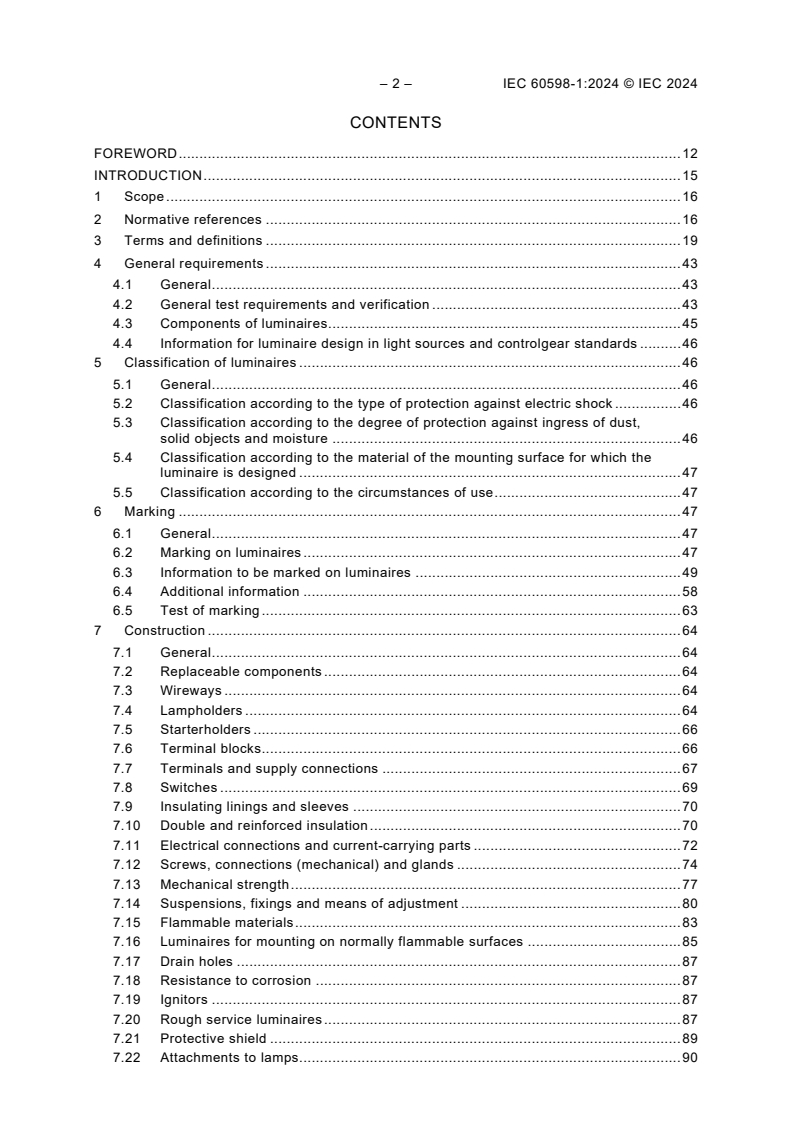
IEC 60598-1:2024 - Luminaires - Part 1: General requirements and tests/6/2024
Overview
IEC 60598-1:2024 - Luminaires: Part 1: General requirements and tests is the 10th edition (technical revision) of the international safety standard for luminaires. It defines general safety, construction, marking and testing requirements for electric luminaires and semi-luminaires intended to operate from supply voltages up to 1 000 V. This edition replaces IEC 60598-1:2020 and introduces structural and technical updates (new annexes, revised clauses on earthing, surge protection, photobiological safety, thermal testing, marking and more).
Key topics and technical requirements
The standard sets out comprehensive requirements and tests for safe luminaire design and performance, including:
- General construction and safety: requirements for materials, mechanical strength, suspensions, fixings, flame resistance and corrosion protection.
- Marking and information: mandatory marking, supply nature, and additional information (including guidance where protective earth current > 10 mA).
- Electrical safety and earthing: provisions for earthing, provision for protective conductors and revisions to earthing terminology aligned with IEC 60050-195.
- Insulation and clearance: insulation between circuits (SELV/PELV/FELV), creepage distances and clearances.
- Wiring and connections: external/internal wiring, terminal blocks, loop-in provisions and conductor mechanical stress.
- Protection against ingress and environment: IP classification tests for dust and moisture resistance.
- Thermal and endurance testing: normal and abnormal thermal tests, endurance tests for controlgear and lamps.
- Photobiological safety: updated requirements addressing UV, blue-light and retinal hazards.
- Surge protection and controlgear: revised requirements for SPDs/SPCs and additional rules for controllable controlgear providing SELV outputs.
- Special topics: suspension by magnets, luminaires using batteries (new Annex W), non-user serviceable components classification, and marking of mains socket outlets.
Practical applications - who uses IEC 60598-1
IEC 60598-1 is used by:
- Luminaire manufacturers for product design, safety compliance and CE/market approvals.
- Test laboratories and certification bodies for type testing and conformity assessment.
- Electrical engineers, lighting designers and specifiers to select compliant luminaires for projects.
- Installers and facility managers to interpret marking, earthing and installation guidance.
- Regulators and procurement teams referencing safety and performance requirements.
Related standards
Relevant cross-references include IEC 60050-195 (terminology), IEC 61058 series and IEC 60669 series for switches, plus other parts of the IEC 60598 luminaire series for specific luminaire types and performance tests.
Keywords: IEC 60598-1, luminaires, general requirements, safety tests, IP rating, earthing, photobiological safety, surge protection, thermal test, luminaire marking.
Relations
- Effective Date
- 01-Jul-2026
- Effective Date
- 05-Sep-2023
- Effective Date
- 05-Sep-2023
Buy Documents
IEC 60598-1:2024 RLV - Luminaires - Part 1: General requirements and tests Released:11/6/2024
IEC 60598-1:2024 - Luminaires - Part 1: General requirements and tests/6/2024
Get Certified
Connect with accredited certification bodies for this standard

IMQ S.p.A. (Certification)
Italian electrical product certification.

SLG Prüf- und Zertifizierungs GmbH
German testing and certification body.

UL Solutions
Global safety science company with testing, inspection and certification.
Sponsored listings
Frequently Asked Questions
IEC 60598-1:2024 is a standard published by the International Electrotechnical Commission (IEC). Its full title is "Luminaires - Part 1: General requirements and tests". This standard covers: IEC 60598-1:2024 specifies general safety requirements for luminaires, incorporating electric light sources for operation from supply voltages up to 1 000 V. Requirements for semi-luminaires are included in this document. This tenth edition cancels and replaces the ninth edition published in 2020. This edition constitutes a technical revision. This edition includes the following significant technical changes with respect to the previous edition: a) new structure to comply with the ISO/IEC Directives, Part 2; b) addition of a new Annex V for comparison with the previous edition; c) revision of 7.32 for SPDs and for SPCs; d) the terms "live part" and "active part" were reviewed and aligned with the definitions of "live part" and "hazardous live part" given in IEC 60050-195; e) revision of 7.14.2 for conductor mechanical stress; f) revision of 14.5.2, Item 4 to include controlgear; g) revision of 9.2.1 (Earthing) with the deletion of the word "permanently"; h) revision of Annex N: earth continuity test time; i) revision of 7.11.4; 7.14.1; Table 22 (14.4.3): Introduction of requirements for suspension by magnets; j) addition of a new Annex W for luminaires using batteries; k) clarification of Clause 6 for marking requirements for nature of supply; l) addition of a new Subclause 7.31.5: Additional requirements for luminaires using controllable controlgear providing SELV output(s); m) revision of 6.4.16: Information to be provided for luminaire having protective earth current > 10 mA; n) revision of 6.3.23; 6.4.18; 6.4.24; 7.30 and 10.2.1 for serviceable, non-user serviceable and non-serviceable components; o) revision of Annex D: Draught-proof enclosure; p) revision of 8.2.1 and 13.2.1: Inconsistencies in the inclusion of the limits of voltage ranges; q) revision of 9.2.10 for looping-in; r) Revision of Clause 2 and 7.8: update of the reference to IEC 61058-1-1, IEC 61058-1-2 and IEC 6105821. Update of temperature limits in Table 21 (14.4.3) for luminaires incorporating switches according to IEC 60669-1 or IEC 60669-2-1; s) revision of 6.3.22 and 7.24 for photobiological safety; t) addition of a new Subclause 6.3.27 for marking of mains socket outlet moved from information requirements.
IEC 60598-1:2024 specifies general safety requirements for luminaires, incorporating electric light sources for operation from supply voltages up to 1 000 V. Requirements for semi-luminaires are included in this document. This tenth edition cancels and replaces the ninth edition published in 2020. This edition constitutes a technical revision. This edition includes the following significant technical changes with respect to the previous edition: a) new structure to comply with the ISO/IEC Directives, Part 2; b) addition of a new Annex V for comparison with the previous edition; c) revision of 7.32 for SPDs and for SPCs; d) the terms "live part" and "active part" were reviewed and aligned with the definitions of "live part" and "hazardous live part" given in IEC 60050-195; e) revision of 7.14.2 for conductor mechanical stress; f) revision of 14.5.2, Item 4 to include controlgear; g) revision of 9.2.1 (Earthing) with the deletion of the word "permanently"; h) revision of Annex N: earth continuity test time; i) revision of 7.11.4; 7.14.1; Table 22 (14.4.3): Introduction of requirements for suspension by magnets; j) addition of a new Annex W for luminaires using batteries; k) clarification of Clause 6 for marking requirements for nature of supply; l) addition of a new Subclause 7.31.5: Additional requirements for luminaires using controllable controlgear providing SELV output(s); m) revision of 6.4.16: Information to be provided for luminaire having protective earth current > 10 mA; n) revision of 6.3.23; 6.4.18; 6.4.24; 7.30 and 10.2.1 for serviceable, non-user serviceable and non-serviceable components; o) revision of Annex D: Draught-proof enclosure; p) revision of 8.2.1 and 13.2.1: Inconsistencies in the inclusion of the limits of voltage ranges; q) revision of 9.2.10 for looping-in; r) Revision of Clause 2 and 7.8: update of the reference to IEC 61058-1-1, IEC 61058-1-2 and IEC 6105821. Update of temperature limits in Table 21 (14.4.3) for luminaires incorporating switches according to IEC 60669-1 or IEC 60669-2-1; s) revision of 6.3.22 and 7.24 for photobiological safety; t) addition of a new Subclause 6.3.27 for marking of mains socket outlet moved from information requirements.
IEC 60598-1:2024 is classified under the following ICS (International Classification for Standards) categories: 29.140.40 - Luminaires. The ICS classification helps identify the subject area and facilitates finding related standards.
IEC 60598-1:2024 has the following relationships with other standards: It is inter standard links to EN ISO 8100-1:2026, IEC 60598-1:2020/ISH1:2023, IEC 60598-1:2020. Understanding these relationships helps ensure you are using the most current and applicable version of the standard.
IEC 60598-1:2024 is available in PDF format for immediate download after purchase. The document can be added to your cart and obtained through the secure checkout process. Digital delivery ensures instant access to the complete standard document.
Standards Content (Sample)
IEC 60598-1 ®
Edition 10.0 2024-11
REDLINE VERSION
INTERNATIONAL
STANDARD
colour
inside
Luminaires –
Part 1: General requirements and tests
All rights reserved. Unless otherwise specified, no part of this publication may be reproduced or utilized in any form
or by any means, electronic or mechanical, including photocopying and microfilm, without permission in writing from
either IEC or IEC's member National Committee in the country of the requester. If you have any questions about IEC
copyright or have an enquiry about obtaining additional rights to this publication, please contact the address below or
your local IEC member National Committee for further information.
IEC Secretariat Tel.: +41 22 919 02 11
3, rue de Varembé info@iec.ch
CH-1211 Geneva 20 www.iec.ch
Switzerland
About the IEC
The International Electrotechnical Commission (IEC) is the leading global organization that prepares and publishes
International Standards for all electrical, electronic and related technologies.
About IEC publications
The technical content of IEC publications is kept under constant review by the IEC. Please make sure that you have the
latest edition, a corrigendum or an amendment might have been published.
IEC publications search - webstore.iec.ch/advsearchform IEC Products & Services Portal - products.iec.ch
The advanced search enables to find IEC publications by a Discover our powerful search engine and read freely all the
variety of criteria (reference number, text, technical publications previews, graphical symbols and the glossary.
committee, …). It also gives information on projects, replaced With a subscription you will always have access to up to date
and withdrawn publications. content tailored to your needs.
IEC Just Published - webstore.iec.ch/justpublished
Electropedia - www.electropedia.org
Stay up to date on all new IEC publications. Just Published
The world's leading online dictionary on electrotechnology,
details all new publications released. Available online and once
containing more than 22 500 terminological entries in English
a month by email.
and French, with equivalent terms in 25 additional languages.
Also known as the International Electrotechnical Vocabulary
IEC Customer Service Centre - webstore.iec.ch/csc
(IEV) online.
If you wish to give us your feedback on this publication or need
further assistance, please contact the Customer Service
Centre: sales@iec.ch.
IEC 60598-1 ®
Edition 10.0 2024-11
REDLINE VERSION
INTERNATIONAL
STANDARD
colour
inside
Luminaires –
Part 1: General requirements and tests
INTERNATIONAL
ELECTROTECHNICAL
COMMISSION
ICS 29.140.40 ISBN 978-2-8327-0020-4
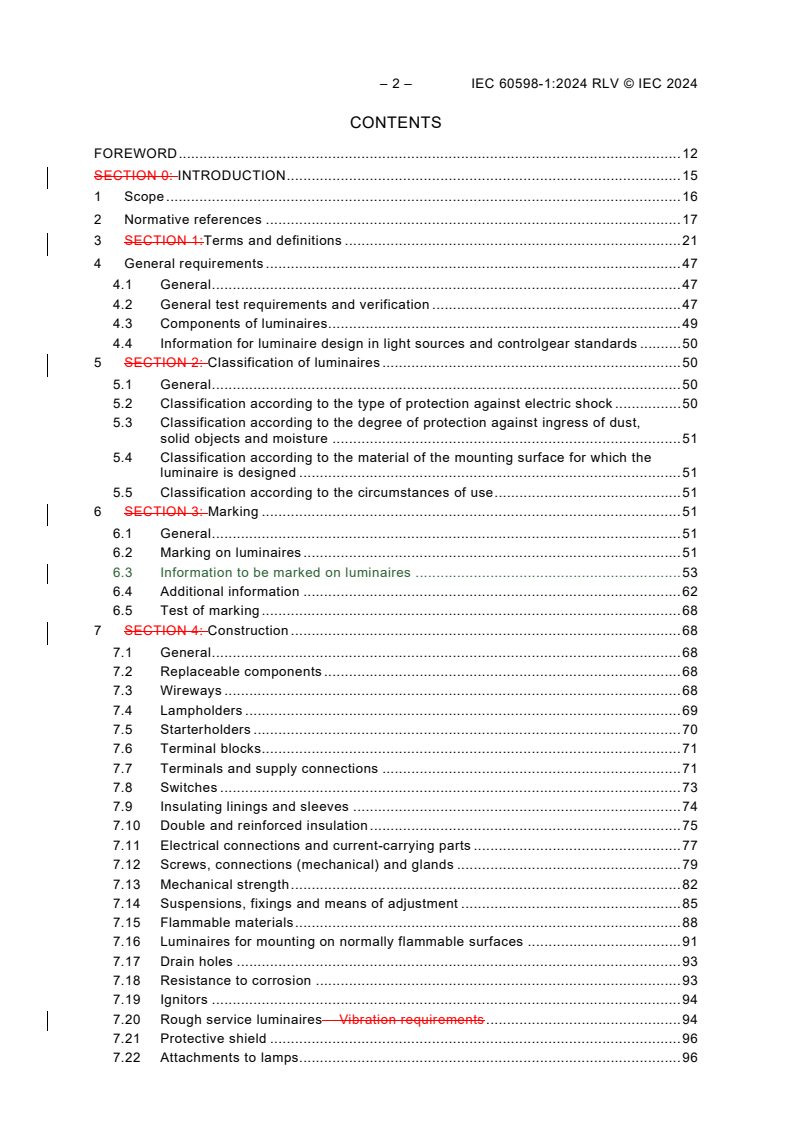
– 2 – IEC 60598-1:2024 RLV © IEC 2024
CONTENTS
FOREWORD . 12
SECTION 0: INTRODUCTION . 15
1 Scope . 16
2 Normative references . 17
3 SECTION 1:Terms and definitions . 21
4 General requirements . 47
4.1 General . 47
4.2 General test requirements and verification . 47
4.3 Components of luminaires . 49
4.4 Information for luminaire design in light sources and controlgear standards . 50
5 SECTION 2: Classification of luminaires . 50
5.1 General . 50
5.2 Classification according to the type of protection against electric shock . 50
5.3 Classification according to the degree of protection against ingress of dust,
solid objects and moisture . 51
5.4 Classification according to the material of the mounting surface for which the
luminaire is designed . 51
5.5 Classification according to the circumstances of use . 51
6 SECTION 3: Marking . 51
6.1 General . 51
6.2 Marking on luminaires . 51
6.3 Information to be marked on luminaires . 53
6.4 Additional information . 62
6.5 Test of marking . 68
7 SECTION 4: Construction . 68
7.1 General . 68
7.2 Replaceable components . 68
7.3 Wireways . 68
7.4 Lampholders . 69
7.5 Starterholders . 70
7.6 Terminal blocks. 71
7.7 Terminals and supply connections . 71
7.8 Switches . 73
7.9 Insulating linings and sleeves . 74
7.10 Double and reinforced insulation . 75
7.11 Electrical connections and current-carrying parts . 77
7.12 Screws, connections (mechanical) and glands . 79
7.13 Mechanical strength . 82
7.14 Suspensions, fixings and means of adjustment . 85
7.15 Flammable materials . 88
7.16 Luminaires for mounting on normally flammable surfaces . 91
7.17 Drain holes . 93
7.18 Resistance to corrosion . 93
7.19 Ignitors . 94
7.20 Rough service luminaires – Vibration requirements . 94
7.21 Protective shield . 96
7.22 Attachments to lamps. 96
7.23 Semi-luminaires . 97
7.24 Photobiological hazards . 97
7.24.1 Actinic UV hazards for skin and eye (200 nm to 400 nm) . 98
7.24.2 UV-A hazard for the eye lens (315 nm to 400 nm) . 98
7.24.3 Retinal blue light hazard . 98
7.24.4 Retinal thermal hazard (380 nm to 1 400 nm) . 100
7.24.5 Infrared hazard for the eye (780 nm to 3 000 nm) . 100
7.24.6 Thermal hazard for the skin (380 nm to 3 000 nm) . 100
7.25 Mechanical hazard . 100
7.26 Short-circuit protection . 100
7.27 Terminal blocks with integrated screwless protective earthing contacts . 101
7.28 Fixing of thermal sensing controls . 101
7.29 Luminaires with non-replaceable light sources . 102
7.30 Luminaires with non-user replaceable light sources and non-user
serviceable components. 102
7.31 Insulation between circuits . 103
7.31.1 General . 103
7.31.2 SELV or PELV circuits . 103
7.31.3 FELV circuits . 104
7.31.4 Other circuits . 105
7.31.5 Additional requirements for luminaires using controllable controlgear
providing SELV output(s) . 105
7.32 Overvoltage protective devices external to controlgear . 106
7.32.1 General . 106
7.32.2 Surge protective devices (SPDs) . 106
7.32.3 Surge protective components (SPCs) . 106
7.33 Luminaire powered via information technology communication cabling . 108
7.34 Electromagnetic fields (EMF) . 109
7.35 Protection against moving fan blades . 109
7.36 Track-mounted luminaires . 109
8 SECTION 5: External and internal wiring . 109
8.1 General . 109
8.2 Supply connection and other external wiring . 109
8.3 Internal wiring . 118
8.4 Test to determine the suitability of conductors having a reduced cross-
sectional area . 121
SECTION 6: Void .
9 SECTION 7: Provision for earthing . 123
9.1 General . 123
9.2 Provision for earthing . 123
10 SECTION 8: Protection against electric shock . 126
10.1 General . 126
10.2 Protection against electric shock . 126
11 SECTION 9: Resistance to dust, solid objects and moisture . 130
11.1 General . 130
11.2 General conditions and tests for ingress of dust, solid objects and moisture
IP classification . 130
11.2.1 General . 130
11.2.2 Tests for first characteristics IP numerals 2, 3 and 4 . 132
– 4 – IEC 60598-1:2024 RLV © IEC 2024
11.2.3 Tests for first characteristic IP numeral 5 and 6 . 132
11.2.4 Drip-proof luminaires – Tests for second characteristic IP numeral 1 . 133
11.2.5 Drip-proof luminaires – Tests for second characteristic IP numeral 2 . 134
11.2.6 Rain-proof luminaires – Tests for second characteristic IP numeral 3 . 134
11.2.7 Splash-proof luminaires – Tests for second characteristic IP numeral 4 . 135
11.2.8 Jet-proof luminaires – Tests for second characteristic IP numeral 5 . 135
11.2.9 Powerful jet-proof luminaires – Tests for second characteristic IP
numeral 6 . 136
11.2.10 Watertight luminaires – Tests for second characteristic IP numeral 7 . 136
11.2.11 Pressure watertight luminaires – Tests for second characteristic IP
numeral 8 . 137
11.2.12 High pressure and temperature water jet-proof luminaires – Tests for
second characteristic IP numeral 9 (80 °C) . 137
11.2.13 High pressure and cold water jet-proof luminaires – Tests for second
characteristic IP numeral 9 (15 °C) . 137
11.3 Humidity test . 137
12 SECTION 10: Insulation resistance and electric strength, touch current and
protective conductor current . 138
12.1 General . 138
12.2 Insulation resistance and electric strength . 138
12.2.1 General . 138
12.2.2 Test – Insulation resistance . 139
12.2.3 Test – Electric strength . 140
12.3 Touch current, protective conductor current and electric burn . 142
13 SECTION 11: Creepage distances and clearances . 143
13.1 General . 143
13.2 Requirements . 144
13.2.1 General . 144
13.2.2 Creepage distances . 145
13.2.3 Clearances . 147
14 SECTION 12: Endurance test and thermal test . 148
14.1 General . 148
14.2 Selection of lamps and ballasts controlgear . 148
14.3 Endurance test . 149
14.3.1 General . 149
14.3.2 Test . 149
14.3.3 Compliance . 150
14.4 Thermal test (normal operation) . 150
14.4.1 General . 150
14.4.2 Test . 151
14.4.3 Compliance . 153
14.5 Thermal test (abnormal operation) . 156
14.5.1 General . 156
14.5.2 Test . 157
14.5.3 Compliance . 158
14.6 Thermal test (failed windings in lamp controlgear) . 160
14.6.1 General . 160
14.6.2 Test for luminaires without thermal cut-outs . 160
14.6.3 Test for luminaires with temperature sensing controls . 161
14.7 Thermal test in regard to fault conditions in lamp controlgear or electronic
devices incorporated in thermoplastic luminaires . 162
14.7.1 General . 162
14.7.2 Test for luminaires without temperature sensing controls . 162
14.7.3 Test for luminaires with temperature sensing controls internal/ or
external to the ballast controlgear or transformer . 165
15 SECTION 13: Resistance to heat, fire and tracking . 166
15.1 General . 166
15.2 Resistance to heat . 166
15.3 Resistance to flame and ignition . 167
15.4 Resistance to tracking . 167
16 SECTION 14: Screw terminals . 168
16.1 General . 168
16.2 General requirements and basic principles . 174
16.3 Mechanical requirements and tests . 176
17 SECTION 15: Screwless terminals and electrical connections . 180
17.1 General . 180
17.2 General requirements . 182
17.3 General instructions for tests . 184
17.3.1 Preparation of samples . 184
17.3.2 Test conductors . 184
17.3.3 Multi-conductor terminals . 184
17.3.4 Multi-way terminals . 184
17.3.5 Test quantities . 184
17.4 Terminal and connections for internal wiring . 184
17.4.1 Mechanical tests . 184
17.4.2 Electrical tests . 185
17.5 Terminals and connections for external wiring . 187
17.5.1 Conductors . 187
17.5.2 Mechanical tests . 187
17.5.3 Electrical tests . 188
Annex A (normative) Test to establish whether a conductive part can cause an electric
shock . 190
A.1 General . 190
A.2 Touch voltage limits . 190
A.3 Touch current limits . 190
A.4 Compliance . 191
Annex B (normative) Test lamps . 192
B.1 General . 192
B.2 Filament lamps within the scope of IEC 60432-1 and IEC 60432-2 . 192
B.2.1 Principal modes of heat transfer and lamps used for testing . 192
B.2.2 Filament test lamps . 193
B.3 Halogen lamps within the scope of IEC 60432-3 . 194
B.4 Tubular fluorescent and other discharge lamps . 194
B.5 LED modules within the scope of IEC 62031 . 194
Annex C (normative) Abnormal circuit conditions . 195
Annex D (normative) Thermal testing . 198
D.1 Draught-proof enclosure . 198
D.2 Mounting surface and test recess . 198
– 6 – IEC 60598-1:2024 RLV © IEC 2024
D.3 Alternative test procedure for adjustment of measured temperatures for
luminaire t rating(s) . 201
a
D.3.1 General . 201
D.3.2 Thermal test of normal operation for luminaires without temperature
sensing controls and where the rated ambient temperature t as marked
a
on the luminaire is higher than the ambient temperature in the draught-
proof enclosure . 202
Annex E (normative) Determination of winding temperature rises by the increase-in-
resistance method . 203
Annex F (normative) Test for resistance to stress corrosion of copper and copper
alloys . 204
F.1 Test cabinet . 204
F.2 Test solution . 204
F.3 Test piece . 204
F.4 Test procedure . 205
Annex G (normative) Measurement of touch current and protective conductor current . 206
G.1 General . 206
G.2 Test conditions . 206
G.3 Test procedures . 206
G.4 Test measurements . 206
G.5 Test sequence . 208
Annex H (xxx) (Void) .
Annex I (xxx) (Void) .
Annex H (informative) Explanation of IP numbers for degrees of protection . 212
Annex I (informative) Temperature measurements . 214
I.1 Temperature measurements of the luminaire . 214
I.2 Temperature measurement of the insulation parts of lampholders . 215
Annex J (informative) Guidelines for good practice in luminaire design . 217
J.1 General . 217
J.2 Plastics in luminaires . 217
J.3 Rust resistance . 218
J.4 Corrosion resistance . 218
J.5 Chemically corrosive atmospheres . 219
J.6 Reflector design . 219
J.7 Components in different kinds of luminaires . 220
J.8 Recommendations for electromagnetic ballast protection for end of life
phenomenon of HID lamps . 220
J.9 Resistance against the effects of vibration . 220
J.10 Flammability of components . 221
J.11 Permanent magnets . 221
Annex K (normative) Determination of creepage distances and clearances . 223
Annex L (informative) Explanation of marking for luminaires that are not suitable for
mounting on normally flammable surfaces and covering with insulation materials . 224
L.1 General . 224
L.2 Protection against flame . 224
L.3 Protection against heat . 225
L.3.1 General . 225
L.3.2 Spacing . 225
L.3.3 Temperature measurements of mounting surface under abnormal or
failed ballast conditions . 225
L.4 Thermal protectors . 227
L.5 Deletion of the F mark requirements . 228
Annex M (normative) Absorption requirements for the protective shield to be fitted to
luminaires designed for metal halide lamps which emit a high level of UV radiation . 230
M.1 General . 230
M.2 Procedure A . 230
M.3 Procedure B . 231
Annex N (informative) Conformity testing during manufacture . 232
N.1 General . 232
N.2 Testing . 232
Annex O (xxx) (Void) .
Annex O (normative) Schedule of amended subclauses containing more serious or
critical requirements which call for products to be retested . 234
Annex P (normative) Requirements for the identification of a family or range of
luminaires for type testing . 236
P.1 General . 236
P.2 Range or family of luminaires . 236
Annex Q (informative) Additional requirements for luminaires where a higher degree of
availability (impulse withstand overvoltage category III) may be requested . 238
Q.1 General . 238
Q.2 Requirements for impulse withstand overvoltage category III . 238
Annex R (normative) Additional test requirements for terminal blocks with integrated
screwless protective earthing contact for direct connection to the luminaire housing or
to parts of the body . 240
R.1 Additional requirements to 9.2.1 . 240
R.1.1 Requirements for mechanical strength . 240
R.1.2 Test for terminal fixing . 240
R.1.3 Test for supporting plate . 240
R.2 Additional requirements to 9.2.3 . 240
Annex S (normative) Alternative thermal test for thermoplastic luminaires . 242
S.1 General . 242
S.2 Thermal test in regard to fault conditions in lamp controlgear or electronic
devices without temperature sensing controls in thermoplastic luminaires for
fluorescent lamps ≤ 70 W . 242
Annex T (xxx) (Void) .
Annex T (normative) Requirements for insulation between active live parts of circuits
and accessible conductive parts . 244
Annex U (informative) Information regarding power sourcing equipment powering
class III luminaires via information technology communication cabling . 246
U.1 General . 246
U.2 Insulation of the mains supply . 246
U.3 Electrical limits of a PSE . 246
Annex V (informative) Cross-references to the previous edition of IEC 60598-1 . 248
Annex W (normative) Battery/EDLC-operated luminaires . 251
W.1 General . 251
W.2 General test requirements and verification . 251
W.3 Marking . 253
– 8 – IEC 60598-1:2024 RLV © IEC 2024
W.3.1 General . 253
W.3.2 Luminaires with replaceable battery . 253
W.3.3 Coin and button batteries . 253
W.3.4 Other standardized batteries (e.g. AAA or AA) . 254
W.3.5 Luminaires with non-standardized replaceable rechargeable battery . 255
W.3.6 Luminaires with non-user replaceable battery/EDLC . 255
W.3.7 Luminaires with non-replaceable battery/EDLC . 256
W.3.8 Luminaires supplied by external dedicated power supply units . 256
W.3.9 Rechargeable luminaires other than ordinary . 256
W.3.10 Conditions for charging . 256
W.4 Construction . 257
W.4.1 General . 257
W.4.2 Small batteries (coins, button and other non-standardized batteries) . 257
W.4.3 Battery compartment fasteners for small batteries and other
standardized batteries (e.g. AAA or AA) . 258
W.4.4 Battery/EDLC chargers incorporated in luminaires . 258
W.4.5 Short-circuit protection . 258
W.4.6 Electrical parameters of the batteries operation . 259
W.4.7 Protection against overpressure for Li-ion batteries used in luminaires . 260
W.4.8 Protection against the consequence of failure of cells or EDLCs . 260
W.5 Protection against electric shock . 261
W.6 Endurance test and thermal test. 261
W.6.1 Endurance test . 261
W.6.2 Thermal test (normal operation) . 261
W.6.3 Thermal test (abnormal operation) . 262
W.6.4 Lithium-ion charging systems – Fault conditions . 263
Bibliography . 265
Figure 1 – Example of "looping-in" (feed through) . 31
Figure 2 – Examples of "through wiring" . 33
Figure 3 – Example of electro-mechanical contact system with plug or socket
connection . 35
Figure 4 – AC supply . 53
Figure 5 – DC supply . 53
Figure 6 – DC and AC supply . 53
Figure 7 – Class II . 54
Figure 8 – Class III . 54
Figure 9 – Luminaire not suitable for direct mounting on normally flammable surfaces . 56
Figure 10 – High-pressure sodium lamps that require an external ignitor (to the lamp) . 56
Figure 11 – High-pressure sodium lamps having an internal starting device . 56
Figure 12 – Warning against the use of cool-beam lamps . 57
Figure 13 – Functional earthing . 57
Figure 14 – Protective earthing . 57
Figure 15 – Minimum distance from lighted objects (metres) . 58
Figure 16 – Rough service . 58
Figure 17 – Bowl mirror lamp . 58
Figure 18 – Replace any cracked protective shield . 59
Figure 19 – Test circuit for safety during insertion . 59
Figure 20 – Self-shielded lamp. 60
Figure 21 – Luminaires with internal fuses . 60
Figure 22 – Do not stare at the operating light source . 61
Figure 23 – Caution, risk of electric shock. 62
Figure 24 – Use of heat resistant supply cables, interconnecting cables or external
wiring . 63
Figure 25 – Pictogram for non-replaceable light source . 65
Figure 26 – Pictogram for non-user replaceable light source . 65
Figure 27 – Pictogram for replaceable light source . 65
Figure 28 – Pictogram for non-replaceable controlgear . 67
Figure 29 – Pictogram for non-user replaceable controlgear . 67
Figure 30 – Pictogram for replaceable controlgear . 68
Figure 31 – Terminal block arrangement for installation test for luminaires with
connecting leads (tails) . 71
Figure 32 – Examples of self-tapping, thread-cutting and thread-forming screws (from
ISO 1891) . 78
Figure 33 – Illustration of the requirements of 7.15.1 . 90
Figure 34 – Apparatus for ball impact tests . 95
Figure 35 – Test chain . 101
Figure 36 – Example of permitted degree of soldering . 116
Figure 37 – Circuit for checking electrical contact between socket-outlet and plug . 117
Figure 38 – Test to determine the suitability of conductors having a reduced cross-
sectional area . 122
Figure 39
...
IEC 60598-1 ®
Edition 10.0 2024-11
INTERNATIONAL
STANDARD
NORME
INTERNATIONALE
Luminaires –
Part 1: General requirements and tests
Luminaires –
Partie 1: Exigences générales et essais
All rights reserved. Unless otherwise specified, no part of this publication may be reproduced or utilized in any form
or by any means, electronic or mechanical, including photocopying and microfilm, without permission in writing from
either IEC or IEC's member National Committee in the country of the requester. If you have any questions about IEC
copyright or have an enquiry about obtaining additional rights to this publication, please contact the address below or
your local IEC member National Committee for further information.
Droits de reproduction réservés. Sauf indication contraire, aucune partie de cette publication ne peut être reproduite ni
utilisée sous quelque forme que ce soit et par aucun procédé, électronique ou mécanique, y compris la photocopie et
les microfilms, sans l'accord écrit de l'IEC ou du Comité national de l'IEC du pays du demandeur. Si vous avez des
questions sur le copyright de l'IEC ou si vous désirez obtenir des droits supplémentaires sur cette publication, utilisez
les coordonnées ci-après ou contactez le Comité national de l'IEC de votre pays de résidence.
IEC Secretariat Tel.: +41 22 919 02 11
3, rue de Varembé info@iec.ch
CH-1211 Geneva 20 www.iec.ch
Switzerland
About the IEC
The International Electrotechnical Commission (IEC) is the leading global organization that prepares and publishes
International Standards for all electrical, electronic and related technologies.
About IEC publications
The technical content of IEC publications is kept under constant review by the IEC. Please make sure that you have the
latest edition, a corrigendum or an amendment might have been published.
IEC publications search - webstore.iec.ch/advsearchform IEC Products & Services Portal - products.iec.ch
The advanced search enables to find IEC publications by a Discover our powerful search engine and read freely all the
variety of criteria (reference number, text, technical publications previews, graphical symbols and the glossary.
committee, …). It also gives information on projects, replaced With a subscription you will always have access to up to date
and withdrawn publications. content tailored to your needs.
IEC Just Published - webstore.iec.ch/justpublished
Electropedia - www.electropedia.org
Stay up to date on all new IEC publications. Just Published
The world's leading online dictionary on electrotechnology,
details all new publications released. Available online and once
containing more than 22 500 terminological entries in English
a month by email.
and French, with equivalent terms in 25 additional languages.
Also known as the International Electrotechnical Vocabulary
IEC Customer Service Centre - webstore.iec.ch/csc
(IEV) online.
If you wish to give us your feedback on this publication or need
further assistance, please contact the Customer Service
Centre: sales@iec.ch.
A propos de l'IEC
La Commission Electrotechnique Internationale (IEC) est la première organisation mondiale qui élabore et publie des
Normes internationales pour tout ce qui a trait à l'électricité, à l'électronique et aux technologies apparentées.
A propos des publications IEC
Le contenu technique des publications IEC est constamment revu. Veuillez vous assurer que vous possédez l’édition la
plus récente, un corrigendum ou amendement peut avoir été publié.
Recherche de publications IEC - IEC Products & Services Portal - products.iec.ch
webstore.iec.ch/advsearchform Découvrez notre puissant moteur de recherche et consultez
La recherche avancée permet de trouver des publications IEC gratuitement tous les aperçus des publications, symboles
en utilisant différents critères (numéro de référence, texte, graphiques et le glossaire. Avec un abonnement, vous aurez
comité d’études, …). Elle donne aussi des informations sur les toujours accès à un contenu à jour adapté à vos besoins.
projets et les publications remplacées ou retirées.
Electropedia - www.electropedia.org
IEC Just Published - webstore.iec.ch/justpublished
Le premier dictionnaire d'électrotechnologie en ligne au monde,
Restez informé sur les nouvelles publications IEC. Just
avec plus de 22 500 articles terminologiques en anglais et en
Published détaille les nouvelles publications parues.
français, ainsi que les termes équivalents dans 25 langues
Disponible en ligne et une fois par mois par email.
additionnelles. Egalement appelé Vocabulaire
Electrotechnique International (IEV) en ligne.
Service Clients - webstore.iec.ch/csc
Si vous désirez nous donner des commentaires sur cette
publication ou si vous avez des questions contactez-nous:
sales@iec.ch.
IEC 60598-1 ®
Edition 10.0 2024-11
INTERNATIONAL
STANDARD
NORME
INTERNATIONALE
Luminaires –
Part 1: General requirements and tests
Luminaires –
Partie 1: Exigences générales et essais
INTERNATIONAL
ELECTROTECHNICAL
COMMISSION
COMMISSION
ELECTROTECHNIQUE
INTERNATIONALE
ICS 29.140.40 ISBN 978-2-8322-9936-4
– 2 – IEC 60598-1:2024 © IEC 2024
CONTENTS
FOREWORD . 12
INTRODUCTION . 15
1 Scope . 16
2 Normative references . 16
3 Terms and definitions . 19
4 General requirements . 43
4.1 General . 43
4.2 General test requirements and verification . 43
4.3 Components of luminaires . 45
4.4 Information for luminaire design in light sources and controlgear standards . 46
5 Classification of luminaires . 46
5.1 General . 46
5.2 Classification according to the type of protection against electric shock . 46
5.3 Classification according to the degree of protection against ingress of dust,
solid objects and moisture . 46
5.4 Classification according to the material of the mounting surface for which the
luminaire is designed . 47
5.5 Classification according to the circumstances of use . 47
6 Marking . 47
6.1 General . 47
6.2 Marking on luminaires . 47
6.3 Information to be marked on luminaires . 49
6.4 Additional information . 58
6.5 Test of marking . 63
7 Construction . 64
7.1 General . 64
7.2 Replaceable components . 64
7.3 Wireways . 64
7.4 Lampholders . 64
7.5 Starterholders . 66
7.6 Terminal blocks. 66
7.7 Terminals and supply connections . 67
7.8 Switches . 69
7.9 Insulating linings and sleeves . 70
7.10 Double and reinforced insulation . 70
7.11 Electrical connections and current-carrying parts . 72
7.12 Screws, connections (mechanical) and glands . 74
7.13 Mechanical strength . 77
7.14 Suspensions, fixings and means of adjustment . 80
7.15 Flammable materials . 83
7.16 Luminaires for mounting on normally flammable surfaces . 85
7.17 Drain holes . 87
7.18 Resistance to corrosion . 87
7.19 Ignitors . 87
7.20 Rough service luminaires . 87
7.21 Protective shield . 89
7.22 Attachments to lamps. 90
7.23 Semi-luminaires . 90
7.24 Photobiological hazards . 90
7.24.1 Actinic UV hazards for skin and eye (200 nm to 400 nm) . 90
7.24.2 UV-A hazard for the eye lens (315 nm to 400 nm) . 91
7.24.3 Retinal blue light hazard . 91
7.24.4 Retinal thermal hazard (380 nm to 1 400 nm) . 92
7.24.5 Infrared hazard for the eye (780 nm to 3 000 nm) . 93
7.24.6 Thermal hazard for the skin (380 nm to 3 000 nm) . 93
7.25 Mechanical hazard . 93
7.26 Short-circuit protection . 93
7.27 Terminal blocks with integrated screwless protective earthing contacts . 94
7.28 Fixing of thermal sensing controls . 94
7.29 Luminaires with non-replaceable light sources . 95
7.30 Luminaires with non-user replaceable light sources and non-user
serviceable components. 95
7.31 Insulation between circuits . 95
7.31.1 General . 95
7.31.2 SELV or PELV circuits . 96
7.31.3 FELV circuits . 97
7.31.4 Other circuits . 97
7.31.5 Additional requirements for luminaires using controllable controlgear
providing SELV output(s) . 98
7.32 Overvoltage protective devices external to controlgear . 98
7.32.1 General . 98
7.32.2 Surge protective devices (SPDs) . 99
7.32.3 Surge protective components (SPCs) . 99
7.33 Luminaire powered via information technology communication cabling . 101
7.34 Electromagnetic fields (EMF) . 101
7.35 Protection against moving fan blades . 102
7.36 Track-mounted luminaires . 102
8 External and internal wiring . 102
8.1 General . 102
8.2 Supply connection and other external wiring . 102
8.3 Internal wiring . 111
8.4 Test to determine the suitability of conductors having a reduced cross-
sectional area . 113
9 Provision for earthing . 114
9.1 General . 114
9.2 Provision for earthing . 114
10 Protection against electric shock . 117
10.1 General . 117
10.2 Protection against electric shock . 117
11 Resistance to dust, solid objects and moisture . 121
11.1 General . 121
11.2 General conditions and tests for IP classification . 121
11.2.1 General . 121
11.2.2 Tests for first characteristics IP numerals 2, 3 and 4 . 123
11.2.3 Tests for first characteristic IP numeral 5 and 6 . 123
11.2.4 Drip-proof luminaires – Tests for second characteristic IP numeral 1 . 124
– 4 – IEC 60598-1:2024 © IEC 2024
11.2.5 Drip-proof luminaires – Tests for second characteristic IP numeral 2 . 125
11.2.6 Rain-proof luminaires – Tests for second characteristic IP numeral 3 . 125
11.2.7 Splash-proof luminaires – Tests for second characteristic IP numeral 4 . 126
11.2.8 Jet-proof luminaires – Tests for second characteristic IP numeral 5 . 126
11.2.9 Powerful jet-proof luminaires – Tests for second characteristic IP
numeral 6 . 127
11.2.10 Watertight luminaires – Tests for second characteristic IP numeral 7 . 127
11.2.11 Pressure watertight luminaires – Tests for second characteristic IP
numeral 8 . 128
11.2.12 High pressure and temperature water jet-proof luminaires – Tests for
second characteristic IP numeral 9 (80 °C) . 128
11.2.13 High pressure and cold water jet-proof luminaires – Tests for second
characteristic IP numeral 9 (15 °C) . 128
11.3 Humidity test . 128
12 Insulation resistance and electric strength, touch current and protective conductor
current . 129
12.1 General . 129
12.2 Insulation resistance and electric strength . 129
12.2.1 General . 129
12.2.2 Test – Insulation resistance . 130
12.2.3 Test – Electric strength . 131
12.3 Touch current, protective conductor current and electric burn . 133
13 Creepage distances and clearances . 134
13.1 General . 134
13.2 Requirements . 135
13.2.1 General . 135
13.2.2 Creepage distances . 136
13.2.3 Clearances . 137
14 Endurance test and thermal test . 139
14.1 General . 139
14.2 Selection of lamps and controlgear . 139
14.3 Endurance test . 140
14.3.1 General . 140
14.3.2 Test . 140
14.3.3 Compliance . 141
14.4 Thermal test (normal operation) . 141
14.4.1 General . 141
14.4.2 Test . 142
14.4.3 Compliance . 144
14.5 Thermal test (abnormal operation) . 147
14.5.1 General . 147
14.5.2 Test . 148
14.5.3 Compliance . 149
14.6 Thermal test (failed windings in controlgear) . 151
14.6.1 General . 151
14.6.2 Test for luminaires without thermal cut-outs . 151
14.6.3 Test for luminaires with temperature sensing controls . 152
14.7 Thermal test in regard to fault conditions in controlgear or electronic devices
incorporated in thermoplastic luminaires . 153
14.7.1 General . 153
14.7.2 Test for luminaires without temperature sensing controls . 153
14.7.3 Test for luminaires with temperature sensing controls internal or
external to the controlgear or transformer . 156
15 Resistance to heat, fire and tracking . 157
15.1 General . 157
15.2 Resistance to heat . 157
15.3 Resistance to flame and ignition . 158
15.4 Resistance to tracking . 158
16 Screw terminals . 159
16.1 General . 159
16.2 General requirements and basic principles . 165
16.3 Mechanical requirements and tests . 167
17 Screwless terminals and electrical connections . 171
17.1 General . 171
17.2 General requirements . 173
17.3 General instructions for tests . 175
17.3.1 Preparation of samples . 175
17.3.2 Test conductors . 175
17.3.3 Multi-conductor terminals . 175
17.3.4 Multi-way terminals . 175
17.3.5 Test quantities . 175
17.4 Terminal and connections for internal wiring . 175
17.4.1 Mechanical tests . 175
17.4.2 Electrical tests . 176
17.5 Terminals and connections for external wiring . 177
17.5.1 Conductors . 177
17.5.2 Mechanical tests . 178
17.5.3 Electrical tests . 179
Annex A (normative) Test to establish whether a conductive part can cause an electric
shock . 181
A.1 General . 181
A.2 Touch voltage limits . 181
A.3 Touch current limits . 181
A.4 Compliance . 181
Annex B (normative) Test lamps . 182
B.1 General . 182
B.2 Filament lamps within the scope of IEC 60432-1 and IEC 60432-2 . 182
B.2.1 Principal modes of heat transfer and lamps used for testing . 182
B.2.2 Filament test lamps . 183
B.3 Halogen lamps within the scope of IEC 60432-3 . 184
B.4 Tubular fluorescent and other discharge lamps . 184
B.5 LED modules within the scope of IEC 62031 . 184
Annex C (normative) Abnormal circuit conditions . 185
Annex D (normative) Thermal testing . 188
D.1 Draught-proof enclosure . 188
D.2 Mounting surface . 188
D.3 Alternative test procedure for adjustment of measured temperatures for
luminaire t rating(s) . 189
a
– 6 – IEC 60598-1:2024 © IEC 2024
D.3.1 General . 189
D.3.2 Thermal test of normal operation for luminaires without temperature
sensing controls and where the rated ambient temperature t as marked
a
on the luminaire is higher than the ambient temperature in the draught-
proof enclosure . 189
Annex E (normative) Determination of winding temperature rises by the increase-in-
resistance method . 190
Annex F (normative) Test for resistance to stress corrosion of copper and copper
alloys . 191
F.1 Test cabinet . 191
F.2 Test solution . 191
F.3 Test piece . 191
F.4 Test procedure . 192
Annex G (normative) Measurement of touch current and protective conductor current . 193
G.1 General . 193
G.2 Test conditions . 193
G.3 Test procedures . 193
G.4 Test measurements . 193
G.5 Test sequence . 195
Annex H (informative) Explanation of IP numbers for degrees of protection . 197
Annex I (informative) Temperature measurements . 199
I.1 Temperature measurements of the luminaire . 199
I.2 Temperature measurement of the insulation parts of lampholders . 200
Annex J (informative) Guidelines for good practice in luminaire design . 202
J.1 General . 202
J.2 Plastics in luminaires . 202
J.3 Rust resistance . 203
J.4 Corrosion resistance . 203
J.5 Chemically corrosive atmospheres . 204
J.6 Reflector design . 204
J.7 Components in different kinds of luminaires . 205
J.8 Recommendations for electromagnetic ballast protection for end of life
phenomenon of HID lamps . 205
J.9 Resistance against the effects of vibration . 205
J.10 Flammability of components . 206
J.11 Permanent magnets . 206
Annex K (normative) Determination of creepage distances and clearances . 208
Annex L (informative) Explanation of marking for luminaires that are not suitable for
mounting on normally flammable surfaces and covering with insulation materials . 209
L.1 General . 209
L.2 Protection against flame . 209
L.3 Protection against heat . 210
L.3.1 General . 210
L.3.2 Spacing . 210
L.3.3 Temperature measurements of mounting surface under abnormal or
failed ballast conditions . 210
L.4 Thermal protectors . 212
L.5 Deletion of the F mark requirements . 213
Annex M (normative) Absorption requirements for the protective shield to be fitted to
luminaires designed for metal halide lamps which emit a high level of UV radiation . 214
M.1 General . 214
M.2 Procedure A . 214
M.3 Procedure B . 215
Annex N (informative) Conformity testing during manufacture . 216
N.1 General . 216
N.2 Testing . 216
Annex O (normative) Schedule of amended subclauses containing more serious or
critical requirements which call for products to be retested . 218
Annex P (normative) Requirements for the identification of a family or range of
luminaires for type testing . 219
P.1 General . 219
P.2 Range or family of luminaires . 219
Annex Q (informative) Additional requirements for luminaires where a higher degree of
availability (overvoltage category III) may be requested . 220
Q.1 General . 220
Q.2 Requirements for overvoltage category III . 220
Annex R (normative) Additional test requirements for terminal blocks with integrated
screwless protective earthing contact for direct connection to the luminaire housing or
to parts of the body . 222
R.1 Additional requirements to 9.2.1 . 222
R.1.1 Requirements for mechanical strength . 222
R.1.2 Test for terminal fixing . 222
R.1.3 Test for supporting plate . 222
R.2 Additional requirements to 9.2.3 . 222
Annex S (normative) Alternative thermal test for thermoplastic luminaires . 224
S.1 General . 224
S.2 Thermal test in regard to fault conditions in controlgear or electronic devices
without temperature sensing controls in thermoplastic luminaires for
fluorescent lamps ≤ 70 W . 224
Annex T (normative) Requirements for insulation between live parts of circuits and
accessible conductive parts . 226
Annex U (informative) Information regarding power sourcing equipment powering
class III luminaires via information technology communication cabling . 228
U.1 General . 228
U.2 Insulation of the mains supply . 228
U.3 Electrical limits of a PSE . 228
Annex V (informative) Cross-references to the previous edition of IEC 60598-1 . 230
Annex W (normative) Battery/EDLC-operated luminaires . 233
W.1 General . 233
W.2 General test requirements and verification . 233
W.3 Marking . 235
W.3.1 General . 235
W.3.2 Luminaires with replaceable battery . 235
W.3.3 Coin and button batteries . 235
W.3.4 Other standardized batteries (e.g. AAA or AA) . 236
W.3.5 Luminaires with non-standardized replaceable rechargeable battery . 237
W.3.6 Luminaires with non-user replaceable battery/EDLC . 237
W.3.7 Luminaires with non-replaceable battery/EDLC . 238
W.3.8 Luminaires supplied by external dedicated power supply units . 238
– 8 – IEC 60598-1:2024 © IEC 2024
W.3.9 Rechargeable luminaires other than ordinary . 238
W.3.10 Conditions for charging . 238
W.4 Construction . 239
W.4.1 General . 239
W.4.2 Small batteries (coins, button and other non-standardized batteries) . 239
W.4.3 Battery compartment fasteners for small batteries and other
standardized batteries (e.g. AAA or AA) . 240
W.4.4 Battery/EDLC chargers incorporated in luminaires . 240
W.4.5 Short-circuit protection . 240
W.4.6 Electrical parameters of the batteries operation . 241
W.4.7 Protection against overpressure for Li-ion batteries used in luminaires . 242
W.4.8 Protection against the consequence of failure of cells or EDLCs . 242
W.5 Protection against electric shock . 243
W.6 Endurance test and thermal test. 243
W.6.1 Endurance test . 243
W.6.2 Thermal test (normal operation) . 243
W.6.3 Thermal test (abnormal operation) . 244
W.6.4 Lithium-ion charging systems – Fault conditions . 245
Bibliography . 247
Figure 1 – Example of "looping-in" (feed through) . 30
Figure 2 – Examples of "through wiring" . 30
Figure 3 – Example of electro-mechanical contact system with plug or socket
connection . 32
Figure 4 – AC supply . 49
Figure 5 – DC supply . 49
Figure 6 – DC and AC supply . 49
Figure 7 – Class II . 50
Figure 8 – Class III . 50
Figure 9 – Luminaire not suitable for direct mounting on normally flammable surfaces . 52
Figure 10 – High-pressure sodium lamps that require an external ignitor (to the lamp) . 52
Figure 11 – High-pressure sodium lamps having an internal starting device . 52
Figure 12 – Warning against the use of cool-beam lamps . 52
Figure 13 – Functional earthing . 53
Figure 14 – Protective earthing . 53
Figure 15 – Minimum distance from lighted objects (metres) . 54
Figure 16 – Rough service . 54
Figure 17 – Bowl mirror lamp . 54
Figure 18 – Replace any cracked protective shield . 55
Figure 19 – Test circuit for safety during insertion . 55
Figure 20 – Self-shielded lamp. 55
Figure 21 – Luminaires with internal fuses . 56
Figure 22 – Do not stare at the operating light source . 56
Figure 23 – Caution, risk of electric shock. 57
Figure 24 – Use of heat resistant supply cables, interconnecting cables or external
wiring .
...