

IEC TS 60695-11-11:2008
(Main)Fire hazard testing - Part 11-11: Test flames - Determination of the characteristic heat flux for ignition from a non-contacting flame source
General Information
- Abstract
IEC/TS 60695-11-11:2008 Describes a test method used to determine the characteristic heat flux for ignition (CHFI) from a non-contacting flame source for materials used in electrotechnical products and sub-assemblies. It provides a relationship between ignition time and incident heat flux. A test specimen cut from an end-product or sub-assembly can be tested by this test method. Has the status of a basic safety publication in accordance with IEC Guide 104.
- Status
- Published
- Publication Date
- 07-Sep-2008
- Technical Committee
- TC 89 - Fire hazard testing
- Drafting Committee
- WG 12 - TC 89/WG 12
- Current Stage
- DELPUB - Deleted Publication
- Start Date
- 18-Feb-2016
- Completion Date
- 28-Aug-2026
Buy Documents
IEC TS 60695-11-11:2008 - Fire hazard testing - Part 11-11: Test flames - Determination of the characteristic heat flux for ignition from a non-contacting flame source Released:9/8/2008
Overview
IEC TS 60695-11-11:2008 is a fundamental international technical specification developed by the International Electrotechnical Commission (IEC) for fire hazard testing. Part of the broader IEC 60695 series, this document details a standardized method to determine the characteristic heat flux for ignition (CHFI) from a non-contacting flame source. This method is crucial for assessing materials used in electrotechnical products and sub-assemblies to ensure they meet essential safety criteria regarding their ignition behavior when exposed to flames that do not make direct contact.
The specification establishes a precise relationship between ignition time and incident heat flux, enabling manufacturers, laboratories, and safety professionals to evaluate flammability performance consistently. As a basic safety publication, it supports compliance with IEC Guide 104 and is referenced in the development of product safety standards.
Key Topics
- Characteristic Heat Flux for Ignition (CHFI): Defines the maximum incident heat flux at which a material resists ignition for more than 120 seconds when exposed to a non-contacting flame. This metric provides a quantifiable measure of a material's resistance to ignition.
- Test Method: The standard describes in detail the apparatus and procedures, including the use of a laboratory burner, heat flux meter, specimen preparation, conditioning, and calibration. The test involves varying the distance and gas flow rate to control the incident heat flux.
- Ignition Time Measurement: Outlines the procedure to measure and average ignition times, ensuring results are robust and reproducible.
- Specimen Preparation and Conditioning: Specifies requirements for test specimen dimensions, conditioning environment, and handling to minimize variability.
- Safety and Compliance: Highlights the importance of safe laboratory practices and the use of draught-free environments to enhance test accuracy.
Applications
IEC TS 60695-11-11 is widely used in the electrotechnical industry for material and product fire safety evaluation. Its applications include:
- Quality Assurance for Electrotechnical Products: Ensures materials used in electrical and electronic equipment have reliable fire resistance properties, aiding manufacturers in meeting international safety requirements.
- Material Selection and Research: Assists engineers and designers in comparing different polymers and composites for their ignition resistance, leading to safer product designs.
- Product Certification and Regulatory Compliance: Forms part of fire risk assessment in line with standards development and certification for electrical devices, housings, and component sub-assemblies.
- Risk Assessment: Provides critical data for fire hazard analysis, particularly in situations where products may be exposed to external flames, such as accidental proximity to candles or other flame sources.
Related Standards
Several other IEC standards and guidelines complement IEC TS 60695-11-11:2008 in fire testing for electrotechnical products:
- IEC 60695-1-10 / IEC 60695-1-11: General guidelines and fire hazard assessment for electrical products.
- IEC 60695-11-4: Test flames - 50 W flame apparatus and method (used in conjunction for the burner specification).
- IEC 60695-11-10 & IEC 60695-11-20: Methods for assessing flammability by direct flame contact.
- ISO/IEC Guide 51 / IEC Guide 104: Guidelines for including safety aspects in standardization work.
- ISO 291, ISO 293/294/295: Conditioning and preparation standards for plastic test specimens.
- ISO/TS 14934-4: Guidance on using heat flux meters for fire tests.
Practical Value
Implementing IEC TS 60695-11-11 improves product safety, supports compliance with international regulations, and helps manufacturers minimize fire risks during the design and production of electrical and electronic goods. By determining a material's CHFI, stakeholders can make informed decisions regarding material selection and product design, ultimately contributing to enhanced consumer safety and reduced fire hazards in real-world applications.
Relations
- Effective Date
- 05-Sep-2023
- Effective Date
- 05-Sep-2023
Buy Documents
IEC TS 60695-11-11:2008 - Fire hazard testing - Part 11-11: Test flames - Determination of the characteristic heat flux for ignition from a non-contacting flame source Released:9/8/2008
Get Certified
Connect with accredited certification bodies for this standard

IMQ S.p.A. (Certification)
Italian electrical product certification.

SLG Prüf- und Zertifizierungs GmbH
German testing and certification body.

UL Solutions
Global safety science company with testing, inspection and certification.
Sponsored listings
Frequently Asked Questions
IEC TS 60695-11-11:2008 is a technical specification published by the International Electrotechnical Commission (IEC). Its full title is "Fire hazard testing - Part 11-11: Test flames - Determination of the characteristic heat flux for ignition from a non-contacting flame source". This standard covers: IEC/TS 60695-11-11:2008 Describes a test method used to determine the characteristic heat flux for ignition (CHFI) from a non-contacting flame source for materials used in electrotechnical products and sub-assemblies. It provides a relationship between ignition time and incident heat flux. A test specimen cut from an end-product or sub-assembly can be tested by this test method. Has the status of a basic safety publication in accordance with IEC Guide 104.
IEC/TS 60695-11-11:2008 Describes a test method used to determine the characteristic heat flux for ignition (CHFI) from a non-contacting flame source for materials used in electrotechnical products and sub-assemblies. It provides a relationship between ignition time and incident heat flux. A test specimen cut from an end-product or sub-assembly can be tested by this test method. Has the status of a basic safety publication in accordance with IEC Guide 104.
IEC TS 60695-11-11:2008 is classified under the following ICS (International Classification for Standards) categories: 13.220.40 - Ignitability and burning behaviour of materials and products; 29.020 - Electrical engineering in general. The ICS classification helps identify the subject area and facilitates finding related standards.
IEC TS 60695-11-11:2008 has the following relationships with other standards: It is inter standard links to IEC TS 60695-11-11:2016, IEC 60695-11-11:2021. Understanding these relationships helps ensure you are using the most current and applicable version of the standard.
IEC TS 60695-11-11:2008 is available in PDF format for immediate download after purchase. The document can be added to your cart and obtained through the secure checkout process. Digital delivery ensures instant access to the complete standard document.
Standards Content (Sample)
IEC/TS 60695-11-11
Edition 1.0 2008-09
TECHNICAL
SPECIFICATION
SPÉCIFICATION
TECHNIQUE
BASIC SAFETY PUBLICATION
PUBLICATION FONDAMENTALE DE SÉCURITÉ
Fire hazard testing –
Part 11-11:Test flames – Determination of the characteristic heat flux for ignition
from a non-contacting flame source
Essais relatifs aux risques du feu –
Partie 11-11: Flammes d'essai – Détermination du flux de chaleur caractéristique
pour l'allumage à partir d'une flamme source sans contact
IEC/TS 60695-11-11:2008
All rights reserved. Unless otherwise specified, no part of this publication may be reproduced or utilized in any form or by
any means, electronic or mechanical, including photocopying and microfilm, without permission in writing from either IEC or
IEC's member National Committee in the country of the requester.
If you have any questions about IEC copyright or have an enquiry about obtaining additional rights to this publication,
please contact the address below or your local IEC member National Committee for further information.
Droits de reproduction réservés. Sauf indication contraire, aucune partie de cette publication ne peut être reproduite
ni utilisée sous quelque forme que ce soit et par aucun procédé, électronique ou mécanique, y compris la photocopie
et les microfilms, sans l'accord écrit de la CEI ou du Comité national de la CEI du pays du demandeur.
Si vous avez des questions sur le copyright de la CEI ou si vous désirez obtenir des droits supplémentaires sur cette
publication, utilisez les coordonnées ci-après ou contactez le Comité national de la CEI de votre pays de résidence.
IEC Central Office
3, rue de Varembé
CH-1211 Geneva 20
Switzerland
Email: inmail@iec.ch
Web: www.iec.ch
About the IEC
The International Electrotechnical Commission (IEC) is the leading global organization that prepares and publishes
International Standards for all electrical, electronic and related technologies.
About IEC publications
The technical content of IEC publications is kept under constant review by the IEC. Please make sure that you have the
latest edition, a corrigenda or an amendment might have been published.
ƒ Catalogue of IEC publications: www.iec.ch/searchpub
The IEC on-line Catalogue enables you to search by a variety of criteria (reference number, text, technical committee,…).
It also gives information on projects, withdrawn and replaced publications.
ƒ IEC Just Published: www.iec.ch/online_news/justpub
Stay up to date on all new IEC publications. Just Published details twice a month all new publications released. Available
on-line and also by email.
ƒ Electropedia: www.electropedia.org
The world's leading online dictionary of electronic and electrical terms containing more than 20 000 terms and definitions
in English and French, with equivalent terms in additional languages. Also known as the International Electrotechnical
Vocabulary online.
ƒ Customer Service Centre: www.iec.ch/webstore/custserv
If you wish to give us your feedback on this publication or need further assistance, please visit the Customer Service
Centre FAQ or contact us:
Email: csc@iec.ch
Tel.: +41 22 919 02 11
Fax: +41 22 919 03 00
A propos de la CEI
La Commission Electrotechnique Internationale (CEI) est la première organisation mondiale qui élabore et publie des
normes internationales pour tout ce qui a trait à l'électricité, à l'électronique et aux technologies apparentées.
A propos des publications CEI
Le contenu technique des publications de la CEI est constamment revu. Veuillez vous assurer que vous possédez
l’édition la plus récente, un corrigendum ou amendement peut avoir été publié.
ƒ Catalogue des publications de la CEI: www.iec.ch/searchpub/cur_fut-f.htm
Le Catalogue en-ligne de la CEI vous permet d’effectuer des recherches en utilisant différents critères (numéro de référence,
texte, comité d’études,…). Il donne aussi des informations sur les projets et les publications retirées ou remplacées.
ƒ Just Published CEI: www.iec.ch/online_news/justpub
Restez informé sur les nouvelles publications de la CEI. Just Published détaille deux fois par mois les nouvelles
publications parues. Disponible en-ligne et aussi par email.
ƒ Electropedia: www.electropedia.org
Le premier dictionnaire en ligne au monde de termes électroniques et électriques. Il contient plus de 20 000 termes et
définitions en anglais et en français, ainsi que les termes équivalents dans les langues additionnelles. Egalement appelé
Vocabulaire Electrotechnique International en ligne.
ƒ Service Clients: www.iec.ch/webstore/custserv/custserv_entry-f.htm
Si vous désirez nous donner des commentaires sur cette publication ou si vous avez des questions, visitez le FAQ du
Service clients ou contactez-nous:
Email: csc@iec.ch
Tél.: +41 22 919 02 11
Fax: +41 22 919 03 00
IEC/TS 60695-11-11
Edition 1.0 2008-09
TECHNICAL
SPECIFICATION
SPÉCIFICATION
TECHNIQUE
BASIC SAFETY PUBLICATION
PUBLICATION FONDAMENTALE DE SÉCURITÉ
Fire hazard testing –
Part 11-11:Test flames – Determination of the characteristic heat flux for ignition
from a non-contacting flame source
Essais relatifs aux risques du feu –
Partie 11-11: Flammes d'essai – Détermination du flux de chaleur caractéristique
pour l'allumage à partir d'une flamme source sans contact
INTERNATIONAL
ELECTROTECHNICAL
COMMISSION
COMMISSION
ELECTROTECHNIQUE
PRICE CODE
INTERNATIONALE
S
CODE PRIX
ICS13.220.40; 29.020 ISBN 2-8318-9998-2
– 2 – TS 60695-11-11 © IEC:2008
CONTENTS
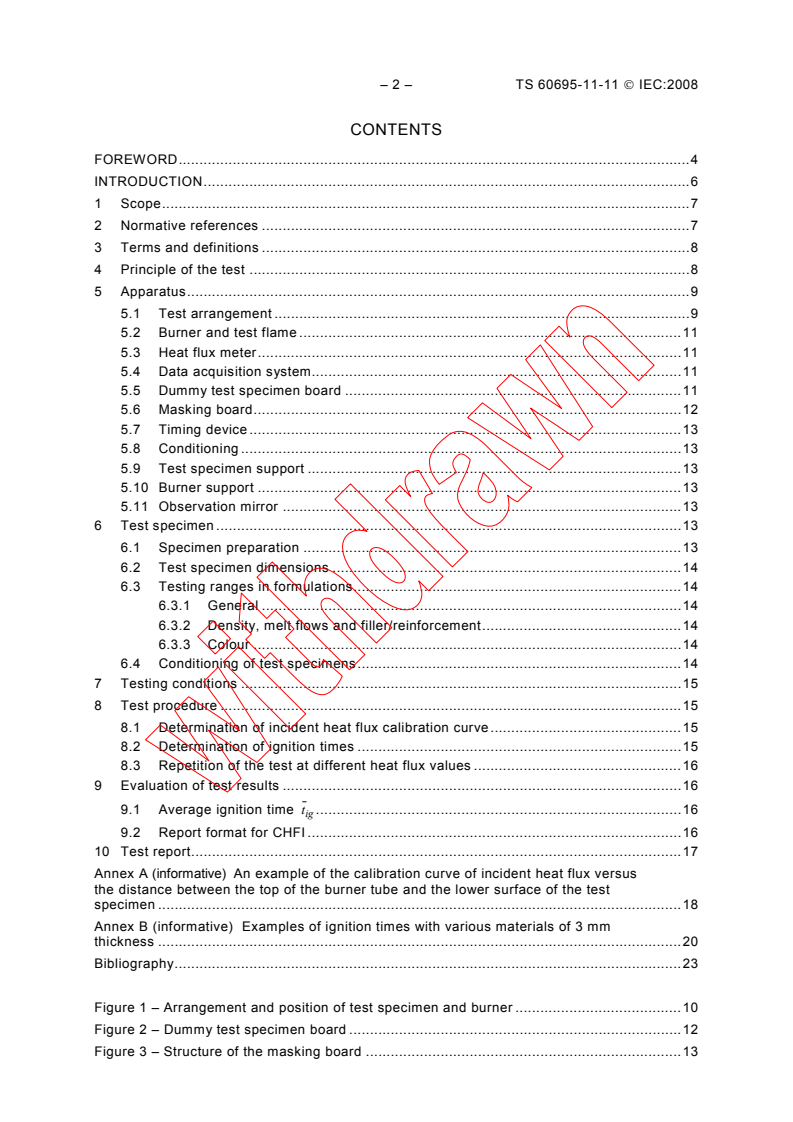
FOREWORD.4
INTRODUCTION.6
1 Scope.7
2 Normative references .7
3 Terms and definitions .8
4 Principle of the test .8
5 Apparatus.9
5.1 Test arrangement .9
5.2 Burner and test flame .11
5.3 Heat flux meter.11
5.4 Data acquisition system.11
5.5 Dummy test specimen board .11
5.6 Masking board.12
5.7 Timing device .13
5.8 Conditioning .13
5.9 Test specimen support .13
5.10 Burner support .13
5.11 Observation mirror .13
6 Test specimen .13
6.1 Specimen preparation .13
6.2 Test specimen dimensions .14
6.3 Testing ranges in formulations.14
6.3.1 General .14
6.3.2 Density, melt flows and filler/reinforcement.14
6.3.3 Colour .14
6.4 Conditioning of test specimens.14
7 Testing conditions .15
8 Test procedure .15
8.1 Determination of incident heat flux calibration curve.15
8.2 Determination of ignition times .15
8.3 Repetition of the test at different heat flux values .16
9 Evaluation of test results .16
9.1 Average ignition time t .16
ig
9.2 Report format for CHFI .16
10 Test report.17
Annex A (informative) An example of the calibration curve of incident heat flux versus
the distance between the top of the burner tube and the lower surface of the test
specimen .18
Annex B (informative) Examples of ignition times with various materials of 3 mm
thickness .20
Bibliography.23
Figure 1 – Arrangement and position of test specimen and burner .10
Figure 2 – Dummy test specimen board .12
Figure 3 – Structure of the masking board .13
TS 60695-11-11 © IEC:2008 – 3 –
Figure A.1 – Calibration curve (example) .18
Figure B.1-Example of ignition times of PMMA .20
Figure B.2 – Ignition times for ABS (example) .21
Figure B.3 – Ignition times for HIPS (example).22
Table A.1 – Calibration data (examples of actual measured data as shown in
Figure A.1).19
Table A.2 – Calibration data (examples of interpolated values) .19
Table B.1 – Illustrative example of tabulated results .22
– 4 – TS 60695-11-11 © IEC:2008
INTERNATIONAL ELECTROTECHNICAL COMMISSION
____________
FIRE HAZARD TESTING –
Part 11-11:Test flames –
Determination of the characteristic heat flux for ignition
from a non-contacting flame source
FOREWORD
1) The International Electrotechnical Commission (IEC) is a worldwide organization for standardization comprising
all national electrotechnical committees (IEC National Committees). The object of IEC is to promote
international co-operation on all questions concerning standardization in the electrical and electronic fields. To
this end and in addition to other activities, IEC publishes International Standards, Technical Specifications,
Technical Reports, Publicly Available Specifications (PAS) and Guides (hereafter referred to as “IEC
Publication(s)”). Their preparation is entrusted to technical committees; any IEC National Committee interested
in the subject dealt with may participate in this preparatory work. International, governmental and non-
governmental organizations liaising with the IEC also participate in this preparation. IEC collaborates closely
with the International Organization for Standardization (ISO) in accordance with conditions determined by
agreement between the two organizations.
2) The formal decisions or agreements of IEC on technical matters express, as nearly as possible, an international
consensus of opinion on the relevant subjects since each technical committee has representation from all
interested IEC National Committees.
3) IEC Publications have the form of recommendations for international use and are accepted by IEC National
Committees in that sense. While all reasonable efforts are made to ensure that the technical content of IEC
Publications is accurate, IEC cannot be held responsible for the way in which they are used or for any
misinterpretation by any end user.
4) In order to promote international uniformity, IEC National Committees undertake to apply IEC Publications
transparently to the maximum extent possible in their national and regional publications. Any divergence
between any IEC Publication and the corresponding national or regional publication shall be clearly indicated in
the latter.
5) IEC provides no marking procedure to indicate its approval and cannot be rendered responsible for any
equipment declared to be in conformity with an IEC Publication.
6) All users should ensure that they have the latest edition of this publication.
7) No liability shall attach to IEC or its directors, employees, servants or agents including individual experts and
members of its technical committees and IEC National Committees for any personal injury, property damage or
other damage of any nature whatsoever, whether direct or indirect, or for costs (including legal fees) and
expenses arising out of the publication, use of, or reliance upon, this IEC Publication or any other IEC
Publications.
8) Attention is drawn to the Normative references cited in this publication. Use of the referenced publications is
indispensable for the correct application of this publication.
9) Attention is drawn to the possibility that some of the elements of this IEC Publication may be the subject of
patent rights. IEC shall not be held responsible for identifying any or all such patent rights.
The main task of IEC technical committees is to prepare International Standards. In
exceptional circumstances, a technical committee may propose the publication of a technical
specification when
• the required support cannot be obtained for the publication of an International Standard,
despite repeated efforts, or
• the subject is still under technical development or where, for any other reason, there is the
future but no immediate possibility of an agreement on an International Standard but there
may be in the future.
Technical specifications are subject to review within three years of publication to decide
whether they can be transformed into International Standards.
IEC 60695-11-11, which is a technical specification, has been prepared by IEC technical
committee 89: Fire hazard testing.
TS 60695-11-11 © IEC:2008 – 5 –
It has the status of a basic safety publication in accordance with IEC Guide 104 and ISO/IEC
Guide 51.
The text of this technical specification is based on the following documents:
Enquiry draft Report on voting
89/866/DTS 89/883/RVC
Full information on the voting for the approval of this technical specification can be found in
the report on voting indicated in the above table.
This publication has been drafted in accordance with the ISO/IEC Directives, Part 2.
This technical specification is to be used in conjunction with IEC 60695-11-4.
A list of all the parts in the IEC 60695 series, under the general title Fire hazard testing, can
be found on the IEC website.
Part 11 consists of the following parts:
Part 11-2: Test flames – 1 kW nominal pre-mixed flame – Apparatus, confirmatory test
arrangement and guidance
Part 11-3: Test flames – 500 W flames – Apparatus and confirmational test methods
Part 11-4: Test flames – 50 W flame – Apparatus and confirmational test method
Part 11-5: Test flames – Needle-flame test method – Apparatus, confirmatory test
arrangement and guidance
Part 11-10: Test flames – 50 W horizontal and vertical flame test methods
Part 11-11: Test flames – Determination of the characteristic heat flux for ignition from a
non-contacting flame source
Part 11-20: Test flames – 500 W flame test methods
Part 11-21: Test flames – 500 W vertical flame test method for tubular polymeric materials
Part 11-30: Test flames – History and development from 1979 to 1999
Part 11-40: Test flames – Confirmatory tests – Guidance
The committee has decided that the contents of this publication will remain unchanged until
the maintenance result date indicated on the IEC web site under "http://webstore.iec.ch" in
the data related to the specific publication. At this date, the publication will be
• transformed into an International standard;
• reconfirmed;
• withdrawn;
• replaced by a revised edition; or
• amended.
– 6 – TS 60695-11-11 © IEC:2008
INTRODUCTION
In the design of any electrotechnical product, the risk of fire and the potential hazards
associated with fire need to be considered. In this respect the objective of component, circuit
and equipment design as well as the choice of materials is to reduce to acceptable levels the
potential risks of fire even in the event of foreseeable abnormal use, malfunction or failure.
IEC 60695-1-10 , together with its companion IEC 60695-1-11 , provide guidance on how this
is to be accomplished.
The primary aims are:
1) to prevent ignition caused by an electrically energized component part, and
2) in the event of ignition, to confine any resulting fire within the bounds of the enclosure of
the electrotechnical product.
Secondary aims include the minimization of any flame spread beyond the product’s enclosure
and the minimization of harmful effects of fire effluents including heat, smoke, and toxic or
corrosive combustion products.
Fires involving electrotechnical products can also be initiated from external non-electrical
sources. Considerations of this nature are dealt with in the overall risk assessment.
This technical specification should be used to measure and describe the properties of
materials used for electrotechnical products and sub-assemblies in response to heat from a
non-contacting flame source under controlled laboratory conditions and should not be used to
describe or appraise the fire hazard or fire risk of materials, products, or assemblies under
actual fire conditions. However, results of this test may be used as elements of a fire risk
assessment which takes into account all of the factors which are pertinent to an assessment
of the fire hazard of a particular end use. A test specimen cut from end-product or sub-
assembly can be tested by this test method.
This technical specification may involve hazardous materials, operations, and equipment. It
does not purport to address all of the safety problems associated with its use. It is the
responsibility of the user to establish appropriate safety and health practices and determine
the applicability of regulatory limitations prior to use.
Test methods to determine flammability by contact of flame have been developed and
standardized already, such as IEC 60695-11-10 [1] and IEC 60695-11-20 [2] and ISO 4589-2
[3].
This is the first test method to determine the characteristic heat flux for ignition (CHFI) of
materials used for electrotechnical products and sub-assemblies from a non-contacting flame
source. CHFI characterizes ignition behaviour in terms of incident heat flux. This test method
simulates the fire behaviour of materials used for electrotechnical products where a flame
source exists close to, but does not contact with these items. An example is a candle flame
near an electrotechnical product.
___________
To be published.
Figures in square brackets refer to the bibliography.
TS 60695-11-11 © IEC:2008 – 7 –
FIRE HAZARD TESTING –
Part 11-11:Test flames –
Determination of the characteristic heat flux for ignition
from a non-contacting flame source
1 Scope
This technical specification describes a test method used to determine the characteristic heat
flux for ignition (CHFI) from a non-contacting flame source for materials used in
electrotechnical products and sub-assemblies. It provides a relationship between ignition time
and incident heat flux. A test specimen cut from an end-product or sub-assembly can be
tested by this test method.
This basic safety publication is intended for use by technical committees in the preparation of
standards in accordance with the principles laid down in IEC Guide 104 and
ISO/IEC Guide 51.
One of the responsibilities of a technical committee is, wherever applicable, to make use of
basic safety publications in the preparation of its publications. The requirements, test
methods or test conditions of this basic safety publication will not apply unless specifically
referred to or included in the relevant publications.
2 Normative references
The following referenced documents are indispensable for the application of this document.
For dated references, only the edition cited applies. For undated references, the latest edition
of the referenced document (including any amendments) applies.
IEC 60695-1-10 , Fire hazard testing – Part 1-10: Guidance for assessing the fire hazard of
electrotechnical products – General guidelines (under development)
IEC 60695-1-11 , Fire hazard testing – Part 1-11: Guidance for assessing the fire hazard of
electrotechnical products – Fire hazard assessment (under development)
IEC 60695-11-4:2004, Fire hazard testing – Part 11-4: Test flames – 50 W flame – Apparatus
and confirmational test method
IEC Guide 104:1997, The preparation of safety publications and the use of basic safety
publications and group safety publications
ISO/IEC Guide 51:1999, Safety aspects – Guidelines for their inclusion in standards
ISO 291:2008, Plastics – Standard atmospheres for conditioning and testing
ISO 293:2004, Plastics – Compression moulding of test specimens of thermoplastic materials
ISO 294 (all parts), Plastics – Injection moulding of test specimens of thermoplastic materials
___________
To be published.
– 8 – TS 60695-11-11 © IEC:2008
ISO 295:2004, Plastics – Compression moulding of test specimens of thermosetting materials
ISO/IEC 13943:2000, Fire safety – Vocabulary
ISO/TS 14934-4:2007, Fire tests – Calibration of heat flux meters – Part 4: Guidance on the
use of heat flux meters in fire tests
3 Terms and definitions
For the purposes of this document, the following terms and definitions apply.
3.1
average ignition time, t
ig
arithmetic mean of three ignition times measured at a given heat flux
3.2
characteristic heat flux for ignition (CHFI)
-2
maximum incident heat flux which is a multiple of 5 kW × m and at which t is greater than 120 s
ig
3.3
draught-free environment
environment in which the results of experiments are not significantly affected by local air
speed
NOTE For example, for small scale tests a maximum air speed of 0,2 m/s is sometimes specified.
[ISO/IEC 13943:2000, definition 31]
3.4
heat flux
amount of thermal energy emitted, transmitted or received per unit area and per unit time
NOTE It is expressed in watts per square metre.
[ISO/IEC 13943:2000, definition 85]
3.5
ignition
initiation of combustion which results in a sustained and continuous flaming combustion for at
least 5 s
NOTE The term “ignition” in French has a very different meaning [state of body combustion].
3.6
incident heat flux
heat flux received by the surface of a test specimen
4 Principle of the test
The incident heat flux is measured using the apparatus described in 5.3 and 5.4. At a specific
incident heat flux, the time to ignite the test specimen depends on properties of the tested
material. The incident heat flux value is controlled by changing the distance between the top
of the burner tube and the lower surface of the test specimen and by changing the flow rate of
gas to the burner (see Annex A). The time required to ignite the test specimen is measured as
a function of the incident heat flux. The tests are performed at different incident heat flux
values until the maximum heat flux, at which t is greater than 120 s, is determined. This
ig
incident heat flux is defined as the characteristic heat flux for ignition (CHFI). The incident
TS 60695-11-11 © IEC:2008 – 9 –
–2
heat flux values at which the tests are carried out are chosen within the range of 30 kW × m
–2 –2
to 75 kW × m and shall be multiples of 5 kW × m .
5 Apparatus
5.1 Test arrangement
The arrangement and position of the test specimen and burner are shown in Figure 1. The
test specimen and masking board shall be mounted horizontally. The burner tube shall be
mounted vertically. The centre line of the test specimen, the burner tube, the sensor of the
heat flux meter and the conical hole in the masking board shall all be aligned vertically. The
sensor of the heat flux meter shall be placed horizontally 6 mm above the upper surface of the
masking board with its sensing surface facing down.
– 10 – TS 60695-11-11 © IEC:2008
5 to 10
Plan view
∅15 ± 1
45°
∅57 ± 1
Side view
IEC 1544/08
Key
1 test specimen
test specimen support
masking board
conical hole (diameter at the top side 15 mm)
burner tube and test flame (inner diameter 9,5 mm)
6 burner support (adjustable vertically)
7 mirror
Dimensions in milimetres
Figure 1 – Arrangement and position of test specimen and burner
6 ± 0,5
3 ± 0,5
24 ± 1
TS 60695-11-11 © IEC:2008 – 11 –
5.2 Burner and test flame
The laboratory burner apparatus shall conform to IEC 60695-11-4. The flame size and the gas
flow rate will differ from that specified in IEC 60695-11-4 in order to obtain the heat flux value
necessary for the test. The flame used for each test shall be maintained throughout the test.
NOTE ISO 10093 [4] describes the burner as ignition source P/PF2 (50 W).
5.3 Heat flux meter
The heat flux meter shall be of a water-cooled thermopile type (see ISO/TS 14934-4) which
determines the incident heat flux applied to the test specimen. The heat flux meter is placed
in the centre of a dummy test specimen board.
When incident heat flux measurements are made, the heat flux meter shall not have any
optical filter in-line with the sensor.
NOTE 1 The incident heat flux measurement is of critical importance to the test results. ISO 14934-3 [5] provides
the calibration method for heat flux meter.
–2
NOTE 2 A thermopile of the Schmidt-Boelter type, with a designed range up to 100 kW × m and a target
diameter of approximately 12,5 mm, has been found to be suitable.
5.4 Data acquisition system
The voltmeter for measuring the output of the heat flux meter shall have a resolution of
0,01 % or better for the maximum output range.
NOTE It may consist of any commercial digital measuring unit designed for the purpose.
5.5 Dummy test specimen board
The dummy test specimen board shall be approximately 100 mm × 100 mm with a centrally
located hole whose diameter is slightly larger than the outside diameter of the heat flux meter.
The board shall be made from a heat-resistant non-combustible rigid board. The dummy
specimen board is used, together with the heat flux meter (see Figure 2), for the
determination of incident heat flux (see 8.1).
NOTE A calcium silicate board of approximately 12 mm thickness has been found suitable for the dummy test
specimen board.
– 12 – TS 60695-11-11 © IEC:2008
1 3
a
b
IEC 1545/08
Key
1 dummy test specimen board
2 heat flux meter
3 cooling water pipe
a approximately 12 mm
b
approximately 100 mm
Figure 2 – Dummy test specimen board
5.6 Masking board
The masking board shall be made of three heat-resistant non-combustible rigid boards, each
-3 -3
having a density of 850 kg × m ± 50 kg × m and a thickness of 8 mm ± 0,5 mm and the
total thickness of the three non-combustible board shall be 24 mm ± 1,5 mm. One board is
inserted between the upper and lower boards and is made moveable. This moveable board is
the radiant heat shield which protects the test specimen from the heat source before the test
is started. At the centre of the masking board there shall be a conically shaped opening. The
diameter of the opening on the upper surface shall be 15 mm ± 1 mm and 57 mm ± 1 mm on
the lower surface. An illustration of the masking board and its operation is shown in Figure 3.
–1 –1
NOTE A calcium silicate board of the required density has a thermal conductivity of 0,14 W × m × K at 200 °C,
–1 –1 –1 –1
0,15 W × m × K at 400 °C, and 0,17 W × m × K at 600 °C.
TS 60695-11-11 © IEC:2008 – 13 –
a
b
IEC 1546/08
Key
masking board
2 upper board
moveable board (radiant heat shield)
4 lower board
a
position of the moveable masking board prior to a test
b position of the moveable masking board during a test
Figure 3 – Structure of the masking board
5.7 Timing device
The timing device shall have a resolution of 0,5 s or better.
5.8 Conditioning
The conditioning chamber shall be maintained at a temperature of 23 ºC ± 2 ºC, with a relative
humidity of 50 % ± 10 % (see ISO 291).
5.9 Test specimen support
The test specimen support shall maintain a distance of 6 mm ± 0,5 mm between the lower
surface of the test specimen and the upper surface of the masking board.
5.10 Burner support
The burner shall be located on a support which can be adjusted in the vertical direction. The
distance between the top of the burner tube and the lower surface of the test specimen shall
be able to be determined using a suitable measuring device which has a resolution of 1 mm or
better.
5.11 Observation mirror
To observe the ignition behaviour of the test specimen, an observation mirror approximately
100 mm × 100 mm shall be positioned underneath the masking board.
6 Test specimen
6.1 Specimen preparation
Test specimens shall be fabricated using the appropriate ISO method, e.g. casting and
injection moulding in accordance with ISO 294, compression moulding in accordance with
ISO 293 or ISO 295, or transfer moulding to the necessary shape. Where this is not possible,
– 14 – TS 60695-11-11 © IEC:2008
the test specimen shall be produced using the same fabrication process as would be normally
used to mould a part of a product.
NOTE If possible, specimen cut from the end-product of electrotechnical products and sub-assemblies can be
tested by the test method.
After any fabrication or cutting operation, care shall be taken to remove all dust and any
particles from the surface; cut edges shall be fine sanded to a smooth finish.
6.2 Test specimen dimensions
The dimensions of the planar sections of the test specimens shall be at least 75 mm ± 1 mm
in length and width and at the thickness under consideration. The preferred values for the
presentation of comparative data include 0,4 mm ± 0,05 mm, 0,75 mm ± 0,1 mm, 1,5 mm
± 0,1 mm, 3,0 mm ± 0,2 mm and 6,0 mm ± 0,4 mm.
6.3 Testing ranges in formulations
6.3.1 General
The results of tests carried out on test specimen sets of different colour, thickness, density,
molecular mass, anisotropic type/direction, additives, fillers, and/or reinforcements can vary.
6.3.2 Density, melt flows and filler/reinforcement
Test specimens covering all combinations of minimum and maximum levels of density, melt
flows and filler/reinforcement content may be provided and considered representative of the
range if the test results yield the same CHFI. If the test results do not yield the same CHFI for
all test specimens representing the range, evaluation shall be limited to the materials with the
specific levels of density, melt flows and filler/reinforcement tested. In addition, test
specimens with intermediate density, melt flows, and filler/reinforcement content shall be
tested to determine the representative range for each CHFI determination. However, as an
alternative, the least favorable performance of the specific levels of density, melt flows and
filler/reinforcement tested may be considered representative of intermediate levels without
additional testing.
6.3.3 Colour
When evaluating a range of colours, uncoloured test specimens and test specimens with the
highest level of organic and inorganic pigment loading by weight are considered
representative of the colour range if the test results yield the same CHFI. When certain
pigments are known to affect flammability characteristics, the test specimens containing those
pigments shall also be tested. Test specimens which shall be tested are those that
a) contain no colouring,
b) contain the highest level of organic pigments,
c) contain the highest level of inorganic pigments,
d) contain pigments which are known to adversely affect flammability characteristics.
6.4 Conditioning of test specimens
Unless otherwise specified in the relevant specification, the test specimen shall be
conditioned for a minimum of 24 h at 23 ºC ± 2 ºC and a relative humidity of 50 % ± 10 %.
Once removed from the conditioning chamber, the test specimens shall be tested within 1 h.
TS 60695-11-11 © IEC:2008 – 15 –
7 Testing conditions
All test specimens shall be tested in a laboratory atmosphere in a draught free environment at
a temperature of between 15 °C and 35 °C and a relative humidity of between 45 % and 75 %.
8 Test procedure
8.1 Determination of incident heat flux calibration curve
The incident heat flux, which will be received by the surface of the test specimen in 8.2, shall
be determined in terms of the distance between the top of the burner and the lower surface of
the test specimen and the gas flow rate to the burner. For this purpose, an incident heat flux
calibration curve shall be determined by the following procedures.
a) Place the heat flux meter, which is located in the centre of a dummy test specimen board,
in the test specimen position.
b) Place the burner (see 5.2) in position.
c) Place the radiation heat shield in position (see Figure 3, position a).
d) Ignite the gas and adjust the gas flow rate to an appropriate value.
–2 –2 3 –1
NOTE For heat fluxes in the range 30 kW × m to 60 kW × m , a gas flow of 105 cm × min has been found to
–2 –2 3 –1
be suitable. For heat fluxes in the range 55 kW × m to 75 kW × m , a gas flow of 160 cm × min has been
found to be suitable.
e) Wait for a period of at least 5 min to allow the burner conditions to reach equilibrium.
f) The radiant heat shield shall then be removed and the output of the heat flux meter shall
be recorded for 5 min (see Figure 3, position b).
g) Perform this measurement for several different distances between the lower surface of the
heat flux meter and the top of the burner tube, so as to obtain a range of incident heat flux
–2 –2
values between 30 kW × m and 75 kW × m .
h) Plot a calibration curve of incident heat flux as a function of the distance, and obtain by
–2
interpolation the distances which correspond to the heat fluxes of 30 kW × m , 35 kW ×
–2 –2 –2 –2 –2 –2 –2
m , 40 kW × m , 45 kW × m , 50 kW × m , 55 kW × m , 60 kW × m , 65 kW × m ,
–2 –2
70 kW × m , and 75 kW × m (see Annex A).
The temperature of cooling water for the heat flux meter shall be maintained above the
ambient temperature in order to avoid water condensation on the sensing surface (see
ISO/TS 14934-4).
8.2 Determination of ignition times
The test shall be conducted under a selected incident heat flux value, in terms of the distance
between the top of the burner and the lower surface of the test specimen and the gas flow
rate to the burner, obtained in accordance with 8.1.
For the purposes of this test method, ignition is as defined in 3.5.
a) Adjust the distance between the top of the burner and lower surface of the test specimen
and gas flow rate to the burner in order to obtain the selected incident heat flux value.
b) Ignite the burner and wait for a period of at least 5 min to allow the burner conditions to
reach equilibrium.
c) Place the radiation heat shield in position (see Figure 3, position a).
d) Place the test specimen in the test specimen position (see Figure 1).
e) Pull aside the radiant heat shield (see Figure 3, position b) and simultaneously start the
timing device.
– 16 – TS 60695-11-11 © IEC:2008
f) Observe the test specimen and note if phenomena such as deformation, cracking and
melting occur.
g) If the test specimen ignites within 120 s, observe the flaming combustion for at least 5 s,
record the time to ignition ( t ) and return the radiation shield to position a. The test can
ig
be stopped if sustained and continuous combustion has been observed for at least 5 s.
h) If the test specimen does not ignite within 120 s, record the failure to ignite, and return the
radiation shield to position a.
i) Repeat d) to h) above two additional times with a new test specimen each time and under
the same test conditions.
j) Calculate and record t , the arithmetic mean of the three ignition times.
ig
NOTE If dripping or melting occurs which adversely affect the test results, the test results would be considered
invalid.
8.3 Repetition of the test at different heat flux values
–2 –2
The incident heat flux shall be chosen within the range from 30 kW × m to 75 kW × m and
–2
shall be multiple of 5 kW × m .
The tests shall be carried out until the highest incident heat flux value at which t is greater
ig
than 120 s is determined.
NOTE It may be efficient to start the test at a incident heat flux which is in the middle of the range from 30 kW ×
-2 –2 –2
m to 75 kW × m , for example 50 kW × m .
9 Evaluation of test results
9.1 Average ignition time t
ig
Calculate the average ignition time t for each incident heat flux value used in the tests.
ig
When ignition and non-ignition occurs in the three tests, the average shall not be calculated.
When all three specimens do not ignite for 120 s, record " t is greater than 120 s".
ig
9.2 Report format for CHFI
The CHFI shall be reported in the following manner.
When three test specimens of thickness X mm do not ignite after 120 s exposure, and the
–2
heat flux H is the maximum multiple of 5 kW × m at which this occurs, then this incident
heat flux shall be determined as the CHFI, and reported in the following format:
–2
CHFI: H kW × m / X mm
for example, for a test specimen of 3,0 mm thickness and the maximum heat flux, at which t
ig
–2
is greater than 120 s, is 50 kW × m :
–2
CHFI: 50 kW × m / 3,0 mm
–2
If the three test specimens do not ignite at the heat flux value of 75 kW × m , CHFI shall be
reported as:
–2
CHFI: >75 kW × m / thickness
TS 60695-11-11 © IEC:2008 – 17 –
–2
If t is less than 120 s at 30 kW × m , the CHFI shall be reported as:
ig
–2
CHFI: <30 kW × m / thickness
10 Test report
The test report shall include the following information:
a) a reference to this technical specification;
b) the type, description and dimensions of the test specimen (see Clause 6) ;
c) the method of preparation of the test specimen (see Clause 6);
d) conditioning, if any, of the test specimens (see 6.4);
e) phenomena, if any, other than ignition such as deformation, cracking and melting
(see 8.2 f);
f) the number of test specimens tested for each incident heat flux value;
g) all test results and t values for each incident flux applied (see Clause 9), and
ig
h) the CHFI value according to 9.2.
– 18 – TS 60695-11-11 © IEC:2008
Annex A
(informative)
An example of the calibration curve of incident heat flux
versus the distance between the top of the burner tube
and the lower surface of the test specimen
An example of a calibration curve of incident heat flux versus distance between the top of the
burner tube and the lower surface of the test specimen is given in Figure A.1, and the
calibration data used to plot this curve are given in Table A.1.
b
Y
a
20 40 60 80 100
x IEC 1547/08
–1
a
gas flow rate 105 cm × min
–1
b
gas flow rate 160 cm × min
–2
x
incident heat flux kW × m
y distance between the top of the burner and the lower surface of the test specimen
Figure A.1 – Calibration curve (example)
TS 60695-11-11 © IEC:2008 – 19 –
Table A.1 – Calibration data (examples of actual measured data as shown in Figure A.1)
Gas flow rate
3 3
–1 –1
105 cm × min 160 cm × min
–2
Distance between the the top
Heat flux in kW × m
of the burner tubeand the test
specimen in mm
152,0 29,9 -
125,0 33,47 -
120,0 34,17 -
115,0 35,56 -
110,0 36,26 -
105,0 36,96
100,0 37,65 51,52
95,0 39,75 53,21
90,0 41,14 54,79
85,0 41,83 55,58
80,0 43,23 58,66
75,0 44,62 60,44
70,0 46,72 63,32
65,0 48,81 66,19
60,0 50,90 69,19
55,0 52,99 73,42
50,0 56,48 78,18
45,0 60,67 83,93
The temperature of cooling water was 40 ºC.
Each measurement of heat flux was continued for 5 min.
Table A.2 – Calibration data (examples of interpolated values)
Gas flow rate
3 3
–1 –1
105 cm × min 160 cm × min
–2
Distance between the top of the burner tube
Heat flux in kW × m
and the test specimen in mm
30 150,0 -
35 117,1 -
40 92,7 -
45 75,0 -
50 62,7 103,4
55 54,1 89,3
60 47,5 77,2
65 - 67,0
70 - 58,8
75 - 52,5
The temperature of cooling water was 40 ºC.
Each measurement of heat flux was continued for 5 min.
– 20 – TS 60695-11-11 © IEC:2008
Annex B
(informative)
Examples of ignition times with various materials of 3 mm thickness
Materials tested:
PMMA – polymethyl methacrylate
ABS – acrylonitrile-butadiene-styrene copolymer
HIPS – high impact polystyrene
y
0 20 40 60 80 100
x
IEC 1548/08
–2
x
incident heat flux kW × m
y ignition times s
–2
CHFI for PMMA: 60 kW × m / 3,0 mm
Figure B.1 – Example of ignition times of PMMA
TS 60695-11-11 © IEC:2008 – 21 –
y
0 20 40 60 80 100
x
IEC 1549/08
–2
x
incident heat flux kW × m
y ignition times s
1 ABS 1
2 ABS 2
–2
CHFI for ABS 1: 60 kW × m / 3,0 mm
–2
× m / 3,0 mm
CHFI for ABS 2: 60 kW
Figure B.2 – Ignition times f
...