


IEC 60269-3-1:1994/AMD2:2001
(Amendment)Amendment 2 - Low-voltage fuses - Part 3-1: Supplementary requirements for fuses for use by unskilled persons (fuses mainly for household and similar applications) - Sections I to IV
Amendment 2 - Low-voltage fuses - Part 3-1: Supplementary requirements for fuses for use by unskilled persons (fuses mainly for household and similar applications) - Sections I to IV
Amendement 2 - Fusibles basse tension - Partie 3-1: Règles supplémentaires pour les fusibles destinés à être utilisés par des personnes non qualifiées (fusibles pour usages essentiellement domestiques et analogues) - Sections I à IV
General Information
- Status
- Published
- Publication Date
- 06-Mar-2001
- Technical Committee
- SC 32B - Low-voltage fuses
- Current Stage
- DELPUB - Deleted Publication
- Start Date
- 08-Jul-2004
- Completion Date
- 26-Oct-2025
Relations
- Effective Date
- 05-Sep-2023
- Effective Date
- 05-Sep-2023
Overview
IEC 60269-3-1:1994/AMD2:2001 is an amendment to the international standard focused on low-voltage fuses, specifically addressing supplementary requirements for fuses intended for use by unskilled persons. This amendment applies mainly to household and similar applications where fuse operation and replacement are expected to be performed by users without formal technical training. Published by the International Electrotechnical Commission (IEC), this document ensures enhanced safety, usability, and reliability for consumer-level fuses.
The amendment builds upon the base standard IEC 60269-3-1, covering Sections I to IV and providing detailed clarifications, modifications, and additions, especially relating to construction, mechanical strength, test methods, and thread standards for fuse components. It is essential for manufacturers, designers, and safety regulators involved in producing and approving low-voltage fuses for domestic and analogous uses.
Key Topics
Fuse Design for Unskilled Users
The amendment emphasizes design features that simplify the handling and replacement of fuses by the general public. It includes supplementary construction requirements for fuse carriers, fuse-links, and gauge-pieces to ensure ease of use and safety.Mechanical and Thermal Testing Requirements
Updates on testing procedures, such as thermal endurance and mechanical strength tests, ensure fuse components withstand operational stresses during use. Temperature rise measurements and cyclical endurance testing are detailed to guarantee consistent performance.Thread and Connection Standards
The document integrates specific references to ISO thread standards including ISO 228-1, ISO 228-2, and ISO 965-1 to standardize the dimensions, tolerances, and verification of pipe threads involved in fuse assembly. This assures interchangeability and secure fastening compatible with household electrical infrastructure.Visual and Dimensional Specifications
Detailed figures and tables (Figures 6a, 6b, 7a–7f, 8a, 9a–9d) provide precise dimensional limits, thread profiles, and assembly standards for D-type fuses mainly used in household applications. These visual aids support compliance with manufacturing and quality control processes.Safety Features
Essential safety considerations include optional holes for voltage testers, the use of specific materials treated for mechanical durability, and integrity checks for cemented parts and sealing compounds at elevated temperatures to prevent failures during electrical faults.
Applications
Household Electrical Systems
This standard amendment guides the design and approval of low-voltage fuses commonly employed in residential electrical panels and household appliances. It targets fuses intended to be replaced safely by non-specialist users.Consumer Electrical Devices
Manufacturers of consumer electrical products that incorporate low-voltage fuses benefit from compliance by ensuring user-friendly fuse servicing without compromising safety or performance.Electrical Installation and Maintenance
Electricians and technicians responsible for domestic electrical systems rely on these specifications to select and install fuses that meet safety regulations and performance requisites for unskilled user environments.Fuse Manufacturing and Quality Control
Fuse producers utilize the amendment to align their product design, testing, and thread calibration processes with international standards, thus reducing product defects and enhancing user safety.
Related Standards
IEC 60269 Series
The broader series covers low-voltage fuses, including general requirements (Part 1), specific fuse types and ratings, and supplementary rules for specialized applications. The amendment complements the base IEC 60269-3-1 standard.ISO 228-1:1994 and ISO 228-2:1987
These standards specify pipe thread dimensions and verification methods without pressure-tight joints, referenced for threaded components in fuse assemblies.ISO 965-1:1998
This standard outlines tolerances for ISO general-purpose metric screw threads, influencing manufacturing precision for threaded fuse parts.
By conforming to IEC 60269-3-1:1994/AMD2:2001, stakeholders in household electrical safety benefit from reliable, standardized, and user-friendly low-voltage fuses designed for safe handling by unskilled persons. The amendment reinforces critical elements such as mechanical strength, thermal performance, thread compatibility, and clear construction specifications critical for domestic electrical protection solutions.
IEC 60269-3-1:1994/AMD2:2001 - Amendment 2 - Low-voltage fuses - Part 3-1: Supplementary requirements for fuses for use by unskilled persons (fuses mainly for household and similar applications) - Sections I to IV Released:3/7/2001 Isbn:2831856485
Frequently Asked Questions
IEC 60269-3-1:1994/AMD2:2001 is a standard published by the International Electrotechnical Commission (IEC). Its full title is "Amendment 2 - Low-voltage fuses - Part 3-1: Supplementary requirements for fuses for use by unskilled persons (fuses mainly for household and similar applications) - Sections I to IV". This standard covers: Amendment 2 - Low-voltage fuses - Part 3-1: Supplementary requirements for fuses for use by unskilled persons (fuses mainly for household and similar applications) - Sections I to IV
Amendment 2 - Low-voltage fuses - Part 3-1: Supplementary requirements for fuses for use by unskilled persons (fuses mainly for household and similar applications) - Sections I to IV
IEC 60269-3-1:1994/AMD2:2001 is classified under the following ICS (International Classification for Standards) categories: 29.120.50 - Fuses and other overcurrent protection devices. The ICS classification helps identify the subject area and facilitates finding related standards.
IEC 60269-3-1:1994/AMD2:2001 has the following relationships with other standards: It is inter standard links to IEC 60269-3-1:1994, IEC 60269-3-1:2004. Understanding these relationships helps ensure you are using the most current and applicable version of the standard.
IEC 60269-3-1:1994/AMD2:2001 is available in PDF format for immediate download after purchase. The document can be added to your cart and obtained through the secure checkout process. Digital delivery ensures instant access to the complete standard document.
Standards Content (Sample)
NORME CEI
INTERNATIONALE IEC
60269-3-1
INTERNATIONAL
STANDARD
AMENDEMENT 2
AMENDMENT 2
2001-03
Amendement 2
Fusibles basse tension –
Partie 3-1:
Règles supplémentaires pour les fusibles destinés
à être utilisés par des personnes non qualifiées
(fusibles pour usages essentiellement
domestiques et analogues) – Sections I à IV
Amendment 2
Low-voltage fuses –
Part 3-1:
Supplementary requirements for fuses for use
by unskilled persons (fuses mainly for household
and similar applications) – Sections I to IV
IEC 2001 Droits de reproduction réservés Copyright - all rights reserved
International Electrotechnical Commission 3, rue de Varembé Geneva, Switzerland
Telefax: +41 22 919 0300 e-mail: inmail@iec.ch IEC web site http://www.iec.ch
CODE PRIX
Commission Electrotechnique Internationale
Q
PRICE CODE
International Electrotechnical Commission
Pour prix, voir catalogue en vigueur
For price, see current catalogue
– 2 – 60269-3-1 amend. 2 © CEI:2001
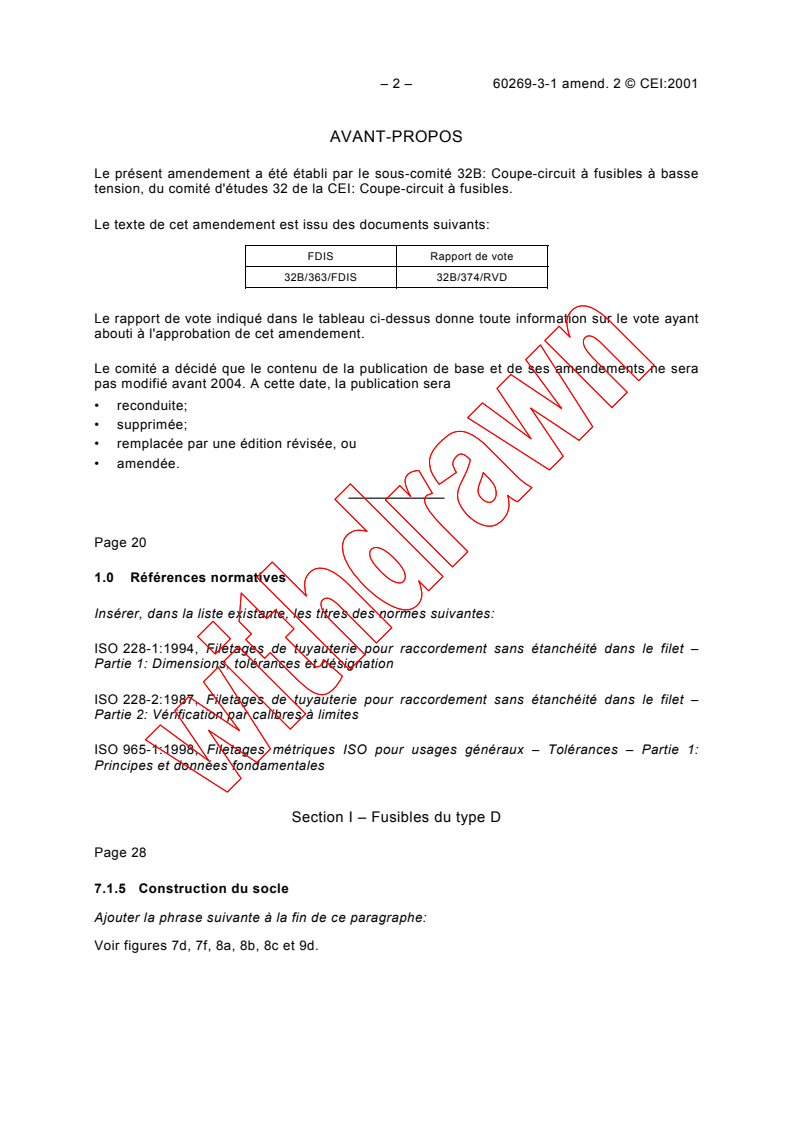
AVANT-PROPOS
Le présent amendement a été établi par le sous-comité 32B: Coupe-circuit à fusibles à basse
tension, du comité d'études 32 de la CEI: Coupe-circuit à fusibles.
Le texte de cet amendement est issu des documents suivants:
FDIS Rapport de vote
32B/363/FDIS 32B/374/RVD
Le rapport de vote indiqué dans le tableau ci-dessus donne toute information sur le vote ayant
abouti à l'approbation de cet amendement.
Le comité a décidé que le contenu de la publication de base et de ses amendements ne sera
pas modifié avant 2004. A cette date, la publication sera
• reconduite;
• supprimée;
• remplacée par une édition révisée, ou
• amendée.
_____________
Page 20
1.0 Références normatives
Insérer, dans la liste existante, les titres des normes suivantes:
ISO 228-1:1994, Filetages de tuyauterie pour raccordement sans étanchéité dans le filet –
Partie 1: Dimensions, tolérances et désignation
ISO 228-2:1987, Filetages de tuyauterie pour raccordement sans étanchéité dans le filet –
Partie 2: Vérification par calibres à limites
ISO 965-1:1998, Filetages métriques ISO pour usages généraux – Tolérances – Partie 1:
Principes et données fondamentales
Section I – Fusibles du type D
Page 28
7.1.5 Construction du socle
Ajouter la phrase suivante à la fin de ce paragraphe:
Voir figures 7d, 7f, 8a, 8b, 8c et 9d.
60269-3-1 Amend. 2 © IEC:2001 – 3 –
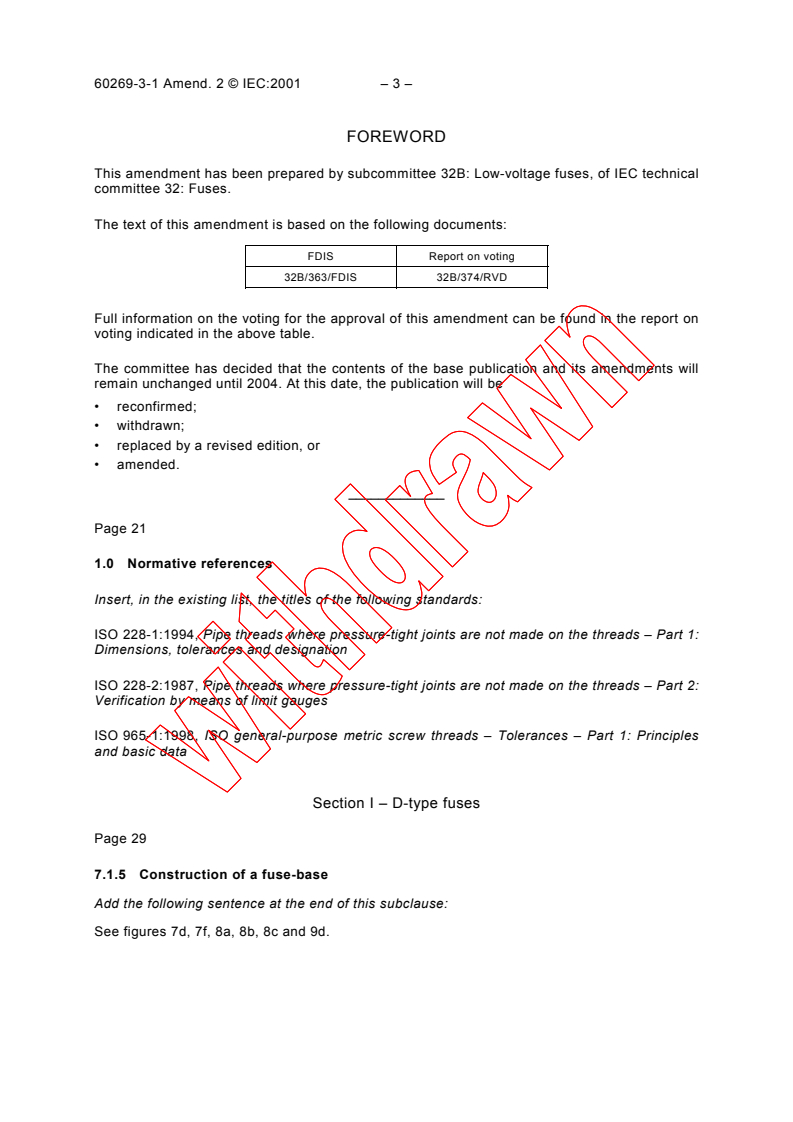
FOREWORD
This amendment has been prepared by subcommittee 32B: Low-voltage fuses, of IEC technical
committee 32: Fuses.
The text of this amendment is based on the following documents:
FDIS Report on voting
32B/363/FDIS 32B/374/RVD
Full information on the voting for the approval of this amendment can be found in the report on
voting indicated in the above table.
The committee has decided that the contents of the base publication and its amendments will
remain unchanged until 2004. At this date, the publication will be
• reconfirmed;
• withdrawn;
• replaced by a revised edition, or
• amended.
_____________
Page 21
1.0 Normative references
Insert, in the existing list, the titles of the following standards:
ISO 228-1:1994, Pipe threads where pressure-tight joints are not made on the threads – Part 1:
Dimensions, tolerances and designation
ISO 228-2:1987, Pipe threads where pressure-tight joints are not made on the threads – Part 2:
Verification by means of limit gauges
ISO 965-1:1998, ISO general-purpose metric screw threads – Tolerances – Part 1: Principles
and basic data
Section I – D-type fuses
Page 29
7.1.5 Construction of a fuse-base
Add the following sentence at the end of this subclause:
See figures 7d, 7f, 8a, 8b, 8c and 9d.
– 4 – 60269-3-1 amend. 2 © CEI:2001
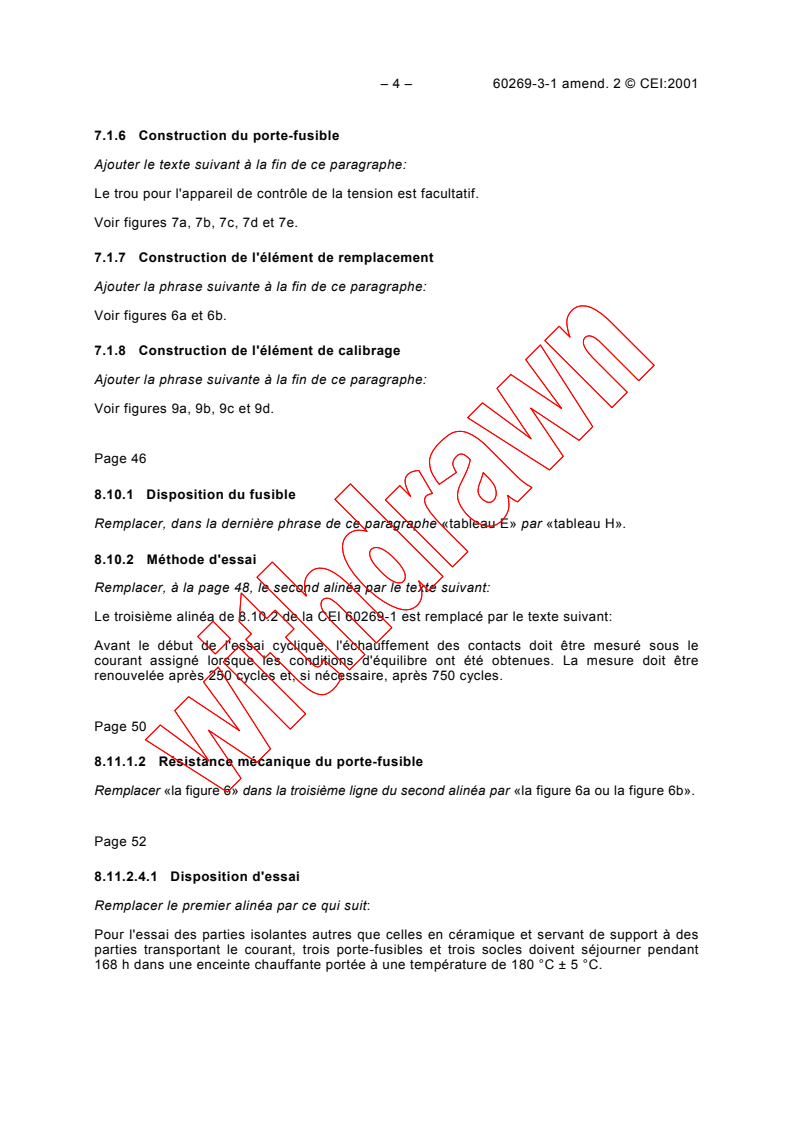
7.1.6 Construction du porte-fusible
Ajouter le texte suivant à la fin de ce paragraphe:
Le trou pour l'appareil de contrôle de la tension est facultatif.
Voir figures 7a, 7b, 7c, 7d et 7e.
7.1.7 Construction de l'élément de remplacement
Ajouter la phrase suivante à la fin de ce paragraphe:
Voir figures 6a et 6b.
7.1.8 Construction de l'élément de calibrage
Ajouter la phrase suivante à la fin de ce paragraphe:
Voir figures 9a, 9b, 9c et 9d.
Page 46
8.10.1 Disposition du fusible
Remplacer, dans la dernière phrase de ce paragraphe «tableau E» par «tableau H».
8.10.2 Méthode d'essai
Remplacer, à la page 48, le second alinéa par le texte suivant:
Le troisième alinéa de 8.10.2 de la CEI 60269-1 est remplacé par le texte suivant:
Avant le début de l'essai cyclique, l'échauffement des contacts doit être mesuré sous le
courant assigné lorsque les conditions d'équilibre ont été obtenues. La mesure doit être
renouvelée après 250 cycles et, si nécessaire, après 750 cycles.
Page 50
8.11.1.2 Résistance mécanique du porte-fusible
Remplacer «la figure 6» dans la troisième ligne du second alinéa par «la figure 6a ou la figure 6b».
Page 52
8.11.2.4.1 Disposition d'essai
Remplacer le premier alinéa par ce qui suit:
Pour l'essai des parties isolantes autres que celles en céramique et servant de support à des
parties transportant le courant, trois porte-fusibles et trois socles doivent séjourner pendant
168 h dans une enceinte chauffante portée à une température de 180 °C ± 5 °C.
60269-3-1 Amend. 2 © IEC:2001 – 5 –
7.1.6 Construction of a fuse-carrier
Add the following text at the end of this subclause:
The hole for the voltage tester is optional.
See figures 7a, 7b, 7c, 7d and 7e.
7.1.7 Construction of a fuse-link
Add the following sentence at the end of this subclause:
See figures 6a and 6b.
7.1.8 Construction of a gauge-piece
Add the following sentence at the end of this subclause:
See figures 9a, 9b, 9c and 9d.
Page 47
8.10.1 Arrangement of the fuse
Replace in the last sentence of this subclause "table E" by "table H".
8.10.2 Test method
Replace, on page 49, the second paragraph by the following:
The third paragraph of 8.10.2 in IEC 60269-1 is replaced by the following wording:
Before the beginning of the cycling test, the temperature rise of the contacts shall be measured
at rated current when steady-state conditions have been obtained. The measurement shall be
repeated after 250 cycles and, if necessary, after 750 cycles.
Page 51
8.11.1.2 Mechanical strength of the fuse carrier
Replace "figure 6" in the third line of the second paragraph by "figure 6a or figure 6b".
Page 53
8.11.2.4.1 Test arrangement
Replace the first paragraph by the following:
Three fuse-carriers and three fuse-bases shall be placed in a heating chamber at a
temperature of 180 °C ± 5 °C for a period of 168 h for the test on insulating parts other than
ceramics supporting current-carrying parts.
– 6 – 60269-3-1 amend. 2 © CEI:2001
Remplacer le troisième alinéa par ce qui suit:
Pour satisfaire les prescriptions relatives aux parties cimentées, matériaux de remplissage et
couleurs d'identification, un fusible complet doit être exposé pendant 1 h à une température
de 150 °C ± 5 °C.
Page 59
Figure 2
Remplacer, dans le tableau supérieur, le titre de la colonne de droite, «1 ± 0,5» par «l ± 0,5».
Page 65
Figure 6a
Dans le tableau, la dimension d pour I = 80 A doit se lire «25,6 ». La dimension d pour I
5 n 5 n
− 2,3
= 100 A doit se lire «25,6 (max.)».
Page 66
Figure 6b (voir amendement 1)
+0,2
La tolérance de la dimension d pour la taille DII doit se lire « ».
−0,4
Page 68
Figure 7a
Dans les deux vues supérieures, remplacer «9,5» par «9,5 min.» à gauche des vues.
Dans la vue supérieure à droite, ajouter «Note 4» à la dimension «M30 × 2».
Ajouter, dans NOTES, les notes suivantes:
4 Filetage selon l’ISO 965-1, classe 8g.
5 Le trou pour l'appareil de contrôle de la tension est facultatif.
Page 69
Figure 7b
Remplacer, dans la vue à droite, du côté gauche, «9» par «9 min.».
Ajouter, dans NOTES, la note suivante:
3 Le trou pour l'appareil de contrôle de la tension est facultatif.
60269-3-1 Amend. 2 © IEC:2001 – 7 –
Replace the third paragraph by the following:
A complete fuse shall be exposed for 1 h to a temperature of 150 °C ± 5 °C to meet the
requirements for cemented parts, sealing compound and colour markings.
Page 59
Figure 2
Replace, in the top table, the title of the right-hand column, "1 ± 0,5" by "l ± 0,5".
Page 65
Figure 6a
In the table, the dimension d for I = 80 A shall read "25,6 ". The dimension d for I = 100 A
5 n 5 n
−2,3
shall read "25,6 (max.)".
Page 66
Figure 6b (see amendment 1)
+0,2
The tolerance of dimension d for size DII shall read " ".
−0,4
Page 68
Figure 7a
Replace, in the top two drawings, "9,5" at the left-hand side of the drawings by "9,5 min.".
Add, in the upper right-hand drawing, "Note 4" to the dimension "M30 × 2".
Add, in NOTES, the following notes:
4 Thread according to ISO 965-1, class designation 8g.
5 The hole for the voltage tester is optional.
Page 69
Figure 7b
Replace, in the right-hand drawing, "9" at the left edge of the drawing by "9 min.".
Add, in NOTES, the following note:
3 The hole for the voltage tester is optional.
– 8 – 60269-3-1 amend. 2 © CEI:2001
Page 70
Figure 7c
Supprimer «DIV» au-dessus de la figure.
Remplacer, dans la vue supérieure, la seconde dimension à partir de la gauche de la vue,
«11», par «11 min.».
Dans la vue supérieure, remplacer «WR 1¼ in» par «G 1¼ B (Note 4)».
Ajouter, dans NOTES, les deux notes suivantes:
4 Filetage selon l’ISO 228-1; calibres limites selon l’ISO 228-2.
5 Le trou pour l'appareil de contrôle de la tension est facultatif.
Ajouter, après la figure 7c, les figures 7d, 7e et 7f suivantes:
! Boulon
" Ecrou
IEC 149/01
Dimensions en millimètres
Boulon Ecrou
Diamètre extérieur Diamètre intérieur Diamètre extérieur Diamètre intérieur
Abréviation
d d D D
1 1
Max. Min. Max. Min. Min. Max. Min. Max.
E 14 13,89 13,7 12,29 12,1 13,97 14,16 12,37 12,56
E 18 18,5 18,25 16,8 16,55 18,6 18,85 16,9 17,15
E 27 26,45 26,15 24,26 23,96 26,55 26,85 24,36 24,66
E 33 33,05 32,65 30,45 30,05 33,15 33,55 30,55 30,95
Filetages par 25,4 mm Pas Congé
Abréviation
z P r
E 14 9 2,822 0,822
E 18 3 0,875
≈ 8,5
E 27 7 3,629 1,025
E 33 6 4,233 1,187
Figure 7d – Filetages Edison pour les fusibles de type D; dimensions limites
60269-3-1 Amend. 2 © IEC:2001 – 9 –
Page 70
Figure 7c
Delete "DIV" above the figure.
Replace, in the upper drawing, the second measurement from the left-hand side of the drawing,
"11", by "11 min.".
Replace, in the upper drawing, "WR 1¼ in" by "G 1¼ B (Note 4)".
Replace, in note 3, "threade" by "thread".
Add, in NOTES, the following two new notes:
4 Thread according to ISO 228-1; limit gauges according to ISO 228-2.
5 The hole for the voltage tester is optional.
Add, after figure 7c, the following figures 7d, 7e and 7f:
! Bolt
" Nut
IEC 149/01
Dimensions in millimetres
Bolt Nut
External diameter Core diameter External diameter Core diameter
Abbreviation d d D D
1 1
Max. Min. Max. Min. Min. Max. Min. Max.
E 14 13,89 13,7 12,29 12,1 13,97 14,16 12,37 12,56
E 18 18,5 18,25 16,8 16,55 18,6 18,85 16,9 17,15
E 27 26,45 26,15 24,26 23,96 26,55 26,85 24,36 24,66
E 33 33,05 32,65 30,45 30,05 33,15 33,55 30,55 30,95
Threads per 25,4 mm Pitch Rounding
Abbreviation
z P r
E 14 9 2,822 0,822
E 18 ≈ 8,5 3 0,875
E 27 7 3,629 1,025
E 33 6 4,233 1,187
Figure 7d – Edison thread for D-type fuses; limit dimensions
– 10 – 60269-3-1 amend. 2 © CEI:2001
! Profil du filetage
" Calibre
# Voir l’ISO 3670
$ Chanfreiné ou arrondi
Matériau: acier, les parties
exposées au contact doivent
être trempées.
Dimensions en millimètres
IEC 150/01
Couples
a b
Anneau de calibre b d Pr M
d d
1 2
Nm
E 14-D 16 13,89 12,29 38 2,822 0,822 1
E 18-D 20 18,5 16,8 45 3 0,875 1
E 27-D 24 26,45 24,26 63 3,629 1,025 1
E 33-D 32 33,05 30,45 71 4,233 1,187 1,5
a
Valeur maximale du diamètre extérieur du filetage du boulon selon la figure 7d.
b
Valeur maximale du diamètre intérieur du filetage du boulon selon la figure 7d.
Tolérance de Usure autorisée Tolérance
Anneau de calibre fabrication pour pour pour le pas
c
d et d d et d
T
1 2 1 2
p
E 14-D 0 +0,02 ±0,01
–0,025 0
E 18-D 0 +0,02 ±0,01
–0,025 0
E 27-D 0 +0,03 ±0,01
–0,03 0
E 33-D 0 +0,04 ±00,01
–0,03 0
c
La tolérance pour le pas est valable quel que soit le nombre de filets sur la longueur
filetée de l'anneau de calibrage.
Il doit être possible de visser le calibre passant sur toute la longueur du filetage avec le couple
maximal M.
Le calibre non passant ne doit pas glisser sur le filetage sous son propre poids.
Figure 7e – Calibres pour le filetage Edison des fusibles de type D, pour anneaux de calibrage
passant pour porte-fusible à capots vissés
60269-3-1 Amend. 2 © IEC:2001 – 11 –
! Thread profile
" Gauge
# See ISO 3670
$ Chamfered or rounded
Material: steel, parts
exposed to wear shall
be hardened.
IEC 150/01
Dimensions in millimetres
Torques
a b
Ring gauge b d Pr M
d d
1 2
Nm
E 14-D 16 13,89 12,29 38 2,822 0,822 1
E 18-D 20 18,5 16,8 45 3 0,875 1
E 27-D 24 26,45 24,26 63 3,629 1,025 1
E 33-D 32 33,05 30,45 71 4,233 1,187 1,5
a
Maximum value of the external diameter of the bolt thread according to figure 7d.
b
Maximum value of the core diameter of the bolt thread according to figure 7d.
Manufacturing Permissible wear Tolerance for
tolerance for for the pitch
Ring gauge
c
d and d d and d
T
1 2 1 2
p
E 14-D 0 +0,02 ±0,01
–0,025 0
E 18-D 0 +0,02 ±0,01
–0,025 0
E 27-D 0 +0,03 ±0,01
–0,03 0
E 33-D 0 +0,04 ±0,01
–0,03 0
c
The tolerance for the pitch is valid for any number of threads within the length of
thread of the ring gauge.
It shall be possible to screw the go gauge on the whole length of the thread with the maximum
torque M.
The not go gauge shall not slip on the thread under its own weight.
Figure 7e – Gauges for Edison thread for D-type fuses for screwed shells of
fuse-carrier go ring gauges
– 12 – 60269-3-1 amend. 2 © CEI:2001
! Calibre du plot fileté passant
" Calibre du plot fileté
non passant
Pour les détails, voir le dessin à la page
suivante.
Matériau: acier, les parties exposées au
contact doivent être trempées.
IEC 151/01
Dimensions en millimètres
l l
2 3
a b c
Calibre Filetage Calibre non Filetage Calibre non
D D l
1 3 1
du plot calibre passant calibre passant
passant passant
0 0
–0,3 –0,3
E 14-D-Gd 13,97 12,56 103 16 8 24 16
E 18-D-Gd 18,6 17,15 120 20 10 30 20
E 27-D-Gd 26,55 24,66 142 24 14 36 26
E 33-D-Gd 33,15 30,95 167 32 15 47 30
a
Voir le tableau suivant.
b
Valeur maximale du diamètre intérieur du filetage de l'écrou selon la figure 7d.
c
La longueur totale l est une dimension approximative.
Figure 7f – Calibres pour filetage Edison, fusibles de type D, calibres passant
et non passant pour capots vissés des socles
60269-3-1 Amend. 2 © IEC:2001 – 13 –
! Thread plug gauge go
" Thread plug gauge not go
For details, see the drawing on the next page.
Material: steel, parts exposed to wear shall be
hardened.
IEC 151/01
Dimensions in millimetres
l l
2 3
a b c
Plug Thread Not go Thread Not go
D D l
1 3 1
gauge go gauge gauge go gauge gauge
0 0
–0,3 –0,3
E 14-D-Gd 13,97 12,56 103 16 8 24 16
E 18-D-Gd 18,6 17,15 120 20 10 30 20
E 27-D-Gd 26,55 24,66 142 24 14 36 26
E 33-D-Gd 33,15 30,95 167 32 15 47 30
a
See the following table.
b
Maximum value of the core diameter of the nut thread according to figure 7d.
c
The total length l is an approximate dimension.
Figure 7f – Gauges for Edison thread, D-type fuses, go and not go plug gauges for
screwed shells of fuse-bases
– 14 – 60269-3-1 amend. 2 © CEI:2001
! Profil du filetage
" Calibre du plot
IEC 152/01
Dimensions en millimètres
d l l
2 2 3
Calibre passant
a b
0 l Pr r
D D ± 0,01 min.
4 1 2
1 2
du plot
–0,3
E 14-D-Gk 13,97 12,37 7 16 24 44 2,822 0,822 2
E 18-D-Gk 18,6 16,9 12 20 30 52 3 0,875 2,5
E 27-D-Gk 26,55 24,36 12 24 36 60 3,629 1,025 2,5
E 33-D-Gk 33,15 30,55 16 32 47 72 4,233 1,187 4
a
Limite inférieure du diamètre extérieur du filetage de l'écrou selon la figure 7d.
b
Limite inférieure du diamètre intérieur du filetage de l'écrou selon la figure 7d.
Tolérance de Usure autorisée Tolérance Couple M
Calibre passant
fabrication pour pour pour le pas
du plot
c
D et D D et D Nm
T
1 2 1 2
p
E 14-D-Gk +0,025 0 ±0,01 1
0 –0,02
E 18-D-Gk +0,025 0 ±0,01 1
0 –0,02
E 27-D-Gk +0,03 0 ±0,01 1
0 –0,03
E 33-D-Gk +0,03 0 ±0,01 1,5
0 –0,04
c
La tolérance pour le pas T est valable quel que soit le nombre de filets sur la longueur du filetage.
p
Il doit être possible de visser le calibre passant à demeure au moins avec le couple maximal M.
Le calibre non passant ne doit pas pouvoir s'engager sous son propre poids.
Figure 7f – Calibres pour filetage Edison, fusibles de type D, calibres passant
et non passant pour capots vissés des socles (suite)
60269-3-1 Amend. 2 © IEC:2001 – 15 –
! Thread profile
" Plug gauge
IEC 152/01
Dimensions in millimetres
d l l
2 2 3
a b
0 l Pr r
Go plug gauge
D D ±0,01 min.
4 1 2
1 2
–0,3
E 14-D-Gk 13,97 12,37 7 16 24 44 2,822 0,822 2
E 18-D-Gk 18,6 16,9 12 20 30 52 3 0,875 2,5
E 27-D-Gk 26,55 24,36 12 24 36 60 3,629 1,025 2,5
E 33-D-Gk 33,15 30,55 16 32 47 72 4,233 1,187 4
a
Lower limit of the external diameter of the nut thread according to figure 7d.
b
Lower limit of the core diameter of the nut thread according to figure 7d.
Manufacturing Permissible wear Tolerance Torque M
Go plug gauge tolerance for for for the pitch
c
D and D D and D Nm
T
1 2 1 2
p
E 14-D-Gk +0,025 0 ±0,01 1
0 –0,02
E 18-D-Gk +0,025 0 ±0,01 1
0 –0,02
E 27-D-Gk +0,03 0 ±0,01 1
0 –0,03
E 33-D-Gk +0,03 0 ±0,01 1,5
0 –0,04
c
The tolerance for the pitch T is valid for any number of the thread being within the length of thread.
p
It shall be possible to screw the go gauge home at least with the maximum torque M. The not
go gauge shall not engage under its own weight.
Figure 7f – Gauges for Edison thread, D-type fuses, go and not go plug gauges for
screwed shells of fuse-bases (continued)
– 16 – 60269-3-1 amend. 2 © CEI:2001
Page 71
Figure 8a
+ 2 + 2,5
Remplacer, en haut de la vue de gauche, «∅ 24,5 » par «∅ 24,5 ».
0 0
Remplacer, en haut de la vue de droite, «M30 × 2» par «M30 × 2 (Note 7)».
Ajouter le texte suivant à la fin de la note 3:
La section des barrettes de connexion peut être réduite au voisinage de leurs propres moyens
de fixation et au voisinage de leurs bornes. La section des barrettes de connexion est calculée
pour un alliage contenant au moins 62 % de cuivre. Les barrettes de connexion en cuivre pur
ou en d'autres matériaux ayant une meilleure conductivité que celle calculée de l'alliage de
cuivre peuvent avoir une section correspondante inférieure.
Ajouter la phrase suivante à la note 5:
Une connexion conductrice entre la pince et les parties actives n'est pas autorisée.
Ajouter la nouvelle note 7 suivante:
7 Filetage selon l’ISO 965-1, classe 7 H.
Page 72
Figure 8b
Remplacer, dans la vue supérieure de droite, la dimension «WR 1¼ in» par «G 1¼ (Note 8)».
Remplacer, dans la colonne «s (min.)» du tableau, le titre «Toler. (note 2)» par «Tolérance
(Note 1)».
Ajouter, dans le tableau au-dessous de d , «(Note 7)».
Ajouter la nouvelle note 8 suivante:
8 Filetage selon l’ISO 228-1; calibres limites selon l’ISO 228-2.
Pages 76 et 77
Figure 9b
Supprimer «(Note 6)» au milieu de la page 76, après «Partie isolante en matière céramique».
Supprimer la note 6 à la page 77. Renuméroter les notes existantes 7 et 8 en 6 et 7 dans les
notes et le tableau.
+0,8
Lire la tolérance de la dimension d comme suit:
60269-3-1 Amend. 2 © IEC:2001 – 17 –
Page 71
Figure 8a
+ 2 + 2,5
Replace, at the top of the upper left-hand drawing, "∅ 24,5 " by "∅ 24,5 ".
0 0
Replace, in the upper right-hand drawing, "M30 × 2" by "M30 × 2 (Note 7)".
Add the following text at the end of note 3:
The cross-sectional area of the connecting strips may be reduced in the region of their own
fixing means and in the region of terminals. The cross-sectional area of the connecting strips is
calculated for an alloy containing at least 62 % copper. Connecting strips made of pure copper
or other materials with better conductivity than that of the calculated copper alloy may have
corresponding lower cross-sectional areas.
Add the following sentence to note 5:
A conductive connection betw
...
Questions, Comments and Discussion
Ask us and Technical Secretary will try to provide an answer. You can facilitate discussion about the standard in here.
Loading comments...