

IEC 62075:2008
(Main)Audio/video, information and communication technology equipment - Environmentally conscious design
General Information
- Abstract
Applies to all audio/video, information and communication technology equipment marketed as final products. This standard specifies requirements and recommendations for the design of environmentally sound products regarding life cycle thinking aspects, material efficiency, consumables and batteries, extension of product lifetime, hazardous substances/preparations, and product packaging. This standard covers only criteria directly related to the environmental performance of the product.
- Status
- Published
- Publication Date
- 14-Jan-2008
- Technical Committee
- TC 108 - Safety of electronic equipment within the field of audio/video, information technology and communication technology
- Drafting Committee
- WG ENV - TC 108/WG ENV
- Current Stage
- DELPUB - Deleted Publication
- Start Date
- 19-Sep-2012
- Completion Date
- 28-Aug-2026
Overview
IEC 62075:2008 is an international standard developed by the International Electrotechnical Commission (IEC) that focuses on environmentally conscious design for audio/video, information, and communication technology (ICT) equipment. Applicable to products marketed as final consumer devices, this standard provides essential requirements and recommendations aimed at promoting sustainable and eco-friendly product design.
The standard covers environmental performance through life cycle thinking, addressing material efficiency, energy consumption, consumables and batteries, product lifetime extension, hazardous substances, emissions, and packaging. It is intended to help manufacturers and product designers integrate environmental considerations into the design and development process effectively, ensuring compliance with increasing market and regulatory demands.
Key Topics
Life Cycle Thinking (LCT): IEC 62075 emphasizes assessing environmental impacts at all stages of the product life cycle, including raw materials, manufacturing, use, and end of life. This holistic approach guides designers in minimizing negative environmental effects throughout the product’s duration.
Material Efficiency: Designing products to optimize the use of materials, reduce waste, enable reuse and recycling, and choose environmentally preferable substances.
Energy Efficiency: The standard specifies energy-related measures such as managing operational, standby, off, and no-load energy modes. It encourages minimizing power consumption without compromising performance.
Consumables and Batteries: Recommends environmentally responsible use and management of user-replaceable parts and batteries to reduce environmental impact during usage and disposal.
Emissions Control: Addresses chemical and noise emissions generated by equipment, encouraging design solutions that minimize release of harmful substances and reduce noise pollution.
Product Lifetime Extension: Strategies to extend product usability, including design for durability, repairability, and upgradeability to reduce waste and resource use.
End of Life Management: Requirements promoting environmentally sound disposal practices, including clear marking for recycling and component separation.
Hazardous Substances and Preparations: Specifies restrictions to limit or avoid substances harmful to the environment or human health in product components.
Packaging Design: Encourages use of environmentally friendly packaging that reduces waste and uses recyclable or biodegradable materials.
Applications
IEC 62075:2008 is essential for manufacturers, designers, and developers of audio/video and ICT equipment who aim to:
- Align product development with global sustainability goals and environmental regulations.
- Achieve compliance with environmental product requirements in various international markets.
- Enhance energy efficiency to reduce operational costs and environmental footprint.
- Improve product design for recycling and reuse, aiding circular economy initiatives.
- Minimize hazardous chemical usage aligning with RoHS and other relevant legislations.
- Reduce environmental impacts associated with consumables and battery disposal.
- Cater to environmentally conscious consumers seeking sustainable technology products.
- Facilitate environmental labeling and declarations based on quantifiable design criteria.
Related Standards
IEC 62075 complements and refers to several internationally recognized standards and guidelines to support environmental design, including:
- ISO 7779 / ISO 9296: Methods for measuring and declaring noise emissions from ICT equipment.
- ISO 3741 / ISO 3744 / ISO 3745: Acoustics standards that define sound power levels relevant to noise control.
- ISO 11469: Guidelines for identification and marking of plastics, helping with material traceability and recycling.
- IEC Guide 114: Addresses environmental aspects in product design more generally, providing guidance integrated into IEC 62075.
- Applicable regional regulations such as RoHS, WEEE, and eco-design directives influence hazardous substances and end-of-life treatment covered by this standard.
By implementing IEC 62075:2008, organizations can proactively design audio/video and ICT products that minimize environmental impact, optimize resource use, and meet evolving regulatory and market demands-ultimately contributing to sustainable technological development and responsible consumer electronics manufacturing.
Relations
- Effective Date
- 05-Sep-2023
Get Certified
Connect with accredited certification bodies for this standard

ANCE
Mexican certification and testing association.

Intertek Slovenia
Intertek testing, inspection, and certification services in Slovenia.

LNE (Laboratoire National de Métrologie et d'Essais)
French national laboratory for metrology and testing.
Sponsored listings
Frequently Asked Questions
IEC 62075:2008 is a standard published by the International Electrotechnical Commission (IEC). Its full title is "Audio/video, information and communication technology equipment - Environmentally conscious design". This standard covers: Applies to all audio/video, information and communication technology equipment marketed as final products. This standard specifies requirements and recommendations for the design of environmentally sound products regarding life cycle thinking aspects, material efficiency, consumables and batteries, extension of product lifetime, hazardous substances/preparations, and product packaging. This standard covers only criteria directly related to the environmental performance of the product.
Applies to all audio/video, information and communication technology equipment marketed as final products. This standard specifies requirements and recommendations for the design of environmentally sound products regarding life cycle thinking aspects, material efficiency, consumables and batteries, extension of product lifetime, hazardous substances/preparations, and product packaging. This standard covers only criteria directly related to the environmental performance of the product.
IEC 62075:2008 is classified under the following ICS (International Classification for Standards) categories: 33.160.01 - Audio, video and audiovisual systems in general. The ICS classification helps identify the subject area and facilitates finding related standards.
IEC 62075:2008 has the following relationships with other standards: It is inter standard links to IEC 62075:2012. Understanding these relationships helps ensure you are using the most current and applicable version of the standard.
IEC 62075:2008 is available in PDF format for immediate download after purchase. The document can be added to your cart and obtained through the secure checkout process. Digital delivery ensures instant access to the complete standard document.
Standards Content (Sample)
IEC 62075
Edition 1.0 2008-01
INTERNATIONAL
STANDARD
NORME
INTERNATIONALE
Audio/video, information and communication technology equipment –
Environmentally conscious design
Equipements relatifs aux technologies de l’audio/vidéo, de l'information et de la
communication – Conception éco-environnementale
All rights reserved. Unless otherwise specified, no part of this publication may be reproduced or utilized in any form or by
any means, electronic or mechanical, including photocopying and microfilm, without permission in writing from either IEC or
IEC's member National Committee in the country of the requester.
If you have any questions about IEC copyright or have an enquiry about obtaining additional rights to this publication,
please contact the address below or your local IEC member National Committee for further information.
Droits de reproduction réservés. Sauf indication contraire, aucune partie de cette publication ne peut être reproduite
ni utilisée sous quelque forme que ce soit et par aucun procédé, électronique ou mécanique, y compris la photocopie
et les microfilms, sans l'accord écrit de la CEI ou du Comité national de la CEI du pays du demandeur.
Si vous avez des questions sur le copyright de la CEI ou si vous désirez obtenir des droits supplémentaires sur cette
publication, utilisez les coordonnées ci-après ou contactez le Comité national de la CEI de votre pays de résidence.
IEC Central Office
3, rue de Varembé
CH-1211 Geneva 20
Switzerland
Email: inmail@iec.ch
Web: www.iec.ch
About the IEC
The International Electrotechnical Commission (IEC) is the leading global organization that prepares and publishes
International Standards for all electrical, electronic and related technologies.
About IEC publications
The technical content of IEC publications is kept under constant review by the IEC. Please make sure that you have the
latest edition, a corrigenda or an amendment might have been published.
ƒ Catalogue of IEC publications: www.iec.ch/searchpub
The IEC on-line Catalogue enables you to search by a variety of criteria (reference number, text, technical committee,…).
It also gives information on projects, withdrawn and replaced publications.
ƒ IEC Just Published: www.iec.ch/online_news/justpub
Stay up to date on all new IEC publications. Just Published details twice a month all new publications released. Available
on-line and also by email.
ƒ Electropedia: www.electropedia.org
The world's leading online dictionary of electronic and electrical terms containing more than 20 000 terms and definitions
in English and French, with equivalent terms in additional languages. Also known as the International Electrotechnical
Vocabulary online.
ƒ Customer Service Centre: www.iec.ch/webstore/custserv
If you wish to give us your feedback on this publication or need further assistance, please visit the Customer Service
Centre FAQ or contact us:
Email: csc@iec.ch
Tel.: +41 22 919 02 11
Fax: +41 22 919 03 00
A propos de la CEI
La Commission Electrotechnique Internationale (CEI) est la première organisation mondiale qui élabore et publie des
normes internationales pour tout ce qui a trait à l'électricité, à l'électronique et aux technologies apparentées.
A propos des publications CEI
Le contenu technique des publications de la CEI est constamment revu. Veuillez vous assurer que vous possédez
l’édition la plus récente, un corrigendum ou amendement peut avoir été publié.
ƒ Catalogue des publications de la CEI: www.iec.ch/searchpub/cur_fut-f.htm
Le Catalogue en-ligne de la CEI vous permet d’effectuer des recherches en utilisant différents critères (numéro de référence,
texte, comité d’études,…). Il donne aussi des informations sur les projets et les publications retirées ou remplacées.
ƒ Just Published CEI: www.iec.ch/online_news/justpub
Restez informé sur les nouvelles publications de la CEI. Just Published détaille deux fois par mois les nouvelles
publications parues. Disponible en-ligne et aussi par email.
ƒ Electropedia: www.electropedia.org
Le premier dictionnaire en ligne au monde de termes électroniques et électriques. Il contient plus de 20 000 termes et
définitions en anglais et en français, ainsi que les termes équivalents dans les langues additionnelles. Egalement appelé
Vocabulaire Electrotechnique International en ligne.
ƒ Service Clients: www.iec.ch/webstore/custserv/custserv_entry-f.htm
Si vous désirez nous donner des commentaires sur cette publication ou si vous avez des questions, visitez le FAQ du
Service clients ou contactez-nous:
Email: csc@iec.ch
Tél.: +41 22 919 02 11
Fax: +41 22 919 03 00
IEC 62075
Edition 1.0 2008-01
INTERNATIONAL
STANDARD
NORME
INTERNATIONALE
Audio/video, information and communication technology equipment –
Environmentally conscious design
Equipements relatifs aux technologies de l’audio/vidéo, de l'information et de la
communication – Conception éco-environnementale
INTERNATIONAL
ELECTROTECHNICAL
COMMISSION
COMMISSION
ELECTROTECHNIQUE
PRICE CODE
INTERNATIONALE
W
CODE PRIX
ICS 33.160 ISBN 2-8318-9528-6
– 2 – 62075 © IEC:2008
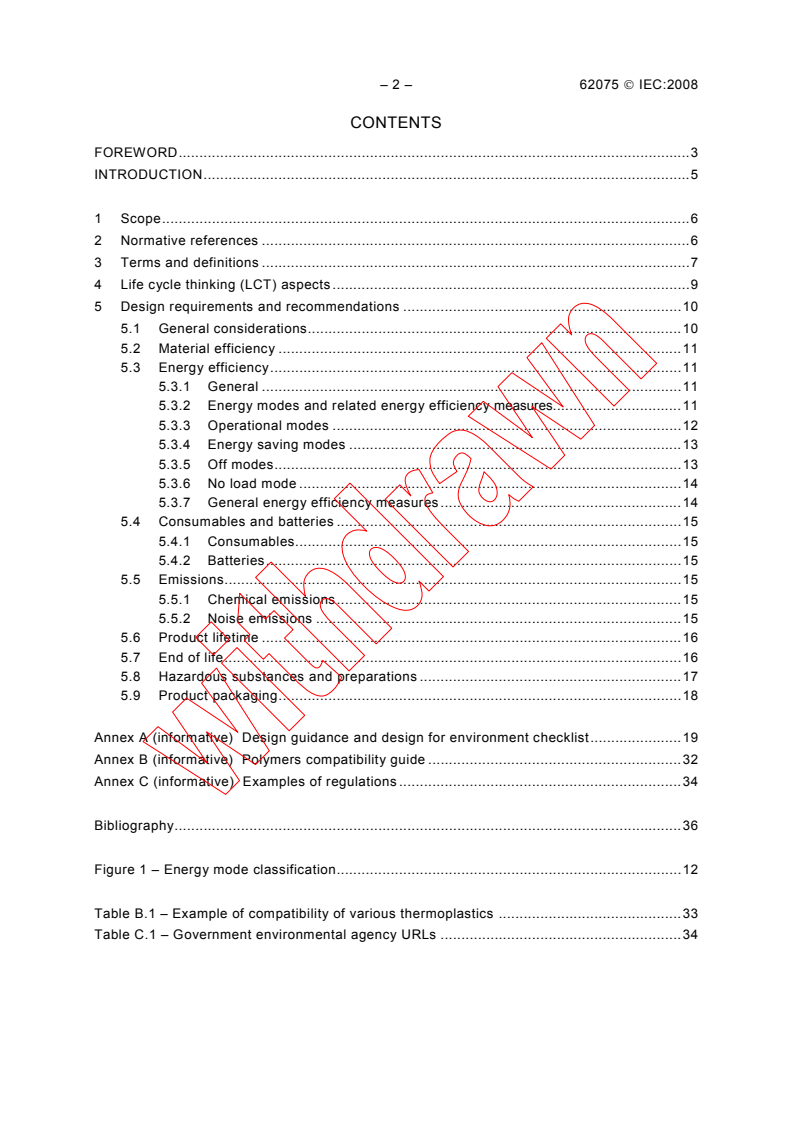
CONTENTS
FOREWORD.3
INTRODUCTION.5
1 Scope.6
2 Normative references .6
3 Terms and definitions .7
4 Life cycle thinking (LCT) aspects .9
5 Design requirements and recommendations .10
5.1 General considerations.10
5.2 Material efficiency .11
5.3 Energy efficiency.11
5.3.1 General .11
5.3.2 Energy modes and related energy efficiency measures.11
5.3.3 Operational modes .12
5.3.4 Energy saving modes .13
5.3.5 Off modes.13
5.3.6 No load mode .14
5.3.7 General energy efficiency measures.14
5.4 Consumables and batteries .15
5.4.1 Consumables.15
5.4.2 Batteries.15
5.5 Emissions.15
5.5.1 Chemical emissions.15
5.5.2 Noise emissions .15
5.6 Product lifetime .16
5.7 End of life.16
5.8 Hazardous substances and preparations .17
5.9 Product packaging.18
Annex A (informative) Design guidance and design for environment checklist.19
Annex B (informative) Polymers compatibility guide .32
Annex C (informative) Examples of regulations .34
Bibliography.36
Figure 1 – Energy mode classification.12
Table B.1 – Example of compatibility of various thermoplastics .33
Table C.1 – Government environmental agency URLs .34
62075 © IEC:2008 – 3 –
INTERNATIONAL ELECTROTECHNICAL COMMISSION
____________
AUDIO/VIDEO, INFORMATION AND
COMMUNICATION TECHNOLOGY EQUIPMENT –
ENVIRONMENTALLY CONSCIOUS DESIGN
FOREWORD
1) The International Electrotechnical Commission (IEC) is a worldwide organization for standardization comprising
all national electrotechnical committees (IEC National Committees). The object of IEC is to promote
international co-operation on all questions concerning standardization in the electrical and electronic fields. To
this end and in addition to other activities, IEC publishes International Standards, Technical Specifications,
Technical Reports, Publicly Available Specifications (PAS) and Guides (hereafter referred to as “IEC
Publication(s)”). Their preparation is entrusted to technical committees; any IEC National Committee interested
in the subject dealt with may participate in this preparatory work. International, governmental and non-
governmental organizations liaising with the IEC also participate in this preparation. IEC collaborates closely
with the International Organization for Standardization (ISO) in accordance with conditions determined by
agreement between the two organizations.
2) The formal decisions or agreements of IEC on technical matters express, as nearly as possible, an international
consensus of opinion on the relevant subjects since each technical committee has representation from all
interested IEC National Committees.
3) IEC Publications have the form of recommendations for international use and are accepted by IEC National
Committees in that sense. While all reasonable efforts are made to ensure that the technical content of IEC
Publications is accurate, IEC cannot be held responsible for the way in which they are used or for any
misinterpretation by any end user.
4) In order to promote international uniformity, IEC National Committees undertake to apply IEC Publications
transparently to the maximum extent possible in their national and regional publications. Any divergence
between any IEC Publication and the corresponding national or regional publication shall be clearly indicated in
the latter.
5) IEC provides no marking procedure to indicate its approval and cannot be rendered responsible for any Product
declared to be in conformity with an IEC Publication.
6) All users should ensure that they have the latest edition of this publication.
7) No liability shall attach to IEC or its directors, employees, servants or agents including individual experts and
members of its technical committees and IEC National Committees for any personal injury, property damage or
other damage of any nature whatsoever, whether direct or indirect, or for costs (including legal fees) and
expenses arising out of the publication, use of, or reliance upon, this IEC Publication or any other IEC
Publications.
8) Attention is drawn to the Normative references cited in this publication. Use of the referenced publications is
indispensable for the correct application of this publication.
9) Attention is drawn to the possibility that some of the elements of this IEC Publication may be the subject of
patent rights. IEC shall not be held responsible for identifying any or all such patent rights.
International Standard IEC 62075 has been prepared by IEC technical committee TC108:
Safety of electronic equipment within the field of audio/video, information technology and
communication technology.
The text of this standard is based on the following documents:
FDIS Report on voting
108/266/FDIS 108/284/RVD
Full information on the voting for the approval of this standard can be found in the report on
voting indicated in the above table.
This publication has been drafted in accordance with the ISO/IEC Directives, Part 2.
– 4 – 62075 © IEC:2008
NOTE The following print types are used:
– requirements: in roman type;
– test specifications: in italic type;
– notes: in small roman type.
Words in bold in the text are defined in Clause 3. When a definition concerns an adjective, the adjective and the
associated noun are also in bold.
The committee has decided that the contents of this publication will remain unchanged until
the maintenance result date indicated on the IEC web site under "http://webstore.iec.ch" in
the data related to the specific publication. At this date, the publication will be
• reconfirmed,
• withdrawn,
• replaced by a revised edition, or
• amended.
62075 © IEC:2008 – 5 –
INTRODUCTION
Every product has an effect on the environment, which may occur at any or all stages of its
life cycle – raw-material acquisition, manufacture, distribution, use, and disposal. These
effects may range from low to significant; they may be short-term or long-term; and they may
occur at the local, regional or global level (or a combination thereof).
The interest of customers, users, developers and other stakeholders in environmental
aspects and effects of products is increasing.
Anticipating or identifying the environmental aspects of a product throughout its life cycle
may be complex. The environmental aspects of a product have to be balanced against
other factors, such as its intended use, performance, safety and health, cost, marketability,
quality and regulatory requirements. It is important to consider the product functionality within
the context of the system where it will be used.
The process of integrating environmental aspects into product design and development has
to be continuous and flexible, promoting creativity and maximizing innovation and
opportunities for environmental improvement. Environmental issues should be addressed in
the policies and strategies of the organization involved.
Early identification and planning enable organizations to make effective decisions about
environmental aspects that they control. This provides a better understanding of how their
decisions will affect environmental aspects controlled by others, for example, at the raw-
material and parts acquisition or end of life stages.
The purpose of this document is to help designers of products in the field of audio/video,
information technology and communication technology to appropriately manage related
environmental issues within the design process.
This sector specific document takes into account the publication of the first edition of
IEC Guide 114 (2005), the publication of the second edition of ECMA-341 ( 2004), recent
engineering best practices as well as current market and regulatory environmental product
requirements.
– 6 – 62075 © IEC:2008
AUDIO/VIDEO, INFORMATION AND
COMMUNICATION TECHNOLOGY EQUIPMENT –
ENVIRONMENTALLY CONSCIOUS DESIGN
1 Scope
This International Standard applies to all audio/video, information and communication
technology equipment marketed as final products, hereafter referred to as products.
Although this standard does not explicitly apply to individual components and subassemblies
to be incorporated into final products, component manufacturers also need to consider this
standard, to enable manufacturers using such components to meet the requirements herein.
Only the intended use of products as defined by the manufacturer is within the scope of this
standard.
This standard specifies requirements and recommendations for the design of environmentally
sound products regarding
• life cycle thinking aspects,
• material efficiency,
• energy efficiency,
• consumables and batteries,
• chemical and noise emissions,
• extension of product lifetime,
• end of life,
• hazardous substances/preparations, and
• product packaging.
This standard covers only criteria directly related to the environmental performance of the
product. Criteria such as safety, ergonomics and electromagnetic compatibility (EMC) are
outside the scope of this standard and covered by other standards.
2 Normative references
The following referenced documents are indispensable for the application of this document.
The latest edition of the referenced document (including any amendments) applies.
ISO 3741, Acoustics – Determination of sound power levels of noise sources using sound
pressure – Precision methods for reverberation rooms
ISO 3744, Acoustics – Determination of sound power levels of noise sources using sound
pressure – Engineering method in an essentially free field over a reflecting plane
ISO 3745, Acoustics – Determination of sound power levels of noise sources using sound
pressure – Precision methods for anechoic and hemi-anechoic rooms
ISO 7779, Acoustics – Measurement of airborne noise emitted by information technology and
telecommunications equipment
62075 © IEC:2008 – 7 –
ISO 9296, Acoustics – Declared noise emission values of computer and business equipment
ISO 11201, Acoustics – Noise emitted by machinery and equipment – Measurement of
emission sound pressure levels at a work station and at other specified positions –
Engineering method in an essentially free field over a reflecting plane
ISO 11469, Plastics – Generic identification and marking of plastics products
3 Terms and definitions
For the purpose of this document the following terms and definitions apply.
3.1
chemical emissions
chemical substances and particulate matter emitted from a product into the air
3.2
consumable
user-replaceable part or piece of equipment that manufacturers place on the market for
direct sale for use in equipment
[IEC Guide 114, definition 3.1]
NOTE Consumables include, for example, printer cartridges and photographic film, and not parts required for
repairs or product upgrades.
3.3
designer
person responsible for the design and development of a product under the supervision of the
manufacturer
NOTE See 3.12 for context with manufacturer.
3.4
end of life
life cycle stage of a product starting when it is removed from a use stage
3.5
energy efficiency
rational use of energy to achieve an intended application performance
More technically, it is the minimum quantity of energy required to deliver a functional output
from a device.
NOTE A more precise definition is not applicable in this context as the output performance largely depends on the
specific device.
EXAMPLE For power supplies the energy efficiency is defined as the percentage of output power per input
power.
3.6
environment
surroundings in which an organization operates, including air, water, land, natural resources,
flora, fauna, humans and their interrelation
[ISO 14001:2004, definition 3.5]
– 8 – 62075 © IEC:2008
3.7
environmental aspect
element of an organization’s activities, products or services that can interact with the
environment
[ISO 14001: 2004, definition 3.6]
NOTE A significant environmental aspect is one that has or can have a significant environmental impact
(ISO 14001:2004, definition 3.7).
3.8
environmental impact
any change to the environment, whether adverse or beneficial, wholly or partially resulting
from an organization’s environmental aspects
[ISO 14001:2004, definition 3.7]
3.9
environmental management system
part of the overall management system that includes organizational structure, planning
activities, responsibilities, practices, procedure, processes, and resources for developing,
implementing, achieving, reviewing and maintaining the environmental policy
[ISO 14001:2004, definition 3.8, modified]
3.10
hazardous substances and preparations
substance or preparation that can adversely impact the environment with immediate or
retarded effect
[IEC Guide 109:2003, definition 3.6, modified]
3.11
life cycle
consecutive and interlinked stages of a product system, from raw material acquisition or
generation of natural resources to the final disposal
[ISO 14040:2006, definition 3.1]
3.12
manufacturer
organization responsible for the design, development and manufacture of a product in view
of its being placed on the market, regardless of whether these operations are carried out by
that organization itself or on its behalf
3.13
module
assembly of parts of a product with a function in itself (for example, a power supply)
including those separately put on the market as a product
3.14
organization
company, corporation, firm, enterprise, authority or institution, or part or combination thereof,
whether incorporated or not, public or private, that has its own functions and administration
[ISO 14001:2004, definition 3.16]
3.15
part
any piece or object of, or included with, a product
62075 © IEC:2008 – 9 –
3.16
preparations
mixtures or solutions composed of two or more substances
EXAMPLE Tin is a substance and solder is a preparation (an alloy) that may contain tin.
3.17
product
audio/video, information and communication technology equipment
3.18
recycling
reprocessing of products, modules or parts thereof for reuse or other purposes during their
end of life stage
3.19
renewable material
organic material not based upon fossil carbon sources
3.20
reuse
recycling of products, modules or parts by entering in a subsequent product use stage
3.21
skilled person
person with relevant education or experience to enable him or her to avoid dangers and to
reduce the likelihood of risks that may be created by the equipment
[IEV 826-18-01, modified]
3.22
substance
matter with an individual molecular identity
3.23
upgrading
process to enhance the functionality or capacity of a product
3.24
use stage
period of the product’s life from placing it into service until it enters its end of life stage
4 Life cycle thinking (LCT) aspects
Within the limits of the designer’s responsibility, the designer shall consider life cycle
thinking (LCT). LCT means integration of the environmental impact caused by a product
throughout all life cycle stages as early as possible in the product design and development
process when opportunities exist to make decisions to improve the environmental
performance of the product.
Basic considerations require that:
– a goal to minimize the overall adverse environmental impact be defined by the
manufacturer/organization;
– the significant environmental aspects of the product be identified and
– trade-offs associated with both environmental aspects and life cycle stages be
considered.
– 10 – 62075 © IEC:2008
Balanced compromises associated with both environmental aspects and the life cycle
stages shall be considered. Any decision should be balanced with technical features and
economic viability and shall not compromise health and safety.
NOTE The goal of integrating environmental aspects into product design and development is the reduction of
adverse environmental impacts of the product throughout its entire life cycle. The life cycle of any product
includes the extraction and processing of raw materials, manufacturing, transportation, use and end of life
management (including reuse, recycling and final disposal). Each of these life cycle stages consumes resources
and generates environmental impacts in air, water or soil.
It is not the designer’s sole responsibility to deal with attributes not directly dependent on the product design.
First, the designer should ensure that products comply with all relevant regulations governing product design.
Then, the designer should take into account the environmental impact of the product throughout its life to
identify the significant impacts that can be reduced by alternative design solutions.
General environmental aspects of life cycle stages such as extraction/processing of raw materials,
manufacturing and transportation should be considered within existing environmental and procurement policies and
guidelines of the organization. Designers should follow the design relevant aspects of those policies and
guidelines.
Any emphasis on a single stage of a product’s life cycle may alter another stage and therefore the overall
environmental impact. The designer’s responsibility is limited by the possibilities within the requested
functionalities and market requirements. Balanced compromises will occur in optimizing environmental impact
across the product life cycle.
5 Design requirements and recommendations
5.1 General considerations
The following requirements have been compiled for use when designing and developing
products as defined in the scope of this standard, as far as they can be practically influenced
by the designer.
The designer
– shall identify the latest environmental related legal and market requirements (from
customers, government, environmental groups, industrial associations, etc.);
– should do benchmarking addressing the comparison of energy efficiency, material
efficiency, and the use of hazardous substances and preparations;
– should gather and evaluate experience from the subsequent manufacturing, sales,
product usage, maintenance and disposal stages;
to continually improve the process of environmentally conscious product design.
The entire environmental performance of the product should be evaluated, while the
considerations should give priority to those factors that can be substantially influenced
through product design and are identified as major environmental impacts (for example,
very often energy consumption). The evaluation should take into consideration the functions
and normal usage of the product as well as the technical and economical feasibility.
As a minimum, the designer shall document decisions by some means, such as by
maintaining a design checklist covering environmental aspects (an example for such a
checklist is provided in Annex A).
This standard requires certain product environmental characteristics to be made available in
a form the manufacturer deems appropriate.
Further applicable information may be made available in an environmental product
declaration (for example, ECMA-370).
62075 © IEC:2008 – 11 –
5.2 Material efficiency
Material selection has an impact on the environment. When specifying materials, the
designer should consider design alternatives that:
– reduce the variety of materials used;
– reduce the amount of material used and consequently the weight of the product;
– use materials that are considered to have lower adverse environmental impact;
– seek to use materials that can be easily recycled.
Material-related end of life aspects are covered in 5.7. For replacing materials containing
hazardous substances and preparations, see 5.8.
5.3 Energy efficiency
5.3.1 General
To focus efforts on increasing energy efficiency, the designer shall be aware in which stage
of the product life cycle the product will consume the most energy.
The intended use patterns of the product, including where relevant its typical system
interactions, shall be considered. Where possible, the organization should strive for
improving the overall system performance in respect to energy efficiency.
Energy consumption information shall be made available (see 5.3.5 d) and 5.3.7).
5.3.2 Energy modes and related energy efficiency measures
Energy mode definitions and applied terms vary depending on the product group. Therefore,
rather than providing precise definitions of energy modes in this standard, modes are
described in generic terms as defined in 5.3.3 to 5.3.6 and illustrated in Figure 1. The intent is
to balance the technical complexity with the simplicity needed for ease of communication and
use.
NOTE Due to the high diversity of products covered by this standard, examples are intended to clarify the energy
modes and to guide the designer.
The designer shall identify specific energy modes that apply to the product under
development.
The designer shall consider energy efficiency measures for the identified energy modes
(described in more detail in the following subclauses).
Designers shall also identify where energy is consumed with the product and take steps to
reduce the overall energy consumption.
– 12 – 62075 © IEC:2008
Energy
modes
Operational Energy saving Off No load
modes modes modes mode
On-maximum Soft-off
On-normal
Hard-off
On-idle
IEC 2367/07
Figure 1 – Energy mode classification
5.3.3 Operational modes
Products perform their intended functions in the on-maximum, on-normal and on-idle
operational modes.
− On-maximum: Operation with all options in use.
EXAMPLE 1 A television with maximum contrast, brightness and sound, or a personal computer with all slots and
bays populated and operating.
− On-normal: Operation with default/standard configuration.
EXAMPLE 2 The factory setting of a computer display or a printer in active/run mode.
− On-idle: Operation with minimum system load by user and ready to operate without delay.
EXAMPLE 3 A personal computer running with no user initiated task consuming significant computing resources,
or a printer in ready mode.
The designer shall consider:
– using low power components and/or design options as well as efficient power supply
components to reduce the energy consumption in the on modes.
NOTE 1 The reason for the above is that less efficient designs result in higher heat dissipation in
the system, which leads to increased cooling requirements. By improving the energy efficiency of
these designs in the on-mode, it may become possible to apply passive cooling thereby avoiding
the use of fans and the resulting additional energy consumption.
NOTE 2 Energy efficiency improvements typically reduce costs and noise and improve
serviceability.
62075 © IEC:2008 – 13 –
– identified modes (see 5.3.2) when specifying the power supply. The AC-DC conversion
efficiency should be high in the most used modes, for example, by applying voluntary
programs and agreements as described in 5.3.7.
EXAMPLE 4 For typical personal computers in office use, the on-idle mode might represent a substantial
percentage of the on-mode consumption and thus the conversion efficiency for this mode should be high. However,
in many personal computers, the power supply loading is low in the on-idle mode, and hence often the conversion
efficiency is low.
NOTE 3 Another reason for a low loading and therefore reduced power supply efficiency is the inherent
extendibility of a system such as a personal computer. As such, the designer should balance extendibility vs.
energy consumption.
– the true specification needs for the product. For example, over-specifying the rating of the
power supply can lead to an energy inefficient design.
– the effect of the operating environment specification provided to users and installers. For
example, over-specifying the maximum allowed ambient (room) operating temperature for
large telecom, server or storage units can lead to energy inefficiencies in the room cooling
systems.
5.3.4 Energy saving modes
Energy saving modes, often denoted as low power, sleep, deep sleep or stand-by, are states
in which the equipment is connected to an electrical supply and is ready to resume an
operational mode, within a user acceptable timeframe, through the use of remote control or
another signal. In complex systems, various energy save modes may be present.
EXAMPLE 1 Sleep [stand-by/suspend to RAM (random access memory) mode for computers], stand-by-active
high mode (set-top-box exchanging data with an external source but not providing picture or sound to the
television), stand-by-active low mode (DVD-recorder programmed for recording but not recording/providing picture
or sound to the television), stand-by-passive (television not providing picture or sound, but can be switched into
operational mode by the remote control).
The designer shall:
− consider practical design options to automatically switch from on mode to energy save
modes. The energy save mode settings should be adjustable by the user and designed in a
way that it is likely to be adjusted if necessary to an alternative or custom setting, more
suitable to their typical use. Other innovative solutions shall be considered;
EXAMPLE 2 A computer monitor may activate sleep mode when the user is detected to have left the viewing area
or after a specified period of inactivity of manual input devices such as keyboard and mouse.
− consider the effect of the time to resume on the user acceptance to use the energy save
modes;
EXAMPLE 3 The delay time for the first copy/print to start from energy save mode on a copier/printer.
− consider design options to reduce the energy consumption in the energy save modes by
also applying similar methods as described in 5.3.3;
− inform the user of the higher energy consumption if the energy save mode is disabled.
5.3.5 Off modes
While connected to an electrical supply, products consume the least power in the following
off modes:
− Soft-off: The equipment is switched off by the device itself or initiated by the user via
remote control or command.
EXAMPLE 1 Printer in auto-off mode or computer after shutdown was completed.
− Hard-off: The off-power state in which the device uses zero watt (minimum energy
consumption might occur due to line filters). The equipment is manually switched off with
the main power switch [see c) and d) below].
EXAMPLE 2 Monitors, televisions and laser printers switched off at the primary side of the power supply and thus
consuming no energy.
– 14 – 62075 © IEC:2008
The designer shall
a) consider design options to automatically switch from energy save mode to an off mode
where practical,
b) consider design options to reduce the energy consumption in the soft off modes to lowest
values (minimum energy consumption might occur due to line filters),
c) consider a main power switch. If applicable, the main power switch should be placed on
the product such that the user can easily reach and use it,
d) prepare energy consumption data (energy level in watthours) for a state a user would
consider hard off but for which a power level of zero watt is not achievable and inform the
user through documentation or other means.
5.3.6 No load mode
No load mode is the mode in which external power supplies or chargers are connected to an
electrical supply, but are not connected to electrical or electronic equipment for which they
have been designed.
EXAMPLE A mobile phone charger is plugged in, but the phone is not connected.
The designer shall consider design options that reduce energy consumption of no load mode
to the lowest value.
5.3.7 General energy efficiency measures
All available energy saving features shall be documented during the design process.
Information on the product’s energy consumption and, where applicable, its related energy
modes shall be made available to the user.
Designers shall consider the requirements of international programmes, applicable for the
product category, aimed to increase energy efficiency.
EXAMPLE 1 The Energy Star international programme has made a number of product specifications and
memoranda of understanding, available here: http://www.energystar.gov.
Designers should consider other agreements as applicable aimed to improve energy
efficiency.
The effects of the improved design decisions compared to previous similar designs should be
quantified and communicated to product marketing departments in order to enable them to
promote products with lower adverse total environmental impact through lower energy
consumption.
The designer should enable the most energy efficient on modes and transitions to energy
saving mode as the default modes with performance taken into consideration after transitions
to energy saving modes as the default mode. If this is not reasonably achievable, the user
shall be made aware of this and instructions on proper use of available energy saving controls
and/or settings shall be provided to users. Instructions may be included in product user
documentation in either printed or electronic form.
EXAMPLE 2 A user should be made aware that enabling the wake-up on Local Area Network features prevents
the product from entering the soft-off energy saving mode.
If the product applies software and/or firmware, the designer shall be aware of the relevance
of those for the overall energy efficiency of a system. The designer should balance the
flexibility of software running on multipurpose devices and the energy efficiency of special
purpose hardware.
62075 © IEC:2008 – 15 –
5.4 Consumables and batteries
5.4.1 Consumables
For consumables, designers shall also consider the guidance specified in 5.7.
Products should be designed such that the use of consumables can be optimized relative to
the functionality of the product. Designers should consider:
– functions to reduce or save the use of consumables;
– ease of replacement and maintenance of consumables.
The manufacturer shall provide users with information on the proper use of consumables
relative to the functionality of the product and, where appropriate, end of life management of
the consumables.
5.4.2 Batteries
Batteries shall comply with all applicable restrictions such as on hazardous substances and
preparations (see 5.8), design requirements on equipment containing batteries and, to the
extent possible, all international labelling requirements.
Batteries with reduced environmental impact shall be considered. When materials with
adverse environmental impact cannot be avoided (for example, mercury in button cells), the
material and its justification shall be documented during the design process.
Batteries shall be easily identifiable and removable, either by users or skilled persons,
except where the battery life span exceeds that of the product. In case the life span of the
battery exceeds that of a product, batteries shall be removable for end of life treatment.
Product documentation shall give advice for the safe removal of the battery by either users or
skilled persons. Information on batteries in the product shall be made available. This
information shall include details on the types of the batteries and their locations, as well as
proper procedures for safe removal and handling of the batteries, including information on
end of life management/proper battery disposal.
Designs that prolong the durability of batteries shall be considered.
5.5 Emissions
5.5.1 Chemical emissions
Products shall be designed such that chemical emissions with adverse environmental
impact during use are reduced wherever possible.
For products that use an electrostatic process, emission rates determined according to
ISO/IEC 28360 should be made available.
5.5.2 Noise emissions
The designer shall consider techniques to reduce noise emissions.
NOTE 1 Reduced noise emissions improve energy efficiency.
In particular, noise emissions shall be evaluated according to ISO 7779, for products covered
by ISO 7779 (or ECMA-74).
– 16 – 62075 © IEC:2008
For products under the scope of this standard and not covered by a product specific
international standard noise test code, such as ISO 7779 (or ECMA-74), noise emissions do
not have to be evaluated.
If noise emissions are evaluated for products under the scope of this standard but not
covered by either ISO 7779/ECMA-74 or another product-specific international standard
noise test code, the basic sound power standards, ISO 3741, ISO 3744 or ISO 3745, and the
basic emission sound pressure standard, ISO 11201, shall be used. The test conditions used
should be recorded.
The resulting sound power levels and, where applicable, emitted sound pressure levels
(including emission sound pressure measurement distance if not covered by
ISO 7779/ECMA-74) shall be declared according to ISO 9296 (or ECMA-109) and should be
documented according to available eco-declaration standards (such as ECMA-370). The
levels shall be made available in the product information.
NOTE 2 The additional noise from cooling systems is a frequent issue for audio and video systems and
computers in home or silent office environments.
NOTE 3 The declared A-weighted sound power level L , according to ISO 9296, is a statistical maximum value
WAd
to account for product variation and lab-to-lab variations, and L is typically about 0,3 bels – 0,4 bels (3 dBA –
WAd
4 dBA) greater than the average A-weighted sound power level L , measured according to ISO 7779, ISO 3741,
WA
ISO 3744 or ISO 3745. ISO 9296 (or ECMA-109) specifies how to determine and verify L .
WAd
5.6 Product lifetime
Where technically and economically feasible, products shall be designed to have a prolonged
useful life and be easy to upgrade and repair. However, designers shall consider the
balanced compromise of using up to date and efficient technology and prolonging the life of
inefficient products. Designers shall consider incorporating the following features:
− use of common mechanical packages (such as covers and chassis) or common parts or
components that are used for multiple models in the product family or in multiple
generations of the same product, allowing for the reuse of common parts;
− use of standardised parts that may be more easily replaced or repaired;
− use of modules;
− reuse of modules, parts and products, whenever applicable. Parts, which may be
targeted for reuse (for example, in maintenance and spare parts applications) should be
identified.
To encourage the optimisation of a product’s useful life, information on available options for
upgrading, expanding and repair of products shall be made available if appropriate.
NOTE 1 Specifics on design for upgradeability may need to be identified based on product categories, and/or
initial cost of a product. There are categories of products for which upgradeability features may not be applicable,
for example, single use cameras and pocket calculators.
NOTE 2 Some of the guidelines provided in this subclause will aid serviceability.
5.7 End of life
Product design shall facilitate reuse, recycling and proper disposal at end of life.
The following design principles, where appropriate for the expected end of life processes,
shall be applied:
− easy and safe separation of parts containing hazardous substances and preparations
shall be possible (see 5.8);
− materials (including electronic modules) connected to case/housing parts or chassis
intended for different end of life treatment shall be easily separable;
62075 © IEC:2008 – 17 –
− disassembly down to the module level (for example, power supply, disk drive, circuit board)
shall be possible usi
...