


IEC 62841-3-10:2015
(Main)Electric motor-operated hand-held tools, transportable tools and lawn and garden machinery - Safety - Part 3-10: Particular requirements for transportable cut-off machines
Electric motor-operated hand-held tools, transportable tools and lawn and garden machinery - Safety - Part 3-10: Particular requirements for transportable cut-off machines
IEC 62841-3-10:2015 applies to transportable cut-off machines intended to cut materials such as metals, concrete and masonry and to be fitted with one abrasive bonded reinforced wheel of Type 41, or diamond cut-off wheel with the peripheral gaps, if any, not exceeding 10 mm and with a rated no-load speed not exceeding a peripheral speed of the wheel of 100 m/s with the maximum wheel diameter and a wheel diameter range of 250 mm to 410 mm. This standard does not apply to:
- transportable mitre saws;
- transportable tile saws or transportable metal saws.
The attention of National Committees is drawn to the fact that equipment manufacturers and testing organizations may need a transitional period following publication of a new, amended or revised IEC publication in which to make products in accordance with the new requirements and to equip themselves for conducting new or revised tests. It is the recommendation of the committee that the content of this publication be adopted for implementation nationally not earlier than 36 months from the date of publication.
This publication is to be read in conjunction with IEC 62841-1:2014. Key words: Hand-held tools, Transportable tools, Cut-off machines The contents of the corrigendum of July 2016 have been included in this copy.
Outils électroportatifs à moteur, outils transportables et machines pour jardins et pelouses - Sécurité - Partie 3-10: Exigences particulières pour les tronçonneuses à disque transportables
IEC 62841-3-10:2015 s’applique aux tronçonneuses à disque transportables destinées au découpage de matériaux tels que les métaux, le béton et la maçonnerie, munies d’un disque abrasif du type disque aggloméré renforcé de Type 41, ou disque à tronçonner diamant à rainures périphériques, le cas échéant, ne dépassant pas 10 mm et avec une vitesse assignée à vide ne dépassant pas une vitesse périphérique du disque de 100 m/s avec le diamètre de disque maximal et une plage de diamètres de disque compris entre 250 mm et 410 mm.
La présente norme ne s’applique pas aux: scies à onglets transportables, scies à céramique transportables ou aux scies à métaux transportables.
L’attention des Comités Nationaux est attirée sur le fait que les fabricants d’appareils et les organismes d’essai peuvent avoir besoin d’une période transitoire après la parution d’une nouvelle publication IEC, ou d’une publication amendée ou révisée, pour fabriquer des produits conformes aux nouvelles exigences et pour adapter leurs équipements aux nouveaux essais ou aux essais révisés. Le comité recommande que le contenu de cette publication soit entériné au niveau national au plus tôt 36 mois après la date de publication.
La présente Partie 3-10 doit être utilisée conjointement avec la première édition de l’IEC 62841-1:2014.
Mots clés: outils portables, outils transportables, tronçonneuses à disque transportables
Le contenu du corrigendum de juillet 2016 a été intégré dans ce texte.
General Information
- Status
- Published
- Publication Date
- 03-May-2022
- Technical Committee
- TC 116 - Safety of motor-operated electric tools
- Drafting Committee
- WG 9 - TC 116/WG 9
- Current Stage
- PPUB - Publication issued
- Start Date
- 22-Sep-2015
- Completion Date
- 31-Oct-2015
Buy Documents
IEC 62841-3-10:2015 - Electric motor-operated hand-held tools, transportable tools and lawn and garden machinery - Safety - Part 3-10: Particular requirements for transportable cut-off machines Released:9/22/2015
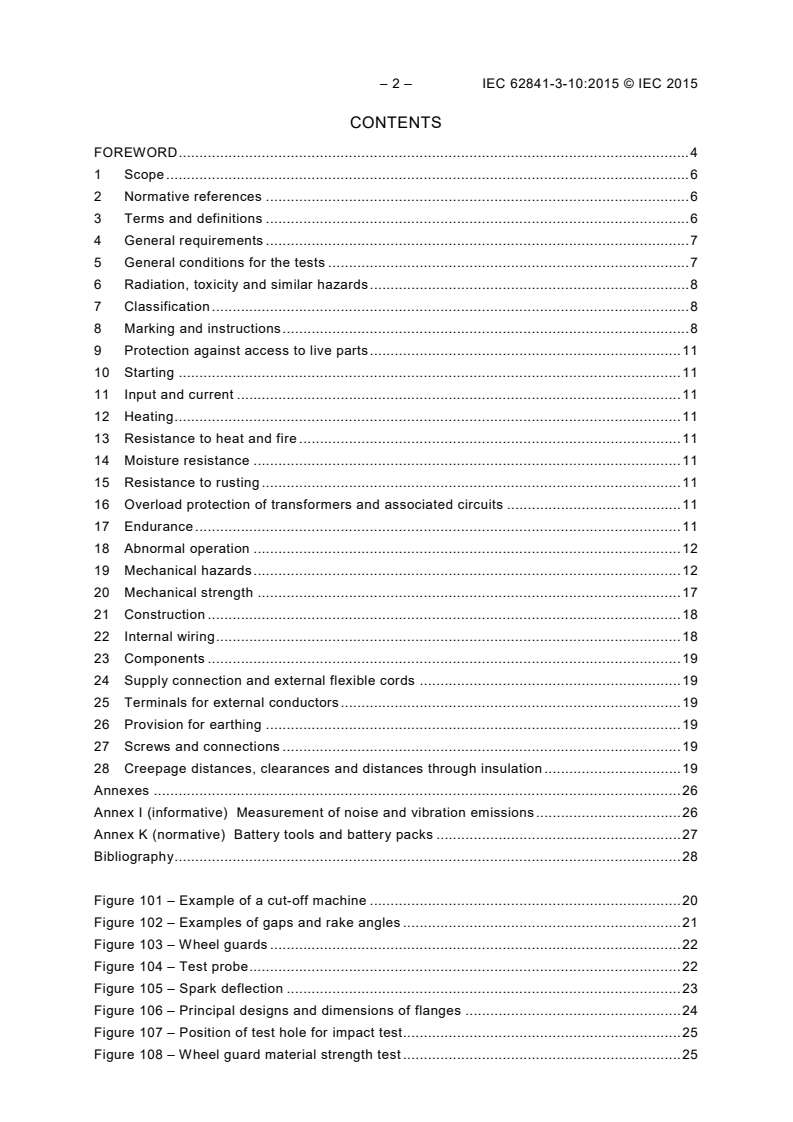
IEC 62841-3-10:2015 - Electric motor-operated hand-held tools, transportable tools and lawn and garden machinery - Safety - Part 3-10: Particular requirements for transportable cut-off machines Released:9/22/2015

IEC 62841-3-10:2015+AMD1:2022 CSV - Electric motor-operated hand-held tools, transportable tools and lawn and garden machinery - Safety - Part 3-10: Particular requirements for transportable cut-off machines Released:5/4/2022
Relations
- Effective Date
- 05-Sep-2023
- Effective Date
- 05-Sep-2023
Overview
IEC 62841-3-10:2015 specifies safety requirements for electric motor-operated transportable cut-off machines, designed for operations such as cutting metals, concrete, and masonry. These machines use either a single abrasive bonded reinforced wheel (Type 41) or a diamond cut-off wheel. They are designed for a rated no-load speed giving a peripheral speed of up to 100 m/s, and accommodate cut-off wheel diameters from 250 mm to 410 mm.
This international standard, developed by the International Electrotechnical Commission (IEC), ensures that such machines are manufactured and tested to mitigate safety risks to users and bystanders. Manufacturers, testing bodies, and users implementing IEC 62841-3-10 can expect a consistent, harmonized set of requirements for cut-off machines, promoting safe operation and regulatory compliance worldwide.
Key Topics
- Scope: Addresses only transportable cut-off machines fitted with one abrasive bonded reinforced or diamond wheel. Excludes mitre saws, tile saws, and general metal saws.
- Wheel Specifications: Machines must be compatible with Type 41 wheels or diamond wheels where peripheral gaps do not exceed 10 mm.
- Performance and Design: Details on wheel guarding systems, maximum speed limits, and stability to prevent tip-over and excessive vibration.
- Markings and Instructions: Specifies clear requirements for tool labeling including rated no-load speed, direction of rotation, wheel diameter, and important safety symbols (e.g., eye protection).
- Personal Protective Equipment (PPE): Emphasizes the use of PPE such as eye and hearing protection, gloves, and dust masks for all users.
- Mechanical Hazards and Safeguards: Comprehensive wheel guarding against accidental contact, ejection of fragments, and spark containment.
- Kickback Prevention: Operational guidance for minimizing risks of wheel binding and kickback events, including proper accessory use and support of workpieces.
Applications
IEC 62841-3-10:2015 is essential for several user groups and industries:
- Manufacturers: Ensures that new transportable cut-off machines are designed, built, and tested to internationally recognized safety requirements.
- Testing and Certification Bodies: Provides an authoritative reference for conformity assessment, allowing comparison across different products and manufacturers.
- Workplaces: Enhances construction, metalworking, and stoneworking site safety by stipulating requirements that minimize operational risks for operators and bystanders.
- Regulators and Policy Makers: Assists in the adoption of harmonized safety rules across nations to support worker protection and facilitate market access.
By following IEC 62841-3-10:2015, organizations can reduce workplace incidents, ensure user confidence, and improve the global interoperability of power tools.
Related Standards
- IEC 62841-1:2014 - General requirements for electric motor-operated hand-held tools, transportable tools, and lawn and garden machinery. IEC 62841-3-10:2015 is intended to be used in conjunction with this overall framework.
- ISO 603-15 - Specifies dimensions for bonded abrasive wheels, relevant for compliance regarding accessories.
- IEC 62841-3-9 - Covers requirements for transportable mitre saws.
- Forthcoming parts of IEC 62841-3 will address additional tool categories such as tile saws and metal saws.
Keywords: cut-off machines, power tool safety, IEC 62841-3-10, abrasive wheel, diamond wheel, electric tools, machine guarding, workplace safety, personal protective equipment, IEC standards, international compliance.
By leveraging IEC 62841-3-10:2015, stakeholders can confidently specify, supply, or use transportable cut-off machines that prioritize safety, performance, and international acceptance.
Buy Documents
IEC 62841-3-10:2015 - Electric motor-operated hand-held tools, transportable tools and lawn and garden machinery - Safety - Part 3-10: Particular requirements for transportable cut-off machines Released:9/22/2015
IEC 62841-3-10:2015 - Electric motor-operated hand-held tools, transportable tools and lawn and garden machinery - Safety - Part 3-10: Particular requirements for transportable cut-off machines Released:9/22/2015
IEC 62841-3-10:2015+AMD1:2022 CSV - Electric motor-operated hand-held tools, transportable tools and lawn and garden machinery - Safety - Part 3-10: Particular requirements for transportable cut-off machines Released:5/4/2022
Get Certified
Connect with accredited certification bodies for this standard

DVS-ZERT GmbH
German welding certification society.
CARES (UK Certification Authority for Reinforcing Steels)
UK certification for reinforcing steels and construction.
EWF/IIW (European/International Welding Federation)
International welding personnel certification.
Sponsored listings
Frequently Asked Questions
IEC 62841-3-10:2015 is a standard published by the International Electrotechnical Commission (IEC). Its full title is "Electric motor-operated hand-held tools, transportable tools and lawn and garden machinery - Safety - Part 3-10: Particular requirements for transportable cut-off machines". This standard covers: IEC 62841-3-10:2015 applies to transportable cut-off machines intended to cut materials such as metals, concrete and masonry and to be fitted with one abrasive bonded reinforced wheel of Type 41, or diamond cut-off wheel with the peripheral gaps, if any, not exceeding 10 mm and with a rated no-load speed not exceeding a peripheral speed of the wheel of 100 m/s with the maximum wheel diameter and a wheel diameter range of 250 mm to 410 mm. This standard does not apply to: - transportable mitre saws; - transportable tile saws or transportable metal saws. The attention of National Committees is drawn to the fact that equipment manufacturers and testing organizations may need a transitional period following publication of a new, amended or revised IEC publication in which to make products in accordance with the new requirements and to equip themselves for conducting new or revised tests. It is the recommendation of the committee that the content of this publication be adopted for implementation nationally not earlier than 36 months from the date of publication. This publication is to be read in conjunction with IEC 62841-1:2014. Key words: Hand-held tools, Transportable tools, Cut-off machines The contents of the corrigendum of July 2016 have been included in this copy.
IEC 62841-3-10:2015 applies to transportable cut-off machines intended to cut materials such as metals, concrete and masonry and to be fitted with one abrasive bonded reinforced wheel of Type 41, or diamond cut-off wheel with the peripheral gaps, if any, not exceeding 10 mm and with a rated no-load speed not exceeding a peripheral speed of the wheel of 100 m/s with the maximum wheel diameter and a wheel diameter range of 250 mm to 410 mm. This standard does not apply to: - transportable mitre saws; - transportable tile saws or transportable metal saws. The attention of National Committees is drawn to the fact that equipment manufacturers and testing organizations may need a transitional period following publication of a new, amended or revised IEC publication in which to make products in accordance with the new requirements and to equip themselves for conducting new or revised tests. It is the recommendation of the committee that the content of this publication be adopted for implementation nationally not earlier than 36 months from the date of publication. This publication is to be read in conjunction with IEC 62841-1:2014. Key words: Hand-held tools, Transportable tools, Cut-off machines The contents of the corrigendum of July 2016 have been included in this copy.
IEC 62841-3-10:2015 is classified under the following ICS (International Classification for Standards) categories: 25.140.20 - Electric tools. The ICS classification helps identify the subject area and facilitates finding related standards.
IEC 62841-3-10:2015 has the following relationships with other standards: It is inter standard links to IEC 62841-3-10:2015/AMD1:2022, IEC 62841-3-10:2015/COR1:2016. Understanding these relationships helps ensure you are using the most current and applicable version of the standard.
IEC 62841-3-10:2015 is available in PDF format for immediate download after purchase. The document can be added to your cart and obtained through the secure checkout process. Digital delivery ensures instant access to the complete standard document.
Standards Content (Sample)
IEC 62841-3-10 ®
Edition 1.0 2015-09
INTERNATIONAL
STANDARD
colour
inside
Electric motor-operated hand-held tools, transportable tools and lawn and
garden machinery – Safety –
Part 3-10: Particular requirements for transportable cut-off machines
All rights reserved. Unless otherwise specified, no part of this publication may be reproduced or utilized in any form
or by any means, electronic or mechanical, including photocopying and microfilm, without permission in writing from
either IEC or IEC's member National Committee in the country of the requester. If you have any questions about IEC
copyright or have an enquiry about obtaining additional rights to this publication, please contact the address below or
your local IEC member National Committee for further information.
IEC Central Office Tel.: +41 22 919 02 11
3, rue de Varembé Fax: +41 22 919 03 00
CH-1211 Geneva 20 info@iec.ch
Switzerland www.iec.ch
About the IEC
The International Electrotechnical Commission (IEC) is the leading global organization that prepares and publishes
International Standards for all electrical, electronic and related technologies.
About IEC publications
The technical content of IEC publications is kept under constant review by the IEC. Please make sure that you have the
latest edition, a corrigenda or an amendment might have been published.
IEC Catalogue - webstore.iec.ch/catalogue Electropedia - www.electropedia.org
The stand-alone application for consulting the entire The world's leading online dictionary of electronic and
bibliographical information on IEC International Standards, electrical terms containing more than 30 000 terms and
Technical Specifications, Technical Reports and other definitions in English and French, with equivalent terms in 15
documents. Available for PC, Mac OS, Android Tablets and additional languages. Also known as the International
iPad. Electrotechnical Vocabulary (IEV) online.
IEC publications search - www.iec.ch/searchpub IEC Glossary - std.iec.ch/glossary
The advanced search enables to find IEC publications by a More than 60 000 electrotechnical terminology entries in
variety of criteria (reference number, text, technical English and French extracted from the Terms and Definitions
committee,…). It also gives information on projects, replaced clause of IEC publications issued since 2002. Some entries
and withdrawn publications. have been collected from earlier publications of IEC TC 37,
77, 86 and CISPR.
IEC Just Published - webstore.iec.ch/justpublished
Stay up to date on all new IEC publications. Just Published IEC Customer Service Centre - webstore.iec.ch/csc
details all new publications released. Available online and If you wish to give us your feedback on this publication or
also once a month by email. need further assistance, please contact the Customer Service
Centre: csc@iec.ch.
IEC 62841-3-10 ®
Edition 1.0 2015-09
INTERNATIONAL
STANDARD
colour
inside
Electric motor-operated hand-held tools, transportable tools and lawn and
garden machinery – Safety –
Part 3-10: Particular requirements for transportable cut-off machines
INTERNATIONAL
ELECTROTECHNICAL
COMMISSION
ICS 25.140.20 ISBN 978-2-8322-2912-5
– 2 – IEC 62841-3-10:2015 © IEC 2015
CONTENTS
FOREWORD . 4
1 Scope . 6
2 Normative references . 6
3 Terms and definitions . 6
4 General requirements . 7
5 General conditions for the tests . 7
6 Radiation, toxicity and similar hazards . 8
7 Classification . 8
8 Marking and instructions . 8
9 Protection against access to live parts . 11
10 Starting . 11
11 Input and current . 11
12 Heating . 11
13 Resistance to heat and fire . 11
14 Moisture resistance . 11
15 Resistance to rusting . 11
16 Overload protection of transformers and associated circuits . 11
17 Endurance . 11
18 Abnormal operation . 12
19 Mechanical hazards . 12
20 Mechanical strength . 17
21 Construction . 18
22 Internal wiring . 18
23 Components . 19
24 Supply connection and external flexible cords . 19
25 Terminals for external conductors . 19
26 Provision for earthing . 19
27 Screws and connections . 19
28 Creepage distances, clearances and distances through insulation . 19
Annexes . 26
Annex I (informative) Measurement of noise and vibration emissions . 26
Annex K (normative) Battery tools and battery packs . 27
Bibliography . 28
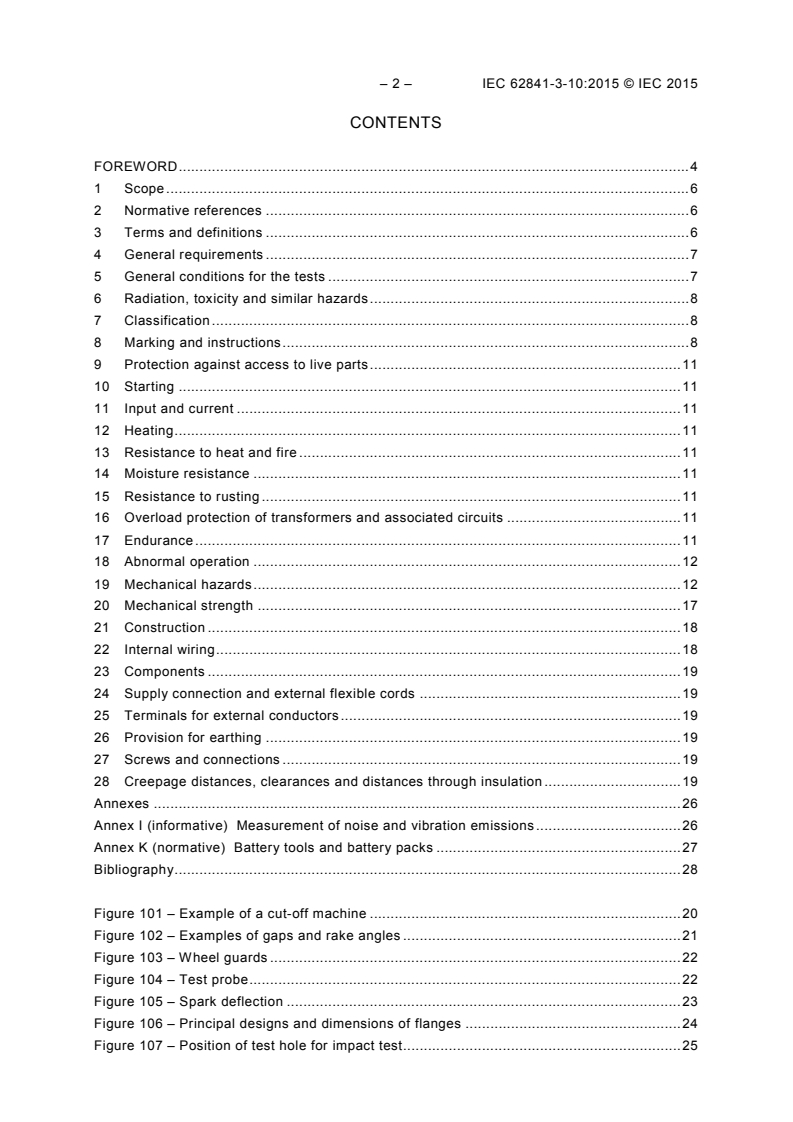
Figure 101 – Example of a cut-off machine . 20
Figure 102 – Examples of gaps and rake angles . 21
Figure 103 – Wheel guards . 22
Figure 104 – Test probe . 22
Figure 105 – Spark deflection . 23
Figure 106 – Principal designs and dimensions of flanges . 24
Figure 107 – Position of test hole for impact test . 25
Figure 108 – Wheel guard material strength test . 25
Table 4 – Required performance levels . 12
Table 101 – Flange dimensions . 16
Table 102 – Torques for testing flanges . 17
Table I.101 – Noise test conditions for cut-off machines . 26
– 4 – IEC 62841-3-10:2015 © IEC 2015
INTERNATIONAL ELECTROTECHNICAL COMMISSION
____________
ELECTRIC MOTOR-OPERATED HAND-HELD TOOLS,
TRANSPORTABLE TOOLS AND LAWN AND GARDEN MACHINERY –
SAFETY –
Part 3-10: Particular requirements for transportable cut-off machines
FOREWORD
1) The International Electrotechnical Commission (IEC) is a worldwide organization for standardization comprising
all national electrotechnical committees (IEC National Committees). The object of IEC is to promote
international co-operation on all questions concerning standardization in the electrical and electronic fields. To
this end and in addition to other activities, IEC publishes International Standards, Technical Specifications,
Technical Reports, Publicly Available Specifications (PAS) and Guides (hereafter referred to as “IEC
Publication(s)”). Their preparation is entrusted to technical committees; any IEC National Committee interested
in the subject dealt with may participate in this preparatory work. International, governmental and non-
governmental organizations liaising with the IEC also participate in this preparation. IEC collaborates closely
with the International Organization for Standardization (ISO) in accordance with conditions determined by
agreement between the two organizations.
2) The formal decisions or agreements of IEC on technical matters express, as nearly as possible, an international
consensus of opinion on the relevant subjects since each technical committee has representation from all
interested IEC National Committees.
3) IEC Publications have the form of recommendations for international use and are accepted by IEC National
Committees in that sense. While all reasonable efforts are made to ensure that the technical content of IEC
Publications is accurate, IEC cannot be held responsible for the way in which they are used or for any
misinterpretation by any end user.
4) In order to promote international uniformity, IEC National Committees undertake to apply IEC Publications
transparently to the maximum extent possible in their national and regional publications. Any divergence
between any IEC Publication and the corresponding national or regional publication shall be clearly indicated in
the latter.
5) IEC itself does not provide any attestation of conformity. Independent certification bodies provide conformity
assessment services and, in some areas, access to IEC marks of conformity. IEC is not responsible for any
services carried out by independent certification bodies.
6) All users should ensure that they have the latest edition of this publication.
7) No liability shall attach to IEC or its directors, employees, servants or agents including individual experts and
members of its technical committees and IEC National Committees for any personal injury, property damage or
other damage of any nature whatsoever, whether direct or indirect, or for costs (including legal fees) and
expenses arising out of the publication, use of, or reliance upon, this IEC Publication or any other IEC
Publications.
8) Attention is drawn to the Normative references cited in this publication. Use of the referenced publications is
indispensable for the correct application of this publication.
9) Attention is drawn to the possibility that some of the elements of this IEC Publication may be the subject of
patent rights. IEC shall not be held responsible for identifying any or all such patent rights.
International Standard IEC 62841-3-10 has been prepared by IEC technical committee 116:
Safety of motor-operated electric tools.
The text of this standard is based on the following documents:
FDIS Report on voting
116/240/FDIS 116/253/RVD
Full information on the voting for the approval of this standard can be found in the report on
voting indicated in the above table.
This publication has been drafted in accordance with the ISO/IEC Directives, Part 2.
This Part 3-10 is to be used in conjunction with the first edition of IEC 62841-1 (2014).
This Part 3-10 supplements or modifies the corresponding clauses in IEC 62841-1, so as to
convert it into the IEC Standard: Particular requirements for transportable cut-off machines.
Where a particular subclause of Part 1 is not mentioned in this Part 3-10, that subclause
applies as far as relevant. Where this standard states “addition”, “modification” or
“replacement”, the relevant text in Part 1 is to be adapted accordingly.
The following print types are used:
– requirements: in roman type;
– test specifications: in italic type;
– notes: in small roman type.
Words in bold in the text are defined in Clause 3. When a definition concerns an adjective,
the adjective and the associated noun are also in bold.
Subclauses, notes and figures which are additional to those in Part 1 are numbered starting
from 101.
A list of all parts of the IEC 62841 series, under the general title: Electric motor-operated
hand-held tools, transportable tools and lawn and garden machinery – Safety, can be found
on the IEC website.
The committee has decided that the contents of this publication will remain unchanged until
the stability date indicated on the IEC website under "http://webstore.iec.ch" in the data
related to the specific publication. At this date, the publication will be
• reconfirmed,
• withdrawn,
• replaced by a revised edition, or
• amended.
A bilingual version of this publication may be issued at a later date.
NOTE The attention of National Committees is drawn to the fact that equipment manufacturers and testing
organizations may need a transitional period following publication of a new, amended or revised IEC publication in
which to make products in accordance with the new requirements and to equip themselves for conducting new or
revised tests.
It is the recommendation of the committee that the content of this publication be adopted for implementation
nationally not earlier than 36 months from the date of publication.
The contents of the corrigendum of July 2016 have been included in this copy.
IMPORTANT – The 'colour inside' logo on the cover page of this publication indicates
that it contains colours which are considered to be useful for the correct
understanding of its contents. Users should therefore print this document using a
colour printer.
– 6 – IEC 62841-3-10:2015 © IEC 2015
ELECTRIC MOTOR-OPERATED HAND-HELD TOOLS,
TRANSPORTABLE TOOLS AND LAWN AND GARDEN MACHINERY –
SAFETY –
Part 3-10: Particular requirements for transportable cut-off machines
1 Scope
This clause of Part 1 is applicable, except as follows:
Addition:
This part of IEC 62841 applies to transportable cut-off machines intended to cut materials
such as metals, concrete and masonry and to be fitted with one abrasive
– bonded reinforced wheel of Type 41, or
– diamond cut-off wheel with the peripheral gaps, if any, not exceeding 10 mm
and with
– a rated no-load speed not exceeding a peripheral speed of the wheel of 100 m/s with the
maximum wheel diameter and
– a wheel diameter range of 250 mm to 410 mm.
This standard does not apply to:
– transportable mitre saws;
– transportable tile saws;
– transportable metal saws.
NOTE 101 Transportable mitre saws are covered by IEC 62841-3-9. Transportable tile saws will be covered by a
future part of IEC 62841-3. Transportable metal saws will be covered by a future part of IEC 62841-3.
2 Normative references
This clause of Part 1 is applicable except as follows:
Addition:
ISO 603-15, Bonded abrasive products – Dimensions – Part 15: Grinding wheels for cutting-
off on stationary or mobile cutting-off machines
ISO 630 (all parts), Structural steels
3 Terms and definitions
This clause of Part 1 is applicable, except as follows:
3.101
inner flange
part that contacts and provides support to the back side of the wheel and is located on the
spindle between wheel and tool
3.102
bonded reinforced wheel
wheel for different applications and of a type in accordance with ISO 603-15
3.103
cut-off machine
tool designed to cut by means of a rotating abrasive cut-off wheel (bonded reinforced or
diamond), where the wheel is fixed on a spindle which is mounted on a cutting unit, the
machine is equipped with a table which supports and positions the workpiece fixed in a vice
and the cutting unit is fitted to an arm which projects over the table from a pivot located at
the table or on part of the frame of the machine
Note 1 to entry: See Figure 101.
3.104
cutting unit
device with an affixed cut-off wheel, capable of generating a cutting action
3.105
D
maximum specified diameter of the wheel
3.106
diamond wheel
wheel made of metal with a continuous or segmented abrasive rim
3.107
fence
device to position the workpiece and absorb the horizontal forces from the wheel during the
cutting process
3.108
outer flange
part that supports the front side of the wheel and secures and clamps the wheel to the spindle
and the inner flange
3.109
rest position
uppermost position of the cutting unit intended by design
3.110
wheel guard
guard which partly encloses the wheel and gives protection to the operator
4 General requirements
This clause of Part 1 is applicable.
5 General conditions for the tests
This clause of Part 1 is applicable, except as follows:
5.17 Addition:
The mass of the tool shall include the wheel guard and the fence.
– 8 – IEC 62841-3-10:2015 © IEC 2015
Further parts such as carrying means that are required in accordance with the user
instructions shall be included in the mass.
6 Radiation, toxicity and similar hazards
This clause of Part 1 is applicable.
7 Classification
This clause of Part 1 is applicable.
8 Marking and instructions
This clause of Part 1 is applicable, except as follows:
8.1 Addition:
Tools shall also be marked with:
– the rated no-load speed of the output spindle.
8.2 Addition:
Tools shall also be marked with the following safety warning:
“ WARNING – Always wear eye protection” or the sign M004 of ISO 7010 or the following
safety sign:
The eye protection symbol may be modified by adding other personal protective equipment
such as ear protection, dust mask, etc.
8.3 Addition:
Tools shall also be marked with additional information as follows:
– the wheel diameter D;
– the direction of rotation of the wheel indicated on the tool by an arrow raised or sunk or by
any other means no less visible and indelible.
8.14.1 Addition:
The additional safety instructions as specified in 8.14.1.101 shall be given. This part may be
printed separately from the “General Power Tool Safety Warnings”.
For all warnings in 8.14.1.101, the term “cutting unit” may be replaced by another
appropriate term at the discretion of the manufacturer.
8.14.1.101 Safety instructions for cut-off machines
1) Cut-off machine safety warnings
a) Position yourself and bystanders away from the plane of the rotating wheel. The
guard helps to protect the operator from broken wheel fragments and accidental
contact with wheel.
b) Use only bonded reinforced or diamond cut-off wheels for your power tool. Just
because an accessory can be attached to your power tool, it does not assure safe
operation.
NOTE 1 The wording “bonded reinforced” or “diamond” is used as applicable depending on the
designation of the tool.
c) The rated speed of the accessory must be at least equal to the maximum speed
marked on the power tool. Accessories running faster than their rated speed can
break and fly apart.
d) Wheels must be used only for recommended applications. For example: do not
grind with the side of a cut-off wheel. Abrasive cut-off wheels are intended for
peripheral grinding, side forces applied to these wheels may cause them to shatter.
e) Always use undamaged wheel flanges that are of correct diameter for your
selected wheel. Proper wheel flanges support the wheel thus reducing the possibility
of wheel breakage.
f) The outside diameter and the thickness of your accessory must be within the
capacity rating of your power tool. Incorrectly sized accessories cannot be
adequately guarded or controlled.
g) The arbour size of wheels and flanges must properly fit the spindle of the power
tool. Wheels and flanges with arbour holes that do not match the mounting hardware
of the power tool will run out of balance, vibrate excessively and may cause loss of
control.
h) Do not use damaged wheels. Before each use, inspect the wheels for chips and
cracks. If the power tool or wheel is dropped, inspect for damage or install an
undamaged wheel. After inspecting and installing the wheel, position yourself
and bystanders away from the plane of the rotating wheel and run the power tool
at maximum no load speed for one minute. Damaged wheels will normally break
apart during this test time.
i) Wear personal protective equipment. Depending on application, use face shield,
safety goggles or safety glasses. As appropriate, wear dust mask, hearing
protectors, gloves and shop apron capable of stopping small abrasive or
workpiece fragments. The eye protection must be capable of stopping flying debris
generated by various operations. The dust mask or respirator must be capable of
filtrating particles generated by your operation. Prolonged exposure to high intensity
noise may cause hearing loss.
j) Keep bystanders a safe distance away from work area. Anyone entering the work
area must wear personal protective equipment. Fragments of workpiece or of a
broken wheel may fly away and cause injury beyond immediate area of operation.
k) Position the cord clear of the spinning accessory. If you lose control, the cord may
be cut or snagged and your hand or arm may be pulled into the spinning wheel.
l) Regularly clean the power tool’s air vents. The motor’s fan can draw the dust inside
the housing and excessive accumulation of powdered metal may cause electrical
hazards.
m) Do not operate the power tool near flammable materials. Do not operate the
power tool while placed on a combustible surface such as wood. Sparks could
ignite these materials.
n) Do not use accessories that require liquid coolants. Using water or other liquid
coolants may result in electrocution or shock.
NOTE 2 The above warning does not apply for power tools specifically designed for use with a liquid
system.
– 10 – IEC 62841-3-10:2015 © IEC 2015
2) Kickback and related warnings
Kickback is a sudden reaction to a pinched or snagged rotating wheel. Pinching or
snagging causes rapid stalling of the rotating wheel which in turn causes the uncontrolled
cutting unit to be forced upwards toward the operator.
For example, if an abrasive wheel is snagged or pinched by the workpiece, the edge of the
wheel that is entering into the pinch point can dig into the surface of the material causing
the wheel to climb out or kick out. Abrasive wheels may also break under these conditions.
Kickback is the result of power tool misuse and/or incorrect operating procedures or
conditions and can be avoided by taking proper precautions as given below.
a) Maintain a firm grip on the power tool and position your body and arm to allow
you to resist kickback forces. The operator can control upward kickbac
...
IEC 62841-3-10 ®
Edition 1.0 2015-09
INTERNATIONAL
STANDARD
NORME
INTERNATIONALE
colour
inside
Electric motor-operated hand-held tools, transportable tools and lawn and
garden machinery – Safety –
Part 3-10: Particular requirements for transportable cut-off machines
Outils électroportatifs à moteur, outils transportables et machines pour jardins
et pelouses – Sécurité –
Partie 3-10: Exigences particulières pour les tronçonneuses à disque
transportables
All rights reserved. Unless otherwise specified, no part of this publication may be reproduced or utilized in any form
or by any means, electronic or mechanical, including photocopying and microfilm, without permission in writing from
either IEC or IEC's member National Committee in the country of the requester. If you have any questions about IEC
copyright or have an enquiry about obtaining additional rights to this publication, please contact the address below or
your local IEC member National Committee for further information.
Droits de reproduction réservés. Sauf indication contraire, aucune partie de cette publication ne peut être reproduite
ni utilisée sous quelque forme que ce soit et par aucun procédé, électronique ou mécanique, y compris la photocopie
et les microfilms, sans l'accord écrit de l'IEC ou du Comité national de l'IEC du pays du demandeur. Si vous avez des
questions sur le copyright de l'IEC ou si vous désirez obtenir des droits supplémentaires sur cette publication, utilisez
les coordonnées ci-après ou contactez le Comité national de l'IEC de votre pays de résidence.
IEC Central Office Tel.: +41 22 919 02 11
3, rue de Varembé Fax: +41 22 919 03 00
CH-1211 Geneva 20 info@iec.ch
Switzerland www.iec.ch
About the IEC
The International Electrotechnical Commission (IEC) is the leading global organization that prepares and publishes
International Standards for all electrical, electronic and related technologies.
About IEC publications
The technical content of IEC publications is kept under constant review by the IEC. Please make sure that you have the
latest edition, a corrigenda or an amendment might have been published.
IEC Catalogue - webstore.iec.ch/catalogue Electropedia - www.electropedia.org
The stand-alone application for consulting the entire The world's leading online dictionary of electronic and
bibliographical information on IEC International Standards, electrical terms containing 20 000 terms and definitions in
Technical Specifications, Technical Reports and other English and French, with equivalent terms in 16 additional
documents. Available for PC, Mac OS, Android Tablets and languages. Also known as the International Electrotechnical
iPad. Vocabulary (IEV) online.
IEC publications search - www.iec.ch/searchpub IEC Glossary - std.iec.ch/glossary
The advanced search enables to find IEC publications by a 65 000 electrotechnical terminology entries in English and
variety of criteria (reference number, text, technical French extracted from the Terms and Definitions clause of
committee,…). It also gives information on projects, replaced IEC publications issued since 2002. Some entries have been
and withdrawn publications. collected from earlier publications of IEC TC 37, 77, 86 and
CISPR.
IEC Just Published - webstore.iec.ch/justpublished
Stay up to date on all new IEC publications. Just Published IEC Customer Service Centre - webstore.iec.ch/csc
details all new publications released. Available online and If you wish to give us your feedback on this publication or
also once a month by email. need further assistance, please contact the Customer Service
Centre: csc@iec.ch.
A propos de l'IEC
La Commission Electrotechnique Internationale (IEC) est la première organisation mondiale qui élabore et publie des
Normes internationales pour tout ce qui a trait à l'électricité, à l'électronique et aux technologies apparentées.
A propos des publications IEC
Le contenu technique des publications IEC est constamment revu. Veuillez vous assurer que vous possédez l’édition la
plus récente, un corrigendum ou amendement peut avoir été publié.
Catalogue IEC - webstore.iec.ch/catalogue Electropedia - www.electropedia.org
Application autonome pour consulter tous les renseignements
Le premier dictionnaire en ligne de termes électroniques et
bibliographiques sur les Normes internationales,
électriques. Il contient 20 000 termes et définitions en anglais
Spécifications techniques, Rapports techniques et autres
et en français, ainsi que les termes équivalents dans 16
documents de l'IEC. Disponible pour PC, Mac OS, tablettes
langues additionnelles. Egalement appelé Vocabulaire
Android et iPad.
Electrotechnique International (IEV) en ligne.
Recherche de publications IEC - www.iec.ch/searchpub
Glossaire IEC - std.iec.ch/glossary
65 000 entrées terminologiques électrotechniques, en anglais
La recherche avancée permet de trouver des publications IEC
en utilisant différents critères (numéro de référence, texte, et en français, extraites des articles Termes et Définitions des
comité d’études,…). Elle donne aussi des informations sur les publications IEC parues depuis 2002. Plus certaines entrées
projets et les publications remplacées ou retirées. antérieures extraites des publications des CE 37, 77, 86 et
CISPR de l'IEC.
IEC Just Published - webstore.iec.ch/justpublished
Service Clients - webstore.iec.ch/csc
Restez informé sur les nouvelles publications IEC. Just
Published détaille les nouvelles publications parues. Si vous désirez nous donner des commentaires sur cette
Disponible en ligne et aussi une fois par mois par email. publication ou si vous avez des questions contactez-nous:
csc@iec.ch.
IEC 62841-3-10 ®
Edition 1.0 2015-09
INTERNATIONAL
STANDARD
NORME
INTERNATIONALE
colour
inside
Electric motor-operated hand-held tools, transportable tools and lawn and
garden machinery – Safety –
Part 3-10: Particular requirements for transportable cut-off machines
Outils électroportatifs à moteur, outils transportables et machines pour jardins
et pelouses – Sécurité –
Partie 3-10: Exigences particulières pour les tronçonneuses à disque
transportables
INTERNATIONAL
ELECTROTECHNICAL
COMMISSION
COMMISSION
ELECTROTECHNIQUE
INTERNATIONALE
ICS 25.140.20 ISBN 978-2-8322-4966-6
– 2 – IEC 62841-3-10:2015 © IEC 2015
CONTENTS
FOREWORD . 4
1 Scope . 6
2 Normative references . 6
3 Terms and definitions . 6
4 General requirements . 7
5 General conditions for the tests . 7
6 Radiation, toxicity and similar hazards . 8
7 Classification . 8
8 Marking and instructions . 8
9 Protection against access to live parts . 11
10 Starting . 11
11 Input and current . 11
12 Heating . 11
13 Resistance to heat and fire . 11
14 Moisture resistance . 11
15 Resistance to rusting . 11
16 Overload protection of transformers and associated circuits . 11
17 Endurance . 11
18 Abnormal operation . 12
19 Mechanical hazards . 12
20 Mechanical strength . 17
21 Construction . 18
22 Internal wiring . 18
23 Components . 19
24 Supply connection and external flexible cords . 19
25 Terminals for external conductors . 19
26 Provision for earthing . 19
27 Screws and connections . 19
28 Creepage distances, clearances and distances through insulation . 19
Annexes . 26
Annex I (informative) Measurement of noise and vibration emissions . 26
Annex K (normative) Battery tools and battery packs . 27
Bibliography . 28
Figure 101 – Example of a cut-off machine . 20
Figure 102 – Examples of gaps and rake angles . 21
Figure 103 – Wheel guards . 22
Figure 104 – Test probe . 22
Figure 105 – Spark deflection . 23
Figure 106 – Principal designs and dimensions of flanges . 24
Figure 107 – Position of test hole for impact test . 25
Figure 108 – Wheel guard material strength test . 25
Table 4 – Required performance levels . 12
Table 101 – Flange dimensions . 16
Table 102 – Torques for testing flanges . 17
Table I.101 – Noise test conditions for cut-off machines . 26
– 4 – IEC 62841-3-10:2015 © IEC 2015
INTERNATIONAL ELECTROTECHNICAL COMMISSION
____________
ELECTRIC MOTOR-OPERATED HAND-HELD TOOLS,
TRANSPORTABLE TOOLS AND LAWN AND GARDEN MACHINERY –
SAFETY –
Part 3-10: Particular requirements for transportable cut-off machines
FOREWORD
1) The International Electrotechnical Commission (IEC) is a worldwide organization for standardization comprising
all national electrotechnical committees (IEC National Committees). The object of IEC is to promote
international co-operation on all questions concerning standardization in the electrical and electronic fields. To
this end and in addition to other activities, IEC publishes International Standards, Technical Specifications,
Technical Reports, Publicly Available Specifications (PAS) and Guides (hereafter referred to as “IEC
Publication(s)”). Their preparation is entrusted to technical committees; any IEC National Committee interested
in the subject dealt with may participate in this preparatory work. International, governmental and non-
governmental organizations liaising with the IEC also participate in this preparation. IEC collaborates closely
with the International Organization for Standardization (ISO) in accordance with conditions determined by
agreement between the two organizations.
2) The formal decisions or agreements of IEC on technical matters express, as nearly as possible, an international
consensus of opinion on the relevant subjects since each technical committee has representation from all
interested IEC National Committees.
3) IEC Publications have the form of recommendations for international use and are accepted by IEC National
Committees in that sense. While all reasonable efforts are made to ensure that the technical content of IEC
Publications is accurate, IEC cannot be held responsible for the way in which they are used or for any
misinterpretation by any end user.
4) In order to promote international uniformity, IEC National Committees undertake to apply IEC Publications
transparently to the maximum extent possible in their national and regional publications. Any divergence
between any IEC Publication and the corresponding national or regional publication shall be clearly indicated in
the latter.
5) IEC itself does not provide any attestation of conformity. Independent certification bodies provide conformity
assessment services and, in some areas, access to IEC marks of conformity. IEC is not responsible for any
services carried out by independent certification bodies.
6) All users should ensure that they have the latest edition of this publication.
7) No liability shall attach to IEC or its directors, employees, servants or agents including individual experts and
members of its technical committees and IEC National Committees for any personal injury, property damage or
other damage of any nature whatsoever, whether direct or indirect, or for costs (including legal fees) and
expenses arising out of the publication, use of, or reliance upon, this IEC Publication or any other IEC
Publications.
8) Attention is drawn to the Normative references cited in this publication. Use of the referenced publications is
indispensable for the correct application of this publication.
9) Attention is drawn to the possibility that some of the elements of this IEC Publication may be the subject of
patent rights. IEC shall not be held responsible for identifying any or all such patent rights.
International Standard IEC 62841-3-10 has been prepared by IEC technical committee 116:
Safety of motor-operated electric tools.
This bilingual version (2017-12) corresponds to the monolingual English version, published in
2015-09.
The text of this standard is based on the following documents:
FDIS Report on voting
116/240/FDIS 116/253/RVD
Full information on the voting for the approval of this standard can be found in the report on
voting indicated in the above table.
The French version of this standard has not been voted upon.
This publication has been drafted in accordance with the ISO/IEC Directives, Part 2.
This Part 3-10 is to be used in conjunction with the first edition of IEC 62841-1 (2014).
This Part 3-10 supplements or modifies the corresponding clauses in IEC 62841-1, so as to
convert it into the IEC Standard: Particular requirements for transportable cut-off machines.
Where a particular subclause of Part 1 is not mentioned in this Part 3-10, that subclause
applies as far as relevant. Where this standard states “addition”, “modification” or
“replacement”, the relevant text in Part 1 is to be adapted accordingly.
The following print types are used:
– requirements: in roman type;
– test specifications: in italic type;
– notes: in small roman type.
Words in bold in the text are defined in Clause 3. When a definition concerns an adjective,
the adjective and the associated noun are also in bold.
Subclauses, notes and figures which are additional to those in Part 1 are numbered starting
from 101.
A list of all parts of the IEC 62841 series, under the general title: Electric motor-operated
hand-held tools, transportable tools and lawn and garden machinery – Safety, can be found
on the IEC website.
The committee has decided that the contents of this publication will remain unchanged until
the stability date indicated on the IEC website under "http://webstore.iec.ch" in the data
related to the specific publication. At this date, the publication will be
• reconfirmed,
• withdrawn,
• replaced by a revised edition, or
• amended.
NOTE The attention of National Committees is drawn to the fact that equipment manufacturers and testing
organizations may need a transitional period following publication of a new, amended or revised IEC publication in
which to make products in accordance with the new requirements and to equip themselves for conducting new or
revised tests.
It is the recommendation of the committee that the content of this publication be adopted for implementation
nationally not earlier than 36 months from the date of publication.
The contents of the corrigendum of July 2016 have been included in this copy.
IMPORTANT – The 'colour inside' logo on the cover page of this publication indicates
that it contains colours which are considered to be useful for the correct
understanding of its contents. Users should therefore print this document using a
colour printer.
– 6 – IEC 62841-3-10:2015 © IEC 2015
ELECTRIC MOTOR-OPERATED HAND-HELD TOOLS,
TRANSPORTABLE TOOLS AND LAWN AND GARDEN MACHINERY –
SAFETY –
Part 3-10: Particular requirements for transportable cut-off machines
1 Scope
This clause of Part 1 is applicable, except as follows:
Addition:
This part of IEC 62841 applies to transportable cut-off machines intended to cut materials
such as metals, concrete and masonry and to be fitted with one abrasive
– bonded reinforced wheel of Type 41, or
– diamond cut-off wheel with the peripheral gaps, if any, not exceeding 10 mm
and with
– a rated no-load speed not exceeding a peripheral speed of the wheel of 100 m/s with the
maximum wheel diameter and
– a wheel diameter range of 250 mm to 410 mm.
This standard does not apply to:
– transportable mitre saws;
– transportable tile saws;
– transportable metal saws.
NOTE 101 Transportable mitre saws are covered by IEC 62841-3-9. Transportable tile saws will be covered by a
future part of IEC 62841-3. Transportable metal saws will be covered by a future part of IEC 62841-3.
2 Normative references
This clause of Part 1 is applicable except as follows:
Addition:
ISO 603-15, Bonded abrasive products – Dimensions – Part 15: Grinding wheels for cutting-
off on stationary or mobile cutting-off machines
ISO 630 (all parts), Structural steels
3 Terms and definitions
This clause of Part 1 is applicable, except as follows:
3.101
inner flange
part that contacts and provides support to the back side of the wheel and is located on the
spindle between wheel and tool
3.102
bonded reinforced wheel
wheel for different applications and of a type in accordance with ISO 603-15
3.103
cut-off machine
tool designed to cut by means of a rotating abrasive cut-off wheel (bonded reinforced or
diamond), where the wheel is fixed on a spindle which is mounted on a cutting unit, the
machine is equipped with a table which supports and positions the workpiece fixed in a vice
and the cutting unit is fitted to an arm which projects over the table from a pivot located at
the table or on part of the frame of the machine
Note 1 to entry: See Figure 101.
3.104
cutting unit
device with an affixed cut-off wheel, capable of generating a cutting action
3.105
D
maximum specified diameter of the wheel
3.106
diamond wheel
wheel made of metal with a continuous or segmented abrasive rim
3.107
fence
device to position the workpiece and absorb the horizontal forces from the wheel during the
cutting process
3.108
outer flange
part that supports the front side of the wheel and secures and clamps the wheel to the spindle
and the inner flange
3.109
rest position
uppermost position of the cutting unit intended by design
3.110
wheel guard
guard which partly encloses the wheel and gives protection to the operator
4 General requirements
This clause of Part 1 is applicable.
5 General conditions for the tests
This clause of Part 1 is applicable, except as follows:
5.17 Addition:
The mass of the tool shall include the wheel guard and the fence.
– 8 – IEC 62841-3-10:2015 © IEC 2015
Further parts such as carrying means that are required in accordance with the user
instructions shall be included in the mass.
6 Radiation, toxicity and similar hazards
This clause of Part 1 is applicable.
7 Classification
This clause of Part 1 is applicable.
8 Marking and instructions
This clause of Part 1 is applicable, except as follows:
8.1 Addition:
Tools shall also be marked with:
– the rated no-load speed of the output spindle.
8.2 Addition:
Tools shall also be marked with the following safety warning:
“ WARNING – Always wear eye protection” or the sign M004 of ISO 7010 or the following
safety sign:
The eye protection symbol may be modified by adding other personal protective equipment
such as ear protection, dust mask, etc.
8.3 Addition:
Tools shall also be marked with additional information as follows:
– the wheel diameter D;
– the direction of rotation of the wheel indicated on the tool by an arrow raised or sunk or by
any other means no less visible and indelible.
8.14.1 Addition:
The additional safety instructions as specified in 8.14.1.101 shall be given. This part may be
printed separately from the “General Power Tool Safety Warnings”.
For all warnings in 8.14.1.101, the term “cutting unit” may be replaced by another
appropriate term at the discretion of the manufacturer.
8.14.1.101 Safety instructions for cut-off machines
1) Cut-off machine safety warnings
a) Position yourself and bystanders away from the plane of the rotating wheel. The
guard helps to protect the operator from broken wheel fragments and accidental
contact with wheel.
b) Use only bonded reinforced or diamond cut-off wheels for your power tool. Just
because an accessory can be attached to your power tool, it does not assure safe
operation.
NOTE 1 The wording “bonded reinforced” or “diamond” is used as applicable depending on the
designation of the tool.
c) The rated speed of the accessory must be at least equal to the maximum speed
marked on the power tool. Accessories running faster than their rated speed can
break and fly apart.
d) Wheels must be used only for recommended applications. For example: do not
grind with the side of a cut-off wheel. Abrasive cut-off wheels are intended for
peripheral grinding, side forces applied to these wheels may cause them to shatter.
e) Always use undamaged wheel flanges that are of correct diameter for your
selected wheel. Proper wheel flanges support the wheel thus reducing the possibility
of wheel breakage.
f) The outside diameter and the thickness of your accessory must be within the
capacity rating of your power tool. Incorrectly sized accessories cannot be
adequately guarded or controlled.
g) The arbour size of wheels and flanges must properly fit the spindle of the power
tool. Wheels and flanges with arbour holes that do not match the mounting hardware
of the power tool will run out of balance, vibrate excessively and may cause loss of
control.
h) Do not use damaged wheels. Before each use, inspect the wheels for chips and
cracks. If the power tool or wheel is dropped, inspect for damage or install an
undamaged wheel. After inspecting and installing the wheel, position yourself
and bystanders away from the plane of the rotating wheel and run the power tool
at maximum no load speed for one minute. Damaged wheels will normally break
apart during this test time.
i) Wear personal protective equipment. Depending on application, use face shield,
safety goggles or safety glasses. As appropriate, wear dust mask, hearing
protectors, gloves and shop apron capable of stopping small abrasive or
workpiece fragments. The eye protection must be capable of stopping flying debris
generated by various operations. The dust mask or respirator must be capable of
filtrating particles generated by your operation. Prolonged exposure to high intensity
noise may cause hearing loss.
j) Keep bystanders a safe distance away from work area. Anyone entering the work
area must wear personal protective equipment. Fragments of workpiece or of a
broken wheel may fly away and cause injury beyond immediate area of operation.
k) Position the cord clear of the spinning accessory. If you lose control, the cord may
be cut or snagged and your hand or arm may be pulled into the spinning wheel.
l) Regularly clean the power tool’s air vents. The motor’s fan can draw the dust inside
the housing and excessive accumulation of powdered metal may cause electrical
hazards.
m) Do not operate the power tool near flammable materials. Do not operate the
power tool while placed on a combustible surface such as wood. Sparks could
ignite these materials.
n) Do not use accessories that require liquid coolants. Using water or other liquid
coolants may result in electrocution or shock.
NOTE 2 The above warning does not apply for power tools specifically designed for use with a liquid
system.
– 10 – IEC 62841-3-10:2015 © IEC 2015
2) Kickback and related warnings
Kickback is a sudden reaction to a pinched or snagged rotating wheel. Pinching or
snagging causes rapid stalling of the rotating wheel which in turn causes the uncontrolled
cutting unit to be forced upwards toward the operator.
For example, if an abrasive wheel is snagged or pinched by the workpiece, the edge of the
wheel that is entering into the pinch point can dig into the surface of the material causing
the wheel to climb out or kick out. Abrasive wheels may also break under these conditions.
Kickback is the result of power tool misuse and/or incorrect operating procedures or
conditions and can be avoided by taking proper precautions as given below.
a) Maintain a firm grip on the power tool and position your body and arm to allow
you to resist kickback forces. The operator can control upward kickback forces, if
proper precautions are taken.
b) Do not position your body in line with the rotating wheel. If kickback occurs, it will
propel the cutting unit upwards toward the operator.
c) Do not attach a saw chain, woodcarving blade, segmented diamond wheel with a
peripheral gap greater than 10 mm or toothed saw blade. Such blades create
frequent kickback and loss of control.
d) Do not “jam” the wheel or apply excessive pressure. Do not attempt to make an
excessive depth of cut. Overstressing the wheel increases the loading and
susceptibility to twisting or binding of the wheel in the cut and the possibility of
kickback or wheel breakage.
e) When the wheel is binding or when interrupting a cut for any reason, switch off
the power tool and hold the cutting unit motionless until the wheel comes to a
complete stop. Never attempt to remove the wheel from the cut while the wheel is
in motion otherwise kickback may occur. Investigate and take corrective action to
eliminate the cause of wheel binding.
f) Do not restart the cutting operation in the workpiece. Let the wheel reach full
speed and carefully re-enter the cut. The wheel may bind, walk up or kickback if the
power tool is restarted in the workpiece.
g) Support any oversized workpiece to minimize the risk of wheel pinching and
kickback. Large workpieces tend to sag under their own weight. Supports must be
placed under the workpiece near the line of cut and near the edge of the workpiece on
both sides of the wheel.
8.14.2 a) Addition:
101) Information about the permitted accessories (diamond or bonded reinforced wheels),
wheel diameter, wheel thickness and bore diameter.
For diamond wheels, instruction that
– the maximum peripheral gap between segments shall be 10 mm;
– the rake angle shall be negative.
See Figure 102.
102) Explanation of the term “bonded reinforced wheel” or type designation, if applicable;
103) Instruction to ensure that the cut-off machine is always used on a stable and level
surface and instruction how to secure the machine if used on a workbench or the like;
104) Information about maximum cutting capacities at zero and maximum mitre angles.
8.14.2 b) Addition:
101) Instruction for proper use of blotters, when they are provided with a bonded reinforced
product;
102) Instruction on mounting of accessories and use of the correct flanges, use and care of
the abrasive product. For reversible flanges, instruction for the correct method of fitting
the flanges;
103) Instruction to the operator on the use of all the different types of wheels specified in
the instructions in accordance with 8.14.2 a) 101), e.g. bonded wheel, diamond
wheel;
104) Instruction how to secure and support the workpiece;
105) Instruction to wear personal protection equipment:
– hearing protection;
– gloves when handling wheels.
8.14.2 c) Addition:
101) Instruction for the storage and handling of accessories.
9 Protection against access to live parts
This clause of Part 1 is applicable.
10 Starting
This clause of Part 1 is applicable.
11 Input and current
This clause of Part 1 is applicable.
12 Heating
This clause of Part 1 is applicable.
13 Resistance to heat and fire
This clause of Part 1 is applicable.
14 Moisture resistance
This clause of Part 1 is applicable.
15 Resistance to rusting
This clause of Part 1 is applicable.
16 Overload protection of transformers and associated circuits
This clause of Part 1 is applicable.
17 Endurance
This clause of Part 1 is applicable.
– 12 – IEC 62841-3-10:2015 © IEC 2015
18 Abnormal operation
This clause of Part 1 is applicable, except as follows:
18.8 Replacement of Table 4 by the following:
Table 4 – Required performance levels
Type and purpose of SCF Minimum performance level (PL)
Power switch – prevent unwanted switch-on Shall be evaluated using the fault conditions of 18.6.1
without the loss of this SCF
Power switch – provide desired switch-off Shall be evaluated using the fault conditions of 18.6.1
without the loss of this SCF
Any electronic control to pass the test of 18.3 c
Over-speed prevention to prevent output speed above c
120 % of rated (no-load) speed
Provide desired direction of rotation b
Lock-off function as required by 21.18.2.3 b
Prevent exceeding thermal limits as in Clause 18 a
Prevent self-resetting as required in 23.3 a
19 Mechanical hazards
This clause of Part 1 is applicable, except as follows:
19.1 Addition:
This subclause is not applicable for providing adequate protection against personal injury by
the wheel.
NOTE Requirements for the wheel guarding are specified in 19.101.
19.6 Replacement:
The tool shall be designed so as to prevent excessive speed under normal use. The speed of
the tool shall not exceed the rated no-load speed under any operating condition.
Compliance is checked by inspection and by measuring the speed after the tool is operated
for a period of 5 min. The recommended accessory that produces the maximum speed shall
be installed.
If the tool is provided with a load sensitive speed control, then an accessory need not be
installed to load the tool to find maximum speed.
19.7 Additional subclauses:
19.7.101 The cut-off machine shall be constructed so that during foreseeable misuse
operation it will not tip over.
Compliance is checked by the following test. The tool is assembled in accordance with
8.14.2 a) 2).
The cut-off machine, without being fixed to the supporting surface, is placed on a horizontal
3 3
medium density fibreboard (MDF) with a density of 650 kg/m to 850 kg/m . The fence is
secured in the position closest to the pivot. Without any workpiece mounted, the cutting unit
is moved down to its lowest cutting position, and then the handle is released. The cut-off
machine shall not tip over.
19.7.102 Cut-off machines shall be provided with means to facilitate the fixing of the
machine to a bench to prevent sliding, e.g. by providing holes or clamping surfaces in the
base.
Compliance is checked by inspection.
19.101 Wheel guarding
19.101.1 General
Tools shall be provided with a guarding system to protect the user during normal use against:
– accidental contact with the abrasive product;
– ejection of fragments of the abrasive product;
– sparks and other debris.
The wheel guard shall fulfill the following requirements:
– to change the wheel, it shall not be necessary to remove the wheel guard from the tool;
– be designed to facilitate easy replacement of the wheel. For this purpose, parts of the
wheel guard may be opened without the aid of a tool provided these parts remain
attached to the wheel guard together with any fasteners;
– be designed so that the risk of an accidental contact between the operator and the wheel
during normal use is minimized.
The installation of an oversized wheel shall be restricted in at least one location by a device
fixed in relation to the spindle. The clearance between the periphery of a new wheel with
diameter D and this device shall be 12 mm maximum.
The guarding system shall comply with the requirements of 19.101.2 and 19.101.3.
Compliance is checked by inspection and by measurement.
19.101.2 Wheel guard design requirements
19.101.2.1 Tools shall be provided with a combination of fixed and movable wheel guards
that covers the areas 1, 2 and 3 of the tool as shown in Figure 103.
When the cutting unit is in the fully down position, area 1 is the area above a line parallel
with the base which intersects the centre of the wheel. For any position of the cutting unit,
the sides and periphery of the wheel, except the spindle end, the nut and the outer flange,
shall be guarded in area 1.
If the spindle end, the nut or the outer flange are not circular, they shall also be guarded.
When the cutting unit is in the rest position, area 2 is the area at the front of the tool
between area 1 and at least 15° (angle β in Figure 103b) below a line parallel with the base
which intersects the centre of the wheel. In rest position, the area 2 shall be guarded by a
wheel guard which protects the periphery and both sides of at least the outer 20 % of the
radius of the wheel.
– 14 – IEC 62841-3-10:2015 © IEC 2015
When the cutting unit is in the fully down position, area 3 is the area at the back of the tool
between area 1 and at least 15° (angle α in Figure 103a) below a line parallel with the base
which intersects the centre of the wheel. In the fully down position, the area 3 shall be
guarded by a wheel guard which protects the periphery and both sides of at least the outer
10 % of the radius of the wheel.
Compliance is checked by inspection and by measurement.
When for technical reasons an overlapping occurs between the fixed and the movable wheel
guard, care shall be taken to prevent access to the wheel in the overlapping area.
Compliance is checked by applying the test probe of Figure 104 with a force not exceeding
5 N between the fixed wheel guard and the movable wheel guard in all positions. It shall not
be possible to contact the wheel with the test probe.
The movable wheel guard shall be either:
– “link activated” complying with the requirements of 19.101.2.2; or
– “workpiece activated” complying with the requirements of 19.101.2.3.
When the handle is released, the cutting unit shall return automatically to its rest position
and the guarding of area 2 shall be restored.
NOTE Movable guards of this type are also known as self-restoring guards.
19.101.2.2 For a link activated wheel guard, the movement of the movable wheel guard
shall be linked with or controlled by the motion of the cutting unit. The down directed
plunging action of the cutting unit’s motion shall cause the opening stroke of the movable
wheel guard. However, the movable wheel guard shall be free to open further independent
of the link, provided this additional movement is self-restoring.
Compliance is checked by inspection.
19.101.2.3 A workpiece activated wheel guard shall open when it makes contact with the
base or the workpiece and may remain in contact with the base or the workpiece during the
cutting action.
NOTE In some cases, such as when cutting a small workpiece, the wheel guard will not be activated.
Compliance is checked by inspection and by measurement.
19.101.3 Guarding of wheel below the table
Cut-off machines shall be guarded so that access to the cutting wheel below the table is
prevented.
Compliance is checked by placing the tool on a horizontal flat surface and applying the test
probe of Figure 104 with a force not exceeding 5 N with the cutting unit in its fully down
position. It shall not be possible to contact the wheel with the test probe.
Compliance is checked by inspection and by measurement.
19.102 Spark deflection
Sparks emitted in a rearward direction that occur in the area specified by the angle β which is
between the two tangent lines 1 (T1) and 2 (T2) as shown in Figure 105 shall be contained or
deflected downwards.
Sparks emitted in a rearward direction that occur in the area specified by the angle α as
shown in Figure 105 shall be contained or deflected downward. The angle α shall be minimum
18°. The vertex of the angle α is the point where a vertical line through the centre of the
abrasive wheel intersects the plane of the base, with the cutting unit in the fully down
position.
Containment or deflection of the sparks may be achieved by the wheel guard, the body of the
machine, a spark deflector or any combination thereof.
Compliance is checked by inspection and by measurement.
19.103 Securement of the workpiece
Tools shall be equipped with a fence secured to the table for positioning the workpiece during
the cutting operation. The fence may be adjustable to enable mitre cuts. The fence shall have
a height at least 0,6 times of the maximum cutting depth.
A workpiece clamp shall be provided to secure the workpiece during the cutting operation.
The workpiece clamp shall apply a clamping force either horizontally against the fence,
vertically against the base or a combination thereof. The contact plate of a horizontal clamp, if
any, shall have a height at least 0,6 times of the maximum cutting depth.
Compliance is checked by inspection and by measurement.
19.104 Mounting of accessories
The accessory may be mounted directly on the spindle or a locating device such as a
bushing or as part of the flange.
The total eccentricity of the combination of the spindle, the diameter of the flange bore and
the diameter of the part of the flange, as applicable, which locates and guides the accessory
shall be less than 0,30 mm.
Compliance is checked by measurement.
For tools with flanges, the eccentricity of the flange in the worst off-centre position allowed by
the mounting procedure is measured.
19.105 Flanges
19.105.1 General
Flanges shall be flat and have no sharp edges. One of the flanges shall be keyed to the
output spindle.
Flanges shall meet the dimensions of 19.105.2.
For tools that are intended to be used with diamond wheels, an additional set of flanges may
be provided that meet the dimensional requirements in 19.105.3.
The inner flange and the outer flange shall have the same diameter D or the overlap of the
f
inner flange and outer flange bearing surfaces shall be at least equal to dimension C, with
C ≥ 1,5 mm.
Compliance is checked by inspection and by measurement.
– 16 – IEC 62841-3-10:2015 © IEC 2015
19.105.2 Flanges shall comply with the minimum dimensions shown in Table 101 and
Figure 106.
Table 101 – Flange dimensions
D D C G W
f
mm mm mm mm mm
250 64 10 1,5 1,5
300 75 13 1,5 1,5
350 to 356 89 16 1,5 1,5
400 to 410 100 17 1,5 1,5
Key
D specified maximum diameter of the wheel
D diameter of the flange clamping surface
f
C width of the clamping surface
G depth of the recess
W width of the recess
Compliance is checked by measurement.
19.105.3 Flanges for diamond wheels shall have the following dimensions illustrated in
Figure 106, where D is the maximum outside diameter of the wheel, G and W are the
dimensions of the recess and D is the outside diameter of the flange clamping surface.
f
D ≥ 0,15 D
f
Dimensions G and W shall be:
W ≥ 0, G ≥ 0
Compliance is checked by measurement.
19.105.4 Flanges shall be so designed that they are of adequate strength.
Compliance is checked by the following test.
The cut-off machine is fitted with a steel disc having an equal thickness and shape as the
abrasive cutting wheel.
The clamping nut is tightened with a first test torque according to Table 102. A feeler gauge of
a thickness of 0,05 mm is used to test whether the flanges are in contact with the disc all
around the circumference.
The test is satisfactory if at no place the feeler gauge can be pushed underneath the flanges.
The clamping nut is further tightened to the second test torque according to Table 102. A
feeler gauge of a thickness of 0,05 mm is used to test the deflection of the flanges. The result
is satisfactory if at no place the feeler gauge can be pushed underneath the flanges by more
than 1 mm.
Table 102 – Torques for testing flanges
Thread First test torque Second test torque
Metric UNC Nm Nm
8 2 2 8
10 3/8 4 15
12 ½ 7,5 30
14 11 45
16 5/8 17,5 70
20 ¾ 35 140
> 20 > ¾ 75 300
19.106 Tool spindle
If a thread is used on the spindle, it shall be such that it is self-tightening
...
IEC 62841-3-10 ®
Edition 1.1 2022-05
CONSOLIDATED VERSION
INTERNATIONAL
STANDARD
NORME
INTERNATIONALE
colour
inside
Electric motor-operated hand-held tools, transportable tools and lawn and
garden machinery – Safety –
Part 3-10: Particular requirements for transportable cut-off machines
Outils électroportatifs à moteur, outils transportables et machines pour jardins
et pelouses – Sécurité –
Partie 3-10: Exigences particulières pour les tronçonneuses à disque
transportables
All rights reserved. Unless otherwise specified, no part of this publication may be reproduced or utilized in any form
or by any means, electronic or mechanical, including photocopying and microfilm, without permission in writing from
either IEC or IEC's member National Committee in the country of the requester. If you have any questions about IEC
copyright or have an enquiry about obtaining additional rights to this publication, please contact the address below or
your local IEC member National Committee for further information.
Droits de reproduction réservés. Sauf indication contraire, aucune partie de cette publication ne peut être reproduite
ni utilisée sous quelque forme que ce soit et par aucun procédé, électronique ou mécanique, y compris la photocopie
et les microfilms, sans l'accord écrit de l'IEC ou du Comité national de l'IEC du pays du demandeur. Si vous avez des
questions sur le copyright de l'IEC ou si vous désirez obtenir des droits supplémentaires sur cette publication, utilisez
les coordonnées ci-après ou contactez le Comité national de l'IEC de votre pays de résidence.
IEC Secretariat Tel.: +41 22 919 02 11
3, rue de Varembé info@iec.ch
CH-1211 Geneva 20 www.iec.ch
Switzerland
About the IEC
The International Electrotechnical Commission (IEC) is the leading global organization that prepares and publishes
International Standards for all electrical, electronic and related technologies.
About IEC publications
The technical content of IEC publications is kept under constant review by the IEC. Please make sure that you have the
latest edition, a corrigendum or an amendment might have been published.
IEC publications search - webstore.iec.ch/advsearchform IEC Products & Services Portal - products.iec.ch
The advanced search enables to find IEC publications by a Discover our powerful search engine and read freely all the
variety of criteria (reference number, text, technical publications previews. With a subscription you will always
committee, …). It also gives information on projects, replaced have access to up to date content tailored to your needs.
and withdrawn publications.
Electropedia - www.electropedia.org
IEC Just Published - webstore.iec.ch/justpublished
The world's leading online dictionary on electrotechnology,
Stay up to date on all new IEC publications. Just Published
containing more than 22 300 terminological entries in English
details all new publications released. Available online and
and French, with equivalent terms in 19 additional languages.
once a month by email.
Also known as the International Electrotechnical Vocabulary
(IEV) online.
IEC Customer Service Centre - webstore.iec.ch/csc
If you wish to give us your feedback on this publication or
need further assistance, please contact the Customer Service
Centre: sales@iec.ch.
A propos de l'IEC
La Commission Electrotechnique Internationale (IEC) est la première organisation mondiale qui élabore et publie des
Normes internationales pour tout ce qui a trait à l'électricité, à l'électronique et aux technologies apparentées.
A propos des publications IEC
Le contenu technique des publications IEC est constamment revu. Veuillez vous assurer que vous possédez l’édition la
plus récente, un corrigendum ou amendement peut avoir été publié.
Recherche de publications IEC - IEC Products & Services Portal - products.iec.ch
webstore.iec.ch/advsearchform Découvrez notre puissant moteur de recherche et consultez
La recherche avancée permet de trouver des publications IEC gratuitement tous les aperçus des publications. Avec un
en utilisant différents critères (numéro de référence, texte, abonnement, vous aurez toujours accès à un contenu à jour
comité d’études, …). Elle donne aussi des informations sur adapté à vos besoins.
les projets et les publications remplacées ou retirées.
Electropedia - www.electropedia.org
IEC Just Published - webstore.iec.ch/justpublished
Le premier dictionnaire d'électrotechnologie en ligne au
Restez informé sur les nouvelles publications IEC. Just
monde, avec plus de 22 300 articles terminologiques en
Published détaille les nouvelles publications parues.
anglais et en français, ainsi que les termes équivalents dans
Disponible en ligne et une fois par mois par email.
19 langues additionnelles. Egalement appelé Vocabulaire
Electrotechnique International (IEV) en ligne.
Service Clients - webstore.iec.ch/csc
Si vous désirez nous donner des commentaires sur cette
publication ou si vous avez des questions contactez-nous:
sales@iec.ch.
IEC 62841-3-10 ®
Edition 1.1 2022-05
CONSOLIDATED VERSION
INTERNATIONAL
STANDARD
NORME
INTERNATIONALE
colour
inside
Electric motor-operated hand-held tools, transportable tools and lawn and
garden machinery – Safety –
Part 3-10: Particular requirements for transportable cut-off machines
Outils électroportatifs à moteur, outils transportables et machines pour jardins
et pelouses – Sécurité –
Partie 3-10: Exigences particulières pour les tronçonneuses à disque
transportables
INTERNATIONAL
ELECTROTECHNICAL
COMMISSION
COMMISSION
ELECTROTECHNIQUE
INTERNATIONALE
ICS 25.140.20 ISBN 978-2-8322-5398-4
IEC 62841-3-10 ®
Edition 1.1 2022-05
CONSOLIDATED VERSION
REDLINE VERSION
VERSION REDLINE
colour
inside
Electric motor-operated hand-held tools, transportable tools and lawn and
garden machinery – Safety –
Part 3-10: Particular requirements for transportable cut-off machines
Outils électroportatifs à moteur, outils transportables et machines pour jardins
et pelouses – Sécurité –
Partie 3-10: Exigences particulières pour les tronçonneuses à disque
transportables
– 2 – IEC 62841-3-10:2015+AMD1:2022 CSV
© IEC 2022
CONTENTS
FOREWORD . 4
1 Scope . 6
2 Normative references . 6
3 Terms and definitions . 7
4 General requirements . 8
5 General conditions for the tests . 8
6 Radiation, toxicity and similar hazards . 8
7 Classification . 8
8 Marking and instructions . 8
9 Protection against access to live parts . 11
10 Starting . 11
11 Input and current . 11
12 Heating . 11
13 Resistance to heat and fire . 11
14 Moisture resistance . 11
15 Resistance to rusting . 11
16 Overload protection of transformers and associated circuits . 12
17 Endurance . 12
18 Abnormal operation . 12
19 Mechanical hazards . 12
20 Mechanical strength . 17
21 Construction . 18
22 Internal wiring . 19
23 Components . 19
24 Supply connection and external flexible cords . 19
25 Terminals for external conductors . 19
26 Provision for earthing . 19
27 Screws and connections . 19
28 Creepage distances, clearances and distances through insulation . 19
Annexes . 26
Annex I (informative) Measurement of noise and vibration emissions . 26
Annex K (normative) Battery tools and battery packs . 27
Bibliography . 28
Figure 101 – Example of a cut-off machine . 20
Figure 102 – Examples of gaps and rake angles . 21
Figure 103 – Wheel guards . 22
Figure 104 – Test probe . 22
Figure 105 – Spark deflection . 23
Figure 106 – Principal designs and dimensions of flanges . 24
Figure 107 – Position of test hole for impact test . 25
© IEC 2022
Figure 108 – Wheel guard material strength test . 25
Table 4 – Required performance levels . 12
Table 101 – Flange dimensions . 16
Table 102 – Torques for testing flanges . 17
Table I.101 – Noise test conditions for cut-off machines . 26
– 4 – IEC 62841-3-10:2015+AMD1:2022 CSV
© IEC 2022
INTERNATIONAL ELECTROTECHNICAL COMMISSION
____________
ELECTRIC MOTOR-OPERATED HAND-HELD TOOLS,
TRANSPORTABLE TOOLS AND LAWN AND GARDEN MACHINERY –
SAFETY –
Part 3-10: Particular requirements for transportable cut-off machines
FOREWORD
1) The International Electrotechnical Commission (IEC) is a worldwide organization for standardization comprising
all national electrotechnical committees (IEC National Committees). The object of IEC is to promote
international co-operation on all questions concerning standardization in the electrical and electronic fields. To
this end and in addition to other activities, IEC publishes International Standards, Technical Specifications,
Technical Reports, Publicly Available Specifications (PAS) and Guides (hereafter referred to as “IEC
Publication(s)”). Their preparation is entrusted to technical committees; any IEC National Committee interested
in the subject dealt with may participate in this preparatory work. International, governmental and non-
governmental organizations liaising with the IEC also participate in this preparation. IEC collaborates closely
with the International Organization for Standardization (ISO) in accordance with conditions determined by
agreement between the two organizations.
2) The formal decisions or agreements of IEC on technical matters express, as nearly as possible, an international
consensus of opinion on the relevant subjects since each technical committee has representation from all
interested IEC National Committees.
3) IEC Publications have the form of recommendations for international use and are accepted by IEC National
Committees in that sense. While all reasonable efforts are made to ensure that the technical content of IEC
Publications is accurate, IEC cannot be held responsible for the way in which they are used or for any
misinterpretation by any end user.
4) In order to promote international uniformity, IEC National Committees undertake to apply IEC Publications
transparently to the maximum extent possible in their national and regional publications. Any divergence
between any IEC Publication and the corresponding national or regional publication shall be clearly indicated in
the latter.
5) IEC itself does not provide any attestation of conformity. Independent certification bodies provide conformity
assessment services and, in some areas, access to IEC marks of conformity. IEC is not responsible for any
services carried out by independent certification bodies.
6) All users should ensure that they have the latest edition of this publication.
7) No liability shall attach to IEC or its directors, employees, servants or agents including individual experts and
members of its technical committees and IEC National Committees for any personal injury, property damage or
other damage of any nature whatsoever, whether direct or indirect, or for costs (including legal fees) and
expenses arising out of the publication, use of, or reliance upon, this IEC Publication or any other IEC
Publications.
8) Attention is drawn to the Normative references cited in this publication. Use of the referenced publications is
indispensable for the correct application of this publication.
9) Attention is drawn to the possibility that some of the elements of this IEC Publication may be the subject of
patent rights. IEC shall not be held responsible for identifying any or all such patent rights.
This consolidated version of the official IEC Standard and its amendment has been
prepared for user convenience.
IEC 62841-3-10 edition 1.1 contains the first edition (2015-09) [documents 116/240/FDIS
and 116/253/RVD], its corrigendum (2016-07) and its amendment 1 (2022-05) [documents
116/576/FDIS and 116/584/RVD].
In this Redline version, a vertical line in the margin shows where the technical content
is modified by amendment 1. Additions are in green text, deletions are in strikethrough
red text. A separate Final version with all changes accepted is available in this
publication.
© IEC 2022
International Standard IEC 62841-3-10 has been prepared by IEC technical committee 116:
Safety of motor-operated electric tools.
This publication has been drafted in accordance with the ISO/IEC Directives, Part 2.
This Part 3-10 is to be used in conjunction with the first edition of IEC 62841-1 (2014).
This Part 3-10 supplements or modifies the corresponding clauses in IEC 62841-1, so as to
convert it into the IEC Standard: Particular requirements for transportable cut-off machines.
Where a particular subclause of Part 1 is not mentioned in this Part 3-10, that subclause
applies as far as relevant. Where this standard states “addition”, “modification” or
“replacement”, the relevant text in Part 1 is to be adapted accordingly.
The following print types are used:
– requirements: in roman type;
– test specifications: in italic type;
– notes: in small roman type.
Words in bold in the text are defined in Clause 3. When a definition concerns an adjective,
the adjective and the associated noun are also in bold.
Subclauses, notes and figures which are additional to those in Part 1 are numbered starting
from 101.
A list of all parts of the IEC 62841 series, under the general title: Electric motor-operated
hand-held tools, transportable tools and lawn and garden machinery – Safety, can be found
on the IEC website.
The committee has decided that the contents of the base publication and its amendment will
remain unchanged until the stability date indicated on the IEC web site under webstore.iec.ch
in the data related to the specific publication. At this date, the publication will be
• reconfirmed,
• withdrawn,
• replaced by a revised edition, or
• amended.
NOTE The attention of National Committees is drawn to the fact that equipment manufacturers and testing
organizations may need a transitional period following publication of a new, amended or revised IEC publication in
which to make products in accordance with the new requirements and to equip themselves for conducting new or
revised tests.
It is the recommendation of the committee that the content of this publication be adopted for implementation
nationally not earlier than 36 months from the date of publication.
IMPORTANT – The 'colour inside' logo on the cover page of this publication indicates
that it contains colours which are considered to be useful for the correct
understanding of its contents. Users should therefore print this document using a
colour printer.
– 6 – IEC 62841-3-10:2015+AMD1:2022 CSV
© IEC 2022
ELECTRIC MOTOR-OPERATED HAND-HELD TOOLS,
TRANSPORTABLE TOOLS AND LAWN AND GARDEN MACHINERY –
SAFETY –
Part 3-10: Particular requirements for transportable cut-off machines
1 Scope
This clause of Part 1 is applicable, except as follows:
Addition:
This part of IEC 62841 applies to transportable cut-off machines intended to cut materials
such as metals, concrete and masonry and to be fitted with one abrasive
– bonded reinforced wheel of Type 41, or
– diamond cut-off wheel with the peripheral gaps, if any, not exceeding 10 mm
and with
– a rated no-load speed not exceeding a peripheral speed of the wheel of 100 m/s with the
maximum wheel diameter and
– a wheel diameter range of 250 mm to 410 mm.
This standard does not apply to:
– transportable mitre saws;
– transportable tile saws;
– transportable metal saws.
NOTE 101 Transportable mitre saws are covered by IEC 62841-3-9. Transportable tile saws will be covered by a
future part of IEC 62841-3. Transportable metal saws will be covered by a future part of IEC 62841-3.
2 Normative references
This clause of Part 1 is applicable except as follows:
Addition:
ISO 603-15, Bonded abrasive products – Dimensions – Part 15: Grinding wheels for cutting-
off on stationary or mobile cutting-off machines
ISO 630 (all parts), Structural steels
ISO 630-2:2011 , Structural steels − Part 2: Technical delivery conditions for structural steels
for general purposes
Addition:
—————————
This document has been replaced by a new edition, but the listed edition applies.
© IEC 2022
IEC 62841-1:2014, Electric motor-operated hand-held tools, transportable tools and lawn and
garden machinery – Safety – Part 1: General requirements
3 Terms and definitions
This clause of Part 1 is applicable, except as follows:
3.101
inner flange
part that contacts and provides support to the back side of the wheel and is located on the
spindle between wheel and tool
3.102
bonded reinforced wheel
wheel for different applications and of a type in accordance with ISO 603-15
3.103
cut-off machine
tool designed to cut by means of a rotating abrasive cut-off wheel (bonded reinforced or
diamond), where the wheel is fixed on a spindle which is mounted on a cutting unit, the
machine is equipped with a table which supports and positions the workpiece fixed in a vice
and the cutting unit is fitted to an arm which projects over the table from a pivot located at
the table or on part of the frame of the machine
Note 1 to entry: See Figure 101.
3.104
cutting unit
device with an affixed cut-off wheel, capable of generating a cutting action
3.105
D
maximum specified diameter of the wheel
3.106
diamond wheel
wheel made of metal with a continuous or segmented abrasive rim
3.107
fence
device to position the workpiece and absorb the horizontal forces from the wheel during the
cutting process
3.108
outer flange
part that supports the front side of the wheel and secures and clamps the wheel to the spindle
and the inner flange
3.109
rest position
uppermost position of the cutting unit intended by design
3.110
wheel guard
guard which partly encloses the wheel and gives protection to the operator
– 8 – IEC 62841-3-10:2015+AMD1:2022 CSV
© IEC 2022
4 General requirements
This clause of Part 1 is applicable.
5 General conditions for the tests
This clause of Part 1 is applicable, except as follows:
5.17 Addition:
The mass of the tool shall include the wheel guard and the fence.
Further parts such as carrying means that are required in accordance with the user
instructions shall be included in the mass.
6 Radiation, toxicity and similar hazards
This clause of Part 1 is applicable.
7 Classification
This clause of Part 1 is applicable.
8 Marking and instructions
This clause of Part 1 is applicable, except as follows:
8.1 Addition:
Tools shall also be marked with:
– the rated no-load speed of the output spindle.
8.2 Addition:
Tools shall also be marked with the following safety warning:
“ WARNING – Always wear eye protection” or the sign M004 of ISO 7010 or the following
safety sign:
The eye protection symbol may be modified by adding other personal protective equipment
such as ear protection, dust mask, etc.
8.3 Addition:
Tools shall also be marked with additional information as follows:
© IEC 2022
– the wheel diameter D;
– the direction of rotation of the wheel indicated on the tool by an arrow raised or sunk or by
any other means no less visible and indelible.
8.14.1 Addition:
The additional safety instructions as specified in 8.14.1.101 shall be given. This part may be
printed separately from the “General Power Tool Safety Warnings”.
For all warnings in 8.14.1.101, the term “cutting unit” may be replaced by another
appropriate term at the discretion of the manufacturer.
8.14.1.101 Safety instructions for cut-off machines
1) Cut-off machine safety warnings
a) Position yourself and bystanders away from the plane of the rotating wheel. The
guard helps to protect the operator from broken wheel fragments and accidental
contact with wheel.
b) Use only bonded reinforced or diamond cut-off wheels for your power tool. Just
because an accessory can be attached to your power tool, it does not assure safe
operation.
NOTE 1 The wording “bonded reinforced” or “diamond” is used as applicable depending on the
designation of the tool.
c) The rated speed of the accessory must be at least equal to the maximum speed
marked on the power tool. Accessories running faster than their rated speed can
break and fly apart.
d) Wheels must be used only for recommended applications. For example: do not
grind with the side of a cut-off wheel. Abrasive cut-off wheels are intended for
peripheral grinding, side forces applied to these wheels may cause them to shatter.
e) Always use undamaged wheel flanges that are of correct diameter for your
selected wheel. Proper wheel flanges support the wheel thus reducing the possibility
of wheel breakage.
f) The outside diameter and the thickness of your accessory must be within the
capacity rating of your power tool. Incorrectly sized accessories cannot be
adequately guarded or controlled.
g) The arbour size of wheels and flanges must properly fit the spindle of the power
tool. Wheels and flanges with arbour holes that do not match the mounting hardware
of the power tool will run out of balance, vibrate excessively and may cause loss of
control.
h) Do not use damaged wheels. Before each use, inspect the wheels for chips and
cracks. If the power tool or wheel is dropped, inspect for damage or install an
undamaged wheel. After inspecting and installing the wheel, position yourself
and bystanders away from the plane of the rotating wheel and run the power tool
at maximum no load speed for one minute. Damaged wheels will normally break
apart during this test time.
i) Wear personal protective equipment. Depending on application, use face shield,
safety goggles or safety glasses. As appropriate, wear dust mask, hearing
protectors, gloves and shop apron capable of stopping small abrasive or
workpiece fragments. The eye protection must be capable of stopping flying debris
generated by various operations. The dust mask or respirator must be capable of
filtrating particles generated by your operation. Prolonged exposure to high intensity
noise may cause hearing loss.
j) Keep bystanders a safe distance away from work area. Anyone entering the work
area must wear personal protective equipment. Fragments of workpiece or of a
broken wheel may fly away and cause injury beyond immediate area of operation.
– 10 – IEC 62841-3-10:2015+AMD1:2022 CSV
© IEC 2022
k) Position the cord clear of the spinning accessory. If you lose control, the cord may
be cut or snagged and your hand or arm may be pulled into the spinning wheel.
l) Regularly clean the power tool’s air vents. The motor’s fan can draw the dust inside
the housing and excessive accumulation of powdered metal may cause electrical
hazards.
m) Do not operate the power tool near flammable materials. Do not operate the
power tool while placed on a combustible surface such as wood. Sparks could
ignite these materials.
n) Do not use accessories that require liquid coolants. Using water or other liquid
coolants may result in electrocution or shock.
NOTE 2 The above warning does not apply for power tools specifically designed for use with a liquid
system.
2) Kickback and related warnings
Kickback is a sudden reaction to a pinched or snagged rotating wheel. Pinching or
snagging causes rapid stalling of the rotating wheel which in turn causes the uncontrolled
cutting unit to be forced upwards toward the operator.
For example, if an abrasive wheel is snagged or pinched by the workpiece, the edge of the
wheel that is entering into the pinch point can dig into the surface of the material causing
the wheel to climb out or kick out. Abrasive wheels may also break under these conditions.
Kickback is the result of power tool misuse and/or incorrect operating procedures or
conditions and can be avoided by taking proper precautions as given below.
a) Maintain a firm grip on the power tool and position your body and arm to allow
you to resist kickback forces. The operator can control upward kickback forces, if
proper precautions are taken.
b) Do not position your body in line with the rotating wheel. If kickback occurs, it will
propel the cutting unit upwards toward the operator.
c) Do not attach a saw chain, woodcarving blade, segmented diamond wheel with a
peripheral gap greater than 10 mm or toothed saw blade. Such blades create
frequent kickback and loss of control.
d) Do not “jam” the wheel or apply excessive pressure. Do not attempt to make an
excessive depth of cut. Overstressing the wheel increases the loading and
susceptibility to twisting or binding of the wheel in the cut and the possibility of
kickback or wheel breakage.
e) When the wheel is binding or when interrupting a cut for any reason, switch off
the power tool and hold the cutting unit motionless until the wheel comes to a
complete stop. Never attempt to remove the wheel from the cut while the wheel is
in motion otherwise kickback may occur. Investigate and take corrective action to
eliminate the cause of wheel binding.
f) Do not restart the cutting operation in the workpiece. Let the wheel reach full
speed and carefully re-enter the cut. The wheel may bind, walk up or kickback if the
power tool is restarted in the workpiece.
g) Support any oversized workpiece to minimize the risk of wheel pinching and
kickback. Large workpieces tend to sag under their own weight. Supports must be
placed under the workpiece near the line of cut and near the edge of the workpiece on
both sides of the wheel.
8.14.2 a) Addition:
101) Information about the permitted accessories (diamond or bonded reinforced wheels),
wheel diameter, wheel thickness and bore diameter.
For diamond wheels, instruction that
– the maximum peripheral gap between segments shall be 10 mm;
– the rake angle shall be negative.
See Figure 102.
© IEC 2022
102) Explanation of the term “bonded reinforced wheel” or type designation, if applicable;
103) Instruction to ensure that the cut-off machine is always used on a stable and level
surface and instruction how to secure the machine if used on a workbench or the like;
104) Information about maximum cutting capacities at zero and maximum mitre angles.
8.14.2 b) Addition:
101) Instruction for proper use of blotters, when they are provided with a bonded reinforced
product;
102) Instruction on mounting of accessories and use of the correct flanges, use and care of
the abrasive product. For reversible flanges, instruction for the correct method of fitting
the flanges;
103) Instruction to the operator on the use of all the different types of wheels specified in
the instructions in accordance with 8.14.2 a) 101), e.g. bonded wheel, diamond
wheel;
104) Instruction how to secure and support the workpiece;
105) Instruction to wear personal protection equipment:
– hearing protection;
– gloves when handling wheels.
8.14.2 c) Addition:
101) Instruction for the storage and handling of accessories.
9 Protection against access to live parts
This clause of Part 1 is applicable.
10 Starting
This clause of Part 1 is applicable.
11 Input and current
This clause of Part 1 is applicable.
12 Heating
This clause of Part 1 is applicable.
13 Resistance to heat and fire
This clause of Part 1 is applicable.
14 Moisture resistance
This clause of Part 1 is applicable.
15 Resistance to rusting
This clause of Part 1 is applicable.
– 12 – IEC 62841-3-10:2015+AMD1:2022 CSV
© IEC 2022
16 Overload protection of transformers and associated circuits
This clause of Part 1 is applicable.
17 Endurance
This clause of Part 1 is applicable.
18 Abnormal operation
This clause of Part 1 is applicable, except as follows.
18.8 Replacement of Table 4 by the following:
Table 4 – Required performance levels
Type and purpose of SCF Minimum performance level (PL)
Power switch – prevent unwanted switch-on Shall be evaluated using the fault conditions of 18.6.1
without the loss of this SCF
Power switch – provide desired switch-off Shall be evaluated using the fault conditions of 18.6.1
without the loss of this SCF
c
Any electronic control to pass the test of 18.3 c
Prevent exceeding thermal limits as in 18.4 and 18.5.3 a
Over-speed prevention to prevent output speed above c
120 % of rated (no-load) speed
Provide desired direction of rotation b
Lock-off Function to have two separate and dissimilar b
actions before the motor is switched on as required by
21.18.2.3
Prevent exceeding thermal limits as in Clause 18 a
Prevent self-resetting as required in 23.3 a
19 Mechanical hazards
This clause of Part 1 is applicable, except as follows:
19.1 Addition:
This subclause is not applicable for providing adequate protection against personal injury by
the wheel.
NOTE Requirements for the wheel guarding are specified in 19.101.
19.6 Replacement:
The tool shall be designed so as to prevent excessive speed under normal use. The speed of
the tool shall not exceed the rated no-load speed under any operating condition.
Compliance is checked by inspection and by measuring the speed after the tool is operated
for a period of 5 min. The recommended accessory that produces the maximum speed shall
be installed.
© IEC 2022
If the tool is provided with a load sensitive speed control, then an accessory need not be
installed to load the tool to find maximum speed.
19.7 Additional subclauses:
19.7.101 The cut-off machine shall be constructed so that during foreseeable misuse
operation it will not tip over.
Compliance is checked by the following test. The tool is assembled in accordance with
8.14.2 a) 2).
The cut-off machine, without being fixed to the supporting surface, is placed on a horizontal
3 3
medium density fibreboard (MDF) with a density of 650 kg/m to 850 kg/m . The fence is
secured in the position closest to the pivot. Without any workpiece mounted, the cutting unit
is moved down to its lowest cutting position, and then the handle is released. The cut-off
machine shall not tip over.
19.7.102 Cut-off machines shall be provided with means to facilitate the fixing of the
machine to a bench to prevent sliding, e.g. by providing holes or clamping surfaces in the
base.
Compliance is checked by inspection.
19.101 Wheel guarding
19.101.1 General
Tools shall be provided with a guarding system to protect the user during normal use against:
– accidental contact with the abrasive product;
– ejection of fragments of the abrasive product;
– sparks and other debris.
The wheel guard shall fulfill the following requirements:
– to change the wheel, it shall not be necessary to remove the wheel guard from the tool;
– be designed to facilitate easy replacement of the wheel. For this purpose, parts of the
wheel guard may be opened without the aid of a tool provided these parts remain
attached to the wheel guard together with any fasteners;
– be designed so that the risk of an accidental contact between the operator and the wheel
during normal use is minimized.
The installation of an oversized wheel shall be restricted in at least one location by a device
fixed in relation to the spindle. The clearance between the periphery of a new wheel with
diameter D and this device shall be 12 mm maximum.
The guarding system shall comply with the requirements of 19.101.2 and 19.101.3.
Compliance is checked by inspection and by measurement.
19.101.2 Wheel guard design requirements
19.101.2.1 Tools shall be provided with a combination of fixed and movable wheel guards
that covers the areas 1, 2 and 3 of the tool as shown in Figure 103.
When the cutting unit is in the fully down position, area 1 is the area above a line parallel
with the base which intersects the centre of the wheel. For any position of the cutting unit,
– 14 – IEC 62841-3-10:2015+AMD1:2022 CSV
© IEC 2022
the sides and periphery of the wheel, except the spindle end, the nut and the outer flange,
shall be guarded in area 1.
If the spindle end, the nut or the outer flange are not circular, they shall also be guarded.
When the cutting unit is in the rest position, area 2 is the area at the front of the tool
between area 1 and at least 15° (angle β in Figure 103b) below a line parallel with the base
which intersects the centre of the wheel. In rest position, the area 2 shall be guarded by a
wheel guard which protects the periphery and both sides of at least the outer 20 % of the
radius of the wheel.
When the cutting unit is in the fully down position, area 3 is the area at the back of the tool
between area 1 and at least 15° (angle α in Figure 103a) below a line parallel with the base
which intersects the centre of the wheel. In the fully down position, the area 3 shall be
guarded by a wheel guard which protects the periphery and both sides of at least the outer
10 % of the radius of the wheel.
Compliance is checked by inspection and by measurement.
When for technical reasons an overlapping occurs between the fixed and the movable wheel
guard, care shall be taken to prevent access to the wheel in the overlapping area.
Compliance is checked by applying the test probe of Figure 104 with a force not exceeding
5 N between the fixed wheel guard and the movable wheel guard in all positions. It shall not
be possible to contact the wheel with the test probe.
The movable wheel guard shall be either:
– “link activated” complying with the requirements of 19.101.2.2; or
– “workpiece activated” complying with the requirements of 19.101.2.3.
When the handle is released, the cutting unit shall return automatically to its rest position
and the guarding of area 2 shall be restored.
NOTE Movable guards of this type are also known as self-restoring guards.
19.101.2.2 For a link activated wheel guard, the movement of the movable wheel guard
shall be linked with or controlled by the motion of the cutting unit. The down directed
plunging action of the cutting unit’s motion shall cause the opening stroke of the movable
wheel guard. However, the movable wheel guard shall be free to open further independent
of the link, provided this additional movement is self-restoring.
Compliance is checked by inspection.
19.101.2.3 A workpiece activated wheel guard shall open when it makes contact with the
base or the workpiece and may remain in contact with the base or the workpiece during the
cutting action.
NOTE In some cases, such as when cutting a small workpiece, the wheel guard will not be activated.
Compliance is checked by inspection and by measurement.
19.101.3 Guarding of wheel below the table
Cut-off machines shall be guarded so that access to the cutting wheel below the table is
prevented.
© IEC 2022
Compliance is checked by placing the tool on a horizontal flat surface and applying the test
probe of Figure 104 with a force not exceeding 5 N with the cutting unit in its fully down
position. It shall not be possible to contact the wheel with the test probe.
Compliance is checked by inspection and by measurement.
19.102 Spark deflection
Sparks emitted in a rearward direction that occur in the area specified by the angle β which is
between the two tangent lines 1 (T1) and 2 (T2) as shown in Figure 105 shall be contained or
deflected downwards.
Sparks emitted in a rearward direction that occur in the area specified by the angle α as
shown in Figure 105 shall be contained or deflected downward. The angle α shall be minimum
18°. The vertex of the angle α is the point where a vertical line through the centre of the
abrasive wheel intersects the plane of the base, with the cutting unit in the fully down
position.
Containment or deflection of the sparks may be achieved by the wheel guard, the body of the
machine, a spark deflector or any combination thereof.
Compliance is checked by inspection and by measurement.
19.103 Securement of the workpiece
Tools shall be equipped with a fence secured to the table for positioning the workpiece during
the cutting operation. The fence may be adjustable to enable mitre cuts. The fence shall have
a height at least 0,6 times of the maximum cutting depth.
A workpiece clamp shall be provided to secure the workpiece during the cutting operation.
The workpiece clamp shall apply a clamping force either horizontally against the fence,
vertically against the base or a combination thereof. The contact plate of a horizontal clamp, if
any, shall have a height at least 0,6 times of the maximum cutting depth.
Compliance is checked by inspection and by measurement.
19.104 Mounting of accessories
The accessory may be mounted directly on the spindle or a locating device such as a
bushing or as part of the flange.
The total eccentricity of the combination of the spindle, the diameter of the flange bore and
the diameter of the part of the flange, as applicable, which locates and guides the accessory
shall be less than 0,30 mm.
Compliance is checked by measurement.
For tools with flanges, the eccentricity of the flange in the worst off-centre position allowed by
the mounting procedure is measured.
19.105 Flanges
19.105.1 General
Flanges shall be flat and have no sharp edges. One of the flanges shall be keyed to the
output spindle.
Flanges shall meet the dimensions of 19.105.2.
– 16 – IEC 62841-3-10:2015+AMD1:2022 CSV
© IEC 2022
For tools that are intended to be used with diamond wheels, an additional set of flanges may
be provided that meet the dimensional requirements in 19.105.3.
The inner flange and the outer flange shall have the same diameter D or the overlap of the
f
inner flange and outer flange bearing surfaces shall be at least equal to dimension C, with
1,5 mm.
C ≥ 1,5 mm.
Compliance is checked by inspection and by measurement.
19.105.2 Flanges shall comply with the minimum dimensions shown in Table 101 and
Figure 106.
Table 101 – Flange dimensions
D D C G W
f
mm mm mm mm mm
250 64 10 1,5 1,5
300 75 13 1,5 1,5
350 to 356 89 16 1,5 1,5
400 to 410 100 17 1,5 1,5
Key
D specified maximum diameter of the wheel
D diameter of the flange clamping surface
f
C width of the clamping surface
G depth of the recess
W width of the recess
Compliance is checked by measurement.
19.105.3 Flanges for diamond wheels shall have the following dimensions illustrated in
Figure 106, where D is the maximum outside diameter of the wheel, G and W are the
dimensions of the recess, C is the width of the clamping surface and D is the outside diameter
f
of the flange clamping surface.
D ≥ 0,15 D
f
Dimensions G and W shall be:
W ≥ 0, G ≥ 0
Compliance is checked by measurement.
19.105.4 Flanges shall be so designed that they are of adequate strength.
Compliance is checked by the following test.
The cut-off machine is fitted with a steel disc having an equal thickness and shape as the
abrasive cutting wheel.
© IEC 2022
The clamping nut is tightened with a first test torque according to Table 102. A feeler gauge of
a thickness of 0,05 mm
...