

IEC TS 62600-100:2024
(Main)Marine energy - Wave, tidal and other water current converters - Part 100: Electricity producing wave energy converters - Power performance assessment
General Information
- Abstract
IEC TS 62600-100:2024 applied in conjunction with the IEC Technical Specification on wave energy resource assessment and characterization (IEC TS 62600-101), provides a method for estimation of the mean annual energy production of a WEC, assessing the electrical power production performance of a single, non-array, wave energy converter, at Location 2 based on the performance at Location 1.
The scope of this document includes:
a) All wave energy converters that produce electrical power from wave energy.
b) All sea resource zones (near and offshore, deep and shallow water).
c) Capture width matrix transposition from one location to another.
d) Limitation on the changes that are allowed to the WEC and the specification of the location.
e) Wave data required at Location 2, as a minimum the requirements found in IEC TS 62600‑101.
f) Development of the capture width matrix at Location 2.
g) Validation of the capture width matrix at Location 2.
h) Assessment of uncertainties in the derived performance parameters at Location 2.
i) Requirements for the allowable power performance transfer by geometric, kinematic and dynamic similarity.
j) Requirements for the allowable incorporation of additional empirical model data.
k) Requirements for the allowable incorporation of additional numerical model data.
l) The document applies to commercial scale wave energy converters that are:
- compliantly moored.
- tautly moored.
- bottom mounted.
- shore mounted.
This second edition cancels and replaces the first edition published in 2012. This edition includes the following significant technical changes with respect to the previous edition:
a) Incorporation of IEC TS 62600-102 as a series of annexes in this document.
b) Removal of the computation of annual energy production. This has been moved to IEC TS 62600-101.
c) Modification to the list of terms definitions, symbols and units.
d) Modification of the reporting section to align with IEC TS 62600-200.
- Status
- Published
- Publication Date
- 17-Nov-2024
- Technical Committee
- TC 114 - Marine Energy Conversion Systems
- Drafting Committee
- MT 62600-100 - TC 114/MT 62600-100
- Current Stage
- PPUB - Publication issued
- Start Date
- 18-Nov-2024
- Completion Date
- 15-Nov-2024
Buy Documents
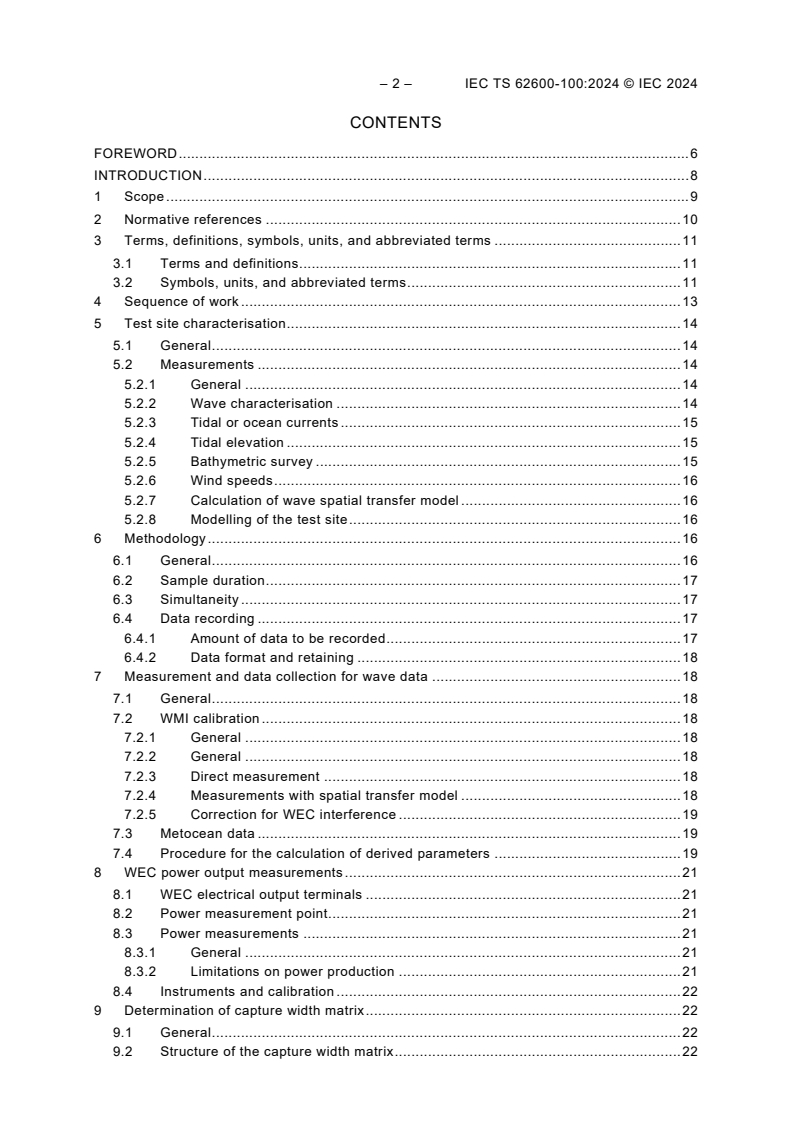
IEC TS 62600-100:2024 - Marine energy - Wave, tidal and other water current converters - Part 100: Electricity producing wave energy converters - Power performance assessment/18/2024
IEC TS 62600-100:2024 RLV - Marine energy - Wave, tidal and other water current converters - Part 100: Electricity producing wave energy converters - Power performance assessment Released:11/18/2024
Overview
IEC TS 62600-100:2024 is an IEC technical specification for power performance assessment of electricity-producing wave energy converters (WECs). Applied together with IEC TS 62600‑101 (wave energy resource assessment), it provides a method to estimate the mean annual energy production (MAEP) of a single, non-array WEC at a second site (Location 2) based on measured performance at a reference site (Location 1). The document covers capture width matrix transposition, validation, uncertainty assessment and allowable modelling or similarity-based transfers for commercial-scale WECs (moored, tautly moored, bottom- and shore-mounted).
Key topics and requirements
- Capture width matrix: Development, representation and transposition of the normalized power capture width matrix from Location 1 to Location 2, including dimensionality, binning and complementation where measurements are missing.
- Site resource data: Minimum wave and metocean data requirements at Location 2 as specified in IEC TS 62600‑101; requirements for bathymetry, currents, wind and spatial transfer modelling.
- Measurement methodology: Instrumentation, calibration and data recording practices for wave measurements and WEC electrical output, including metering location, data formats and retention.
- Validation and uncertainty: Validation procedures for spatial transfer models and capture width matrices, plus uncertainty evaluation for derived performance parameters at the target location.
- Permitted modelling inputs: Rules for incorporating additional empirical and numerical model data, and criteria for geometric, kinematic and dynamic similarity when transferring performance data.
- Reporting: Structured reporting requirements (WEC description, testsite, electrical/load, measurement procedures) aligned with IEC TS 62600‑200.
- Technical updates (Edition 2): Incorporation of IEC TS 62600‑102 as annexes, MAEP computation moved to IEC TS 62600‑101, updated terms/symbols and aligned reporting.
Practical applications and who uses it
This specification is intended for practitioners involved in wave energy performance assessment and project development:
- WEC developers and manufacturers assessing product performance and site suitability.
- Project engineers and resource analysts estimating energy yield transfers between sites (capture width transposition).
- Certification bodies and test laboratories validating measured performance and uncertainty.
- Investors and asset owners needing standardized, comparable performance estimates for commercial-scale WECs.
- Researchers and modelers using numerical or empirical models to complement measurement datasets.
Common use cases: estimating MAEP at a proposed deployment site using reference test data, validating spatial transfer models, documenting power performance for permitting and investment decisions, and assessing confidence in predicted yields.
Related standards
- IEC TS 62600‑101 - Wave energy resource assessment and characterization (MAEP computation).
- IEC TS 62600‑102 - Now incorporated as annexes in this edition.
- IEC TS 62600‑200 - Reporting alignment for marine energy converters.
Keywords: IEC TS 62600-100:2024, wave energy converters, WEC power performance, capture width matrix, MAEP estimation, wave resource assessment, metocean measurements.
Relations
- Effective Date
- 05-Sep-2023
- Effective Date
- 05-Sep-2023
Buy Documents
IEC TS 62600-100:2024 - Marine energy - Wave, tidal and other water current converters - Part 100: Electricity producing wave energy converters - Power performance assessment/18/2024
IEC TS 62600-100:2024 RLV - Marine energy - Wave, tidal and other water current converters - Part 100: Electricity producing wave energy converters - Power performance assessment Released:11/18/2024
Get Certified
Connect with accredited certification bodies for this standard

DNV
DNV is an independent assurance and risk management provider.

Lloyd's Register
Lloyd's Register is a global professional services organisation specialising in engineering and technology.
DNV Energy Systems
Energy and renewable energy certification.
Sponsored listings
Frequently Asked Questions
IEC TS 62600-100:2024 is a technical specification published by the International Electrotechnical Commission (IEC). Its full title is "Marine energy - Wave, tidal and other water current converters - Part 100: Electricity producing wave energy converters - Power performance assessment". This standard covers: IEC TS 62600-100:2024 applied in conjunction with the IEC Technical Specification on wave energy resource assessment and characterization (IEC TS 62600-101), provides a method for estimation of the mean annual energy production of a WEC, assessing the electrical power production performance of a single, non-array, wave energy converter, at Location 2 based on the performance at Location 1. The scope of this document includes: a) All wave energy converters that produce electrical power from wave energy. b) All sea resource zones (near and offshore, deep and shallow water). c) Capture width matrix transposition from one location to another. d) Limitation on the changes that are allowed to the WEC and the specification of the location. e) Wave data required at Location 2, as a minimum the requirements found in IEC TS 62600‑101. f) Development of the capture width matrix at Location 2. g) Validation of the capture width matrix at Location 2. h) Assessment of uncertainties in the derived performance parameters at Location 2. i) Requirements for the allowable power performance transfer by geometric, kinematic and dynamic similarity. j) Requirements for the allowable incorporation of additional empirical model data. k) Requirements for the allowable incorporation of additional numerical model data. l) The document applies to commercial scale wave energy converters that are: - compliantly moored. - tautly moored. - bottom mounted. - shore mounted. This second edition cancels and replaces the first edition published in 2012. This edition includes the following significant technical changes with respect to the previous edition: a) Incorporation of IEC TS 62600-102 as a series of annexes in this document. b) Removal of the computation of annual energy production. This has been moved to IEC TS 62600-101. c) Modification to the list of terms definitions, symbols and units. d) Modification of the reporting section to align with IEC TS 62600-200.
IEC TS 62600-100:2024 applied in conjunction with the IEC Technical Specification on wave energy resource assessment and characterization (IEC TS 62600-101), provides a method for estimation of the mean annual energy production of a WEC, assessing the electrical power production performance of a single, non-array, wave energy converter, at Location 2 based on the performance at Location 1. The scope of this document includes: a) All wave energy converters that produce electrical power from wave energy. b) All sea resource zones (near and offshore, deep and shallow water). c) Capture width matrix transposition from one location to another. d) Limitation on the changes that are allowed to the WEC and the specification of the location. e) Wave data required at Location 2, as a minimum the requirements found in IEC TS 62600‑101. f) Development of the capture width matrix at Location 2. g) Validation of the capture width matrix at Location 2. h) Assessment of uncertainties in the derived performance parameters at Location 2. i) Requirements for the allowable power performance transfer by geometric, kinematic and dynamic similarity. j) Requirements for the allowable incorporation of additional empirical model data. k) Requirements for the allowable incorporation of additional numerical model data. l) The document applies to commercial scale wave energy converters that are: - compliantly moored. - tautly moored. - bottom mounted. - shore mounted. This second edition cancels and replaces the first edition published in 2012. This edition includes the following significant technical changes with respect to the previous edition: a) Incorporation of IEC TS 62600-102 as a series of annexes in this document. b) Removal of the computation of annual energy production. This has been moved to IEC TS 62600-101. c) Modification to the list of terms definitions, symbols and units. d) Modification of the reporting section to align with IEC TS 62600-200.
IEC TS 62600-100:2024 is classified under the following ICS (International Classification for Standards) categories: 27.140 - Hydraulic energy engineering. The ICS classification helps identify the subject area and facilitates finding related standards.
IEC TS 62600-100:2024 has the following relationships with other standards: It is inter standard links to IEC TS 62600-100:2012, IEC TS 62600-100:2012/COR1:2017. Understanding these relationships helps ensure you are using the most current and applicable version of the standard.
IEC TS 62600-100:2024 is available in PDF format for immediate download after purchase. The document can be added to your cart and obtained through the secure checkout process. Digital delivery ensures instant access to the complete standard document.
Standards Content (Sample)
IEC TS 62600-100 ®
Edition 2.0 2024-11
TECHNICAL
SPECIFICATION
colour
inside
Marine energy – Wave, tidal and other water current converters –
Part 100: Electricity producing wave energy converters – Power performance
assessment
All rights reserved. Unless otherwise specified, no part of this publication may be reproduced or utilized in any form
or by any means, electronic or mechanical, including photocopying and microfilm, without permission in writing from
either IEC or IEC's member National Committee in the country of the requester. If you have any questions about IEC
copyright or have an enquiry about obtaining additional rights to this publication, please contact the address below or
your local IEC member National Committee for further information.
IEC Secretariat Tel.: +41 22 919 02 11
3, rue de Varembé info@iec.ch
CH-1211 Geneva 20 www.iec.ch
Switzerland
About the IEC
The International Electrotechnical Commission (IEC) is the leading global organization that prepares and publishes
International Standards for all electrical, electronic and related technologies.
About IEC publications
The technical content of IEC publications is kept under constant review by the IEC. Please make sure that you have the
latest edition, a corrigendum or an amendment might have been published.
IEC publications search - webstore.iec.ch/advsearchform IEC Products & Services Portal - products.iec.ch
The advanced search enables to find IEC publications by a Discover our powerful search engine and read freely all the
variety of criteria (reference number, text, technical publications previews, graphical symbols and the glossary.
committee, …). It also gives information on projects, replaced With a subscription you will always have access to up to date
and withdrawn publications. content tailored to your needs.
IEC Just Published - webstore.iec.ch/justpublished
Electropedia - www.electropedia.org
Stay up to date on all new IEC publications. Just Published
The world's leading online dictionary on electrotechnology,
details all new publications released. Available online and once
containing more than 22 500 terminological entries in English
a month by email.
and French, with equivalent terms in 25 additional languages.
Also known as the International Electrotechnical Vocabulary
IEC Customer Service Centre - webstore.iec.ch/csc
(IEV) online.
If you wish to give us your feedback on this publication or need
further assistance, please contact the Customer Service
Centre: sales@iec.ch.
IEC TS 62600-100 ®
Edition 2.0 2024-11
TECHNICAL
SPECIFICATION
colour
inside
Marine energy – Wave, tidal and other water current converters –
Part 100: Electricity producing wave energy converters – Power performance
assessment
INTERNATIONAL
ELECTROTECHNICAL
COMMISSION
ICS 27.140 ISBN 978-2-8322-9860-2
– 2 – IEC TS 62600-100:2024 © IEC 2024
CONTENTS
FOREWORD . 6
INTRODUCTION . 8
1 Scope . 9
2 Normative references . 10
3 Terms, definitions, symbols, units, and abbreviated terms . 11
3.1 Terms and definitions . 11
3.2 Symbols, units, and abbreviated terms . 11
4 Sequence of work . 13
5 Test site characterisation . 14
5.1 General . 14
5.2 Measurements . 14
5.2.1 General . 14
5.2.2 Wave characterisation . 14
5.2.3 Tidal or ocean currents . 15
5.2.4 Tidal elevation . 15
5.2.5 Bathymetric survey . 15
5.2.6 Wind speeds . 16
5.2.7 Calculation of wave spatial transfer model . 16
5.2.8 Modelling of the test site . 16
6 Methodology . 16
6.1 General . 16
6.2 Sample duration . 17
6.3 Simultaneity . 17
6.4 Data recording . 17
6.4.1 Amount of data to be recorded . 17
6.4.2 Data format and retaining . 18
7 Measurement and data collection for wave data . 18
7.1 General . 18
7.2 WMI calibration . 18
7.2.1 General . 18
7.2.2 General . 18
7.2.3 Direct measurement . 18
7.2.4 Measurements with spatial transfer model . 18
7.2.5 Correction for WEC interference . 19
7.3 Metocean data . 19
7.4 Procedure for the calculation of derived parameters . 19
8 WEC power output measurements . 21
8.1 WEC electrical output terminals . 21
8.2 Power measurement point . 21
8.3 Power measurements . 21
8.3.1 General . 21
8.3.2 Limitations on power production . 21
8.4 Instruments and calibration . 22
9 Determination of capture width matrix . 22
9.1 General . 22
9.2 Structure of the capture width matrix . 22
9.2.1 Core structure. 22
9.2.2 Sub-division of the normalized capture width matrix . 23
9.2.3 Calculation of the capture width . 23
9.2.4 Representation of the capture width per bin . 23
10 Reporting format . 23
10.1 General . 23
10.2 WEC description report . 24
10.3 WEC test site report . 24
10.4 Electrical grid and load report . 25
10.5 Test equipment report . 25
10.6 Measurement procedure report . 25
10.7 Presentation of measured data . 25
10.8 Deviations from the procedure . 26
Annex A (informative) Example production of a normalized capture width matrix. 27
A.1 General . 27
A.2 Sample data . 27
Annex B (normative) Method for power loss compensation where the measurement
point is located on shore . 33
B.1 Single-line diagram . 33
B.2 Cable loss compensation . 34
Annex C (normative) Evaluation of uncertainty . 36
C.1 General . 36
C.2 Uncertainty analysis . 36
Annex D (normative) Error analysis of the wave spatial transfer model . 38
D.1 General . 38
D.2 Overview. 38
D.2.1 Validation procedure . 38
D.2.2 Validation technique . 38
Annex E (normative) Wave energy converter power performance assessment at a
second location using measured assessment data . 40
E.1 General . 40
E.2 Sequence of work . 40
E.3 Limitations of this annex . 41
E.4 Description of wave energy conversion (WEC) technology . 41
E.5 Assess and characterize wave resource related to Location 1 and Location 2 . 41
E.5.1 General . 41
E.5.2 Ambient condition . 41
E.5.3 Wave resource at Location 1 and Location 2 . 42
E.6 WEC power capture data at Location 1 . 42
E.7 WEC model validation . 42
E.7.1 General . 42
E.7.2 Bin selection . 42
E.7.3 Error per bin . 42
E.7.4 Accounting for PTO losses . 43
E.8 Modifications to the WEC . 43
E.9 Calculate capture width matrix for use at Location 2 . 44
E.9.1 Evaluate appropriate dimensionality of the capture width matrix at
Location 2 . 44
E.9.2 Calculate information for each bin of the capture width matrix . 44
– 4 – IEC TS 62600-100:2024 © IEC 2024
E.10 Quality assurance for cells based on measurements at Location 1 . 45
E.11 Complement capture width matrix to cover range of conditions at Location 2 . 45
E.11.1 Capture width matrix complementation requirement . 45
E.11.2 Interpolation or extrapolation of the capture width matrix . 45
E.11.3 Numerical model . 45
E.11.4 Use of physical model . 46
E.12 Calculate AEP at Location 2 using complemented capture width matrix and
Location 2 resource data . 46
E.13 Assessment of confidence . 46
Annex F (informative) Example analysis . 47
F.1 General . 47
F.2 Description of the WEC technology . 47
F.3 Assess and characterize wave resource related to Location 1 and Location 2 . 48
F.4 Assess and characterize wave resource at Location 1 . 49
F.5 Assess and characterize wave resource at Location 2 . 50
F.6 WEC power capture data at Location 1 . 51
F.7 WEC model validation . 52
F.8 Calculate capture width matrix for use at Location 2 . 54
F.8.1 Assess the appropriate dimensionality of the capture width matrix at
Location 2 . 54
F.8.2 Calculate information for each bin of the capture width matrix . 54
F.9 Perform quality assurance on capture width matrix for application at Location
2 . 55
F.10 Complement capture width matrix to cover range of conditions at Location 2 . 55
F.11 Calculate AEP at Location 2 using complemented capture width matrix and
Location 2 resource data . 56
F.12 Assessment of confidence . 56
Annex G (informative) Power take off efficiency . 57
G.1 General . 57
G.2 Absorbed power . 57
G.3 WEC Power take off efficiency – location 1 . 58
G.4 Example calculation of PTO efficiency . 58
G.5 Power take off efficiency – location 2 . 61
Bibliography . 62
Figure 1 – Timeline of assessment . 14
Figure 2 – Data flow diagram . 17
Figure A.1 – Power scatter . 28
Figure B.1 – Location options for metering equipment . 33
Figure B.2 – Positive sequence cable model . 34
Figure F.1 – The Wavestar prototype (diameter of each float is 5 m) . 47
Figure F.2 – Map showing Location 1 Hanstholm and Location 2 Fjatring . 48
Figure F.3 – Location 1 wave energy flux matrix, Hantsholm, Denmark (based on
measured data from Wavestar prototype Feb 2012 – Jan 2013) . 50
Figure F.4 – Location 2 Wave Energy Flux Matrix, Buoy 2031 (Fjaltring, Denmark) . 51
Figure F.5 – Wavestar prototype capture width matrix Location 1. 52
Figure F.6 – Numerically modelled electrical power matrix, adapted from [3] . 53
Figure F.7 – Model validation indicating percent difference in capture width between
observations and model (model-observations) . 54
Figure F.8 – Wavestar prototype capture width matrix for Location 2. Fjaltring,
Denmark . 56
Figure G.1 – Overview of Power Take Off System . 57
Table 1 – Symbols, units, and abbreviated terms . 11
Table A.1 – Sample data . 27
Table A.2 – Average capture width . 29
Table A.3 – Standard deviation of capture width . 30
Table A.4 – Maximum capture width . 30
Table A.5 – Minimum capture width . 31
Table A.6 – Number of data samples . 32
Table C.1 – List of uncertainty components . 36
Table F.1 – Locations 1 and 2, basic information . 48
Table G.1 – Absorbed capture width . 59
Table G.2 – PTO efficiency . 60
– 6 – IEC TS 62600-100:2024 © IEC 2024
INTERNATIONAL ELECTROTECHNICAL COMMISSION
____________
MARINE ENERGY –
WAVE, TIDAL AND OTHER WATER CURRENT CONVERTERS –
Part 100: Electricity producing wave energy converters –
Power performance assessment
FOREWORD
1) The International Electrotechnical Commission (IEC) is a worldwide organization for standardization comprising
all national electrotechnical committees (IEC National Committees). The object of IEC is to promote international
co-operation on all questions concerning standardization in the electrical and electronic fields. To this end and
in addition to other activities, IEC publishes International Standards, Technical Specifications, Technical Reports,
Publicly Available Specifications (PAS) and Guides (hereafter referred to as "IEC Publication(s)"). Their
preparation is entrusted to technical committees; any IEC National Committee interested in the subject dealt with
may participate in this preparatory work. International, governmental and non-governmental organizations liaising
with the IEC also participate in this preparation. IEC collaborates closely with the International Organization for
Standardization (ISO) in accordance with conditions determined by agreement between the two organizations.
2) The formal decisions or agreements of IEC on technical matters express, as nearly as possible, an international
consensus of opinion on the relevant subjects since each technical committee has representation from all
interested IEC National Committees.
3) IEC Publications have the form of recommendations for international use and are accepted by IEC National
Committees in that sense. While all reasonable efforts are made to ensure that the technical content of IEC
Publications is accurate, IEC cannot be held responsible for the way in which they are used or for any
misinterpretation by any end user.
4) In order to promote international uniformity, IEC National Committees undertake to apply IEC Publications
transparently to the maximum extent possible in their national and regional publications. Any divergence between
any IEC Publication and the corresponding national or regional publication shall be clearly indicated in the latter.
5) IEC itself does not provide any attestation of conformity. Independent certification bodies provide conformity
assessment services and, in some areas, access to IEC marks of conformity. IEC is not responsible for any
services carried out by independent certification bodies.
6) All users should ensure that they have the latest edition of this publication.
7) No liability shall attach to IEC or its directors, employees, servants or agents including individual experts and
members of its technical committees and IEC National Committees for any personal injury, property damage or
other damage of any nature whatsoever, whether direct or indirect, or for costs (including legal fees) and
expenses arising out of the publication, use of, or reliance upon, this IEC Publication or any other IEC
Publications.
8) Attention is drawn to the Normative references cited in this publication. Use of the referenced publications is
indispensable for the correct application of this publication.
9) IEC draws attention to the possibility that the implementation of this document may involve the use of (a)
patent(s). IEC takes no position concerning the evidence, validity or applicability of any claimed patent rights in
respect thereof. As of the date of publication of this document, IEC had not received notice of (a) patent(s), which
may be required to implement this document. However, implementers are cautioned that this may not represent
the latest information, which may be obtained from the patent database available at https://patents.iec.ch. IEC
shall not be held responsible for identifying any or all such patent rights.
IEC TS 62600-100 has been prepared by IEC technical committee 114: Marine energy – Wave,
tidal and other water current converters. It is a Technical Specification.
This second edition cancels and replaces the first edition published in 2012. This
edition constitutes a technical revision.
This edition includes the following significant technical changes with respect to the previous
edition:
a) Incorporation of IEC TS 62600-102 as a series of annexes in this document
b) Removal of the computation of annual energy production. This has been moved to
IEC TS 62600-101.
c) Modification to the list of terms definitions, symbols and units.
d) Modification of the reporting section to align with IEC TS 62600-200
The text of this Technical Specification is based on the following documents:
Draft Report on voting
114/537/DTS 114/554/RVDTS
Full information on the voting for its approval can be found in the report on voting indicated in
the above table.
The language used for the development of this Technical Specification is English.
This document was drafted in accordance with ISO/IEC Directives, Part 2, and developed in
accordance with ISO/IEC Directives, Part 1 and ISO/IEC Directives, IEC Supplement, available
at www.iec.ch/members_experts/refdocs. The main document types developed by IEC are
described in greater detail at www.iec.ch/publications.
A list of all parts in the IEC 62600 series, published under the general title Marine Energy –
Wave, tidal and other water current converters, can be found on the IEC website.
The committee has decided that the contents of this document will remain unchanged until the
stability date indicated on the IEC website under webstore.iec.ch in the data related to the
specific document. At this date, the document will be
• reconfirmed,
• withdrawn, or
• revised.
IMPORTANT – The "colour inside" logo on the cover page of this document indicates
that it contains colours which are considered to be useful for the correct understanding
of its contents. Users should therefore print this document using a colour printer.
– 8 – IEC TS 62600-100:2024 © IEC 2024
INTRODUCTION
This part of IEC 62600, which is a Technical Specification, provides performance assessment
methods for wave energy converters. A wave energy converter is a device which generates
electricity using the action of water waves and delivers electricity to an electrical load.
Wave energy industry development is transitioning from preliminary stages to commercial
production stages. Validated data gathering and processing techniques are important to
improve existing technologies. This document will be subject to changes as data are collected
and processed from testing of wave energy converters.
The expected users of the document include:
• Device developers who want to validate the performance of their wave energy converter.
• Investors who want to assess the performance of a device developer's wave energy
converter.
• Project developers who want to assess the performance of their project against
manufacturer's claims.
• Surveyors contracted to carry out the assessment.
• Conformity assessment, test laboratories, and certification.
• Project developers – income, return on investment
• Device developers – performance of device
• Utilities and investors – reliability/predictability of supply, return on investment
• Policy-makers and planners – usage of seascape, optimisation of resource, power supply
issues
• Consultants to produce resource data/due diligence – compatible/readable data format
An essential element for any published Technical Specification or International Standard is to
allow an opportunity to provide feedback on its contents to the appropriate TC 114 Working
Group. TC 114 utilizes a standard methodology to allow this.
To submit feedback such as proposed changes, corrections and/or improvements to this
document, please send an email to the TC 114 Chair using the Contact TC 114 Officers feature
on the IEC TC 114 Dashboard, accessible at www.iec.ch/tc114. On the right side of the
Dashboard under Further information select the link to contact the TC 114 Officers. On the
subsequent page find and select the Send Email link for the Chair to access the email tool.
Complete all the required elements within the email pop-up. For the Subject field please include
the document title and edition you are providing feedback for (ex: feedback for TS 62600-1
ED2). In the Message field, include text which summarizes your feedback and note if further
information can be made available (note attachments are not allowed). The Chair may request
added information as needed before forwarding the submission to the remaining TC 114
Officers for review and then to the appropriate Working Group for their consideration.
MARINE ENERGY –
WAVE, TIDAL AND OTHER WATER CURRENT CONVERTERS –
Part 100: Electricity producing wave energy converters –
Power performance assessment
1 Scope
Wave Energy Converters (WEC) are designed to operate efficiently at different locations.
Systematic methods are used to evaluate the power performance of a WEC at a second location
(hereinafter Location 2) based on power performance assessment at a first location (hereinafter
Location 1). The degree of similarity of the measured WEC (WEC 1) and the metocean
conditions at Location 1 to the secondary WEC (WEC 2) at Location 2 determine the
methodology and the applicability of this document.
This document applied in conjunction with the IEC Technical Specification on wave energy
resource assessment and characterization (IEC TS 62600-101), provides a method for
estimation of the mean annual energy production of a WEC, assessing the electrical power
production performance of a single, non-array, wave energy converter, at Location 2 based on
the performance at Location 1.
The scope of this document includes:
a) All wave energy converters that produce electrical power from wave energy.
b) All sea resource zones (near and offshore, deep and shallow water).
c) Capture width matrix transposition from one location to another.
d) Limitation on the changes that are allowed to the WEC and the specification of the location.
e) Wave data required at Location 2, as a minimum the requirements found in
IEC TS 62600-101.
f) Development of the capture width matrix at Location 2.
g) Validation of the capture width matrix at Location 2.
h) Assessment of uncertainties in the derived performance parameters at Location 2.
i) Requirements for the allowable power performance transfer by geometric, kinematic and
dynamic similarity.
j) Requirements for the allowable incorporation of additional empirical model data.
k) Requirements for the allowable incorporation of additional numerical model data.
l) The document applies to commercial scale wave energy converters that are:
1) compliantly moored.
2) tautly moored.
3) bottom mounted.
4) shore mounted.
The scope of this document does not include:
a) Wave energy converters that produce nonelectrical energy.
b) Resource assessment.
c) Scaled devices in test facilities (tank or scaled sea conditions) where any scaling would be
carried out to extrapolate results for a full-scale device.
d) Power quality issues.
– 10 – IEC TS 62600-100:2024 © IEC 2024
e) Environmental issues.
f) Operation and maintenance.
g) Annual energy production (AEP).
This document provides a systematic method which includes:
• measurement of WEC capture width in a range of sea states.
• transposition of capture width from one location to a second location.
• an agreed framework for reporting the results of capture width and wave measurements.
• estimate of the capture width of a modified WEC at Location 2. This work would include the
development of parameters for the modified WEC for the second location.
This document provides:
• guidance on the use of observations from Location 1.
• methods for assessing and reporting the validity of numerical and physical models.
• limits on the permissible changes to the WEC between Locations 1 and 2.
• limits on the use of data fitting techniques, and
• requirements for reporting.
The wave power industry is at an early stage of development. There is little practical experience
with field-scale WECs deployment. Because of this, the present document will be subject to
change as more data is collected and experience with wave energy converters develops.
2 Normative references
The following documents are referred to in the text in such a way that some or all of their content
constitutes requirements of this document. For dated references, only the edition cited applies.
For undated references, the latest edition of the referenced document (including any
amendments) applies.
IEC 60688, Electrical measuring transducers for converting AC and DC. electrical quantities to
analogue or digital signals
IEC 61869-1, Instrument transformers – Part 1: General requirements
IEC 61869-2, Instrument transformers – Part 2: Additional Requirements for current
transformers
IEC 61869-3, Instrument transformers – Part 3: Additional requirements for inductive voltage
transformers
IEC TS 62600-3, Marine energy – Wave, tidal and other water current converters – Part 3:
Measurement of mechanical loads
IEC TS 62600-101:2015, Marine energy – Wave, tidal and other water current converters –
Part 101: Wave energy resource assessment and characterization
IEC TS 62600-103, Marine energy – Wave, tidal and other water current converters – Part 103:
Guidelines for the early stage development of wave energy converters – Best practices and
recommended procedures for the testing of pre-prototype devices
ISO/IEC Guide 98-1, Uncertainty of measurement – Part 1: Introduction to the expression of
uncertainty in measurement
ISO/IEC Guide 98-3, Uncertainty of measurement – Part 3: Guide to the expression of
uncertainty in measurement (GUM:1995)
ISO 8601, Data elements and interchange formats – Information interchange – Representation
of dates and times
ISO 19901-1, Petroleum and natural gas industries – Specific requirements for offshore
structures – Part 1: Metocean design and operating considerations
3 Terms, definitions, symbols, units, and abbreviated terms
3.1 Terms and definitions
No terms and definitions are listed in this document.
ISO and IEC maintain terminology databases for use in standardization at the following
addresses:
• IEC Electropedia: available at https://www.electropedia.org/
• ISO Online browsing platform: available at https://www.iso.org/obp
3.2 Symbols, units, and abbreviated terms
For the purposes of this document, the following symbols, units, and abbreviated terms listed
in Table 1 apply.
Table 1 – Symbols, units, and abbreviated terms
Symbol Definition Units
C
total positive sequence line-to-line capacitance of subsea cable farad
cable
c
group velocity at frequency component i m/s
g,i
c
phase velocity at frequency component i m/s
pi
f frequency Hz
f
peak frequency
p
f
frequency at component i Hz
i
f
frequency spacing Hz
i
directional spreading function
G(θ,f) 1/rad
+π
NOTE 1
G(θ,1f)×=dθ
∫
−π
h water depth m
H
spectral estimate of significant wave m
m0
H
significant wave height m
s
I
Line RMS current
meas A
J Omni-directional wave power per unit width W/m
∧ J
maximum omni-directional wave power per unit width
W/m
∨ J
minimum omni-directional wave power per unit width W/m
average omni-directional wave power per unit width W/m
J
k
wave number at frequency component i 1/m
i
– 12 – IEC TS 62600-100:2024 © IEC 2024
Symbol Definition Units
CW capture width m
∧ CW maximum capture width m
∨ CW
minimum capture width m
average capture width m
CW
th
CW
m
model capture width for i bin
model,i
th
CW
measured capture width for i bin m
measured,i
th
CW
error capture width for i bin m
err,i
M number of data sets in a bin -
th
n
m
frequency n order moments of the variance spectrum
Hz
n
n number of records -
N number of bins -
P
measured power output per bin W
i
P
hydraulic power input W
h
P
absorbed power W
abs
P
measured real electrical power output W
e
P
power loss (dissipated) in the PTO W
pto
PF
power factor -
meas
P
real or active power W
meas
P
power generated by WEC W
genWEC
P
cable power loss component W
loss
PTO power take off
Q
reactive power VAR
meas
R
total positive sequence resistance of subsea cable Ω
cable
m
S variance density
Hz
m
S(f) variance density as function of frequency
Hz
spectral density at WEC 2
m
S(f)
WEC
equals T(ft, ,θh, ,.)× S( f )
Hz
wmi
m
S(f)
spectral density at WMI
WMI
Hz
Directional wave energy spectral density
m
S(f, θ)
Sf( )×G(,θf )
Hz⋅ rad
Directional wave energy spectral density
m
𝑆𝑆(𝑓𝑓,𝜃𝜃)
𝑊𝑊𝑊𝑊𝑊𝑊
Sf( )×G(,θf ) at WEC
Hz⋅ rad
Directional wave energy spectral density
m
𝑆𝑆(𝑓𝑓,𝜃𝜃)
𝑊𝑊𝑊𝑊𝑊𝑊
Sf( )×G(,θf ) at WMI
Hz⋅ rad
Symbol Definition Units
m
th
S
variance density over the i discrete frequency
i
Hz
th th 2
𝑆𝑆
variance density of the i discrete frequency and j discrete direction m /Hz/rad
𝑖𝑖𝑖𝑖
σ standard deviation -
t time lag or shift between the WMI and the WEC s
T operational hours per record h
Variance density spatial transfer model, for correction of the spectral density
measured at the WMI to the WEC
T(f, t, θ, h,.) -
NOTE 2 not all the variables are listed. the transfer model dependencies will
be specific to each test site.
T
energy period (also written as T )
s
e
-10
th
Δf
frequency width of the variance density of the i discrete frequency Hz
i
th
Δθj rad
angular width of the variance density of the j discrete direction
U line-to-line voltage V
U
line-to-line RMS voltage
meas
V
V , V
WEC side positive sequence voltage V
p1+ p1–
V , V
shore side positive voltage V
p2 p2–
WEC wave energy converter
WMI wave measurement instrument
X
total positive sequence reactance of subsea cable Ω
cable
fluid density
ρ kg/m
θ wave direction rad
λ wavelength m
φ phase angle Degrees°
voltage phase angle Degrees°
current phase angle Degrees°
η
power take off efficiency -
pto
CF(X) Centre frequency fraction of errors that lie within the limits of ± X % %
4 Sequence of work
Figure 1 shows the sequence of work for the assessment as described in this document. The
pre-test sections shall be conducted prior to the testing period. Following the testing period, the
post-test sections shall be conducted.
– 14 – IEC TS 62600-100:2024 © IEC 2024
Figure 1 – Timeline of assessment
5 Test site characterisation
5.1 General
An analysis of the prospective test site shall be undertaken to ensure that it is suitable for power
assessment of a WEC. The incident wave climate shall be evaluated to ensure the capture width
matrix can be populated. To infer the incident wave power at the location of a WEC, the effect
of bathymetry and metocean parameters and conditions on the incident wave climate shall be
sufficiently analysed to determine whether a transfer model between the Wave Measurement
Instrument (WMI) and WEC will be required. If a transfer model is required, the analysis shall
support the development of a suitable transfer model.
5.2 Measurements
5.2.1 General
The boundary of the test site shall be defined and documented. The main physiographic and
oceanographic features of the study area shall be identified, especially those features that
influence wave propagation and thus the wave characteristics at the proposed WEC location.
Locations and time periods of all measurements will be recorded.
In cases where a wave propagation model is necessary to infer the wave characteristics at the
WEC location, the test site boundary should be considered the wave propagation model domain.
5.2.2 Wave characterisation
A WMI shall be deployed at the proposed WEC testing location prior to WEC deployment. A
second WMI shall be deployed simultaneously at the proposed post-deployment wave
measurement location. The WMIs shall be deployed for a minimum of 3 months prior to WEC
deployment, and it is recommended the WMIs record data for 12 months prior to WEC
deployment to account for seasonal variations. The frequency of WMI measurements will be at
least once per hour. It is expected that during each measurement the WMI will record data
defining the free surface elevation time series profile, and that this time series data will be at
sufficient temporal resolution to permit subsequent transformation of the data into a frequency
domain representation.
More than one WMI should be used if there is a large variation of wave direction and sea state
due to bathymetric changes near the WEC location.
The directional wave energy spectrum, Sf( ,)θ , shall be calculated from WMI recorded data.
The wave spectra can be recorded in discrete form, but the maximum frequency bin width shall
not exceed 0,015 Hz, and the maximum directional bin width shall not exceed 5 degrees, or
0,088 rad.
From each directional wave energy spectrum record, spectrally derived estimates of the
following parameters shall be derived for use in the determination of the capture width matrix:
a) significant wave height.
b) energy period.
c) wave direction.
d) directional spread.
e) spectral width.
In addition to wave parameters mentioned, the following environmental parameters shall be
recorded:
f) water depth including tidal effect.
g) tidal or ocean current speed and direction.
h) wind speed and direction.
i) density of water.
j) occurrence and thickness of ice.
Parameters from the lists (items a-j) that have not been recorded, and thus not included in the
development the capture width matrix, shall be identified and the rationale for their exclusion
justified.
The preferred characteristic period is the energy period, but additional characteristic periods
may also be calculated. These include the peak period and the zero up-crossing period.
5.2.3 Tidal or ocean currents
Currents at the test site shall be recorded and documented through a current measurement
instrument. The current speed and direction data shall be measured simultaneously with the
wav
...
IEC TS 62600-100 ®
Edition 2.0 2024-11
REDLINE VERSION
TECHNICAL
SPECIFICATION
colour
inside
Marine energy – Wave, tidal and other water current converters –
Part 100: Electricity producing wave energy converters – Power performance
assessment
All rights reserved. Unless otherwise specified, no part of this publication may be reproduced or utilized in any form
or by any means, electronic or mechanical, including photocopying and microfilm, without permission in writing from
either IEC or IEC's member National Committee in the country of the requester. If you have any questions about IEC
copyright or have an enquiry about obtaining additional rights to this publication, please contact the address below or
your local IEC member National Committee for further information.
IEC Secretariat Tel.: +41 22 919 02 11
3, rue de Varembé info@iec.ch
CH-1211 Geneva 20 www.iec.ch
Switzerland
About the IEC
The International Electrotechnical Commission (IEC) is the leading global organization that prepares and publishes
International Standards for all electrical, electronic and related technologies.
About IEC publications
The technical content of IEC publications is kept under constant review by the IEC. Please make sure that you have the
latest edition, a corrigendum or an amendment might have been published.
IEC publications search - webstore.iec.ch/advsearchform IEC Products & Services Portal - products.iec.ch
The advanced search enables to find IEC publications by a Discover our powerful search engine and read freely all the
variety of criteria (reference number, text, technical publications previews, graphical symbols and the glossary.
committee, …). It also gives information on projects, replaced With a subscription you will always have access to up to date
and withdrawn publications. content tailored to your needs.
IEC Just Published - webstore.iec.ch/justpublished
Electropedia - www.electropedia.org
Stay up to date on all new IEC publications. Just Published
The world's leading online dictionary on electrotechnology,
details all new publications released. Available online and once
containing more than 22 500 terminological entries in English
a month by email.
and French, with equivalent terms in 25 additional languages.
Also known as the International Electrotechnical Vocabulary
IEC Customer Service Centre - webstore.iec.ch/csc
(IEV) online.
If you wish to give us your feedback on this publication or need
further assistance, please contact the Customer Service
Centre: sales@iec.ch.
IEC TS 62600-100 ®
Edition 2.0 2024-11
REDLINE VERSION
TECHNICAL
SPECIFICATION
colour
inside
Marine energy – Wave, tidal and other water current converters –
Part 100: Electricity producing wave energy converters – Power performance
assessment
INTERNATIONAL
ELECTROTECHNICAL
COMMISSION
ICS 27.140 ISBN 978-2-8327-0039-6
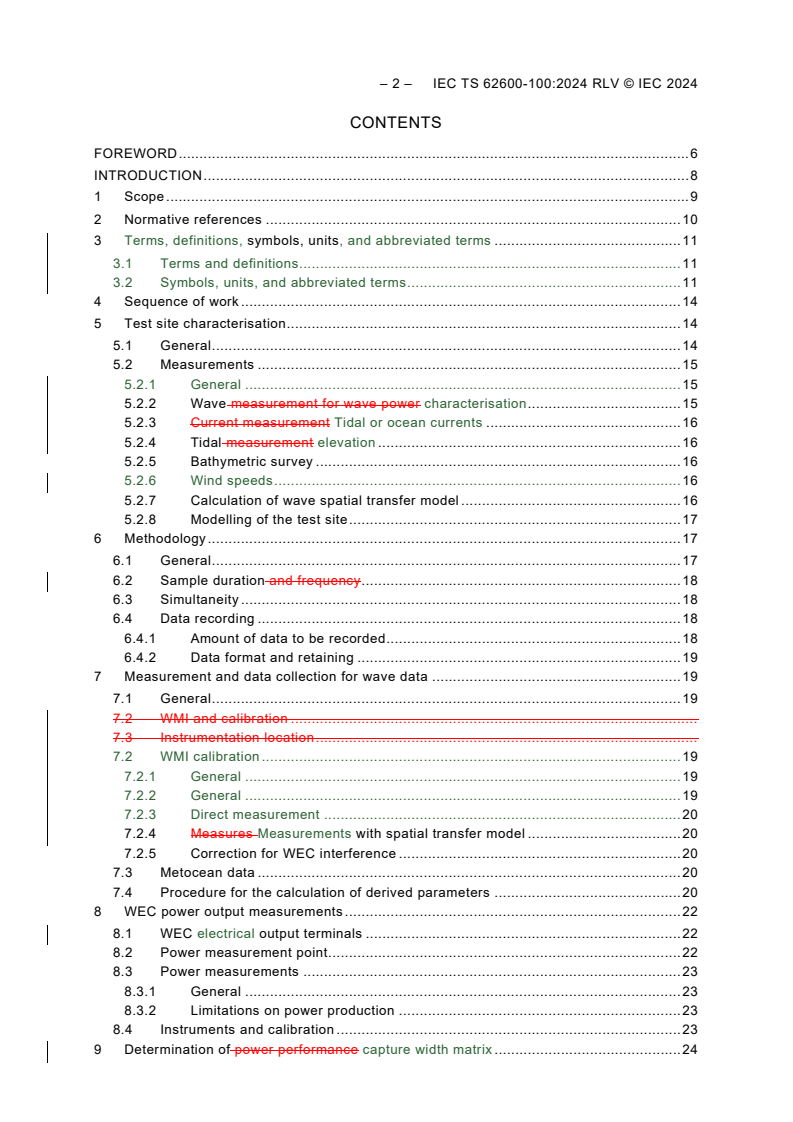
– 2 – IEC TS 62600-100:2024 RLV © IEC 2024
CONTENTS
FOREWORD . 6
INTRODUCTION . 8
1 Scope . 9
2 Normative references . 10
3 Terms, definitions, symbols, units, and abbreviated terms . 11
3.1 Terms and definitions . 11
3.2 Symbols, units, and abbreviated terms . 11
4 Sequence of work . 14
5 Test site characterisation . 14
5.1 General . 14
5.2 Measurements . 15
5.2.1 General . 15
5.2.2 Wave measurement for wave power characterisation . 15
5.2.3 Current measurement Tidal or ocean currents . 16
5.2.4 Tidal measurement elevation . 16
5.2.5 Bathymetric survey . 16
5.2.6 Wind speeds . 16
5.2.7 Calculation of wave spatial transfer model . 16
5.2.8 Modelling of the test site . 17
6 Methodology . 17
6.1 General . 17
6.2 Sample duration and frequency . 18
6.3 Simultaneity . 18
6.4 Data recording . 18
6.4.1 Amount of data to be recorded . 18
6.4.2 Data format and retaining . 19
7 Measurement and data collection for wave data . 19
7.1 General . 19
7.2 WMI and calibration .
7.3 Instrumentation location .
7.2 WMI calibration . 19
7.2.1 General . 19
7.2.2 General . 19
7.2.3 Direct measurement . 20
7.2.4 Measures Measurements with spatial transfer model . 20
7.2.5 Correction for WEC interference . 20
7.3 Metocean data . 20
7.4 Procedure for the calculation of derived parameters . 20
8 WEC power output measurements . 22
8.1 WEC electrical output terminals . 22
8.2 Power measurement point . 22
8.3 Power measurements . 23
8.3.1 General . 23
8.3.2 Limitations on power production . 23
8.4 Instruments and calibration . 23
9 Determination of power performance capture width matrix . 24
9.1 General . 24
9.2 Structure of the normalized power capture width matrix . 24
9.2.1 Core structure. 24
9.2.2 Sub-division of the normalized power capture width matrix . 24
9.2.3 Calculation of the capture length width . 24
9.2.4 Representation of the capture length matrix width per bin . 25
9.3 Calculation of power matrix .
10 Calculation of mean annual energy production (MAEP).
10.1 General .
10.2 Standard methodology .
10.3 Alternative methodology .
10.4 Completeness of the capture length matrix for MAEP .
10 Reporting format . 27
10.1 General . 27
10.2 WEC description report . 27
10.3 WEC test site report . 27
10.4 Electrical grid and load report . 28
10.5 Test equipment report . 28
10.6 Measurement procedure report . 29
10.7 Presentation of measured data . 29
10.8 Deviations from the procedure . 29
Annex A (informative) Example production of a normalized power capture width matrix . 30
A.1 General . 30
A.2 Sample data . 30
Annex B (normative) Method for power loss compensation where the measurement
point is located on shore . 45
B.1 Single-line diagram . 45
B.2 Cable loss compensation . 46
Annex C (normative) Evaluation of uncertainty . 48
C.1 General . 48
C.2 Uncertainty analysis . 48
Annex D (normative) Error analysis of the wave spatial transfer model . 50
D.1 General . 50
D.2 Overview. 50
D.2.1 Validation procedure . 50
D.2.2 Validation technique . 50
Annex E (normative) Wave energy converter power performance assessment at a
second location using measured assessment data . 52
E.1 General . 52
E.2 Sequence of work . 52
E.3 Limitations of this annex . 53
E.4 Description of wave energy conversion (WEC) technology . 53
E.5 Assess and characterize wave resource related to Location 1 and Location 2 . 53
E.5.1 General . 53
E.5.2 Ambient condition . 53
E.5.3 Wave resource at Location 1 and Location 2 . 54
E.6 WEC power capture data at Location 1 . 54
E.7 WEC model validation . 54
– 4 – IEC TS 62600-100:2024 RLV © IEC 2024
E.7.1 General . 54
E.7.2 Bin selection . 54
E.7.3 Error per bin . 54
E.7.4 Accounting for PTO losses . 55
E.8 Modifications to the WEC . 55
E.9 Calculate capture width matrix for use at Location 2 . 56
E.9.1 Evaluate appropriate dimensionality of the capture width matrix at
Location 2 . 56
E.9.2 Calculate information for each bin of the capture width matrix . 56
E.10 Quality assurance for cells based on measurements at Location 1 . 57
E.11 Complement capture width matrix to cover range of conditions at Location 2 . 57
E.11.1 Capture width matrix complementation requirement . 57
E.11.2 Interpolation or extrapolation of the capture width matrix . 57
E.11.3 Numerical model . 57
E.11.4 Use of physical model . 58
E.12 Calculate AEP at Location 2 using complemented capture width matrix and
Location 2 resource data . 58
E.13 Assessment of confidence . 58
Annex F (informative) Example analysis . 59
F.1 General . 59
F.2 Description of the WEC technology . 59
F.3 Assess and characterize wave resource related to Location 1 and Location 2 . 60
F.4 Assess and characterize wave resource at Location 1 . 61
F.5 Assess and characterize wave resource at Location 2 . 62
F.6 WEC power capture data at Location 1 . 63
F.7 WEC model validation . 64
F.8 Calculate capture width matrix for use at Location 2 . 66
F.8.1 Assess the appropriate dimensionality of the capture width matrix at
Location 2 . 66
F.8.2 Calculate information for each bin of the capture width matrix . 66
F.9 Perform quality assurance on capture width matrix for application at Location
2 . 67
F.10 Complement capture width matrix to cover range of conditions at Location 2 . 67
F.11 Calculate AEP at Location 2 using complemented capture width matrix and
Location 2 resource data . 68
F.12 Assessment of confidence . 68
Annex G (informative) Power take off efficiency . 69
G.1 General . 69
G.2 Absorbed power . 69
G.3 WEC Power take off efficiency – location 1 . 70
G.4 Example calculation of PTO efficiency . 70
G.5 Power take off efficiency – location 2 . 73
Bibliography . 74
Figure 1 – Timeline of assessment . 14
Figure 2 – Data flow diagram . 18
Figure A.1 – Power scatter . 32
Figure B.1 – Location options for metering equipment . 45
Figure B.2 – Positive sequence cable model . 46
Figure F.1 – The Wavestar prototype (diameter of each float is 5 m) . 59
Figure F.2 – Map showing Location 1 Hanstholm and Location 2 Fjatring . 60
Figure F.3 – Location 1 wave energy flux matrix, Hantsholm, Denmark (based on
measured data from Wavestar prototype Feb 2012 – Jan 2013) . 62
Figure F.4 – Location 2 Wave Energy Flux Matrix, Buoy 2031 (Fjaltring, Denmark) . 63
Figure F.5 – Wavestar prototype capture width matrix Location 1. 64
Figure F.6 – Numerically modelled electrical power matrix, adapted from [3] . 65
Figure F.7 – Model validation indicating percent difference in capture width between
observations and model (model-observations) . 66
Figure F.8 – Wavestar prototype capture width matrix for Location 2. Fjaltring,
Denmark . 68
Figure G.1 – Overview of Power Take Off System . 69
Table 1 – Symbols, units, and abbreviated terms . 12
Table A.1 – Sample data . 30
Table A.2 – Average capture length width . 34
Table A.3 – Standard deviation of capture length width . 36
Table A.4 – Maximum capture length width . 38
Table A.5 – Minimum capture capture length width . 40
Table A.6 – Number of data samples . 42
Table A.7 – Power matrix .
Table C.1 – List of uncertainty components . 48
Table F.1 – Locations 1 and 2, basic information . 60
Table G.1 – Absorbed capture width . 71
Table G.2 – PTO efficiency . 72
– 6 – IEC TS 62600-100:2024 RLV © IEC 2024
INTERNATIONAL ELECTROTECHNICAL COMMISSION
____________
MARINE ENERGY –
WAVE, TIDAL AND OTHER WATER CURRENT CONVERTERS –
Part 100: Electricity producing wave energy converters –
Power performance assessment
FOREWORD
1) The International Electrotechnical Commission (IEC) is a worldwide organization for standardization comprising
all national electrotechnical committees (IEC National Committees). The object of IEC is to promote international
co-operation on all questions concerning standardization in the electrical and electronic fields. To this end and
in addition to other activities, IEC publishes International Standards, Technical Specifications, Technical Reports,
Publicly Available Specifications (PAS) and Guides (hereafter referred to as "IEC Publication(s)"). Their
preparation is entrusted to technical committees; any IEC National Committee interested in the subject dealt with
may participate in this preparatory work. International, governmental and non-governmental organizations liaising
with the IEC also participate in this preparation. IEC collaborates closely with the International Organization for
Standardization (ISO) in accordance with conditions determined by agreement between the two organizations.
2) The formal decisions or agreements of IEC on technical matters express, as nearly as possible, an international
consensus of opinion on the relevant subjects since each technical committee has representation from all
interested IEC National Committees.
3) IEC Publications have the form of recommendations for international use and are accepted by IEC National
Committees in that sense. While all reasonable efforts are made to ensure that the technical content of IEC
Publications is accurate, IEC cannot be held responsible for the way in which they are used or for any
misinterpretation by any end user.
4) In order to promote international uniformity, IEC National Committees undertake to apply IEC Publications
transparently to the maximum extent possible in their national and regional publications. Any divergence between
any IEC Publication and the corresponding national or regional publication shall be clearly indicated in the latter.
5) IEC itself does not provide any attestation of conformity. Independent certification bodies provide conformity
assessment services and, in some areas, access to IEC marks of conformity. IEC is not responsible for any
services carried out by independent certification bodies.
6) All users should ensure that they have the latest edition of this publication.
7) No liability shall attach to IEC or its directors, employees, servants or agents including individual experts and
members of its technical committees and IEC National Committees for any personal injury, property damage or
other damage of any nature whatsoever, whether direct or indirect, or for costs (including legal fees) and
expenses arising out of the publication, use of, or reliance upon, this IEC Publication or any other IEC
Publications.
8) Attention is drawn to the Normative references cited in this publication. Use of the referenced publications is
indispensable for the correct application of this publication.
9) IEC draws attention to the possibility that the implementation of this document may involve the use of (a)
patent(s). IEC takes no position concerning the evidence, validity or applicability of any claimed patent rights in
respect thereof. As of the date of publication of this document, IEC had not received notice of (a) patent(s), which
may be required to implement this document. However, implementers are cautioned that this may not represent
the latest information, which may be obtained from the patent database available at https://patents.iec.ch. IEC
shall not be held responsible for identifying any or all such patent rights.
This redline version of the official IEC Standard allows the user to identify the changes
made to the previous edition IEC TS 62600-100:2012. A vertical bar appears in the margin
wherever a change has been made. Additions are in green text, deletions are in
strikethrough red text.
IEC TS 62600-100 has been prepared by IEC technical committee 114: Marine energy – Wave,
tidal and other water current converters. It is a Technical Specification.
This second edition cancels and replaces the first edition published in 2012. This edition
constitutes a technical revision.
This edition includes the following significant technical changes with respect to the previous
edition:
a) Incorporation of IEC TS 62600-102 as a series of annexes in this document
b) Removal of the computation of annual energy production. This has been moved to
IEC TS 62600-101.
c) Modification to the list of terms definitions, symbols and units.
d) Modification of the reporting section to align with IEC TS 62600-200
The text of this Technical Specification is based on the following documents:
Draft Report on voting
114/537/DTS 114/554/RVDTS
Full information on the voting for its approval can be found in the report on voting indicated in
the above table.
The language used for the development of this Technical Specification is English.
This document was drafted in accordance with ISO/IEC Directives, Part 2, and developed in
accordance with ISO/IEC Directives, Part 1 and ISO/IEC Directives, IEC Supplement, available
at www.iec.ch/members_experts/refdocs. The main document types developed by IEC are
described in greater detail at www.iec.ch/publications.
A list of all parts in the IEC 62600 series, published under the general title Marine Energy –
Wave, tidal and other water current converters, can be found on the IEC website.
The committee has decided that the contents of this document will remain unchanged until the
stability date indicated on the IEC website under webstore.iec.ch in the data related to the
specific document. At this date, the document will be
• reconfirmed,
• withdrawn, or
• revised.
IMPORTANT – The 'colour inside' logo on the cover page of this publication indicates
that it contains colours which are considered to be useful for the correct understanding
of its contents. Users should therefore print this document using a colour printer.
– 8 – IEC TS 62600-100:2024 RLV © IEC 2024
INTRODUCTION
This part of IEC 62600, which is a Technical Specification, provides performance assessment
methods for wave energy Conversion Systems (WECS) converters. A wave energy converter is
a device which generates electricity using the action of water waves and delivers electricity to
an electrical load.
Wave energy industry development is transitioning from preliminary stages to commercial
production stages. Validated data gathering and processing techniques are important to
improve existing technologies. This document will be subject to changes as data are collected
and processed from testing of wave energy converters.
The expected users of the document include:
• Device developers who want to validate the performance of their wave energy converter.
• Investors who want to assess the performance of a device developer's wave energy
converter.
• Project developers who want to assess the performance of their project against
manufacturer's claims.
• Surveyors contracted to carry out the assessment.
• Conformity assessment, test laboratories, and certification.
• Project developers – income, return on investment
• Device developers – performance of device
• Utilities and investors – reliability/predictability of supply, return on investment
• Policy-makers and planners – usage of seascape, optimisation of resource, power supply
issues
• Consultants to produce resource data/due diligence – compatible/readable data format
An essential element for any published Technical Specification or International Standard is to
allow an opportunity to provide feedback on its contents to the appropriate TC 114 Working
Group. TC 114 utilizes a standard methodology to allow this.
To submit feedback such as proposed changes, corrections and/or improvements to this
document, please send an email to the TC 114 Chair using the Contact TC 114 Officers feature
on the IEC TC 114 Dashboard, accessible at www.iec.ch/tc114. On the right side of the
Dashboard under Further information select the link to contact the TC 114 Officers. On the
subsequent page find and select the Send Email link for the Chair to access the email tool.
Complete all the required elements within the email pop-up. For the Subject field please include
the document title and edition you are providing feedback for (ex: feedback for TS 62600-1
ED2). In the Message field, include text which summarizes your feedback and note if further
information can be made available (note attachments are not allowed). The Chair may request
added information as needed before forwarding the submission to the remaining TC 114
Officers for review and then to the appropriate Working Group for their consideration.
MARINE ENERGY –
WAVE, TIDAL AND OTHER WATER CURRENT CONVERTERS –
Part 100: Electricity producing wave energy converters –
Power performance assessment
1 Scope
Wave Energy Converters (WEC) are designed to operate efficiently at different locations.
Systematic methods are used to evaluate the power performance of a WEC at a second location
(hereinafter Location 2) based on power performance assessment at a first location (hereinafter
Location 1). The degree of similarity of the measured WEC (WEC 1) and the metocean
conditions at Location 1 to the secondary WEC (WEC 2) at Location 2 determine the
methodology and the applicability of this document.
This part of IEC 62600, which is a Technical Specification, provides a method for assessing the
electrical power production performance of a Wave Energy Converter (WEC), based on the
performance at a testing site.
This document applied in conjunction with the IEC Technical Specification on wave energy
resource assessment and characterization (IEC TS 62600-101), provides a method for
estimation of the mean annual energy production of a WEC, assessing the electrical power
production performance of a single, non-array, wave energy converter, at Location 2 based on
the performance at Location 1.
The scope of this document includes:
a) All wave energy converters that produce electrical power from wave energy.
b) All sea resource zones (near and offshore, deep and shallow water).
c) Capture width matrix transposition from one location to another.
d) Limitation on the changes that are allowed to the WEC and the specification of the location.
e) Wave data required at Location 2, as a minimum the requirements found in
IEC TS 62600-101.
f) Development of the capture width matrix at Location 2.
g) Validation of the capture width matrix at Location 2.
h) Assessment of uncertainties in the derived performance parameters at Location 2.
i) Requirements for the allowable power performance transfer by geometric, kinematic and
dynamic similarity.
j) Requirements for the allowable incorporation of additional empirical model data.
k) Requirements for the allowable incorporation of additional numerical model data.
l) The document applies to commercial scale wave energy converters that are:
1) compliantly moored.
2) tautly moored.
3) bottom mounted.
4) shore mounted.
The scope of this document does not include:
a) WECs that produce other forms of energy unless this energy is converted into electrical
energy;
– 10 – IEC TS 62600-100:2024 RLV © IEC 2024
a) Wave energy converters that produce nonelectrical energy.
b) Resource assessment.
c) Scaled devices in test facilities (tank or scaled sea conditions) where any scaling would
need to be carried out to extrapolate results for a full-scale device.
d) Power quality issues.
e) Environmental issues.
f) power matrix transposition from one location to another.
f) Operation and maintenance.
g) Annual energy production (AEP).
This document provides a systematic method which includes:
• measurement of WEC power output capture width in a range of sea states.
• WEC power matrix development;
• transposition of capture width from one location to a second location.
wer capture width and wave
• an agreed framework for reporting the results of po
measurements.
• estimate of the capture width of a modified WEC at Location 2. This work would include the
development of parameters for the modified WEC for the second location.
This document provides:
• guidance on the use of observations from Location 1.
• methods for assessing and reporting the validity of numerical and physical models.
• limits on the permissible changes to the WEC between Locations 1 and 2.
• limits on the use of data fitting techniques, and
• requirements for reporting.
The wave power industry is at an early stage of development. There is little practical experience
with field-scale WECs deployment. Because of this, the present document will be subject to
change as more data is collected and experience with wave energy converters develops.
2 Normative references
The following documents are referred to in the text in such a way that some or all of their content
constitutes requirements of this document. For dated references, only the edition cited applies.
For undated references, the latest edition of the referenced document (including any
amendments) applies.
IEC 60044-1, Instrument transformers – Part 1: Current transformers
IEC 60688, Electrical measuring transducers for converting AC and DC. electrical quantities to
analogue or digital signals
IEC 61000-3 (all parts), Electromagnetic compatibility (EMC) – Part 3: Limits
IEC 61869-1, Instrument transformers – Part 1: General requirements
869-2, Instrument transformers – Part 2: Additional Requirements for current
IEC 61
transformers
IEC 61869-3, Instrument transformers – Part 3: Additional requirements for inductive voltage
transformers
IEC TS 62600-3, Marine energy – Wave, tidal and other water current converters – Part 3:
Measurement of mechanical loads
IEC TS 62600-101:2015, Marine energy – Wave, tidal and other water current converters –
Part 101: Wave energy resource assessment and characterization
IEC TS 62600-103, Marine energy – Wave, tidal and other water current converters – Part 103:
Guidelines for the early stage development of wave energy converters – Best practices and
recommended procedures for the testing of pre-prototype devices
ISO/IEC Guide 98-1:2009, Uncertainty of measurement – Part 1: Introduction to the expression
of uncertainty in measurement
ISO/IEC Guide 98-3:2008, Uncertainty of measurement – Part 3: Guide to the expression of
uncertainty in measurement (GUM:1995)
ISO 8601, Data elements and interchange formats – Information interchange – Representation
of dates and times
ISO 19901-1, Petroleum and natural gas industries – Specific requirements for offshore
structures – Part 1: Metocean design and operating considerations
EquiMar: Protocols for the equitable assessment of marine energy converters, Part II, Chapters
I.A.1 through I.A.5., Editors: David Ingram, George Smith, Claudio Bittencourt Ferreira, Helen
Smith. European Commission 7th framework programme grant agreement number 213380, First
Edition 2011
NDBC:2009, Technical Document 09-02, Handbook of automated data quality control checks
and procedures. National Data Buoy Center, August 2009
3 Terms, definitions, symbols, units, and abbreviated terms
3.1 Terms and definitions
No terms and definitions are listed in this document.
ISO and IEC maintain terminology databases for use in standardization at the following
addresses:
• IEC Electropedia: available at https://www.electropedia.org/
• ISO Online browsing platform: available at https://www.iso.org/obp
3.2 Symbols, units, and abbreviated terms
For the purposes of this document, the following symbols, units, and abbreviated terms listed
in Table 1 apply.
– 12 – IEC TS 62600-100:2024 RLV © IEC 2024
Table 1 – Symbols, units, and abbreviated terms
Symbol Definition Units
Hz
th
fcell
Frequency of occurrence in the i bin
i
C
total positive sequence line-to-line capacitance of subsea cable farad
cable
c
group velocity at frequency component i m/s
g,i
c
phase velocity at frequency component i m/s
pi
f frequency Hz
f
peak frequency
p
f
frequency at component i Hz
i
f
frequency spacing Hz
i
Energy at f distributed with angle θ directional spreading function
G(θ,f) 1/rad
+π
NOTE 1 G θ,1f ×=dθ
( )
∫
−π
h water depth m
H
spectral estimate of significant wave m
m0
H
significant wave height m
s
I
Line RMS current
meas A
J Omni-directional measured wave energy flux wave power per unit width W/m
J
Omnidirectional measured wave energy flux per bin
i W/m
L Capture length m
L
Capture length per bin m
i
∧ J
maximum omni-directional wave power per unit width
W/m
∨ J
minimum omni-directional wave power per unit width W/m
average omni-directional wave power per unit width W/m
J
k
wave number at frequency component i 1/m
i
CW capture width m
∧ CW
maximum capture width m
∨ CW
minimum capture width m
average capture width m
CW
th
CW
model capture width for i bin m
model,i
th
CW
measured capture width for i bin m
measured,i
th
CW
m
error capture width for i bin
err,i
M number of data sets in a bin -
Wh
MAEP Mean Annual Energy Production
th n
m
frequency n order moments of the variance spectrum Hz
n
n number of sea states records -
N number of bins -
P measured power output W
P
measured power output per bin W
i
Symbol Definition Units
P hydraulic power input W
h
P
absorbed power W
abs
P
measured real electrical power output W
e
P
power loss (dissipated) in the PTO W
pto
PF
power factor -
meas
P
real or active power W
meas
P
power generated by WEC W
genWEC
P
cable power loss component W
loss
PTO power take off
Q
reactive power W VAR
meas
R
total positive sequence resistance of subsea cable Ω
cable
m
S Spectral variance density
Hz
m
S(f) Spectral variance density as function of frequency
Hz
spectral density at WEC 2
m
S(f)
WEC
equals T( ft, ,θh, ,.) × S( f )
wmi Hz
m
S(f)
spectral density at WMI
WMI
Hz
Directional spectrum wave energy spectral density
m
S(f, θ)
Sf( ) × G(,θf )
Hz ⋅ rad
Directional wave energy spectral density
m
𝑆𝑆(𝑓𝑓,𝜃𝜃)
𝑊𝑊𝑊𝑊𝑊𝑊
Sf( ) × G(,θf ) at WEC
Hz ⋅ rad
Directional wave energy spectral density
m
𝑆𝑆(𝑓𝑓,𝜃𝜃)
𝑊𝑊𝑊𝑊𝑊𝑊
Sf( ) × G(,θf ) at WMI
Hz ⋅ rad
th
m
Spectral density at frequency component i variance density over the i
S
i
discrete frequency
Hz
th th 2
𝑆𝑆
𝑖𝑖𝑖𝑖 variance density of the i discrete frequency and j discrete direction m /Hz/rad
S σ
standard deviation -
p
t time lag or shift between the WMI and the WEC s
T operational hours per record h
Variance density spatial transfer model, for correction of the spectral
density measured at the WMI to the WEC
T(f, t, θ, h,.) -
NOTE 2 not all the variables are listed. The correction depends on the
test site. the transfer model dependencies will be specific to each test site.
T
energy period (also written as T )
s
e
-10
th
Δf
frequency width of the variance density of the i discrete frequency Hz
i
th
Δθj rad
angular width of the variance density of the j discrete direction
U line-to-line voltage V
– 14 – IEC TS 62600-100:2024 RLV © IEC 2024
Symbol Definition Units
U
line-to-line RMS voltage
meas
V
V , V
WEC side positive sequence voltage V
p1+ p1–
V , V
shore side positive voltage V
p2 p2–
WEC wave energy converter
WMI wave measurement instrument
X
total positive sequence reactance of subsea cable Ω
cable
Hz
Δf
Frequency spacing
i
g
kg/m
ρ fluid density
m
θ wave direction ° rad
λ wavelength m
φ phase angle Degrees°
voltage phase angle Degrees°
current phase angle Degrees°
η
power take off efficiency -
pto
CF(X) Centre frequency fraction of errors that lie within the limits of ± X % %
4 Sequence of work
Figure 1 shows the sequence of work for the assessment as described in this document. The
pre-test sections shall be conducted prior to the testing period. Following the testing period, the
post-test sections shall be conducted.
Figure 1 – Timeline of assessment
5 Test site characterisation
5.1 General
An analysis of the prospective test site shall be undertaken to ensure that it is suitable for power
assessment of a WEC. The incident wave climate shall be evaluated to ensure the power
performance capture width matrix can be populated. To infer the incident wave power at the
location of a WEC, the effect of bathymetry and marine currents metocean parameters and
conditions on the incident wave climate shall be sufficiently analysed to determine whether a
transfer model between the Wave Measurement Instrument (WMI) and WEC will be required. If
a transfer model is required, the analysis shall support the development of a suitable transfer
model.
5.2 Measurements
5.2.1 General
The boundary of the test site shall be defined and documented. The main ph
...