

IEC TS 62600-2:2019
(Main)Marine energy - Wave, tidal and other water current converters - Part 2: Marine energy systems - Design requirements
General Information
- Abstract
IEC TS 62600-2:2019 provides design requirements to ensure the engineering integrity of wave, ocean, tidal and river current energy converters, collectively referred to as marine energy converters. Its purpose is to provide an appropriate level of protection against damage from all hazards that may lead to catastrophic failure of the MEC structural, mechanical, electrical or control systems.
This document provides requirements for MEC main structure, appendages, seabed interface, mechanical systems and electrical systems as they pertain to the viability of the device under site-specific environmental conditions. This document applies to MECs that are either floating or fixed to the seafloor or shore and are unmanned during operational periods.
In addition to environmental conditions, this document addresses design conditions (normal operation, operation with fault, parked, etc.); design categories (normal, extreme, abnormal and transport); and limit states (serviceability, ultimate, fatigue and accidental) using a limit state design methodology. This second edition cancels and replaces the first edition published in 2016.
This edition includes the following significant technical changes with respect to the previous edition:
a) The second edition sets forth design conditions unique to marine energy converters.
- Status
- Published
- Publication Date
- 17-Oct-2019
- Technical Committee
- TC 114 - Marine Energy Conversion Systems
- Drafting Committee
- MT 62600-2 - TC 114/MT 62600-2
- Current Stage
- PPUB - Publication issued
- Start Date
- 18-Oct-2019
- Completion Date
- 21-Oct-2019
Overview
IEC TS 62600-2:2019 - Marine energy systems - Design requirements - is a technical specification from the IEC that defines engineering and design requirements for wave, tidal and other water current converters (collectively marine energy converters, MECs). The second edition (2019) replaces the 2016 edition and specifically sets forth design conditions unique to MECs. It applies to floating or fixed MECs that are unmanned during operational periods and focuses on protecting structural, mechanical, electrical and control systems from hazards that could lead to catastrophic failure.
Keywords: IEC TS 62600-2:2019, marine energy, wave energy converters, tidal energy, design requirements, limit state design
Key topics and technical requirements
- Scope and objectives
- Engineering integrity and protection against damage from environmental and operational hazards.
- Environmental conditions
- Definition of primary (waves, currents, water level) and secondary (breaking waves, wind, ice, tsunamis, marine growth, scour) metocean conditions for site-specific design.
- Design conditions and categories
- Uses a limit state design methodology covering design situations (normal, faulted, parked), categories (normal, extreme, abnormal, transport) and limit states (serviceability, ultimate, fatigue, accidental).
- Loads, modelling and partial safety factors
- Load definition, combinations, structural modelling and application of partial safety factors for materials and actions.
- Materials and structural integrity
- Selection and verification of metals, concrete and composite materials; joint/interface considerations and fatigue assessment.
- Electrical, mechanical, instrumentation & control systems
- Design requirements for electrical systems (protective devices, earthing, lightning protection), mechanical systems (bearings, gearings), piping, and control safety measures.
- Mooring, foundations and unique MEC challenges
- Guidance for floating moorings, fixed foundations, seabed interface and scour.
- Life cycle considerations
- Planning, assembly, transport, commissioning, inspection, maintenance and decommissioning.
- Corrosion protection
- Normative annex on corrosion, coatings and cathodic protection.
Practical applications and users
This standard is intended for:
- Design and structural engineers developing MEC prototypes and commercial devices
- System integrators and manufacturers of wave and tidal energy converters
- Project developers assessing site-specific design loads and survivability
- Certification bodies and regulators evaluating compliance, safety and reliability
- Research organizations studying marine energy device performance and durability
IEC TS 62600-2:2019 helps ensure devices are designed to withstand realistic site conditions, reduces failure risk, and supports certification and deployment planning.
Related standards
- Other parts of the IEC 62600 series (covering resource assessment, testing, performance, etc.) and relevant marine, structural and electrical IEC standards used alongside IEC TS 62600-2 for comprehensive design and certification.
Relations
- Effective Date
- 05-Sep-2023
Get Certified
Connect with accredited certification bodies for this standard

DNV
DNV is an independent assurance and risk management provider.

Lloyd's Register
Lloyd's Register is a global professional services organisation specialising in engineering and technology.
DNV Energy Systems
Energy and renewable energy certification.
Sponsored listings
Frequently Asked Questions
IEC TS 62600-2:2019 is a technical specification published by the International Electrotechnical Commission (IEC). Its full title is "Marine energy - Wave, tidal and other water current converters - Part 2: Marine energy systems - Design requirements". This standard covers: IEC TS 62600-2:2019 provides design requirements to ensure the engineering integrity of wave, ocean, tidal and river current energy converters, collectively referred to as marine energy converters. Its purpose is to provide an appropriate level of protection against damage from all hazards that may lead to catastrophic failure of the MEC structural, mechanical, electrical or control systems. This document provides requirements for MEC main structure, appendages, seabed interface, mechanical systems and electrical systems as they pertain to the viability of the device under site-specific environmental conditions. This document applies to MECs that are either floating or fixed to the seafloor or shore and are unmanned during operational periods. In addition to environmental conditions, this document addresses design conditions (normal operation, operation with fault, parked, etc.); design categories (normal, extreme, abnormal and transport); and limit states (serviceability, ultimate, fatigue and accidental) using a limit state design methodology. This second edition cancels and replaces the first edition published in 2016. This edition includes the following significant technical changes with respect to the previous edition: a) The second edition sets forth design conditions unique to marine energy converters.
IEC TS 62600-2:2019 provides design requirements to ensure the engineering integrity of wave, ocean, tidal and river current energy converters, collectively referred to as marine energy converters. Its purpose is to provide an appropriate level of protection against damage from all hazards that may lead to catastrophic failure of the MEC structural, mechanical, electrical or control systems. This document provides requirements for MEC main structure, appendages, seabed interface, mechanical systems and electrical systems as they pertain to the viability of the device under site-specific environmental conditions. This document applies to MECs that are either floating or fixed to the seafloor or shore and are unmanned during operational periods. In addition to environmental conditions, this document addresses design conditions (normal operation, operation with fault, parked, etc.); design categories (normal, extreme, abnormal and transport); and limit states (serviceability, ultimate, fatigue and accidental) using a limit state design methodology. This second edition cancels and replaces the first edition published in 2016. This edition includes the following significant technical changes with respect to the previous edition: a) The second edition sets forth design conditions unique to marine energy converters.
IEC TS 62600-2:2019 is classified under the following ICS (International Classification for Standards) categories: 27.140 - Hydraulic energy engineering. The ICS classification helps identify the subject area and facilitates finding related standards.
IEC TS 62600-2:2019 has the following relationships with other standards: It is inter standard links to IEC TS 62600-2:2016. Understanding these relationships helps ensure you are using the most current and applicable version of the standard.
IEC TS 62600-2:2019 is available in PDF format for immediate download after purchase. The document can be added to your cart and obtained through the secure checkout process. Digital delivery ensures instant access to the complete standard document.
Standards Content (Sample)
IEC TS 62600-2 ®
Edition 2.0 2019-10
TECHNICAL
SPECIFICATION
colour
inside
Marine energy – Wave, tidal and other water current converters –
Part 2: Marine energy systems – Design requirements
All rights reserved. Unless otherwise specified, no part of this publication may be reproduced or utilized in any form
or by any means, electronic or mechanical, including photocopying and microfilm, without permission in writing from
either IEC or IEC's member National Committee in the country of the requester. If you have any questions about IEC
copyright or have an enquiry about obtaining additional rights to this publication, please contact the address below or
your local IEC member National Committee for further information.
IEC Central Office Tel.: +41 22 919 02 11
3, rue de Varembé info@iec.ch
CH-1211 Geneva 20 www.iec.ch
Switzerland
About the IEC
The International Electrotechnical Commission (IEC) is the leading global organization that prepares and publishes
International Standards for all electrical, electronic and related technologies.
About IEC publications
The technical content of IEC publications is kept under constant review by the IEC. Please make sure that you have the
latest edition, a corrigendum or an amendment might have been published.
IEC publications search - webstore.iec.ch/advsearchform Electropedia - www.electropedia.org
The advanced search enables to find IEC publications by a The world's leading online dictionary on electrotechnology,
variety of criteria (reference number, text, technical containing more than 22 000 terminological entries in English
committee,…). It also gives information on projects, replaced and French, with equivalent terms in 16 additional languages.
and withdrawn publications. Also known as the International Electrotechnical Vocabulary
(IEV) online.
IEC Just Published - webstore.iec.ch/justpublished
Stay up to date on all new IEC publications. Just Published IEC Glossary - std.iec.ch/glossary
details all new publications released. Available online and 67 000 electrotechnical terminology entries in English and
once a month by email. French extracted from the Terms and Definitions clause of
IEC publications issued since 2002. Some entries have been
IEC Customer Service Centre - webstore.iec.ch/csc collected from earlier publications of IEC TC 37, 77, 86 and
If you wish to give us your feedback on this publication or CISPR.
need further assistance, please contact the Customer Service
Centre: sales@iec.ch.
IEC TS 62600-2 ®
Edition 2.0 2019-10
TECHNICAL
SPECIFICATION
colour
inside
Marine energy – Wave, tidal and other water current converters –
Part 2: Marine energy systems – Design requirements
INTERNATIONAL
ELECTROTECHNICAL
COMMISSION
ICS 27.140 ISBN 978-2-8322-7420-0
– 2 – IEC TS 62600-2:2019 © IEC 2019
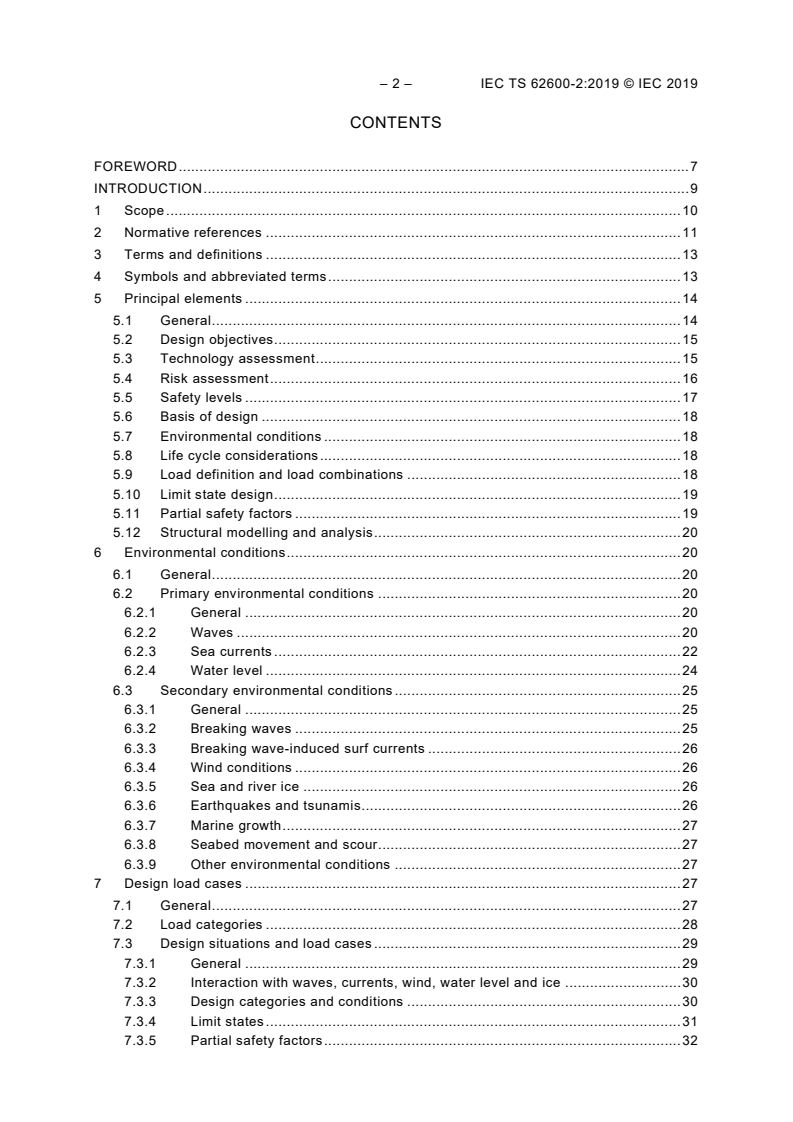
CONTENTS
FOREWORD . 7
INTRODUCTION . 9
1 Scope . 10
2 Normative references . 11
3 Terms and definitions . 13
4 Symbols and abbreviated terms . 13
5 Principal elements . 14
5.1 General . 14
5.2 Design objectives . 15
5.3 Technology assessment . 15
5.4 Risk assessment . 16
5.5 Safety levels . 17
5.6 Basis of design . 18
5.7 Environmental conditions . 18
5.8 Life cycle considerations . 18
5.9 Load definition and load combinations . 18
5.10 Limit state design . 19
5.11 Partial safety factors . 19
5.12 Structural modelling and analysis . 20
6 Environmental conditions . 20
6.1 General . 20
6.2 Primary environmental conditions . 20
6.2.1 General . 20
6.2.2 Waves . 20
6.2.3 Sea currents . 22
6.2.4 Water level . 24
6.3 Secondary environmental conditions . 25
6.3.1 General . 25
6.3.2 Breaking waves . 25
6.3.3 Breaking wave-induced surf currents . 26
6.3.4 Wind conditions . 26
6.3.5 Sea and river ice . 26
6.3.6 Earthquakes and tsunamis . 26
6.3.7 Marine growth . 27
6.3.8 Seabed movement and scour . 27
6.3.9 Other environmental conditions . 27
7 Design load cases . 27
7.1 General . 27
7.2 Load categories . 28
7.3 Design situations and load cases . 29
7.3.1 General . 29
7.3.2 Interaction with waves, currents, wind, water level and ice . 30
7.3.3 Design categories and conditions . 30
7.3.4 Limit states . 31
7.3.5 Partial safety factors . 32
7.3.6 Load case modelling and simulation . 33
7.3.7 Design conditions . 34
8 Materials . 43
8.1 General . 43
8.2 Material selection criteria . 44
8.3 Environmental considerations . 44
8.4 Structural materials . 45
8.4.1 General . 45
8.4.2 Metals . 45
8.4.3 Concrete . 46
8.4.4 Composites . 46
8.5 Compatibility of materials . 48
9 Structural integrity . 48
9.1 General . 48
9.2 Material models . 48
9.3 Partial safety factors for materials . 49
9.4 Design of steel structures . 49
9.4.1 General . 49
9.4.2 Steel partial safety factors . 49
9.5 Design of concrete structures. 50
9.5.1 General . 50
9.5.2 Concrete material partial safety factors . 50
9.5.3 Reinforcing steel . 51
9.6 Design of composite structures . 51
9.6.1 General . 51
9.6.2 Composite material partial safety factors . 51
9.6.3 Joints and interfaces . 53
10 Electrical, mechanical, instrumentation and control systems . 54
10.1 Overview. 54
10.2 General requirements . 54
10.3 Electrical . 54
10.3.1 General . 54
10.3.2 Electrical system design . 55
10.3.3 Protective devices . 55
10.3.4 Disconnect devices . 55
10.3.5 Earth system . 56
10.3.6 Lightning protection . 56
10.3.7 Electrical cables . 56
10.4 Mechanical . 57
10.4.1 General . 57
10.4.2 Bearings . 57
10.4.3 Gearing . 57
10.5 Piping systems . 57
10.5.1 General . 57
10.5.2 Bilge systems . 57
10.5.3 Ballast systems . 58
10.5.4 Hydraulic or pneumatic systems . 58
10.6 Instrumentation and control system . 58
10.6.1 General . 58
– 4 – IEC TS 62600-2:2019 © IEC 2019
10.6.2 Locking devices . 58
10.6.3 Protection against unsafe operating conditions . 58
10.7 Abnormal operating conditions safeguard . 59
11 Mooring and foundation considerations . 59
11.1 General . 59
11.2 Unique challenges for wave energy converters . 59
11.3 Unique challenges for tidal energy converters . 59
11.4 Fixed structures . 60
11.5 Compound MEC structures . 60
12 Life cycle considerations . 60
12.1 General . 60
12.2 Planning . 61
12.3 Stability and watertight integrity . 61
12.3.1 General . 61
12.3.2 Stability calculations . 61
12.3.3 Watertight integrity and temporary closures . 61
12.4 Assembly . 61
12.4.1 General . 61
12.4.2 Fasteners and attachments . 61
12.4.3 Cranes, hoists and lifting equipment . 62
12.5 Transportation . 62
12.6 Commissioning . 62
12.7 Metocean limits . 63
12.8 Inspection . 64
12.8.1 General . 64
12.8.2 Coating inspection . 64
12.8.3 Underwater inspection . 64
12.9 Maintenance . 64
12.9.1 General . 64
12.9.2 Maintenance planning . 64
12.9.3 Maintenance execution . 65
12.10 Decommissioning . 65
Annex A (normative) Corrosion protection . 66
A.1 General . 66
A.2 Steel structures . 66
A.2.1 General . 66
A.2.2 Corrosion rates . 67
A.2.3 Protective coatings . 67
A.3 Cathodic protection . 67
A.3.1 General . 67
A.3.2 Closed compartments . 68
A.3.3 Stainless steel . 68
A.4 Concrete structures . 68
A.4.1 General . 68
A.4.2 Provision of adequate cover . 69
A.4.3 Use of stainless steel or composite reinforcement . 69
A.4.4 Cathodic protection of reinforcement . 69
A.5 Non-ferrous metals . 69
A.6 Composite structures . 70
A.7 Compatibility of materials . 70
Annex B (normative) Operational and structural resonance . 71
B.1 General . 71
B.2 Control systems . 71
B.3 Exciting frequencies . 71
B.4 Natural frequencies . 71
B.5 Analysis . 72
B.6 Balancing of the rotating components . 72
Annex C (informative) Wave spectrum . 73
C.1 Overview. 73
C.2 The Pierson-Moskowitz spectrum . 73
C.3 Relationship between peak and zero crossing periods . 76
C.4 Wave directional spreading . 76
Annex D (informative) Shallow water hydrodynamics and breaking waves . 78
D.1 Selection of suitable wave theories . 78
D.2 Modelling of irregular wave trains. 79
D.3 Breaking waves . 79
Bibliography . 82
Figure 1 – Marine energy converter system boundary for IEC TS 62600-2 and
interfaces . 10
Figure 2 – Design process for a MEC . 15
Figure 3 – Definition of water levels . 25
Figure 4 – Process for determining design loads via load cases . 28
Figure A.1 – Profile of the thickness loss resulting from corrosion of an unprotected
steel structure in seawater (1 mil = 0,025 4 mm) . 66
Figure C.1 – PM spectrum . 74
Figure C.2 – JONSWAP and PM spectrums for typical North Sea storm sea state . 75
Figure D.1 – Regions of applicability of stream functions, Stokes V, and linear wave
theory . 78
Figure D.2 – Breaking wave height dependent on still water depth . 80
Figure D.3 – Transitions between different types of breaking waves as a function of
seabed slope, wave height in deep waters and wave period. 81
Table 1 – Technology classes . 16
Table 2 – Safety levels . 17
Table 3 – Types of loads that shall be considered . 29
Table 4 – ULS combinations of uncorrelated extreme events . 30
Table 5 – Design categories and conditions . 31
Table 6 – ULS partial load safety factors γ for design categories . 33
f
Table 7 – Design load cases for WECs . 35
Table 8 – Design load cases for TECs . 37
Table 9 – ISO test standards for composite laminates . 47
Table 10 – Material partial safety factors γ for buckling . 50
m
Table 11 – Values for test value uncertainty, . 51
– 6 – IEC TS 62600-2:2019 © IEC 2019
Table 12 – Values for manufacturing variation . 52
Table 13 – Values for environmental factors, . 52
Table 14 – Values for fatigue, . 53
Table 15 – Values for adhesive joints, . 54
INTERNATIONAL ELECTROTECHNICAL COMMISSION
____________
MARINE ENERGY –
WAVE, TIDAL AND OTHER WATER CURRENT CONVERTERS –
Part 2: Marine energy systems – Design requirements
FOREWORD
1) The International Electrotechnical Commission (IEC) is a worldwide organization for standardization comprising
all national electrotechnical committees (IEC National Committees). The object of IEC is to promote
international co-operation on all questions concerning standardization in the electrical and electronic fields. To
this end and in addition to other activities, IEC publishes International Standards, Technical Specifications,
Technical Reports, Publicly Available Specifications (PAS) and Guides (hereafter referred to as “IEC
Publication(s)”). Their preparation is entrusted to technical committees; any IEC National Committee interested
in the subject dealt with may participate in this preparatory work. International, governmental and non-
governmental organizations liaising with the IEC also participate in this preparation. IEC collaborates closely
with the International Organization for Standardization (ISO) in accordance with conditions determined by
agreement between the two organizations.
2) The formal decisions or agreements of IEC on technical matters express, as nearly as possible, an international
consensus of opinion on the relevant subjects since each technical committee has representation from all
interested IEC National Committees.
3) IEC Publications have the form of recommendations for international use and are accepted by IEC National
Committees in that sense. While all reasonable efforts are made to ensure that the technical content of IEC
Publications is accurate, IEC cannot be held responsible for the way in which they are used or for any
misinterpretation by any end user.
4) In order to promote international uniformity, IEC National Committees undertake to apply IEC Publications
transparently to the maximum extent possible in their national and regional publications. Any divergence
between any IEC Publication and the corresponding national or regional publication shall be clearly indicated in
the latter.
5) IEC itself does not provide any attestation of conformity. Independent certification bodies provide conformity
assessment services and, in some areas, access to IEC marks of conformity. IEC is not responsible for any
services carried out by independent certification bodies.
6) All users should ensure that they have the latest edition of this publication.
7) No liability shall attach to IEC or its directors, employees, servants or agents including individual experts and
members of its technical committees and IEC National Committees for any personal injury, property damage or
other damage of any nature whatsoever, whether direct or indirect, or for costs (including legal fees) and
expenses arising out of the publication, use of, or reliance upon, this IEC Publication or any other IEC
Publications.
8) Attention is drawn to the Normative references cited in this publication. Use of the referenced publications is
indispensable for the correct application of this publication.
9) Attention is drawn to the possibility that some of the elements of this IEC Publication may be the subject of
patent rights. IEC shall not be held responsible for identifying any or all such patent rights.
The main task of IEC technical committees is to prepare International Standards. In
exceptional circumstances, a technical committee may propose the publication of a Technical
Specification when
• the required support cannot be obtained for the publication of an International Standard,
despite repeated efforts, or
• the subject is still under technical development or where, for any other reason, there is the
future but no immediate possibility of an agreement on an International Standard.
Technical Specifications are subject to review within three years of publication to decide
whether they can be transformed into International Standards.
IEC TS 62600-2, which is a Technical Specification, has been prepared by IEC technical
committee 114: Marine energy – Wave, tidal and other water current converters.
– 8 – IEC TS 62600-2:2019 © IEC 2019
This second edition cancels and replaces the first edition published in 2016. This edition
constitutes a technical revision.
This edition includes the following significant technical changes with respect to the previous
edition:
a) The first edition published in 2016 was based on design methodologies developed by
TC88. The second edition sets forth design conditions unique to marine energy
converters.
The text of this Technical Specification is based on the following documents:
Enquiry draft Report on voting
114/306/DTS 114/322/RVDTS
Full information on the voting for the approval of this Technical Specification can be found in
the report on voting indicated in the above table.
This publication has been drafted in accordance with the ISO/IEC Directives, Part 2.
A list of all parts in the IEC 62600 series, published under the general title Marine energy –
Wave, tidal and other water current converters, can be found on the IEC website.
The committee has decided that the contents of this publication will remain unchanged until
the stability date indicated on the IEC website under "http://webstore.iec.ch" in the data
related to the specific publication. At this date, the publication will be
• transformed into an International Standard,
• reconfirmed,
• withdrawn,
• replaced by a revised edition, or
• amended.
A bilingual version of this publication may be issued at a later date.
IMPORTANT – The 'colour inside' logo on the cover page of this publication indicates
that it contains colours which are considered to be useful for the correct
understanding of its contents. Users should therefore print this document using a
colour printer.
INTRODUCTION
This part of IEC 62600 outlines minimum design requirements for marine energy converters
(MECs) and is not intended for use as a complete design specification.
Any of the requirements of this document may be altered if it can be demonstrated that the
overall safety of the marine energy converter is not compromised. Compliance with this
document shall be done in observance of applicable regional regulations.
– 10 – IEC TS 62600-2:2019 © IEC 2019
MARINE ENERGY –
WAVE, TIDAL AND OTHER WATER CURRENT CONVERTERS –
Part 2: Marine energy systems – Design requirements
1 Scope
This document provides design requirements to ensure the engineering integrity of wave,
ocean, tidal and river current energy converters, collectively referred to as marine energy
converters. Its purpose is to provide an appropriate level of protection against damage from
all hazards that may lead to catastrophic failure of the MEC structural, mechanical, electrical
or control systems. Figure 1 illustrates the scope of this document and critical interfaces with
other elements of a marine energy converter installation.
Figure 1 – Marine energy converter system boundary for IEC TS 62600-2 and interfaces
This document provides requirements for MEC main structure, appendages, seabed interface,
mechanical systems and electrical systems as they pertain to the viability of the device under
site-specific environmental conditions. This document applies to MECs that are either floating
or fixed to the seafloor or shore and are unmanned during operational periods.
NOTE Refer to IEC 62600-10 for guidance on the design of moorings for floating MECs.
In addition to environmental conditions, this document addresses design conditions (normal
operation, operation with fault, parked, etc.); design categories (normal, extreme, abnormal
and transport); and limit states (serviceability, ultimate, fatigue and accidental) using a limit
state design methodology.
Several different parties may be responsible for undertaking the various elements of the
design, manufacture, assembly, installation, erection, commissioning, operation, maintenance
and decommissioning of a marine energy converter and for ensuring that the requirements of
this document are met. The division of responsibility between these parties is outside the
scope of this document.
This document is used in conjunction with IEC and ISO standards cited as normative
references, as well as regional regulations that have jurisdiction over the installation site.
This document is applicable to MEC systems designed to operate from ocean, tidal and river
current energy sources, but not systems associated with hydroelectric impoundments or
barrages. This document is also applicable to wave energy converters. It is not applicable to
ocean thermal energy conversion (OTEC) systems or salinity gradient systems.
Although important to the overall objectives of the IEC 62600 series, this document does not
address all aspects of the engineering process that are taken into account during the full
system design of MECs. Specifically, this document does not address energy production,
performance efficiency, environmental impacts, electric generation and transmission,
ergonomics, or power quality.
This document takes precedence over existing applicable standards referred to for additional
guidance. This document adheres to a limit state design approach utilizing partial safety
factors for loads and materials to ensure MEC reliability in accordance with ISO 2394.
MECs designed to convert hydrokinetic energy from hydrodynamic forces into forms of usable
energy, such as electrical, hydraulic, or pneumatic may be different from other types of
marine systems. Many MECs are designed to operate in resonance or conditions close to
resonance. Furthermore, MECs are hybrids between machines and marine structures. The
control forces imposed by the power take-off (PTO) and possible forces from faults in the
operation of the PTO distinguish MECs from other marine structures.
The document is applicable to MECs at the preliminary design stage to those that have
progressed to advanced prototypes and commercial deployment. It is anticipated that this
document will be used in certification schemes for design conformity.
2 Normative references
The following documents are referred to in the text in such a way that some or all of their
content constitutes requirements of this document. For dated references, only the edition
cited applies. For undated references, the latest edition of the referenced document (including
any amendments) applies.
IEC 60092-301, Electrical installations in ships – Part 301: Equipment – Generators and
motors
IEC 60092-350, Electrical installations in ships – Part 350: General construction and test
methods of power, control and instrumentation cables for shipboard and offshore applications
IEC 60204-1:2016, Safety of machinery – Electrical equipment of machines – Part 1: General
requirements
– 12 – IEC TS 62600-2:2019 © IEC 2019
IEC 60204-11:2018, Safety of machinery – Electrical equipment of machines – Part 11:
Requirements for equipment for voltages above 1 000 V AC or 1 500 V DC and not exceeding
36 kV
IEC 60228, Conductors of insulated cables
IEC 60364-5-54, Low-voltage electrical installations – Part 5-54: Selection and erection of
electrical equipment – Earthing arrangements and protective conductors
IEC 60812, Failure modes and effects analysis (FMEA and FMECA)
IEC 61508 (all parts), Functional safety of electrical/electronic/programmable electronic
safety-related systems
IEC 61643-11, Low-voltage surge protective devices – Part 11: Surge protective devices
connected to low-voltage power systems – Requirements and test methods
IEC 61882, Hazard and operability studies (HAZOP studies) – Application guide
IEC 62305-3, Protection against lightning – Part 3: Physical damage to structures and life
hazard
IEC 62305-4, Protection against lightning – Part 4: Electrical and electronic systems within
structures
IEC TS 62600-1, Marine energy – Wave, tidal and other water current converters – Part 1:
Terminology
IEC TS 62600-201, Marine energy – Wave, tidal and other water current converters – Part
201: Tidal energy resource assessment and characterization
IEC TS 62600-10, Marine energy – Wave, tidal and other water current converters – Part 10:
Assessment of mooring system for marine energy converters (MECs)
ISO 2394, General principles on reliability for structures
ISO 12473, General principles of cathodic protection in sea water
ISO 17776, Petroleum and natural gas industries – Offshore production installations – Major
accident hazard management during the design of new installations
ISO 19900, Petroleum and natural gas industries – General requirements for offshore
structures
ISO 19901-1: 2015, Petroleum and natural gas industries – Specific requirements for offshore
Metocean design and operating considerations
structures – Part 1:
ISO 19901-4, Petroleum and natural gas industries – Specific requirements for offshore
structures – Part 4: Geotechnical and foundation design considerations
ISO 19901-6, Petroleum and natural gas industries – Specific requirements for offshore
structures – Part 6: Marine operations
ISO 19902, Petroleum and natural gas industries – Fixed steel offshore structures
ISO 19903, Petroleum and natural gas industries – Fixed concrete offshore structures
ISO 31010, Risk management – Risk assessment techniques
DNVGL-OS-C301, Stability and watertight integrity
DNVGL-RP-C205, Environmental conditions and environmental loads
EUROCOMP, Structural design of polymer composites
3 Terms and definitions
For the purposes of this document, the terms and definitions given in IEC TS 62600-1 as well
as the following apply.
IEC and ISO maintain terminological databases for use in standardization at the following
addresses:
• IEC Electropedia: available at http://www.electropedia.org/
• ISO Online browsing platform: available at http://www.iso.org/obp
4 Symbols and abbreviated terms
For the purposes of this document, the symbols and abbreviated terms given in
IEC TS 62600-1 as well as the following apply.
d water depth
f wave spectrum frequency
f material property design value
d
f material property characteristic value
k
f wave spectrum peak frequency
P
f elastic buckling stress
E
f specified minimum yield stress
y
F load design value
d
F load characteristic value
k
g gravitational acceleration
h ice thickness with a 50-year return period
H extreme wave height with a return period of 1 year
H extreme wave height with a return period of 5 years
H extreme wave height with a return period of 50 years
H breaking wave height
b
H extreme wave height
EWH
H operational wave height
OWH
H device rated wave height
rated
H significant wave height
m0
H significant wave height of the operational sea state
m0, OSS
H significant wave height with a return period of n years
mn
– 14 – IEC TS 62600-2:2019 © IEC 2019
I turbulence intensity
K turbulent kinetic energy
MEC marine energy converter
REC river energy converter
s slope of beach floor
S pseudo response spectrum
SWL still water level
T wave period
T peak wave period
P
TEC tidal energy converter
U breaking wave current velocity
bw
U cut-in velocity for a TEC
in
U device rated current velocity
rated
U cut-out velocity for a TEC
out
U sub-surface current velocity
ss
U wind-generated current velocity
w
V 10 min mean wind speed
V 1 h mean value of wind speed at 10 m height above SWL
1-hour
V extreme wind speed with a return period of 5 years
WEC wave energy converter
z height above still water level
σ ice crushing strength
c
σ standard deviation of the current velocity
U
σ characteristic standard deviation of mean current velocity at a specified probability
U,c
distribution
γ damping ratio
γ partial load safety factor
f
γ partial material safety factor
m
ω angular frequency
λ slenderness parameter; wave length
5 Principal elements
5.1 General
The engineering and technical requirements to ensure the integrity and safety of the
structural, mechanical, electrical and control systems of a MEC are given in the following
clauses. This specification of requirements applies to the design, manufacture, installation,
operation and maintenance of MECs.
A common characteristic of all MEC devices that distinguishes them from other marine
devices is the requirement to determine loading and response due to interaction with power
take-off (PTO) and control systems.
The design process for MECs is illustrated in Figure 2. The process is iterative and shall
incorporate load and load effect calculations for the complete MEC, including the support
structure, foundation or moorings, mechanical and electrical elements. The structural design
of a MEC shall be regarded as completed when its structural integrity has been verified based
on the limit state analyses described in Clause 7.
Figure 2 – Design process for a MEC
Verification of the adequacy of the design shall be made by calculation and/or by testing. If
test results are used in this verification, the environmental conditions during the test shall be
shown to reflect the characteristic values and design situations defined in this document.
5.2 Design objectives
Design objectives shall be established to outline the design targets and project requirements.
...