

IEC TS 62600-103:2024
(Main)Marine energy - Wave, tidal and other water current converters - Part 103: Guidelines for the early stage development of wave energy converters - Best practices and recommended procedures for the testing of pre-prototype devices
General Information
- Abstract
IEC TS 62600-103:2024 is concerned with the sub-prototype scale development of wave energy converters (WECs). It includes wave tank test programmes, where wave conditions are controlled so they can be scheduled, and first sea trials, where sea states occur naturally and the programmes are adjusted and flexible to accommodate the conditions. Commercial-scale prototype tests are not covered in this document.
This document addresses:
- Planning an experimental programme, including a design statement, technical drawings, facility selection, site data and other inputs as specified in Clause 5.
- Device characterisation, including the physical device model, PTO components and mooring arrangements where appropriate.
- Environment characterisation, concerning either the tank testing facility or the sea deployment site, depending on the stage of development.
- Specification of specific test goals, including power conversion performance, device motions, device loads and device survival.
This document prescribes the minimum test programmes that form the basis of a structured technology development schedule. For each testing campaign, the prerequisites, goals and minimum test plans are specified. This document serves a wide audience of wave energy stakeholders, including device developers and their technical advisors; government agencies and funding councils; test centres and certification bodies; private investors; and environmental regulators and NGOs.
- Status
- Published
- Publication Date
- 02-Jul-2024
- Technical Committee
- TC 114 - Marine Energy Conversion Systems
- Drafting Committee
- MT 62600-103 - TC 114/MT 62600-103
- Current Stage
- PPUB - Publication issued
- Start Date
- 03-Jul-2024
- Completion Date
- 17-May-2024
Buy Documents
IEC TS 62600-103:2024 - Marine energy - Wave, tidal and other water current converters - Part 103: Guidelines for the early stage development of wave energy converters - Best practices and recommended procedures for the testing of pre-prototype devices Released:7/3/2024
IEC TS 62600-103:2024 RLV - Marine energy - Wave, tidal and other water current converters - Part 103: Guidelines for the early stage development of wave energy converters - Best practices and recommended procedures for the testing of pre-prototype devices Released:7/3/2024
Overview
IEC TS 62600-103:2024 provides best-practice guidelines for the early-stage (pre-prototype/sub-prototype) development of wave energy converters (WECs). It covers structured testing programmes for both controlled wave tank tests and first sea trials, prescribing minimum test content, prerequisites and objectives for each campaign. Commercial-scale prototype testing is explicitly excluded. The document supports a staged development approach with defined stage gates and emphasizes clear documentation (design statement, technical drawings, facility/site selection and site data).
Key topics and technical requirements
- Test planning and staged development
- Staged approach (Stages 1–3) with stage-gate criteria to progress from tank to sea trials.
- Requirements for a formal design statement and test programme planning (see Clause 5).
- Device characterisation
- Physical model requirements, Power Take-Off (PTO) components and mooring arrangements where applicable.
- Similitude guidance for scale modelling of WECs and power conversion chains.
- Environment characterisation
- Wave tank facility specification and sea trial site data requirements.
- Wave condition descriptions for regular, irregular long-crested and short-crested waves.
- Specific test goals
- Power conversion performance, device motions (kinematics), device loads (dynamics), and survival/extreme-condition testing.
- Minimum test plans, required measurements and performance indicators for each goal.
- Data acquisition and control
- DAQ, sampling, calibration, synchronisation, and real-time control considerations for accurate measurement and verification.
- Uncertainty and reporting
- Identification of main uncertainty sources (scale effects, variability, procedural) and recommended presentation of results (RAOs, scatter diagrams, performance indicators).
- Supporting guidance
- Informative annexes with example test plans, physical modelling guidance and stage-gate templates.
Practical applications and users
IEC TS 62600-103:2024 is practical for:
- WEC developers planning pre-prototype validation and de-risking campaigns.
- Wave tank test centres and sea trial operators implementing standard test programmes.
- Certification bodies, technical advisors, and funding agencies assessing technology readiness.
- Private investors, government regulators, and environmental NGOs requiring consistent test data for evaluation and permitting. The standard helps ensure repeatable, auditable early-stage tests that support technology progression, investment decisions and certification readiness.
Related standards
- Part of the broader IEC 62600 marine energy series (other parts cover tidal, device-specific and grid integration topics). Use IEC TS 62600-103 alongside other IEC 62600 documents and national test-facility protocols for comprehensive compliance and harmonised reporting.
Keywords: IEC TS 62600-103:2024, wave energy, wave energy converters, WEC testing, pre-prototype testing, wave tank testing, sea trials, PTO, mooring, power performance, device characterisation.
Relations
- Effective Date
- 05-Sep-2023
Buy Documents
IEC TS 62600-103:2024 - Marine energy - Wave, tidal and other water current converters - Part 103: Guidelines for the early stage development of wave energy converters - Best practices and recommended procedures for the testing of pre-prototype devices Released:7/3/2024
IEC TS 62600-103:2024 RLV - Marine energy - Wave, tidal and other water current converters - Part 103: Guidelines for the early stage development of wave energy converters - Best practices and recommended procedures for the testing of pre-prototype devices Released:7/3/2024
Get Certified
Connect with accredited certification bodies for this standard

DNV
DNV is an independent assurance and risk management provider.

Lloyd's Register
Lloyd's Register is a global professional services organisation specialising in engineering and technology.
DNV Energy Systems
Energy and renewable energy certification.
Sponsored listings
Frequently Asked Questions
IEC TS 62600-103:2024 is a technical specification published by the International Electrotechnical Commission (IEC). Its full title is "Marine energy - Wave, tidal and other water current converters - Part 103: Guidelines for the early stage development of wave energy converters - Best practices and recommended procedures for the testing of pre-prototype devices". This standard covers: IEC TS 62600-103:2024 is concerned with the sub-prototype scale development of wave energy converters (WECs). It includes wave tank test programmes, where wave conditions are controlled so they can be scheduled, and first sea trials, where sea states occur naturally and the programmes are adjusted and flexible to accommodate the conditions. Commercial-scale prototype tests are not covered in this document. This document addresses: - Planning an experimental programme, including a design statement, technical drawings, facility selection, site data and other inputs as specified in Clause 5. - Device characterisation, including the physical device model, PTO components and mooring arrangements where appropriate. - Environment characterisation, concerning either the tank testing facility or the sea deployment site, depending on the stage of development. - Specification of specific test goals, including power conversion performance, device motions, device loads and device survival. This document prescribes the minimum test programmes that form the basis of a structured technology development schedule. For each testing campaign, the prerequisites, goals and minimum test plans are specified. This document serves a wide audience of wave energy stakeholders, including device developers and their technical advisors; government agencies and funding councils; test centres and certification bodies; private investors; and environmental regulators and NGOs.
IEC TS 62600-103:2024 is concerned with the sub-prototype scale development of wave energy converters (WECs). It includes wave tank test programmes, where wave conditions are controlled so they can be scheduled, and first sea trials, where sea states occur naturally and the programmes are adjusted and flexible to accommodate the conditions. Commercial-scale prototype tests are not covered in this document. This document addresses: - Planning an experimental programme, including a design statement, technical drawings, facility selection, site data and other inputs as specified in Clause 5. - Device characterisation, including the physical device model, PTO components and mooring arrangements where appropriate. - Environment characterisation, concerning either the tank testing facility or the sea deployment site, depending on the stage of development. - Specification of specific test goals, including power conversion performance, device motions, device loads and device survival. This document prescribes the minimum test programmes that form the basis of a structured technology development schedule. For each testing campaign, the prerequisites, goals and minimum test plans are specified. This document serves a wide audience of wave energy stakeholders, including device developers and their technical advisors; government agencies and funding councils; test centres and certification bodies; private investors; and environmental regulators and NGOs.
IEC TS 62600-103:2024 is classified under the following ICS (International Classification for Standards) categories: 27.140 - Hydraulic energy engineering. The ICS classification helps identify the subject area and facilitates finding related standards.
IEC TS 62600-103:2024 has the following relationships with other standards: It is inter standard links to IEC TS 62600-103:2018. Understanding these relationships helps ensure you are using the most current and applicable version of the standard.
IEC TS 62600-103:2024 is available in PDF format for immediate download after purchase. The document can be added to your cart and obtained through the secure checkout process. Digital delivery ensures instant access to the complete standard document.
Standards Content (Sample)
IEC TS 62600-103 ®
Edition 2.0 2024-07
TECHNICAL
SPECIFICATION
Marine energy – Wave, tidal and other water current converters –
Part 103: Guidelines for the early stage development of wave energy converters –
Best practices and recommended procedures for the testing of pre-prototype
devices
All rights reserved. Unless otherwise specified, no part of this publication may be reproduced or utilized in any form
or by any means, electronic or mechanical, including photocopying and microfilm, without permission in writing from
either IEC or IEC's member National Committee in the country of the requester. If you have any questions about IEC
copyright or have an enquiry about obtaining additional rights to this publication, please contact the address below or
your local IEC member National Committee for further information.
IEC Secretariat Tel.: +41 22 919 02 11
3, rue de Varembé info@iec.ch
CH-1211 Geneva 20 www.iec.ch
Switzerland
About the IEC
The International Electrotechnical Commission (IEC) is the leading global organization that prepares and publishes
International Standards for all electrical, electronic and related technologies.
About IEC publications
The technical content of IEC publications is kept under constant review by the IEC. Please make sure that you have the
latest edition, a corrigendum or an amendment might have been published.
IEC publications search - webstore.iec.ch/advsearchform IEC Products & Services Portal - products.iec.ch
The advanced search enables to find IEC publications by a Discover our powerful search engine and read freely all the
variety of criteria (reference number, text, technical publications previews, graphical symbols and the glossary.
committee, …). It also gives information on projects, replaced With a subscription you will always have access to up to date
and withdrawn publications. content tailored to your needs.
IEC Just Published - webstore.iec.ch/justpublished
Electropedia - www.electropedia.org
Stay up to date on all new IEC publications. Just Published
The world's leading online dictionary on electrotechnology,
details all new publications released. Available online and once
containing more than 22 500 terminological entries in English
a month by email.
and French, with equivalent terms in 25 additional languages.
Also known as the International Electrotechnical Vocabulary
IEC Customer Service Centre - webstore.iec.ch/csc
(IEV) online.
If you wish to give us your feedback on this publication or need
further assistance, please contact the Customer Service
Centre: sales@iec.ch.
IEC TS 62600-103 ®
Edition 2.0 2024-07
TECHNICAL
SPECIFICATION
Marine energy – Wave, tidal and other water current converters –
Part 103: Guidelines for the early stage development of wave energy converters –
Best practices and recommended procedures for the testing of pre-prototype
devices
INTERNATIONAL
ELECTROTECHNICAL
COMMISSION
ICS 27.140 ISBN 978-2-8322-8963-1
– 2 – IEC TS 62600-103:2024 © IEC 2024
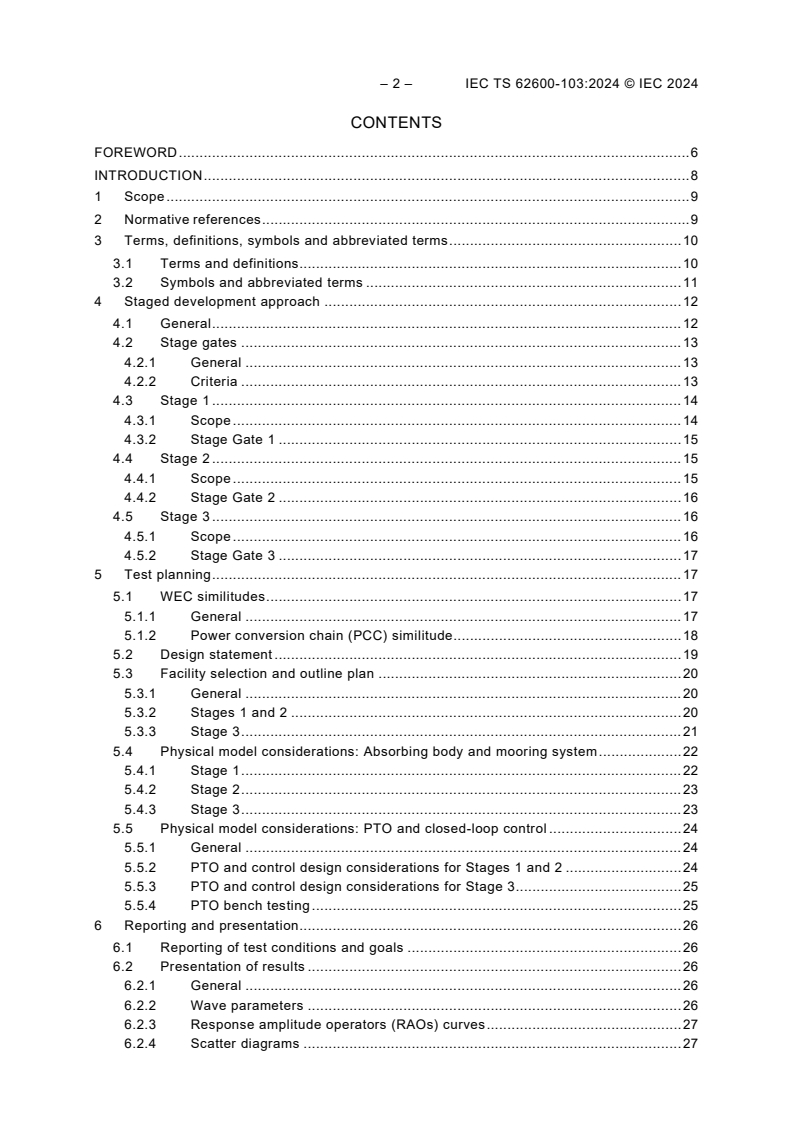
CONTENTS
FOREWORD . 6
INTRODUCTION . 8
1 Scope . 9
2 Normative references . 9
3 Terms, definitions, symbols and abbreviated terms . 10
3.1 Terms and definitions . 10
3.2 Symbols and abbreviated terms . 11
4 Staged development approach . 12
4.1 General . 12
4.2 Stage gates . 13
4.2.1 General . 13
4.2.2 Criteria . 13
4.3 Stage 1 . 14
4.3.1 Scope . 14
4.3.2 Stage Gate 1 . 15
4.4 Stage 2 . 15
4.4.1 Scope . 15
4.4.2 Stage Gate 2 . 16
4.5 Stage 3 . 16
4.5.1 Scope . 16
4.5.2 Stage Gate 3 . 17
5 Test planning . 17
5.1 WEC similitudes . 17
5.1.1 General . 17
5.1.2 Power conversion chain (PCC) similitude . 18
5.2 Design statement . 19
5.3 Facility selection and outline plan . 20
5.3.1 General . 20
5.3.2 Stages 1 and 2 . 20
5.3.3 Stage 3 . 21
5.4 Physical model considerations: Absorbing body and mooring system . 22
5.4.1 Stage 1 . 22
5.4.2 Stage 2 . 23
5.4.3 Stage 3 . 23
5.5 Physical model considerations: PTO and closed-loop control . 24
5.5.1 General . 24
5.5.2 PTO and control design considerations for Stages 1 and 2 . 24
5.5.3 PTO and control design considerations for Stage 3 . 25
5.5.4 PTO bench testing . 25
6 Reporting and presentation . 26
6.1 Reporting of test conditions and goals . 26
6.2 Presentation of results . 26
6.2.1 General . 26
6.2.2 Wave parameters . 26
6.2.3 Response amplitude operators (RAOs) curves . 27
6.2.4 Scatter diagrams . 27
6.2.5 Alternative iso-variable curves . 28
6.3 Presentation of performance indicators . 28
6.3.1 General . 28
6.3.2 Presentation of performance indicators in regular waves . 28
6.3.3 Presentation of performance indicators in irregular long-crested waves . 29
6.3.4 Presentation of performance indicators in irregular short-crested waves . 30
7 Testing environment characterisation . 30
7.1 General . 30
7.2 Wave tank characterisation (Stages 1 and 2) . 30
7.3 Trial site characterisation (Stage 3) . 32
7.4 Wave characterisation. 32
7.4.1 General . 32
7.4.2 Laboratory regular waves . 32
7.4.3 Laboratory irregular long-crested waves . 32
7.4.4 Laboratory irregular short-crested waves . 32
7.4.5 Sea trials . 32
8 Data acquisition and real-time control system . 33
8.1 Signal conditioning . 33
8.2 Sample rate . 34
8.3 Analogue to digital conversion and DAQ system . 34
8.4 Frequency response . 35
8.5 Data synchronisation . 35
8.6 Data recording . 35
8.7 Recording of supplementary test data . 35
8.8 Calibration factors . 36
8.9 Instrument response functions . 36
8.10 Health monitoring and verification of signals . 36
8.11 Special requirements for Stage 3 sea trials . 36
9 Power performance . 37
9.1 Testing goals . 37
9.2 WEC and mooring similitude . 37
9.3 Power conversion chain similitude . 38
9.3.1 General . 38
9.3.2 Stage 1 . 39
9.3.3 Stage 2 . 39
9.3.4 Stage 3 . 39
9.4 Physical measurements . 40
9.5 Calibration and setup . 40
9.6 Wave parameters . 41
9.6.1 Stages 1 and 2 . 41
9.6.2 Stage 3 . 42
9.7 Performance indicators . 42
10 Kinematics and dynamics in operational environments . 42
10.1 Testing goals . 42
10.2 Testing similitude . 43
10.3 Physical measurements . 44
10.4 Calibration and setup . 46
10.5 Wave parameters . 47
– 4 – IEC TS 62600-103:2024 © IEC 2024
10.5.1 Stages 1 and 2 . 47
10.5.2 Stage 3 . 48
10.6 Performance indicators . 48
11 Kinematics and dynamics in extreme environments . 49
11.1 Testing goals . 49
11.2 Testing similitude . 49
11.3 Physical measurements . 50
11.4 Calibration and setup . 51
11.5 Wave parameters . 51
11.5.1 Stage 1 . 51
11.5.2 Stage 2 . 51
11.5.3 Stage 3 . 52
11.6 Performance indicators . 53
12 Uncertainty . 53
12.1 General . 53
12.2 Main sources of uncertainty . 54
12.2.1 General . 54
12.2.2 Variability of measured physical properties including control signals . 54
12.2.3 Differences between model built and expected full-scale device . 54
12.2.4 Scale effects and device scale . 55
12.2.5 Procedural effects . 55
12.3 Accepted levels of uncertainty . 56
Annex A (informative) Stage Gates . 57
A.1 Overview. 57
A.2 Design statements . 57
A.3 Stage Gate criteria . 57
A.4 Uncertainty factors . 58
A.5 Concept review . 59
Annex B (informative) Example test plan . 60
Annex C (informative) Physical modelling guidance . 61
C.1 Similitude . 61
C.1.1 General . 61
C.1.2 Geometric similitude . 61
C.1.3 Structural similitude . 61
C.1.4 Hydrodynamic similitude . 61
C.2 Model instrumentation and data acquisition . 62
C.2.1 General . 62
C.2.2 Water surface elevation . 63
C.2.3 PTO . 63
C.2.4 Device and mooring loads . 63
C.3 Recommendations on calibrations . 63
Annex D (informative) Scale effects . 65
Bibliography . 66
Figure 1 – Staged development approach . 13
Figure B.1 – Example test plan . 60
Table 1 – Presentation of performance indicators (regular waves) . 29
Table 2 – Presentation of performance indicators (irregular long-crested waves) . 29
Table 3 – Presentation of performance indicators (irregular short-crested waves) . 30
Table 4 – Environmental measurements . 31
Table 5 – Environmental performance indicators . 33
Table 6 – Power performance testing similitude . 38
Table 7 – Power conversion chain (PCC) representation . 38
Table 8 – Power performance physical measurements . 40
Table 9 – Power performance calibrations . 41
Table 10 – Power performance wave parameters . 41
Table 11 – Kinematics and dynamics similitude requirements (operational
environments) . 44
Table 12 – Kinematic physical measurements (operational environments) . 45
Table 13 – Dynamic physical measurements (operational environments) . 46
Table 14 – Calibration for kinematic and dynamic testing (operational environments) . 47
Table 15 – Wave parameters for kinematics and dynamics testing (operational
conditions) . 48
Table 16 – Kinematics and dynamics similitude requirements (extreme environments) . 50
Table C.1 – Scale laws . 62
Table C.2 – Sensor calibrations . 64
Table D.1 – Scale example for absorbed power . 65
– 6 – IEC TS 62600-103:2024 © IEC 2024
INTERNATIONAL ELECTROTECHNICAL COMMISSION
____________
MARINE ENERGY – WAVE, TIDAL AND OTHER
WATER CURRENT CONVERTERS –
Part 103: Guidelines for the early stage development of
wave energy converters – Best practices and recommended
procedures for the testing of pre-prototype devices
FOREWORD
1) The International Electrotechnical Commission (IEC) is a worldwide organization for standardization comprising
all national electrotechnical committees (IEC National Committees). The object of IEC is to promote international
co-operation on all questions concerning standardization in the electrical and electronic fields. To this end and
in addition to other activities, IEC publishes International Standards, Technical Specifications, Technical Reports,
Publicly Available Specifications (PAS) and Guides (hereafter referred to as “IEC Publication(s)”). Their
preparation is entrusted to technical committees; any IEC National Committee interested in the subject dealt with
may participate in this preparatory work. International, governmental and non-governmental organizations liaising
with the IEC also participate in this preparation. IEC collaborates closely with the International Organization for
Standardization (ISO) in accordance with conditions determined by agreement between the two organizations.
2) The formal decisions or agreements of IEC on technical matters express, as nearly as possible, an international
consensus of opinion on the relevant subjects since each technical committee has representation from all
interested IEC National Committees.
3) IEC Publications have the form of recommendations for international use and are accepted by IEC National
Committees in that sense. While all reasonable efforts are made to ensure that the technical content of IEC
Publications is accurate, IEC cannot be held responsible for the way in which they are used or for any
misinterpretation by any end user.
4) In order to promote international uniformity, IEC National Committees undertake to apply IEC Publications
transparently to the maximum extent possible in their national and regional publications. Any divergence between
any IEC Publication and the corresponding national or regional publication shall be clearly indicated in the latter.
5) IEC itself does not provide any attestation of conformity. Independent certification bodies provide conformity
assessment services and, in some areas, access to IEC marks of conformity. IEC is not responsible for any
services carried out by independent certification bodies.
6) All users should ensure that they have the latest edition of this publication.
7) No liability shall attach to IEC or its directors, employees, servants or agents including individual experts and
members of its technical committees and IEC National Committees for any personal injury, property damage or
other damage of any nature whatsoever, whether direct or indirect, or for costs (including legal fees) and
expenses arising out of the publication, use of, or reliance upon, this IEC Publication or any other IEC
Publications.
8) Attention is drawn to the Normative references cited in this publication. Use of the referenced publications is
indispensable for the correct application of this publication.
9) IEC draws attention to the possibility that the implementation of this document may involve the use of (a)
patent(s). IEC takes no position concerning the evidence, validity or applicability of any claimed patent rights in
respect thereof. As of the date of publication of this document, IEC had not received notice of (a) patent(s), which
may be required to implement this document. However, implementers are cautioned that this may not represent
the latest information, which may be obtained from the patent database available at https://patents.iec.ch. IEC
shall not be held responsible for identifying any or all such patent rights.
IEC TS 62600-103 has been prepared by IEC technical committee 114: Marine energy – Wave,
tidal and other water current converters. It is a Technical Specification.
This second edition cancels and replaces the first edition published in 2018. This edition
constitutes a technical revision.
This edition includes the following significant technical changes with respect to the previous
edition:
a) Revised several numeric values (e.g. test durations) to align with best testing practice;
b) Introduced guidance and requirements relating to PTO testing and closed-loop control;
c) Introduced uncertainty clause in normative part of the document;
d) Strengthened the document sections relating to Stage 3, the first sea trials;
e) Updated the data synchronisation requirements to align with best testing practices.
The text of this Technical Specification is based on the following documents:
Draft Report on voting
114/510/DTS 114/523/RVDTS
Full information on the voting for its approval can be found in the report on voting indicated in
the above table.
The language used for the development of this Technical Specification is English.
This document was drafted in accordance with ISO/IEC Directives, Part 2, and developed in
accordance with ISO/IEC Directives, Part 1 and ISO/IEC Directives, IEC Supplement, available
at www.iec.ch/members_experts/refdocs. The main document types developed by IEC are
described in greater detail at www.iec.ch/publications.
A list of all parts in the IEC 62600 series, published under the general title Marine energy –
Wave, tidal and other water current converters, can be found on the IEC website.
The committee has decided that the contents of this document will remain unchanged until the
stability date indicated on the IEC website under webstore.iec.ch in the data related to the
specific document. At this date, the document will be
• reconfirmed,
• withdrawn, or
• revised.
IMPORTANT – The "colour inside" logo on the cover page of this document indicates
that it contains colours which are considered to be useful for the correct understanding
of its contents. Users should therefore print this document using a colour printer.
– 8 – IEC TS 62600-103:2024 © IEC 2024
INTRODUCTION
Developing wave energy converters (WECs) will always be a demanding engineering process.
It is important, therefore, to follow a design path that will minimise the risks encountered along
a route of increasing technical complexity and fiscal commitment. This document presents a
guide that addresses these issues, the approach being based on a proven methodology adapted
from other technology areas, especially NASA and similar heavy maritime engineering
industries.
The scope of the work is defined in Clause 1. Normative references and definitions of important
terms are introduced in Clause 2 and Clause 3 respectively. The core of the document then
follows a twin-track approach, relying on:
a) a structured or staged development approach outlined in Clause 4, and
b) a set of model specific and goal orientated clauses (Clause 9 to Clause 11) ensuring that
targets are clearly defined and attained with confidence. Testing specific requirements such
as test planning (Clause 5), reporting and presentation (Clause 6), characterisation of the
surrounding wave environment (Clause 7), data acquisition and real-time control (Clause 8),
and testing uncertainty Clause 12 are also included.
The structured development schedule makes use of the ability to accurately scale wave energy
converters such that sub-prototype size physical models can be used to investigate the relevant
device parameters and design variables at an appropriate dimension and associated budget.
The parallel development of mathematical models describing a wave energy converter’s
behaviour and performance is encouraged, but the procedure is not included in the document.
This document is quite exacting in terms of both the approach and requirements for the
development of wave energy converters since it takes a professional approach to the process.
An essential element for any published Technical Specification or International Standard is to
allow an opportunity to provide feedback on its contents to the appropriate TC 114 Working
Group. TC 114 utilizes a standard methodology to allow this.
To submit feedback such as proposed changes, corrections and/or improvements to this
document, please send an email to the TC 114 Chair using the Contact TC 114 Officers feature
on the IEC TC 114 Dashboard, accessible at www.iec.ch/tc114. On the right side of the
Dashboard under Further information select the link to contact the TC 114 Officers. On the
subsequent page find and select the Send Email link for the Chair to access the email tool.
Complete all the required elements within the email pop-up. For the Subject field please include
the document title and edition you are providing feedback for (ex: feedback for TS 62600-1
ED2). In the Message field, include text which summarizes your feedback and note if further
information can be made available (note attachments are not allowed). The Chair may request
added information as needed before forwarding the submission to the remaining TC 114 Officers
for review and then to the appropriate Working Group for their consideration.
MARINE ENERGY – WAVE, TIDAL AND OTHER
WATER CURRENT CONVERTERS –
Part 103: Guidelines for the early stage development of
wave energy converters – Best practices and recommended
procedures for the testing of pre-prototype devices
1 Scope
This part of IEC TS 62600 is concerned with the sub-prototype scale development of wave
energy converters (WECs). It includes wave tank test programmes, where wave conditions are
controlled so they can be scheduled, and first sea trials, where sea states occur naturally and
the programmes are adjusted and flexible to accommodate the conditions. Commercial-scale
prototype tests are not covered in this document.
This document prescribes the minimum test programmes that form the basis of a structured
technology development schedule. For each testing campaign, the prerequisites, goals and
minimum test plans are specified. This document addresses:
• Planning an experimental programme, including a design statement, technical drawings,
facility selection, site data and other inputs as specified in Clause 5.
• Device characterisation, including the physical device model, PTO components and
mooring arrangements where appropriate.
• Environment characterisation, concerning either the tank testing facility or the sea
deployment site, depending on the stage of development.
• Specification of specific test goals, including power conversion performance, device
motions, device loads and device survival.
Guidance on the measurement sensors and data acquisition packages is included but not
dictated. Provided that the specified parameters and tolerances are adhered to, selection of the
components and instrumentation can be at the device developer’s discretion.
An important element of the test protocol is to define the limitations and accuracy of the raw
data and, more specifically, the results and conclusion drawn from the trials. A methodology
addressing these limitations is presented with each goal, so the plan always produces
defendable results of defined uncertainty.
This document serves a wide audience of wave energy stakeholders, including device
developers and their technical advisors; government agencies and funding councils; test
centres and certification bodies; private investors; and environmental regulators and NGOs.
2 Normative references
The following documents are referred to in the text in such a way that some or all of their content
constitutes requirements of this document. For dated references, only the edition cited applies.
For undated references, the latest edition of the referenced document (including any
amendments) applies.
IEC TS 62600‑2, Marine energy – Wave, tidal and other water current converters – Part 2:
Marine energy systems – Design requirements for marine energy systems
– 10 – IEC TS 62600-103:2024 © IEC 2024
IEC TS 62600‑100, Marine energy – Wave, tidal and other water current converters – Part 100:
Electricity producing wave energy converters – Power performance assessment
IEC TS 62600‑101, Marine energy – Wave, tidal and other water current converters – Part 101:
Wave energy resource assessment and characterization
3 Terms, definitions, symbols and abbreviated terms
3.1 Terms and definitions
For the purposes of this document, the following terms and definitions apply.
ISO and IEC maintain terminological databases for use in standardization at the following
addresses:
• IEC Electropedia: available at http://www.electropedia.org/
• ISO Online browsing platform: available at http://www.iso.org/obp
3.1.1
dynamic
forces responsible for the object’s motion
Note 1 to entry: Dynamic side of absorbed power: “Load measurement” (force, torque, pressure, etc.).
3.1.2
kinematic
motion of object, irrespective of how this motion was caused
Note 1 to entry: Kinematic side of absorbed power: “Velocity measurement” (velocity, angular velocity, flow, etc.).
Note 2 to entry: The terms “dynamic” and “kinematic” as defined above are used extensively throughout this
document. These terms are used to ensure that a range of WEC conversion concepts are covered. For example,
“dynamic” side of load measurement may refer to forces, torques or pressures, and as such provides a convenient
and concise means of relating to a range of technologies.
3.1.3
operational sea states
wave conditions where the wave energy converter is in power production mode
3.1.4
peak distribution
distribution of peak magnitude values
3.1.5
stage 1
small-scale testing in the laboratory
Note 1 to entry: Stage 1 is equivalent to technology readiness level 3.
3.1.6
stage 2
medium-scale testing in the laboratory
Note 1 to entry: Stage 2 is equivalent to technology readiness level 4.
3.1.7
stage 3
first testing at sea
Note 1 to entry: Stage 3 is equivalent to technology readiness level 6.
3.1.8
storm conditions
sea state with return period as defined in IEC TS 62600‑2
3.2 Symbols and abbreviated terms
For the purposes of this document, the following symbols and abbreviated terms apply.
g Acceleration due to gravity [m/s ]
H Wave height [m]
H Significant wave height [m]
m0
J Wave energy flux [W/m]
P Wave power [W]
T Wave period [s]
T Wave energy period [s]
e
T Wave peak period [s]
p
T Zero up-crossing period [s]
z
λ Length scale factor [-]
θ Wave direction [rad]
ρ Density [kg/m ]
AD Analogue to digital
CoG Centre of gravity
DAQ Data acquisition
DFT Discrete Fourier transform
DoF Degree of freedom
FFT Fast Fourier transform
FMECA Failures mode, effects, and criticality analysis
IMU Inertial measurement unit
OWC Oscillating water column
PCC Power conversion chain
NOTE The power conversion chain is made up of a drivetrain, generator, storage, and power electronics.
PTO Power take-off
RAO Response amplitude operator
SCADA Supervisory control and data acquisition system
SWL Still water level
TRL Technology readiness level
ULS Ultimate limit state in the context of structural engineering
WEC Wave energy converter
– 12 – IEC TS 62600-103:2024 © IEC 2024
4 Staged development approach
4.1 General
Clause 4 introduces the staged development of the design for a WEC through physical model
testing. Each stage of development is motivated by risk reduction. The primary goals for each
stage address elements that shall be completed before proceeding through the user’s pre-
defined Stage Gate for that stage.
Scaled wave conditions produced in the wave tank should be representative of anticipated full-
scale wave conditions at the expected deployment sites, including sea state spectral
characteristics.
Figure 1 shows an overview of the process from the early design concept to the deployment of
the first limited device number array. Each stage is based on a different physical scale range
carefully selected to achieve a set of specific design objectives prior to advancing the device
trials to the next stage. This clause outlines the scope and Stage Gates for Stages 1, 2 and 3,
guiding the development process from Technology Readiness Level (TRL) 1 to 6 (Figure 1).
Stages 4 and 5 (Figure 1) concern commercial scale (or near commercial scale) testing and are
not covered in this document.
This document does not dictate a scale for each of the Stages 1 to 3. The model testing scale
heavily depends on the type of WEC developed, the fidelity of the available instrumentation,
and to some extent on the availability of appropriate test facilities. The scales provided in
Figure 1 are included as indicators of previous WEC development efforts.
Every type of WEC will have slightly different requirements so a bespoke programme should be
drawn up around these basic testing requirements. The necessary and recommended goals and
experimental activities for Stages 1 to 3 are described in detail in Clause 5 to Clause 11.
Activities are to be defined in the context of good engineering practice, where factor of safety,
reliability or other design philosophy are followed.
Although the ordering of the test schedule is of paramount importance, it is equally essential
that a Stage Gate process is applied at the conclusion of each set of trials to evaluate if the
WEC has achieved the required experimental objectives before advancing forward. This due
diligence should be monitored against the design statement produced by the device developer
prior to each stage and the standards being established by the industry based on the other
WEC’s performances.
A set of Stage Gate criteria for the evaluation of the WEC behaviour and performance at the
conclusion of each testing period are defined. These shall be achieved before advancing to the
next stage. The criteria are defined as a general framework and allow for a high degree of
flexibility to suit the design requirements.
At Stage 1, it should be anticipated that several iterations of a device will be required to optimise
the performance, reliability, safety, and economics. More than one iteration may still be required
at Stage 2, and a single implementation should normally suffice at Stage 3.
Figure 1 – Staged development approach
4.2 Stage gates
4.2.1 General
At the conclusion of each stage of device model testing, an evaluation procedure should be
initiated to assess the overall performance of the design. The appraisal may include a technical
and economic review based on three elements of the proposed device design:
• Analysis of the results from the appropriate preceding test programme.
• A comparison with the related device design statement produced at the beginning of the
stage.
• An overall design review by a third party, independent, established engineering company.
NOTE See also Annex A for an informative description of the Stage Gate process.
4.2.2 Criteria
The review shall follow the same set of evaluation criteria at each Stage which are based on
the test goals specified for each Stage in Clause 9, Clause 10 and Clause 11. As the test
scale enlarges, the complexity of the model and trials increase to produce more accurate
results with less uncertainty in the data extrapolation. The Stage Gate evaluation criteria reflect
this decreasing uncertainty.
The evaluation criteria shall include:
• Energy absorption.
• Device seakeeping (motions).
• Mooring loads.
• PTO loads.
• Ultimate Limit State (ULS) verification.
– 14 – IEC TS 62600-103:2024 © IEC 2024
The minimum specifications for each Stage Gate criterion that experimental testing can
contribute to are outlined in Clause 9, Clause 10 and Clause 11 and summarised below.
Each stage can comprise more than one model testing campaign, using progressively optimised
models, to maintain relevance as the device design progresses, and to comprehensively meet
the Stage requirements and Stage Gate criteria.
NOTE Physical model testing is often run in conjunction with a mathematical model development, with model
validation criteria similar to those listed in Clause 4.
4.3 Stage 1
4.3.1 Scope
Stage 1 is intended to demonstrate that the design has potential and can be realised or
transitioned up to TRL3. A key purpose of Stage 1 testing is to explore initial design choices.
NOTE 1 Stage 1 is often used to explore several device configurations without a detailed design for the commercial
scale prototype.
There are three facets to Stage 1 tests:
• Proof of concept: to verify that the device design concept operates under wave excitation
as predicted and described (under TRL1).
• Optimisation of design: to evolve the most favourable device configuration(s) in regular and
irregular waves.
• Device performance: to obtain a first indication of power performance for the optimised PTO
setting o
...
IEC TS 62600-103 ®
Edition 2.0 2024-07
REDLINE VERSION
TECHNICAL
SPECIFICATION
colour
inside
Marine energy – Wave, tidal and other water current converters –
Part 103: Guidelines for the early stage development of wave energy converters –
Best practices and recommended procedures for the testing of pre-prototype
devices
All rights reserved. Unless otherwise specified, no part of this publication may be reproduced or utilized in any form
or by any means, electronic or mechanical, including photocopying and microfilm, without permission in writing from
either IEC or IEC's member National Committee in the country of the requester. If you have any questions about IEC
copyright or have an enquiry about obtaining additional rights to this publication, please contact the address below or
your local IEC member National Committee for further information.
IEC Secretariat Tel.: +41 22 919 02 11
3, rue de Varembé info@iec.ch
CH-1211 Geneva 20 www.iec.ch
Switzerland
About the IEC
The International Electrotechnical Commission (IEC) is the leading global organization that prepares and publishes
International Standards for all electrical, electronic and related technologies.
About IEC publications
The technical content of IEC publications is kept under constant review by the IEC. Please make sure that you have the
latest edition, a corrigendum or an amendment might have been published.
IEC publications search - webstore.iec.ch/advsearchform IEC Products & Services Portal - products.iec.ch
The advanced search enables to find IEC publications by a Discover our powerful search engine and read freely all the
variety of criteria (reference number, text, technical publications previews, graphical symbols and the glossary.
committee, …). It also gives information on projects, replaced With a subscription you will always have access to up to date
and withdrawn publications. content tailored to your needs.
IEC Just Published - webstore.iec.ch/justpublished
Electropedia - www.electropedia.org
Stay up to date on all new IEC publications. Just Published
The world's leading online dictionary on electrotechnology,
details all new publications released. Available online and once
containing more than 22 500 terminological entries in English
a month by email.
and French, with equivalent terms in 25 additional languages.
Also known as the International Electrotechnical Vocabulary
IEC Customer Service Centre - webstore.iec.ch/csc
(IEV) online.
If you wish to give us your feedback on this publication or need
further assistance, please contact the Customer Service
Centre: sales@iec.ch.
IEC TS 62600-103 ®
Edition 2.0 2024-07
REDLINE VERSION
TECHNICAL
SPECIFICATION
colour
inside
Marine energy – Wave, tidal and other water current converters –
Part 103: Guidelines for the early stage development of wave energy converters –
Best practices and recommended procedures for the testing of pre-prototype
devices
INTERNATIONAL
ELECTROTECHNICAL
COMMISSION
ICS 27.140 ISBN 978-2-8322-9373-7
– 2 – IEC TS 62600-103:2024 RLV © IEC 2024
CONTENTS
FOREWORD . 6
INTRODUCTION . 8
1 Scope . 9
2 Normative references . 9
3 Terms, definitions, symbols and abbreviated terms . 10
3.1 Terms and definitions . 10
3.2 Symbols and abbreviated terms . 11
4 Staged development approach . 12
4.1 General . 12
4.2 Stage gates . 14
4.2.1 General . 14
4.2.2 Criteria . 14
4.3 Stage 1 . 14
4.3.1 Scope . 14
4.3.2 Stage Gate 1 . 15
4.4 Stage 2 . 15
4.4.1 Scope . 15
4.4.2 Stage Gate 2 . 16
4.5 Stage 3 . 16
4.5.1 Scope . 16
4.5.2 Stage Gate 3 . 17
5 Test planning . 18
5.1 WEC similitudes . 18
5.1.1 General . 18
5.1.2 Power conversion chain (PCC) similitude . 18
5.2 Design statement . 19
5.3 Facility selection and outline plan . 20
5.3.1 General . 20
5.3.2 Stages 1 and 2 . 20
5.3.3 Stage 3 . 21
5.4 Physical model considerations: Absorbing body and mooring system . 23
5.4.1 Stage 1 . 23
5.4.2 Stage 2 . 23
5.4.3 Stage 3 . 23
5.5 Physical model considerations: PTO and closed-loop control . 24
5.5.1 General . 24
5.5.2 PTO and control design considerations for Stages 1 and 2 . 25
5.5.3 PTO and control design considerations for Stage 3 . 25
5.5.4 PTO bench testing . 25
6 Reporting and presentation . 26
6.1 Reporting of test conditions and goals . 26
6.2 Presentation of results . 27
6.2.1 General . 27
6.2.2 Wave parameters . 27
6.2.3 Response amplitude operators (RAOs) curves . 27
6.2.4 Scatter diagrams . 28
6.2.5 Alternative iso-variable curves . 28
6.3 Presentation of performance indicators . 29
6.3.1 General . 29
6.3.2 Presentation of performance indicators in regular waves . 29
6.3.3 Presentation of performance indicators in irregular long-crested waves . 29
6.3.4 Presentation of performance indicators in irregular short-crested waves . 30
7 Testing environment characterisation . 30
7.1 General . 30
7.2 Wave tank characterisation (Stages 1 and 2) . 31
7.3 Trial site characterisation (Stage 3) . 32
7.4 Wave characterisation. 32
7.4.1 General . 32
7.4.2 Laboratory regular waves . 32
7.4.3 Laboratory irregular long-crested waves . 32
7.4.4 Laboratory irregular short-crested waves . 33
7.4.5 Sea trials . 33
8 Data acquisition and real-time control system . 34
8.1 Signal conditioning . 34
8.2 Sample rate . 34
8.3 Analogue to digital conversion and DAQ system . 35
8.4 Frequency response . 35
8.5 Data synchronisation . 35
8.6 Data recording . 35
8.7 Recording of supplementary test data . 35
8.8 Calibration factors . 36
8.9 Instrument response functions . 36
8.10 Health monitoring and verification of signals . 36
8.11 Special data acquisition requirements for Stage 3 sea trials . 37
9 Power performance . 37
9.1 Testing goals . 37
9.2 WEC and mooring similitude . 38
9.3 Power conversion chain similitude . 39
9.3.1 General . 39
9.3.2 Stage 1 . 39
9.3.3 Stage 2 . 40
9.3.4 Stage 3 . 40
9.4 Signal Physical measurements . 40
9.5 Calibration and setup . 41
9.6 Wave parameters . 42
9.6.1 Stages 1 and 2 . 42
9.6.2 Stage 3 . 43
9.7 Performance indicators . 43
10 Kinematics and dynamics in operational environments . 43
10.1 Testing goals . 43
10.2 Testing similitude . 44
10.3 Signal Physical measurements . 45
10.4 Calibration and setup . 47
10.5 Wave parameters . 48
– 4 – IEC TS 62600-103:2024 RLV © IEC 2024
10.5.1 Stages 1 and 2 . 48
10.5.2 Stage 3 . 49
10.6 Performance indicators . 49
11 Kinematics and dynamics in survival extreme environments . 50
11.1 Testing goals . 50
11.2 Testing similitude . 50
11.3 Signal Physical measurements . 51
11.4 Calibration and setup . 52
11.5 Wave parameters . 52
11.5.1 Stage 1 . 52
11.5.2 Stage 2 . 52
11.5.3 Stage 3 . 53
11.6 Performance indicators . 54
12 Uncertainty . 54
12.1 General . 54
12.2 Main sources of uncertainty . 55
12.2.1 General . 55
12.2.2 Variability of measured physical properties including control signals . 55
12.2.3 Differences between model built and expected full-scale device . 55
12.2.4 Scale effects and device scale . 56
12.2.5 Procedural effects . 56
12.3 Accepted levels of uncertainty . 57
Annex A (informative) Stage Gates . 58
A.1 Overview. 58
A.2 Design statements . 58
A.3 Stage Gate criteria . 58
A.4 Uncertainty factors . 59
A.5 Third party Concept review . 60
Annex B (informative) Example test plan . 61
Annex C (informative) Physical modelling guidance . 62
C.1 Similitude . 62
C.1.1 General . 62
C.1.2 Geometric similitude . 62
C.1.3 Structural similitude . 62
C.1.4 Hydrodynamic similitude . 62
C.2 Model instrumentation and data acquisition . 63
C.2.1 General . 63
C.2.2 Water surface elevation . 64
C.2.3 PTO . 64
C.2.4 Device and mooring loads . 64
C.3 Recommendations on calibrations . 65
Annex D (informative) Uncertainty Scale effects . 66
Bibliography . 68
Figure 1 – Staged development approach . 13
Figure B.1 – Example test plan . 61
Table 1 – Presentation of performance indicators (regular waves) . 29
Table 2 – Presentation of performance indicators (irregular long-crested waves) . 30
Table 3 – Presentation of performance indicators (irregular short-crested waves) . 30
Table 4 – Environmental measurements . 31
Table 5 – Environmental performance indicators . 33
Table 6 – Power performance testing similitude . 38
Table 7 – Power conversion chain (PCC) representation . 39
Table 8 – Power performance signal physical measurements . 41
Table 9 – Power performance calibrations . 42
Table 10 – Power performance wave parameters . 42
Table 11 – Kinematics and dynamics similitude requirements (operational
environments) . 45
Table 12 – Kinematic signal physical measurements (operational environments) . 46
Table 13 – Dynamic signal physical measurements (operational environments) . 47
Table 14 – Calibration for kinematic and dynamic testing (operational environments) . 48
Table 15 – Wave parameters for kinematics and dynamics testing (operational
conditions) . 49
Table 16 – Kinematics and dynamics similitude requirements (survivalextreme
environments) . 51
Table C.1 – Scale laws . 63
Table C.2 – Sensor calibrations . 65
Table D.1 – Scale example for absorbed power . 67
– 6 – IEC TS 62600-103:2024 RLV © IEC 2024
INTERNATIONAL ELECTROTECHNICAL COMMISSION
____________
MARINE ENERGY – WAVE, TIDAL AND OTHER
WATER CURRENT CONVERTERS –
Part 103: Guidelines for the early stage development of
wave energy converters – Best practices and recommended
procedures for the testing of pre-prototype devices
FOREWORD
1) The International Electrotechnical Commission (IEC) is a worldwide organization for standardization comprising
all national electrotechnical committees (IEC National Committees). The object of IEC is to promote international
co-operation on all questions concerning standardization in the electrical and electronic fields. To this end and
in addition to other activities, IEC publishes International Standards, Technical Specifications, Technical Reports,
Publicly Available Specifications (PAS) and Guides (hereafter referred to as “IEC Publication(s)”). Their
preparation is entrusted to technical committees; any IEC National Committee interested in the subject dealt with
may participate in this preparatory work. International, governmental and non-governmental organizations liaising
with the IEC also participate in this preparation. IEC collaborates closely with the International Organization for
Standardization (ISO) in accordance with conditions determined by agreement between the two organizations.
2) The formal decisions or agreements of IEC on technical matters express, as nearly as possible, an international
consensus of opinion on the relevant subjects since each technical committee has representation from all
interested IEC National Committees.
3) IEC Publications have the form of recommendations for international use and are accepted by IEC National
Committees in that sense. While all reasonable efforts are made to ensure that the technical content of IEC
Publications is accurate, IEC cannot be held responsible for the way in which they are used or for any
misinterpretation by any end user.
4) In order to promote international uniformity, IEC National Committees undertake to apply IEC Publications
transparently to the maximum extent possible in their national and regional publications. Any divergence between
any IEC Publication and the corresponding national or regional publication shall be clearly indicated in the latter.
5) IEC itself does not provide any attestation of conformity. Independent certification bodies provide conformity
assessment services and, in some areas, access to IEC marks of conformity. IEC is not responsible for any
services carried out by independent certification bodies.
6) All users should ensure that they have the latest edition of this publication.
7) No liability shall attach to IEC or its directors, employees, servants or agents including individual experts and
members of its technical committees and IEC National Committees for any personal injury, property damage or
other damage of any nature whatsoever, whether direct or indirect, or for costs (including legal fees) and
expenses arising out of the publication, use of, or reliance upon, this IEC Publication or any other IEC
Publications.
8) Attention is drawn to the Normative references cited in this publication. Use of the referenced publications is
indispensable for the correct application of this publication.
9) IEC draws attention to the possibility that the implementation of this document may involve the use of (a)
patent(s). IEC takes no position concerning the evidence, validity or applicability of any claimed patent rights in
respect thereof. As of the date of publication of this document, IEC had not received notice of (a) patent(s), which
may be required to implement this document. However, implementers are cautioned that this may not represent
the latest information, which may be obtained from the patent database available at https://patents.iec.ch. IEC
shall not be held responsible for identifying any or all such patent rights.
This redline version of the official IEC Standard allows the user to identify the changes
made to the previous edition IEC TS 62600-103:2018. A vertical bar appears in the margin
wherever a change has been made. Additions are in green text, deletions are in
strikethrough red text.
IEC TS 62600-103 has been prepared by IEC technical committee 114: Marine energy – Wave,
tidal and other water current converters. It is a Technical Specification.
This second edition cancels and replaces the first edition published in 2018. This edition
constitutes a technical revision.
This edition includes the following significant technical changes with respect to the previous
edition:
a) Revised several numeric values (e.g. test durations) to align with best testing practice;
b) Introduced guidance and requirements relating to PTO testing and closed-loop control;
c) Introduced uncertainty clause in normative part of the document;
d) Strengthened the document sections relating to Stage 3, the first sea trials;
e) Updated the data synchronisation requirements to align with best testing practices.
The text of this Technical Specification is based on the following documents:
Draft Report on voting
114/510/DTS 114/523/RVDTS
Full information on the voting for its approval can be found in the report on voting indicated in
the above table.
The language used for the development of this Technical Specification is English.
This document was drafted in accordance with ISO/IEC Directives, Part 2, and developed in
accordance with ISO/IEC Directives, Part 1 and ISO/IEC Directives, IEC Supplement, available
at www.iec.ch/members_experts/refdocs. The main document types developed by IEC are
described in greater detail at www.iec.ch/publications.
A list of all parts in the IEC 62600 series, published under the general title Marine energy –
Wave, tidal and other water current converters, can be found on the IEC website.
The committee has decided that the contents of this document will remain unchanged until the
stability date indicated on the IEC website under webstore.iec.ch in the data related to the
specific document. At this date, the document will be
• reconfirmed,
• withdrawn, or
• revised.
IMPORTANT – The "colour inside" logo on the cover page of this document indicates
that it contains colours which are considered to be useful for the correct understanding
of its contents. Users should therefore print this document using a colour printer.
– 8 – IEC TS 62600-103:2024 RLV © IEC 2024
INTRODUCTION
Developing wave energy converters (WECs) will always be a demanding engineering process.
It is important, therefore, to follow a design path that will minimise the risks encountered along
a route of increasing technical complexity and fiscal commitment. This document presents a
guide that addresses these issues, the approach being based on a proven methodology adapted
from other technology areas, especially NASA and similar heavy maritime engineering
industries.NASA and similar heavy maritime engineering industries.
The scope of the work is defined in Clause 1. Normative references and definitions of important
terms are introduced in Clause 2 and Clause 3 respectively. The core of the document then
follows a twin-track approach, relying on:
a) a structured or staged development approach outlined in Clause 4, and
b) a set of model specific and goal orientated clauses (Clause 9 to Clause 11) ensuring that
targets are clearly defined and attained with confidence. Testing specific requirements such
as test planning (Clause 5), reporting and presentation (Clause 6), characterisation of the
surrounding wave environment (Clause 7), data acquisition and real-time control (Clause 8),
and testing uncertainty Clause 12 are also included.
The structured development schedule makes use of the ability to accurately scale wave energy
converters such that sub-prototype size physical models can be used to investigate the relevant
device parameters and design variables at an appropriate dimension and associated budget.
The parallel development of mathematical models describing a wave energy converter’s
behaviour and performance is encouraged, but the procedure is not included in the document.
This document is quite exacting in terms of both the approach and requirements for the
development of wave energy converters since it takes a professional approach to the process.
Following these guidelines will not guarantee success, but not following them will be a recipe
for lost time and opportunities.
An essential element for any published Technical Specification or International Standard is to
allow an opportunity to provide feedback on its contents to the appropriate TC 114 Working
Group. TC 114 utilizes a standard methodology to allow this.
To submit feedback such as proposed changes, corrections and/or improvements to this
document, please send an email to the TC 114 Chair using the Contact TC 114 Officers feature
on the IEC TC 114 Dashboard, accessible at www.iec.ch/tc114. On the right side of the
Dashboard under Further information select the link to contact the TC 114 Officers. On the
subsequent page find and select the Send Email link for the Chair to access the email tool.
Complete all the required elements within the email pop-up. For the Subject field please include
the document title and edition you are providing feedback for (ex: feedback for TS 62600-1
ED2). In the Message field, include text which summarizes your feedback and note if further
information can be made available (note attachments are not allowed). The Chair may request
added information as needed before forwarding the submission to the remaining TC 114 Officers
for review and then to the appropriate Working Group for their consideration.
MARINE ENERGY – WAVE, TIDAL AND OTHER
WATER CURRENT CONVERTERS –
Part 103: Guidelines for the early stage development of
wave energy converters – Best practices and recommended
procedures for the testing of pre-prototype devices
1 Scope
This part of IEC TS 62600 is concerned with the sub-prototype scale development of wave
energy converters (WECs). It includes wave tank test programmes, where wave conditions are
controlled so they can be scheduled, and first large-scale sea trials, where sea states occur
naturally and the programmes are adjusted and flexible to accommodate the conditions. A full-
scale prototype test schedule is not covered in this document. Bench tests of PTO (power take-
off) equipment are also not covered in this document. Commercial-scale prototype tests are not
covered in this document.
This document describes prescribes the minimum test programmes that form the basis of a
structured technology development schedule. For each testing campaign, the prerequisites,
goals and minimum test plans are specified. This document addresses:
• Planning an experimental programme, including a design statement, technical drawings,
facility selection, site data and other inputs as specified in Clause 5.
• Device characterisation, including the physical device model, PTO components and
mooring arrangements where appropriate.
• Environment characterisation, concerning either the tank testing facility or the sea
deployment site, depending on the stage of development.
• Specification of specific test goals, including power conversion performance, device
motions, device loads and device survival.
Guidance on the measurement sensors and data acquisition packages is included but not
dictated. Provided that the specified parameters and tolerances are adhered to, selection of the
components and instrumentation can be at the device developer’s discretion.
An important element of the test protocol is to define the limitations and accuracy of the raw
data and, more specifically, the results and conclusion drawn from the trials. A methodology
addressing these limitations is presented with each goal, so the plan always produces
defendable results of defined uncertainty.
This document serves a wide audience of wave energy stakeholders, including device
developers and their technical advisors; government agencies and funding councils; test
centres and certification bodies; private investors; and environmental regulators and NGOs.
2 Normative references
The following documents are referred to in the text in such a way that some or all of their content
constitutes requirements of this document. For dated references, only the edition cited applies.
For undated references, the latest edition of the referenced document (including any
amendments) applies.
IEC TS 62600-1, Marine energy – Wave, tidal and other water current converters – Part 1:
Terminology
– 10 – IEC TS 62600-103:2024 RLV © IEC 2024
IEC TS 62600-2, Marine energy – Wave, tidal and other water current converters – Part 2:
Marine energy systems – Design requirements for marine energy systems
IEC TS 62600‑100, Marine energy – Wave, tidal and other water current converters – Part 100:
Electricity producing wave energy converters – Power performance assessment
IEC TS 62600‑101, Marine energy – Wave, tidal and other water current converters – Part 101:
Wave energy resource assessment and characterization
3 Terms, definitions, symbols and abbreviated terms
3.1 Terms and definitions
For the purposes of this document, the following terms and definitions given in IEC TS 62600-
1 apply.
ISO and IEC maintain terminological databases for use in standardization at the following
addresses:
• IEC Electropedia: available at http://www.electropedia.org/
• ISO Online browsing platform: available at http://www.iso.org/obp
3.1.1
cross-sectional load
compressive or tensile stress parallel to the stress plane and shear stress perpendicular to the
stress plane
3.1.1
dynamic
forces responsible for the object’s motion
Note 1 to entry: Dynamic side of absorbed power: “Load measurement” (force, torque, pressure, etc.).
3.1.2
kinematic
motion of object, irrespective of how this motion was caused
Note 1 to entry: Kinematic side of absorbed power: “Velocity measurement” (velocity, angular velocity, flow, etc.).
Note 2 to entry: The terms “dynamic” and “kinematic” as defined above are used extensively throughout this
document. These terms are used to ensure that a range of WEC conversion concepts are covered. For example,
“dynamic” side of load measurement may refer to forces, torques or pressures, and as such provides a convenient
and concise means of relating to a range of technologies.
3.1.4
local load
highly localised impacts like green water, slam event or other impacts that could occur due to
motion limitations
3.1.5
regular wave
series of waves containing a single frequency component
3.1.3
operational sea states
wave conditions where the wave energy converter is in power production mode
3.1.7
irregular wave
wave composed of multiple frequency components
3.1.4
peak distribution
distribution of peak magnitude values
3.1.5
stage 1
small-scale testing in the laboratory
Note 1 to entry: Stage 1 is equivalent to technology readiness level 3.
3.1.6
stage 2
medium-scale testing in the laboratory
Note 1 to entry: Stage 2 is equivalent to technology readiness level 4.
3.1.7
stage 3
large-scale first testing at sea
Note 1 to entry: Stage 3 is equivalent to technology readiness level 6.
3.1.12
stationary part of the time series (regular waves)
interval of the time series in which the wave amplitude and frequency result in repeatable values
with small standard deviations
3.1.13
stationary part of the time series (irregular waves)
interval of the time series used to analyse the spectral shape of the series
3.1.8
storm conditions
sea state with return period as defined in IEC TS 62600-2
3.1.15
wave train
laboratory generated series of similar period waves
3.1.16
long-crested waves
sea state with little or no directional spreading
3.1.17
short-crested waves
sea state where energy propagation is directionally spread
3.2 Symbols and abbreviated terms
For the purposes of this document, the following symbols and abbreviated terms apply.
g Acceleration due to gravity [m/s ]
H Wave height [m]
H Significant wave height [m]
m0
– 12 – IEC TS 62600-103:2024 RLV © IEC 2024
J Wave energy flux [W/m]
P Wave power [W]
T Wave period [s]
T Wave energy period [s]
e
T Wave peak period [s]
p
T Zero up-crossing period [s]
z
λ Length scale factor [-]
θ Wave direction [rad]
ρ Density [kg/m ]
AD Analogue to digital
CoG Centre of gravity
DAQ Data acquisition as defined in IEC TS 62600-1
DFT Discrete Fourier transform
DoF Degree of freedom
FFT Fast Fourier transform
FMECA Failures mode, effects, and criticality analysis
IMU Inertial measurement unit
OWC Oscillating water column
PCC Power conversion chain
NOTE The power conversion chain is made up of a drivetrain, generator, storage, and power electronics.
PTO Power take-off
RAO Response amplitude operator
SCADA Supervisory control and data acquisition system
SWL Still water level
TRL Technology readiness level
ULS Ultimate limit state in the context of structural engineering
WEC Wave energy converter
4 Staged development approach
4.1 General
Clause 4 introduces the staged development of the design for a WEC through physical model
testing. Each stage of development is motivated by risk reduction. The primary goals for each
stage address elements that shall be completed before proceeding through the user’s pre-
defined Stage Gate for that stage.
Scaled wave conditions produced in the wave tank should be representative of anticipated full-
scale wave conditions at the expected deployment sites, including sea state spectral
characteristics.
Figure 1 shows an overview of the process from the early design concept to the deployment of
the first limited device number array. Each stage is based on a different physical scale range
carefully selected to achieve a set of specific design objectives prior to advancing the device
trials to the next stage. This clause outlines the scope and Stage Gates for Stages 1, 2 and 3,
guiding the development process from Technology Readiness Level (TRL) 1 to 6 (Figure 1).
Stages 4 and 5 (Figure 1) concern full commercial scale (or near full commercial scale) testing
and are not covered in this document.
This document does not dictate a scale for each of the Stages 1 to 3. The model testing scale
heavily depends on the type of WEC developed, the fidelity of the available instrumentation,
and to some extent on the availability of appropriate test facilities. The scales provided in
Figure 1 are included as indicators of previous WEC development efforts.
Every type of WEC will have slightly different requirements so a bespoke programme should be
drawn up around these basic testing requirements. The necessary and recommended goals and
experimental activities for Stages 1 to 3 are described in detail in Clause 5 to Clause 11.
Activities are to be defined in the context of good engineering practice, where factor of safety,
reliability or other design philosophy are followed.
Although the ordering of the test schedule is of paramount importance, it is equally essential
that a Stage Gate process is applied at the conclusion of each set of trials to evaluate if the
WEC has achieved the required experimental objectives before advancing forward. This due
diligence should be monitored against the design statement produced by the device developer
prior to each stage and the standards being established by the industry based on the other
WEC’s performances.
A set of Stage Gate criteria for the evaluation of the WEC behaviour and performance at the
conclusion of each testing period are defined. These shall be achieved before advancing to the
next stage. The criteria are defined as a general framework and allow for a high degree of
flexibility to suit the design requirements.
At Stage 1, it should be anticipated that several iterations of a device will be required to optimise
the performance, reliability, safety, and economics. More than one iteration may still be required
at Stage 2, and a single implementation should normally suffice at Stage 3.
Figure 1 – Staged development approach
– 14 – IEC TS 62600-103:2024 RLV © IEC 2024
4.2 Stage gates
4.2.1 General
At the conclusion of each stage of device model testing, an evaluation procedure should be
initiated to assess the overall performance of the design. The appraisal may include a technical
and economic review based on three elements of the proposed device design:
• Analysis of the results from the appropriate preceding test programme.
• A comparison with the related device design statement produced at the beginning of the
stage.
• An overall design review by a third party, independent, established engineering company.
NOTE See also Annex A for an informative description of the Stage Gate process.
4.2.2 Criteri
...