

IEC TS 62600-101:2024
(Main)Marine energy - Wave, tidal and other water current converters - Part 101: Wave energy resource assessment and characterization
General Information
- Abstract
IEC TS 62600-101:2024 establishes a system for estimating, analysing and reporting the wave energy resource at sites potentially suitable for the installation of Wave Energy Converters (WECs). This document is to be applied at all stages of site assessment, from initial investigations to detailed project design. This document is to be applied in conjunction with the IEC Technical Specification on WEC performance (IEC TS 62600-100) to estimate the mean annual energy production of a WEC or WEC array as described in the methodology in Annex A. This document is not intended for estimation of extreme wave conditions. The framework and methodologies prescribed in this document are intended to ensure that only adequate models are used, and that they are applied in an appropriate manner to ensure confidence and consistency in the reported results. Moreover, the document prescribes methods for analysing metocean data (including the data generated by modelling) in order to properly quantify and characterize the temporal and spatial attributes of the wave energy resource, and for reporting the results of a resource assessment in a comprehensive and consistent manner.
- Status
- Published
- Publication Date
- 16-Dec-2024
- Technical Committee
- TC 114 - Marine Energy Conversion Systems
- Drafting Committee
- MT 62600-101 - TC 114/MT 62600-101
- Current Stage
- PPUB - Publication issued
- Start Date
- 17-Dec-2024
- Completion Date
- 15-Nov-2024
Buy Documents
IEC TS 62600-101:2024 - Marine energy - Wave, tidal and other water current converters - Part 101: Wave energy resource assessment and characterization Released:12/17/2024
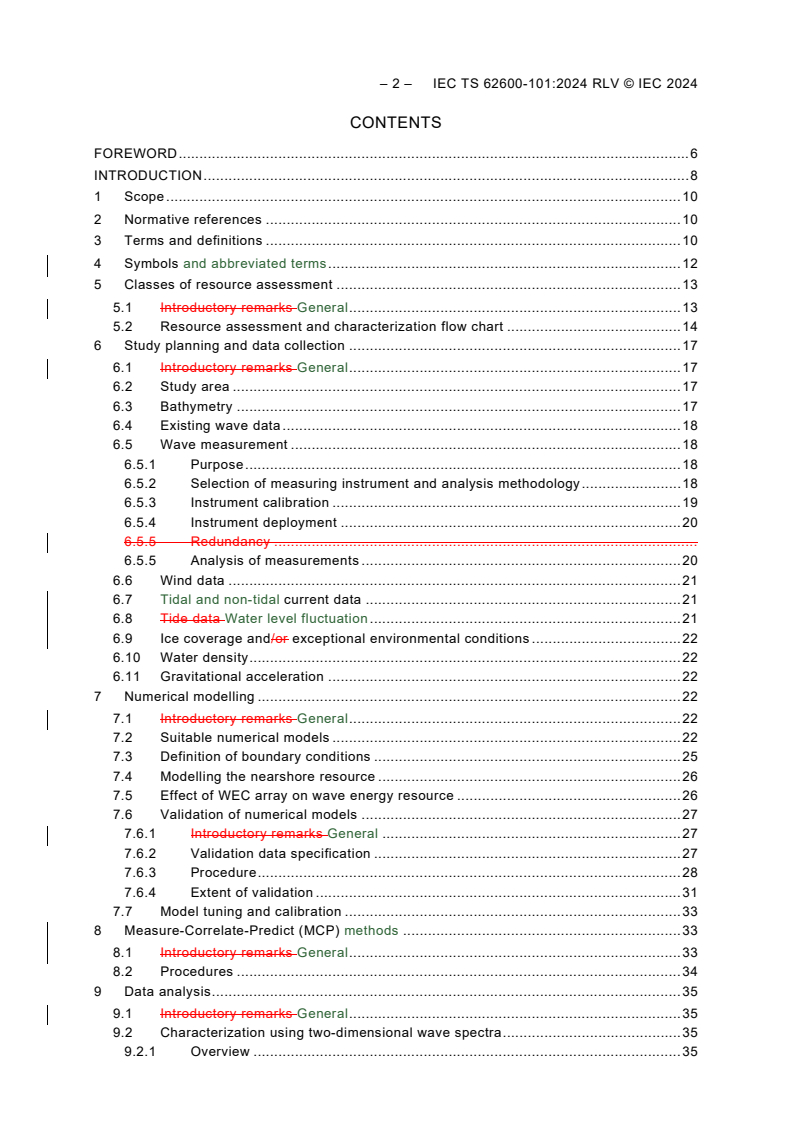
REDLINE IEC TS 62600-101:2024 RLV - Marine energy - Wave, tidal and other water current converters - Part 101: Wave energy resource assessment and characterization/17/2024
Overview
IEC TS 62600-101:2024 - Marine energy - Wave, tidal and other water current converters - Part 101: Wave energy resource assessment and characterization - establishes a consistent, auditable system for estimating, analysing and reporting the wave energy resource at sites for Wave Energy Converters (WECs). Applicable from initial site screening through detailed project design, the technical specification defines procedures for metocean data handling, numerical modelling, validation, uncertainty analysis and reporting. It is explicitly intended to be used alongside IEC TS 62600-100 (WEC performance) to calculate mean annual energy production (AEP, Annex A). It is not intended for extreme-wave estimation.
Key Topics and Requirements
- Classes of resource assessment: guidance on study scope and depth depending on project stage.
- Study planning and data collection: selection of study area, bathymetry, wave measurements, wind, currents, water levels, ice and water density considerations.
- Wave measurement best practice: instrument selection, calibration, deployment and analysis to ensure reliable metocean datasets.
- Numerical modelling: selection of suitable wave models, boundary conditions, nearshore modelling and assessment of WEC-array effects.
- Validation and model tuning: minimum validation procedures and data requirements to demonstrate model performance and confidence.
- Measure–Correlate–Predict (MCP) methods: procedures to extend short-term measurements to long-term resource estimates.
- Data analysis: two-dimensional wave-spectral analysis, omni-directional and directionally resolved wave power, characteristic wave height/period, spectral partitioning and parameterized sea-state methods.
- Uncertainty and sensitivity: methods to quantify measurement, modelling and long-term climatic uncertainties (Annex B, C, D).
- Reporting and archiving: standardized reporting formats, digital databases, maps (wave power roses, scatter tables) and study-point presentation.
Applications and Who Uses It
IEC TS 62600-101:2024 is used by:
- Wave energy developers and project engineers for site selection and layout optimization.
- Resource assessors and metocean consultants conducting long-term wave resource characterization.
- Numerical modellers validating wave models for AEP prediction.
- Investors, permitting authorities and grid planners requiring consistent, auditable resource reports.
- WEC manufacturers linking device performance (IEC TS 62600-100) to site-specific AEP estimates.
Practical outputs include long-term AEP estimates, wave power maps, wave roses, scatter tables and documented uncertainty assessments to support design, financing and consenting.
Related Standards
- IEC TS 62600-100 - WEC performance (used to compute AEP with this TS).
- Other IEC 62600 series documents covering tidal/current converters and related testing and performance terminology.
Keywords: IEC TS 62600-101:2024, wave energy resource assessment, wave energy converters, WEC, metocean data, numerical modelling, MCP methods, AEP, resource characterization.
Relations
- Effective Date
- 05-Sep-2023
Buy Documents
IEC TS 62600-101:2024 - Marine energy - Wave, tidal and other water current converters - Part 101: Wave energy resource assessment and characterization Released:12/17/2024
REDLINE IEC TS 62600-101:2024 RLV - Marine energy - Wave, tidal and other water current converters - Part 101: Wave energy resource assessment and characterization/17/2024
Get Certified
Connect with accredited certification bodies for this standard

DNV
DNV is an independent assurance and risk management provider.

Lloyd's Register
Lloyd's Register is a global professional services organisation specialising in engineering and technology.
DNV Energy Systems
Energy and renewable energy certification.
Sponsored listings
Frequently Asked Questions
IEC TS 62600-101:2024 is a technical specification published by the International Electrotechnical Commission (IEC). Its full title is "Marine energy - Wave, tidal and other water current converters - Part 101: Wave energy resource assessment and characterization". This standard covers: IEC TS 62600-101:2024 establishes a system for estimating, analysing and reporting the wave energy resource at sites potentially suitable for the installation of Wave Energy Converters (WECs). This document is to be applied at all stages of site assessment, from initial investigations to detailed project design. This document is to be applied in conjunction with the IEC Technical Specification on WEC performance (IEC TS 62600-100) to estimate the mean annual energy production of a WEC or WEC array as described in the methodology in Annex A. This document is not intended for estimation of extreme wave conditions. The framework and methodologies prescribed in this document are intended to ensure that only adequate models are used, and that they are applied in an appropriate manner to ensure confidence and consistency in the reported results. Moreover, the document prescribes methods for analysing metocean data (including the data generated by modelling) in order to properly quantify and characterize the temporal and spatial attributes of the wave energy resource, and for reporting the results of a resource assessment in a comprehensive and consistent manner.
IEC TS 62600-101:2024 establishes a system for estimating, analysing and reporting the wave energy resource at sites potentially suitable for the installation of Wave Energy Converters (WECs). This document is to be applied at all stages of site assessment, from initial investigations to detailed project design. This document is to be applied in conjunction with the IEC Technical Specification on WEC performance (IEC TS 62600-100) to estimate the mean annual energy production of a WEC or WEC array as described in the methodology in Annex A. This document is not intended for estimation of extreme wave conditions. The framework and methodologies prescribed in this document are intended to ensure that only adequate models are used, and that they are applied in an appropriate manner to ensure confidence and consistency in the reported results. Moreover, the document prescribes methods for analysing metocean data (including the data generated by modelling) in order to properly quantify and characterize the temporal and spatial attributes of the wave energy resource, and for reporting the results of a resource assessment in a comprehensive and consistent manner.
IEC TS 62600-101:2024 is classified under the following ICS (International Classification for Standards) categories: 27.140 - Hydraulic energy engineering. The ICS classification helps identify the subject area and facilitates finding related standards.
IEC TS 62600-101:2024 has the following relationships with other standards: It is inter standard links to IEC TS 62600-101:2015. Understanding these relationships helps ensure you are using the most current and applicable version of the standard.
IEC TS 62600-101:2024 is available in PDF format for immediate download after purchase. The document can be added to your cart and obtained through the secure checkout process. Digital delivery ensures instant access to the complete standard document.
Standards Content (Sample)
IEC TS 62600-101 ®
Edition 2.0 2024-12
TECHNICAL
SPECIFICATION
colour
inside
Marine energy – Wave, tidal and other water current converters –
Part 101: Wave energy resource assessment and characterization
All rights reserved. Unless otherwise specified, no part of this publication may be reproduced or utilized in any form
or by any means, electronic or mechanical, including photocopying and microfilm, without permission in writing from
either IEC or IEC's member National Committee in the country of the requester. If you have any questions about IEC
copyright or have an enquiry about obtaining additional rights to this publication, please contact the address below or
your local IEC member National Committee for further information.
IEC Secretariat Tel.: +41 22 919 02 11
3, rue de Varembé info@iec.ch
CH-1211 Geneva 20 www.iec.ch
Switzerland
About the IEC
The International Electrotechnical Commission (IEC) is the leading global organization that prepares and publishes
International Standards for all electrical, electronic and related technologies.
About IEC publications
The technical content of IEC publications is kept under constant review by the IEC. Please make sure that you have the
latest edition, a corrigendum or an amendment might have been published.
IEC publications search - webstore.iec.ch/advsearchform IEC Products & Services Portal - products.iec.ch
The advanced search enables to find IEC publications by a Discover our powerful search engine and read freely all the
variety of criteria (reference number, text, technical publications previews, graphical symbols and the glossary.
committee, …). It also gives information on projects, replaced With a subscription you will always have access to up to date
and withdrawn publications. content tailored to your needs.
IEC Just Published - webstore.iec.ch/justpublished
Electropedia - www.electropedia.org
Stay up to date on all new IEC publications. Just Published
The world's leading online dictionary on electrotechnology,
details all new publications released. Available online and once
containing more than 22 500 terminological entries in English
a month by email.
and French, with equivalent terms in 25 additional languages.
Also known as the International Electrotechnical Vocabulary
IEC Customer Service Centre - webstore.iec.ch/csc
(IEV) online.
If you wish to give us your feedback on this publication or need
further assistance, please contact the Customer Service
Centre: sales@iec.ch.
IEC TS 62600-101 ®
Edition 2.0 2024-12
TECHNICAL
SPECIFICATION
colour
inside
Marine energy – Wave, tidal and other water current converters –
Part 101: Wave energy resource assessment and characterization
INTERNATIONAL
ELECTROTECHNICAL
COMMISSION
ICS 27.140 ISBN 978-2-8327-0036-5
– 2 – IEC TS 62600-101:2024 © IEC 2024
CONTENTS
FOREWORD . 6
INTRODUCTION . 8
1 Scope . 9
2 Normative references . 9
3 Terms and definitions . 9
4 Symbols and abbreviated terms . 10
5 Classes of resource assessment . 11
5.1 General . 11
5.2 Resource assessment and characterization flow chart . 12
6 Study planning and data collection . 14
6.1 General . 14
6.2 Study area . 14
6.3 Bathymetry . 14
6.4 Existing wave data . 15
6.5 Wave measurement . 15
6.5.1 Purpose . 15
6.5.2 Selection of measuring instrument and analysis methodology . 15
6.5.3 Instrument calibration . 16
6.5.4 Instrument deployment . 17
6.5.5 Analysis of measurements . 17
6.6 Wind data . 18
6.7 Tidal and non-tidal current data . 18
6.8 Water level fluctuation . 18
6.9 Ice coverage and exceptional environmental conditions . 19
6.10 Water density . 19
6.11 Gravitational acceleration . 19
7 Numerical modelling . 19
7.1 General . 19
7.2 Suitable numerical models . 19
7.3 Definition of boundary conditions . 22
7.4 Modelling the nearshore resource . 23
7.5 Effect of WEC array on wave energy resource . 23
7.6 Validation of numerical models . 24
7.6.1 General . 24
7.6.2 Validation data specification . 24
7.6.3 Procedure . 25
7.6.4 Extent of validation . 28
7.7 Model tuning and calibration . 30
8 Measure-Correlate-Predict (MCP) methods . 30
8.1 General . 30
8.2 Procedures . 31
9 Data analysis . 32
9.1 General . 32
9.2 Characterization using two-dimensional wave spectra . 32
9.2.1 Overview . 32
9.2.2 Omni-directional wave power . 33
9.2.3 Characteristic wave height . 33
9.2.4 Characteristic wave period. 34
9.2.5 Spectral width . 34
9.2.6 Directionally resolved wave power . 34
9.2.7 Wave system partitioning . 35
9.3 Estimation of wave power using parameterized sea states . 35
9.4 Aggregation and statistics of results . 36
9.4.1 General . 36
9.4.2 Mean . 36
9.4.3 Standard deviation . 37
9.4.4 Percentiles . 37
9.4.5 Monthly variability . 37
9.5 Uncertainty of the resource assessment . 37
10 Reporting of results . 38
10.1 General . 38
10.2 Selection of study points . 38
10.3 Technical report . 38
10.4 Digital database . 39
10.5 Presentation of regional information . 40
10.6 Presentation of information at study points. 41
Annex A (normative) Calculation of annual energy production (AEP) . 45
A.1 Wave energy converter AEP at primary site . 45
A.2 Standard methodology . 45
A.3 Alternative methodology . 45
A.4 Completeness of the capture width matrix for AEP . 46
A.5 Wave energy converter AEP at a second location using measured
assessment data . 46
A.5.1 Connection to 62600-100 . 46
A.5.2 Calculate AEP at Location 2 using complemented capture width matrix
and Location 2 resource data. 46
A.5.3 Assessment of confidence . 47
A.6 Example Analysis . 47
A.6.1 Connection to 62600-100 . 47
A.6.2 Calculate AEP at Location 2 using complemented capture width matrix
and Location 2 resource data. 47
A.6.3 Assessment of confidence . 48
A.7 Sources of uncertainty for AEP at Location 2 . 48
A.7.1 Comparisons between Location 1 and Location 2 . 48
A.7.2 Bathymetry and water depth . 48
A.7.3 Current . 48
A.7.4 Wave spectrum . 49
A.7.5 Wave direction and short-crested waves . 49
A.7.6 Wave converter modifications . 49
Annex B (normative) Evaluation of measurement uncertainty . 50
B.1 General . 50
B.2 Uncertainty analysis . 50
Annex C (informative) A method for sensitivity analysis . 51
C.1 General . 51
C.2 Specification of significance . 51
– 4 – IEC TS 62600-101:2024 © IEC 2024
C.3 Sample sea states . 52
C.4 Condition of insensitivity . 52
Annex D (informative) Example calculation of long-term uncertainty . 53
D.1 General . 53
D.2 Climatic variability . 54
D.3 Anthropogenic climatic variability . 57
D.4 Conclusion . 57
Annex E (informative) Nearshore resource . 58
E.1 General . 58
E.2 Limiting water depth . 58
E.3 Bathymetry . 59
E.4 Fluctuating water level . 59
E.5 Currents . 59
E.6 Validation . 59
E.7 Uncertainty . 60
Bibliography . 61
Figure 1 – Wave resource assessment and characterization flow chart . 13
Figure 2 – Validation flow chart . 28
Figure 3 – Example map of mean annual wave power . 41
Figure 4 – Example of a scatter table summarizing a long-term wave climate in terms
of H and T . 43
m0 e
Figure 5 – Example of a wave power rose . 43
Figure 6 – Example plot showing the distribution of wave power for different months . 44
Figure D.1 – Annual wave power variability in the UK. Eleven sites in North East, North
West and South West Regions [1] . 53
Figure D.2 – Comparison between mean annual power from the E04 model data set
and the North Atlantic Oscillation index from 1988 to 2006 [2] . 54
Figure D.3 – Recorded North Atlantic Oscillation index from 1825 to 2010 (red bars),
with a five year moving average (black line) [2] . 55
Figure D.4 – Annual, 5-year, 10-year and 20-year moving averages of wave power at
the a site [4] . 56
Figure D.5 – Annual mean power and running 5, 10 and 20-year mean values, 150 km
North of Scotland [3] . 56
Table 1 – Classes of resource assessment . 11
Table 2 – Resolution of bathymetric data . 14
Table 3 – Minimum requirements for wave measuring instruments and associated
analysis . 16
Table 4 – Resolution of wind data . 18
Table 5 – Elements of suitable numerical models . 20
Table 6 – Minimum validation requirements . 27
Table 7 – Uncertainty categories . 37
Table 8 – Summary of wave energy resource parameters to be archived and mapped . 40
Table A.1 – Table of AEP contributions . 47
Table B.1 – List of uncertainty components . 50
Table C.1 – Recommended sensitivity thresholds . 51
Table C.2 – Recommended condition of insensitivity . 52
Table D.1 – Comparison of mean average error (MAE) and maximum error (max.
error) between the 3, 5 and 10-year averages of the data at the combined UK sites
and the E04 Data set (WaveHub) . 54
– 6 – IEC TS 62600-101:2024 © IEC 2024
INTERNATIONAL ELECTROTECHNICAL COMMISSION
____________
MARINE ENERGY –
WAVE, TIDAL AND OTHER WATER CURRENT CONVERTERS –
Part 101: Wave energy resource
assessment and characterization
FOREWORD
1) The International Electrotechnical Commission (IEC) is a worldwide organization for standardization comprising
all national electrotechnical committees (IEC National Committees). The object of IEC is to promote international
co-operation on all questions concerning standardization in the electrical and electronic fields. To this end and
in addition to other activities, IEC publishes International Standards, Technical Specifications, Technical Reports,
Publicly Available Specifications (PAS) and Guides (hereafter referred to as "IEC Publication(s)"). Their
preparation is entrusted to technical committees; any IEC National Committee interested in the subject dealt with
may participate in this preparatory work. International, governmental and non-governmental organizations liaising
with the IEC also participate in this preparation. IEC collaborates closely with the International Organization for
Standardization (ISO) in accordance with conditions determined by agreement between the two organizations.
2) The formal decisions or agreements of IEC on technical matters express, as nearly as possible, an international
consensus of opinion on the relevant subjects since each technical committee has representation from all
interested IEC National Committees.
3) IEC Publications have the form of recommendations for international use and are accepted by IEC National
Committees in that sense. While all reasonable efforts are made to ensure that the technical content of IEC
Publications is accurate, IEC cannot be held responsible for the way in which they are used or for any
misinterpretation by any end user.
4) In order to promote international uniformity, IEC National Committees undertake to apply IEC Publications
transparently to the maximum extent possible in their national and regional publications. Any divergence between
any IEC Publication and the corresponding national or regional publication shall be clearly indicated in the latter.
5) IEC itself does not provide any attestation of conformity. Independent certification bodies provide conformity
assessment services and, in some areas, access to IEC marks of conformity. IEC is not responsible for any
services carried out by independent certification bodies.
6) All users should ensure that they have the latest edition of this publication.
7) No liability shall attach to IEC or its directors, employees, servants or agents including individual experts and
members of its technical committees and IEC National Committees for any personal injury, property damage or
other damage of any nature whatsoever, whether direct or indirect, or for costs (including legal fees) and
expenses arising out of the publication, use of, or reliance upon, this IEC Publication or any other IEC
Publications.
8) Attention is drawn to the Normative references cited in this publication. Use of the referenced publications is
indispensable for the correct application of this publication.
9) IEC draws attention to the possibility that the implementation of this document may involve the use of (a)
patent(s). IEC takes no position concerning the evidence, validity or applicability of any claimed patent rights in
respect thereof. As of the date of publication of this document, IEC had not received notice of (a) patent(s), which
may be required to implement this document. However, implementers are cautioned that this may not represent
the latest information, which may be obtained from the patent database available at https://patents.iec.ch. IEC
shall not be held responsible for identifying any or all such patent rights.
IEC TS 62600-101 has been prepared by IEC technical committee 114: Marine energy – Wave,
tidal and other water current converters. It is a Technical Specification.
This second edition cancels and replaces the first edition published in 2015. This edition
constitutes a technical revision.
This edition includes the following significant technical changes with respect to the previous
edition:
a) Incorporation of annual energy production (AEP), formerly detailed in IEC TS 62600-102,
as Annex A in this document and in IEC TS 62600-100.
b) Modification to the list of terms and abbreviations
The text of this Technical Specification is based on the following documents:
Draft Report on voting
114/539/DTS 114/555/RVDTS
Full information on the voting for its approval can be found in the report on voting indicated in
the above table.
The language used for the development of this Technical Specification is English.
This document was drafted in accordance with ISO/IEC Directives, Part 2, and developed in
accordance with ISO/IEC Directives, Part 1 and ISO/IEC Directives, IEC Supplement, available
at www.iec.ch/members_experts/refdocs. The main document types developed by IEC are
described in greater detail at www.iec.ch/publications.
A list of all parts in the IEC 62600 series, published under the general title Marine energy –
Wave, tidal and other water current converters, can be found on the IEC website.
The committee has decided that the contents of this document will remain unchanged until the
stability date indicated on the IEC website under webstore.iec.ch in the data related to the
specific document. At this date, the document will be
• reconfirmed,
• withdrawn, or
• revised.
IMPORTANT – The "colour inside" logo on the cover page of this document indicates
that it contains colours which are considered to be useful for the correct understanding
of its contents. Users should therefore print this document using a colour printer.
– 8 – IEC TS 62600-101:2024 © IEC 2024
INTRODUCTION
This document provides a uniform methodology that will ensure consistency, accuracy and
reproducibility in the estimation, measurement, and analysis of the wave energy resource at
sites that could be suitable for the installation of Wave Energy Converters (WECs), together
with defining a standardised methodology with which this resource can be described. This
document, when used in conjunction with other Technical Specifications in this series
(IEC TS 62600), is intended for several types of users, including but not limited to the following:
• Project developers and investors to accurately and fairly estimate resource availability and
mean annual energy production at a potential project site for income or return on investment
calculations.
• Device developers striving to accurately estimate and report potential device performance,
or recommend a particular device design to a project developer, given specific site
conditions.
• Utilities and owners or operators in calculating reliability and predictability of power supply,
as well as return on investment.
• Policy-makers, planners, and regulators who are concerned with accurately planning usage
of seascape among stakeholders, optimisation of resources, and power supply issues.
• Consultants involved in producing resource data and conducting due diligence studies, who
require a standard, compatible, and readable data format.
Application by all parties of the methodologies recommended in this document will ensure that
continuing resource assessment of potential development sites is undertaken in a consistent
and accurate manner. This document presents techniques that are expected to provide fair and
suitably accurate results that can be replicated by others.
The wave energy resource is primarily defined using hydrodynamic models that are successfully
validated against measured data. This document deals directly with the theoretical resource
and the main focus of the defined methodology is to generate the resource information required
to estimate annual energy production. The capture width of a WEC is estimated using the
methodology presented in IEC TS 62600-100. Then, using the capture width information, in
conjunction with the resource information generated with the methodology described in this
document, the methodology in Annex A is used to calculate annual energy production. A
framework for estimating the uncertainty of the wave energy resource estimates is also provided
in Annex B.
The development of the wave power industry is at an early stage and the significance of
particular wave energy resource characteristics is poorly understood. Because of this, the
present document is designated as a Technical Specification and will be subject to change as
more data is collected and experience with wave energy conversion develops.
An essential element for any published Technical Specification or International Standard is to
allow an opportunity to provide feedback on its contents to the appropriate TC 114 Working
Group. TC 114 utilizes a standard methodology to allow this. To submit feedback such as
proposed changes, corrections and/or improvements to this document, please send an email to
the TC 114 Chair using the Contact TC 114 Officers feature on the IEC TC 114 Dashboard,
accessible at www.iec.ch/tc114. On the right side of the Dashboard under Further information
select the link to contact the TC 114 Officers. On the subsequent page find and select the Send
Email link for the Chair to access the email tool.
Complete all the required elements within the email pop-up. For the Subject field please include
the document title and edition you are providing feedback for (ex: Feedback for TS 62600-1
ED2). In the Message field, include text which summarizes your feedback and note if further
information can be made available (note attachments are not allowed). The Chair may request
added information as needed before forwarding the submission to the remaining TC 114
Officers for review and then to the appropriate Working Group for their consideration.
MARINE ENERGY –
WAVE, TIDAL AND OTHER WATER CURRENT CONVERTERS –
Part 101: Wave energy resource
assessment and characterization
1 Scope
This part of IEC 62600 establishes a system for estimating, analysing and reporting the wave
energy resource at sites potentially suitable for the installation of Wave Energy Converters
(WECs). This document is to be applied at all stages of site assessment, from initial
investigations to detailed project design. This document is to be applied in conjunction with the
IEC Technical Specification on WEC performance (IEC TS 62600-100) to estimate the mean
annual energy production of a WEC or WEC array as described in the methodology in Annex A.
This document is not intended for estimation of extreme wave conditions.
The wave energy resource is primarily defined using hydrodynamic models that are successfully
validated against measurements. The framework and methodologies prescribed in this
document are intended to ensure that only adequate models are used, and that they are applied
in an appropriate manner to ensure confidence and consistency in the reported results.
Moreover, the document prescribes methods for analysing metocean data (including the data
generated by modelling) in order to properly quantify and characterize the temporal and spatial
attributes of the wave energy resource, and for reporting the results of a resource assessment
in a comprehensive and consistent manner.
2 Normative references
The following documents are referred to in the text in such a way that some or all of their content
constitutes requirements of this document. For dated references, only the edition cited applies.
For undated references, the latest edition of the referenced document (including any
amendments) applies.
IEC TS 62600-100:—, Marine energy – Wave, tidal and other water current converters –
Part 100: Electricity producing wave energy converters – Power performance assessment
IEC/ISO Guide 98-3:2008, Guide to the expression of uncertainty of measurement
IHO (International Hydrographic Organisation), 2008, Standards for Hydrographic Surveys,
Special Publication No. 44, 5th Edition
3 Terms and definitions
No terms and definitions are listed in this document.
ISO and IEC maintain terminology databases for use in standardization at the following
addresses:
• IEC Electropedia: available at https://www.electropedia.org/
• ISO Online browsing platform: available at https://www.iso.org/obp
___________
Under preparation. Stage at the time of publication: IEC/DTS 62600-100:2024.
– 10 – IEC TS 62600-101:2024 © IEC 2024
4 Symbols and abbreviated terms
For the purposes of this document, the following symbols and units apply.
The results of the resource assessment shall be presented in accordance with the SI system of
units. Results can also be presented in terms of an alternative system of units if desired.
Symbol Definition Units
th
c
[m/s]
group velocity of the i discrete frequency
g,i
C
capture width [m]
W
C
discrete capture width [m]
W,i
d directionality coefficient
th
f
i discrete frequency [Hz]
i
f
peak frequency [Hz]
p
g acceleration due to gravity [m/s ]
h water depth [m]
H
spectrally estimated significant wave height [m]
m0
[W/m]
J omni-directional wave power
J
wave power resolved along the direction θ [W/m]
θ
J
maximum directionally resolved wave power [W/m]
θ
Jmax
th -1
k
wave number associated with the i discrete frequency [m ]
i
th 2 -n
m
spectral moment of n order [m s ]
n
n number of sea states -
MV(p) monthly variability statistic of parameter, p
s directional spreading parameter
th 2
S
variance density over the i discrete frequency [m /Hz]
i
th th 2
S
variance density over the i discrete frequency and j discrete direction [m /Hz/rad]
ij
T
spectrally estimated average zero-crossing wave period. [s]
T spectrally defined energy period (also written as T )
[s]
e -10
T
peak wave period [s]
p
T
average zero-crossing wave period [s]
z
δ factor insuring that only positive components are summed
th
∆f frequency width of the variance density of the i discrete frequency [Hz]
i
Symbol Definition Units
th
∆θ
angular width of the variance density of the j discrete direction [rad]
j
ò spectral width
ρ
reference sea water density [kg/m ]
θ direction of wave propagation [deg]
θ direction of maximum directionally resolved wave power [deg]
Jmax
φ geographical latitude [rad]
5 Classes of resource assessment
5.1 General
This document is intended to be applied across a range of resource assessment study types,
from reconnaissance studies spanning a large region to detailed design studies focused on a
specific site. The procedure to be followed when undertaking an assessment of the wave energy
resource depends on the stage of the study and the study objectives.
Three distinct classes of resource assessments are indicated in Table 1. A Reconnaissance
(Class 1) resource assessment is most suitable for application over large areas of seascape
and would typically be the first resource assessment conducted in an area. A Feasibility
(Class 2) resource assessment is most suitable for refinement of a Reconnaissance resource
assessment prior to undertaking a design resource assessment. A design (Class 3) resource
assessment is most suitable for application over small areas of seascape and is typically the
final and most detailed assessment conducted for a particular project.
The user shall declare the class of resource assessment being undertaken and shall follow the
appropriate procedures prescribed herein.
Table 1 – Classes of resource assessment
Uncertainty of wave energy resource Typical long-shore
Class Description
parameter estimation extent
Class 1 Reconnaissance High Greater than 300 km
Class 2 Feasibility Medium 20 km to 500 km
Class 3 Design Low Less than 25 km
NOTE Information on typical extent is provided for guidance only. The class of resource assessment depends on
the degree of certainty required, not on the extent or size of the study area.
The results and outputs from previous resource assessment studies can be considered for use
as boundary conditions in more detailed studies. As the project progresses through a number
of development stages, the wave energy propagation model and its application should be
refined such that the uncertainty of the resource estimation decreases. The following factors
can reduce uncertainty:
• use of more capable models that include more accurate representation of the physical
processes, as outlined in Table 5 in 7.2;
• finer discretization in frequency, direction, space and time;
– 12 – IEC TS 62600-101:2024 © IEC 2024
• use of more realistic boundary conditions and system forcing (winds, currents, etc.);
• availability of additional measurements for model validation; and
• modelling longer durations.
5.2 Resource assessment and characterization flow chart
The flowchart in Figure 1 depicts the general methodology outlined in this document. Different
procedures are to be followed depending on the class of the resource assessment. For Class 1
studies, the resource assessment can be based either on:
a) analysis of existing archived sea state parameters, provided they were generated using a
methodology consistent with the requirements for Class 1 studies set forth herein, or
b) analysis of directional spectra generated through the application of a numerical wave
propagation model in a manner consistent with the requirements for Class 1 studies set forth
herein, or
c) application of Measure-Correlate-Predict (MCP) methods as specified in Clause 8.
For Class 2 and Class 3 studies, the assessment shall be based on either:
d) analysis of directional wave spectra generated through the application of a numerical wave
propagation model in a manner consistent with the requirements for Class 2 or Class 3
studies set forth herein, or
e) application of MCP methods as specified in Clause 8.
Regardless of assessment class, the numerical model used to generate the directional wave
spectra spanning space and time shall be appropriate for the task, configured in an appropriate
manner, and successfully validated against measured oceanographic data. The boundary
conditions and source terms (i.e. wind, wave or tidal fields) used to force the numerical model
shall also be suitable and verified.
Figure 1 – Wave resource assessment and characterization flow chart
– 14 – IEC TS 62600-101:2024 © IEC 2024
6 Study planning and data collection
6.1 General
To obtain an overview of the factors affecting the wave energy resource across the study area,
and to identify the data that will be required to conduct the resource assessment, a site
description shall be prepared. The site description shall include, but need not be limited to, a
description of the elements in the following subclauses.
6.2 Study area
The study area is the area in which the wave resource is of interest and is to be assessed and
characterized. The extent of the study area shall be declared. The main physiographic and
oceanographic features of the study area shall be reviewed, especially those features that
influence wave propagation and wave climate. When wave modelling is used to assess the
resource, the model domain is the area across which the wave conditions are modelled. The
model domain can extend beyond the study area. In this case, the extent of the model domain
shall also be declared. When MCP methods are used to assess the resource, the study area is
restricted to a single location or a finite number of discrete locations.
NOTE It is possible that the model domain is larger than the study area because it extends to the known boundary
conditions. In the offshore direction that will typically be for water depths of at least 100 m to 200 m to avoid shallow
water influences. In the long-shore direction this will generally be greater than the distance from the offshore
boundary to the area of interest. In case the model domain does not extend beyond, or only partially covers, the
study area, ensure other means of assessment, appropriate for the chosen class, are used as well.
6.3 Bathymetry
The bathymetry of the model domain shall be described, and a bathymetric contour map shall
be prepared. Where existing data sets are used, their source shall be provided. Existing
bathymetric data sets will normally be employed in a Class 1 assessment. Depending on the
quality of the bathymetric data that is available, new high-resolution bathymetric surveys can
be required for higher class assessments. All bathymetric surveys used, whether existing or
new, should comply with IHO S44 (2008). A Survey Order 2 or better, as specified in IHO S44,
should be used for water depths of less than 200 m, and a Survey Order 3 or better should be
used for water depths greater than 200 m.
The bathymetric data shall be used to construct a digital elevation model for use in the wave
propagation modelling. In general, the bathymetry shall be defined with sufficient horizontal and
vertical resolution to adequately describe the bathymetric features influencing wave
propagation. Better resolution is generally required in shallower water (where the waves are
more strongly affected by the seabed) and in areas with steep bottom slopes. The spatial
resolution of the bathymetric data should meet the minimum requirements shown in Table 2.
Table 2 – Resolution of bathymetric data
Class of assessment: 1 2 3
Recommended maximum horizontal spacing of bathymetric data in water depths
5 km 2 km 1 km
greater than 200 m.
Recommended maximum percentage difference in water depth between adjacent
10 % 5 % 2 %
bathymetric points in water depths less than 200 m.
Recommended maximum horizontal spacing of bathymetric data in water depths less
500 m 100 m 25 m
than 200 m.
Recommended maximum horizontal spacing of bathymetric data in water depths less
100 m 50 m 10 m
than 20 m.
6.4 Existing wave data
Existing data and study reports characterising wave conditions across the study area shall be
collected, reviewed and described. Existing data can come from previous numerical simulations,
physical measurements, earlier resource assessment studies or previous wave climate studies.
The existing data and information can help guide the user in setting up the resource
assessment, as it can describe key aspects of the wave resource including but not limited to
seasonal variability, interannual variability, frequency of storms, prevalence of multimodal wave
systems, expected spectral shape and the variability of dominant wave direction. Furthermore,
this data can be used to define boundary conditions for numerical modelling provided it
conforms to the requirements of 7.3. In the case of Class 1 assessments, the archived data can
serve as the primary data source, provided it conforms to the requirements detailed in 6.5.
Measured wave data within a numerical model domain can be used for validation, provided it
satisfies the requirements of 6.5. If the existing wave data is characterised using parameters
that differ from those used in this document, then the data shall be converted to match the
parameters consistent with this document. The methods used to convert the data shall be
detailed and justified. The uncertainty associated with the existing data shall also be calculated
and presented as detailed in 9.5.
6.5 Wave measurement
6.5.1 Purpose
Measured wave data is required to validate the numerical wave model used to e
...
IEC TS 62600-101 ®
Edition 2.0 2024-12
REDLINE VERSION
TECHNICAL
SPECIFICATION
colour
inside
Marine energy – Wave, tidal and other water current converters –
Part 101: Wave energy resource assessment and characterization
All rights reserved. Unless otherwise specified, no part of this publication may be reproduced or utilized in any form
or by any means, electronic or mechanical, including photocopying and microfilm, without permission in writing from
either IEC or IEC's member National Committee in the country of the requester. If you have any questions about IEC
copyright or have an enquiry about obtaining additional rights to this publication, please contact the address below or
your local IEC member National Committee for further information.
IEC Secretariat Tel.: +41 22 919 02 11
3, rue de Varembé info@iec.ch
CH-1211 Geneva 20 www.iec.ch
Switzerland
About the IEC
The International Electrotechnical Commission (IEC) is the leading global organization that prepares and publishes
International Standards for all electrical, electronic and related technologies.
About IEC publications
The technical content of IEC publications is kept under constant review by the IEC. Please make sure that you have the
latest edition, a corrigendum or an amendment might have been published.
IEC publications search - webstore.iec.ch/advsearchform IEC Products & Services Portal - products.iec.ch
The advanced search enables to find IEC publications by a Discover our powerful search engine and read freely all the
variety of criteria (reference number, text, technical publications previews, graphical symbols and the glossary.
committee, …). It also gives information on projects, replaced With a subscription you will always have access to up to date
and withdrawn publications. content tailored to your needs.
IEC Just Published - webstore.iec.ch/justpublished
Electropedia - www.electropedia.org
Stay up to date on all new IEC publications. Just Published
The world's leading online dictionary on electrotechnology,
details all new publications released. Available online and once
containing more than 22 500 terminological entries in English
a month by email.
and French, with equivalent terms in 25 additional languages.
Also known as the International Electrotechnical Vocabulary
IEC Customer Service Centre - webstore.iec.ch/csc
(IEV) online.
If you wish to give us your feedback on this publication or need
further assistance, please contact the Customer Service
Centre: sales@iec.ch.
IEC TS 62600-101 ®
Edition 2.0 2024-12
REDLINE VERSION
TECHNICAL
SPECIFICATION
colour
inside
Marine energy – Wave, tidal and other water current converters –
Part 101: Wave energy resource assessment and characterization
INTERNATIONAL
ELECTROTECHNICAL
COMMISSION
ICS 27.140 ISBN 978-2-8327-0110-2
– 2 – IEC TS 62600-101:2024 RLV © IEC 2024
CONTENTS
FOREWORD . 6
INTRODUCTION . 8
1 Scope . 10
2 Normative references . 10
3 Terms and definitions . 10
4 Symbols and abbreviated terms . 12
5 Classes of resource assessment . 13
5.1 Introductory remarks General . 13
5.2 Resource assessment and characterization flow chart . 14
6 Study planning and data collection . 17
6.1 Introductory remarks General . 17
6.2 Study area . 17
6.3 Bathymetry . 17
6.4 Existing wave data . 18
6.5 Wave measurement . 18
6.5.1 Purpose . 18
6.5.2 Selection of measuring instrument and analysis methodology . 18
6.5.3 Instrument calibration . 19
6.5.4 Instrument deployment . 20
6.5.5 Redundancy .
6.5.5 Analysis of measurements . 20
6.6 Wind data . 21
6.7 Tidal and non-tidal current data . 21
6.8 Tide data Water level fluctuation . 21
6.9 Ice coverage and/or exceptional environmental conditions . 22
6.10 Water density . 22
6.11 Gravitational acceleration . 22
7 Numerical modelling . 22
7.1 Introductory remarks General . 22
7.2 Suitable numerical models . 22
7.3 Definition of boundary conditions . 25
7.4 Modelling the nearshore resource . 26
7.5 Effect of WEC array on wave energy resource . 26
7.6 Validation of numerical models . 27
7.6.1 Introductory remarks General . 27
7.6.2 Validation data specification . 27
7.6.3 Procedure . 28
7.6.4 Extent of validation . 31
7.7 Model tuning and calibration . 33
8 Measure-Correlate-Predict (MCP) methods . 33
8.1 Introductory remarks General . 33
8.2 Procedures . 34
9 Data analysis . 35
9.1 Introductory remarks General . 35
9.2 Characterization using two-dimensional wave spectra . 35
9.2.1 Overview . 35
9.2.2 Omni-directional wave power . 36
9.2.3 Characteristic wave height . 36
9.2.4 Characteristic wave period. 37
9.2.5 Spectral width . 37
9.2.6 Directionally resolved wave power . 37
9.2.7 Wave system partitioning . 38
9.3 Estimation of wave power using parameterized sea states . 38
9.4 Aggregation and statistics of results . 39
9.4.1 General . 39
9.4.2 Mean . 39
9.4.3 Standard deviation . 40
9.4.4 Percentiles . 40
9.4.5 Monthly variability . 40
9.5 Uncertainty of the resource assessment . 40
10 Reporting of results . 41
10.1 Introductory remarks General . 41
10.2 Selection of study points . 41
10.3 Technical report . 41
10.4 Digital database . 42
10.5 Presentation of regional information . 43
10.6 Presentation of information at study points. 44
Annex A (normative) Calculation of annual energy production (AEP) . 48
A.1 Wave energy converter AEP at primary site . 48
A.2 Standard methodology . 48
A.3 Alternative methodology . 48
A.4 Completeness of the capture width matrix for AEP . 49
A.5 Wave energy converter AEP at a second location using measured
assessment data . 49
A.5.1 Connection to 62600-100 . 49
A.5.2 Calculate AEP at Location 2 using complemented capture width matrix
and Location 2 resource data. 49
A.5.3 Assessment of confidence . 50
A.6 Example Analysis . 50
A.6.1 Connection to 62600-100 . 50
A.6.2 Calculate AEP at Location 2 using complemented capture width matrix
and Location 2 resource data. 50
A.6.3 Assessment of confidence . 51
A.7 Sources of uncertainty for AEP at Location 2 . 51
A.7.1 Comparisons between Location 1 and Location 2 . 51
A.7.2 Bathymetry and water depth . 51
A.7.3 Current . 51
A.7.4 Wave spectrum . 52
A.7.5 Wave direction and short-crested waves . 52
A.7.6 Wave converter modifications . 52
Annex B (normative) Evaluation of measurement uncertainty . 53
B.1 General . 53
B.2 Uncertainty analysis . 53
Annex C (informative) A method for sensitivity analysis . 54
C.1 General . 54
– 4 – IEC TS 62600-101:2024 RLV © IEC 2024
C.2 Specification of significance . 54
C.3 Sample sea states . 55
C.4 Condition of insensitivity . 55
Annex D (informative) Example calculation of long-term uncertainty . 56
D.1 General . 56
D.2 Climatic variability . 57
D.3 Anthropogenic climatic variability . 60
D.4 Conclusion . 60
Annex E (informative) Nearshore resource . 61
E.1 General . 61
E.2 Limiting water depth . 61
E.3 Bathymetry . 62
E.4 Fluctuating water level . 62
E.5 Currents . 62
E.6 Validation . 62
E.7 Uncertainty . 63
Bibliography . 64
Figure 1 – Wave resource assessment and characterization flow chart . 16
Figure 2 – Validation flow chart . 31
Figure 3 – Example map of mean annual wave power . 44
Figure 4 – Example of a scatter table summarizing a long-term wave climate in terms
T
of H and . 46
m0 e
Figure 5 – Example of a wave power rose . 46
Figure 6 – Example plot showing the distribution of wave power for different months . 47
Figure D.1 – Annual wave power variability in the UK. Eleven sites in North East, North
West and South West Regions [1] . 56
Figure D.2 – Comparison between mean annual power from the E04 model data set
and the North Atlantic Oscillation index from 1988 to 2006 [2] . 57
Figure D.3 – Recorded North Atlantic Oscillation index from 1825 to 2010 (red bars),
with a five year moving average (black line) [2] . 58
Figure D.4 – Annual, 5-year, 10-year and 20-year moving averages of available wave
power at the a site [4] . 59
Figure D.5 – Annual mean power and running 5, 10 and 20-year mean values, 150 km
North of Scotland [3] . 59
Table 1 – Classes of resource assessment . 14
Table 2 – Resolution of bathymetric data . 17
Table 3 – Minimum requirements for wave measuring instruments and associated
analysis . 19
Table 4 – Resolution of wind data . 21
Table 5 – Elements of suitable numerical models . 23
Table 6 – Minimum validation requirements . 30
Table 7 – Uncertainty categories . 40
Table 8 – Summary of wave energy resource parameters to be archived and mapped . 43
Table A.1 – Table of AEP contributions . 50
Table B.1 – List of uncertainty components . 53
Table C.1 – Recommended sensitivity thresholds . 54
Table C.2 – Recommended condition of insensitivity . 55
Table D.1 – Comparison of mean average error (MAE) and maximum error (max.
error) between the 3, 5 and 10-year averages of the data at the combined UK sites
and the E04 Data set (WaveHub) . 57
– 6 – IEC TS 62600-101:2024 RLV © IEC 2024
INTERNATIONAL ELECTROTECHNICAL COMMISSION
____________
MARINE ENERGY –
WAVE, TIDAL AND OTHER WATER CURRENT CONVERTERS –
Part 101: Wave energy resource
assessment and characterization
FOREWORD
1) The International Electrotechnical Commission (IEC) is a worldwide organization for standardization comprising
all national electrotechnical committees (IEC National Committees). The object of IEC is to promote international
co-operation on all questions concerning standardization in the electrical and electronic fields. To this end and
in addition to other activities, IEC publishes International Standards, Technical Specifications, Technical Reports,
Publicly Available Specifications (PAS) and Guides (hereafter referred to as "IEC Publication(s)"). Their
preparation is entrusted to technical committees; any IEC National Committee interested in the subject dealt with
may participate in this preparatory work. International, governmental and non-governmental organizations liaising
with the IEC also participate in this preparation. IEC collaborates closely with the International Organization for
Standardization (ISO) in accordance with conditions determined by agreement between the two organizations.
2) The formal decisions or agreements of IEC on technical matters express, as nearly as possible, an international
consensus of opinion on the relevant subjects since each technical committee has representation from all
interested IEC National Committees.
3) IEC Publications have the form of recommendations for international use and are accepted by IEC National
Committees in that sense. While all reasonable efforts are made to ensure that the technical content of IEC
Publications is accurate, IEC cannot be held responsible for the way in which they are used or for any
misinterpretation by any end user.
4) In order to promote international uniformity, IEC National Committees undertake to apply IEC Publications
transparently to the maximum extent possible in their national and regional publications. Any divergence between
any IEC Publication and the corresponding national or regional publication shall be clearly indicated in the latter.
5) IEC itself does not provide any attestation of conformity. Independent certification bodies provide conformity
assessment services and, in some areas, access to IEC marks of conformity. IEC is not responsible for any
services carried out by independent certification bodies.
6) All users should ensure that they have the latest edition of this publication.
7) No liability shall attach to IEC or its directors, employees, servants or agents including individual experts and
members of its technical committees and IEC National Committees for any personal injury, property damage or
other damage of any nature whatsoever, whether direct or indirect, or for costs (including legal fees) and
expenses arising out of the publication, use of, or reliance upon, this IEC Publication or any other IEC
Publications.
8) Attention is drawn to the Normative references cited in this publication. Use of the referenced publications is
indispensable for the correct application of this publication.
9) IEC draws attention to the possibility that the implementation of this document may involve the use of (a)
patent(s). IEC takes no position concerning the evidence, validity or applicability of any claimed patent rights in
respect thereof. As of the date of publication of this document, IEC had not received notice of (a) patent(s), which
may be required to implement this document. However, implementers are cautioned that this may not represent
the latest information, which may be obtained from the patent database available at https://patents.iec.ch. IEC
shall not be held responsible for identifying any or all such patent rights.
This redline version of the official IEC Standard allows the user to identify the changes
made to the previous edition IEC TS 62600-101:2015. A vertical bar appears in the margin
wherever a change has been made. Additions are in green text, deletions are in
strikethrough red text.
IEC TS 62600-101 has been prepared by IEC technical committee 114: Marine energy – Wave,
tidal and other water current converters. It is a Technical Specification.
This second edition cancels and replaces the first edition published in 2015. This edition
constitutes a technical revision.
This edition includes the following significant technical changes with respect to the previous
edition:
a) Incorporation of annual energy production (AEP), formerly detailed in IEC TS 62600-102,
as Annex A in this document and in IEC TS 62600-100.
b) Modification to the list of terms and abbreviations
The text of this Technical Specification is based on the following documents:
Draft Report on voting
114/539/DTS 114/555/RVDTS
Full information on the voting for its approval can be found in the report on voting indicated in
the above table.
The language used for the development of this Technical Specification is English.
This document was drafted in accordance with ISO/IEC Directives, Part 2, and developed in
accordance with ISO/IEC Directives, Part 1 and ISO/IEC Directives, IEC Supplement, available
at www.iec.ch/members_experts/refdocs. The main document types developed by IEC are
described in greater detail at www.iec.ch/publications.
A list of all parts in the IEC 62600 series, published under the general title Marine energy –
Wave, tidal and other water current converters, can be found on the IEC website.
The committee has decided that the contents of this document will remain unchanged until the
stability date indicated on the IEC website under webstore.iec.ch in the data related to the
specific document. At this date, the document will be
• reconfirmed,
• withdrawn, or
• revised.
IMPORTANT – The "colour inside" logo on the cover page of this document indicates
that it contains colours which are considered to be useful for the correct understanding
of its contents. Users should therefore print this document using a colour printer.
– 8 – IEC TS 62600-101:2024 RLV © IEC 2024
INTRODUCTION
This document provides a uniform methodology that will ensure consistency, accuracy and
reproducibility in the estimation, measurement, and analysis of the wave energy resource at
sites that could be suitable for the installation of Wave Energy Converters (WECs), together
with defining a standardised methodology with which this resource can be described. This
document, when used in conjunction with other Technical Specifications in this series
(IEC TS 62600), is intended for several types of users, including but not limited to the following:
• Project developers and investors to accurately and fairly estimate resource availability and
mean annual energy production at a potential project site for income or return on investment
calculations.
• Device developers striving to accurately estimate and report potential device performance,
or recommend a particular device design to a project developer, given specific site
conditions.
• Utilities and owners or operators in calculating reliability and predictability of power supply,
as well as return on investment.
• Policy-makers, planners, and regulators who are concerned with accurately planning usage
of seascape among stakeholders, optimisation of resources, and power supply issues.
• Consultants involved in producing resource data and conducting due diligence studies, who
require a standard, compatible, and readable data format.
Application by all parties of the methodologies recommended in this document will ensure that
continuing resource assessment of potential development sites is undertaken in a consistent
and accurate manner. This document presents techniques that are expected to provide fair and
suitably accurate results that can be replicated by others.
The wave energy resource is primarily defined using hydrodynamic models that are successfully
validated against measured data. This document deals directly with the theoretical resource
and the main focus of the defined methodology is to generate the resource information required
to estimate annual energy production. Practical energy production can then be estimated in
conjunction with other Technical Specifications in this series (IEC TS 62600), and by
considering available technology and external constraints. The capture width of a WEC is
estimated using the methodology presented in IEC TS 62600-100. Then, using the capture
width information, in conjunction with the resource information generated with the methodology
Annex A is used to calculate annual energy
described in this document, the methodology in
production. A framework for estimating the uncertainty of the wave energy resource estimates
is also provided in Annex B.
This Technical Specification provides guidance relating to the measurement, modelling,
analysis and reporting of the wave energy resource, and the linkages between these activities.
A framework for estimating the uncertainty of the wave energy resource estimates is also
provided. Application by all parties of the methodologies recommended in this document will
ensure that continuing resource assessment of potential development sites is undertaken in a
consistent and accurate manner. This Technical Specification presents techniques that are
expected to provide fair and suitably accurate results that can be replicated by others.
The development of the wave power industry is at an early stage and the significance of
particular wave energy resource characteristics is poorly understood. Because of this, the
present document is designated as a Technical Specification and will be subject to change as
more data is collected and experience with wave energy Converters conversion develops.
This Technical Specification, when used in conjunction with other Technical Specifications in
this series (IEC TS 62600), is intended for several types of users, including but not limited to
the following:
• Project developers – income, return on investment
• Device developers – performance of device
• Utilities/investors – reliability/predictability of supply, return on investment,
• Policy-makers/Planners – usage of seascape, optimisation of resource, power supply issues
• Consultants to produce resource data/due diligence – compatible/readable data format
The report required by this Technical Specification is highly technical and may be difficult to
understand for some intended users. It is recommended that a short (2 to 4 pages) summary of
the key findings of the resource assessment is also produced, converting some of the more
technical language into information that could be readily understood by a non-technical user.
An essential element for any published Technical Specification or International Standard is to
allow an opportunity to provide feedback on its contents to the appropriate TC 114 Working
Group. TC 114 utilizes a standard methodology to allow this. To submit feedback such as
proposed changes, corrections and/or improvements to this document, please send an email to
the TC 114 Chair using the Contact TC 114 Officers feature on the IEC TC 114 Dashboard,
accessible at www.iec.ch/tc114. On the right side of the Dashboard under Further information
select the link to contact the TC 114 Officers. On the subsequent page find and select the Send
Email link for the Chair to access the email tool.
Complete all the required elements within the email pop-up. For the Subject field please include
the document title and edition you are providing feedback for (ex: Feedback for TS 62600-1
ED2). In the Message field, include text which summarizes your feedback and note if further
information can be made available (note attachments are not allowed). The Chair may request
added information as needed before forwarding the submission to the remaining TC 114
Officers for review and then to the appropriate Working Group for their consideration.
– 10 – IEC TS 62600-101:2024 RLV © IEC 2024
MARINE ENERGY –
WAVE, TIDAL AND OTHER WATER CURRENT CONVERTERS –
Part 101: Wave energy resource
assessment and characterization
1 Scope
This part of IEC 62600 establishes a system for estimating, analysing and reporting the wave
energy resource at sites potentially suitable for the installation of Wave Energy Converters
(WECs). This document is to be applied at all stages of site assessment, from initial
investigations to detailed project design. This document is to be applied in conjunction with the
IEC Technical Specification on WEC performance (IEC TS 62600-100) to estimate the mean
annual energy production of a WEC or WEC array to be calculated as described in the
methodology in Annex A. This document is not intended for estimation of extreme wave
conditions.
The wave energy resource is primarily defined using hydrodynamic models that are successfully
validated against measurements. The framework and methodologies prescribed in this
document are intended to ensure that only adequate models are used, and that they are applied
in an appropriate manner to ensure confidence and consistency in the reported results.
Moreover, the document prescribes methods for analysing metocean data (including the data
generated by modelling) in order to properly quantify and characterize the temporal and spatial
attributes of the wave energy resource, and for reporting the results of a resource assessment
in a comprehensive and consistent manner.
2 Normative references
The following documents are referred to in the text in such a way that some or all of their content
constitutes requirements of this document. For dated references, only the edition cited applies.
For undated references, the latest edition of the referenced document (including any
amendments) applies.
IEC TS 62600-100:—, Marine energy – Wave, tidal and other water current converters –
Part 100: Electricity producing wave energy converters – Power performance assessment
IEC/ISO/IEC Guide 98-3:2008, Guide to the expression of uncertainty of measurement
ASME 20-2009, Standard for Verification and Validation in Computational Fluid Dynamics and
Heat Transfer
IHO (International Hydrographic Organisation), 2008, Standards for Hydrographic Surveys,
Special Publication No. 44, 5th Edition
3 Terms and definitions
For the purposes of this document, the following terms and definitions apply.
___________
Under preparation. Stage at the time of publication: IEC/DTS 62600-100:2024.
3.1
class of resource assessment
3.1.1
class 1: Reconnaissance
resource assessment class requiring relatively low effort, and resulting in a resource
characterization with relatively high uncertainty
Note 1 to entry: Reconnaissance (Class 1) resource assessment is one of three distinct classes of resource
assessment. The remaining two classes are Feasibility (Class 2) and Design (Class 3). A Reconnaissance resource
assessment is most suitable for application over large areas of seascape and would typically be the first resource
assessment conducted in an area.
3.1.2
class 2: Feasibility
resource assessment class requiring relatively moderate effort, and resulting in a resource
characterization with relatively moderate uncertainty
Note 1 to entry: Feasibility (Class 2) resource assessment is one of three distinct classes of resource assessment.
The remaining two classes are Reconnaissance (Class 1) and Design (Class 3). A Feasibility resource assessment
is most suitable for refinement of a Reconnaissance resource assessment prior to undertaking a Design resource
assessment.
3.1.3
class 3: Design
resource assessment class requiring relatively high effort, and resulting in a resource
characterization with relatively low uncertainty
Note 1 to entry: Design (Class 3) resource assessment is one of three distinct classes of resource assessment.
The remaining two classes are Reconnaissance (Class 1) and Feasibility (Class 2). A Design resource assessment
is most suitable for application over small areas of seascape and is typically the final and most detailed assessment
conducted for a particular project.
3.2
wave energy resource
amount of energy that is available for extraction from surface gravity waves
Note 1 to entry: This may be characterised using the directional spectrum or by spectral parameters.
3.3
wave propagation model
3.3.1
parametric wave model
wave model using aggregate sea state parameters such as significant wave height and peak
period to calculate the propagation and transformation of waves
3.3.2
nd
2 generation spectral wave model
wave model using a phase-averaged spectral representation of the sea-state and simplified
parametric representations of non-linear interactions to calculate the propagation and
transformation of waves
3.3.3
rd
3 generation spectral wave model
wave model using a phase-averaged spectral representation of the sea-state and explicit
representation of the physical processes to calculate the propagation and transformation of
waves
3.3.4
mild-slope wave model / parabolic wave model / elliptical wave model
wave model using the associated phase-resolving equation (e.g. mild-slope equation) to
calculate the propagation and transformation of waves
– 12 – IEC TS 62600-101:2024 RLV © IEC 2024
No terms and definitions are listed in this document.
ISO and IEC maintain terminology databases for use in standardization at the following
addresses:
• IEC Electropedia: available at https://www.electropedia.org/
• ISO Online browsing platform: available at https://www.iso.org/obp
4 Symbols and abbreviated terms
For the purposes of this document, the following symbols and units apply.
The results of the resource assessment shall be presented in accordance with the SI system of
units. Results may can also be presented in terms of an alternative system of units if desired.
Symbol Definition Units
th
c
[m/s]
group velocity of the i discrete frequency
g,i
C
capture width [m]
W
C
discrete capture width [m]
W,i
d directionality coefficient
th
f
i discrete frequency [Hz]
i
f
peak frequency [Hz]
p
g acceleration due to gravity [m/s ]
h water depth [m]
H
spectrally estimated significant wave height [m]
m0
[W/m]
J omni-directional wave power
J
wave power resolved along the direction θ [W/m]
θ
J
θ maximum directionally resolved wave power [W/m]
Jmax
th -1
k
wave number associated with the i discrete frequency [m ]
i
th 2 -n
m
spectral moment of n order [m s ]
n
n number of sea states -
MV(p) monthly variability statistic of parameter, p
p any parameter used to characterise the resource
p
maximum value of the monthly mean values of p
max
p
minimum value of the monthly mean values of p
min
𝑛𝑛 order of the spectral moment
s directional sp reading parameter
Symbol Definition Units
th 2
S
variance density over the i discrete frequency [m /Hz]
i
th th 2
S
variance density over the i discrete frequency and j discrete direction [m /Hz/rad]
ij
T
spectrally estimated average zero-crossing wave period. [s]
T spectrally defined energy period (also written as T )
[s]
e -10
T
peak wave period [s]
p
T
average zero-crossing wave period [s]
z
δ factor insuring that only positive components are summed
th
∆f frequency width of the variance density of the i discrete frequency [Hz]
i
th
∆θ [rad]
angular width of the variance density of the j discrete direction
j
spectral width
ò
𝜖𝜖
ρ
reference sea water density [kg/m ]
direction of wave propagation [deg]
θ
θ
direction of maximum directionally resolved wave power [deg]
Jmax
φ geographical latitude [rad]
5 Classes of resource assessment
5.1 Introductory remarks General
This document is intended to be applied across a range of resource assessment study types,
from reconnaissance studies spanning a large region to detailed design studies focused on a
specific site. The procedure to be followed when undertaking an assessment of the wave energy
resource depends on the stage of the study and the study objectives.
Three distinct types of studies, reconnaissance, feasibility and design, are defined as indicated
in Table 1. Class 1 studies are typically conducted at low to medium resolution, span a relatively
large area, and produce estimates with considerable uncertainty. Resource assessments
conducted to investigate the feasibility of one or more potential sites or to support the design
of a specific project normally will focus on smaller areas, will employ greater resolution and
should generate more certain estimates of the wave energy resource.
Three distinct classes of resource assessments are indicated in Table 1. A Reconnaissance
(Class 1) resource assessment is most suitable for application over large areas of seascape
and would typically be the first resource assessment conducted in an area. A Feasibility
(Class 2) resource assessment is most suitable for refinement of a Reconnaissance resource
assessment prior to undertaking a design resource assessment. A design (Class 3) resource
assessment is most suitable for application over small areas of seascape and is typically the
final and most detailed assessment conducted for a particular project.
– 14 – IEC TS 62600-101:2024 RLV © IEC 2024
The user shall declare the class of study resource assessment being undertaken and shall
follow the appropriate procedures prescribed herein.
Table 1 – Classes of resource assessment
Uncertainty of wave energy resource Typical long-shore
Class Description
parameter estimation extent
Class 1 Reconnaissance High Greater than 300 km
Class 2 Feasibility Medium 20 km to 500 km
Class 3 Design Low Less than 25 km
NOTE Information on typical extent is provided for guidance only. The class of resource assessment depends on
the degree of certainty required, not on the extent or size of the study area.
The results and outputs from previous resource assessment studies can be considered for use
as boundary conditions in more detailed studies. As the project progresses through a number
of development stages, the wave energy propagation model and its application should be
refined such that the uncertainty of the resource estimation decreases. The following factors
may can reduce uncertainty:
• use of more capable models that include more accurate representation of the physical
processes, as outlined in Table 5 in 7.2;
• finer discretization in frequency, direction, space and time;
• use of more realistic boundary conditions and system forcing (winds, currents, etc.);
• availability of additional measurements for model validation; and
• modelling longer durations.
5.2 Resource assessment and characterization flow chart
The flowchart in Figure 1 depicts the general methodology outlined in this document. Different
procedures are to be followed depending on the class of the resource assessment. For Class 1
studies, the resource assessment may can be based either on:
a) analysis of existing archived sea state parameters, provided they were generated using a
methodology consistent with the requirements for Class 1 studies set forth herein, or
b) analysis of directional spectra generated through the application of a numerical wave
propagation model in a manner consistent with the requirements for Class 1 studies set forth
herein, or
c) application of Measure-Correlate-Predict (MCP) methods as specified in Cl
...