

IEC TS 62600-201:2025
(Main)Marine energy - Wave, tidal and other water current converters - Part 201: Tidal energy resource assessment and characterization
General Information
- Abstract
IEC TS 62600-201:2025 establishes a system for analysing and reporting, through estimation or direct measurement, the theoretical tidal current energy resource in oceanic areas including estuaries (to the limit of tidal influence) that can be suitable for the installation of one or more TECs. It is intended to be applied at various stages of project life cycle to provide suitably accurate estimates of the tidal resource to enable the arrays’ projected annual energy production to be calculated at each TEC location in conjunction with IEC TS 62600-200.
The purpose of this document is to provide a uniform methodology that will ensure consistency and accuracy in the estimation, measurement, characterization and analysis of the theoretical tidal current resource at sites that could be suitable for the installation of individual or arrays of Tidal Energy Converters (TECs), together with defining a standardised methodology with which this resource can be described and reported. Application of the estimation, measurement and analysis techniques recommended in this document will ensure that resource assessment is undertaken in a consistent and accurate manner. This document presents techniques that are expected to provide fair and suitably accurate results that can be replicated by others.
This document describes only the aspects of the resource required to calculate AEP and assess its uncertainty; e.g. it does not describe aspects of the resource required to evaluate design loads or to satisfy environmental regulations. Furthermore, this document is not intended to cover every eventuality that can be relevant for any particular project. Therefore, this document assumes that the user has access to, and reviews, other relevant IEC documentation before undertaking work (e.g. surveys and modelling) which could also satisfy other requirements.
- Status
- Published
- Publication Date
- 26-Nov-2025
- Technical Committee
- TC 114 - Marine Energy Conversion Systems
- Drafting Committee
- MT 62600-201 - TC 114/MT 62600-201
- Current Stage
- PPUB - Publication issued
- Start Date
- 27-Nov-2025
- Completion Date
- 15-Aug-2025
Overview
IEC TS 62600-201:2025 - "Marine energy - Wave, tidal and other water current converters - Part 201: Tidal energy resource assessment and characterization" - defines a uniform, repeatable system for estimating and measuring the theoretical tidal current energy resource in oceanic areas and estuaries (to the limit of tidal influence). The technical specification supports project stages from feasibility to layout design by providing methods to produce suitably accurate estimates of tidal currents required to calculate annual energy production (AEP) for individual or arrayed Tidal Energy Converters (TECs).
This document focuses specifically on the resource information needed to calculate AEP and quantify its uncertainty; it does not address design loads or environmental permitting requirements.
Key topics and technical requirements
- Methodology overview and project staging: Guidance for Stage 1 (feasibility) and Stage 2 (layout design) resource assessments.
- Data collection: Standardized approaches for bathymetry, tidal height, tidal current surveys (mobile and stationary), meteorological data (wind, pressure), wave climate, river discharge, turbulence, stratification and sediment.
- Instrumentation and quality control: Best-practice guidance for current profilers, deployment, calibration, clock drift correction and data QA/QC.
- Model development: Selection, resolution, boundary conditions, duration and incorporation of energy extraction into hydrodynamic models; calibration and validation procedures.
- Time series generation: Harmonic analysis and methods for creating long‑term velocity time series for AEP calculations.
- Data analysis and outputs: Joint probability distributions, power‑weighted velocity, AEP calculation methodology (see informative Annex A), and uncertainty estimation (Annex B).
- Reporting: Standardized report contents and presentation to ensure consistency and replicability.
Applications and who should use it
IEC TS 62600-201:2025 is intended for professionals involved in tidal resource characterisation and project planning, including:
- Tidal energy developers and project managers
- Resource assessment engineers and oceanographers
- Numerical modelers and site survey teams
- Investors, lenders and feasibility analysts seeking consistent AEP estimates
- Regulatory and permitting advisers (for resource aspects; not environmental compliance)
Applying this standard ensures consistent, defensible estimates of tidal resource and AEP that can be reproduced by third parties, reducing uncertainty for design decisions and investment appraisal.
Related standards
- IEC TS 62600-200 (used alongside Part 201 for TEC performance and AEP calculation)
- Other IEC 62600 series documents covering wave and current converters and related testing practices
Keywords: IEC TS 62600-201:2025, tidal energy resource assessment, tidal current, TEC, annual energy production, resource characterization, tidal resource uncertainty.
Relations
- Effective Date
- 05-Sep-2023
Get Certified
Connect with accredited certification bodies for this standard

DNV
DNV is an independent assurance and risk management provider.

Lloyd's Register
Lloyd's Register is a global professional services organisation specialising in engineering and technology.
DNV Energy Systems
Energy and renewable energy certification.
Sponsored listings
Frequently Asked Questions
IEC TS 62600-201:2025 is a technical specification published by the International Electrotechnical Commission (IEC). Its full title is "Marine energy - Wave, tidal and other water current converters - Part 201: Tidal energy resource assessment and characterization". This standard covers: IEC TS 62600-201:2025 establishes a system for analysing and reporting, through estimation or direct measurement, the theoretical tidal current energy resource in oceanic areas including estuaries (to the limit of tidal influence) that can be suitable for the installation of one or more TECs. It is intended to be applied at various stages of project life cycle to provide suitably accurate estimates of the tidal resource to enable the arrays’ projected annual energy production to be calculated at each TEC location in conjunction with IEC TS 62600-200. The purpose of this document is to provide a uniform methodology that will ensure consistency and accuracy in the estimation, measurement, characterization and analysis of the theoretical tidal current resource at sites that could be suitable for the installation of individual or arrays of Tidal Energy Converters (TECs), together with defining a standardised methodology with which this resource can be described and reported. Application of the estimation, measurement and analysis techniques recommended in this document will ensure that resource assessment is undertaken in a consistent and accurate manner. This document presents techniques that are expected to provide fair and suitably accurate results that can be replicated by others. This document describes only the aspects of the resource required to calculate AEP and assess its uncertainty; e.g. it does not describe aspects of the resource required to evaluate design loads or to satisfy environmental regulations. Furthermore, this document is not intended to cover every eventuality that can be relevant for any particular project. Therefore, this document assumes that the user has access to, and reviews, other relevant IEC documentation before undertaking work (e.g. surveys and modelling) which could also satisfy other requirements.
IEC TS 62600-201:2025 establishes a system for analysing and reporting, through estimation or direct measurement, the theoretical tidal current energy resource in oceanic areas including estuaries (to the limit of tidal influence) that can be suitable for the installation of one or more TECs. It is intended to be applied at various stages of project life cycle to provide suitably accurate estimates of the tidal resource to enable the arrays’ projected annual energy production to be calculated at each TEC location in conjunction with IEC TS 62600-200. The purpose of this document is to provide a uniform methodology that will ensure consistency and accuracy in the estimation, measurement, characterization and analysis of the theoretical tidal current resource at sites that could be suitable for the installation of individual or arrays of Tidal Energy Converters (TECs), together with defining a standardised methodology with which this resource can be described and reported. Application of the estimation, measurement and analysis techniques recommended in this document will ensure that resource assessment is undertaken in a consistent and accurate manner. This document presents techniques that are expected to provide fair and suitably accurate results that can be replicated by others. This document describes only the aspects of the resource required to calculate AEP and assess its uncertainty; e.g. it does not describe aspects of the resource required to evaluate design loads or to satisfy environmental regulations. Furthermore, this document is not intended to cover every eventuality that can be relevant for any particular project. Therefore, this document assumes that the user has access to, and reviews, other relevant IEC documentation before undertaking work (e.g. surveys and modelling) which could also satisfy other requirements.
IEC TS 62600-201:2025 is classified under the following ICS (International Classification for Standards) categories: 27.140 - Hydraulic energy engineering. The ICS classification helps identify the subject area and facilitates finding related standards.
IEC TS 62600-201:2025 has the following relationships with other standards: It is inter standard links to IEC TS 62600-201:2015. Understanding these relationships helps ensure you are using the most current and applicable version of the standard.
IEC TS 62600-201:2025 is available in PDF format for immediate download after purchase. The document can be added to your cart and obtained through the secure checkout process. Digital delivery ensures instant access to the complete standard document.
Standards Content (Sample)
IEC TS 62600-201 ®
Edition 2.0 2025-11
TECHNICAL
SPECIFICATION
Marine energy - Wave, tidal and other water current converters -
Part 201: Tidal energy resource assessment and characterization
ICS 27.140 ISBN 978-2-8327-0881-1
All rights reserved. Unless otherwise specified, no part of this publication may be reproduced or utilized in any form or
by any means, electronic or mechanical, including photocopying and microfilm, without permission in writing from either
IEC or IEC's member National Committee in the country of the requester. If you have any questions about IEC copyright
or have an enquiry about obtaining additional rights to this publication, please contact the address below or your local
IEC member National Committee for further information.
IEC Secretariat Tel.: +41 22 919 02 11
3, rue de Varembé info@iec.ch
CH-1211 Geneva 20 www.iec.ch
Switzerland
About the IEC
The International Electrotechnical Commission (IEC) is the leading global organization that prepares and publishes
International Standards for all electrical, electronic and related technologies.
About IEC publications
The technical content of IEC publications is kept under constant review by the IEC. Please make sure that you have the
latest edition, a corrigendum or an amendment might have been published.
IEC publications search - IEC Products & Services Portal - products.iec.ch
webstore.iec.ch/advsearchform Discover our powerful search engine and read freely all the
The advanced search enables to find IEC publications by a
publications previews, graphical symbols and the glossary.
variety of criteria (reference number, text, technical With a subscription you will always have access to up to date
committee, …). It also gives information on projects, content tailored to your needs.
replaced and withdrawn publications.
Electropedia - www.electropedia.org
IEC Just Published - webstore.iec.ch/justpublished The world's leading online dictionary on electrotechnology,
Stay up to date on all new IEC publications. Just Published containing more than 22 500 terminological entries in English
details all new publications released. Available online and and French, with equivalent terms in 25 additional languages.
once a month by email. Also known as the International Electrotechnical Vocabulary
(IEV) online.
IEC Customer Service Centre - webstore.iec.ch/csc
If you wish to give us your feedback on this publication or
need further assistance, please contact the Customer
Service Centre: sales@iec.ch.
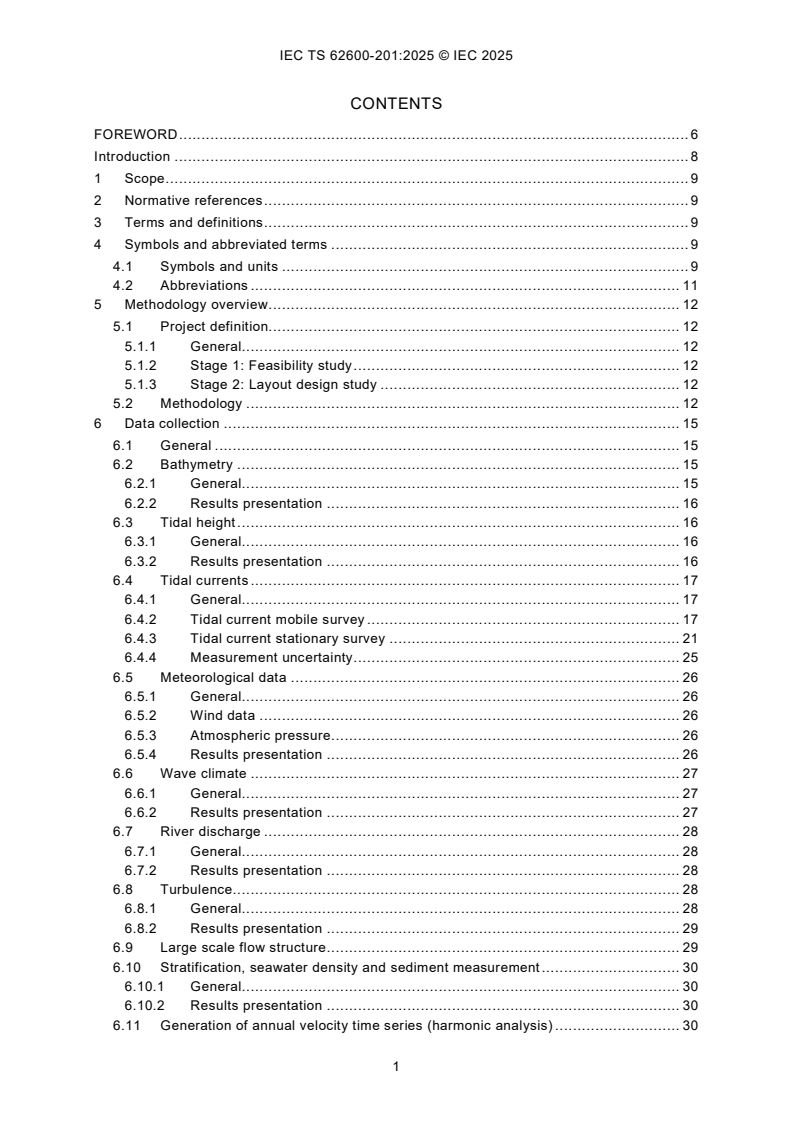
CONTENTS
FOREWORD . 6
Introduction . 8
1 Scope . 9
2 Normative references . 9
3 Terms and definitions . 9
4 Symbols and abbreviated terms . 9
4.1 Symbols and units . 9
4.2 Abbreviations . 11
5 Methodology overview . 12
5.1 Project definition. 12
5.1.1 General. 12
5.1.2 Stage 1: Feasibility study . 12
5.1.3 Stage 2: Layout design study . 12
5.2 Methodology . 12
6 Data collection . 15
6.1 General . 15
6.2 Bathymetry . 15
6.2.1 General. 15
6.2.2 Results presentation . 16
6.3 Tidal height . 16
6.3.1 General. 16
6.3.2 Results presentation . 16
6.4 Tidal currents . 17
6.4.1 General. 17
6.4.2 Tidal current mobile survey . 17
6.4.3 Tidal current stationary survey . 21
6.4.4 Measurement uncertainty . 25
6.5 Meteorological data . 26
6.5.1 General. 26
6.5.2 Wind data . 26
6.5.3 Atmospheric pressure . 26
6.5.4 Results presentation . 26
6.6 Wave climate . 27
6.6.1 General. 27
6.6.2 Results presentation . 27
6.7 River discharge . 28
6.7.1 General. 28
6.7.2 Results presentation . 28
6.8 Turbulence . 28
6.8.1 General. 28
6.8.2 Results presentation . 29
6.9 Large scale flow structure . 29
6.10 Stratification, seawater density and sediment measurement . 30
6.10.1 General. 30
6.10.2 Results presentation . 30
6.11 Generation of annual velocity time series (harmonic analysis) . 30
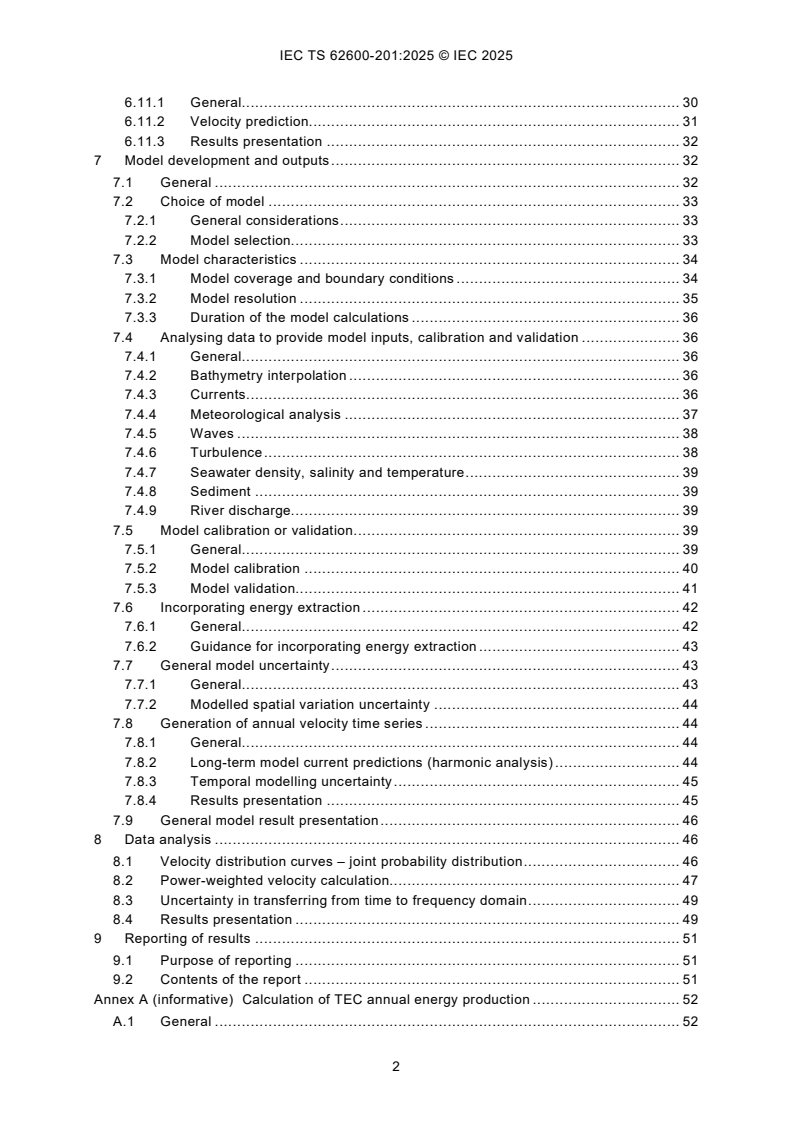
6.11.1 General. 30
6.11.2 Velocity prediction. 31
6.11.3 Results presentation . 32
7 Model development and outputs . 32
7.1 General . 32
7.2 Choice of model . 33
7.2.1 General considerations . 33
7.2.2 Model selection. 33
7.3 Model characteristics . 34
7.3.1 Model coverage and boundary conditions . 34
7.3.2 Model resolution . 35
7.3.3 Duration of the model calculations . 36
7.4 Analysing data to provide model inputs, calibration and validation . 36
7.4.1 General. 36
7.4.2 Bathymetry interpolation . 36
7.4.3 Currents . 36
7.4.4 Meteorological analysis . 37
7.4.5 Waves . 38
7.4.6 Turbulence . 38
7.4.7 Seawater density, salinity and temperature . 39
7.4.8 Sediment . 39
7.4.9 River discharge. 39
7.5 Model calibration or validation . 39
7.5.1 General. 39
7.5.2 Model calibration . 40
7.5.3 Model validation. 41
7.6 Incorporating energy extraction . 42
7.6.1 General. 42
7.6.2 Guidance for incorporating energy extraction . 43
7.7 General model uncertainty . 43
7.7.1 General. 43
7.7.2 Modelled spatial variation uncertainty . 44
7.8 Generation of annual velocity time series . 44
7.8.1 General. 44
7.8.2 Long-term model current predictions (harmonic analysis) . 44
7.8.3 Temporal modelling uncertainty . 45
7.8.4 Results presentation . 45
7.9 General model result presentation . 46
8 Data analysis . 46
8.1 Velocity distribution curves – joint probability distribution . 46
8.2 Power-weighted velocity calculation. 47
8.3 Uncertainty in transferring from time to frequency domain . 49
8.4 Results presentation . 49
9 Reporting of results . 51
9.1 Purpose of reporting . 51
9.2 Contents of the report . 51
Annex A (informative) Calculation of TEC annual energy production . 52
A.1 General . 52
A.2 Individual TEC annual energy production (AEP) . 52
A.3 Array AEP . 53
A.4 Loss categories . 53
A.4.1 General. 53
A.4.2 Plant performance and losses uncertainty . 53
A.5 AEP uncertainty. 54
A.6 Results presentation . 54
Annex B (informative) Uncertainty . 55
B.1 Uncertainty categories . 55
B.2 Combining uncertainties . 55
Annex C (informative) Guidelines for current profiler measurements . 56
C.1 General . 56
C.2 Instrument configuration . 56
C.3 Instrument calibration . 57
C.4 Correcting for clock drift . 57
C.5 Depth quality control . 57
C.6 Velocity quality control . 58
C.7 Estimating turbulence quantities . 58
C.8 Mobile and hybrid mobile-stationary survey . 59
C.8.1 General. 59
C.8.2 Navigation and vessel-handling . 59
Annex D (informative) Case Studies . 61
D.1 General . 61
D.2 Site evaluation . 61
D.2.1 General. 61
D.2.2 Stationary survey - design . 61
D.2.3 Stationary survey - results presentation . 64
D.2.4 Generation of annual velocity time series (harmonic analysis) . 68
D.2.5 Calculation of TEC annual energy prediction . 72
D.3 Model case study . 76
D.3.1 General. 76
D.3.2 Study location . 76
D.3.3 Model description . 77
D.3.4 Model calibration . 78
D.3.5 Model validation. 80
D.3.6 General model output . 84
D.3.7 Energy extraction . 86
Annex E (informative) Tidal resource classification system . 92
E.1 Introduction . 92
E.2 Classification parameters . 92
E.3 Classification example . 93
Bibliography . 96
Figure 1 – The vertical variation of tidal current across an example projected capture
area for a horizontal-axis TEC . 48
Figure 2 – Joint velocity and direction probability density distribution, a location in
Cook Inlet, Alaska . 50
Figure 3 – Example velocity magnitude probability histogram . 50
Figure 4 – Example exceedance curve for velocity magnitude . 51
Figure C.1 – Hybrid mobile-stationary vessel waypoints and tolerance range rings . 60
Figure D.1 – Site selection - the Strangford Narrows . 61
Figure D.2 – Strangford Lough bathymetry . 62
Figure D.3 – ADP seabed frame prior to deployment . 63
Figure D.4 – Raw data time-series of heading, pitch, and roll . 64
Figure D.5 – Hovmöller diagram showing the current data over the water column over
deployment time . 65
Figure D.6 – Instantaneous height above mean sea level time series . 66
Figure D.7 – Instantaneous current velocity . 67
Figure D.8 – Instantaneous power-weighted speed and 10 min averaged power-
weighted speed . 67
Figure D.9 – Velocity-bin averaged current profiles through the water column . 68
Figure D.10 – A 1-year forecast of height above mean sea level and current-speed . 72
Figure D.11 – Schottel SIT deployment configuration at QML tidal test site, Strangford
Lough, Northern Ireland . 73
Figure D.12 – Theoretical, data derived and actual power output performance, cyan
data points are taken from (Starzmann et al., 2015 [97]) . 74
Figure D.13 – Velocity probability distribution at TEC location . 74
Figure D.14 – Velocity exceedance curve at TEC location . 75
Figure D.15 – Forecast tidal flow magnitude and electrical power output for location 1 . 75
Figure D.16 – The study area in Tacoma Narrows, WA . 77
Figure D.17 – Distribution of tide gauges in the Salish Sea . 79
Figure D.18 – Six NOAA - C.MIST CP locations in Tacoma Narrows area used for
FVCOM model validation . 81
Figure D.19 – Hodographs from the model and field data at all six locations and a
scatter comparison of the different matrices computed to quantify the model
performance . 82
Figure D.20 – Comparisons of modelled and observed vertical velocity profiles at
gauge PUG1528 during two spring and neap cycles in 2015 . 83
Figure D.21 – Velocity exceedance curves from the model and current profiler at gauge
PUG1528. 83
Figure D.22 – The variation of tidal current speed, V, and power density, P , at
w
different tide cycles in the Tacoma Narrows . 84
Figure D.23 – Tidal ellipse map of the largest tidal current constituents, M and K , in
2 1
the Tacoma Narrows (represented by blue lines) . 85
Figure D.24 – Joint velocity direction distribution at PUG1528 . 86
Figure D.25 – Energy extraction at the project location . 88
Figure D.26 – The effect of the proposed TEC array in Tacoma Narrows . 89
Figure D.27 – Representative TEC locations . 90
Figure D.28 – Velocity probability histograms for the three representative TEC
locations . 91
Figure E.1 – Scatter plot of maximum theoretical power available vs cross-sectional
area for all the hotspot locations around the US coast (Kilcher et al. [33]) . 94
Figure E.2 – Primary parameter classification scheme based on mean velocity . 94
Figure E.3 – Scatter plot of mean velocity vs cross-section for all the hotspot locations
around the US coast from national tidal resource assessment report (Haas et al.,
2011[67]) . 95
Figure E.4 – Tidal stream mean currents across Cook Inlet (60.79 N, 151.26 W),
colour-coded by their classes . 95
Table 1 – Resource assessment stages . 12
Table 2 – Model and field survey recommendations (overview) . 14
Table 3 – Differences in measurement requirements at Stage 1 and Stage 2 . 23
Table A.1 – Recommended loss categories and definitions . 53
Table B.1 – Recommended uncertainty categories and definitions . 55
Table D.1 – ADP deployment location . 62
Table D.2 – Sentinel V sampling configuration . 64
Table D.3 – Sea-level at Location 1: Tidal constituents, amplitudes and phases . 69
Table D.4 – Depth-averaged current velocity at Location 1 ellipse parameters (major
axis, minor axis, inclination and phase) . 70
Table D.5 – Year-to-year variability of AEP . 76
Table D.6 – Comparison of modelled and observed tidal constituent amplitude (a) (in
meters) and phase lag (Φ) (in degrees) at 10 tide gauge stations in the Salish Sea . 79
Table D.7 – AEP estimated at gauge PUG1528 using principal component velocity
(PCU, in m/s) and different channel vertical positions . 83
Table D.8 – TEC array configuration used for energy extraction . 89
Table D.9 – AEP for each representative TEC and total for the project . 91
Table E.1 – Proposed tidal resource classification system . 93
INTERNATIONAL ELECTROTECHNICAL COMMISSION
____________
Marine energy - Wave, tidal and other water current converters -
Part 201: Tidal energy resource assessment and characterization
FOREWORD
1) The International Electrotechnical Commission (IEC) is a worldwide organization for
standardization comprising all national electrotechnical committees (IEC National Committees).
The object of IEC is to promote international co-operation on all questions concerning
standardization in the electrical and electronic fields. To this end and in addition to other
activities, IEC publishes International Standards, Technical Specifications, Technical Reports,
Publicly Available Specifications (PAS) and Guides (hereafter referred to as "IEC
Publication(s)"). Their preparation is entrusted to technical committees; any IEC National
Committee interested in the subject dealt with may participate in this preparatory work.
International, governmental and non-governmental organizations liaising with the IEC also
participate in this preparation. IEC collaborates closely with the International Organization for
Standardization (ISO) in accordance with conditions determined by agreement between the two
organizations.
2) The formal decisions or agreements of IEC on technical matters express, as nearly as
possible, an international consensus of opinion on the relevant subjects since each technical
committee has representation from all interested IEC National Committees.
3) IEC Publications have the form of recommendations for international use and are accepted
by IEC National Committees in that sense. While all reasonable efforts are made to ensure that
the technical content of IEC Publications is accurate, IEC cannot be held responsible for the
way in which they are used or for any misinterpretation by any end user.
4) In order to promote international uniformity, IEC National Committees undertake to apply IEC
Publications transparently to the maximum extent possible in their national and regional
publications. Any divergence between any IEC Publication and the corresponding national or
regional publication shall be clearly indicated in the latter.
5) IEC itself does not provide any attestation of conformity. Independent certification bodies
provide conformity assessment services and, in some areas, access to IEC marks of conformity.
IEC is not responsible for any services carried out by independent certification bodies.
6) All users should ensure that they have the latest edition of this publication.
7) No liability shall attach to IEC or its directors, employees, servants or agents including
individual experts and members of its technical committees and IEC National Committees for
any personal injury, property damage or other damage of any nature whatsoever, whether direct
or indirect, or for costs (including legal fees) and expenses arising out of the publication, use
of, or reliance upon, this IEC Publication or any other IEC Publications.
8) Attention is drawn to the Normative references cited in this publication. Use of the referenced
publications is indispensable for the correct application of this publication.
9) IEC draws attention to the possibility that the implementation of this document may involve
the use of (a) patent(s). IEC takes no position concerning the evidence, validity or applicability
of any claimed patent rights in respect thereof. As of the date of publication of this document,
IEC [had/had not] received notice of (a) patent(s), which may be required to implement this
document. However, implementers are cautioned that this may not represent the latest
information, which may be obtained from the patent database available at https://patents.iec.ch.
IEC shall not be held responsible for identifying any or all such patent rights.
IEC TS 62600-201 has been prepared by IEC technical committee 114: Marine energy – Wave,
tidal and other water current converters. It is a Technical Specification.
This second edition cancels and replaces the first edition published in 2015. This edition
constitutes a technical revision.
This edition includes the following significant technical changes with respect to the previous
edition:
a) Includes clauses on assessing wave and current interaction;
b) Expands turbulence data collection;
c) Expands the measurement only method to include a combination of static and mobile
surveys;
d) Includes a method for combined tidal and river flow;
e) Adds more description for treating uncertainty;
f) Includes two case study examples.
The text of this Technical Specification is based on the following documents:
Draft Report on voting
114/573/DTS 114/590/RVDTS
Full information on the voting for its approval can be found in the report on voting indicated in
the above table.
The language used for the development of this Technical Specification is English.
This document was drafted in accordance with ISO/IEC Directives, Part 2, and developed in
accordance with ISO/IEC Directives, Part 1 and ISO/IEC Directives, IEC Supplement, available
at www.iec.ch/members_experts/refdocs. The main document types developed by IEC are
described in greater detail at www.iec.ch/publications.
A list of all parts in the IEC 62600 series, published under the general title Marine energy –
Wave, tidal and other water current converters, can be found on the IEC website.
The committee has decided that the contents of this document will remain unchanged until the
stability date indicated on the IEC website under webstore.iec.ch in the data related to the
specific document. At this date, the document will be
– reconfirmed,
– withdrawn, or
– revised.
Introduction
The development of the tidal power industry is at an early stage and the significance of
particular tidal energy resource characteristics is not well understood. This document is
intended to be updated as understanding of the resource and its response to power extraction
becomes better understood. It is noted that it is presently particularly difficult to derive the
uncertainty (within specified confidence limits) of the resource, given lack of field and model
data for a statistically significant number of sites. However, within this document, guidance
regarding the assessment of uncertainty within tidal resource assessment is given. Additionally,
Annex C provides an overview of proposed loss and uncertainty categories, to help users better
understand the key areas to be included in an energy yield assessment.
The purpose of this document is to provide a uniform methodology that will ensure consistency
and accuracy in the estimation, measurement, characterization and analysis of the theoretical
tidal current resource at sites that could be suitable for the installation of individual or arrays of
Tidal Energy Converters (TECs), together with defining a standardised methodology with which
this resource can be described and reported. Application of the estimation, measurement and
analysis techniques recommended in this document will ensure that resource assessment is
undertaken in a consistent and accurate manner. This document presents techniques that are
expected to provide fair and suitably accurate results that can be replicated by others.
The overall goal of the methodology is to enable calculation of the Annual Energy Production
(AEP) for the proposed array of TECs at each TEC location in conjunction with IEC TS 62600–
200.
In this document, the theoretical tidal energy resource (undisturbed or disturbed by power
extraction) is defined by the velocity probability distribution that is used to compute the AEP.
For projects where the proposed AEP (converted to average power production) is less than 2 %
of the theoretical undisturbed tidal energy resource (or in the case of headlands less than 10
MW installed capacity), AEP can be estimated from direct resource measurements, without
requiring hydrodynamic modelling. In all other cases, the velocity probability distribution is
assessed by hydrodynamic modelling that includes the effects of energy extraction, with
appropriate verification of the baseline model by measurements. The methodology for
measuring the required data is also defined. The direct resource measurement approach may
use measured data at each TEC location, using either data from a stationary survey or hybrid
mobile-stationary surveys, or both.
This document describes only the aspects of the resource required to calculate AEP and assess
its uncertainty; e.g. it does not describe aspects of the resource required to evaluate design
loads or to satisfy environmental regulations. Furthermore, this document is not intended to
cover every eventuality that can be relevant for any particular project. Therefore, this document
assumes that the user has access to, and reviews, other relevant IEC documentation before
undertaking work (e.g. surveys and modelling) which could also satisfy other requirements.
Further background reading can be found here: IEC TS 62600-101:2015 [1], Coles and Blunden
(2017) [2], Kreyszig (1983) [3], Batten et al., (2013) [4], Burton et al., (2011) [5], Roache (1994)
[6].
1 Scope
This part of IEC 62600 establishes a system for analysing and reporting, through estimation or
direct measurement, the theoretical tidal current energy resource in oceanic areas including
estuaries (to the limit of tidal influence) that can be suitable for the installation of one or more
TECs.
It is intended to be applied at various stages of project life cycle to provide suitably accurate
estimates of the tidal resource to enable the arrays’ projected annual energy production to be
calculated at each TEC location in conjunction with IEC TS 62600–200.
2 Normative references
The following documents are referred to in the text in such a way that some or all of their content
constitutes requirements of this document. For dated references, only the edition cited applies.
For undated references, the latest edition of the referenced document (including any
amendments) applies.
IEC 60050-417, International Electrotechnical Vocabulary (IEV) - Part 417: Marine energy -
Wave, tidal and other water current converters
IEC 61400–12–1, Wind turbines – Part 12-1: Power performance measurements of electricity
producing wind turbines
IEC TS 62600–200, Marine energy – Wave, tidal and other water current converters – Part 200:
Electricity producing tidal energy converters – Power performance assessment
IHO (International Hydrographic Organization), 2008, Standards for Hydrographic Surveys.
Special Publication No. 44. 5th Edition
3 Terms and definitions
For the purposes of this document, the terms and definitions given in IEC 60050-417 apply.
ISO and IEC maintain terminological databases for use in standardization at the following
addresses:
– IEC Electropedia: available at https://www.electropedia.org/
– ISO Online browsing platform: available at https://www.iso.org/obp
4 Symbols and abbreviated terms
4.1 Symbols and units
amplitude difference between the two ends of the tidal channel or largest tidal constituent amplitude
a
in the channel (m)
additional constituent amplitudes (m)
a
i
A projected capture area of TEC (m )
A , A , A total flow-facing swept area of the blades, supporting poles and device foundation (m )
b p f
A area of current profiler bin k across the projected capture area (m )
k
bias
B
extraction coefficient
C
ext
TEC thrust coefficient
C
T
C , C , drag coefficients due to the physical TEC blades, supporting poles, and the foundation
b p
C
f
C turbine power coefficient
p
equivalent diameter (m)
D
E
time occurrence likelihood of a velocity in each magnitude bin (%)
f(U )
i
time occurrence likelihood of a velocity in each magnitude and direction bin (%)
f(U , θ )
i k
→
flow retarding force
𝑚𝑚
𝐹𝐹
g atcceleration due to gravity (m / s )
turbulence intensity of the horizontal velocity
I
U
index for velocity magnitude bin numbers
i
index for number of time intervals
j
index for direction bin numbers or index for current profiler bin across projected capture area
k
2 2
K
turbulent kinetic energy (m /s )
L number of samples in the defined averaging period which produces data point n
model result
M
n
index number defining an individual data point in a velocity bin
n
number of time intervals
N
number of velocity bins
N
B
number of hours in the simulated year
N
h
observed data
O
n
mean of observed data
O
P
available annual mean power density (kW/m )
power generated by the i velocity bin of the TEC power curve (kW)
P (U )
i i
total measured velocity (m/s)
u, v, w
turbulent velocity fluctuations (m/s)
u′, v′, w′
turbulent-averaged mean velocity (m/s)
u, v, w
horizontal component of the turbulent-averaged mean velocity (m/s)
U
th
U central value velocity magnitude in the i bin (m/s)
i
U central value velocity magnitude of time step j (m/s)
j
root mean squared value of the horizontal turbulent velocity fluctuations (m/s)
U′
Û , , instantaneous power weighted current velocity across A (m/s)
i j n
𝑈𝑈 magnitude of the instantaneous tidal current velocity, time j, at current profiler bin k, in velocity bin
𝑖𝑖,𝑗𝑗,𝑘𝑘,𝑛𝑛
i, for data point n (m/s)
𝑈𝑈 mean power-weighted tidal current velocity in velocity bin i for data point n (m/s)
𝑖𝑖,𝑛𝑛
tidal current speed (m/s)
V
P maximum average available power in tidal channel (W)
tidal current velocity (m/s)
𝑣𝑣⃗
P power density (W/m )
W
available theoretical maximum annual average power (W)
P
max
Q
maximum volume flux through the tidal channel (m /s)
max
linear correlation coefficient
R
total number of current profiler bins across the projected capture area normal to the principal axis of
S
energy capture
Sk skill
TECA expected TEC availability (%)
TECAEP expected annual power production for the TEC (kWh)
depth (m)
z
ε turbulent kinetic energy dissipation (J/kg)
standard deviation of the uncertainty in the horizontal current speed (m/s)
σ
n
principal direction of flow (deg)
θ
p
direction of the depth-averaged or hub height velocity (deg)
θ
th
θ direction for the k bin (deg)
k
coefficient within Garrett and Cummins equation
γ
⍴ water density (kg/m )
4.2 Abbreviations
AEP annual energy production
ADV acoustic doppler velocimeter
CP current profiler
CTD conductivity, temperature, depth
CFD computational fluid dynamics
DGPS differential GPS
EEP energy extraction plane
FDC flow duration curve
FVCOM finite volume community ocean model
GPS Global Positioning System
HAB height above bed
IEC International Electrotechnical Commission
IHO International Hydrographic Organization
ISO International Organization for Standardization
MW negawatt
NOAA National Oceanic and Atmospheric Administration
NTP network time protocol
PAS publicly available specifications
PCA projected capture area
PST phase-space thresholding
QA quality assurance
RMS root-mean-squared
SAR synthetic aperture radar
SD standard deviation
SJDF Strait of Juan de Fuca
SMS surface-water modelling system
TI turbulence intensity
TEC tidal energy converter
TS technical specification
USGS United States Geological Survey
UTC Coordinated Universal Time
VDC velocity duration curve
5 Methodology overview
5.1 Project definition
5.1.1 General
This document should be applied at various stages of the resource assessment process to
provide velocity probability distributions for computing annual energy production (AEP) with
increasing accuracy or lower levels of uncertainty. This document assumes that a region of
interest has already been identified. Aspects of the methodology to be followed when
undertaking a tidal resource assessment depend on the scope of the analysis and its objectives.
Two distinct types of studies, feasibility and layout design, are defined as indicated in Table 1.
The feasibility study generally has a focus on the whole estuary, channel, etc. with a medium
level of uncertainty and is used to identify potential project locations. The layout design study
is expected to focus on the particular sites chosen through the feasibility studies and is used to
predict project AEP with a lower level of uncertainty. A classification system is described in
Annex E to assist with site identification.
Table 1 – Resource assessment stages
Stage Aim Area
Stage 1 Feasibility Whole estuary, channel, etc.
Stage 2 Layout design Development site
5.1.2 Stage 1: Feasibility study
A Stage 1 study is focused on investigating the scale and attributes of the energy resource
within a particular study area. The results of a Stage 1 resource assessment can be used to
help assess the feasibility of constructing tidal energy arrays at sites within the study area by
estimating the undisturbed site resource.
5.1.3 Stage 2: Layout design study
A Stage 2 study is focused on generating detailed and accurate information on the tidal energy
resource in a specific area to determine AEP, through supporting the layout design of a tidal
array, and may incorporate energy extraction impacts depending upon the project scale. The
Stage 2 study should consider the technology to be installed and locations of TEC deployments
in order to estimate AEP with lower uncertainty.
5.2 Methodology
The resource assessment requirements are defined depending on the scale of the project as
well as the objective of the assessment (feasibility or layout design). The AEP (calculated using
the method outlined in Annex A) can be assessed based on data from either direct
measurements or from hydrodynamic modelling. In addition to defining the methodologies
througout this document, case studies for both approaches are provided in Annex D.
...