

IEC 61386-1:2008
(Main)Conduit systems for cable management - Part 1: General requirements
General Information
- Abstract
This part of IEC 61386 specifies requirements and tests for conduit systems, including conduits and conduit fittings, for the protection and management of insulated conductors and/or cables in electrical installations or in communication systems up to 1 000 V a.c. and/or 1 500 V d.c. This second edition cancels and replaces the first edition published in 1996, and its Amendment 1 (2000), and it constitutes a technical revision. The changes to the first edition are as follows:
- change to the length of the test specimen between fittings for the tensile test,
- editorial and normative reference updates.
- Status
- Published
- Publication Date
- 24-Apr-2017
- Technical Committee
- SC 23A - Cable management systems
- Drafting Committee
- MT 13 - TC 23/SC 23A/MT 13
- Current Stage
- PPUB - Publication issued
- Start Date
- 22-Feb-2008
- Completion Date
- 15-Mar-2008
Buy Documents
IEC 61386-1:2008 - Conduit systems for cable management - Part 1: General requirements Released:2/22/2008

IEC 61386-1:2008+AMD1:2017 CSV - Conduit systems for cable management - Part 1: General requirements Released:4/25/2017
Overview
IEC 61386-1:2008, titled Conduit systems for cable management – Part 1: General requirements, is an authoritative international standard published by the International Electrotechnical Commission (IEC). It specifies essential requirements and test procedures for conduit systems used in electrical and communication installations. These systems include conduits and conduit fittings designed to protect and manage insulated conductors and cables operating up to 1,000 V AC and 1,500 V DC. The document ensures reliable performance, safety, and compatibility of conduit systems worldwide.
This edition, updated with Amendment 1 in 2017, supersedes the original 1996 standard and its 2000 amendment. The revised content focuses on updated test length requirements for tensile testing, editorial improvements, and modernized normative references.
Key Topics
IEC 61386-1 addresses a comprehensive range of technical criteria for conduit systems, organized into several key areas:
Mechanical Properties: The standard defines classifications and testing methods for resistance to compression, impact, bending, tensile strength, suspended load capacity, collapse, and flexing to guarantee mechanical durability in various environments.
Thermal Properties: Specifies temperature ranges for conduit performance, including lower and upper limits, ensuring conduits can withstand operating conditions without degradation.
Electrical Characteristics: Includes requirements for electrical continuity, insulation, dielectric strength, bonding tests, and insulation resistance to safeguard electrical integrity.
Ingress Protection: Conduit systems must meet minimum IP ratings against dust and water ingress, following IEC 60529 standards, ensuring reliable protection against environmental factors.
Corrosion Resistance: Conduits and fittings are tested and classified for resistance to corrosion, enhancing durability in harsh or corrosive installations.
Flame Propagation: Testing and classification criteria for flame resistance and fire hazard assessment ensure safety under fire conditions.
Marking and Documentation: Proper marking and comprehensive documentation requirements facilitate identification, traceability, and adherence to regulatory standards.
Electromagnetic Compatibility (EMC): Guidelines address the behavior of conduit systems in the presence of electromagnetic interference to prevent disruptions.
The document also provides detailed test methods, including compression, impact, bending, and bonding tests with standardized apparatus and procedures to confirm conformity.
Applications
IEC 61386-1 is essential for manufacturers, engineers, and installers involved in electrical and communication infrastructures requiring safe and effective cable management. Typical applications include:
Electrical Installations: Ensuring safe conduit systems in residential, commercial, and industrial electrical wiring to prevent mechanical damage and support electrical insulation.
Communication Systems: Protecting cables and conductors in telephone, data, and network systems, maintaining signal integrity, and reducing electromagnetic interference.
Infrastructure Projects: Supporting robust cable protection in tunnels, underground installations, and hazardous environments by specifying conduits resistant to mechanical stress, corrosion, and fire hazards.
Regulatory Compliance: Serving as a benchmark for compliance certification and quality assurance during product development and installation.
By adhering to IEC 61386-1, stakeholders can enhance system reliability, reduce maintenance costs, and align with international safety standards.
Related Standards
To complement IEC 61386-1, the following related standards are relevant for comprehensive cable management solutions:
IEC 60529: Degrees of protection provided by enclosures (IP Code) – closely linked for ingress protection requirements.
IEC 61386 Series (Parts 2 and beyond): Specifics on particular types of conduits, fittings, and accessories, providing further technical details beyond general requirements.
ISO/IEC 11801: Generic cabling for customer premises – relevant for structured cabling systems interfacing with conduit systems.
IEC 61000 Series: Electromagnetic compatibility standards that complement the EMC requirements described.
National and Regional Wiring Regulations: Such as NEC (USA), BS 7671 (UK), or IEC-adopted standards for localized compliance.
Understanding and implementing IEC 61386-1 in conjunction with these standards ensures a holistic approach to cable management and conduit system safety worldwide.
Keywords: IEC 61386-1, conduit systems, cable management, electrical installations, conduit fittings, mechanical properties, ingress protection, flame propagation, electrical continuity, corrosion resistance, cable protection standard, electrical safety, communication systems, IEC standards.
Relations
- Effective Date
- 25-Aug-2026
- Effective Date
- 25-Aug-2026
- Amended By
IEC 61386-1:2008/AMD1:2017 - Conduit systems for cable management - Part 1: General requirements - Effective Date
- 05-Sep-2023
- Revises
IEC 61386-1:1996 - Conduit systems for electrical installations - Part 1: General requirements - Effective Date
- 05-Sep-2023
- Effective Date
- 05-Sep-2023
Buy Documents
IEC 61386-1:2008 - Conduit systems for cable management - Part 1: General requirements Released:2/22/2008
IEC 61386-1:2008+AMD1:2017 CSV - Conduit systems for cable management - Part 1: General requirements Released:4/25/2017
Get Certified
Connect with accredited certification bodies for this standard

IMQ S.p.A. (Certification)
Italian electrical product certification.

SLG Prüf- und Zertifizierungs GmbH
German testing and certification body.

UL Solutions
Global safety science company with testing, inspection and certification.
Sponsored listings
Frequently Asked Questions
IEC 61386-1:2008 is a standard published by the International Electrotechnical Commission (IEC). Its full title is "Conduit systems for cable management - Part 1: General requirements". This standard covers: This part of IEC 61386 specifies requirements and tests for conduit systems, including conduits and conduit fittings, for the protection and management of insulated conductors and/or cables in electrical installations or in communication systems up to 1 000 V a.c. and/or 1 500 V d.c. This second edition cancels and replaces the first edition published in 1996, and its Amendment 1 (2000), and it constitutes a technical revision. The changes to the first edition are as follows: - change to the length of the test specimen between fittings for the tensile test, - editorial and normative reference updates.
This part of IEC 61386 specifies requirements and tests for conduit systems, including conduits and conduit fittings, for the protection and management of insulated conductors and/or cables in electrical installations or in communication systems up to 1 000 V a.c. and/or 1 500 V d.c. This second edition cancels and replaces the first edition published in 1996, and its Amendment 1 (2000), and it constitutes a technical revision. The changes to the first edition are as follows: - change to the length of the test specimen between fittings for the tensile test, - editorial and normative reference updates.
IEC 61386-1:2008 is classified under the following ICS (International Classification for Standards) categories: 29.120.10 - Conduits for electrical purposes. The ICS classification helps identify the subject area and facilitates finding related standards.
IEC 61386-1:2008 has the following relationships with other standards: It is inter standard links to EN ISO 11197:2016, EN ISO 11197:2019, IEC 61386-1:2008/AMD1:2017, IEC 61386-1:1996, IEC 61386-1:1996/AMD1:2000. Understanding these relationships helps ensure you are using the most current and applicable version of the standard.
IEC 61386-1:2008 is available in PDF format for immediate download after purchase. The document can be added to your cart and obtained through the secure checkout process. Digital delivery ensures instant access to the complete standard document.
Standards Content (Sample)
IEC 61386-1
Edition 2.0 2008-02
INTERNATIONAL
STANDARD
NORME
INTERNATIONALE
Conduit systems for cable management –
Part 1: General requirements
Systèmes de conduits pour la gestion du câblage –
Partie 1: Exigences générales
All rights reserved. Unless otherwise specified, no part of this publication may be reproduced or utilized in any form or by
any means, electronic or mechanical, including photocopying and microfilm, without permission in writing from either IEC or
IEC's member National Committee in the country of the requester.
If you have any questions about IEC copyright or have an enquiry about obtaining additional rights to this publication,
please contact the address below or your local IEC member National Committee for further information.
Droits de reproduction réservés. Sauf indication contraire, aucune partie de cette publication ne peut être reproduite
ni utilisée sous quelque forme que ce soit et par aucun procédé, électronique ou mécanique, y compris la photocopie
et les microfilms, sans l'accord écrit de la CEI ou du Comité national de la CEI du pays du demandeur.
Si vous avez des questions sur le copyright de la CEI ou si vous désirez obtenir des droits supplémentaires sur cette
publication, utilisez les coordonnées ci-après ou contactez le Comité national de la CEI de votre pays de résidence.
IEC Central Office
3, rue de Varembé
CH-1211 Geneva 20
Switzerland
Email: inmail@iec.ch
Web: www.iec.ch
About the IEC
The International Electrotechnical Commission (IEC) is the leading global organization that prepares and publishes
International Standards for all electrical, electronic and related technologies.
About IEC publications
The technical content of IEC publications is kept under constant review by the IEC. Please make sure that you have the
latest edition, a corrigenda or an amendment might have been published.
ƒ Catalogue of IEC publications: www.iec.ch/searchpub
The IEC on-line Catalogue enables you to search by a variety of criteria (reference number, text, technical committee,…).
It also gives information on projects, withdrawn and replaced publications.
ƒ IEC Just Published: www.iec.ch/online_news/justpub
Stay up to date on all new IEC publications. Just Published details twice a month all new publications released. Available
on-line and also by email.
ƒ Electropedia: www.electropedia.org
The world's leading online dictionary of electronic and electrical terms containing more than 20 000 terms and definitions
in English and French, with equivalent terms in additional languages. Also known as the International Electrotechnical
Vocabulary online.
ƒ Customer Service Centre: www.iec.ch/webstore/custserv
If you wish to give us your feedback on this publication or need further assistance, please visit the Customer Service
Centre FAQ or contact us:
Email: csc@iec.ch
Tel.: +41 22 919 02 11
Fax: +41 22 919 03 00
A propos de la CEI
La Commission Electrotechnique Internationale (CEI) est la première organisation mondiale qui élabore et publie des
normes internationales pour tout ce qui a trait à l'électricité, à l'électronique et aux technologies apparentées.
A propos des publications CEI
Le contenu technique des publications de la CEI est constamment revu. Veuillez vous assurer que vous possédez
l’édition la plus récente, un corrigendum ou amendement peut avoir été publié.
ƒ Catalogue des publications de la CEI: www.iec.ch/searchpub/cur_fut-f.htm
Le Catalogue en-ligne de la CEI vous permet d’effectuer des recherches en utilisant différents critères (numéro de référence,
texte, comité d’études,…). Il donne aussi des informations sur les projets et les publications retirées ou remplacées.
ƒ Just Published CEI: www.iec.ch/online_news/justpub
Restez informé sur les nouvelles publications de la CEI. Just Published détaille deux fois par mois les nouvelles
publications parues. Disponible en-ligne et aussi par email.
ƒ Electropedia: www.electropedia.org
Le premier dictionnaire en ligne au monde de termes électroniques et électriques. Il contient plus de 20 000 termes et
définitions en anglais et en français, ainsi que les termes équivalents dans les langues additionnelles. Egalement appelé
Vocabulaire Electrotechnique International en ligne.
ƒ Service Clients: www.iec.ch/webstore/custserv/custserv_entry-f.htm
Si vous désirez nous donner des commentaires sur cette publication ou si vous avez des questions, visitez le FAQ du
Service clients ou contactez-nous:
Email: csc@iec.ch
Tél.: +41 22 919 02 11
Fax: +41 22 919 03 00
IEC 61386-1
Edition 2.0 2008-02
INTERNATIONAL
STANDARD
NORME
INTERNATIONALE
Conduit systems for cable management –
Part 1: General requirements
Systèmes de conduits pour la gestion du câblage –
Partie 1: Exigences générales
INTERNATIONAL
ELECTROTECHNICAL
COMMISSION
COMMISSION
ELECTROTECHNIQUE
PRICE CODE
INTERNATIONALE
W
CODE PRIX
ICS 29.120.10 ISBN 2-8318-9623-1
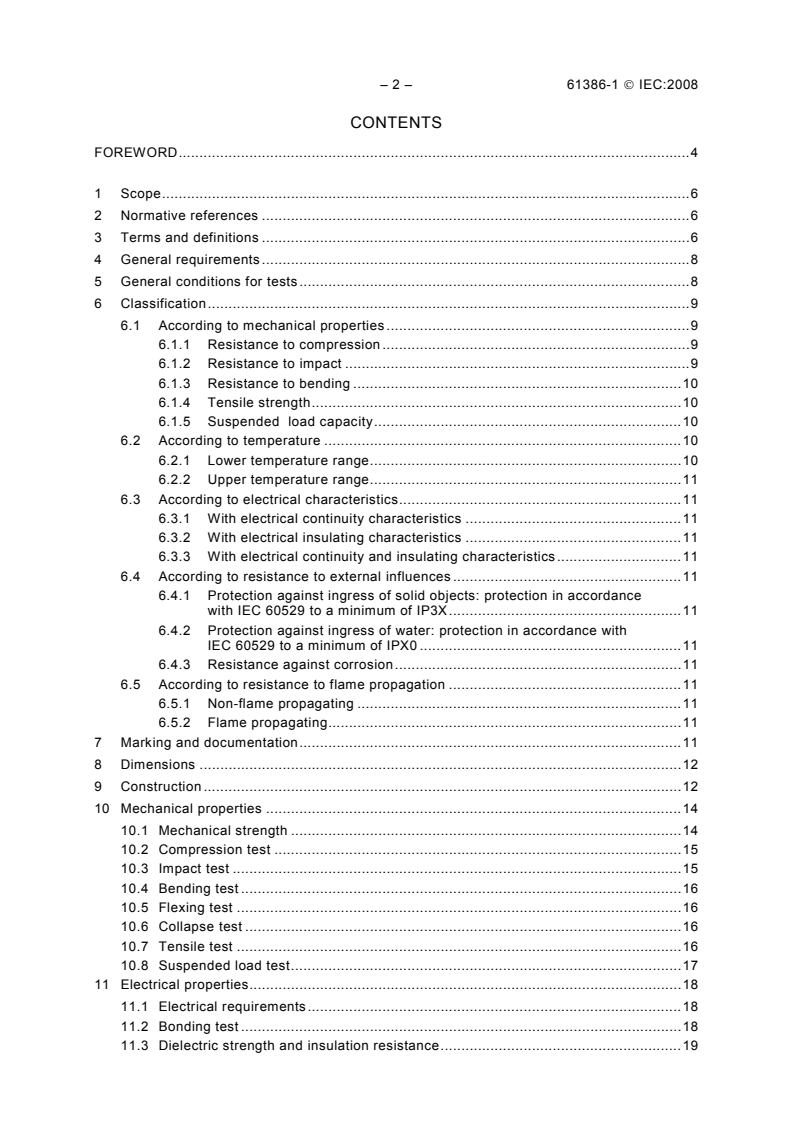
– 2 – 61386-1 © IEC:2008
CONTENTS
FOREWORD.4
1 Scope.6
2 Normative references .6
3 Terms and definitions .6
4 General requirements .8
5 General conditions for tests.8
6 Classification.9
6.1 According to mechanical properties .9
6.1.1 Resistance to compression.9
6.1.2 Resistance to impact .9
6.1.3 Resistance to bending .10
6.1.4 Tensile strength.10
6.1.5 Suspended load capacity.10
6.2 According to temperature .10
6.2.1 Lower temperature range.10
6.2.2 Upper temperature range.11
6.3 According to electrical characteristics.11
6.3.1 With electrical continuity characteristics .11
6.3.2 With electrical insulating characteristics .11
6.3.3 With electrical continuity and insulating characteristics.11
6.4 According to resistance to external influences .11
6.4.1 Protection against ingress of solid objects: protection in accordance
with IEC 60529 to a minimum of IP3X.11
6.4.2 Protection against ingress of water: protection in accordance with
IEC 60529 to a minimum of IPX0 .11
6.4.3 Resistance against corrosion.11
6.5 According to resistance to flame propagation .11
6.5.1 Non-flame propagating .11
6.5.2 Flame propagating.11
7 Marking and documentation.11
8 Dimensions .12
9 Construction .12
10 Mechanical properties .14
10.1 Mechanical strength .14
10.2 Compression test .15
10.3 Impact test .15
10.4 Bending test .16
10.5 Flexing test .16
10.6 Collapse test .16
10.7 Tensile test .16
10.8 Suspended load test.17
11 Electrical properties.18
11.1 Electrical requirements.18
11.2 Bonding test .18
11.3 Dielectric strength and insulation resistance.19
61386-1 © IEC:2008 – 3 –
12 Thermal properties .20
13 Fire hazard.21
13.1 Reaction to fire.21
13.1.1 Initiation of fire .21
13.1.2 Contribution to fire.21
13.1.3 Spread of fire .21
13.1.4 Additional reaction to fire characteristics .23
13.2 Resistance to fire .23
14 External influences .23
14.1 Degree of protection provided by enclosure.23
14.1.1 General .23
14.1.2 Degree of protection – Ingress of foreign solid objects.23
14.1.3 Degree of protection – Ingress of water .23
14.2 Resistance against corrosion.24
15 Electromagnetic compatibility .25
Annex A (normative) Classification coding for conduit systems .33
Annex B (normative) Determination of material thickness.36
Bibliography.38
Figure 1 – Arrangement for compression test.26
Figure 2 – Impact test apparatus.26
Figure 3 – Assembly of conduit and conduit fitting for bonding test .27
Figure 4 – Arrangement for dielectric strength and insulation resistance tests – Rigid
conduit.28
Figure 5 – Arrangement for dielectric strength and insulation resistance tests – Pliable
and flexible conduit.29
Figure 6 – Steel enclosure for test for resistance to flame propagation .30
Figure 7 – Test arrangement for resistance to flame propagation .31
Figure 8 – Test apparatus for resistance to heat .32
Table 1 – Lower temperature range .10
Table 2 – Upper temperature range .11
Table 3 – Torque values for screw tests.14
Table 4 – Compression force .15
Table 5 – Impact test values .16
Table 6 – Tensile force .17
Table 7 – Suspended load .18
Table 8 – Load for heating test .20
Table 9 – Times of exposure of the sample to the flame .22
Table 10 – Resistance to corrosion classification .24
– 4 – 61386-1 © IEC:2008
INTERNATIONAL ELECTROTECHNICAL COMMISSION
____________
CONDUIT SYSTEMS FOR CABLE MANAGEMENT –
Part 1: General requirements
FOREWORD
1) The International Electrotechnical Commission (IEC) is a worldwide organization for standardization comprising
all national electrotechnical committees (IEC National Committees). The object of IEC is to promote
international co-operation on all questions concerning standardization in the electrical and electronic fields. To
this end and in addition to other activities, IEC publishes International Standards, Technical Specifications,
Technical Reports, Publicly Available Specifications (PAS) and Guides (hereafter referred to as “IEC
Publication(s)”). Their preparation is entrusted to technical committees; any IEC National Committee interested
in the subject dealt with may participate in this preparatory work. International, governmental and non-
governmental organizations liaising with the IEC also participate in this preparation. IEC collaborates closely
with the International Organization for Standardization (ISO) in accordance with conditions determined by
agreement between the two organizations.
2) The formal decisions or agreements of IEC on technical matters express, as nearly as possible, an international
consensus of opinion on the relevant subjects since each technical committee has representation from all
interested IEC National Committees.
3) IEC Publications have the form of recommendations for international use and are accepted by IEC National
Committees in that sense. While all reasonable efforts are made to ensure that the technical content of IEC
Publications is accurate, IEC cannot be held responsible for the way in which they are used or for any
misinterpretation by any end user.
4) In order to promote international uniformity, IEC National Committees undertake to apply IEC Publications
transparently to the maximum extent possible in their national and regional publications. Any divergence
between any IEC Publication and the corresponding national or regional publication shall be clearly indicated in
the latter.
5) IEC provides no marking procedure to indicate its approval and cannot be rendered responsible for any
equipment declared to be in conformity with an IEC Publication.
6) All users should ensure that they have the latest edition of this publication.
7) No liability shall attach to IEC or its directors, employees, servants or agents including individual experts and
members of its technical committees and IEC National Committees for any personal injury, property damage or
other damage of any nature whatsoever, whether direct or indirect, or for costs (including legal fees) and
expenses arising out of the publication, use of, or reliance upon, this IEC Publication or any other IEC
Publications.
8) Attention is drawn to the Normative references cited in this publication. Use of the referenced publications is
indispensable for the correct application of this publication.
9) Attention is drawn to the possibility that some of the elements of this IEC Publication may be the subject of
patent rights. IEC shall not be held responsible for identifying any or all such patent rights.
International Standard IEC 61386-1 has been prepared by subcommittee 23A: Cable
management systems, of IEC technical committee 23: Electrical accessories.
This second edition cancels and replaces the first edition published in 1996, and its
Amendment 1 (2000), and it constitutes a technical revision. The changes to the first edition
are as follows:
– change to the length of the test specimen between fittings for the tensile test,
– editorial and normative reference updates.
61386-1 © IEC:2008 – 5 –
The text of this standard is based on the following documents:
FDIS Report on voting
23A/553/FDIS 23A/558/RVD
Full information on the voting for the approval of this standard can be found in the report on
voting indicated in the above table.
This publication has been drafted in accordance with the ISO/IEC Directives, Part 2.
A list of all the parts in the IEC 61386 series, under the general title Conduit systems for cable
management, can be found on the IEC website.
This Part 1 is to be used in conjunction with the appropriate Part 2, which contains clauses to
supplement or modify the corresponding clauses in Part 1, to provide the relevant particular
requirements for each type of product. A conduit system which conforms to this standard is
deemed safe for use.
In this publication, the following print types are used:
– Requirements proper: in roman type.
– Test specifications: in italic type.
Explanatory matter: in smaller roman type.
–
The following differences exist in some countries:
6.5.2: In Australia and Austria, conduits and conduit fittings may be classified with low acid
gas emission.
13.1.4: In Australia conduits and conduit fittings classified as low acid gas emission shall be
tested in accordance with IEC 60754-1, evolve not more than the equivalent of 5 mg of
hydrochloride-acid per gram of sample.
In Austria conduits and conduit fittings classified as low acid gas emission shall be tested in
accordance with IEC 60754-2.
The committee has decided that the contents of this publication will remain unchanged until
the maintenance result date indicated on the IEC web site under "http://webstore.iec.ch" in
the data related to the specific publication. At this date, the publication will be
• reconfirmed,
• withdrawn,
• replaced by a revised edition, or
• amended.
– 6 – 61386-1 © IEC:2008
CONDUIT SYSTEMS FOR CABLE MANAGEMENT –
Part 1: General requirements
1 Scope
This part of IEC 61386 specifies requirements and tests for conduit systems, including
conduits and conduit fittings, for the protection and management of insulated conductors
and/or cables in electrical installations or in communication systems up to 1 000 V a.c. and/or
1 500 V d.c. This standard applies to metallic, non-metallic and composite conduit systems,
including threaded and non-threaded entries which terminate the system. This standard does
not apply to enclosures and connecting boxes which come within the scope of IEC 60670.
NOTE 1 Certain conduit systems may also be suitable for use in hazardous atmospheres. Regard should then be
taken of the extra requirements necessary for equipment to be installed in such conditions.
NOTE 2 Earthing conductors may or may not be insulated.
2 Normative references
The following referenced documents are indispensable for the application of this document.
For dated references, only the edition cited applies. For undated references, the latest edition
of the referenced document (including any amendments) applies.
IEC 60417, Graphical symbols for use on equipment
IEC 60423:2007, Conduit systems for cable management – Outside diameters of conduits for
electrical installations and threads for conduits and fittings
IEC 60529:1989, Degrees of protection provided by enclosures (IP Code)
Amendment 1 (1999)
IEC 60695-2-11:2000, Fire hazard testing – Part 2-11: Glowing/hot-wire based test methods -
Glow-wire flammability test method for end-products
IEC 60695-11-2:2003, Fire hazard testing – Part 11-2: Test flames - 1 kW nominal pre-mixed
flame - Apparatus, confirmatory test arrangement and guidance
3 Terms and definitions
For the purposes of this document, the following definitions apply:
3.1
conduit system
cable management system consisting of conduits and conduit fittings for the protection and
management of insulated conductors and/or cables in electrical or communication
installations, allowing them to be drawn in and/or replaced, but not to be inserted laterally
61386-1 © IEC:2008 – 7 –
3.2
conduit
part of conduit system of circular cross-section for insulated conductors and/or cables in
electrical or communication installations, allowing them to be drawn in and/or replaced
3.3
conduit fitting
device designed to join components of a conduit system, or for them to change direction
3.4
terminating conduit fitting
conduit fitting that terminates a conduit system
3.5
metallic conduit and/or conduit fitting
conduit or conduit fitting which consists of metal only
3.6
non-metallic conduit and/or conduit fitting
conduit or conduit fitting which consists uniquely of non-metallic material and which has no
metallic components whatsoever
3.7
composite conduit and/or conduit fitting
conduit or conduit fitting comprising both metallic and non-metallic materials
3.8
non-flame propagating conduit and/or conduit fitting
conduit or conduit fitting which is liable to catch fire as a result of an applied flame, but in
which the flame does not propagate, and which extinguishes itself within a limited time after
the flame is removed
3.9
plain conduit
conduit in which the profile is even in the longitudinal section (see note to 3.10)
3.10
corrugated conduit
conduit in which the profile is corrugated in the longitudinal section
NOTE Both annular and helical corrugated conduits are permissible, and a combination of both corrugated and
plain conduit is possible.
3.11
rigid conduit
conduit which cannot be bent, or which can only be bent with the help of a mechanical aid,
with or without special treatment
3.12
pliable conduit
conduit which can be bent by hand with reasonable force, and which is not intended for
frequent flexing
3.13
flexible conduit
conduit which can be bent by hand with reasonable small force, and which is intended to flex
frequently throughout its life
– 8 – 61386-1 © IEC:2008
3.14
self-recovering conduit
pliable conduit which deforms when a transverse force is applied for a short time and which,
after removal of this force, returns close to its original shape within a further short time
3.15
threadable conduit and conduit fitting
conduit and conduit fittings which carry a thread for connection, or in or on which a thread can
be formed
3.16
non-threadable conduit and conduit fitting
conduit and conduit fittings which are suitable for connection only by means other than
threads
3.17
external influence
factors which may affect the conduit system
NOTE Examples of such factors are a presence of water, oil or building materials, low and high temperatures, and
corrosive or polluting substances.
4 General requirements
4.1 Conduit and conduit fittings shall be so designed and constructed that in normal use
their performance is reliable and they provide protection to the user or surroundings.
When assembled in accordance with manufacturer's instructions as part of a conduit system,
conduits and conduit fittings shall provide mechanical and, where required, electrical
protection of the insulated conductors and cables contained therein.
4.2 The protective properties of the joint between the conduit and conduit fitting shall not be
less than that declared for the conduit system.
4.3 Conduit and conduit fittings shall withstand the stresses likely to occur during transport,
storage, recommended installation practice and application.
4.4 Compliance is checked by carrying out all specified tests.
5 General conditions for tests
5.1 Tests in accordance with this standard are type tests. Conduit systems, having the same
classification, which can vary in colour only, shall be the same product type.
5.2 Unless otherwise specified, the tests shall be carried out at an ambient temperature of
°
(20 ± 5) C.
5.3 Unless otherwise specified, each test shall be made on three new samples, which may
be taken from one length.
NOTE Certain tests, for instance the checking of dimensions, do not affect a change in the property of the
samples; therefore these samples are considered as new samples and can be used for further tests.
61386-1 © IEC:2008 – 9 –
5.4 Samples of non-metallic and composite conduits and conduit fittings shall be conditioned
for at least 240 h, at a temperature of (23 ± 2) °C and a relative humidity between 40 % and
60 %. All tests shall be carried out immediately after general conditioning.
5.5 Unless otherwise specified, the samples for each test shall be in a clean and new
condition, with all parts in place and mounted as in normal use. After checking dimensions in
accordance with Clause 8, and unless otherwise specified in the relevant test, the conduit
fittings shall be assembled with adequate lengths of conduit of the type for which they are
intended. Due regard shall be taken of the manufacturer's instructions, especially where force
is required in the assembly of the joint.
NOTE Where similarities are claimed, the selection of representative fittings for test purposes can be agreed
between the manufacturer, or responsible vendor, and the testing station.
5.6 Where the conduit entries are part of the detachable or loose type conduit fitting, the
detachable conduit fitting shall be capable of being assembled again, after the test, according
to the manufacturer's instructions without loss of the declared properties according to
Clause 6.
5.7 Unless otherwise specified, three samples are subjected to the tests, and the
requirements are satisfied if the tests are met.
If only one of the samples does not satisfy a test, due to an assembly or a manufacturing
defect, that test and any preceding one which may have influenced the result of the test shall
be repeated, and also the tests which follow shall be carried out in the required sequence on
another full set of samples, all of which shall comply with the requirements.
NOTE If the additional set of samples is not submitted at the same time, a failure of one sample will entail a
rejection. The applicant, when submitting the first set of samples, may also submit an additional set of samples
which may be used, should one sample fail. The testing station will then, without further request, test the additional
set of samples and will reject them only if a further failure occurs.
5.8 When toxic or hazardous processes are used, due regard shall be taken of the safety of
the persons within the test area.
5.9 Conduit systems which are used as an integral part of other equipment shall also be
tested in accordance with the relevant standard for that equipment.
6 Classification
NOTE Annex A shows the classification coding format for declared properties of the conduit system, which may
be incorporated in the manufacturer's literature.
6.1 According to mechanical properties
6.1.1 Resistance to compression
1 Very light
2 Light
3 Medium
4 Heavy
5 Very heavy
6.1.2 Resistance to impact
1 Very light
2 Light
3 Medium
– 10 – 61386-1 © IEC:2008
4 Heavy
5 Very heavy
6.1.3 Resistance to bending
1 Rigid
2 Pliable
3 Pliable/Self-recovering
4 Flexible
6.1.4 Tensile strength
1 Very light
2 Light
3 Medium
4 Heavy
5 Very heavy
6.1.5 Suspended load capacity
1 Very light
2 Light
3 Medium
4 Heavy
5 Very heavy
6.2 According to temperature
6.2.1 Lower temperature range
Table 1 – Lower temperature range
Transport, installation and
application – Temperature not less than:
Classification
°C
1 + 5
2 – 5
3 – 15
4 – 25
5 – 45
61386-1 © IEC:2008 – 11 –
6.2.2 Upper temperature range
Table 2 – Upper temperature range
Application and
installation – Temperature not more than:
Classification
°C
1 60
2 90
3 105
4 120
5 150
6 250
7 400
6.3 According to electrical characteristics
6.3.1 With electrical continuity characteristics
6.3.2 With electrical insulating characteristics
6.3.3 With electrical continuity and insulating characteristics
6.4 According to resistance to external influences
6.4.1 Protection against ingress of solid objects: protection in accordance with
IEC 60529 to a minimum of IP3X
6.4.2 Protection against ingress of water: protection in accordance with IEC 60529 to
a minimum of IPX0
6.4.3 Resistance against corrosion
6.4.3.1 Without protection
6.4.3.2 With protection as detailed in Table 10
6.5 According to resistance to flame propagation
6.5.1 Non-flame propagating
6.5.2 Flame propagating
In Australia and Austria, conduits and conduit fittings may be classified with low acid gas
emission.
7 Marking and documentation
7.1 Each conduit shall be marked with
– the manufacturer's or responsible vendor's name or trade mark or identification mark,
– a product identification mark, which may be, for example, a catalogue number, a symbol or
the like, in such a way that it can be identified in the manufacturer’s or responsible
vendor’s literature.
7.1.1 The conduit may also be marked with the classification code, which shall be in
accordance with Annex A, and which shall include at least the first four digits.
– 12 – 61386-1 © IEC:2008
7.1.2 The manufacturer shall be responsible for indicating the compatibility of parts within a
conduit system.
7.1.3 The manufacturer shall provide in his literature its classification in accordance with
Clause 6 and all information necessary for the proper and safe transport, storage, installation
and use.
7.2 The conduit fitting shall be marked in accordance with 7.1, on the product wherever
possible, but, where this is impractical, then the mark may be on a label attached to the
product, or on the smallest supplied package.
7.3 Flame propagating material shall be orange in colour. It shall not be coloured orange by
painting or other superficial means.
Non-flame propagating material may be of any colour except yellow, orange or red, unless
clearly marked on the product to be of non-flame propagating material.
7.4 Earthing facilities shall be indicated by the symbol for protective earth in accordance
with IEC 60417, symbol IEC 60417-5019 (2006-08). This marking shall not be placed on
easily removable parts, for example screws.
7.5 Compliance with 7.1 to 7.4 is checked by inspection.
7.6 The marking shall be durable and clearly legible.
Compliance is checked by inspection and by rubbing the marking by hand for 15 s with a
piece of cloth soaked with water, and again for 15 s with a piece of cloth soaked with
petroleum spirit.
NOTE 1 Petroleum spirit is defined as the aliphatic solvent hexane with a content of aromatics of maximum 0,1%
volume, a kauri-butanol value of 29, initial boiling point 65 °C, a dry point 69 °C, and density of approximately
0,68 g/cm .
NOTE 2 Marking may be applied, for example, by moulding, pressing, engraving, printing, adhesive labels, or
water slide transfers.
NOTE 3 Marking made by moulding, pressing or engraving is not subjected to this test.
After the test, the marking shall be legible.
8 Dimensions
8.1 Threads and outside diameters, where appropriate, shall comply with IEC 60423.
Compliance is checked by means of the gauges specified in IEC 60423.
8.2 Other dimensions shall comply with the requirements of the relevant Part 2 of IEC
61386.
9 Construction
9.1 Within the conduit system, there shall be no sharp edges, burrs or surface projections
which are likely to damage insulated conductors or cables, or inflict injury on the installer or
user.
Compliance is checked by inspection, if necessary after cutting the samples apart.
61386-1 © IEC:2008 – 13 –
9.2 Screws, if any, used for attaching components or covers to conduit fittings, or in joints to
conduits, shall not cause damage to cable insulation when correctly inserted. They shall have
ISO metric threads. Thread-cutting screws shall not be used.
Fixing screws and small clips for use with non-metallic or composite conduit fittings need not
be of non-metallic material if they are isolated from insulated conductors or cables.
Screw fixing means shall be so designed to withstand the mechanical stresses occurring
during installation and normal use.
Compliance for screw fixing using preformed threads is checked by the test in 9.3, followed by
inspection.
Compliance for screw fixing using thread-forming screws is checked by the test in 9.4,
followed by inspection.
9.3 Screws used with preformed threads shall be tightened and loosened 10 times for
screws in engagement with a thread of non-metallic material and for screws of non-metallic
material, and five times in all other cases.
The test is carried out using a suitable screwdriver or spanner to apply a torque, as specified
by the manufacturer. In case the manufacturer does not specify the torque, the values of
Table 3 apply. The screws shall be tightened in one smooth and continuous motion.
After the test, there shall be no damage sustained by the screw or nut, such as breakage of
the screw or damage to the head or thread, that will impair the further use of the screw or nut.
9.4 Thread-forming screws are tightened and loosened 10 times for screws in engagement
with a thread of insulating material, and five times in all other cases. Screws in engagement
with a thread of insulating material shall be completely removed each time.
The test is made by using a suitable screwdriver or spanner applying with the relevant torque
given in Table 3. The screw shall not be tightened by sudden or jerky motions.
After the test, there shall be no damage such as breakage of the screw or damage to the
head or thread, that will impair the further use of the screw.
– 14 – 61386-1 © IEC:2008
Table 3 – Torque values for screw tests
Nominal diameter of thread Torque
mm Nm
a b
Over Up to and including I II
– 2,8 0,4 0,4
2,8 3,0 0,5 0,5
3,0 3,2 0,6 0,6
3,2 3,6 0,8 0,8
3,6 4,1 1,2 1,2
4,1 4,7 1,8 1,8
4,7 5,3 2,0 2,0
5,3 6,0 2,5 3,0
6,0 8,0 3,5 6,0
8,0 10,0 4,0 10,0
a
Column I applies to screws which are tightened by means of a screwdriver.
b
Column II applies to screws and nuts which are tightened by means other than a
screwdriver.
9.5 Any material, for example rubber, fibre etc., within the joint, which may be exposed to
external influences when assembled according to the manufacturer's instructions, shall have
at least the same level of resistance to the external influence as either the conduit or the
conduit fitting.
Compliance is checked by means of tests specified in Clause 14.
9.6 For conduit systems that are assembled by means other than threads, the manufacturer
shall indicate whether the system can be disassembled and if so, how this can be achieved.
Compliance is checked by inspection and by manual test.
10 Mechanical properties
10.1 Mechanical strength
10.1.1 Conduit systems shall have adequate mechanical strength.
10.1.2 Conduits, according to their classification, when bent or compressed, or exposed to
impact or extreme temperature of a specified value in accordance with impact and
temperature classification declared for the product, either during, or after installation
according to the manufacturer's instructions, shall not crack and shall not be deformed to
such an extent that introduction of the insulated conductors or cables becomes difficult, or
that the installed insulated conductors or cables are likely to be damaged while being drawn
in.
10.1.3 Conduit systems intended as a mounting for other equipment shall have adequate
mechanical strength to support such equipment and to withstand the force required to operate
the equipment, both during and after installation.
10.1.4 Compliance of 10.1.1 to 10.1.3 is checked by the tests specified in 10.2 to 10.8.
61386-1 © IEC:2008 – 15 –
10.2 Compression test
10.2.1 Samples of conduit, each (200 ± 5) mm long, shall be subjected to a compression test
at (23 ± 2) ºC, using the apparatus shown in Figure 1.
10.2.2 Before the test, the outside diameters of the samples shall be measured.
10.2.3 The samples shall be positioned on a flat steel support, and a steel intermediate
piece, as shown in Figure 1, shall be placed in the middle of the sample.
10.2.4 A uniformly increasing compression force, reaching the values shown in Table 4
within (30 ± 3) s, shall be applied to the intermediate piece.
10.2.5 After the force given in Table 4 has been applied for (60 ± 2) s, the outside diameter
of the sample shall be measured where flattening has taken place, without removing the force.
Table 4 – Compression force
Compression force
+4
Tolerance %
Classification Conduits
N
1 Very light 125
2 Light 320
3 Medium 750
4 Heavy 1250
5 Very heavy 4000
10.2.6 The difference between the initial outside diameter and the diameter of the flattened
sample shall not exceed 25 % of the initial outside diameter measured before the test.
10.2.7 The force and the intermediate piece are then removed and, (60 ± 2) s after removal,
the outside diameter of the samples, where they have flattened, shall be measured again.
The difference between the initial diameter and the diameter of the flattened samples shall not
exceed 10 % of the outside diameter, measured before the test.
10.2.8 After the test, the samples shall show no cracks visible to normal or corrected vision
without additional magnification.
10.3 Impact test
10.3.1 Twelve samples of conduit each (200 ± 5) mm in length, or twelve conduit fittings are
subjected to an impact test by means of the apparatus shown in Figure 2.
Before the test, the samples are assembled with all the components as for normal use,
including conduits required for conducting of the test.
NOTE Conduit fittings are not required when testing conduits.
– 16 – 61386-1 © IEC:2008
Parts, which are not accessible when mounted in normal use, and small conduit fittings whose
maximum dimension is less than 20 mm, are not subjected to this test.
10.3.2 The test apparatus, together with the samples, shall be placed in a refrigerator, the
temperature within which shall be maintained at the declared temperature as given in Table 1
with a tolerance of ± 2 °C.
When the samples have attained the temperature specified, or after 2 h, whichever is the
longer period, each sample shall be placed in position on the steel base as shown in Figure 2.
The hammer shall be allowed to fall once on each sample. The mass of the hammer and the
fall height shall be as given in Table 5.
The test shall be made on the weakest part of the conduit fitting, except that it shall not be
applied to within 5 mm of any conduit entry. Samples of conduit are tested at the centre of
their length.
Table 5 – Impact test values
Classification Conduit Mass of hammer Fall height
+ 1
and fittings
Tolerance %
0 Tolerance ± 1 %
kg mm
1 Very light 0,5 100
2 Light 1,0 100
3 Medium 2,0 100
4 Heavy 2,0 300
5 Very heavy 6,8 300
10.3.3 After the test, when samples have attained (20 ± 5) °C, it shall be possible to pass
the appropriate gauge specified in the relevant particular requirements (Parts 21, 22, 23, etc.)
through the conduit, under its own weight and without any initial speed, with the sample in the
vertical position. There shall be no sign of disintegration nor shall there be any crack visible to
normal or corrected vision without magnification.
At least nine of the twelve samples shall pass the test.
10.4 Bending test
The test is specified in the relevant particular requirements (Parts 21, 22, 23, etc.) of IEC
61386.
10.5 Flexing test
The test is specified in the relevant particular requirements (Parts 21, 22, 23, etc.) of IEC
61386.
10.6 Collapse test
The test is specified in the relevant particular requirements (Parts 21, 22, 23, etc.) of IEC
61386.
10.7 Tensile test
10.7.1 Conduit systems declaring tensile strength shall be tested as follows:
61386-1 © IEC:2008 – 17 –
A sample of conduit and two conduit fittings or terminating conduit fittings are assembled in
accordance with the manufacturer’s instructions so that the length of the conduit between the
fittings is at least 200 mm. Where this is impractical, the test shall be carried out on two samples of
conduits and a conduit fitting. The assembly is subjected to a uniformly increasing tensile force
reaching the value given in Table 6, at (23 ± 2) °C, in (30 ± 3) s. This tensile force is then
maintained for 2 min ± 10 s.
10.7.2 Where elongation occurs, the manufacturer shall be responsible for providing
guidelines to assist the safe installation of the conduit system.
10.7.3 For conduit systems where tensile strength is not declared, the tensile strength of the
joint shall meet the requirements of the relevant tests of the appropriate Part 2.
10.7.4 After the test, the conduit fittings or terminating conduit fittings shall remain properly
assembled to the conduit, and there shall be no damage visible to normal or corrected vision
without magnification.
Table 6 – Tensile force
Tensile force
+ 2
Conduit
Tolerance %
Classification 0
and fittings
N
1 Very light 100
2 Light 250
3 Medium 500
4 Heavy 1000
5 Very heavy 2500
10.8 Suspended load test
The conduit fitting, declared by the manufacturer to be sui
...
IEC 61386-1 ®
Edition 2.1 2017-04
CONSOLIDATED VERSION
INTERNATIONAL
STANDARD
NORME
INTERNATIONALE
colour
inside
Conduit systems for cable management –
Part 1: General requirements
Systèmes de conduits pour la gestion du câblage –
Partie 1: Exigences générales
All rights reserved. Unless otherwise specified, no part of this publication may be reproduced or utilized in any form
or by any means, electronic or mechanical, including photocopying and microfilm, without permission in writing from
either IEC or IEC's member National Committee in the country of the requester. If you have any questions about IEC
copyright or have an enquiry about obtaining additional rights to this publication, please contact the address below or
your local IEC member National Committee for further information.
Droits de reproduction réservés. Sauf indication contraire, aucune partie de cette publication ne peut être reproduite
ni utilisée sous quelque forme que ce soit et par aucun procédé, électronique ou mécanique, y compris la photocopie
et les microfilms, sans l'accord écrit de l'IEC ou du Comité national de l'IEC du pays du demandeur. Si vous avez des
questions sur le copyright de l'IEC ou si vous désirez obtenir des droits supplémentaires sur cette publication, utilisez
les coordonnées ci-après ou contactez le Comité national de l'IEC de votre pays de résidence.
IEC Central Office Tel.: +41 22 919 02 11
3, rue de Varembé Fax: +41 22 919 03 00
CH-1211 Geneva 20 info@iec.ch
Switzerland www.iec.ch
About the IEC
The International Electrotechnical Commission (IEC) is the leading global organization that prepares and publishes
International Standards for all electrical, electronic and related technologies.
About IEC publications
The technical content of IEC publications is kept under constant review by the IEC. Please make sure that you have the
latest edition, a corrigenda or an amendment might have been published.
IEC Catalogue - webstore.iec.ch/catalogue Electropedia - www.electropedia.org
The stand-alone application for consulting the entire The world's leading online dictionary of electronic and
bibliographical information on IEC International Standards, electrical terms containing 20 000 terms and definitions in
Technical Specifications, Technical Reports and other English and French, with equivalent terms in 16 additional
documents. Available for PC, Mac OS, Android Tablets and languages. Also known as the International Electrotechnical
iPad. Vocabulary (IEV) online.
IEC publications search - www.iec.ch/searchpub IEC Glossary - std.iec.ch/glossary
The advanced search enables to find IEC publications by a 65 000 electrotechnical terminology entries in English and
variety of criteria (reference number, text, technical French extracted from the Terms and Definitions clause of
committee,…). It also gives information on projects, replaced IEC publications issued since 2002. Some entries have been
and withdrawn publications. collected from earlier publications of IEC TC 37, 77, 86 and
CISPR.
IEC Just Published - webstore.iec.ch/justpublished
Stay up to date on all new IEC publications. Just Published IEC Customer Service Centre - webstore.iec.ch/csc
details all new publications released. Available online and If you wish to give us your feedback on this publication or
also once a month by email. need further assistance, please contact the Customer Service
Centre: csc@iec.ch.
A propos de l'IEC
La Commission Electrotechnique Internationale (IEC) est la première organisation mondiale qui élabore et publie des
Normes internationales pour tout ce qui a trait à l'électricité, à l'électronique et aux technologies apparentées.
A propos des publications IEC
Le contenu technique des publications IEC est constamment revu. Veuillez vous assurer que vous possédez l’édition la
plus récente, un corrigendum ou amendement peut avoir été publié.
Catalogue IEC - webstore.iec.ch/catalogue Electropedia - www.electropedia.org
Application autonome pour consulter tous les renseignements
Le premier dictionnaire en ligne de termes électroniques et
bibliographiques sur les Normes internationales,
électriques. Il contient 20 000 termes et définitions en anglais
Spécifications techniques, Rapports techniques et autres
et en français, ainsi que les termes équivalents dans 16
documents de l'IEC. Disponible pour PC, Mac OS, tablettes
langues additionnelles. Egalement appelé Vocabulaire
Android et iPad.
Electrotechnique International (IEV) en ligne.
Recherche de publications IEC - www.iec.ch/searchpub
Glossaire IEC - std.iec.ch/glossary
La recherche avancée permet de trouver des publications IEC
65 000 entrées terminologiques électrotechniques, en anglais
en utilisant différents critères (numéro de référence, texte,
et en français, extraites des articles Termes et Définitions des
comité d’études,…). Elle donne aussi des informations sur les
publications IEC parues depuis 2002. Plus certaines entrées
projets et les publications remplacées ou retirées.
antérieures extraites des publications des CE 37, 77, 86 et
CISPR de l'IEC.
IEC Just Published - webstore.iec.ch/justpublished
Restez informé sur les nouvelles publications IEC. Just Service Clients - webstore.iec.ch/csc
Published détaille les nouvelles publications parues. Si vous désirez nous donner des commentaires sur cette
Disponible en ligne et aussi une fois par mois par email. publication ou si vous avez des questions contactez-nous:
csc@iec.ch.
IEC 61386-1 ®
Edition 2.1 2017-04
CONSOLIDATED VERSION
INTERNATIONAL
STANDARD
NORME
INTERNATIONALE
colour
inside
Conduit systems for cable management –
Part 1: General requirements
Systèmes de conduits pour la gestion du câblage –
Partie 1: Exigences générales
INTERNATIONAL
ELECTROTECHNICAL
COMMISSION
COMMISSION
ELECTROTECHNIQUE
INTERNATIONALE
ICS 29.120.10 ISBN 978-2-8322-4257-5
IEC 61386-1 ®
Edition 2.1 2017-04
CONSOLIDATED VERSION
REDLINE VERSION
VERSION REDLINE
colour
inside
Conduit systems for cable management –
Part 1: General requirements
Systèmes de conduits pour la gestion du câblage –
Partie 1: Exigences générales
– 2 – IEC 61386-1:2008+AMD1:2017 CSV
IEC 2017
CONTENTS
FOREWORD . 4
1 Scope . 6
2 Normative references . 6
3 Terms and definitions . 7
4 General requirements . 8
5 General conditions for tests . 8
6 Classification . 9
6.1 According to mechanical properties . 9
6.1.1 Resistance to compression . 9
6.1.2 Resistance to impact . 10
6.1.3 Resistance to bending . 10
6.1.4 Tensile strength . 10
6.1.5 Suspended load capacity . 10
6.2 According to temperature . 10
6.2.1 Lower temperature range . 10
6.2.2 Upper temperature range . 11
6.3 According to electrical characteristics . 11
6.3.1 With electrical continuity characteristics . 11
6.3.2 With electrical insulating characteristics . 11
6.3.3 With electrical continuity and insulating characteristics . 11
6.4 According to resistance to external influences . 11
6.4.1 Protection against ingress of solid objects: protection in accordance
with IEC 60529 to a minimum of IP3X . 11
6.4.2 Protection against ingress of water: protection in accordance with
IEC 60529 to a minimum of IPX0 . 11
6.4.3 Resistance against corrosion . 11
6.5 According to resistance to flame propagation . 11
6.5.1 Non-flame propagating . 11
6.5.2 Flame propagating . 11
7 Marking and documentation . 11
8 Dimensions . 13
9 Construction . 13
10 Mechanical properties . 15
10.1 Mechanical strength . 15
10.2 Compression test . 15
10.3 Impact test . 16
10.4 Bending test . 17
10.5 Flexing test . 17
10.6 Collapse test . 17
10.7 Tensile test . 17
10.8 Suspended load test . 18
11 Electrical properties . 19
11.1 Electrical requirements . 19
11.2 Bonding test . 19
11.3 Dielectric strength and insulation resistance . 19
IEC 2017
12 Thermal properties . 21
13 Fire hazard . 21
13.1 Reaction to fire . 21
13.1.1 Initiation of fire . 21
13.1.2 Contribution to fire . 22
13.1.3 Spread of fire . 22
13.1.4 Additional reaction to fire characteristics . 23
13.2 Resistance to fire . 23
14 External influences . 24
14.1 Degree of protection provided by enclosure . 24
14.1.1 General . 24
14.1.2 Degree of protection – Ingress of foreign solid objects . 24
14.1.3 Degree of protection – Ingress of water . 24
14.2 Resistance against corrosion . 24
15 Electromagnetic compatibility . 26
Annex A (normative) Classification coding for conduit systems . 34
Annex B (normative) Determination of material thickness . 37
Annex C (normative) Additional test requirements for conduit systems already
complying with IEC 61386-1:2008 . 39
Bibliography . 40
Figure 1 – Arrangement for compression test . 26
Figure 2 – Impact test apparatus . 27
Figure 3 – Example of the assembly of conduit and conduit fittings for bonding test . 28
Figure 4 – Arrangement for dielectric strength and insulation resistance tests – Rigid
conduit . 29
Figure 5 – Arrangement for dielectric strength and insulation resistance tests – Pliable
and flexible conduit . 30
Figure 6 – Steel enclosure for test for resistance to flame propagation . 31
Figure 7 – Test arrangement for resistance to flame propagation . 32
Figure 8 – Test apparatus for resistance to heat . 33
Figure 9 – Test piston and dimensions for rubbing test of marking . 33
Table 1 – Lower temperature range . 10
Table 2 – Upper temperature range . 11
Table 3 – Torque values for screw tests . 14
Table 4 – Compression force . 16
Table 5 – Impact test values . 17
Table 6 – Tensile force . 18
Table 7 – Suspended load . 18
Table 8 – Load for heating test . 21
Table 9 – Times of exposure of the sample to the flame . 23
Table 10 – Resistance to corrosion classification . 24
– 4 – IEC 61386-1:2008+AMD1:2017 CSV
IEC 2017
INTERNATIONAL ELECTROTECHNICAL COMMISSION
____________
CONDUIT SYSTEMS FOR CABLE MANAGEMENT –
Part 1: General requirements
FOREWORD
1) The International Electrotechnical Commission (IEC) is a worldwide organization for standardization comprising
all national electrotechnical committees (IEC National Committees). The object of IEC is to promote
international co-operation on all questions concerning standardization in the electrical and electronic fields. To
this end and in addition to other activities, IEC publishes International Standards, Technical Specifications,
Technical Reports, Publicly Available Specifications (PAS) and Guides (hereafter referred to as “IEC
Publication(s)”). Their preparation is entrusted to technical committees; any IEC National Committee interested
in the subject dealt with may participate in this preparatory work. International, governmental and non-
governmental organizations liaising with the IEC also participate in this preparation. IEC collaborates closely
with the International Organization for Standardization (ISO) in accordance with conditions determined by
agreement between the two organizations.
2) The formal decisions or agreements of IEC on technical matters express, as nearly as possible, an international
consensus of opinion on the relevant subjects since each technical committee has representation from all
interested IEC National Committees.
3) IEC Publications have the form of recommendations for international use and are accepted by IEC National
Committees in that sense. While all reasonable efforts are made to ensure that the technical content of IEC
Publications is accurate, IEC cannot be held responsible for the way in which they are used or for any
misinterpretation by any end user.
4) In order to promote international uniformity, IEC National Committees undertake to apply IEC Publications
transparently to the maximum extent possible in their national and regional publications. Any divergence
between any IEC Publication and the corresponding national or regional publication shall be clearly indicated in
the latter.
5) IEC provides no marking procedure to indicate its approval and cannot be rendered responsible for any
equipment declared to be in conformity with an IEC Publication.
6) All users should ensure that they have the latest edition of this publication.
7) No liability shall attach to IEC or its directors, employees, servants or agents including individual experts and
members of its technical committees and IEC National Committees for any personal injury, property damage or
other damage of any nature whatsoever, whether direct or indirect, or for costs (including legal fees) and
expenses arising out of the publication, use of, or reliance upon, this IEC Publication or any other IEC
Publications.
8) Attention is drawn to the Normative references cited in this publication. Use of the referenced publications is
indispensable for the correct application of this publication.
9) Attention is drawn to the possibility that some of the elements of this IEC Publication may be the subject of
patent rights. IEC shall not be held responsible for identifying any or all such patent rights.
This consolidated version of the official IEC Standard and its amendment has been prepared
for user convenience.
IEC 61386-1 edition 2.1 contains the second edition (2008-02) [documents 23A/553/FDIS and
23A/558/RVD] and its amendment 1 (2017-04) [documents 23A/831/FDIS and 23A/838/RVD].
In this Redline version, a vertical line in the margin shows where the technical content is
modified by amendment 1. Additions are in green text, deletions are in strikethrough red text.
A separate Final version with all changes accepted is available in this publication.
IEC 2017
International Standard IEC 61386-1 has been prepared by subcommittee 23A: Cable
management systems, of IEC technical committee 23: Electrical accessories.
This second edition constitutes a technical revision. The changes to the first edition are as
follows:
– change to the length of the test specimen between fittings for the tensile test,
– editorial and normative reference updates.
This publication has been drafted in accordance with the ISO/IEC Directives, Part 2.
A list of all the parts in the IEC 61386 series, under the general title Conduit systems for cable
management, can be found on the IEC website.
This Part 1 is to be used in conjunction with the appropriate Part 2, which contains clauses to
supplement or modify the corresponding clauses in Part 1, to provide the relevant particular
requirements for each type of product. A conduit system which conforms to this standard is
deemed safe for use.
In this publication, the following print types are used:
– Requirements proper: in roman type.
– Test specifications: in italic type.
– Explanatory matter: in smaller roman type.
The following differences exist in some countries:
6.5.2: In Australia and Austria, conduits and conduit fittings may be classified with low acid
gas emission.
13.1.4: In Australia conduits and conduit fittings classified as low acid gas emission shall be
tested in accordance with IEC 60754-1, evolve not more than the equivalent of 5 mg of
hydrochloride-acid per gram of sample.
In Austria conduits and conduit fittings classified as low acid gas emission shall be tested in
accordance with IEC 60754-2.
The committee has decided that the contents of the base publication and its amendment will
remain unchanged until the stability date indicated on the IEC web site under
"http://webstore.iec.ch" in the data related to the specific publication. At this date, the
publication will be
• reconfirmed,
• withdrawn,
• replaced by a revised edition, or
• amended.
IMPORTANT – The 'colour inside' logo on the cover page of this publication indicates
that it contains colours which are considered to be useful for the correct
understanding of its contents. Users should therefore print this document using a
colour printer.
– 6 – IEC 61386-1:2008+AMD1:2017 CSV
IEC 2017
CONDUIT SYSTEMS FOR CABLE MANAGEMENT –
Part 1: General requirements
1 Scope
This part of IEC 61386 specifies requirements and tests for conduit systems, including
conduits and conduit fittings, for the protection and management of insulated conductors
and/or cables in electrical installations or in communication systems up to 1 000 V a.c. and/or
1 500 V d.c. This standard applies to metallic, non-metallic and composite conduit systems,
including threaded and non-threaded entries which terminate the system. This standard does
not apply to enclosures and connecting boxes which come within the scope of IEC 60670.
NOTE 1 Certain conduit systems may also be suitable for use in hazardous atmospheres. Regard should then be
taken of the extra requirements necessary for equipment to be installed in such conditions.
NOTE 2 Earthing conductors may or may not be insulated.
2 Normative references
The following referenced documents are indispensable for the application of this document.
For dated references, only the edition cited applies. For undated references, the latest edition
of the referenced document (including any amendments) applies.
IEC 60417, Graphical symbols for use on equipment
IEC 60423:2007, Conduit systems for cable management – Outside diameters of conduits for
electrical installations and threads for conduits and fittings
IEC 60529:1989+AMD1:1999+AMD2:2013, Degrees of protection provided by enclosures (IP
Code)
IEC 60695-2-11:2000 2014, Fire hazard testing – Part 2-11: Glowing/hot-wire based test
methods - Glow-wire flammability test method for end-products (GWEPT)
IEC 60695-11-2:2003, Fire hazard testing – Part 11-2: Test flames - 1 kW nominal pre-mixed
flame - Apparatus, confirmatory test arrangement and guidance
IEC 61386-21:2002, Conduit systems for cable management – Part 21: Particular
requirements – Rigid conduit systems
IEC 61386-22:2002, Conduit Systems for cable management – Part 22: Particular
requirements – Pliable conduit systems
IEC 61386-23:2002, Conduit systems for cable management – Part 23: Particular
requirements – Flexible conduit systems
IEC 61386-24:2004, Conduit systems for cable management – Part 24: Particular
requirements – Conduit systems buried underground
IEC 61386-25:2011, Conduit systems for cable management – Part 25: Particular
requirements – Conduit fixing devices
IEC 2017
3 Terms and definitions
For the purposes of this document, the following definitions apply:
3.1
conduit system
cable management system consisting of conduits and conduit fittings for the protection and
management of insulated conductors and/or cables in electrical or communication
installations, allowing them to be drawn in and/or replaced, but not to be inserted laterally
3.2
conduit
part of conduit system of circular cross-section for insulated conductors and/or cables in
electrical or communication installations, allowing them to be drawn in and/or replaced
3.3
conduit fitting
device designed to join components of a conduit system, or for them to change direction
3.4
terminating conduit fitting
conduit fitting that terminates a conduit system
3.5
metallic conduit and/or conduit fitting
conduit or conduit fitting which consists of metal only
3.6
non-metallic conduit and/or conduit fitting
conduit or conduit fitting which consists uniquely of non-metallic material and which has no
metallic components whatsoever
3.7
composite conduit and/or conduit fitting
conduit or conduit fitting comprising both metallic and non-metallic materials
3.8
non-flame propagating conduit and/or conduit fitting
conduit or conduit fitting which is liable to catch fire as a result of an applied flame, but in
which the flame does not propagate, and which extinguishes itself within a limited time after
the flame is removed
3.9
plain conduit
conduit in which the profile is even in the longitudinal section (see note to 3.10)
3.10
corrugated conduit
conduit in which the profile is corrugated in the longitudinal section
NOTE Both annular and helical corrugated conduits are permissible, and a combination of both corrugated and
plain conduit is possible.
3.11
rigid conduit
conduit which cannot be bent, or which can only be bent with the help of a mechanical aid,
with or without special treatment
– 8 – IEC 61386-1:2008+AMD1:2017 CSV
IEC 2017
3.12
pliable conduit
conduit which can be bent by hand with reasonable force, and which is not intended for
frequent flexing
3.13
flexible conduit
conduit which can be bent by hand with reasonable small force, and which is intended to flex
frequently throughout its life
3.14
self-recovering conduit
pliable conduit which deforms when a transverse force is applied for a short time and which,
after removal of this force, returns close to its original shape within a further short time after a
defined period
3.15
threadable conduit and conduit fitting
conduit and conduit fittings which carry a thread for connection, or in or on which a thread can
be formed
3.16
non-threadable conduit and conduit fitting
conduit and conduit fittings which are suitable for connection only by means other than
threads
3.17
external influence
factors which may affect the conduit system
NOTE Examples of such factors are a presence of water, oil or building materials, low and high temperatures, and
corrosive or polluting substances.
4 General requirements
4.1 Conduit and conduit fittings shall be so designed and constructed that in normal use
their performance is reliable and they provide protection to the user or surroundings.
When assembled in accordance with manufacturer's instructions as part of a conduit system,
conduits and conduit fittings shall provide mechanical and, where required, electrical
protection of the insulated conductors and cables contained therein.
4.2 The protective properties of the joint between the conduit and conduit fitting shall not be
less than that declared for the conduit system.
4.3 Conduit and conduit fittings shall withstand the stresses likely to occur during transport,
storage, recommended installation practice and application.
4.4 Compliance is checked by carrying out all specified tests.
5 General conditions for tests
5.1 Tests in accordance with this standard are type tests. Conduit systems, having the same
classification, which can vary in colour only, shall be the same product type.
5.2 Unless otherwise specified, the tests shall be carried out at an ambient temperature of
°
(20 ± 5) C.
IEC 2017
5.3 Unless otherwise specified, each test shall be made on three new samples, which may
be taken from one length.
NOTE Certain tests, for instance the checking of dimensions, do not affect a change in the property of the
samples; therefore these samples are considered as new samples and can be used for further tests.
5.4 Samples of non-metallic and composite conduits and conduit fittings shall be conditioned
for at least 240 h, at a temperature of (23 ± 2) °C and a relative humidity between 40 % and
60 %. All tests shall be carried out immediately after general conditioning.
5.5 Unless otherwise specified, the samples for each test shall be in a clean and new
condition, with all parts in place and mounted as in normal use. After checking dimensions in
accordance with Clause 8, and unless otherwise specified in the relevant test, the conduit
fittings shall be assembled with adequate lengths of conduit of the type for which they are
intended. Due regard shall be taken of the manufacturer's instructions, especially where force
is required in the assembly of the joint.
NOTE Where similarities are claimed, the selection of representative fittings for test purposes can be agreed
between the manufacturer, or responsible vendor, and the testing station.
5.6 Where the conduit entries are part of the detachable or loose type conduit fitting, the
detachable conduit fitting shall be capable of being assembled again, after the test, according
to the manufacturer's instructions without loss of the declared properties according to
Clause 6.
5.7 Unless otherwise specified, three samples are subjected to the tests, and the
requirements are satisfied if the tests are met.
If only one of the samples does not satisfy a test, due to an assembly or a manufacturing
defect, that test and any preceding one which may have influenced the result of the test shall
be repeated, and also the tests which follow shall be carried out in the required sequence on
another full set of samples, all of which shall comply with the requirements.
NOTE If the additional set of samples is not submitted at the same time, a failure of one sample will entail a
rejection. The applicant, when submitting the first set of samples, may also submit an additional set of samples
which may be used, should one sample fail. The testing station will then, without further request, test the additional
set of samples and will reject them only if a further failure occurs.
5.8 When toxic or hazardous processes are used, due regard shall be taken of the safety of
the persons within the test area.
5.9 Conduit systems which are used as an integral part of other equipment shall also be
tested in accordance with the relevant standard for that equipment.
6 Classification
NOTE Annex A shows the classification coding format for declared properties of the conduit system, which may
be incorporated in the manufacturer's literature.
6.1 According to mechanical properties
6.1.1 Resistance to compression
1 Very light
2 Light
3 Medium
4 Heavy
5 Very heavy
– 10 – IEC 61386-1:2008+AMD1:2017 CSV
IEC 2017
6.1.2 Resistance to impact
1 Very light
2 Light
3 Medium
4 Heavy
5 Very heavy
6.1.3 Resistance to bending
1 Rigid
2 Pliable
3 Pliable/Self-recovering
4 Flexible
6.1.4 Tensile strength
1 Very light
2 Light
3 Medium
4 Heavy
5 Very heavy
6.1.5 Suspended load capacity
1 Very light
2 Light
3 Medium
4 Heavy
5 Very heavy
6.2 According to temperature
6.2.1 Lower temperature range
Table 1 – Lower temperature range
Transport, installation and
application – Temperature not less than:
Classification
°C
1 + 5
2 – 5
3 – 15
4 – 25
5 – 45
IEC 2017
6.2.2 Upper temperature range
Table 2 – Upper temperature range
Application and
installation – Temperature not more than:
Classification
°C
1 60
2 90
3 105
4 120
5 150
6 250
7 400
6.3 According to electrical characteristics
6.3.1 With electrical continuity characteristics
6.3.2 With electrical insulating characteristics
6.3.3 With electrical continuity and insulating characteristics
6.4 According to resistance to external influences
6.4.1 Protection against ingress of solid objects: protection in accordance with
IEC 60529 to a minimum of IP3X
6.4.2 Protection against ingress of water: protection in accordance with IEC 60529 to
a minimum of IPX0
6.4.3 Resistance against corrosion
6.4.3.1 Without protection
6.4.3.2 With protection as detailed in Table 10
6.5 According to resistance to flame propagation
6.5.1 Non-flame propagating
6.5.2 Flame propagating
In Australia and Austria, conduits and conduit fittings may be classified with low acid gas
emission.
7 Marking and documentation
7.1 Each conduit shall be marked with
– the manufacturer's or responsible vendor's name or trade mark or identification mark,
– a product identification mark, which may be, for example, a catalogue number, a symbol or
the like, in such a way that it can be identified in the manufacturer’s or responsible
vendor’s literature.
7.1.1 The conduit may or smallest supplied package shall also be marked with the
classification code, which shall be in accordance with Annex A, and which shall include at
least the first four digits.
– 12 – IEC 61386-1:2008+AMD1:2017 CSV
IEC 2017
7.1.1.1
Self-recovering conduits shall also be marked on the conduit or smallest supplied package
with the classification code, in accordance with Annex A, and shall include at least the first
five digits.
Compliance is checked by inspection.
7.1.2 The manufacturer shall be responsible for indicating the compatibility of parts within a
conduit system.
7.1.3 The manufacturer shall provide in his literature its classification in accordance with
Clause 6 and all information necessary for the proper and safe transport, storage, installation
and use.
7.2 The conduit fitting shall be marked in accordance with 7.1, on the product wherever
possible, but, where this is impractical, then the mark may be on a label attached to the
product, or on the smallest supplied package.
7.3 Flame propagating material shall be orange in colour. It shall not be coloured orange by
painting or other superficial means.
Flame propagating conduits shall also be marked with the following symbol:
− along its entire length at intervals of preferably 1 m but not longer than 3 m with each
length being marked at least once, and
− when the packaging of the smallest supplied package prevents the marking on the conduit
being seen, the symbol shall be marked on the packaging or by means of a label
IEC 60417-6180:2013-01
Non-flame propagating material may be of any colour except yellow, orange or red, unless
clearly marked on the product to be of non-flame propagating material.
7.4 Earthing facilities shall be indicated by the symbol for protective earth in accordance
with IEC 60417, symbol IEC 60417-5019 (2006-08). This marking shall not be placed on
easily removable parts, for example screws.
7.5 Compliance with 7.1 to 7.4 is checked by inspection.
7.6 The marking shall be durable and clearly legible.
Compliance is checked by inspection, using normal or corrected vision, without additional
magnification and by rubbing the marking by hand for 15 s with a piece of cotton cloth soaked
with water and again for 15 s with a piece of cotton cloth soaked with petroleum spirit n-
hexane 95 % .
___________
Chemical Abstracts Service Registry Number, CAS RN, 110-54-3.
IEC 2017
When using the liquid specified for the test, precautions as stated in the relative material
safety datasheet provided by the chemical supplier shall be taken to safeguard the laboratory
technicians.
Laser marking directly on the product and marking made by moulding, pressing or engraving
are not subjected to this test.
The marking surface to be tested shall be dried before rubbing the marking with n-hexane
95 % solvent.
Rubbing shall commence immediately after soaking the piece of cotton, applying a
compression force of (5 ± 1) N at a rate of about one cycle per second (a cycle comprising a
forward and backward movement along the length of the marking). For markings longer than
20 mm, rubbing can be limited to a part of the marking, over a path of at least 20 mm length.
The compression force is applied by means of a test piston which is wrapped with cotton
comprising of cotton wool covered by a piece of cotton medical gauze.
The test piston shall have the dimensions given in Figure 9 and shall be made of an elastic
material which is inert against the test liquids and has a Shore-A hardness of 47 ± 5 (for
example synthetic rubber).
When it is not possible to carry out the test on the specimens due to the shape/size of the
product, a suitable piece having the same characteristics as the product can be submitted to
the test.
NOTE 1 Petroleum spirit is defined as the aliphatic solvent hexane with a content of aromatics of maximum 0,1%
volume, a kauri-butanol value of 29, initial boiling point 65 °C, a dry point 69 °C, and density of approximately
0,68 g/cm .
NOTE 2 Marking may be applied, for example, by moulding, pressing, engraving, printing, adhesive labels, or
water slide transfers.
NOTE 3 Marking made by moulding, pressing or engraving is not subjected to this test.
After the test, the marking shall be legible.
8 Dimensions
8.1 Threads and outside diameters, where appropriate, shall comply with IEC 60423.
Compliance is checked by means of the gauges specified in IEC 60423.
8.2 Other dimensions shall comply with the requirements of the relevant Part 2 of IEC
61386.
9 Construction
9.1 Within the conduit system, there shall be no sharp edges, burrs or surface projections
which are likely to damage insulated conductors or cables, or inflict injury on the installer or
user.
Compliance is checked by inspection, if necessary after cutting the samples apart.
9.2 Screws, if any, used for attaching components or covers to conduit fittings, or in joints to
conduits, shall not cause damage to cable insulation when correctly inserted. They shall have
ISO metric threads. Thread-cutting screws shall not be used.
– 14 – IEC 61386-1:2008+AMD1:2017 CSV
IEC 2017
Fixing screws and small clips for use with non-metallic or composite conduit fittings need not
be of non-metallic material if they are isolated from insulated conductors or cables.
Screw fixing means shall be so designed to withstand the mechanical stresses occurring
during installation and normal use.
Compliance for screw fixing using preformed threads is checked by the test in 9.3, followed by
inspection.
Compliance for screw fixing using thread-forming screws is checked by the test in 9.4,
followed by inspection.
9.3 Screws used with preformed threads shall be tightened and loosened 10 times for
screws in engagement with a thread of non-metallic material and for screws of non-metallic
material, and five times in all other cases.
The test is carried out using a suitable screwdriver or spanner to apply a torque, as specified
by the manufacturer. In case the manufacturer does not specify the torque, the values of
Table 3 apply. The screws shall be tightened in one smooth and continuous motion.
After the test, there shall be no damage sustained by the screw or nut, such as breakage of
the screw or damage to the head or thread, that will impair the further use of the screw or nut.
9.4 Thread-forming screws are tightened and loosened 10 times for screws in engagement
with a thread of insulating material, and five times in all other cases. Screws in engagement
with a thread of insulating material shall be completely removed each time.
The test is made by using a suitable screwdriver or spanner applying with the relevant torque
given in Table 3. The screw shall not be tightened by sudden or jerky motions.
After the test, there shall be no damage such as breakage of the screw or damage to the
head or thread, that will impair the further use of the screw.
Table 3 – Torque values for screw tests
Nominal diameter of thread Torque
mm Nm
a b
Over Up to and including I II
– 2,8 0,4 0,4
2,8 3,0 0,5 0,5
3,0 3,2 0,6 0,6
3,2 3,6 0,8 0,8
3,6 4,1 1,2 1,2
4,1 4,7 1,8 1,8
4,7 5,3 2,0 2,0
5,3 6,0 2,5 3,0
6,0 8,0 3,5 6,0
8,0 10,0 4,0 10,0
a
Column I applies to screws which are tightened by means of a screwdriver.
b
Column II applies to screws and nuts which are tightened by means other than a
screwdriver.
IEC 2017
9.5 Any material, for example rubber, fibre etc., within the joint, which may be exposed to
external influences when assembled according to the manufacturer's instructions, shall have
at least the same level of resistance to the external influence as either the conduit or the
conduit fitting.
Compliance is checked by means of tests specified in Clause 14.
9.6 For conduit systems that are assembled by means other than threads, the manufacturer
shall indicate whether the system can be disassembled and if so, how this can be achieved.
Compliance is checked by inspection and by manual test.
10 Mechanical properties
10.1 Mechanical strength
10.1.1 Conduit systems shall have adequate mechanical strength.
10.1.2 Conduits, according to their classification, when bent or compressed, or exposed to
impact or extreme temperature of a specified value in accordance with impact and
temperature classification declared for the product, either during, or after installation
according to the manufacturer's instructions, shall not crack and shall not be deformed to
such an extent that introduction of the insulated conductors or cables becomes difficult, or
that the installed insulated conductors or cables are likely to be damaged whi
...