

IEC 60335-2-13:2002
(Main)Household and similar electrical appliances - Safety - Part 2-13: Particular requirements for deep fat fryers, frying pans and similar appliances
General Information
- Abstract
Deals with the safety of electric deep fat fryers, frying pans and other appliances in which oil is used for cooking, and intended for household use only, their rated voltage being not more than 250 V.This standard does not apply to deep fat fryers having a recommended maximum quantity of oil exceeding 4 l (refer to IEC 60335-2-37) or commercial multi-purpose cooking pans (refer to IEC 60335-2-39).
- Status
- Published
- Publication Date
- 26-Mar-2008
- Technical Committee
- TC 61 - Safety of household and similar electrical appliances
- Current Stage
- DELPUB - Deleted Publication
- Start Date
- 14-Dec-2009
- Completion Date
- 28-Aug-2026
Buy Documents
IEC 60335-2-13:2002 - Household and similar electrical appliances - Safety - Part 2-13: Particular requirements for deep fat fryers, frying pans and similar appliances Released:10/23/2002
IEC 60335-2-13:2002+AMD1:2004 CSV - Household and similar electrical appliances - Safety - Part 2-13: Particular requirements for deep fat fryers, frying pans and similar appliances Released:7/8/2004
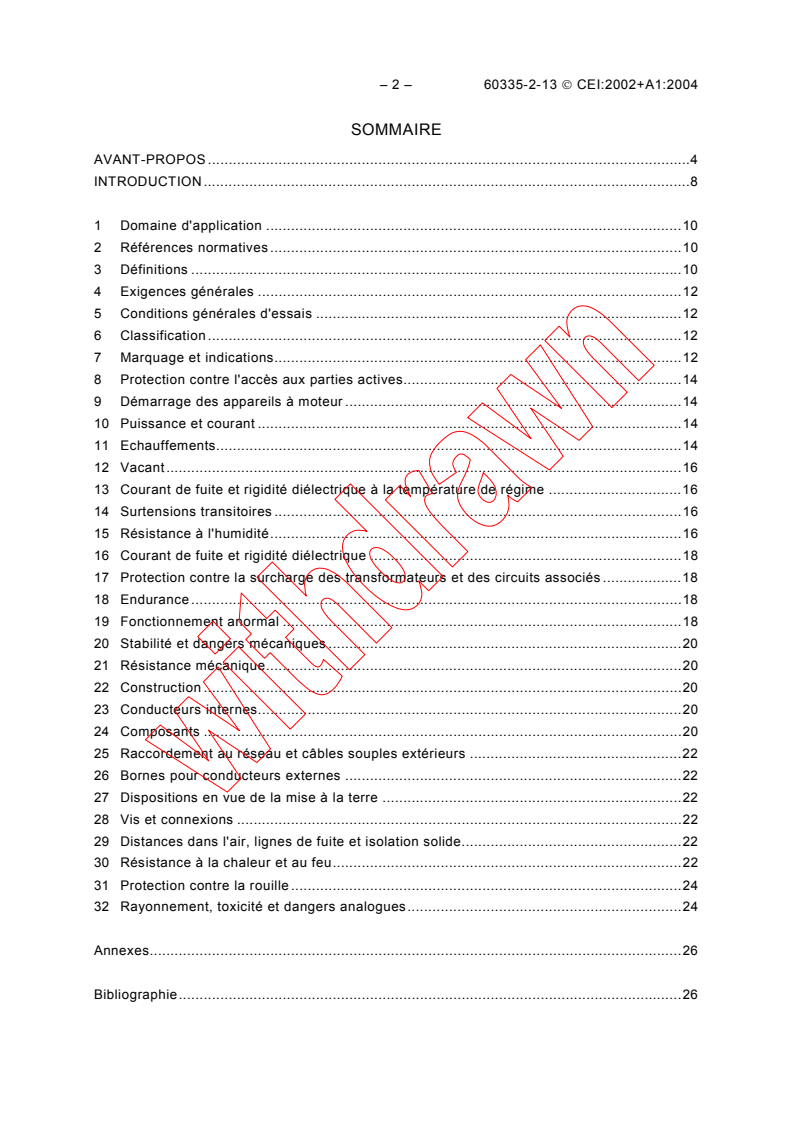
IEC 60335-2-13:2002+AMD1:2004 CSV - Appareils électrodomestiques et analogues - Sécurité - Partie 2-13: Regles particulieres pour les friteuses, les poeles a frire et appareils analogues Released:4/19/2005
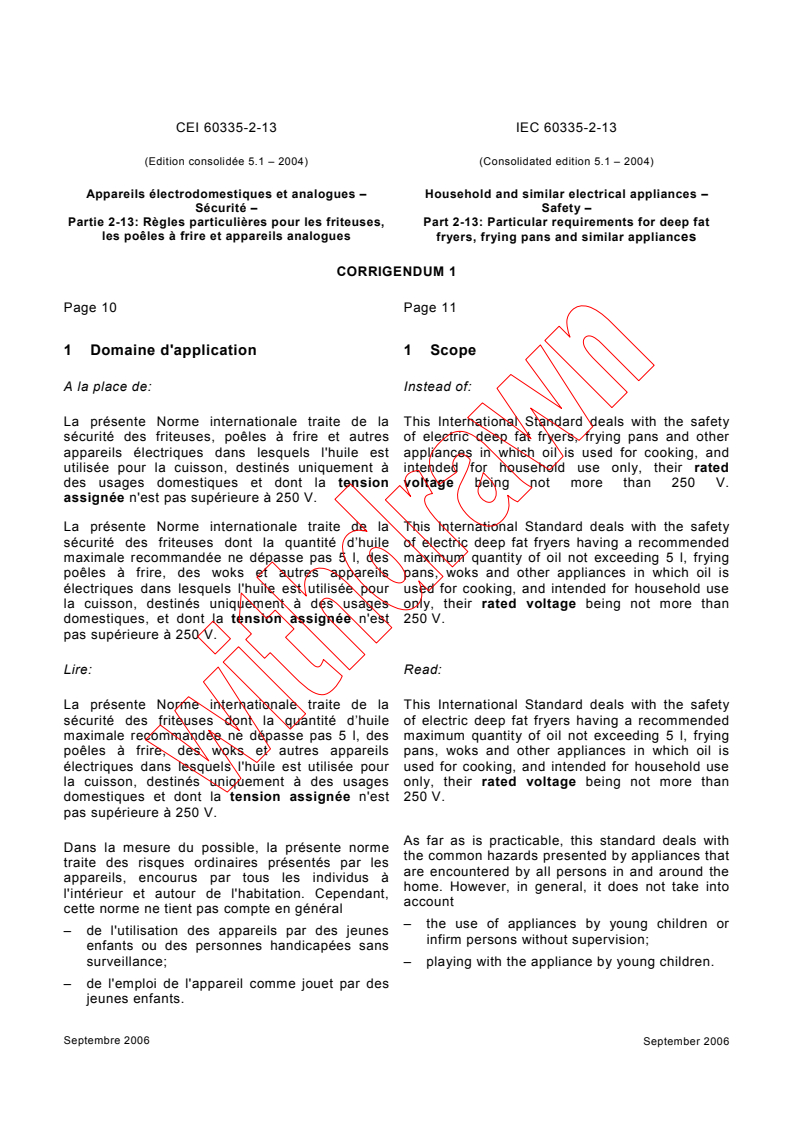


IEC 60335-2-13:2002+AMD1:2004 CSV/COR1:2006 - Corrigendum 1 - Household and similar electrical appliances - Safety - Part 2-13: Particular requirements for deep fat fryers, frying pans and similar appliances Released:9/21/2006
IEC 60335-2-13:2002 - Household and similar electrical appliances - Safety - Part 2-13: Particular requirements for deep fat fryers, frying pans and similar appliances Released:10/23/2002
IEC 60335-2-13:2002+AMD1:2004 CSV - Household and similar electrical appliances - Safety - Part 2-13: Particular requirements for deep fat fryers, frying pans and similar appliances Released:7/8/2004
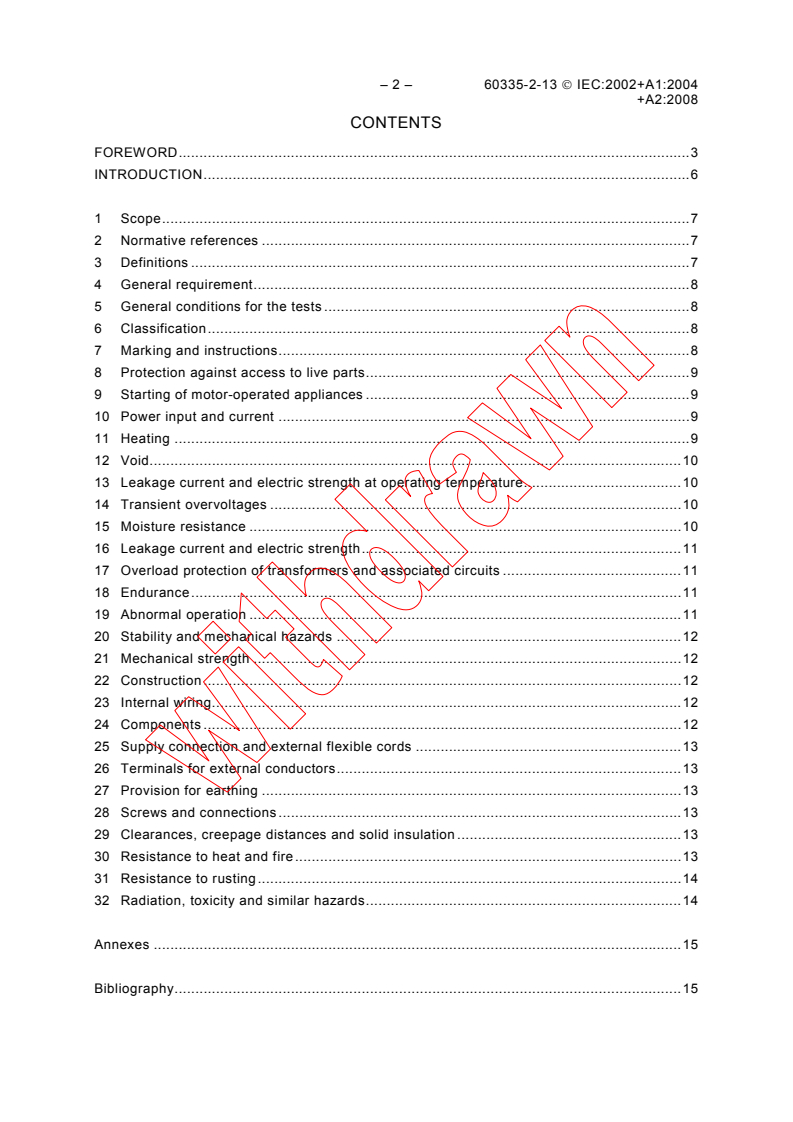
IEC 60335-2-13:2002+AMD1:2004+AMD2:2008 CSV - Household and similar electrical appliances - Safety - Part 2-13: Particular requirements for deep fat fryers, frying pans and similar appliances Released:3/27/2008
Overview
IEC 60335-2-13:2002 is an internationally recognized safety standard developed by the International Electrotechnical Commission (IEC). This standard specifies particular safety requirements for household electrical appliances such as deep fat fryers, frying pans, woks, and other domestic appliances that use oil for cooking, all with a rated voltage of no more than 250 V. Its purpose is to minimize electrical, thermal, and mechanical hazards associated with these appliances, ensuring a safer environment for consumers and domestic users.
The standard applies exclusively to household appliances and excludes:
- Electric deep fat fryers with an oil capacity exceeding 4 liters (covered by IEC 60335-2-37)
- Commercial multi-purpose cooking pans (covered by IEC 60335-2-39)
- Appliances used in specialized environments (such as those with corrosive or explosive atmospheres)
Key Topics
IEC 60335-2-13 addresses a wide range of safety considerations specific to oil-based cooking appliances, including but not limited to:
- Voltage and Capacity Limitations: Applicability is for devices not exceeding 250 V and oil capacity up to 4 liters.
- Electrical Safety: Requirements for electrical insulation, protection against access to live parts, leakage current, and overvoltage protection.
- Thermal Safety: Limits on oil temperature, protection against overheating, and measures to prevent fires.
- Mechanical Safety: Ensures the stability, structural integrity and mechanical strength of appliances to reduce accident risks.
- Moisture Resistance: Testing and requirements for appliances designed to be immersed partially or fully for cleaning.
- Marking and User Instructions: Clear labeling regarding maximum/minimum oil levels, cleaning instructions, and guidance to prevent improper use.
- Abnormal Operation: Testing conditions simulating foreseeable misuse or faults, securing safer appliance operation even in abnormal circumstances.
- Construction and Materials: Specifications for safe construction, fixed and flexible wiring, durability of components, and resistance to rust and corrosion.
Applications
IEC 60335-2-13 is essential for:
- Manufacturers of household electric deep fat fryers, frying pans, and similar appliances, serving as a benchmark for design and production to meet international safety requirements.
- Testing laboratories and certification bodies evaluating appliance compliance to ensure products conform to mandatory safety standards before reaching the market.
- Regulators and government authorities establishing import, sale, and market surveillance policies for domestic electrical products.
- Retailers and distributors seeking assurance that the products they stock meet relevant safety requirements, helping minimize liability and improve consumer trust.
- Consumers indirectly benefit, as adherence to this standard reduces the risk of household fires, electric shock, and other hazards associated with oil-based cooking appliances.
By following this standard, manufacturers can also facilitate smoother global trade, as IEC 60335-2-13 is internationally recognized and referenced in many national regulations.
Related Standards
Compliance with IEC 60335-2-13:2002 may require consideration of the following related standards:
- IEC 60335-1: General Requirements for Household and Similar Electrical Appliances - Part 1 forms the foundation onto which Part 2-13 adds specific requirements for oil-using cooking appliances.
- IEC 60335-2-37: Safety requirements for commercial deep fat fryers (oil capacities above 4 liters).
- IEC 60335-2-39: Requirements for commercial multi-purpose cooking pans.
- IEC 60320-1: Appliance couplers for household and similar general purposes, covering connectors used in some appliances.
- ISO 13732-1: Human responses to contact with hot surfaces.
Understanding and implementing the requirements of IEC 60335-2-13 enhances product safety, aids international acceptance, and helps to protect end-users from avoidable risks associated with the use of household oil-cooking appliances. For manufacturers and industry professionals, referencing this safety standard is an essential step in ensuring both regulatory compliance and customer confidence.
Relations
- Effective Date
- 05-Sep-2023
- Effective Date
- 05-Sep-2023
- Effective Date
- 05-Sep-2023
- Effective Date
- 05-Sep-2023
- Effective Date
- 05-Sep-2023
Buy Documents
IEC 60335-2-13:2002 - Household and similar electrical appliances - Safety - Part 2-13: Particular requirements for deep fat fryers, frying pans and similar appliances Released:10/23/2002
IEC 60335-2-13:2002+AMD1:2004 CSV - Household and similar electrical appliances - Safety - Part 2-13: Particular requirements for deep fat fryers, frying pans and similar appliances Released:7/8/2004
IEC 60335-2-13:2002+AMD1:2004 CSV - Appareils électrodomestiques et analogues - Sécurité - Partie 2-13: Regles particulieres pour les friteuses, les poeles a frire et appareils analogues Released:4/19/2005
IEC 60335-2-13:2002+AMD1:2004 CSV/COR1:2006 - Corrigendum 1 - Household and similar electrical appliances - Safety - Part 2-13: Particular requirements for deep fat fryers, frying pans and similar appliances Released:9/21/2006
IEC 60335-2-13:2002 - Household and similar electrical appliances - Safety - Part 2-13: Particular requirements for deep fat fryers, frying pans and similar appliances Released:10/23/2002
IEC 60335-2-13:2002+AMD1:2004 CSV - Household and similar electrical appliances - Safety - Part 2-13: Particular requirements for deep fat fryers, frying pans and similar appliances Released:7/8/2004
IEC 60335-2-13:2002+AMD1:2004+AMD2:2008 CSV - Household and similar electrical appliances - Safety - Part 2-13: Particular requirements for deep fat fryers, frying pans and similar appliances Released:3/27/2008
Get Certified
Connect with accredited certification bodies for this standard

CIS Institut d.o.o.
Personal Protective Equipment (PPE) certification body. Notified Body NB-2890 for EU Regulation 2016/425 PPE.

Kiwa BDA Testing
Building and construction product certification.
Kmetijski inštitut Slovenije
Agricultural Institute of Slovenia. Soil testing, plant health, agricultural product analysis.
Sponsored listings
Frequently Asked Questions
IEC 60335-2-13:2002 is a standard published by the International Electrotechnical Commission (IEC). Its full title is "Household and similar electrical appliances - Safety - Part 2-13: Particular requirements for deep fat fryers, frying pans and similar appliances". This standard covers: Deals with the safety of electric deep fat fryers, frying pans and other appliances in which oil is used for cooking, and intended for household use only, their rated voltage being not more than 250 V.This standard does not apply to deep fat fryers having a recommended maximum quantity of oil exceeding 4 l (refer to IEC 60335-2-37) or commercial multi-purpose cooking pans (refer to IEC 60335-2-39).
Deals with the safety of electric deep fat fryers, frying pans and other appliances in which oil is used for cooking, and intended for household use only, their rated voltage being not more than 250 V.This standard does not apply to deep fat fryers having a recommended maximum quantity of oil exceeding 4 l (refer to IEC 60335-2-37) or commercial multi-purpose cooking pans (refer to IEC 60335-2-39).
IEC 60335-2-13:2002 is classified under the following ICS (International Classification for Standards) categories: 13.120 - Domestic safety; 97.040.50 - Small kitchen appliances. The ICS classification helps identify the subject area and facilitates finding related standards.
IEC 60335-2-13:2002 has the following relationships with other standards: It is inter standard links to IEC 60335-2-13:2002/AMD1:2004, IEC 60335-2-13:2002/AMD2:2008, IEC 60335-2-13:2009, IEC 60335-2-13:1993/AMD2:1998, IEC 60335-2-13:1993. Understanding these relationships helps ensure you are using the most current and applicable version of the standard.
IEC 60335-2-13:2002 is available in PDF format for immediate download after purchase. The document can be added to your cart and obtained through the secure checkout process. Digital delivery ensures instant access to the complete standard document.
Standards Content (Sample)
INTERNATIONAL IEC
STANDARD
60335-2-13
Fifth edition
2002-10
Household and similar electrical appliances –
Safety –
Part 2-13:
Particular requirements for deep fat fryers,
frying pans and similar appliances
Appareils électrodomestiques et analogues –
Sécurité –
Partie 2-13:
Règles particulières pour les friteuses, les poêles à frire
et appareils analogues
Reference number
Publication numbering
As from 1 January 1997 all IEC publications are issued with a designation in the
60000 series. For example, IEC 34-1 is now referred to as IEC 60034-1.
Consolidated editions
The IEC is now publishing consolidated versions of its publications. For example,
edition numbers 1.0, 1.1 and 1.2 refer, respectively, to the base publication, the
base publication incorporating amendment 1 and the base publication incorporating
amendments 1 and 2.
Further information on IEC publications
The technical content of IEC publications is kept under constant review by the IEC,
thus ensuring that the content reflects current technology. Information relating to
this publication, including its validity, is available in the IEC Catalogue of
publications (see below) in addition to new editions, amendments and corrigenda.
Information on the subjects under consideration and work in progress undertaken
by the technical committee which has prepared this publication, as well as the list
of publications issued, is also available from the following:
• IEC Web Site (www.iec.ch)
• Catalogue of IEC publications
The on-line catalogue on the IEC web site (http://www.iec.ch/searchpub/cur_fut.htm)
enables you to search by a variety of criteria including text searches, technical
committees and date of publication. On-line information is also available on
recently issued publications, withdrawn and replaced publications, as well as
corrigenda.
• IEC Just Published
This summary of recently issued publications (http://www.iec.ch/online_news/
justpub/jp_entry.htm) is also available by email. Please contact the Customer
Service Centre (see below) for further information.
• Customer Service Centre
If you have any questions regarding this publication or need further assistance,
please contact the Customer Service Centre:
Email: custserv@iec.ch
Tel: +41 22 919 02 11
Fax: +41 22 919 03 00
INTERNATIONAL IEC
STANDARD
60335-2-13
Fifth edition
2002-10
Household and similar electrical appliances –
Safety –
Part 2-13:
Particular requirements for deep fat fryers,
frying pans and similar appliances
Appareils électrodomestiques et analogues –
Sécurité –
Partie 2-13:
Règles particulières pour les friteuses, les poêles à frire
et appareils analogues
IEC 2002 Copyright - all rights reserved
No part of this publication may be reproduced or utilized in any form or by any means, electronic or
mechanical, including photocopying and microfilm, without permission in writing from the publisher.
International Electrotechnical Commission, 3, rue de Varembé, PO Box 131, CH-1211 Geneva 20, Switzerland
Telephone: +41 22 919 02 11 Telefax: +41 22 919 03 00 E-mail: inmail@iec.ch Web: www.iec.ch
PRICE CODE
Commission Electrotechnique Internationale
M
International Electrotechnical Commission
Международная Электротехническая Комиссия
For price, see current catalogue
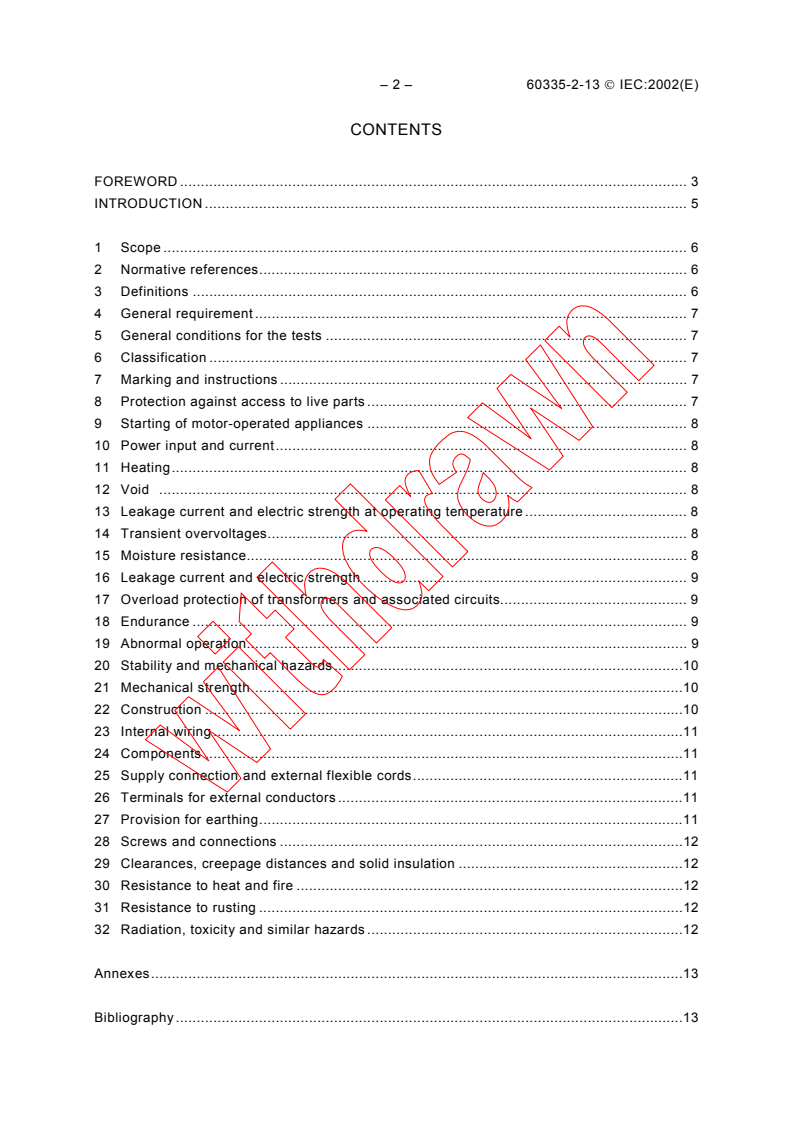
– 2 – 60335-2-13 IEC:2002(E)
CONTENTS
FOREWORD . 3
INTRODUCTION .5
1 Scope . 6
2 Normative references. 6
3 Definitions . 6
4 General requirement . 7
5 General conditions for the tests . 7
6 Classification . 7
7 Marking and instructions . 7
8 Protection against access to live parts . 7
9 Starting of motor-operated appliances . 8
10 Power input and current. 8
11 Heating. 8
12 Void . 8
13 Leakage current and electric strength at operating temperature . 8
14 Transient overvoltages. 8
15 Moisture resistance. 8
16 Leakage current and electric strength . 9
17 Overload protection of transformers and associated circuits. 9
18 Endurance . 9
19 Abnormal operation. 9
20 Stability and mechanical hazards.10
21 Mechanical strength.10
22 Construction .10
23 Internal wiring.11
24 Components .11
25 Supply connection and external flexible cords.11
26 Terminals for external conductors .11
27 Provision for earthing.11
28 Screws and connections .12
29 Clearances, creepage distances and solid insulation .12
30 Resistance to heat and fire .12
31 Resistance to rusting .12
32 Radiation, toxicity and similar hazards .12
Annexes.13
Bibliography.13
60335-2-13 IEC:2002(E) – 3 –
INTERNATIONAL ELECTROTECHNICAL COMMISSION
___________
HOUSEHOLD AND SIMILAR ELECTRICAL APPLIANCES –
SAFETY –
Part 2-13: Particular requirements for deep fat fryers,
frying pans and similar appliances
FOREWORD
1) The IEC (International Electrotechnical Commission) is a worldwide organization for standardization comprising
all national electrotechnical committees (IEC National Committees). The object of the IEC is to promote
international co-operation on all questions concerning standardization in the electrical and electronic fields. To
this end and in addition to other activities, the IEC publishes International Standards. Their preparation is
entrusted to technical committees; any IEC National Committee interested in the subject dealt with may
participate in this preparatory work. International, governmental and non-governmental organizations liaising
with the IEC also participate in this preparation. The IEC collaborates closely with the International
Organization for Standardization (ISO) in accordance with conditions determined by agreement between the
two organizations.
2) The formal decisions or agreements of the IEC on technical matters express, as nearly as possible, an
international consensus of opinion on the relevant subjects since each technical committee has representation
from all interested National Committees.
3) The documents produced have the form of recommendations for international use and are published in the form
of standards, technical specifications, technical reports or guides and they are accepted by the National
Committees in that sense.
4) In order to promote international unification, IEC National Committees undertake to apply IEC International
Standards transparently to the maximum extent possible in their national and regional standards. Any
divergence between the IEC Standard and the corresponding national or regional standard shall be clearly
indicated in the latter.
5) The IEC provides no marking procedure to indicate its approval and cannot be rendered responsible for any
equipment declared to be in conformity with one of its standards.
6) Attention is drawn to the possibility that some of the elements of this International Standard may be the subject
of patent rights. The IEC shall not be held responsible for identifying any or all such patent rights.
This part of International Standard IEC 60335 has been prepared by IEC technical committee
61: Safety of household and similar electrical appliances.
This fifth edition cancels and replaces the fourth edition published in 1993 and its
amendment 1 (1993) and amendment 2 (1999). It constitutes a technical revision.
The text of this standard is based on the following documents:
FDIS Report on voting
61/2202/FDIS 61/2283/RVD
Full information on the voting for the approval of this standard can be found in the report on
voting indicated in the above table.
This part 2 is to be used in conjunction with the latest edition of IEC 60335-1 and its
amendments. It was established on the basis of the fourth edition (2001) of that standard.
NOTE 1 When “Part 1” is mentioned in this standard, it refers to IEC 60335-1.
This part 2 supplements or modifies the corresponding clauses in IEC 60335-1, so as to
convert that publication into the IEC standard: Safety requirements for electric deep fat fryers,
frying pans and similar appliances.
– 4 – 60335-2-13 IEC:2002(E)
When a particular subclause of Part 1 is not mentioned in this part 2, that subclause applies
as far as is reasonable. When this standard states “addition”, “modification” or “replacement”,
the relevant text in Part 1 is to be adapted accordingly.
NOTE 2 The following numbering system is used:
– subclauses, tables and figures that are numbered starting from 101 are additional to those in Part 1;
– unless notes are in a new subclause or involve notes in Part 1, they are numbered starting from 101, including
those in a replaced clause or subclause;
– additional annexes are lettered AA, BB, etc.
NOTE 3 The following print types are used:
– requirements: in roman type;
– test specifications: in italic type;
– notes: in small roman type.
Words in bold in the text are defined in Clause 3. When a definition concerns an adjective, the adjective and the
associated noun are also in bold.
The committee has decided that the contents of this publication will remain unchanged until
2003. At this date, the publication will be
• reconfirmed;
• withdrawn;
• replaced by a revised edition, or
• amended.
The following differences exist in the countries indicated below.
– 3.1.9: Normal operation is different (USA).
– 7.1: Non-immersible appliances are required to be marked with a warning against immersion (Canada and
USA).
– 7.1: Appliances are required to be marked with the identity of the appropriate connector when it incorporates
a thermostat (Canada and USA).
– 11.2: Plywood 9,5 mm thick is used for the test corner (USA).
– 11.7: Appliances are operated until a specified quantity of food is cooked (USA).
– 11.8: The oil temperatures are higher (USA).
– 19.2: The test is different (USA).
– 19.13: The oil temperatures are higher (USA).
– 19.101: The test is not carried out (USA).
– 25.7: The types of cords are different (USA).
– 30.2: For frying pans, 30.2.3 applies (USA).
A bilingual version of this publication may be issued at a later date.
60335-2-13 IEC:2002(E) – 5 –
INTRODUCTION
It has been assumed in the drafting of this International Standard that the execution of its
provisions is entrusted to appropriately qualified and experienced persons.
This standard recognizes the internationally accepted level of protection against hazards such
as electrical, mechanical, thermal, fire and radiation of appliances when operated as in
normal use taking into account the manufacturer's instructions. It also covers abnormal
situations that can be expected in practice.
This standard takes into account the requirements of IEC 60364 as far as possible so that
there is compatibility with the wiring rules when the appliance is connected to the supply
mains. However, national wiring rules may differ.
If an appliance within the scope of this standard also incorporates functions that are covered
by another part 2 of IEC 60335, the relevant part 2 is applied to each function separately, as
far as is reasonable. If applicable, the influence of one function on the other is taken into
account.
This standard is a product family standard dealing with the safety of appliances and takes
precedence over horizontal and generic standards covering the same subject.
An appliance that complies with the text of this standard will not necessarily be considered to
comply with the safety principles of the standard if, when examined and tested, it is found to
have other features that impair the level of safety covered by these requirements.
An appliance employing materials or having forms of construction differing from those detailed
in the requirements of this standard may be examined and tested according to the intent of
the requirements and, if found to be substantially equivalent, may be considered to comply
with the standard.
– 6 – 60335-2-13 IEC:2002(E)
HOUSEHOLD AND SIMILAR ELECTRICAL APPLIANCES –
SAFETY –
Part 2-13: Particular requirements for deep fat fryers,
frying pans and similar appliances
1 Scope
This clause of Part 1 is replaced by the following.
This International Standard deals with the safety of electric deep fat fryers, frying pans and
other appliances in which oil is used for cooking, and intended for household use only, their
rated voltage being not more than 250 V.
As far as is practicable, this standard deals with the common hazards presented by
appliances that are encountered by all persons in and around the home. However, in general,
it does not take into account
– the use of appliances by young children or infirm persons without supervision;
– playing with the appliance by young children.
NOTE 101 Attention is drawn to the fact that
– for appliances intended to be used in vehicles or on board ships or aircraft, additional requirements may be
necessary;
– in many countries additional requirements are specified by the n
...
INTERNATIONAL IEC
STANDARD 60335-2-13
Edition 5.1
2004-07
Edition 5:2002 consolidated with amendment 1:2004
Household and similar electrical appliances –
Safety –
Part 2-13:
Particular requirements for deep fat fryers,
frying pans and similar appliances
Reference number
Publication numbering
As from 1 January 1997 all IEC publications are issued with a designation in the
60000 series. For example, IEC 34-1 is now referred to as IEC 60034-1.
Consolidated editions
The IEC is now publishing consolidated versions of its publications. For example,
edition numbers 1.0, 1.1 and 1.2 refer, respectively, to the base publication, the
base publication incorporating amendment 1 and the base publication incorporating
amendments 1 and 2.
Further information on IEC publications
The technical content of IEC publications is kept under constant review by the IEC,
thus ensuring that the content reflects current technology. Information relating to
this publication, including its validity, is available in the IEC Catalogue of
publications (see below) in addition to new editions, amendments and corrigenda.
Information on the subjects under consideration and work in progress undertaken
by the technical committee which has prepared this publication, as well as the list
of publications issued, is also available from the following:
• IEC Web Site (www.iec.ch)
• Catalogue of IEC publications
The on-line catalogue on the IEC web site (www.iec.ch/searchpub) enables you to
search by a variety of criteria including text searches, technical committees
and date of publication. On-line information is also available on recently issued
publications, withdrawn and replaced publications, as well as corrigenda.
• IEC Just Published
This summary of recently issued publications (www.iec.ch/online_news/ justpub)
is also available by email. Please contact the Customer Service Centre (see
below) for further information.
• Customer Service Centre
If you have any questions regarding this publication or need further assistance,
please contact the Customer Service Centre:
Email: custserv@iec.ch
Tel: +41 22 919 02 11
Fax: +41 22 919 03 00
INTERNATIONAL IEC
STANDARD 60335-2-13
Edition 5.1
2004-07
Edition 5:2002 consolidated with amendment 1:2004
Household and similar electrical appliances –
Safety –
Part 2-13:
Particular requirements for deep fat fryers,
frying pans and similar appliances
© IEC 2004 ⎯ Copyright - all rights reserved
No part of this publication may be reproduced or utilized in any form or by any means, electronic or
mechanical, including photocopying and microfilm, without permission in writing from the publisher.
International Electrotechnical Commission, 3, rue de Varembé, PO Box 131, CH-1211 Geneva 20, Switzerland
Telephone: +41 22 919 02 11 Telefax: +41 22 919 03 00 E-mail: inmail@iec.ch Web: www.iec.ch
PRICE CODE
Commission Electrotechnique Internationale M
International Electrotechnical Commission
ɆɟɠɞɭɧɚɪɨɞɧɚɹɗɥɟɤɬɪɨɬɟɯɧɢɱɟɫɤɚɹɄɨɦɢɫɫɢɹ
For price, see current catalogue
– 2 – 60335-2-13 © IEC:2002+A1:2004(E)
CONTENTS
FOREWORD.3
INTRODUCTION.5
1 Scope.6
2 Normative references.6
3 Definitions.6
4 General requirement.7
5 General conditions for the tests .7
6 Classification.7
7 Marking and instructions.7
8 Protection against access to live parts.8
9 Starting of motor-operated appliances .8
10 Power input and current .8
11 Heating.8
12 Void .8
13 Leakage current and electric strength at operating temperature.8
14 Transient overvoltages.9
15 Moisture resistance.9
16 Leakage current and electric strength.9
17 Overload protection of transformers and associated circuits .9
18 Endurance.9
19 Abnormal operation.10
20 Stability and mechanical hazards .10
21 Mechanical strength.10
22 Construction.11
23 Internal wiring.11
24 Components.11
25 Supply connection and external flexible cords .11
26 Terminals for external conductors.12
27 Provision for earthing.12
28 Screws and connections .12
29 Clearances, creepage distances and solid insulation .12
30 Resistance to heat and fire.12
31 Resistance to rusting.12
32 Radiation, toxicity and similar hazards.12
Annexes .13
Bibliography.13
60335-2-13 © IEC:2002+A1:2004(E) – 3 –
INTERNATIONAL ELECTROTECHNICAL COMMISSION
___________
HOUSEHOLD AND SIMILAR ELECTRICAL APPLIANCES –
SAFETY –
Part 2-13: Particular requirements for deep fat fryers,
frying pans and similar appliances
FOREWORD
1) The International Electrotechnical Commission (IEC) is a worldwide organization for standardization comprising
all national electrotechnical committees (IEC National Committees). The object of IEC is to promote
international co-operation on all questions concerning standardization in the electrical and electronic fields. To
this end and in addition to other activities, IEC publishes International Standards, Technical Specifications,
Technical Reports, Publicly Available Specifications (PAS) and Guides (hereafter referred to as “IEC
Publication(s)”). Their preparation is entrusted to technical committees; any IEC National Committee interested
in the subject dealt with may participate in this preparatory work. International, governmental and non-
governmental organizations liaising with the IEC also participate in this preparation. IEC collaborates closely
with the International Organization for Standardization (ISO) in accordance with conditions determined by
agreement between the two organizations.
2) The formal decisions or agreements of IEC on technical matters express, as nearly as possible, an international
consensus of opinion on the relevant subjects since each technical committee has representation from all
interested IEC National Committees.
3) IEC Publications have the form of recommendations for international use and are accepted by IEC National
Committees in that sense. While all reasonable efforts are made to ensure that the technical content of IEC
Publications is accurate, IEC cannot be held responsible for the way in which they are used or for any
misinterpretation by any end user.
4) In order to promote international uniformity, IEC National Committees undertake to apply IEC Publications
transparently to the maximum extent possible in their national and regional publications. Any divergence
between any IEC Publication and the corresponding national or regional publication shall be clearly indicated in
the latter.
5) IEC provides no marking procedure to indicate its approval and cannot be rendered responsible for any
equipment declared to be in conformity with an IEC Publication.
6) All users should ensure that they have the latest edition of this publication.
7) No liability shall attach to IEC or its directors, employees, servants or agents including individual experts and
members of its technical committees and IEC National Committees for any personal injury, property damage or
other damage of any nature whatsoever, whether direct or indirect, or for costs (including legal fees) and
expenses arising out of the publication, use of, or reliance upon, this IEC Publication or any other IEC
Publications.
8) Attention is drawn to the Normative references cited in this publication. Use of the referenced publications is
indispensable for the correct application of this publication.
9) Attention is drawn to the possibility that some of the elements of this IEC Publication may be the subject of
patent rights. IEC shall not be held responsible for identifying any or all such patent rights.
This part of International Standard IEC 60335 has been prepared by IEC technical committee
61: Safety of household and similar electrical appliances.
This consolidated version of IEC 60335-2-13 is based on the fifth edition (2002) [documents
61/2202/FDIS and 61/2283/RVD] and its amendment 1 (2004) [documents 61/2623/FDIS and
61/2678/RVD].
It bears the edition number 5.1.
A vertical line in the margin shows where the base publication has been modified by
amendment 1.
This publication has been drafted in accordance with the ISO/IEC Directives, Part 2.
– 4 – 60335-2-13 © IEC:2002+A1:2004(E)
This part 2 is to be used in conjunction with the latest edition of IEC 60335-1 and its
amendments. It was established on the basis of the fourth edition (2001) of that standard.
NOTE 1 When “Part 1” is mentioned in this standard, it refers to IEC 60335-1.
This part 2 supplements or modifies the corresponding clauses in IEC 60335-1, so as to
convert that publication into the IEC standard: Safety requirements for electric deep fat fryers,
frying pans and similar appliances.
When a particular subclause of Part 1 is not mentioned in this part 2, that subclause applies
as far as is reasonable. When this standard states “addition”, “modification” or “replacement”,
the relevant text in Part 1 is to be adapted accordingly.
NOTE 2 The following numbering system is used:
– subclauses, tables and figures that are numbered starting from 101 are additional to those in Part 1;
– unless notes are in a new subclause or involve notes in Part 1, they are numbered starting from 101, including
those in a replaced clause or subclause;
– additional annexes are lettered AA, BB, etc.
NOTE 3 The following print types are used:
– requirements: in roman type;
– test specifications: in italic type;
– notes: in small roman type.
Words in bold in the text are defined in Clause 3. When a definition concerns an adjective, the adjective and the
associated noun are also in bold.
The committee has decided that the contents of this publication will remain unchanged until
the maintenance result date indicated on the IEC web site under "http://webstore.iec.ch" in
the data related to the specific publication. At this date, the publication will be
• reconfirmed;
• withdrawn;
• replaced by a revised edition, or
• amended.
The following differences exist in the countries indicated below.
– 3.1.9: Normal operation is different (USA).
– 7.1: Non-immersible appliances are required to be marked with a warning against immersion (Canada and
USA).
– 7.1: Appliances are required to be marked with the identity of the appropriate connector when it incorporates
a thermostat (Canada and USA).
– 11.2: Plywood 9,5 mm thick is used for the test corner (USA).
– 11.7: Appliances are operated until a specified quantity of food is cooked (USA).
– 11.8: The oil temperatures are higher (USA).
– 19.2: The test is different (USA).
– 19.13: The oil temperatures are higher (USA).
– 19.101: The test is not carried out (USA).
– 25.7: The types of cords are different (USA).
– 30.2: For frying pans, 30.2.3 applies (USA).
A bilingual version of this publication may be issued at a later date.
60335-2-13 © IEC:2002+A1:2004(E) – 5 –
INTRODUCTION
It has been assumed in the drafting of this International Standard that the execution of its
provisions is entrusted to appropriately qualified and experienced persons.
This standard recognizes the internationally accepted level of protection against hazards such
as electrical, mechanical, thermal, fire and radiation of appliances when operated as in
normal use taking into account the manufacturer's instructions. It also covers abnormal
situations that can be expected in practice and takes into account the way in which
electromagnetic phenomena can affect the safe operation of appliances.
This standard takes into account the requirements of IEC 60364 as far as possible so that
there is compatibility with the wiring rules when the appliance is connected to the supply
mains. However, national wiring rules may differ.
If an appliance within the scope of this standard also incorporates functions that are covered
by another part 2 of IEC 60335, the relevant part 2 is applied to each function separately, as
far as is reasonable. If applicable, the influence of one function on the other is taken into
account.
This standard is a product family standard dealing with the safety of appliances and takes
precedence over horizontal and generic standards covering the same subject.
An appliance that complies with the text of this standard will not necessarily be considered to
comply with the safety principles of the standard if, when examined and tested, it is found to
have other features that impair the level of safety covered by these requirements.
An appliance employing materials or having forms of construction differing from those detailed
in the requirements of this standard may be examined and tested according to the intent of
the requirements and, if found to be substantially equivalent, may be considered to comply
with the standard.
– 6 – 60335-2-13 © IEC:2002+A1:2004(E)
HOUSEHOLD AND SIMILAR ELECTRICAL APPLIANCES –
SAFETY –
Part 2-13: Particular requirements for deep fat fryers,
frying pans and similar appliances
1 Scope
This clause of Part 1 is replaced by the following.
This International Standard deals with the safety of electric deep fat fryers having a
recommended maximum quantity of oil not exceeding 5 l, frying pans, woks and other
appliances in which oil is used for cooking, and intended for household use only, their rated
voltage being not more than 250 V.
As far as is practicable, this standard deals with the common hazards presented by
appliances that are encountered by all persons in and
...
NORME CEI
INTERNATIONALE 60335-2-13
Edition 5.1
2004-07
Edition 5:2002 consolidée par l’amendement 1:2004
Appareils électrodomestiques et analogues –
Sécurité –
Partie 2-13:
Règles particulières pour les friteuses,
les poêles à frire et appareils analogues
Cette version française découle de la publication d’origine
bilingue dont les pages anglaises ont été supprimées.
Les numéros de page manquants sont ceux des pages
supprimées.
Numéro de référence
CEI 60335-2-13:2002+A1:2004(F)
Numérotation des publications
Depuis le 1er janvier 1997, les publications de la CEI sont numérotées à partir de
60000. Ainsi, la CEI 34-1 devient la CEI 60034-1.
Editions consolidées
Les versions consolidées de certaines publications de la CEI incorporant les
amendements sont disponibles. Par exemple, les numéros d’édition 1.0, 1.1 et 1.2
indiquent respectivement la publication de base, la publication de base incorporant
l’amendement 1, et la publication de base incorporant les amendements 1 et 2.
Informations supplémentaires
sur les publications de la CEI
Le contenu technique des publications de la CEI est constamment revu par la CEI
afin qu'il reflète l'état actuel de la technique. Des renseignements relatifs à cette
publication, y compris sa validité, sont disponibles dans le Catalogue des
publications de la CEI (voir ci-dessous) en plus des nouvelles éditions, amende-
ments et corrigenda. Des informations sur les sujets à l’étude et l’avancement des
travaux entrepris par le comité d’études qui a élaboré cette publication, ainsi que la
liste des publications parues, sont également disponibles par l’intermédiaire de:
• Site web de la CEI (www.iec.ch)
• Catalogue des publications de la CEI
Le catalogue en ligne sur le site web de la CEI (www.iec.ch/searchpub) vous permet
de faire des recherches en utilisant de nombreux critères, comprenant des
recherches textuelles, par comité d’études ou date de publication. Des informations
en ligne sont également disponibles sur les nouvelles publications, les publications
remplacées ou retirées, ainsi que sur les corrigenda.
• IEC Just Published
Ce résumé des dernières publications parues (www.iec.ch/online_news/justpub)
est aussi disponible par courrier électronique. Veuillez prendre contact avec le
Service client (voir ci-dessous) pour plus d’informations.
• Service clients
Si vous avez des questions au sujet de cette publication ou avez besoin de
renseignements supplémentaires, prenez contact avec le Service clients:
Email: custserv@iec.ch
Tél: +41 22 919 02 11
Fax: +41 22 919 03 00
NORME CEI
INTERNATIONALE 60335-2-13
Edition 5.1
2004-07
Edition 1:2002 consolidée par l’amendement 1:2004
Appareils électrodomestiques et analogues –
Sécurité –
Partie 2-13:
Règles particulières pour les friteuses,
les poêles à frire et appareils analogues
© IEC 2005 Droits de reproduction réservés
Aucune partie de cette publication ne peut être reproduite ni utilisée sous quelque forme que ce soit et par aucun
procédé, électronique ou mécanique, y compris la photocopie et les microfilms, sans l'accord écrit de l'éditeur.
International Electrotechnical Commission, 3, rue de Varembé, PO Box 131, CH-1211 Geneva 20, Switzerland
Telephone: +41 22 919 02 11 Telefax: +41 22 919 03 00 E-mail: inmail@iec.ch Web: www.iec.ch
CODE PRIX
CD
Commission Electrotechnique Internationale
International Electrotechnical Commission
МеждународнаяЭлектротехническаяКомиссия
Pour prix, voir catalogue en vigueur
– 2 – 60335-2-13 CEI:2002+A1:2004
SOMMAIRE
AVANT-PROPOS .4
INTRODUCTION.8
1 Domaine d'application .10
2 Références normatives .10
3 Définitions .10
4 Exigences générales .12
5 Conditions générales d'essais .12
6 Classification.12
7 Marquage et indications.12
8 Protection contre l'accès aux parties actives.14
9 Démarrage des appareils à moteur .14
10 Puissance et courant .14
11 Echauffements.14
12 Vacant.16
13 Courant de fuite et rigidité diélectrique à la température de régime .16
14 Surtensions transitoires .16
15 Résistance à l'humidité.16
16 Courant de fuite et rigidité diélectrique .18
17 Protection contre la surcharge des transformateurs et des circuits associés .18
18 Endurance .18
19 Fonctionnement anormal .18
20 Stabilité et dangers mécaniques .20
21 Résistance mécanique.20
22 Construction .20
23 Conducteurs internes.20
24 Composants .20
25 Raccordement au réseau et câbles souples extérieurs .22
26 Bornes pour conducteurs externes .22
27 Dispositions en vue de la mise à la terre .22
28 Vis et connexions .22
29 Distances dans l'air, lignes de fuite et isolation solide.22
30 Résistance à la chaleur et au feu.22
31 Protection contre la rouille .24
32 Rayonnement, toxicité et dangers analogues.24
Annexes.26
Bibliographie.26
– 4 – 60335-2-13 © CEI:2002+A1:2004
COMMISSION ÉLECTROTECHNIQUE INTERNATIONALE
____________
APPAREILS ÉLECTRODOMESTIQUES ET ANALOGUES –
SÉCURITÉ –
Partie 2-13: Règles particulières pour les friteuses,
les poêles à frire et appareils analogues
AVANT-PROPOS
1) La Commission Electrotechnique Internationale (CEI) est une organisation mondiale de normalisation
composée de l'ensemble des comités électrotechniques nationaux (Comités nationaux de la CEI). La CEI a
pour objet de favoriser la coopération internationale pour toutes les questions de normalisation dans les
domaines de l'électricité et de l'électronique. A cet effet, la CEI – entre autres activités – publie des Normes
internationales, des Spécifications techniques, des Rapports techniques, des Spécifications accessibles au
public (PAS) et des Guides (ci-après dénommés "Publication(s) de la CEI"). Leur élaboration est confiée à des
comités d'études, aux travaux desquels tout Comité national intéressé par le sujet traité peut participer. Les
organisations internationales, gouvernementales et non gouvernementales, en liaison avec la CEI, participent
également aux travaux. La CEI collabore étroitement avec l'Organisation Internationale de Normalisation (ISO),
selon des conditions fixées par accord entre les deux organisations.
2) Les décisions ou accords officiels de la CEI concernant les questions techniques représentent, dans la mesure
du possible, un accord international sur les sujets étudiés, étant donné que les Comités nationaux de la CEI
intéressés sont représentés dans chaque comité d’études.
3) Les Publications de la CEI se présentent sous la forme de recommandations internationales et sont agréées
comme telles par les Comités nationaux de la CEI. Tous les efforts raisonnables sont entrepris afin que la CEI
s'assure de l'exactitude du contenu technique de ses publications; la CEI ne peut pas être tenue responsable
de l'éventuelle mauvaise utilisation ou interprétation qui en est faite par un quelconque utilisateur final.
4) Dans le but d'encourager l'unification internationale, les Comités nationaux de la CEI s'engagent, dans toute la
mesure possible, à appliquer de façon transparente les Publications de la CEI dans leurs publications
nationales et régionales. Toutes divergences entre toutes Publications de la CEI et toutes publications
nationales ou régionales correspondantes doivent être indiquées en termes clairs dans ces dernières.
5) La CEI n’a prévu aucune procédure de marquage valant indication d’approbation et n'engage pas sa
responsabilité pour les équipements déclarés conformes à une de ses Publications.
6) Tous les utilisateurs doivent s'assurer qu'ils sont en possession de la dernière édition de cette publication.
7) Aucune responsabilité ne doit être imputée à la CEI, à ses administrateurs, employés, auxiliaires ou
mandataires, y compris ses experts particuliers et les membres de ses comités d'études et des Comités
nationaux de la CEI, pour tout préjudice causé en cas de dommages corporels et matériels, ou de tout autre
dommage de quelque nature que ce soit, directe ou indirecte, ou pour supporter les coûts (y compris les frais
de justice) et les dépenses découlant de la publication ou de l'utilisation de cette Publication de la CEI ou de
toute autre Publication de la CEI, ou au crédit qui lui est accordé.
8) L'attention est attirée sur les références normatives citées dans cette publication. L'utilisation de publications
référencées est obligatoire pour une application correcte de la présente publication.
9) L’attention est attirée sur le fait que certains des éléments de la présente Publication de la CEI peuvent faire
l’objet de droits de propriété intellectuelle ou de droits analogues. La CEI ne saurait être tenue pour
responsable de ne pas avoir identifié de tels droits de propriété et de ne pas avoir signalé leur existence.
La présente partie de la Norme internationale CEI 60335 a été établie par le comité
d’études 61 de la CEI: Sécurité des appareils électrodomestiques et analogues.
La présente version consolidée de la CEI 60335-2-13 comprend la cinquième édition (2002)
[documents 61/2202/FDIS et 61/2283/RVD], son amendement 1 (2004) [documents
61/2623/FDIS et 61/2678/RVD].
Le contenu technique de cette version consolidée est donc identique à celui de l'édition de
base et à son amendement; cette version a été préparée par commodité pour l'utilisateur.
Elle porte le numéro d'édition 5.1.
Une ligne verticale dans la marge indique où la publication de base a été modifiée par
l’amendement 1.
La version française de cette norme n’a pas été soumise au vote.
– 6 – 60335-2-13 CEI:2002+A1:2004
La présente partie 2 doit être utilisée conjointement avec la dernière édition de la CEI 60335-1 et
ses amendements. Elle a été établie sur la base de la quatrième édition (2001) de cette norme.
NOTE 1 L’expression «Partie 1» utilisée dans la présente norme fait référence à la CEI 60335-1.
La présente partie 2 complète ou modifie les articles correspondants de la CEI 60335-1 de
façon à transformer cette publication en norme CEI: Règles de sécurité pour les friteuses, les
poêles à frire et appareils électriques analogues.
Lorsqu'un paragraphe particulier de la Partie 1 n'est pas mentionné dans cette partie 2,
ce paragraphe s'applique pour autant qu'il est raisonnable. Lorsque la présente norme
spécifie «addition», «modification» ou «remplacement», le texte correspondant de la Partie 1
doit être adapté en conséquence.
NOTE 2 Le système de numérotation suivant est utilisé:
– paragraphes, tableaux et figures: ceux qui sont numérotés à partir de 101 sont complémentaires à ceux de la
Partie 1;
– notes: à l’exception de celles qui sont dans un nouveau paragraphe ou de celles qui concernent des notes de
la Partie 1, les notes sont numérotées à partir de 101, y compris celles des articles ou paragraphes qui sont
modifiés ou remplacés;
– les annexes supplémentaires sont appelées AA, BB, etc.
NOTE 3 Les caractères d'imprimerie suivants sont utilisés:
– exigences: caractères romains;
– modalités d'essais: caractères italiques;
– notes: petits caractères romains.
Les mots en gras dans le texte sont définis à l'Article 3. Lorsqu'une définition concerne un adjectif, l'adjectif et le
nom associé figurent également en gras.
Le comité a décidé que le contenu de cette publication ne sera pas modifié avant la date de
maintenance indiquée sur le site web de la CEI sous «http://webstore.iec.ch» dans les
données relatives à la publication recherchée. A cette date, la publication sera
• reconduite,
• supprimée,
• remplacée par une édition révisée, ou
• amendée.
Les différences suivantes existent dans les pays indiqués ci-après.
– 3.1.9: Les conditions de fonctionnement normal sont différentes (USA).
– 7.1: Les appareils qui ne peuvent être immergés doivent porter un avertissement contre l'immersion (Canada
et USA).
– 7.1: Les appareils doivent porter l'identification de la prise mobile de connecteur appropriée quand le
connecteur comporte un thermostat (Canada et USA).
– 11.2: Du contreplaqué de 9,5 mm d'épaisseur est utilisé pour le coin d’essai (USA).
– 11.7: Les appareils sont mis en fonctionnement jusqu'à ce qu'une quantité spécifiée d'aliments soit cuite
(USA).
– 11.8: Les températures de l'huile sont plus élevées (USA).
– 19.2: L’essai est différent (USA).
– 19.13: Les températures de l'huile sont plus élevées (USA).
– 19.101: L’essai n’est pas effectué (USA).
– 25.7: Les types de câbles sont différents (USA).
– 30.2: Pour les poêles à frire, le 30.2.3 est applicable (USA).
Cette version bilingue (2005-04) remplace la version monolingue anglaise.
– 8 – 60335-2-13 CEI:2002+A1:2004
INTRODUCTION
Il a été considéré en établissant la présente Norme internationale que l'exécution de ses
dispositions était confiée à des personnes expérimentées et ayant une qualification
appropriée.
Cette norme reconnaît le niveau de protection internationalement accepté contre les risques
électriques, mécaniques, thermiques, liés au feu et au rayonnement des appareils, lorsqu'ils
fonctionnent comme en usage normal en tenant compte des instructions du fabricant. Elle
couvre également les situations anormales auxquelles on peut s'attendre dans la pratique et
prend en considération les phénomènes électromagnétiques qui peuvent affecter le
fonctionnement en toute sécurité des appareils.
Cette norme tient compte autant que possible des exigences de la CEI 60364, de façon à
rester compatible avec les règles d'installation quand l’appareil est raccordé au réseau
d’alimentation. Cependant, des règles nationales d'installation peuvent être différentes.
Si un appareil compris dans le domaine d’application de cette norme comporte également des
fonctions qui sont couvertes par une autre partie 2 de la CEI 60335, la partie 2
correspondante est
...
CEI 60335-2-13 IEC 60335-2-13
(Edition consolidée 5.1 – 2004) (Consolidated edition 5.1 – 2004)
Appareils électrodomestiques et analogues – Household and similar electrical appliances –
Sécurité – Safety –
Partie 2-13: Règles particulières pour les friteuses, Part 2-13: Particular requirements for deep fat
les poêles à frire et appareils analogues
fryers, frying pans and similar appliances
CORRIGENDUM 1
Page 10 Page 11
1 Domaine d'application 1 Scope
A la place de: Instead of:
La présente Norme internationale traite de la This International Standard deals with the safety
sécurité des friteuses, poêles à frire et autres of electric deep fat fryers, frying pans and other
appareils électriques dans lesquels l'huile est appliances in which oil is used for cooking, and
utilisée pour la cuisson, destinés uniquement à intended for household use only, their rated
des usages domestiques et dont la tension voltage being not more than 250 V.
assignée n'est pas supérieure à 250 V.
La présente Norme internationale traite de la This International Standard deals with the safety
sécurité des friteuses dont la quantité d’huile of electric deep fat fryers having a recommended
maximale recommandée ne dépasse pas 5 l, des maximum quantity of oil not exceeding 5 l, frying
poêles à frire, des woks et autres appareils pans, woks and other appliances in which oil is
électriques dans lesquels l'huile est utilisée pour used for cooking, and intended for household use
la cuisson, destinés uniquement à des usages only, their rated voltage being not more than
...
NORME CEI
INTERNATIONALE IEC
60335-2-13
INTERNATIONAL
Cinquième édition
STANDARD
Fifth edition
2002-10
Appareils électrodomestiques et analogues –
Sécurité –
Partie 2-13:
Règles particulières pour les friteuses,
les poêles à frire et appareils analogues
Household and similar electrical appliances –
Safety –
Part 2-13:
Particular requirements for deep fat fryers,
frying pans and similar appliances
Numéro de référence
Reference number
CEI/IEC 60335-2-13:2005
Numérotation des publications Publication numbering
Depuis le 1er janvier 1997, les publications de la CEI As from 1 January 1997 all IEC publications are
sont numérotées à partir de 60000. Ainsi, la CEI 34-1 issued with a designation in the 60000 series. For
devient la CEI 60034-1. example, IEC 34-1 is now referred to as IEC 60034-1.
Editions consolidées Consolidated editions
Les versions consolidées de certaines publications de la The IEC is now publishing consolidated versions of its
CEI incorporant les amendements sont disponibles. Par publications. For example, edition numbers 1.0, 1.1
exemple, les numéros d’édition 1.0, 1.1 et 1.2 indiquent and 1.2 refer, respectively, to the base publication,
respectivement la publication de base, la publication de the base publication incorporating amendment 1 and
base incorporant l’amendement 1, et la publication de the base publication incorporating amendments 1
base incorporant les amendements 1 et 2. and 2.
Informations supplémentaires Further information on IEC publications
sur les publications de la CEI
Le contenu technique des publications de la CEI est The technical content of IEC publications is kept
constamment revu par la CEI afin qu'il reflète l'état under constant review by the IEC, thus ensuring that
actuel de la technique. Des renseignements relatifs à the content reflects current technology. Information
cette publication, y compris sa validité, sont dispo- relating to this publication, including its validity, is
nibles dans le Catalogue des publications de la CEI available in the IEC Catalogue of publications
(voir ci-dessous) en plus des nouvelles éditions, (see below) in addition to new editions, amendments
amendements et corrigenda. Des informations sur les and corrigenda. Information on the subjects under
sujets à l’étude et l’avancement des travaux entrepris consideration and work in progress undertaken by the
par le comité d’études qui a élaboré cette publication, technical committee which has prepared this
ainsi que la liste des publications parues, sont publication, as well as the list of publications issued,
également disponibles par l’intermédiaire de: is also available from the following:
• Site web de la CEI (www.iec.ch) • IEC Web Site (www.iec.ch)
• Catalogue des publications de la CEI • Catalogue of IEC publications
Le catalogue en ligne sur le site web de la CEI The on-line catalogue on the IEC web site
(www.iec.ch/searchpub) vous permet de faire des (www.iec.ch/searchpub) enables you to search by a
recherches en utilisant de nombreux critères, variety of criteria including text searches,
comprenant des recherches textuelles, par comité technical committees and date of publication. On-
d’études ou date de publication. Des informations en line information is also available on recently
ligne sont également disponibles sur les nouvelles issued publications, withdrawn and replaced
publications, les publications remplacées ou retirées, publications, as well as corrigenda.
ainsi que sur les corrigenda.
• IEC Just Published • IEC Just Published
Ce résumé des dernières publications parues This summary of recently issued publications
(www.iec.ch/online_news/justpub) est aussi dispo- (www.iec.ch/online_news/justpub) is also available
nible par courrier électronique. Veuillez prendre by email. Please contact the Customer Service
contact avec le Service client (voir ci-dessous) Centre (see below) for further information.
pour plus d’informations.
• Service clients • Customer Service Centre
Si vous avez des questions au sujet de cette If you have any questions regarding this
publication ou avez besoin de renseignements publication or need further assistance, please
supplémentaires, prenez contact avec le Service contact the Customer Service Centre:
clients:
Email: custserv@iec.ch Email: custserv@iec.ch
Tél: +41 22 919 02 11 Tel: +41 22 919 02 11
Fax: +41 22 919 03 00 Fax: +41 22 919 03 00
.
NORME CEI
INTERNATIONALE IEC
60335-2-13
INTERNATIONAL
Cinquième édition
STANDARD
Fifth edition
2002-10
Appareils électrodomestiques et analogues –
Sécurité –
Partie 2-13:
Règles particulières pour les friteuses,
les poêles à frire et appareils analogues
Household and similar electrical appliances –
Safety –
Part 2-13:
Particular requirements for deep fat fryers,
frying pans and similar appliances
IEC 2005 Droits de reproduction réservés Copyright - all rights reserved
Aucune partie de cette publication ne peut être reproduite ni No part of this publication may be reproduced or utilized in any
utilisée sous quelque forme que ce soit et par aucun procédé, form or by any means, electronic or mechanical, including
électronique ou mécanique, y compris la photocopie et les photocopying and microfilm, without permission in writing from
microfilms, sans l'accord écrit de l'éditeur. the publisher.
International Electrotechnical Commission, 3, rue de Varembé, PO Box 131, CH-1211 Geneva 20, Switzerland
Telephone: +41 22 919 02 11 Telefax: +41 22 919 03 00 E-mail: inmail@iec.ch Web: www.iec.ch
CODE PRIX
Commission Electrotechnique Internationale PRICE CODE N
International Electrotechnical Commission
Международная Электротехническая Комиссия
Pour prix, voir catalogue en vigueur
For price, see current catalogue
– 2 – 60335-2-13 CEI:2005
SOMMAIRE
AVANT-PROPOS.4
INTRODUCTION.8
1 Domaine d'application.10
2 Références normatives .10
3 Définitions .10
4 Exigences générales .12
5 Conditions générales d'essais.12
6 Classification.12
7 Marquage et indications.12
8 Protection contre l'accès aux parties actives .14
9 Démarrage des appareils à moteur .14
10 Puissance et courant .14
11 Echauffements .14
12 Vacant .14
13 Courant de fuite et rigidité diélectrique à la température de régime.14
14 Surtensions transitoires .16
15 Résistance à l'humidité.16
16 Courant de fuite et rigidité diélectrique.16
17 Protection contre la surcharge des transformateurs et des circuits associés.16
18 Endurance.18
19 Fonctionnement anormal .18
20 Stabilité et dangers mécaniques .20
21 Résistance mécanique.20
22 Construction.20
23 Conducteurs internes.20
24 Composants .20
25 Raccordement au réseau et câbles souples extérieurs .22
26 Bornes pour conducteurs externes .22
27 Dispositions en vue de la mise à la terre .22
28 Vis et connexions .22
29 Distances dans l'air, lignes de fuite et isolation solide.22
30 Résistance à la chaleur et au feu .22
31 Protection contre la rouille .24
32 Rayonnement, toxicité et dangers analogues .24
Annexes .26
Bibliographie .26
60335-2-13 IEC:2005 – 3 –
CONTENTS
FOREWORD.5
INTRODUCTION.9
1 Scope .11
2 Normative references .11
3 Definitions .11
4 General requirement.13
5 General conditions for the tests .13
6 Classification.13
7 Marking and instructions .13
8 Protection against access to live parts .15
9 Starting of motor-operated appliances.15
10 Power input and current.15
11 Heating .15
12 Void .15
13 Leakage current and electric strength at operating temperature .15
14 Transient overvoltages .17
15 Moisture resistance .17
16 Leakage current and electric strength .17
17 Overload protection of transformers and associated circuits .17
18 Endurance.19
19 Abnormal operation .19
20 Stability and mechanical hazards .21
21 Mechanical strength .21
22 Construction.21
23 Internal wiring.21
24 Components .21
25 Supply connection and external flexible cords .23
26 Terminals for external conductors .23
27 Provision for earthing.23
28 Screws and connections .23
29 Clearances, creepage distances and solid insulation .23
30 Resistance to heat and fire .23
31 Resistance to rusting .25
32 Radiation, toxicity and similar hazards .25
Annexes .27
Bibliography .27
– 4 – 60335-2-13 CEI:2005
COMMISSION ÉLECTROTECHNIQUE INTERNATIONALE
____________
APPAREILS ÉLECTRODOMESTIQUES ET ANALOGUES –
SÉCURITÉ –
Partie 2-13: Règles particulières pour les friteuses,
les poêles à frire et appareils analogues
AVANT-PROPOS
1) La Commission Electrotechnique Internationale (CEI) est une organisation mondiale de normalisation
composée de l'ensemble des comités électrotechniques nationaux (Comités nationaux de la CEI). La CEI a
pour objet de favoriser la coopération internationale pour toutes les questions de normalisation dans les
domaines de l'électricité et de l'électronique. A cet effet, la CEI – entre autres activités – publie des Normes
internationales, des Spécifications techniques, des Rapports techniques, des Spécifications accessibles au
public (PAS) et des Guides (ci-après dénommés "Publication(s) de la CEI"). Leur élaboration est confiée à des
comités d'études, aux travaux desquels tout Comité national intéressé par le sujet traité peut participer. Les
organisations internationales, gouvernementales et non gouvernementales, en liaison avec la CEI, participent
également aux travaux. La CEI collabore étroitement avec l'Organisation Internationale de Normalisation (ISO),
selon des conditions fixées par accord entre les deux organisations.
2) Les décisions ou accords officiels de la CEI concernant les questions techniques représentent, dans la mesure
du possible, un accord international sur les sujets étudiés, étant donné que les Comités nationaux de la CEI
intéressés sont représentés dans chaque comité d’études.
3) Les Publications de la CEI se présentent sous la forme de recommandations internationales et sont agréées
comme telles par les Comités nationaux de la CEI. Tous les efforts raisonnables sont entrepris afin que la CEI
s'assure de l'exactitude du contenu technique de ses publications; la CEI ne peut pas être tenue responsable
de l'éventuelle mauvaise utilisation ou interprétation qui en est faite par un quelconque utilisateur final.
4) Dans le but d'encourager l'unification internationale, les Comités nationaux de la CEI s'engagent, dans toute la
mesure possible, à appliquer de façon transparente les Publications de la CEI dans leurs publications
nationales et régionales. Toutes divergences entre toutes Publications de la CEI et toutes publications
nationales ou régionales correspondantes doivent être indiquées en termes clairs dans ces dernières.
5) La CEI n’a prévu aucune procédure de marquage valant indication d’approbation et n'engage pas sa
responsabilité pour les équipements déclarés conformes à une de ses Publications.
6) Tous les utilisateurs doivent s'assurer qu'ils sont en possession de la dernière édition de cette publication.
7) Aucune responsabilité ne doit être imputée à la CEI, à ses administrateurs, employés, auxiliaires ou
mandataires, y compris ses experts particuliers et les membres de ses comités d'études et des Comités
nationaux de la CEI, pour tout préjudice causé en cas de dommages corporels et matériels, ou de tout autre
dommage de quelque nature que ce soit, directe ou indirecte, ou pour supporter les coûts (y compris les frais
de justice) et les dépenses découlant de la publication ou de l'utilisation de cette Publication de la CEI ou de
toute autre Publication de la CEI, ou au crédit qui lui est accordé.
8) L'attention est attirée sur les références normatives citées dans cette publication. L'utilisation de publications
référencées est obligatoire pour une application correcte de la présente publication.
9) L’attention est attirée sur le fait que certains des éléments de la présente Publication de la CEI peuvent faire
l’objet de droits de propriété intellectuelle ou de droits analogues. La CEI ne saurait être tenue pour
responsable de ne pas avoir identifié de tels droits de propriété et de ne pas avoir signalé leur existence.
La présente partie de la Norme internationale CEI 60335 a été établie par le comité
d’études 61 de la CEI: Sécurité des appareils électrodomestiques et analogues.
Cette cinquième édition annule et remplace la quatrième édition parue en 1993 et ses
amendements 1 (1993) et 2 (1999) dont elle constitue une révision technique.
Cette version bilingue (2005-04) remplace la version monolingue anglaise.
Le texte anglais de cette norme est issu des documents 61/2202/FDIS et 61/2283/RVD. Le
rapport de vote 61/2283/RVD donne toute information sur le vote ayant abouti à l’approbation
de cette norme.
60335-2-13 IEC:2005 – 5 –
INTERNATIONAL ELECTROTECHNICAL COMMISSION
___________
HOUSEHOLD AND SIMILAR ELECTRICAL APPLIANCES –
SAFETY –
Part 2-13: Particular requirements for deep fat fryers,
frying pans and similar appliances
FOREWORD
1) The International Electrotechnical Commission (IEC) is a worldwide organization for standardization comprising
all national electrotechnical committees (IEC National Committees). The object of IEC is to promote
international co-operation on all questions concerning standardization in the electrical and electronic fields. To
this end and in addition to other activities, IEC publishes International Standards, Technical Specifications,
Technical Reports, Publicly Available Specifications (PAS) and Guides (hereafter referred to as “IEC
Publication(s)”). Their preparation is entrusted to technical committees; any IEC National Committee interested
in the subject dealt with may participate in this preparatory work. International, governmental and non-
governmental organizations liaising with the IEC also participate in this preparation. IEC collaborates closely
with the International Organization for Standardization (ISO) in accordance with conditions determined by
agreement between the two organizations.
2) The formal decisions or agreements of IEC on technical matters express, as nearly as possible, an international
consensus of opinion on the relevant subjects since each technical committee has representation from all
interested IEC National Committees.
3) IEC Publications have the form of recommendations for international use and are accepted by IEC National
Committees in that sense. While all reasonable efforts are made to ensure that the technical content of IEC
Publications is accurate, IEC cannot be held responsible for the way in which they are used or for any
misinterpretation by any end user.
4) In order to promote international uniformity, IEC National Committees undertake to apply IEC Publications
transparently to the maximum extent possible in their national and regional publications. Any divergence
between any IEC Publication and the corresponding national or regional publication shall be clearly indicated in
the latter.
5) IEC provides no marking procedure to indicate its approval and cannot be rendered responsible for any
equipment declared to be in conformity with an IEC Publication.
6) All users should ensure that they have the latest edition of this publication.
7) No liability shall attach to IEC or its directors, employees, servants or agents including individual experts and
members of its technical committees and IEC National Committees for any personal injury, property damage or
other damage of any nature whatsoever, whether direct or indirect, or for costs (including legal fees) and
expenses arising out of the publication, use of, or reliance upon, this IEC Publication or any other IEC
Publications.
8) Attention is drawn to the Normative references cited in this publication. Use of the referenced publications is
indispensable for the correct application of this publication.
9) Attention is drawn to the possibility that some of the elements of this IEC Publication may be the subject of
patent rights. IEC shall not be held responsible for identifying any or all such patent rights.
This part of International Standard IEC 60335 has been prepared by IEC technical committee
61: Safety of household and similar electrical appliances.
This fifth edition cancels and replaces the fourth edition published in 1993 and its
amendment 1 (1993) and amendment 2 (1999). It constitutes a technical revision.
This bilingual version (2005-04) replaces the English version.
The text of this standard is based on the following documents:
FDIS Report on voting
61/2202/FDIS 61/2283/RVD
Full information on the voting for the approval of this standard can be found in the report on
voting indicated in the above table.
– 6 – 60335-2-13 CEI:2005
La version française de cette norme n’a pas été soumise au vote.
La présente partie 2 doit être utilisée conjointement avec la dernière édition de la CEI 60335-1 et
ses amendements. Elle a été établie sur la base de la quatrième édition (2001) de cette norme.
NOTE 1 L’expression «Partie 1» utilisée dans la présente norme fait référence à la CEI 60335-1.
La présente partie 2 complète ou modifie les articles correspondants de la CEI 60335-1 de
façon à transformer cette publication en norme CEI: Règles de sécurité pour les friteuses, les
poêles à frire et appareils électriques analogues.
Lorsqu'un paragraphe particulier de la Partie 1 n'est pas mentionné dans cette partie 2,
ce paragraphe s'applique pour autant qu'il est raisonnable. Lorsque la présente norme
spécifie «addition», «modification» ou «remplacement», le texte correspondant de la Partie 1
doit être adapté en conséquence.
NOTE 2 Le système de numérotation suivant est utilisé:
– paragraphes, tableaux et figures: ceux qui sont numérotés à partir de 101 sont complémentaires à ceux de la
Partie 1;
– notes: à l’exception de celles qui sont dans un nouveau paragraphe ou de celles qui concernent des notes de
la Partie 1, les notes sont numérotées à partir de 101, y compris celles des articles ou paragraphes qui sont
modifiés ou remplacés;
– les annexes supplémentaires sont appelées AA, BB, etc.
NOTE 3 Les caractères d'imprimerie suivants sont utilisés:
– exigences: caractères romains;
– modalités d'essais: caractères italiques;
– notes: petits caractères romains.
Les mots en gras dans le texte sont définis à l'Article 3. Lorsqu'une définition concerne un adjectif, l'adjectif et le
nom associé figurent également en gras.
Le comité a décidé que le contenu de cette publication ne sera pas modifié avant la date de
maintenance indiquée sur le site web de la CEI sous «http://webstore.iec.ch» dans les
données relatives à la publication recherchée. A cette date, la publication sera
• reconduite,
• supprimée,
• remplacée par une édition révisée, ou
• amendée.
Les différences suivantes existent dans les pays indiqués ci-après.
– 3.1.9: Les conditions de fonctionnement normal sont différentes (USA).
– 7.1: Les appareils qui ne peuvent être immergés doivent porter un avertissement contre l'immersion (Canada
et USA).
– 7.1: Les appareils doivent porter l'identification de la prise mobile de connecteur appropriée quand le
connecteur comporte un thermostat (Canada et USA).
– 11.2: Du contreplaqué de 9,5 mm d'épaisseur est utilisé pour le coin d’essai (USA).
– 11.7: Les appareils sont mis en fonctionnement jusqu'à ce qu'une quantité spécifiée d'aliments soit cuite
(USA).
– 11.8: Les températures de l'huile sont plus élevées (USA).
– 19.2: L’essai est différent (USA).
– 19.13: Les températures de l'huile sont plus élevées (USA).
– 19.101: L’essai n’est pas effectué (USA).
– 25.7: Les types de câbles sont différents (USA).
– 30.2: Pour les poêles à frire, le 30.2.3 est applicable (USA).
60335-2-13 IEC:2005 – 7 –
The French version of this standard has not been voted upon.
This part 2 is to be used in conjunction with the latest edition of IEC 60335-1 and its
amendments. It was established on the basis of the fourth edition (2001) of that standard.
NOTE 1 When “Part 1” is mentioned in this standard, it refers to IEC 60335-1.
This part 2 supplements or modifies the corresponding clauses in IEC 60335-1, so as to
convert that publication into the IEC standard: Safety requirements for electric deep fat fryers,
frying pans and similar appliances.
When a particular subclause of Part 1 is not mentioned in this part 2, that subclause applies
as far as is reasonable. When this standard states “addition”, “modification” or “replacement”,
the relevant text in Part 1 is to be adapted accordingly.
NOTE 2 The following numbering system is used:
– subclauses, tables and figures that are numbered starting from 101 are additional to those in Part 1;
– unless notes are in a new subclause or involve notes in Part 1, they are numbered starting from 101, including
those in a replaced clause or subclause;
– additional annexes are lettered AA, BB, etc.
NOTE 3 The following print types are used:
– requirements: in roman type;
– test specifications: in italic type;
– notes: in small roman type.
Words in bold in the text are defined in Clause 3. When a definition concerns an adjective, the adjective and the
associated noun are also in bold.
The committee has decided that the contents of this publication will remain unchanged until
the maintenance result date indicated on the IEC web site under "http://webstore.iec.ch" in
the data related to the specific publication. At this date, the publication will be
• reconfirmed;
• withdrawn;
• replaced by a revised edition, or
• amended.
The following differences exist in the countries indicated below.
– 3.1.9: Normal operation is different (USA).
– 7.1: Non-immersible appliances are required to be marked with a warning against immersion (Canada and
USA).
– 7.1: Appliances are required to be marked with the identity of the appropriate connector when it incorporates
a thermostat (Canada and USA).
– 11.2: Plywood 9,5 mm thick is used for the test corner (USA).
– 11.7: Appliances are operated until a specified quantity of food is cooked (USA).
– 11.8: The oil temperatures are higher (USA).
– 19.2: The test is different (USA).
– 19.13: The oil temperatures are higher (USA).
– 19.101: The test is not carried out (USA).
– 25.7: The types of cords are different (USA).
– 30.2: For frying pans, 30.2.3 applies (USA).
– 8 – 60335-2-13 CEI:2005
INTRODUCTION
Il a été considéré en établissant la présente Norme internationale que l'exécution de ses
dispositions était confiée à des personnes expérimentées et ayant une qualification
appropriée.
Cette norme reconnaît le niveau de protection internationalement accepté contre les risques
électriques, mécaniques, thermiques, liés au feu et au rayonnement des appareils, lorsqu'ils
fonctionnent comme en usage normal en tenant compte des instructions du fabricant. Elle
couvre également les situations anormales auxquelles on peut s'attendre dans la pratique.
Cette norme tient compte autant que possible des exigences de la CEI 60364, de façon à
rester compatible avec les règles d'installation quand l’appareil est raccordé au réseau
d’alimentation. Cependant, des règles nationales d'installation peuvent être différentes.
Si un appareil compris dans le domaine d’application de cette norme comporte également des
fonctions qui sont couvertes par une autre partie 2 de la CEI 60335, la partie 2
correspondante est appliquée à chaque fonction séparément, dans la limite du raisonnable. Si
cela est applicable, on tient compte de l’influence d’une fonction sur les autres fonctions.
Cette norme est une norme de famille de produits traitant de la sécurité d’appareils et a
préséance sur les normes horizontales et génériques couvrant le même sujet.
Un appareil conforme au texte de la présente norme ne sera pas nécessairement jugé
conforme aux principes de sécurité de la norme si, lorsqu'il est examiné et soumis aux essais,
il apparaît qu'il présente d'autres caractéristiques qui compromettent le niveau de sécurité
visé par ces exigences.
Un appareil utilisant des matériaux ou présentant des modes de construction différents de
ceux décrits dans les exigences de cette norme peut être examiné et essayé en fonction de
l'objectif poursuivi par ces exigences et, s'il est jugé pratiquement équivalent, il peut être
estimé conforme aux principes de sécurité de la norme.
60335-2-13 IEC:2005 – 9 –
INTRODUCTION
It has been assumed in the drafting of this International Standard that the execution of its
provisions is entrusted to appropriately qualified and experienc
...
IEC 60335-2-13
Edition 5.1 2004-07
INTERNATIONAL
STANDARD
NORME
INTERNATIONALE
Household and similar electrical appliances – Safety –
Part 2-13: Particular requirements for deep fat fryers, frying pans and similar
appliances
Appareils électrodomestiques et analogues – Sécurité –
Partie 2-13: Règles particulières pour les friteuses, les poêles à frire et appareils
analogues
All rights reserved. Unless otherwise specified, no part of this publication may be reproduced or utilized in any form or by
any means, electronic or mechanical, including photocopying and microfilm, without permission in writing from either IEC or
IEC's member National Committee in the country of the requester.
If you have any questions about IEC copyright or have an enquiry about obtaining additional rights to this publication,
please contact the address below or your local IEC member National Committee for further information.
Droits de reproduction réservés. Sauf indication contraire, aucune partie de cette publication ne peut être reproduite
ni utilisée sous quelque forme que ce soit et par aucun procédé, électronique ou mécanique, y compris la photocopie
et les microfilms, sans l'accord écrit de la CEI ou du Comité national de la CEI du pays du demandeur.
Si vous avez des questions sur le copyright de la CEI ou si vous désirez obtenir des droits supplémentaires sur cette
publication, utilisez les coordonnées ci-après ou contactez le Comité national de la CEI de votre pays de résidence.
IEC Central Office
3, rue de Varembé
CH-1211 Geneva 20
Switzerland
Email: inmail@iec.ch
Web: www.iec.ch
About the IEC
The International Electrotechnical Commission (IEC) is the leading global organization that prepares and publishes
International Standards for all electrical, electronic and related technologies.
About IEC publications
The technical content of IEC publications is kept under constant review by the IEC. Please make sure that you have the
latest edition, a corrigenda or an amendment might have been published.
ƒ Catalogue of IEC publications: www.iec.ch/searchpub
The IEC on-line Catalogue enables you to search by a variety of criteria (reference number, text, technical committee,…).
It also gives information on projects, withdrawn and replaced publications.
ƒ IEC Just Published: www.iec.ch/online_news/justpub
Stay up to date on all new IEC publications. Just Published details twice a month all new publications released. Available
on-line and also by email.
ƒ Electropedia: www.electropedia.org
The world's leading online dictionary of electronic and electrical terms containing more than 20 000 terms and definitions
in English and French, with equivalent terms in additional languages. Also known as the International Electrotechnical
Vocabulary online.
ƒ Customer Service Centre: www.iec.ch/webstore/custserv
If you wish to give us your feedback on this publication or need further assistance, please visit the Customer Service
Centre FAQ or contact us:
Email: csc@iec.ch
Tel.: +41 22 919 02 11
Fax: +41 22 919 03 00
A propos de la CEI
La Commission Electrotechnique Internationale (CEI) est la première organisation mondiale qui élabore et publie des
normes internationales pour tout ce qui a trait à l'électricité, à l'électronique et aux technologies apparentées.
A propos des publications CEI
Le contenu technique des publications de la CEI est constamment revu. Veuillez vous assurer que vous possédez
l’édition la plus récente, un corrigendum ou amendement peut avoir été publié.
ƒ Catalogue des publications de la CEI: www.iec.ch/searchpub/cur_fut-f.htm
Le Catalogue en-ligne de la CEI vous permet d’effectuer des recherches en utilisant différents critères (numéro de référence,
texte, comité d’études,…). Il donne aussi des informations sur les projets et les publications retirées ou remplacées.
ƒ Just Published CEI: www.iec.ch/online_news/justpub
Restez informé sur les nouvelles publications de la CEI. Just Published détaille deux fois par mois les nouvelles
publications parues. Disponible en-ligne et aussi par email.
ƒ Electropedia: www.electropedia.org
Le premier dictionnaire en ligne au monde de termes électroniques et électriques. Il contient plus de 20 000 termes et
définitions en anglais et en français, ainsi que les termes équivalents dans les langues additionnelles. Egalement appelé
Vocabulaire Electrotechnique International en ligne.
ƒ Service Clients: www.iec.ch/webstore/custserv/custserv_entry-f.htm
Si vous désirez nous donner des commentaires sur cette publication ou si vous avez des questions, visitez le FAQ du
Service clients ou contactez-nous:
Email: csc@iec.ch
Tél.: +41 22 919 02 11
Fax: +41 22 919 03 00
IEC 60335-2-13
Edition 5.1 2004-07
INTERNATIONAL
STANDARD
NORME
INTERNATIONALE
Household and similar electrical appliances – Safety –
Part 2-13: Particular requirements for deep fat fryers, frying pans and similar
appliances
Appareils électrodomestiques et analogues – Sécurité –
Partie 2-13: Règles particulières pour les friteuses, les poêles à frire et appareils
analogues
INTERNATIONAL
ELECTROTECHNICAL
COMMISSION
COMMISSION
ELECTROTECHNIQUE
PRICE CODE
INTERNATIONALE
CD
CODE PRIX
ICS 13.120; 97.040.50 ISBN 2-8318-7951-5
– 2 – 60335-2-13 CEI:2002+A1:2004
SOMMAIRE
AVANT-PROPOS .4
INTRODUCTION.8
1 Domaine d'application .10
2 Références normatives .10
3 Définitions .10
4 Exigences générales .12
5 Conditions générales d'essais .12
6 Classification.12
7 Marquage et indications.12
8 Protection contre l'accès aux parties actives.14
9 Démarrage des appareils à moteur .14
10 Puissance et courant .14
11 Echauffements.14
12 Vacant.16
13 Courant de fuite et rigidité diélectrique à la température de régime .16
14 Surtensions transitoires .16
15 Résistance à l'humidité.16
16 Courant de fuite et rigidité diélectrique .18
17 Protection contre la surcharge des transformateurs et des circuits associés .18
18 Endurance .18
19 Fonctionnement anormal .18
20 Stabilité et dangers mécaniques .20
21 Résistance mécanique.20
22 Construction .20
23 Conducteurs internes.20
24 Composants .20
25 Raccordement au réseau et câbles souples extérieurs .22
26 Bornes pour conducteurs externes .22
27 Dispositions en vue de la mise à la terre .22
28 Vis et connexions .22
29 Distances dans l'air, lignes de fuite et isolation solide.22
30 Résistance à la chaleur et au feu.22
31 Protection contre la rouille .24
32 Rayonnement, toxicité et dangers analogues.24
Annexes.26
Bibliographie.26
60335-2-13 IEC:2002+A1:2004 – 3 –
CONTENTS
FOREWORD.5
INTRODUCTION.9
1 Scope.11
2 Normative references .11
3 Definitions .11
4 General requirement.13
5 General conditions for the tests .13
6 Classification.13
7 Marking and instructions.13
8 Protection against access to live parts.15
9 Starting of motor-operated appliances .15
10 Power input and current .15
11 Heating .15
12 Void.17
13 Leakage current and electric strength at operating temperature.17
14 Transient overvoltages .17
15 Moisture resistance .17
16 Leakage current and electric strength.19
17 Overload protection of transformers and associated circuits .19
18 Endurance.19
19 Abnormal operation .19
20 Stability and mechanical hazards .21
21 Mechanical strength .21
22 Construction .21
23 Internal wiring.21
24 Components .21
25 Supply connection and external flexible cords .23
26 Terminals for external conductors.23
27 Provision for earthing .23
28 Screws and connections .23
29 Clearances, creepage distances and solid insulation .23
30 Resistance to heat and fire.23
31 Resistance to rusting.25
32 Radiation, toxicity and similar hazards.25
Annexes .27
Bibliography.27
– 4 – 60335-2-13 © CEI:2002+A1:2004
COMMISSION ÉLECTROTECHNIQUE INTERNATIONALE
____________
APPAREILS ÉLECTRODOMESTIQUES ET ANALOGUES –
SÉCURITÉ –
Partie 2-13: Règles particulières pour les friteuses,
les poêles à frire et appareils analogues
AVANT-PROPOS
1) La Commission Electrotechnique Internationale (CEI) est une organisation mondiale de normalisation
composée de l'ensemble des comités électrotechniques nationaux (Comités nationaux de la CEI). La CEI a
pour objet de favoriser la coopération internationale pour toutes les questions de normalisation dans les
domaines de l'électricité et de l'électronique. A cet effet, la CEI – entre autres activités – publie des Normes
internationales, des Spécifications techniques, des Rapports techniques, des Spécifications accessibles au
public (PAS) et des Guides (ci-après dénommés "Publication(s) de la CEI"). Leur élaboration est confiée à des
comités d'études, aux travaux desquels tout Comité national intéressé par le sujet traité peut participer. Les
organisations internationales, gouvernementales et non gouvernementales, en liaison avec la CEI, participent
également aux travaux. La CEI collabore étroitement avec l'Organisation Internationale de Normalisation (ISO),
selon des conditions fixées par accord entre les deux organisations.
2) Les décisions ou accords officiels de la CEI concernant les questions techniques représentent, dans la mesure
du possible, un accord international sur les sujets étudiés, étant donné que les Comités nationaux de la CEI
intéressés sont représentés dans chaque comité d’études.
3) Les Publications de la CEI se présentent sous la forme de recommandations internationales et sont agréées
comme telles par les Comités nationaux de la CEI. Tous les efforts raisonnables sont entrepris afin que la CEI
s'assure de l'exactitude du contenu technique de ses publications; la CEI ne peut pas être tenue responsable
de l'éventuelle mauvaise utilisation ou interprétation qui en est faite par un quelconque utilisateur final.
4) Dans le but d'encourager l'unification internationale, les Comités nationaux de la CEI s'engagent, dans toute la
mesure possible, à appliquer de façon transparente les Publications de la CEI dans leurs publications
nationales et régionales. Toutes divergences entre toutes Publications de la CEI et toutes publications
nationales ou régionales correspondantes doivent être indiquées en termes clairs dans ces dernières.
5) La CEI n’a prévu aucune procédure de marquage valant indication d’approbation et n'engage pas sa
responsabilité pour les équipements déclarés conformes à une de ses Publications.
6) Tous les utilisateurs doivent s'assurer qu'ils sont en possession de la dernière édition de cette publication.
7) Aucune responsabilité ne doit être imputée à la CEI, à ses administrateurs, employés, auxiliaires ou
mandataires, y compris ses experts particuliers et les membres de ses comités d'études et des Comités
nationaux de la CEI, pour tout préjudice causé en cas de dommages corporels et matériels, ou de tout autre
dommage de quelque nature que ce soit, directe ou indirecte, ou pour supporter les coûts (y compris les frais
de justice) et les dépenses découlant de la publication ou de l'utilisation de cette Publication de la CEI ou de
toute autre Publication de la CEI, ou au crédit qui lui est accordé.
8) L'attention est attirée sur les références normatives citées dans cette publication. L'utilisation de publications
référencées est obligatoire pour une application correcte de la présente publication.
9) L’attention est attirée sur le fait que certains des éléments de la présente Publication de la CEI peuvent faire
l’objet de droits de propriété intellectuelle ou de droits analogues. La CEI ne saurait être tenue pour
responsable de ne pas avoir identifié de tels droits de propriété et de ne pas avoir signalé leur existence.
La présente partie de la Norme internationale CEI 60335 a été établie par le comité
d’études 61 de la CEI: Sécurité des appareils électrodomestiques et analogues.
La présente version consolidée de la CEI 60335-2-13 comprend la cinquième édition (2002)
[documents 61/2202/FDIS et 61/2283/RVD], son amendement 1 (2004) [documents
61/2623/FDIS et 61/2678/RVD].
Le contenu technique de cette version consolidée est donc identique à celui de l'édition de
base et à son amendement; cette version a été préparée par commodité pour l'utilisateur.
Elle porte le numéro d'édition 5.1.
Une ligne verticale dans la marge indique où la publication de base a été modifiée par
l’amendement 1.
La version française de cette norme n’a pas été soumise au vote.
60335-2-13 © IEC:2002+A1:2004 – 5 –
INTERNATIONAL ELECTROTECHNICAL COMMISSION
___________
HOUSEHOLD AND SIMILAR ELECTRICAL APPLIANCES –
SAFETY –
Part 2-13: Particular requirements for deep fat fryers,
frying pans and similar appliances
FOREWORD
1) The International Electrotechnical Commission (IEC) is a worldwide organization for standardization comprising
all national electrotechnical committees (IEC National Committees). The object of IEC is to promote
international co-operation on all questions concerning standardization in the electrical and electronic fields. To
this end and in addition to other activities, IEC publishes International Standards, Technical Specifications,
Technical Reports, Publicly Available Specifications (PAS) and Guides (hereafter referred to as “IEC
Publication(s)”). Their preparation is entrusted to technical committees; any IEC National Committee interested
in the subject dealt with may participate in this preparatory work. International, governmental and non-
governmental organizations liaising with the IEC also participate in this preparation. IEC collaborates closely
with the International Organization for Standardization (ISO) in accordance with conditions determined by
agreement between the two organizations.
2) The formal decisions or agreements of IEC on technical matters express, as nearly as possible, an international
consensus of opinion on the relevant subjects since each technical committee has representation from all
interested IEC National Committees.
3) IEC Publications have the form of recommendations for international use and are accepted by IEC National
Committees in that sense. While all reasonable efforts are made to ensure that the technical content of IEC
Publications is accurate, IEC cannot be held responsible for the way in which they are used or for any
misinterpretation by any end user.
4) In order to promote international uniformity, IEC National Committees undertake to apply IEC Publications
transparently to the maximum extent possible in their national and regional publications. Any divergence
between any IEC Publication and the corresponding national or regional publication shall be clearly indicated in
the latter.
5) IEC provides no marking procedure to indicate its approval and cannot be rendered responsible for any
equipment declared to be in conformity with an IEC Publication.
6) All users should ensure that they have the latest edition of this publication.
7) No liability shall attach to IEC or its directors, employees, servants or agents including individual experts and
members of its technical committees and IEC National Committees for any personal injury, property damage or
other damage of any nature whatsoever, whether direct or indirect, or for costs (including legal fees) and
expenses arising out of the publication, use of, or reliance upon, this IEC Publication or any other IEC
Publications.
8) Attention is drawn to the Normative references cited in this publication. Use of the referenced publications is
indispensable for the correct application of this publication.
9) Attention is drawn to the possibility that some of the elements of this IEC Publication may be the subject of
patent rights. IEC shall not be held responsible for identifying any or all such patent rights.
This part of International Standard IEC 60335 has been prepared by IEC technical committee 61:
Safety of household and similar electrical appliances.
This consolidated version of IEC 60335-2-13 consists of the fifth edition (2002) [documents
61/2202/FDIS and 61/2283/RVD] and its amendment 1 (2004) [documents 61/2623/FDIS and
61/2678/RVD].
The technical content is therefore identical to the base edition and its amendment and has
been prepared for user convenience.
It bears the edition number 5.1.
A vertical line in the margin shows where the base publication has been modified by
amendment 1.
The French version of this standard has not been voted upon.
– 6 – 60335-2-13 CEI:2002+A1:2004
La présente partie 2 doit être utilisée conjointement avec la dernière édition de la CEI 60335-1 et
ses amendements. Elle a été établie sur la base de la quatrième édition (2001) de cette norme.
NOTE 1 L’expression «Partie 1» utilisée dans la présente norme fait référence à la CEI 60335-1.
La présente partie 2 complète ou modifie les articles correspondants de la CEI 60335-1 de
façon à transformer cette publication en norme CEI: Règles de sécurité pour les friteuses, les
poêles à frire et appareils électriques analogues.
Lorsqu'un paragraphe particulier de la Partie 1 n'est pas mentionné dans cette partie 2,
ce paragraphe s'applique pour autant qu'il est raisonnable. Lorsque la présente norme
spécifie «addition», «modification» ou «remplacement», le texte correspondant de la Partie 1
doit être adapté en conséquence.
NOTE 2 Le système de numérotation suivant est utilisé:
– paragraphes, tableaux et figures: ceux qui sont numérotés à partir de 101 sont complémentaires à ceux de la
Partie 1;
– notes: à l’exception de celles qui sont dans un nouveau paragraphe ou de celles qui concernent des notes de
la Partie 1, les notes sont numérotées à partir de 101, y compris celles des articles ou paragraphes qui sont
modifiés ou remplacés;
– les annexes supplémentaires sont appelées AA, BB, etc.
NOTE 3 Les caractères d'imprimerie suivants sont utilisés:
– exigences: caractères romains;
– modalités d'essais: caractères italiques;
– notes: petits caractères romains.
Les mots en gras dans le texte sont définis à l'Article 3. Lorsqu'une définition concerne un adjectif, l'adjectif et le
nom associé figurent également en gras.
Le comité a décidé que le contenu de cette publication ne sera pas modifié avant la date de
maintenance indiquée sur le site web de la CEI sous «http://webstore.iec.ch» dans les
données relatives à la publication recherchée. A cette date, la publication sera
• reconduite,
• supprimée,
• remplacée par une édition révisée, ou
• amendée.
Les différences suivantes existent dans les pays indiqués ci-après.
– 3.1.9: Les conditions de fonctionnement normal sont différentes (USA).
– 7.1: Les appareils qui ne peuvent être immergés doivent porter un avertissement contre l'immersion (Canada
et USA).
– 7.1: Les appareils doivent porter l'identification de la prise mobile de connecteur appropriée quand le
connecteur comporte un thermostat (Canada et USA).
– 11.2: Du contreplaqué de 9,5 mm d'épaisseur est utilisé pour le coin d’essai (USA).
– 11.7: Les appareils sont mis en fonctionnement jusqu'à ce qu'une quantité spécifiée d'aliments soit cuite
(USA).
– 11.8: Les températures de l'huile sont plus élevées (USA).
– 19.2: L’essai est différent (USA).
– 19.13: Les températures de l'huile sont plus élevées (USA).
– 19.101: L’essai n’est pas effectué (USA).
– 25.7: Les types de câbles sont différents (USA).
– 30.2: Pour les poêles à frire, le 30.2.3 est applicable (USA).
Cette version bilingue (2005-04) remplace la version monolingue anglaise.
Le contenu du corrigendum de septembre 2006 a été pris en considération dans cet
exemplaire.
60335-2-13 IEC:2002+A1:2004 – 7 –
This part 2 is to be used in conjunction with the latest edition of IEC 60335-1 and its
amendments. It was established on the basis of the fourth edition (2001) of that standard.
NOTE 1 When “Part 1” is mentioned in this standard, it refers to IEC 60335-1.
This part 2 supplements or modifies the corresponding clauses in IEC 60335-1, so as to
convert that publication into the IEC standard: Safety requirements for electric deep fat fryers,
frying pans and similar appliances.
When a particular subclause of Part 1 is not mentioned in this part 2, that subclause applies
as far as is reasonable. When this standard states “addition”, “modification” or “replacement”,
the relevant text in Part 1 is to be adapted accordingly.
NOTE 2 The following numbering system is used:
– subclauses, tables and figures that are numbered starting from 101 are additional to those in Part 1;
– unless notes are in a new subclause or involve notes in Part 1, they are numbered starting from 101, including
those in a replaced clause or subclause;
– additional annexes are lettered AA, BB, etc.
NOTE 3 The following print types are used:
– requirements: in roman type;
– test specifications: in italic type;
– notes: in small roman type.
Words in bold in the text are defined in Clause 3. When a definition concerns an adjective, the adjective and the
associated noun are also in bold.
The committee has decided that the contents of this publication will remain unchanged until
the maintenance result date indicated on the IEC web site under "http://webstore.iec.ch" in
the data related to the specific publication. At this date, the publication will be
• reconfirmed;
• withdrawn;
• replaced by a revised edition, or
• amended.
The following differences exist in the countries indicated below.
– 3.1.9: Normal operation is different (USA).
– 7.1: Non-immersible appliances are required to be marked with a warning against immersion (Canada and
USA).
– 7.1: Appliances are required to be marked with the identity of the appropriate connector when it incorporates
a thermostat (Canada and USA).
– 11.2: Plywood 9,5 mm thick is used for the test corner (USA).
– 11.7: Appliances are operated until a specified quantity of food is cooked (USA).
– 11.8: The oil temperatures are higher (USA).
– 19.2: The test is different (USA).
– 19.13: The oil temperatures are higher (USA).
– 19.101: The test is not carried out (USA).
– 25.7: The types of cords are different (USA).
– 30.2: For frying pans, 30.2.3 applies (USA).
This bilingual version (2005-04) replaces the English version.
The contents of the corrigendum of September 2006 have been included in this copy.
– 8 – 60335-2-13 CEI:2002+A1:2004
INTRODUCTION
Il a été considéré en établissant la présente Norme internationale que l'exécution de ses
dispositions était confiée à des personnes expérimentées et ayant une qualification
appropriée.
Cette norme reconnaît le niveau de protection internationalement accepté contre les risques
électriques, mécaniques, thermiques, liés au feu et au rayonnement des appareils, lorsqu'ils
fonctionnent comme en usage normal en tenant compte des instructions du fabricant. Elle
couvre également les situations anormales auxquelles on peut s'attendre dans la pratique et
prend en considération les phénomènes électromagnétiques qui peuvent affecter le
fonctionnement en toute sécurité des appareils.
Cette norme tient compte autant que possible des exigences de la CEI 60364, de façon à
rester compatible avec les règles d'installation quand l’appareil est raccordé au réseau
d’alimentation. Cependant, des règles nationales d'installation peuvent être différentes.
Si un appareil compris dans le domaine d’application de cette norme comporte également des
fonctions qui sont couvertes par une autre partie 2 de la CEI 60335, la partie 2
correspondante est appliquée à chaque fonction séparément, dans la limite du raisonnable. Si
cela est applicable, on tient compte de l’influence d’une fonction sur les autres fonctions.
Cette norme est une norme de famille de produits traitant de la sécurité d’appareils et a
préséance sur les normes horizontales et génériques couvrant le même sujet.
Un appareil conforme au texte de la présente norme ne sera pas nécessairement jugé
conforme aux principes de sécurité de la norme si, lorsqu'il est examiné et soumis aux essais,
il apparaît qu'il présente d'autres caractéristiques qui compromettent le niveau de sécurité
visé par ces exigences.
Un appareil utilisant des matériaux ou présentant des modes de construction différents de
ceux décrits dans les exigences de cette norme peut être examiné et essayé en fonction de
l'objectif poursuivi par ces exigences et, s'il est jugé pratiquement équivalent, il peut être
estimé conforme aux principes de sécurité de la norme.
60335-2-13 IEC:2002+A1:2004 – 9 –
INTRODUCTION
It has been assumed in the drafting of this International Standard that the execution of its
provisions is entrusted to appropriately qualified and experienced persons.
This standard recognizes the internationally accepted level of protection against hazards such
as electrical, mechanical, thermal, fire and radiation of appliances when operated as in
normal use taking into account the manufacturer's instructions. It also covers abnormal
situations that can be expected in practice
...
IEC 60335-2-13
Edition 5.2 2008-03
INTERNATIONAL
STANDARD
NORME
INTERNATIONALE
Household and similar electrical appliances – Safety –
Part 2-13: Particular requirements for deep fat fryers, frying pans and similar
appliances
Appareils électrodomestiques et analogues – Sécurité –
Partie 2-13: Règles particulières pour les friteuses, les poêles à frire et appareils
analogues
All rights reserved. Unless otherwise specified, no part of this publication may be reproduced or utilized in any form or by
any means, electronic or mechanical, including photocopying and microfilm, without permission in writing from either IEC or
IEC's member National Committee in the country of the requester.
If you have any questions about IEC copyright or have an enquiry about obtaining additional rights to this publication,
please contact the address below or your local IEC member National Committee for further information.
Droits de reproduction réservés. Sauf indication contraire, aucune partie de cette publication ne peut être reproduite
ni utilisée sous quelque forme que ce soit et par aucun procédé, électronique ou mécanique, y compris la photocopie
et les microfilms, sans l'accord écrit de la CEI ou du Comité national de la CEI du pays du demandeur.
Si vous avez des questions sur le copyright de la CEI ou si vous désirez obtenir des droits supplémentaires sur cette
publication, utilisez les coordonnées ci-après ou contactez le Comité national de la CEI de votre pays de résidence.
IEC Central Office
3, rue de Varembé
CH-1211 Geneva 20
Switzerland
Email: inmail@iec.ch
Web: www.iec.ch
About the IEC
The International Electrotechnical Commission (IEC) is the leading global organization that prepares and publishes
International Standards for all electrical, electronic and related technologies.
About IEC publications
The technical content of IEC publications is kept under constant review by the IEC. Please make sure that you have the
latest edition, a corrigenda or an amendment might have been published.
ƒ Catalogue of IEC publications: www.iec.ch/searchpub
The IEC on-line Catalogue enables you to search by a variety of criteria (reference number, text, technical committee,…).
It also gives information on projects, withdrawn and replaced publications.
ƒ IEC Just Published: www.iec.ch/online_news/justpub
Stay up to date on all new IEC publications. Just Published details twice a month all new publications released. Available
on-line and also by email.
ƒ Electropedia: www.electropedia.org
The world's leading online dictionary of electronic and electrical terms containing more than 20 000 terms and definitions
in English and French, with equivalent terms in additional languages. Also known as the International Electrotechnical
Vocabulary online.
ƒ Customer Service Centre: www.iec.ch/webstore/custserv
If you wish to give us your feedback on this publication or need further assistance, please visit the Customer Service
Centre FAQ or contact us:
Email: csc@iec.ch
Tel.: +41 22 919 02 11
Fax: +41 22 919 03 00
A propos de la CEI
La Commission Electrotechnique Internationale (CEI) est la première organisation mondiale qui élabore et publie des
normes internationales pour tout ce qui a trait à l'électricité, à l'électronique et aux technologies apparentées.
A propos des publications CEI
Le contenu technique des publications de la CEI est constamment revu. Veuillez vous assurer que vous possédez
l’édition la plus récente, un corrigendum ou amendement peut avoir été publié.
ƒ Catalogue des publications de la CEI: www.iec.ch/searchpub/cur_fut-f.htm
Le Catalogue en-ligne de la CEI vous permet d’effectuer des recherches en utilisant différents critères (numéro de référence,
texte, comité d’études,…). Il donne aussi des informations sur les projets et les publications retirées ou remplacées.
ƒ Just Published CEI: www.iec.ch/online_news/justpub
Restez informé sur les nouvelles publications de la CEI. Just Published détaille deux fois par mois les nouvelles
publications parues. Disponible en-ligne et aussi par email.
ƒ Electropedia: www.electropedia.org
Le premier dictionnaire en ligne au monde de termes électroniques et électriques. Il contient plus de 20 000 termes et
définitions en anglais et en français, ainsi que les termes équivalents dans les langues additionnelles. Egalement appelé
Vocabulaire Electrotechnique International en ligne.
ƒ Service Clients: www.iec.ch/webstore/custserv/custserv_entry-f.htm
Si vous désirez nous donner des commentaires sur cette publication ou si vous avez des questions, visitez le FAQ du
Service clients ou contactez-nous:
Email: csc@iec.ch
Tél.: +41 22 919 02 11
Fax: +41 22 919 03 00
IEC 60335-2-13
Edition 5.2 2008-03
INTERNATIONAL
STANDARD
NORME
INTERNATIONALE
Household and similar electrical appliances – Safety –
Part 2-13: Particular requirements for deep fat fryers, frying pans and similar
appliances
Appareils électrodomestiques et analogues – Sécurité –
Partie 2-13: Règles particulières pour les friteuses, les poêles à frire et appareils
analogues
INTERNATIONAL
ELECTROTECHNICAL
COMMISSION
COMMISSION
ELECTROTECHNIQUE
PRICE CODE
INTERNATIONALE
CF
CODE PRIX
ICS 13.120; 97.040.50 ISBN 2-8318-9657-6
– 2 – 60335-2-13 © IEC:2002+A1:2004
+A2:2008
CONTENTS
FOREWORD.3
INTRODUCTION.6
1 Scope.7
2 Normative references .7
3 Definitions .7
4 General requirement.8
5 General conditions for the tests .8
6 Classification.8
7 Marking and instructions.8
8 Protection against access to live parts.9
9 Starting of motor-operated appliances .9
10 Power input and current .9
11 Heating .9
12 Void.10
13 Leakage current and electric strength at operating temperature.10
14 Transient overvoltages .10
15 Moisture resistance .10
16 Leakage current and electric strength.11
17 Overload protection of transformers and associated circuits .11
18 Endurance.11
19 Abnormal operation .11
20 Stability and mechanical hazards .12
21 Mechanical strength .12
22 Construction .12
23 Internal wiring.12
24 Components .12
25 Supply connection and external flexible cords .13
26 Terminals for external conductors.13
27 Provision for earthing .13
28 Screws and connections .13
29 Clearances, creepage distances and solid insulation .13
30 Resistance to heat and fire.13
31 Resistance to rusting.14
32 Radiation, toxicity and similar hazards.14
Annexes .15
Bibliography.15
60335-2-13 © IEC:2002+A1:2004 – 3 –
+A2:2008
INTERNATIONAL ELECTROTECHNICAL COMMISSION
___________
HOUSEHOLD AND SIMILAR ELECTRICAL APPLIANCES –
SAFETY –
Part 2-13: Particular requirements for deep fat fryers,
frying pans and similar appliances
FOREWORD
1) The International Electrotechnical Commission (IEC) is a worldwide organization for standardization comprising
all national electrotechnical committees (IEC National Committees). The object of IEC is to promote
international co-operation on all questions concerning standardization in the electrical and electronic fields. To
this end and in addition to other activities, IEC publishes International Standards, Technical Specifications,
Technical Reports, Publicly Available Specifications (PAS) and Guides (hereafter referred to as “IEC
Publication(s)”). Their preparation is entrusted to technical committees; any IEC National Committee interested
in the subject dealt with may participate in this preparatory work. International, governmental and non-
governmental organizations liaising with the IEC also participate in this preparation. IEC collaborates closely
with the International Organization for Standardization (ISO) in accordance with conditions determined by
agreement between the two organizations.
2) The formal decisions or agreements of IEC on technical matters express, as nearly as possible, an international
consensus of opinion on the relevant subjects since each technical committee has representation from all
interested IEC National Committees.
3) IEC Publications have the form of recommendations for international use and are accepted by IEC National
Committees in that sense. While all reasonable efforts are made to ensure that the technical content of IEC
Publications is accurate, IEC cannot be held responsible for the way in which they are used or for any
misinterpretation by any end user.
4) In order to promote international uniformity, IEC National Committees undertake to apply IEC Publications
transparently to the maximum extent possible in their national and regional publications. Any divergence
between any IEC Publication and the corresponding national or regional publication shall be clearly indicated in
the latter.
5) IEC provides no marking procedure to indicate its approval and cannot be rendered responsible for any
equipment declared to be in conformity with an IEC Publication.
6) All users should ensure that they have the latest edition of this publication.
7) No liability shall attach to IEC or its directors, employees, servants or agents including individual experts and
members of its technical committees and IEC National Committees for any personal injury, property damage or
other damage of any nature whatsoever, whether direct or indirect, or for costs (including legal fees) and
expenses arising out of the publication, use of, or reliance upon, this IEC Publication or any other IEC
Publications.
8) Attention is drawn to the Normative references cited in this publication. Use of the referenced publications is
indispensable for the correct application of this publication.
9) Attention is drawn to the possibility that some of the elements of this IEC Publication may be the subject of
patent rights. IEC shall not be held responsible for identifying any or all such patent rights.
This part of International Standard IEC 60335 has been prepared by IEC technical committee 61:
Safety of household and similar electrical appliances.
This consolidated version of IEC 60335-2-13 consists of the fifth edition (2002) [documents
61/2202/FDIS and 61/2283/RVD], its amendment 1 (2004) [documents 61/2623/FDIS and
61/2678/RVD], its amendment 2 (2008) [documents 61/3143/FDIS and 61/3221/RVD] and its
corrigendum of September 2006.
The technical content is therefore identical to the base edition and its amendments and has
been prepared for user convenience.
It bears the edition number 5.2.
A vertical line in the margin shows where the base publication has been modified by
amendments 1 and 2.
– 4 – 60335-2-13 © IEC:2002+A1:2004
+A2:2008
The French version of this standard has not been voted upon.
This part 2 is to be used in conjunction with the latest edition of IEC 60335-1 and its
amendments. It was established on the basis of the fourth edition (2001) of that standard.
NOTE 1 When “Part 1” is mentioned in this standard, it refers to IEC 60335-1.
This part 2 supplements or modifies the corresponding clauses in IEC 60335-1, so as to
convert that publication into the IEC standard: Safety requirements for electric deep fat fryers,
frying pans and similar appliances.
When a particular subclause of Part 1 is not mentioned in this part 2, that subclause applies
as far as is reasonable. When this standard states “addition”, “modification” or “replacement”,
the relevant text in Part 1 is to be adapted accordingly.
NOTE 2 The following numbering system is used:
– subclauses, tables and figures that are numbered starting from 101 are additional to those in Part 1;
– unless notes are in a new subclause or involve notes in Part 1, they are numbered starting from 101, including
those in a replaced clause or subclause;
– additional annexes are lettered AA, BB, etc.
NOTE 3 The following print types are used:
– requirements: in roman type;
– test specifications: in italic type;
– notes: in small roman type.
Words in bold in the text are defined in Clause 3. When a definition concerns an adjective, the adjective and the
associated noun are also in bold.
The following differences exist in the countries indicated below.
– 3.1.9: Normal operation is different (USA).
– 7.1: Non-immersible appliances are required to be marked with a warning against immersion (Canada and
USA).
– 7.1: Appliances are required to be marked with the identity of the appropriate connector when it incorporates
a thermostat (Canada and USA).
– 11.2: Plywood 9,5 mm thick is used for the test corner (USA).
– 11.7: Appliances are operated until a specified quantity of food is cooked (USA).
– 11.8: The oil temperatures are higher (USA).
– 19.2: The test is different (USA).
– 19.13: The oil temperatures are higher (USA).
– 19.101: The test is not carried out (USA).
– 25.7: The types of cords are different (USA).
– 30.2: For frying pans, 30.2.3 applies (USA).
60335-2-13 © IEC:2002+A1:2004 – 5 –
+A2:2008
The committee has decided that the contents of the base publication and its amendments will
remain unchanged until the maintenance result date indicated on the IEC web site under
"http://webstore.iec.ch" in the data related to the specific publication. At this date,
the publication will be
• reconfirmed,
• withdrawn,
• replaced by a revised edition, or
• amended.
NOTE 4 The attention of National Committees is drawn to the fact that equipment manufacturers and testing
organizations may need a transitional period following publication of a new, amended or revised IEC publication in
which to make products in accordance with the new requirements and to equip themselves for conducting new or
revised tests.
It is the recommendation of the committee that the content of the amendment 2 be adopted for implementation
nationally not earlier than 12 months from the date of its publication.
– 6 – 60335-2-13 © IEC:2002+A1:2004
+A2:2008
INTRODUCTION
It has been assumed in the drafting of this International Standard that the execution of its
provisions is entrusted to appropriately qualified and experienced persons.
This standard recognizes the internationally accepted level of protection against hazards such
as electrical, mechanical, thermal, fire and radiation of appliances when operated as in
normal use taking into account the manufacturer's instructions. It also covers abnormal
situations that can be expected in practice and takes into account the way in which
electromagnetic phenomena can affect the safe operation of appliances.
This standard takes into account the requirements of IEC 60364 as far as possible so that
there is compatibility with the wiring rules when the appliance is connected to the supply
mains. However, national wiring rules may differ.
If an appliance within the scope of this standard also incorporates functions that are covered
by another part 2 of IEC 60335, the relevant part 2 is applied to each function separately, as
far as is reasonable. If applicable, the influence of one function on the other is taken into
account.
When a part 2 standard does not include additional requirements to cover hazards dealt with
in Part 1, Part 1 applies.
NOTE 1 This means that the technical committees responsible for the part 2 standards have determined that it is
not necessary to specify particular requirements for the appliance in question over and above the general
requirements.
This standard is a product family standard dealing with the safety of appliances and takes
precedence over horizontal and generic standards covering the same subject.
NOTE 2 Horizontal and generic standards covering a hazard are not applicable since they have been taken into
consideration when developing the general and particular requirements for the IEC 60335 series of standards. For
example, in the case of temperature requirements for surfaces on many appliances, generic standards, such as
ISO 13732-1 for hot surfaces, are not applicable in addition to Part 1 or part 2 standards.
An appliance that complies with the text of this standard will not necessarily be considered to
comply with the safety principles of the standard if, when examined and tested, it is found to
have other features that impair the level of safety covered by these requirements.
An appliance employing materials or having forms of construction differing from those detailed
in the requirements of this standard may be examined and tested according to the intent of
the requirements and, if found to be substantially equivalent, may be considered to comply
with the standard.
60335-2-13 © IEC:2002+A1:2004 – 7 –
+A2:2008
HOUSEHOLD AND SIMILAR ELECTRICAL APPLIANCES –
SAFETY –
Part 2-13: Particular requirements for deep fat fryers,
frying pans and similar appliances
1 Scope
This clause of Part 1 is replaced by the following.
This International Standard deals with the safety of electric deep fat fryers having a
recommended maximum quantity of oil not exceeding 5 l, frying pans, woks and other
appliances in which oil is used for cooking, and intended for household use only, their rated
voltage being not more than 250 V.
As far as is practicable, this standard deals with the common hazards presented by
appliances that are encountered by all persons in and around the home. However, in general,
it does not take into account
– persons (including children) whose
• physical, sensory or mental capabilities; or
• lack of experience and knowledge
prevents them from using the appliance safely without supervision or instruction;
– children playing with the appliance.
NOTE 101 Attention is drawn to the fact that
– for appliances intended to be used in vehicles or on board ships or aircraft, additional requirements may be
necessary;
– in many countries additional requirements are specified by the national health authorities, the national
authorities responsible for the protection of labour and similar authorities.
NOTE 102 This standard does not apply to
– deep fat fryers for commercial use (IEC 60335-2-37);
– commercial multi-purpose cooking pans (IEC 60335-2-39);
– appliances intended to be used in locations where special conditions prevail, such as the presence of a
corrosive or explosive atmosphere (dust, vapour or gas).
2 Normative references
This clause of Part 1 is applicable.
3 Definitions
This clause of Part 1 is applicable except as follows.
3.1.9 Replacement:
normal operation
operation of the appliance under the following conditions
Deep fat fryers are operated filled with sunflower oil to the minimum oil level marked on the
appliance.
– 8 – 60335-2-13 © IEC:2002+A1:2004
+A2:2008
Frying pans are operated filled with frying oil to a height of 10 mm above the highest point of
the heated surface until the temperature of the oil attains 250 °C at the centre of the heated
surface. The temperature of the oil is maintained at 250 °C ± 15 °C, or at the highest
temperature allowed by the thermostat if this is lower. If the appliance does not have a
thermostat, the temperature is maintained by switching the supply on and off.
Woks are filled with frying oil to a depth of 10 mm and operated as specified for frying pans.
4 General requirement
This clause of Part 1 is applicable.
5 General conditions for the tests
This clause of Part 1 is applicable except as follows.
5.2 Addition:
NOTE 101 If the test of 15.101 has to be carried out, three additional samples are required.
5.101 Deep fat fryers that can also be used as frying pans are tested as deep fat fryers or as
frying pans, whichever is more unfavourable.
NOTE Deep fat fryers incorporating heating elements that do not project into the oil container, and are not marked
with the minimum oil level, are considered to be usable as frying pans.
6 Classification
This clause of Part 1 is applicable.
7 Marking and instructions
This clause of Part 1 is applicable except as follows.
7.1 Addition:
Deep fat fryers shall be marked with the maximum oil level. They shall also be marked with
the minimum oil level, unless they can be used as frying pans.
Appliances intended to be partially immersed in water for cleaning shall be marked with the
maximum level of immersion and with the substance of the following:
Do not immerse beyond this level.
7.12 Addition:
The instructions for appliances incorporating an appliance inlet, and intended to be partially or
completely immersed in water for cleaning, shall state that the connector must be removed
before the appliance is cleaned and that the appliance inlet must be dried before the
appliance is used again.
The instructions for portable deep fat fryers and other appliances not intended to be
immersed in water for cleaning shall state that the appliance must not be immersed.
NOTE 101 Portable frying pans are considered to be appliances that are intended to be immersed in water for
cleaning.
60335-2-13 © IEC:2002+A1:2004 – 9 –
+A2:2008
The instructions for appliances intended to be used with a connector incorporating a
thermostat shall state that only the appropriate connector must be used.
The instructions shall include details on how to clean surfaces in contact with food or oil.
2 The instructions shall state that the appliance is not intended to be operated by means of an
external timer or a separate remote-control system.
8 Protection against access to live parts
This clause of Part 1 is applicable.
9 Starting of motor-operated appliances
This clause of Part 1 is not applicable.
10 Power input and current
This clause of Part 1 is applicable.
11 Heating
This clause of Part 1 is applicable except as follows.
11.2 Modification:
Portable appliances are placed away from the walls of the test corner.
11.3 Addition:
The temperature rise of the oil in deep fat fryers is determined by means of thermocouples
attached to disks of copper or brass, 15 mm in diameter and 1 mm thick.
11.7 Replacement:
Appliances are operated until steady conditions are established.
11.8 Addition:
The temperature of the oil in deep fat fryers and similar appliances is measured at least
10 mm from the wall of the container and 10 mm above the bottom. However, the temperature
is measured 10 mm above the highest point of heating elements if they are located in the
container. The temperature shall not exceed 225 °C, except that a temperature of 243 °C is
allowed for the first cycle of operation of the thermostat.
The temperature rise of parts of deep fat fryers likely to be contacted by spilt oil shall not
exceed 275 K.
When an appliance connector incorporates a thermostat, the temperature rise limit for the
pins of the inlet does not apply.
– 10 – 60335-2-13 © IEC:2002+A1:2004
+A2:2008
12 Void
13 Leakage current and electric strength at operating temperature
This clause of Part 1 is applicable.
14 Transient overvoltages
This clause of Part 1 is applicable.
15 Moisture resistance
This clause of Part 1 is applicable except as follows.
15.101 Appliances intended to be partially or completely immersed in water for cleaning
shall have adequate protection against the effects of immersion.
Compliance is checked by the following tests, which are carried out on three additional
appliances.
The appliances are operated under normal operation at 1,15 times rated power input, until
the thermostat operates for the first time. Appliances without a thermostat are operated until
steady conditions are established. The appliances are disconnected from the supply, any
appliance connector being withdrawn. They are then completely immersed in water
containing approximately 1 % NaCl and having a temperature between 10 °C and 25 °C,
unless they are marked with the maximum level of immersion, in which case they are
immersed 50 mm deeper than this level.
After 1 h, the appliances are removed from the saline solution, dried and subjected to the
leakage current test of 16.2.
NOTE Care is to be taken to ensure that all moisture is removed from the insulation around the pins of appliance
inlets.
This test is carried out four more times, after which the appliances shall withstand the electric
strength test of 16.3, the voltage being as specified in Table 4.
The appliance having the highest leakage current after the fifth immersion is dismantled and
inspection shall show that there is no trace of liquid on insulation that could result in a
reduction of clearances and creepage distances below the values specified in Clause 29.
The remaining two appliances are operated under normal operation at 1,15 times rated
power input for 240 h. After this period, the appliances are disconnected from the supply
and immersed again for 1 h. They are then dried and subjected to the electric strength test of
16.3, the voltage being as specified in Table 4.
Inspection shall show that there is no trace of liquid on insulation that could result in a
reduction of clearances and creepage distances below the values specified in Clause 29.
60335-2-13 © IEC:2002+A1:2004 – 11 –
+A2:2008
16 Leakage current and electric strength
This clause of Part 1 is applicable.
17 Overload protection of transformers and associated circuits
This clause of Part 1 is applicable.
18 Endurance
This clause of Part 1 is not applicable.
19 Abnormal operation
This clause of Part 1 is applicable except as follows.
19.1 Addition:
Deep fat fryers incorporating a thermal cut-out of the capillary type are also subjected to the
test of 19.101.
Deep fat fryers with detachable heating elements are also subjected to the test of 19.102.
Frying pans are not subjected to the tests of 19.4 and 19.5.
19.2 Addition:
Deep fat fryers are filled with oil to a height of 10 mm above the highest point of the bottom of
the container. If the heating element is located in the container, the appliance is filled to a
height of 10 mm above the highest point of the heating element. If the container has an
inclined bottom and a rotating basket, the quantity of oil is 60 % of that required to fill the
appliance to the minimum marked level.
Frying pans are operated without oil in the container.
19.3 Modification:
Frying pans are tested at 1,15 times rated power input, the thermostat being adjusted to its
highest setting.
19.13 Addition:
The temperature of the oil in deep fat fryers and the temperature at the centre of the heated
surface of frying pans shall not exceed 295 °C. During the tests of 19.2 and 19.3, the
temperature of the oil in deep fat fryers, measured 5 mm below the oil level and at a distance
of not less than 5 mm from any surface inside the container, shall not exceed 265 °C.
However, a temperature of 280 °C is allowed for the first cycle of operation of the thermostat.
A temperature rise of 200 K is allowed for the floor and the walls of the test corner during the
first minute of the test of 19.102.
19.101 Deep fat fryers incorporating a thermal cut-out of the capillary type are tested as
specified in 19.4 but with the capillary tube ruptured.
– 12 – 60335-2-13 © IEC:2002+A1:2004
+A2:2008
19.102 Detachable heating elements, which are not automatically disconnected from the
supply when they are removed from the deep fat fryer, are placed on the floor of the test
corner in the most unfavourable position and operated at rated power input.
20 Stability and mechanical hazards
This clause of Part 1 is applicable.
21 Mechanical strength
This clause of Part 1 is applicable.
22 Construction
This clause of Part 1 is applicable except as follows.
22.35 Addition:
NOTE 101 Handles and similar parts of accessories that do not incorporate electrical components are not
considered likely to become live in the event of an insulation fault.
23 Internal wiring
This clause of Part 1 is applicable.
24 Components
This clause of Part 1 is applicable except as follows.
24.1.5 Addition:
For appliance couplers incorporating thermostats, thermal cut-outs or fuses in the
connector, IEC 60320-1 is applicable except that
– the earthing contact of the connector is allowed to be accessible, provided that this
contact is not likely to be gripped during insertion or withdrawal of the connector;
– the temperature required for the test of Clause 18 is that measured on the pins of the
appliance inlet during the heating test of Clause 11 of this standard;
– the breaking-capacity test of Clause 19 is carried out using the inlet of the appliance;
– the temperature rise of current-carrying parts specified in Clause 21 is not determined.
NOTE 101 Thermal controls are not allowed in connectors complying with the standard sheets of IEC 60320-1.
24.101 Thermal cut-outs incorporated in appliances for compliance with 19.4 shall not be
self-resetting.
Compliance is checked by inspection.
60335-2-13 © IEC:2002+A1:2004 – 13 –
+A2:2008
25 Supply connection and external flexible cords
This clause of Part 1 is applicable except as follows.
25.1 Addition:
Appliances incorporating an appliance inlet that does not comply with the standard sheets of
IEC 60320-1 shall be supplied with a cord set.
25.7 Addition:
Rubber sheathed cords shall be not lighter than ordinary polychloroprene sheathed cord
(code designation 60245 IEC 57).
25.14 Not applicable.
26 Terminals for external conductors
This clause of Part 1 is applicable.
27 Provision for earthing
This clause of Part 1 is applicable.
28 Screws and connections
This clause of Part 1 is applicable.
29 Clearances, creepage distances and solid insulation
This clause of Part 1 is applicable except as follows.
29.2 Addition:
The microenvironment is pollution degree 3 unless the insulation is enclosed or located so
that it is unlikely to be exposed to pollution during normal use of the appliance.
30 Resistance to heat and fire
This clause of Part 1 is applicable except as follows.
30.2 Addition:
For frying pans, 30.2.2 is applicable. For deep fat fryers, 30.2.3 is applicable.
– 14 – 60335-2-13 © IEC:2002+A1:2004
+A2:2008
31 Resistance to rusting
This clause of Part 1 is applicable.
32 Radiation, toxicity and similar hazards
This clause of Part 1 is applicable.
60335-2-13 © IEC:2002+A1:2004 – 15 –
+A2:2008
Annexes
The annexes of Part 1 are applicable.
Bibliography
The bibliography of Part 1 is applicable except as follows.
Addition:
IEC 60335-2-37, Household and similar electrical appliances – Safety – Part 2-37: Particular
requirements for commercial electric deep fat fryers
IEC 60335-2-39, Household and similar electrical appliances – Safety – Part 2-39: Particular
requirements for commercial electric multi-purpose cooking pans
ISO 13732-1, Ergonomics of the thermal environment – Methods for the assessment of human
responses to contact with surfaces – Part 1: Hot surfaces
___________
– 16 – 60335-2-13 © CEI:2002+A1:2004
+A2:2008
SOMMAIRE
AVANT-PROPOS.17
INTRODUCTION.20
1 Domaine d'application .21
2 Références normatives.21
3 Définitions .21
4 Exigences générales .22
5 Conditions générales d'essais .22
6 Classification.22
7 Marquage et indications .22
8 Protection contre l'accès aux parties actives .23
9 Démarrage des appareils à moteur.23
10 Puissance et courant .23
11 Echauffements .23
12 Vacant.24
13 Courant de fuite et rigidité diélectrique à la température de régime .24
14 Surtensions transitoires.24
15 Résistance à l'humidité.24
16 Courant de fuite et rigidité diélectrique .25
17 Protection contre la surcharge des transformateurs et des circuits associés.25
18 Endurance.25
19 Fonctionnement anormal .25
20 Stabilité et dangers mécaniques .26
21 Résistance mécanique .26
22 Construction .26
23 Conducteurs internes .26
24 Composants .26
25 Raccordement au réseau et câbles souples extérieurs .27
26 Bornes pour conducteurs externes .27
27 Dispositions en vue de la mise à la terre .27
28 Vis et connexions .27
29 Distances dans l'air, lignes de fuite et isolation solide .27
30 Résistance à la chaleur et au feu.28
31 Protection contre la rouille.28
32 Rayonnement, toxicité et dangers analogues.28
Annexes .29
Bibliographie.29
60335-2-13 © CEI:2002+A1:2004 – 17 –
+A2:2008
COMMISSION ÉLECTROTECHNIQUE INTERNATIONALE
____________
APPAREILS ÉLECTRODOMESTIQUES ET ANALOGUES –
SÉCURITÉ –
Partie 2-13: Règles particulières pour les friteuses,
les poêles à frire et appareils analogues
AVANT-PROPOS
1) La Commission Electrotechnique Internationale (CEI) est une organisation mondiale de normalisation
composée de l'ensemble des comités électrotechniques nationaux (Comités nationaux de la CEI). La CEI a
pour objet de favoriser la coopération internationale pour toutes les questions de normalisation dans les
domaines de l'électricité et de l'électronique. A cet effet, la CEI – entre autres activités – publie des Normes
internationales, des Spécifications techniques, des Rapports techniques, des Spécifications accessibles au
public (PAS) et des Guides (ci-après dénommés "Publication(s) de la CEI"). Leur élaboration est confiée à des
comités d'études, aux travaux desquels tout Comité national intéressé par le sujet traité peut participer. Les
organisations internationales, gouvernementales et non gouvernementales, en liaison avec la CEI, participent
également aux travaux. La CEI collabore étroitement avec l'Organisation Internationale de Normalisation (ISO),
selon des conditions fixées par accord entre les deux organisations.
2) Les décisions ou accords officiels de la CEI concernant les questions techniques représentent, dans la mesure
du possible, un accord international sur les sujets étudiés, étant donné que les Comités nationaux de la CEI
intéressés sont représentés dans chaque comité d’études.
3) Les Publications de la CEI se présentent sous la forme de recommandations internationales et sont agréées
comme telles par les Comités nationaux de la CEI. Tous les efforts raisonnables sont entrepris afin que la CEI
s'assure de l'exactitude du contenu technique de ses publications; la CEI ne peut pas être tenue responsable
de l'éventuelle mauvaise utilisation ou interprétation qui en est faite par un quelconque utilisateur final.
4) Dans le but d'encourager l'unification internationale, les Comités nationaux de la CEI s'engagent, dans toute la
mesure possible, à appliquer de façon transparente les Publications de la CEI dans leurs publications
nationales et régionales. Toutes divergences entre toutes Publications de la CEI et toutes publications
nationales ou régionales correspondantes doivent être indiquées en termes clairs dans ces dernières.
5) La CEI n’a prévu aucune procédure de marquage valant indication d’approbation et n'engage pas sa
responsabilité pour les équipements déclarés conformes à une de ses Publications.
6) Tous les utilisateurs doivent s'assurer qu'ils sont en possession de la dernière édition de cette publication.
7) Aucune responsabilité ne doit être imputée à la CEI, à ses administrateurs, employés, auxiliaires ou
mandataires, y compris ses experts particuliers et les membres de ses comités d'études et des Comités
nationaux de la CEI, pour tout préjudice causé en cas de dommages corporels et matériels, ou de tout autre
dommage de quelque nature que ce soit, directe ou indirecte, ou pour supporter les coûts (y compris les frais
de justice) et les dépenses découlant de la publication ou de l'utilisation de cette Publication de la CEI ou de
toute autre Publication de la CEI, ou au crédit qui lui est accordé.
8) L'attention est attirée sur les références normatives citées dans cette publication. L'utilisation de publications
référencées est obligatoire pour une application correcte de la présente publication.
9) L’attention est attirée sur le fait que certains des éléments de la présente Publication de la CEI peuvent faire
l’objet de droits de propriété intellectuelle ou de droits analogues. La CEI ne saurait être tenue pour
responsable de ne pas avoir identifié de tels droits de propriété et de ne pas avoir signalé leur existence.
La présente partie de la Norme internationale CEI 60335 a été établie par le comité
d’études 61 de la CEI: Sécurité des appareils électrodomestiques et analogues.
La présente version consolidée de la CEI 60335-2-13 comprend la cinquième édition (2002)
[documents 61/2202/FDIS et 61/2283/RVD], son amendement 1 (2004) [documents
61/2623/FDIS et 61/2678/RVD], son amendement 2 (2008) [documents 61/3143/FDIS et
61/3221/RVD] et son corrigendum de septembr
...