

IEC 60335-2-23:2026
(Main)Household and similar electrical appliances - Safety - Part 2-23: Particular requirements for hair care and similar appliances
General Information
- Abstract
IEC 60335-2-23:2026 deals with the safety of electric appliances for the care of the hair of persons or animals and similar appliances, intended for household and similar purposes, their rated voltage being not more than 250 V including direct current (DC) supplied appliances and battery-operated appliances.
Examples of appliances that are within the scope of this standard are:
- curling combs;
- curling irons;
- hairdryers;
- hair straighteners;
- hand dryers;
- heaters for detachable curlers;
- permanent-wave appliances.
Appliances covered by this standard can incorporate steam-producing or spray-producing devices. Hand dryers can have a feature to redirect the air so that it can be used to dry the face or hair. Appliances not intended for normal household use but that nevertheless can be a source of danger to the public, such as appliances intended to be used by laymen in shops, in light industry and on farms, are within the scope of this standard. Examples are appliances for use in hairdressing salons.
This standard deals with the reasonably foreseeable hazards presented by appliances that are encountered by all persons. However, in general, it does not take into account:
- persons (including children) whose physical, sensory or mental capabilities; or lack of experience and knowledge prevents them from using the appliance safely without supervision or instruction;
- children playing with the appliance.
Attention is drawn to the fact that
- it is recognized that persons having very extensive and complex disabilities can have needs beyond the level addressed in this standard.
- for appliances intended to be used in vehicles or on board ships or aircraft, additional requirements can be necessary;
- in many countries, additional requirements are specified by the national health authorities, the national authorities responsible for the protection of labour and similar authorities.
This standard does not apply to:
- appliances intended exclusively for industrial purposes;
- appliances intended to be used in locations where special conditions prevail, such as the presence of a corrosive or explosive atmosphere (dust, vapour or gas);
- shavers, hair clippers and similar appliances (IEC 60335-2-8);
- cosmetic and beauty care appliances incorporating lasers and intense light sources (IEC 60335-2-113);
- appliances intended for skin care (IEC 60335-2-115).
This seventh edition cancels and replaces the sixth edition published in 2016 and Amendment 1:2019. This edition constitutes a technical revision.
This edition includes the following significant technical changes with respect to the previous edition:
a) alignment with IEC 60335-1:2020;
b) conversion of some notes to normative text (Clause 1, 11.101, 20.1);
c) change in standard title and relocation of skin care appliances, such as facial saunas and foot care appliances, to IEC 60335-2-115 (Clause 1, 3.1.9, 3.5.103, 6.1, 7.12, 8.1.4, 11.8, 15.2, 21.1);
d) clarification of testing of appliances with PTC heating elements (10.1, 10.2);
e) clarification of the application of test probe 18 for appliances for use in hairdressing salons (8.1.1, 20.2, B.22.3, B.22.4);
f) addition of accessible surface temperature limits including marking of hot surfaces (7.1, 7.6, 7.12, 7.14, 7.15, 11.3, 11.8);
g) clarification of placement of the appliance in the test corner (19.2);
h) addition of moisture resistance and strength tests for detachable power supply parts (6.2, 21.102, 21.103, 24.2).
This part 2 is to be used in conjunction with the latest edition of IEC 60335-1 and its amendments unless that edition precludes it; in that case, the latest edition that does not preclude it is used. It was established on the basis of the sixth edition (2020) of that standard.
- Status
- Published
- Publication Date
- 15-Feb-2026
- Technical Committee
- TC 61 - Safety of household and similar electrical appliances
- Drafting Committee
- MT 37 - TC 61/MT 37
- Current Stage
- PPUB - Publication issued
- Start Date
- 16-Feb-2026
- Completion Date
- 06-Mar-2026
Buy Documents
IEC 60335-2-23:2026 - Household and similar electrical appliances - Safety - Part 2-23: Particular requirements for hair care and similar appliances
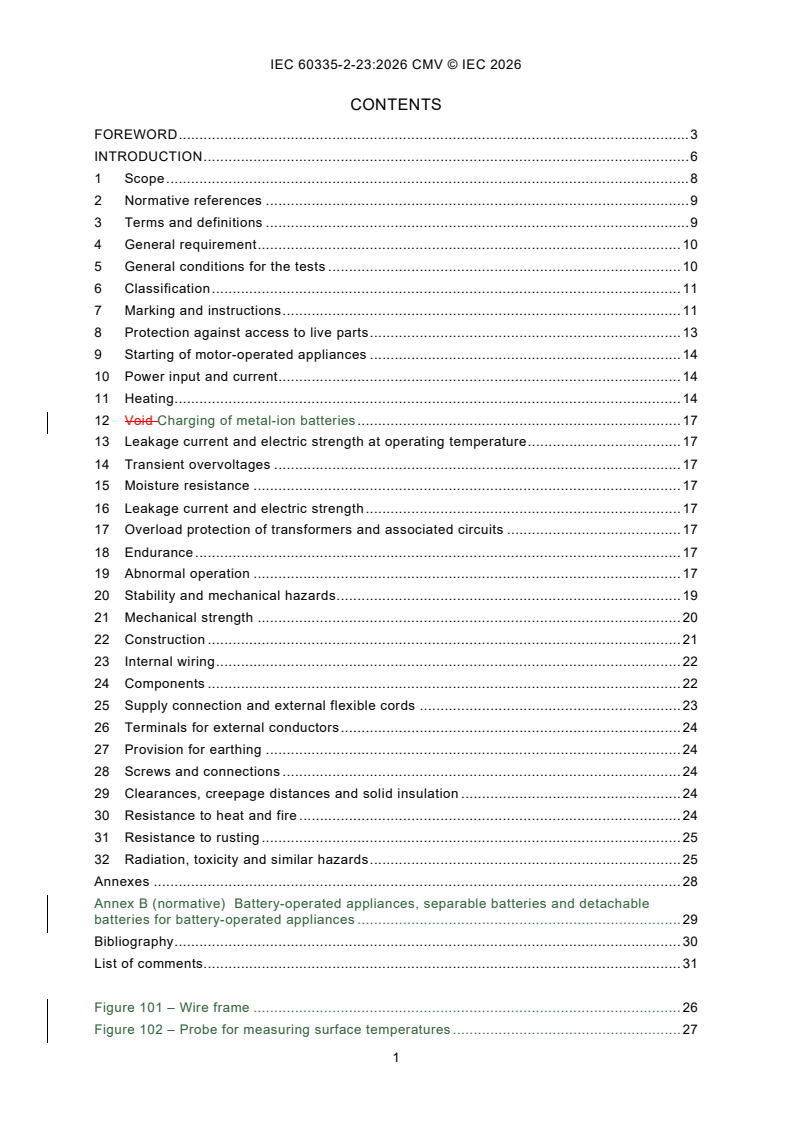
REDLINE IEC 60335-2-23:2026 CMV - Household and similar electrical appliances - Safety - Part 2-23: Particular requirements for hair care and similar appliances
IEC 60335-2-23:2026 EXV - Household and similar electrical appliances - Safety - Part 2-23: Particular requirements for hair care and similar appliances
IEC 60335-2-23:2026 - Appareils électrodomestiques et analogues - Sécurité - Partie 2-23: Exigences particulières pour les appareils destinés aux soins des cheveux et appareils analogues
IEC 60335-2-23:2026 - Household and similar electrical appliances - Safety - Part 2-23: Particular requirements for hair care and similar appliances
Overview
IEC 60335-2-23:2026 is an international standard developed by the International Electrotechnical Commission (IEC) that addresses the safety requirements for hair care and similar electrical appliances, including those for use on persons or animals. This standard applies to appliances such as hairdryers, curling irons, straighteners, and hand dryers intended for household and similar purposes with a rated voltage not exceeding 250 V-including DC and battery-powered devices. The document is vital for manufacturers, designers, testing bodies, and regulatory authorities focused on the safe design, manufacture, and use of small electrical appliances in homes, salons, light industry, and related environments.
Key Topics
Scope of Appliances Covered
- Curling combs, curling irons, hairdryers, hair straighteners
- Hand dryers for hair or face drying
- Heaters for detachable curlers and permanent-wave appliances
- Appliances with steam- or spray-producing functions
Safety Considerations
- Protection against electric shock, overheating, moisture, and mechanical hazards
- Marking and instruction requirements, including warnings for use near water and hot surfaces
- Special requirements for appliances used by the public in non-household locations, such as salons and light industry
Testing and Compliance
- Clarification of test methods, particularly for appliances with PTC (Positive Temperature Coefficient) heating elements
- Requirements for accessible surface temperature and marking of hot surfaces
- Moisture resistance and mechanical strength tests for detachable power supply parts
Exclusions
- The standard excludes industrial-only appliances, those intended for use in corrosive or explosive atmospheres, and devices like shavers, hair clippers, cosmetic appliances with lasers or intense light, or appliances intended for skin care (covered by different standards)
Applications
IEC 60335-2-23:2026 is directly applicable to:
- Manufacturers seeking market access or conformity assessment for hair care appliances in global markets
- Design Engineers responsible for product safety, development, and compliance with international regulations
- Testing Laboratories performing certification and safety evaluation for electrical appliances
- Importers and Distributors ensuring compliance with national and international safety standards
- Regulatory Agencies referencing IEC standards for ensuring public safety in consumer and commercial environments
Typical environments where the requirements of this standard must be met include:
- Private homes (household use)
- Hairdressing salons and beauty shops
- Light industrial settings and farms where the public or laypersons use appliances
- Hotel rooms and similar accommodation
By adhering to IEC 60335-2-23:2026, stakeholders help prevent common electrical hazards, minimize fire and injury risks, and assure consumers of reliable, safe products. The standard also ensures that products meet evolving safety expectations in line with updated international safety benchmarks.
Related Standards
For comprehensive safety compliance in the design and use of small electrical appliances, the following related IEC standards are relevant:
- IEC 60335-1: General requirements for safety of household and similar electrical appliances
- IEC 60335-2-8: Particular requirements for shavers, hair clippers, and similar appliances
- IEC 60335-2-113: Cosmetic and beauty care appliances incorporating lasers and intense light sources
- IEC 60335-2-115: Appliances intended for skin care
- IEC 60364: Electrical installations of buildings (for broader wiring compatibility)
- ISO 7010: Safety signs, including symbols used in appliance markings
Practical Value
By following IEC 60335-2-23:2026, businesses and organizations:
- Ensure safer products and prevent accidents related to electrical appliances
- Meet international and regional regulatory requirements, supporting market access and acceptance
- Promote customer confidence and satisfaction in hair care and similar electrical devices
- Strengthen product liability defense and lower the risk of recalls or legal challenges related to safety compliance
IEC 60335-2-23:2026 provides essential safety guidance for anyone involved in the design, sale, or regulation of household and professional hair care electrical appliances.
Relations
- Effective Date
- 05-Sep-2023
- Effective Date
- 05-Sep-2023
Buy Documents
IEC 60335-2-23:2026 - Household and similar electrical appliances - Safety - Part 2-23: Particular requirements for hair care and similar appliances
REDLINE IEC 60335-2-23:2026 CMV - Household and similar electrical appliances - Safety - Part 2-23: Particular requirements for hair care and similar appliances
IEC 60335-2-23:2026 EXV - Household and similar electrical appliances - Safety - Part 2-23: Particular requirements for hair care and similar appliances
IEC 60335-2-23:2026 - Appareils électrodomestiques et analogues - Sécurité - Partie 2-23: Exigences particulières pour les appareils destinés aux soins des cheveux et appareils analogues
IEC 60335-2-23:2026 - Household and similar electrical appliances - Safety - Part 2-23: Particular requirements for hair care and similar appliances
Get Certified
Connect with accredited certification bodies for this standard

CIS Institut d.o.o.
Personal Protective Equipment (PPE) certification body. Notified Body NB-2890 for EU Regulation 2016/425 PPE.

Kiwa BDA Testing
Building and construction product certification.
Kmetijski inštitut Slovenije
Agricultural Institute of Slovenia. Soil testing, plant health, agricultural product analysis.
Sponsored listings
Frequently Asked Questions
IEC 60335-2-23:2026 is a standard published by the International Electrotechnical Commission (IEC). Its full title is "Household and similar electrical appliances - Safety - Part 2-23: Particular requirements for hair care and similar appliances". This standard covers: IEC 60335-2-23:2026 deals with the safety of electric appliances for the care of the hair of persons or animals and similar appliances, intended for household and similar purposes, their rated voltage being not more than 250 V including direct current (DC) supplied appliances and battery-operated appliances. Examples of appliances that are within the scope of this standard are: - curling combs; - curling irons; - hairdryers; - hair straighteners; - hand dryers; - heaters for detachable curlers; - permanent-wave appliances. Appliances covered by this standard can incorporate steam-producing or spray-producing devices. Hand dryers can have a feature to redirect the air so that it can be used to dry the face or hair. Appliances not intended for normal household use but that nevertheless can be a source of danger to the public, such as appliances intended to be used by laymen in shops, in light industry and on farms, are within the scope of this standard. Examples are appliances for use in hairdressing salons. This standard deals with the reasonably foreseeable hazards presented by appliances that are encountered by all persons. However, in general, it does not take into account: - persons (including children) whose physical, sensory or mental capabilities; or lack of experience and knowledge prevents them from using the appliance safely without supervision or instruction; - children playing with the appliance. Attention is drawn to the fact that - it is recognized that persons having very extensive and complex disabilities can have needs beyond the level addressed in this standard. - for appliances intended to be used in vehicles or on board ships or aircraft, additional requirements can be necessary; - in many countries, additional requirements are specified by the national health authorities, the national authorities responsible for the protection of labour and similar authorities. This standard does not apply to: - appliances intended exclusively for industrial purposes; - appliances intended to be used in locations where special conditions prevail, such as the presence of a corrosive or explosive atmosphere (dust, vapour or gas); - shavers, hair clippers and similar appliances (IEC 60335-2-8); - cosmetic and beauty care appliances incorporating lasers and intense light sources (IEC 60335-2-113); - appliances intended for skin care (IEC 60335-2-115). This seventh edition cancels and replaces the sixth edition published in 2016 and Amendment 1:2019. This edition constitutes a technical revision. This edition includes the following significant technical changes with respect to the previous edition: a) alignment with IEC 60335-1:2020; b) conversion of some notes to normative text (Clause 1, 11.101, 20.1); c) change in standard title and relocation of skin care appliances, such as facial saunas and foot care appliances, to IEC 60335-2-115 (Clause 1, 3.1.9, 3.5.103, 6.1, 7.12, 8.1.4, 11.8, 15.2, 21.1); d) clarification of testing of appliances with PTC heating elements (10.1, 10.2); e) clarification of the application of test probe 18 for appliances for use in hairdressing salons (8.1.1, 20.2, B.22.3, B.22.4); f) addition of accessible surface temperature limits including marking of hot surfaces (7.1, 7.6, 7.12, 7.14, 7.15, 11.3, 11.8); g) clarification of placement of the appliance in the test corner (19.2); h) addition of moisture resistance and strength tests for detachable power supply parts (6.2, 21.102, 21.103, 24.2). This part 2 is to be used in conjunction with the latest edition of IEC 60335-1 and its amendments unless that edition precludes it; in that case, the latest edition that does not preclude it is used. It was established on the basis of the sixth edition (2020) of that standard.
IEC 60335-2-23:2026 deals with the safety of electric appliances for the care of the hair of persons or animals and similar appliances, intended for household and similar purposes, their rated voltage being not more than 250 V including direct current (DC) supplied appliances and battery-operated appliances. Examples of appliances that are within the scope of this standard are: - curling combs; - curling irons; - hairdryers; - hair straighteners; - hand dryers; - heaters for detachable curlers; - permanent-wave appliances. Appliances covered by this standard can incorporate steam-producing or spray-producing devices. Hand dryers can have a feature to redirect the air so that it can be used to dry the face or hair. Appliances not intended for normal household use but that nevertheless can be a source of danger to the public, such as appliances intended to be used by laymen in shops, in light industry and on farms, are within the scope of this standard. Examples are appliances for use in hairdressing salons. This standard deals with the reasonably foreseeable hazards presented by appliances that are encountered by all persons. However, in general, it does not take into account: - persons (including children) whose physical, sensory or mental capabilities; or lack of experience and knowledge prevents them from using the appliance safely without supervision or instruction; - children playing with the appliance. Attention is drawn to the fact that - it is recognized that persons having very extensive and complex disabilities can have needs beyond the level addressed in this standard. - for appliances intended to be used in vehicles or on board ships or aircraft, additional requirements can be necessary; - in many countries, additional requirements are specified by the national health authorities, the national authorities responsible for the protection of labour and similar authorities. This standard does not apply to: - appliances intended exclusively for industrial purposes; - appliances intended to be used in locations where special conditions prevail, such as the presence of a corrosive or explosive atmosphere (dust, vapour or gas); - shavers, hair clippers and similar appliances (IEC 60335-2-8); - cosmetic and beauty care appliances incorporating lasers and intense light sources (IEC 60335-2-113); - appliances intended for skin care (IEC 60335-2-115). This seventh edition cancels and replaces the sixth edition published in 2016 and Amendment 1:2019. This edition constitutes a technical revision. This edition includes the following significant technical changes with respect to the previous edition: a) alignment with IEC 60335-1:2020; b) conversion of some notes to normative text (Clause 1, 11.101, 20.1); c) change in standard title and relocation of skin care appliances, such as facial saunas and foot care appliances, to IEC 60335-2-115 (Clause 1, 3.1.9, 3.5.103, 6.1, 7.12, 8.1.4, 11.8, 15.2, 21.1); d) clarification of testing of appliances with PTC heating elements (10.1, 10.2); e) clarification of the application of test probe 18 for appliances for use in hairdressing salons (8.1.1, 20.2, B.22.3, B.22.4); f) addition of accessible surface temperature limits including marking of hot surfaces (7.1, 7.6, 7.12, 7.14, 7.15, 11.3, 11.8); g) clarification of placement of the appliance in the test corner (19.2); h) addition of moisture resistance and strength tests for detachable power supply parts (6.2, 21.102, 21.103, 24.2). This part 2 is to be used in conjunction with the latest edition of IEC 60335-1 and its amendments unless that edition precludes it; in that case, the latest edition that does not preclude it is used. It was established on the basis of the sixth edition (2020) of that standard.
IEC 60335-2-23:2026 is classified under the following ICS (International Classification for Standards) categories: 13.120 - Domestic safety; 97.040.50 - Small kitchen appliances. The ICS classification helps identify the subject area and facilitates finding related standards.
IEC 60335-2-23:2026 has the following relationships with other standards: It is inter standard links to IEC 60335-2-23:2016/AMD1:2019, IEC 60335-2-23:2016. Understanding these relationships helps ensure you are using the most current and applicable version of the standard.
IEC 60335-2-23:2026 is available in PDF format for immediate download after purchase. The document can be added to your cart and obtained through the secure checkout process. Digital delivery ensures instant access to the complete standard document.
Standards Content (Sample)
IEC 60335-2-23 ®
Edition 7.0 2026-02
INTERNATIONAL
STANDARD
Household and similar electrical appliances - Safety -
Part 2-23: Particular requirements for hair care and similar appliances
ICS 13.120; 97.040.50 ISBN 978-2-8327-1037-1
All rights reserved. Unless otherwise specified, no part of this publication may be reproduced or utilized in any form or
by any means, electronic or mechanical, including photocopying and microfilm, without permission in writing from either
IEC or IEC's member National Committee in the country of the requester. If you have any questions about IEC copyright
or have an enquiry about obtaining additional rights to this publication, please contact the address below or your local
IEC member National Committee for further information.
IEC Secretariat Tel.: +41 22 919 02 11
3, rue de Varembé info@iec.ch
CH-1211 Geneva 20 www.iec.ch
Switzerland
About the IEC
The International Electrotechnical Commission (IEC) is the leading global organization that prepares and publishes
International Standards for all electrical, electronic and related technologies.
About IEC publications
The technical content of IEC publications is kept under constant review by the IEC. Please make sure that you have the
latest edition, a corrigendum or an amendment might have been published.
IEC publications search - IEC Products & Services Portal - products.iec.ch
webstore.iec.ch/advsearchform Discover our powerful search engine and read freely all the
The advanced search enables to find IEC publications by a publications previews, graphical symbols and the glossary.
variety of criteria (reference number, text, technical With a subscription you will always have access to up to date
committee, …). It also gives information on projects, content tailored to your needs.
replaced and withdrawn publications.
Electropedia - www.electropedia.org
The world's leading online dictionary on electrotechnology,
IEC Just Published - webstore.iec.ch/justpublished
Stay up to date on all new IEC publications. Just Published containing more than 22 500 terminological entries in English
details all new publications released. Available online and and French, with equivalent terms in 25 additional languages.
once a month by email. Also known as the International Electrotechnical Vocabulary
(IEV) online.
IEC Customer Service Centre - webstore.iec.ch/csc
If you wish to give us your feedback on this publication or
need further assistance, please contact the Customer
Service Centre: sales@iec.ch.
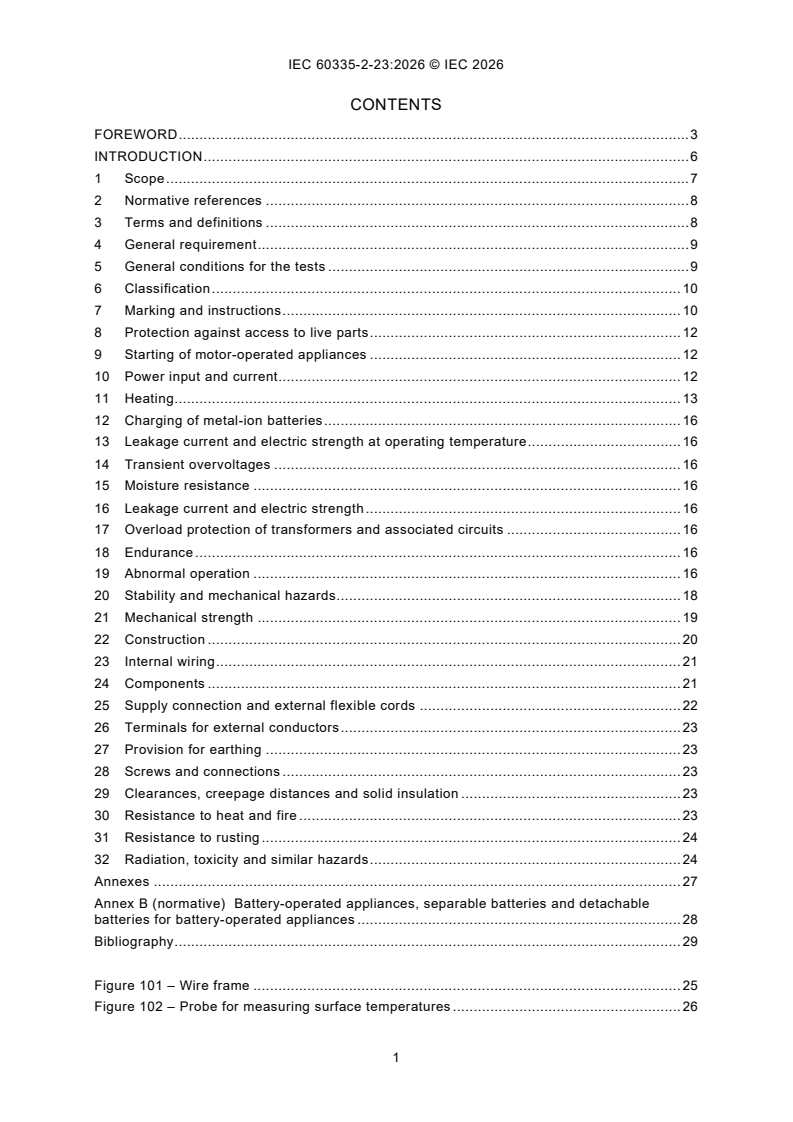
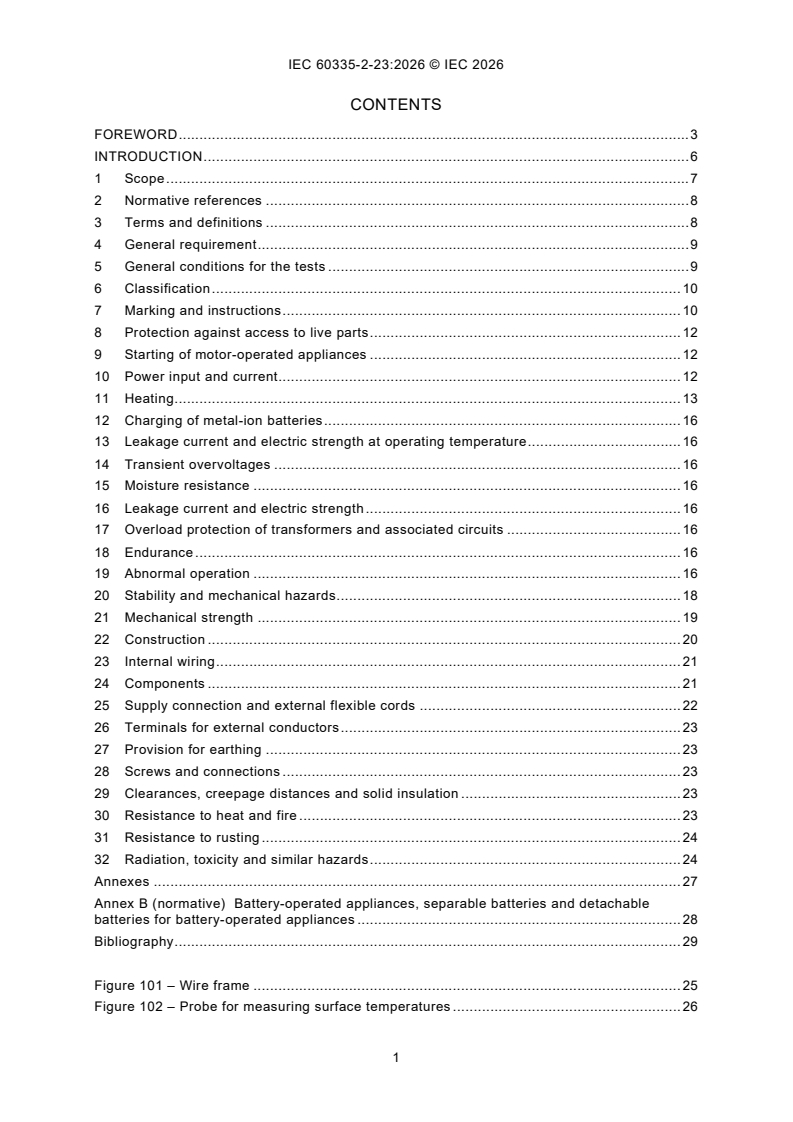
CONTENTS
FOREWORD . 3
INTRODUCTION . 6
1 Scope . 7
2 Normative references . 8
3 Terms and definitions . 8
4 General requirement . 9
5 General conditions for the tests . 9
6 Classification . 10
7 Marking and instructions . 10
8 Protection against access to live parts . 12
9 Starting of motor-operated appliances . 12
10 Power input and current . 12
11 Heating . 13
12 Charging of metal-ion batteries . 16
13 Leakage current and electric strength at operating temperature . 16
14 Transient overvoltages . 16
15 Moisture resistance . 16
16 Leakage current and electric strength . 16
17 Overload protection of transformers and associated circuits . 16
18 Endurance . 16
19 Abnormal operation . 16
20 Stability and mechanical hazards . 18
21 Mechanical strength . 19
22 Construction . 20
23 Internal wiring . 21
24 Components . 21
25 Supply connection and external flexible cords . 22
26 Terminals for external conductors . 23
27 Provision for earthing . 23
28 Screws and connections . 23
29 Clearances, creepage distances and solid insulation . 23
30 Resistance to heat and fire . 23
31 Resistance to rusting . 24
32 Radiation, toxicity and similar hazards . 24
Annexes . 27
Annex B (normative) Battery-operated appliances, separable batteries and detachable
batteries for battery-operated appliances . 28
Bibliography . 29
Figure 101 – Wire frame . 25
Figure 102 – Probe for measuring surface temperatures . 26
Table 101 – Maximum temperature rises for specified external accessible surfaces
under normal operating conditions . 15
INTERNATIONAL ELECTROTECHNICAL COMMISSION
____________
Household and similar electrical appliances - Safety -
Part 2-23: Particular requirements for hair care and similar appliances
FOREWORD
1) The International Electrotechnical Commission (IEC) is a worldwide organization for standardization comprising
all national electrotechnical committees (IEC National Committees). The object of IEC is to promote international
co-operation on all questions concerning standardization in the electrical and electronic fields. To this end and
in addition to other activities, IEC publishes International Standards, Technical Specifications, Technical Reports,
Publicly Available Specifications (PAS) and Guides (hereafter referred to as “IEC Publication(s)”). Their
preparation is entrusted to technical committees; any IEC National Committee interested in the subject dealt with
may participate in this preparatory work. International, governmental and non-governmental organizations liaising
with the IEC also participate in this preparation. IEC collaborates closely with the International Organization for
Standardization (ISO) in accordance with conditions determined by agreement between the two organizations.
2) The formal decisions or agreements of IEC on technical matters express, as nearly as possible, an international
consensus of opinion on the relevant subjects since each technical committee has representation from all
interested IEC National Committees.
3) IEC Publications have the form of recommendations for international use and are accepted by IEC National
Committees in that sense. While all reasonable efforts are made to ensure that the technical content of IEC
Publications is accurate, IEC cannot be held responsible for the way in which they are used or for any
misinterpretation by any end user.
4) In order to promote international uniformity, IEC National Committees undertake to apply IEC Publications
transparently to the maximum extent possible in their national and regional publications. Any divergence between
any IEC Publication and the corresponding national or regional publication shall be clearly indicated in the latter.
5) IEC itself does not provide any attestation of conformity. Independent certification bodies provide conformity
assessment services and, in some areas, access to IEC marks of conformity. IEC is not responsible for any
services carried out by independent certification bodies.
6) All users should ensure that they have the latest edition of this publication.
7) No liability shall attach to IEC or its directors, employees, servants or agents including individual experts and
members of its technical committees and IEC National Committees for any personal injury, property damage or
other damage of any nature whatsoever, whether direct or indirect, or for costs (including legal fees) and
expenses arising out of the publication, use of, or reliance upon, this IEC Publication or any other IEC
Publications.
8) Attention is drawn to the Normative references cited in this publication. Use of the referenced publications is
indispensable for the correct application of this publication.
9) IEC draws attention to the possibility that the implementation of this document may involve the use of (a)
patent(s). IEC takes no position concerning the evidence, validity or applicability of any claimed patent rights in
respect thereof. As of the date of publication of this document, IEC had not received notice of (a) patent(s), which
may be required to implement this document. However, implementers are cautioned that this may not represent
the latest information, which may be obtained from the patent database available at https://patents.iec.ch. IEC
shall not be held responsible for identifying any or all such patent rights.
IEC 60335-2-23 has been prepared by IEC technical committee 61: Safety of household and
similar electrical appliances. It is an International Standard.
This seventh edition cancels and replaces the sixth edition published in 2016 and
Amendment 1:2019. This edition constitutes a technical revision.
This edition includes the following significant technical changes with respect to the previous
edition:
a) alignment with IEC 60335-1:2020;
b) conversion of some notes to normative text (Clause 1, 11.101, 20.1);
c) change in standard title and relocation of skin care appliances, such as facial saunas and
foot care appliances, to IEC 60335-2-115 (Clause 1, 3.1.9, 3.5.103, 6.1, 7.12, 8.1.4, 11.8,
15.2, 21.1);
d) clarification of testing of appliances with PTC heating elements (10.1, 10.2);
e) clarification of the application of test probe 18 for appliances for use in hairdressing salons
(8.1.1, 20.2, B.22.3, B.22.4);
f) addition of accessible surface temperature limits including marking of hot surfaces (7.1, 7.6,
7.12, 7.14, 7.15, 11.3, 11.8);
g) clarification of placement of the appliance in the test corner (19.2);
h) addition of moisture resistance and strength tests for detachable power supply parts (6.2,
21.102, 21.103, 24.2).
The text of this International Standard is based on the following documents:
Draft Report on voting
61/7533/FDIS 61/7542/RVD
Full information on the voting for its approval can be found in the report on voting indicated in
the above table.
The language used for the development of this International Standard is English.
This document was drafted in accordance with ISO/IEC Directives, Part 2, and developed in
accordance with ISO/IEC Directives, Part 1 and ISO/IEC Directives, IEC Supplement, available
at www.iec.ch/members_experts/refdocs. The main document types developed by IEC are
described in greater detail at www.iec.ch/publications.
This part 2 is to be used in conjunction with the latest edition of IEC 60335-1 and its
amendments unless that edition precludes it; in that case, the latest edition that does not
preclude it is used. It was established on the basis of the sixth edition (2020) of that standard.
NOTE 1 When "Part 1" is mentioned in this standard, it refers to IEC 60335-1.
This part 2 supplements or modifies the corresponding clauses in IEC 60335-1, so as to convert
that publication into the IEC standard: Particular requirements for hair care and similar
appliances.
When a particular subclause of Part 1 is not mentioned in this part 2, that subclause applies as
far as is reasonable. When this standard states "addition", "modification" or "replacement", the
relevant text in Part 1 is to be adapted accordingly.
NOTE 2 The following numbering system is used:
– subclauses, tables and figures that are numbered starting from 101 are additional to those in Part 1;
– unless notes are in a new subclause or involve notes in Part 1, they are numbered starting from 101, including
those in a replaced clause or subclause;
– additional annexes are lettered AA, BB, etc.
NOTE 3 The following print types are used:
– requirements: in roman type;
– test specifications: in italic type;
– notes: in small roman type.
Words in bold in the text are defined in Clause 3. When a definition concerns an adjective, the adjective and the
associated noun are also in bold.
NOTE 4 The attention of National Committees is drawn to the fact that equipment manufacturers and testing
organizations can need a transitional period following publication of a new, amended or revised IEC publication in
which to make products in accordance with the new requirements and to equip themselves for conducting new or
revised tests.
It is the recommendation of the committee that the content of this publication be adopted for implementation nationally
not earlier than 12 months or later than 36 months from the date of publication.
A list of all parts of the IEC 60335 series, under the general title: Household and similar
electrical appliances - Safety, can be found on the IEC website.
The committee has decided that the contents of this document will remain unchanged until the
stability date indicated on the IEC website under webstore.iec.ch in the data related to the
specific document. At this date, the document will be
– reconfirmed,
– withdrawn, or
– revised.
INTRODUCTION
It has been assumed in the drafting of this International Standard that the execution of its
provisions is entrusted to appropriately qualified and experienced persons.
Guidance documents concerning the application of the safety requirements for appliances can
be accessed via TC 61 supporting documents on the IEC website
https://www.iec.ch/tc61/supportingdocuments
This information is given for the convenience of users of this International Standard and does
not constitute a replacement for the normative text in this standard.
This standard recognizes the internationally accepted level of protection against hazards such
as electrical, mechanical, thermal, fire and radiation of appliances when operated as in normal
use taking into account the manufacturer's instructions. It also covers abnormal situations that
can be expected in practice and takes into account the way in which electromagnetic
phenomena can affect the safe operation of appliances.
This standard takes into account the requirements of IEC 60364 as far as possible so that there
is compatibility with the wiring rules when the appliance is connected to the supply mains.
However, national wiring rules can differ.
If an appliance within the scope of this standard also incorporates functions that are covered
by another part 2 of IEC 60335, the relevant part 2 is applied to each function separately, as
far as is reasonable. If applicable, the influence of one function on the other is taken into
account.
When a part 2 standard does not include additional requirements to cover hazards dealt with in
Part 1, Part 1 applies.
NOTE 1 This means that the technical committees responsible for the part 2 standards have determined that it is
not necessary to specify particular requirements for the appliance in question over and above the general
requirements.
This standard is a product family standard dealing with the safety of appliances and takes
precedence over horizontal and generic standards covering the same subject.
NOTE 2 Horizontal publications, basic safety publications and group safety publications covering a hazard are not
applicable since they have been taken into consideration when developing the general and particular requirements
for the IEC 60335 series of standards.
An appliance that complies with the text of this standard will not necessarily be considered to
comply with the safety principles of the standard if, when examined and tested, it is found to
have other features that impair the level of safety covered by these requirements.
An appliance employing materials or having forms of construction differing from those detailed
in the requirements of this standard may be examined and tested according to the intent of the
requirements and, if found to be substantially equivalent, may be considered to comply with the
standard.
NOTE 3 Standards dealing with non-safety aspects of household appliances are:
– IEC standards published by TC 59 concerning methods of measuring performance;
– CISPR 11, CISPR 14-1 and relevant IEC 61000-3 series standards concerning electromagnetic emissions;
– CISPR 14-2 concerning electromagnetic immunity;
– IEC standards published by TC 111 concerning environmental matters.
1 Scope
This clause of Part 1 is replaced by the following.
This part of IEC 60335 deals with the safety of electric appliances for the care of the hair of
persons or animals and similar appliances, intended for household and similar purposes, their
rated voltage being not more than 250 V including direct current (DC) supplied appliances and
battery-operated appliances.
Examples of appliances that are within the scope of this standard are
– curling combs;
– curling irons;
– hairdryers;
– hair straighteners;
– hand dryers;
– heaters for detachable curlers;
– permanent-wave appliances.
Appliances covered by this standard can incorporate steam-producing or spray-producing
devices.
NOTE 101 Hand dryers can have a feature to redirect the air so that it can be used to dry the face or hair.
Appliances not intended for normal household use but that nevertheless can be a source of
danger to the public, such as appliances intended to be used by laymen in shops, in light
industry and on farms, are within the scope of this standard. Examples are appliances for use
in hairdressing salons.
This standard deals with the reasonably foreseeable hazards presented by appliances that are
encountered by all persons. However, in general, it does not take into account
– persons (including children) whose
• physical, sensory or mental capabilities; or
• lack of experience and knowledge
prevents them from using the appliance safely without supervision or instruction;
– children playing with the appliance.
Attention is drawn to the fact that
– it is recognized that persons having very extensive and complex disabilities can have needs
beyond the level addressed in this standard.
– for appliances intended to be used in vehicles or on board ships or aircraft, additional
requirements can be necessary;
– in many countries, additional requirements are specified by the national health authorities,
the national authorities responsible for the protection of labour and similar authorities.
This standard does not apply to
– appliances intended exclusively for industrial purposes;
– appliances intended to be used in locations where special conditions prevail, such as the
presence of a corrosive or explosive atmosphere (dust, vapour or gas);
– shavers, hair clippers and similar appliances (IEC 60335-2-8);
– cosmetic and beauty care appliances incorporating lasers and intense light sources
(IEC 60335-2-113);
– appliances intended for skin care (IEC 60335-2-115).
2 Normative references
This clause of Part 1 is applicable except as follows:
Addition:
ISO 7010:2019, Graphical symbols - Safety colours and safety signs - Registered safety signs
IEC 60584-1, Thermocouples - Part 1: EMF specifications and tolerances
3 Terms and definitions
This clause of Part 1 is applicable except as follows.
3.1 Definitions relating to physical characteristics
3.1.9 Modification:
normal operation
Replace the first paragraph with the following:
operation of the appliance under the conditions specified in 3.1.9.101 to 3.1.9.107
3.1.9.101 Helmet-type hairdryers are operated with the axis of the hood inclined at an angle
of 60° to the horizontal or the maximum angle allowed by the construction if this is less. A dull
black-painted wooden sphere, 200 mm in diameter, is placed in the hood so that its centre
coincides with the axis of the hood, the shortest distance between the sphere and the air-outlet
grille being 50 mm.
Hairdryers having a flexible hood attachment are operated with the hood attachment placed
over the wire frame of Figure 101, the frame being positioned over the wooden sphere.
Helmet-type hairdryers that are supported by the head are operated as hairdryers having a
flexible hood attachment.
3.1.9.102 Hand-held hairdryers are operated with unrestricted airflow directed downwards.
3.1.9.103 Permanent-wave appliances are operated in the position of normal use, the curling
rollers hanging freely.
3.1.9.104 Heaters for detachable curlers are operated in the position of normal use together
with the curlers.
3.1.9.105 Curling irons, curling combs and similar appliances are operated with their major
axis horizontal.
3.1.9.106 Appliances having steam-producing or spray-producing devices are operated with
the container empty or filled, whichever is more unfavourable. However, if the appliance is
marked to indicate that it is to be used with the container filled, the container is filled. Water is
added, when necessary, to compensate for evaporation.
3.1.9.107 Hand dryers are operated in the normal position of use with unrestricted airflow.
3.5 Definitions relating to types of appliances
3.5.101
helmet-type hairdryer
hairdryer having a rigid hood that is placed over the head in normal use
Note 1 to entry: The hood can be supported by a stand or have means for attaching to a support.
3.5.102
heater for detachable curlers
appliance for heating curling irons or curling rollers that accumulate heat
3.6 Definitions relating to parts of an appliance
3.6.101
swivel connection
means for connecting the supply cord so that the appliance can be rotated continuously without
twisting the cord
3.6.102
functional surface
surface that is intentionally heated by an internal heat source and has to be hot to carry out the
function for which the appliance is intended
Note 1 to entry: An example is the heated sheath of a heated barrel of a curling iron.
4 General requirement
This clause of Part 1 is applicable.
5 General conditions for the tests
This clause of Part 1 is applicable except as follows.
5.2 Addition:
The test of 25.14 for hand-held appliances without a swivel connection is carried out on a
separate appliance.
6 Classification
This clause of Part 1 is applicable except as follows.
6.1 Modification:
Replace the first paragraph with the following:
Appliances shall be of one of the following classes with respect to protection against electric
shock:
– hairdryers, curling irons, curling combs, hair straighteners and steam-producing or spray-
producing appliances shall be class II or class III. However, fixed hairdryers intended to
be permanently connected to fixed wiring, helmet-type hairdryers for hairdressers and
steam-producing or spray-producing appliances for hairdressers may be class I;
– other appliances shall be class I, class II or class III.
6.2 Addition:
Hand dryers shall be at least IPX1.
Curling rollers of permanent-wave appliances shall be at least IPX4.
Detachable power supply parts in a flexible cord shall be at least IPX4.
7 Marking and instructions
This clause of Part 1 is applicable except as follows.
7.1 Addition:
Portable hairdryers, curling irons and similar appliances shall be marked with symbol
ISO 7010-P026 (2011-05) or with the substance of the following:
WARNING: Do not use this appliance near water.
If appliances have external accessible surfaces, for which temperature rise limits are specified
in Table 101 and for which the provisions of footnote b to Table 101 apply, then the appliance
shall be marked with symbol IEC 60417-5041(2002-10), or with the substance of the following:
CAUTION: Hot surfaces.
7.6 Addition:
[symbol ISO 7010-P026 do not use this device in a bathtub,
(2011-05)] shower or water-filled reservoir
[symbol IEC 60417-5041
caution, hot surface
(2002-10)]
7.12 Addition:
The instructions for portable appliances shall include the substance of the following:
– when the appliance is used in a bathroom, unplug it after use since the proximity of water
presents a hazard even when the appliance is switched off;
– for additional protection, the installation of a residual current device (RCD) having a rated
residual operating current not exceeding 30 mA is advisable in the electrical circuit supplying
the bathroom. Ask your installer for advice.
If symbol IEC 60417-5041 (2002-10) is used, the meaning shall be explained.
If symbol ISO 7010-P026 (2011-05) is used, instructions shall state the substance of the
following:
WARNING: Do not use this appliance near bathtubs, showers, basins or other vessels
containing water.
The instructions for hair straighteners and curling irons shall include the substance of the
following:
– burn hazard. Keep appliance out of reach from young children, particularly during use and
cool down;
– when the appliance is connected to the power supply, never leave it unattended;
– always place the appliance with the stand, if any, on a heat-resistant, stable flat surface.
If the appliance is intended for use only in hairdressing salons, the instructions shall state that
the appliance is intended to be used in hairdressing salons. If the appliance is not suitable for
use in area open to the public, the instructions shall include the substance of the following:
WARNING: This appliance shall not be used other than in hairdressing salons.
7.12.1 Addition:
The installation instructions for fixed hairdryers intended for use in bathrooms shall include
the substance of the following:
This hairdryer must be fixed out of reach of a person taking a bath or shower.
If the hand-held part of the hairdryer incorporates electrical components, the instructions shall
state that the appliance must be fixed so that the hand-held part, when fully extended, is out of
reach of a person taking a bath or shower.
7.12.9 Addition:
Supplying of
...
IEC 60335-2-23 ®
Edition 7.0 2026-02
INTERNATIONAL
STANDARD
COMMENTED VERSION
Household and similar electrical appliances - Safety -
Part 2-23: Particular requirements for hair care and similar appliances
ICS 13.120; 97.040.50 ISBN 978-2-8327-1084-5
All rights reserved. Unless otherwise specified, no part of this publication may be reproduced or utilized in any form or
by any means, electronic or mechanical, including photocopying and microfilm, without permission in writing from either
IEC or IEC's member National Committee in the country of the requester. If you have any questions about IEC copyright
or have an enquiry about obtaining additional rights to this publication, please contact the address below or your local
IEC member National Committee for further information.
IEC Secretariat Tel.: +41 22 919 02 11
3, rue de Varembé info@iec.ch
CH-1211 Geneva 20 www.iec.ch
Switzerland
About the IEC
The International Electrotechnical Commission (IEC) is the leading global organization that prepares and publishes
International Standards for all electrical, electronic and related technologies.
About IEC publications
The technical content of IEC publications is kept under constant review by the IEC. Please make sure that you have the
latest edition, a corrigendum or an amendment might have been published.
IEC publications search - IEC Products & Services Portal - products.iec.ch
webstore.iec.ch/advsearchform Discover our powerful search engine and read freely all the
The advanced search enables to find IEC publications by a publications previews, graphical symbols and the glossary.
variety of criteria (reference number, text, technical With a subscription you will always have access to up to date
committee, …). It also gives information on projects, content tailored to your needs.
replaced and withdrawn publications.
Electropedia - www.electropedia.org
The world's leading online dictionary on electrotechnology,
IEC Just Published - webstore.iec.ch/justpublished
Stay up to date on all new IEC publications. Just Published containing more than 22 500 terminological entries in English
details all new publications released. Available online and and French, with equivalent terms in 25 additional languages.
once a month by email. Also known as the International Electrotechnical Vocabulary
(IEV) online.
IEC Customer Service Centre - webstore.iec.ch/csc
If you wish to give us your feedback on this publication or
need further assistance, please contact the Customer
Service Centre: sales@iec.ch.
CONTENTS
FOREWORD . 3
INTRODUCTION . 6
1 Scope . 8
2 Normative references . 9
3 Terms and definitions . 9
4 General requirement . 10
5 General conditions for the tests . 10
6 Classification . 11
7 Marking and instructions . 11
8 Protection against access to live parts . 13
9 Starting of motor-operated appliances . 14
10 Power input and current . 14
11 Heating . 14
12 Void Charging of metal-ion batteries . 17
13 Leakage current and electric strength at operating temperature . 17
14 Transient overvoltages . 17
15 Moisture resistance . 17
16 Leakage current and electric strength . 17
17 Overload protection of transformers and associated circuits . 17
18 Endurance . 17
19 Abnormal operation . 17
20 Stability and mechanical hazards . 19
21 Mechanical strength . 20
22 Construction . 21
23 Internal wiring . 22
24 Components . 22
25 Supply connection and external flexible cords . 23
26 Terminals for external conductors . 24
27 Provision for earthing . 24
28 Screws and connections . 24
29 Clearances, creepage distances and solid insulation . 24
30 Resistance to heat and fire . 24
31 Resistance to rusting . 25
32 Radiation, toxicity and similar hazards . 25
Annexes . 28
Annex B (normative) Battery-operated appliances, separable batteries and detachable
batteries for battery-operated appliances . 29
Bibliography . 30
List of comments. 31
Figure 101 – Wire frame . 26
Figure 102 – Probe for measuring surface temperatures . 27
Table 101 – Maximum temperature rises for specified external accessible surfaces
under normal operating conditions . 16
INTERNATIONAL ELECTROTECHNICAL COMMISSION
____________
Household and similar electrical appliances - Safety -
Part 2-23: Particular requirements for appliances for skin or hair care and
similar appliances 1
FOREWORD
1) The International Electrotechnical Commission (IEC) is a worldwide organization for standardization comprising
all national electrotechnical committees (IEC National Committees). The object of IEC is to promote international
co-operation on all questions concerning standardization in the electrical and electronic fields. To this end and
in addition to other activities, IEC publishes International Standards, Technical Specifications, Technical Reports,
Publicly Available Specifications (PAS) and Guides (hereafter referred to as “IEC Publication(s)”). Their
preparation is entrusted to technical committees; any IEC National Committee interested in the subject dealt with
may participate in this preparatory work. International, governmental and non-governmental organizations liaising
with the IEC also participate in this preparation. IEC collaborates closely with the International Organization for
Standardization (ISO) in accordance with conditions determined by agreement between the two organizations.
2) The formal decisions or agreements of IEC on technical matters express, as nearly as possible, an international
consensus of opinion on the relevant subjects since each technical committee has representation from all
interested IEC National Committees.
3) IEC Publications have the form of recommendations for international use and are accepted by IEC National
Committees in that sense. While all reasonable efforts are made to ensure that the technical content of IEC
Publications is accurate, IEC cannot be held responsible for the way in which they are used or for any
misinterpretation by any end user.
4) In order to promote international uniformity, IEC National Committees undertake to apply IEC Publications
transparently to the maximum extent possible in their national and regional publications. Any divergence between
any IEC Publication and the corresponding national or regional publication shall be clearly indicated in the latter.
5) IEC itself does not provide any attestation of conformity. Independent certification bodies provide conformity
assessment services and, in some areas, access to IEC marks of conformity. IEC is not responsible for any
services carried out by independent certification bodies.
6) All users should ensure that they have the latest edition of this publication.
7) No liability shall attach to IEC or its directors, employees, servants or agents including individual experts and
members of its technical committees and IEC National Committees for any personal injury, property damage or
other damage of any nature whatsoever, whether direct or indirect, or for costs (including legal fees) and
expenses arising out of the publication, use of, or reliance upon, this IEC Publication or any other IEC
Publications.
8) Attention is drawn to the Normative references cited in this publication. Use of the referenced publications is
indispensable for the correct application of this publication.
9) IEC draws attention to the possibility that the implementation of this document may involve the use of (a)
patent(s). IEC takes no position concerning the evidence, validity or applicability of any claimed patent rights in
respect thereof. As of the date of publication of this document, IEC had not received notice of (a) patent(s), which
may be required to implement this document. However, implementers are cautioned that this may not represent
the latest information, which may be obtained from the patent database available at https://patents.iec.ch. IEC
shall not be held responsible for identifying any or all such patent rights.
This commented version (CMV) of the official standard IEC 60335-2-23:2026 edition 7.0 allows
the user to identify the changes made to the previous IEC 60335-2-23:2016+AMD1:2019 CSV
edition 6.1. Furthermore, comments from IEC TC 61 experts are provided to explain the reasons
of the most relevant changes, or to clarify any part of the content.
A vertical bar appears in the margin wherever a change has been made. Additions are in green
text, deletions are in strikethrough red text. Experts' comments are identified by a blue-
background number. Mouse over a number to display a pop-up note with the comment.
This publication contains the CMV and the official standard. The full list of comments is available
at the end of the CMV.
IEC 60335-2-23 has been prepared by IEC technical committee 61: Safety of household and
similar electrical appliances. It is an International Standard.
This seventh edition cancels and replaces the sixth edition published in 2016 and
Amendment 1:2019. This edition constitutes a technical revision.
This edition includes the following significant technical changes with respect to the previous
edition:
a) alignment with IEC 60335-1:2020;
b) conversion of some notes to normative text (Clause 1, 11.101, 20.1);
c) change in standard title and relocation of skin care appliances, such as facial saunas and
foot care appliances, to IEC 60335-2-115 (Clause 1, 3.1.9, 3.5.103, 6.1, 7.12, 8.1.4, 11.8,
15.2, 21.1);
d) clarification of testing of appliances with PTC heating elements (10.1, 10.2);
e) clarification of the application of test probe 18 for appliances for use in hairdressing salons
(8.1.1, 20.2, B.22.3, B.22.4);
f) addition of accessible surface temperature limits including marking of hot surfaces (7.1, 7.6,
7.12, 7.14, 7.15, 11.3, 11.8);
g) clarification of placement of the appliance in the test corner (19.2);
h) addition of moisture resistance and strength tests for detachable power supply parts (6.2,
21.102, 21.103, 24.2).
The text of this International Standard is based on the following documents:
Draft Report on voting
61/7533/FDIS 61/7542/RVD
Full information on the voting for its approval can be found in the report on voting indicated in
the above table.
The language used for the development of this International Standard is English.
This document was drafted in accordance with ISO/IEC Directives, Part 2, and developed in
accordance with ISO/IEC Directives, Part 1 and ISO/IEC Directives, IEC Supplement, available
at www.iec.ch/members_experts/refdocs. The main document types developed by IEC are
described in greater detail at www.iec.ch/publications.
This part 2 is to be used in conjunction with the latest edition of IEC 60335-1 and its
amendments unless that edition precludes it; in that case, the latest edition that does not
preclude it is used. It was established on the basis of the sixth edition (2020) of that standard.
NOTE 1 When "Part 1" is mentioned in this standard, it refers to IEC 60335-1.
This part 2 supplements or modifies the corresponding clauses in IEC 60335-1, so as to convert
that publication into the IEC standard: Particular requirements for hair care and similar
appliances.
When a particular subclause of Part 1 is not mentioned in this part 2, that subclause applies as
far as is reasonable. When this standard states "addition", "modification" or "replacement", the
relevant text in Part 1 is to be adapted accordingly.
NOTE 2 The following numbering system is used:
– subclauses, tables and figures that are numbered starting from 101 are additional to those in Part 1;
– unless notes are in a new subclause or involve notes in Part 1, they are numbered starting from 101, including
those in a replaced clause or subclause;
– additional annexes are lettered AA, BB, etc.
NOTE 3 The following print types are used:
– requirements: in roman type;
– test specifications: in italic type;
– notes: in small roman type.
Words in bold in the text are defined in Clause 3. When a definition concerns an adjective, the adjective and the
associated noun are also in bold.
NOTE 4 The attention of National Committees is drawn to the fact that equipment manufacturers and testing
organizations can need a transitional period following publication of a new, amended or revised IEC publication in
which to make products in accordance with the new requirements and to equip themselves for conducting new or
revised tests.
It is the recommendation of the committee that the content of this publication be adopted for implementation nationally
not earlier than 12 months or later than 36 months from the date of publication.
A list of all parts of the IEC 60335 series, under the general title: Household and similar
electrical appliances - Safety, can be found on the IEC website.
The committee has decided that the contents of this document will remain unchanged until the
stability date indicated on the IEC website under webstore.iec.ch in the data related to the
specific document. At this date, the document will be
– reconfirmed,
– withdrawn, or
– revised.
INTRODUCTION
It has been assumed in the drafting of this International Standard that the execution of its
provisions is entrusted to appropriately qualified and experienced persons.
Guidance documents concerning the application of the safety requirements for appliances can
be accessed via TC 61 supporting documents on the IEC website
https://www.iec.ch/tc61/supportingdocuments
This information is given for the convenience of users of this International Standard and does
not constitute a replacement for the normative text in this standard.
This standard recognizes the internationally accepted level of protection against hazards such
as electrical, mechanical, thermal, fire and radiation of appliances when operated as in normal
use taking into account the manufacturer's instructions. It also covers abnormal situations that
can be expected in practice and takes into account the way in which electromagnetic
phenomena can affect the safe operation of appliances.
This standard takes into account the requirements of IEC 60364 as far as possible so that there
is compatibility with the wiring rules when the appliance is connected to the supply mains.
However, national wiring rules may can differ.
If an appliance within the scope of this standard also incorporates functions that are covered
by another part 2 of IEC 60335, the relevant part 2 is applied to each function separately, as
far as is reasonable. If applicable, the influence of one function on the other is taken into
account.
NOTE 1 For example, if appliances within the scope of this Part 2 include an ion generator, then IEC 60335-2-65
is applicable as far as is reasonable.
When a part 2 standard does not include additional requirements to cover hazards dealt with in
Part 1, Part 1 applies.
NOTE 2 1 This means that the technical committees responsible for the part 2 standards have determined that it
is not necessary to specify particular requirements for the appliance in question over and above the general
requirements.
This standard is a product family standard dealing with the safety of appliances and takes
precedence over horizontal and generic standards covering the same subject.
NOTE 3 2 Horizontal and generic standards Horizontal publications, basic safety publications and group safety
publications covering a hazard are not applicable since they have been taken into consideration when developing
the general and particular requirements for the IEC 60335 series of standards. For example, in the case of
temperature requirements for surfaces on many appliances, generic standards, such as ISO 13732-1 for hot surfaces,
are not applicable in addition to Part 1 or part 2 standards. 2
An appliance that complies with the text of this standard will not necessarily be considered to
comply with the safety principles of the standard if, when examined and tested, it is found to
have other features that impair the level of safety covered by these requirements.
An appliance employing materials or having forms of construction differing from those detailed
in the requirements of this standard may be examined and tested according to the intent of the
requirements and, if found to be substantially equivalent, may be considered to comply with the
standard.
NOTE 3 Standards dealing with non-safety aspects of household appliances are:
– IEC standards published by TC 59 concerning methods of measuring performance;
– CISPR 11, CISPR 14-1 and relevant IEC 61000-3 series standards concerning electromagnetic emissions;
– CISPR 14-2 concerning electromagnetic immunity;
– IEC standards published by TC 111 concerning environmental matters. 3
1 Scope
This clause of Part 1 is replaced by the following.
This part of IEC 60335 deals with the safety of electric appliances for the care of skin or the
hair of persons or animals and similar appliances 4, intended for household and similar
purposes, their rated voltage being not more than 250 V including direct current (DC) supplied
appliances and battery-operated appliances. 5
NOTE 101 Examples of appliances that are within the scope of this standard are
– curling combs;
– curling irons;
– curling rollers with separate heaters; 6
– facial saunas; 7
– hairdryers;
– hair straighteners;
– hand dryers;
– heaters for detachable curlers;
– water filled foot care appliances without massage function; 8
– permanent-wave appliances.
NOTE 102 Appliances covered by this standard may can incorporate steam-producing or spray-
producing devices.
NOTE 101 Hand dryers can have a feature to redirect the air so that it can be used to dry the face or hair.
Appliances not intended for normal household use but that nevertheless may can be a source
of danger to the public, such as appliances intended to be used by laymen in shops, in light
industry and on farms, are within the scope of this standard.
NOTE 103 Examples are appliances for use in hairdressing salons.
This standard deals with the reasonably foreseeable hazards presented by appliances that are
encountered by all persons. However, in general, it does not take into account
– persons (including children) whose
• physical, sensory or mental capabilities; or
• lack of experience and knowledge
prevents them from using the appliance safely without supervision or instruction;
– children playing with the appliance.
NOTE 104 Attention is drawn to the fact that
– it is recognized that persons having very extensive and complex disabilities can have needs
beyond the level addressed in this standard.
– for appliances intended to be used in vehicles or on board ships or aircraft, additional
requirements may can be necessary;
– in many countries, additional requirements are specified by the national health authorities,
the national authorities responsible for the protection of labour and similar authorities.
NOTE 105 This standard does not apply to
– appliances intended exclusively for industrial purposes;
– appliances intended to be used in locations where special conditions prevail, such as the
presence of a corrosive or explosive atmosphere (dust, vapour or gas);
– shavers, hair clippers and similar appliances (IEC 60335-2-8);
– blankets, pads, clothing and similar flexible heating appliances (IEC 60335-2-17);
– appliances for skin exposure to optical radiation (IEC 60335-2-27);
– sauna heating appliances (IEC 60335-2-53);
– cosmetic and beauty care appliances incorporating lasers and intense light sources
(IEC 60335-2-113);
– water filled foot massagers (IEC 60335-2-32);
– appliances intended for medical purposes (IEC 60601) skin care (IEC 60335-2-115).
NOTE 106 A water filled foot care appliance with water jets is not considered to have a massage function. 9
2 Normative references
This clause of Part 1 is applicable except as follows:
Addition:
ISO 7010:20112019, Graphical symbols - Safety colours and safety signs - Registered safety
signs
IEC 60584-1, Thermocouples - Part 1: EMF specifications and tolerances
3 Terms and definitions
This clause of Part 1 is applicable except as follows.
3.1 Definitions relating to physical characteristics
3.1.9 ReplacementModification: 10
normal operation
Replace the first paragraph with the following:
operation of the appliance under the following conditions specified in 3.1.9.101 to 3.1.9.107
3.1.9.101 Helmet-type hairdryers are operated with the axis of the hood inclined at an angle
of 60° to the horizontal or the maximum angle allowed by the construction if this is less. A dull
black-painted wooden sphere, 200 mm in diameter, is placed in the hood so that its centre
coincides with the axis of the hood, the shortest distance between the sphere and the air-outlet
grille being 50 mm.
Hairdryers having a flexible hood attachment are operated with the hood attachment placed
over the wire frame of Figure 101, the frame being positioned over the wooden sphere.
Helmet-type hairdryers that are supported by the head are operated as hairdryers having a
flexible hood attachment.
3.1.9.102 Hand-held hairdryers are operated with unrestricted airflow directed downwards.
3.1.9.103 Permanent-wave appliances are operated in the position of normal use, the curling
rollers hanging freely.
3.1.9.104 Heaters for detachable curlers are operated in the position of normal use together
with the curlers.
3.1.9.105 Curling irons, curling combs and similar appliances are operated with their major
axis horizontal.
3.1.9.106 Appliances having steam-producing or spray-producing devices are operated with
the container empty or filled, whichever is more unfavourable. However, if the appliance is
marked to indicate that it is to be used with the container filled, the container is filled. Water is
added, when necessary, to compensate for evaporation.
3.1.9.107 Hand dryers are operated in the normal position of use with unrestricted airflow.
Facial saunas are operated in the normal position of use and filled with water. Water is added,
when necessary, to maintain the steam output.
The liquid container of water filled foot care appliances is filled with water at a temperature of
40 °C ± 2 °C in accordance with the instructions, and if no rated water capacity is specified in
the instructions, it is filled with the maximum water capacity, and then loaded with an additional
mass of 10 kg evenly distributed over an area of 100 mm x 300 mm. 11
3.5 Definitions relating to types of appliances
3.5.101
helmet-type hairdryer
hairdryer having a rigid hood that is placed over the head in normal use
Note 1 to entry: The hood may can be supported by a stand or have means for attaching to a support.
3.5.102
heater for detachable curlers
appliance for heating curling irons or curling rollers that accumulate heat
3.6 Definitions relating to parts of an appliance
3.1036.101
swivel connection
means for connecting the supply cord so that the appliance can be rotated continuously without
twisting the cord
3.104
foot care appliance
appliance for softening the feet skin or relaxing the feet 12
3.6.102
functional surface
surface that is intentionally heated by an internal heat source and has to be hot to carry out the
function for which the appliance is intended
Note 1 to entry: An example is the heated sheath of a heated barrel of a curling iron. 13
4 General requirement
This clause of Part 1 is applicable.
5 General conditions for the tests
This clause of Part 1 is applicable except as follows.
5.2 Addition:
The additional test of 25.14 for hand-held appliances without a swivel connection is carried
out on a separate appliance.
6 Classification
This clause of Part 1 is applicable except as follows.
6.1 ReplacementModification: 14
Replace the first paragraph with the following:
Appliances shall be of one of the following classes with respect to protection against electric
shock:
– hairdryers, curling irons, curling combs, facial saunas hair straighteners 15 and other steam-
producing or spray-producing appliances shall be class II or class III. However, fixed
hairdryers intended to be permanently connected to fixed wiring, helmet-type hairdryers
for hairdressers and steam-producing or spray-producing appliances for hairdressers may
be class I;
– water filled foot care appliances shall be class II or class III; 16
– other appliances shall be class I, class II or class III.
Compliance is checked by inspection and by the relevant tests.
6.2 Addition:
Hand dryers shall be at least IPX1.
Curling rollers of permanent-wave appliances shall be at least IPX4.
Detachable power supply parts in a flexible cord shall be at least IPX4. 17
7 Marking and instructions
This clause of Part 1 is applicable except as follows.
7.1 Addition:
Portable hairdryers, curling irons and similar appliances shall be marked with symbol
ISO 7010-P026 (2011-05) or with the substance of the following:
WARNING: Do not use this appliance near water.
If appliances have external accessible surfaces, for which temperature rise limits are specified
in Table 101 and for which the provisions of footnote b to Table 101 apply, then the appliance
shall be marked with symbol IEC 60417-5041(2002-10), or with the substance of the following:
CAUTION: Hot surfaces. 18
7.6 Addition:
[symbol ISO 7010-P026 do not use this device in a bathtub,
(2011-05)] shower or water-filled reservoir
[symbol IEC 60417-5041
caution, hot surface
(2002-10)]
7.12 Addition:
The instructions for portable appliances shall include the substance of the following:
– when the appliance is used in a bathroom, unplug it after use since the proximity of water
presents a hazard even when the appliance is switched off;
– for additional protection, the installation of a residual current device (RCD) having a rated
residual operating current not exceeding 30 mA is advisable in the electrical circuit supplying
the bathroom. Ask your installer for advice.
If symbol IEC 60417-5041 (2002-10) is used, the meaning shall be explained. 19
If symbol ISO 7010-P026 (2011-05) is used the meaning shall be explained, instructions shall
also state the substance of the following:
WARNING: Do not use this appliance near bathtubs, showers, basins or other vessels
containing water.
The instructions for facial saunas shall state that after use the appliance should be cleaned to
avoid the accumulation of grease and other residues. 20
The instructions for hair straighteners and curling irons shall include the substance of the
following:
– burn hazard. Keep appliance out of reach from young children, particularly during use and
cool down;
– when the appliance is connected to the power supply, never leave it unattended;
– always place the appliance with the stand, if any, on a heat-resistant, stable flat surface.
The instructions for water filled foot care appliances shall include the substance of the
following warnings:
WARNING: This appliance is intended to be used under the feet of a sitting person.
WARNING: If water leaks from the appliance, the appliance should no longer be used.
WARNING: Persons insensitive to heat must be careful when using the appliance. 21
If the appliance is intended for use only in hairdressing salons, the instructions shall state that
the appliance is intended to be used in hairdressing salons. If the appliance is not suitable for
use in area open to the public, the instructions shall include the substance of the following:
WARNING: This appliance shall not be used other than in hairdressing salons. 22
7.12.1 Addition:
The installation instructions for fixed hairdryers intended for use in bathrooms shall include
the substance of the following:
This hairdryer must be fixed out of reach of a person taking a bath or shower.
If the hand-held part of the hairdryer incorporates electrical components, the instructions shall
state that the appliance must be fixed so that the hand-held part, when fully extended, is out of
reach of a person taking a bath or shower.
7.12.9 Addition:
Supplying of instructions in an alternative format is not required for fixed hand dryers and
fixed hairdryers.
7.14 Addition:
The outer diameter of the circle in symbol ISO 7010-P026 (2011-05) shall be at least 10 mm.
The height of the triangle in symbol IEC 60417-5041 (2002-10) shall be at least 5 mm. 23
Compliance is checked by measurement.
7.15 Addition:
The additional marking required for portable hairdryers, curling irons and similar appliances
may alternatively be on a warning flag tag that is permanently attached to the supply cord
close to the plug.
NOTE 101 A flag tag is otherwise referred to as a swing tag or cord tag or other permanently affixed label on a
cord.
If the hot surface marking in 7.1, or symbol IEC 60417-5041 (2002-10) is marked on the
appliance, it shall be visible when the appliance is operated as in normal use. It shall not be
placed on a functional surface. 24
8 Protection against access to live parts
This clause of Part 1 is applicable except as follows.
8.1.1 Addition:
Test probe 18 of IEC 61032 is not applied to appliances only for use in hairdressing salons. 25
8.1.3 Not applicable.
8.1.4 Addition:
All energized parts in water filled foot care appliances are considered to be live parts.
However, this requirement is not applicable to class III appliances or class III constructions
that have working voltage not exceeding 12 V. 26
9 Starting of motor-operated appliances
This clause of Part 1 is not applicable.
10 Power input and current
This clause of part 1 is applicable except as follows:
10.1 Addition:
The representative period for appliances incorporating PTC heating elements is 30 min. The
representative period for appliances incorporating PTC heating elements and a timer is 30 min,
the maximum setting of the timer, or time until which the appliance automatically shifts to
another operation mode with lower power consumption, whichever is less. 27
For curling irons and hair straighteners that incorporate PTC heating elements and
temperature control, the power input is taken as the arithmetic mean value. 28
10.2 Addition:
The representative period for appliances incorporating PTC heating elements is 30 min. The
representative period for appliances incorporating PTC heating elements and a timer is 30 min,
the maximum setting of the timer, or time until which the appliance automatically shifts to
another operation mode with lower input current, whichever is less. 29
For curling irons and hair straighteners that incorporate PTC heating elements and
temperature control, the current is taken as the arithmetic mean value. 30
11 Heating
This clause of Part 1 is applicable except as follows.
11.1 Addition:
For appliances incorporating a swivel connection, compliance is also checked by the test
of 11.101.
11.2 Addition:
Appliances intended to be used on a stand or attached to a support are placed to give the most
unfavourable results.
Hand-held appliances with an integral rest are also tested when placed on their rest away
from the walls of the test corner.
11.3 Addition:
Where the external accessible surfaces are suitably flat and access permits, then the test
probe of Figure 102 is used to measure the temperature rises of external accessible surfaces
specified in Table 101. The probe is applied with a force of 4 N ± 1 N to the surface in such a
way that the best possible contact between the probe and the surface is ensured. The
measurement is performed after a contact period of 30 s.
The probe may be held in place using a laboratory stand clamp or similar device. Any measuring
instrument giving the same results as the probe may be used. 31
11.4 Addition:
If the temperature rise limits are exceeded in appliances incorporating motors, transformers or
electronic circuits, and the power input is lower than the rated power input, the test is
repeated with the appliance supplied at 1,06 times rated voltage.
11.6 Replacement:
Combined appliances are operated as heating appliances.
11.7 ReplacementModification: 32
Replace the first paragraph with the following:
Appliances without a timer are operated
– for 30 min, for hand-held appliances;
– in cycles of 30 s on and 5 s off until steady conditions are established, for hand dryers that
are automatically controlled by the presence of the hands;
– until steady conditions are established, for other appliances.
Appliances incorporating a timer are operated in cycles until steady conditions are established.
Each cycle consists of the maximum operating time of the timer followed by a rest period of 5 s.
Replace the first dashed item of the third paragraph with the following:
– the battery that has been fully discharged is charged while the appliance is operated as
specified for 1 h or the time specified, whichever comes first, if allowed by the construction
of the appliance; 33
11.8 Modification:
Replace the first paragraph with the following:
During the test, the temperature rises are monitored continuously and shall not exceed the
values shown in Table 3 and Table 101. 34
The temperature rise of handles or grips of vents and air shutters shall not exceed the value
specified in Table 3 for surfaces of handles, knobs, grips and similar parts which are held for
short periods only in normal use. 35
Addition:
The temperature rise of parts that are intended to be in contact with skin in normal use, or are
held in the hand, shall not exceed the limits specified for handles which are continuously held
in normal use. The temperature rise of parts that are intended to be in contact with the skin for
short periods shall not exceed the limits specified for handles which are held for short periods
only in normal use. 36
The temperature rise limits of motors, transformers and components of electronic circuits,
including parts directly influenced by them, may be exceeded when the appliance is operated
at 1,15 times rated power input.
The temperature rise of the handles of curling irons heated by a heater for detachable curlers
incorporating a timer is determined at the end of the first cycle.
The temperature rise of detachable curlers is not measured.
The water temperature at the geometric centre of the water volume shall not exceed 50 °C. 37
Table 101 – Maximum temperature rises for specified external
accessible surfaces under normal operating conditions
a, b, c
Surface
Temperature rise of external accessible surfaces
K
Surfaces of appliances Surfaces of hand-held
situated on the floor and appliances and other
surfaces of appliances appliances
situated not more than
850 mm above the floor after
installation
Bare metal 38 42
d
42 49
Coated metal
Glass and ceramic 51 56
e, f
58 62
Plastic and plastic coating > 0,4 mm
NOTE The temperature rise limits of handles, knobs, grips, keyboards, keypads and similar parts are specified in
Table 3.
a
Temperature rises are not measured on:
– the underside of appliances intended to be used on a working surface or floor, where these surfaces are
inaccessible to a 75 mm diameter probe having a hemispherical end;
– hot water supply fittings and hoses;
– functional surfaces;
– air outlet grills and attachments/nozzles directly mounted at air outlets of appliances having functional hot
air (e.g. hairdryers and hand dryers);
– surfaces within 25 mm of the outline of the functional surfaces;
– surfaces within 25 mm of the outline of the air outlet of appliances having functional hot air (e.g. hairdryers
and hand dryers);
– lids and covers;
– surfaces of curling irons and hair straighteners beyond the handle as identified in 22.13.
b
When the required values are not met, the maximum temperature rise shall not be higher than two times the
values indicated.
c
Within 25 mm from ventilation openings, the above values may be increased by 10 K.
d
Metal is considered coated when a coating having a minimum thickness of 90 µm made of enamel, powder or
non-substantially plastic coating is used.
e
The temperature rise limit of plastic also applies for plastic material having a metal finish of thickness less than
0,1 mm.
f
When the thickness of the plastic coating does not exceed 0,4 mm, the temperature rise limits of coated metal
for underlying metal apply or the temperature rise limits for glass or ceramic material for underlying glass or
ceramic material apply.
11.101 Appliances incorporating a swivel connection are positioned with their major axis
horizontal, the supply cord hanging vertically. A pull force of 1 N is applied to the supply cord.
The appliance is supplied at rated voltage, the current being 1,25 times the rated current.
NOTE 1 This condition can may be obtained by means of a resistor connected in place of the
heating element.
The appliance is rotated about its major axis at a rate of approximately 50 r/min, the direction
of rotation being reversed every 20 revolutions. The test is carried out for 1 500 revolutions.
The temperature rise of the sliding contacts shall not exceed 65 K.
NOTE 2 The temperature rise can may be determined by melting particles or colour changing
indicators.
12 Void Charging of metal-ion batteries
This clause of Part 1 is applicable. 38
13 Leakage current and electric strength at operating temperature
This clause of Part 1 is applicable.
14 Transient overvoltages
This clause of Part 1 is applicable.
15 Moisture resistance
This clause of Part 1 is applicable except as follows.
15.2 Addition:
Water filled foot care appliances are completely filled with the spillage solution and are then
emptied within 30 s by being tilted or overturned in the most unfavourable way. 39
16 Leakage current and electric strength
This clause of Part 1 is applicable.
17 Overload protection of transformers and associated circuits
This clause of Part 1 is applicable.
18 Endurance
This clause of Part 1 is not applicable.
19 Abnormal operation
This clause of Part 1 is applicable except as follows.
19.1 Addition:
Hairdryers are also subjected to the tests of 19.101 and 19.102.
19.2 Addition:
The following conditions of restricted heat dissipation is obtained as follows are considered and,
if applicable, applied one at a time: 40
– motors are disconnected;
– hand-held hairdryers are placed on the floor of the test corner away from the walls in any
stable position likely to occur of normal use;
– appliances intended to be filled with water are operated empty;
– hand-held appliances without an integral rest are placed on the floor of the test corner as
close as possible to the walls in any stable position likely to occur of normal use. 41
Hairdryers having a flexible hood attachment are also tested with the motor operating, the
airflow through the hose being restricted to gi
...
IEC 60335-2-23 ®
Edition 7.0 2026-02
INTERNATIONAL
STANDARD
EXTENDED VERSION
This full version of IEC 60335-2-23:2026 includes the content of the references made
to IEC 60335-1:2020+AMD1:2025
Household and similar electrical appliances - Safety -
Part 2-23: Particular requirements for hair care and similar appliances
ICS 13.120; 97.040.50 ISBN 978-2-8327-1085-2
All rights reserved. Unless otherwise specified, no part of this publication may be reproduced or utilized in any form or
by any means, electronic or mechanical, including photocopying and microfilm, without permission in writing from either
IEC or IEC's member National Committee in the country of the requester. If you have any questions about IEC copyright
or have an enquiry about obtaining additional rights to this publication, please contact the address below or your local
IEC member National Committee for further information.
IEC Secretariat Tel.: +41 22 919 02 11
3, rue de Varembé info@iec.ch
CH-1211 Geneva 20 www.iec.ch
Switzerland
About the IEC
The International Electrotechnical Commission (IEC) is the leading global organization that prepares and publishes
International Standards for all electrical, electronic and related technologies.
About IEC publications
The technical content of IEC publications is kept under constant review by the IEC. Please make sure that you have the
latest edition, a corrigendum or an amendment might have been published.
IEC publications search - IEC Products & Services Portal - products.iec.ch
webstore.iec.ch/advsearchform Discover our powerful search engine and read freely all the
The advanced search enables to find IEC publications by a publications previews, graphical symbols and the glossary.
variety of criteria (reference number, text, technical With a subscription you will always have access to up to date
committee, …). It also gives information on projects, content tailored to your needs.
replaced and withdrawn publications.
Electropedia - www.electropedia.org
The world's leading online dictionary on electrotechnology,
IEC Just Published - webstore.iec.ch/justpublished
Stay up to date on all new IEC publications. Just Published containing more than 22 500 terminological entries in English
details all new publications released. Available online and and French, with equivalent terms in 25 additional languages.
once a month by email. Also known as the International Electrotechnical Vocabulary
(IEV) online.
IEC Customer Service Centre - webstore.iec.ch/csc
If you wish to give us your feedback on this publication or
need further assistance, please contact the Customer
Service Centre: sales@iec.ch.
INTERNATIONAL ELECTROTECHNICAL COMMISSION
____________
IEC 60335-1
Edition 6.0 2020-09
HOUSEHOLD AND SIMILAR ELECTRICAL APPLIANCES – SAFETY –
Part 1: General requirements
INTERPRETATION SHEET 1
This interpretation sheet has been prepared by IEC technical committee 61: Safety of household
and similar electrical appliances.
The text of this Interpretation Sheet is based on the following documents:
Draft Report on voting
61/5999/DISH 61/6009/RVDISH
Full information on the voting for its approval can be found in the report on voting indicated in
the above table.
___________
INTRODUCTION
Edition 6 of IEC 60335-1:2020 defines and introduces requirements for a detachable power
supply part of an appliance. In the document, 24.2 prohibits the use of a power supply in
a flexible cord.
QUESTION:
Does Subclause 24.2 prohibit the use of a detachable power supply part?
ANSWER
No, a "detachable power supply part" is a defined term and is not captured by the term
"power supply" as used in Subclause 24.2.
NOTE A detachable power supply part is captured by the defined term when the output of the power supply
part is detachable from the class III construction part of the appliance at:
– the power supply part, or
– the class III construction part of the appliance.
However, the supply cord (if any) does not have to be detachable from the detachable power supply part.
IEC 60335-1:2020-09/ISH1:2021-11(en)
INTERNATIONAL ELECTROTECHNICAL COMMISSION
____________
IEC 60335-1
Edition 6.0 2020-09
Household and similar electrical appliances - Safety -
Part 1: General requirements
INTERPRETATION SHEET 2
This interpretation sheet has been prepared by IEC technical committee 61: Safety of household
and similar electrical appliances.
The text of this interpretation sheet is based on the following documents:
DISH Report on voting
61/7436/DISH 61/7464/RVDISH
Full information on the voting for the approval of this interpretation sheet can be found in the
report on voting indicated in the above table.
___________
TC 61 interpretation sheet on: Mechanical shock and vibration testing on large metal-ion
batteries of IEC 60335-1:2020
INTRODUCTION
Currently the standard mentions:
B.24.1 The relevant standards for non-acid based electrolyte cells employed in batteries
are IEC 62133-1:2017 for nickel systems and IEC 62133-2:2017 for lithium systems.
NOTE The requirement for cells does not extend to the battery itself.
A battery that uses metal-ion chemistry shall additionally be subjected to the tests of
Subclauses 7.3.8.1 (vibration) and 7.3.8.2 (mechanical shock) of IEC 62133-2:2017.
When Annex B was written for the IEC 60335-1 edition 6, the batteries foreseen were for
portable applications and rather lightweight. The IEC 62133-2:2017 standard referred to is
applicable to portable lithium batteries only.
IEC 60335-1:2020-09/ISH2:2025-08(en-fr)
For non-portable and/or large batteries (mass > 12 kg), the tests of IEC 62133-2 for mechanical
shock and vibration are not suitable.
QUESTION:
What test sequence for mechanical shock and vibration can be followed for large batteries?
ANSWER:
For practical reasons, IEC 60335-1 should follow the same differentiation as the UN 38.3
transport test or IEC 62281 standard (Safety of primary and secondary lithium cells and
batteries during transport).
For larger batteries with a mass exceeding 12 kg, Subclauses 6.4.3 (Test T-3: Vibration) and
6.4.4 (Test T-4: Shock) of IEC 62281:2019, including AMD1:2021 and AMD2:2023, may be
applied.
NOTE 1 The tests are technically identical to Test T.3 and Test T.4 of the UN manual of tests and criteria, section
38.3 rev.8 (2023).
NOTE 2 In accordance with Table 5 of IEC 62281:2019, testing is carried out on the battery without packaging.
CONTENTS
FOREWORD . 5
INTRODUCTION to IEC 60335-1:2020 . 8
INTRODUCTION to IEC 60335-2-23:2026 . 10
1 Scope . 11
2 Normative references . 12
3 Terms and definitions . 17
4 General requirement . 29
5 General conditions for the tests . 30
6 Classification . 34
7 Marking and instructions . 35
8 Protection against access to live parts . 45
9 Starting of motor-operated appliances . 46
10 Power input and current . 47
11 Heating . 49
12 Charging of metal-ion batteries . 57
13 Leakage current and electric strength at operating temperature . 58
14 Transient overvoltages . 61
15 Moisture resistance . 61
16 Leakage current and electric strength . 64
17 Overload protection of transformers and associated circuits . 66
18 Endurance . 66
19 Abnormal operation . 66
20 Stability and mechanical hazards . 77
21 Mechanical strength . 79
22 Construction . 81
23 Internal wiring . 96
24 Components . 98
25 Supply connection and external flexible cords . 103
26 Terminals for external conductors . 112
27 Provision for earthing . 114
28 Screws and connections . 116
29 Clearances, creepage distances and solid insulation . 118
30 Resistance to heat and fire . 126
31 Resistance to rusting . 131
32 Radiation, toxicity and similar hazards . 131
Annex A (informative) Routine tests . 148
Annex B (normative) Battery-operated appliances, separable batteries and detachable
batteries for battery-operated appliances . 150
Annex C (normative) Ageing test on motors . 174
Annex D (normative) Thermal motor protectors . 175
Annex E (normative) Needle-flame test . 176
Annex F (normative) Capacitors . 177
Annex G (normative) Safety isolating transformers . 179
Annex I (normative) Motors having basic insulation that is inadequate for the rated
voltage of the appliance . 182
Annex J (normative) Coated printed circuit boards . 184
Annex K (informative) Overvoltage categories . 185
Annex L (informative) Guidance for the measurement of clearances and creepage
distances . 186
Annex M (informative) Pollution degree . 190
Annex N (normative) Proof tracking test . 191
Annex O (informative) Selection and sequence of the tests of Clause 30 . 192
Annex P (informative) Guidance for the application of this standard to appliances
used in tropical climates . 197
Annex Q (informative) Sequence of tests for the evaluation of electronic circuits . 199
Annex R (normative) Software evaluation . 202
Annex S (informative) Guidance for the application of this standard on measurement
of power input and current based on the requirements of 10.1 and 10.2 concerning the
representative period . 217
Annex T (normative) UV-C radiation effect on non-metallic materials . 218
Annex U (normative) Appliances intended for remote communication through public
networks . 221
Bibliography . 226
Index of defined terms . 229
Figure 1 – Circuit diagram for leakage current measurement at operating temperature
for single-phase connection of class II appliances and for parts of class ll construction . 133
Figure 2 – Circuit diagram for leakage current measurement at operating temperature
for single-phase connection of other than class II appliances or parts of class ll
construction . 134
Figure 3 – Circuit diagram for leakage current measurement at operating temperature
for three-phase with neutral class II appliances and for parts of class ll construction . 135
Figure 4 – Circuit diagram for leakage current measurement at operating temperature
for three-phase with neutral appliances other than those of class II or parts of class ll
construction . 136
Figure 5 – Small part . 137
Figure 6 – Example of an electronic circuit with low-power points . 137
Figure 7 – Test finger nail . 138
Figure 8 – Flexing test apparatus . 139
Figure 9 – Constructions of cord anchorages . 140
Figure 10 – An example of parts of an earthing terminal . 141
Figure 11 – Examples of clearances . 142
Figure 12 – Example of the placement of the cylinder . 143
Figure 13 – Small parts cylinder . 144
Figure 14 – Example of a specified operating region of a lithium-ion cell during
charging . 145
Figure 101 – Wire frame . 146
Figure 102 – Probe for measuring surface temperatures . 147
Figure B.1 – Examples of battery-operated appliance constructions and application of
normative Annex B (1 of 2) . 171
Figure B.2 – Examples of correct polarity connection marking representing three
batteries . 173
Figure I.1 – Simulation of faults . 183
Figure L.2 – Sequence for the determination of creepage distances . 188
Figure L.3 – Measurement of clearances . 188
Figure O.1 – Tests for resistance to heat . 192
Figure O.2 – Selection and sequence of tests for resistance to fire in hand-held
appliances . 193
Figure O.3 – Selection and sequence of tests for resistance to fire in attended
appliances . 193
Figure O.4 – Selection and sequence of tests for resistance to fire in unattended
appliances . 194
Figure O.5 – Some applications of the term "within a distance of 3 mm" . 196
Figure Q.1 – Flowchart outlining the sequence of tests for the evaluation of electronic
circuits (1 of 2) . 200
Figure R.1 – Examples of software separation . 213
Figure S.1 – Flowchart giving guidance on measurement of power input and current
concerning the representative period . 217
Table 1 – Power input deviation . 47
Table 2 – Current deviation . 48
Table 3 – Maximum normal temperature rises . 52
Table 101 – Maximum temperature rises for specified external accessible surfaces
under normal operating conditions . 56
Table 4 – Voltage for electric strength test . 60
Table 5 – Characteristics of high-voltage sources . 60
Table 6 – Impulse test voltage . 61
Table 7 – Test voltages. 65
Table 8 – Maximum winding temperature . 69
Table 9 – Maximum abnormal temperature rise . 75
Table 20 – Halogen-free cord sets and cords . 101
Table 10 – Dimensions of cables and conduits . 104
Table 11 – Minimum cross-sectional area of conductors . 106
Table 12 – Pull force and torque . 109
Table 13 – Nominal cross-sectional area of conductors . 113
Table 14 – Torque for testing screws and nuts . 117
Table 15 – Rated impulse voltage . 119
Table 16 – Minimum clearances . 120
Table 17 – Minimum creepage distances for basic insulation . 123
Table 18 – Minimum creepage distances for functional insulation . 124
Table 19 – Minimum thickness for accessible parts of reinforced insulation consisting
of a single layer . 126
Table A.1 – Test voltages . 149
Table B.1 – Artificial source characteristics . 152
Table B.2 – Total area of openings for metal-ion cells . 161
Table B.3 – Volume of air injected at 2 070 kPa . 161
Table C.1 – Test conditions . 174
Table R.1 – General fault/error conditions . 204
Table R.2 – Specific fault/error conditions . 206
Table R.3 – Semi-formal methods . 212
Table R.4 – Software architecture specification . 212
Table R.8 – Principles of software partitioning . 213
Table R.5 – Module design specification . 214
Table R.6 – Design and coding standards . 214
Table R.7 – Software safety validation . 215
Table T.1 – Minimum property retention limits after UV-C exposure . 219
Table U.1 – Acceptable measures against unauthorised access and transmission
fault/error modes . 223
INTERNATIONAL ELECTROTECHNICAL COMMISSION
____________
Household and similar electrical appliances - Safety -
Part 2-23: Particular requirements for hair care and similar appliances
FOREWORD
1) The International Electrotechnical Commission (IEC) is a worldwide organization for standardization comprising
all national electrotechnical committees (IEC National Committees). The object of IEC is to promote international
co-operation on all questions concerning standardization in the electrical and electronic fields. To this end and
in addition to other activities, IEC publishes International Standards, Technical Specifications, Technical Reports,
Publicly Available Specifications (PAS) and Guides (hereafter referred to as “IEC Publication(s)”). Their
preparation is entrusted to technical committees; any IEC National Committee interested in the subject dealt with
may participate in this preparatory work. International, governmental and non-governmental organizations liaising
with the IEC also participate in this preparation. IEC collaborates closely with the International Organization for
Standardization (ISO) in accordance with conditions determined by agreement between the two organizations.
2) The formal decisions or agreements of IEC on technical matters express, as nearly as possible, an international
consensus of opinion on the relevant subjects since each technical committee has representation from all
interested IEC National Committees.
3) IEC Publications have the form of recommendations for international use and are accepted by IEC National
Committees in that sense. While all reasonable efforts are made to ensure that the technical content of IEC
Publications is accurate, IEC cannot be held responsible for the way in which they are used or for any
misinterpretation by any end user.
4) In order to promote international uniformity, IEC National Committees undertake to apply IEC Publications
transparently to the maximum extent possible in their national and regional publications. Any divergence between
any IEC Publication and the corresponding national or regional publication shall be clearly indicated in the latter.
5) IEC itself does not provide any attestation of conformity. Independent certification bodies provide conformity
assessment services and, in some areas, access to IEC marks of conformity. IEC is not responsible for any
services carried out by independent certification bodies.
6) All users should ensure that they have the latest edition of this publication.
7) No liability shall attach to IEC or its directors, employees, servants or agents including individual experts and
members of its technical committees and IEC National Committees for any personal injury, property damage or
other damage of any nature whatsoever, whether direct or indirect, or for costs (including legal fees) and
expenses arising out of the publication, use of, or reliance upon, this IEC Publication or any other IEC Publications.
8) Attention is drawn to the Normative references cited in this publication. Use of the referenced publications is
indispensable for the correct application of this publication.
9) IEC draws attention to the possibility that the implementation of this document may involve the use of (a) patent(s).
IEC takes no position concerning the evidence, validity or applicability of any claimed patent rights in respect
thereof. As of the date of publication of this document, IEC had not received notice of (a) patent(s), which may
be required to implement this document. However, implementers are cautioned that this may not represent the
latest information, which may be obtained from the patent database available at https://patents.iec.ch. IEC shall
not be held responsible for identifying any or all such patent rights.
This extended version (EXV) of the official IEC Standard provides the user with the full content
of the Standard.
to IEC 60335-1:2020+AMD1:2025.
The specific content of IEC 60335-2-23:2026 is displayed on a blue background.
IEC 60335-2-23 has been prepared by IEC technical committee 61: Safety of household and
similar electrical appliances. It is an International Standard.
This seventh edition cancels and replaces the sixth edition published in 2016 and
Amendment 1:2019. This edition constitutes a technical revision.
This edition includes the following significant technical changes with respect to the previous
edition:
a) alignment with IEC 60335-1:2020;
b) conversion of some notes to normative text (Clause 1, 11.101, 20.1);
c) change in standard title and relocation of skin care appliances, such as facial saunas and
foot care appliances, to IEC 60335-2-115 (Clause 1, 3.1.9, 3.5.103, 6.1, 7.12, 8.1.4, 11.8,
15.2, 21.1);
d) clarification of testing of appliances with PTC heating elements (10.1, 10.2);
e) clarification of the application of test probe 18 for appliances for use in hairdressing salons
(8.1.1, 20.2, B.22.3, B.22.4);
f) addition of accessible surface temperature limits including marking of hot surfaces (7.1, 7.6,
7.12, 7.14, 7.15, 11.3, 11.8);
g) clarification of placement of the appliance in the test corner (19.2);
h) addition of moisture resistance and strength tests for detachable power supply parts (6.2,
21.102, 21.103, 24.2).
The text of this International Standard is based on the following documents:
Draft Report on voting
61/7533/FDIS 61/7542/RVD
Full information on the voting for its approval can be found in the report on voting indicated in
the above table.
The language used for the development of this International Standard is English.
This document was drafted in accordance with ISO/IEC Directives, Part 2, and developed in
accordance with ISO/IEC Directives, Part 1 and ISO/IEC Directives, IEC Supplement, available
at www.iec.ch/members_experts/refdocs. The main document types developed by IEC are
described in greater detail at www.iec.ch/publications.
This part 2 is to be used in conjunction with the latest edition of IEC 60335-1 and its
amendments unless that edition precludes it; in that case, the latest edition that does not
preclude it is used. It was established on the basis of the sixth edition (2020) of that standard.
NOTE 1 When "Part 1" is mentioned in this standard, it refers to IEC 60335-1.
This part 2 supplements or modifies the corresponding clauses in IEC 60335-1, so as to convert
that publication into the IEC standard: Particular requirements for hair care and similar
appliances.
When a particular subclause of Part 1 is not mentioned in this part 2, that subclause applies as
far as is reasonable. When this standard states "addition", "modification" or "replacement", the
relevant text in Part 1 is to be adapted accordingly.
NOTE 2 The following numbering system is used:
– subclauses, tables and figures that are numbered starting from 101 are additional to those in Part 1;
– unless notes are in a new subclause or involve notes in Part 1, they are numbered starting from 101, including
those in a replaced clause or subclause;
– additional annexes are lettered AA, BB, etc.
NOTE 3 The following print types are used:
– requirements: in roman type;
– test specifications: in italic type;
– notes: in small roman type.
Words in bold in the text are defined in Clause 3. When a definition concerns an adjective, the adjective and the
associated noun are also in bold.
NOTE 4 The attention of National Committees is drawn to the fact that equipment manufacturers and testing
organizations can need a transitional period following publication of a new, amended or revised IEC publication in
which to make products in accordance with the new requirements and to equip themselves for conducting new or
revised tests.
It is the recommendation of the committee that the content of this publication be adopted for implementation nationally
not earlier than 12 months or later than 36 months from the date of publication.
A list of all parts of the IEC 60335 series, under the general title: Household and similar
electrical appliances - Safety, can be found on the IEC website.
The committee has decided that the contents of this document will remain unchanged until the
stability date indicated on the IEC website under webstore.iec.ch in the data related to the
specific document. At this date, the document will be
– reconfirmed,
– withdrawn, or
– revised.
INTRODUCTION to IEC 60335-1:2020
It has been assumed in the drafting of this International Standard that the execution of its
provisions is entrusted to appropriately qualified and experienced persons.
Guidance documents concerning the application of the safety requirements for appliances can
be accessed via TC 61 supporting documents on the IEC website –
www.iec.ch/tc61/supportingdocuments
This information is given for the convenience of users of this International Standard and does
not constitute a replacement for the normative text in this standard.
This standard recognizes the internationally accepted level of protection against hazards such
as electrical, mechanical, thermal, fire and radiation of appliances when operated as in normal
use taking into account the manufacturer's instructions. It also covers abnormal situations that
can be expected in practice and takes into account the way in which electromagnetic
phenomena can affect the safe operation of appliances.
This standard takes into account the requirements of IEC 60364 as far as possible so that there
is compatibility with the wiring rules when the appliance is connected to the supply mains.
However, national wiring rules may differ.
If the functions of an appliance are covered by different parts 2 of IEC 60335, the relevant part 2
is applied to each function separately, as far as is reasonable. If applicable, the influence of
one function on the other is taken into account.
Throughout this publication, when "part 2" is mentioned, it refers to the relevant part of
IEC 60335.
When a part 2 standard does not include additional requirements to cover hazards dealt with in
Part 1, Part 1 applies.
NOTE 1 This means that the technical committees responsible for the part 2 standards have determined that it is
not necessary to specify particular requirements for the appliance in question over and above the general
requirements.
This standard is a product family standard dealing with the safety of appliances and takes
precedence over horizontal and generic standards covering the same subject.
NOTE 2 Horizontal publications, basic safety publications and group safety publications covering a hazard are not
applicable since they have been taken into consideration when developing the general and particular requirements
for the IEC 60335 series of standards.
Individual countries may wish to consider the application of this standard, as far as is
reasonable, to appliances not mentioned in a part 2, and to appliances designed on new
principles. In this case, consideration should be given to defining normal operation, specifying
the classification of the appliance according to Clause 6 and specifying whether the appliance
is operated attended or unattended. Consideration should also be given to particular categories
of likely users and to related specific risks such as access to live parts, hot surfaces or
hazardous moving parts.
An appliance that complies with the text of this standard will not necessarily be considered to
comply with the safety principles of this standard if, when examined and tested, it is found to
have other features which impair the level of safety covered by these requirements.
An appliance employing materials or having forms of construction differing from those detailed
in the requirements of this standard may be examined and tested according to the intent of the
requirements and, if found to be substantially equivalent, may be considered to comply with this
standard.
NOTE 3 Standards dealing with non-safety aspects of household appliances are:
– IEC standards published by TC 59 concerning methods of measuring performance;
– CISPR 11, CISPR 14-1 and relevant IEC 61000-3 series standards concerning electromagnetic emissions;
– CISPR 14-2 concerning electromagnetic immunity;
– IEC standards published by TC 111 concerning environmental matters.
INTRODUCTION to IEC 60335-2-23:2026
It has been assumed in the drafting of this International Standard that the execution of its
provisions is entrusted to appropriately qualified and experienced persons.
Guidance documents concerning the application of the safety requirements for appliances can
be accessed via TC 61 supporting documents on the IEC website
https://www.iec.ch/tc61/supportingdocuments
This information is given for the convenience of users of this International Standard and does
not constitute a replacement for the normative text in this standard.
This standard recognizes the internationally accepted level of protection against hazards such
as electrical, mechanical, thermal, fire and radiation of appliances when operated as in normal
use taking into account the manufacturer's instructions. It also covers abnormal situations that
can be expected in practice and takes into account the way in which electromagnetic
phenomena can affect the safe operation of appliances.
This standard takes into account the requirements of IEC 60364 as far as possible so that there
is compatibility with the wiring rules when the appliance is connected to the supply mains.
However, national wiring rules can differ.
If an appliance within the scope of this standard also incorporates functions that are covered
by another part 2 of IEC 60335, the relevant part 2 is applied to each function separately, as
far as is reasonable. If applicable, the influence of one function on the other is taken into
account.
When a part 2 standard does not include additional requirements to cover hazards dealt with in
Part 1, Part 1 applies.
NOTE 1 This means that the technical committees responsible for the part 2 standards have determined that it is
not necessary to specify particular requirements for the appliance in question over and above the general
requirements.
This standard is a product family standard dealing with the safety of appliances and takes
precedence over horizontal and generic standards covering the same subject.
NOTE 2 Horizontal publications, basic safety publications and group safety publications covering a hazard are not
applicable since they have been taken into consideration when developing the general and particular requirements
for the IEC 60335 series of standards.
An appliance that complies with the text of this standard will not necessarily be considered to
comply with the safety principles of the standard if, when examined and tested, it is found to
have other features that impair the level of safety covered by these requirements.
An appliance employing materials or having forms of construction differing from those detailed
in the requirements of this standard may be examined and tested according to the intent of the
requirements and, if found to be substantially equivalent, may be considered to comply with the
standard.
NOTE 3 Standards dealing with non-safety aspects of household appliances are:
– IEC standards published by TC 59 concerning methods of measuring performance;
– CISPR 11, CISPR 14-1 and relevant IEC 61000-3 series standards concerning electromagnetic emissions;
– CISPR 14-2 concerning electromagnetic immunity;
– IEC standards published by TC 111 concerning environmental matters.
1 Scope
This part of IEC 60335 deals with the safety of electric appliances for the care of the hair of
persons or animals and similar appliances, intended for household and similar purposes, their
rated voltage being not more than 250 V including direct current (DC) supplied appliances and
battery-operated appliances.
Examples of appliances that are within the scope of this standard are
– curling combs;
– curling irons;
– hairdryers;
– hair straighteners;
– hand dryers;
– heaters for detachable curlers;
– permanent-wave appliances.
Appliances covered by this standard can incorporate steam-producing or spray-producing
devices.
NOTE 101 Hand dryers can have a feature to redirect the air so that it can be used to dry the face or hair.
Appliances not intended for normal household use but that nevertheless can be a source of
danger to the public, such as appliances intended to be used by laymen in shops, in light
industry and on farms, are within the scope of this standard. Examples are appliances for use
in hairdressing salons.
This standard deals with the reasonably foreseeable hazards presented by appliances that are
encountered by all persons. However, in general, it does not take into account
– persons (including children) whose
• physical, sensory or mental capabilities; or
• lack of experience and knowledge
prevents them from using the appliance safely without supervision or instruction;
– children playing with the appliance.
Attention is drawn to the fact that
– it is recognized that persons having very extensive and complex disabilities can have needs
beyond the level addressed in this standard.
– for appliances intended to be used in vehicles or on board ships or aircraft, additional
requirements can be necessary;
– in many countries, additional requirements are specified by the national health authorities,
the national authorities responsible for the protection of labour and similar authorities.
This standard does not apply to
– appliances intended exclusively for industrial purposes;
– appliances intended to be used in locations where special conditions prevail, such as the
presence of a corrosive or explosive atmosphere (dust, vapour or gas);
– shavers, hair clippers and similar appliances (IEC 60335-2-8);
– cosmetic and beauty care appliances incorporating lasers and intense light sources
(IEC 60335-2-113);
– appliances intended for skin care (IEC 60335-2-115).
2 Normative references
The following documents are referred to in the text in such a way that some or all of their content
constitutes requirements of this document. For dated references, only the edition cited applies.
For undated references, the latest edition of the referenced document (including any
amendments) applies.
IEC 60034-1, Rotating electrical machines – Part 1: Rating and performance
IEC 60061-1, Lamp caps and holders together with gauges for the control of interchangeability
and safety – Part 1: Lamp caps
IEC 60068-2-2, Environmental testing – Part 2-2: Tests – Test B: Dry heat
IEC 60068-2-31, Environmental testing – Part 2-31: Tests – Test Ec: Rough handling shocks,
primarily for equipment-type specimens
IEC 60068-2-75, Environmental testing – Part 2-75: Tests – Test Eh: Hammer tests
IEC 60068-2-78, Environmental testing – Part 2-78: Tests – Test Cab: Damp heat, steady state
IEC TR 60083, Plugs and socket-outlets for domestic and similar general use standardized in
member countries of IEC
IEC 60085, Electrical insulation – Thermal evaluation and designation
IEC 60112:2020, Method for the determination of the proof and the comparative tracking indices
of solid insulating materials
IEC 60127 (all parts), Miniature fuses
IEC 60227-5:
...
IEC 60335-2-23 ®
Edition 7.0 2026-02
NORME
INTERNATIONALE
Appareils électrodomestiques et analogues - Sécurité -
Partie 2-23: Exigences particulières pour les appareils destinés aux soins des
cheveux et appareils analogues
ICS 13.120; 97.040.50 ISBN 978-2-8327-1037-1
Droits de reproduction réservés. Sauf indication contraire, aucune partie de cette publication ne peut être reproduite ni
utilisée sous quelque forme que ce soit et par aucun procédé, électronique ou mécanique, y compris la photocopie et
les microfilms, sans l'accord écrit de l'IEC ou du Comité national de l'IEC du pays du demandeur. Si vous avez des
questions sur le copyright de l'IEC ou si vous désirez obtenir des droits supplémentaires sur cette publication, utilisez
les coordonnées ci-après ou contactez le Comité national de l'IEC de votre pays de résidence.
IEC Secretariat Tel.: +41 22 919 02 11
3, rue de Varembé info@iec.ch
CH-1211 Geneva 20 www.iec.ch
Switzerland
A propos de l'IEC
La Commission Electrotechnique Internationale (IEC) est la première organisation mondiale qui élabore et publie des
Normes internationales pour tout ce qui a trait à l'électricité, à l'électronique et aux technologies apparentées.
A propos des publications IEC
Le contenu technique des publications IEC est constamment revu. Veuillez vous assurer que vous possédez l’édition la
plus récente, un corrigendum ou amendement peut avoir été publié.
Recherche de publications IEC - IEC Products & Services Portal - products.iec.ch
webstore.iec.ch/advsearchform Découvrez notre puissant moteur de recherche et consultez
La recherche avancée permet de trouver des publications gratuitement tous les aperçus des publications, symboles
IEC en utilisant différents critères (numéro de référence, graphiques et le glossaire. Avec un abonnement, vous aurez
texte, comité d’études, …). Elle donne aussi des toujours accès à un contenu à jour adapté à vos besoins.
informations sur les projets et les publications remplacées
ou retirées. Electropedia - www.electropedia.org
Le premier dictionnaire d'électrotechnologie en ligne au
IEC Just Published - webstore.iec.ch/justpublished monde, avec plus de 22 500 articles terminologiques en
Restez informé sur les nouvelles publications IEC. Just anglais et en français, ainsi que les termes équivalents
dans 25 langues additionnelles. Egalement appelé
Published détaille les nouvelles publications parues.
Disponible en ligne et une fois par mois par email. Vocabulaire Electrotechnique International (IEV) en ligne.
Service Clients - webstore.iec.ch/csc
Si vous désirez nous donner des commentaires sur cette
publication ou si vous avez des questions contactez-
nous: sales@iec.ch.
SOMMAIRE
AVANT-PROPOS . 3
INTRODUCTION . 6
1 Domaine d'application . 8
2 Références normatives . 9
3 Termes et définitions . 9
4 Exigences générales . 10
5 Conditions générales d'essais . 10
6 Classification . 11
7 Marquage et instructions . 11
8 Protection contre l'accès aux parties actives . 13
9 Démarrage des appareils à moteur . 13
10 Puissance et courant . 14
11 Échauffements . 14
12 Charge des batteries à ions métalliques . 17
13 Courant de fuite et rigidité diélectrique à la température de régime . 17
14 Surtensions transitoires . 17
15 Résistance à l'humidité . 17
16 Courant de fuite et rigidité diélectrique . 17
17 Protection contre la surcharge des transformateurs et des circuits associés . 17
18 Endurance . 17
19 Fonctionnement anormal . 17
20 Stabilité et dangers mécaniques . 19
21 Résistance mécanique. 20
22 Construction . 21
23 Conducteurs internes . 23
24 Composants . 23
25 Raccordement au réseau et câbles souples extérieurs . 23
26 Bornes pour conducteurs externes . 24
27 Dispositions en vue de la mise à la terre . 24
28 Vis et connexions . 25
29 Distances dans l'air, lignes de fuite et isolation solide . 25
30 Résistance à la chaleur et au feu . 25
31 Protection contre la rouille . 25
32 Rayonnement, toxicité et dangers analogues . 25
Annexes . 28
Annexe B (normative) Appareils alimentés par batteries, batteries séparables et
batteries amovibles pour les appareils alimentés par batteries . 29
Bibliographie . 30
Figure 101 – Armature de fils . 26
Figure 102 – Calibre pour le mesurage des températures de surface . 27
Tableau 101 – Échauffements maximaux pour les surfaces accessibles extérieures
spécifiées en conditions de fonctionnement normal. 16
COMMISSION ÉLECTROTECHNIQUE INTERNATIONALE
____________
Appareils électrodomestiques et analogues - Sécurité -
Partie 2-23: Exigences particulières pour les appareils destinés
aux soins des cheveux et appareils analogues
AVANT-PROPOS
1) La Commission Électrotechnique Internationale (IEC) est une organisation mondiale de normalisation composée
de l'ensemble des comités électrotechniques nationaux (Comités nationaux de l'IEC). L'IEC a pour objet de
favoriser la coopération internationale pour toutes les questions de normalisation dans les domaines de
l'électricité et de l'électronique. À cet effet, l'IEC – entre autres activités – publie des Normes internationales,
des Spécifications techniques, des Rapports techniques, des Spécifications accessibles au public (PAS) et des
Guides (ci-après dénommés "Publication(s) de l'IEC"). Leur élaboration est confiée à des comités d'études, aux
travaux desquels tout Comité national intéressé par le sujet traité peut participer. Les organisations
internationales, gouvernementales et non gouvernementales, en liaison avec l'IEC, participent également aux
travaux. L'IEC collabore étroitement avec l'Organisation Internationale de Normalisation (ISO), selon des
conditions fixées par accord entre les deux organisations.
2) Les décisions ou accords officiels de l'IEC concernant les questions techniques représentent, dans la mesure du
possible, un accord international sur les sujets étudiés, étant donné que les Comités nationaux de l'IEC intéressés
sont représentés dans chaque comité d'études.
3) Les Publications de l'IEC se présentent sous la forme de recommandations internationales et sont agréées
comme telles par les Comités nationaux de l'IEC. Tous les efforts raisonnables sont entrepris afin que l'IEC
s'assure de l'exactitude du contenu technique de ses publications; l'IEC ne peut pas être tenue responsable de
l'éventuelle mauvaise utilisation ou interprétation qui en est faite par un quelconque utilisateur final.
4) Dans le but d'encourager l'uniformité internationale, les Comités nationaux de l'IEC s'engagent, dans toute la
mesure possible, à appliquer de façon transparente les Publications de l'IEC dans leurs publications nationales
et régionales. Toutes divergences entre toutes Publications de l'IEC et toutes publications nationales ou
régionales correspondantes doivent être indiquées en termes clairs dans ces dernières.
5) L'IEC elle-même ne fournit aucune attestation de conformité. Des organismes de certification indépendants
fournissent des services d'évaluation de conformité et, dans certains secteurs, accèdent aux marques de
conformité de l'IEC. L'IEC n'est responsable d'aucun des services effectués par les organismes de certification
indépendants.
6) Tous les utilisateurs doivent s'assurer qu'ils sont en possession de la dernière édition de cette publication.
7) Aucune responsabilité ne doit être imputée à l'IEC, à ses administrateurs, employés, auxiliaires ou mandataires,
y compris ses experts particuliers et les membres de ses comités d'études et des Comités nationaux de l'IEC,
pour tout préjudice causé en cas de dommages corporels et matériels, ou de tout autre dommage de quelque
nature que ce soit, directe ou indirecte, ou pour supporter les coûts (y compris les frais de justice) et les dépenses
découlant de la publication ou de l'utilisation de cette Publication de l'IEC ou de toute autre Publication de l'IEC,
ou au crédit qui lui est accordé.
8) L'attention est attirée sur les références normatives citées dans cette publication. L'utilisation de publications
référencées est obligatoire pour une application correcte de la présente publication.
9) L'IEC attire l'attention sur le fait que la mise en application du présent document peut entraîner l'utilisation d'un
ou de plusieurs brevets. L'IEC ne prend pas position quant à la preuve, à la validité et à l'applicabilité de tout
droit de brevet revendiqué à cet égard. À la date de publication du présent document, l'IEC n'avait pas reçu
notification qu'un ou plusieurs brevets pouvaient être nécessaires à sa mise en application. Toutefois, il y a lieu
d'avertir les responsables de la mise en application du présent document que des informations plus récentes
sont susceptibles de figurer dans la base de données de brevets, disponible à l'adresse https://patents.iec.ch.
L'IEC ne saurait être tenue pour responsable de ne pas avoir identifié de tels droits de brevets.
L'IEC 60335-2-23 a été établie par le comité d'études 61 de l'IEC: Sécurité des appareils
électrodomestiques et analogues. Il s'agit d'une Norme internationale.
Cette septième édition annule et remplace la sixième édition parue en 2016 et
l'Amendement 1:2019. Cette édition constitue une révision technique.
Cette édition inclut les modifications techniques majeures suivantes par rapport à l'édition
précédente:
a) le texte a été aligné sur l'IEC 60335-1:2020;
b) certaines notes ont été converties en texte normatif (Article 1, 11.101, 20.1);
c) le titre de la norme a été modifié et les appareils destinés aux soins de la peau, tels que les
appareils de sauna facial et les appareils destinés aux soins des pieds, ont été déplacés
vers l'IEC 60335-2-115 (Article 1, 3.1.9, 3.5.103, 6.1, 7.12, 8.1.4, 11.8, 15.2, 21.1);
d) les essais des appareils avec des éléments chauffants CTP ont été clarifiés (10.1, 10.2);
e) l'application du calibre d'essai 18 a été clarifiée pour les appareils destinés à être utilisés
dans les salons de coiffure (8.1.1, 20.2, B.22.3, B.22.4);
f) des limites de température ont été ajoutées pour les surfaces accessibles, y compris le
marquage des surfaces chaudes (7.1, 7.6, 7.12, 7.14, 7.15, 11.3, 11.8);
g) le positionnement de l'appareil dans le coin d'essai a été clarifié (19.2);
h) des essais de résistance à l'humidité et de tenue ont été ajoutés pour les parties
d'alimentation amovibles (6.2, 21.102, 21.103, 24.2).
Le texte de cette Norme internationale est issu des documents suivants:
Projet Rapport de vote
61/7533/FDIS 61/7542/RVD
Le rapport de vote indiqué dans le tableau ci-dessus donne toute information sur le vote ayant
abouti à son approbation.
La langue employée pour l'élaboration de cette Norme internationale est l'anglais.
Ce document a été rédigé selon les Directives ISO/IEC, Partie 2, il a été développé selon les
Directives ISO/IEC, Partie 1 et les Directives ISO/IEC, Supplément IEC, disponibles sous
www.iec.ch/members_experts/refdocs. Les principaux types de documents développés par
l'IEC sont décrits plus en détail sous www.iec.ch/publications.
La présente partie 2 doit être utilisée conjointement avec la dernière édition de l'IEC 60335-1
et ses amendements sauf si cette édition l'exclut. Dans ce cas, la dernière édition qui n'exclut
pas la présente partie 2 est utilisée. Elle a été établie sur la base de la sixième édition (2020)
de cette norme.
NOTE 1 L'expression "la Partie 1" utilisée dans la présente norme fait référence à l'IEC 60335-1.
La présente Partie 2 complète ou modifie les articles correspondants de l'IEC 60335-1, de façon
à transformer cette publication en norme IEC: Exigences particulières pour les appareils
destinés aux soins des cheveux et appareils analogues.
Lorsqu'un paragraphe particulier de la Partie 1 n'est pas mentionné dans cette partie 2, ce
paragraphe s'applique pour autant que cela soit raisonnable. Lorsque la présente norme
mentionne "addition", "modification" ou "remplacement", le texte correspondant de la Partie 1
doit être adapté en conséquence.
NOTE 2 Le système de numérotation suivant est utilisé:
– les paragraphes, tableaux et figures qui s'ajoutent à ceux de la Partie 1 sont numérotés à partir de 101;
– à l'exception de celles qui sont dans un nouveau paragraphe ou de celles qui concernent des notes de la Partie 1,
les notes sont numérotées à partir de 101, y compris celles des articles ou paragraphes qui sont remplacés;
– les annexes qui sont ajoutées sont désignées AA, BB, etc.
NOTE 3 Les caractères d'imprimerie suivants sont utilisés:
– exigences: caractères romains;
– modalités d'essais: caractères italiques;
– notes: petits caractères romains.
Les termes en gras dans le texte sont définis à l'Article 3. Lorsqu'une définition concerne un adjectif, l'adjectif et le
nom associé figurent également en gras.
NOTE 4 L'attention des Comités nationaux est attirée sur le fait que les fabricants d'appareils et les organismes
d'essai peuvent avoir besoin d'une période transitoire après la publication d'une nouvelle publication IEC, ou d'une
publication amendée ou révisée, pour fabriquer des produits conformes aux nouvelles exigences et pour adapter
leurs équipements aux nouveaux essais ou aux essais révisés.
Le comité recommande que le contenu de cette publication soit adopté pour application nationale (obligatoire) au
plus tôt 12 mois et au plus tard 36 mois après la date de publication.
Une liste de toutes les parties de la série IEC 60335, publiées sous le titre général Appareils
électrodomestiques et analogues - Sécurité, se trouve sur le site web de l'IEC.
Le comité a décidé que le contenu de ce document ne sera pas modifié avant la date de stabilité
indiquée sur le site web de l'IEC sous webstore.iec.ch dans les données relatives au document
recherché. À cette date, le document sera
– reconduit,
– supprimé, ou
– révisé.
INTRODUCTION
Il a été admis par hypothèse, en établissant la présente Norme internationale, que l'exécution
de ses dispositions était confiée à des personnes expérimentées et ayant une qualification
appropriée.
Les documents de recommandations concernant l'application des exigences de sécurité pour
les appareils peuvent être consultés dans les documents de support du CE 61, accessibles sur
le site web de l'IEC à l'adresse:
https://www.iec.ch/tc61/supportingdocuments
Cette information est donnée à l'intention des utilisateurs de la présente Norme internationale
et ne constitue nullement un remplacement du texte normatif de la présente norme.
La présente norme reconnaît le niveau de protection internationalement accepté contre les
risques électriques, mécaniques, thermiques, liés au feu et au rayonnement des appareils,
lorsqu'ils fonctionnent comme en usage normal en tenant compte des instructions du fabricant.
Elle couvre également les situations anormales qui peuvent être attendues dans la pratique et
elle tient compte de la façon dont les phénomènes électromagnétiques peuvent altérer le
fonctionnement sûr des appareils.
La présente norme tient compte autant que possible des exigences de l'IEC 60364, de façon à
rester compatible avec les règles d'installation quand l'appareil est raccordé au réseau
d'alimentation. Cependant, des règles d'installation nationales peuvent être différentes.
Si un appareil relevant du domaine d'application de la présente norme comporte également des
fonctions couvertes par une autre partie 2 de l'IEC 60335, la partie 2 correspondante est
appliquée à chaque fonction séparément, dans la limite du raisonnable. Si cela s'applique,
l'influence d'une fonction sur les autres fonctions est prise en compte.
Lorsqu'une partie 2 ne comporte pas d'exigences complémentaires pour couvrir les dangers
traités dans la Partie 1, la Partie 1 s'applique.
NOTE 1 Cela signifie que les comités d'études responsables pour les parties 2 ont déterminé qu'il n'était pas
nécessaire de spécifier des exigences particulières pour l'appareil en question en plus des exigences générales.
La présente norme est une norme de famille de produits traitant de la sécurité d'appareils et a
préséance sur les normes horizontales et génériques couvrant le même sujet.
NOTE 2 Les publications horizontales, les publications fondamentales de sécurité et les publications groupées de
sécurité couvrant un danger ne s'appliquent pas, parce qu'elles ont été prises en considération lorsque les exigences
générales et particulières ont été étudiées pour la série de normes IEC 60335.
Un appareil conforme au texte de la présente norme ne sera pas nécessairement jugé conforme
aux principes de sécurité de la norme si, lorsqu'il est examiné et soumis aux essais, il apparaît
qu'il présente d'autres caractéristiques qui compromettent le niveau de sécurité visé par ces
exigences.
Un appareil utilisant des matériaux ou présentant des modes de construction différents de ceux
décrits dans les exigences de la présente norme peut être examiné et soumis aux essais en
fonction de l'objectif poursuivi par ces exigences et, s'il est jugé pratiquement équivalent, il peut
être estimé conforme aux principes de sécurité de la présente norme.
NOTE 3 Les normes traitant des aspects non relatifs à la sécurité des appareils électrodomestiques sont:
– les normes IEC publiées par le comité d'études 59 concernant les méthodes de mesure d'aptitude à la fonction;
– les normes CISPR 11 et CISPR 14-1, ainsi que les normes applicables de la série IEC 61000-3 concernant les
émissions électromagnétiques;
– la norme CISPR 14-2 concernant l'immunité électromagnétique;
– les normes IEC publiées par le comité d'études 111 concernant l'environnement.
1 Domaine d'application
L'article de la Partie 1 est remplacé par le texte suivant.
La présente partie de l'IEC 60335 traite de la sécurité des appareils électriques pour les soins
des cheveux des personnes ou des poils des animaux et appareils analogues, destinés aux
usages domestiques et analogues, dont la tension assignée est inférieure ou égale à 250 V,
y compris les appareils alimentés en courant continu et les appareils alimentés par batteries.
La liste suivante répertorie les exemples d'appareils qui relèvent du domaine d'application de
la présente norme:
– les peignes à friser;
– les fers à friser;
– les sèche-cheveux;
– les lisseurs;
– les sèche-mains;
– les dispositifs de chauffage pour parties frisantes amovibles;
– les appareils à permanente.
Les appareils couverts par la présente norme peuvent intégrer des dispositifs à production de
vapeur ou à aspersion.
NOTE 101 Les sèche-mains peuvent disposer d'une fonctionnalité permettant de rediriger l'air de manière à pouvoir
être utilisés pour sécher le visage ou les cheveux.
Les appareils non destinés à un usage domestique normal, mais qui peuvent néanmoins
constituer une source de danger pour le public, tels que les appareils destinés à être utilisés
par des utilisateurs non avertis dans des magasins, chez des artisans et dans des fermes, sont
compris dans le domaine d'application de la présente norme. Les appareils utilisés dans les
salons de coiffure constituent des exemples de ce type d'appareils.
La présente norme traite des dangers raisonnablement prévisibles que présentent les appareils
pour toutes les personnes. Cependant, elle ne tient en général pas compte
– des personnes (y compris des enfants) dont
• les capacités physiques, sensorielles ou mentales; ou
• le manque d'expérience et de connaissance
les empêchent d'utiliser l'appareil en toute sécurité sans surveillance ou instruction;
– des enfants qui jouent avec l'appareil.
L'attention est attirée sur le fait que
– il est avéré que les personnes qui présentent des handicaps très importants et complexes
peuvent avoir des besoins qui dépassent le cadre de la présente norme;
– pour les appareils destinés à être utilisés dans des véhicules ou à bord de navires ou
d'avions, des exigences supplémentaires peuvent être nécessaires;
– dans de nombreux pays, des exigences supplémentaires sont spécifiées par les organismes
nationaux de la santé, par les organismes nationaux responsables de la protection des
travailleurs et par des organismes similaires.
La présente norme ne s'applique pas
– aux appareils prévus exclusivement pour des usages industriels;
– aux appareils destinés à être utilisés dans des locaux qui présentent des conditions
particulières, telles que la présence d'une atmosphère corrosive ou explosive (poussière,
vapeur ou gaz);
– aux rasoirs, tondeuses et appareils analogues (IEC 60335-2-8);
– aux appareils destinés aux soins cosmétiques et esthétiques comportant des lasers et des
sources de lumière de forte intensité (IEC 60335-2-113);
– aux appareils destinés aux soins de la peau (IEC 60335-2-115).
2 Références normatives
L'article de la Partie 1 s'applique, avec l'exception suivante.
Addition:
ISO 7010:2019, Symboles graphiques - Couleurs de sécurité et signaux de sécurité - Signaux
de sécurité enregistrés
IEC 60584-1, Couples thermoélectriques - Partie 1: Spécifications et tolérances en matière de
FEM
3 Termes et définitions
L'article de la Partie 1 s'applique, avec les exceptions suivantes.
3.1 Définitions relatives aux caractéristiques physiques
3.1.9 Modification:
fonctionnement normal
Remplacer le premier alinéa par ce qui suit:
fonctionnement de l'appareil dans les conditions spécifiées du 3.1.9.101 au 3.1.9.107
3.1.9.101 Les casques sèche-cheveux sont mis en fonctionnement avec l'axe du casque
incliné selon un angle de 60° par rapport à l'horizontale ou selon l'angle maximal autorisé par
la construction s'il est inférieur. Une sphère en bois peint en noir mat, de 200 mm de diamètre,
est placée dans le casque de façon que son centre coïncide avec l'axe du casque, la plus courte
distance entre la sphère et la grille de sortie d'air étant de 50 mm.
Les sèche-cheveux équipés d'un casque accessoire souple sont mis en fonctionnement avec
le casque accessoire mis en place sur l'armature de fils de la Figure 101, l'armature étant
placée sur la sphère en bois.
Les casques sèche-cheveux soutenus par la tête sont mis en fonctionnement comme les
sèche-cheveux équipés d'un casque accessoire souple.
3.1.9.102 Les sèche-cheveux portatifs sont mis en fonctionnement avec le courant d'air non
limité dirigé vers le bas.
3.1.9.103 Les appareils à permanente sont mis en fonctionnement en position d'usage normal,
les rouleaux à friser pendant librement.
3.1.9.104 Les dispositifs de chauffage pour parties frisantes amovibles sont mis en
fonctionnement avec les parties frisantes, dans la position d'usage normal.
3.1.9.105 Les fers à friser, les peignes à friser et les appareils analogues sont mis en
fonctionnement avec leur axe principal dans le plan horizontal.
3.1.9.106 Les appareils équipés de dispositifs à production de vapeur ou à aspersion sont mis
en fonctionnement avec le réservoir vide ou plein, si cette condition est plus défavorable.
Toutefois, si le marquage sur l'appareil indique que celui-ci doit être mis en fonctionnement
avec le réservoir plein, le réservoir est rempli. De l'eau est ajoutée, si nécessaire, pour
compenser l'évaporation.
3.1.9.107 Les sèche-mains sont mis en fonctionnement en position normale d'emploi, le
courant d'air n'étant pas limité.
3.5 Définitions relatives aux types d'appareils
3.5.101
casque sèche-cheveux
sèche-cheveux équipé d'un casque rigide qui, en usage normal, est placé au-dessus de la tête
de l'utilisateur
Note 1 à l'article: Le casque peut comporter un support ou des moyens de fixation à un support.
3.5.102
dispositif de chauffage pour parties frisantes amovibles
appareil destiné à chauffer les fers à friser ou les rouleaux à friser qui accumulent de la chaleur
3.6 Définitions relatives aux parties d'un appareil
3.6.101
raccord pivotant
moyen qui permet de raccorder le câble d'alimentation de façon telle que l'appareil puisse
effectuer une rotation continue sans tordre le câble
3.6.102
surface fonctionnelle
surface qui est volontairement chauffée par une source de chaleur interne et qui doit être
chaude pour assurer la fonction prévue de l'appareil
Note 1 à l'article: La gaine chauffée du cylindre chauffé d'un fer à friser constitue un exemple.
4 Exigences générales
L'article de la Partie 1 s'applique.
5 Conditions générales d'essais
L'article de la Partie 1 s'applique, avec l'exception suivante.
5.2 Addition:
L'essai décrit au 25.14 pour les appareils portatifs sans raccord pivotant est effectué sur un
appareil distinct.
6 Classification
L'article de la Partie 1 s'applique, avec les exceptions suivantes.
6.1 Modification:
Remplacer le premier alinéa par ce qui suit:
Les appareils doivent être de l'une des classes suivantes, d'après la protection contre les chocs
électriques:
– les sèche-cheveux, les fers à friser, les peignes à friser, les lisseurs et les appareils à
production de vapeur ou à aspersion doivent être de la classe II ou de la classe III.
Toutefois, les sèche-cheveux installés à poste fixe destinés à être raccordés de façon
permanente aux câblages fixes, les casques sèche-cheveux pour coiffeurs et les appareils
à production de vapeur et à aspersion pour coiffeurs peuvent être de la classe I;
– les autres appareils doivent être de la classe I, de la classe II ou de la classe III.
6.2 Addition:
Les sèche-mains doivent être classés au moins IPX1.
Les rouleaux à friser des appareils à permanente doivent être classés au moins IPX4.
Les parties d'alimentation amovibles montées sur un câble souple doivent être classées au
moins IPX4.
7 Marquage et instructions
L'article de la Partie 1 s'applique, avec les exceptions suivantes.
7.1 Addition:
Les sèche-cheveux mobiles, les fers à friser et appareils analogues doivent porter le symbole
ISO 7010-P026 (2011-05) ou porter en substance la mise en garde suivante:
MISE EN GARDE: Ne pas utiliser cet appareil à proximité de l'eau.
Si un appareil possède des surfaces accessibles extérieures, pour lesquelles des limites
d'échauffement sont spécifiées dans le Tableau 101 et pour lesquelles les dispositions de la
note de bas de tableau b du Tableau 101 s'appliquent, l'appareil doit porter un marquage sur
lequel est apposé le symbole IEC 60417-5041 (2002-10), ou qui comporte en substance
l'indication suivante:
ATTENTION: Surfaces très chaudes.
7.6 Addition:
ne pas utiliser ce dispositif dans une
[symbole ISO 7010-P026
baignoire, une douche ou un réservoir
(2011-05)]
rempli d'eau
[symbole IEC 60417-5041
Attention: surface très chaude
(2002-10)]
7.12 Addition:
Les instructions des appareils mobiles doivent inclure, en substance, les indications suivantes:
– lorsque l'appareil est utilisé dans une salle de bains, le débrancher après utilisation, car la
proximité de l'eau représente un danger même lorsque l'appareil est éteint;
– pour procurer une protection supplémentaire, l'installation, dans le circuit électrique qui
alimente la salle de bain, d'un dispositif à courant différentiel résiduel (DDR) de courant
différentiel de fonctionnement assigné inférieur ou égal à 30 mA est conseillée. Demandez
conseil à votre installateur.
Si le symbole IEC 60417-5041 (2002-10) est utilisé, sa signification doit être explicitée.
Si le symbole ISO 7010-P026 (2011-05) est utilisé, les instructions doivent comporter en
substance la mise en garde suivante:
MISE EN GARDE: Ne pas utiliser cet appareil près des baignoires, des douches, des
lavabos ou autres récipients qui contiennent de l'eau.
Les instructions pour les lisseurs et les fers à friser doivent comporter en substance les
indications suivantes:
– danger de brûlure. Conserver l'appareil hors de portée des jeunes enfants, en particulier
lors de son utilisation et de son refroidissement;
– lorsque l'appareil est raccordé à l'alimentation, ne jamais le laisser sans surveillance;
– toujours placer l'appareil avec le support, le cas échéant, sur une surface plate stable,
résistante à la chaleur.
Si l'appareil est destiné à être utilisé uniquement dans des salons de coiffure, les instructions
doivent indiquer que l'appareil est destiné à être utilisé dans les salons de coiffure. Si l'appareil
ne convient pas à un usage dans un endroit ouvert au public, les instructions doivent inclure
en substance la mise en garde suivante:
MISE EN GARDE: Cet appareil ne doit pas être utilisé en dehors des salons de coiffure.
7.12.1 Addition:
Les instructions d'installation des sèche-cheveux installés à poste fixe destinés à être utilisés
dans des salles de bains doivent comporter en substance l'indication suivante:
Ce sèche-cheveux doit être fixé hors d'atteinte d'une personne prenant un bain ou une
douche.
Si la partie du sèche-cheveux tenue à la main comporte des composants électriques, les
instructions doivent indiquer que l'appareil doit être fixé de façon telle que la partie tenue à la
main, lorsqu'elle est en position totalement déployée, soit hors d'atteinte d'une personne
prenant un bain ou une douche.
7.12.9 Addition:
La fourniture d'instructions sous un autre format n'est pas exigée pour les sèche-mains
installés à poste fixe et les sèche-cheveux installés à poste fixe.
7.14 Addition:
Le diamètre extérieur du cercle dans le symbole ISO 7010-P026 (2011-05) doit être d'au moins
10 mm.
La hauteur du triangle dans le symbole IEC 60417-5041 (2002-10) doit être d'au moins 5 mm.
La vérification est effectuée par mesurage.
7.15 Addition:
Le marquage supplémentaire exigé pour les sèche-cheveux mobiles, les fers à friser et
appareils analogues peut être, en variante, apposé sur une étiquette d'avertissement fixée de
façon permanente sur le câble d'alimentation à proximité de la fiche.
NOTE 101 Une étiquette d'avertissement est autrement désignée par le terme d'étiquette volante ou d'étiquette de
câble ou autre étiquette fixée de façon permanente sur un câble.
Si le marquage des surfaces très chaudes donné au 7.1 ou le symbole IEC 60417-5041
(2002-10) est apposé sur l'appareil, il doit être visible lorsque l'appareil est mis en
fonctionnement comme en usage normal. Il ne doit pas être apposé sur une surface
fonctionnelle.
8 Protection contre l'accès aux parties actives
L'article de la Partie 1 s'applique, avec les exceptions suivantes.
8.1.1 Addition:
Le calibre d'essai 18 de l'IEC 61032 n'est pas appliqué aux appareils utilisés exclusivement
dans les salons de coiffure.
8.1.3 Ne s'applique pas.
9 Démarrage des appareils à moteur
L'article de la Partie 1 ne s'applique pas.
10 Puissance et courant
L'article de la Partie 1 s'applique, avec les exceptions suivantes.
10.1 Addition:
La période représentative pour les appareils qui incorporent des éléments chauffants CTP est
de 30 min. La période représentative pour les appareils qui incorporent des éléments
chauffants CTP et une minuterie est de 30 min, égale à la durée maximale réglable de la
minuterie, ou égale à la durée après laquelle l'appareil passe automatiquement à un autre mode
de fonctionnement avec une consommation d'énergie plus faible, si cette durée est inférieure.
Pour les fers à friser et les lisseurs qui incorporent des éléments chauffants CTP et un
dispositif de commande de la température, la puissance est prise comme la valeur moyenne
arithmétique.
10.2 Addition:
La période représentative pour les appareils qui incorporent des éléments chauffants CTP est
de 30 min. La période représentative pour les appareils qui incorporent des éléments
chauffants CTP et une minuterie est de 30 min, égale à la durée maximale réglable de la
minuterie, ou égale à la durée après laquelle l'appareil passe automatiquement à un autre mode
de fonctionnement avec un courant d'entrée plus faible, si cette durée est inférieure.
Pour les fers à friser et les lisseurs qui incorporent des éléments chauffants CTP et un
dispositif de commande de la température, le courant est pris comme la valeur moyenne
arithmétique.
11 Échauffements
L'article de la Partie 1 s'applique, avec les exceptions suivantes.
11.1 Addition:
Pour les appareils équipés d'un raccord pivotant, la vérification est également effectuée par
l'essai décrit au 11.101.
11.2 Addition:
Les appareils destinés à être posés ou fixés sur un support sont placés de manière à produire
les résultats les plus défavorables.
Les appareils portatifs équipés d'un socle intégré sont également soumis à l'essai lorsqu'ils
sont placés sur leur socle à distance des parois du coin d'essai.
11.3 Addition:
Lorsque les surfaces accessibles extérieures sont suffisamment planes et que l'accès le
permet, le calibre d'essai de la Figure 102 est utilisé pour mesurer les échauffements des
surfaces accessibles extérieures spécifiées dans le Tableau 101. Le calibre est appliqué sur
la surface avec une force de 4 N ± 1 N de manière à établir le meilleur contact possible entre
le calibre et la surface. Le mesurage est effectué après une durée de contact de 30 s.
Le calibre peut être maintenu en place à l'aide d'une pince de laboratoire sur statif ou d'un
dispositif analogue. Tout instrument de mesure qui donne les mêmes résultats que le calibre
peut être utilisé.
11.4 Addition:
Si les limites d'échauffement sont dépassées dans les appareils qui incorporent des moteurs,
des transformateurs ou des circuits électroniques, et si la puissance est inférieure à la
puissance assignée, l'essai est répété en alimentant l'appareil à 1,06 fois la tension assignée.
11.6 Remplacement:
Les appareils combinés sont mis en fonctionnement comme des appareils chauffants.
11.7 Modification:
Remplacer le premier alinéa par ce qui suit:
Les appareils sans minuterie sont mis en fonctionnement:
– pendant 30 min pour les appareils portatifs;
– par cycles de 30 s de fonctionnement et 5 s d'arrêt, jusqu'à établissement des conditions
de régime, pour les sèche-mains qui sont commandés automatiquement par la présence
des mains;
– jusqu'à établissement des conditions de régime pour les autres appareils.
Les appareils qui intègrent une minuterie sont mis en fonctionnement sur plusieurs cycles
jusqu'à établissement des conditions de régime. Chaque cycle comprend le temps de
fonctionnement maximal de la minuterie suivi d'une période de repos de 5 s.
Remplacer le premier tiret du troisième alinéa par ce qui suit:
– la batterie, qui a été complètement déchargée, est chargée pendant 1 h ou le temps
spécifié, si cette durée est plus courte, l'appareil étant mis en fonctionnement de la manière
spécifiée si cela est admis par la construction de l'appareil;
11.8 Modification:
Remplacer le premier alinéa par ce qui suit:
Pendant l'essai, les échauffements sont relevés en permanence et ne doivent pas dépasser les
valeurs indiquées dans le Tableau 3 et le Tableau 101.
L'échauffement des poignées ou des manettes des évents et obturateurs d'air ne doit pas
dépasser la valeur spécifiée dans le Tableau 3 pour les surfaces des poignées, boutons,
manettes et parties analogues qui ne sont touchés que pendant de courtes périodes en usage
normal.
Addition:
L'échauffement des parties qui sont prévues pour être en contact avec la peau en usage normal
ou qui sont tenues à la main ne doit pas être supérieur aux limites spécifiées pour les poignées
qui, en usage normal, sont tenues en permanence. L'échauffement des parties qui sont prévues
pour être en contact avec la peau pendant de courtes périodes ne doit pas être supérieur aux
limites spécifiées pour les poignées qui, en usage normal, ne sont tenues que pendant de
courtes périodes.
Les limites d'échauffement des moteurs, des transformateurs et des composants des circuits
électroniques, y compris des parties directement influencées par ceux-ci, peuvent être
dépassées lorsque l'appareil est mis en fonctionnement à 1,15 fois la puissance assignée.
L'échauffement des poignées des fers à friser chauffés par un dispositif de chauffage pour
parties frisantes amovibles qui comporte une minuterie est déterminé à la fin du premier cycle.
L'échauffement des parties frisantes amovibles n'est pas mesuré.
Tableau 101 – Échauffements maximaux pour les surfaces accessibles extérieures
spécifiées en conditions de fonctionnement normal
a, b, c
Surface
Échauffement des surfaces accessibles extérieures
K
Surfaces des appareils Surfaces des appareils
situées au sol et surfaces portatifs et autres appareils
des appareils situées au
maximum à 850 mm du sol
après installation
Métal nu 38 42
d
42 49
Métal recouvert
Verre et céramique 51 56
e, f
58 62
Plastique et revêtement plastique > 0,4 mm
NOTE Les limites d'échauffement des poignées, boutons, manettes, claviers, pavés numériques et parties
analogues sont spécifiées dans le Tableau 3.
a
Les échauffements ne sont pas mesurés sur:
– la face inférieure des appareils destinés à être utilisés sur un plan de travail ou sur le sol, lorsque ces
surfaces sont inaccessibles par un calibre de 75 mm de diamètre et à extrémité hémisphérique;
– les raccords et les tuyaux d'alimentation en eau chaude;
‒ les surfaces fonctionnelles;
– les grilles de sortie d'air et les accessoires/embouts montés directement sur les sorties d'air des appareils
à air chaud (sèche-cheveux et sèche-mains, par exemple);
– les surfaces situées à 25 mm au maximum du contour des surfaces fonctionnelles;
– les surfaces situées à 25 mm au maximum du contour de la sortie d'air des appareils à air chaud (sèche-
cheveux et sèche-mains, par exemple);
‒ les couvercles;
– les surfaces des fers à friser et des lisseurs en dehors de la poignée identifiées au 22.13.
b
Lorsque les valeurs exigées ne sont pas respectées, l'échauffement maximal ne doit pas dépasser le double
des valeurs indiquées.
c
À l'intérieur d'une zone de 25 mm à partir des ouvertures de ventilation, les valeurs ci-dessus peuvent
augmenter de 10 K.
d
Un métal est considéré comme recouvert lorsqu'un revêtement en émail ou en poudre d'une épaisseur minimale
de 90 µm ou qu'un revêtement non constitué majoritairement de plastique est utilisé.
e
La limite d'échauffement du plastique s'applique également aux matières plastiques dont l'épaisseur de la
finition métallique est inférieure à 0,1 mm.
f
Lorsque l'épaisseur du revêtement plastique ne dépasse pas 0,4 mm, les limites d'échauffement du métal
recouvert pour le métal sous-jacent s'appliquent ou les limites d'échauffement du matériau en verre ou
céramique pour le matériau en verre ou céramique sous-jacent s'appliquent.
11.101 Les appareils équipés d'un raccord pivotant sont positionnés avec leur axe principal
à l'horizontale, le câble d'alimentation étant suspendu verticalement. Une force de traction de
1 N est appliquée au câble d'alimentation.
L'appareil est alimenté à la tension assignée, le courant étant égal à 1,25 fois le courant
assigné. Cette condition peut être obtenue au moyen d'une résistance connectée à la place de
l'élément chauffant.
L'appareil est tourné autour de son axe principal à une cadence d'environ 50 r/min, le sens de
rotation étant inversé tous les 20 tours. L'essai est effectué pendant 1 500 tours.
L'échauffement des contacts glissants ne doit pas dépasser 65 K.
L'échauffement peut être déterminé au moyen de particules en fusion ou d'indicateurs à
variation de couleur.
12 Charge des batteries à ions métalliques
L'article de la Partie 1 s'applique.
13 Courant de fuite et rigidité diélectrique à la température de régime
L'article de la Partie 1 s'applique.
...
IEC 60335-2-23 ®
Edition 7.0 2026-02
INTERNATIONAL
STANDARD
NORME
INTERNATIONALE
Household and similar electrical appliances - Safety -
Part 2-23: Particular requirements for hair care and similar appliances
Appareils électrodomestiques et analogues - Sécurité -
Partie 2-23: Exigences particulières pour les appareils destinés aux soins des
cheveux et appareils analogues
ICS 13.120, 97.040.50 ISBN 978-2-8327-1037-1
All rights reserved. Unless otherwise specified, no part of this publication may be reproduced or utilized in any form or
by any means, electronic or mechanical, including photocopying and microfilm, without permission in writing from either
IEC or IEC's member National Committee in the country of the requester. If you have any questions about IEC copyright
or have an enquiry about obtaining additional rights to this publication, please contact the address below or your local
IEC member National Committee for further information.
Droits de reproduction réservés. Sauf indication contraire, aucune partie de cette publication ne peut être reproduite ni
utilisée sous quelque forme que ce soit et par aucun procédé, électronique ou mécanique, y compris la photocopie et
les microfilms, sans l'accord écrit de l'IEC ou du Comité national de l'IEC du pays du demandeur. Si vous avez des
questions sur le copyright de l'IEC ou si vous désirez obtenir des droits supplémentaires sur cette publication, utilisez
les coordonnées ci-après ou contactez le Comité national de l'IEC de votre pays de résidence.
IEC Secretariat Tel.: +41 22 919 02 11
3, rue de Varembé info@iec.ch
CH-1211 Geneva 20 www.iec.ch
Switzerland
About the IEC
The International Electrotechnical Commission (IEC) is the leading global organization that prepares and publishes
International Standards for all electrical, electronic and related technologies.
About IEC publications
The technical content of IEC publications is kept under constant review by the IEC. Please make sure that you have the
latest edition, a corrigendum or an amendment might have been published.
IEC publications search - IEC Products & Services Portal - products.iec.ch
webstore.iec.ch/advsearchform Discover our powerful search engine and read freely all the
The advanced search enables to find IEC publications by a publications previews, graphical symbols and the glossary.
variety of criteria (reference number, text, technical With a subscription you will always have access to up to date
committee, …). It also gives information on projects, content tailored to your needs.
replaced and withdrawn publications.
Electropedia - www.electropedia.org
IEC Just Published - webstore.iec.ch/justpublished The world's leading online dictionary on electrotechnology,
Stay up to date on all new IEC publications. Just Published containing more than 22 500 terminological entries in English
details all new publications released. Available online and and French, with equivalent terms in 25 additional languages.
once a month by email. Also known as the International Electrotechnical Vocabulary
(IEV) online.
IEC Customer Service Centre - webstore.iec.ch/csc
If you wish to give us your feedback on this publication or
need further assistance, please contact the Customer
Service Centre: sales@iec.ch.
A propos de l'IEC
La Commission Electrotechnique Internationale (IEC) est la première organisation mondiale qui élabore et publie des
Normes internationales pour tout ce qui a trait à l'électricité, à l'électronique et aux technologies apparentées.
A propos des publications IEC
Le contenu technique des publications IEC est constamment revu. Veuillez vous assurer que vous possédez l’édition la
plus récente, un corrigendum ou amendement peut avoir été publié.
Recherche de publications IEC - IEC Products & Services Portal - products.iec.ch
webstore.iec.ch/advsearchform Découvrez notre puissant moteur de recherche et consultez
La recherche avancée permet de trouver des publications gratuitement tous les aperçus des publications, symboles
IEC en utilisant différents critères (numéro de référence, graphiques et le glossaire. Avec un abonnement, vous aurez
texte, comité d’études, …). Elle donne aussi des toujours accès à un contenu à jour adapté à vos besoins.
informations sur les projets et les publications remplacées
ou retirées. Electropedia - www.electropedia.org
Le premier dictionnaire d'électrotechnologie en ligne au
IEC Just Published - webstore.iec.ch/justpublished monde, avec plus de 22 500 articles terminologiques en
Restez informé sur les nouvelles publications IEC. Just anglais et en français, ainsi que les termes équivalents
Published détaille les nouvelles publications parues. dans 25 langues additionnelles. Egalement appelé
Disponible en ligne et une fois par mois par email. Vocabulaire Electrotechnique International (IEV) en ligne.
Service Clients - webstore.iec.ch/csc
Si vous désirez nous donner des commentaires sur cette
publication ou si vous avez des questions contactez-
nous: sales@iec.ch.
CONTENTS
FOREWORD . 3
INTRODUCTION . 6
1 Scope . 7
2 Normative references . 8
3 Terms and definitions . 8
4 General requirement . 9
5 General conditions for the tests . 9
6 Classification . 10
7 Marking and instructions . 10
8 Protection against access to live parts . 12
9 Starting of motor-operated appliances . 12
10 Power input and current . 12
11 Heating . 13
12 Charging of metal-ion batteries . 16
13 Leakage current and electric strength at operating temperature . 16
14 Transient overvoltages . 16
15 Moisture resistance . 16
16 Leakage current and electric strength . 16
17 Overload protection of transformers and associated circuits . 16
18 Endurance . 16
19 Abnormal operation . 16
20 Stability and mechanical hazards . 18
21 Mechanical strength . 19
22 Construction . 20
23 Internal wiring . 21
24 Components . 21
25 Supply connection and external flexible cords . 22
26 Terminals for external conductors . 23
27 Provision for earthing . 23
28 Screws and connections . 23
29 Clearances, creepage distances and solid insulation . 23
30 Resistance to heat and fire . 23
31 Resistance to rusting . 24
32 Radiation, toxicity and similar hazards . 24
Annexes . 27
Annex B (normative) Battery-operated appliances, separable batteries and detachable
batteries for battery-operated appliances . 28
Bibliography . 29
Figure 101 – Wire frame . 25
Figure 102 – Probe for measuring surface temperatures . 26
Table 101 – Maximum temperature rises for specified external accessible surfaces
under normal operating conditions . 15
INTERNATIONAL ELECTROTECHNICAL COMMISSION
____________
Household and similar electrical appliances - Safety -
Part 2-23: Particular requirements for hair care and similar appliances
FOREWORD
1) The International Electrotechnical Commission (IEC) is a worldwide organization for standardization comprising
all national electrotechnical committees (IEC National Committees). The object of IEC is to promote international
co-operation on all questions concerning standardization in the electrical and electronic fields. To this end and
in addition to other activities, IEC publishes International Standards, Technical Specifications, Technical Reports,
Publicly Available Specifications (PAS) and Guides (hereafter referred to as “IEC Publication(s)”). Their
preparation is entrusted to technical committees; any IEC National Committee interested in the subject dealt with
may participate in this preparatory work. International, governmental and non-governmental organizations liaising
with the IEC also participate in this preparation. IEC collaborates closely with the International Organization for
Standardization (ISO) in accordance with conditions determined by agreement between the two organizations.
2) The formal decisions or agreements of IEC on technical matters express, as nearly as possible, an international
consensus of opinion on the relevant subjects since each technical committee has representation from all
interested IEC National Committees.
3) IEC Publications have the form of recommendations for international use and are accepted by IEC National
Committees in that sense. While all reasonable efforts are made to ensure that the technical content of IEC
Publications is accurate, IEC cannot be held responsible for the way in which they are used or for any
misinterpretation by any end user.
4) In order to promote international uniformity, IEC National Committees undertake to apply IEC Publications
transparently to the maximum extent possible in their national and regional publications. Any divergence between
any IEC Publication and the corresponding national or regional publication shall be clearly indicated in the latter.
5) IEC itself does not provide any attestation of conformity. Independent certification bodies provide conformity
assessment services and, in some areas, access to IEC marks of conformity. IEC is not responsible for any
services carried out by independent certification bodies.
6) All users should ensure that they have the latest edition of this publication.
7) No liability shall attach to IEC or its directors, employees, servants or agents including individual experts and
members of its technical committees and IEC National Committees for any personal injury, property damage or
other damage of any nature whatsoever, whether direct or indirect, or for costs (including legal fees) and
expenses arising out of the publication, use of, or reliance upon, this IEC Publication or any other IEC
Publications.
8) Attention is drawn to the Normative references cited in this publication. Use of the referenced publications is
indispensable for the correct application of this publication.
9) IEC draws attention to the possibility that the implementation of this document may involve the use of (a)
patent(s). IEC takes no position concerning the evidence, validity or applicability of any claimed patent rights in
respect thereof. As of the date of publication of this document, IEC had not received notice of (a) patent(s), which
may be required to implement this document. However, implementers are cautioned that this may not represent
the latest information, which may be obtained from the patent database available at https://patents.iec.ch. IEC
shall not be held responsible for identifying any or all such patent rights.
IEC 60335-2-23 has been prepared by IEC technical committee 61: Safety of household and
similar electrical appliances. It is an International Standard.
This seventh edition cancels and replaces the sixth edition published in 2016 and
Amendment 1:2019. This edition constitutes a technical revision.
This edition includes the following significant technical changes with respect to the previous
edition:
a) alignment with IEC 60335-1:2020;
b) conversion of some notes to normative text (Clause 1, 11.101, 20.1);
c) change in standard title and relocation of skin care appliances, such as facial saunas and
foot care appliances, to IEC 60335-2-115 (Clause 1, 3.1.9, 3.5.103, 6.1, 7.12, 8.1.4, 11.8,
15.2, 21.1);
d) clarification of testing of appliances with PTC heating elements (10.1, 10.2);
e) clarification of the application of test probe 18 for appliances for use in hairdressing salons
(8.1.1, 20.2, B.22.3, B.22.4);
f) addition of accessible surface temperature limits including marking of hot surfaces (7.1, 7.6,
7.12, 7.14, 7.15, 11.3, 11.8);
g) clarification of placement of the appliance in the test corner (19.2);
h) addition of moisture resistance and strength tests for detachable power supply parts (6.2,
21.102, 21.103, 24.2).
The text of this International Standard is based on the following documents:
Draft Report on voting
61/7533/FDIS 61/7542/RVD
Full information on the voting for its approval can be found in the report on voting indicated in
the above table.
The language used for the development of this International Standard is English.
This document was drafted in accordance with ISO/IEC Directives, Part 2, and developed in
accordance with ISO/IEC Directives, Part 1 and ISO/IEC Directives, IEC Supplement, available
at www.iec.ch/members_experts/refdocs. The main document types developed by IEC are
described in greater detail at www.iec.ch/publications.
This part 2 is to be used in conjunction with the latest edition of IEC 60335-1 and its
amendments unless that edition precludes it; in that case, the latest edition that does not
preclude it is used. It was established on the basis of the sixth edition (2020) of that standard.
NOTE 1 When "Part 1" is mentioned in this standard, it refers to IEC 60335-1.
This part 2 supplements or modifies the corresponding clauses in IEC 60335-1, so as to convert
that publication into the IEC standard: Particular requirements for hair care and similar
appliances.
When a particular subclause of Part 1 is not mentioned in this part 2, that subclause applies as
far as is reasonable. When this standard states "addition", "modification" or "replacement", the
relevant text in Part 1 is to be adapted accordingly.
NOTE 2 The following numbering system is used:
– subclauses, tables and figures that are numbered starting from 101 are additional to those in Part 1;
– unless notes are in a new subclause or involve notes in Part 1, they are numbered starting from 101, including
those in a replaced clause or subclause;
– additional annexes are lettered AA, BB, etc.
NOTE 3 The following print types are used:
– requirements: in roman type;
– test specifications: in italic type;
– notes: in small roman type.
Words in bold in the text are defined in Clause 3. When a definition concerns an adjective, the adjective and the
associated noun are also in bold.
NOTE 4 The attention of National Committees is drawn to the fact that equipment manufacturers and testing
organizations can need a transitional period following publication of a new, amended or revised IEC publication in
which to make products in accordance with the new requirements and to equip themselves for conducting new or
revised tests.
It is the recommendation of the committee that the content of this publication be adopted for implementation nationally
not earlier than 12 months or later than 36 months from the date of publication.
A list of all parts of the IEC 60335 series, under the general title: Household and similar
electrical appliances - Safety, can be found on the IEC website.
The committee has decided that the contents of this document will remain unchanged until the
stability date indicated on the IEC website under webstore.iec.ch in the data related to the
specific document. At this date, the document will be
– reconfirmed,
– withdrawn, or
– revised.
INTRODUCTION
It has been assumed in the drafting of this International Standard that the execution of its
provisions is entrusted to appropriately qualified and experienced persons.
Guidance documents concerning the application of the safety requirements for appliances can
be accessed via TC 61 supporting documents on the IEC website
https://www.iec.ch/tc61/supportingdocuments
This information is given for the convenience of users of this International Standard and does
not constitute a replacement for the normative text in this standard.
This standard recognizes the internationally accepted level of protection against hazards such
as electrical, mechanical, thermal, fire and radiation of appliances when operated as in normal
use taking into account the manufacturer's instructions. It also covers abnormal situations that
can be expected in practice and takes into account the way in which electromagnetic
phenomena can affect the safe operation of appliances.
This standard takes into account the requirements of IEC 60364 as far as possible so that there
is compatibility with the wiring rules when the appliance is connected to the supply mains.
However, national wiring rules can differ.
If an appliance within the scope of this standard also incorporates functions that are covered
by another part 2 of IEC 60335, the relevant part 2 is applied to each function separately, as
far as is reasonable. If applicable, the influence of one function on the other is taken into
account.
When a part 2 standard does not include additional requirements to cover hazards dealt with in
Part 1, Part 1 applies.
NOTE 1 This means that the technical committees responsible for the part 2 standards have determined that it is
not necessary to specify particular requirements for the appliance in question over and above the general
requirements.
This standard is a product family standard dealing with the safety of appliances and takes
precedence over horizontal and generic standards covering the same subject.
NOTE 2 Horizontal publications, basic safety publications and group safety publications covering a hazard are not
applicable since they have been taken into consideration when developing the general and particular requirements
for the IEC 60335 series of standards.
An appliance that complies with the text of this standard will not necessarily be considered to
comply with the safety principles of the standard if, when examined and tested, it is found to
have other features that impair the level of safety covered by these requirements.
An appliance employing materials or having forms of construction differing from those detailed
in the requirements of this standard may be examined and tested according to the intent of the
requirements and, if found to be substantially equivalent, may be considered to comply with the
standard.
NOTE 3 Standards dealing with non-safety aspects of household appliances are:
– IEC standards published by TC 59 concerning methods of measuring performance;
– CISPR 11, CISPR 14-1 and relevant IEC 61000-3 series standards concerning electromagnetic emissions;
– CISPR 14-2 concerning electromagnetic immunity;
– IEC standards published by TC 111 concerning environmental matters.
1 Scope
This clause of Part 1 is replaced by the following.
This part of IEC 60335 deals with the safety of electric appliances for the care of the hair of
persons or animals and similar appliances, intended for household and similar purposes, their
rated voltage being not more than 250 V including direct current (DC) supplied appliances and
battery-operated appliances.
Examples of appliances that are within the scope of this standard are
– curling combs;
– curling irons;
– hairdryers;
– hair straighteners;
– hand dryers;
– heaters for detachable curlers;
– permanent-wave appliances.
Appliances covered by this standard can incorporate steam-producing or spray-producing
devices.
NOTE 101 Hand dryers can have a feature to redirect the air so that it can be used to dry the face or hair.
Appliances not intended for normal household use but that nevertheless can be a source of
danger to the public, such as appliances intended to be used by laymen in shops, in light
industry and on farms, are within the scope of this standard. Examples are appliances for use
in hairdressing salons.
This standard deals with the reasonably foreseeable hazards presented by appliances that are
encountered by all persons. However, in general, it does not take into account
– persons (including children) whose
• physical, sensory or mental capabilities; or
• lack of experience and knowledge
prevents them from using the appliance safely without supervision or instruction;
– children playing with the appliance.
Attention is drawn to the fact that
– it is recognized that persons having very extensive and complex disabilities can have needs
beyond the level addressed in this standard.
– for appliances intended to be used in vehicles or on board ships or aircraft, additional
requirements can be necessary;
– in many countries, additional requirements are specified by the national health authorities,
the national authorities responsible for the protection of labour and similar authorities.
This standard does not apply to
– appliances intended exclusively for industrial purposes;
– appliances intended to be used in locations where special conditions prevail, such as the
presence of a corrosive or explosive atmosphere (dust, vapour or gas);
– shavers, hair clippers and similar appliances (IEC 60335-2-8);
– cosmetic and beauty care appliances incorporating lasers and intense light sources
(IEC 60335-2-113);
– appliances intended for skin care (IEC 60335-2-115).
2 Normative references
This clause of Part 1 is applicable except as follows:
Addition:
ISO 7010:2019, Graphical symbols - Safety colours and safety signs - Registered safety signs
IEC 60584-1, Thermocouples - Part 1: EMF specifications and tolerances
3 Terms and definitions
This clause of Part 1 is applicable except as follows.
3.1 Definitions relating to physical characteristics
3.1.9 Modification:
normal operation
Replace the first paragraph with the following:
operation of the appliance under the conditions specified in 3.1.9.101 to 3.1.9.107
3.1.9.101 Helmet-type hairdryers are operated with the axis of the hood inclined at an angle
of 60° to the horizontal or the maximum angle allowed by the construction if this is less. A dull
black-painted wooden sphere, 200 mm in diameter, is placed in the hood so that its centre
coincides with the axis of the hood, the shortest distance between the sphere and the air-outlet
grille being 50 mm.
Hairdryers having a flexible hood attachment are operated with the hood attachment placed
over the wire frame of Figure 101, the frame being positioned over the wooden sphere.
Helmet-type hairdryers that are supported by the head are operated as hairdryers having a
flexible hood attachment.
3.1.9.102 Hand-held hairdryers are operated with unrestricted airflow directed downwards.
3.1.9.103 Permanent-wave appliances are operated in the position of normal use, the curling
rollers hanging freely.
3.1.9.104 Heaters for detachable curlers are operated in the position of normal use together
with the curlers.
3.1.9.105 Curling irons, curling combs and similar appliances are operated with their major
axis horizontal.
3.1.9.106 Appliances having steam-producing or spray-producing devices are operated with
the container empty or filled, whichever is more unfavourable. However, if the appliance is
marked to indicate that it is to be used with the container filled, the container is filled. Water is
added, when necessary, to compensate for evaporation.
3.1.9.107 Hand dryers are operated in the normal position of use with unrestricted airflow.
3.5 Definitions relating to types of appliances
3.5.101
helmet-type hairdryer
hairdryer having a rigid hood that is placed over the head in normal use
Note 1 to entry: The hood can be supported by a stand or have means for attaching to a support.
3.5.102
heater for detachable curlers
appliance for heating curling irons or curling rollers that accumulate heat
3.6 Definitions relating to parts of an appliance
3.6.101
swivel connection
means for connecting the supply cord so that the appliance can be rotated continuously without
twisting the cord
3.6.102
functional surface
surface that is intentionally heated by an internal heat source and has to be hot to carry out the
function for which the appliance is intended
Note 1 to entry: An example is the heated sheath of a heated barrel of a curling iron.
4 General requirement
This clause of Part 1 is applicable.
5 General conditions for the tests
This clause of Part 1 is applicable except as follows.
5.2 Addition:
The test of 25.14 for hand-held appliances without a swivel connection is carried out on a
separate appliance.
6 Classification
This clause of Part 1 is applicable except as follows.
6.1 Modification:
Replace the first paragraph with the following:
Appliances shall be of one of the following classes with respect to protection against electric
shock:
– hairdryers, curling irons, curling combs, hair straighteners and steam-producing or spray-
producing appliances shall be class II or class III. However, fixed hairdryers intended to
be permanently connected to fixed wiring, helmet-type hairdryers for hairdressers and
steam-producing or spray-producing appliances for hairdressers may be class I;
– other appliances shall be class I, class II or class III.
6.2 Addition:
Hand dryers shall be at least IPX1.
Curling rollers of permanent-wave appliances shall be at least IPX4.
Detachable power supply parts in a flexible cord shall be at least IPX4.
7 Marking and instructions
This clause of Part 1 is applicable except as follows.
7.1 Addition:
Portable hairdryers, curling irons and similar appliances shall be marked with symbol
ISO 7010-P026 (2011-05) or with the substance of the following:
WARNING: Do not use this appliance near water.
If appliances have external accessible surfaces, for which temperature rise limits are specified
in Table 101 and for which the provisions of footnote b to Table 101 apply, then the appliance
shall be marked with symbol IEC 60417-5041(2002-10), or with the substance of the following:
CAUTION: Hot surfaces.
7.6 Addition:
[symbol ISO 7010-P026 do not use this device in a bathtub,
(2011-05)] shower or water-filled reservoir
[symbol IEC 60417-5041
caution, hot surface
(2002-10)]
7.12 Addition:
The instructions for portable appliances shall include the substance of the following:
– when the appliance is used in a bathroom, unplug it after use since the proximity of water
presents a hazard even when the appliance is switched off;
– for additional protection, the installation of a residual current device (RCD) having a rated
residual operating current not exceeding 30 mA is advisable in the electrical circuit supplying
the bathroom. Ask your installer for advice.
If symbol IEC 60417-5041 (2002-10) is used, the meaning shall be explained.
If symbol ISO 7010-P026 (2011-05) is used, instructions shall state the substance of the
following:
WARNING: Do not use this appliance near bathtubs, showers, basins or other vessels
containing water.
The instructions for hair straighteners and curling irons shall include the substance of the
following:
– burn hazard. Keep appliance out of reach from young children, particularly during use and
cool down;
– when the appliance is connected to the power supply, never leave it unattended;
– always place the appliance with the stand, if any, on a heat-resistant, stable flat surface.
If the appliance is intended for use only in hairdressing salons, the instructions shall state that
the appliance is intended to be used in hairdressing salons. If the appliance is not suitable for
use in area open to the public, the instructions shall include the substance of the following:
WARNING: This appliance shall not be used other than in hairdressing salons.
7.12.1 Addition:
The installation instructions for fixed hairdryers intended for use in bathrooms shall include
the substance of the following:
This hairdryer must be fixed out of reach of a person taking a bath or shower.
If the hand-held part of the hairdryer incorporates electrical components, the instructions shall
state that the appliance must be fixed so that the hand-held part, when fully extended, is out of
reach of a person taking a bath or shower.
7.12.9 Addition:
Supplying of instructions in an alternative format is not required for fixed hand dryers and
fixed hairdryers.
7.14 Addition:
The outer diameter of the circle in symbol ISO 7010-P026 (2011-05) shall be at least 10 mm.
The height of the triangle in symbol IEC 60417-5041 (2002-10) shall be at least 5 mm.
Compliance is checked by measurement.
7.15 Addition:
The additional marking required for portable hairdryers, curling irons and similar appliances
may alternatively be on a warning flag tag that is permanently attached to the supply cord
close to the plug.
NOTE 101 A flag tag is otherwise referred to as a swing tag or cord tag or other permanently affixed label on a
cord.
If the hot surface marking in 7.1, or symbol IEC 60417-5041 (2002-10) is marked on the
appliance, it shall be visible when the appliance is operated as in normal use. It shall not be
placed on a functional surface.
8 Protection against access to live parts
This clause of Part 1 is applicable except as follows.
8.1.1 Addition:
Test probe 18 of IEC 61032 is not applied to appliances only for use in hairdressing salons.
8.1.3 Not applicable.
9 Starting of motor-operated appliances
This clause of Part 1 is not applicable.
10 Power input and current
This clause of part 1 is applicable except as follows:
10.1 Addition:
The representative period for appliances incorporating PTC heating elements is 30 min. The
representative period for appliances incorporating PTC heating elements and a timer is 30 min,
the maximum setting of the timer, or time until which the appliance automatically shifts to
another operation mode with lower power consumption, whichever is less.
For curling irons and hair straighteners that incorporate PTC heating elements and
temperature control, the power input is taken as the arithmetic mean value.
10.2 Addition:
The representative period for appliances incorporating PTC heating elements is 30 min. The
representative period for appliances incorporating PTC heating elements and a timer is 30 min,
the maximum setting of the timer, or time until which the appliance automatically shifts to
another operation mode with lower input current, whichever is less.
For curling irons and hair straighteners that incorporate PTC heating elements and
temperature control, the current is taken as the arithmetic mean value.
11 Heating
This clause of Part 1 is applicable except as follows.
11.1 Addition:
For appliances incorporating a swivel connection, compliance is also checked by the test
of 11.101.
11.2 Addition:
Appliances intended to be used on a stand or attached to a support are placed to give the most
unfavourable results.
Hand-held appliances with an integral rest are also tested when placed on their rest away
from the walls of the test corner.
11.3 Addition:
Where the external accessible surfaces are suitably flat and access permits, then the test
probe of Figure 102 is used to measure the temperature rises of external accessible surfaces
specified in Table 101. The probe is applied with a force of 4 N ± 1 N to the surface in such a
way that the best possible contact between the probe and the surface is ensured. The
measurement is performed after a contact period of 30 s.
The probe may be held in place using a laboratory stand clamp or similar device. Any measuring
instrument giving the same results as the probe may be used.
11.4 Addition:
If the temperature rise limits are exceeded in appliances incorporating motors, transformers or
electronic circuits, and the power input is lower than the rated power input, the test is
repeated with the appliance supplied at 1,06 times rated voltage.
11.6 Replacement:
Combined appliances are operated as heating appliances.
11.7 Modification:
Replace the first paragraph with the following:
Appliances without a timer are operated
– for 30 min, for hand-held appliances;
– in cycles of 30 s on and 5 s off until steady conditions are established, for hand dryers that
are automatically controlled by the presence of the hands;
– until steady conditions are established, for other appliances.
Appliances incorporating a timer are operated in cycles until steady conditions are established.
Each cycle consists of the maximum operating time of the timer followed by a rest period of 5 s.
Replace the first dashed item of the third paragraph with the following:
– the battery that has been fully discharged is charged while the appliance is operated as
specified for 1 h or the time specified, whichever comes first, if allowed by the construction
of the appliance;
11.8 Modification:
Replace the first paragraph with the following:
During the test, the temperature rises are monitored continuously and shall not exceed the
values shown in Table 3 and Table 101.
The temperature rise of handles or grips of vents and air shutters shall not exceed the value
specified in Table 3 for surfaces of handles, knobs, grips and similar parts which are held for
short periods only in normal use.
Addition:
The temperature rise of parts that are intended to be in contact with skin in normal use, or are
held in the hand, shall not exceed the limits specified for handles which are continuously held
in normal use. The temperature rise of parts that are intended to be in contact with the skin for
short periods shall not exceed the limits specified for handles which are held for short periods
only in normal use.
The temperature rise limits of motors, transformers and components of electronic circuits,
including parts directly influenced by them, may be exceeded when the appliance is operated
at 1,15 times rated power input.
The temperature rise of the handles of curling irons heated by a heater for detachable curlers
incorporating a timer is determined at the end of the first cycle.
The temperature rise of detachable curlers is not measured.
Table 101 – Maximum temperature rises for specified external
accessible surfaces under normal operating conditions
a, b, c
Surface
Temperature rise of external accessible surfaces
K
Surfaces of appliances Surfaces of hand-held
situated on the floor and appliances and other
surfaces of appliances appliances
situated not more than
850 mm above the floor after
installation
Bare metal 38 42
d
42 49
Coated metal
Glass and ceramic 51 56
e, f
58 62
Plastic and plastic coating > 0,4 mm
NOTE The temperature rise limits of handles, knobs, grips, keyboards, keypads and similar parts are specified in
Table 3.
a
Temperature rises are not measured on:
– the underside of appliances intended to be used on a working surface or floor, where these surfaces are
inaccessible to a 75 mm diameter probe having a hemispherical end;
– hot water supply fittings and hoses;
– functional surfaces;
– air outlet grills and attachments/nozzles directly mounted at air outlets of appliances having functional hot
air (e.g. hairdryers and hand dryers);
– surfaces within 25 mm of the outline of the functional surfaces;
– surfaces within 25 mm of the outline of the air outlet of appliances having functional hot air (e.g. hairdryers
and hand dryers);
– lids and covers;
– surfaces of curling irons and hair straighteners beyond the handle as identified in 22.13.
b
When the required values are not met, the maximum temperature rise shall not be higher than two times the
values indicated.
c
Within 25 mm from ventilation openings, the above values may be increased by 10 K.
d
Metal is considered coated when a coating having a minimum thickness of 90 µm made of enamel, powder or
non-substantially plastic coating is used.
e
The temperature rise limit of plastic also applies for plastic material having a metal finish of thickness less than
0,1 mm.
f
When the thickness of the plastic coating does not exceed 0,4 mm, the temperature rise limits of coated metal
for underlying metal apply or the temperature rise limits for glass or ceramic material for underlying glass or
ceramic material apply.
11.101 Appliances incorporating a swivel connection are positioned with their major axis
horizontal, the supply cord hanging vertically. A pull force of 1 N is applied to the supply cord.
The appliance is supplied at rated voltage, the current being 1,25 times the rated current.
This condition may be obtained by means of a resistor connected in place of the heating element.
The appliance is rotated about its major axis at a rate of approximately 50 r/min, the direction
of rotation being reversed every 20 revolutions. The test is carried out for 1 500 revolutions.
The temperature rise of the sliding contacts shall not exceed 65 K.
The temperature rise may be determined by melting particles or colour changing indicators.
12 Charging of metal-ion batteries
This clause of Part 1 is applicable.
13 Leakage current and electric strength at operating temperature
This clause of Part 1 is applicable.
14 Transient overvoltages
This clause of Part 1 is applicable.
15 Moisture resistance
This clause of Part 1 is applicable.
16 Leakage current and electric strength
This clause of Part 1 is applicable.
17 Overload protection of transformers and associated circuits
This clause of Part 1 is applicable.
18 Endurance
This clause of Part 1 is not applicable.
19 Abnormal operation
This clause of Part 1 is applicable except as follows.
19.1 Addition:
Hairdryers are also subjected to the tests of 19.101 and 19.102.
19.2 Addition:
The following conditions of restricted heat dissipation are considered and, if applicable, applied
one at a time:
– motors are disconnected;
– hand-held hairdryers are placed on the floor of the test corner away from the walls in any
stable position of normal use;
– appliances intended to be filled with water are operated empty;
– hand-held appliances without an integral rest are placed on the floor of the test corner as
close as possible to the walls in any stable position of normal use.
Hairdryers having a flexible hood attachment are also tested with the motor operating, the
airflow through the hose being restricted to give the most unfavourable result.
Heaters for detachable curlers are placed on a piece of low-density glass-fibre insulation
having a coefficient of thermal insulation of approximately 2,5 m K/W.
19.7 Addition:
The test is carried out for 5 min except for
– hand-held appliances;
– appliances that have to be kept switched on by hand;
– appliances incorporating a timer.
During and after the test, the appliance shall not emit flames.
Hand dryers are subjected to the test only if the locked rotor torque is less than the full load
torque.
19.9 Not applicable.
19.10 Addition:
The test is carried out with the heating elements disconnected or switched off.
19.101 Hairdryers are operated as specified in Clause 11 until steady conditions are
established. The voltage at the terminals of the motor is then reduced until the running speed
of the motor is just sufficient to prevent the thermal cut-out from operating, the power input to
the heating element being maintained at 1,15 times rated power input.
To determine the minimum voltage without the thermal cut-out operating, the voltage of the
motor is decreased until the thermal cut-out operates at
– 1 V per minute, for motors having a working voltage not exceeding 30 V;
– 5 V per minute, for motors having a working voltage exceeding 30 V.
The voltage is then increased in 1 V increments until the thermal cut-out does not operate.
The appliance is then operated until steady conditions are established.
The test is repeated with the heat setting switch placed in
...