


IEC 63237-1:2022
(Main)Household and similar electrical appliances - Product information properties - Part 1: Fundamentals
Household and similar electrical appliances - Product information properties - Part 1: Fundamentals
IEC 63237-1:2022 provides a method for standardizing the descriptions of household electrical appliances.
The aims of this document are to:
- define a common language for customers and suppliers through the publication of classes, represented by properties and their attributes;
- enable electronic data exchange by machines (including information technology systems, see machine-to-machine communication [M2M]);
- optimize workflows between customers and suppliers, as well as in processes, such as engineering, development and purchasing within their own organizations;
- offer also a dictionary to legislators; and
- reduce transaction costs.
This document describes household electrical appliances using properties and makes the associated properties available in the IEC Common Data Dictionary (IEC CDD).
Furthermore, this document provides rules, methods and the generic data structure for product specific classification standards and on how to produce a reference dictionary based on the IEC 61360 series. This in turn creates a descriptive basis of company internal and external descriptions of household electrical appliances based on structured classes and lists of properties.
Appareils électrodomestiques et analogues - Propriétés des informations produit - Partie 1: Principes essentiels
L'IEC 63237-1:2022 fournit une méthode de normalisation des descriptions des appareils électrodomestiques.
Les objectifs du présent document sont les suivants:
- définir un langage commun pour les clients et les fournisseurs par la publication de classes, représentées par des propriétés et leurs attributs;
- permettre l'échange électronique des données entre les machines (notamment les systèmes des technologies de l'information; voir la communication machine à machine [M2M]);
- optimiser les flux d'informations entre les clients et les fournisseurs, mais également dans des processus tels que l'ingénierie, le développement et les achats au sein de leurs propres organismes;
- proposer également un dictionnaire aux législateurs; et
- réduire le coût des transactions.
Le présent document décrit les appareils électrodomestiques en s'appuyant sur des propriétés et met à disposition les propriétés associées dans le Dictionnaire de données communes de l'IEC (IEC CDD).
En outre, le présent document fournit des règles, des méthodes et la structure de données générique pour les normes de classification spécifiques des produits. Il explique également comment créer un dictionnaire de référence à partir de la série IEC 61360. Cela permettra aux entreprises de créer une base descriptive qui contiendra les descriptions internes et externes des appareils électrodomestiques, articulées autour de classes structurées et de listes de propriétés.
General Information
- Status
- Withdrawn
- Publication Date
- 23-Oct-2022
- Withdrawal Date
- 21-May-2026
- Technical Committee
- TC 59 - Performance of household and similar electrical appliances
- Drafting Committee
- PT 63237 - TC 59/PT 63237
- Current Stage
- WPUB - Publication withdrawn
- Start Date
- 22-May-2026
- Completion Date
- 22-May-2026
Overview
IEC 63237-1:2022, titled Household and similar electrical appliances - Product information properties - Part 1: Fundamentals, is an international standard developed by the International Electrotechnical Commission (IEC). It establishes a unified method for standardizing product descriptions of household electrical appliances. This standard focuses on creating a common language that simplifies communication between customers, suppliers, manufacturers, and regulatory bodies. By defining structured classes and properties for appliances, IEC 63237-1 supports efficient electronic data exchange, optimized workflows, and reduced transaction costs in the household appliance sector.
Key Topics
Standardized Product Description
The standard introduces a framework to describe household electrical appliances through classes, properties, and attributes. This approach promotes clarity and consistency in product information documentation.Common Language for Stakeholders
By defining shared terminology and classifications, it facilitates clear understanding between customers, suppliers, and legislators.Electronic Data Exchange & M2M Communication
Enables seamless machine-to-machine (M2M) exchange of product data across information technology systems, supporting digitalization and IoT integration in household appliances.Optimizing Business Processes
Through structured data, the standard aids in improving workflows in engineering, development, purchasing, and regulatory compliance across organizations.Use of IEC Common Data Dictionary (IEC CDD)
Product information is aligned with the IEC CDD, a reference database ensuring uniform data definitions and facilitating interoperability.Reference to IEC 61360 Series
Provides rules and generic data structures for product classification based on the IEC 61360 series, ensuring compatibility with other relevant standards.
Applications
Manufacturers
Streamlines product data management and supports interoperability with partners and digital platforms.Suppliers and Trade Partners
Standardized information exchange improves procurement efficiency and reduces misunderstandings related to product specifications.Regulatory Authorities and Legislators
Utilizes the provided dictionary for defining compliance requirements and legislative frameworks tied to household electrical appliances.Information Technology Systems
Supports structured product data integration in databases, e-commerce, smart manufacturing, and IoT ecosystems.Workflow Optimization
Enhances internal organizational processes involving product engineering, purchasing, and development through clear data structures.
Related Standards
IEC 61360 Series
These standards define the data element types and classification schemes that underpin the IEC 63237-1 product description methods.- IEC 61360-1:2017 - Definitions, principles, and methods for standard data elements.
- IEC 61360-2 - EXPRESS dictionary schema for electric components (withdrawn but historically relevant).
- IEC 61360-4 - Reference collection of standard data elements and component classes.
IEC Common Data Dictionary (IEC CDD)
The electronic repository for standardized product properties referenced by IEC 63237-1 to ensure consistent data definitions.
Practical Value
Implementing IEC 63237-1:2022 allows stakeholders in the household electrical appliance market to:
- Ensure accuracy and consistency in product data exchange globally.
- Utilize a harmonized language reducing errors and data conflicts.
- Leverage machine-readable data for automation in supply chains and manufacturing processes.
- Support digital transformation efforts via IoT and smart appliance ecosystems.
- Lower transaction costs by minimizing the need for manual data reconciliation.
- Facilitate regulatory compliance with product information easily accessible and standardized.
By adopting IEC 63237-1, businesses and regulators can achieve a streamlined, interoperable environment for product information management, thus enhancing competitiveness and innovation in the household appliance industry.
Keywords: IEC 63237-1, household electrical appliances, product information properties, standardization, IEC Common Data Dictionary, electronic data exchange, machine-to-machine communication, product classification, IEC 61360 series, workflow optimization, digitalization, IoT, regulatory compliance.
Frequently Asked Questions
IEC 63237-1:2022 is a standard published by the International Electrotechnical Commission (IEC). Its full title is "Household and similar electrical appliances - Product information properties - Part 1: Fundamentals". This standard covers: IEC 63237-1:2022 provides a method for standardizing the descriptions of household electrical appliances. The aims of this document are to: - define a common language for customers and suppliers through the publication of classes, represented by properties and their attributes; - enable electronic data exchange by machines (including information technology systems, see machine-to-machine communication [M2M]); - optimize workflows between customers and suppliers, as well as in processes, such as engineering, development and purchasing within their own organizations; - offer also a dictionary to legislators; and - reduce transaction costs. This document describes household electrical appliances using properties and makes the associated properties available in the IEC Common Data Dictionary (IEC CDD). Furthermore, this document provides rules, methods and the generic data structure for product specific classification standards and on how to produce a reference dictionary based on the IEC 61360 series. This in turn creates a descriptive basis of company internal and external descriptions of household electrical appliances based on structured classes and lists of properties.
IEC 63237-1:2022 provides a method for standardizing the descriptions of household electrical appliances. The aims of this document are to: - define a common language for customers and suppliers through the publication of classes, represented by properties and their attributes; - enable electronic data exchange by machines (including information technology systems, see machine-to-machine communication [M2M]); - optimize workflows between customers and suppliers, as well as in processes, such as engineering, development and purchasing within their own organizations; - offer also a dictionary to legislators; and - reduce transaction costs. This document describes household electrical appliances using properties and makes the associated properties available in the IEC Common Data Dictionary (IEC CDD). Furthermore, this document provides rules, methods and the generic data structure for product specific classification standards and on how to produce a reference dictionary based on the IEC 61360 series. This in turn creates a descriptive basis of company internal and external descriptions of household electrical appliances based on structured classes and lists of properties.
IEC 63237-1:2022 is classified under the following ICS (International Classification for Standards) categories: 97.030 - Domestic electrical appliances in general. The ICS classification helps identify the subject area and facilitates finding related standards.
IEC 63237-1:2022 is available in PDF format for immediate download after purchase. The document can be added to your cart and obtained through the secure checkout process. Digital delivery ensures instant access to the complete standard document.
Standards Content (Sample)
IEC 63237-1 ®
Edition 1.0 2022-10
INTERNATIONAL
STANDARD
NORME
INTERNATIONALE
colour
inside
Household and similar electrical appliances – Product information properties –
Part 1: Fundamentals
Appareils électrodomestiques et analogues – Propriétés des informations
produit –
Partie 1: Principes essentiels
All rights reserved. Unless otherwise specified, no part of this publication may be reproduced or utilized in any form
or by any means, electronic or mechanical, including photocopying and microfilm, without permission in writing from
either IEC or IEC's member National Committee in the country of the requester. If you have any questions about IEC
copyright or have an enquiry about obtaining additional rights to this publication, please contact the address below or
your local IEC member National Committee for further information.
Droits de reproduction réservés. Sauf indication contraire, aucune partie de cette publication ne peut être reproduite
ni utilisée sous quelque forme que ce soit et par aucun procédé, électronique ou mécanique, y compris la photocopie
et les microfilms, sans l'accord écrit de l'IEC ou du Comité national de l'IEC du pays du demandeur. Si vous avez des
questions sur le copyright de l'IEC ou si vous désirez obtenir des droits supplémentaires sur cette publication, utilisez
les coordonnées ci-après ou contactez le Comité national de l'IEC de votre pays de résidence.
IEC Secretariat Tel.: +41 22 919 02 11
3, rue de Varembé info@iec.ch
CH-1211 Geneva 20 www.iec.ch
Switzerland
About the IEC
The International Electrotechnical Commission (IEC) is the leading global organization that prepares and publishes
International Standards for all electrical, electronic and related technologies.
About IEC publications
The technical content of IEC publications is kept under constant review by the IEC. Please make sure that you have the
latest edition, a corrigendum or an amendment might have been published.
IEC publications search - webstore.iec.ch/advsearchform IEC Products & Services Portal - products.iec.ch
The advanced search enables to find IEC publications by a Discover our powerful search engine and read freely all the
variety of criteria (reference number, text, technical publications previews. With a subscription you will always
committee, …). It also gives information on projects, replaced have access to up to date content tailored to your needs.
and withdrawn publications.
Electropedia - www.electropedia.org
IEC Just Published - webstore.iec.ch/justpublished
The world's leading online dictionary on electrotechnology,
Stay up to date on all new IEC publications. Just Published
containing more than 22 300 terminological entries in English
details all new publications released. Available online and
and French, with equivalent terms in 19 additional languages.
once a month by email.
Also known as the International Electrotechnical Vocabulary
(IEV) online.
IEC Customer Service Centre - webstore.iec.ch/csc
If you wish to give us your feedback on this publication or
need further assistance, please contact the Customer Service
Centre: sales@iec.ch.
A propos de l'IEC
La Commission Electrotechnique Internationale (IEC) est la première organisation mondiale qui élabore et publie des
Normes internationales pour tout ce qui a trait à l'électricité, à l'électronique et aux technologies apparentées.
A propos des publications IEC
Le contenu technique des publications IEC est constamment revu. Veuillez vous assurer que vous possédez l’édition la
plus récente, un corrigendum ou amendement peut avoir été publié.
Recherche de publications IEC - IEC Products & Services Portal - products.iec.ch
webstore.iec.ch/advsearchform Découvrez notre puissant moteur de recherche et consultez
La recherche avancée permet de trouver des publications IEC gratuitement tous les aperçus des publications. Avec un
en utilisant différents critères (numéro de référence, texte, abonnement, vous aurez toujours accès à un contenu à jour
comité d’études, …). Elle donne aussi des informations sur adapté à vos besoins.
les projets et les publications remplacées ou retirées.
Electropedia - www.electropedia.org
IEC Just Published - webstore.iec.ch/justpublished
Le premier dictionnaire d'électrotechnologie en ligne au
Restez informé sur les nouvelles publications IEC. Just
monde, avec plus de 22 300 articles terminologiques en
Published détaille les nouvelles publications parues.
anglais et en français, ainsi que les termes équivalents dans
Disponible en ligne et une fois par mois par email.
19 langues additionnelles. Egalement appelé Vocabulaire
Electrotechnique International (IEV) en ligne.
Service Clients - webstore.iec.ch/csc
Si vous désirez nous donner des commentaires sur cette
publication ou si vous avez des questions contactez-nous:
sales@iec.ch.
IEC 63237-1 ®
Edition 1.0 2022-10
INTERNATIONAL
STANDARD
NORME
INTERNATIONALE
colour
inside
Household and similar electrical appliances – Product information properties –
Part 1: Fundamentals
Appareils électrodomestiques et analogues – Propriétés des informations
produit –
Partie 1: Principes essentiels
INTERNATIONAL
ELECTROTECHNICAL
COMMISSION
COMMISSION
ELECTROTECHNIQUE
INTERNATIONALE
ICS 97.030 ISBN 978-2-8322-5935-1
– 2 – IEC 63237-1:2022 © IEC 2022
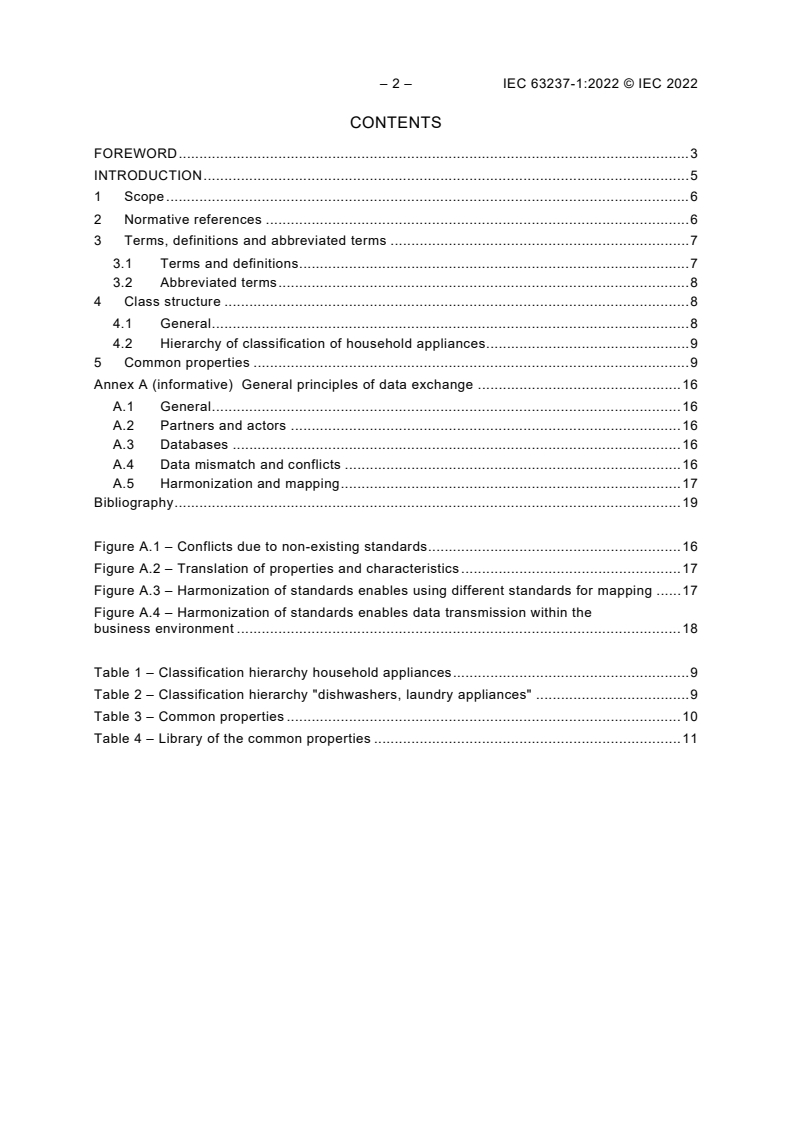
CONTENTS
FOREWORD . 3
INTRODUCTION . 5
1 Scope . 6
2 Normative references . 6
3 Terms, definitions and abbreviated terms . 7
3.1 Terms and definitions . 7
3.2 Abbreviated terms . 8
4 Class structure . 8
4.1 General . 8
4.2 Hierarchy of classification of household appliances . 9
5 Common properties . 9
Annex A (informative) General principles of data exchange . 16
A.1 General . 16
A.2 Partners and actors . 16
A.3 Databases . 16
A.4 Data mismatch and conflicts . 16
A.5 Harmonization and mapping . 17
Bibliography . 19
Figure A.1 – Conflicts due to non-existing standards . 16
Figure A.2 – Translation of properties and characteristics . 17
Figure A.3 – Harmonization of standards enables using different standards for mapping . 17
Figure A.4 – Harmonization of standards enables data transmission within the
business environment . 18
Table 1 – Classification hierarchy household appliances . 9
Table 2 – Classification hierarchy "dishwashers, laundry appliances" . 9
Table 3 – Common properties . 10
Table 4 – Library of the common properties . 11
INTERNATIONAL ELECTROTECHNICAL COMMISSION
____________
HOUSEHOLD AND SIMILAR ELECTRICAL APPLIANCES –
PRODUCT INFORMATION PROPERTIES –
Part 1: Fundamentals
FOREWORD
1) The International Electrotechnical Commission (IEC) is a worldwide organization for standardization comprising
all national electrotechnical committees (IEC National Committees). The object of IEC is to promote international
co-operation on all questions concerning standardization in the electrical and electronic fields. To this end and
in addition to other activities, IEC publishes International Standards, Technical Specifications, Technical Reports,
Publicly Available Specifications (PAS) and Guides (hereafter referred to as "IEC Publication(s)"). Their
preparation is entrusted to technical committees; any IEC National Committee interested in the subject dealt with
may participate in this preparatory work. International, governmental and non-governmental organizations liaising
with the IEC also participate in this preparation. IEC collaborates closely with the International Organization for
Standardization (ISO) in accordance with conditions determined by agreement between the two organizations.
2) The formal decisions or agreements of IEC on technical matters express, as nearly as possible, an international
consensus of opinion on the relevant subjects since each technical committee has representation from all
interested IEC National Committees.
3) IEC Publications have the form of recommendations for international use and are accepted by IEC National
Committees in that sense. While all reasonable efforts are made to ensure that the technical content of IEC
Publications is accurate, IEC cannot be held responsible for the way in which they are used or for any
misinterpretation by any end user.
4) In order to promote international uniformity, IEC National Committees undertake to apply IEC Publications
transparently to the maximum extent possible in their national and regional publications. Any divergence between
any IEC Publication and the corresponding national or regional publication shall be clearly indicated in the latter.
5) IEC itself does not provide any attestation of conformity. Independent certification bodies provide conformity
assessment services and, in some areas, access to IEC marks of conformity. IEC is not responsible for any
services carried out by independent certification bodies.
6) All users should ensure that they have the latest edition of this publication.
7) No liability shall attach to IEC or its directors, employees, servants or agents including individual experts and
members of its technical committees and IEC National Committees for any personal injury, property damage or
other damage of any nature whatsoever, whether direct or indirect, or for costs (including legal fees) and
expenses arising out of the publication, use of, or reliance upon, this IEC Publication or any other IEC
Publications.
8) Attention is drawn to the Normative references cited in this publication. Use of the referenced publications is
indispensable for the correct application of this publication.
9) Attention is drawn to the possibility that some of the elements of this IEC Publication may be the subject of patent
rights. IEC shall not be held responsible for identifying any or all such patent rights.
IEC 63237-1 has been prepared by IEC technical committee 59: Performance of household and
similar electrical appliances. It is an International Standard.
The text of this International Standard is based on the following documents:
Draft Report on voting
59/799/FDIS 59/801/RVD
Full information on the voting for its approval can be found in the report on voting indicated in
the above table.
The language used for the development of this International Standard is English.
A list of all parts in the IEC 63237 series, published under the general title Household and
similar electrical appliances – Product information properties, can be found on the IEC website.
– 4 – IEC 63237-1:2022 © IEC 2022
This document was drafted in accordance with ISO/IEC Directives, Part 2, and developed in
accordance with ISO/IEC Directives, Part 1 and ISO/IEC Directives, IEC Supplement, available
at www.iec.ch/members_experts/refdocs. The main document types developed by IEC are
described in greater detail at www.iec.ch/standardsdev/publications.
The committee has decided that the contents of this document will remain unchanged until the
stability date indicated on the IEC website under webstore.iec.ch in the data related to the
specific document. At this date, the document will be
• reconfirmed,
• withdrawn,
• replaced by a revised edition, or
• amended.
IMPORTANT – The "colour inside" logo on the cover page of this document indicates that it
contains colours which are considered to be useful for the correct understanding of its
contents. Users should therefore print this document using a colour printer.
INTRODUCTION
Due to progressing developments in the fields of digitalization, the Internet of Things (IoT) and
smart manufacturing, product characterization needs to be raised to the next level. The
exchange of product data between companies, business partners and, in the future, various
databases at business and governmental level, can run smoothly only when the information to
be exchanged has been clearly defined. To enable the automatic exchange of product
information, it is vital that manufacturers, trade partners, regulators and authorities speak "one
language", a harmonized language.
This document is aimed at all parties on the market who have a need to exchange product data
very efficiently.
This document describes a method for standardization and a unique characterization of product
specification information which will help both suppliers and partners to optimize workflows,
business, and implementation of legislative measures in the industrial sector of household and
similar appliances. By using a "common appliance language", an optimization of data exchange
and digitalization will be achieved, conflicting situations between appliances will be minimized,
and the cost of running data systems will be reduced. In addition, the use of a "common
appliance language" will allow and simplify the data information exchange between appliances
themselves (not necessarily from the same manufacturer) with a view to optimize the
interactions and the energy consumptions. To achieve the above-mentioned targets, it is
necessary to define a common set of standardized product properties, also called "product
characteristics", including value lists.
NOTE Terms and definitions used in other standards of IEC/TC 59 can be different to some extent. It is the goal of
IEC/TC 59 to harmonize these as much as possible.
This document provides a clear characterization of a set information properties. This document
is to be used in conjunction with the relevant standard for the specific product. The content will
be transferred to the IEC Common Data Dictionary (CDD).
The method described herein provides enough detailed information for an unambiguous
electronic data exchange for the business area of electrical household and similar appliances.
There is no other IEC standard providing descriptions for electronic data exchange between
electric household and similar appliances, which is a limitation for electronic data exchange.
It is the aim to continuously harmonize the content of this document by taking into account
present classification systems (e.g. APPLiA PI, ECLASS and ETIM).
– 6 – IEC 63237-1:2022 © IEC 2022
HOUSEHOLD AND SIMILAR ELECTRICAL APPLIANCES –
PRODUCT INFORMATION PROPERTIES –
Part 1: Fundamentals
1 Scope
This part of IEC 63237 provides a method for standardizing the descriptions of household
electrical appliances.
The aims of this document are to:
• define a common language for customers and suppliers through the publication of classes,
represented by properties and their attributes;
• enable electronic data exchange by machines (including information technology systems,
see machine-to-machine communication [M2M]);
• optimize workflows between customers and suppliers, as well as in processes, such as
engineering, development and purchasing within their own organizations;
• offer also a dictionary to legislators; and
• reduce transaction costs.
This document describes household electrical appliances using properties and makes the
associated properties available in the IEC Common Data Dictionary (IEC CDD).
Furthermore, this document provides rules, methods and the generic data structure for product
specific classification standards and on how to produce a reference dictionary based on the
IEC 61360 series. This in turn creates a descriptive basis of company internal and external
descriptions of household electrical appliances based on structured classes and lists of
properties.
NOTE The terms "class", "properties" and "attributes" are defined in Clause 3, following the established definitions
in IEC and ISO documents.
2 Normative references
The following documents are referred to in the text in such a way that some or all of their content
constitutes requirements of this document. For dated references, only the edition cited applies.
For undated references, the latest edition of the referenced document (including any
amendments) applies.
IEC 61360-1:2017, Standard data elements types with associated classification scheme –
Part 1: Definitions – Principles and methods
IEC 61360-2, Standard data element types with associated classification scheme for electric
components – Part 2: EXPRESS dictionary schema
IEC 61360-4 , Standard data element types with associated classification scheme for electric
components – Part 4: IEC reference collection of standard data element types and component
classes
___________
Withdrawn.
IEC 61360-4 DB, Common Data Dictionary, CDD, available at: https://cdd.iec.ch
3 Terms, definitions and abbreviated terms
For the purposes of this document, the following terms and definitions apply.
ISO and IEC maintain terminology databases for use in standardization at the following
addresses:
• IEC Electropedia: available at https://www.electropedia.org/
• ISO Online browsing platform: available at https://www.iso.org/obp
3.1 Terms and definitions
3.1.1
attribute
characteristic of an object or entity
EXAMPLE Properties, blocks, LOPs, units of measure.
[SOURCE: ISO/IEC 11179-1:2015, 3.1.1, modified – Example has been added.]
3.1.2
classification
systematic division of a set of items into subsets according to their difference in some
predetermined characteristics
[SOURCE: IEC 61360-1:2017, 3.1.5]
3.1.3
class
abstraction of a set of similar products
Note 1 to entry: A product that complies with the abstraction defined by a class is called a class member.
Note 2 to entry: A class is an intentional concept that can take different extensional meanings in different contexts.
The set of products used by a particular enterprise and the set of all ISO-standardized products are two examples of
contexts. In these two contexts (the particular enterprise and ISO), the set of products that are considered as
members of the single ball bearing class can be different, in particular because employees of each enterprise ignore
a number of existing single ball bearing products.
[SOURCE: IEC 61360-2:2012, 3.6, modified – Notes to entry 2, 3, 4 and 5 have been omitted,
and the example has been rewritten to become the present Note 2 to entry.]
3.1.4
data
facts about an object
[SOURCE: ISO 9000:2015, 3.8.1]
3.1.5
information
meaningful data
[SOURCE: ISO 9000:2015, 3.8.2]
3.1.6
characteristic
distinguishing feature
– 8 – IEC 63237-1:2022 © IEC 2022
Note 1 to entry: A characteristic can be inherent or assigned.
Note 2 to entry: A characteristic can be qualitative or quantitative.
Note 3 to entry: here are various classes of characteristic, such as the following:
a) physical (e.g. mechanical, electrical, chemical or biological characteristics);
b) sensory (e.g. related to smell, touch, taste, sight, hearing);
c) behavioral (e.g. courtesy, honesty, veracity);
d) temporal (e.g. punctuality, reliability, availability, continuity);
e) ergonomic (e.g. physiological characteristic, or related to human safety);
f) functional (e.g. maximum speed of an aircraft).
[SOURCE: ISO 9000:2015, 3.10.1]
3.1.7
mapping
identification and assignation of pairs of semantically equivalent information objects
3.1.8
property
defined parameter suitable for the description and differentiation of products
Note 1 to entry: A property describes one aspect of a given object.
Note 2 to entry: A property is defined by the totality of its associated attributes. The types and number of attributes
that describe a property with high accuracy are documented in this part of ISO 13584.
Note 3 to entry: This part of ISO 13584 has identified three different kinds of properties: product characteristics,
context parameters and context-dependent product characteristics.
[SOURCE: ISO 13584-42:2010, 3.37, modified – Notes 4 and 5 to entry have been deleted.]
3.1.9
block
bundle of properties with common features
3.2 Abbreviated terms
ClassID identification number of a class in IEC CDD
PropertyID identification number of a property in IEC CDD
IEC CDD IEC Common Data Dictionary
GS1 Global Specification Barcodes
GLN Global Location Number, according to GS1
GTIN Global Trade Item Number, according to GS1
IRDI international registration data identifier, according to ISO/TS 29002-5
UML Unified Modelling Language, according to ISO/IEC 19505-1
URI Uniform Resource Identifier in WWW, according to RFC 1630
XML eXtensible Markup Language, according to W3C
4 Class structure
4.1 General
A general description of data exchange for household appliances is provided in Annex A.
It is the aim to make classes and properties (see Clause 5) available in the IEC Common Data
Dictionary (IEC CDD). For unique identification identifiers, IDs are assigned to each. These
ClassIDs and PropertyIDs are given in Table 1 to Table 4. For reasons of consistency, the
structure and approach of IEC 61360-4 and IEC 61360-4 DB shall be followed.
From a practical point of view, classification as defined in this document (see 3.1.2), is a
systematic order or method to divide items to different subsets. IEC 61360-1 shall be followed
with this respect. To reach the group level, different hierarchy levels shall be used depending
on the complexity shown; the approach as set out in IEC 61360-2 shall be followed.
NOTE The IEC Common Data Dictionary (IEC CDD) is an International Standard (IEC 61360-4 DB) and serves as
a common repository of concepts for all industrial/technical domains based on the methodology and the information
model of IEC 61360 series, available at https://cdd.iec.ch.
4.2 Hierarchy of classification of household appliances
The concept of classification applies to household appliances. The hierarchy of the
classification structure applies to home goods including household appliances. A non-
exhaustive example of household appliances is shown in Table 1. This principle shall be
followed when adding other household appliances.
Table 1 – Classification hierarchy household appliances
Class ClassID
household appliances BCA000
large household appliances BCA001
refrigerator, freezer BCA002
oven, hob, cooking fume extractor BCA003
dishwasher, laundry appliance BCA004
heating, cooling appliances BCA010
small household appliance BCA011
rd th
In this hierarchy, the items of the 3 level are subdivided once more. The 4 level shows
appliance categories. Table 2 shows the subdivision of "dishwashers, laundry appliances" as
an example.
Table 2 – Classification hierarchy "dishwashers, laundry appliances"
Class ClassID
dishwasher, laundry appliance BCA004
dishwasher (household) BCA005
washing machine (household) BCA006
washer-dryer (household) BCA007
tumble dryer (household) BCA008
spin dryer (household) BCA009
5 Common properties
Common properties are intended for the description of basic characteristics relevant for all
products in Table 1 and Table 2. For structuring common properties the concept of BLOCKS is
used. BLOCKS are a collection of properties with a unique (BLOCK) name and an identifier
(ClassID). The common properties including its structuring in BLOCKS are shown in Table 3. A
detailed description of all common properties is provided in Table 4.
NOTE Table 3 gives an overview and introduction of needed properties, whereas Table 4 gives a detailed
description of all properties.
– 10 – IEC 63237-1:2022 © IEC 2022
Table 3 – Common properties
Common properties ClassID PropertyID
identification BCA500
product identifier BCB000
reference to supplier BCB001
supplier BCA501
batch number from supplier BCB006
supplier product designation BCB005
product article number of supplier BCB003
name of supplier BCB004
delivery time of supplier BCB002
supplier product family BCB008
supplier product root BCB009
supplier product description BCB007
supplier product type BCB011
supplier product order suffix BCB010
GLN of supplier BCB012
reference to manufacturer BCB013
manufacturer BCA502
date of manufacture BCB020
GTIN BCB015
manufacturer name BCB016
manufacturer product family BCB026
manufacturer product root BCB025
manufacturer product order suffix BCB024
manufacturer product description BCB022
brand BCB023
manufacturer product designation BCB027
delivery time of manufacturer BCB014
serial number BCB018
national stock number BCB021
fabrication number BCB017
product article number of manufacturer BCB019
product type BCB028
URI of the product BCB029
GLN of manufacturer BCB030
URI of the manufacturer BCB031
add on documentation BCA507
number of additional information BCB032
reference to additional Information BCB033
additional Information BCA508
calendrical validity from BCB034
document identifier BCB035
source as path info BCB036
type of document BCB037
Common properties ClassID PropertyID
type of source file BCB038
description BCB039
country/region classification of document BCB040
version BCB041
type of certificate BCB042
scope of document BCB043
language of document BCB044
commercial CAA100
number of customs tariff numbers CAP000
reference to customs tariff number CAP001
customs tariff number CAA101
region of customs tariff number CAP002
type of customs tariff number CAP004
country of customs tariff number CAP003
use of customs tariff number CAP005
customs tariff number CAP006
customs tariff number (TARIC) CAP008
HS-Code of the WCO CAP007
Table 4 illustrates the common properties in detail.
Table 4 – Library of the common properties
Value
PropertyID Preferred name Definition Source Unit Data type
format
BCB000 product identifier unique identifier of the product STRING_TYPE
BCB001 reference to reference property to supplier CLASS_REFERENCE_
supplier TYPE
BCB006 batch number unique combination of numbers STRING_TYPE
from supplier and letters that distinguishes a
product from other products of
a different fabrication process
BCB005 supplier product short description of the product TRANSLATABLE_STRI
designation (short text) NG_TYPE
BCB003 product article the customer can use this STRING_TYPE
number of number to order the article (or
supplier service) from the manufacturer
or supplier.
BCB004 name of supplier name of supplier who provides STRING_TYPE
the customer with a product or
a service
BCB002 delivery time of duration per working days day REAL_MEASUREMEN
supplier needed by the supplier to T_TYPE
deliver the product beginning
with the receipt of the order
BCB008 supplier product 2nd level of a 3-level supplier- TRANSLATABLE_STRI
family specific product hierarchy NG_TYPE
BCB009 supplier product top level of a 3-level supplier- TRANSLATABLE_STRI
root specific product hierarchy NG_TYPE
– 12 – IEC 63237-1:2022 © IEC 2022
Value
PropertyID Preferred name Definition Source Unit Data type
format
BCB007 supplier product description of the product, its TRANSLATABLE_STRI
description technical features and NG_TYPE
implementation if needed (long
text)
BCB011 supplier product characteristic to differentiate TRANSLATABLE_STRI
type between different products of a NG_TYPE
product family or special
variants
BCB010 supplier product by the supplier awarded string TRANSLATABLE_STRI
order suffix for the identification of NG_TYPE
additional attributes, not by a
structured supplier item
number may be expressed
BCB012 GLN of supplier internationally unique GS1 INT_TYPE
identification number for the system
supplier of the device or the
product and for the physical
location
BCB013 reference to reference property to CLASS_REFERENCE_
manufacturer manufacturer TYPE
BCB020 date of date from which the production DATE_TYPE
manufacture and/or development process is
completed or from which a
service is provided completely
BCB015 GTIN internationally unique and GS1 STRING_TYPE
unambiguous article number for system
products and services (Global
Trade Item Number)
BCB016 manufacturer legally valid designation of the STRING_TYPE
name natural or judicial person which
is directly responsible for the
design, production, packaging
and labeling of a product in
respect to its being brought
into circulation
BCB026 manufacturer 2nd level of a 3-level TRANSLATABLE_STRI
product family manufacturer-specific product NG_TYPE
hierarchy
BCB025 manufacturer top level of a 3-level TRANSLATABLE_STRI
product root manufacturer-specific product NG_TYPE
hierarchy
BCB024 manufacturer can be expressed by the TRANSLATABLE_STRI
product order manufacturer-awarded string NG_TYPE
suffix for the identification of
additional attributes, not by a
structured manufacturer item
number
BCB022 manufacturer description of the product, its TRANSLATABLE_STRI
product technical features and NG_TYPE
description implementation if needed (long
text)
BCB023 brand part of the naming for the STRING_TYPE
support and the recognition of
the brand position of products
and services consisting of
words, numbers, letters or
other characters. Registered
brands and trademarks are
indicated with the appropriate
protective signs (® or TM)
BCB027 manufacturer short description of the product TRANSLATABLE_STRI
product (short text) NG_TYPE
designation
Value
PropertyID Preferred name Definition Source Unit Data type
format
BCB014 delivery time of duration per working days day INT_MEASUREMENT_
manufacturer needed by the manufacturer to TYPE or
deliver the product beginning REAL_MEASUREMEN
with the receipt of the order T_TYPE,
depending on full days
or a fraction of days
BCB018 serial number unique combination of numbers STRING_TYPE
and letters used to identify the
device once it has been
manufactured
BCB021 national stock 13-digit numeric code, TRANSLATABLE_STRI
number identifying all the standardized NG_TYPE
material items of supply as
they have been recognized by
the United States Department
of Defense
BCB017 fabrication alphanumeric character STRING_TYPE
number sequence assigned to a
fabricated product, which
allows the date, time and
circumstances of fabrication to
be traced
BCB019 product article unique product identifier of the STRING_TYPE
number of manufacturer
manufacturer
BCB028 product type characteristic to differentiate TRANSLATABLE_STRI
between different products of a NG_TYPE
product family or special
variants
BCB029 URI of the unique global identification of TRANSLATABLE_STRI
product the product using a universal NG_TYPE
resource identifier (URI)
BCB030 GLN of internationally unique GS1 INT_TYPE
manufacturer identification number for the system
manufacturer of the device or
the product and for the physical
location
BCB031 URI of the unique global identification of URI_TYPE
manufacturer the manufacturer using a
universal resource identifier
(URI)
BCB032 number of cardinality property for INT_TYPE
additional additional information
information
BCB033 reference to reference property for CLASS_REFERENCE_
additional
additional information TYPE
Information
BCB034 calendrical appointment information DATE_TYPE
validity from covered to a fixed date
BCB035 document unique identification of a STRING_TYPE
identifier document
BCB036 source as path information, related to STRING_TYPE
info information technology, where
the searched object can be
found
BCB037 type of document classification of a document ENUM_STRING_TYPE
according to its purpose or the
information it contains
BCB038 type of source classification of a file seal ENUM_STRING_TYPE
file according to its application
type
– 14 – IEC 63237-1:2022 © IEC 2022
Value
PropertyID Preferred name Definition Source Unit Data type
format
BCB039 description text note TRANSLATABLE_STRI
NG_TYPE
BCB040 country/region documents which are ENUM_STRING_TYPE
classification of considered for usage in a
document certain region
BCB041 version design that partly deviates from STRING_TYPE
the previous
classification of a certificate
BCB042 type of certificate ENUM_STRING_TYPE
according to the standard or
directive on the basis of which
it was issued
BCB043 scope of description of the application ENUM_STRING_TYPE
document range of the document
BCB044 language of language of the document ENUM_STRING_TYPE
document
CAP000 number of cardinality property for customs INT_TYPE
customs tariff tariff number
number
CAP001 reference to reference property for customs CLASS_REFERENCE_
customs tariff tariff number TYPE
number
CAP002 region of describes the membership of TRANSLATABLE_STRI
customs tariff the tariff number to a specific NG_TYPE
number region
CAP004 type of customs describes the membership of ENUM_CODE_TYPE()
tariff number the tariff number to a specific
type in terms of structure and
meaning and thus also defines
its general context
CAP003 country of country for which the declared ENUM_CODE_TYPE()
customs tariff tariff number is applicable in
number terms of content and structure
CAP005 use of customs indicates what the tariff number ENUM_CODE_TYPE()
tariff number is for (for example, import or
export)
customs tariff nomenclature of goods in
CAP006 STRING_TYPE
number accordance with a regulation
relating to customs tariff and
statistical purposes for
application to a specific country
and/or region. The structure of
the customs tariff number is
defined by the type otherwise
indicated
CAP008 customs tariff nomenclature of goods INT_TYPE
number (TARIC) according to the current
regulation including the tariff
and statistical nomenclature
and the common Customs
Tariff in the European
Community. The structure of
the number defines in the 1.-6.
place the HS code of the WCO,
in the 7.-8. the combined
nomenclature of the European
Community, in the 9.-10. the
TARIC Code (Integrated Tariff
of the European Communities)
and in the 11th place a code
for national purposes
Value
PropertyID Preferred name Definition Source Unit Data type
format
CAP007 HS-Code of the internationally applied 4 to 6- INT_TYPE
WCO digit coding of classes of goods
as defined by the Harmonized
System (HS) of the World
Customs Organization (WCO)
Product-specific properties are intended to be published in separate parts of the IEC 63237
series.
– 16 – IEC 63237-1:2022 © IEC 2022
Annex A
(informative)
General principles of data exchange
A.1 General
Exchange of information amongst different partners and actors (e.g. business partners,
machines), which is creating value.
A.2 Partners and actors
Information and data are generally aggregated by manufacturers of household appliances. It is
provided to business partners, for example, retailers. Information is also provided to consumers
directly by manufacturers or by retailers. Data is requested by regulations and other actors also
in order to guarantee smooth running of regulations, agreements, common projects and
programs, etc.
A.3 Databases
Data exchange is provided by databases, which are interconnected to each other. Databases
implement a data architecture. Information and data should be available in a correct format.
A.4 Data mismatch and conflicts
According to the request, information and data shall be provided in a defined format. If actors
are using different systems, the actor receiving the information and data will not be in a position
to understand the information and data.
Figure A.1 shows data exchange from database A to database B. If there is no alignment of
characteristics or properties, database B will not be in a position to automatically understand
what has been transferred. As an example "NominalVoltage" is transferred from database A to
database B. However, database B does not understand what is meant with by this, because no
correspondence is integrated there. "RatedVoltage" would be the correct property of
database B.
Figure A.1 – Conflicts due to non-existing standards
A.5 Harmonization and mapping
Harmonization of characteristics and properties should be the priority. It could result in a unique
characteristic, i.e. "NominalVoltage" or "RatedVoltage". It could also result in a new unique
characteristic, like "SupplyVoltage".
However, this would be not sufficient as a databases C, D, etc. need a solution, as they do not
include characteristics defined by the owners of databases A and B.
Mapping of properties and characteristics solves this problem: mapping is a hidden "translation"
procedure. At database A, the name of a property or a characteristic is assigned to an intrinsic
name, which is to be transferred to database B. This intrinsic name will be translated at
database B into the appropriate name. Figure A.2 shows an example. At database A, the
characteristic "NominalVoltage" is selected. This name is transferred as "SupplyVoltage" to
database B. Database B interprets this as "RatedVoltage", in accordance with its structure.
Figure A.2 – Translation of properties and characteristics
As there exist different standards within the household appliances sector, the mapping
procedure will be hindered if database A is using mapping in accordance with Standard 1 and
database C is using a different mapping in accordance with Standard 2. The conditions for a
mapping procedure are developed in so far that both Standard 1 and Standard 2 have been
harmonized and even adopted their content in the field of household appliances. As shown in
Figure A.3, this enables a data transmission between two databases, even if they are using
different standards.
Figure A.3 – Harmonization of standards enables using different standards for mapping
– 18 – IEC 63237-1:2022 © IEC 2022
Figure A.4 shows the data transmission within a business environment. Thanks to harmonized
standards and the mapping procedure, various and unlimited numbers of participants can
communicate with each other.
Figure A.4 – Harmonization of standards enables data transmission
within the business environment
Bibliography
IEC 60456, Clothes washing machines for household use – Methods for measuring the
performance
IEC TS 62720, Identification of units of measurement for computer-based processing
ISO/IEC 11179-1:2015, Information technology – Metadata registries (MDR) – Part 1:
Framework
ISO/IEC 11179-6:2015, Information technology – Metadata registries (MDR) – Part 6:
Registration
ISO/IEC 19505-1, Information technology – Object Management Group Unified modelling
language (OMG UML) – Part 1: Infrastructure
ISO 9000:2015, Quality management systems – Fundamentals and vocabulary
ISO 13584-42:2010, Industrial automation systems and integration – Parts library – Part 42:
Description methodology for structuring part families
ISO/TS 29002-5, Industrial automation systems and integration – Exchange of characteristic
data – Part 5: Identification scheme
United Nations Economic Commission for Europe (UNECE), Codes for Trade [viewed 2022-07-
27]. Available at https://www.unece.org/cefact/codesfortrade/codes_index.html
Global Specification Barcode, GS1 [viewed 2022-07-27]. Available at https://gs1.org
Global Location Number, GLN, GS1 [viewed 2022-07-27]. Available at https://gs1.org
Global Trade Item Number, GTIN, GS1 [viewed 2022-07-27]. Available at https://gs1.org
INTERNET ENGINEERING TASK FORCE (IETF). RFC 1630: Uniform Resource Identifiers in
WWW [online]. Edited by T. Berners-Lee. June 1994 [viewed 2022-07-27]. Available at
https://www.ietf.org/rfc/rfc1630.txt
Extensible Markup Language, XML, W3C standard [viewed 2022-07-27]. Available at
https://www.w3.org/XML/
APPLiA Home Appliance Europe, The PI-Standard [viewed 2022-07-27]. Available at
https://www.picertified.com/
ECLASS e.V., ECLASS-Standard [viewed 2022-07-27]. Available at
https://eclass.eu/en/eclass-standard
___________
– 20 – IEC 63237-1:2022 © IEC 2022
SOMMAIRE
AVANT-PROPOS . 21
INTRODUCTION . 23
1 Domaine d'application .
...