


IEC 62849:2016
(Main)Performance evaluation methods of mobile household robots
Performance evaluation methods of mobile household robots
IEC 62849:2016 applies to mobile household robots and provides performance testing and evaluation methods for common features of various mobile household robots. This standard is neither concerned with safety nor with performance requirements. This standard will cover the generic performance test methods for mobile household robots within one document. However this current version is applicable for indoor floor supported wheeled or wheel-track robots with focus on mobility and power consumption related performance. As the needs for manipulation related performance grows, it will be added into this generic performance standard.
Méthodes d'évaluation de l'aptitude à la fonction des robots mobiles à usage domestique
L'IEC 62849:2016 s'applique aux robots mobiles à usage domestique et fournit des essais d'aptitude à la fonction ainsi que des méthodes d'évaluation applicables aux caractéristiques communes de plusieurs robots mobiles à usage domestique. La présente norme ne couvre ni les exigences de sécurité ni les exigences d'aptitude à la fonction. La présente norme couvre les méthodes d'essai génériques pour l'aptitude à la fonction des robots mobiles à usage domestique dans un seul document. Toutefois, la présente version est applicable aux robots à roues ou à chenilles pouvant être utilisés sur un sol intérieur et met l'accent sur les aptitudes à la fonction relatives à la mobilité et à la consommation d énergie. À mesure que les besoins associés à l'aptitude à la manipulation augmentent, ils sont ajoutés à la présente Norme générique sur l'aptitude à la fonction.
General Information
- Status
- Published
- Publication Date
- 24-Aug-2016
- Technical Committee
- TC 59 - Performance of household and similar electrical appliances
- Drafting Committee
- WG 16 - TC 59/WG 16
Relations
- Effective Date
- 05-Sep-2023
Overview
IEC 62849:2016, published by the International Electrotechnical Commission (IEC), specifies performance evaluation methods for mobile household robots. It provides standardized test procedures to assess the key functional characteristics of indoor, floor-supported, wheeled, or wheel-track robots. This standard focuses on mobility and power consumption-related performance, allowing manufacturers, laboratories, and industry stakeholders to consistently measure and compare robot capabilities. Importantly, IEC 62849:2016 does not specify safety or performance requirements but rather unifies generic performance test methods within a single document to promote comparability and repeatability.
Key Topics
The standard outlines a comprehensive suite of test methods covering essential aspects of mobile household robot performance:
- General Testing Conditions: Specifies how products must be prepared before testing, including requirements for assembly, alignment, environmental conditions (temperature, humidity, lighting), and equipment calibration.
- Pose Measurements: Evaluates the robot’s ability to travel a prescribed path, return to a set position, and orient itself accurately, ensuring reliability in navigation.
- Homing Function: Assesses whether robots can reliably return to their charging station from remote locations, a critical function for automated recharging and task completion.
- Operation Time Per Charge: Measures the duration a robot can operate under standard conditions on a single battery charge, evaluating energy efficiency and practicality for household use.
- Single Step Management: Tests the robot’s ability to manage small obstacles like steps or raised edges, important for traversing varied domestic environments.
- Obstacle Avoidance: Examines the robot’s capacity to detect and avoid obstacles, minimizing the risk of collisions and disruptions during operation.
- Cable Traversing: Evaluates the robot’s ability to move over floor cables, a common challenge in real-world settings.
Applications
IEC 62849:2016 is widely applicable in the design, production, and validation of mobile household robots:
- Manufacturers: Enables consistent benchmarking of robot models, supporting product development, quality control, and marketing claims by providing reliable performance metrics.
- Testing Laboratories: Provides a standardized reference for evaluating and certifying mobile household robot performance, ensuring that tests are repeatable and comparable.
- Purchasers and Consumers: Informs purchasing decisions by enabling objective comparisons between robot models based on standardized criteria.
- Research and Development: Supports innovation by highlighting key performance areas and establishing common evaluation frameworks.
These test methods are especially relevant for indoor robots with wheels or wheel tracks and can be adapted as new functional needs, such as manipulation capabilities, become more prominent in future robot designs.
Related Standards
IEC 62849:2016 is part of a growing family of standards dedicated to the evaluation of household robotic appliances. Key related standards include:
- IEC 62929:2014 - Cleaning robots for household use – Dry cleaning: Methods of measuring performance. Offers detailed requirements for cleaning performance specifically.
- IEC TS 62885-1 - Surface cleaning appliances – General requirements on test material and equipment.
- ISO 554 - Standard atmospheres for conditioning and/or testing – Specifications, which defines environmental conditions for standardized testing.
- ISO 2768-1:1989 - General tolerances – Part 1: Tolerances for linear and angular dimensions without individual tolerance indications.
By utilizing IEC 62849:2016 in combination with these standards, stakeholders ensure robust, interoperable benchmarks for mobile household robots. This supports global consistency, enhances consumer confidence, and facilitates the adoption of advanced robotics technology in domestic environments.
Keywords: IEC 62849, mobile household robots, performance evaluation, robot testing standards, home robot benchmarking, robot mobility, autonomous robot testing, household robotics performance
Frequently Asked Questions
IEC 62849:2016 is a standard published by the International Electrotechnical Commission (IEC). Its full title is "Performance evaluation methods of mobile household robots". This standard covers: IEC 62849:2016 applies to mobile household robots and provides performance testing and evaluation methods for common features of various mobile household robots. This standard is neither concerned with safety nor with performance requirements. This standard will cover the generic performance test methods for mobile household robots within one document. However this current version is applicable for indoor floor supported wheeled or wheel-track robots with focus on mobility and power consumption related performance. As the needs for manipulation related performance grows, it will be added into this generic performance standard.
IEC 62849:2016 applies to mobile household robots and provides performance testing and evaluation methods for common features of various mobile household robots. This standard is neither concerned with safety nor with performance requirements. This standard will cover the generic performance test methods for mobile household robots within one document. However this current version is applicable for indoor floor supported wheeled or wheel-track robots with focus on mobility and power consumption related performance. As the needs for manipulation related performance grows, it will be added into this generic performance standard.
IEC 62849:2016 is classified under the following ICS (International Classification for Standards) categories: 97.030 - Domestic electrical appliances in general. The ICS classification helps identify the subject area and facilitates finding related standards.
IEC 62849:2016 has the following relationships with other standards: It is inter standard links to IEC 62849:2025. Understanding these relationships helps ensure you are using the most current and applicable version of the standard.
IEC 62849:2016 is available in PDF format for immediate download after purchase. The document can be added to your cart and obtained through the secure checkout process. Digital delivery ensures instant access to the complete standard document.
Standards Content (Sample)
IEC 62849 ®
Edition 1.0 2016-08
INTERNATIONAL
STANDARD
NORME
INTERNATIONALE
colour
inside
Performance evaluation methods of mobile household robots
Méthodes d’évaluation de l’aptitude à la fonction des robots mobiles à usage
domestique
All rights reserved. Unless otherwise specified, no part of this publication may be reproduced or utilized in any form
or by any means, electronic or mechanical, including photocopying and microfilm, without permission in writing from
either IEC or IEC's member National Committee in the country of the requester. If you have any questions about IEC
copyright or have an enquiry about obtaining additional rights to this publication, please contact the address below or
your local IEC member National Committee for further information.
Droits de reproduction réservés. Sauf indication contraire, aucune partie de cette publication ne peut être reproduite
ni utilisée sous quelque forme que ce soit et par aucun procédé, électronique ou mécanique, y compris la photocopie
et les microfilms, sans l'accord écrit de l'IEC ou du Comité national de l'IEC du pays du demandeur. Si vous avez des
questions sur le copyright de l'IEC ou si vous désirez obtenir des droits supplémentaires sur cette publication, utilisez
les coordonnées ci-après ou contactez le Comité national de l'IEC de votre pays de résidence.
IEC Central Office Tel.: +41 22 919 02 11
3, rue de Varembé Fax: +41 22 919 03 00
CH-1211 Geneva 20 info@iec.ch
Switzerland www.iec.ch
About the IEC
The International Electrotechnical Commission (IEC) is the leading global organization that prepares and publishes
International Standards for all electrical, electronic and related technologies.
About IEC publications
The technical content of IEC publications is kept under constant review by the IEC. Please make sure that you have the
latest edition, a corrigenda or an amendment might have been published.
IEC Catalogue - webstore.iec.ch/catalogue Electropedia - www.electropedia.org
The stand-alone application for consulting the entire The world's leading online dictionary of electronic and
bibliographical information on IEC International Standards, electrical terms containing 20 000 terms and definitions in
Technical Specifications, Technical Reports and other English and French, with equivalent terms in 15 additional
documents. Available for PC, Mac OS, Android Tablets and languages. Also known as the International Electrotechnical
iPad. Vocabulary (IEV) online.
IEC publications search - www.iec.ch/searchpub IEC Glossary - std.iec.ch/glossary
The advanced search enables to find IEC publications by a 65 000 electrotechnical terminology entries in English and
variety of criteria (reference number, text, technical French extracted from the Terms and Definitions clause of
committee,…). It also gives information on projects, replaced IEC publications issued since 2002. Some entries have been
and withdrawn publications. collected from earlier publications of IEC TC 37, 77, 86 and
CISPR.
IEC Just Published - webstore.iec.ch/justpublished
Stay up to date on all new IEC publications. Just Published IEC Customer Service Centre - webstore.iec.ch/csc
details all new publications released. Available online and If you wish to give us your feedback on this publication or
also once a month by email. need further assistance, please contact the Customer Service
Centre: csc@iec.ch.
A propos de l'IEC
La Commission Electrotechnique Internationale (IEC) est la première organisation mondiale qui élabore et publie des
Normes internationales pour tout ce qui a trait à l'électricité, à l'électronique et aux technologies apparentées.
A propos des publications IEC
Le contenu technique des publications IEC est constamment revu. Veuillez vous assurer que vous possédez l’édition la
plus récente, un corrigendum ou amendement peut avoir été publié.
Catalogue IEC - webstore.iec.ch/catalogue Electropedia - www.electropedia.org
Application autonome pour consulter tous les renseignements
Le premier dictionnaire en ligne de termes électroniques et
bibliographiques sur les Normes internationales,
électriques. Il contient 20 000 termes et définitions en anglais
Spécifications techniques, Rapports techniques et autres
et en français, ainsi que les termes équivalents dans 15
documents de l'IEC. Disponible pour PC, Mac OS, tablettes
langues additionnelles. Egalement appelé Vocabulaire
Android et iPad.
Electrotechnique International (IEV) en ligne.
Recherche de publications IEC - www.iec.ch/searchpub
Glossaire IEC - std.iec.ch/glossary
La recherche avancée permet de trouver des publications IEC 65 000 entrées terminologiques électrotechniques, en anglais
en utilisant différents critères (numéro de référence, texte, et en français, extraites des articles Termes et Définitions des
comité d’études,…). Elle donne aussi des informations sur les publications IEC parues depuis 2002. Plus certaines entrées
projets et les publications remplacées ou retirées. antérieures extraites des publications des CE 37, 77, 86 et
CISPR de l'IEC.
IEC Just Published - webstore.iec.ch/justpublished
Service Clients - webstore.iec.ch/csc
Restez informé sur les nouvelles publications IEC. Just
Published détaille les nouvelles publications parues. Si vous désirez nous donner des commentaires sur cette
Disponible en ligne et aussi une fois par mois par email. publication ou si vous avez des questions contactez-nous:
csc@iec.ch.
IEC 62849 ®
Edition 1.0 2016-08
INTERNATIONAL
STANDARD
NORME
INTERNATIONALE
colour
inside
Performance evaluation methods of mobile household robots
Méthodes d’évaluation de l’aptitude à la fonction des robots mobiles à usage
domestique
INTERNATIONAL
ELECTROTECHNICAL
COMMISSION
COMMISSION
ELECTROTECHNIQUE
INTERNATIONALE
ICS 97.030 ISBN 978-2-8322-3596-6
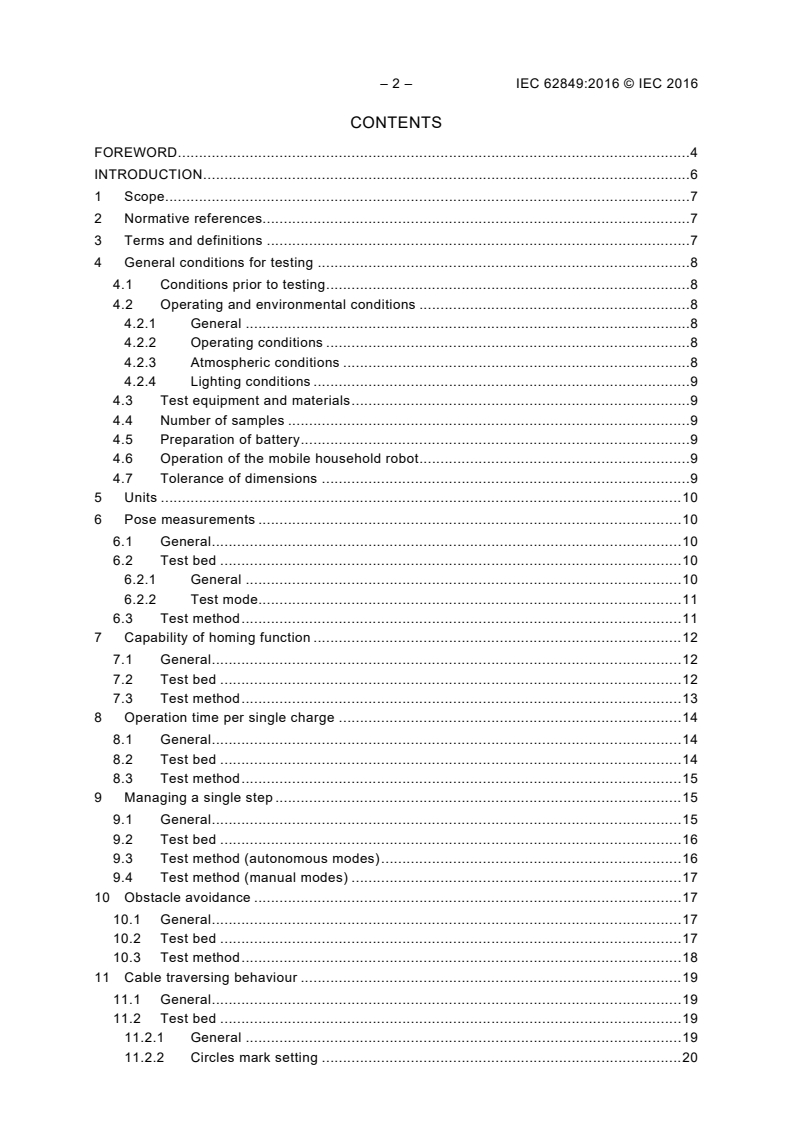
– 2 – IEC 62849:2016 © IEC 2016
CONTENTS
FOREWORD . 4
INTRODUCTION . 6
1 Scope . 7
2 Normative references. 7
3 Terms and definitions . 7
4 General conditions for testing . 8
4.1 Conditions prior to testing . 8
4.2 Operating and environmental conditions . 8
4.2.1 General . 8
4.2.2 Operating conditions . 8
4.2.3 Atmospheric conditions . 8
4.2.4 Lighting conditions . 9
4.3 Test equipment and materials . 9
4.4 Number of samples . 9
4.5 Preparation of battery . 9
4.6 Operation of the mobile household robot . 9
4.7 Tolerance of dimensions . 9
5 Units . 10
6 Pose measurements . 10
6.1 General . 10
6.2 Test bed . 10
6.2.1 General . 10
6.2.2 Test mode. 11
6.3 Test method . 11
7 Capability of homing function . 12
7.1 General . 12
7.2 Test bed . 12
7.3 Test method . 13
8 Operation time per single charge . 14
8.1 General . 14
8.2 Test bed . 14
8.3 Test method . 15
9 Managing a single step . 15
9.1 General . 15
9.2 Test bed . 16
9.3 Test method (autonomous modes) . 16
9.4 Test method (manual modes) . 17
10 Obstacle avoidance . 17
10.1 General . 17
10.2 Test bed . 17
10.3 Test method . 18
11 Cable traversing behaviour . 19
11.1 General . 19
11.2 Test bed . 19
11.2.1 General . 19
11.2.2 Circles mark setting . 20
11.2.3 Cable . 20
11.3 Test method . 21
Annex A (normative) . 23
A.1 General . 23
A.2 Door specification . 26
Bibiography . 27
Figure 1 – Pose measurements configuration . 12
Figure 2 – Capability of homing function configuration . 13
Figure 3 – Operation time per single charge configuration. 14
Figure 4 – Managing a single step configuration . 16
Figure 5 – Starting position for managing a single step test . 17
Figure 6 – Obstacle avoidance configuration . 18
Figure 7 – Starting position for obstacle avoidance test . 18
Figure 8 – Wire fastening configuration . 20
Figure 9 – Floor circle marks schematic diagram . 20
Figure 10 – Floor circle marks schematic diagram with robot . 21
Figure 11 – Top view of cable traversing behaviour Configuration . 21
Figure 12 – Side view of cable traversing behaviour Configuration . 22
Figure A.1 – Details of obstacles around table . 23
Figure A.2 – Illustration of metal transition installation . 25
Figure A.3 – Illustration of wood transition Installation . 25
Figure A.4 – Detail view of checker board and transitions . 26
Figure A.5 – Illustration of four-panel door . 26
Table 1 – Tolerance of linear dimension (from ISO 2768-1) . 10
Table 2 – Tolerance of external radius and chamfer heights (from ISO 2768-1) . 10
Table A.1 – Dimensions of furniture and obstacles . 24
– 4 – IEC 62849:2016 © IEC 2016
INTERNATIONAL ELECTROTECHNICAL COMMISSION
____________
PERFORMANCE EVALUATION METHODS
OF MOBILE HOUSEHOLD ROBOTS
FOREWORD
1) The International Electrotechnical Commission (IEC) is a worldwide organization for standardization comprising
all national electrotechnical committees (IEC National Committees). The object of IEC is to promote
international co-operation on all questions concerning standardization in the electrical and electronic fields. To
this end and in addition to other activities, IEC publishes International Standards, Technical Specifications,
Technical Reports, Publicly Available Specifications (PAS) and Guides (hereafter referred to as “IEC
Publication(s)”). Their preparation is entrusted to technical committees; any IEC National Committee interested
in the subject dealt with may participate in this preparatory work. International, governmental and non-
governmental organizations liaising with the IEC also participate in this preparation. IEC collaborates closely
with the International Organization for Standardization (ISO) in accordance with conditions determined by
agreement between the two organizations.
2) The formal decisions or agreements of IEC on technical matters express, as nearly as possible, an international
consensus of opinion on the relevant subjects since each technical committee has representation from all
interested IEC National Committees.
3) IEC Publications have the form of recommendations for international use and are accepted by IEC National
Committees in that sense. While all reasonable efforts are made to ensure that the technical content of IEC
Publications is accurate, IEC cannot be held responsible for the way in which they are used or for any
misinterpretation by any end user.
4) In order to promote international uniformity, IEC National Committees undertake to apply IEC Publications
transparently to the maximum extent possible in their national and regional publications. Any divergence
between any IEC Publication and the corresponding national or regional publication shall be clearly indicated in
the latter.
5) IEC itself does not provide any attestation of conformity. Independent certification bodies provide conformity
assessment services and, in some areas, access to IEC marks of conformity. IEC is not responsible for any
services carried out by independent certification bodies.
6) All users should ensure that they have the latest edition of this publication.
7) No liability shall attach to IEC or its directors, employees, servants or agents including individual experts and
members of its technical committees and IEC National Committees for any personal injury, property damage or
other damage of any nature whatsoever, whether direct or indirect, or for costs (including legal fees) and
expenses arising out of the publication, use of, or reliance upon, this IEC Publication or any other IEC
Publications.
8) Attention is drawn to the Normative references cited in this publication. Use of the referenced publications is
indispensable for the correct application of this publication.
9) Attention is drawn to the possibility that some of the elements of this IEC Publication may be the subject of
patent rights. IEC shall not be held responsible for identifying any or all such patent rights.
International Standard IEC 62849 has been prepared by IEC technical committee 59:
Performance of household and similar electrical appliances.
The text of this standard is based on the following documents:
FDIS Report on voting
59/655/FDIS 59/656/RVD
Full information on the voting for the approval of this standard can be found in the report on
voting indicated in the above table.
This publication has been drafted in accordance with the ISO/IEC Directives, Part 2.
The committee has decided that the contents of this publication will remain unchanged until
the stability date indicated on the IEC website under "http://webstore.iec.ch" in the data
related to the specific publication. At this date, the publication will be
• reconfirmed,
• withdrawn,
• replaced by a revised edition, or
• amended.
IMPORTANT – The 'colour inside' logo on the cover page of this publication indicates
that it contains colours which are considered to be useful for the correct
understanding of its contents. Users should therefore print this document using a
colour printer.
– 6 – IEC 62849:2016 © IEC 2016
INTRODUCTION
This standard will cover the generic performance test methods for mobile household robots
within one document. However this current version is applicable for indoor floor supported
wheeled or wheel-track robots with focus on mobility and power consumption related
performance. As the needs for manipulation related performance grows, it will be added into
this generic performance standard.
PERFORMANCE EVALUATION METHODS
OF MOBILE HOUSEHOLD ROBOTS
1 Scope
This International Standard applies to mobile household robots and provides performance
testing and evaluation methods for common features of various mobile household robots.
This standard is neither concerned with safety nor with performance requirements.
2 Normative references
The following documents are referred to in the text in such a way that some or all of their
content constitutes requirements of this document. For dated references, only the edition
cited applies. For undated references, the latest edition of the referenced document (including
any amendments) applies.
IEC TS 62885-1, Surface cleaning appliances – Part 1: General requirements on test material
and test equipment
IEC 62929:2014, Cleaning robots for household use – Dry cleaning: Methods of measuring
performance
ISO 554, Standard atmospheres for conditioning and/or testing – Specifications
ISO 2768-1:1989, General tolerances – Part 1: Tolerances for linear and angular dimensions
without individual tolerance indications
3 Terms and definitions
For the purposes of this document, the following terms and definitions apply.
ISO and IEC maintain terminological databases for use in standardization at the following
addresses:
• IEC Electropedia: available at http://www.electropedia.org/
• ISO Online browsing platform: available at http://www.iso.org/obp
3.1
household robot
actuated mechanism with a degree of autonomy, operating within the household and similar
environment, to perform intended tasks
Note 1 to entry: Operating includes travel and/or robot body movement.
3.2
mobile household robot
household robot able to travel under its own control
3.3
capability of homing function
capability of a mobile household robot to return to the charge station(s) for charging or after
completion of the work task or called by user
– 8 – IEC 62849:2016 © IEC 2016
3.4
pose
the combination of position and orientation
3.5
autonomous mode
mode set by user where the robot travels horizontally with no user interaction
3.6
manual mode
mode set by the user where the robot travels with intermittent or continuous user interaction
4 General conditions for testing
4.1 Conditions prior to testing
The robot shall be completely assembled and fully operational in accordance with the
manufacturer’s instructions. All necessary leveling operations, alignment procedures and
functional tests shall be satisfactorily completed.
Prior to conducting any series of tests, the age, condition, and history of the product shall be
recorded.
NOTE Condition information can include model number/name, software version, and accessories used, if
available.
4.2 Operating and environmental conditions
4.2.1 General
The performance characteristics determined by the related test methods in this International
Standard are valid only under the environmental and normal operating conditions as
stipulated by the manufacturer.
4.2.2 Operating conditions
All tests shall be carried out under conditions in which the mobile household robot is operated
in normal use; the normal operating conditions used in the tests shall be in accordance with
the manufacturer’s instructions.
Performance will be affected by the installed software. Therefore installed software shall not
be modified or changed during a set of tests.
4.2.3 Atmospheric conditions
Unless otherwise specified, the test procedures and measurements shall be carried out under
the following atmospheric conditions (in accordance with ISO 554):
Temperature: (20 ± 5) °C
Air pressure: 86 kPa to 106 kPa
Temperature and humidity conditions if provided shall be aligned with manufacturer’s
instruction for good repeatability and reproducibility. Care should be taken to avoid changes
during a test.
4.2.4 Lighting conditions
Unless otherwise specified, the test procedures and measurements shall be carried out under
the following lighting conditions:
Intensity: (200 ± 50) lux
Colour temperature: 2 000 K to 6 000 K
Measurement shall be made at the test surface.
4.3 Test equipment and materials
Measurements on carpets shall be carried out on a level floor consisting of a smooth
untreated laminated pine tree plate or equivalent panel, at least 15 mm thick and of a size
appropriate for the test.
Equipment and materials for measurements (devices, test carpets, test dust etc.) to be used
in a test shall, prior to the test, be kept for at least 16 h at standard atmospheric conditions
according to 4.2.3.
4.4 Number of samples
All measurements of performance shall be carried out on the same sample(s) of the robot with
its attachments, if any.
Tests carried out to simulate stresses a robot may be exposed to during normal use, possibly
causing impairment of the robot performance, may require additional samples of replaceable
parts. Such tests shall be carried out at the end of a test programme.
4.5 Preparation of battery
Any new battery shall need to go through at least one full charge and complete discharge
cycle in the robot prior to conducting first test of the robot.
Complete discharge in the robot shall be done by performing a normal operation following the
manufacturer’s instructions.
NOTE The complete discharge means low battery signal, if any, without any motion.
4.6 Operation of the mobile household robot
If not otherwise specified in this standard,
• The mobile household robot, its attachments, the docking station and any accessories
shall be used and adjusted in accordance with the manufacturer's instructions for normal
operation before a test is carried out, and
• The operation mode of the robot can be selected and adjusted per manufacturer published
instructions only before the test to fit the environment to be operated.
• The operation mode shall be recorded.
Any safety-related device shall be allowed to operate.
4.7 Tolerance of dimensions
For all dimensions which are not presented as a range and no tolerance is specified, the
tolerance shall be determined as Table 1.
– 10 – IEC 62849:2016 © IEC 2016
Table 1 – Tolerance of linear dimension (from ISO 2768-1)
Nominal size range Tolerance
mm mm
> 3 ≤ 6 ± 0,5
> 6 ≤ 30 ± 1,0
> 30 ≤ 120 ± 1,5
> 120 ≤ 400 ± 2,5
> 400 ≤ 1 000 ± 4,0
> 1 000 ≤ 2 000 ± 6,0
> 2 000 ≤ 5 000 ± 8,0
NOTE Values are taken from Table 1 of ISO 2768-1:1989.
Table 2 – Tolerance of external radius and chamfer heights (from ISO 2768-1)
Nominal size range Tolerance
mm mm
> 0,5 ≤ 3 ± 0,4
> 3 ≤ 6 ± 1,0
> 6 ± 2,0
NOTE Values are taken from Table 2 of ISO 2768-1:1989.
5 Units
Unless otherwise stated, all dimensions are as follows:
– length in millimetres (mm)
– angle in degrees (°)
– time in seconds (s)
– mass in kilograms (kg)
– velocity in metres per second (m/s)
6 Pose measurements
6.1 General
This test assesses the ability of a robot to accurately arrive at a predetermined pose.
NOTE This test is most relevant to mobile household robot where the end point/orientation of the run is critical to
success.
6.2 Test bed
6.2.1 General
The test shall be carried out in the centre area of the test room defined in IEC 62929 without
area rug, chair legs, table legs and other items placed on the floor.
The size of the test bed is 4 000 mm × 5 000 mm. The floor shall be untreated laminated pine
tree plate or equivalent and its thickness shall be at least 15 mm, or Wilton carpet as
specified in IEC TS 62885-1.
6.2.2 Test mode
This mode shall enable the robot to perform a repeatable test mode action in which it shall be
driven forward 1 000 mm and turned 90 degrees 4 times in order to form a single loop. This
test shall be carried out in clockwise and anticlockwise loop as shown in Figure 1.The precise
nature of access to the test mode shall be clearly stated by the manufacturer and it should be
simple to execute. Once the test mode operation is completed it should leave the machine in
an idle state.
NOTE Examples of access methods to the test mode could be to require the user to have a combination of
buttons on the machine pressed when the robot is switched on, or for a combination of buttons to be held for a
period of time which would not occur during normal robot operation. The only condition is that this access method
is to be documented.
6.3 Test method
The fully charged robot with test mode shall be placed at the starting position as shown in
Figure 1. The body centre of robot shall be on top of the starting point, and the robot body
shall be aligned along the direction of travel. Clockwise and anti-clockwise operation
commands shall be given to robot to follow the commanded paths individually as shown in
Figure 1.
After the operation has been performed, the deviation (position and orientation) between
actual pose and the commanded pose of the robot shall be measured. A single test for each
operation (clockwise or anticlockwise) consists of three runs.
The floor material used shall be reported in the test report.
NOTE If the test mode which is to generate the motion required for the test is not readily available in the robot the
test can be skipped.
The average deviation of the position dP for the trial shall be calculated from the three runs
dP = dP
∑ n
n=1
.
where:
th
dP is the deviation of position from the n run, n= 1,2,3
n
dP is defined as the distance between body centre and starting position after run.
The average deviation of the orientation dA for the trial shall be calculated from the three runs
dA = dA
∑ n
n=1
.
where:
th
dA is the deviation of absolute angle from the n run, n = 1, 2, 3
n
dA is defined as the angle between body centre and starting position after run.
– 12 – IEC 62849:2016 © IEC 2016
Dimensions in millimetres
1 000 1 000
y y
0 0
x x
Starting and Starting and
final position final position
IEC
Figure 1 – Pose measurements configuration
7 Capability of homing function
7.1 General
This test assesses the ability of robot to find its way back to its charging station from a remote
location, successfully align for recharging, and the time taken to do so.
7.2 Test bed
The length and the width of the test bed shall be 5 000 mm × 4 000 mm as specified in
Figure 2. The ceiling height shall be at height of 2 500 mm ± 50 mm from the surface of the
test bed floor. The partition wall height is 600 mm to 800 mm. The test floor shall be untreated
laminated pine tree plate or equivalent and its thickness shall be at least 15 mm.
A white extension cable shall be installed on top of the baseboard by transparent tape along
the east wall toward the partition wall, then up along the top of solid partition wall, to provide
the power supply to the station at P . The cable from charging station shall be run up over the
partition wall to the power supply. As for P , a white extension cable shall be installed from
the east wall power socket along the baseboard toward to the P station as shown Figure 2.
1 000
1 000
Dimensions in millimetres
IEC
Figure 2 – Capability of homing function configuration
7.3 Test method
The fully charged robot shall be set in accordance with the manufacturer’s instructions to
perform its normal operation mode from the docking station P and P as shown in Figure 2.
1 2
The home command shall be given when the whole body of the robot has entered the home
function initiation area as shown in Figure 2. The time for returning to the docking station shall
be measured and recorded as t. In case the robot cannot reach the docking station within 30
minutes the run shall be considered as not completed, including the robot not successfully
returning to the charging station. The successful return to the charging station shall be
defined as docked and able to initiate the charging process.
A single test trial consists of 5 runs from each starting position and all results shall be
reported.
The capability of homing function shall be indicated by the completion rate and average time.
The completion rate shall be calculated as following:
𝐶
𝑅 = × 100 %
where:
R is the completion rate of returning to the charging station in percentage
C is the number of completion
Average time of returning to the charging station shall be calculated as follows:
n
∑
𝑡
i=1 𝑖
𝑡 =
𝑛
– 14 – IEC 62849:2016 © IEC 2016
where:
th
t is the returning time for from the i completion case
i
n is the number of completion
𝑡 is the average returning time of returning to the charging station
If additional devices are available to improve the guidance of the robot, these can be
optionally added according to manufacturer’s instructions and shall be recorded in the test
report.
8 Operation time per single charge
8.1 General
This test estimates the maximum permitted operation time of a robot per single charge cycle.
8.2 Test bed
The length and the width of the test bed shall be 5 000 mm × 4 000 mm as specified in Figure
3. The height of the wall surrounding the test bed floor shall be at least 300 mm. The ceiling
height of the room above the test bed shall not be higher than 3 500 mm. The test floor shall
be untreated laminated pine tree plate or equivalent and its thickness shall be at least 15 mm.
Further furniture details are shown in Annex A.
Dimensions in millimetres
IEC
NOTE Test bed in Figure 3 is referred to Figure 8 as described in IEC 62929:2014.
Key
RUT – robot under test
Figure 3 – Operation time per single charge configuration
8.3 Test method
Prior to the test, the robot should be discharged completely by operating it in a sufficiently
large area to ensure a complete discharge. Remove the charge station once it is in operation
to ensure complete discharge.
NOTE 1 The complete discharge means low battery signal, if any, without any motion.
After discharge the robot shall be fully charged according to the manufacturer’s instruction.
The test shall be carried out immediately, or the robot shall be removed from the charging
station and powered off to prevent additional power dissipation.
The total energy input to the battery charger while charging the robot shall be recorded as
E .
max
After that, the fully charged robot shall be placed at the starting position as shown in Figure 3.
The robot shall be run in the chosen operation mode in the test room until it stops by itself
away from charge station or cannot be restarted, or has reached the charge station. Record
the total operation time as t and the chosen operation mode.
work
The robot shall be fully recharged according to the manufacturer’s instruction. The
corresponding a.c. energy consumption shall be recorded as E .
work
The operation time per single charge is calculated as follows:
T = (E /E ) × t
max max work work
where:
T is operation time per single charge
max
E is the corresponding a.c. energy consumption for robot from completely discharged
max
to fully charged
E is the corresponding a.c. energy consumption for robot from fully charged to
work
completely discharged after each run
t is the total operation time for each run
work
Three runs shall be carried out, and the average shall be considered as the result of the
operation time per single charge.
NOTE 2 This calculation is based on assumption of linear relationships for charging behaviour.
NOTE 3 Although this test method is only defined as single test, the tester, may perform more than 1 test.
NOTE 4 Due to tolerances of the measurement if E > E , then set T = t .
work max max work
9 Managing a single step
9.1 General
The purpose of the test is to determine the robot’s management of a single step whilst moving
during activities. The mobile robot shall be moving throughout the test time and it is permitted
to restart the robot to encourage movement when terminated because of its function. Other
possible tasks (e.g. air purifying without movement) are not understood as movement and the
time for these tasks are not included to the overall test time.
NOTE The tester is allowed to restart the robot to encourage movement if necessary.
– 16 – IEC 62849:2016 © IEC 2016
9.2 Test bed
The test bed is shown as in Figure 4. The test bed consists of the base and the step. The
base and the step shall be made of untreated laminated pine tree. No surrounding walls shall
be placed around the test bed within 700 mm and the test setup shall not be altered during
the test.
NOTE 1 It is possible to use different colours and materials for the test bed and floor in different combinations. In
this case, the test result may be different.
NOTE 2 In case the robot footprint size is bigger than the size of the test bed, this test method is not applicable.
Dimensions in millimetres
1 850
Step
R 175
Base
2 000
R 350
R3
Step
Base
IEC
Figure 4 – Managing a single step configuration
9.3 Test method (autonomous modes)
Place the fully charged robot at the starting position as shown in Figure 5. The robot shall
operate for 10 min following the manufacturer’s instructions. The behaviour of the robot shall
be recorded. Different behaviour is possible:
i) Base Touching: The robot does not stop in front of the step, and any part of the robot
touches the base plate. The test shall be stopped.
ii) Hanging: The robot hangs at the edge of the step (without any part of it in contact with the
base plate) and is not able to continue its movement. In this case, the robot shall be given
the opportunity to recover until the 10 min test time is completed. If the robot displays an
error message, the test shall be stopped before the 10 min test time is reached.
iii) Running: The robot continues running on the table and detects the edges. In case the
robot stops itself during the 10 min test time, the robot shall be restarted at the position,
where it stopped, until the 10 min test time is reached.
1 150
The test shall be repeated three times in all possible operation modes following the
manufacturer’s instructions. The behaviour (base touching, hanging, running), the time, and
the operation mode shall be recorded for each test.
Dimensions in millimetres
45°
IEC
Figure 5 – Starting position for managing a single step test
9.4 Test method (manual modes)
NOTE This method is only applicable if the robot can be moved in a manual mode by the operator.
Place the fully charged robot at the starting position as shown in Figure 5 (refer to 9.2). The
robot shall be moved manually for 10 min by the operator in all possible modes. The operator
shall try to move the robot over the edge. The robot behaviour shall be recorded in
accordance with the given behaviours in 9.2. The test shall be continued until the 10 min test
time is reached. All different behaviour (base touching, hanging, running) and the
corresponding test times shall be recorded.
10 Obstacle avoidance
10.1 General
This test determines whether a robot makes head-on contact with an object, and if so, with
what force.
10.2 Test bed
The test equipment which consists of signal sampling instrument, tester base, force sensor,
slide rail, and baseboard are shown in Figure 6. The height of the surrounding guide shall be
at least 300 mm. The frequency of signal sampling equipment shall be at least 10 kHz. The
tester base shall be fixed on the floor to avoid movement. The force sensor is connected with
signal sampling instrument. The baseboard is connected with the slide rail and the surface
colour of the baseboard shall be untreated laminated pine tree plate. The height and
thickness of the baseboard is 80 mm × 10 mm, its length could be specified by tester and
recommended length is 200 mm, 100 mm and 50 mm. The baseboard shall be installed 2 mm
±1 mm above the floor and it shall be adjusted according to the height of robot if required. In
order to detect the minimum avoidance distance, a high speed camera with at least 50 fps
shall be installed above baseboard, and a ruler with a range of 0 to 500 mm with millimetres
graduation shall be placed in between the robot and baseboard on the test bed as shown in
Figure 7.
– 18 – IEC 62849:2016 © IEC 2016
Dimensions in millimetres
Camera
Tester
Signal
base
sampling
instrument
Force
sensor
Baseboard
Slide rail
IEC
Figure 6 – Obstacle avoidance configuration
Dimensions in millimetres
Fence
Starting position
Fence
Fence
IEC
Figure 7 – Starting position for obstacle avoidance test
10.3 Test method
Place the fully-charged robot at the starting position as shown in Figure 7.The robot shall be
instructed to perform its normal operation towards the target. The baseboard shown in Figure
6 is an example of an object which can be used as the target .The test shall be terminated if
the robot makes a turn or collides with the target. The tester can decide to substitute the
baseboard with a different target dimension of their choice. The details of the target shall be
clearly referenced in the report. (e.g.: colour, dimension, shape etc.)
NOTE The robot is allowed to warm-up for learning the test environment.
The test will be carried out 5 times, and shall be terminated as per following conditions:
Robot
100 100
Case 1: Robot avoids the obstacle successfully
Robot is moved toward and does not make contact with the obstacle. The test shall be
terminated and the minimum avoidance distance shall be recorded by camera. If the robot
stops permanently for any reason during the test, it shall be restarted from the starting
position. The rate of avoiding the obstacle shall be indicated as follows.
𝑆
𝑅 = × 100 %
where:
R is the rate of avoiding the obstacle in percentage
S is the number of avoiding the obstacle
Case 2: Robot collides with obstacle
The test shall be terminated if the robot collides with the obstacle.
The maximum force shall be recorded.
The average force of collision with the obstacle shall be calculated as follows:
𝑛
∑ 𝐹
𝑖=1
�
𝐹 =
𝑛
where
th
F is the maximum force of colliding the obstacle after i collision case
N is the number of collisions with the obstacles
�
𝐹 is the average force of collision with the obstacle
11 Cable traversing behaviour
11.1 General
This test measures the impact of the mobile household robot has on a cable when the robot
tries to cross it. By having the cable attached to a pendulum it is possible to measure the
pendulum swinging distance. The swinging distance corresponds to the pulse transferred to
the cable.
NOTE This is a comparative test within a single lab and absolute values may not be repeatable in different
laboratories.
11.2 Test bed
11.2.1 General
The length and width of the test bed shall be at least 2 000 mm × 1 150 mm. Only the
obstacle under test shall be placed in the test bed area. A scale, similar to a dartboard, shall
be put on the floor where there is a free space, in order to ensure that there is no impact from
the surroundings on the product. A carbon fibre pendulum hanging freely from the ceiling with
its bottom end freely movable in its X and Y-axes, with Z defined in the direction of the
pendulum, and coordinate system fixed at the cent
...
Questions, Comments and Discussion
Ask us and Technical Secretary will try to provide an answer. You can facilitate discussion about the standard in here.
Loading comments...