


IEC 60335-2-35:2002
(Main)Household and similar electrical appliances - Safety - Part 2-35: Particular requirements for instantaneous water heaters
Household and similar electrical appliances - Safety - Part 2-35: Particular requirements for instantaneous water heaters
Deals with the safety of electric instantaneous water heaters for household and similar purposes and intended for heating water below boiling temperature.The rated voltage being not more than 250 V for single phase and 480 V for other appliances.
Appareils électrodomestiques et analogues - Sécurité - Partie 2-35: Règles particulières pour les chauffe-eau instantanés
Traite de la sécurité des chauffe-eau électriques instantanés pour usages domestiques et analogues, destinés à chauffer l'eau au-dessous de la température d'ébullition. La tension assignée n'est pas supérieure à 250 V pour les appareils monophasés et à 480 V pour les autres appareils.
General Information
- Status
- Published
- Publication Date
- 16-Oct-2002
- Technical Committee
- TC 61 - Safety of household and similar electrical appliances
- Current Stage
- DELPUB - Deleted Publication
- Start Date
- 07-Nov-2012
- Completion Date
- 14-Feb-2026
Relations
- Effective Date
- 05-Sep-2023
- Effective Date
- 05-Sep-2023
- Effective Date
- 05-Sep-2023
- Effective Date
- 05-Sep-2023
- Effective Date
- 05-Sep-2023
Overview
IEC 60335-2-35:2002 is an international standard from the International Electrotechnical Commission (IEC) that specifies safety requirements for electric instantaneous water heaters intended for household and similar purposes. The standard addresses water heaters designed to heat water below boiling temperature, with rated voltages not exceeding 250 V for single-phase appliances and 480 V for other appliances. Its primary aim is to ensure safe operation for end-users and installers, while also considering product reliability and safety under both normal and abnormal conditions.
This standard supplements the general requirements of IEC 60335-1 and applies to stationary electric appliances that heat water as it flows through the device. It covers both domestic environments and commercial applications such as shops, light industry, and farms, where the appliances may present a similar level of risk.
Key Topics
Scope and Applicability
- Electric instantaneous water heaters intended to heat water below boiling, for household and comparable uses.
- Applies to both single-phase (≤250 V) and multi-phase (≤480 V) appliances.
- Includes open-outlet, closed, and bare-element water heaters.
Safety Considerations
- Protection against electric shock, mechanical hazards, overheating, and fire.
- Leakage current and electric strength testing under operating conditions to ensure electrical safety.
- Moisture resistance and durability of construction materials.
Marking and Instructions
- Appliances must be marked with rated pressure and, where applicable, water resistivity requirements.
- Installation and user instructions must address safety, proper fitting, required accessories (e.g., pressure relief devices), and maintenance practices (e.g., regular descaling of spray heads).
Testing and Compliance
- Prescribes specific test conditions for insulation, component durability (e.g., flow and pressure switches), resistance to high temperature, and mechanical endurance.
- Requires the use of water at specified temperatures and resistivity during tests.
- Pressure tests to validate the safety of water containers and pressure relief devices.
Construction Requirements
- Guidelines for reliable earthing, prevention of excessive water temperatures, and integration of safety cut-outs.
- Specific provisions for wall-mounting strength and clear identification of water inlets and outlets.
Applications
IEC 60335-2-35:2002 is crucial for manufacturers, testing laboratories, quality assurance specialists, regulators, and installers involved in:
- Household Electric Water Heaters: Ensuring safety, durability, and reliability of products installed in private residences.
- Light Commercial Use: Application in shops, small businesses, and similar environments, including rural installations (e.g., on farms).
- Product Certification and Conformance Assessment: Providing recognized criteria for third-party safety certification and market access.
- Installation and Maintenance: Supplying installers and service personnel with clear safety and servicing guidance, including warnings about frozen water or required pressure relief devices.
Compliance with this standard helps minimize the risks of electric shock, overheating, mechanical failure, and improper installation, ensuring user safety and long-term operation.
Related Standards
For a comprehensive approach to product safety and compliance, the following related standards should also be considered:
- IEC 60335-1: General requirements for the safety of household and similar electrical appliances.
- IEC 60335-2-15: Particular requirements for appliances for boiling water.
- IEC 60335-2-21: Particular requirements for storage water heaters.
- IEC 60335-2-75: Particular requirements for commercial dispensing appliances and vending machines.
- IEC 60364: Requirements for electrical installations and compatibility with the wiring rules.
- IEC 60730-1: Automatic electrical controls for household and similar use.
Adhering to IEC 60335-2-35:2002 not only promotes safety but also facilitates international trade by aligning product requirements across global markets.
Buy Documents
IEC 60335-2-35:2002 - Household and similar electrical appliances - Safety - Part 2-35: Particular requirements for instantaneous water heaters Released:10/17/2002
IEC 60335-2-35:2002+AMD1:2006 CSV - Household and similar electrical appliances - Safety - Part 2-35: Particular requirements for instantaneous water heaters Released:11/28/2006
IEC 60335-2-35:2002 - Appareils électrodomestiques et analogues - Sécurité - Partie 2-35: Regles particulieres pour les chauffe-eau instantanés Released:11/24/2005
IEC 60335-2-35:2002+AMD1:2006 CSV - Appareils électrodomestiques et analogues - Sécurité - Partie 2-35: Regles particulieres pour les chauffe-eau instantanés Released:11/28/2006
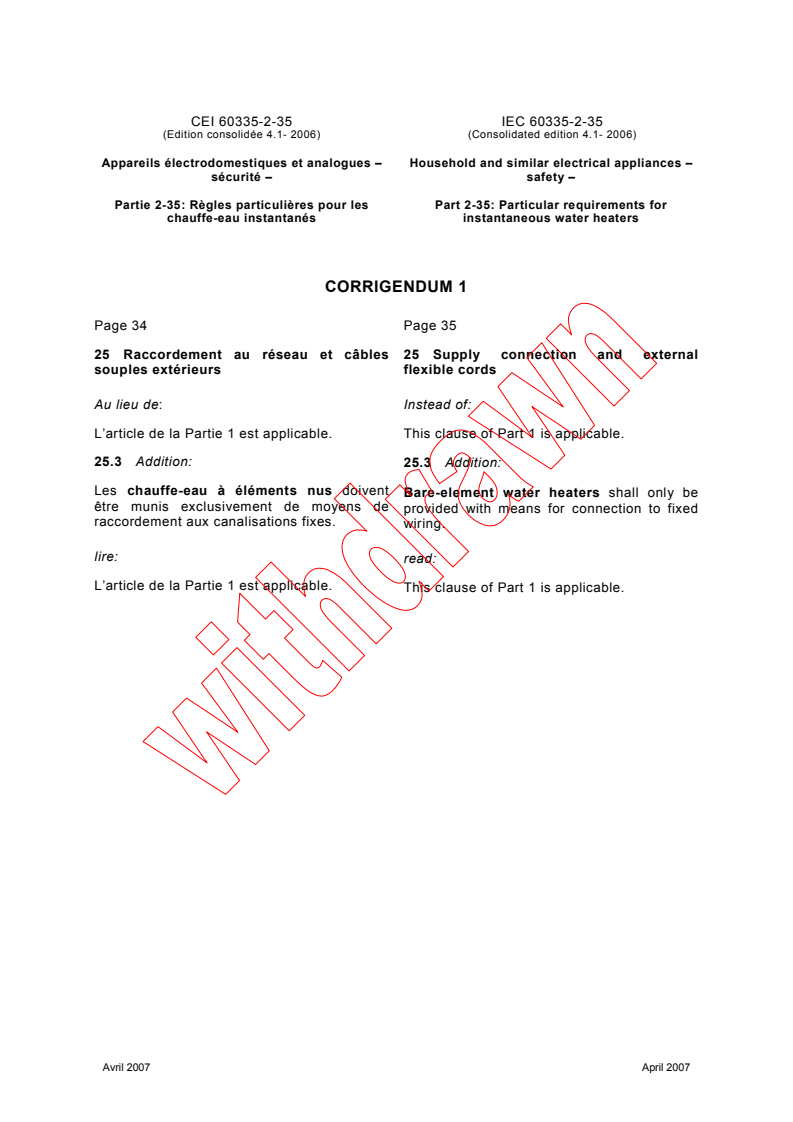


IEC 60335-2-35:2002+AMD1:2006 CSV/COR1:2007 - Corrigendum 1 - Household and similar electrical appliances - Safety - Part 2-35: Particular requirements for instantaneous water heaters Released:4/18/2007
IEC 60335-2-35:2002 - Household and similar electrical appliances - Safety - Part 2-35: Particular requirements for instantaneous water heaters Released:10/17/2002
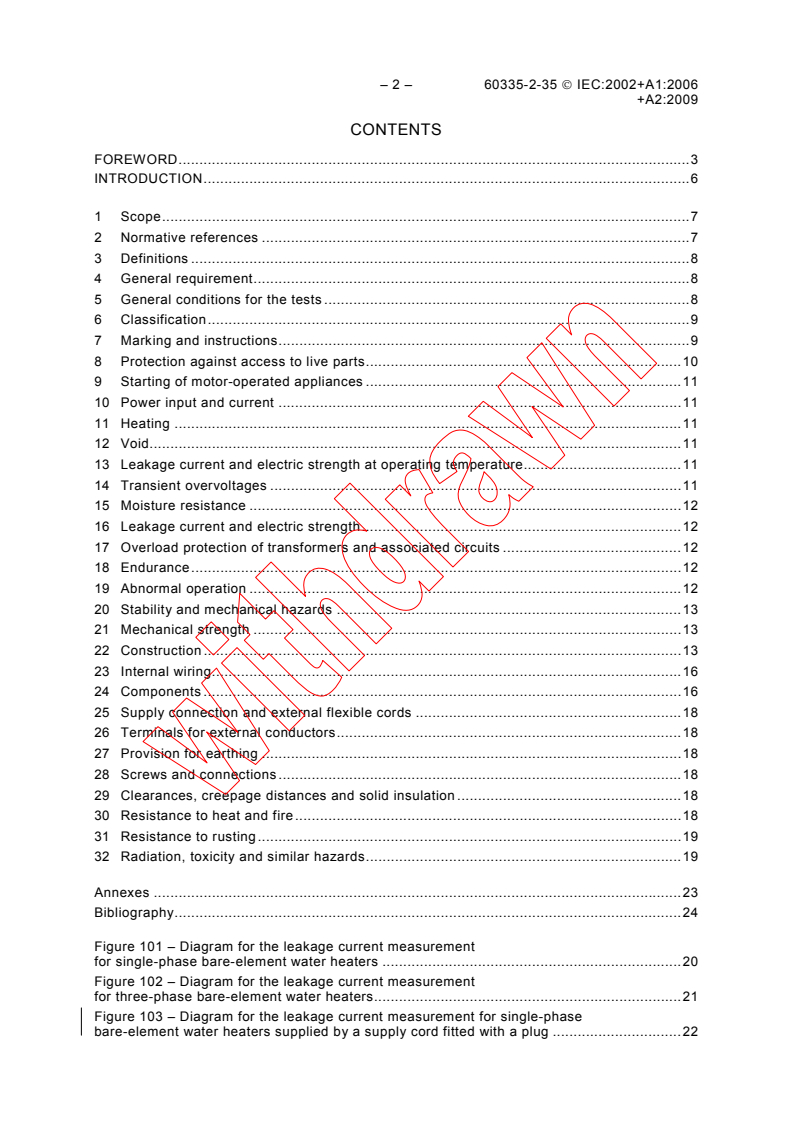
IEC 60335-2-35:2002+AMD1:2006+AMD2:2009 CSV - Household and similar electrical appliances - Safety - Part 2-35: Particular requirements for instantaneous water heaters Released:3/17/2010
IEC 60335-2-35:2002+AMD1:2006 CSV - Household and similar electrical appliances - Safety - Part 2-35: Particular requirements for instantaneous water heaters Released:11/28/2006
Get Certified
Connect with accredited certification bodies for this standard

CIS Institut d.o.o.
Personal Protective Equipment (PPE) certification body. Notified Body NB-2890 for EU Regulation 2016/425 PPE.

Kiwa BDA Testing
Building and construction product certification.
Kmetijski inštitut Slovenije
Agricultural Institute of Slovenia. Soil testing, plant health, agricultural product analysis.
Sponsored listings
Frequently Asked Questions
IEC 60335-2-35:2002 is a standard published by the International Electrotechnical Commission (IEC). Its full title is "Household and similar electrical appliances - Safety - Part 2-35: Particular requirements for instantaneous water heaters". This standard covers: Deals with the safety of electric instantaneous water heaters for household and similar purposes and intended for heating water below boiling temperature.The rated voltage being not more than 250 V for single phase and 480 V for other appliances.
Deals with the safety of electric instantaneous water heaters for household and similar purposes and intended for heating water below boiling temperature.The rated voltage being not more than 250 V for single phase and 480 V for other appliances.
IEC 60335-2-35:2002 is classified under the following ICS (International Classification for Standards) categories: 13.120 - Domestic safety; 97.040.50 - Small kitchen appliances. The ICS classification helps identify the subject area and facilitates finding related standards.
IEC 60335-2-35:2002 has the following relationships with other standards: It is inter standard links to IEC 60335-2-35:2002/AMD2:2009, IEC 60335-2-35:2002/AMD1:2006, IEC 60335-2-35:1997, IEC 60335-2-35:2012, IEC 60335-2-35:1997/AMD1:1999. Understanding these relationships helps ensure you are using the most current and applicable version of the standard.
IEC 60335-2-35:2002 is available in PDF format for immediate download after purchase. The document can be added to your cart and obtained through the secure checkout process. Digital delivery ensures instant access to the complete standard document.
Standards Content (Sample)
INTERNATIONAL IEC
STANDARD
60335-2-35
Fourth edition
2002-10
Household and similar electrical appliances –
Safety –
Part 2-35:
Particular requirements for instantaneous
water heaters
Appareils électrodomestiques et analogues –
Sécurité –
Partie 2-35:
Règles particulières pour les chauffe-eau instantanés
Reference number
Publication numbering
As from 1 January 1997 all IEC publications are issued with a designation in the
60000 series. For example, IEC 34-1 is now referred to as IEC 60034-1.
Consolidated editions
The IEC is now publishing consolidated versions of its publications. For example,
edition numbers 1.0, 1.1 and 1.2 refer, respectively, to the base publication, the
base publication incorporating amendment 1 and the base publication incorporating
amendments 1 and 2.
Further information on IEC publications
The technical content of IEC publications is kept under constant review by the IEC,
thus ensuring that the content reflects current technology. Information relating to
this publication, including its validity, is available in the IEC Catalogue of
publications (see below) in addition to new editions, amendments and corrigenda.
Information on the subjects under consideration and work in progress undertaken
by the technical committee which has prepared this publication, as well as the list
of publications issued, is also available from the following:
• IEC Web Site (www.iec.ch)
• Catalogue of IEC publications
The on-line catalogue on the IEC web site (http://www.iec.ch/searchpub/cur_fut.htm)
enables you to search by a variety of criteria including text searches, technical
committees and date of publication. On-line information is also available on
recently issued publications, withdrawn and replaced publications, as well as
corrigenda.
• IEC Just Published
This summary of recently issued publications (http://www.iec.ch/online_news/
justpub/jp_entry.htm) is also available by email. Please contact the Customer
Service Centre (see below) for further information.
• Customer Service Centre
If you have any questions regarding this publication or need further assistance,
please contact the Customer Service Centre:
Email: custserv@iec.ch
Tel: +41 22 919 02 11
Fax: +41 22 919 03 00
INTERNATIONAL IEC
STANDARD
60335-2-35
Fourth edition
2002-10
Household and similar electrical appliances –
Safety –
Part 2-35:
Particular requirements for instantaneous
water heaters
Appareils électrodomestiques et analogues –
Sécurité –
Partie 2-35:
Règles particulières pour les chauffe-eau instantanés
IEC 2002 Copyright - all rights reserved
No part of this publication may be reproduced or utilized in any form or by any means, electronic or
mechanical, including photocopying and microfilm, without permission in writing from the publisher.
International Electrotechnical Commission, 3, rue de Varembé, PO Box 131, CH-1211 Geneva 20, Switzerland
Telephone: +41 22 919 02 11 Telefax: +41 22 919 03 00 E-mail: inmail@iec.ch Web: www.iec.ch
PRICE CODE
Commission Electrotechnique Internationale
R
International Electrotechnical Commission
Международная Электротехническая Комиссия
For price, see current catalogue
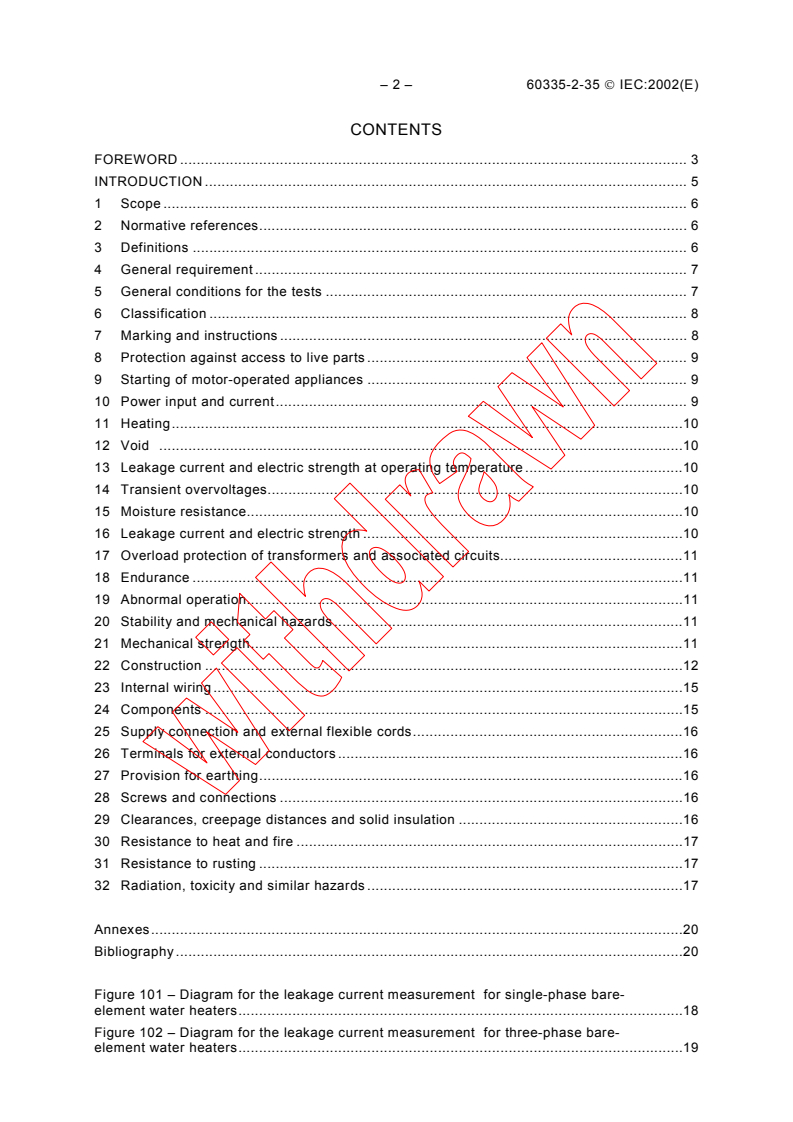
– 2 – 60335-2-35 IEC:2002(E)
CONTENTS
FOREWORD . 3
INTRODUCTION .5
1 Scope . 6
2 Normative references. 6
3 Definitions . 6
4 General requirement . 7
5 General conditions for the tests . 7
6 Classification . 8
7 Marking and instructions . 8
8 Protection against access to live parts . 9
9 Starting of motor-operated appliances . 9
10 Power input and current. 9
11 Heating.10
12 Void .10
13 Leakage current and electric strength at operating temperature .10
14 Transient overvoltages.10
15 Moisture resistance.10
16 Leakage current and electric strength .10
17 Overload protection of transformers and associated circuits.11
18 Endurance .11
19 Abnormal operation.11
20 Stability and mechanical hazards.11
21 Mechanical strength.11
22 Construction .12
23 Internal wiring.15
24 Components .15
25 Supply connection and external flexible cords.16
26 Terminals for external conductors .16
27 Provision for earthing.16
28 Screws and connections .16
29 Clearances, creepage distances and solid insulation .16
30 Resistance to heat and fire .17
31 Resistance to rusting .17
32 Radiation, toxicity and similar hazards .17
Annexes.20
Bibliography.20
Figure 101 – Diagram for the leakage current measurement for single-phase bare-
element water heaters.18
Figure 102 – Diagram for the leakage current measurement for three-phase bare-
element water heaters.19
60335-2-35 IEC:2002(E) – 3 –
INTERNATIONAL ELECTROTECHNICAL COMMISSION
–––––––––––––
HOUSEHOLD AND SIMILAR ELECTRICAL APPLIANCES –
SAFETY –
Part 2-35: Particular requirements for instantaneous water heaters
FOREWORD
1) The IEC (International Electrotechnical Commission) is a worldwide organization for standardization comprising
all national electrotechnical committees (IEC National Committees). The object of the IEC is to promote
international co-operation on all questions concerning standardization in the electrical and electronic fields. To
this end and in addition to other activities, the IEC publishes International Standards. Their preparation is
entrusted to technical committees; any IEC National Committee interested in the subject dealt with may
participate in this preparatory work. International, governmental and non-governmental organizations liaising
with the IEC also participate in this preparation. The IEC collaborates closely with the International
Organization for Standardization (ISO) in accordance with conditions determined by agreement between the
two organizations.
2) The formal decisions or agreements of the IEC on technical matters express, as nearly as possible, an
international consensus of opinion on the relevant subjects since each technical committee has representation
from all interested National Committees.
3) The documents produced have the form of recommendations for international use and are published in the form
of standards, technical specifications, technical reports or guides and they are accepted by the National
Committees in that sense.
4) In order to promote international unification, IEC National Committees undertake to apply IEC International
Standards transparently to the maximum extent possible in their national and regional standards. Any
divergence between the IEC Standard and the corresponding national or regional standard shall be clearly
indicated in the latter.
5) The IEC provides no marking procedure to indicate its approval and cannot be rendered responsible for any
equipment declared to be in conformity with one of its standards.
6) Attention is drawn to the possibility that some of the elements of this International Standard may be the subject
of patent rights. The IEC shall not be held responsible for identifying any or all such patent rights.
This part of International Standard IEC 60335 has been prepared by IEC technical committee
61: Safety of household and similar electrical appliances.
This fourth edition cancels and replaces the third edition published in 1997 and its
amendment 1 (1999). It constitutes a technical revision.
The text of this part of IEC 60335 is based on the following documents:
FDIS Report on voting
61/2170/FDIS 61/2251/RVD
Full information on the voting for the approval of this standard can be found in the report on
voting indicated in the above table.
This part 2 is to be used in conjunction with the latest edition of IEC 60335-1 and its
amendments. It was established on the basis of the fourth edition (2001) of that standard.
NOTE 1 When “Part 1” is mentioned in this standard, it refers to IEC 60335-1.
This part 2 supplements or modifies the corresponding clauses in IEC 60335-1, so as to
convert that publication into the IEC standard: Safety requirements for electric instantaneous
water heaters.
– 4 – 60335-2-35 IEC:2002(E)
When a particular subclause of Part 1 is not mentioned in this part 2, that subclause applies
as far as is reasonable. When this standard states "addition", "modification", or "replacement",
the relevant text in Part 1 is to be adapted accordingly.
NOTE 2 The following numbering system is used:
– subclauses, tables and figures that are numbered starting from 101 are additional to those in Part 1;
– unless notes are in a new subclause or involve notes in Part 1, they are numbered starting from 101, including
those in a replaced clause or subclause;
– additional annexes are lettered AA, BB, etc.
NOTE 3 The following print types are used:
– requirements: in roman type;
– test specifications: in italic type;
– notes: in small roman type.
Words in bold in the text are defined in Clause 3. When a definition concerns an adjective, the adjective and the
associated noun are also in bold.
The committee has decided that the contents of this publication will remain unchanged until
2004. At this date, the publication will be
• reconfirmed;
• withdrawn;
• replaced by a revised edition, or
• amended.
The following differences exist in the countries indicated below.
– 6.1: Bare-element water heaters are not allowed (Greece, Indonesia, Israel, Malaysia, Singapore and Turkey).
– 6.1: Class 0I appliances are allowed (Japan).
– 7.1: Closed water heaters having a rated pressure less than 1,0 MPa have to be marked with a statement that a
pressure reducing valve is to be fitted in the installation (Sweden).
– 7.1: Marking of rated pressure is different and marking of water resistivity is not required (USA).
– 7.12: Information concerning the removal of air from bare-element water heaters has to be given (Poland).
– 7.12.1: The installation of bare-element water heaters has to comply with particular conditions dependent on
the supply system and which are to be included in the instructions (France, Poland and Spain).
– 19.4: Flow switches tested for reliability are not short-circuited (USA).
– 19.13: The water temperature in closed water heaters having a capacity in excess of 15 l is limited to 99 °C
(Israel, Norway and United Kingdom).
– 19.13: The water temperatures are different (USA).
– 22.101: For closed water heaters, the minimum rated pressure is 1,0 MPa (Norway).
– 22.103: Closed water heaters having a capacity in excess of 15 l have to be provided with a pressure relief
device (Israel).
– 22.103: Closed water heaters have to incorporate a temperature relief valve or a combined temperature and
pressure relief valve that has to operate before the water temperature reaches 100 °C (United Kingdom).
– 22.103: The pressure relief valve is not required to be provided with the heater (USA).
A bilingual version of this publication may be issued at a later date.
60335-2-35 IEC:2002(E) – 5 –
INTRODUCTION
It has been assumed in the drafting of this International Standard that the execution of its
provisions is entrusted to appropriately qualified and experienced persons.
This standard recognizes the internationally accepted level of protection against hazards such
as electrical, mechanical, thermal, fire and radiation of appliances when operated as in
normal use taking into account the manufacturer's instructions. It also covers abnormal
situations that can be expected in practice.
This standard takes into account the requirements of IEC 60364 as far as possible so that
there is compatibility with the wiring rules when the appliance is connected to the supply
mains. However, national wiring rules may differ.
If an appliance within the scope of this standard also incorporates functions that are covered
by another part 2 of IEC 60335, the relevant part 2 is applied to each function separately, as
far as is reasonable. If applicable, the influence of one function on the other is taken into
account.
This standard is a product family standard dealing with the safety of appliances and takes
precedence over horizontal and generic standards covering the same subject.
An appliance that complies with the text of this standard will not necessarily be considered to
comply with the safety principles of the standard if, when examined and tested, it is found to
have other features that impair the level of safety covered by these requirements.
An appliance employing materials or having forms of construction differing from those detailed
in the requirements of this standard may be examined and tested according to the intent of
the requirements and, if found to be substantially equivalent, may be considered to comply
with the standard.
– 6 – 60335-2-35 IEC:2002(E)
HOUSEHOLD AND SIMILAR ELECTRICAL APPLIANCES –
SAFETY –
Part 2-35: Particular requirements for instantaneous water heaters
1 Scope
This clause of Part 1 is replaced by the following.
This International Standard deals with the safety of electric instantaneous water heaters for
household and similar purposes and intended for heating water below boiling temperature,
their rated voltage being not more than 250 V for single-phase appliances and 480 V for
other appliances.
NOTE 101 Instantaneous water heaters incorporating bare heating elements are within the scope of this
standard.
Appliances not intended for normal household use but which nevertheless may be a source of
danger to the public, such as appliances intended for use in shops, in light industry and on
farms, are within the scope of this standard.
As far as is practicable, this standard deals with the common hazards presented by
appliances which are encountered by all persons in and around the home. However, in
general, it does not take into account
– the use of appliances by young children or infirm persons without supervision;
– playing with the appliance by young children.
NOTE 102 Attention is drawn to the fact that
– for appliances intended to be used in vehicles or on board ships or aircraft, additional requirements may be
necessary;
– in many countries additional requirements are specified by the national health authorities, the national
authorities responsible for the protection of labour and similar authorities;
– in many countries regulations exist for the installation of equipment connected to the water mains.
NOTE 103 This standard does not apply to
– appliances for boiling water (IEC 60335-2-15);
– storage water heaters (IEC 60335-2-21);
– appliances intended exclusively for industrial purposes;
– appliances intended to be used in locations where special conditions prevail, such as the presence of a
corrosive or explosive atmosphere (dust, vapour or gas);
– commercial dispensing appliances and vending machines (IEC 60335-2-75).
2 Normative references
This clause of Part 1 is applicable.
3 Definitions
This clause of Part 1 is applicable except as follows.
60335-2-35 IEC:2002(E) – 7 –
3.1.9 Replacement:
normal operation
operation of the appliance while supplied with water, the flow being adjusted to attain the
highest outlet water temperature without operation of the thermal cut-out
3.101
instantaneous water heater
stationary appliance for heating water while it flows through the appliance
NOTE Instantaneous water heaters are referred to as water heaters.
3.102
closed water heater
instantaneous water heater intended to operate at the pressure of the water system, the
flow of water being controlled by one or more valves in the outlet system
NOTE The operating pressure may be the output pressure of a reducing or boosting device.
3.103
open-outlet water heater
instantaneous water heater in which the flow of water is controlled by a valve in the inlet
pipe, there being no valve in the outlet pipe
3.104
bare-element water heater
instantaneous water heater in which uninsulated heating elements are immersed in the
water
3.105
rated pressure
water pressure assigned to the appliance by the manufacturer
3.106
flow switch
switch that operates in response to a flow of water
3.107
pressure switch
switch that operates in response to a change in pressure
4 General requirement
This clause of Part 1 is applicable.
5 General conditions for the tests
This clause of Part 1 is applicable except as follows.
5.2 Addition:
NOTE 101 Additional samples may be required for the tests of 22.109.
5.3 Addition:
When the tests are carried out on a single appliance, the tests of 22.102, 22.107, 22.108 and
24.102 are carried out before the tests of Clause 19.
– 8 – 60335-2-35 IEC:2002(E)
5.7 Addition:
Water having a temperature of 15 °C ± 5 °C is used for the tests.
6 Classification
This clause of Part 1 is applicable except as follows.
6.1 Modification:
Bare-element water heaters shall be class I or class III.
Other water heaters shall be class I, class II or class III.
6.2 Addition:
Water heaters shall be at least IPX1.
NOTE 101 A higher degree of protection may be required depending on the zone in which the water heater is
installed, as specified in IEC 60364.
7 Marking and instructions
This clause of Part 1 is applicable except as follows.
7.1 Addition:
NOTE 101 The minimum rated frequency for bare-element water heaters is 50 Hz.
Appliances shall be marked with the rated pressure in pascals.
Bare-element water heaters shall be marked with the substance of the following:
The water resistivity must not be less than… Ωcm.
NOTE 102 The value of the water resistivity is not to exceed 1 300 Ωcm at a temperature of 15 °C.
7.12 Addition:
The instructions for open-outlet water heaters to be used with a spray head shall state that
the spray head must be descaled regularly.
The instructions shall include the substance of the following:
WARNING: Do not switch on if there is a possibility that the water in the heater is frozen.
NOTE 101 This warning is not required if the appliance incorporates a flow switch.
7.12.1 Addition:
The installation instructions for open-outlet water heaters shall state that the outlet must not
be connected to any tap or fitting other than those specified.
60335-2-35 IEC:2002(E) – 9 –
If a pressure relief device is required for closed water heaters, the instructions shall state
that it must be fitted during installation, unless it is incorporated in the appliance.
The installation instructions for bare-element water heaters shall state the substance of the
following:
– the resistivity of the water supply must not be less than … Ωcm;
– the appliance must be permanently connected to fixed wiring;
– the appliance must be earthed (for class I appliances only).
When bare-element water heaters cannot be emptied, the installation instruction shall state
that the appliance is not to be installed in locations where freezing can occ
...
INTERNATIONAL IEC
STANDARD 60335-2-35
Edition 4.1
2006-11
Edition 4:2002 consolidated with amendment 1:2006
Household and similar electrical appliances –
Safety –
Part 2-35:
Particular requirements for instantaneous
water heaters
This English-language version is derived from the original
bilingual publication by leaving out all French-language
pages. Missing page numbers correspond to the French-
language pages.
Reference number
All rights reserved. Unless otherwise specified, no part of this publication may be reproduced or utilized in any form
or by any means, electronic or mechanical, including photocopying and microfilm, without permission in writing from
either IEC or IEC's member National Committee in the country of the requester.
If you have any questions about IEC copyright or have an enquiry about obtaining additional rights to this publication,
please contact the address below or your local IEC member National Committee for further information.
IEC Central Office
3, rue de Varembé
CH-1211 Geneva 20
Switzerland
Email: inmail@iec.ch
Web: www.iec.ch
About the IEC
The International Electrotechnical Commission (IEC) is the leading global organization that prepares and publishes
International Standards for all electrical, electronic and related technologies.
About IEC publications
The technical content of IEC publications is kept under constant review by the IEC. Please make sure that you have the
latest edition, a corrigenda or an amendment might have been published.
ƒ Catalogue of IEC publications: www.iec.ch/searchpub
The IEC on-line Catalogue enables you to search by a variety of criteria (reference number, text, technical committee,…).
It also gives information on projects, withdrawn and replaced publications.
ƒ IEC Just Published: www.iec.ch/online_news/justpub
Stay up to date on all new IEC publications. Just Published details twice a month all new publications released. Available
on-line and also by email.
ƒ Customer Service Centre: www.iec.ch/webstore/custserv
If you wish to give us your feedback on this publication or need further assistance, please visit the Customer Service
Centre FAQ or contact us:
Email: csc@iec.ch
Tel.: +41 22 919 02 11
Fax: +41 22 919 03 00
INTERNATIONAL IEC
STANDARD 60335-2-35
Edition 4.1
2006-11
Edition 4:2002 consolidated with amendment 1:2006
Household and similar electrical appliances –
Safety –
Part 2-35:
Particular requirements for instantaneous
water heaters
© IEC 2006 Copyright - all rights reserved
No part of this publication may be reproduced or utilized in any form or by any means, electronic or mechanical,
including photocopying and microfilm, without permission in writing from the publisher.
International Electrotechnical Commission, 3, rue de Varembé, PO Box 131, CH-1211 Geneva 20, Switzerland
Telephone: +41 22 919 02 11 Telefax: +41 22 919 03 00 E-mail: inmail@iec.ch Web: www.iec.ch
PRICE CODE
T
Commission Electrotechnique Internationale
International Electrotechnical Commission
МеждународнаяЭлектротехническаяКомиссия
For price, see current catalogue
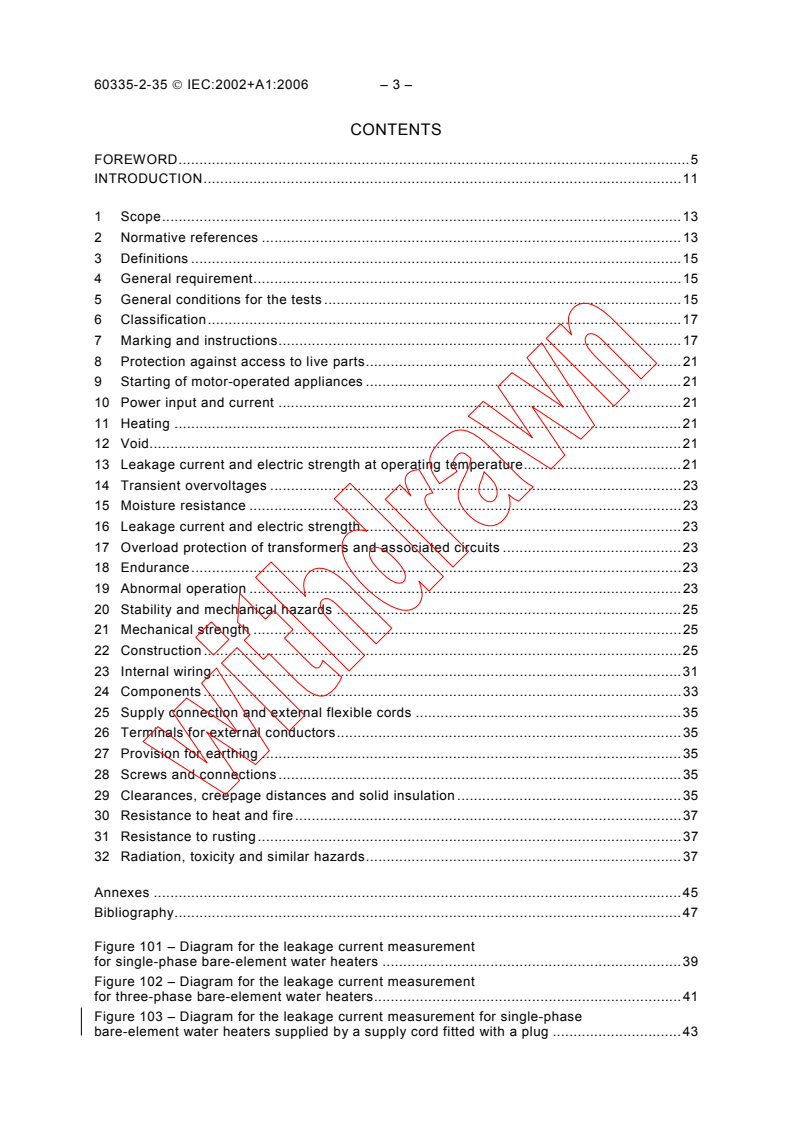
60335-2-35 © IEC:2002+A1:2006 – 3 –
CONTENTS
FOREWORD.5
INTRODUCTION.11
1 Scope.13
2 Normative references .13
3 Definitions .15
4 General requirement.15
5 General conditions for the tests .15
6 Classification.17
7 Marking and instructions.17
8 Protection against access to live parts.21
9 Starting of motor-operated appliances .21
10 Power input and current .21
11 Heating .21
12 Void.21
13 Leakage current and electric strength at operating temperature.21
14 Transient overvoltages .23
15 Moisture resistance .23
16 Leakage current and electric strength.23
17 Overload protection of transformers and associated circuits .23
18 Endurance.23
19 Abnormal operation .23
20 Stability and mechanical hazards .25
21 Mechanical strength .25
22 Construction .25
23 Internal wiring.31
24 Components .33
25 Supply connection and external flexible cords .35
26 Terminals for external conductors.35
27 Provision for earthing .35
28 Screws and connections .35
29 Clearances, creepage distances and solid insulation .35
30 Resistance to heat and fire.37
31 Resistance to rusting.37
32 Radiation, toxicity and similar hazards.37
Annexes .45
Bibliography.47
Figure 101 – Diagram for the leakage current measurement
for single-phase bare-element water heaters .39
Figure 102 – Diagram for the leakage current measurement
for three-phase bare-element water heaters.41
Figure 103 – Diagram for the leakage current measurement for single-phase
bare-element water heaters supplied by a supply cord fitted with a plug .43
60335-2-35 © IEC:2002+A1:2006 – 5 –
INTERNATIONAL ELECTROTECHNICAL COMMISSION
–––––––––––––
HOUSEHOLD AND SIMILAR ELECTRICAL APPLIANCES –
SAFETY –
Part 2-35: Particular requirements for instantaneous water heaters
FOREWORD
1) The International Electrotechnical Commission (IEC) is a worldwide organization for standardization comprising
all national electrotechnical committees (IEC National Committees). The object of IEC is to promote
international co-operation on all questions concerning standardization in the electrical and electronic fields. To
this end and in addition to other activities, IEC publishes International Standards, Technical Specifications,
Technical Reports, Publicly Available Specifications (PAS) and Guides (hereafter referred to as “IEC
Publication(s)”). Their preparation is entrusted to technical committees; any IEC National Committee interested
in the subject dealt with may participate in this preparatory work. International, governmental and non-
governmental organizations liaising with the IEC also participate in this preparation. IEC collaborates closely
with the International Organization for Standardization (ISO) in accordance with conditions determined by
agreement between the two organizations.
2) The formal decisions or agreements of IEC on technical matters express, as nearly as possible, an international
consensus of opinion on the relevant subjects since each technical committee has representation from all
interested IEC National Committees.
3) IEC Publications have the form of recommendations for international use and are accepted by IEC National
Committees in that sense. While all reasonable efforts are made to ensure that the technical content of IEC
Publications is accurate, IEC cannot be held responsible for the way in which they are used or for any
misinterpretation by any end user.
4) In order to promote international uniformity, IEC National Committees undertake to apply IEC Publications
transparently to the maximum extent possible in their national and regional publications. Any divergence
between any IEC Publication and the corresponding national or regional publication shall be clearly indicated in
the latter.
5) IEC provides no marking procedure to indicate its approval and cannot be rendered responsible for any
equipment declared to be in conformity with an IEC Publication.
6) All users should ensure that they have the latest edition of this publication.
7) No liability shall attach to IEC or its directors, employees, servants or agents including individual experts and
members of its technical committees and IEC National Committees for any personal injury, property damage or
other damage of any nature whatsoever, whether direct or indirect, or for costs (including legal fees) and
expenses arising out of the publication, use of, or reliance upon, this IEC Publication or any other IEC
Publications.
8) Attention is drawn to the Normative references cited in this publication. Use of the referenced publications is
indispensable for the correct application of this publication.
9) Attention is drawn to the possibility that some of the elements of this IEC Publication may be the subject of
patent rights. IEC shall not be held responsible for identifying any or all such patent rights.
This part of International Standard IEC 60335 has been prepared by IEC technical committee 61:
Safety of household and similar electrical appliances.
This consolidated version of IEC 60335-2-35 consists of the fourth edition (2002) [documents
61/2170/FDIS and 61/2251/RVD] and its amendment 1 (2006) [documents 61/3088/FDIS and
61/3144/RVD].
The technical content is therefore identical to the base edition and its amendment and has
been prepared for user convenience.
It bears the edition number 4.1.
A vertical line in the margin shows where the base publication has been modified by
amendment 1.
The French version of this standard has not been voted upon.
60335-2-35 © IEC:2002+A1:2006 – 7 –
This part 2 is to be used in conjunction with the latest edition of IEC 60335-1 and its
amendments. It was established on the basis of the fourth edition (2001) of that standard.
NOTE 1 When “Part 1” is mentioned in this standard, it refers to IEC 60335-1.
This part 2 supplements or modifies the corresponding clauses in IEC 60335-1, so as to
convert that publication into the IEC standard: Safety requirements for electric instantaneous
water heaters.
When a particular subclause of Part 1 is not mentioned in this part 2, that subclause applies
as far as is reasonable. When this standard states "addition", "modification", or "replacement",
the relevant text in Part 1 is to be adapted accordingly.
NOTE 2 The following numbering system is used:
– subclauses, tables and figures that are numbered starting from 101 are additional to those in Part 1;
– unless notes are in a new subclause or involve notes in Part 1, they are numbered starting from 101, including
those in a replaced clause or subclause;
– additional annexes are lettered AA, BB, etc.
NOTE 3 The following print types are used:
– requirements: in roman type;
– test specifications: in italic type;
– notes: in small roman type.
Words in bold in the text are defined in Clause 3. When a definition concerns an adjective, the adjective and the
associated noun are also in bold.
The following differences exist in the countries indicated below.
– 6.1: Bare-element water heaters are not allowed (Greece, India, Indonesia, Israel, Malaysia, Singapore, and
Turkey).
– 6.1: Class 0I appliances are allowed (Japan).
– 7.1: Closed water heaters having a rated pressure less than 1,0 MPa have to be marked with a statement that a
pressure reducing valve is to be fitted in the installation (Sweden).
– 7.1: Marking of rated pressure is different and marking of water resistivity is not required (USA).
– 7.12: Information concerning the removal of air from bare-element water heaters has to be given (Poland).
– 7.12.1: The installation of bare-element water heaters has to comply with particular conditions dependent on
the supply system and which are to be included in the instructions (France, Poland and Spain).
– 19.4: Flow switches tested for reliability are not short-circuited (USA).
– 19.13: The water temperature in closed water heaters having a capacity in excess of 15 l is limited to 99 °C
(Israel, Norway and United Kingdom).
– 19.13: The water temperatures are different (USA).
– 22.101: For closed water heaters, the minimum rated pressure is 1,0 MPa (Norway).
– 22.103: Closed water heaters having a capacity in excess of 15 l have to be provided with a pressure relief
device (Israel).
– 22.103: Closed water heaters have to incorporate a temperature relief valve or a combined temperature and
pressure relief valve that has to operate before the water temperature reaches 100 °C (United Kingdom).
– 22.103: The pressure relief valve is not required to be provided with the heater (USA).
60335-2-35 © IEC:2002+A1:2006 – 9 –
The committee has decided that the contents of the base publication and its amendments will
remain unchanged until the maintenance result date indicated on the IEC web site under
"http://webstore.iec.ch" in the data related to the specific publication. At this date,
the publication will be
• reconfirmed,
• withdrawn,
• replaced by a revised edition, or
• amended.
The contents of the corrigendum of April 2007 have been included in this copy.
60335-2-35 © IEC:2002+A1:2006 – 11 –
INTRODUCTION
It has been assumed in the drafting of this International Standard that the execution of its
provisions is entrusted to appropriately qualified and experienced persons.
This standard recognizes the internationally accepted level of protection against hazards such
as electrical, mechanical, thermal, fire and radiation of appliances when operated as in
normal use taking into account the manufacturer's instructions. It also covers abnormal
situations that can be expected in practice and takes into account the way in which
electromagnetic phenomena can affect the safe operation of appliances.
This standard takes into account the requirements of IEC 60364 as far as possible so that
there is compatibility with the wiring rules when the appliance is connected to the supply
mains. However, national wiring rules may differ.
If an appliance within the scope of this standard also incorporates functions that are covered
by another part 2 of IEC 60335, the relevant part 2 is applied to each function separately, as
far as is reasonable. If applicable, the influence of one function on the other is taken into
account.
This standard is a product family standard dealing with the safety of appliances and takes
precedence over horizontal and generic standards covering the same subject.
An appliance that complies with the text of this standard will not necessarily be considered to
comply with the safety principles of the standard if, when examined and tested, it is found to
have other features that impair the level of safety covered by these requirements.
An appliance employing materials or having forms of construction differing from those detailed
in the requirements of this standard may be examined and tested according to the intent of
the requirements and, if found to be substantially equivalent, may be considered to comply
with the standard.
60335-2-35 © IEC:2002+A1:2006 – 13 –
HOUSEHOLD AND SIMILAR ELECTRICAL APPLIANCES –
SAFETY –
Part 2-35: Particular requirements for instantaneous water heaters
1 Scope
This clause of Part 1 is replaced by the following.
This International Standard deals with the safety of electric instantaneous water heaters for
household and similar purposes and intended for heating water below boiling temperature,
their rated voltage being not more than 250 V for single-phase appliances and 480 V for
other appliances.
NOTE 101 Instantaneous water heaters incorporating bare heating elements are within the scope of this
standard.
Appliances not intended for normal household use but which nevertheless may be a source of
danger to the public, such as appliances intended for use in shops, in light industry and on
farms, are within the scope of this standard.
As far as is practicable, this standard deals with the common hazards presented by
appliances which are encountered by all persons in and around the home. However, in
general, it does not take into account
– the use of appliances by young children or infirm persons without supervision;
– playing with the appliance by young children.
NOTE 102 Attention is drawn to the fact that
– for appliances intended to be used in vehicles or on board ships or aircraft, additional requirements may be
necessary;
– in many countries additional requirements are specified by the national health authorities, the national
authorities responsible for the protection of labour and similar authorities;
– in many countries regulations exist for the installation of equipment connected to the water mains.
NOTE 103 This standard does not apply to
– appliances for boiling water (IEC 60335-2-15);
– storage water heaters (IEC 60335-2-21);
– appliances intended exclusively for industrial purposes;
– appliances intended to be used in locations where special conditions prevail, such as the presence of a
corrosive or explosive atmosphere (dust, vapour or gas);
– commercial dispensing appliances and vending machines (IEC 60335-2-75).
2 Normative references
This clause of Part 1 is applicable.
60335-2-35 © IEC:2002+A1:2006 – 15 –
3 Definitions
This clause of Part 1 is applicable except as follows.
3.1.9 Replacement:
normal operation
operation of the appliance while supplied with water, the flow being adjusted to attain the
highest outlet water temperature without operation of the thermal cut-out
3.101
instantaneous water heater
stationary appliance for heating water while it flows through the appliance
NOTE Instantaneous water heaters are referred to as water heaters.
3.102
closed water heater
instantaneous water heater intended to operate at the pressure of the water system, the
flow of water being controlled by one or more valves in the outlet system
NOTE The operating pressure may be the output pressure of a reducing or boosting device.
3.103
open-outlet water heater
instantaneous water heater in which the flow of water is controlled by a valve in the inlet
pipe, there being no valve in the outlet pipe
3.104
bare-element water heater
instantaneous water heater in which uninsulated heating elements are immersed in the
water
3.105
rated pressure
water pressure assigned to the appliance by the manufacturer
3.106
flow switch
switch that operates in response to a flow of water
3.107
pressure switch
switch that operates in response to a change in pressure
4 General requirement
This clause of Part 1 is applicable.
5 General conditions for the tests
This clause of Part 1 is applicable except as follows.
60335-2-35 © IEC:2002+A1:2006 – 17 –
5.2 Addition:
NOTE 101 Additional samples may be required for the tests of 22.109.
5.3 Addition:
When the tests are carried out on a single appliance, the tests of 22.102, 22.107, 22.108 and
24.102 are carried out before the tests of Clause 19.
5.7 Addition:
Water having a temperature of 15 °C ± 5 °C is used for the tests.
6 Classification
This clause of Part 1 is applicable except as follows.
6.1 Modification:
Bare-element water heaters shall be class I or class III.
Other water heaters shall be class I, class II or class III.
6.2 Addition:
Water heaters shall be at least IPX1.
NOTE 101 A higher degree of protection may be required depending on the zone in which the water heater is
installed, as specified in IEC 60364.
7 Marking and instructions
This clause of Part 1
...
NORME CEI
INTERNATIONALE 60335-2-35
Quatrième édition
2002-10
Appareils électrodomestiques et analogues –
Sécurité –
Partie 2-35:
Règles particulières pour les chauffe-eau
instantanés
Cette version française découle de la publication d’origine
bilingue dont les pages anglaises ont été supprimées.
Les numéros de page manquants sont ceux des pages
supprimées.
Numéro de référence
CEI 60335-2-35:2002(F)
Numérotation des publications
Depuis le 1er janvier 1997, les publications de la CEI sont numérotées à partir de
60000. Ainsi, la CEI 34-1 devient la CEI 60034-1.
Editions consolidées
Les versions consolidées de certaines publications de la CEI incorporant les
amendements sont disponibles. Par exemple, les numéros d’édition 1.0, 1.1 et 1.2
indiquent respectivement la publication de base, la publication de base incorporant
l’amendement 1, et la publication de base incorporant les amendements 1 et 2
Informations supplémentaires sur les publications de la CEI
Le contenu technique des publications de la CEI est constamment revu par la CEI
afin qu'il reflète l'état actuel de la technique. Des renseignements relatifs à cette
publication, y compris sa validité, sont disponibles dans le Catalogue des
publications de la CEI (voir ci-dessous) en plus des nouvelles éditions, amende-
ments et corrigenda. Des informations sur les sujets à l’étude et l’avancement des
travaux entrepris par le comité d’études qui a élaboré cette publication, ainsi que la
liste des publications parues, sont également disponibles par l’intermédiaire de:
• Site web de la CEI (www.iec.ch)
• Catalogue des publications de la CEI
Le catalogue en ligne sur le site web de la CEI (www.iec.ch/searchpub) vous permet
de faire des recherches en utilisant de nombreux critères, comprenant des
recherches textuelles, par comité d’études ou date de publication. Des informations
en ligne sont également disponibles sur les nouvelles publications, les publications
remplacées ou retirées, ainsi que sur les corrigenda.
• IEC Just Published
Ce résumé des dernières publications parues (www.iec.ch/online_news/justpub)
est aussi disponible par courrier électronique. Veuillez prendre contact avec le
Service client (voir ci-dessous) pour plus d’informations.
• Service clients
Si vous avez des questions au sujet de cette publication ou avez besoin de
renseignements supplémentaires, prenez contact avec le Service clients:
Email: custserv@iec.ch
Tél: +41 22 919 02 11
Fax: +41 22 919 03 00
NORME CEI
INTERNATIONALE 60335-2-35
Quatrième édition
2002-10
Appareils électrodomestiques et analogues –
Sécurité –
Partie 2-35:
Règles particulières pour les chauffe-eau
instantanés
© IEC 2005 Droits de reproduction réservés
Aucune partie de cette publication ne peut être reproduite ni utilisée sous quelque forme que ce soit et par aucun
procédé, électronique ou mécanique, y compris la photocopie et les microfilms, sans l'accord écrit de l'éditeur.
International Electrotechnical Commission, 3, rue de Varembé, PO Box 131, CH-1211 Geneva 20, Switzerland
Telephone: +41 22 919 02 11 Telefax: +41 22 919 03 00 E-mail: inmail@iec.ch Web: www.iec.ch
CODE PRIX
S
Commission Electrotechnique Internationale
International Electrotechnical Commission
МеждународнаяЭлектротехническаяКомиссия
Pour prix, voir catalogue en vigueur
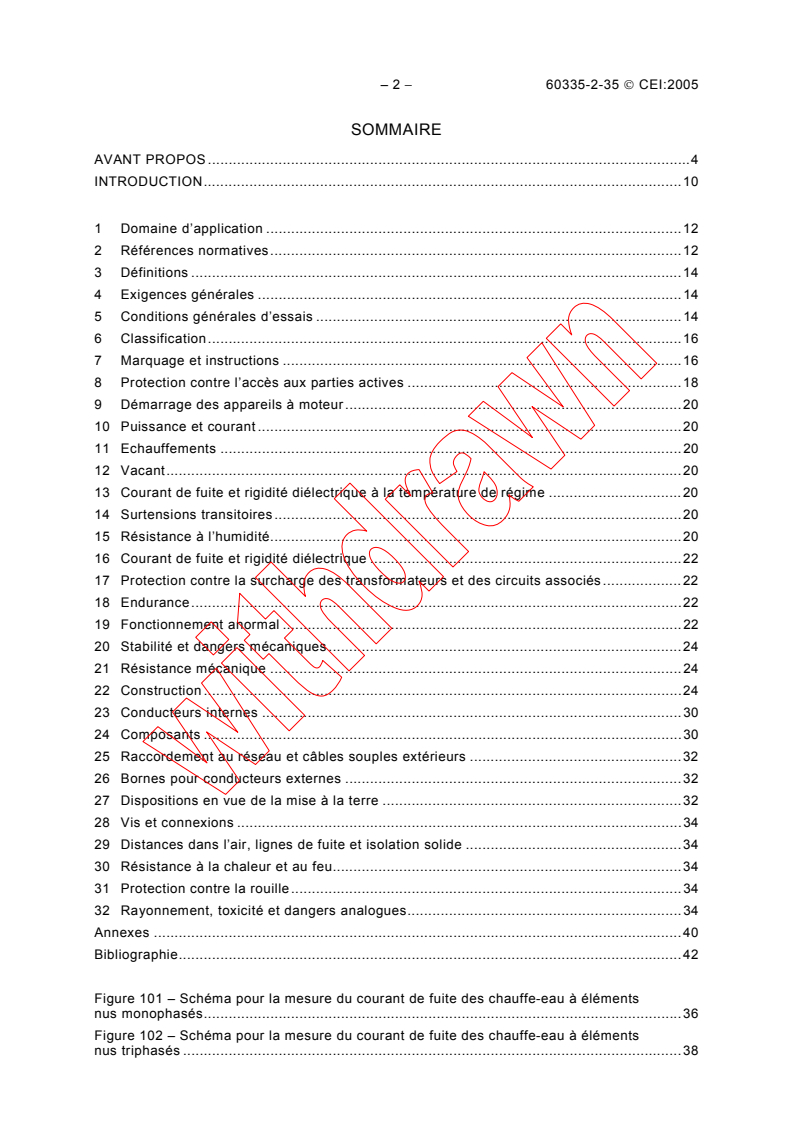
– 2 − 60335-2-35 CEI:2005
SOMMAIRE
AVANT PROPOS .4
INTRODUCTION.10
1 Domaine d’application .12
2 Références normatives.12
3 Définitions .14
4 Exigences générales .14
5 Conditions générales d’essais .14
6 Classification.16
7 Marquage et instructions .16
8 Protection contre l’accès aux parties actives .18
9 Démarrage des appareils à moteur.20
10 Puissance et courant .20
11 Echauffements .20
12 Vacant.20
13 Courant de fuite et rigidité diélectrique à la température de régime .20
14 Surtensions transitoires.20
15 Résistance à l’humidité.20
16 Courant de fuite et rigidité diélectrique .22
17 Protection contre la surcharge des transformateurs et des circuits associés.22
18 Endurance.22
19 Fonctionnement anormal .22
20 Stabilité et dangers mécaniques .24
21 Résistance mécanique .24
22 Construction .24
23 Conducteurs internes .30
24 Composants .30
25 Raccordement au réseau et câbles souples extérieurs .32
26 Bornes pour conducteurs externes .32
27 Dispositions en vue de la mise à la terre .32
28 Vis et connexions .34
29 Distances dans l’air, lignes de fuite et isolation solide .34
30 Résistance à la chaleur et au feu.34
31 Protection contre la rouille.34
32 Rayonnement, toxicité et dangers analogues.34
Annexes .40
Bibliographie.42
Figure 101 – Schéma pour la mesure du courant de fuite des chauffe-eau à éléments
nus monophasés.36
Figure 102 – Schéma pour la mesure du courant de fuite des chauffe-eau à éléments
nus triphasés .38
– 4 − 60335-2-35 CEI:2005
COMMISSION ÉLECTROTECHNIQUE INTERNATIONALE
___________
APPAREILS ÉLECTRODOMESTIQUES ET ANALOGUES –
SÉCURITÉ –
Partie 2-35: Règles particulières pour les chauffe-eau instantanés
AVANT PROPOS
1) La Commission Electrotechnique Internationale (CEI) est une organisation mondiale de normalisation
composée de l'ensemble des comités électrotechniques nationaux (Comités nationaux de la CEI). La CEI a
pour objet de favoriser la coopération internationale pour toutes les questions de normalisation dans les
domaines de l'électricité et de l'électronique. A cet effet, la CEI – entre autres activités – publie des Normes
internationales, des Spécifications techniques, des Rapports techniques, des Spécifications accessibles au
public (PAS) et des Guides (ci-après dénommés "Publication(s) de la CEI"). Leur élaboration est confiée à des
comités d'études, aux travaux desquels tout Comité national intéressé par le sujet traité peut participer. Les
organisations internationales, gouvernementales et non gouvernementales, en liaison avec la CEI, participent
également aux travaux. La CEI collabore étroitement avec l'Organisation Internationale de Normalisation (ISO),
selon des conditions fixées par accord entre les deux organisations.
2) Les décisions ou accords officiels de la CEI concernant les questions techniques représentent, dans la mesure
du possible, un accord international sur les sujets étudiés, étant donné que les Comités nationaux de la CEI
intéressés sont représentés dans chaque comité d’études.
3) Les Publications de la CEI se présentent sous la forme de recommandations internationales et sont agréées
comme telles par les Comités nationaux de la CEI. Tous les efforts raisonnables sont entrepris afin que la CEI
s'assure de l'exactitude du contenu technique de ses publications; la CEI ne peut pas être tenue responsable
de l'éventuelle mauvaise utilisation ou interprétation qui en est faite par un quelconque utilisateur final.
4) Dans le but d'encourager l'unification internationale, les Comités nationaux de la CEI s'engagent, dans toute la
mesure possible, à appliquer de façon transparente les Publications de la CEI dans leurs publications
nationales et régionales. Toutes divergences entre toutes Publications de la CEI et toutes publications
nationales ou régionales correspondantes doivent être indiquées en termes clairs dans ces dernières.
5) La CEI n’a prévu aucune procédure de marquage valant indication d’approbation et n'engage pas sa
responsabilité pour les équipements déclarés conformes à une de ses Publications.
6) Tous les utilisateurs doivent s'assurer qu'ils sont en possession de la dernière édition de cette publication.
7) Aucune responsabilité ne doit être imputée à la CEI, à ses administrateurs, employés, auxiliaires ou
mandataires, y compris ses experts particuliers et les membres de ses comités d'études et des Comités
nationaux de la CEI, pour tout préjudice causé en cas de dommages corporels et matériels, ou de tout autre
dommage de quelque nature que ce soit, directe ou indirecte, ou pour supporter les coûts (y compris les frais
de justice) et les dépenses découlant de la publication ou de l'utilisation de cette Publication de la CEI ou de
toute autre Publication de la CEI, ou au crédit qui lui est accordé.
8) L'attention est attirée sur les références normatives citées dans cette publication. L'utilisation de publications
référencées est obligatoire pour une application correcte de la présente publication.
9) L’attention est attirée sur le fait que certains des éléments de la présente Publication de la CEI peuvent faire
l’objet de droits de propriété intellectuelle ou de droits analogues. La CEI ne saurait être tenue pour
responsable de ne pas avoir identifié de tels droits de propriété et de ne pas avoir signalé leur existence.
La présente partie de la Norme internationale CEI 60335 a été établie par le comité d'études
61: Sécurité des appareils électrodomestiques et analogues.
Cette quatrième édition annule et remplace la troisième édition parue en 1997 et son
amendement 1 (1999), dont elle constitue une révision technique.
Cette version bilingue (2005-11) remplace la version monolingue anglaise.
Le texte anglais de cette norme est issu des documents 61/2170/FDIS et 61/2251/RVD. Le
rapport de vote 61/2251/RVD donne toute information sur le vote ayant abouti à l’approbation
de cette norme.
– 6 − 60335-2-35 CEI:2005
La version française de cette norme n’a pas été soumise au vote.
La présente partie 2 doit être utilisée conjointement avec la dernière édition de la
CEI 60335-1 et ses amendements. Elle a été établie sur la base de la quatrième édition (2001) de
cette norme.
NOTE 1 L’expression «Partie 1» utilisée dans la présente norme fait référence à la CEI 60335-1.
La présente partie 2 complète ou modifie les articles correspondants de la CEI 60335-1 de
façon à transformer cette publication en norme CEI: Règles de sécurité pour les chauffe-eau
électriques instantanés.
Lorsqu'un paragraphe particulier de la Partie 1 n'est pas mentionné dans cette partie 2,
ce paragraphe s'applique pour autant qu'il soit raisonnable. Lorsque la présente norme
spécifie «addition», «modification» ou «remplacement», le texte correspondant de la Partie 1
doit être adapté en conséquence.
NOTE 2 Le système de numérotation suivant est utilisé:
– paragraphes, tableaux et figures: ceux qui sont numérotés à partir de 101 sont complémentaires à ceux de la
Partie 1;
– notes: à l’exception de celles qui sont dans un nouveau paragraphe ou de celles qui concernent des notes de
la Partie 1, les notes sont numérotées à partir de 101, y compris celles des articles ou paragraphes qui sont
modifiés ou remplacés;
– les annexes supplémentaires sont appelées AA, BB, etc.
NOTE 3 Les caractères d'imprimerie suivants sont utilisés:
– exigences: caractères romains;
modalités d'essais: caractères italiques;
–
– notes: petits caractères romains.
Les mots en gras dans le texte sont définis à l'Article 3. Lorsqu'une définition concerne un adjectif, l'adjectif et le
nom associé figurent également en gras.
Les différences suivantes existent dans les pays indiqués ci-après.
– 6.1: Les chauffe-eau à éléments nus ne sont pas autorisés (Grèce, Indonésie, Israël, Malaisie, Singapour, et
Turquie).
– 6.1: Les appareils de la classe 0I sont autorisés (Japon).
– 7.1: Les chauffe-eau fermés dont la pression assignée est inférieure à 1,0 MPa doivent porter l'indication
qu'un dispositif réducteur de pression doit être mis en place dans l'installation (Suède).
– 7.1: Le marquage de la pression assignée est différent et celui de la résistivité de l'eau n'est pas exigé (USA).
– 7.12: Des informations concernant l'élimination de l'air des chauffe-eau à éléments chauffants nus doivent être
fournies (Pologne).
– 7.12.1: L'installation de chauffe-eau à éléments nus est soumise à des conditions particulières dépendant du
système d'alimentation et qui doivent être mentionnées dans les instructions (France et Pologne et Espagne).
– 19.4: Les interrupteurs de débits dont la fiabilité à été vérifiée ne sont pas court-circuités (USA).
– 19.13: La température de l'eau dans les chauffe-eau fermés dont la capacité est supérieure à 15 l est limitée à
99 °C (Israël, Norvège et Royaume-Uni).
– 19.13: Les températures de l'eau sont différentes (USA).
– 22.101: Pour les chauffe-eau fermés, la pression assignée minimale est de 1,0 MPa (Norvège).
– 22.103: Les chauffe-eau fermés dont la capacité est supérieure à 15 l doivent comporter un limiteur de
pression (Israël).
– 22.103: Les chauffe-eau fermés doivent comporter un dispositif limiteur de pression sensible à la température
ou un dispositif sensible à la fois à la pression et à la température qui doit fonctionner avant que la
température de l'eau atteigne 100 °C (Royaume Uni).
– 22.103: Il n'est pas exigé que le dispositif limiteur de pression soit fourni avec le chauffe-eau (USA).
– 8 − 60335-2-35 CEI:2005
Le comité a décidé que le contenu de cette publication ne sera pas modifié avant la date de
maintenance indiquée sur le site web de la CEI sous «http://webstore.iec.ch» dans les
données relatives à la publication recherchée. A cette date, la publication sera
• reconduite;
• supprimée;
• remplacée par une édition révisée, ou
• amendée.
– 10 − 60335-2-35 CEI:2005
INTRODUCTION
Il a été considéré en établissant la présente Norme internationale que l'exécution de ses dis-
positions était confiée à des personnes expérimentées et ayant une qualification appropriée.
Cette norme reconnaît le niveau de protection internationalement accepté contre les risques
électriques, mécaniques, thermiques, liés au feu et au rayonnement des appareils, lorsqu'ils
fonctionnent comme en usage normal en tenant compte des instructions du fabricant. Elle
couvre également les situations anormales auxquelles on peut s'attendre dans la pratique.
Cette norme tient compte autant que possible des exigences de la CEI 60364, de façon à
rester compatible avec les règles d'installation quand l’appareil est raccordé au réseau
d’alimentation. Cependant, des règles nationales d'installation peuvent être différentes.
Si un appareil compris dans le domaine d’application de cette norme comporte également des
fonctions qui sont couvertes par une autre partie 2 de la CEI 60335, la partie 2
correspondante est appliquée à chaque fonction séparément, dans la limite du raisonnable. Si
cela est applicable, on tient compte de l’influence d’une fonction sur les autres fonctions.
Cette norme est une norme de famille de produits traitant de la sécurité d’appareils et a
préséance sur les normes horizontales et génériques couvrant le même sujet.
Un appareil conforme au texte de la présente norme ne sera pas nécessairement jugé
conforme aux principes de sécurité de la norme si, lorsqu'il est examiné et soumis aux essais,
il apparaît qu'il présente d'autres caractéristiques qui compromettent le niveau de sécurité
visé par ces exigences.
Un appareil utilisant des matériaux ou présentant des modes de construction différents de
ceux décrits dans les exigences de cette norme peut être examiné et essayé en fonction de
l'objectif poursuivi par ces exigences et, s'il est jugé pratiquement équivalent, il peut être
estimé conforme aux principes de sécurité de la norme.
– 12 − 60335-2-35 CEI:2005
APPAREILS ÉLECTRODOMESTIQUES ET ANALOGUES –
SÉCURITÉ –
Partie 2-35: Règles particulières pour les chauffe-eau instantanés
1 Domaine d’application
L'article de la Partie 1 est remplacé par l'article ci-après.
La présente Norme internationale traite de la sécurité des chauffe-eau électriques
instantanés pour usages domestiques et analogues, destinés à chauffer l’eau au-dessous de
la température d’ébullition, et dont la tension assignée n'est pas supérieure à 250 V pour les
appareils monophasés et à 480 V pour les autres appareils.
NOTE 101 Les chauffe-eau instantanés comportant des éléments chauffants nus sont compris dans le domaine
d'application de la présente norme.
Les appareils non destinés à un usage domestique normal mais qui peuvent néanmoins
constituer une source de danger pour le public, tels que les appareils destinés à être utilisés
dans les magasins, chez les artisans et dans les fermes, sont compris dans le domaine
d'application de la présente norme.
Dans la mesure du possible, la présente norme traite des risques ordinaires présentés par les
appareils qui sont encourus par tous les individus à l'intérieur et autour de l'habitation.
Cependant, cette norme ne tient pas compte en général
– de l'utilisation des appareils par de jeunes enfants ou par des personnes handicapées
sans surveillance;
– de l’emploi de l’appareil comme jouet par de jeunes enfants.
NOTE 102 L’attention est attirée sur le fait que
– pour les appareils destinés à être utilisés dans des véhicules ou à bord de navires ou d'avions, des exigences
supplémentaires peuvent être nécessaires;
– dans de nombreux pays, des exigences supplémentaires sont spécifiées par les organismes nationaux de la
santé, par les organismes nationaux responsables de la protection des travailleurs et par des organismes
similaires;
– dans de nombreux pays, des réglementations existent pour l'installation des équipements raccordés au réseau
d'alimentation en eau.
NOTE 103 Cette norme ne s’applique pas
– aux appareils pour faire bouillir l'eau (CEI 60335-2-15);
– aux chauffe-eau à accumulation (CEI 60335-2-21);
– aux appareils destinés exclusivement à des usages industriels;
– aux appareils destinés à être utilisés dans des locaux présentant des conditions particulières telles que la
présence d'une atmosphère corrosive ou explosive (poussières, vapeur ou gaz);
– aux distributeurs commerciaux avec ou sans moyens de paiement (CEI 60335-2-75).
2 Références normatives
L’article de la Partie 1 est applicable.
– 14 − 60335-2-35 CEI:2005
3 Définitions
L’article de la Partie 1 est applicable avec les exceptions suivantes.
3.1.9 Remplacement:
fonctionnement normal
fonctionnement de l’appareil lorsqu’il est alimenté en eau, le débit étant réglé de façon à
obtenir la température de l'eau à la sortie la plus élevée possible, sans faire fonctionner le
coupe-circuit thermique
3.101
chauffe-eau instantané
appareil fixe destiné à chauffer l'eau lorsqu'elle circule dans l’appareil
NOTE Les chauffe-eau instantanés sont par la suite appelés chauffe-eau.
3.102
chauffe-eau fermé
chauffe-eau prévu pour fonctionner à la pression du système d'alimentation en eau,
l'écoulement de l'eau étant commandé par un ou plusieurs robinets placés dans le circuit de
sortie
NOTE La pression de fonctionnement peut être la pression à la sortie d'un dispositif réduisant ou augmentant la
pression.
3.103
chauffe-eau à écoulement libre
chauffe-eau dont l'écoulement de l'eau est commandé par un robinet placé dans le tuyau
d'entrée, aucun robinet n'étant placé dans le tuyau de sortie
3.104
chauffe-eau à éléments nus
chauffe-eau dans lequel des éléments chauffants non isolés sont immergés dans l'eau
3.105
pression assignée
pression d'eau assignée à l’appareil par le fabricant
3.106
interrupteur de débit
interrupteur qui est actionné par un courant d'eau
3.107
interrupteur de pression
interrupteur qui est actionné par une modification de pression
4 Exigences générales
L’article de la Partie 1 est applicable.
5 Conditions générales d’essais
L’article de la Partie 1 est applicable avec les exceptions suivantes.
– 16 − 60335-2-35 CEI:2005
5.2 Addition:
NOTE 101 Des échantillons supplémentaires peuvent être nécessaires pour les essais de 22.109.
5.3 Addition:
Si les essais sont effectués sur un seul appareil, les essais de 22.102, 22.107, 22.108 et
24.102 sont effectués avant les essais de l'Article 19.
5.7 Addition:
Les essais sont effectués avec de l'eau dont la température est de 15 °C ± 5 °C.
6 Classification
L’article de la Partie 1 est applicable avec les exceptions suivantes.
6.1 Modification:
Les chauffe-eau à éléments nus doivent être de la classe I ou de la classe III.
Les autres chauffe-eau doivent être de la classe I, de la classe II ou de la classe III.
6.2 Addition:
Les chauffe-eau doivent être au moins IPX1.
NOTE 101 Un degré de protection supérieur peut être ex
...
NORME CEI
INTERNATIONALE 60335-2-35
Edition 4.1
2006-11
Edition 4:2002 consolidée par l’amendement 1:2006
Appareils électrodomestiques et analogues –
Sécurité –
Partie 2-35:
Règles particulières pour les chauffe-eau
instantanés
Cette version française découle de la publication d’origine
bilingue dont les pages anglaises ont été supprimées.
Les numéros de page manquants sont ceux des pages
supprimées.
Numéro de référence
CEI 60335-2-35:2002+A1:2006(F)
Droits de reproduction réservés. Sauf indication contraire, aucune partie de cette publication ne peut être reproduite
ni utilisée sous quelque forme que ce soit et par aucun procédé, électronique ou mécanique, y compris la photocopie
et les microfilms, sans l'accord écrit de la CEI ou du Comité national de la CEI du pays du demandeur.
Si vous avez des questions sur le copyright de la CEI ou si vous désirez obtenir des droits supplémentaires sur cette
publication, utilisez les coordonnées ci-après ou contactez le Comité national de la CEI de votre pays de résidence.
IEC Central Office
3, rue de Varembé
CH-1211 Geneva 20
Switzerland
Email: 0inmail@iec.ch
Web: 1Hwww.iec.ch
A propos de la CEI
La Commission Electrotechnique Internationale (CEI) est la première organisation mondiale qui élabore et publie des
normes internationales pour tout ce qui a trait à l'électricité, à l'électronique et aux technologies apparentées.
A propos des publications CEI
Le contenu technique des publications de la CEI est constamment revu. Veuillez vous assurer que vous possédez
l’édition la plus récente, un corrigendum ou amendement peut avoir été publié.
ƒ Catalogue des publications de la CEI: 2Hwww.iec.ch/searchpub/cur_fut-f.htm
Le Catalogue en-ligne de la CEI vous permet d’effectuer des recherches en utilisant différents critères (numéro de
référence, texte, comité d’études,…). Il donne aussi des informations sur les projets et les publications retirées ou
remplacées.
ƒ Just Published CEI: 3Hwww.iec.ch/online_news/justpub
Restez informé sur les nouvelles publications de la CEI. Just Published détaille deux fois par mois les nouvelles
publications parues. Disponible en-ligne et aussi par email.
ƒ Service Clients: 4Hwww.iec.ch/webstore/custserv/custserv_entry-f.htm
Si vous désirez nous donner des commentaires sur cette publication ou si vous avez des questions, visitez le FAQ du
Service clients ou contactez-nous:
Email: 5Hcsc@iec.ch
Tél.: +41 22 919 02 11
Fax: +41 22 919 03 00
NORME CEI
INTERNATIONALE 60335-2-35
Edition 4.1
2006-11
Edition 4:2002 consolidée par l’amendement 1:2006
Appareils électrodomestiques et analogues –
Sécurité –
Partie 2-35:
Règles particulières pour les chauffe-eau
instantanés
© IEC 2006 Droits de reproduction réservés
Aucune partie de cette publication ne peut être reproduite ni utilisée sous quelque forme que ce soit et par aucun
procédé, électronique ou mécanique, y compris la photocopie et les microfilms, sans l'accord écrit de l'éditeur.
International Electrotechnical Commission, 3, rue de Varembé, PO Box 131, CH-1211 Geneva 20, Switzerland
Telephone: +41 22 919 02 11 Telefax: +41 22 919 03 00 E-mail: inmail@iec.ch Web: www.iec.ch
CODE PRIX
&+
Commission Electrotechnique Internationale
International Electrotechnical Commission
МеждународнаяЭлектротехническаяКомиссия
Pour prix, voir catalogue en vigueur
– 2 − 60335-2-35 © CEI:2002+A1:2006
SOMMAIRE
AVANT PROPOS .4
INTRODUCTION.10
1 Domaine d’application .12
2 Références normatives.12
3 Définitions .14
4 Exigences générales .14
5 Conditions générales d’essais .14
6 Classification.16
7 Marquage et instructions .16
8 Protection contre l’accès aux parties actives .20
9 Démarrage des appareils à moteur.20
10 Puissance et courant .20
11 Echauffements .20
12 Vacant.20
13 Courant de fuite et rigidité diélectrique à la température de régime .20
14 Surtensions transitoires.22
15 Résistance à l’humidité.22
16 Courant de fuite et rigidité diélectrique .22
17 Protection contre la surcharge des transformateurs et des circuits associés.22
18 Endurance.22
19 Fonctionnement anormal .22
20 Stabilité et dangers mécaniques .24
21 Résistance mécanique .24
22 Construction .24
23 Conducteurs internes .30
24 Composants .32
25 Raccordement au réseau et câbles souples extérieurs .34
26 Bornes pour conducteurs externes .34
27 Dispositions en vue de la mise à la terre .34
28 Vis et connexions .34
29 Distances dans l’air, lignes de fuite et isolation solide .34
30 Résistance à la chaleur et au feu.36
31 Protection contre la rouille.36
32 Rayonnement, toxicité et dangers analogues.36
Annexes .44
Bibliographie.46
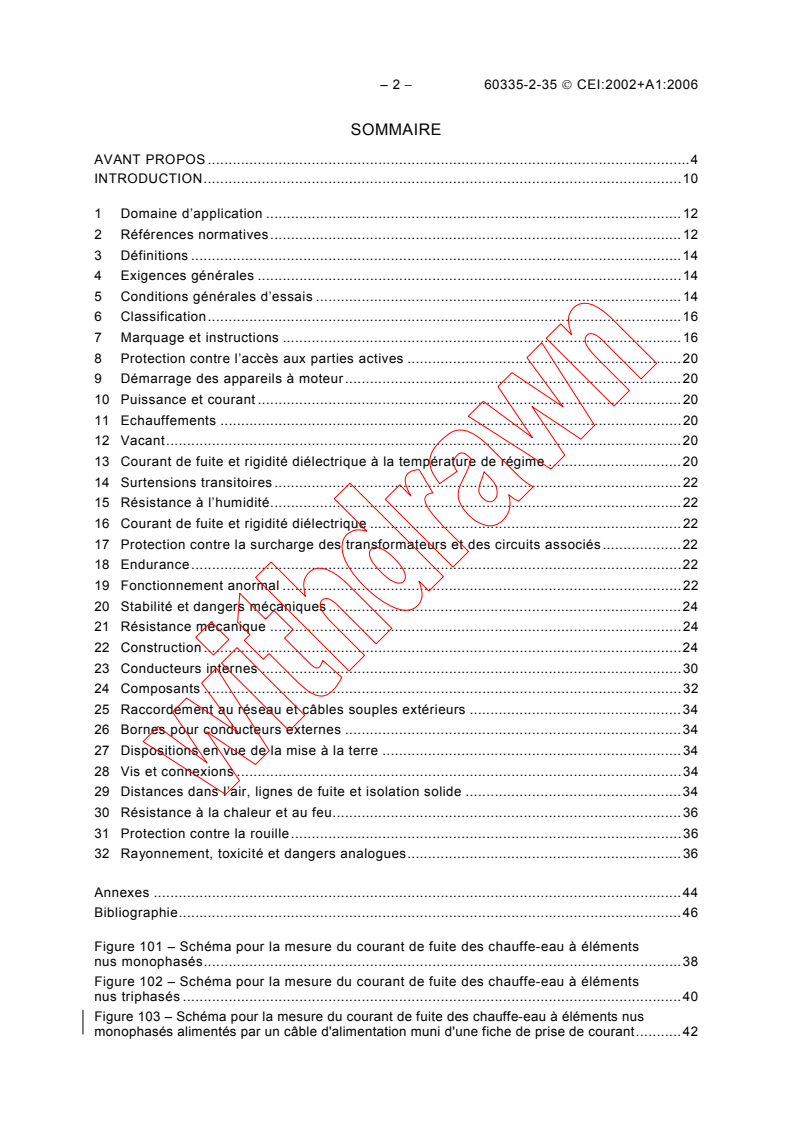
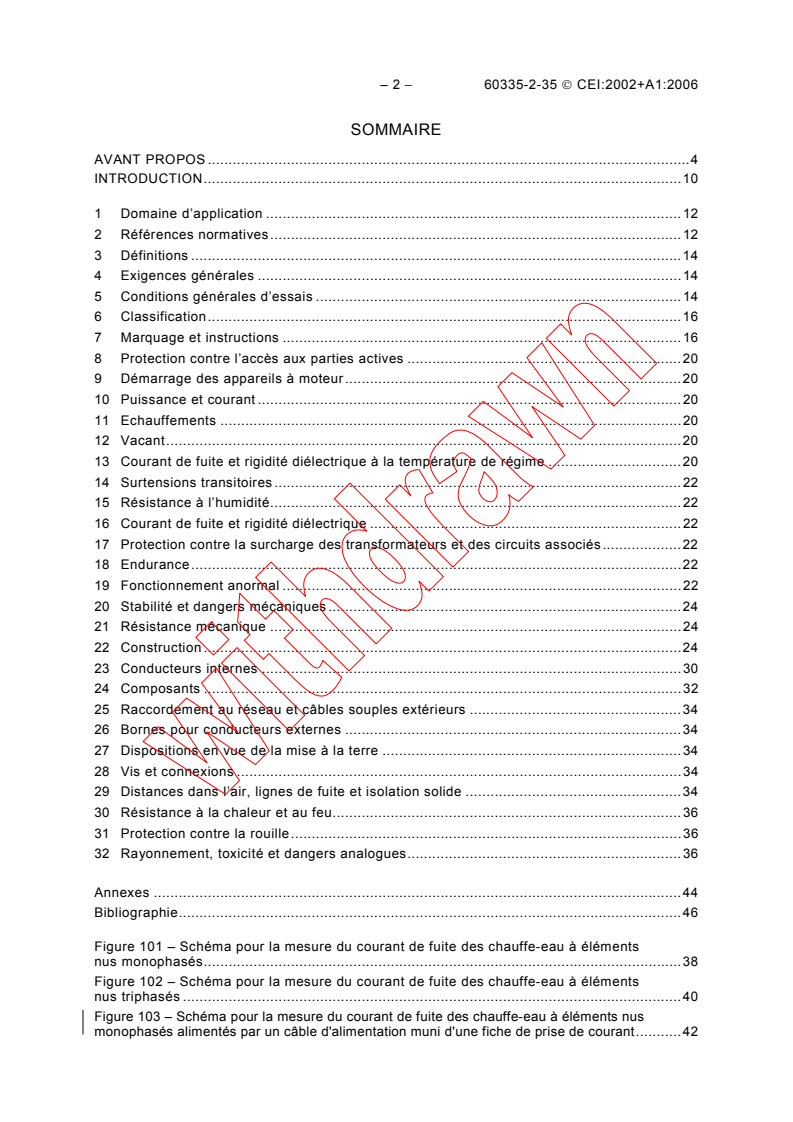
Figure 101 – Schéma pour la mesure du courant de fuite des chauffe-eau à éléments
nus monophasés.38
Figure 102 – Schéma pour la mesure du courant de fuite des chauffe-eau à éléments
nus triphasés .40
Figure 103 – Schéma pour la mesure du courant de fuite des chauffe-eau à éléments nus
monophasés alimentés par un câble d'alimentation muni d'une fiche de prise de courant.42
– 4 − 60335-2-35 © CEI:2002+A1:2006
COMMISSION ÉLECTROTECHNIQUE INTERNATIONALE
___________
APPAREILS ÉLECTRODOMESTIQUES ET ANALOGUES –
SÉCURITÉ –
Partie 2-35: Règles particulières pour les chauffe-eau instantanés
AVANT PROPOS
1) La Commission Electrotechnique Internationale (CEI) est une organisation mondiale de normalisation
composée de l'ensemble des comités électrotechniques nationaux (Comités nationaux de la CEI). La CEI a
pour objet de favoriser la coopération internationale pour toutes les questions de normalisation dans les
domaines de l'électricité et de l'électronique. A cet effet, la CEI – entre autres activités – publie des Normes
internationales, des Spécifications techniques, des Rapports techniques, des Spécifications accessibles au
public (PAS) et des Guides (ci-après dénommés "Publication(s) de la CEI"). Leur élaboration est confiée à des
comités d'études, aux travaux desquels tout Comité national intéressé par le sujet traité peut participer. Les
organisations internationales, gouvernementales et non gouvernementales, en liaison avec la CEI, participent
également aux travaux. La CEI collabore étroitement avec l'Organisation Internationale de Normalisation (ISO),
selon des conditions fixées par accord entre les deux organisations.
2) Les décisions ou accords officiels de la CEI concernant les questions techniques représentent, dans la mesure
du possible, un accord international sur les sujets étudiés, étant donné que les Comités nationaux de la CEI
intéressés sont représentés dans chaque comité d’études.
3) Les Publications de la CEI se présentent sous la forme de recommandations internationales et sont agréées
comme telles par les Comités nationaux de la CEI. Tous les efforts raisonnables sont entrepris afin que la CEI
s'assure de l'exactitude du contenu technique de ses publications; la CEI ne peut pas être tenue responsable
de l'éventuelle mauvaise utilisation ou interprétation qui en est faite par un quelconque utilisateur final.
4) Dans le but d'encourager l'unification internationale, les Comités nationaux de la CEI s'engagent, dans toute la
mesure possible, à appliquer de façon transparente les Publications de la CEI dans leurs publications
nationales et régionales. Toutes divergences entre toutes Publications de la CEI et toutes publications
nationales ou régionales correspondantes doivent être indiquées en termes clairs dans ces dernières.
5) La CEI n’a prévu aucune procédure de marquage valant indication d’approbation et n'engage pas sa
responsabilité pour les équipements déclarés conformes à une de ses Publications.
6) Tous les utilisateurs doivent s'assurer qu'ils sont en possession de la dernière édition de cette publication.
7) Aucune responsabilité ne doit être imputée à la CEI, à ses administrateurs, employés, auxiliaires ou
mandataires, y compris ses experts particuliers et les membres de ses comités d'études et des Comités
nationaux de la CEI, pour tout préjudice causé en cas de dommages corporels et matériels, ou de tout autre
dommage de quelque nature que ce soit, directe ou indirecte, ou pour supporter les coûts (y compris les frais
de justice) et les dépenses découlant de la publication ou de l'utilisation de cette Publication de la CEI ou de
toute autre Publication de la CEI, ou au crédit qui lui est accordé.
8) L'attention est attirée sur les références normatives citées dans cette publication. L'utilisation de publications
référencées est obligatoire pour une application correcte de la présente publication.
9) L’attention est attirée sur le fait que certains des éléments de la présente Publication de la CEI peuvent faire
l’objet de droits de propriété intellectuelle ou de droits analogues. La CEI ne saurait être tenue pour
responsable de ne pas avoir identifié de tels droits de propriété et de ne pas avoir signalé leur existence.
La présente partie de la Norme internationale CEI 60335 a été établie par le comité d'études 61:
Sécurité des appareils électrodomestiques et analogues.
La présente version consolidée de la CEI 60335-2-35 comprend la quatrième édition (2002)
[documents 61/2170/FDIS et 61/2251/RVD] et son amendement 1 (2006) [documents
61/3088/FDIS et 61/3144/RVD].
Le contenu technique de cette version consolidée est donc identique à celui de l'édition de
base et à son amendement; cette version a été préparée par commodité pour l'utilisateur.
Elle porte le numéro d'édition 4.1.
Une ligne verticale dans la marge indique où la publication de base a été modifiée par
l'amendement 1.
La version française de cette norme n’a pas été soumise au vote.
– 6 − 60335-2-35 © CEI:2002+A1:2006
La présente partie 2 doit être utilisée conjointement avec la dernière édition de la
CEI 60335-1 et ses amendements. Elle a été établie sur la base de la quatrième édition (2001) de
cette norme.
NOTE 1 L’expression «Partie 1» utilisée dans la présente norme fait référence à la CEI 60335-1.
La présente partie 2 complète ou modifie les articles correspondants de la CEI 60335-1 de
façon à transformer cette publication en norme CEI: Règles de sécurité pour les chauffe-eau
électriques instantanés.
Lorsqu'un paragraphe particulier de la Partie 1 n'est pas mentionné dans cette partie 2,
ce paragraphe s'applique pour autant qu'il soit raisonnable. Lorsque la présente norme
spécifie «addition», «modification» ou «remplacement», le texte correspondant de la Partie 1
doit être adapté en conséquence.
NOTE 2 Le système de numérotation suivant est utilisé:
– paragraphes, tableaux et figures: ceux qui sont numérotés à partir de 101 sont complémentaires à ceux de la
Partie 1;
– notes: à l’exception de celles qui sont dans un nouveau paragraphe ou de celles qui concernent des notes de
la Partie 1, les notes sont numérotées à partir de 101, y compris celles des articles ou paragraphes qui sont
modifiés ou remplacés;
– les annexes supplémentaires sont appelées AA, BB, etc.
NOTE 3 Les caractères d'imprimerie suivants sont utilisés:
– exigences: caractères romains;
– modalités d'essais: caractères italiques;
– notes: petits caractères romains.
Les mots en gras dans le texte sont définis à l'Article 3. Lorsqu'une définition concerne un adjectif, l'adjectif et le
nom associé figurent également en gras.
Les différences suivantes existent dans les pays indiqués ci-après.
– 6.1: Les chauffe-eau à éléments nus ne sont pas autorisés (Grèce, Inde, Indonésie, Israël, Malaisie,
Singapour and Turquie).
– 6.1: Les appareils de la classe 0I sont autorisés (Japon).
– 7.1: Les chauffe-eau fermés dont la pression assignée est inférieure à 1,0 MPa doivent porter l'indication
qu'un dispositif réducteur de pression doit être mis en place dans l'installation (Suède).
– 7.1: Le marquage de la pression assignée est différent et celui de la résistivité de l'eau n'est pas exigé (USA).
– 7.12: Des informations concernant l'élimination de l'air des chauffe-eau à éléments chauffants nus doivent être
fournies (Pologne).
– 7.12.1: L'installation de chauffe-eau à éléments nus est soumise à des conditions particulières dépendant du
système d'alimentation et qui doivent être mentionnées dans les instructions (France et Pologne et Espagne).
– 19.4: Les interrupteurs de débits dont la fiabilité à été vérifiée ne sont pas court-circuités (USA).
– 19.13: La température de l'eau dans les chauffe-eau fermés dont la capacité est supérieure à 15 l est limitée à
99 °C (Israël, Norvège et Royaume-Uni).
– 19.13: Les températures de l'eau sont différentes (USA).
– 22.101: Pour les chauffe-eau fermés, la pression assignée minimale est de 1,0 MPa (Norvège).
– 22.103: Les chauffe-eau fermés dont la capacité est supérieure à 15 l doivent comporter un limiteur de
pression (Israël).
– 22.103: Les chauffe-eau fermés doivent comporter un dispositif limiteur de pression sensible à la température
ou un dispositif sensible à la fois à la pression et à la température qui doit fonctionner avant que la
température de l'eau atteigne 100 °C (Royaume Uni).
– 22.103: Il n'est pas exigé que le dispositif limiteur de pression soit fourni avec le chauffe-eau (USA).
– 8 − 60335-2-35 © CEI:2002+A1:2006
Le comité a décidé que le contenu de la publication de base et de ses amendements ne sera
pas modifié avant la date de maintenance indiquée sur le site web de la CEI sous
"http://webstore.iec.ch" dans les données relatives à la publication recherchée. A cette date,
la publication sera
• reconduite,
• supprimée,
• remplacée par une édition révisée, ou
• amendée.
Le contenu du corrigendum d'avril 2007 a été pris en considération dans cet exemplaire.
– 10 − 60335-2-35 © CEI:2002+A1:2006
INTRODUCTION
Il a été considéré en établissant la présente Norme internationale que l'exécution de ses dis-
positions était confiée à des personnes expérimentées et ayant une qualification appropriée.
Cette norme reconnaît le niveau de protection internationalement accepté contre les risques
électriques, mécaniques, thermiques, liés au feu et au rayonnement des appareils, lorsqu'ils
fonctionnent comme en usage normal en tenant compte des instructions du fabricant. Elle
couvre également les situations anormales auxquelles on peut s'attendre dans la pratique et
prend en considération les phénomènes électromagnétiques qui peuvent affecter le
fonctionnement en toute sécurité des appareils.
Cette norme tient compte autant que possible des exigences de la CEI 60364, de façon à
rester compatible avec les règles d'installation quand l’appareil est raccordé au réseau
d’alimentation. Cependant, des règles nationales d'installation peuvent être différentes.
Si un appareil compris dans le domaine d’application de cette norme comporte également des
fonctions qui sont couvertes par une autre partie 2 de la CEI 60335, la partie 2
correspondante est appliquée à chaque fonction séparément, dans la limite du raisonnable. Si
cela est applicable, on tient compte de l’influence d’une fonction sur les autres fonctions.
Cette norme est une norme de famille de produits traitant de la sécurité d’appareils et a
préséance sur les normes horizontales et génériques couvrant le même sujet.
Un appareil conforme au texte de la présente norme ne sera pas nécessairement jugé
conforme aux principes de sécurité de la norme si, lorsqu'il est examiné et soumis aux essais,
il apparaît qu'il présente d'autres caractéristiques qui compromettent le niveau de sécurité
visé par ces exigences.
Un appareil utilisant des matériaux ou présentant des modes de construction différents de
ceux décrits dans les exigences de cette norme peut être examiné et essayé en fonction de
l'objectif poursuivi par ces exigences et, s'il est jugé pratiquement équivalent, il peut être
estimé conforme aux principes de sécurité de la norme.
– 12 − 60335-2-35 © CEI:2002+A1:2006
APPAREILS ÉLECTRODOMESTIQUES ET ANALOGUES –
SÉCURITÉ –
Partie 2-35: Règles particulières pour les chauffe-eau instantanés
1 Domaine d’application
L'article de la Partie 1 est remplacé par l'article ci-après.
La présente Norme internationale traite de la sécurité des chauffe-eau électriques
instantanés pour usages domestiques et analogues, destinés à chauffer l’eau au-dessous de
la température d’ébullition, et dont la tension assignée n'est pas supérieure à 250 V pour les
appareils monophasés et à 480 V pour les autres appareils.
NOTE 101 Les chauffe-eau instantanés comportant des éléments chauffants nus sont compris dans le domaine
d'application de la présente norme.
Les appareils non destinés à un usage domestique normal mais qui peuvent néanmoins
constituer une source de danger pour le public, tels que les appareils destinés à être utilisés
dans les magasins, chez les artisans et dans les fermes, sont compris dans le domaine
d'application de la présente norme.
Dans la mesure du possible, la présente norme traite des risques ordinaires présentés par les
appareils qui sont encourus par tous les individus à l'intérieur et autour de l'habitation.
Cependant, cette norme ne tient pas compte en général
– de l'utilisation des appareils par de jeunes enfants ou par des personnes handicapées
sans surveillance;
– de l’emploi de l’appareil comme jouet par de jeunes enfants.
NOTE 102 L’attention est attirée sur le fait que
– pour les appareils destinés à être utilisés dans des véhicules ou à bord de navires ou d'avions, des exigences
supplémentaires peuvent être nécessaires;
– dans de nombreux pays, des exigences supplémentaires sont spécifiées par les organismes nationaux de la
santé, par les organismes nationaux responsables de la protection des travailleurs et par des organismes
similaires;
– dans de nombreux pays, des réglementations existent pour l'installation des équipements raccordés au réseau
d'alimentation en eau.
NOTE 103 Cette norme ne s’applique pas
– aux appareils pour faire bouillir l'eau (CEI 60335-2-15);
– aux chauffe-eau à accumulation (CEI 60335-2-21);
– aux appareils destinés exclusivement à des usages industriels;
– aux appareils destinés à être utilisés dans des locaux présentant des conditions particulières telles que la
présence d'une atmosphère corrosive ou explosive (poussières, vapeur ou gaz);
– aux distributeurs commerciaux avec ou sans moyens de paiement (CEI 60335-2-75).
2 Références normatives
L’article de la Partie 1 est applicable.
– 14 − 60335-2-35 © CEI:2002+A1:2006
3 Définitions
L’article de la Partie 1 est applicable avec les exceptions suivantes.
3.1.9 Remplacement:
fonctionnement normal
fonctionnement de l’appareil lorsqu’il est alimenté en eau, le débit étant réglé de façon à
obtenir la température de l'eau à la sortie la plus élevée possible, sans faire fonctionner le
coupe-circuit thermique
3.101
chauffe-eau instantané
appareil fixe destiné à chauffer l'eau lorsqu'elle circule dans l’appareil
NOTE Les chauffe-eau instantanés sont par la suite appelés chauffe-eau.
3.102
chauffe-eau fermé
chauffe-eau prévu pour fonctionner à la pression du système d'alimentation en eau,
l'écoulement de l'eau étant commandé par un ou plusieurs robinets placés dans le circuit de
sortie
NOTE La pression de fonctionnement peut être la pression à la sortie d'un dispositif réduisant ou augmentant la
pression.
3.103
chauffe-eau à écoulement libre
chauffe-eau dont l'écoulement de l'eau est commandé par un robinet placé dans le tuyau
d'entrée, aucun robinet n'étant placé dans le tuyau de sortie
3.104
chauffe-eau à éléments nus
chauffe-eau dans lequel des éléments chauffants non isolés sont immergés dans l'eau
3.105
pression assignée
pression d'eau assignée à l’appareil par le fabricant
3.106
interrupteur de débit
interrupteur qui est actionné par un courant d'eau
3.107
interrupteur de pression
interrupteur qui est actionné par une modification de pression
4 Exigences générales
L’article de la Partie 1 est applicable.
5 Conditions générales d’essais
L’article de la Partie 1 est applicable avec les exceptions suivantes.
– 16 − 60335-2-35 © CEI:2002+A1:2006
5.2 Addition:
NOTE 101 Des échantillons supplémentaires peuvent être nécessaires pour les essais de 22.109.
5.3 Addition:
Si les essais sont effectués sur un seul appareil, les essais de 22.102, 22.107, 22.108 et
24.102 sont effectués avant les essais de l'Article 19.
5.7 Addition:
Les essais sont effectués avec de l'eau dont la température est de 15 °C ± 5 °C.
6 Classification
L’article de la Partie 1 est applicable avec les exceptions suivantes.
6.1 Modification:
Les chauffe-eau à éléments nus doivent être de la classe I ou de la classe III.
Les autres chauffe-eau doivent être de la classe I, de la classe II ou de la classe III.
6.2 Addition:
Les chauffe-eau doivent être au moins IPX1.
NOTE 101 Un degré de protection supérieur peut être exigé, conformément à la CEI 60364, suivant la zone dans
laquelle le chauffe-eau est installé.
7 Marquage et instructions
L’article de la Partie 1 est applicable avec les exceptions suivantes.
7.1 Addition:
NOTE 101 La fréquence assignée minimale des chauffe-eau à éléments nus est 50 Hz.
Les appareils doivent porter le marquage de la pression assignée en pascals.
Les chauffe-eau à éléments nus doivent porter, en substance, le marquage suivant:
La résistivité de l'eau ne doit pas être inférieure à… Ωcm.
NOTE 102 La valeur de la résistivi
...
CEI 60335-2-35 IEC 60335-2-35
(Edition consolidée 4.1- 2006) (Consolidated edition 4.1- 2006)
Appareils électrodomestiques et analogues – Household and similar electrical appliances –
sécurité – safety –
Partie 2-35: Règles particulières pour les Part 2-35: Particular requirements for
chauffe-eau instantanés instantaneous water heaters
CORRIGENDUM 1
Page 34 Page 35
25 Raccordement au réseau et câbles 25 Supply connection and external
souples extérieurs flexible cords
Au lieu de: Instead of:
L’article de la Partie 1 est applicable. This clause of Part 1 is applic
...
NORME CEI
INTERNATIONALE
IEC
60335-2-35
INTERNATIONAL
Quatrième édition
STANDARD
Fourth edition
2002-10
Appareils électrodomestiques et analogues –
Sécurité –
Partie 2-35:
Règles particulières pour les chauffe-eau
instantanés
Household and similar electrical appliances –
Safety –
Part 2-35:
Particular requirements for instantaneous
water heaters
Numéro de référence
Reference number
CEI/IEC 60335-2-35:2002
Numérotation des publications Publication numbering
Depuis le 1er janvier 1997, les publications de la CEI As from 1 January 1997 all IEC publications are
sont numérotées à partir de 60000. Ainsi, la CEI 34-1 issued with a designation in the 60000 series. For
devient la CEI 60034-1. example, IEC 34-1 is now referred to as IEC 60034-1.
Editions consolidées Consolidated editions
Les versions consolidées de certaines publications de la The IEC is now publishing consolidated versions of its
CEI incorporant les amendements sont disponibles. Par publications. For example, edition numbers 1.0, 1.1
exemple, les numéros d’édition 1.0, 1.1 et 1.2 indiquent and 1.2 refer, respectively, to the base publication,
respectivement la publication de base, la publication de the base publication incorporating amendment 1 and
base incorporant l’amendement 1, et la publication de the base publication incorporating amendments 1
base incorporant les amendements 1 et 2. and 2.
Informations supplémentaires Further information on IEC publications
sur les publications de la CEI
Le contenu technique des publications de la CEI est The technical content of IEC publications is kept
constamment revu par la CEI afin qu'il reflète l'état under constant review by the IEC, thus ensuring that
actuel de la technique. Des renseignements relatifs à the content reflects current technology. Information
cette publication, y compris sa validité, sont dispo- relating to this publication, including its validity, is
nibles dans le Catalogue des publications de la CEI available in the IEC Catalogue of publications
(voir ci-dessous) en plus des nouvelles éditions, (see below) in addition to new editions, amendments
amendements et corrigenda. Des informations sur les and corrigenda. Information on the subjects under
sujets à l’étude et l’avancement des travaux entrepris consideration and work in progress undertaken by the
par le comité d’études qui a élaboré cette publication, technical committee which has prepared this
ainsi que la liste des publications parues, sont publication, as well as the list of publications issued,
également disponibles par l’intermédiaire de: is also available from the following:
• Site web de la CEI (www.iec.ch) • IEC Web Site (www.iec.ch)
• Catalogue des publications de la CEI • Catalogue of IEC publications
Le catalogue en ligne sur le site web de la CEI The on-line catalogue on the IEC web site
(www.iec.ch/searchpub) vous permet de faire des (www.iec.ch/searchpub) enables you to search by a
recherches en utilisant de nombreux critères, variety of criteria including text searches,
comprenant des recherches textuelles, par comité technical committees and date of publication. On-
d’études ou date de publication. Des informations en line information is also available on recently
ligne sont également disponibles sur les nouvelles issued publications, withdrawn and replaced
publications, les publications remplacées ou retirées, publications, as well as corrigenda.
ainsi que sur les corrigenda.
• IEC Just Published • IEC Just Published
Ce résumé des dernières publications parues This summary of recently issued publications
(www.iec.ch/online_news/justpub) est aussi dispo- (www.iec.ch/online_news/justpub) is also available
nible par courrier électronique. Veuillez prendre by email. Please contact the Customer Service
contact avec le Service client (voir ci-dessous) Centre (see below) for further information.
pour plus d’informations.
• Service clients • Customer Service Centre
Si vous avez des questions au sujet de cette If you have any questions regarding this
publication ou avez besoin de renseignements publication or need further assistance, please
supplémentaires, prenez contact avec le Service contact the Customer Service Centre:
clients:
Email: custserv@iec.ch Email: custserv@iec.ch
Tél: +41 22 919 02 11 Tel: +41 22 919 02 11
Fax: +41 22 919 03 00 Fax: +41 22 919 03 00
.
NORME CEI
INTERNATIONALE
IEC
60335-2-35
INTERNATIONAL
Quatrième édition
STANDARD
Fourth edition
2002-10
Appareils électrodomestiques et analogues –
Sécurité –
Partie 2-35:
Règles particulières pour les chauffe-eau
instantanés
Household and similar electrical appliances –
Safety –
Part 2-35:
Particular requirements for instantaneous
water heaters
IEC 2002 Droits de reproduction réservés Copyright - all rights reserved
Aucune partie de cette publication ne peut être reproduite ni No part of this publication may be reproduced or utilized in any
utilisée sous quelque forme que ce soit et par aucun procédé, form or by any means, electronic or mechanical, including
électronique ou mécanique, y compris la photocopie et les photocopying and microfilm, without permission in writing from
microfilms, sans l'accord écrit de l'éditeur. the publisher.
International Electrotechnical Commission, 3, rue de Varembé, PO Box 131, CH-1211 Geneva 20, Switzerland
Telephone: +41 22 919 02 11 Telefax: +41 22 919 03 00 E-mail: inmail@iec.ch Web: www.iec.ch
CODE PRIX
S
PRICE CODE
Commission Electrotechnique Internationale
International Electrotechnical Commission
МеждународнаяЭлектротехническаяКомиссия
Pour prix, voir catalogue en vigueur
For price, see current catalogue
– 2 − 60335-2-35 CEI:2005
SOMMAIRE
AVANT PROPOS .4
INTRODUCTION.10
1 Domaine d’application .12
2 Références normatives.12
3 Définitions .14
4 Exigences générales .14
5 Conditions générales d’essais .14
6 Classification.16
7 Marquage et instructions .16
8 Protection contre l’accès aux parties actives .18
9 Démarrage des appareils à moteur.20
10 Puissance et courant .20
11 Echauffements .20
12 Vacant.20
13 Courant de fuite et rigidité diélectrique à la température de régime .20
14 Surtensions transitoires.20
15 Résistance à l’humidité.20
16 Courant de fuite et rigidité diélectrique .22
17 Protection contre la surcharge des transformateurs et des circuits associés.22
18 Endurance.22
19 Fonctionnement anormal .22
20 Stabilité et dangers mécaniques .24
21 Résistance mécanique .24
22 Construction .24
23 Conducteurs internes .30
24 Composants .30
25 Raccordement au réseau et câbles souples extérieurs .32
26 Bornes pour conducteurs externes .32
27 Dispositions en vue de la mise à la terre .32
28 Vis et connexions .34
29 Distances dans l’air, lignes de fuite et isolation solide .34
30 Résistance à la chaleur et au feu.34
31 Protection contre la rouille.34
32 Rayonnement, toxicité et dangers analogues.34
Annexes .40
Bibliographie.42
Figure 101 – Schéma pour la mesure du courant de fuite des chauffe-eau à éléments
nus monophasés.36
Figure 102 – Schéma pour la mesure du courant de fuite des chauffe-eau à éléments
nus triphasés .38
60335-2-35 IEC:2005 – 3 –
CONTENTS
FOREWORD.5
INTRODUCTION.11
1 Scope.13
2 Normative references .13
3 Definitions .15
4 General requirement.15
5 General conditions for the tests .15
6 Classification.17
7 Marking and instructions.17
8 Protection against access to live parts.19
9 Starting of motor-operated appliances .21
10 Power input and current .21
11 Heating .21
12 Void.21
13 Leakage current and electric strength at operating temperature.21
14 Transient overvoltages .21
15 Moisture resistance .21
16 Leakage current and electric strength.23
17 Overload protection of transformers and associated circuits .23
18 Endurance.23
19 Abnormal operation .23
20 Stability and mechanical hazards .25
21 Mechanical strength .25
22 Construction .25
23 Internal wiring.31
24 Components .31
25 Supply connection and external flexible cords .33
26 Terminals for external conductors.33
27 Provision for earthing .33
28 Screws and connections .35
29 Clearances, creepage distances and solid insulation .35
30 Resistance to heat and fire.35
31 Resistance to rusting.35
32 Radiation, toxicity and similar hazards.35
Annexes .41
Bibliography.43
Figure 101 – Diagram for the leakage current measurement for single-phase bare-
element water heaters .37
Figure 102 – Diagram for the leakage current measurement for three-phase bare-
element water heaters .39
– 4 − 60335-2-35 CEI:2005
COMMISSION ÉLECTROTECHNIQUE INTERNATIONALE
___________
APPAREILS ÉLECTRODOMESTIQUES ET ANALOGUES –
SÉCURITÉ –
Partie 2-35: Règles particulières pour les chauffe-eau instantanés
AVANT PROPOS
1) La Commission Electrotechnique Internationale (CEI) est une organisation mondiale de normalisation
composée de l'ensemble des comités électrotechniques nationaux (Comités nationaux de la CEI). La CEI a
pour objet de favoriser la coopération internationale pour toutes les questions de normalisation dans les
domaines de l'électricité et de l'électronique. A cet effet, la CEI – entre autres activités – publie des Normes
internationales, des Spécifications techniques, des Rapports techniques, des Spécifications accessibles au
public (PAS) et des Guides (ci-après dénommés "Publication(s) de la CEI"). Leur élaboration est confiée à des
comités d'études, aux travaux desquels tout Comité national intéressé par le sujet traité peut participer. Les
organisations internationales, gouvernementales et non gouvernementales, en liaison avec la CEI, participent
également aux travaux. La CEI collabore étroitement avec l'Organisation Internationale de Normalisation (ISO),
selon des conditions fixées par accord entre les deux organisations.
2) Les décisions ou accords officiels de la CEI concernant les questions techniques représentent, dans la mesure
du possible, un accord international sur les sujets étudiés, étant donné que les Comités nationaux de la CEI
intéressés sont représentés dans chaque comité d’études.
3) Les Publications de la CEI se présentent sous la forme de recommandations internationales et sont agréées
comme telles par les Comités nationaux de la CEI. Tous les efforts raisonnables sont entrepris afin que la CEI
s'assure de l'exactitude du contenu technique de ses publications; la CEI ne peut pas être tenue responsable
de l'éventuelle mauvaise utilisation ou interprétation qui en est faite par un quelconque utilisateur final.
4) Dans le but d'encourager l'unification internationale, les Comités nationaux de la CEI s'engagent, dans toute la
mesure possible, à appliquer de façon transparente les Publications de la CEI dans leurs publications
nationales et régionales. Toutes divergences entre toutes Publications de la CEI et toutes publications
nationales ou régionales correspondantes doivent être indiquées en termes clairs dans ces dernières.
5) La CEI n’a prévu aucune procédure de marquage valant indication d’approbation et n'engage pas sa
responsabilité pour les équipements déclarés conformes à une de ses Publications.
6) Tous les utilisateurs doivent s'assurer qu'ils sont en possession de la dernière édition de cette publication.
7) Aucune responsabilité ne doit être imputée à la CEI, à ses administrateurs, employés, auxiliaires ou
mandataires, y compris ses experts particuliers et les membres de ses comités d'études et des Comités
nationaux de la CEI, pour tout préjudice causé en cas de dommages corporels et matériels, ou de tout autre
dommage de quelque nature que ce soit, directe ou indirecte, ou pour supporter les coûts (y compris les frais
de justice) et les dépenses découlant de la publication ou de l'utilisation de cette Publication de la CEI ou de
toute autre Publication de la CEI, ou au crédit qui lui est accordé.
8) L'attention est attirée sur les références normatives citées dans cette publication. L'utilisation de publications
référencées est obligatoire pour une application correcte de la présente publication.
9) L’attention est attirée sur le fait que certains des éléments de la présente Publication de la CEI peuvent faire
l’objet de droits de propriété intellectuelle ou de droits analogues. La CEI ne saurait être tenue pour
responsable de ne pas avoir identifié de tels droits de propriété et de ne pas avoir signalé leur existence.
La présente partie de la Norme internationale CEI 60335 a été établie par le comité d'études
61: Sécurité des appareils électrodomestiques et analogues.
Cette quatrième édition annule et remplace la troisième édition parue en 1997 et son
amendement 1 (1999), dont elle constitue une révision technique.
Cette version bilingue (2005-11) remplace la version monolingue anglaise.
Le texte anglais de cette norme est issu des documents 61/2170/FDIS et 61/2251/RVD. Le
rapport de vote 61/2251/RVD donne toute information sur le vote ayant abouti à l’approbation
de cette norme.
60335-2-35 IEC:2005 – 5 –
INTERNATIONAL ELECTROTECHNICAL COMMISSION
–––––––––––––
HOUSEHOLD AND SIMILAR ELECTRICAL APPLIANCES –
SAFETY –
Part 2-35: Particular requirements for instantaneous water heaters
FOREWORD
1) The International Electrotechnical Commission (IEC) is a worldwide organization for standardization comprising
all national electrotechnical committees (IEC National Committees). The object of IEC is to promote
international co-operation on all questions concerning standardization in the electrical and electronic fields. To
this end and in addition to other activities, IEC publishes International Standards, Technical Specifications,
Technical Reports, Publicly Available Specifications (PAS) and Guides (hereafter referred to as “IEC
Publication(s)”). Their preparation is entrusted to technical committees; any IEC National Committee interested
in the subject dealt with may participate in this preparatory work. International, governmental and non-
governmental organizations liaising with the IEC also participate in this preparation. IEC collaborates closely
with the International Organization for Standardization (ISO) in accordance with conditions determined by
agreement between the two organizations.
2) The formal decisions or agreements of IEC on technical matters express, as nearly as possible, an international
consensus of opinion on the relevant subjects since each technical committee has representation from all
interested IEC National Committees.
3) IEC Publications have the form of recommendations for international use and are accepted by IEC National
Committees in that sense. While all reasonable efforts are made to ensure that the technical content of IEC
Publications is accurate, IEC cannot be held responsible for the way in which they are used or for any
misinterpretation by any end user.
4) In order to promote international uniformity, IEC National Committees undertake to apply IEC Publications
transparently to the maximum extent possible in their national and regional publications. Any divergence
between any IEC Publication and the corresponding national or regional publication shall be clearly indicated in
the latter.
5) IEC provides no marking procedure to indicate its approval and cannot be rendered responsible for any
equipment declared to be in conformity with an IEC Publication.
6) All users should ensure that they have the latest edition of this publication.
7) No liability shall attach to IEC or its directors, employees, servants or agents including individual experts and
members of its technical committees and IEC National Committees for any personal injury, property damage or
other damage of any nature whatsoever, whether direct or indirect, or for costs (including legal fees) and
expenses arising out of the publication, use of, or reliance upon, this IEC Publication or any other IEC
Publications.
8) Attention is drawn to the Normative references cited in this publication. Use of the referenced publications is
indispensable for the correct application of this publication.
9) Attention is drawn to the possibility that some of the elements of this IEC Publication may be the subject of
patent rights. IEC shall not be held responsible for identifying any or all such patent rights.
This part of International Standard IEC 60335 has been prepared by IEC technical committee
61: Safety of household and similar electrical appliances.
This fourth edition cancels and replaces the third edition published in 1997 and its
amendment 1 (1999). It constitutes a technical revision.
This bilingual version (2005-11) replaces the English version.
The text of this part of IEC 60335 is based on the following documents:
FDIS Report on voting
61/2170/FDIS 61/2251/RVD
Full information on the voting for the approval of this standard can be found in the report on
voting indicated in the above table.
– 6 − 60335-2-35 CEI:2005
La version française de cette norme n’a pas été soumise au vote.
La présente partie 2 doit être utilisée conjointement avec la dernière édition de la
CEI 60335-1 et ses amendements. Elle a été établie sur la base de la quatrième édition (2001) de
cette norme.
NOTE 1 L’expression «Partie 1» utilisée dans la présente norme fait référence à la CEI 60335-1.
La présente partie 2 complète ou modifie les articles correspondants de la CEI 60335-1 de
façon à transformer cette publication en norme CEI: Règles de sécurité pour les chauffe-eau
électriques instantanés.
Lorsqu'un paragraphe particulier de la Partie 1 n'est pas mentionné dans cette partie 2,
ce paragraphe s'applique pour autant qu'il soit raisonnable. Lorsque la présente norme
spécifie «addition», «modification» ou «remplacement», le texte correspondant de la Partie 1
doit être adapté en conséquence.
NOTE 2 Le système de numérotation suivant est utilisé:
– paragraphes, tableaux et figures: ceux qui sont numérotés à partir de 101 sont complémentaires à ceux de la
Partie 1;
– notes: à l’exception de celles qui sont dans un nouveau paragraphe ou de celles qui concernent des notes de
la Partie 1, les notes sont numérotées à partir de 101, y compris celles des articles ou paragraphes qui sont
modifiés ou remplacés;
– les annexes supplémentaires sont appelées AA, BB, etc.
NOTE 3 Les caractères d'imprimerie suivants sont utilisés:
– exigences: caractères romains;
modalités d'essais: caractères italiques;
–
– notes: petits caractères romains.
Les mots en gras dans le texte sont définis à l'Article 3. Lorsqu'une définition concerne un adjectif, l'adjectif et le
nom associé figurent également en gras.
Les différences suivantes existent dans les pays indiqués ci-après.
– 6.1: Les chauffe-eau à éléments nus ne sont pas autorisés (Grèce, Indonésie, Israël, Malaisie, Singapour, et
Turquie).
– 6.1: Les appareils de la classe 0I sont autorisés (Japon).
– 7.1: Les chauffe-eau fermés dont la pression assignée est inférieure à 1,0 MPa doivent porter l'indication
qu'un dispositif réducteur de pression doit être mis en place dans l'installation (Suède).
– 7.1: Le marquage de la pression assignée est différent et celui de la résistivité de l'eau n'est pas exigé (USA).
– 7.12: Des informations concernant l'élimination de l'air des chauffe-eau à éléments chauffants nus doivent être
fournies (Pologne).
– 7.12.1: L'installation de chauffe-eau à éléments nus est soumise à des conditions particulières dépendant du
système d'alimentation et qui doivent être mentionnées dans les instructions (France et Pologne et Espagne).
– 19.4: Les interrupteurs de débits dont la fiabilité à été vérifiée ne sont pas court-circuités (USA).
– 19.13: La température de l'eau dans les chauffe-eau fermés dont la capacité est supérieure à 15 l est limitée à
99 °C (Israël, Norvège et Royaume-Uni).
– 19.13: Les températures de l'eau sont différentes (USA).
– 22.101: Pour les chauffe-eau fermés, la pression assignée minimale est de 1,0 MPa (Norvège).
– 22.103: Les chauffe-eau fermés dont la capacité est supérieure à 15 l doivent comporter un limiteur de
pression (Israël).
– 22.103: Les chauffe-eau fermés doivent comporter un dispositif limiteur de pression sensible à la température
ou un dispositif sensible à la fois à la pression et à la température qui doit fonctionner avant que la
température de l'eau atteigne 100 °C (Royaume Uni).
– 22.103: Il n'est pas exigé que le dispositif limiteur de pression soit fourni avec le chauffe-eau (USA).
60335-2-35 IEC:2005 – 7 –
The French version of this standard has not been voted upon.
This part 2 is to be used in conjunction with the latest edition of IEC 60335-1 and its
amendments. It was established on the basis of the fourth edition (2001) of that standard.
NOTE 1 When “Part 1” is mentioned in this standard, it refers to IEC 60335-1.
This part 2 supplements or modifies the corresponding clauses in IEC 60335-1, so as to
convert that publication into the IEC standard: Safety requirements for electric instantaneous
water heaters.
When a particular subclause of Part 1 is not mentioned in this part 2, that subclause applies
as far as is reasonable. When this standard states "addition", "modification", or "replacement",
the relevant text in Part 1 is to be adapted accordingly.
NOTE 2 The following numbering system is used:
– subclauses, tables and figures that are numbered starting from 101 are additional to those in Part 1;
– unless notes are in a new subclause or involve notes in Part 1, they are numbered starting from 101, including
those in a replaced clause or subclause;
– additional annexes are lettered AA, BB, etc.
NOTE 3 The following print types are used:
– requirements: in roman type;
– test specifications: in italic type;
– notes: in small roman type.
Words in bold in the text are defined in Clause 3. When a definition concerns an adjective, the adjective and the
associated noun are also in bold.
The following differences exist in the countries indicated below.
– 6.1: Bare-element water heaters are not allowed (Greece, Indonesia, Israel, Malaysia, Singapore and Turkey).
– 6.1: Class 0I appliances are allowed (Japan).
– 7.1: Closed water heaters having a rated pressure less than 1,0 MPa have to be marked with a statement that a
pressure reducing valve is to be fitted in the installation (Sweden).
– 7.1: Marking of rated pressure is different and marking of water resistivity is not required (USA).
– 7.12: Information concerning the removal of air from bare-element water heaters has to be given (Poland).
– 7.12.1: The installation of bare-element water heaters has to comply with particular conditions dependent on
the supply system and which are to be included in the instructions (France, Poland and Spain).
– 19.4: Flow switches tested for reliability are not short-circuited (USA).
– 19.13: The water temperature in closed water heaters having a capacity in excess of 15 l is limited to 99 °C
(Israel, Norway and United Kingdom).
– 19.13: The water temperatures are different (USA).
– 22.101: For closed water heaters, the minimum rated pressure is 1,0 MPa (Norway).
– 22.103: Closed water heaters having a capacity in excess of 15 l have to be provided with a pressure relief
device (Israel).
– 22.103: Closed water heaters have to incorporate a temperature relief valve or a combined temperature and
pressure relief valve that has to operate before the water temperature reaches 100 °C (United Kingdom).
– 22.103: The pressure relief valve is not required to be provided with the heater (USA).
– 8 − 60335-2-35 CEI:2005
Le comité a décidé que le contenu de cette publication ne sera pas modifié avant la date de
maintenance indiquée sur le site web de la CEI sous «http://webstore.iec.ch» dans les
données relatives à la publication recherchée. A cette date, la publication sera
• reconduite;
• supprimée;
• remplacée par une édition révisée, ou
• amendée.
60335-2-35 IEC:2005 – 9 –
The committee has decided that the contents of this publication will remain unchanged until
the maintenance result date indicated on the IEC web site under "http://webstore.iec.ch" in
the data related to the specific publication. At this date, the publication will be
• reconfirmed;
• withdrawn;
• replaced by a revised edition, or
• amended.
– 10 − 60335-2-35 CEI:2005
INTRODUCTION
Il a été considéré en établissant la présente Norme internationale que l'exécution de ses dis-
positions était confiée à des personnes expérimentées et ayant une qualification appropriée.
Cette norme reconnaît le niveau de protection internationalement accepté contre les risques
électriques, mécaniques, thermiques, liés au feu et au rayonnement des appareils, lorsqu'ils
fonctionnent comme en usage normal en tenant compte des instructions du fabricant. Elle
couvre également les situations anormales auxquelles on peut s'attendre dans la pratique.
Cette norme tient compte autant que possible des exigences de la CEI 60364, de façon à
rester compatible avec les règles d'installation quand l’appareil est raccordé au réseau
d’alimentation. Cependant, des règles nationales d'installation peuvent être différentes.
Si un appareil compris dans le domaine d’application de cette norme comporte également des
fonctions qui sont couvertes par une autre partie 2 de la CEI 60335, la partie 2
correspondante est appliquée à chaque fonction séparément, dans la limite du raisonnable. Si
cela est applicable, on tient compte de l’influence d’une fonction sur les autres fonctions.
Cette norme est une norme de famille de produits traitant de la sécurité d’appareils et a
préséance sur les normes horizontales et génériques couvrant le même sujet.
Un appareil conforme au texte de la présente norme ne sera pas nécessairement jugé
conforme aux principes de sécurité de la norme si, lorsqu'il est examiné et soumis aux essais,
il apparaît qu'il présente d'autres caractéristiques qui compromettent le niveau de sécurité
visé par ces exigences.
Un appareil utilisant des matériaux ou présentant des modes de construction différents de
ceux décrits dans les exigences de cette norme peut être examiné et essayé en fonction de
l'objectif poursuivi par ces exigences et, s'il est jugé pratiquement équivalent, il peut être
estimé conforme aux principes de sécurité de la norme.
60335-2-35 IEC:2005 – 11 –
INTRODUCTION
It has been assumed in the drafting of this International Standard that the execution of its
provisions is entrusted to appropriately qualified and experienced persons.
This standard recognizes the internationally accepted level of protection against hazards such
as electrical, mechanical, thermal, fire and radiation of appliances when operated as in
normal use taking into account the manufacturer's instructions. It also covers abnormal
situations that can be expected in practice.
This standard takes into account the requirements of IEC 60364 as far as possible so that
there is compatibility with the wiring rules when the appliance is connected to the supply
mains. However, national wiring rules may differ.
If an appliance within the scope of this standard also incorporates functions that are covered
by another part 2 of IEC 60335, the relevant part 2 is applied to each function separately, as
far as is reasonable. If applicable, the influence of one function on the other is taken into
account.
This standard is a product family standard dealing with the safety of appliances and takes
precedence over horizontal and generic standards covering the same subject.
An appliance that complies with the text of this standard will not necessarily be considered to
comply with the safety principles of the standard if, when examined and tested, it is found to
have other features that impair the level of safety covered by these requirements.
An appliance employing materials or having forms of construction differing from those detailed
in the requirements of this standard may be examined and tested according to the intent of
the requirements and, if found to be substantially equivalent, may be considered to comply
with the standard.
– 12 − 60335-2-35 CEI:2005
APPAREILS ÉLECTRODOMESTIQUES ET ANALOGUES –
SÉCURITÉ –
Partie 2-35: Règles particulières pour les chauffe-eau instantanés
1 Domaine d’application
L'article de la Partie 1 est remplacé par l'article ci-après.
La présente Norme internationale traite de la sécurité des chauffe-eau électriques
instantanés pour usages domestiques et analogues, destinés à chauffer l’eau au-dessous de
la température d’ébullition, et dont la tension assignée n'est pas supérieure à 250 V pour les
appareils monophasés et à 480 V pour les autres appareils.
NOTE 101 Les chauffe-eau instantanés comportant des éléments chauffants nus sont compris dans le domaine
d'application de la présente norme.
Les appareils non destinés à un usage domestique normal mais qui peuvent néanmoins
constituer une source de danger pour le public, tels que les appareils destinés à être utilisés
dans les magasins, chez les artisans et dans les fermes, sont compris dans le domaine
d'application de la présente norme.
Dans la mesure du possible, la présente norme traite des risques ordinaires présentés par les
appareils qui sont encourus par tous les individus à l'intérieur et autour de l'habitation.
Cependant, cette norme ne tient pas compte en général
– de l'utilisation des appareils par de jeunes enfants ou par des personnes handicapées
sans surveillance;
– de l’emploi de l’appareil comme jouet par de jeunes enfants.
NOTE 102 L’attention est attirée sur le fait que
– pour les appareils destinés à être utilisés dans des véhicules ou à bord de navires ou d'avions, des exigences
supplémentaires peuvent être nécessaires;
– dans de nombreux pays, des exigences supplémentaires sont spécifiées par les organismes nationaux de la
santé, par les organismes nationaux responsables de la protection des travailleurs et par des organismes
similaires;
– dans de nombreux pays, des réglementations existent pour l'installation des équipements raccordés au réseau
d'alimentation en eau.
NOTE 103 Cette norme ne s’applique pas
– aux appareils pour faire bouillir l'eau (CEI 60335-2-15);
– aux chauffe-eau à accumulation (CEI 60335-2-21);
– aux appareils destinés exclusivement à des usages industriels;
– aux appareils destinés à être utilisés dans des locaux présentant des conditions particulières telles que la
présence d'une atmosphère corrosive ou explosive (poussières, vapeur ou gaz);
– aux distributeurs commerciaux avec ou sans moyens de paiement (CEI 60335-2-75).
2 Références normatives
L’article de la Partie 1 est applicable.
60335-2-35 IEC:2005 – 13 –
HOUSEHOLD AND SIMILAR ELECTRICAL APPLIANCES –
SAFETY –
Part 2-35: Particular requirements for instantaneous water heaters
1 Scope
This clause of Part 1 is replaced by the following.
This International Standard deals with the safety of electric instantaneous water heaters for
household and similar purposes and intended for heating water below boiling temperature,
their rated voltage being not more than 250 V for single-phase appliances and 480 V for
other appliances.
NOTE 101 Instantaneous water heaters incorporating bare heating elements are within the scope of this
standard.
Appliances not intended for normal household use but which nevertheless may be a source of
danger to the public, such as appliances intended for use in shops, in light industry and on
farms, are within the scope of this standard.
As far as is practicable, this standard deals with the common hazards presented by
appliances which are encountered by all persons in and around the home. However, in
general, it does not take into account
– the use of appliances by young children or infirm persons without supervision;
– playing with the appliance by young children.
NOTE 102 Attention is drawn to the fact that
– for appliances intended to be used in vehicles or on board ships or aircraft, additional requirements may be
necessary;
– in many countries additional requirements are specified by the national health authorities, the national
authorities responsible for the protection of labour and similar authorities;
– in many countries regulations exist for the installation of equipment connected to the water mains.
NOTE 103 This standard does not apply to
– appliances for boiling water (IEC 60335-2-15);
– storage water heaters (IEC 60335-2-21);
– appliances intended exclusively for industrial purposes;
– appliances intended to be used in locations where special conditions prevail, such as the presence of a
corrosive or explosive atmosphere (dust, vapour or gas);
– commercial dispensing appliances and vending machines (IEC 60335-2-75).
2 Normative references
This clause of Part 1 is applicable.
– 14 − 60335-2-35 CEI:2005
3 Définitions
L’article de la Partie 1 est applicable avec les exceptions suivantes.
3.1.9 Remplacement:
fonctionnement normal
fonctionnement de l’appareil lorsqu’il est alimenté en eau, le débit étant réglé de façon à
obtenir la température de l'eau à la sortie la plus élevée possible, sans faire fonctionner le
coupe-circuit thermique
3.101
chauffe-eau instantané
appareil fixe destiné à chauffer l'eau lorsqu'elle circule dans l’appareil
NOTE Les chauffe-eau instantanés sont par la suite appelés chauffe-eau.
3.102
chauffe-eau fermé
chauffe-eau prévu pour fonctionner à la pression du système d'alimentation en eau,
l'écoulement de l'eau étant commandé par un ou plusieurs robinets placés dans le circuit de
sortie
NOTE La pression de fonctionnement peut être la pression à la sortie d'un dispositif réduisant ou augmentant la
pression.
3.103
chauffe-eau à écoulement libre
chauffe-eau dont l'écoulement de l'eau est commandé par un robinet placé dans le tuyau
d'entrée, aucun robinet n'étant placé dans le tuyau de sortie
3.104
chauffe-eau à éléments nus
chauffe-eau dans lequel des éléments chauffants non isolés sont immergés dans l'eau
3.105
pression assignée
pression d'eau assignée à l’appareil par le fabricant
3.106
interrupteur de débit
interrupteur qui est actionné par un courant d'eau
3.107
interrupteur de pression
interrupteur qui est actionné par une modification de pression
4 Exigences générales
L’article de la Partie 1 est applicable.
5 Conditions générales d’essais
L’article de la Partie 1 est applicable avec les exceptions suivantes.
60335-2-35 IEC:2005 – 15 –
3 Definitions
This clause of Part 1 is applicable except as follows.
3.1.9 Replacement:
normal operation
operation of the appliance while supplied with water, the flow being adjusted to attain the
highest outlet water temperature without operation of the thermal cut-out
3.101
instantaneous water heater
stationary appliance for heating water while it flows through the appliance
NOTE Instantaneous water heaters are referred to as water heaters.
3.102
closed water heater
instantaneous water heater intended to operate at the pressure of the water system, the
flow of water being controlled by one or more valves in the outlet system
NOTE The operating pressure may be the output pressure of a reducing or boosting device.
3.103
open-outlet water heater
instantaneous water heater in which the flow of water is controlled by a valve in the inlet
pipe, there being no valve in the outlet pipe
3.104
bare-element water heater
instantaneous water heater in which uninsulated heating elements are immersed in the
water
3.105
rated pressure
water pressure assigned to the appliance by the manufacturer
3.106
flow switch
switch that operates in response to a flow of water
3.107
pressure switch
switch that operates in response to a change in pressure
4 General requirement
This clause of Part 1 is applicable.
5 General conditions for the tests
This clause of Part 1 is applicable except as follows.
– 16 − 60335-2-35 CEI:2005
5.2 Addition:
NOTE 101 Des échantillons supplémentaires peuvent être nécessaires pour les essais de 22.109.
5.3 Addition:
Si les essais sont effectués sur un seul appareil, les essais de 22.102, 22.107, 22.108 et
24.102 sont effectués avant les essais de l'Article 19.
5.7 Addition:
Les essais sont effectués avec de l'eau dont la température est de 15 °C ± 5 °C.
6 Classification
L’article de la Partie 1 est applicable avec les exceptions suivantes.
6.1 Modification:
Les chauffe-eau à éléments nus doivent être de la classe I ou de la classe III.
Les autres chauffe-eau doivent être de la c
...
IEC 60335-2-35 ®
Edition 4.2 2010-03
INTERNATIONAL
STANDARD
NORME
INTERNATIONALE
Household and similar electrical appliances – Safety –
Part 2-35: Particular requirements for instantaneous water heaters
Appareils électrodomestiques et analogues – Sécurité –
Partie 2-35: Règles particulières pour les chauffe-eau instantanés
All rights reserved. Unless otherwise specified, no part of this publication may be reproduced or utilized in any form or by
any means, electronic or mechanical, including photocopying and microfilm, without permission in writing from either IEC or
IEC's member National Committee in the country of the requester.
If you have any questions about IEC copyright or have an enquiry about obtaining additional rights to this publication,
please contact the address below or your local IEC member National Committee for further information.
Droits de reproduction réservés. Sauf indication contraire, aucune partie de cette publication ne peut être reproduite
ni utilisée sous quelque forme que ce soit et par aucun procédé, électronique ou mécanique, y compris la photocopie
et les microfilms, sans l'accord écrit de la CEI ou du Comité national de la CEI du pays du demandeur.
Si vous avez des questions sur le copyright de la CEI ou si vous désirez obtenir des droits supplémentaires sur cette
publication, utilisez les coordonnées ci-après ou contactez le Comité national de la CEI de votre pays de résidence.
IEC Central Office
3, rue de Varembé
CH-1211 Geneva 20
Switzerland
Email: inmail@iec.ch
Web: www.iec.ch
About the IEC
The International Electrotechnical Commission (IEC) is the leading global organization that prepares and publishes
International Standards for all electrical, electronic and related technologies.
About IEC publications
The technical content of IEC publications is kept under constant review by the IEC. Please make sure that you have the
latest edition, a corrigenda or an amendment might have been published.
ƒ Catalogue of IEC publications: www.iec.ch/searchpub
The IEC on-line Catalogue enables you to search by a variety of criteria (reference number, text, technical committee,…).
It also gives information on projects, withdrawn and replaced publications.
ƒ IEC Just Published: www.iec.ch/online_news/justpub
Stay up to date on all new IEC publications. Just Published details twice a month all new publications released. Available
on-line and also by email.
ƒ Electropedia: www.electropedia.org
The world's leading online dictionary of electronic and electrical terms containing more than 20 000 terms and definitions
in English and French, with equivalent terms in additional languages. Also known as the International Electrotechnical
Vocabulary online.
ƒ Customer Service Centre: www.iec.ch/webstore/custserv
If you wish to give us your feedback on this publication or need further assistance, please visit the Customer Service
Centre FAQ or contact us:
Email: csc@iec.ch
Tel.: +41 22 919 02 11
Fax: +41 22 919 03 00
A propos de la CEI
La Commission Electrotechnique Internationale (CEI) est la première organisation mondiale qui élabore et publie des
normes internationales pour tout ce qui a trait à l'électricité, à l'électronique et aux technologies apparentées.
A propos des publications CEI
Le contenu technique des publications de la CEI est constamment revu. Veuillez vous assurer que vous possédez
l’édition la plus récente, un corrigendum ou amendement peut avoir été publié.
ƒ Catalogue des publications de la CEI: www.iec.ch/searchpub/cur_fut-f.htm
Le Catalogue en-ligne de la CEI vous permet d’effectuer des recherches en utilisant différents critères (numéro de référence,
texte, comité d’études,…). Il donne aussi des informations sur les projets et les publications retirées ou remplacées.
ƒ Just Published CEI: www.iec.ch/online_news/justpub
Restez informé sur les nouvelles publications de la CEI. Just Published détaille deux fois par mois les nouvelles
publications parues. Disponible en-ligne et aussi par email.
ƒ Electropedia: www.electropedia.org
Le premier dictionnaire en ligne au monde de termes électroniques et électriques. Il contient plus de 20 000 termes et
définitions en anglais et en français, ainsi que les termes équivalents dans les langues additionnelles. Egalement appelé
Vocabulaire Electrotechnique International en ligne.
ƒ Service Clients: www.iec.ch/webstore/custserv/custserv_entry-f.htm
Si vous désirez nous donner des commentaires sur cette publication ou si vous avez des questions, visitez le FAQ du
Service clients ou contactez-nous:
Email: csc@iec.ch
Tél.: +41 22 919 02 11
Fax: +41 22 919 03 00
IEC 60335-2-35 ®
Edition 4.2 2010-03
INTERNATIONAL
STANDARD
NORME
INTERNATIONALE
Household and similar electrical appliances – Safety –
Part 2-35: Particular requirements for instantaneous water heaters
Appareils électrodomestiques et analogues – Sécurité –
Partie 2-35: Règles particulières pour les chauffe-eau instantanés
INTERNATIONAL
ELECTROTECHNICAL
COMMISSION
COMMISSION
ELECTROTECHNIQUE
PRICE CODE
INTERNATIONALE
CJ
CODE PRIX
ICS 13.120, 97.040.50 ISBN 978-2-88910-155-9
– 2 – 60335-2-35 © IEC:2002+A1:2006
+A2:2009
CONTENTS
FOREWORD.3
INTRODUCTION.6
1 Scope.7
2 Normative references .7
3 Definitions .8
4 General requirement.8
5 General conditions for the tests .8
6 Classification.9
7 Marking and instructions.9
8 Protection against access to live parts.10
9 Starting of motor-operated appliances .11
10 Power input and current .11
11 Heating .11
12 Void.11
13 Leakage current and electric strength at operating temperature.11
14 Transient overvoltages .11
15 Moisture resistance .12
16 Leakage current and electric strength.12
17 Overload protection of transformers and associated circuits .12
18 Endurance.12
19 Abnormal operation .12
20 Stability and mechanical hazards .13
21 Mechanical strength .13
22 Construction .13
23 Internal wiring.16
24 Components .16
25 Supply connection and external flexible cords .18
26 Terminals for external conductors.18
27 Provision for earthing .18
28 Screws and connections .18
29 Clearances, creepage distances and solid insulation .18
30 Resistance to heat and fire.18
31 Resistance to rusting.19
32 Radiation, toxicity and similar hazards.19
Annexes .23
Bibliography.24
Figure 101 – Diagram for the leakage current measurement
for single-phase bare-element water heaters .20
Figure 102 – Diagram for the leakage current measurement
for three-phase bare-element water heaters.21
Figure 103 – Diagram for the leakage current measurement for single-phase
bare-element water heaters supplied by a supply cord fitted with a plug .22
60335-2-35 © IEC:2002+A1:2006 – 3 –
+A2:2009
INTERNATIONAL ELECTROTECHNICAL COMMISSION
–––––––––––––
HOUSEHOLD AND SIMILAR ELECTRICAL APPLIANCES –
SAFETY –
Part 2-35: Particular requirements for instantaneous water heaters
FOREWORD
1) The International Electrotechnical Commission (IEC) is a worldwide organization for standardization comprising
all national electrotechnical committees (IEC National Committees). The object of IEC is to promote
international co-operation on all questions concerning standardization in the electrical and electronic fields. To
this end and in addition to other activities, IEC publishes International Standards, Technical Specifications,
Technical Reports, Publicly Available Specifications (PAS) and Guides (hereafter referred to as “IEC
Publication(s)”). Their preparation is entrusted to technical committees; any IEC National Committee interested
in the subject dealt with may participate in this preparatory work. International, governmental and non-
governmental organizations liaising with the IEC also participate in this preparation. IEC collaborates closely
with the International Organization for Standardization (ISO) in accordance with conditions determined by
agreement between the two organizations.
2) The formal decisions or agreements of IEC on technical matters express, as nearly as possible, an international
consensus of opinion on the relevant subjects since each technical committee has representation from all
interested IEC National Committees.
3) IEC Publications have the form of recommendations for international use and are accepted by IEC National
Committees in that sense. While all reasonable efforts are made to ensure that the technical content of IEC
Publications is accurate, IEC cannot be held responsible for the way in which they are used or for any
misinterpretation by any end user.
4) In order to promote international uniformity, IEC National Committees undertake to apply IEC Publications
transparently to the maximum extent possible in their national and regional publications. Any divergence
between any IEC Publication and the corresponding national or regional publication shall be clearly indicated in
the latter.
5) IEC itself does not provide any attestation of conformity. Independent certification bodies provide conformity
assessment services and, in some areas, access to IEC marks of conformity. IEC is not responsible for any
services carried out by independent certification bodies.
6) All users should ensure that they have the latest edition of this publication.
7) No liability shall attach to IEC or its directors, employees, servants or agents including individual experts and
members of its technical committees and IEC National Committees for any personal injury, property damage or
other damage of any nature whatsoever, whether direct or indirect, or for costs (including legal fees) and
expenses arising out of the publication, use of, or reliance upon, this IEC Publication or any other IEC
Publications.
8) Attention is drawn to the Normative references cited in this publication. Use of the referenced publications is
indispensable for the correct application of this publication.
9) Attention is drawn to the possibility that some of the elements of this IEC Publication may be the subject of
patent rights. IEC shall not be held responsible for identifying any or all such patent rights.
This part of International Standard IEC 60335 has been prepared by IEC technical committee 61:
Safety of household and similar electrical appliances.
This consolidated version of IEC 60335-2-35 consists of the fourth edition (2002) [documents
61/2170/FDIS and 61/2251/RVD], its amendment 1 (2006) [documents 61/3088/FDIS and
61/3144/RVD], its amendment 2 (2009) [documents 61/3915/FDIS and 61/3971/RVD] and its
corrigendum of April 2007.
The technical content is therefore identical to the base edition and its amendments and has
been prepared for user convenience.
It bears the edition number 4.2.
A vertical line in the margin shows where the base publication has been modified by
amendments 1 and 2.
– 4 – 60335-2-35 © IEC:2002+A1:2006
+A2:2009
The French version of this standard has not been voted upon.
This part 2 is to be used in conjunction with the latest edition of IEC 60335-1 and its
amendments. It was established on the basis of the fourth edition (2001) of that standard.
NOTE 1 When “Part 1” is mentioned in this standard, it refers to IEC 60335-1.
This part 2 supplements or modifies the corresponding clauses in IEC 60335-1, so as to
convert that publication into the IEC standard: Safety requirements for electric instantaneous
water heaters.
When a particular subclause of Part 1 is not mentioned in this part 2, that subclause applies
as far as is reasonable. When this standard states "addition", "modification", or "replacement",
the relevant text in Part 1 is to be adapted accordingly.
NOTE 2 The following numbering system is used:
– subclauses, tables and figures that are numbered starting from 101 are additional to those in Part 1;
– unless notes are in a new subclause or involve notes in Part 1, they are numbered starting from 101, including
those in a replaced clause or subclause;
– additional annexes are lettered AA, BB, etc.
NOTE 3 The following print types are used:
– requirements: in roman type;
– test specifications: in italic type;
– notes: in small roman type.
Words in bold in the text are defined in Clause 3. When a definition concerns an adjective, the adjective and the
associated noun are also in bold.
The following differences exist in the countries indicated below.
– 6.1: Bare-element water heaters are not allowed (Greece, India, Indonesia, Israel, Malaysia, Singapore, and
Turkey).
– 6.1: Class 0I appliances are allowed (Japan).
– 7.1: Closed water heaters having a rated pressure less than 1,0 MPa have to be marked with a statement that a
pressure reducing valve is to be fitted in the installation (Sweden).
– 7.1: Marking of rated pressure is different and marking of water resistivity is not required (USA).
– 7.12: Information concerning the removal of air from bare-element water heaters has to be given (Poland).
– 7.12.1: The installation of bare-element water heaters has to comply with particular conditions dependent on
the supply system and which are to be included in the instructions (France, Poland and Spain).
– 19.4: Flow switches tested for reliability are not short-circuited (USA).
– 19.13: The water temperature in closed water heaters having a capacity in excess of 15 l is limited to 99 °C
(Israel, Norway and United Kingdom).
– 19.13: The water temperatures are different (USA).
– 22.101: For closed water heaters, the minimum rated pressure is 1,0 MPa (Norway).
– 22.103: Closed water heaters having a capacity in excess of 15 l have to be provided with a pressure relief
device (Israel).
– 22.103: Closed water heaters have to incorporate a temperature relief valve or a combined temperature and
pressure relief valve that has to operate before the water temperature reaches 100 °C (United Kingdom).
– 22.103: The pressure relief valve is not required to be provided with the heater (USA).
60335-2-35 © IEC:2002+A1:2006 – 5 –
+A2:2009
The committee has decided that the contents of the base publication and its amendments will
remain unchanged until the maintenance result date indicated on the IEC web site under
"http://webstore.iec.ch" in the data related to the specific publication. At this date,
the publication will be
• reconfirmed,
• withdrawn,
• replaced by a revised edition, or
• amended.
NOTE 4 The attention of National Committees is drawn to the fact that equipment manufacturers and testing
organizations may need a transitional period following publication of a new, amended or revised IEC publication in
which to make products in accordance with the new requirements and to equip themselves for conducting new or
revised tests.
It is the recommendation of the committee that the content of the amendment 2 be adopted for implementation
nationally not earlier than 12 months or later than 36 months from the date of publication.
– 6 – 60335-2-35 © IEC:2002+A1:2006
+A2:2009
INTRODUCTION
It has been assumed in the drafting of this International Standard that the execution of its
provisions is entrusted to appropriately qualified and experienced persons.
This standard recognizes the internationally accepted level of protection against hazards such
as electrical, mechanical, thermal, fire and radiation of appliances when operated as in
normal use taking into account the manufacturer's instructions. It also covers abnormal
situations that can be expected in practice and takes into account the way in which
electromagnetic phenomena can affect the safe operation of appliances.
This standard takes into account the requirements of IEC 60364 as far as possible so that
there is compatibility with the wiring rules when the appliance is connected to the supply
mains. However, national wiring rules may differ.
If an appliance within the scope of this standard also incorporates functions that are covered
by another part 2 of IEC 60335, the relevant part 2 is applied to each function separately, as
far as is reasonable. If applicable, the influence of one function on the other is taken into
account.
When a part 2 standard does not include additional requirements to cover hazards dealt with
in Part 1, Part 1 applies.
NOTE 1 This means that the technical committees responsible for the part 2 standards have determined that it is
not necessary to specify particular requirements for the appliance in question over and above the general
requirements.
This standard is a product family standard dealing with the safety of appliances and takes
precedence over horizontal and generic standards covering the same subject.
NOTE 2 Horizontal and generic standards covering a hazard are not applicable since they have been taken into
consideration when developing the general and particular requirements for the IEC 60335 series of standards. For
example, in the case of temperature requirements for surfaces on many appliances, generic standards, such as
ISO 13732-1 for hot surfaces, are not applicable in addition to Part 1 or part 2 standards.
An appliance that complies with the text of this standard will not necessarily be considered to
comply with the safety principles of the standard if, when examined and tested, it is found to
have other features that impair the level of safety covered by these requirements.
An appliance employing materials or having forms of construction differing from those detailed
in the requirements of this standard may be examined and tested according to the intent of
the requirements and, if found to be substantially equivalent, may be considered to comply
with the standard.
60335-2-35 © IEC:2002+A1:2006 – 7 –
+A2:2009
HOUSEHOLD AND SIMILAR ELECTRICAL APPLIANCES –
SAFETY –
Part 2-35: Particular requirements for instantaneous water heaters
1 Scope
This clause of Part 1 is replaced by the following.
This International Standard deals with the safety of electric instantaneous water heaters for
household and similar purposes and intended for heating water below boiling temperature,
their rated voltage being not more than 250 V for single-phase appliances and 480 V for
other appliances.
NOTE 101 Instantaneous water heaters incorporating bare heating elements are within the scope of this
standard.
Appliances not intended for normal household use but which nevertheless may be a source of
danger to the public, such as appliances intended for use in shops, in light industry and on
farms, are within the scope of this standard.
As far as is practicable, this standard deals with the common hazards presented by
appliances which are encountered by all persons in and around the home. However, in
general, it does not take into account
– persons (including children) whose
• physical, sensory or mental capabilities; or
• lack of experience and knowledge
prevents them from using the appliance safely without supervision or instruction;
– children playing with the appliance.
NOTE 102 Attention is drawn to the fact that
– for appliances intended to be used in vehicles or on board ships or aircraft, additional requirements may be
necessary;
– in many countries additional requirements are specified by the national health authorities, the national
authorities responsible for the protection of labour and similar authorities;
– in many countries regulations exist for the installation of equipment connected to the water mains.
NOTE 103 This standard does not apply to
– appliances for boiling water (IEC 60335-2-15);
– storage water heaters (IEC 60335-2-21);
– appliances intended exclusively for industrial purposes;
– appliances intended to be used in locations where special conditions prevail, such as the presence of a
corrosive or explosive atmosphere (dust, vapour or gas);
– commercial dispensing appliances and vending machines (IEC 60335-2-75).
2 Normative references
This clause of Part 1 is applicable.
– 8 – 60335-2-35 © IEC:2002+A1:2006
+A2:2009
3 Definitions
This clause of Part 1 is applicable except as follows.
3.1.9 Replacement:
normal operation
operation of the appliance while supplied with water, the flow being adjusted to attain the
highest outlet water temperature without operation of the thermal cut-out
3.101
instantaneous water heater
stationary appliance for heating water while it flows through the appliance
NOTE Instantaneous water heaters are referred to as water heaters.
3.102
closed water heater
instantaneous water heater intended to operate at the pressure of the water system, the
flow of water being controlled by one or more valves in the outlet system
NOTE The operating pressure may be the output pressure of a reducing or boosting device.
3.103
open-outlet water heater
instantaneous water heater in which the flow of water is controlled by a valve in the inlet
pipe, there being no valve in the outlet pipe
3.104
bare-element water heater
instantaneous water heater in which uninsulated heating elements are immersed in the
water
3.105
rated pressure
water pressure assigned to the appliance by the manufacturer
3.106
flow switch
device that operates in response to a flow of water
3.107
pressure switch
device that operates in response to a change in pressure
4 General requirement
This clause of Part 1 is applicable.
5 General conditions for the tests
This clause of Part 1 is applicable except as follows.
5.2 Addition:
NOTE 101 Additional samples may be required for the tests of 22.109.
60335-2-35 © IEC:2002+A1:2006 – 9 –
+A2:2009
5.3 Addition:
When the tests are carried out on a single appliance, the tests of 22.102, 22.107, 22.108 and
24.102 are carried out before the tests of Clause 19.
5.7 Addition:
Water having a temperature of 15 °C ± 5 °C is used for the tests.
6 Classification
This clause of Part 1 is applicable except as follows.
6.1 Modification:
Bare-element water heaters shall be class I or class III.
Other water heaters shall be class I, class II or class III.
6.2 Addition:
Water heaters shall be at least IPX1.
NOTE 101 A higher degree of protection may be required depending on the zone in which the water heater is
installed, as specified in IEC 60364.
7 Marking and instructions
This clause of Part 1 is applicable except as follows.
7.1 Addition:
NOTE 101 The minimum rated frequency for bare-element water heaters is 50 Hz.
Appliances shall be marked with the rated pressure in pascals.
Bare-element water heaters shall be marked with the substance of the following:
The water resistivity must not be less than… Ωcm.
NOTE 102 The value of the water resistivity is not to exceed 1 300 Ωcm at a temperature of 15 °C.
7.12 Addition:
The instructions for open-outlet water heaters to be used with a spray head shall state that
the spray head must be descaled regularly.
The instructions shall include the substance of the following:
WARNING: Do not switch on if there is a possibility that the water in the heater is frozen.
NOTE 101 This warning is not required if the appliance incorporates a flow switch.
– 10 – 60335-2-35 © IEC:2002+A1:2006
+A2:2009
7.12.1 Addition:
The installation instructions for open-outlet water heaters shall state that the outlet must not
be connected to any tap or fitting other than those specified.
If a pressure relief device is required for closed water heaters, the instructions shall state
that it must be fitted during installation, unless it is incorporated in the appliance.
The installation instructions for bare-element water heaters shall state the substance of the
following:
– the resistivity of the water supply must not be less than … Ωcm;
– the appliance must be permanently connected to fixed wiring (not necessary if it complies
with the requirements for the connection by a supply cord fitted with a plug specified
in 13.2 and 24.101);
– the appliance must be earthed (for class I appliances only).
When bare-element water heaters cannot be emptied, the installation instruction shall state
that the appliance is not to be installed in locations where freezing can occur.
2 In a multiple water outlet system where the water temperature can be set at each individual
water outlet, the instructions shall state the substance of the following:
The system shall be installed so that the control for setting the water temperature in
normal use installed at a shower outlet shall take priority over any other controls in the
system that set the water temperature in normal use at other water outlets.
7.15 Addition:
The additional markings for bare-element water heaters shall be visible during the
installation of the appliance.
7.101 The water inlet and water outlet shall be identified. This identification shall not be on
detachable parts. If colours are used, blue shall be used for the inlet and red for the outlet.
NOTE Identification may be by means of arrows showing the direction of the water flow.
Compliance is checked by inspection.
7.102 Class I bare-element water heaters shall be marked to state that the appliance must
be earthed.
Compliance is checked by inspection.
NOTE The marking may be on a removable label or tag attached to the appliance.
8 Protection against access to live parts
This clause of Part 1 is applicable except as follows.
8.1.5 Addition:
NOTE 101 The connections to the water mains and electrical supply are assumed to be in position during the test.
The requirement does not apply to wall-mounted appliances intended to be permanently
connected to fixed wiring by cables having a nominal cross-sectional area more than 2,5 mm .
60335-2-35 © IEC:2002+A1:2006 – 11 –
+A2:2009
However, the cross-sectional area of the cable entry shall not exceed 25 cm and there shall
be no accessible live parts within the projection of the opening.
9 Starting of motor-operated appliances
This clause of Part 1 is not applicable.
10 Power input and current
This clause of Part 1 is applicable.
11 Heating
This clause of Part 1 is applicable except as follows.
11.7 Replacement:
The appliance is operated until steady conditions are established.
12 Void
13 Leakage current and electric strength at operating temperature
This clause of Part 1 is applicable except as follows.
13.2 Addition:
Bare-element water heaters are tested with water having the resistivity marked on the
appliance.
NOTE 101 The appropriate resistivity may be obtained by adding ammonium phosphate to the water.
For class I bare-element water heaters, the leakage current is measured between a metal
sieve positioned in the water 10 mm from the orifice of the outlet, and the earthing terminal.
For single-phase appliances, the terminals of the heating element are connected through the
selector switch to each pole of the supply in turn, as shown in Figure 101. For three-phase
appliances, the earthing terminal is connected to the neutral conductor, as shown in
Figure 102.
The leakage current shall not exceed 0,25 mA.
For bare-element water heaters intended to be connected to the power supply by a supply
cord fitted with a plug, the leakage current test is repeated. During this test, the leakage
current is measured between the earthing terminal of the appliance and the neutral conductor,
as shown in Figure 103. The leakage current, measured with the selector switch in each
position, shall not exceed 2,75 mA.
14 Transient overvoltages
This clause of Part 1 is applicable.
– 12 – 60335-2-35 © IEC:2002+A1:2006
+A2:2009
15 Moisture resistance
This clause of Part 1 is applicable except as follows.
15.1.2 Addition:
Wall-mounted appliances are fixed at a distance of 3 mm from the mounting surface, unless
the installation instructions specify a larger value.
16 Leakage current and electric strength
This clause of Part 1 is applicable except as follows.
16.2 Addition:
Bare-element water heaters are tested with water having the resistivity marked on the
appliance.
17 Overload protection of transformers and associated circuits
This clause of Part 1 is applicable.
18 Endurance
This clause of Part 1 is not applicable.
19 Abnormal operation
This clause of Part 1 is applicable except as follows.
19.2 Not applicable.
19.3 Not applicable.
19.4 Addition:
For open-outlet water heaters, flow switches and pressure switches that operate during
the test of Clause 11 are short-circuited, the water-control valve being adjusted to the most
unfavourable position.
NOTE 101 The closed position of the valve may be the most unfavourable position.
Flow switches of closed water heaters are short-circuited and any pressure relief device
rendered inoperative, the outlet valve being closed. However, if the appliance has no flow
switch and back-siphonage is likely to occur, the water heater is filled with just sufficient
water to cover the heating element and operated with the outlet valve open.
NOTE 102 Back-siphonage is not considered likely to occur if a non-return valve or a pipe interrupter is
incorporated in the appliance or if the instructions state that a non-return valve has to be included in the
installation.
60335-2-35 © IEC:2002+A1:2006 – 13 –
+A2:2009
19.13 Addition:
NOTE 101 The water container is considered to be an enclosure.
During the test of 19.4, the container shall not rupture and the water temperature shall not
exceed
– 99 °C, for open-outlet water heaters having a capacity exceeding 1 l;
– 140 °C, for closed water heaters having a capacity exceeding 1 l.
20 Stability and mechanical hazards
This clause of Part 1 is applicable.
21 Mechanical strength
This clause of Part 1 is applicable.
22 Construction
This clause of Part 1 is applicable except as follows.
22.6 Addition:
The enclosure shall have a drain hole positioned so that the water can drain without impairing
the electrical insulation, unless condensed water cannot accumulate within the enclosure in
normal use. The hole shall be at least 5 mm in diameter or 20 mm in area with a width of at
least 3 mm.
Compliance is checked by inspection and by measurement.
22.33 Addition:
The requirement does not apply to bare-element water heaters.
22.47 Replacement:
Appliances shall withstand the water pressure occurring in normal use.
Compliance is checked by subjecting the appliance to a water pressure of
– twice the rated pressure, for closed water heaters;
– 0,15 MPa, for open-outlet water heaters.
If an open-outlet water heater incorporates a valve that regulates the water flow, a water
pressure of 2 MPa is applied to the inlet of the appliance, the valve being closed.
Pressure-relief devices are rendered inoperative. The pressure is raised at a rate of
0,13 MPa/s to the specified value and is maintained at that value for 5 min.
Water shall not leak from the appliance and there shall be no permanent deformation to such
an extent that compliance with this standard is impaired.
– 14 – 60335-2-35 © IEC:2002+A1:2006
+A2:2009
2 22.48 Not applicable.
22.50 Addition:
The requirement is not applicable provided that the system is such that the shower outlet
normal use water temperature control takes precedence in setting the system temperature. In
the case of systems with multiple shower outlets, the shower with the lowest temperature
setting shall take precedence, the other shower outlets taking precedence over non-shower
outlets.
22.51 Addition:
o
If the maximum temperature of the water obtainable from the system can exceed 55 C, then
the requirement is not applicable provided that the system is such that a shower outlet normal
use water temperature control takes precedence in setting the system temperature. In the
case of systems with multiple shower outlets the shower with the lowest temperature setting
shall take precedence, the other shower outlets taking precedence over non-shower outlets.
22.101 The rated pressure of closed water heaters shall be at least 0,6 MPa.
The rated pressure of closed water heaters intended to be supplied by a pressure reducing
valve shall be at least 0,1 MPa.
NOTE The rated pressure of open-outlet water heaters is 0 Pa.
Compliance is checked by inspection.
22.102 Void.
22.103 Closed water heaters having a capacity exceeding 3 l shall be supplied with a
pressure relief device that prevents excessive pressure.
Compliance is checked by inspection and by subjecting the appliance to a slowly increasing
water pressure.
The pressure relief device shall operate before the water pressure exceeds the rated
pressure by more than 0,1 MPa.
NOTE The pressure relief device may be fitted during installation.
22.104 The outlet of open-outlet water heaters shall be constructed so that the water flow
is not limited to such an extent that the container is subjected to a significant pressure in
normal use.
Compliance is checked by inspection.
NOTE The requirement is considered to be met if the cross-sectional area of the water outlet is not less than that
of the inlet.
22.105 Appliances incorporating a flow switch shall be constructed so that if there is no
water flow, the heating element cannot be switched on, and it is switched off if the water flow
ceases.
Compliance is checked by inspection and by manual test.
22.106 Closed water heaters shall incorporate a thermal cut-out that operates
independently from a thermostat or flow switch. It shall only be possible to reset the
thermal cut-out after removal of a non-detachable cover.
60335-2-35 © IEC:2002+A1:2006 – 15 –
+A2:2009
If the capacity does not exceed 1 l and the appliance incorporates a flow switch, an
alternative protective device, such as a pressure switch, may be used instead of the
thermal cut-out.
Compliance is checked by inspection.
22.107 Water shall not attain an excessive temperature in normal use.
Compliance is checked by the following test.
The appliance is operated at rated power input. Any regulating valve is fully opened and the
water flow is adjusted so that the flow switch or pressure switch is on the verge of operating.
The temperature of the outlet water shall not be higher than 95 °C and shall not exceed the
temperature of the inlet water by more than 75 K.
For appliances intended to supply water for showering only, the test is carried out under
normal operation and with a water pressure of 0,2 MPa. The temperature of the water at the
outlet shall not exceed 55 °C.
22.108 The outlet water of appliances intended to supply water for showering only shall not
attain an excessive temperature due to a sudden pressure drop in the water supply.
Compliance is checked by the following test.
The appliance is supplied with water at a pressure of 0,4 MPa. It is operated at rated power
input with the regulating valve adjusted so that the outlet water temperature is 25 K ± 1 K
above the inlet water temperature. The water pressure is then reduced to 0,2 MPa within 1 s.
The outlet water temperature shall not rise by more than 25 K within 10 s.
The outlet water temperature is measured by means of a fine-wire thermocouple placed in the
centre of a plastic cylindrical receptacle having a diameter of 30 mm and a height of 12 mm.
The receptacle is positioned 25 mm below the shower head.
22.109 Water containers of open-outlet water heaters having a pressure switch shall not
rupture due to excessive internal pressure.
Compliance is checked by inspection and for
– appliances having a weak part that is ejected or ruptures when the pressure is excessive,
by the test of 22.109.1;
NOTE 1 Examples of weak parts are diaphragms and plugs.
– appliances having other means for relieving pressure, by the tests of 22.109.1 and
22.109.3;
– appliances having heating elements that
• rupture before the internal pressure is excessive, or
• cannot be energized when the internal pressure is excessive,
by the tests of 22.109.2 and 22.109.3.
After the tests, the appliance shall comply with Clauses 8 and 16.2.
NOTE 2 The tests simulate a blocked outlet or frozen water in the container.
NOTE 3 When carrying out the tests, precautions have to be taken against the consequences of explosive
rupture.
– 16 – 60335-2-35 © IEC:2002+A1:2006
+A2:2009
22.109.1 The appliance is filled with water, the water outlet being sealed. The water
pressure is then steadily increased.
The weak part shall be ejected or rupture, or the pressure relief device operate, before the
internal pressure reaches 1,1 MPa.
After the pressure has been relieved, water is allowed to flow for a period of 1 min.
22.109.2 The appliance is filled with water, the water outlet being sealed and the inlet valve
closed. Controls are short-circuited or open-circuited, whichever is more unfavourable. The
appliance is then operated at rated power input.
The heating element shall rupture without causing a hazard unless it remains de-energized.
If the heating element ruptures, the inlet valve is opened and the water pressure steadily
increased until it reaches 1,1 MPa. The pressure is maintained for 1 min.
22.109.3 The appliance is filled with water, the water inlet and outlet being sealed. Controls
are short-circuited or open-circuited, whichever is more unfavourable.
The appliance is placed in an ambient having a temperature not exceeding –5 °C until the
water is frozen. The appliance is then placed in the normal ambient and operated at rated
power input.
NOTE The orientation of the appliance at low temperature is the same as in normal use.
The heating element shall rupture without causing a hazard or any excessive pressure shall
be relieved by means of a pressure relief device, unless the heating element remains de-
energized.
The appliance is switched off and allowed to reach room temperature.
If the heating element remains de-energized or has ruptured, water is supplied through the
inlet and the pressure is steadily increased until it reaches 1,1 MPa. The pressure is
maintained for 1 min.
If a pressure relief device has operated, the appliance is connected to the water supply for a
period of 1 min with the outlet still sealed.
22.110 Appliances for wall-mounting shall have reliable provision for fixing to a wall,
independent of the connection to the water mains.
Compliance is checked by inspection.
23 Internal wiring
This clause of Part 1 is applicable.
24 Components
This clause of Part 1 is applicable except as follows.
60335-2-35 © IEC:2002+A1:2006 – 17 –
+A2:2009
24.1.3 Addition:
Flow switches are tested for 50 000 cycles of operation.
Pressure switches for open-outlet water heaters and pressure switches for appliances
intended to supply water for showering only are tested for 20 000 cycles of operation.
Pressure switches for other water heaters are tested for 50 000 cycles of operation.
24.1.4 Addition:
Thermal cut-outs incorporated in closed water heaters shall comply with the requirements
for type 2B controls in Clauses 13, 15, 16, 17 and 20 of IEC 60730-1, unless they are tested
with the appliance.
If a self-resetting thermal cut-out operates during the test of 22.107, the number of cycles
of operation is increased to
– 3 000, for waters heaters intended to supply water for showering only;
– 1 000, for other appliances.
24.101 The thermal cut-out or other protective device incorporated to comply with 22.106
shall be non-self resetting and, for multi-phase appliances, provide all-pole disconnection.
For bare-element water heaters intended to be connected to the power supply by a supply
cord fitted with a non-polarized plug, the thermal cut-out or other protected device
incorporated in the appliance shall provide all-pole disconnection.
Compliance is checked by inspection.
24.102 The thermal cut-out or other protective device, incorporated for compliance with
22.106 in closed water heaters having a capacity not exceeding 1 l, s
...
IEC 60335-2-35
Edition 4.1 2006-11
INTERNATIONAL
STANDARD
NORME
INTERNATIONALE
Household and similar electrical appliances – Safety –
Part 2-35: Particular requirements for instantaneous water heaters
Appareils électrodomestiques et analogues – Sécurité –
Partie 2-35: Règles particulières pour les chauffe-eau instantanés
All rights reserved. Unless otherwise specified, no part of this publication may be reproduced or utilized in any form or by
any means, electronic or mechanical, including photocopying and microfilm, without permission in writing from either IEC or
IEC's member National Committee in the country of the requester.
If you have any questions about IEC copyright or have an enquiry about obtaining additional rights to this publication,
please contact the address below or your local IEC member National Committee for further information.
Droits de reproduction réservés. Sauf indication contraire, aucune partie de cette publication ne peut être reproduite
ni utilisée sous quelque forme que ce soit et par aucun procédé, électronique ou mécanique, y compris la photocopie
et les microfilms, sans l'accord écrit de la CEI ou du Comité national de la CEI du pays du demandeur.
Si vous avez des questions sur le copyright de la CEI ou si vous désirez obtenir des droits supplémentaires sur cette
publication, utilisez les coordonnées ci-après ou contactez le Comité national de la CEI de votre pays de résidence.
IEC Central Office
3, rue de Varembé
CH-1211 Geneva 20
Switzerland
Email: inmail@iec.ch
Web: www.iec.ch
About the IEC
The International Electrotechnical Commission (IEC) is the leading global organization that prepares and publishes
International Standards for all electrical, electronic and related technologies.
About IEC publications
The technical content of IEC publications is kept under constant review by the IEC. Please make sure that you have the
latest edition, a corrigenda or an amendment might have been published.
ƒ Catalogue of IEC publications: www.iec.ch/searchpub
The IEC on-line Catalogue enables you to search by a variety of criteria (reference number, text, technical committee,…).
It also gives information on projects, withdrawn and replaced publications.
ƒ IEC Just Published: www.iec.ch/online_news/justpub
Stay up to date on all new IEC publications. Just Published details twice a month all new publications released. Available
on-line and also by email.
ƒ Electropedia: www.electropedia.org
The world's leading online dictionary of electronic and electrical terms containing more than 20 000 terms and definitions
in English and French, with equivalent terms in additional languages. Also known as the International Electrotechnical
Vocabulary online.
ƒ Customer Service Centre: www.iec.ch/webstore/custserv
If you wish to give us your feedback on this publication or need further assistance, please visit the Customer Service
Centre FAQ or contact us:
Email: csc@iec.ch
Tel.: +41 22 919 02 11
Fax: +41 22 919 03 00
A propos de la CEI
La Commission Electrotechnique Internationale (CEI) est la première organisation mondiale qui élabore et publie des
normes internationales pour tout ce qui a trait à l'électricité, à l'électronique et aux technologies apparentées.
A propos des publications CEI
Le contenu technique des publications de la CEI est constamment revu. Veuillez vous assurer que vous possédez
l’édition la plus récente, un corrigendum ou amendement peut avoir été publié.
ƒ Catalogue des publications de la CEI: www.iec.ch/searchpub/cur_fut-f.htm
Le Catalogue en-ligne de la CEI vous permet d’effectuer des recherches en utilisant différents critères (numéro de référence,
texte, comité d’études,…). Il donne aussi des informations sur les projets et les publications retirées ou remplacées.
ƒ Just Published CEI: www.iec.ch/online_news/justpub
Restez informé sur les nouvelles publications de la CEI. Just Published détaille deux fois par mois les nouvelles
publications parues. Disponible en-ligne et aussi par email.
ƒ Electropedia: www.electropedia.org
Le premier dictionnaire en ligne au monde de termes électroniques et électriques. Il contient plus de 20 000 termes et
définitions en anglais et en français, ainsi que les termes équivalents dans les langues additionnelles. Egalement appelé
Vocabulaire Electrotechnique International en ligne.
ƒ Service Clients: www.iec.ch/webstore/custserv/custserv_entry-f.htm
Si vous désirez nous donner des commentaires sur cette publication ou si vous avez des questions, visitez le FAQ du
Service clients ou contactez-nous:
Email: csc@iec.ch
Tél.: +41 22 919 02 11
Fax: +41 22 919 03 00
IEC 60335-2-35
Edition 4.1 2006-11
INTERNATIONAL
STANDARD
NORME
INTERNATIONALE
Household and similar electrical appliances – Safety –
Part 2-35: Particular requirements for instantaneous water heaters
Appareils électrodomestiques et analogues – Sécurité –
Partie 2-35: Règles particulières pour les chauffe-eau instantanés
INTERNATIONAL
ELECTROTECHNICAL
COMMISSION
COMMISSION
ELECTROTECHNIQUE
PRICE CODE
INTERNATIONALE
CH
CODE PRIX
ICS 97.040.50; 13.120 ISBN 2-8318-8901-4
– 2 − 60335-2-35 © CEI:2002+A1:2006
SOMMAIRE
AVANT PROPOS .4
INTRODUCTION.10
1 Domaine d’application .12
2 Références normatives.12
3 Définitions .14
4 Exigences générales .14
5 Conditions générales d’essais .14
6 Classification.16
7 Marquage et instructions .16
8 Protection contre l’accès aux parties actives .20
9 Démarrage des appareils à moteur.20
10 Puissance et courant .20
11 Echauffements .20
12 Vacant.20
13 Courant de fuite et rigidité diélectrique à la température de régime .20
14 Surtensions transitoires.22
15 Résistance à l’humidité.22
16 Courant de fuite et rigidité diélectrique .22
17 Protection contre la surcharge des transformateurs et des circuits associés.22
18 Endurance.22
19 Fonctionnement anormal .22
20 Stabilité et dangers mécaniques .24
21 Résistance mécanique .24
22 Construction .24
23 Conducteurs internes .30
24 Composants .32
25 Raccordement au réseau et câbles souples extérieurs .34
26 Bornes pour conducteurs externes .34
27 Dispositions en vue de la mise à la terre .34
28 Vis et connexions .34
29 Distances dans l’air, lignes de fuite et isolation solide .34
30 Résistance à la chaleur et au feu.36
31 Protection contre la rouille.36
32 Rayonnement, toxicité et dangers analogues.36
Annexes .44
Bibliographie.46
Figure 101 – Schéma pour la mesure du courant de fuite des chauffe-eau à éléments
nus monophasés.38
Figure 102 – Schéma pour la mesure du courant de fuite des chauffe-eau à éléments
nus triphasés .40
Figure 103 – Schéma pour la mesure du courant de fuite des chauffe-eau à éléments nus
monophasés alimentés par un câble d'alimentation muni d'une fiche de prise de courant.42
60335-2-35 © IEC:2002+A1:2006 – 3 –
CONTENTS
FOREWORD.5
INTRODUCTION.11
1 Scope.13
2 Normative references .13
3 Definitions .15
4 General requirement.15
5 General conditions for the tests .15
6 Classification.17
7 Marking and instructions.17
8 Protection against access to live parts.21
9 Starting of motor-operated appliances .21
10 Power input and current .21
11 Heating .21
12 Void.21
13 Leakage current and electric strength at operating temperature.21
14 Transient overvoltages .23
15 Moisture resistance .23
16 Leakage current and electric strength.23
17 Overload protection of transformers and associated circuits .23
18 Endurance.23
19 Abnormal operation .23
20 Stability and mechanical hazards .25
21 Mechanical strength .25
22 Construction .25
23 Internal wiring.31
24 Components .33
25 Supply connection and external flexible cords .35
26 Terminals for external conductors.35
27 Provision for earthing .35
28 Screws and connections .35
29 Clearances, creepage distances and solid insulation .35
30 Resistance to heat and fire.37
31 Resistance to rusting.37
32 Radiation, toxicity and similar hazards.37
Annexes .45
Bibliography.47
Figure 101 – Diagram for the leakage current measurement
for single-phase bare-element water heaters .39
Figure 102 – Diagram for the leakage current measurement
for three-phase bare-element water heaters.41
Figure 103 – Diagram for the leakage current measurement for single-phase
bare-element water heaters supplied by a supply cord fitted with a plug .43
– 4 − 60335-2-35 © CEI:2002+A1:2006
COMMISSION ÉLECTROTECHNIQUE INTERNATIONALE
___________
APPAREILS ÉLECTRODOMESTIQUES ET ANALOGUES –
SÉCURITÉ –
Partie 2-35: Règles particulières pour les chauffe-eau instantanés
AVANT PROPOS
1) La Commission Electrotechnique Internationale (CEI) est une organisation mondiale de normalisation
composée de l'ensemble des comités électrotechniques nationaux (Comités nationaux de la CEI). La CEI a
pour objet de favoriser la coopération internationale pour toutes les questions de normalisation dans les
domaines de l'électricité et de l'électronique. A cet effet, la CEI – entre autres activités – publie des Normes
internationales, des Spécifications techniques, des Rapports techniques, des Spécifications accessibles au
public (PAS) et des Guides (ci-après dénommés "Publication(s) de la CEI"). Leur élaboration est confiée à des
comités d'études, aux travaux desquels tout Comité national intéressé par le sujet traité peut participer. Les
organisations internationales, gouvernementales et non gouvernementales, en liaison avec la CEI, participent
également aux travaux. La CEI collabore étroitement avec l'Organisation Internationale de Normalisation (ISO),
selon des conditions fixées par accord entre les deux organisations.
2) Les décisions ou accords officiels de la CEI concernant les questions techniques représentent, dans la mesure
du possible, un accord international sur les sujets étudiés, étant donné que les Comités nationaux de la CEI
intéressés sont représentés dans chaque comité d’études.
3) Les Publications de la CEI se présentent sous la forme de recommandations internationales et sont agréées
comme telles par les Comités nationaux de la CEI. Tous les efforts raisonnables sont entrepris afin que la CEI
s'assure de l'exactitude du contenu technique de ses publications; la CEI ne peut pas être tenue responsable
de l'éventuelle mauvaise utilisation ou interprétation qui en est faite par un quelconque utilisateur final.
4) Dans le but d'encourager l'unification internationale, les Comités nationaux de la CEI s'engagent, dans toute la
mesure possible, à appliquer de façon transparente les Publications de la CEI dans leurs publications
nationales et régionales. Toutes divergences entre toutes Publications de la CEI et toutes publications
nationales ou régionales correspondantes doivent être indiquées en termes clairs dans ces dernières.
5) La CEI n’a prévu aucune procédure de marquage valant indication d’approbation et n'engage pas sa
responsabilité pour les équipements déclarés conformes à une de ses Publications.
6) Tous les utilisateurs doivent s'assurer qu'ils sont en possession de la dernière édition de cette publication.
7) Aucune responsabilité ne doit être imputée à la CEI, à ses administrateurs, employés, auxiliaires ou
mandataires, y compris ses experts particuliers et les membres de ses comités d'études et des Comités
nationaux de la CEI, pour tout préjudice causé en cas de dommages corporels et matériels, ou de tout autre
dommage de quelque nature que ce soit, directe ou indirecte, ou pour supporter les coûts (y compris les frais
de justice) et les dépenses découlant de la publication ou de l'utilisation de cette Publication de la CEI ou de
toute autre Publication de la CEI, ou au crédit qui lui est accordé.
8) L'attention est attirée sur les références normatives citées dans cette publication. L'utilisation de publications
référencées est obligatoire pour une application correcte de la présente publication.
9) L’attention est attirée sur le fait que certains des éléments de la présente Publication de la CEI peuvent faire
l’objet de droits de propriété intellectuelle ou de droits analogues. La CEI ne saurait être tenue pour
responsable de ne pas avoir identifié de tels droits de propriété et de ne pas avoir signalé leur existence.
La présente partie de la Norme internationale CEI 60335 a été établie par le comité d'études 61:
Sécurité des appareils électrodomestiques et analogues.
La présente version consolidée de la CEI 60335-2-35 comprend la quatrième édition (2002)
[documents 61/2170/FDIS et 61/2251/RVD] et son amendement 1 (2006) [documents
61/3088/FDIS et 61/3144/RVD].
Le contenu technique de cette version consolidée est donc identique à celui de l'édition de
base et à son amendement; cette version a été préparée par commodité pour l'utilisateur.
Elle porte le numéro d'édition 4.1.
Une ligne verticale dans la marge indique où la publication de base a été modifiée par
l'amendement 1.
La version française de cette norme n’a pas été soumise au vote.
60335-2-35 © IEC:2002+A1:2006 – 5 –
INTERNATIONAL ELECTROTECHNICAL COMMISSION
–––––––––––––
HOUSEHOLD AND SIMILAR ELECTRICAL APPLIANCES –
SAFETY –
Part 2-35: Particular requirements for instantaneous water heaters
FOREWORD
1) The International Electrotechnical Commission (IEC) is a worldwide organization for standardization comprising
all national electrotechnical committees (IEC National Committees). The object of IEC is to promote
international co-operation on all questions concerning standardization in the electrical and electronic fields. To
this end and in addition to other activities, IEC publishes International Standards, Technical Specifications,
Technical Reports, Publicly Available Specifications (PAS) and Guides (hereafter referred to as “IEC
Publication(s)”). Their preparation is entrusted to technical committees; any IEC National Committee interested
in the subject dealt with may participate in this preparatory work. International, governmental and non-
governmental organizations liaising with the IEC also participate in this preparation. IEC collaborates closely
with the International Organization for Standardization (ISO) in accordance with conditions determined by
agreement between the two organizations.
2) The formal decisions or agreements of IEC on technical matters express, as nearly as possible, an international
consensus of opinion on the relevant subjects since each technical committee has representation from all
interested IEC National Committees.
3) IEC Publications have the form of recommendations for international use and are accepted by IEC National
Committees in that sense. While all reasonable efforts are made to ensure that the technical content of IEC
Publications is accurate, IEC cannot be held responsible for the way in which they are used or for any
misinterpretation by any end user.
4) In order to promote international uniformity, IEC National Committees undertake to apply IEC Publications
transparently to the maximum extent possible in their national and regional publications. Any divergence
between any IEC Publication and the corresponding national or regional publication shall be clearly indicated in
the latter.
5) IEC provides no marking procedure to indicate its approval and cannot be rendered responsible for any
equipment declared to be in conformity with an IEC Publication.
6) All users should ensure that they have the latest edition of this publication.
7) No liability shall attach to IEC or its directors, employees, servants or agents including individual experts and
members of its technical committees and IEC National Committees for any personal injury, property damage or
other damage of any nature whatsoever, whether direct or indirect, or for costs (including legal fees) and
expenses arising out of the publication, use of, or reliance upon, this IEC Publication or any other IEC
Publications.
8) Attention is drawn to the Normative references cited in this publication. Use of the referenced publications is
indispensable for the correct application of this publication.
9) Attention is drawn to the possibility that some of the elements of this IEC Publication may be the subject of
patent rights. IEC shall not be held responsible for identifying any or all such patent rights.
This part of International Standard IEC 60335 has been prepared by IEC technical committee 61:
Safety of household and similar electrical appliances.
This consolidated version of IEC 60335-2-35 consists of the fourth edition (2002) [documents
61/2170/FDIS and 61/2251/RVD] and its amendment 1 (2006) [documents 61/3088/FDIS and
61/3144/RVD].
The technical content is therefore identical to the base edition and its amendment and has
been prepared for user convenience.
It bears the edition number 4.1.
A vertical line in the margin shows where the base publication has been modified by
amendment 1.
The French version of this standard has not been voted upon.
– 6 − 60335-2-35 © CEI:2002+A1:2006
La présente partie 2 doit être utilisée conjointement avec la dernière édition de la
CEI 60335-1 et ses amendements. Elle a été établie sur la base de la quatrième édition (2001) de
cette norme.
NOTE 1 L’expression «Partie 1» utilisée dans la présente norme fait référence à la CEI 60335-1.
La présente partie 2 complète ou modifie les articles correspondants de la CEI 60335-1 de
façon à transformer cette publication en norme CEI: Règles de sécurité pour les chauffe-eau
électriques instantanés.
Lorsqu'un paragraphe particulier de la Partie 1 n'est pas mentionné dans cette partie 2,
ce paragraphe s'applique pour autant qu'il soit raisonnable. Lorsque la présente norme
spécifie «addition», «modification» ou «remplacement», le texte correspondant de la Partie 1
doit être adapté en conséquence.
NOTE 2 Le système de numérotation suivant est utilisé:
– paragraphes, tableaux et figures: ceux qui sont numérotés à partir de 101 sont complémentaires à ceux de la
Partie 1;
– notes: à l’exception de celles qui sont dans un nouveau paragraphe ou de celles qui concernent des notes de
la Partie 1, les notes sont numérotées à partir de 101, y compris celles des articles ou paragraphes qui sont
modifiés ou remplacés;
– les annexes supplémentaires sont appelées AA, BB, etc.
NOTE 3 Les caractères d'imprimerie suivants sont utilisés:
– exigences: caractères romains;
– modalités d'essais: caractères italiques;
– notes: petits caractères romains.
Les mots en gras dans le texte sont définis à l'Article 3. Lorsqu'une définition concerne un adjectif, l'adjectif et le
nom associé figurent également en gras.
Les différences suivantes existent dans les pays indiqués ci-après.
– 6.1: Les chauffe-eau à éléments nus ne sont pas autorisés (Grèce, Inde, Indonésie, Israël, Malaisie,
Singapour and Turquie).
– 6.1: Les appareils de la classe 0I sont autorisés (Japon).
– 7.1: Les chauffe-eau fermés dont la pression assignée est inférieure à 1,0 MPa doivent porter l'indication
qu'un dispositif réducteur de pression doit être mis en place dans l'installation (Suède).
– 7.1: Le marquage de la pression assignée est différent et celui de la résistivité de l'eau n'est pas exigé (USA).
– 7.12: Des informations concernant l'élimination de l'air des chauffe-eau à éléments chauffants nus doivent être
fournies (Pologne).
– 7.12.1: L'installation de chauffe-eau à éléments nus est soumise à des conditions particulières dépendant du
système d'alimentation et qui doivent être mentionnées dans les instructions (France et Pologne et Espagne).
– 19.4: Les interrupteurs de débits dont la fiabilité à été vérifiée ne sont pas court-circuités (USA).
– 19.13: La température de l'eau dans les chauffe-eau fermés dont la capacité est supérieure à 15 l est limitée à
99 °C (Israël, Norvège et Royaume-Uni).
– 19.13: Les températures de l'eau sont différentes (USA).
– 22.101: Pour les chauffe-eau fermés, la pression assignée minimale est de 1,0 MPa (Norvège).
– 22.103: Les chauffe-eau fermés dont la capacité est supérieure à 15 l doivent comporter un limiteur de
pression (Israël).
– 22.103: Les chauffe-eau fermés doivent comporter un dispositif limiteur de pression sensible à la température
ou un dispositif sensible à la fois à la pression et à la température qui doit fonctionner avant que la
température de l'eau atteigne 100 °C (Royaume Uni).
– 22.103: Il n'est pas exigé que le dispositif limiteur de pression soit fourni avec le chauffe-eau (USA).
60335-2-35 © IEC:2002+A1:2006 – 7 –
This part 2 is to be used in conjunction with the latest edition of IEC 60335-1 and its
amendments. It was established on the basis of the fourth edition (2001) of that standard.
NOTE 1 When “Part 1” is mentioned in this standard, it refers to IEC 60335-1.
This part 2 supplements or modifies the corresponding clauses in IEC 60335-1, so as to
convert that publication into the IEC standard: Safety requirements for electric instantaneous
water heaters.
When a particular subclause of Part 1 is not mentioned in this part 2, that subclause applies
as far as is reasonable. When this standard states "addition", "modification", or "replacement",
the relevant text in Part 1 is to be adapted accordingly.
NOTE 2 The following numbering system is used:
– subclauses, tables and figures that are numbered starting from 101 are additional to those in Part 1;
– unless notes are in a new subclause or involve notes in Part 1, they are numbered starting from 101, including
those in a replaced clause or subclause;
– additional annexes are lettered AA, BB, etc.
NOTE 3 The following print types are used:
– requirements: in roman type;
– test specifications: in italic type;
– notes: in small roman type.
Words in bold in the text are defined in Clause 3. When a definition concerns an adjective, the adjective and the
associated noun are also in bold.
The following differences exist in the countries indicated below.
– 6.1: Bare-element water heaters are not allowed (Greece, India, Indonesia, Israel, Malaysia, Singapore, and
Turkey).
– 6.1: Class 0I appliances are allowed (Japan).
– 7.1: Closed water heaters having a rated pressure less than 1,0 MPa have to be marked with a statement that a
pressure reducing valve is to be fitted in the installation (Sweden).
– 7.1: Marking of rated pressure is different and marking of water resistivity is not required (USA).
– 7.12: Information concerning the removal of air from bare-element water heaters has to be given (Poland).
– 7.12.1: The installation of bare-element water heaters has to comply with particular conditions dependent on
the supply system and which are to be included in the instructions (France, Poland and Spain).
– 19.4: Flow switches tested for reliability are not short-circuited (USA).
– 19.13: The water temperature in closed water heaters having a capacity in excess of 15 l is limited to 99 °C
(Israel, Norway and United Kingdom).
– 19.13: The water temperatures are different (USA).
– 22.101: For closed water heaters, the minimum rated pressure is 1,0 MPa (Norway).
– 22.103: Closed water heaters having a capacity in excess of 15 l have to be provided with a pressure relief
device (Israel).
– 22.103: Closed water heaters have to incorporate a temperature relief valve or a combined temperature and
pressure relief valve that has to operate before the water temperature reaches 100 °C (United Kingdom).
– 22.103: The pressure relief valve is not required to be provided with the heater (USA).
– 8 − 60335-2-35 © CEI:2002+A1:2006
Le comité a décidé que le contenu de la publication de base et de ses amendements ne sera
pas modifié avant la date de maintenance indiquée sur le site web de la CEI sous
"http://webstore.iec.ch" dans les données relatives à la publication recherchée. A cette date,
la publication sera
• reconduite,
• supprimée,
• remplacée par une édition révisée, ou
• amendée.
Le contenu du corrigendum d'avril 2007 a été pris en considération dans cet exemplaire.
60335-2-35 © IEC:2002+A1:2006 – 9 –
The committee has decided that the contents of the base publication and its amendments will
remain unchanged until the maintenance result date indicated on the IEC web site under
"http://webstore.iec.ch" in the data related to the specific publication. At this date,
the publication will be
• reconfirmed,
• withdrawn,
• replaced by a revised edition, or
• amended.
The contents of the corrigendum of April 2007 have been included in this copy.
– 10 − 60335-2-35 © CEI:2002+A1:2006
INTRODUCTION
Il a été considéré en établissant la présente Norme internationale que l'exécution de ses dis-
positions était confiée à des personnes expérimentées et ayant une qualification appropriée.
Cette norme reconnaît le niveau de protection internationalement accepté contre les risques
électriques, mécaniques, thermiques, liés au feu et au rayonnement des appareils, lorsqu'ils
fonctionnent comme en usage normal en tenant compte des instructions du fabricant. Elle
couvre également les situations anormales auxquelles on peut s'attendre dans la pratique et
prend en considération les phénomènes électromagnétiques qui peuvent affecter le
fonctionnement en toute sécurité des appareils.
Cette norme tient compte autant que possible des exigences de la CEI 60364, de façon à
rester compatible avec les règles d'installation quand l’appareil est raccordé au réseau
d’alimentation. Cependant, des règles nationales d'installation peuvent être différentes.
Si un appareil compris dans le domaine d’application de cette norme comporte également des
fonctions qui sont couvertes par une autre partie 2 de la CEI 60335, la partie 2
correspondante est appliquée à chaque fonction séparément, dans la limite du raisonnable. Si
cela est applicable, on tient compte de l’influence d’une fonction sur les autres fonctions.
Cette norme est une norme de famille de produits traitant de la sécurité d’appareils et a
préséance sur les normes horizontales et génériques couvrant le même sujet.
Un appareil conforme au texte de la présente norme ne sera pas nécessairement jugé
conforme aux principes de sécurité de la norme si, lorsqu'il est examiné et soumis aux essais,
il apparaît qu'il présente d'autres caractéristiques qui compromettent le niveau de sécurité
visé par ces exigences.
Un appareil utilisant des matériaux ou présentant des modes de construction différents de
ceux décrits dans les exigences de cette norme peut être examiné et essayé en fonction de
l'objectif poursuivi par ces exigences et, s'il est jugé pratiquement équivalent, il peut être
estimé conforme aux principes de sécurité de la norme.
60335-2-35 © IEC:2002+A1:2006 – 11 –
INTRODUCTION
It has been assumed in the drafting of this International Standard that the execution of its
provisions is entrusted to appropriately qualified and experienced persons.
This standard recognizes the internationally accepted level of protection against hazards such
as electrical, mechanical, thermal, fire and radiation of appliances when operated as in
normal use taking into account the manufacturer's instructions. It also covers abnormal
situations that can be expected in practice and takes into account the way in which
electromagnetic phenomena can affect the safe operation of appliances.
This standard takes into account the requirements of IEC 60364 as far as possible so that
there is compatibility with the wiring rules when the appliance is connected to the supply
mains. However, national wiring rules may differ.
If an appliance within the scope of this standard also incorporates functions that are covered
by another part 2 of IEC 60335, the relevant part 2 is applied to each function separately, as
far as is reasonable. If applicable, the influence of one function on the other is taken into
account.
This standard is a product family standard dealing with the safety of appliances and takes
precedence over horizontal and generic standards covering the same subject.
An appliance that complies with the text of this standard will not necessarily be considered to
comply with the safety principles of the standard if, when examined and tested, it is found to
have other features that impair the level of safety covered by these requirements.
An appliance employing materials or having forms of construction differing from those detailed
in the requirements of this standard may be examined and tested according to the intent of
the requirements and, if found to be substantially equivalent, may be considered to comply
with the standard.
– 12 − 60335-2-35 © CEI:2002+A1:2006
APPAREILS ÉLECTRODOMESTIQUES ET ANALOGUES –
SÉCURITÉ –
Partie 2-35: Règles particulières pour les chauffe-eau instantanés
1 Domaine d’application
L'article de la Partie 1 est remplacé par l'article ci-après.
La présente Norme internationale traite de la sécurité des chauffe-eau électriques
instantanés pour usages domestiques et analogues, destinés à chauffer l’eau au-dessous de
la température d’ébullition, et dont la tension assignée n'est pas supérieure à 250 V pour les
appareils monophasés et à 480 V pour les autres appareils.
NOTE 101 Les chauffe-eau instantanés comportant des éléments chauffants nus sont compris dans le domaine
d'application de la présente norme.
Les appareils non destinés à un usage domestique normal mais qui peuvent néanmoins
constituer une source de danger pour le public, tels que les appareils destinés à être utilisés
dans les magasins, chez les artisans et dans les fermes, sont compris dans le domaine
d'application de la présente norme.
Dans la mesure du possible, la présente norme traite des risques ordinaires présentés par les
appareils qui sont encourus par tous les individus à l'intérieur et autour de l'habitation.
Cependant, cette norme ne tient pas compte en général
– de l'utilisation des appareils par de jeunes enfants ou par des personnes handicapées
sans surveillance;
– de l’emploi de l’appareil comme jouet par de jeunes enfants.
NOTE 102 L’attention est attirée sur le fait que
– pour les appareils destinés à être utilisés dans des véhicules ou à bord de navires ou d'avions, des exigences
supplémentaires peuvent être nécessaires;
– dans de nombreux pays, des exigences supplémentaires sont spécifiées par les organismes nationaux de la
santé, par les organismes nationaux responsables de la protection des travailleurs et par des organismes
similaires;
– dans de nombreux pays, des réglementations existent pour l'installation des équipements raccordés au réseau
d'alimentation en eau.
NOTE 103 Cette norme ne s’applique pas
– aux appareils pour faire bouillir l'eau (CEI 60335-2-15);
– aux chauffe-eau à accumulation (CEI 60335-2-21);
– aux appareils destinés exclusivement à des usages industriels;
– aux appareils destinés à être utilisés dans des locaux présentant des conditions particulières telles que la
présence d'une atmosphère corrosive ou explosive (poussières, vapeur ou gaz);
– aux distributeurs commerciaux avec ou sans moyens de paiement (CEI 60335-2-75).
2 Références normatives
L’article de la Partie 1 est applicable.
60335-2-35 © IEC:2002+A1:2006 – 13 –
HOUSEHOLD AND SIMILAR ELECTRICAL APPLIANCES –
SAFETY –
Part 2-35: Particular requirements for instantaneous water heaters
1 Scope
This clause of Part 1 is replaced by the following.
This International Standard deals with the safety of electric instantaneous water heaters for
household and similar purposes and intended for heating water below boiling temperature,
their rated voltage being not more than 250 V for single-phase appliances and 480 V for
other appliances.
NOTE 101 Instantaneous water heaters incorporating bare heating elements are within the scope of this
standard.
Appliances not intended for normal household use but which nevertheless may be a source of
danger to the public, such as appliances intended for use in shops, in light industry and on
farms, are within the scope of this standard.
As far as is practicable, this standard deals with the common hazards presented by
appliances which are encountered by all persons in and around the home. However, in
general, it does not take into account
– the use of appliances by young children or infirm persons without supervision;
– playing with the appliance by young children.
NOTE 102 Attention is drawn to the fact that
– for appliances intended to be used in vehicles or on board ships or aircraft, additional requirements may be
necessary;
– in many countries additional requirements are specified by the national health authorities, the national
authorities responsible for the protection of labour and similar authorities;
– in many countries regulations exist for the installation of equipment connected to the water mains.
NOTE 103 This standard does not apply to
– appliances for boiling water (IEC 60335-2-15);
– storage water heaters (IEC 60335-2-21);
– appliances intended exclusively for industrial purposes;
– appliances intended to be used in locations where special conditions prevail, such as the presence of a
corrosive or explosive atmosphere (dust, vapour or gas);
– commercial dispensing appliances and vending machines (IEC 60335-2-75).
2 Normative references
This clause of Part 1 is applicable.
– 14 − 60335-2-35 © CEI:2002+A1:2006
3 Définitions
L’article de la Partie 1 est applicable avec les exceptions suivantes.
3.1.9 Remplacement:
fonctionnement normal
fonctionnement de l’appareil lorsqu’il est alimenté en eau, le débit étant réglé de façon à
obtenir la température de l'eau à la sortie la plus élevée possible, sans faire fonctionner le
coupe-circuit thermique
3.101
chauffe-eau instantané
appareil fixe destiné à chauffer l'eau lorsqu'elle circule dans l’appareil
NOTE Les chauffe-eau instantanés sont par la suite appelés chauffe-eau.
3.102
chauffe-eau fermé
chauffe-eau prévu pour fonctionner à la pression du système d'alimentation en eau,
l'écoulement de l'eau étant commandé par un ou plusieurs robinets placés dans le circuit de
sortie
NOTE La pression de fonctionnement peut être la pression à la sortie d'un dispositif réduisant ou augmentant la
pression.
3.103
chauffe-eau à écoulement libre
chauffe-eau dont l'écoulement de l'eau est commandé par un robinet placé dans le tuyau
d'entrée, aucun robinet n'étant placé dans le tuyau de sortie
3.104
chauffe-eau à éléments nus
chauffe-eau dans lequel des éléments chauffants non isolés sont immergés dans l'eau
3.105
pression assignée
pression d'eau assignée à l’appareil par le fabricant
3.106
interrupteur de débit
interrupteur qui est actionné par un courant d'eau
3.107
interrupteur de pression
interrupteur qui est actionné par une modification de pression
4 Exigences générales
L’article de la Partie 1 est applicable.
5 Conditions générales d’essais
L’article de la Partie 1 est applicable avec les exceptions suivantes.
60335-2-35 © IEC:2002+A1:2006 – 15 –
3 Definitions
This clause of Part 1 is applicable except as follows.
3.1.9 Replacement:
normal operation
operation of the appliance while supplied with water, the flow being adjusted to attain the
highest outlet water temperature without operation of the thermal cut-out
3.101
instantaneous water heater
stationary appliance for heating water while it flows through the appliance
NOTE Instantaneous water heaters are referred to as water heaters.
3.102
closed water heater
instantaneous water heater intended to operate at the pressure of the water system, the
flow of water being controlled by one or more valves in the outlet system
NOTE The operating pressure may be the output pressure of a reducing or boosting device.
3.103
open-outlet water heater
instantaneous water heater in which the flow of water is controlled by a valve in the inlet
pipe, there being no valve in the outlet pipe
3.104
bare-element water heater
instantaneous water heater in which uninsulated heating elements are immersed in the
water
3.105
rated pressure
water pressure assigned to the appliance by the manufacturer
3.106
flow switch
switch that operates in response to a flow of water
3.107
pressure switch
switch that operates in response to a change in pressure
4 General requirement
This clause of Part 1 is applicable.
5 General conditions for the tests
This clause of Part 1 is applicable except as follows.
– 16 − 60335-2-35 © CEI:2002+A1:2006
5.2 Addition:
NOTE 101 Des échantillons supplémentaire
...
Questions, Comments and Discussion
Ask us and Technical Secretary will try to provide an answer. You can facilitate discussion about the standard in here.
Loading comments...