

IEC TR 60909-4:2021
(Main)Short-circuit currents in three-phase AC systems - Part 4: Examples for the calculation of short-circuit currents
General Information
- Abstract
IEC TR 60909-4:2021 which is a Technical Report, is intended to give help for the application of IEC 60909-0 for the calculation of short-circuit currents in 50 Hz or 60 Hz three-phase AC systems.
This document does not include additional requirements but gives support for the modelling of electrical equipment in the positive-sequence, the negative-sequence and the zero-sequence system (Clause 4), the practical execution of calculations in a low-voltage system (Clause 5), a medium-voltage system with asynchronous motors (Clause 6) and a power station unit with its auxiliary network feeding a large number of medium-voltage asynchronous motors and low-voltage motor groups (Clause 7).
The three examples given in Clauses 5, 6 and 7 are similar to those given in IEC TR 60909-4:2000 but they are revised in accordance with IEC 60909-0, which replaces it. The example given in Clause 8 is new and mirrors the introduction of the new 6.8 of IEC 60909-0:2016.
Clause 9 gives the circuit diagram and the data of a test network and the results for a calculation carried out in accordance with IEC 60909-0, to offer the possibility for a comparison between the results found with a digital program for the calculation of short-circuit currents and the given results for and in a high-voltage network with power station units, generators, asynchronous motors and lines in four different voltage levels 380 kV, 110 kV, 30 kV and 10 kV.
This second edition cancels and replaces the first edition published in 2000. This edition constitutes a technical revision.
This edition includes the following significant technical changes with respect to the previous edition:
a) adaption to IEC 60909-0:2016;
b) addition of an example for the calculation of short-circuit currents of wind power station units;
c) correction of errors.
- Status
- Published
- Publication Date
- 23-Jun-2021
- Technical Committee
- TC 73 - Short-circuit currents
- Drafting Committee
- MT 1 - TC 73/MT 1
- Current Stage
- PPUB - Publication issued
- Start Date
- 24-Jun-2021
- Completion Date
- 20-May-2021
Overview
IEC TR 60909-4:2021 - Short‑circuit currents in three‑phase AC systems, Part 4 - is a Technical Report from the IEC that provides worked examples and practical guidance for applying IEC 60909‑0 to calculate short‑circuit currents in 50 Hz and 60 Hz three‑phase systems. This 2021 edition (Edition 2.0) replaces the 2000 edition, aligning examples with IEC 60909‑0:2016 and adding a new wind‑power example. It is guidance only (no new requirements) and focuses on modelling, calculation steps and test cases for validation.
Key topics
- Purpose and scope
- Guidance for calculation of short‑circuit currents in three‑phase AC systems (50/60 Hz).
- Not a prescriptive standard - provides examples and modelling help.
- Sequence modelling
- Positive‑sequence, negative‑sequence and zero‑sequence impedances for equipment (transformers, lines, reactors, generators, motors).
- Worked examples
- Low‑voltage system (Un = 400 V) short‑circuit calculations.
- Medium‑voltage system with asynchronous motors and methods (absolute, per‑unit, superposition).
- Power‑station unit with auxiliary networks feeding MV asynchronous motors and LV motor groups.
- Wind power plant example (new in 2021) covering doubly‑fed and full‑converter units.
- Test network for software validation
- High‑voltage test network (380 kV / 110 kV / 30 kV / 10 kV) with data and reference results to compare results from digital calculation programs.
- Calculation details
- Nodal admittance and impedance matrices, equivalent circuits, per‑unit and absolute calculations, and Joule integral considerations for thermal effects.
Practical applications
- Utility and grid protection engineers performing short‑circuit current calculations for equipment rating, protection setting and coordination.
- Power system planners and consultants modelling realistic fault levels in LV, MV and HV networks.
- Software developers and validation teams using the IEC TR 60909‑4 test network to verify short‑circuit calculation programs.
- Wind‑farm designers assessing fault contribution from different generator types (doubly‑fed vs full converter).
- Manufacturers and OEMs checking equipment withstand and breaker selection against example scenarios.
Who should use it
- Protection engineers, system planners, consultants, researchers, software vendors and electrical contractors who need practical worked examples and validated test cases for IEC 60909‑based short‑circuit studies.
Related standards
- IEC 60909‑0 (main normative reference) - fundamental method for short‑circuit calculation.
- IEC 60909 series - other parts give methodology, definitions and calculation rules.
Keywords: IEC TR 60909‑4:2021, short‑circuit currents, three‑phase AC systems, IEC 60909‑0, positive‑sequence, zero‑sequence, asynchronous motors, wind power, short‑circuit calculation, test network, protection engineering.
Relations
- Effective Date
- 05-Sep-2023
Get Certified
Connect with accredited certification bodies for this standard

IMQ S.p.A. (Certification)
Italian electrical product certification.

SLG Prüf- und Zertifizierungs GmbH
German testing and certification body.

UL Solutions
Global safety science company with testing, inspection and certification.
Sponsored listings
Frequently Asked Questions
IEC TR 60909-4:2021 is a technical report published by the International Electrotechnical Commission (IEC). Its full title is "Short-circuit currents in three-phase AC systems - Part 4: Examples for the calculation of short-circuit currents". This standard covers: IEC TR 60909-4:2021 which is a Technical Report, is intended to give help for the application of IEC 60909-0 for the calculation of short-circuit currents in 50 Hz or 60 Hz three-phase AC systems. This document does not include additional requirements but gives support for the modelling of electrical equipment in the positive-sequence, the negative-sequence and the zero-sequence system (Clause 4), the practical execution of calculations in a low-voltage system (Clause 5), a medium-voltage system with asynchronous motors (Clause 6) and a power station unit with its auxiliary network feeding a large number of medium-voltage asynchronous motors and low-voltage motor groups (Clause 7). The three examples given in Clauses 5, 6 and 7 are similar to those given in IEC TR 60909-4:2000 but they are revised in accordance with IEC 60909-0, which replaces it. The example given in Clause 8 is new and mirrors the introduction of the new 6.8 of IEC 60909-0:2016. Clause 9 gives the circuit diagram and the data of a test network and the results for a calculation carried out in accordance with IEC 60909-0, to offer the possibility for a comparison between the results found with a digital program for the calculation of short-circuit currents and the given results for and in a high-voltage network with power station units, generators, asynchronous motors and lines in four different voltage levels 380 kV, 110 kV, 30 kV and 10 kV. This second edition cancels and replaces the first edition published in 2000. This edition constitutes a technical revision. This edition includes the following significant technical changes with respect to the previous edition: a) adaption to IEC 60909-0:2016; b) addition of an example for the calculation of short-circuit currents of wind power station units; c) correction of errors.
IEC TR 60909-4:2021 which is a Technical Report, is intended to give help for the application of IEC 60909-0 for the calculation of short-circuit currents in 50 Hz or 60 Hz three-phase AC systems. This document does not include additional requirements but gives support for the modelling of electrical equipment in the positive-sequence, the negative-sequence and the zero-sequence system (Clause 4), the practical execution of calculations in a low-voltage system (Clause 5), a medium-voltage system with asynchronous motors (Clause 6) and a power station unit with its auxiliary network feeding a large number of medium-voltage asynchronous motors and low-voltage motor groups (Clause 7). The three examples given in Clauses 5, 6 and 7 are similar to those given in IEC TR 60909-4:2000 but they are revised in accordance with IEC 60909-0, which replaces it. The example given in Clause 8 is new and mirrors the introduction of the new 6.8 of IEC 60909-0:2016. Clause 9 gives the circuit diagram and the data of a test network and the results for a calculation carried out in accordance with IEC 60909-0, to offer the possibility for a comparison between the results found with a digital program for the calculation of short-circuit currents and the given results for and in a high-voltage network with power station units, generators, asynchronous motors and lines in four different voltage levels 380 kV, 110 kV, 30 kV and 10 kV. This second edition cancels and replaces the first edition published in 2000. This edition constitutes a technical revision. This edition includes the following significant technical changes with respect to the previous edition: a) adaption to IEC 60909-0:2016; b) addition of an example for the calculation of short-circuit currents of wind power station units; c) correction of errors.
IEC TR 60909-4:2021 is classified under the following ICS (International Classification for Standards) categories: 17.220.01 - Electricity. Magnetism. General aspects; 29.240.20 - Power transmission and distribution lines. The ICS classification helps identify the subject area and facilitates finding related standards.
IEC TR 60909-4:2021 has the following relationships with other standards: It is inter standard links to IEC TR 60909-4:2000. Understanding these relationships helps ensure you are using the most current and applicable version of the standard.
IEC TR 60909-4:2021 is available in PDF format for immediate download after purchase. The document can be added to your cart and obtained through the secure checkout process. Digital delivery ensures instant access to the complete standard document.
Standards Content (Sample)
IEC TR 60909-4 ®
Edition 2.0 2021-06
TECHNICAL
REPORT
colour
inside
Short-circuit currents in three-phase AC systems –
Part 4: Examples for the calculation of short-circuit currents
All rights reserved. Unless otherwise specified, no part of this publication may be reproduced or utilized in any form
or by any means, electronic or mechanical, including photocopying and microfilm, without permission in writing from
either IEC or IEC's member National Committee in the country of the requester. If you have any questions about IEC
copyright or have an enquiry about obtaining additional rights to this publication, please contact the address below or
your local IEC member National Committee for further information.
IEC Central Office Tel.: +41 22 919 02 11
3, rue de Varembé info@iec.ch
CH-1211 Geneva 20 www.iec.ch
Switzerland
About the IEC
The International Electrotechnical Commission (IEC) is the leading global organization that prepares and publishes
International Standards for all electrical, electronic and related technologies.
About IEC publications
The technical content of IEC publications is kept under constant review by the IEC. Please make sure that you have the
latest edition, a corrigendum or an amendment might have been published.
IEC publications search - webstore.iec.ch/advsearchform IEC online collection - oc.iec.ch
The advanced search enables to find IEC publications by a Discover our powerful search engine and read freely all the
variety of criteria (reference number, text, technical publications previews. With a subscription you will always
committee, …). It also gives information on projects, replaced have access to up to date content tailored to your needs.
and withdrawn publications.
Electropedia - www.electropedia.org
IEC Just Published - webstore.iec.ch/justpublished
The world's leading online dictionary on electrotechnology,
Stay up to date on all new IEC publications. Just Published
containing more than 22 000 terminological entries in English
details all new publications released. Available online and
and French, with equivalent terms in 18 additional languages.
once a month by email.
Also known as the International Electrotechnical Vocabulary
(IEV) online.
IEC Customer Service Centre - webstore.iec.ch/csc
If you wish to give us your feedback on this publication or
need further assistance, please contact the Customer Service
Centre: sales@iec.ch.
IEC TR 60909-4 ®
Edition 2.0 2021-06
TECHNICAL
REPORT
colour
inside
Short-circuit currents in three-phase AC systems –
Part 4: Examples for the calculation of short-circuit currents
INTERNATIONAL
ELECTROTECHNICAL
COMMISSION
ICS 17.220.01; 29.240.20 ISBN 978-2-8322-9932-6
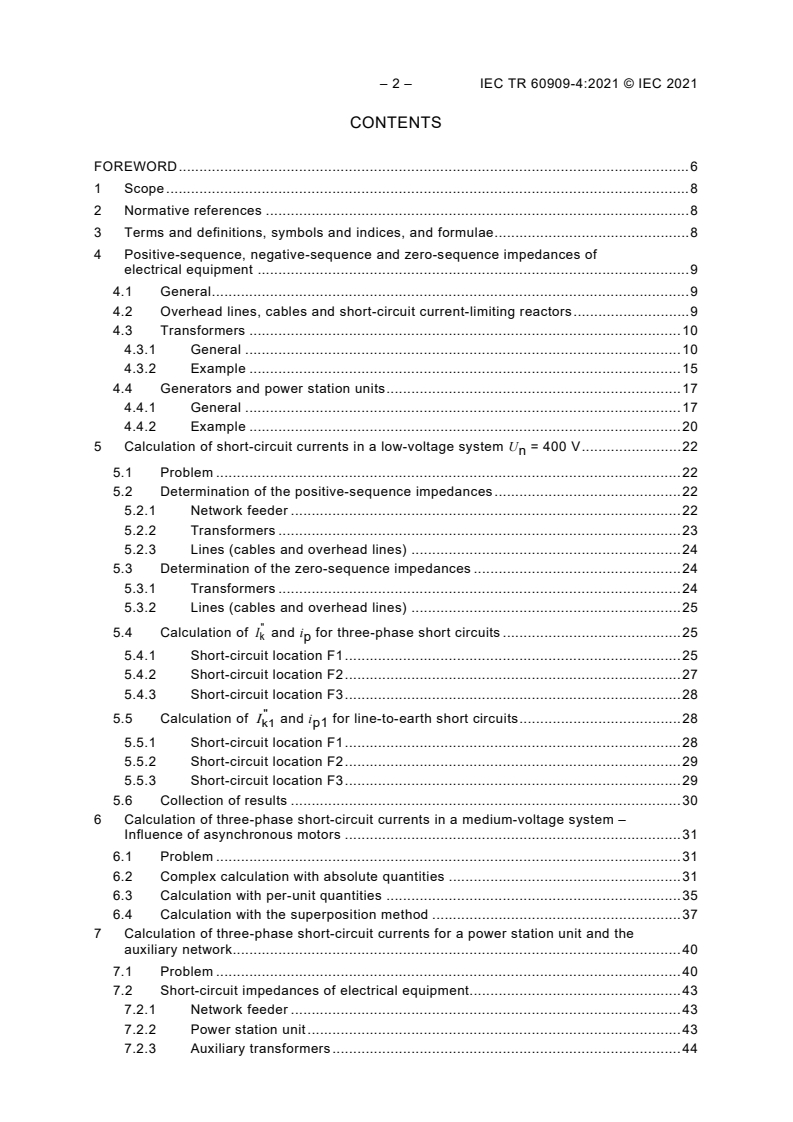
– 2 – IEC TR 60909-4:2021 © IEC 2021
CONTENTS
FOREWORD . 6
1 Scope . 8
2 Normative references . 8
3 Terms and definitions, symbols and indices, and formulae . 8
4 Positive-sequence, negative-sequence and zero-sequence impedances of
electrical equipment . 9
4.1 General . 9
4.2 Overhead lines, cables and short-circuit current-limiting reactors . 9
4.3 Transformers . 10
4.3.1 General . 10
4.3.2 Example . 15
4.4 Generators and power station units . 17
4.4.1 General . 17
4.4.2 Example . 20
5 Calculation of short-circuit currents in a low-voltage system U = 400 V . 22
n
5.1 Problem . 22
5.2 Determination of the positive-sequence impedances . 22
5.2.1 Network feeder . 22
5.2.2 Transformers . 23
5.2.3 Lines (cables and overhead lines) . 24
5.3 Determination of the zero-sequence impedances . 24
5.3.1 Transformers . 24
5.3.2 Lines (cables and overhead lines) . 25
"
5.4 Calculation of I and i for three-phase short circuits . 25
k p
5.4.1 Short-circuit location F1 . 25
5.4.2 Short-circuit location F2 . 27
5.4.3 Short-circuit location F3 . 28
"
5.5 Calculation of I and i for line-to-earth short circuits . 28
k1 p1
5.5.1 Short-circuit location F1 . 28
5.5.2 Short-circuit location F2 . 29
5.5.3 Short-circuit location F3 . 29
5.6 Collection of results . 30
6 Calculation of three-phase short-circuit currents in a medium-voltage system –
Influence of asynchronous motors . 31
6.1 Problem . 31
6.2 Complex calculation with absolute quantities . 31
6.3 Calculation with per-unit quantities . 35
6.4 Calculation with the superposition method . 37
7 Calculation of three-phase short-circuit currents for a power station unit and the
auxiliary network. 40
7.1 Problem . 40
7.2 Short-circuit impedances of electrical equipment. 43
7.2.1 Network feeder . 43
7.2.2 Power station unit . 43
7.2.3 Auxiliary transformers . 44
7.2.4 Low-voltage transformers 2,5 MVA and 1,6 MVA . 45
7.2.5 Asynchronous motors . 49
7.3 Calculation of short-circuit currents . 49
7.3.1 Short-circuit location F1 . 49
7.3.2 Short-circuit location F2 . 50
7.3.3 Short-circuit location F3 . 51
7.3.4 Short-circuit location F4 . 55
7.3.5 Short-circuit location F5 . 57
8 Calculation of three-phase short-circuit currents in a wind power plant . 59
8.1 General . 59
8.2 Problem . 59
8.3 Data and short-circuit impedances of electrical equipment . 60
8.4 Nodal admittance and nodal impedance matrices . 62
8.5 Short-circuit currents for the wind power plant with ten wind power station
units WD . 63
8.6 Short-circuit currents for the wind power plant with ten wind power station
units WF . 65
8.7 Short-circuit currents for the wind power plant with five wind power station
units WD and five wind power station units WF . 68
9 Test network for the calculation of short-circuit currents with digital programs in
accordance with IEC 60909-0 . 72
9.1 General . 72
9.2 High-voltage test network 380 kV/110 kV/30 kV/10 kV . 73
9.2.1 Network topology and data . 73
9.2.2 Short-circuit impedances of electrical equipment . 76
9.3 Results . 77
9.3.1 General . 77
9.3.2 Three-phase short-circuit currents . 78
9.3.3 Line-to-earth short-circuit currents . 78
Bibliography . 80
Figure 1 – Positive-sequence and zero-sequence impedances of an overhead line
(one circuit) and cable (cross-bonded) . 9
Figure 2 – Positive-sequence and zero-sequence impedance of a short-circuit current-
limiting reactor . 10
Figure 3 – Positive-sequence and zero-sequence system impedances of a two-
winding transformer YNd5 . 11
Figure 4 – Equivalent circuits of a three-winding network transformer . 15
Figure 5 – Short circuit at the high-voltage side of a power station unit with on-load
tap changer . 19
Figure 6 – Low-voltage system Un = 400 V with short-circuit locations F1, F2, F3 . 22
"
Figure 7 – Positive-sequence system (according to Figure 6) for the calculation of I
k
at the short-circuit location F1 . 26
Figure 8 – Positive-sequence, negative-sequence and zero-sequence system with
"
connections at the short-circuit location F1 for the calculation of I . 29
k1
Figure 9 – Medium-voltage network 33 kV/6 kV: data . 32
– 4 – IEC TR 60909-4:2021 © IEC 2021
"
Figure 10 – Short-circuit current I calculated by the superposition method (S)
k(T1,T2)S
"
compared with I calculated by the IEC method of equivalent voltage source
k(T1,T2)IEC
b b
at the short-circuit location, depending on the load S and the voltage U . 39
"
Figure 11 – Short-circuit current I calculated by the superposition method (S)
kS
"
compared with I calculated by the IEC method of equivalent voltage source at the
kIEC
short-circuit location, depending on the transformation ratio t before the short circuit . 40
Figure 12 – Power station unit (generator and unit transformer with on-load tap-
changer) and auxiliary network with medium- and low-voltage asynchronous
motors: data . 42
Figure 13 – Positive-sequence system for the calculation of the short-circuit currents
at the location F3 (see Figure 12) . 52
Figure 14 – Positive-sequence system for the calculation of the short-circuit currents
at the location F4 (see Figure 12) . 55
Figure 15 – Positive-sequence system for the calculation of the short-circuit currents
at the location F5 (see Figure 12) . 57
Figure 16 – Windfarm with ten wind power station units . 60
Figure 17 – Equivalent circuit diagram for the calculation of the short-circuit current at
the location F1 without the consideration of the internal wind power plant cables
(values are related to the 20 kV voltage level), variant 1 . 64
Figure 18 – Equivalent circuit diagram for the calculation of the short-circuit current at
the location F1 without the consideration of the internal wind power plant cables
(values are related to the 20 kV voltage level), variant 2 . 67
Figure 19 – Equivalent circuit diagram for the calculation of the short-circuit current at
the location F1 without the consideration of the internal wind power plant cables
(values are related to the 20 kV voltage level), variant 3 . 70
Figure 20 – High-voltage AC test network 380 kV/110 kV/30 kV/10 kV . 74
Table 1 – Examples for equivalent circuit-diagrams of transformers in the positive-
sequence and the zero-sequence system . 12
Table 2 – Approximations for the ratios X /X of two- and three-winding
(0)T T
transformers . 15
Table 3 – Data of electrical equipment for the example in Figure 6 – Positive-
sequence and zero-sequence impedances (Z = Z ) . 23
(2) (1)
Table 4 – Short-circuit impedances and short-circuit currents . 30
Table 5 – Joule integral depending on T at the short-circuit location F2 and F3 . 30
k
Table 6 – Calculation of the short-circuit impedances of electrical equipment and
Z at the short-circuit location F, without motors (circuit-breakers CB1 and CB2
k T1,T2
( )
are open) . 33
Table 7 – Calculation of the per-unit short-circuit reactances of electrical equipment
and *X at the short-circuit location F . 36
k(T1,T2)
Table 8 – Data of transformers 10 kV/0,73 kV and 10 kV/0,42 kV, data of low-voltage
motor groups and partial short-circuit currents of these motor groups on busbars B
and C respectively . 47
Table 9 – Data of medium-voltage asynchronous motors and their partial short-circuit
currents at short-circuit locations on busbars B and C respectively . 48
Table 10 – Data and impedances of the electrical equipment (see Figure 16) referred
to the 20 kV side . 61
Table 11 – The diagonal elements of the nodal admittance matrices for the three
variants in 1/Ω . 62
Table 12 – Short-circuit impedances and short-circuit currents at F1 to F14 for wind
power stations units with doubly fed asynchronous generators WD . 63
Table 13 – Short-circuit impedances and short-circuit currents at F1 to F3 for wind
power stations units with doubly fed asynchronous generators WD neglecting the
internal wind power plant cables . 64
Table 14 – Quotients Z /Z for i = 1 to 14 and j = 3…6, 8…10, 12…14 and the sum
ij kFi
of the columns . 66
Table 15 – Short-circuit impedances and short-circuit currents at F1 to F14 for wind
power stations units with full size converters WF . 66
Table 16 – Short-circuit impedances and short-circuit currents at F1 to F3 for wind
power stations units with full size converters WF neglecting the internal wind power
plant cables . 68
Table 17 – Quotients Z /Z for i = 1 to 14 and j = 3, 10, 12, 13, 14 and the sum of the
ij kFi
columns . 69
Table 18 –Short-circuit impedances and short-circuit currents at F1 to F14 for five
wind power stations units with doubly fed asynchronous generators WD and five wind
power station units with full size converters WF . 69
Table 19 – Short-circuit impedances and short-circuit currents at F1 to F3 for five wind
power stations units with doubly fed asynchronous generators WD and five wind power
station units with full size converters WF neglecting the internal wind power plant
cables . 71
Table 20 – Overhead lines and cables . 76
Table 21 – Impedances (corrected if necessary) of the electrical equipment (see
Figure 20) referred to the 110 kV side with Z = Z . 77
(2) (1)
"
Table 22 – Results I , i , I and I . 78
k p b k
"
I
Table 23 – Results and i . 79
k p1
– 6 – IEC TR 60909-4:2021 © IEC 2021
INTERNATIONAL ELECTROTECHNICAL COMMISSION
____________
SHORT-CIRCUIT CURRENTS IN THREE-PHASE AC SYSTEMS –
Part 4: Examples for the calculation of short-circuit currents
FOREWORD
1) The International Electrotechnical Commission (IEC) is a worldwide organization for standardization comprising
all national electrotechnical committees (IEC National Committees). The object of IEC is to promote international
co-operation on all questions concerning standardization in the electrical and electronic fields. To this end and
in addition to other activities, IEC publishes International Standards, Technical Specifications, Technical Reports,
Publicly Available Specifications (PAS) and Guides (hereafter referred to as “IEC Publication(s)”). Their
preparation is entrusted to technical committees; any IEC National Committee interested in the subject dealt with
may participate in this preparatory work. International, governmental and non-governmental organizations liaising
with the IEC also participate in this preparation. IEC collaborates closely with the International Organization for
Standardization (ISO) in accordance with conditions determined by agreement between the two organizations.
2) The formal decisions or agreements of IEC on technical matters express, as nearly as possible, an international
consensus of opinion on the relevant subjects since each technical committee has representation from all
interested IEC National Committees.
3) IEC Publications have the form of recommendations for international use and are accepted by IEC National
Committees in that sense. While all reasonable efforts are made to ensure that the technical content of IEC
Publications is accurate, IEC cannot be held responsible for the way in which they are used or for any
misinterpretation by any end user.
4) In order to promote international uniformity, IEC National Committees undertake to apply IEC Publications
transparently to the maximum extent possible in their national and regional publications. Any divergence between
any IEC Publication and the corresponding national or regional publication shall be clearly indicated in the latter.
5) IEC itself does not provide any attestation of conformity. Independent certification bodies provide conformity
assessment services and, in some areas, access to IEC marks of conformity. IEC is not responsible for any
services carried out by independent certification bodies.
6) All users should ensure that they have the latest edition of this publication.
7) No liability shall attach to IEC or its directors, employees, servants or agents including individual experts and
members of its technical committees and IEC National Committees for any personal injury, property damage or
other damage of any nature whatsoever, whether direct or indirect, or for costs (including legal fees) and
expenses arising out of the publication, use of, or reliance upon, this IEC Publication or any other IEC
Publications.
8) Attention is drawn to the Normative references cited in this publication. Use of the referenced publications is
indispensable for the correct application of this publication.
9) Attention is drawn to the possibility that some of the elements of this IEC Publication may be the subject of patent
rights. IEC shall not be held responsible for identifying any or all such patent rights.
IEC TR 60909-4 has been prepared by IEC technical committee 73: Short-circuit currents. It is
a Technical Report.
This second edition cancels and replaces the first edition published in 2000. This edition
constitutes a technical revision.
This edition includes the following significant technical changes with respect to the previous
edition:
a) adaption to IEC 60909-0:2016;
b) addition of an example for the calculation of short-circuit currents of wind power station
units;
c) correction of errors.
The text of this Technical Report is based on the following documents:
Draft Report on voting
73/187/DTR 73/193/RVDTR
Full information on the voting for its approval can be found in the report on voting indicated in
the above table.
The language used for the development of this Technical Report is English.
This document was drafted in accordance with ISO/IEC Directives, Part 2, and developed in
accordance with ISO/IEC Directives, Part 1 and ISO/IEC Directives, IEC Supplement, available
at www.iec.ch/members_experts/refdocs. The main document types developed by IEC are
described in greater detail at www.iec.ch/standardsdev/publications.
A list of all parts in the IEC 60909 series, published under the general title Short-circuit currents
in three-phase AC systems, can be found on the IEC website.
The committee has decided that the contents of this document will remain unchanged until the
stability date indicated on the IEC website under webstore.iec.ch in the data related to the
specific document. At this date, the document will be
• reconfirmed,
• withdrawn,
• replaced by a revised edition, or
• amended.
IMPORTANT – The 'colour inside' logo on the cover page of this publication indicates that it
contains colours which are considered to be useful for the correct understanding of its
contents. Users should therefore print this document using a colour printer.
– 8 – IEC TR 60909-4:2021 © IEC 2021
SHORT-CIRCUIT CURRENTS IN THREE-PHASE AC SYSTEMS –
Part 4: Examples for the calculation of short-circuit currents
1 Scope
This part of IEC 60909, which is a Technical Report, is intended to give help for the application
of IEC 60909-0 for the calculation of short-circuit currents in 50 Hz or 60 Hz three-phase AC
systems.
This document does not include additional requirements but gives support for the modelling of
electrical equipment in the positive-sequence, the negative-sequence and the zero-sequence
system (Clause 4), the practical execution of calculations in a low-voltage system (Clause 5),
a medium-voltage system with asynchronous motors (Clause 6) and a power station unit with
its auxiliary network feeding a large number of medium-voltage asynchronous motors and low-
voltage motor groups (Clause 7).
The three examples given in Clauses 5, 6 and 7 are similar to those given in IEC TR 60909-
4:2000 but they are revised in accordance with IEC 60909-0, which replaces it. The example
given in Clause 8 is new and mirrors the introduction of the new 6.8 of IEC 60909-0:2016.
Clause 9 gives the circuit diagram and the data of a test network and the results for a calculation
carried out in accordance with IEC 60909-0, to offer the possibility for a comparison between
the results found with a digital program for the calculation of short-circuit currents and the given
""
results for and i in a high-voltage network with power station units,
I ,,iI , I , I
k p k k1 p1
b
generators, asynchronous motors and lines in four different voltage levels 380 kV, 110 kV,
30 kV and 10 kV.
2 Normative references
IEC 60038:2009, IEC standard voltages
IEC 60909-0:2016, Short-circuit currents in three-phase a.c. systems – Part 0: Calculation of
currents
3 Terms and definitions, symbols and indices, and formulae
For the purposes of this document, the terms and definitions, symbols and indices, and formulae
given in IEC 60909-0 apply.
ISO and IEC maintain terminological databases for use in standardization at the following
addresses:
• IEC Electropedia: available at http://www.electropedia.org/
• ISO Online browsing platform: available at http://www.iso.org/obp
4 Positive-sequence, negative-sequence and zero-sequence impedances of
electrical equipment
4.1 General
In addition to Clause 6 of IEC 60909-0:2016, modelling and calculation of the positive-sequence
and the zero-sequence impedances of electrical equipment is given. In most cases, the
negative-sequence impedances are equal to the positive-sequence impedances when
calculating the initial symmetrical short-circuit currents, but see 6.6.1 of IEC 60909-0:2016 and
IEC TR 60909-2.
4.2 Overhead lines, cables and short-circuit current-limiting reactors
Figure 1 demonstrates the meaning and the principal measurement of the positive-sequence
[Figure 1 a)] and the zero-sequence [Figure 1 b)] impedances of lines with one circuit L1, L2,
L3.
a) Positive-sequence b) Zero-sequence
NOTE Positive-sequence:
Z UI//U I with UU++ U =0 and
UU U
L1 L2 L3
(1) L1 L1 (1) (1) L1 L2 L3
Zero-sequence:
II I I
Z UI//U I with UU U U and
(0) L1 L1 (0) (0) L1 L2 L3 (0) L1 L2 L3 (0)
Figure 1 – Positive-sequence and zero-sequence impedances
of an overhead line (one circuit) and cable (cross-bonded)
In practice, the measurement of voltage U and current I leads to the absolute value Z of the
L1 L1
impedance. Together with the measurement of the total loss P at the current I , it is possible
V L1
to find the complex value Z of the impedance:
U
P
L1
V
X ZR²²− ZR+ j X
Z=
R=
I
L1 3I
L1
Formulae for the calculation of the positive-sequence and the zero-sequence system
impedances of overhead lines with one or two parallel circuits (double circuit line) and without
or with one or two earth wires are given in IEC TR 60909-2. The negative-sequence impedance
is equal to the positive-sequence impedance assuming transposed lines and cross-bonded
cables, respectively. The measurements to find the positive-sequence and the zero-sequence
impedances of cables with sheath, shielding and armouring are similar to those given in Figure
1. Examples are given in IEC TR 60909-2. In the case of the zero-sequence impedance, the
earthing of the sheath or the shielding or the armouring is important as well as the number of
parallel cables. In the case of low-voltage four-core cables, the cross-section of the earthed
core has an influence on the zero-sequence impedance.
= =
=== ==
===
==
==
– 10 – IEC TR 60909-4:2021 © IEC 2021
Figure 2 demonstrates the meaning and the principal measurement of the positive-sequence
[Figure 2 a)] and the zero-sequence impedance [Figure 2 b)] of a three-phase AC short-circuit
current-limiting reactor.
a) Positive-sequence b) Zero-sequence
NOTE Positive-sequence:
Z UI//U I UU++ U =0 UU U
with and
L1 L2 L3
(1) L1 L1 (1) (1) L1 L2 L3
Zero-sequence:
II I I
Z UI//U I with UU U U and
(0) L1 L1 (0) (0) L1 L2 L3 (0) L1 L2 L3 (0)
Figure 2 – Positive-sequence and zero-sequence impedance
of a short-circuit current-limiting reactor
If the magnetic coupling between the three coils without or with iron core is small, the zero-
sequence impedance Z is approximately equal to the positive-sequence impedance Z .
(0) (1)
When calculating short-circuit currents in high-voltage systems, it is generally sufficient to use
the reactance only.
4.3 Transformers
4.3.1 General
Unit transformers of power station units are also dealt with in 4.4.
Network transformers have two, or three or even more three-phase windings. Figure 3 gives an
example for the positive-sequence [Figure 3 b)] and the zero-sequence system impedances
[Figure 3 c)] of a two-winding transformer with the vector group YNd5 [Figure 3 a)].
In the case of three-winding transformers (examples are given in Table 3 of IEC TR 60909-
2:2008), it is necessary to measure three different impedances and then to calculate the three
impedances of the equivalent circuit in the positive-sequence or the zero-sequence system of
the transformer (see 6.3.2 of IEC 60909-0:2016 and the example in 4.3.2 of this document).
Table 1 gives examples for the equivalent circuits in the positive-sequence and the zero-
sequence system of two- and three-winding transformers with different earthing conditions on
the HV- and the LV-side. The impedances of Table 1 are related to side A, which may be the
HV-side or the LV-side of the transformer.
=== ==
===
== ==
a) Two-winding transformer with the terminals 1U,1V,1W at the high-voltage side
and 2U,2V,2W at the low-voltage side
b) Positive-sequence and negative-sequence impedance Z = Z
(1) (2)
c) Zero-sequence impedance Z
(0)
a
In the case of a delta winding, it is not necessary to introduce the short circuit and the earth connection.
Figure 3 – Positive-sequence and zero-sequence system
impedances of a two-winding transformer YNd5
As shown in Table 2, transformers with the vector group Yy should not be used in low-voltage
systems with low-impedance earthing on the LV-side (TN-network), because Z may be very
(0)
high, so that short-circuit protection may fail. For feeding TN-networks, transformers of no. 2 or
3 in Table 1 should be used.
Transformers with the vector group YNyn,d are typical in high-voltage networks, with neutral
point earthing normally only on one side (A or B). The examples no. 4b and 6 of Table 1 show
that the zero-sequence system of both networks are coupled, if both the neutral points A and B
are earthed (earthing switch ES in case no. 4b closed). In these cases, additional considerations
are necessary, especially if the transformation ratio is high, to find out if this coupling is
admissible. Case no. 5 of Table 1 gives an example how to avoid this coupling in the zero-
sequence system. Case no. 9 of Table 1 gives a further example to avoid the coupling in the
zero-sequence system if two parallel transformers at the same place or at different places are
present.
– 12 – IEC TR 60909-4:2021 © IEC 2021
Table 1 – Examples for equivalent circuit-diagrams of transformers
in the positive-sequence and the zero-sequence system
No. Vector Transformer Positive-sequence Zero-sequence system
group system
1a YNy
a) b)
1b YNy
a) b)
2 Dyn
b)
a)
3 YNd
ZNy
a) b)
ZNd
4a YNdy
c)
d)
No. Vector Transformer Positive-sequence Zero-sequence system
group system
4b YNdyn
c)
e)
d)
5 YNdz
d)
c)
6 YNdyn
g)
f)
7 YNdzn
f)
g)
– 14 – IEC TR 60909-4:2021 © IEC 2021
No. Vector Transformer Positive-sequence Zero-sequence system
group system
8 YNa+d
g)
f)
9 YNdy
f)
h)
g)
Ydyn
a)
Z = K Z ; K from Formula (12a) or (12b) of IEC 60909-0:2016.
(1)K (1)
T T
b)
Z(0)K = K Z(0), K from Formula (12a) or (12b) of IEC 60909-0:2016; ZN without correction factor.
T T
c)
K , K , K from Formula (13) of IEC 60909-0:2016.
TAB TAC TBC
d)
Correction factors as indicated under 3); Z and X without correction factor.
N S
e)
Earthing switch.
f)
K , K , K from Formula (13) of IEC 60909-0:2016.
TAB TAC TBC
g)
Corrections factors as indicated under 3); Z without correction factor.
N
h)
Two parallel three-winding transformers with an earthing pattern to separate the zero-sequence
systems of the networks A and B.
In case no. 8 for auto-transformers with neutral point earthing Z ≠ ∞, three separate units and
N
an additional auxiliary winding in delta connection, the coupling between the zero-sequence
systems of the networks connected to both sides of the transformer cannot be avoided. To find
the impedances *Z , *Z and *Z as a function of Z ≠ ∞, special calculations are necessary as
1 2 3 N
given under case no. 6 in Table 1.
Booster transformers (or regulating transformers for voltage and/or phase-angle control) are
represented as network transformers with an equivalent generally of form no. 6 in Table 1. The
construction and connection arrangement of shunt transformers will determine whether Z
(0)C
has a finite low value and, in this case, it will be necessary to measure three different
impedances, as with three-winding transformers, in order to calculate the impedances of the
equivalent circuit.
Table 2 gives some approximations for the ratios X /X of transformers, if one neutral point
(0)T T
of the transformer is earthed. In the case of three-winding transformers (cases no. 4 to 7 and 9
of Table 1), the reactance X = X is given by X = X + X .
T (1)T (1)T (1)A (1)B
Table 2 – Approximations for the ratios X /X of two- and three-winding transformers
(0)T T
Construction of Vector group
transformers
c
YNd or Dyn Yzn YNynd YNy or YNz
a
Three cores 0,7.1,0 3.10
b
Five cores 1,0 0,1.0,15 1.3,5 10.100
Three single-core 1,0 10.100
transformers
a
Transformers with small apparent power: X /X ≈ 1,0 (for instance distribution transformers Dyn5 with S =
(0)T T rT
400 kVA, U /U = 10 kV/0,4 kV).
rTHV rTLV
b
The ratio X /X depends on the construction of the transformer, see IEC TR 60909-2.
(0)T T
c
Transformers Yy should not be used in networks with low impedance earthing, for instance in low-voltage TN-
networks (see IEC 60364-4-41).
4.3.2 Example
The following is an example for the impedances and equivalent circuits of a three-winding
network transformer YNynd5, S = 350 MVA.
rTHVMV
Figure 4 gives the equivalent circuits of a three-winding network transformer [Figure 4 a)] in the
positive-sequence [Figure 4b)] and the zero-sequence system [Figure 4c)]. The negative-
sequence system is equal to the positive-sequence system (see no. 4b in Table 1 with Z = 0).
N
a) Vector group and b) Positive-sequence system c) Zero-sequence system
terminals of the
transformer YNynd5
Figure 4 – Equivalent circuits of a three-winding network transformer
The following data are given from measurements:
U = 400 kV U = 120 kV U = 30 kV
rTHV rTMV rTLV
S = 350 MVA S = 350 MVA S = 50 MVA
rTHV rTMV rTLV
u = 21 %; u = 0,26 %; referred to S = 350 MVA U = 400 kV
krHVMV RrHVMV rTHVMV rTHV
u = 10 %; u = 0,16 % referred to S = 50 MVA U = 400 kV
krHVLV RrHVLV rTHVLV rTHV
u = 7 %; u = 0,16 % referred to S = 50 MVA U = 120 kV
krMVLV RrMVLV rTMVLV rTMV
– 16 – IEC TR 60909-4:2021 © IEC 2021
From Formula (10) of IEC 60909-0:2016, the following impedances of the positive-sequence
system are found, related to the MV-side B:
u uU
RrHVMV XrHVMV rTMV
Z=+ j =(0,106 971+ j8,639 338)Ω
AB
100 % 100 % S
rTHVMV
u uU
RrHVLV XrHVLV rTMV
Z=+ j =(0,460 800+ j28,796 313)Ω
AC
100 % 100 % S
rTHVLV
u uU
RrMVLV XrMVLV rTMV
Z=+ j =0,460 800+ j20,154 733 Ω
( )
BC
100 % 100 % S
rTMVLV
The calculations are carried out here with six-figure numbers following the decimal comma,
because this example is used also for the test network in Clause 9 (transformers T3 = T4).
With the rated relative reactances x found from the reactive short-circuit voltage
T
according to Formula (10d) and Table 1 of IEC 60909-0:2016, the following
u uu−
Xr kr Rr
impedance correction factors (Formula (13) of IEC 60909-0:2016) are found:
c 1,1
max
K 0,95 0,95 0,928 072
TAB
1+ 0,6 x 1+⋅0,6 0,209 984
TAB
c 1,1
max
K 0,95 0,95 0,985 856
TAC
1+ 0,6 x 1+⋅0,6 0,099 987
TAC
c 1,1
max
K 0,95 0,95 1,002 890
TBC
1+ 0,6 x 1+⋅0,6 0,069 982
TBC
Together with these correction factors, for instance Z = K Z , the following corrected
ABK TAB AB
impedances (index K) are found:
Z= 0,099 277+Ωj8,017 927
( )
ABK
Z=0,454 283+Ωj28,389 024
( )
ACK
Z=0,462 132+Ωj20,212 973
( )
BCK
The corrected equivalent positive-sequence impedances in Figure 4 b), related to the MV-side,
are calculated with Formulae (11a), (11b), (11c) of IEC 60909-0:2016.
Z= 0,045 714+Ωj8,096 989
( )
AK
Z= 0,053 563−Ωj0,079 062
( )
BK
===
===
===
=
Z=0,408 568+Ωj20,292 035
( )
CK
For the equivalent model of the transformer in the zero-sequence system [Figure 4 c)], the
following reactances are known, related to the medium-voltage side B:
X 8,555 1Ω X =−Ω0,688 1 X 18,830 71Ω
(0)A (0)B (0)C
If only the medium-voltage neutral point of the transformer is earthed, the effective zero-
sequence reactance is the sum of X and X leading to X when introducing the
(0)B (0)C (0)MVK
:
impedance correction factor K
TBC
X = K (X + X ) = 18,195 036 Ω
(0)MVK TBC (0)B (0)C
4.4 Generators and power station units
4.4.1 General
For synchronous generators without unit transformers in low- and medium-voltage networks,
" '
X
the positive-sequence reactances are X , X and (see IEC TR 60909-2). In the first
d
d d
" "
moment of short circuit, the subtransient reactance X leads to I .
d k
""
In this case XX≈ and therefore the reactance of the negative-sequence system is
qd
" "
approximately equal to the subtransient reactance: X ≈ X . If X is considerably different
(2) d q
" ""
from X , then X 0,5 XX+ should be used (see Formula (19) of IEC 60909-0:2016).
d (2) ( d q)
The zero-sequence reactance X is smaller than the subtransient reactance and depends on
(0)
the winding configuration of the synchronous machine (see 2.2 of IEC TR 60909-2:2008). If the
neutral point of the generator is earthed by an additional impedance (preferably a reactance
" "
between neutral point and earth to limit the line-to-earth short-circuit current II≤ and/or to
k1 k
suppress third-order currents in the case of generators in parallel to transformers with neutral
points, which are earthed in the same part of the network), the impedance correction factor K
G
shall be used in the positive-sequence, the negative-sequence, and the zero-sequence system.
But K shall not be used for the additional neutral point impedance (see 6.6.1 of
G
IEC 60909-0:2016).
The zero-sequence impedance [Figure 5 c)] at the high-voltage side of the power station unit is
given by the zero-sequence impedance of the unit transformer and the threefold value of the
impedance Z between the neutral point of the transformer (HV-side) and earth, in the case of
N
a power station unit (S) with on-load tap changer [Figure 5 a)] (see 6.7.1 of IEC 60909-0:2016)
or without on-load tap changer (see 6.7.2 of IEC 60909-0:2016). The positive-sequence and
the negative-sequence impedance [Figure 5 b)] of the power station unit shall be calculated
with Formula (21) or Formula (23) of IEC 60909-0:2016 together with the impedance correction
factor K from Formula (22) or K from Formula (24) of IEC 60909-0:2016. The zero-sequence
S SO
impedance of the power station unit is found with Z = K ·Z + 3Z , respectively
(0)SK S (0)THV N
Z = K ·Z + 3Z .
(0)SOK SO (0)THV N
The impedance correction factor shall be used as follows:
a) for the positive-sequence impedance:
=
= =
– 18 – IEC TR 60909-4:2021 © IEC 2021
2" 2"
Z = K⋅⋅tR+ j X+ Z Z K⋅⋅tR+ j X+ Z
Sr ( G d) SO r ( G d)
SK THV SOK THV
d) for the negative-sequence impedance:
2 2
Z = K⋅⋅tR+ j X + Z Z K⋅⋅tR+ j X
...