

IEC 60079-29-3:2014
(Main)Explosive atmospheres - Part 29-3: Gas detectors - Guidance on functional safety of fixed gas detection systems
General Information
- Abstract
IEC 60079-29-3:2014 gives guidance for the design and implementation of a fixed gas detection system, including associated and/or peripheral gas detection equipment, for the detection of flammable gases/vapours and oxygen when used in a safety-related application in accordance with IEC 61508 and IEC 61511. This International standard also applies to the detection of toxic gases. Other parts of this international standard and pertinent local, national and international standards separately specify the performance requirements of a gas detector and a gas detection control unit (logic solver). These standards are commonly known as Metrological Performance Standards and are concerned with the accuracy of the measured value, the overall system performance, but not the device or system integrity with respect to the safety function. This international standard applies to the integrity of the safety function. Keywords: fixed gas detection system, flammable gases/vapours and Oxygen, detection of toxic gases
This publication is to be read in conjunction with IEC 60079-0:2011, IEC 60079-29-1:2007, IEC 60079-29-2:2007 and IEC 60079-29-4:2009
- Status
- Published
- Publication Date
- 26-Mar-2014
- Technical Committee
- TC 31 - Equipment for explosive atmospheres
- Drafting Committee
- MT 60079-29 - TC 31/MT 60079-29
- Current Stage
- PPUB - Publication issued
- Start Date
- 27-Mar-2014
- Completion Date
- 30-Apr-2014
Overview
IEC 60079-29-3:2014 is an international standard published by the International Electrotechnical Commission (IEC) that provides comprehensive guidance on the functional safety of fixed gas detection systems used in explosive atmospheres. This standard addresses the design, implementation, and integrity of gas detection systems that monitor flammable gases, vapours, oxygen, and toxic gases in safety-related applications. It aligns with the functional safety standards IEC 61508 and IEC 61511, emphasizing system integrity rather than just metrological performance.
The document is essential for ensuring the reliable operation and safety of fixed gas detection systems in hazardous industrial environments, such as chemical plants, oil and gas facilities, and manufacturing sectors. It complements other standards focused on performance and accuracy, offering a holistic approach to gas detection system safety management.
Key Topics
Functional Safety Management
IEC 60079-29-3 outlines requirements for managing functional safety throughout the lifecycle of gas detection systems, including competence requirements, planning, validation, and ongoing maintenance.Unique Features of Gas Detection Systems
The standard highlights gas detection-specific issues such as sensor location, sensor poisoning, cross-sensitivities, and the impact of chemical reactions on sensor performance.System Requirements and Architecture
It specifies general safety requirements for gas detectors, control units (logic solvers), and final elements (actuators), covering behaviour under failure conditions, power supply considerations, and system architecture including Probability of Failure on Demand (PFD) and Probability of Dangerous Failure per Hour (PFH).Gas Sampling and Calibration
Guidance includes the implementation of gas sampling methods such as diffusion and multiplexer sampling, as well as requirements for automatic calibration and adjustment systems to maintain sensor accuracy and reliability.Testing, Installation, and Validation
The standard defines procedures for factory acceptance testing, site installation, commissioning, system validation, and ongoing operation and maintenance to ensure compliance with safety objectives.Documentation and System Modifications
Detailed documentation practices and processes to handle system modifications and decommissioning are provided to maintain traceability and safety integrity.
Applications
IEC 60079-29-3 is applicable in any industry or environment that requires fixed gas detection systems for safety assurance, including but not limited to:
Oil and Gas Industry
Detection of flammable hydrocarbons and oxygen depletion in refineries, offshore platforms, and pipelines.Chemical and Petrochemical Plants
Monitoring toxic gases and flammable vapours to prevent explosions and occupational hazards.Mining Operations
Ensuring the detection of explosive gases in underground mines.Manufacturing Facilities
Protection against toxic emissions and flammable gases in processing and storage areas.Environmental Safety
Fixed gas detectors for measuring emissions and controlling safety risks related to hazardous gases.
Related Standards
To implement a comprehensive and compliant gas detection system, IEC 60079-29-3:2014 should be used in conjunction with several complementary IEC standards:
IEC 61508 and IEC 61511 – Functional safety standards covering safety instrumented systems and lifecycle management.
IEC 60079-0:2011 – General requirements for equipment used in explosive atmospheres.
IEC 60079-29-1:2007 – Performance requirements for flammable gas detectors.
IEC 60079-29-2:2007 – Particular requirements for toxic gas detectors.
IEC 60079-29-4:2009 – Gas and vapour detectors for oxygen.
These related standards provide detailed technical specifications, performance criteria, and safety operational guidelines complementing the functional safety focus of IEC 60079-29-3.
Keywords: fixed gas detection system, functional safety, flammable gases, toxic gas detection, gas detection control unit, safety integrity, IEC 60079-29-3, hazardous environments, explosion protection, sensor calibration, gas sampling, safety instrumented system (SIS).
Relations
- Effective Date
- 09-Feb-2026
- Effective Date
- 09-Feb-2026
Get Certified
Connect with accredited certification bodies for this standard

IMQ S.p.A. (Certification)
Italian electrical product certification.

SLG Prüf- und Zertifizierungs GmbH
German testing and certification body.

UL Solutions
Global safety science company with testing, inspection and certification.
Sponsored listings
Frequently Asked Questions
IEC 60079-29-3:2014 is a standard published by the International Electrotechnical Commission (IEC). Its full title is "Explosive atmospheres - Part 29-3: Gas detectors - Guidance on functional safety of fixed gas detection systems". This standard covers: IEC 60079-29-3:2014 gives guidance for the design and implementation of a fixed gas detection system, including associated and/or peripheral gas detection equipment, for the detection of flammable gases/vapours and oxygen when used in a safety-related application in accordance with IEC 61508 and IEC 61511. This International standard also applies to the detection of toxic gases. Other parts of this international standard and pertinent local, national and international standards separately specify the performance requirements of a gas detector and a gas detection control unit (logic solver). These standards are commonly known as Metrological Performance Standards and are concerned with the accuracy of the measured value, the overall system performance, but not the device or system integrity with respect to the safety function. This international standard applies to the integrity of the safety function. Keywords: fixed gas detection system, flammable gases/vapours and Oxygen, detection of toxic gases This publication is to be read in conjunction with IEC 60079-0:2011, IEC 60079-29-1:2007, IEC 60079-29-2:2007 and IEC 60079-29-4:2009
IEC 60079-29-3:2014 gives guidance for the design and implementation of a fixed gas detection system, including associated and/or peripheral gas detection equipment, for the detection of flammable gases/vapours and oxygen when used in a safety-related application in accordance with IEC 61508 and IEC 61511. This International standard also applies to the detection of toxic gases. Other parts of this international standard and pertinent local, national and international standards separately specify the performance requirements of a gas detector and a gas detection control unit (logic solver). These standards are commonly known as Metrological Performance Standards and are concerned with the accuracy of the measured value, the overall system performance, but not the device or system integrity with respect to the safety function. This international standard applies to the integrity of the safety function. Keywords: fixed gas detection system, flammable gases/vapours and Oxygen, detection of toxic gases This publication is to be read in conjunction with IEC 60079-0:2011, IEC 60079-29-1:2007, IEC 60079-29-2:2007 and IEC 60079-29-4:2009
IEC 60079-29-3:2014 is classified under the following ICS (International Classification for Standards) categories: 29.260.20 - Electrical apparatus for explosive atmospheres. The ICS classification helps identify the subject area and facilitates finding related standards.
IEC 60079-29-3:2014 has the following relationships with other standards: It is inter standard links to EN ISO 16315:2016, EN ISO 20257-1:2020. Understanding these relationships helps ensure you are using the most current and applicable version of the standard.
IEC 60079-29-3:2014 is available in PDF format for immediate download after purchase. The document can be added to your cart and obtained through the secure checkout process. Digital delivery ensures instant access to the complete standard document.
Standards Content (Sample)
IEC 60079-29-3 ®
Edition 1.0 2014-03
INTERNATIONAL
STANDARD
NORME
INTERNATIONALE
colour
inside
Explosive atmospheres –
Part 29-3: Gas detectors – Guidance on functional safety of fixed gas detection
systems
Atmosphères explosives –
Partie 29-3: Détecteurs de gaz – Recommandations relatives à la sécurité
fonctionnelle des systèmes fixes de détection de gaz
All rights reserved. Unless otherwise specified, no part of this publication may be reproduced or utilized in any form
or by any means, electronic or mechanical, including photocopying and microfilm, without permission in writing from
either IEC or IEC's member National Committee in the country of the requester. If you have any questions about IEC
copyright or have an enquiry about obtaining additional rights to this publication, please contact the address below or
your local IEC member National Committee for further information.
Droits de reproduction réservés. Sauf indication contraire, aucune partie de cette publication ne peut être reproduite
ni utilisée sous quelque forme que ce soit et par aucun procédé, électronique ou mécanique, y compris la photocopie
et les microfilms, sans l'accord écrit de l'IEC ou du Comité national de l'IEC du pays du demandeur. Si vous avez des
questions sur le copyright de l'IEC ou si vous désirez obtenir des droits supplémentaires sur cette publication, utilisez
les coordonnées ci-après ou contactez le Comité national de l'IEC de votre pays de résidence.
IEC Central Office Tel.: +41 22 919 02 11
3, rue de Varembé Fax: +41 22 919 03 00
CH-1211 Geneva 20 info@iec.ch
Switzerland www.iec.ch
About the IEC
The International Electrotechnical Commission (IEC) is the leading global organization that prepares and publishes
International Standards for all electrical, electronic and related technologies.
About IEC publications
The technical content of IEC publications is kept under constant review by the IEC. Please make sure that you have the
latest edition, a corrigenda or an amendment might have been published.
IEC Catalogue - webstore.iec.ch/catalogue Electropedia - www.electropedia.org
The stand-alone application for consulting the entire The world's leading online dictionary of electronic and
bibliographical information on IEC International Standards, electrical terms containing more than 30 000 terms and
Technical Specifications, Technical Reports and other definitions in English and French, with equivalent terms in 14
documents. Available for PC, Mac OS, Android Tablets and additional languages. Also known as the International
iPad. Electrotechnical Vocabulary (IEV) online.
IEC publications search - www.iec.ch/searchpub IEC Glossary - std.iec.ch/glossary
The advanced search enables to find IEC publications by a More than 55 000 electrotechnical terminology entries in
variety of criteria (reference number, text, technical English and French extracted from the Terms and Definitions
committee,…). It also gives information on projects, replaced clause of IEC publications issued since 2002. Some entries
and withdrawn publications. have been collected from earlier publications of IEC TC 37,
77, 86 and CISPR.
IEC Just Published - webstore.iec.ch/justpublished
Stay up to date on all new IEC publications. Just Published IEC Customer Service Centre - webstore.iec.ch/csc
details all new publications released. Available online and If you wish to give us your feedback on this publication or
also once a month by email. need further assistance, please contact the Customer Service
Centre: csc@iec.ch.
A propos de l'IEC
La Commission Electrotechnique Internationale (IEC) est la première organisation mondiale qui élabore et publie des
Normes internationales pour tout ce qui a trait à l'électricité, à l'électronique et aux technologies apparentées.
A propos des publications IEC
Le contenu technique des publications IEC est constamment revu. Veuillez vous assurer que vous possédez l’édition la
plus récente, un corrigendum ou amendement peut avoir été publié.
Catalogue IEC - webstore.iec.ch/catalogue Electropedia - www.electropedia.org
Application autonome pour consulter tous les renseignements
Le premier dictionnaire en ligne de termes électroniques et
bibliographiques sur les Normes internationales,
électriques. Il contient plus de 30 000 termes et définitions en
Spécifications techniques, Rapports techniques et autres
anglais et en français, ainsi que les termes équivalents dans
documents de l'IEC. Disponible pour PC, Mac OS, tablettes
14 langues additionnelles. Egalement appelé Vocabulaire
Android et iPad.
Electrotechnique International (IEV) en ligne.
Recherche de publications IEC - www.iec.ch/searchpub
Glossaire IEC - std.iec.ch/glossary
Plus de 55 000 entrées terminologiques électrotechniques, en
La recherche avancée permet de trouver des publications IEC
en utilisant différents critères (numéro de référence, texte, anglais et en français, extraites des articles Termes et
comité d’études,…). Elle donne aussi des informations sur les Définitions des publications IEC parues depuis 2002. Plus
projets et les publications remplacées ou retirées. certaines entrées antérieures extraites des publications des
CE 37, 77, 86 et CISPR de l'IEC.
IEC Just Published - webstore.iec.ch/justpublished
Service Clients - webstore.iec.ch/csc
Restez informé sur les nouvelles publications IEC. Just
Published détaille les nouvelles publications parues. Si vous désirez nous donner des commentaires sur cette
Disponible en ligne et aussi une fois par mois par email. publication ou si vous avez des questions contactez-nous:
csc@iec.ch.
IEC 60079-29-3 ®
Edition 1.0 2014-03
INTERNATIONAL
STANDARD
NORME
INTERNATIONALE
colour
inside
Explosive atmospheres –
Part 29-3: Gas detectors – Guidance on functional safety of fixed gas detection
systems
Atmosphères explosives –
Partie 29-3: Détecteurs de gaz – Recommandations relatives à la sécurité
fonctionnelle des systèmes fixes de détection de gaz
INTERNATIONAL
ELECTROTECHNICAL
COMMISSION
COMMISSION
ELECTROTECHNIQUE
PRICE CODE
INTERNATIONALE
CODE PRIX X
ICS 29.260.20 ISBN 978-2-8322-1496-1
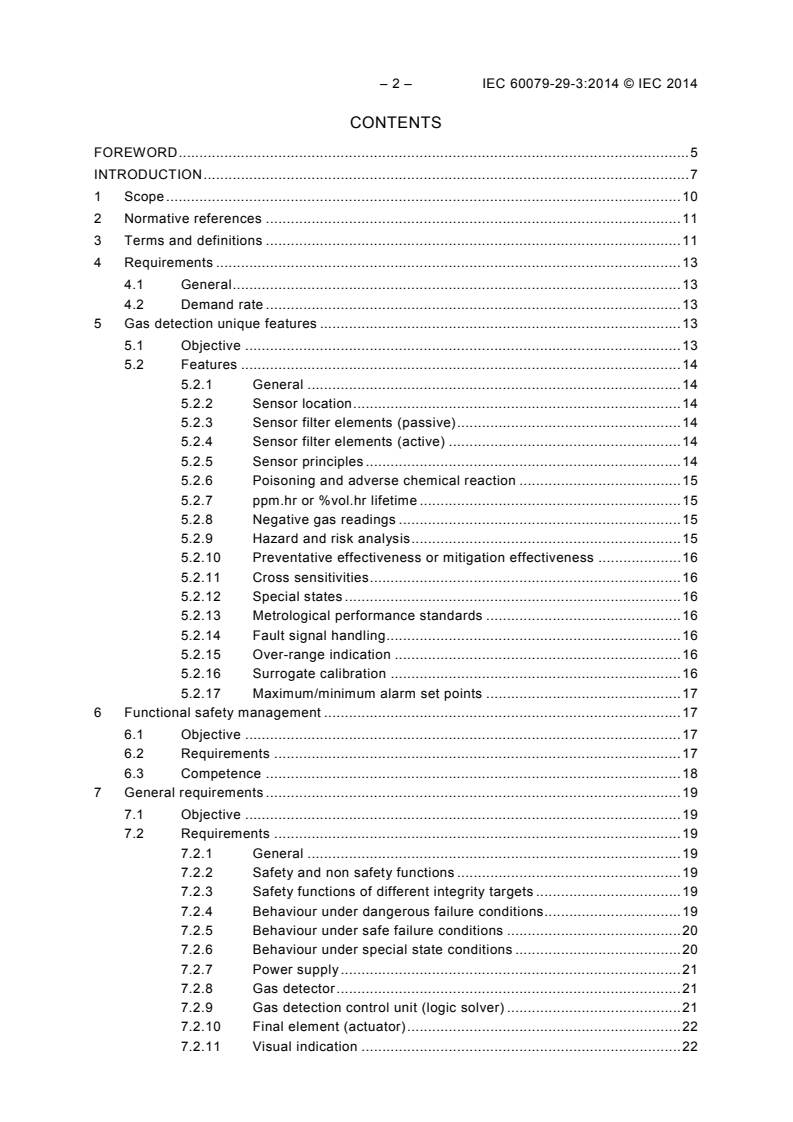
– 2 – IEC 60079-29-3:2014 © IEC 2014
CONTENTS
FOREWORD . 5
INTRODUCTION . 7
1 Scope . 10
2 Normative references . 11
3 Terms and definitions . 11
4 Requirements . 13
4.1 General . 13
4.2 Demand rate . 13
5 Gas detection unique features . 13
5.1 Objective . 13
5.2 Features . 14
5.2.1 General . 14
5.2.2 Sensor location . 14
5.2.3 Sensor filter elements (passive) . 14
5.2.4 Sensor filter elements (active) . 14
5.2.5 Sensor principles . 14
5.2.6 Poisoning and adverse chemical reaction . 15
5.2.7 ppm.hr or %vol.hr lifetime . 15
5.2.8 Negative gas readings . 15
5.2.9 Hazard and risk analysis . 15
5.2.10 Preventative effectiveness or mitigation effectiveness . 16
5.2.11 Cross sensitivities . 16
5.2.12 Special states . 16
5.2.13 Metrological performance standards . 16
5.2.14 Fault signal handling . 16
5.2.15 Over-range indication . 16
5.2.16 Surrogate calibration . 16
5.2.17 Maximum/minimum alarm set points . 17
6 Functional safety management . 17
6.1 Objective . 17
6.2 Requirements . 17
6.3 Competence . 18
7 General requirements . 19
7.1 Objective . 19
7.2 Requirements . 19
7.2.1 General . 19
7.2.2 Safety and non safety functions . 19
7.2.3 Safety functions of different integrity targets . 19
7.2.4 Behaviour under dangerous failure conditions. 19
7.2.5 Behaviour under safe failure conditions . 20
7.2.6 Behaviour under special state conditions . 20
7.2.7 Power supply . 21
7.2.8 Gas detector . 21
7.2.9 Gas detection control unit (logic solver) . 21
7.2.10 Final element (actuator) . 22
7.2.11 Visual indication . 22
7.2.12 Switching outputs . 22
7.2.13 Protocol outputs . 24
7.2.14 Protocol inputs . 24
7.2.15 System architecture, PFD and PFH values . 24
8 Gas detection unique requirements . 24
8.1 Objectives . 24
8.2 Requirements . 25
8.2.1 Introduction to gas sampling . 25
8.2.2 Gas sampling. 25
8.2.3 Gas multiplexer . 26
8.2.4 Gas multiplexer control system . 27
8.2.5 Conditioning of measured gas . 27
8.2.6 Gas sampling by diffusion mode . 28
8.2.7 Automatic calibration and adjustment. 28
8.2.8 Automatic calibration and adjustment control system . 29
9 Alternative control units (logic solvers) . 30
9.1 Objectives . 30
9.2 Requirements . 30
9.2.1 Performance (metrological) . 30
9.2.2 Programming of logic . 30
10 Factory acceptance testing . 30
10.1 Objectives . 30
10.2 Requirements . 30
10.2.1 Planning . 30
10.2.2 Execution . 31
11 Installation and commissioning . 31
11.1 Objectives . 31
11.2 Requirements . 32
11.2.1 Planning . 32
11.2.2 Execution . 32
12 System validation . 33
12.1 Objectives . 33
12.2 Requirements . 33
12.2.1 Planning . 33
12.2.2 Execution . 33
13 Operation and maintenance . 34
13.1 Objectives . 34
13.2 Requirements . 34
13.2.1 Planning . 34
13.2.2 Execution . 34
14 System modification . 35
14.1 Objectives . 35
14.2 Requirements . 35
14.2.1 Planning . 35
14.2.2 Execution . 35
15 System decommissioning . 36
15.1 Objectives . 36
15.2 Requirements . 36
– 4 – IEC 60079-29-3:2014 © IEC 2014
15.2.1 Planning . 36
15.2.2 Execution . 36
16 Documentation . 37
16.1 Objectives . 37
16.2 Requirements . 37
Annex A (informative) Typical Applications . 38
A.1 Typical diffusion applications . 39
A.1.1 Application 1 . 39
A.1.2 Application 2 . 40
A.1.3 Application 3 . 40
A.1.4 Application 4 . 40
A.2 Typical sampling applications . 41
A.2.1 Point to Point sampling . 41
A.2.2 Multi-stream sampling . 42
Annex B (informative) Cross references between standards. 43
Annex C (informative) Transformation of requirements . 44
C.1 General . 44
C.2 SIL capability 1 . 44
C.2.1 Characteristic . 44
C.2.2 Transformation . 44
C.3 SIL capability 2 . 44
C.3.1 Characteristic . 44
C.3.2 Transformation . 45
C.4 SIL capability 3 . 45
C.4.1 Characteristic . 45
C.4.2 Transformation . 45
Bibliography . 46
Figure 1 – Gas Detection System Architecture . 8
Figure 2 − Related Safety Instrumented System Standards . 10
Figure A.1 – Gas detection safety loops . 39
Figure A.2 – Typical gas detector aspiration configurations . 41
Figure B.1 – Cross references between standards . 43
Table 1 – Typical Job Descriptions and Most Relevant Clauses . 9
Table 2 – Demand for Functional Safety Management (see IEC 61508-1) . 18
INTERNATIONAL ELECTROTECHNICAL COMMISSION
____________
EXPLOSIVE ATMOSPHERES –
Part 29-3: Gas detectors – Guidance on
functional safety of fixed gas detection systems
FOREWORD
1) The International Electrotechnical Commission (IEC) is a worldwide organization for standardization comprising
all national electrotechnical committees (IEC National Committees). The object of IEC is to promote
international co-operation on all questions concerning standardization in the electrical and electronic fields. To
this end and in addition to other activities, IEC publishes International Standards, Technical Specifications,
Technical Reports, Publicly Available Specifications (PAS) and Guides (hereafter referred to as “IEC
Publication(s)”). Their preparation is entrusted to technical committees; any IEC National Committee interested
in the subject dealt with may participate in this preparatory work. International, governmental and non-
governmental organizations liaising with the IEC also participate in this preparation. IEC collaborates closely
with the International Organization for Standardization (ISO) in accordance with conditions determined by
agreement between the two organizations.
2) The formal decisions or agreements of IEC on technical matters express, as nearly as possible, an international
consensus of opinion on the relevant subjects since each technical committee has representation from all
interested IEC National Committees.
3) IEC Publications have the form of recommendations for international use and are accepted by IEC National
Committees in that sense. While all reasonable efforts are made to ensure that the technical content of IEC
Publications is accurate, IEC cannot be held responsible for the way in which they are used or for any
misinterpretation by any end user.
4) In order to promote international uniformity, IEC National Committees undertake to apply IEC Publications
transparently to the maximum extent possible in their national and regional publications. Any divergence
between any IEC Publication and the corresponding national or regional publication shall be clearly indicated in
the latter.
5) IEC itself does not provide any attestation of conformity. Independent certification bodies provide conformity
assessment services and, in some areas, access to IEC marks of conformity. IEC is not responsible for any
services carried out by independent certification bodies.
6) All users should ensure that they have the latest edition of this publication.
7) No liability shall attach to IEC or its directors, employees, servants or agents including individual experts and
members of its technical committees and IEC National Committees for any personal injury, property damage or
other damage of any nature whatsoever, whether direct or indirect, or for costs (including legal fees) and
expenses arising out of the publication, use of, or reliance upon, this IEC Publication or any other IEC
Publications.
8) Attention is drawn to the Normative references cited in this publication. Use of the referenced publications is
indispensable for the correct application of this publication.
9) Attention is drawn to the possibility that some of the elements of this IEC Publication may be the subject of
patent rights. IEC shall not be held responsible for identifying any or all such patent rights.
International Standard IEC 60079-29-3 has been prepared by IEC technical committee 31:
Equipment for explosive atmospheres.
This part of IEC 60079-29 is to be used in conjunction with the following standards:
– IEC 60079-0, Explosive atmospheres – Part 0: Equipment – General requirements
– IEC 60079-29-1, Explosive atmospheres – Part 29-1: Gas detectors – Performance
requirements of detectors for flammable gases
– IEC 60079-29-2, Explosive atmospheres – Part 29-2: Gas detectors – Selection,
installation, use and maintenance of detectors for flammable gases and oxygen
– IEC 60079-29-4, Explosive atmospheres – Part 29-4: Gas detectors – Performance
requirements of open path detectors for flammable gases
– 6 – IEC 60079-29-3:2014 © IEC 2014
The text of this standard is based on the following documents:
FDIS Report on voting
31/1105A/FDIS 31/1117/RVD
Full information on the voting for the approval of this standard can be found in the report on
voting indicated in the above table.
This publication has been drafted in accordance with the ISO/IEC Directives, Part 2.
A list of all parts of the IEC 60079 series, under the general title: Explosive atmospheres, can
be found on the IEC website.
The committee has decided that the contents of this publication will remain unchanged until
the stability date indicated on the IEC web site under "http://webstore.iec.ch" in the data
related to the specific publication. At this date, the publication will be
• reconfirmed,
• withdrawn,
• replaced by a revised edition, or
• amended.
IMPORTANT – The 'colour inside' logo on the cover page of this publication indicates
that it contains colours which are considered to be useful for the correct
understanding of its contents. Users should therefore print this document using a
colour printer.
INTRODUCTION
Fixed gas detection systems have been used for many years to perform safety instrumented
functions. Like any instrumented system, a fixed gas detection system commonly comprises
of a single or multiple gas detector input(s), a control unit and a single or multiple final
element(s) or output(s). Additional peripheral equipment may be incorporated into a fixed gas
detection system e.g. a gas sampling system or a gas conditioning system. If a fixed gas
detection system, including any relevant peripheral equipment is to be effectively used for
safety instrumented functions, it is essential that the total system achieves certain minimum
standards and performance levels.
It is important to understand that the number of sensing points and their appropriate location,
their redundancy, the management of regular maintenance, specifically response checking or
calibration, and other gas detection specific features (such as design of gas sampling
systems) are all likely to have a far greater effect on the integrity of the overall Safety
Instrumented System (SIS) than the required Safety Integrity Level (SIL) or SIL-capability of
any of the individual functional units. This, however, does not exclude the requirement for
each Safety Instrumented Function (SIF) to have a stand-alone functional integrity.
This international standard addresses the minimum standards and performance levels of a
fixed gas detection system which is based on the use of electrical, electronic or
programmable electronic systems (E/E/PES) for any application where there is either a risk
reduction target stated or if the gas detection system is used as an additional safe guarding
system.
This international standard does not apply to portable gas detectors or fixed gas detection
systems when there is no risk reduction target stated. However, this standard could be used
as a best practice document for such devices or systems.
The expression ‘gas detection system’ within this international standard is generic and applies
to standalone fixed gas detectors, which might have their own internal alarm trip levels and
switching outputs up to complex standalone fixed gas detection systems (Annex A – Typical
Applications).
This international standard takes into consideration the possible complexity of the supply
chain which a gas detection manufacturer, seller or system integrator might encounter which
includes, but is not limited to:
• the use of standalone gas detectors which are integrated into an overall safety system by
a gas detection equipment manufacturer, seller or system integrator (or equivalent)
• the design and use of fixed gas detection sub-systems, including any associated and/or
peripheral gas detection equipment which are integrated into an overall safety system by a
gas detection equipment manufacturer, seller or system integrator (or equivalent)
• the design and use of a complete fixed gas detection system, including associated and/or
peripheral gas detection equipment which is the overall safety system
NOTE 1 IEC 61508 Parts 1, 2 and 3 cover the design of the stand-alone gas detector, control unit or final
element. Guidance on the design of peripheral equipment is included within this international standard.
Before this international standard can be applied, it is important to understand and categorise
the application of the fixed gas detection system. The three main applications are:
• as a prevention system – the total system or an individual instrumented control loop has a
safety function and safety integrity clearly defined.
• as a mitigation system – the total system or an individual instrumented control loop has a
safety function and safety integrity clearly defined.
• as an additional safe guarding system – this covers those fixed gas detection systems or
individual instrumented control loops which operate in parallel (secondary) to an
– 8 – IEC 60079-29-3:2014 © IEC 2014
instrumented safety system, where the demand on the fixed gas detection system or
individual instrumented control loop is only when the primary instrumented safety system
fails or another layer of protection fails.
Under no circumstances should the use of an additional safeguarding gas detection system
contribute to the Hardware Fault Tolerance (HFT) declaration for the instrumented safety
system.
A fixed gas detection system, as shown in Figure 1, may operate several times per year
subject to the application, therefore this international standard accepts that the demand rate
associated with ‘on demand’ (low demand) should be specified in the safety requirements
(e.g. a reference could be “> 1/yr but <10/yr”).
IEC 1059/14
Figure 1 – Gas Detection System Architecture
To assist with the possible complexity and unique requirements associated with fixed gas
detection systems, a fixed gas detection system may be broken down into functional units.
Each functional unit can vary in complexity; a functional unit may be a simple gas detector or
a combination of components which form peripheral equipment. Each functional unit is
independently assessed against this international standard and/or IEC 61508 during the initial
design phase of the functional unit, thus allowing safety data to be contributed to a functional
unit.
NOTE 2 Basic elements of a sub-system/system (e.g. a gas detector, logic controller/solver, etc.) are designed as
a product in compliance with IEC 61508 Parts 1, 2 and 3.
Each functional unit is then assembled in line with this international standard to deliver a
complete fixed gas detection system. It is not necessary to re-assess individual functional
units when they are used in a different configuration – it is only necessary to evaluate the
combination of functional units.
This international standard is based on the safety lifecycle model detailed in IEC 61508, but
adds additional and supportive information to assist with particular phases of this typical
safety lifecycle.
This international standard specifies those requirements under ‘Functional Safety
Management’ which all persons or companies who are involved in the supply chain of a fixed
gas detection system should comply with.
NOTE 3 Functional Safety Management applies to all stages of the safety lifecycle irrespective of the product,
subsystem, system supply or service being supplied.
For this document, the SIL capability excludes consideration of gas detection coverage or the
transport of gas or vapour to the measuring point – IEC 60079-29-2 is pertinent to these two
subjects.
Table 1 gives a broad suggestion as to the most relevant clauses to the typical tasks to be
performed.
Table 1 – Typical Job Descriptions and Most Relevant Clauses
Clause 3 4 5 6 7 8 9 10 11 12 13 14 15 16
Consultant +++ +++
Contractor
+++ +++
Vendor +++ +++
System Integrator +++ +++
Manufacturer +++ +++
NOTE Each category above will have personnel in several of the categories below.
General management + + + + + + + + + ++ ++ + +
Design engineering /
+++ + +++ +++ +++ +++ + + + ++ +++ ++ ++
management
System engineer /
+++ + +++ +++ +++ +++ +++ ++ ++ + +++ ++ ++
management
Installation engineering /
++ + ++ + ++ + + +++ ++ + ++ ++ ++
management
Commissioning engineer
++ + ++ ++ ++ + + +++ ++ + ++ ++ ++
/ management
Service engineer /
++ + ++ ++ ++ + + ++ ++ +++ +++ +++ ++
management
Quality engineer /
++ + +++ +++ +++ + +++ ++ +++ + ++ + +++
management
Training officers +++ + +++ +++ +++ ++ + + + +++ + + ++
Operation &
+ + ++ + ++ + ++ + +++ +++ +++ +++ +++
maintenance
“+++” Most appropriate “++” Advisable “+” Useful
The end-user, regulator and certification authorities need to be familiar with the entire family of IEC 61508
standards.
NOTE See Annex B for guidance on the life cycle of gas detection.
Applies to
Definitions
Conformance to this
International standard
Gas detection unique
features
Functional safety
management
General requirements
Gas detection unique
requirements
Alternative control
units (logic solvers)
Factory acceptance
testing
Installation and
commissioning
System validation
(SAT)
Operation and
maintenance
System modification
System de-
commissioning
Documentation
– 10 – IEC 60079-29-3:2014 © IEC 2014
EXPLOSIVE ATMOSPHERES –
Part 29-3: Gas detectors – Guidance on
functional safety of fixed gas detection systems
1 Scope
This International standard gives guidance for the design and implementation of a fixed gas
detection system, including associated and/or peripheral gas detection equipment, for the
detection of flammable gases/vapours and Oxygen when used in a safety-related application
in accordance with IEC 61508 and IEC 61511. This International standard also applies to the
detection of toxic gases.
Other parts of this international standard and pertinent local, national and international
standards separately specify the performance requirements of a gas detector and a gas
detection control unit (logic solver). These standards are commonly known as Metrological
Performance Standards and are concerned with the accuracy of the measured value, the
overall system performance, but not the device or system integrity with respect to the safety
function. This international standard applies to the integrity of the safety function.
NOTE In certain jurisdictions, it can be a requirement for a Certification Body to certify the performance of
equipment for the measurement of flammable gases, vapours, toxic gases and/or Oxygen used in life safety
applications.
This international standard sets out safety-related considerations of fixed gas detection
systems, including associated and/or peripheral gas detection equipment in terms of the
framework and philosophy of IEC 61508, and introduces the particular requirements
demanded by a fixed gas detection system as shown in Figure 2.
IEC 1060/14
Figure 2 − Related Safety Instrumented System Standards
This international standard does not consider the Safety Integrity Level SIL 4. SIL 4 is
assumed to be unrealistic to be achieved for gas detection systems.
NOTE 3 It is rare for any risk study to determine a Safety Integrity higher than SIL 2 for a fixed gas detection
system.
This international standard is applicable for fixed gas detection systems, which might consist
of the following hardware functional units
• Gas sensor/transmitter
• Gas detection control unit (logic solver)
• Gas sampling (single and multiplexed streams)
• Gas conditioning
• Automatic gas calibration and adjustment
• Output module (if not part of the control unit)
2 Normative references
The following documents, in whole or in part, are normatively referenced in this document and
are indispensable for its application. For dated references, only the edition cited applies. For
undated references, the latest edition of the referenced document (including any
amendments) applies.
IEC 60079-29-1, Explosive atmospheres – Part 29-1: Gas detectors – Performance
requirements of detectors for flammable gases
IEC 60079-29-2:2007, Explosive atmospheres – Part 29-2: Gas detectors – Selection,
installation, use and maintenance of detectors for flammable gases and oxygen
IEC 60079-29-4, Explosive atmospheres – Part 29-4: Gas detectors – Performance
requirements of open path detectors for flammable gases
IEC 61508 (all parts), Functional safety of electrical/electronic/programmable electronic
safety-related systems
IEC 61508-1, Functional safety of electrical/electronic/programmable electronic safety-related
systems – Part 1: General requirements
IEC 61508-2, Functional safety of electrical/electronic/programmable electronic safety-related
systems – Part 2: Requirements for electrical/electronic/programmable electronic safety-
related systems
IEC 61508-3, Functional safety of electrical/electronic/programmable electronic safety-related
systems – Part 3: Software requirements
3 Terms and definitions
For the purposes of this document, the following terms and definitions apply.
3.1
additional safe guarding system
fixed gas detection system or individual instrumented control loops which operate in parallel
(secondary) to an instrumented safety system, where the demand on the fixed gas detection
system or individual instrumented control loop is only when the primary instrumented safety
system fails or another layer of protection fails
– 12 – IEC 60079-29-3:2014 © IEC 2014
3.2
associated gas detection equipment
equipment additional to the gas detection equipment covered by IEC 60079-29-1 or
IEC 60079-29-4 which is part of the overall fixed gas detection system and is essential with
respect to the safety function
Note 1 to entry: Examples of associated gas detection equipment are gas sampling or gas multiplexing.
3.3
dangerous failure
failure which has the potential to put the safety-related system in a hazardous or fail-to-
function state
Note 1 to entry: Whether or not the potential is realised can depend on the channel architecture of the system; in
systems with redundant/multiple channels to improve safety, a dangerous hardware failure is less likely to lead to
the overall dangerous or fail-to-function state.
Note 2 to entry: An example of a dangerous failure is the loss of a sensing head.
3.4
fail safe mode
mode of output signal where the normal operation is the energised mode.
Note 1 to entry: In the case of loss of power supply the output will be de-energised and the signal is active.
3.5
fault signal
audible, visible or other type of output, different from the alarm signal, permitting, directly or
indirectly, a warning or indication that the equipment is not working satisfactorily
3.6
functional unit
entity of hardware or software, or both, capable of accomplishing a specified purpose which
may consist of several elements
3.7
hardware module
entity of hardware capable of accomplishing a specified purpose e.g. a transmitter or control
unit
3.8
measuring point
location of a gas detector
3.9
peripheral equipment
equipment which is part of the overall fixed gas detection system but is usually non-essential
with respect to the safety function
Note 1 to entry: Data storage is an example independent from the safety function.
3.10
proof test
periodic test performed to detect hidden failures in a safety-related system so that, if
necessary, the system can be restored to an “as new” condition or as close as practical to this
condition
3.11
safe failure
failure which does not have the potential to put the safety-related system in a hazardous or
fail-to-function state
Note 1 to entry: An example of a safe failure is a fault in an EMC filtering circuit which has no influence in normal
operation but may cause a spurious alarm when EMC disturbances are present.
3.12
safe state
state of the equipment under control (EUC) when safety is achieved
Note 1 to entry: In going from a potentially hazardous condition to the final safe state, the EUC may have to go
through a number of intermediate safe states. For some situations, a safe state exists only so long as the EUC is
continuously controlled. Such continuous control can be for a short or an indefinite period of time.
3.13
sample line
dedicated pipe or tube which connects a sample point to a gas detector within a point to point
or multi-stream sampling system
3.14
sample point
end of a sample line where the sampled gas is taken from
Note 1 to entry: A sample point (hardware) normally comprises a physical housing containing a particle filter or
equivalent.
3.15
SIL-capability
characteristic of functional units that comply with the requirements of IEC 61508-2 and
IEC 61508-3 suitable for use in functions which are allocated a SIL 1, 2 or 3 respectively
3.16
special state
state of the equipment other than that in which monitoring of gas concentration takes place,
for example warm-up, calibration mode or fault condition
4 Requirements
4.1 General
It should be ensured that each of the requirements outlined in Clauses 5 through 16 has been
satisfied to the defined criteria and therefore the clause objective(s) have been met.
4.2 Demand rate
A fixed gas detection system may operate several times per year subject to the application,
therefore this international standard accepts that the demand rate associated with ‘on
demand’ (low demand) should be specified in the safety requirements (e.g. a reference could
be “> 1/yr but <10/yr”).
Proof test intervals for low demand mode are determined with the assumption that the
demand rate is maximum 1 per year.
If the specified demand rate is higher than 1 per year by factor “X” the proof test interval shall
be reduced by the factor “X”.
5 Gas detection unique features
5.1 Objective
The objective of Clause 5 is to identify unique features which apply to fixed gas detection
systems with respect to other sensing elements, instrumented control systems and actuators.
– 14 – IEC 60079-29-3:2014 © IEC 2014
5.2 Features
5.2.1 General
Fixed gas detection systems differ from standard instrumented systems in many ways. During
the design and engineering phase of any
...