

IEC 62841-4-3:2020
(Main)Electric motor-operated hand-held tools, transportable tools and lawn and garden machinery - Safety - Part 4-3: Particular requirements for pedestrian controlled walk-behind lawnmowers
General Information
- Abstract
IEC 62841-4-3:2020 This document applies to the design of pedestrian controlled walk-behind
- cylinder lawnmowers;
and
- rotary lawnmowers
equipped with
- metallic cutting means; and/or
- rigid non-metallic cutting means; and/or
- non-metallic cutting means with one or more cutting elements pivotally mounted on a generally circular drive unit, where these cutting elements rely on centrifugal force to achieve cutting, and have a kinetic energy for each single cutting element of greater than 10 J.
This document does not apply to
- robotic lawnmowers;
- remote-controlled lawnmowers;
- flail mowers or flail-type attachments;
- scissors type lawnmowers;
- grassland mowers;
- sickle bar mowers;
- towed/semi-mounted grass-cutting machines;
- scrub-clearing machines;
- lawn trimmers and lawn edge trimmers;
- lawn edgers;
- grass trimmers;
- brush cutters;
- brush saws;
- agricultural mowers;
- trailing seat/sulky units;
- ride-on machines;
- non-powered lawnmowers;
- combustion engine powered lawnmowers;
- hybrid and fuel cell powered machines and associated charging systems; and
- garden tractors or their attachments.
Robotic lawnmowers are covered by IEC 60335-2-107, and will be covered by a future part of IEC 62841.
- Status
- Published
- Publication Date
- 17-Jul-2025
- Technical Committee
- TC 116 - Safety of motor-operated electric tools
- Drafting Committee
- WG 10 - TC 116/WG 10
- Current Stage
- PPUB - Publication issued
- Start Date
- 11-Nov-2020
- Completion Date
- 23-Oct-2020
Buy Documents

IEC 62841-4-3:2020+AMD1:2025 CSV - Electric motor-operated hand-held tools, transportable tools and lawn and garden machinery - Safety - Part 4-3: Particular requirements for pedestrian controlled walk-behind lawnmowers


IEC 62841-4-3:2020 - Electric motor-operated hand-held tools, transportable tools and lawn and garden machinery - Safety - Part 4-3: Particular requirements for pedestrian controlled walk-behind lawnmowers Released:11/11/2020
Overview
IEC 62841-4-3:2020 (consolidated with Amendment 1, edition 1.1) is the international safety standard for pedestrian controlled walk‑behind lawnmowers. It sets particular safety requirements for both cylinder (reel) lawnmowers and rotary lawnmowers driven by electric motors and transportable tools, where cutting means are:
- metallic, and/or
- rigid non‑metallic, and/or
- non‑metallic pivoting cutting elements mounted on a circular drive unit that rely on centrifugal force and have a kinetic energy per element greater than 10 J.
The document is part of the IEC 62841 series (electric motor‑operated hand‑held and transportable tools and lawn & garden machinery - Safety) and consolidates the first edition (2020) with a 2025 amendment.
Key topics and technical requirements
This standard addresses design, testing and documentation to reduce mechanical, electrical and environmental hazards. Key technical topics include:
- Scope & classification: definition of covered machine types and explicit exclusions (for example: robotic and remote‑controlled mowers, flail mowers, agricultural mowers, ride‑on machines, combustion‑powered and hybrid machines, lawn trimmers/edge trimmers, garden tractors).
- Marking and instructions: mandatory safety labels, user instructions and warning signs to support safe operation and maintenance.
- Mechanical hazards & guarding: requirements and test methods for cutting means guards, front/rear discharge openings, obstruction tests and impact resistance.
- Cutting‑means stopping time: performance limits for how quickly cutting elements must stop under defined test conditions (see specific tables in the standard).
- Foot protection & accessibility tests: normative test procedures (e.g., foot probe tests) to verify operator protection.
- Noise, vibration and endurance tests: measurement methods and limits (informative Annex I) for acoustic and vibration emissions.
- Electrical & battery provisions: requirements for battery tools/packs (Annex K/L), earthing, insulation and internal wiring.
- Construction, mechanical strength & environmental resistance: moisture, rust, heat/fire resistance and abnormal operation tests.
- Safety signs & test enclosures: normative annexes with standardised symbols and test‑fixture designs.
Practical applications and who uses it
IEC 62841-4-3 is essential for:
- Design engineers and product developers creating safe walk‑behind mowers.
- Compliance and safety managers preparing technical files for CE marking and international markets.
- Test laboratories and certification bodies performing mechanical, electrical and acoustic tests.
- Manufacturers and OEMs updating warnings, manuals and guard designs.
- Regulators and procurement teams evaluating product conformity and safety claims.
Use this standard to guide risk assessment, test planning, safety labeling and design choices that ensure compliance with international safety expectations for electric walk‑behind lawnmowers.
Related standards
- IEC 62841 series (other parts covering hand‑held and transportable tools)
- IEC 60335‑2‑107 - covers robotic lawnmowers (robotic mowers are excluded from IEC 62841‑4‑3)
Relations
- Effective Date
- 28-Aug-2026
- Effective Date
- 05-Sep-2023
Buy Documents
IEC 62841-4-3:2020+AMD1:2025 CSV - Electric motor-operated hand-held tools, transportable tools and lawn and garden machinery - Safety - Part 4-3: Particular requirements for pedestrian controlled walk-behind lawnmowers
IEC 62841-4-3:2020 - Electric motor-operated hand-held tools, transportable tools and lawn and garden machinery - Safety - Part 4-3: Particular requirements for pedestrian controlled walk-behind lawnmowers Released:11/11/2020
Get Certified
Connect with accredited certification bodies for this standard

Control Union Certifications
Global certification for agriculture and sustainability.

ECOCERT
Organic and sustainability certification.

FSC International
Forest Stewardship Council certification.
Sponsored listings
Frequently Asked Questions
IEC 62841-4-3:2020 is a standard published by the International Electrotechnical Commission (IEC). Its full title is "Electric motor-operated hand-held tools, transportable tools and lawn and garden machinery - Safety - Part 4-3: Particular requirements for pedestrian controlled walk-behind lawnmowers". This standard covers: IEC 62841-4-3:2020 This document applies to the design of pedestrian controlled walk-behind - cylinder lawnmowers; and - rotary lawnmowers equipped with - metallic cutting means; and/or - rigid non-metallic cutting means; and/or - non-metallic cutting means with one or more cutting elements pivotally mounted on a generally circular drive unit, where these cutting elements rely on centrifugal force to achieve cutting, and have a kinetic energy for each single cutting element of greater than 10 J. This document does not apply to - robotic lawnmowers; - remote-controlled lawnmowers; - flail mowers or flail-type attachments; - scissors type lawnmowers; - grassland mowers; - sickle bar mowers; - towed/semi-mounted grass-cutting machines; - scrub-clearing machines; - lawn trimmers and lawn edge trimmers; - lawn edgers; - grass trimmers; - brush cutters; - brush saws; - agricultural mowers; - trailing seat/sulky units; - ride-on machines; - non-powered lawnmowers; - combustion engine powered lawnmowers; - hybrid and fuel cell powered machines and associated charging systems; and - garden tractors or their attachments. Robotic lawnmowers are covered by IEC 60335-2-107, and will be covered by a future part of IEC 62841.
IEC 62841-4-3:2020 This document applies to the design of pedestrian controlled walk-behind - cylinder lawnmowers; and - rotary lawnmowers equipped with - metallic cutting means; and/or - rigid non-metallic cutting means; and/or - non-metallic cutting means with one or more cutting elements pivotally mounted on a generally circular drive unit, where these cutting elements rely on centrifugal force to achieve cutting, and have a kinetic energy for each single cutting element of greater than 10 J. This document does not apply to - robotic lawnmowers; - remote-controlled lawnmowers; - flail mowers or flail-type attachments; - scissors type lawnmowers; - grassland mowers; - sickle bar mowers; - towed/semi-mounted grass-cutting machines; - scrub-clearing machines; - lawn trimmers and lawn edge trimmers; - lawn edgers; - grass trimmers; - brush cutters; - brush saws; - agricultural mowers; - trailing seat/sulky units; - ride-on machines; - non-powered lawnmowers; - combustion engine powered lawnmowers; - hybrid and fuel cell powered machines and associated charging systems; and - garden tractors or their attachments. Robotic lawnmowers are covered by IEC 60335-2-107, and will be covered by a future part of IEC 62841.
IEC 62841-4-3:2020 is classified under the following ICS (International Classification for Standards) categories: 65.060.70 - Horticultural equipment. The ICS classification helps identify the subject area and facilitates finding related standards.
IEC 62841-4-3:2020 has the following relationships with other standards: It is inter standard links to IEC 60335-2-77:2002, IEC 62841-4-3:2020/AMD1:2025. Understanding these relationships helps ensure you are using the most current and applicable version of the standard.
IEC 62841-4-3:2020 is available in PDF format for immediate download after purchase. The document can be added to your cart and obtained through the secure checkout process. Digital delivery ensures instant access to the complete standard document.
Standards Content (Sample)
IEC 62841-4-3 ®
Edition 1.1 2025-07
INTERNATIONAL
STANDARD
CONSOLIDATED VERSION
Electric motor-operated hand-held tools, transportable tools and lawn and
garden machinery - Safety -
Part 4-3: Particular requirements for pedestrian controlled walk-behind
lawnmowers
ICS 65.060.70 ISBN 978-2-8327-0602-2
All rights reserved. Unless otherwise specified, no part of this publication may be reproduced or utilized in any form or
by any means, electronic or mechanical, including photocopying and microfilm, without permission in writing from either
IEC or IEC's member National Committee in the country of the requester. If you have any questions about IEC copyright
or have an enquiry about obtaining additional rights to this publication, please contact the address below or your local
IEC member National Committee for further information.
IEC Secretariat Tel.: +41 22 919 02 11
3, rue de Varembé info@iec.ch
CH-1211 Geneva 20 www.iec.ch
Switzerland
About the IEC
The International Electrotechnical Commission (IEC) is the leading global organization that prepares and publishes
International Standards for all electrical, electronic and related technologies.
About IEC publications
The technical content of IEC publications is kept under constant review by the IEC. Please make sure that you have the
latest edition, a corrigendum or an amendment might have been published.
IEC publications search - IEC Products & Services Portal - products.iec.ch
webstore.iec.ch/advsearchform Discover our powerful search engine and read freely all the
The advanced search enables to find IEC publications by a publications previews, graphical symbols and the glossary.
variety of criteria (reference number, text, technical With a subscription you will always have access to up to date
committee, …). It also gives information on projects, content tailored to your needs.
replaced and withdrawn publications.
Electropedia - www.electropedia.org
The world's leading online dictionary on electrotechnology,
IEC Just Published - webstore.iec.ch/justpublished
Stay up to date on all new IEC publications. Just Published containing more than 22 500 terminological entries in English
details all new publications released. Available online and and French, with equivalent terms in 25 additional languages.
once a month by email. Also known as the International Electrotechnical Vocabulary
(IEV) online.
IEC Customer Service Centre - webstore.iec.ch/csc
If you wish to give us your feedback on this publication or
need further assistance, please contact the Customer
Service Centre: sales@iec.ch.
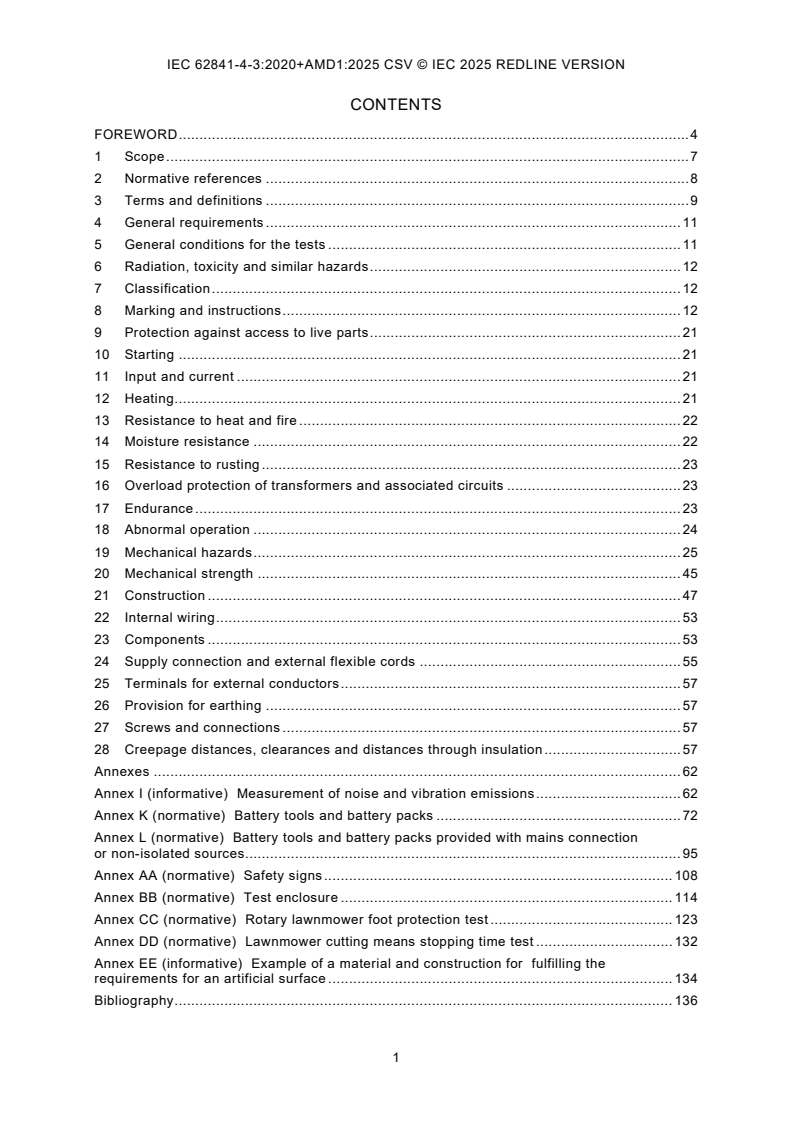
CONTENTS
FOREWORD . 4
1 Scope . 7
2 Normative references . 8
3 Terms and definitions . 9
4 General requirements . 11
5 General conditions for the tests . 11
6 Radiation, toxicity and similar hazards . 12
7 Classification . 12
8 Marking and instructions . 12
9 Protection against access to live parts . 21
10 Starting . 21
11 Input and current . 21
12 Heating . 21
13 Resistance to heat and fire . 22
14 Moisture resistance . 22
15 Resistance to rusting . 23
16 Overload protection of transformers and associated circuits . 23
17 Endurance . 23
18 Abnormal operation . 24
19 Mechanical hazards . 25
20 Mechanical strength . 45
21 Construction . 47
22 Internal wiring . 53
23 Components . 53
24 Supply connection and external flexible cords . 55
25 Terminals for external conductors . 57
26 Provision for earthing . 57
27 Screws and connections . 57
28 Creepage distances, clearances and distances through insulation . 57
Annexes . 62
Annex I (informative) Measurement of noise and vibration emissions . 62
Annex K (normative) Battery tools and battery packs . 72
Annex L (normative) Battery tools and battery packs provided with mains connection
or non-isolated sources. 95
Annex AA (normative) Safety signs . 108
Annex BB (normative) Test enclosure . 114
Annex CC (normative) Rotary lawnmower foot protection test . 123
Annex DD (normative) Lawnmower cutting means stopping time test . 132
Annex EE (informative) Example of a material and construction for fulfilling the
requirements for an artificial surface . 134
Bibliography . 136
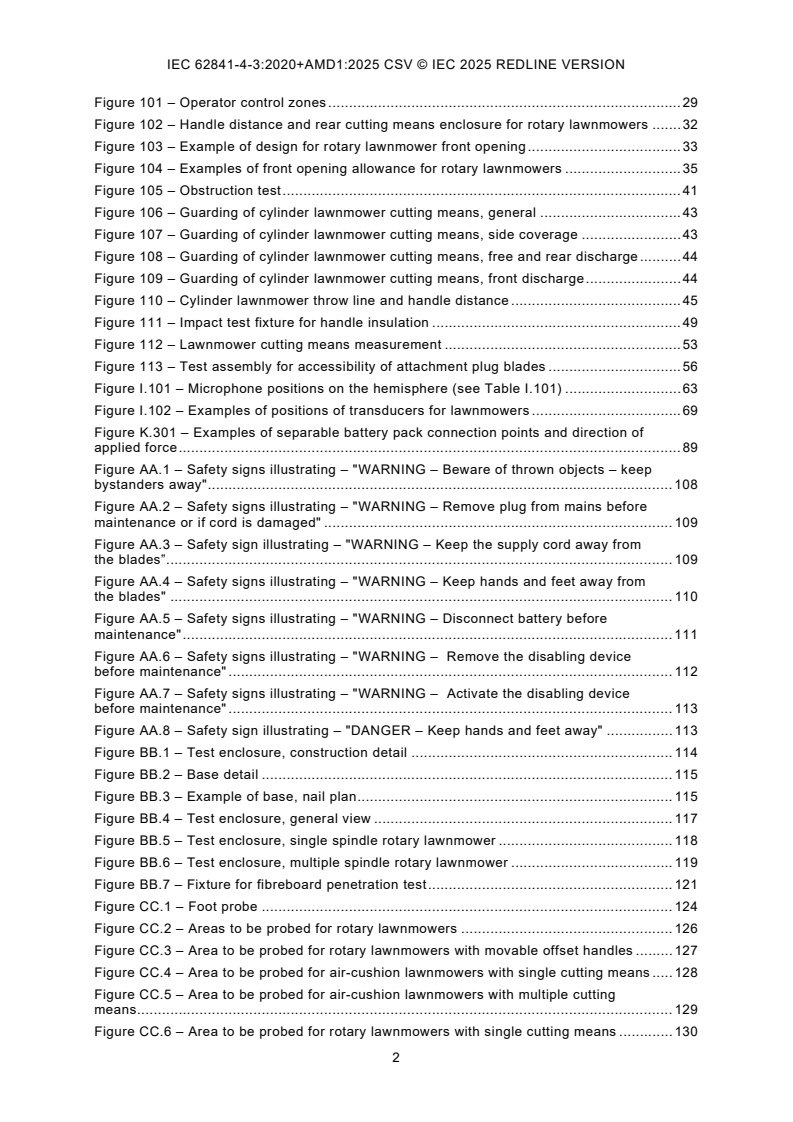
Figure 101 – Operator control zones . 29
Figure 102 – Handle distance and rear cutting means enclosure for rotary lawnmowers . 32
Figure 103 – Example of design for rotary lawnmower front opening . 33
Figure 104 – Examples of front opening allowance for rotary lawnmowers . 35
Figure 105 – Obstruction test . 41
Figure 106 – Guarding of cylinder lawnmower cutting means, general . 43
Figure 107 – Guarding of cylinder lawnmower cutting means, side coverage . 43
Figure 108 – Guarding of cylinder lawnmower cutting means, free and rear discharge . 44
Figure 109 – Guarding of cylinder lawnmower cutting means, front discharge . 44
Figure 110 – Cylinder lawnmower throw line and handle distance . 45
Figure 111 – Impact test fixture for handle insulation . 49
Figure 112 – Lawnmower cutting means measurement . 53
Figure 113 – Test assembly for accessibility of attachment plug blades . 56
Figure I.101 – Microphone positions on the hemisphere (see Table I.101) . 63
Figure I.102 – Examples of positions of transducers for lawnmowers . 69
Figure K.301 – Examples of separable battery pack connection points and direction of
applied force . 89
Figure AA.1 – Safety signs illustrating – "WARNING – Beware of thrown objects – keep
bystanders away" . 108
Figure AA.2 – Safety signs illustrating – "WARNING – Remove plug from mains before
maintenance or if cord is damaged" . 109
Figure AA.3 – Safety sign illustrating – "WARNING – Keep the supply cord away from
the blades”. 109
Figure AA.4 – Safety signs illustrating – "WARNING – Keep hands and feet away from
the blades" . 110
Figure AA.5 – Safety signs illustrating – "WARNING – Disconnect battery before
maintenance" . 111
Figure AA.6 – Safety signs illustrating – "WARNING – Remove the disabling device
before maintenance" . 112
Figure AA.7 – Safety signs illustrating – "WARNING – Activate the disabling device
before maintenance" . 113
Figure AA.8 – Safety sign illustrating – "DANGER – Keep hands and feet away" . 113
Figure BB.1 – Test enclosure, construction detail . 114
Figure BB.2 – Base detail . 115
Figure BB.3 – Example of base, nail plan . 115
Figure BB.4 – Test enclosure, general view . 117
Figure BB.5 – Test enclosure, single spindle rotary lawnmower . 118
Figure BB.6 – Test enclosure, multiple spindle rotary lawnmower . 119
Figure BB.7 – Fixture for fibreboard penetration test . 121
Figure CC.1 – Foot probe . 124
Figure CC.2 – Areas to be probed for rotary lawnmowers . 126
Figure CC.3 – Area to be probed for rotary lawnmowers with movable offset handles . 127
Figure CC.4 – Area to be probed for air-cushion lawnmowers with single cutting means . 128
Figure CC.5 – Area to be probed for air-cushion lawnmowers with multiple cutting
means. 129
Figure CC.6 – Area to be probed for rotary lawnmowers with single cutting means . 130
Figure CC.7 – Area to be probed for rotary lawnmowers with multiple cutting means . 131
Figure EE.1 – Sketch of the measurement surface covered with an artificial surface . 135
Table 4 – Required performance levels . 25
Table 101 – Cutting means stopping time . 38
Table 102 – Permissible hits from thrown object test . 40
Table 9 – Pull and torque value . 57
Table 12 – Minimum creepage distances and clearances . 59
Table I.101 – Co-ordinates of microphone positions . 65
Table I.102 – Values of the constant a . 65
Table I.103 – Absorption coefficients . 66
Table 4 – Required performance levels . 83
Table 301 – Pull and torque value . 91
Table K.1 – Minimum creepage distances and clearances between parts of different
potential. 93
Table K.2 – Minimum total sum of creepage distances and clearances to accessible
surfaces . 94
INTERNATIONAL ELECTROTECHNICAL COMMISSION
____________
Electric motor-operated hand-held tools, transportable tools and lawn and
garden machinery - Safety -
Part 4-3: Particular requirements for pedestrian controlled walk-behind
lawnmowers
FOREWORD
1) The International Electrotechnical Commission (IEC) is a worldwide organization for standardization comprising
all national electrotechnical committees (IEC National Committees). The object of IEC is to promote
international co-operation on all questions concerning standardization in the electrical and electronic fields. To
this end and in addition to other activities, IEC publishes International Standards, Technical Specifications,
Technical Reports, Publicly Available Specifications (PAS) and Guides (hereafter referred to as "IEC
Publication(s)"). Their preparation is entrusted to technical committees; any IEC National Committee interested
in the subject dealt with may participate in this preparatory work. International, governmental and non-
governmental organizations liaising with the IEC also participate in this preparation. IEC collaborates closely
with the International Organization for Standardization (ISO) in accordance with conditions determined by
agreement between the two organizations.
2) The formal decisions or agreements of IEC on technical matters express, as nearly as possible, an international
consensus of opinion on the relevant subjects since each technical committee has representation from all
interested IEC National Committees.
3) IEC Publications have the form of recommendations for international use and are accepted by IEC National
Committees in that sense. While all reasonable efforts are made to ensure that the technical content of IEC
Publications is accurate, IEC cannot be held responsible for the way in which they are used or for any
misinterpretation by any end user.
4) In order to promote international uniformity, IEC National Committees undertake to apply IEC Publications
transparently to the maximum extent possible in their national and regional publications. Any divergence
between any IEC Publication and the corresponding national or regional publication shall be clearly indicated in
the latter.
5) IEC itself does not provide any attestation of conformity. Independent certification bodies provide conformity
assessment services and, in some areas, access to IEC marks of conformity. IEC is not responsible for any
services carried out by independent certification bodies.
6) All users should ensure that they have the latest edition of this publication.
7) No liability shall attach to IEC or its directors, employees, servants or agents including individual experts and
members of its technical committees and IEC National Committees for any personal injury, property damage or
other damage of any nature whatsoever, whether direct or indirect, or for costs (including legal fees) and
expenses arising out of the publication, use of, or reliance upon, this IEC Publication or any other IEC
Publications.
8) Attention is drawn to the Normative references cited in this publication. Use of the referenced publications is
indispensable for the correct application of this publication.
9) IEC draws attention to the possibility that the implementation of this document may involve the use of (a)
patent(s). IEC takes no position concerning the evidence, validity or applicability of any claimed patent rights in
respect thereof. As of the date of publication of this document, IEC had not received notice of (a) patent(s),
which may be required to implement this document. However, implementers are cautioned that this may not
represent the latest information, which may be obtained from the patent database available at
https://patents.iec.ch. IEC shall not be held responsible for identifying any or all such patent rights.
This consolidated version of the official IEC Standard and its amendment has been prepared
for user convenience.
IEC 62841-4-3 edition 1.1 contains the first edition (2020-11) [documents 116/467/FDIS and
116/478/RVD] and its amendment 1 (2025-07) [documents 116/898/FDIS and 116/906/RVD].
In this Redline version, a vertical line in the margin shows where the technical content is
modified by amendment 1. Additions are in green text, deletions are in strikethrough red text.
A separate Final version with all changes accepted is available in this publication.
International Standard IEC 62841-4-3 has been prepared by IEC technical committee 116:
Safety of motor-operated electric tools.
The text of this International standard is based on the following documents:
FDIS Report on voting
116/467/FDIS 116/478/RVD
Full information on the voting for the approval of this International Standard can be found in
the report on voting indicated in the above table.
This publication has been drafted in accordance with the ISO/IEC Directives, Part 2.
This Part 4-3 is to be used in conjunction with the first edition of IEC 62841-1:2014 and
IEC 62841-1:2014/AMD1:2025.
This Part 4-3 supplements or modifies the corresponding clauses in IEC 62841-1, so as to
convert it into the IEC Standard: Particular requirements for pedestrian controlled walk-behind
lawnmowers.
Where a particular subclause of Part 1 is not mentioned in this Part 4-3, that subclause
applies as far as reasonable. Where this document states “addition”, “modification” or
“replacement”, the relevant text in Part 1 is to be adapted accordingly.
The following print types are used:
– requirements: in roman type;
– test specifications: in italic type;
notes: in small roman type.
–
The terms defined in Clause 3 are printed in bold typeface.
Subclauses, notes, tables and figures which are additional to those in Part 1 are numbered
starting from 101.
Subclauses, notes, tables and figures in Annex K and Annex L which are additional to those
in the main body of this Part 4-3 are numbered starting from 301.
A list of all parts of the IEC 62841 series, under the general title: Electric motor-operated
hand-held tools, transportable tools and lawn and garden machinery – Safety, can be found
on the IEC website.
The committee has decided that the contents of this document and its amendment will remain
unchanged until the stability date indicated on the IEC website under webstore.iec.ch in the
data related to the specific document. At this date, the document will be
• reconfirmed,
• withdrawn, or
• revised.
NOTE The attention of National Committees is drawn to the fact that equipment manufacturers and testing
organizations may need a transitional period following publication of a new, amended or revised IEC publication in
which to make products in accordance with the new requirements and to equip themselves for conducting new or
revised tests.
It is the recommendation of the committee that the content of this publication be adopted for implementation
nationally not earlier than 36 months from the date of publication.
1 Scope
This clause of Part 1 is applicable, except as follows:
Addition:
This document applies to the design of pedestrian controlled walk-behind
– cylinder lawnmowers;
and
– rotary lawnmowers
equipped with
– metallic cutting means; and/or
– rigid non-metallic cutting means; and/or
– non-metallic cutting means with one or more cutting elements pivotally mounted on a
generally circular drive unit, where these cutting elements rely on centrifugal force to
achieve cutting, and have a kinetic energy for each single cutting element of greater than
10 J.
NOTE 101 Machines that have non-metallic cutting means and a kinetic energy for each single cutting element
of less than or equal to 10 J are considered to be lawn trimmers.
This document does not apply to
– robotic lawnmowers;
– remote-controlled lawnmowers;
– flail mowers or flail-type attachments;
– scissors type lawnmowers;
– grassland mowers;
– sickle bar mowers;
– towed/semi-mounted grass-cutting machines;
– scrub-clearing machines;
– lawn trimmers and lawn edge trimmers;
– lawn edgers;
– grass trimmers;
– brush cutters;
– brush saws;
– agricultural mowers;
– trailing seat/sulky units;
– ride-on machines, including those that can be operated in pedestrian controlled mode;
– non-powered lawnmowers;
– combustion engine powered lawnmowers;
– hybrid and fuel cell powered machines and associated charging systems; and
– garden tractors or their attachments.
NOTE 102 Robotic lawnmowers are covered by IEC 60335-2-107, and will be covered by a future part of
IEC 62841.
NOTE 103 Lawn trimmers and lawn edge trimmers are covered by IEC 60335-2-91.
NOTE 104103 Lawn trimmers, lawn edge trimmers, grass trimmers, brush cutters and brush saws will be are
covered by a future part of IEC 62841-4-4.
NOTE 105104 Lawn edgers will be are covered by a future part of IEC 62841-4-11 .
NOTE 105 Battery powered ride-on lawnmowers will be covered by a future part of IEC 62841.
NOTE 106 In Europe (EN IEC 62841-4-3), the following requirements apply:
This document covers all significant hazards, hazardous situations or hazardous events relevant for machines
covered by this document.
NOTE Z101 Essential requirements not mentioned in Table ZZ.1 are deemed to be not applicable, because the
corresponding hazards are either not relevant for machines covered by this document or do not require specific
action by the designer.
2 Normative references
This clause of Part 1 is applicable, except as follows:
Addition:
IEC 60112:2020, Method for the determination of the proof and the comparative tracking
indices of solid insulating materials
IEC 60664-3, Insulation coordination for equipment within low-voltage systems – Part 3: Use
of coating, potting or moulding for protection against pollution
IEC 60664-4:2005, Insulation coordination for equipment within low-voltage systems – Part 4:
Consideration of high-frequency voltage stress
IEC 61058-2-6:2018, Switches for appliances – Part 2-6: Particular requirements for switches
used in electric motor-operated hand-held tools, transportable tools and lawn and garden
machinery
IEC 61672-1:2013, Electroacoustics – Sound level meters – Part 1: Specifications
ISO 354:2003, Acoustics – Measurement of sound absorption in a reverberation room
ISO 5395-1:2013, Garden equipment – Safety requirements for combustion-engine-powered
lawnmowers – Part 1: Terminology and common tests
ISO 5395-1:2013/AMD1:2017
ISO 5395-2:2013/AMD1:2016, Garden equipment – Safety requirements for combustion-
engine-powered lawnmowers – Part 2: Pedestrian-controlled lawnmowers
ISO 5395-2:2013/AMD1:2016/AMD2:2017
ISO 5395-2:2013, Garden equipment – Safety requirements for combustion-engine-powered
lawnmowers – Part 2: Pedestrian-controlled lawnmowers
ISO 5395-2:2013/Amd 1:2016
ISO 5395-2:2013/Amd 2:2017
ISO 9773:2024, Plastics – Determination of burning behaviour of thin flexible vertical
specimens in contact with a small flame ignition source
—————————
Under preparation. Stage at the time of publication: IEC/FDIS 62841-4-11:2025.
ISO 11684:2023, Tractors, machinery for agriculture and forestry, powered lawn and garden
equipment – Safety labels – General principles
ISO 13857:2019, Safety of machinery – Safety distances to prevent hazard zones being
reached by upper and lower limbs
ANSI B71.1:2017, Consumer turf care equipment – Pedestrian-controlled mowers and ride-on
mowers – Safety specifications
EN 12096, Mechanical Vibration – Declaration and Verification of Vibration Emission Values
Replacement:
IEC 61058-1:2016, Switches for appliances – Part 1: General requirements
ISO 3744:2010, Acoustics – Determination of sound power levels and sound energy levels of
noise sources using sound pressure – Engineering methods for an essentially free field over a
reflecting plane
ISO 11201:2010, Acoustics – Noise emitted by machinery and equipment – Determination of
emission sound pressure levels at a work station and at other specified positions in an
essentially free field over a reflecting plane with negligible environmental corrections
3 Terms and definitions
This clause of Part 1 is applicable, except as follows:
3.101
cutter bar
stationary device used on a cylinder lawnmower to provide a shearing action in combination
with the cutting means
3.102
cutting height
shortest vertical distance between the cutting edge of the cutting means and the supporting
surface of a lawnmower
3.103
cutting means
rotating mechanism or rotating part of the lawnmower that is designed to perform the cutting
action
Note 101 to entry: Cutting means are also known as blades, cutting cylinders or reels.
3.104
cutting means assembly
cutting means together with the cutting means enclosure, including cutting means shaft(s)
3.105
cutting means control
device to engage and disengage the cutting means from its drive, in order to start and stop
the cutting means motion
3.106
cutting means enclosure
part or assembly, including the discharge chute and guard for grass catcher opening,
designed to prevent unintended contact with the cutting means
3.107
cutting means tip circle
path described by the outermost point of the rotary lawnmower cutting means cutting edge
as it rotates about its shaft axis
3.108
cutting position
any height setting of the cutting means designated by the manufacturer for cutting grass
3.109
cutting width
total distance across the cutting means path at 90º to the direction of travel
3.110
discharge chute
portion of the cutting means enclosure, extending outward from the discharge opening,
designed to control the ejection of material from the cutting means
3.111
discharge opening
opening in the cutting means enclosure through which material such as grass clippings can
be discharged
3.112
grass catcher
part or combination of parts, intended to be used with the lawnmower, which provides a
means for collecting material such as grass clippings
3.113
lawnmower
pedestrian controlled walk-behind lawn cutting machine, where the cutting means cuts
approximately parallel to the ground and which uses the ground to determine the cutting
height by means of wheels, air-cushion or skids, etc.
3.113.1
air-cushion lawnmower
rotary lawnmower which hovers using pressurized air as its ground support
3.113.2
cylinder lawnmower
lawnmower with one or more cutting means rotating about a horizontal axis to provide a
shearing action with a cutter bar
Note 101 to entry: Cylinder lawnmowers are also known as reel lawnmowers.
3.113.3
rotary lawnmower
lawnmower in which one or more cutting means, cutting by impact, rotate about an axis
perpendicular to the cutting plane
3.114
maximum speed
highest steady-state cutting means speed attainable under all conditions of normal use,
including no-load, when adjusted in accordance with the manufacturer's specifications and/or
instructions
Note 101 to entry: The steady-state cutting means speed excludes transients such as overshoot that can occur
before attaining a steady-state condition.
3.115
mulching
mode of operation of a rotary lawnmower, having a fixed or optional configuration, which
returns clippings to the lawn without discharge openings
Note 101 to entry: Some lawnmowers are converted to a mulching type by the use of mulching parts or plugs.
3.116
operator control
device requiring operator actuation to perform specific functions during normal operation
3.117
operator presence control
device that deactivates rotation of the cutting means when the operator’s hand(s) is removed
from the control
Note 101 to entry: The device typically consists of a combination of a mechanical actuator and other mechanical
and electrical components (e.g. tactile switch, relays, load switches or electronic components).
3.118
parking brake
device to prevent a stationary machine from moving
3.119
service brake
device for decelerating and stopping a machine from its ground travel speed
3.120
throw line
steepest line in a vertical plane, tangential to the periphery of the cutting cylinder in the
direction of rotation, which does not intersect a guard or other components of a cylinder
lawnmower
3.121
swing-over handle
handle that pivots about a horizontal axis from one end of a lawnmower to the other end to
allow reversing the direction of travel of the lawnmower without turning the lawnmower
around
Note 1 to entry: Reproduced from ANSI/OPEI B71.1-2017, American National Standard for Consumer Turf Care
Equipment – Pedestrian-Controlled Mowers and Ride-On Mowers – Safety Specifications, with the consent of The
Outdoor Power Equipment Institute, Inc.
3.122
traction drive
means (system) used to transmit power from the motor to the ground drive means
4 General requirements
This clause of Part 1 is applicable.
5 General conditions for the tests
This clause of Part 1 is applicable, except as follows:
5.4 Addition:
Handle positions that are used for storage purposes are not included in this requirement.
5.7.2 Replacement:
Machines are tested at rated voltage. Machines having more than one rated voltage or
having a rated voltage range are tested at the highest voltage.
5.17 Addition:
The mass of the machine includes the cutting means, grass catcher (empty) (if any), grass
catcher adapter (if any), mulching parts or plug (if any), cutting means enclosure cover (if
any) in the heaviest configuration in accordance with 8.14.2.
5.101 During the tests, the cutting means may be adjusted and lubricated as needed to
permit operation for extended periods.
NOTE 101 For example, it is possible that a cylinder lawnmower cutting means is not able to run for extended
periods at normal adjustment because of lack of lubrication, etc. normally provided by the grass.
5.102 For tests that are performed at maximum speed and no-load, the manufacturer may
need to provide special hardware and/or software in order to achieve maximum speed at no-
load.
5.103 The tests are performed using all cutting means in accordance with 8.14.2 a) 103).
6 Radiation, toxicity and similar hazards
This clause of Part 1 is applicable.
7 Classification
This clause of Part 1 is applicable, except as follows:
7.1 Replacement:
Machines shall be of one of the following classes with respect to protection against electric
shock:
class II tool (machine), class III tool (machine).
Compliance is checked by inspection and by the relevant tests.
7.2 Addition:
Class II tools (machines) shall be at least IPX4. Class III tools (machines) shall be at least
IPX1.
8 Marking and instructions
This clause of Part 1 is applicable, except as follows:
8.1.101 Machines with more than one motor (i.e. separate motors for the cutting means and
traction drive) shall be marked with the rated input, in watts or rated current, in amperes, for
each motor. These markings may be located on each motor.
Compliance is checked by inspection.
8.2 Addition:
Lawnmowers shall be marked with the following safety warnings:
– One of the following safety warnings:
• " WARNING – Beware of thrown objects – keep bystanders away"; or
• " WARNING – Keep bystanders away by at least ____", where "____" is the
recommended minimum distance between the machine and the bystander; or
• one of the safety signs specified in Figure AA.1;
For mains supplied machines:
– " WARNING – Remove plug from mains before maintenance or if cord is damaged",
symbol M006 of ISO 7010 (2011-05), or one of the safety signs specified in Figure AA.2;
– “ WARNING – Keep the supply cord away from the blades” or the safety sign specified
in Figure AA.3.
Rotary lawnmowers shall be marked with the following safety warning:
– “ WARNING – Keep hands and feet away from the blades” or one of the safety signs
specified in Figure AA.4.
NOTE 101 In Canada and the United States of America, the following additional requirements apply in place of
8.2.
Lawnmowers must be marked with a safety warning in one of the following versions:
– " WARNING – To reduce the risk of injury, user must read instruction manual", or symbol M002 of
ISO 7010(2011-05).
In Canada, the equivalent French wording of the above warning is as follows: "AVERTISSEMENT – Pour réduire le
risque de blessure, l'utilisateur doit lire le manuel d'instructions".
If used, the word "WARNING" must be in capital letters not less than 2,4 mm high and must not be separated from
either the cautionary statement or the symbol ISO 7000-0434A (2004-01) or ISO 7000-0434B (2004-01).
If used, the statement must be verbatim except that the term "operator's manual" or "user guide" may be used for
the term "instruction manual".
Cautionary statements having the same signal word such as " WARNING" may be combined into one paragraph
under one signal word.
Lawnmowers must be marked with the following safety warnings:
– " WARNING – Beware of thrown objects – keep bystanders away" or one of the safety signs specified in
Figure AA.1;
In Canada, the equivalent French wording of the above warning is as follows: "AVERTISSEMENT – Attention aux
objets projetés – éloigner les passants".
For mains supplied machines:
– " WARNING – Remove plug from mains before maintenance or if cord is damaged" or one of the safety
signs specified in Figure AA.2;
In Canada, the equivalent French wording of the above warning is as follows: "AVERTISSEMENT – Débranchez la
fiche du secteur avant l'entretien ou si le cordon est endommagé".
– " WARNING – Keep the supply cord away from the blades" or the safety sign specified in Figure AA.3.
In Canada, the equivalent French wording of the above warning is as follows: "AVERTISSEMENT – Gardez le
cordon d'alimentation éloigné des lames".
Rotary lawnmowers must be marked with the following safety warning:
– " WARNING – Keep hands and feet away from the blades" or one of the safety signs specified in
Figure AA.4.
In Canada, the equivalent French wording of the above warning is as follows: "AVERTISSEMENT – Gardez les
mains et les pieds éloignés des lames".
Alternatively, the requirements of this subclause are considered to be fulfilled if the lawnmower complies with
ANSI/OPEI 5395-2:2024, 7.2.2, except for the first dashed item, except that in Canada, all warning text must be
provided in French.
Compliance is checked by inspection and by measurement.
For applicable lawnmowers in accordance with the scope of 16 CFR 1205:
– Warning label for cylinder lawnmowers and rotary lawnmowers.
• (a) General. Walk-behind cylinder lawnmowers and rotary lawnmowers shall must be labeled on the
blade (cutting means) housing or, in the absence of a blade (cutting means) housing, on other blade
(cutting means) shielding or on an adjacent supporting structure or assembly, with the warning label
shown in Figure AA.8. The label shall must be at least 82,5 mm high and 102 mm wide, and the lettering
and symbol shall must retain the same size relation to each other and to the label as shown in
Figure AA.8.
• (b) Rotary lawnmowers. Walk-behind rotary lawnmowers shall must have one label as shown in
Figure AA.8, on the blade (cutting means) housing. The label shall must be located as close as possible
to any discharge opening, or, if there is no discharge opening, in a position that is conspicuous to an
operator in the normal operating position.
• (c) Cylinder lawnmowers. Walk-behind cylinder lawnmowers shall must have one label as shown in
Figure AA.8, located as close to the centre of the cutting width of the blade (cutting means) as
possible. However, in the absence of a suitable mounting surface near the centre of the cutting width,
the label shall must be placed on the nearest suitable mounting surface to the centre of the cutting
width.
Compliance is checked by inspection and by measurement.
8.3 Addition:
For rotary lawnmowers, the cutting means, where replaceable during user maintenance,
shall be marked to identify the part number(s) and the manufacturer, importer or supplier. This
marking is not required to be clearly discernible from the outside of the machine.
NOTE 101 In the United States of America, the following additional requirements apply.
For rotary lawnmowers in accordance with 16 CFR 1205:
Rotary lawnmowers shall be marked with “Meets CPSC blade safety requirements” on the product.
Replacement of the sixth dash:
– “> 25 kg” if the mass of the machine is over 25 kg. For this requirement, the mass of the
machine includes the mass of a supply cord with a length not less than 10 m, if any, in
addition to the items specified in 5.17.
– if the mass of the machine is greater than 25 kg, either with "> 25 kg" or with the mass of
the machine in kg.
NOTE 102 In Europe (EN IEC 62841-4-3), the following requirement applies:
Replacement of the sixth dashed list item:
– the mass of the machine in kg. For this requirement, the mass of the machine includes the mass of a supply
cord with a length not less than 10 m, if any, in addition to the items specified in 5.17.
NOTE 103 In Canada and the United States of America, the sixth dashed list item is deleted.
8.9 Replacement:
Unless it is obviously unnecessary, switches and controls (e.g. a cutting means brake/clutch)
which may give rise to a hazard when operated shall be marked or so placed as to indicate
clearly which part of the machine they control.
Compliance is checked by inspection.
8.11 This subclause of Part 1 is not applicable for traction drive speed controls.
8.14.1 Addition:
The additional safety instructions as specified in 8.14.1.101 shall be given. This part may be
printed separately from the “General Machine Safety Warnings”.
NOTE 101 "General Machine Safety Warnings" are referred to as "General Power Tool Safety Warnings" in
Part 1.
NOTE 102 In Canada and the United States of America, the following requirements apply in place of 8.14.1:
8.14.1
The subjects of safety instructions are the warnings as given in 8.14.1.101 and any additional safety warning
statements deemed necessary by the manufacturer. The warnings given in 8.14.1.101, if in English, must be
verbatim and in any other official language to be equivalent. The numbering of the safety instructions, as given in
8.14.1.101, is not mandatory and may be omitted or replaced by other sorting means such as bullets. The warnings
given in 8.14.1.101 may be separate from the instruction manual.
The term verbatim means word-for-word but permits the differences in spelling between English-speaking
countries.
Format of all safety warnings must differentiate, by font, highlighting or similar means, the context of clauses as
illustrated below.
All notes in the safety instructions are not to be printed, they are information for the designer of the manual.
The safety instructions specified in 8.14.1.101 must be given.
8.14.1.1 Addition:
NOTE 101 In Canada and the United States of America, this subclause of Part 1 is not applicable.
Addition for item 2) c):
For machines classified at least IPX4, the warning may be replaced as specified below.
c) Do not operate the lawnmower power tool in rain or and avoid operation in wet
conditions. This Operating the power tool in rain or wet conditions may increase the risk
of electric shock.
NOTE 102 In accordance with 8.14.1 of Part 1, it is possible to replace the term "power tool" with an
appropriate term such as "machine" in the warning above.
8.14.1.2 Addition:
NOTE 101 In Canada and the United States of America, the following requirements apply in place of 8.14.1.2:
8.14.1.2
The order of the safety warnings must be in accordance with either item a) or b) and in accordance with item c):
a) The order of the warnings must remain as given in 8.14.1.101;
b) The warnings given in 8.14.1.101 may be divided into the sections defined by the numbered subtitles and the
associated warnings below the numbered subtitle. The order of warnings within each section must remain as
given in 8.14.1.101.
st
W
...
IEC 62841-4-3 ®
Edition 1.0 2020-11
INTERNATIONAL
STANDARD
NORME
INTERNATIONALE
Electric motor-operated hand-held tools, transportable tools and lawn and
garden machinery – Safety –
Part 4-3: Particular requirements for pedestrian controlled walk-behind
lawnmowers
Outils électroportatifs à moteur, outils portables et machines pour jardins et
pelouses – Sécurité –
Partie 4-3: Exigences particulières pour tondeuses à gazon à conducteur à pied
All rights reserved. Unless otherwise specified, no part of this publication may be reproduced or utilized in any form
or by any means, electronic or mechanical, including photocopying and microfilm, without permission in writing from
either IEC or IEC's member National Committee in the country of the requester. If you have any questions about IEC
copyright or have an enquiry about obtaining additional rights to this publication, please contact the address below or
your local IEC member National Committee for further information.
Droits de reproduction réservés. Sauf indication contraire, aucune partie de cette publication ne peut être reproduite
ni utilisée sous quelque forme que ce soit et par aucun procédé, électronique ou mécanique, y compris la photocopie
et les microfilms, sans l'accord écrit de l'IEC ou du Comité national de l'IEC du pays du demandeur. Si vous avez des
questions sur le copyright de l'IEC ou si vous désirez obtenir des droits supplémentaires sur cette publication, utilisez
les coordonnées ci-après ou contactez le Comité national de l'IEC de votre pays de résidence.
IEC Central Office Tel.: +41 22 919 02 11
3, rue de Varembé info@iec.ch
CH-1211 Geneva 20 www.iec.ch
Switzerland
About the IEC
The International Electrotechnical Commission (IEC) is the leading global organization that prepares and publishes
International Standards for all electrical, electronic and related technologies.
About IEC publications
The technical content of IEC publications is kept under constant review by the IEC. Please make sure that you have the
latest edition, a corrigendum or an amendment might have been published.
IEC publications search - webstore.iec.ch/advsearchform Electropedia - www.electropedia.org
The advanced search enables to find IEC publications by a The world's leading online dictionary on electrotechnology,
variety of criteria (reference number, text, technical containing more than 22 000 terminological entries in English
committee,…). It also gives information on projects, replaced and French, with equivalent terms in 16 additional languages.
and withdrawn publications. Also known as the International Electrotechnical Vocabulary
(IEV) online.
IEC Just Published - webstore.iec.ch/justpublished
Stay up to date on all new IEC publications. Just Published IEC Glossary - std.iec.ch/glossary
details all new publications released. Available online and 67 000 electrotechnical terminology entries in English and
once a month by email. French extracted from the Terms and Definitions clause of
IEC publications issued since 2002. Some entries have been
IEC Customer Service Centre - webstore.iec.ch/csc collected from earlier publications of IEC TC 37, 77, 86 and
If you wish to give us your feedback on this publication or CISPR.
need further assistance, please contact the Customer Service
Centre: sales@iec.ch.
A propos de l'IEC
La Commission Electrotechnique Internationale (IEC) est la première organisation mondiale qui élabore et publie des
Normes internationales pour tout ce qui a trait à l'électricité, à l'électronique et aux technologies apparentées.
A propos des publications IEC
Le contenu technique des publications IEC est constamment revu. Veuillez vous assurer que vous possédez l’édition la
plus récente, un corrigendum ou amendement peut avoir été publié.
Recherche de publications IEC - Electropedia - www.electropedia.org
webstore.iec.ch/advsearchform Le premier dictionnaire d'électrotechnologie en ligne au
La recherche avancée permet de trouver des publications IEC monde, avec plus de 22 000 articles terminologiques en
en utilisant différents critères (numéro de référence, texte, anglais et en français, ainsi que les termes équivalents dans
comité d’études,…). Elle donne aussi des informations sur les 16 langues additionnelles. Egalement appelé Vocabulaire
projets et les publications remplacées ou retirées. Electrotechnique International (IEV) en ligne.
IEC Just Published - webstore.iec.ch/justpublished Glossaire IEC - std.iec.ch/glossary
Restez informé sur les nouvelles publications IEC. Just 67 000 entrées terminologiques électrotechniques, en anglais
Published détaille les nouvelles publications parues. et en français, extraites des articles Termes et Définitions des
Disponible en ligne et une fois par mois par email. publications IEC parues depuis 2002. Plus certaines entrées
antérieures extraites des publications des CE 37, 77, 86 et
Service Clients - webstore.iec.ch/csc CISPR de l'IEC.
Si vous désirez nous donner des commentaires sur cette
publication ou si vous avez des questions contactez-nous:
sales@iec.ch.
IEC 62841-4-3 ®
Edition 1.0 2020-11
INTERNATIONAL
STANDARD
NORME
INTERNATIONALE
Electric motor-operated hand-held tools, transportable tools and lawn and
garden machinery – Safety –
Part 4-3: Particular requirements for pedestrian controlled walk-behind
lawnmowers
Outils électroportatifs à moteur, outils portables et machines pour jardins et
pelouses – Sécurité –
Partie 4-3: Exigences particulières pour tondeuses à gazon à conducteur à pied
INTERNATIONAL
ELECTROTECHNICAL
COMMISSION
COMMISSION
ELECTROTECHNIQUE
INTERNATIONALE
ICS 65.060.70 ISBN 978-2-8322-8896-2
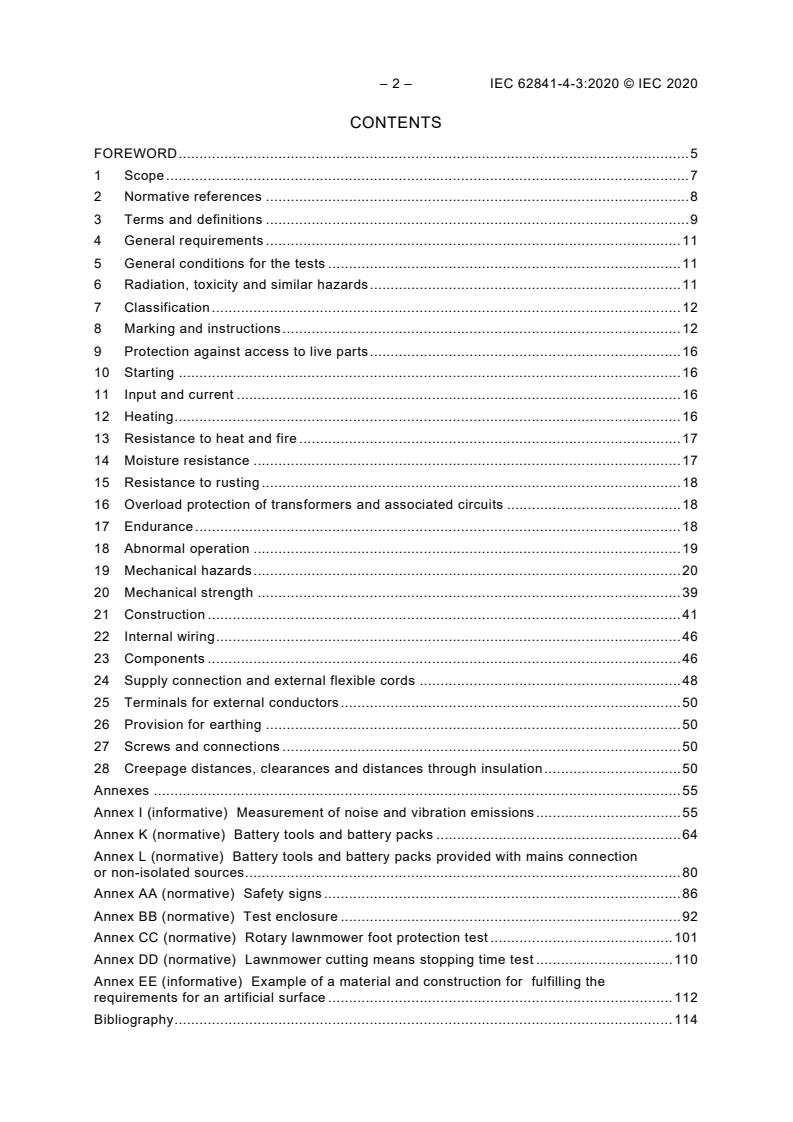
– 2 – IEC 62841-4-3:2020 © IEC 2020
CONTENTS
FOREWORD . 5
1 Scope . 7
2 Normative references . 8
3 Terms and definitions . 9
4 General requirements . 11
5 General conditions for the tests . 11
6 Radiation, toxicity and similar hazards . 11
7 Classification . 12
8 Marking and instructions . 12
9 Protection against access to live parts . 16
10 Starting . 16
11 Input and current . 16
12 Heating . 16
13 Resistance to heat and fire . 17
14 Moisture resistance . 17
15 Resistance to rusting . 18
16 Overload protection of transformers and associated circuits . 18
17 Endurance . 18
18 Abnormal operation . 19
19 Mechanical hazards . 20
20 Mechanical strength . 39
21 Construction . 41
22 Internal wiring . 46
23 Components . 46
24 Supply connection and external flexible cords . 48
25 Terminals for external conductors . 50
26 Provision for earthing . 50
27 Screws and connections . 50
28 Creepage distances, clearances and distances through insulation . 50
Annexes . 55
Annex I (informative) Measurement of noise and vibration emissions . 55
Annex K (normative) Battery tools and battery packs . 64
Annex L (normative) Battery tools and battery packs provided with mains connection
or non-isolated sources . 80
Annex AA (normative) Safety signs . 86
Annex BB (normative) Test enclosure . 92
Annex CC (normative) Rotary lawnmower foot protection test . 101
Annex DD (normative) Lawnmower cutting means stopping time test . 110
Annex EE (informative) Example of a material and construction for fulfilling the
requirements for an artificial surface . 112
Bibliography . 114
Figure 101 – Operator control zones . 24
Figure 102 – Handle distance and rear cutting means enclosure for rotary lawnmowers . 27
Figure 103 – Example of design for rotary lawnmower front opening . 28
Figure 104 – Examples of front opening allowance for rotary lawnmowers . 29
Figure 105 – Obstruction test . 35
Figure 106 – Guarding of cylinder lawnmower cutting means, general . 37
Figure 107 – Guarding of cylinder lawnmower cutting means, side coverage . 37
Figure 108 – Guarding of cylinder lawnmower cutting means, free and rear discharge . 38
Figure 109 – Guarding of cylinder lawnmower cutting means, front discharge . 38
Figure 110 – Cylinder lawnmower throw line and handle distance . 39
Figure 111 – Impact test fixture for handle insulation . 42
Figure 112 – Lawnmower cutting means measurement . 46
Figure 113 – Test assembly for accessibility of attachment plug blades . 49
Figure I.101 – Microphone positions on the hemisphere (see Table I.101) . 56
Figure I.102 – Examples of positions of transducers for lawnmowers . 62
Figure K.301 – Examples of separable battery pack connection points and direction of
applied force . 74
Figure AA.1 – Safety signs illustrating – "WARNING – Beware of thrown objects – keep
bystanders away" . 86
Figure AA.2 – Safety signs illustrating – "WARNING – Remove plug from mains before
maintenance or if cord is damaged" . 87
Figure AA.3 – Safety sign illustrating – "WARNING – Keep the supply cord away from
the blades” . 87
Figure AA.4 – Safety signs illustrating – "WARNING – Keep hands and feet away from
the blades" . 88
Figure AA.5 – Safety signs illustrating – "WARNING – Disconnect battery before
maintenance" . 89
Figure AA.6 – Safety signs illustrating – "WARNING – Remove the disabling device
before maintenance" . 90
Figure AA.7 – Safety signs illustrating – "WARNING – Activate the disabling device
before maintenance" . 91
Figure AA.8 – Safety sign illustrating – "DANGER – Keep hands and feet away" . 91
Figure BB.1 – Test enclosure, construction detail . 92
Figure BB.2 – Base detail . 93
Figure BB.3 – Example of base, nail plan . 93
Figure BB.4 – Test enclosure, general view . 95
Figure BB.5 – Test enclosure, single spindle rotary lawnmower . 96
Figure BB.6 – Test enclosure, multiple spindle rotary lawnmower . 97
Figure BB.7 – Fixture for fibreboard penetration test . 99
Figure CC.1 – Foot probe . 102
Figure CC.2 – Areas to be probed for rotary lawnmowers . 104
Figure CC.3 – Area to be probed for rotary lawnmowers with movable offset handles . 105
Figure CC.4 – Area to be probed for air-cushion lawnmowers with single cutting means . 106
Figure CC.5 – Area to be probed for air-cushion lawnmowers with multiple cutting
means . 107
Figure CC.6 – Area to be probed for rotary lawnmowers with single cutting means . 108
– 4 – IEC 62841-4-3:2020 © IEC 2020
Figure CC.7 – Area to be probed for rotary lawnmowers with multiple cutting means . 109
Figure EE.1 – Sketch of the measurement surface covered with an artificial surface . 113
Table 4 – Required performance levels . 20
Table 101 – Cutting means stopping time . 32
Table 102 – Permissible hits from thrown object test . 34
Table 9 – Pull and torque value . 50
Table 12 – Minimum creepage distances and clearances . 52
Table I.101 – Co-ordinates of microphone positions . 58
Table I.102 – Values of the constant a . 58
Table I.103 – Absorption coefficients . 59
Table 4 – Required performance levels . 69
Table 301 – Pull and torque value . 76
Table K.1 – Minimum creepage distances and clearances between parts of different
potential . 78
Table K.2 – Minimum total sum of creepage distances and clearances to accessible
surfaces . 79
Table 4 – Required performance levels . 82
INTERNATIONAL ELECTROTECHNICAL COMMISSION
____________
ELECTRIC MOTOR-OPERATED HAND-HELD TOOLS, TRANSPORTABLE
TOOLS AND LAWN AND GARDEN MACHINERY – SAFETY –
Part 4-3: Particular requirements for pedestrian
controlled walk-behind lawnmowers
FOREWORD
1) The International Electrotechnical Commission (IEC) is a worldwide organization for standardization comprising
all national electrotechnical committees (IEC National Committees). The object of IEC is to promote
international co-operation on all questions concerning standardization in the electrical and electronic fields. To
this end and in addition to other activities, IEC publishes International Standards, Technical Specifications,
Technical Reports, Publicly Available Specifications (PAS) and Guides (hereafter referred to as “IEC
Publication(s)”). Their preparation is entrusted to technical committees; any IEC National Committee interested
in the subject dealt with may participate in this preparatory work. International, governmental and non-
governmental organizations liaising with the IEC also participate in this preparation. IEC collaborates closely
with the International Organization for Standardization (ISO) in accordance with conditions determined by
agreement between the two organizations.
2) The formal decisions or agreements of IEC on technical matters express, as nearly as possible, an international
consensus of opinion on the relevant subjects since each technical committee has representation from all
interested IEC National Committees.
3) IEC Publications have the form of recommendations for international use and are accepted by IEC National
Committees in that sense. While all reasonable efforts are made to ensure that the technical content of IEC
Publications is accurate, IEC cannot be held responsible for the way in which they are used or for any
misinterpretation by any end user.
4) In order to promote international uniformity, IEC National Committees undertake to apply IEC Publications
transparently to the maximum extent possible in their national and regional publications. Any divergence
between any IEC Publication and the corresponding national or regional publication shall be clearly indicated in
the latter.
5) IEC itself does not provide any attestation of conformity. Independent certification bodies provide conformity
assessment services and, in some areas, access to IEC marks of conformity. IEC is not responsible for any
services carried out by independent certification bodies.
6) All users should ensure that they have the latest edition of this publication.
7) No liability shall attach to IEC or its directors, employees, servants or agents including individual experts and
members of its technical committees and IEC National Committees for any personal injury, property damage or
other damage of any nature whatsoever, whether direct or indirect, or for costs (including legal fees) and
expenses arising out of the publication, use of, or reliance upon, this IEC Publication or any other IEC
Publications.
8) Attention is drawn to the Normative references cited in this publication. Use of the referenced publications is
indispensable for the correct application of this publication.
9) Attention is drawn to the possibility that some of the elements of this IEC Publication may be the subject of
patent rights. IEC shall not be held responsible for identifying any or all such patent rights.
International Standard IEC 62841-4-3 has been prepared by IEC technical committee 116:
Safety of motor-operated electric tools.
The text of this International standard is based on the following documents:
FDIS Report on voting
116/467/FDIS 116/478/RVD
Full information on the voting for the approval of this International Standard can be found in
the report on voting indicated in the above table.
This publication has been drafted in accordance with the ISO/IEC Directives, Part 2.
– 6 – IEC 62841-4-3:2020 © IEC 2020
This Part 4-3 is to be used in conjunction with the first edition of IEC 62841-1:2014.
This Part 4-3 supplements or modifies the corresponding clauses in IEC 62841-1, so as to
convert it into the IEC Standard: Particular requirements for pedestrian controlled walk-behind
lawnmowers.
Where a particular subclause of Part 1 is not mentioned in this Part 4-3, that subclause
applies as far as reasonable. Where this document states “addition”, “modification” or
“replacement”, the relevant text in Part 1 is to be adapted accordingly.
The following print types are used:
– requirements: in roman type;
– test specifications: in italic type;
– notes: in small roman type.
The terms defined in Clause 3 are printed in bold typeface.
Subclauses, notes, tables and figures which are additional to those in Part 1 are numbered
starting from 101.
Subclauses, notes, tables and figures in Annex K and Annex L which are additional to those in
the main body of this Part 4-3 are numbered starting from 301.
A list of all parts of the IEC 62841 series, under the general title: Electric motor-operated
hand-held tools, transportable tools and lawn and garden machinery – Safety, can be found
on the IEC website.
The committee has decided that the contents of this publication will remain unchanged until
the stability date indicated on the IEC web site under "http://webstore.iec.ch" in the data
related to the specific publication. At this date, the publication will be
• reconfirmed,
• withdrawn,
• replaced by a revised edition, or
• amended.
NOTE The attention of National Committees is drawn to the fact that equipment manufacturers and testing
organizations may need a transitional period following publication of a new, amended or revised IEC publication in
which to make products in accordance with the new requirements and to equip themselves for conducting new or
revised tests.
It is the recommendation of the committee that the content of this publication be adopted for implementation
nationally not earlier than 36 months from the date of publication.
ELECTRIC MOTOR-OPERATED HAND-HELD TOOLS, TRANSPORTABLE
TOOLS AND LAWN AND GARDEN MACHINERY – SAFETY –
Part 4-3: Particular requirements for pedestrian
controlled walk-behind lawnmowers
1 Scope
This clause of Part 1 is applicable, except as follows:
Addition:
This document applies to the design of pedestrian controlled walk-behind
– cylinder lawnmowers;
and
– rotary lawnmowers
equipped with
– metallic cutting means; and/or
– rigid non-metallic cutting means; and/or
– non-metallic cutting means with one or more cutting elements pivotally mounted on a
generally circular drive unit, where these cutting elements rely on centrifugal force to
achieve cutting, and have a kinetic energy for each single cutting element of greater than
10 J.
NOTE 101 Machines that have non-metallic cutting means and a kinetic energy for each single cutting element
of less than or equal to 10 J are considered to be lawn trimmers.
This document does not apply to
– robotic lawnmowers;
– remote-controlled lawnmowers;
– flail mowers or flail-type attachments;
– scissors type lawnmowers;
– grassland mowers;
– sickle bar mowers;
– towed/semi-mounted grass-cutting machines;
– scrub-clearing machines;
– lawn trimmers and lawn edge trimmers;
– lawn edgers;
– grass trimmers;
– brush cutters;
– brush saws;
– agricultural mowers;
– trailing seat/sulky units;
– ride-on machines;
– 8 – IEC 62841-4-3:2020 © IEC 2020
– non-powered lawnmowers;
– combustion engine powered lawnmowers;
– hybrid and fuel cell powered machines and associated charging systems; and
– garden tractors or their attachments.
NOTE 102 Robotic lawnmowers are covered by IEC 60335-2-107, and will be covered by a future part of
IEC 62841.
NOTE 103 Lawn trimmers and lawn edge trimmers are covered by IEC 60335-2-91.
NOTE 104 Lawn trimmers, lawn edge trimmers, grass trimmers, brush cutters and brush saws will be covered by
a future part of IEC 62841.
NOTE 105 Lawn edgers will be covered by a future part of IEC 62841.
2 Normative references
This clause of Part 1 is applicable, except as follows:
Addition:
IEC 60664-3, Insulation coordination for equipment within low-voltage systems – Part 3: Use
of coating, potting or moulding for protection against pollution
IEC 60664-4, Insulation coordination for equipment within low-voltage systems – Part 4:
Consideration of high-frequency voltage stress
IEC 61058-2-6:2018, Switches for appliances – Part 2-6: Particular requirements for switches
used in electric motor-operated hand-held tools, transportable tools and lawn and garden
machinery
IEC 61672-1, Electroacoustics – Sound level meters – Part 1: Specifications
ISO 354:2003, Acoustics – Measurement of sound absorption in a reverberation room
ISO 5395-1:2013, Garden equipment – Safety requirements for combustion-engine-powered
lawnmowers – Part 1: Terminology and common tests
ISO 5395-1:2013/AMD1:2017
ISO 5395-2:2013/AMD1:2016, Garden equipment – Safety requirements for combustion-
engine-powered lawnmowers – Part 2: Pedestrian-controlled lawnmowers
ISO 5395-2:2013/AMD1:2016/AMD2:2017
ISO 13857:2019, Safety of machinery – Safety distances to prevent hazard zones being
reached by upper and lower limbs
ANSI B71.1:2017, Consumer turf care equipment – Pedestrian-controlled mowers and ride-on
mowers – Safety specifications
EN 12096, Mechanical Vibration – Declaration and Verification of Vibration Emission Values
Replacement:
IEC 61058-1:2016, Switches for appliances – Part 1: General requirements
ISO 3744:2010, Acoustics – Determination of sound power levels and sound energy levels of
noise sources using sound pressure – Engineering methods for an essentially free field over a
reflecting plane
ISO 11201:2010, Acoustics – Noise emitted by machinery and equipment – Determination of
emission sound pressure levels at a work station and at other specified positions in an
essentially free field over a reflecting plane with negligible environmental corrections
3 Terms and definitions
This clause of Part 1 is applicable, except as follows:
3.101
cutter bar
stationary device used on a cylinder lawnmower to provide a shearing action in combination
with the cutting means
3.102
cutting height
shortest vertical distance between the cutting edge of the cutting means and the supporting
surface of a lawnmower
3.103
cutting means
rotating mechanism or rotating part of the lawnmower that is designed to perform the cutting
action
Note 101 to entry: Cutting means are also known as blades, cutting cylinders or reels.
3.104
cutting means assembly
cutting means together with the cutting means enclosure, including cutting means shaft(s)
3.105
cutting means control
device to engage and disengage the cutting means from its drive, in order to start and stop
the cutting means motion
3.106
cutting means enclosure
part or assembly, including the discharge chute and guard for grass catcher opening,
designed to prevent unintended contact with the cutting means
3.107
cutting means tip circle
path described by the outermost point of the rotary lawnmower cutting means cutting edge
as it rotates about its shaft axis
3.108
cutting position
any height setting of the cutting means designated by the manufacturer for cutting grass
3.109
cutting width
total distance across the cutting means path at 90º to the direction of travel
– 10 – IEC 62841-4-3:2020 © IEC 2020
3.110
discharge chute
portion of the cutting means enclosure, extending outward from the discharge opening,
designed to control the ejection of material from the cutting means
3.111
discharge opening
opening in the cutting means enclosure through which material such as grass clippings can
be discharged
3.112
grass catcher
part or combination of parts, intended to be used with the lawnmower, which provides a
means for collecting material such as grass clippings
3.113
lawnmower
pedestrian controlled walk-behind lawn cutting machine, where the cutting means cuts
approximately parallel to the ground and which uses the ground to determine the cutting
height by means of wheels, air-cushion or skids, etc.
3.113.1
air-cushion lawnmower
rotary lawnmower which hovers using pressurized air as its ground support
3.113.2
cylinder lawnmower
lawnmower with one or more cutting means rotating about a horizontal axis to provide a
shearing action with a cutter bar
Note 101 to entry: Cylinder lawnmowers are also known as reel lawnmowers.
3.113.3
rotary lawnmower
lawnmower in which one or more cutting means, cutting by impact, rotate about an axis
perpendicular to the cutting plane
3.114
maximum speed
highest cutting means speed attainable under all conditions of normal use, including no-load
3.115
mulching
mode of operation of a rotary lawnmower, having a fixed or optional configuration, which
returns clippings to the lawn without discharge openings
Note 101 to entry: Some lawnmowers are converted to a mulching type by the use of mulching parts or plugs.
3.116
operator control
device requiring operator actuation to perform specific functions during normal operation
3.117
operator presence control
device that deactivates rotation of the cutting means when the operator’s hand(s) is removed
from the control
Note 101 to entry: The device typically consists of a combination of a mechanical actuator and other mechanical
and electrical components (e.g. tactile switch, relays, load switches).
3.118
parking brake
device to prevent a stationary machine from moving
3.119
service brake
device for decelerating and stopping a machine from its ground travel speed
3.120
throw line
steepest line in a vertical plane, tangential to the periphery of the cutting cylinder in the
direction of rotation, which does not intersect a guard or other components of a cylinder
lawnmower
4 General requirements
This clause of Part 1 is applicable.
5 General conditions for the tests
This clause of Part 1 is applicable, except as follows:
5.4 Addition:
Handle positions that are used for storage purposes are not included in this requirement.
5.7.2 Replacement:
Machines are tested at rated voltage. Machines having more than one rated voltage or
having a rated voltage range are tested at the highest voltage.
5.17 Addition:
The mass of the machine includes the cutting means, grass catcher (empty) (if any), grass
catcher adapter (if any), mulching parts or plug (if any), cutting means enclosure cover (if
any) in the heaviest configuration in accordance with 8.14.2.
5.101 During the tests, the cutting means may be adjusted and lubricated as needed to
permit operation for extended periods.
NOTE 101 For example, it is possible that a cylinder lawnmower cutting means is not able to run for extended
periods at normal adjustment because of lack of lubrication, etc. normally provided by the grass.
5.102 For tests that are performed at maximum speed and no-load, the manufacturer may
need to provide special hardware and/or software in order to achieve maximum speed at no-
load.
5.103 The tests are performed using all cutting means in accordance with 8.14.2 a) 103).
6 Radiation, toxicity and similar hazards
This clause of Part 1 is applicable.
– 12 – IEC 62841-4-3:2020 © IEC 2020
7 Classification
This clause of Part 1 is applicable, except as follows:
7.1 Replacement:
Machines shall be of one of the following classes with respect to protection against electric
shock:
class II tool (machine), class III tool (machine).
Compliance is checked by inspection and by the relevant tests.
7.2 Addition:
Class II tools (machines) shall be at least IPX4. Class III tools (machines) shall be at least
IPX1.
8 Marking and instructions
This clause of Part 1 is applicable, except as follows:
8.1.101 Machines with more than one motor (i.e. separate motors for the cutting means and
traction drive) shall be marked with the rated input, in watts or rated current, in amperes, for
each motor. These markings may be located on each motor.
Compliance is checked by inspection.
8.2 Addition:
Lawnmowers shall be marked with the following safety warnings:
– “ WARNING – Beware of thrown objects – keep bystanders away” or one of the safety
signs specified in Figure AA.1;
For mains supplied machines:
– “ WARNING – Remove plug from mains before maintenance or if cord is damaged” or
one of the safety signs specified in Figure AA.2;
– “ WARNING – Keep the supply cord away from the blades” or the safety sign specified
in Figure AA.3.
Rotary lawnmowers shall be marked with the following safety warning:
– “ WARNING – Keep hands and feet away from the blades” or one of the safety signs
specified in Figure AA.4.
NOTE 101 In the United States of America, the following additional requirements apply.
For lawnmowers in accordance with 16 CFR 1205:
– Warning label for cylinder lawnmowers and rotary lawnmowers.
(a) General. Walk-behind cylinder lawnmowers and rotary lawnmowers shall be labeled on the blade (cutting
means) housing or, in the absence of a blade (cutting means) housing, on other blade (cutting means)
shielding or on an adjacent supporting structure or assembly, with the warning label shown in Figure AA.8. The
label shall be at least 82,5 mm high and 102 mm wide, and the lettering and symbol shall retain the same size
relation to each other and to the label as shown in Figure AA.8.
(b) Rotary lawnmowers. Walk-behind rotary lawnmowers shall have one label as shown in Figure AA.8, on the
blade (cutting means) housing. The label shall be located as close as possible to any discharge opening, or,
if there is no discharge opening, in a position that is conspicuous to an operator in the normal operating
position.
(c) Cylinder lawnmowers. Walk-behind cylinder lawnmowers shall have one label as shown in Figure AA.8,
located as close to the centre of the cutting width of the blade (cutting means) as possible. However, in the
absence of a suitable mounting surface near the centre of the cutting width, the label shall be placed on the
nearest suitable mounting surface to the centre of the cutting width.
8.3 Addition:
For rotary lawnmowers, the cutting means, where replaceable during user maintenance,
shall be marked to identify the part number(s) and the manufacturer, importer or supplier. This
marking is not required to be clearly discernible from the outside of the machine.
NOTE 101 In the United States of America, the following additional requirements apply.
For rotary lawnmowers in accordance with 16 CFR 1205:
Rotary lawnmowers shall be marked with “Meets CPSC blade safety requirements” on the product.
Replacement of the sixth dash:
– “> 25 kg” if the mass of the machine is over 25 kg. For this requirement, the mass of the
machine includes the mass of a supply cord with a length not less than 10 m, if any, in
addition to the items specified in 5.17.
NOTE 102 In Europe, the following requirement applies:
Replacement of the sixth dash:
– the mass of the machine in kg. For this requirement, the mass of the machine includes the mass of a supply
cord with a length not less than 10 m, if any, in addition to the items specified in 5.17.
8.9 Replacement:
Unless it is obviously unnecessary, switches and controls (e.g. a cutting means brake/clutch)
which may give rise to a hazard when operated shall be marked or so placed as to indicate
clearly which part of the machine they control.
Compliance is checked by inspection.
8.11 This subclause of Part 1 is not applicable for traction drive speed controls.
8.14.1 Addition:
The additional safety instructions as specified in 8.14.1.101 shall be given. This part may be
printed separately from the “General Machine Safety Warnings”.
8.14.1.1 Addition for item 2) c):
For machines classified at least IPX4, the warning may be replaced as specified below.
c) Do not operate the lawnmower in rain or wet conditions. This may increase the risk of
electric shock.
8.14.1.101 Lawnmower safety warnings
a) Do not use the lawnmower in bad weather conditions, especially when there is a risk
of lightning. This decreases the risk of being struck by lightning.
b) Thoroughly inspect the area for wildlife where the lawnmower is to be used. Wildlife
may be injured by the lawnmower during operation.
– 14 – IEC 62841-4-3:2020 © IEC 2020
c) Thoroughly inspect the area where the lawnmower is to be used and remove all
stones, sticks, wires, bones, and other foreign objects. Thrown objects can cause
personal injury.
d) Before using the lawnmower, always visually inspect to see that the blade and the
blade assembly are not worn or damaged. Worn or damaged parts increase the risk of
injury.
e) Before use, check the supply cord and any extension cord for signs of damage or
aging. Do not use the lawnmower if the cord is damaged or worn. If the cord is
damaged or worn during use, switch off the lawnmower and do not touch the cord
before disconnecting it from the supply. A damaged supply cord or extension cord may
result in electric shock, fire and/or serious injury.
f) Check the grass catcher frequently for wear or deterioration. A worn or damaged
grass catcher may increase the risk of personal injury.
NOTE 101 It is possible to replace the term “catcher” by an alternative term such as “collector” or “bag”.
NOTE 102 The above warning is omitted for machines that can only be operated as a mulching lawnmower.
g) Keep guards in place. Guards must be in working order and be properly mounted. A
guard that is loose, damaged, or is not functioning correctly may result in personal injury.
h) Keep all cooling air inlets clear of debris. Blocked air inlets and debris may result in
overheating or risk of fire.
i) While operating the lawnmower, always wear non-slip and protective footwear. Do
not operate the lawnmower when barefoot or wearing open sandals. This reduces the
chance of injury to the feet from contact with the moving blade.
j) While operating the lawnmower, always wear long trousers. Exposed skin increases
the likelihood of injury from thrown objects.
k) Do not operate the lawnmower in wet grass. Walk, never run. This reduces the risk of
slipping and falling which may result in personal injury.
l) Do not operate the lawnmower on excessively steep slopes. This reduces the risk of
loss of control, slipping and falling which may result in personal injury.
m) When working on slopes, always be sure of your footing, always work across the
face of slopes, never up or down and exercise extreme caution when changing
direction. This reduces the risk of loss of control, slipping and falling which may result in
personal injury.
n) Use extreme caution when reversing or pulling the lawnmower towards you. Always
be aware of your surroundings. This reduces the risk of tripping during operation.
o) Keep the supply cord away from the cutting blades. A damaged supply cord may result
in electric shock, fire and/or serious injury.
p) Switch off and remove plug from mains if the cord is entangled or damaged.
Entangled or damaged cords can increase the risk of electric shock.
q) Do not touch blades and other hazardous moving parts while they are still in motion.
This reduces the risk of injury from moving parts.
r) When clearing jammed material or cleaning the lawnmower, make sure all power
switches are off and the power cord is disconnected. Unexpected operation of the
lawnmower may result in serious personal injury.
8.14.2 a) Addition:
101) Explanation of the safety devices that the lawnmower incorporates as part of the
original equipment;
102) Information regarding pre-operating procedures;
103) Information regarding the recommended cutting means to be used on the lawnmower;
104) Instructions on the permitted operating positions for handles.
8.14.2 b) Addition:
101) Hazards which may be encountered while using the lawnmower, such as blockage of
the cutting means, and how to avoid them while performing typical tasks;
102) Instructions to stop the cutting means if the machine has to be tilted for transportation
when crossing surfaces other than grass and when transporting the machine to and
from the area to be used;
103) Instructions not to tilt the machine when switching on the motor, except if the machine
has to be tilted for starting. In this case, instruction not to tilt it more than absolutely
necessary and to lift only the part which is away from the operator;
104) Instructions to stop the machine, and remove plug from the socket, and to make sure
that all moving parts have come to a complete stop
– after striking a foreign object, and to inspect the machine for damage and make
repairs before restarting and operating the machine;
– if the machine starts to vibrate abnormally, and then to immediately inspect for
damage, replace or repair any damaged parts and to check for and tighten any loose
parts;
105) Recommendation for the use of a
...