

IEC 62769-3:2015
(Main)Field Device Integration (FDI) - Part 3: FDI Server
General Information
- Abstract
IEC 62769-3:2015 specifies the FDI Server. The overall FDI architecture is illustrated in Figure 1. The architectural components that are within the scope of this document have been highlighted in this figure.
- Status
- Published
- Publication Date
- 19-May-2015
- Technical Committee
- SC 65E - Devices and integration in enterprise systems
- Drafting Committee
- WG 7 - TC 65/SC 65E/WG 7
- Current Stage
- DELPUB - Deleted Publication
- Start Date
- 05-Feb-2021
- Completion Date
- 15-Jun-2018
Overview
IEC 62769-3:2015, titled Field Device Integration (FDI) - Part 3: FDI Server, is an international standard developed by the International Electrotechnical Commission (IEC) that specifies the design and functional requirements of the FDI Server. The FDI Server plays a crucial role in the overall Field Device Integration architecture, enabling seamless communication, configuration, and management of field devices within complex industrial automation and control systems.
This standard outlines how the FDI Server supports integration by providing a unified platform that consolidates device management and operational data, ensuring interoperability between various devices and systems. It focuses on the architecture, information model, communication protocols, and execution mechanisms essential for the efficient functioning and interoperability of field device data servers.
Key Topics
FDI Architecture and Information Model
- The standard specifies the FDI Server architecture, emphasizing core components handling device data.
- It defines an extensive information model supporting online and offline device data, access privileges, locking mechanisms, and edit contexts.
- The model supports device topology management, including connection points and topology scanning, to clearly represent field device arrangements.
Communication Services and Protocols
- IEC 62769-3 integrates with OPC UA (Open Platform Communications Unified Architecture) services, detailing how OPC UA profiles are leveraged.
- Service responses, parameter updates, localization support, and audit event handling for communication services are defined to ensure reliable and secure data exchange.
- Communication service processing includes discovery, error handling, and synchronizing device information models in real-time.
User Interaction and Execution
- User interface elements such as UI descriptions and plug-ins enable smooth interaction with the field devices via the FDI Server.
- The standard describes actions and action state machines to manage complex device operations.
- It addresses parallel execution within the FDI Server, including concurrency handling and deadlock detection to enhance system performance and robustness.
Security and Access Control
- Detailed access privileges and user role management ensure secure use of private parameters and administrative controls.
- Locking services prevent conflicting operations when multiple users or clients access device data concurrently.
Applications
IEC 62769-3:2015 is vital for industries requiring reliable, interoperable integration of diverse field devices, such as:
- Process Automation: Managing sensors, actuators, and control valves across manufacturing plants with unified device integration.
- Electrical Power Systems: Integrating protective relays, meters, and controllers with seamless communications.
- Oil and Gas Industry: Facilitating device interoperability for upstream and downstream operations.
- Building Automation: Centralizing control interfaces for HVAC, lighting, and security devices.
- Smart Factories and Industry 4.0: Enabling real-time device data exchange and control via standardized server integration.
The standard helps to improve device maintenance, reduce engineering effort, and ensure consistent data availability across platforms, optimizing operational efficiency.
Related Standards
- IEC 62769-1 (FDI Architecture): Provides the overall framework and context into which the FDI Server fits.
- IEC 62769-2 (FDI Client): Defines the client-side interaction protocols and interfaces compatible with the FDI Server.
- OPC UA Standards: Underpin communication protocols utilized by the FDI Server for secure and standardized data exchange.
- IEC 61804 (EDDL): Supports device description languages referenced for device parameter management.
- IEC 61131 Series: Covers control system programming standards that may interface with FDI Servers for device control logic.
By adhering to IEC 62769-3:2015, organizations achieve enhanced interoperability, system scalability, and simplified device integration workflows critical for modern industrial automation environments.
Relations
- Effective Date
- 05-Sep-2023
Get Certified
Connect with accredited certification bodies for this standard

BSI Group
BSI (British Standards Institution) is the business standards company that helps organizations make excellence a habit.

DVS-ZERT GmbH
German welding certification society.
CARES (UK Certification Authority for Reinforcing Steels)
UK certification for reinforcing steels and construction.
Sponsored listings
Frequently Asked Questions
IEC 62769-3:2015 is a standard published by the International Electrotechnical Commission (IEC). Its full title is "Field Device Integration (FDI) - Part 3: FDI Server". This standard covers: IEC 62769-3:2015 specifies the FDI Server. The overall FDI architecture is illustrated in Figure 1. The architectural components that are within the scope of this document have been highlighted in this figure.
IEC 62769-3:2015 specifies the FDI Server. The overall FDI architecture is illustrated in Figure 1. The architectural components that are within the scope of this document have been highlighted in this figure.
IEC 62769-3:2015 is classified under the following ICS (International Classification for Standards) categories: 25.040.40 - Industrial process measurement and control; 35.100.05 - Multilayer applications. The ICS classification helps identify the subject area and facilitates finding related standards.
IEC 62769-3:2015 has the following relationships with other standards: It is inter standard links to IEC 62769-3:2021. Understanding these relationships helps ensure you are using the most current and applicable version of the standard.
IEC 62769-3:2015 is available in PDF format for immediate download after purchase. The document can be added to your cart and obtained through the secure checkout process. Digital delivery ensures instant access to the complete standard document.
Standards Content (Sample)
IEC 62769-3 ®
Edition 1.0 2015-05
INTERNATIONAL
STANDARD
NORME
INTERNATIONALE
colour
inside
Field Device Integration (FDI) –
Part 3: FDI Server
Intégration des appareils de terrain (FDI) –
Partie 3: Serveur FDI
All rights reserved. Unless otherwise specified, no part of this publication may be reproduced or utilized in any form
or by any means, electronic or mechanical, including photocopying and microfilm, without permission in writing from
either IEC or IEC's member National Committee in the country of the requester. If you have any questions about IEC
copyright or have an enquiry about obtaining additional rights to this publication, please contact the address below or
your local IEC member National Committee for further information.
Droits de reproduction réservés. Sauf indication contraire, aucune partie de cette publication ne peut être reproduite
ni utilisée sous quelque forme que ce soit et par aucun procédé, électronique ou mécanique, y compris la photocopie
et les microfilms, sans l'accord écrit de l'IEC ou du Comité national de l'IEC du pays du demandeur. Si vous avez des
questions sur le copyright de l'IEC ou si vous désirez obtenir des droits supplémentaires sur cette publication, utilisez
les coordonnées ci-après ou contactez le Comité national de l'IEC de votre pays de résidence.
IEC Central Office Tel.: +41 22 919 02 11
3, rue de Varembé Fax: +41 22 919 03 00
CH-1211 Geneva 20 info@iec.ch
Switzerland www.iec.ch
About the IEC
The International Electrotechnical Commission (IEC) is the leading global organization that prepares and publishes
International Standards for all electrical, electronic and related technologies.
About IEC publications
The technical content of IEC publications is kept under constant review by the IEC. Please make sure that you have the
latest edition, a corrigenda or an amendment might have been published.
IEC Catalogue - webstore.iec.ch/catalogue Electropedia - www.electropedia.org
The stand-alone application for consulting the entire The world's leading online dictionary of electronic and
bibliographical information on IEC International Standards, electrical terms containing more than 30 000 terms and
Technical Specifications, Technical Reports and other definitions in English and French, with equivalent terms in 15
documents. Available for PC, Mac OS, Android Tablets and additional languages. Also known as the International
iPad. Electrotechnical Vocabulary (IEV) online.
IEC publications search - www.iec.ch/searchpub IEC Glossary - std.iec.ch/glossary
The advanced search enables to find IEC publications by a More than 60 000 electrotechnical terminology entries in
variety of criteria (reference number, text, technical English and French extracted from the Terms and Definitions
committee,…). It also gives information on projects, replaced clause of IEC publications issued since 2002. Some entries
and withdrawn publications. have been collected from earlier publications of IEC TC 37,
77, 86 and CISPR.
IEC Just Published - webstore.iec.ch/justpublished
Stay up to date on all new IEC publications. Just Published IEC Customer Service Centre - webstore.iec.ch/csc
details all new publications released. Available online and If you wish to give us your feedback on this publication or
also once a month by email. need further assistance, please contact the Customer Service
Centre: csc@iec.ch.
A propos de l'IEC
La Commission Electrotechnique Internationale (IEC) est la première organisation mondiale qui élabore et publie des
Normes internationales pour tout ce qui a trait à l'électricité, à l'électronique et aux technologies apparentées.
A propos des publications IEC
Le contenu technique des publications IEC est constamment revu. Veuillez vous assurer que vous possédez l’édition la
plus récente, un corrigendum ou amendement peut avoir été publié.
Catalogue IEC - webstore.iec.ch/catalogue Electropedia - www.electropedia.org
Application autonome pour consulter tous les renseignements
Le premier dictionnaire en ligne de termes électroniques et
bibliographiques sur les Normes internationales,
électriques. Il contient plus de 30 000 termes et définitions en
Spécifications techniques, Rapports techniques et autres
anglais et en français, ainsi que les termes équivalents dans
documents de l'IEC. Disponible pour PC, Mac OS, tablettes
15 langues additionnelles. Egalement appelé Vocabulaire
Android et iPad.
Electrotechnique International (IEV) en ligne.
Recherche de publications IEC - www.iec.ch/searchpub
Glossaire IEC - std.iec.ch/glossary
Plus de 60 000 entrées terminologiques électrotechniques, en
La recherche avancée permet de trouver des publications IEC
en utilisant différents critères (numéro de référence, texte, anglais et en français, extraites des articles Termes et
comité d’études,…). Elle donne aussi des informations sur les Définitions des publications IEC parues depuis 2002. Plus
projets et les publications remplacées ou retirées. certaines entrées antérieures extraites des publications des
CE 37, 77, 86 et CISPR de l'IEC.
IEC Just Published - webstore.iec.ch/justpublished
Service Clients - webstore.iec.ch/csc
Restez informé sur les nouvelles publications IEC. Just
Published détaille les nouvelles publications parues. Si vous désirez nous donner des commentaires sur cette
Disponible en ligne et aussi une fois par mois par email. publication ou si vous avez des questions contactez-nous:
csc@iec.ch.
IEC 62769-3 ®
Edition 1.0 2015-05
INTERNATIONAL
STANDARD
NORME
INTERNATIONALE
colour
inside
Field Device Integration (FDI) –
Part 3: FDI Server
Intégration des appareils de terrain (FDI) –
Partie 3: Serveur FDI
INTERNATIONAL
ELECTROTECHNICAL
COMMISSION
COMMISSION
ELECTROTECHNIQUE
INTERNATIONALE
ICS 25.040.40; 35.100 ISBN 978-2-8322-2639-1
– 2 – IEC 62769-3:2015 IEC 2015
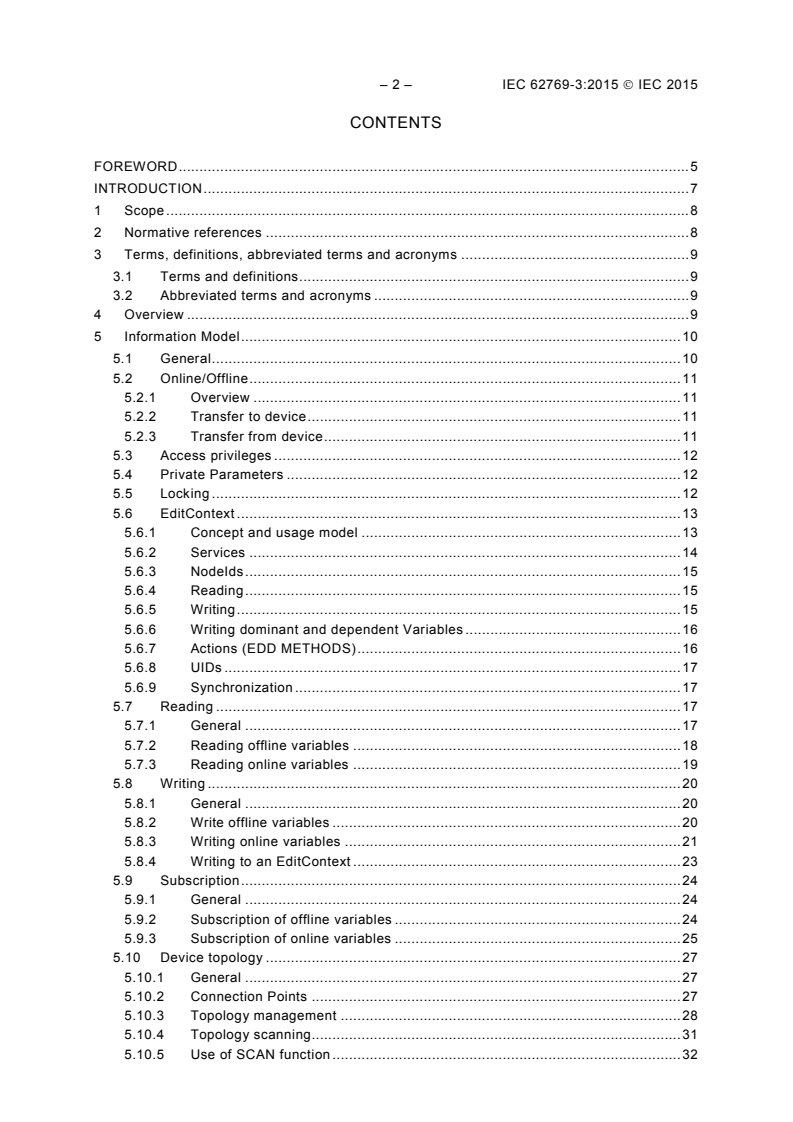
CONTENTS
FOREWORD . 5
INTRODUCTION . 7
1 Scope . 8
2 Normative references . 8
3 Terms, definitions, abbreviated terms and acronyms . 9
3.1 Terms and definitions . 9
3.2 Abbreviated terms and acronyms . 9
4 Overview . 9
5 Information Model . 10
5.1 General . 10
5.2 Online/Offline . 11
5.2.1 Overview . 11
5.2.2 Transfer to device . 11
5.2.3 Transfer from device . 11
5.3 Access privileges . 12
5.4 Private Parameters . 12
5.5 Locking . 12
5.6 EditContext . 13
5.6.1 Concept and usage model . 13
5.6.2 Services . 14
5.6.3 NodeIds . 15
5.6.4 Reading . 15
5.6.5 Writing . 15
5.6.6 Writing dominant and dependent Variables . 16
5.6.7 Actions (EDD METHODS) . 16
5.6.8 UIDs . 17
5.6.9 Synchronization . 17
5.7 Reading . 17
5.7.1 General . 17
5.7.2 Reading offline variables . 18
5.7.3 Reading online variables . 19
5.8 Writing . 20
5.8.1 General . 20
5.8.2 Write offline variables . 20
5.8.3 Writing online variables . 21
5.8.4 Writing to an EditContext . 23
5.9 Subscription . 24
5.9.1 General . 24
5.9.2 Subscription of offline variables . 24
5.9.3 Subscription of online variables . 25
5.10 Device topology . 27
5.10.1 General . 27
5.10.2 Connection Points . 27
5.10.3 Topology management . 28
5.10.4 Topology scanning . 31
5.10.5 Use of SCAN function . 32
5.10.6 Validation of defined topology . 32
5.11 User Interface Elements . 33
5.11.1 User Interface Descriptions. 33
5.11.2 User Interface Plug-ins . 34
5.12 Actions . 34
5.12.1 FDI Server – FDI Client interaction . 34
5.12.2 Action state machine . 37
5.12.3 Actions Proxies . 38
5.12.4 Actions, EDD Actions and Actions Proxies . 39
6 OPC UA services . 40
6.1 OPC UA profiles . 40
6.2 Service error information . 40
6.2.1 Overview . 40
6.2.2 OPC UA services and their response . 41
6.2.3 Mappings of EDDL response codes to OPC UA service response . 41
6.3 Parameter value update during write service request . 42
6.4 Localization . 42
6.5 Audit events . 43
7 Communication . 43
7.1 Notation . 43
7.2 General . 43
7.2.1 Concepts . 43
7.2.2 Terms . 45
7.3 Communication Service processing . 46
7.3.1 Communication Service invocation . 46
7.3.2 Analyze communication path . 46
7.3.3 Manage communication relations . 47
7.3.4 Communication service request mapping . 47
7.3.5 Communication service request propagation . 48
7.3.6 Communication error handling . 49
7.4 FDI Communication Server specific handling . 49
7.4.1 Discovery . 49
7.4.2 Information Model synchronization . 50
8 Parallel Execution within the FDI Server . 50
8.1 Motivation . 50
8.2 Internal structure of the EDD interpreter. 50
8.3 Rules for running an EDD entity . 51
Annex A (informative) FDI Server functional structure . 52
A.1 FDI functional elements . 52
A.2 FDI Server extension . 53
Annex B (informative) Access privileges and user roles . 55
B.1 User roles and usage case . 55
B.2 Private data usage . 56
Annex C (informative) Parallel execution within the FDI Server – Examples . 57
C.1 Simple example for a synchronous execution . 57
C.2 Example for a concurrent execution . 57
C.3 Deadlock detection in concurrent execution . 59
Bibliography . 60
– 4 – IEC 62769-3:2015 IEC 2015
Figure 1 – FDI architecture diagram . 8
Figure 2 – Locking services . 13
Figure 3 – EditContext models . 14
Figure 4 – EditContext for EDD Methods . 17
Figure 5 – Offline variable read . 18
Figure 6 – Online variable read . 19
Figure 7 – Offline variable write immediate . 21
Figure 8 – Online variable write immediate . 22
Figure 9 – Write with EditContext . 23
Figure 10 – Offline variable subscription . 25
Figure 11 – Online variable subscription . 26
Figure 12 – Topology with Network objects (non-normative) . 27
Figure 13 – Add Device to topology . 29
Figure 14 – Remove Device from topology . 30
Figure 15 – Scan topology . 31
Figure 16 – Action execution . 36
Figure 17 – Action state machine . 37
Figure 18 – System communication integration example . 43
Figure 19 – FDI Communication Server integration example . 44
Figure 20 – Gateway integration example . 45
Figure 21 – Message propagation example scenario . 48
Figure A.1 – Functional components of an FDI Server . 52
Figure A.2 – FDI Server extensions . 53
Figure B.1 – User roles and access privileges . 55
Figure C.1 – Synchronous execution of two triggers . 57
Figure C.2 – Concurrent execution of two triggers (step1) . 57
Figure C.3 – Concurrent execution of two triggers (step 2) . 58
Figure C.4 – Concurrent execution of two triggers (step 3) . 58
Figure C.5 – Concurrent execution of two triggers (step 4) . 58
Figure C.6 – Concurrent execution of two triggers. 59
Table 1 – Action states . 37
Table 2 – Action state transitions . 38
Table 3 – EDD Action types and the EDD constructs that use them . 39
Table 4 – OPC UA severity bits and EDDL response codes TYPE . 41
INTERNATIONAL ELECTROTECHNICAL COMMISSION
____________
FIELD DEVICE INTEGRATION (FDI) –
Part 3: FDI Server
FOREWORD
1) The International Electrotechnical Commission (IEC) is a worldwide organization for standardization comprising
all national electrotechnical committees (IEC National Committees). The object of IEC is to promote
international co-operation on all questions concerning standardization in the electrical and electronic fields. To
this end and in addition to other activities, IEC publishes International Standards, Technical Specifications,
Technical Reports, Publicly Available Specifications (PAS) and Guides (hereafter referred to as “IEC
Publication(s)”). Their preparation is entrusted to technical committees; any IEC National Committee interested
in the subject dealt with may participate in this preparatory work. International, governmental and non-
governmental organizations liaising with the IEC also participate in this preparation. IEC collaborates closely
with the International Organization for Standardization (ISO) in accordance with conditions determined by
agreement between the two organizations.
2) The formal decisions or agreements of IEC on technical matters express, as nearly as possible, an international
consensus of opinion on the relevant subjects since each technical committee has representation from all
interested IEC National Committees.
3) IEC Publications have the form of recommendations for international use and are accepted by IEC National
Committees in that sense. While all reasonable efforts are made to ensure that the technical content of IEC
Publications is accurate, IEC cannot be held responsible for the way in which they are used or for any
misinterpretation by any end user.
4) In order to promote international uniformity, IEC National Committees undertake to apply IEC Publications
transparently to the maximum extent possible in their national and regional publications. Any divergence
between any IEC Publication and the corresponding national or regional publication shall be clearly indicated in
the latter.
5) IEC itself does not provide any attestation of conformity. Independent certification bodies provide conformity
assessment services and, in some areas, access to IEC marks of conformity. IEC is not responsible for any
services carried out by independent certification bodies.
6) All users should ensure that they have the latest edition of this publication.
7) No liability shall attach to IEC or its directors, employees, servants or agents including individual experts and
members of its technical committees and IEC National Committees for any personal injury, property damage or
other damage of any nature whatsoever, whether direct or indirect, or for costs (including legal fees) and
expenses arising out of the publication, use of, or reliance upon, this IEC Publication or any other IEC
Publications.
8) Attention is drawn to the Normative references cited in this publication. Use of the referenced publications is
indispensable for the correct application of this publication.
International Standard IEC 62769-3 has been prepared by subcommittee 65E: Devices and
integration in enterprise systems, of IEC technical committee 65: Industrial-process
measurement, control and automation.
The text of this standard is based on the following documents:
CDV Report on voting
65E/346/CDV 65E/423/RVC
Full information on the voting for the approval of this standard can be found in the report on
voting indicated in the above table.
This publication has been drafted in accordance with the ISO/IEC Directives, Part 2.
A list of all parts in the IEC 62769 series, published under the general title Field Device
Integration (FDI), can be found on the IEC website.
– 6 – IEC 62769-3:2015 IEC 2015
The committee has decided that the contents of this publication will remain unchanged until
the stability date indicated on the IEC website under "http://webstore.iec.ch" in the data
related to the specific publication. At this date, the publication will be
• reconfirmed,
• withdrawn,
• replaced by a revised edition, or
• amended.
IMPORTANT – The 'colour inside' logo on the cover page of this publication indicates
that it contains colours which are considered to be useful for the correct
understanding of its contents. Users should therefore print this document using a
colour printer.
INTRODUCTION
The International Electrotechnical Commission (IEC) draws attention to the fact that it is
claimed that compliance with this document may involve the use of patents concerning
a) method for the Supplying and Installation of Device-Specific Functionalities, see Patent
Family DE10357276;
b) method and device for accessing a functional module of automation system, see Patent
Family EP2182418;
c) methods and apparatus to reduce memory requirements for process control system
;
software applications, see Patent Family US2013232186
d) extensible device object model, see Patent Family US12/893,680.
IEC takes no position concerning the evidence, validity and scope of this patent right.
The holders of these patent rights have assured the IEC that he/she is willing to negotiate
licences either free of charge or under reasonable and non-discriminatory terms and
conditions with applicants throughout the world. In this respect, the statement of the holder of
this patent right is registered with IEC. Information may be obtained from:
a) ABB Research Ltd
Claes Rytoft
Affolterstrasse 4
Zurich, 8050
Switzerland
b) Phoenix Contact GmbH & Co KG
Intellectual Property, Licenses & Standards
Flachsmarktstrasse 8, 32825 Blomberg
Germany
c) Fisher Controls International LLC
John Dilger, Emerson Process Management LLLP
st
301 S. 1 Avenue, Marshaltown, Iowa 50158
USA
d) Rockwell Automation Technologies, Inc.
1 Allen-Bradley Drive
Mayfield Heights, Ohio 44124
USA
Attention is drawn to the possibility that some of the elements of this document may be the
subject of patent rights other than those identified above. IEC shall not be held responsible for
identifying any or all such patent rights.
ISO (www.iso.org/patents) and IEC (http://patents.iec.ch) maintain on-line data bases of
patents relevant to their standards. Users are encouraged to consult the data bases for the
most up to date information concerning patents.
– 8 – IEC 62769-3:2015 IEC 2015
FIELD DEVICE INTEGRATION (FDI) –
Part 3: FDI Server
1 Scope
This part of IEC 62769 specifies the FDI Server. The overall FDI architecture is illustrated in
Figure 1. The architectural components that are within the scope of this document have been
highlighted in this figure.
User Interface
FDI Package
Description
FDI Package
User
Device Business User
Interface
Definition Interface
User Logic User
FDI Client Device Business Plug-in
Interface Interface
Definition Logic
Description Plug-in
UID
Interpreter
UID
FDI Server
UIP
Information Model Management
Services
Information Model Business Logic
User Interface Processor
OPC UA
Plug-in
Device Object
Business
Device Object
Logic
Device Object
User Interface Services
Platform UI Services
(Drawing, Input Devices)
System Services
OPC UA
Services
OPC UA
OPC UA Client
Services
System
Communication
Communication
Hardware
Server
Data
Specified by this part of this International Standard
Store
Specified by other parts of this International Standard
Not specified by this International Standard
IEC
Figure 1 – FDI architecture diagram
2 Normative references
The following documents, in whole or in part, are normatively referenced in this document and
are indispensable for its application. For dated references, only the edition cited applies. For
undated references, the latest edition of the referenced document (including any
amendments) applies.
IEC 61804 (all parts), Function blocks (FB) for process control and Electronic Device
Description Language (EDDL)
OPC UA
Hosting Services
Device Access
Services
OPC UA Services
Business Logic
Interface
IEC 61804-3 , Function block (FB) for process control and Electronic Device Description
Language (EDDL) – Part 3: EDDL syntax and semantics
IEC 61804-4 , Function blocks (FB) for process control and Electronic Device Description
Language (EDDL) – Part 4: EDD interpretation
IEC 62541 (all parts), OPC unified architecture
IEC 62541-4, OPC unified architecture –Part 4: Services
IEC 62541-7, OPC unified architecture – Part 7: Profiles
IEC 62769-1, Field Device Integration – Part 1: Overview
NOTE IEC 62769-1 is technically identical to FDI-2021.
IEC 62769-2, Field Device Integration – Part 2: FDI Client
NOTE IEC 62769-2 is technically identical to FDI-2022.
IEC 62769-4, Field Device Integration – Part 4: FDI Packages
NOTE IEC 62769-4 is technically identical to FDI-2024.
IEC 62769-5, Field Device Integration – Part 5: FDI Information Model
NOTE IEC 62769-5 is technically identical to FDI-2025.
IEC 62769-7, Field Device Integration – Part 7: FDI Communication Devices
NOTE IEC 62769-7 is technically identical to FDI-2027.
3 Terms, definitions, abbreviated terms and acronyms
3.1 Terms and definitions
For the purposes of this document, the terms and definitions given in IEC 62769-1 as well as
the following apply.
3.1.1
Actions Proxy
internal FDI Server entity that encapsulates all the EDD Methods specified in an EDD Action
definition
3.2 Abbreviated terms and acronyms
For the purposes of this document, the abbreviated terms and acronyms given in IEC 62769-1
apply.
4 Overview
The structure for an FDI Server is shown in Figure 1.
—————————
To be published.
To be published.
– 10 – IEC 62769-3:2015 IEC 2015
FDI Servers that support connectivity with third-party FDI Clients shall support OPC UA. A
vendor can provide both an FDI Server and one or more FDI Clients. In this case, the FDI
Clients can communicate with the FDI Server through proprietary protocols.
An FDI Server communicates with devices via Native Communication (see 7.2.1) and/or
Communication Devices (see IEC 62769-7).
An FDI Server provides information to FDI Clients through an Information Model (see
IEC 62769-5) as follows.
• The Information Model includes information about Device Types and Device Instances.
The information for a Device Instance includes offline data (engineering data), as well as
online data (values from the physical device).
• The Information Model is created using information from FDI Packages. However, not all
of the information in an FDI Package is reflected in the Information Model.
• Referential integrity of the Information Model is maintained using information from FDI
Packages.
• FDI Packages can contain Attachments that contain device manuals and protocol specific
information (see IEC 62769-4). Those Attachments, including device manuals and protocol
specific support files, are exposed via the Information Model.
• FDI Device Packages contain information about device types (see
IEC 62769-4). Each device type defined in a package is mapped to a distinct DeviceType
node in the Information Model.
• FDI Profile Packages are used to provide interaction with devices for which an FDI Device
Package does not exist (see IEC 62769-4).
• Multiple revisions of an FDI Package generate distinct DeviceType nodes in the
Information Model (see IEC 62769-4).
FDI Packages contain digital signatures that allow an FDI Server to authenticate their
contents (see IEC 62769-4). An FDI Server shall not use an FDI Package if the digital
signature provided by the FDI Package is invalid.
An FDI Server shall verify the FDI Technology Version (see IEC 62769-1) of any FDI Package
it uses to ensure the FDI Package is compatible with the FDI Server.
5 Information Model
5.1 General
The FDI Server shall use the Device Definition of an FDI Package to maintain the Information
Model.
The Device Definition can contain conditional expressions. Conditional expressions are used
when a certain aspect of the Device Definition is not static but rather is dependent on the
state of the device. Whenever the online or offline values of a Device Instance are modified,
the FDI Server shall re-evaluate the relevant conditional expressions and modify the
Information Model accordingly.
The evaluation of conditional expressions can invalidate variables in the Information Model.
The FDI Server shall change the AccessLevel attribute of invalidated variables such that they
are neither readable nor writable and the status of these variables shall be set to bad. Read
and write service requests for invalidated variables shall return a failure.
The Device Definition can specify relationships between variables in a device. These
relationships can impact the value of variables in the Information Model.
The FDI Server shall generate DataChange Notifications to any FDI Clients that are
subscribing to Information Model elements that have changed.
FDI Packages provide Business Logic that is used by the FDI Server to maintain the integrity
of the Information Model. The Business Logic specified in an FDI Package can invoke built-in
functions that shall be implemented by the FDI Server. The built-in functions that shall be
implemented by the FDI Server are specified in IEC 61804.
5.2 Online/Offline
5.2.1 Overview
The Information Model maintained by the FDI Server contains online and offline values. The
online values reflect values in a physical component/device. The offline values reflect values
stored in a configuration database.
The offline values are updated through write service requests from an FDI Client or Business
Logic executed by the FDI Server. The offline values are not updated when the FDI Server
reads data from the device or writes data to the device.
The online values in the Information Model are not updated through write service requests.
Successful write service requests through the Information Model result in value changes in
the physical devices. The online values in the Information Model will then be updated as a
result of read service requests or subscriptions.
FDI Servers can provide a server-specific mechanism for creating Device Instances without
the presence of physical hardware. The FDI Server creates these instances using information
in FDI Packages. All read/write requests for online values for Device Instances with no
physical device shall return an error.
The transfer of information between the offline values and the physical device is supported
through the TransferToDevice and TransferFromDevice methods in the Information Model.
These Methods shall implement the download and upload procedures, respectively, as
specified in IEC 61804-4. When no implementation is provided based on IEC 61804-4, then
these Methods shall return Bad_NotSupported, as per IEC 62541-4.
The Device shall have been locked prior to invoking these methods, as specified in
IEC 62769-5.
5.2.2 Transfer to device
The TransferToDevice method shall implement the download procedure as specified in
IEC 61804-4. This transfers the offline values to the physical device.
As a general rule, the FDI Server should not change the Online variable node when writing a
value to the device. The Online variable node should be updated only in the process of read
operations or subscriptions. Notwithstanding, as specified in IEC 62769-5, the FDI Server will
reset any cached Value for the target Nodes in the Information Model so that they will be re-
read next time they are requested.
The status information returned for each variable included in the write service request is used
to compose the TransferResult, as specified in IEC 62769-5.
5.2.3 Transfer from device
The TransferFromDevice method shall implement the upload procedure as specified in
IEC 61804-4. This transfers the values from the physical device to the offline values.
– 12 – IEC 62769-3:2015 IEC 2015
If any read operations from the device fail during upload, the corresponding offline value shall
not be modified.
The status information returned for each variable included in the read service request is used
to compose the TransferResult, as specified in IEC 62769-5.
5.3 Access privileges
Systems implement security and access policies based on a number of characteristics such
as user role and plant area. FDI Servers use these policies, along with information in FDI
Packages, to determine the access privileges granted to the user.
The elements of an FDI Package can be associated with one or more usage attributes. The
FDI Server uses these attributes to set the UserAccessLevel attribute of Variables and the
UserExecutable attribute of Methods. The usage attributes in an FDI Package are simply hints
to be used by the FDI Server, i.e., they may be disregarded or overridden by the FDI Server.
See also Annex B.
5.4 Private Parameters
The Parameters and Actions specified in an FDI Package may be declared private. Private
Parameters and Actions shall not be browsable; they shall only be accessible through
references from other elements of an FDI Package.
More specifically, the FDI Server shall support private Parameters and Actions as follows.
• The FDI Server shall create nodes in the Information Model for the private Parameters and
Actions.
• The FDI Server shall not include information about private Parameters and Actions in a
response to a Browse, BrowseNext, QueryFirst, or QueryNext service request.
• The FDI Server shall return the NodeIds of private Parameters and Actions when the
name of a private Parameter or Action is passed to TranslateBrowsePathsToNodeIds.
• The FDI Server shall process a read/write service request for a private Parameter in the
same way as it does for public (browsable) Parameters (see 5.7 and 5.8).
• The FDI Server shall execute private Actions in the same way as it does public
(browsable) Actions (see 5.12).
An example of private parameters is parameters that should only be modified through an
Action. These parameters should not be visible to FDI Clients to prevent direct access. FDI
Clients invoke Actions to access these private parameters.
5.5 Locking
The FDI Server provides locking services to grant FDI Clients exclusive access to Device and
Network elements in the Information Model. The locking services consist of a set of Methods
and status information. The methods, and their behavior, are specified in IEC 62769-5.
The following behavior shall be implemented by the FDI Server to support locks.
• Locking applies to both online and offline nodes.
• Once locked by one FDI Client, any attempt to write to a Parameter or to execute an
Action by another FDI Client shall be rejected.
• Locking is not required for read services.
• Parameters that are locked by one FDI Client can still be read by other FDI Clients, i.e.,
read requests on a Parameter that is locked are not rejected.
Internal use of the locking mechanism for maintaining the Information Model integrity is FDI
Server vendor specific.
Figure 2 illustrates a locking sequence with multiple service invocations during the locked
state.
FDIServer
FDIClient
InitLock()
Process Service Requests to Device
Service Request
Optional
Process Service Request
ExitLock()
IEC
Figure 2 – Locking services
A service request that requires locking shall fail either partially or completely if no lock has
been acquired by the FDI Client via InitLock prior to requesting the service. The FDI Client
has to release the lock via ExitLock after all service requests have been completed.
NOTE A write operation will partially fail, i.e., it will return a status code for each variable in the set of variables to
be written since some may belong to devices that are locked and some to devices that are not locked.
FDI Servers may queue InitLock requests until a service for which a lock has been created
completes and the lock has been released. However, such an optimization is not part of the
standard behavior required of an FDI Server.
5.6 EditContext
5.6.1 Concept and usage model
The FDI Server provides the EditContext model to interact with Clients during their editing
task. The concept is closely related to UIDs and fulfills the needs for Server-driven UI dialogs
based on EDDL rules.
An EditContext can be used to make changes to Variable Values visible to the Server without
applying them to the online or offline representation of a Device. The Server will apply
business logic associated to the edited Variable which – in some cases – causes changes to
other Variable Values (e.g. if an engineering unit is changed) or the UID (e.g. a Variable
becomes invisible). Thus the Client can use an EditContext to modify (edit) Parameters like
engineering units, ranges and more, verify any side effects, and re-adjust the settings before
applying the changes.
An FDI Server may implement different EditContext strategies:
• A single EditContext instance for all dialogues of an FDI Client.
• Multiple EditContext instances.
• Hierarchical EditContext instances.
– 14 – IEC 62769-3:2015 IEC 2015
IEC
Figure 3 – EditContext models
Figure 3 shows two possible Server strategies and how the Client can adapt. In the lower
scenario the Server provides a single EditContext instance for all dialogs. Here, the Client
groups all dialogs and exposes a single set of buttons to Apply and Cancel, because it always
concerns all edits.
In the upper scenario, the Server provides multiple EditContext instances, one of them as
child of another one. Each instance can be addressed separately. If the changes in a child
instance are applied, they are transferred to the parent. If the changes in a root instance are
applied, they are transferred to the Device.
Parent-child dependencies:
...