

IEC 60601-2-44:2001/AMD1:2002
(Amendment)Amendment 1 - Medical electrical equipment - Part 2-44: Particular requirements for the safety of X-ray equipment for computed tomography
General Information
- Abstract
The contents of the corrigendum of April 2006 have been included in this copy.
- Status
- Published
- Publication Date
- 18-Sep-2002
- Technical Committee
- SC 62B - Medical imaging equipment, software, and systems
- Drafting Committee
- WG 30 - TC 62/SC 62B/WG 30
- Current Stage
- DELPUB - Deleted Publication
- Start Date
- 25-Feb-2009
- Completion Date
- 28-Aug-2026

Overview
IEC 60601-2-44:2001/AMD1:2002 is an important amendment to the international standard focusing on the safety of medical electrical equipment, specifically X-ray equipment used in computed tomography (CT). Developed by the International Electrotechnical Commission (IEC) and its technical committee 62B on Diagnostic Imaging Equipment, this amendment updates definitions and requirements to better align with scientific standards and improve safety measures. It incorporates corrections and detailed definitions related to dose values to be displayed, reflecting the latest understanding and regulatory expectations as of 2002, with corrigendum updates integrated through 2006.
Key Topics
Terminology and Definitions
- CT Scanner: Defined as an X-ray system that generates cross-sectional images through computer reconstruction, which includes patient support and accessories but excludes secondary image processing.
- Computed Tomography Dose Index 100 (CTDI₁₀₀): Quantifies the absorbed dose profile from a single axial scan over a specific 100 mm length. It is calculated by integrating the dose profile, divided by the product of the number of tomographic sections and nominal section thickness.
- CT Pitch Factor: Relevant in helical scanning, it describes the ratio of patient table travel per rotation to the total collimated slice thickness.
- Tomographic Section Thickness and Nominal Thickness: Precise definitions clarify the measured and selected thicknesses for slices, important for dose calculations and image quality.
- Dose Statements and Display Requirements: The amendment specifies how CTDI values and operational conditions must be presented clearly on control panels, including volume CTDI and weighted CTDI calculations.
- Interlocks and Radiation Protection: Guidance on the use of external interlocks highlights the risks of dose increase to both patients and operators if interlocks cause scan interruptions, recommending minimal use only when mandatory.
Safety and Radiation Dose Management
- Ensures strict controls on radiation output limits and means for operators to terminate exposures immediately, enhancing patient and operator safety.
- Introduces clear requirements for measurement, reporting, and display of CT dose indices to aid dose optimization and radiation protection compliance.
- Defines geometric efficiency in the z-direction for detector elements to assure dose distributions are within safe and efficient parameters.
Applications
IEC 60601-2-44 Amendment 1 is critical for manufacturers, healthcare providers, and regulatory bodies involved with CT scanner design, operation, and safety compliance. Its application ensures:
- Manufacturers develop CT equipment that clearly reports radiation dose information, enabling informed clinical use and compliance with radiation safety standards.
- Medical Physicists and Radiologists benefit from standardized dose measurements and definitions, promoting accurate dose tracking and optimization during diagnostic imaging.
- Healthcare Facilities can maintain safer CT scanning environments with operational controls that mitigate excessive radiation exposure risks.
- Regulatory Authorities utilize this standard as a benchmark when approving medical electrical equipment for clinical use, emphasizing patient and operator safety.
Related Standards
- IEC 60601 Series: General requirements for the safety and essential performance of medical electrical equipment.
- US FDA 21 CFR 1020.33: Specific regulations on computed tomography equipment in the United States, referenced to align dose measurement standards.
- European Guidelines on Quality Criteria for Computed Tomography (EUR 16262 EN:2000): Provides clinical quality requirements complementary to IEC safety standards.
- ICRU Report 47:1992: Addresses measurement methodologies for radiation dose equivalents, providing scientific underpinning for dose definitions.
Conclusion
IEC 60601-2-44:2001/AMD1:2002 amendment enhances the safety framework for CT X-ray equipment by refining dose definitions, measurement protocols, and operational safety features. It supports consistent, transparent radiation dose reporting and establishes operator protections that are essential for maintaining patient safety and compliance with international medical device standards. This standard serves as a cornerstone for anyone involved in the development, regulation, or clinical use of computed tomography imaging systems.
Relations
- Effective Date
- 05-Sep-2023
- Effective Date
- 05-Sep-2023
- Effective Date
- 05-Sep-2023
Get Certified
Connect with accredited certification bodies for this standard

BSI Group
BSI (British Standards Institution) is the business standards company that helps organizations make excellence a habit.

TÜV Rheinland
TÜV Rheinland is a leading international provider of technical services.

TÜV SÜD
TÜV SÜD is a trusted partner of choice for safety, security and sustainability solutions.
Sponsored listings
Frequently Asked Questions
IEC 60601-2-44:2001/AMD1:2002 is a standard published by the International Electrotechnical Commission (IEC). Its full title is "Amendment 1 - Medical electrical equipment - Part 2-44: Particular requirements for the safety of X-ray equipment for computed tomography". This standard covers: The contents of the corrigendum of April 2006 have been included in this copy.
The contents of the corrigendum of April 2006 have been included in this copy.
IEC 60601-2-44:2001/AMD1:2002 is classified under the following ICS (International Classification for Standards) categories: 11.040.50 - Radiographic equipment. The ICS classification helps identify the subject area and facilitates finding related standards.
IEC 60601-2-44:2001/AMD1:2002 has the following relationships with other standards: It is inter standard links to IEC 60601-2-44:2001, IEC 60601-2-44:2001/AMD1:2002/COR1:2006, IEC 60601-2-44:2009. Understanding these relationships helps ensure you are using the most current and applicable version of the standard.
IEC 60601-2-44:2001/AMD1:2002 is available in PDF format for immediate download after purchase. The document can be added to your cart and obtained through the secure checkout process. Digital delivery ensures instant access to the complete standard document.
Standards Content (Sample)
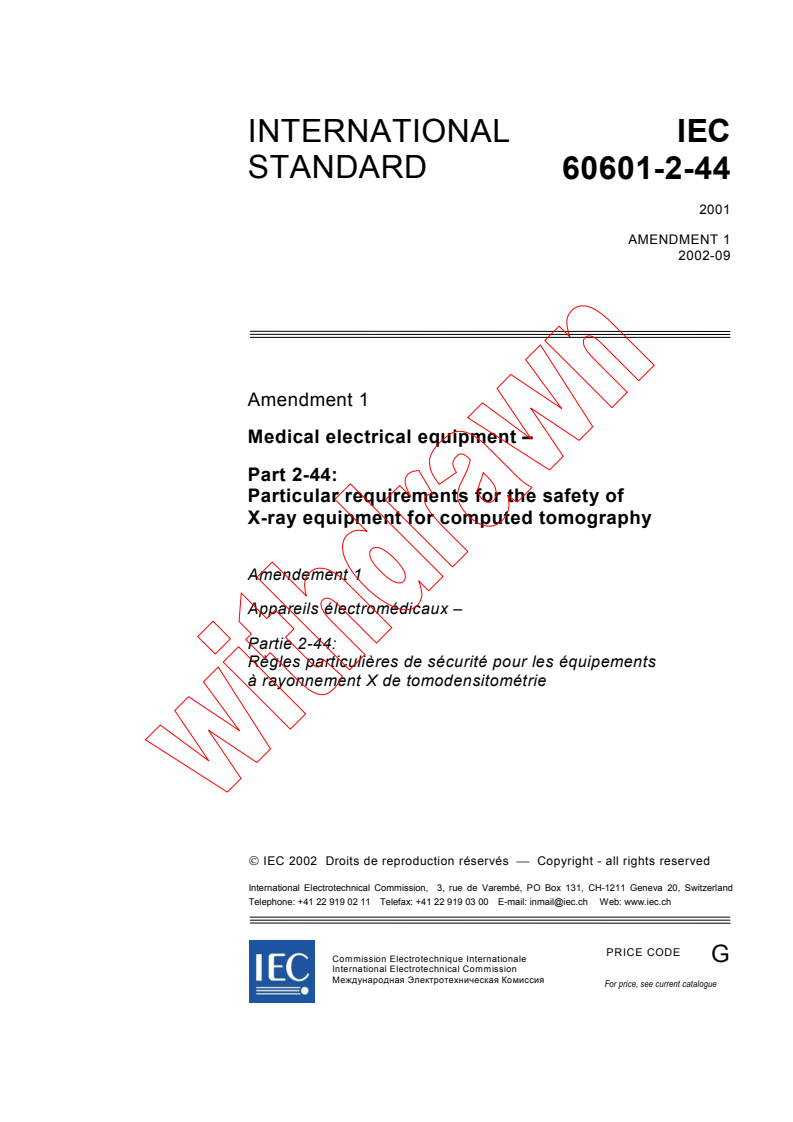
INTERNATIONAL IEC
STANDARD
60601-2-44
AMENDMENT 1
2002-09
Amendment 1
Medical electrical equipment –
Part 2-44:
Particular requirements for the safety of
X-ray equipment for computed tomography
Amendement 1
Appareils électromédicaux –
Partie 2-44:
Règles particulières de sécurité pour les équipements
à rayonnement X de tomodensitométrie
IEC 2002 Droits de reproduction réservés Copyright - all rights reserved
International Electrotechnical Commission, 3, rue de Varembé, PO Box 131, CH-1211 Geneva 20, Switzerland
Telephone: +41 22 919 02 11 Telefax: +41 22 919 03 00 E-mail: inmail@iec.ch Web: www.iec.ch
PRICE CODE
Commission Electrotechnique Internationale
G
International Electrotechnical Commission
Международная Электротехническая Комиссия
For price, see current catalogue
– 2 – 60601-2-44 Amend. 1 IEC:2002(E)
FOREWORD
This amendment has been prepared by subcommittee 62B: Diagnostic imaging equipment, of
IEC technical committee 62: Electrical equipment in medical practice.
The text of this amendment is based on the following documents:
FDIS Report on voting
62B/472/FDIS 62B/478/RVD
Full information on the voting for the approval of this amendment can be found in the report
on voting indicated in the above table.
The committee has decided that the contents of the base publication and its amendments will
remain unchanged until 2004-06. At this date, the publication will be
• reconfirmed;
• withdrawn;
• replaced by a revised edition, or
• amended.
The contents of the corrigendum of April 2006 have been included in this copy.
_____________
INTRODUCTION
In the second edition of this Particular Standard six definitions were changed compared with the
first edition. These changes, however, were not in line with the definitions used in international
scientific publications. This amendment to the Particular Standard mainly corrects those
definitions and adds more detailed definitions of the dose values to be displayed.
Page 8
2 Terminology and definitions
Replace the existing definitions 2.101 and 2.106 to 2.110 by the following:
2.101
CT SCANNER
X-RAY EQUIPMENT for COMPUTED TOMOGRAPHY (CT)
diagnostic X-ray system intended to generate cross-sectional images of the body by computer
reconstruction of X-ray transmission data obtained at different angles. This generic type of
device may include signal analysis and display equipment, PATIENT SUPPORT, support parts
ACCESSORIES
and
NOTE Secondary imaging processing is not included in the scope of this standard.
2.106
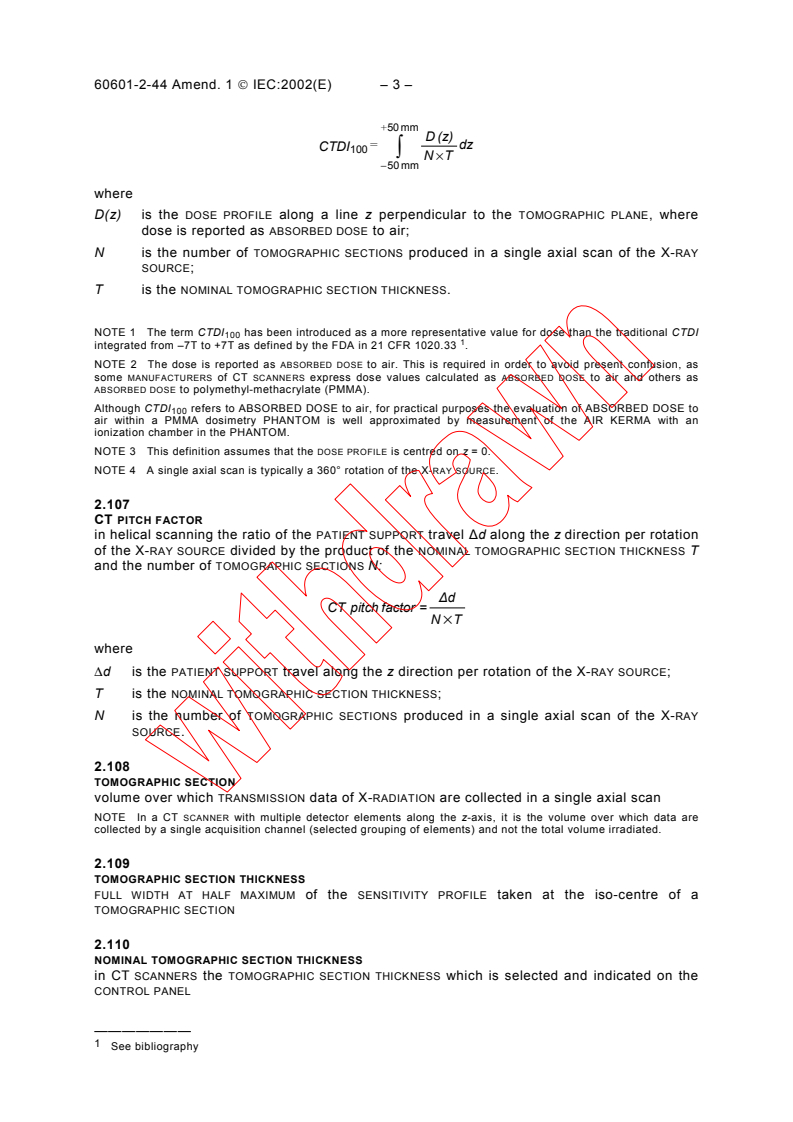
COMPUTED TOMOGRAPHY DOSE INDEX 100 (CTDI )
integral of the DOSE PROFILE produced in a single axial scan along a line perpendicular to
the TOMOGRAPHIC PLANE from –50 mm to +50 mm, divided by the product of the number of
TOMOGRAPHIC SECTIONS N and the NOMINAL TOMOGRAPHIC SECTION THICKNESS T:
60601-2-44 Amend. 1 IEC:2002(E) – 3 –
+50 mm
D (z)
= dz
CTDI
∫
N × T
−50 mm
where
D(z) is the DOSE PROFILE along a line z perpendicular to the TOMOGRAPHIC PLANE, where
dose is reported as ABSORBED DOSE to air;
N is the number of TOMOGRAPHIC SECTIONS produced in a single axial scan of the X-RAY
SOURCE;
T is the NOMINAL TOMOGRAPHIC SECTION THICKNESS.
NOTE 1 The term CTDI has been introduced as a more representative value for dose than the traditional CTDI
integrated from –7T to +7T as defined by the FDA in 21 CFR 1020.33 .
NOTE 2 The dose is reported as ABSORBED DOSE to air. This is required in order to avoid present confusion, as
some MANUFACTURERS of CT SCANNERS express dose values calculated as ABSORBED DOSE to air and others as
ABSORBED DOSE to polymethyl-methacrylate (PMMA).
Although CTDI refers to ABSORBED DOSE to air, for practical purposes the evaluation of ABSORBED DOSE to
air within a PMMA dosimetry PHANTOM is well approximated by measurement of the AIR KERMA with an
ionization chamber in the PHANTOM.
NOTE 3 This definition assumes that the DOSE PROFILE is centred on z = 0.
NOTE 4 A single axial scan is typically a 360° rotation of the X-RAY SOURCE.
2.107
CT PITCH FACTOR
in helical scanning the ratio of the PATIENT SUPPORT travel ∆d along the z direction per rotation
of the X-RAY SOURCE divided by the product of the NOMINAL TOMOGRAPHIC SECTION THICKNESS T
and the number of TOMOGRAPHIC SECTIONS N:
∆d
CT pitch factor =
N ×T
where
Δd is the PATIENT SUPPORT travel along the z direction per rotation of the X-RAY SOURCE;
T is the NOMINAL TOMOGRAPHIC SECTION THICKNESS;
N is the number of TOMOGRAPHIC SECTIONS produced in a single axial scan of the X-RAY
SOURCE.
2.108
TOMOGRAPHIC SECTION
volume over which TRANSMISSION data of X-RADIATION are collected in a single axial scan
NOTE In a CT SCANNER with multiple detector elements along the z-axis, it is the volume over which data are
collected by a single acquisition channel (selected grouping of elements) and not the total volume irradiated.
2.109
TOMOGRAPHIC SECTION THICKNESS
FULL WIDTH AT HALF MAXIMUM of the SENSITIVITY PROFILE taken at the iso-centre of a
TOMOGRAPHIC SECTION
2.110
NOMINAL TOMOGRAPHIC SECTION THICKNESS
in CT SCANNERS the TOMOGRAPHIC SECTION THICKNESS which is selected and indicated on the
CONTROL PANEL
———————
See bibliography
– 4 – 60601-2-44 Amend. 1 IEC:2002(E)
NOTE In helical scanning the thickness of a reconstructed image depends on the helical reconstruction algorithm
and pitch, and hence this thickness may not equal the NOMINAL TOMOGRAPHIC SECTION THICKNESS. The thickness of
the reconstructed image may be indicated or selected prior to the helical scan.
Page 13
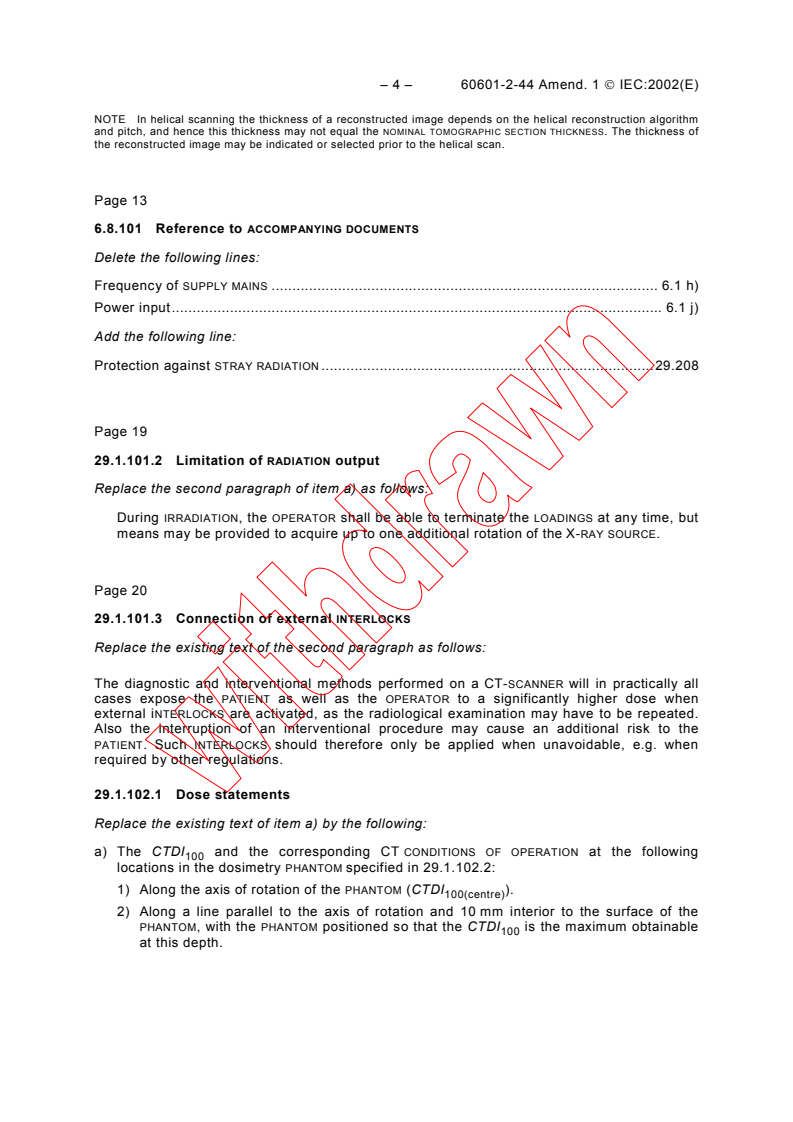
6.8.101 Reference to ACCOMPANYING DOCUMENTS
Delete the following lines:
Frequency of SUPPLY MAINS . 6.1 h)
Power input. 6.1 j)
Add the following line:
Protection against STRAY RADIATION .29.208
Page 19
...