

IEC 61223-3-6:2020
(Main)Evaluation and routine testing in medical imaging departments - Part 3-6: Acceptance and constancy tests - Imaging performance of mammographic X-ray equipment used in a mammographic tomosynthesis mode of operation
General Information
- Abstract
IEC 61223-3-6:2020 applies to the performance of MAMMOGRAPHIC X-RAY EQUIPMENT when used in MAMMOGRAPHIC TOMOSYNTHESIS modes of operation, with respect to image quality and dose.
Excluded from the scope of this document are:
- MAMMOGRAPHIC X-RAY EQUIPMENT modes of operation other than MAMMOGRAPHIC TOMOSYNTHESIS;
- 2D images synthesised from the tomosynthesis images;
- reconstructive TOMOGRAPHY other than MAMMOGRAPHIC TOMOSYNTHESIS;
- CT SCANNERS covered by IEC 61223-3-5.
IEC 61223-3-6:2020 defines
a) the essential parameters which describe the acceptability criteria of MAMMOGRAPHIC TOMOSYNTHESIS modes of operation of MAMMOGRAPHIC X-RAY EQUIPMENT with regard to image quality and dose,
b) the methods of testing whether measured quantities related to those parameters comply with specified tolerances, and
c) CONSTANCY TEST frequency when required.
This document is intended to be applied along with the acceptability criteria included in IEC 61223-3-2 or equivalent protocol for 2D mammography which are also relevant for MAMMOGRAPHIC TOMOSYNTHESIS modes of operation.
These methods mainly rely on non-invasive measurements that use appropriate test equipment and are performed during or after the installation. Signed statements covering steps in the installation procedure can be used as part of the ACCEPTANCE TEST. Tests required by a higher level of compliance take precedence over similar tests with a lower level of compliance.
When the results of the ACCEPTANCE TEST are in compliance with the expected values, the BASELINE VALUES for the subsequent CONSTANCY TESTS are established.
- Status
- Published
- Publication Date
- 06-Feb-2020
- Technical Committee
- SC 62B - Medical imaging equipment, software, and systems
- Drafting Committee
- WG 31 - TC 62/SC 62B/WG 31
- Current Stage
- PPUB - Publication issued
- Start Date
- 07-Feb-2020
- Completion Date
- 14-Feb-2020
Buy Documents
IEC 61223-3-6:2020 - Evaluation and routine testing in medical imaging departments - Part 3-6: Acceptance and constancy tests - Imaging performance of mammographic X-ray equipment used in a mammographic tomosynthesis mode of operation Released:2/7/2020
Overview
IEC 61223-3-6:2020 is an international standard established by the International Electrotechnical Commission (IEC) that focuses on the evaluation and routine testing of mammographic X-ray equipment operating in mammographic tomosynthesis mode. This document sets acceptance and constancy test procedures aimed at assessing imaging performance related to image quality and radiation dose in specialized tomosynthesis mammography systems. The standard specifically addresses imaging performance testing and excludes other mammographic modes, 2D synthesized images, non-tomosynthesis tomography, and CT scanners relevant to other IEC standards.
This standard is critical for medical imaging departments to ensure the reliability, safety, and effectiveness of mammographic tomosynthesis equipment used for breast cancer screening and diagnostics.
Key Topics
Scope and Application
The standard applies exclusively to mammographic X-ray systems operating in mammographic tomosynthesis mode. It defines essential parameters governing acceptance criteria for image quality and patient dose.Acceptance Testing
Establishes baseline performance values post-installation through non-invasive measurements with test equipment. Acceptance tests ensure that the equipment meets regulatory, contractual, and general performance requirements before clinical use.Constancy Testing
Details periodic test schedules and methods to verify that equipment performance remains consistent over time by comparing against baseline values established during acceptance.Test Parameters and Methods
The standard outlines comprehensive test protocols including:- Alignment and collimation checks to confirm mechanical precision.
- Automatic Exposure Control (AEC) system performance including short-term and long-term reproducibility.
- Image receptor response functions and defective detector element identification.
- System projection Modulation Transfer Function (MTF) assessments.
- Phantom testing for image quality of reconstructed tomosynthesis images.
- Evaluation of z-resolution or artifact spread functions to verify slice thickness and image fidelity.
- Detection of missed tissue areas in reconstructed volumes critical for diagnostic completeness.
Regulatory and Contractual Compliance
IEC 61223-3-6 emphasizes compliance with local regulations and contractual obligations, giving precedence to stricter test levels when applicable.Documentation and Test Equipment
Specifies the need for detailed documentation and software or dosimetry tools used for quantitative assessment and data analysis in the test procedures.
Applications
IEC 61223-3-6:2020 is valuable for:
Medical Imaging Departments
Facilitates routine and acceptance testing of mammographic tomosynthesis systems, ensuring high diagnostic image quality and radiation safety.Quality Assurance Programs
Supports quality control managers and medical physicists in maintaining compliance with performance standards through consistent monitoring.Medical Device Manufacturers
Guides manufacturers in validating the imaging performance of tomosynthesis equipment before market release or installation.Regulatory Bodies and Inspectors
Provides a framework for evaluating equipment compliance during regulatory audits or inspections.Healthcare Institutions Implementing Tomosynthesis
Ensures that mammographic tomosynthesis systems perform optimally to enhance breast cancer detection without unnecessary radiation exposure.
Related Standards
IEC 61223-3-2
Covers acceptance and constancy tests related to 2D mammography systems, complementing the parameters relevant for tomosynthesis in IEC 61223-3-6.IEC 61223-3-5
Addresses acceptance and constancy tests for computed tomography scanners, distinctly separate from mammographic tomosynthesis.Local Regulatory Standards and Protocols
Hospitals and clinics must adhere to country-specific regulations which may supersede or enhance test requirements defined by IEC 61223-3-6.
Summary
IEC 61223-3-6:2020 is a specialized standard that ensures mammographic tomosynthesis X-ray equipment delivers reliable image quality while controlling radiation dose. By defining clear acceptance and constancy test procedures, the document supports healthcare providers in maintaining high standards of breast imaging services and patient safety. Adopting this standard strengthens medical imaging quality assurance programs and aligns with global regulatory expectations for mammographic tomosynthesis technology.
Buy Documents
IEC 61223-3-6:2020 - Evaluation and routine testing in medical imaging departments - Part 3-6: Acceptance and constancy tests - Imaging performance of mammographic X-ray equipment used in a mammographic tomosynthesis mode of operation Released:2/7/2020
Get Certified
Connect with accredited certification bodies for this standard

BSI Group
BSI (British Standards Institution) is the business standards company that helps organizations make excellence a habit.

TÜV Rheinland
TÜV Rheinland is a leading international provider of technical services.

TÜV SÜD
TÜV SÜD is a trusted partner of choice for safety, security and sustainability solutions.
Sponsored listings
Frequently Asked Questions
IEC 61223-3-6:2020 is a standard published by the International Electrotechnical Commission (IEC). Its full title is "Evaluation and routine testing in medical imaging departments - Part 3-6: Acceptance and constancy tests - Imaging performance of mammographic X-ray equipment used in a mammographic tomosynthesis mode of operation". This standard covers: IEC 61223-3-6:2020 applies to the performance of MAMMOGRAPHIC X-RAY EQUIPMENT when used in MAMMOGRAPHIC TOMOSYNTHESIS modes of operation, with respect to image quality and dose. Excluded from the scope of this document are: - MAMMOGRAPHIC X-RAY EQUIPMENT modes of operation other than MAMMOGRAPHIC TOMOSYNTHESIS; - 2D images synthesised from the tomosynthesis images; - reconstructive TOMOGRAPHY other than MAMMOGRAPHIC TOMOSYNTHESIS; - CT SCANNERS covered by IEC 61223-3-5. IEC 61223-3-6:2020 defines a) the essential parameters which describe the acceptability criteria of MAMMOGRAPHIC TOMOSYNTHESIS modes of operation of MAMMOGRAPHIC X-RAY EQUIPMENT with regard to image quality and dose, b) the methods of testing whether measured quantities related to those parameters comply with specified tolerances, and c) CONSTANCY TEST frequency when required. This document is intended to be applied along with the acceptability criteria included in IEC 61223-3-2 or equivalent protocol for 2D mammography which are also relevant for MAMMOGRAPHIC TOMOSYNTHESIS modes of operation. These methods mainly rely on non-invasive measurements that use appropriate test equipment and are performed during or after the installation. Signed statements covering steps in the installation procedure can be used as part of the ACCEPTANCE TEST. Tests required by a higher level of compliance take precedence over similar tests with a lower level of compliance. When the results of the ACCEPTANCE TEST are in compliance with the expected values, the BASELINE VALUES for the subsequent CONSTANCY TESTS are established.
IEC 61223-3-6:2020 applies to the performance of MAMMOGRAPHIC X-RAY EQUIPMENT when used in MAMMOGRAPHIC TOMOSYNTHESIS modes of operation, with respect to image quality and dose. Excluded from the scope of this document are: - MAMMOGRAPHIC X-RAY EQUIPMENT modes of operation other than MAMMOGRAPHIC TOMOSYNTHESIS; - 2D images synthesised from the tomosynthesis images; - reconstructive TOMOGRAPHY other than MAMMOGRAPHIC TOMOSYNTHESIS; - CT SCANNERS covered by IEC 61223-3-5. IEC 61223-3-6:2020 defines a) the essential parameters which describe the acceptability criteria of MAMMOGRAPHIC TOMOSYNTHESIS modes of operation of MAMMOGRAPHIC X-RAY EQUIPMENT with regard to image quality and dose, b) the methods of testing whether measured quantities related to those parameters comply with specified tolerances, and c) CONSTANCY TEST frequency when required. This document is intended to be applied along with the acceptability criteria included in IEC 61223-3-2 or equivalent protocol for 2D mammography which are also relevant for MAMMOGRAPHIC TOMOSYNTHESIS modes of operation. These methods mainly rely on non-invasive measurements that use appropriate test equipment and are performed during or after the installation. Signed statements covering steps in the installation procedure can be used as part of the ACCEPTANCE TEST. Tests required by a higher level of compliance take precedence over similar tests with a lower level of compliance. When the results of the ACCEPTANCE TEST are in compliance with the expected values, the BASELINE VALUES for the subsequent CONSTANCY TESTS are established.
IEC 61223-3-6:2020 is classified under the following ICS (International Classification for Standards) categories: 11.040.50 - Radiographic equipment. The ICS classification helps identify the subject area and facilitates finding related standards.
IEC 61223-3-6:2020 is available in PDF format for immediate download after purchase. The document can be added to your cart and obtained through the secure checkout process. Digital delivery ensures instant access to the complete standard document.
Standards Content (Sample)
IEC 61223-3-6 ®
Edition 1.0 2020-02
INTERNATIONAL
STANDARD
NORME
INTERNATIONALE
colour
inside
Evaluation and routine testing in medical imaging departments –
Part 3-6: Acceptance and constancy tests – Imaging performance
of mammographic X-ray equipment used in a mammographic tomosynthesis
mode of operation
Essais d'évaluation et de routine dans les services d'imagerie médicale –
Partie 3-6: Essais d'acceptation et de constance – Performance d'imagerie
des appareils de mammographie à rayonnement X utilisés en mode
tomosynthèse en mammographie
All rights reserved. Unless otherwise specified, no part of this publication may be reproduced or utilized in any form
or by any means, electronic or mechanical, including photocopying and microfilm, without permission in writing from
either IEC or IEC's member National Committee in the country of the requester. If you have any questions about IEC
copyright or have an enquiry about obtaining additional rights to this publication, please contact the address below or
your local IEC member National Committee for further information.
Droits de reproduction réservés. Sauf indication contraire, aucune partie de cette publication ne peut être reproduite
ni utilisée sous quelque forme que ce soit et par aucun procédé, électronique ou mécanique, y compris la photocopie
et les microfilms, sans l'accord écrit de l'IEC ou du Comité national de l'IEC du pays du demandeur. Si vous avez des
questions sur le copyright de l'IEC ou si vous désirez obtenir des droits supplémentaires sur cette publication, utilisez
les coordonnées ci-après ou contactez le Comité national de l'IEC de votre pays de résidence.
IEC Central Office Tel.: +41 22 919 02 11
3, rue de Varembé info@iec.ch
CH-1211 Geneva 20 www.iec.ch
Switzerland
About the IEC
The International Electrotechnical Commission (IEC) is the leading global organization that prepares and publishes
International Standards for all electrical, electronic and related technologies.
About IEC publications
The technical content of IEC publications is kept under constant review by the IEC. Please make sure that you have the
latest edition, a corrigendum or an amendment might have been published.
IEC publications search - webstore.iec.ch/advsearchform Electropedia - www.electropedia.org
The advanced search enables to find IEC publications by a The world's leading online dictionary on electrotechnology,
variety of criteria (reference number, text, technical containing more than 22 000 terminological entries in English
committee,…). It also gives information on projects, replaced and French, with equivalent terms in 16 additional languages.
and withdrawn publications. Also known as the International Electrotechnical Vocabulary
(IEV) online.
IEC Just Published - webstore.iec.ch/justpublished
Stay up to date on all new IEC publications. Just Published IEC Glossary - std.iec.ch/glossary
details all new publications released. Available online and 67 000 electrotechnical terminology entries in English and
once a month by email. French extracted from the Terms and Definitions clause of
IEC publications issued since 2002. Some entries have been
IEC Customer Service Centre - webstore.iec.ch/csc collected from earlier publications of IEC TC 37, 77, 86 and
If you wish to give us your feedback on this publication or CISPR.
need further assistance, please contact the Customer Service
Centre: sales@iec.ch.
A propos de l'IEC
La Commission Electrotechnique Internationale (IEC) est la première organisation mondiale qui élabore et publie des
Normes internationales pour tout ce qui a trait à l'électricité, à l'électronique et aux technologies apparentées.
A propos des publications IEC
Le contenu technique des publications IEC est constamment revu. Veuillez vous assurer que vous possédez l’édition la
plus récente, un corrigendum ou amendement peut avoir été publié.
Recherche de publications IEC - Electropedia - www.electropedia.org
webstore.iec.ch/advsearchform Le premier dictionnaire d'électrotechnologie en ligne au
La recherche avancée permet de trouver des publications IEC monde, avec plus de 22 000 articles terminologiques en
en utilisant différents critères (numéro de référence, texte, anglais et en français, ainsi que les termes équivalents dans
comité d’études,…). Elle donne aussi des informations sur les 16 langues additionnelles. Egalement appelé Vocabulaire
projets et les publications remplacées ou retirées. Electrotechnique International (IEV) en ligne.
IEC Just Published - webstore.iec.ch/justpublished Glossaire IEC - std.iec.ch/glossary
Restez informé sur les nouvelles publications IEC. Just 67 000 entrées terminologiques électrotechniques, en anglais
Published détaille les nouvelles publications parues. et en français, extraites des articles Termes et Définitions des
Disponible en ligne et une fois par mois par email. publications IEC parues depuis 2002. Plus certaines entrées
antérieures extraites des publications des CE 37, 77, 86 et
Service Clients - webstore.iec.ch/csc CISPR de l'IEC.
Si vous désirez nous donner des commentaires sur cette
publication ou si vous avez des questions contactez-nous:
sales@iec.ch.
IEC 61223-3-6 ®
Edition 1.0 2020-02
INTERNATIONAL
STANDARD
NORME
INTERNATIONALE
colour
inside
Evaluation and routine testing in medical imaging departments –
Part 3-6: Acceptance and constancy tests – Imaging performance
of mammographic X-ray equipment used in a mammographic tomosynthesis
mode of operation
Essais d'évaluation et de routine dans les services d'imagerie médicale –
Partie 3-6: Essais d'acceptation et de constance – Performance d'imagerie
des appareils de mammographie à rayonnement X utilisés en mode
tomosynthèse en mammographie
INTERNATIONAL
ELECTROTECHNICAL
COMMISSION
COMMISSION
ELECTROTECHNIQUE
INTERNATIONALE
ICS 11.040.50 ISBN 978-2-8322-7812-3
– 2 – IEC 61223-3-6:2020 © IEC 2020
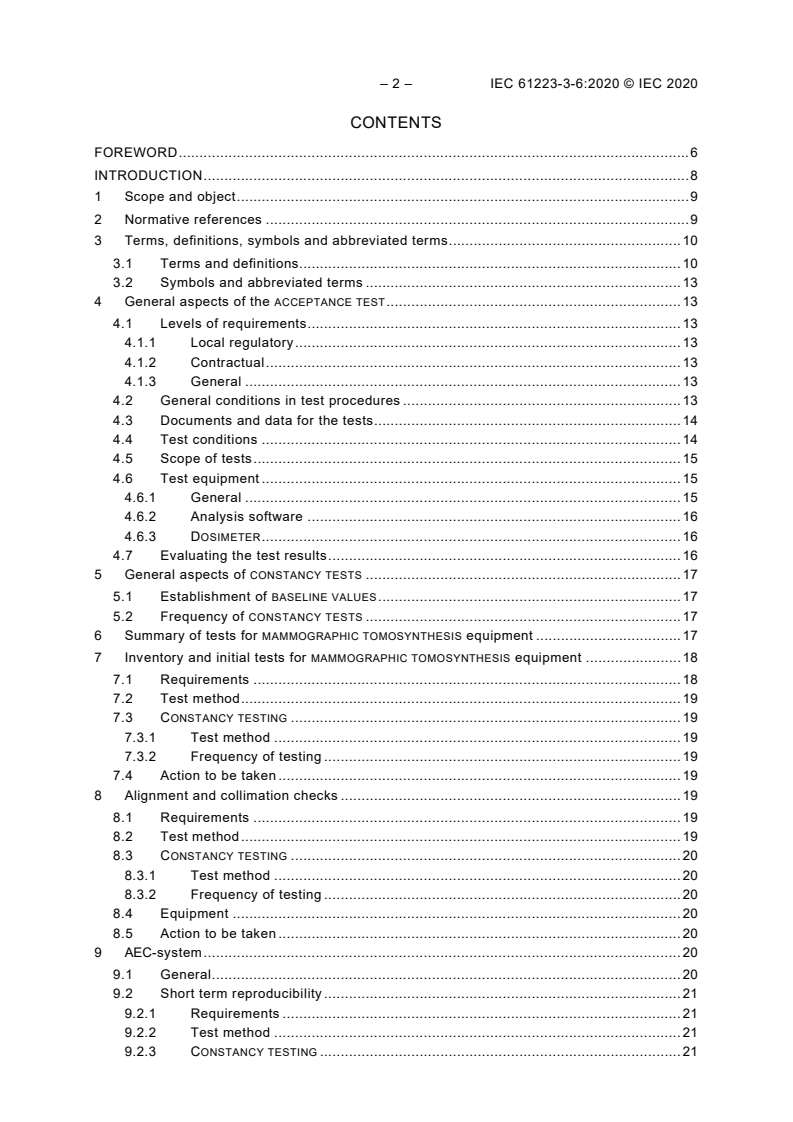
CONTENTS
FOREWORD . 6
INTRODUCTION . 8
1 Scope and object . 9
2 Normative references . 9
3 Terms, definitions, symbols and abbreviated terms . 10
3.1 Terms and definitions. 10
3.2 Symbols and abbreviated terms . 13
4 General aspects of the ACCEPTANCE TEST . 13
4.1 Levels of requirements . 13
4.1.1 Local regulatory . 13
4.1.2 Contractual . 13
4.1.3 General . 13
4.2 General conditions in test procedures . 13
4.3 Documents and data for the tests. 14
4.4 Test conditions . 14
4.5 Scope of tests . 15
4.6 Test equipment . 15
4.6.1 General . 15
4.6.2 Analysis software . 16
4.6.3 DOSIMETER . 16
4.7 Evaluating the test results . 16
5 General aspects of CONSTANCY TESTS . 17
5.1 Establishment of BASELINE VALUES . 17
5.2 Frequency of CONSTANCY TESTS . 17
6 Summary of tests for MAMMOGRAPHIC TOMOSYNTHESIS equipment . 17
7 Inventory and initial tests for MAMMOGRAPHIC TOMOSYNTHESIS equipment . 18
7.1 Requirements . 18
7.2 Test method . 19
7.3 CONSTANCY TESTING . 19
7.3.1 Test method . 19
7.3.2 Frequency of testing . 19
7.4 Action to be taken . 19
8 Alignment and collimation checks . 19
8.1 Requirements . 19
8.2 Test method . 19
8.3 CONSTANCY TESTING . 20
8.3.1 Test method . 20
8.3.2 Frequency of testing . 20
8.4 Equipment . 20
8.5 Action to be taken . 20
9 AEC-system . 20
9.1 General . 20
9.2 Short term reproducibility . 21
9.2.1 Requirements . 21
9.2.2 Test method . 21
9.2.3 CONSTANCY TESTING . 21
9.2.4 Equipment . 21
9.2.5 Action to be taken . 21
9.3 Long term reproducibility . 21
9.3.1 Requirements . 21
9.3.2 Test method . 22
9.3.3 CONSTANCY TESTING . 22
9.3.4 Action to be taken . 22
9.4 AEC performance . 22
9.4.1 Requirements . 22
9.4.2 Test method . 22
9.4.3 CONSTANCY TESTING . 25
9.4.4 Equipment . 25
9.4.5 Action to be taken . 25
10 Image receptor . 25
10.1 Response function . 25
10.1.1 General . 25
10.1.2 Requirements . 26
10.1.3 Test method . 26
10.1.4 CONSTANCY TESTING . 26
10.1.5 Action to be taken . 26
10.2 Detector element failure . 27
10.2.1 Requirements . 27
10.2.2 Test method . 27
10.2.3 CONSTANCY TESTING . 27
10.2.4 Equipment . 27
10.2.5 Action to be taken . 27
10.3 Uncorrected DEFECTIVE DETECTOR ELEMENTS . 27
10.3.1 General . 27
10.3.2 Requirements . 27
10.3.3 Test method . 27
10.3.4 CONSTANCY TESTING . 28
10.3.5 Equipment . 28
10.3.6 Action to be taken . 28
10.4 System PROJECTION MTF . 28
10.4.1 General . 28
10.4.2 Requirements . 28
10.4.3 Test method . 29
10.4.4 CONSTANCY TESTING . 29
10.4.5 Equipment . 29
10.4.6 Action to be taken . 29
11 Image quality of the reconstructed image . 29
11.1 PHANTOM testing . 29
11.1.1 General . 29
11.1.2 Requirements . 29
11.1.3 Test method . 30
11.1.4 CONSTANCY TESTING . 30
11.1.5 Action to be taken . 30
11.2 z-resolution (ARTEFACT spread function) . 30
11.2.1 Requirements . 30
– 4 – IEC 61223-3-6:2020 © IEC 2020
11.2.2 Test method . 30
11.2.3 CONSTANCY TESTING . 32
11.2.4 Equipment . 32
11.2.5 Action to be taken . 32
12 Missed tissue . 32
12.1 General . 32
12.2 Missed tissue at chest wall side in the reconstructed tomosynthesis volume . 33
12.2.1 Requirements . 33
12.2.2 Test method . 33
12.2.3 CONSTANCY TESTING . 33
12.2.4 Equipment . 33
12.2.5 Action to be taken . 33
12.3 Missed tissue at the top and bottom of the reconstructed tomosynthesis
volume . 33
12.3.1 Requirements . 33
12.3.2 Test method . 33
12.3.3 CONSTANCY TESTING . 34
12.3.4 Equipment . 35
12.3.5 Action to be taken . 35
13 ARTEFACTS in the tomosynthesis data sets . 35
13.1 General . 35
13.2 ARTEFACT evaluation . 35
13.2.1 Requirements . 35
13.2.2 Test method . 35
13.2.3 CONSTANCY TESTING . 35
13.2.4 Equipment . 35
13.2.5 Action to be taken . 35
13.3 GEOMETRIC DISTORTION . 35
13.3.1 Requirements . 35
13.3.2 Test method . 36
13.3.3 Equipment . 37
13.3.4 Action to be taken . 37
14 Dosimetry for digital breast tomosynthesis . 37
14.1 Requirements . 37
14.2 Test method . 38
14.3 CONSTANCY TESTING . 39
14.3.1 Test method . 39
14.3.2 Frequency of testing . 39
14.4 Equipment . 39
14.5 Action to be taken . 39
Annex A (informative) Tables for dosimetry calculation in digital breast tomosynthesis . 40
Annex B (normative) Guidance on action to be taken . 44
B.1 Failing the ESTABLISHED CRITERIA at first measurement . 44
B.2 Failing the ESTABLISHED CRITERIA at multiple measurements . 44
B.3 Marginally failing the ESTABLISHED CRITERIA . 44
B.4 History of repeatedly failing the ESTABLISHED CRITERIA . 44
B.5 Substantially failing the ESTABLISHED CRITERIA . 45
B.6 Cases not covered by Clauses B.1 to B.5 . 45
Annex C (informative) Image quality evaluation . 46
Annex D (informative) ARTEFACTS . 47
Bibliography . 48
Index of defined terms . 52
Figure 1 – Set-up for measuring the alignment between the reconstructed and the
irradiated volume at the chest wall edge of the PATIENT SUPPORT. 20
Figure 2 – Top and 3D view of setup for the AEC performance measurements . 23
Figure 3 – Placement of ROI for the AEC performance measurement . 24
Figure 4 – Top and 3D view of setup for the evaluation of z-resolution . 31
Figure 5 – Front and side view of setup for the evaluation of z-resolution . 32
Figure 6 – Configuration for the determination of missed tissue for curved paddles . 34
Figure 7 – Top and 3D view of setup for the evaluation of GEOMETRIC DISTORTION . 36
Figure 8 – Front and side view of setup for the evaluation of GEOMETRIC DISTORTION . 37
Figure 9 –Top and 3D view of position of DOSIMETER to determine the incident AIR
KERMA for dose estimation . 39
Table 1 – Tests, test frequencies, and test objects used in this document . 17
Table 2 – Height of the compression paddle when using different PMMA thicknesses . 24
Table 3 – Limits for AGD versus the thickness of the PMMA and the height of the
compression paddle . 38
Table A.1 – g factors for breasts simulated with PMMA . 40
Table A.2 – c factors for breasts simulated with PMMA . 40
Table A.3 – Typical HVL measurements for different tube voltage and TARGET FILTER
combinations . 41
Table A.4 – s factors for clinically used spectra . 41
Table A.5 – s factors for clinically used spectra with W TARGET material . 41
Table A.6 – s factors for a tungsten TARGET filtered by 0,5 mm aluminium. 42
Table A.7 – s factors for a tungsten TARGET filtered by 0,7 mm aluminium. 42
Table A.8 – T factors vs. PMMA thickness for a variety of scan angles . 43
– 6 – IEC 61223-3-6:2020 © IEC 2020
INTERNATIONAL ELECTROTECHNICAL COMMISSION
____________
EVALUATION AND ROUTINE TESTING
IN MEDICAL IMAGING DEPARTMENTS –
Part 3-6: Acceptance and constancy tests –
Imaging performance of mammographic X-ray equipment used in a
mammographic tomosynthesis mode of operation
FOREWORD
1) The International Electrotechnical Commission (IEC) is a worldwide organization for standardization comprising
all national electrotechnical committees (IEC National Committees). The object of IEC is to promote international
co-operation on all questions concerning standardization in the electrical and electronic fields. To this end and
in addition to other activities, IEC publishes International Standards, Technical Specifications, Technical Reports,
Publicly Available Specifications (PAS) and Guides (hereafter referred to as "IEC Publication(s)"). Their
preparation is entrusted to technical committees; any IEC National Committee interested in the subject dealt with
may participate in this preparatory work. International, governmental and non-governmental organizations liaising
with the IEC also participate in this preparation. IEC collaborates closely with the International Organization for
Standardization (ISO) in accordance with conditions determined by agreement between the two organizations.
2) The formal decisions or agreements of IEC on technical matters express, as nearly as possible, an international
consensus of opinion on the relevant subjects since each technical committee has representation from all
interested IEC National Committees.
3) IEC Publications have the form of recommendations for international use and are accepted by IEC National
Committees in that sense. While all reasonable efforts are made to ensure that the technical content of IEC
Publications is accurate, IEC cannot be held responsible for the way in which they are used or for any
misinterpretation by any end user.
4) In order to promote international uniformity, IEC National Committees undertake to apply IEC Publications
transparently to the maximum extent possible in their national and regional publications. Any divergence between
any IEC Publication and the corresponding national or regional publication shall be clearly indicated in the latter.
5) IEC itself does not provide any attestation of conformity. Independent certification bodies provide conformity
assessment services and, in some areas, access to IEC marks of conformity. IEC is not responsible for any
services carried out by independent certification bodies.
6) All USERS should ensure that they have the latest edition of this publication.
7) No liability shall attach to IEC or its directors, employees, servants or agents including individual experts and
members of its technical committees and IEC National Committees for any personal injury, property damage or
other damage of any nature whatsoever, whether direct or indirect, or for costs (including legal fees) and
expenses arising out of the publication, use of, or reliance upon, this IEC Publication or any other IEC
Publications.
8) Attention is drawn to the Normative references cited in this publication. Use of the referenced publications is
indispensable for the correct application of this publication.
9) Attention is drawn to the possibility that some of the elements of this IEC Publication may be the subject of patent
rights. IEC shall not be held responsible for identifying any or all such patent rights.
International Standard IEC 61223-3-6 has been prepared by subcommittee 62B: Diagnostic
imaging equipment, of IEC technical committee 62: Electrical equipment in medical practice.
The text of this International Standard is based on the following documents:
CDV Report on voting
62B/1127/CDV 62B/1148/RVC
Full information on the voting for the approval of this International Standard can be found in the
report on voting indicated in the above table.
This document has been drafted in accordance with the ISO/IEC Directives, Part 2.
In this document, the following print types are used:
– requirements, compliance with which can be tested, and definitions: in roman type.
– explanations, advice, notes, general statements, exceptions and references: in smaller type;
– TERMS USED THROUGHOUT THIS DOCUMENT THAT HAVE BEEN LISTED IN THE INDEX OF DEFINED
TERMS AND DEFINED IN CLAUSE 3, OR IN OTHER STANDARDS: IN SMALL CAPITALS.
A list of all parts of the IEC 61223 series, published under the general title Evaluation and
routine testing in medical imaging departments, can be found on the IEC website.
The committee has decided that the contents of this document will remain unchanged until the
stability date indicated on the IEC website under "http://webstore.iec.ch" in the data related to
the specific document. At this date, the document will be
• reconfirmed,
• withdrawn,
• replaced by a revised edition, or
• amended.
NOTE The attention of the users of this document is drawn to the fact that equipment MANUFACTURERS and testing
organizations may need a transitional period following publication of a new, amended or revised IEC publication in
which to make products in accordance with the new requirements and to equip themselves for conducting new or
revised tests. It is the recommendation of the committee that the content of this publication be adopted for
implementation nationally not earlier than 3 years from the date of publication.
IMPORTANT – The 'colour inside' logo on the cover page of this publication indicates
that it contains colours which are considered to be useful for the correct understanding
of its contents. Users should therefore print this document using a colour printer.
– 8 – IEC 61223-3-6:2020 © IEC 2020
INTRODUCTION
IEC 61223 (all parts) gives methods for ACCEPTANCE TESTS and CONSTANCY TESTS for diagnostic
X-RAY EQUIPMENT.
This part of IEC 61223 describes test methods for the ACCEPTANCE and CONSTANCY TESTS of
MAMMOGRAPHIC X-RAY EQUIPMENT used in a MAMMOGRAPHIC TOMOSYNTHESIS MODE OF OPERATION.
EVALUATION AND ROUTINE TESTING
IN MEDICAL IMAGING DEPARTMENTS –
Part 3-6: Acceptance and constancy tests –
Imaging performance of mammographic X-ray equipment used in a
mammographic tomosynthesis mode of operation
1 Scope and object
This part of IEC 61223 applies to the performance of MAMMOGRAPHIC X-RAY EQUIPMENT when
used in MAMMOGRAPHIC TOMOSYNTHESIS modes of operation, with respect to image quality and
dose.
Excluded from the scope of this document are:
– MAMMOGRAPHIC X-RAY EQUIPMENT modes of operation other than MAMMOGRAPHIC
TOMOSYNTHESIS;
– 2D images synthesised from the tomosynthesis images;
– reconstructive TOMOGRAPHY other than MAMMOGRAPHIC TOMOSYNTHESIS;
– CT SCANNERS covered by IEC 61223-3-5.
This document defines:
a) the essential parameters which describe the acceptability criteria of MAMMOGRAPHIC
TOMOSYNTHESIS modes of operation of MAMMOGRAPHIC X-RAY EQUIPMENT with regard to
image quality and dose,
b) the methods of testing whether measured quantities related to those parameters comply
with specified tolerances, and
c) CONSTANCY TEST frequency when required.
This document is intended to be applied along with the acceptability criteria included in
IEC 61223-3-2 or equivalent protocol for 2D mammography which are also relevant for
MAMMOGRAPHIC TOMOSYNTHESIS modes of operation.
These methods mainly rely on non-invasive measurements that use appropriate test equipment
and are performed during or after the installation. Signed statements covering steps in the
installation procedure can be used as part of the ACCEPTANCE TEST. Tests required by a higher
level of compliance take precedence over similar tests with a lower level of compliance.
When the results of the ACCEPTANCE TEST are in compliance with the expected values, the
BASELINE VALUES for the subsequent CONSTANCY TESTS are established.
2 Normative references
The following documents are referred to in the text in such a way that some or all of their content
constitutes requirements of this document. For dated references, only the edition cited applies.
For undated references, the latest edition of the referenced document (including any
amendments) applies.
IEC 60601-2-45:2011, Medical electrical equipment – Part 2-45: Particular requirements for
basic safety and essential performance of mammographic X-ray equipment and mammographic
stereotactic devices
IEC 60601-2-45:2011/AMD1:2015
– 10 – IEC 61223-3-6:2020 © IEC 2020
IEC 61223-3-2:2007, Evaluation and routine testing in medical imaging departments – Part 3-
2: Acceptance tests – Imaging performance of mammographic X-ray equipment
IEC 61674:2012, Medical electrical equipment – Dosimeters with ionization chambers and/or
semiconductor detectors as used in X-ray diagnostic imaging
3 Terms, definitions, symbols and abbreviated terms
3.1 Terms and definitions
For the purposes of this document, the terms and definitions given in IEC 60601-2-45,
IEC 61223-3-2 and the following apply.
ISO and IEC maintain terminological databases for use in standardization at the following
addresses:
• IEC Electropedia: available at http://www.electropedia.org/
• ISO Online browsing platform: available at http://www.iso.org/obp
3.1.1
ACCEPTANCE TEST
test carried out after new equipment has been installed, or major modifications have been made
to existing equipment, in order to verify compliance with contractual specifications
[SOURCE: IEC TR 61223-1:1993, 3.2.4]
3.1.2
ARTEFACT
apparent structure, visible in the image, which does not represent a structure within the object
[SOURCE: IEC 61223-3-4:2000, 3.3.1]
3.1.3
AUTOMATIC EXPOSURE CONTROL
AEC
MODE OF OPERATION, in a radiological equipment, in which, in reaction to the properties of the
object, one or more of the LOADING FACTORS or IRRADIATION conditions are controlled
automatically in order to obtain a specified quantity of RADIATION of a desired quality
Note 1 to entry: Examples of such properties of the object are: thickness, composition, or X-ray TRANSMISSION.
Examples for IRRADIATION conditions are anode materials of the X-RAY TUBE and ADDED FILTERS.
Note 2 to entry: This note applies to the French language only.
3.1.4
AVERAGE GLANDULAR DOSE
AGD
X-ray mammography average ABSORBED DOSE in the glandular tissue (excluding skin) in a
uniformly compressed breast of known tissue composition, using a specified calculation method
[SOURCE: IEC 61223-3-2:2007, 3.7]
3.1.5
BASELINE VALUE
reference value of functional parameter, which is either:
– the value obtained for this parameter in the initial CONSTANCY TEST immediately following a
STATUS TEST, or
– where described in a corresponding particular standard, the mean value of values obtained
in a series of initial CONSTANCY TESTS, immediately following a STATUS TEST
3.1.6
CONSTANCY TEST
CONSTANCY TESTING
each of a series of tests, carried out:
– to ensure that the functional performance of the equipment meets ESTABLISHED CRITERIA; or
– to enable the early recognition of changes in the properties of components of the equipment
Note 1 to entry: May use a subset of the ACCEPTANCE TEST.
[SOURCE: IEC TR 61223-1:1993, 3.2.6, modified – Note 1 to entry has been added.]
3.1.7
DIAGNOSTIC DOSIMETER
DOSIMETER
equipment which uses IONIZATION CHAMBERS and/or semiconductor detectors for the
measurement of AIR KERMA, AIR KERMA length and/or AIR KERMA RATE in the beam of an X-ray
machine used for diagnostic medical radiological examinations
Note 1 to entry: A DIAGNOSTIC DOSIMETER contains the following components:
– one or more detector assemblies which may or may not be an integral part of the measuring assembly;
– a measuring assembly; and/or
– one or more stability check devices.
[SOURCE: IEC 61674:2012, 3.1, modified – Note 1 to entry has been rephrased.]
3.1.8
ESTABLISHED CRITERIA
acceptable variations, in a QUALITY ASSURANCE PROGRAMME, in results of a CONSTANCY TEST
which signal satisfactory functional performance of the equipment tested
3.1.9
FOCAL SPOT
perpendicular PROJECTION of the actual FOCAL SPOT on the reference plane
Note 1 to entry: The shortened term "FOCAL SPOT" refers to the effective FOCAL SPOT (IEC 60806 [1] ).
3.1.10
LINEARIZED DATA
ORIGINAL DATA to which the inverse CONVERSION FUNCTION has been applied
Note 1 to entry: The LINEARIZED DATA are directly proportional to the AIR KERMA.
Note 2 to entry: For practical reasons, AIR KERMA proportional data can be generated by applying the inverse
response function (see 10.1.3).
[SOURCE: IEC 62220-1-2:2007, 3.7, modified – Note 2 to entry has been added.]
3.1.11
MAMMOGRAPHIC TOMOSYNTHESIS
DBT
technique using MAMMOGRAPHIC X-RAY EQUIPMENT to produce multiple tomographic images
reconstructed from multiple PROJECTIONS acquired over a total angular range of less than 180°
Note 1 to entry: This note applies to the French language only.
[SOURCE: IEC 60601-2-45:2011 and IEC 60601-2-45:2011/AMD1:2015, 201.3.210, modified –
The abbreviated term "DBT" has been added, as well as Note 1 to entry.]
___________
Numbers in square brackets refer to the Bibliography.
– 12 – IEC 61223-3-6:2020 © IEC 2020
3.1.12
MEASUREMENT UNCERTAINTY
non-negative parameter characterizing the dispersion of the quantity values being attributed to
a measurand, based on the information used
[SOURCE: ISO/IEC Guide 99:2007, 2.26, modified – The notes to entry have been deleted.]
3.1.13
ORIGINAL DATA
RAW DATA to which the corrections as in normal clinical use have been applied
Note 1 to entry: Some detectors execute linear image processing due to their physical concept. As long as this
image processing is linear and image-independent, these operations are allowed as an exception.
Note 2 to entry: See IEC 60601-2-45:2011, 201.3.208.
3.1.14
QUALITY ASSURANCE PROGRAMME
detailed instruction for carrying out actions of quality assurance for individual items of
equipment, systems of equipment or facilities, including quality administrative elements and
QUALITY CONTROL techniques
3.1.15
RAW DATA
PIXEL values read directly after the analogue-digital-conversion from the DIGITAL X-RAY IMAGING
or counts from photon counting systems without any corrections
DEVICE
[SOURCE: IEC 60601-2-45:2011, 201.3.209, modified – The word "software" has been deleted
in "software corrections".]
3.1.16
REFERENCE ROI
REGION OF INTEREST (size 5 mm x 5 mm) in the PROJECTION
Note 1 to entry: The centre of the ROI is positioned 60 mm perpendicular to the chest edge of the PATIENT SUPPORT
and centred laterally.
Note 2 to entry: This note applies to the French language only.
3.1.17
SIGNAL DIFFERENCE TO NOISE RATIO
SDNR
ratio, in a digital image, of the difference of mean PIXEL values of the contrast object and image
background and the standard deviation of the image background PIXEL value
Note 1 to entry: This note applies to the French language only.
3.1.18
SIGNAL TO NOISE RATIO
SNR
measure of signal strength versus the background NOISE, defined as the ratio of mean PIXEL
values of an area of interest in an image to the standard deviation of the PIXEL value of the area
of interest
Note 1 to entry: This note applies to the French language only.
3.1.19
STATUS TEST
test carried out to establish the functional status of equipment at a given time
3.1.20
ZERO DEGREE ANGLE STATIONARY MODE
MODE OF OPERATION of the tomosynthesis equipment identical to a tomosynthesis mode, without
the tomosynthesis movement of the X-RAY BEAM with the PATIENT SUPPORT surface positioned
horizontally and the beam axis as close as possible perpendicular to it
3.2 Symbols and abbreviated terms
Symbol/abbreviated
Physical quantity/Description Unit
term
K ENTRANCE SURFACE AIR KERMA mGy
E
FWHM full width at half maximum mm
MTF MODULATION TRANSFER FUNCTION -
PMMA polymethylmethacrylate -
ROI region of interest -
4 General aspects of the ACCEPTANCE TEST
4.1 Levels of requirements
4.1.1 Local regulatory
Local regulatory requirements, including test procedures and acceptable values, shall take
precedence over similar contractual requirements or corresponding items in this document.
4.1.2 Contractual
Individual contractual requirements, including test procedures and acceptable values, shall take
precedence over similar corresponding items in this document.
Requirements for STATUS TESTS should be included in the contractual requirements.
4.1.3 General
In the absence of specific regulatory or contractual requirements, the test procedures in this
document shall be applicable.
Values and acceptable tolerances shall be in accordance with the MANUFACTURER’s
specifications for the equipment.
The aim of the ACCEPTANCE TEST is to demonstrate that the specified characteristics of the
equipment lie within specified tolerances. These tolerances are determin
...