

IEC 61828:2001
(Main)Ultrasonics - Focusing transducers - Definitions and measurement methods for the transmitted fields
General Information
- Abstract
This International Standard - provides definitions for the transmitted field characteristics of focusing transducers for applications in medical ultrasound; - relates these definitions to theoretical descriptions, design, and measurement of the transmitted fields of focusing transducers; - gives measurement methods for obtaining defined characteristics of focusing transducers; - specifies beam axis alignment methods appropriate for focusing transducers. This International Standard relates to focusing ultrasonic transducers operating in the frequency range appropriate to medical ultrasound (0,5 MHz to 40 MHz) for both therapeutic and diagnostic applications. It shows how the characteristics of the transmitted field of transducers may be described from the point of view of design, as well as measured by someone with no prior knowledge of the construction details of a particular device. The radiated ultrasound field for a specified excitation is measured by a hydrophone in either a standard test medium (for example, water) or in a given medium. The standard applies only to media where the field behaviour is essentially like that in a fluid (i.e. where the influence of shear waves and elastic anisotropy is small), including soft tissues and tissue-mimicking gels. Any aspects of the field that affect their theoretical description or are important in design are also included. These definitions would have use in scientific communications, system design and description of the performance and safety of systems using these devices.
- Status
- Published
- Publication Date
- 28-May-2001
- Technical Committee
- TC 87 - Ultrasonics
- Drafting Committee
- WG 6 - TC 87/WG 6
- Current Stage
- DELPUB - Deleted Publication
- Start Date
- 15-Dec-2020
- Completion Date
- 28-Aug-2026
Buy Documents
IEC 61828:2001 - Ultrasonics - Focusing transducers - Definitions and measurement methods for the transmitted fields Released:5/29/2001

IEC 61828:2001 - Ultrasonics - Focusing transducers - Definitions and measurement methods for the transmitted fields Released:5/29/2001
Overview
IEC 61828:2001 - Ultrasonics: Focusing transducers - Definitions and measurement methods for the transmitted fields defines how to describe, measure and align the transmitted ultrasonic fields of focusing transducers used in medical ultrasound. The standard links theoretical descriptions and design parameters with practical measurement techniques, enabling consistent characterization of focusing behavior across diagnostic and therapeutic devices operating in the 0.5 MHz to 40 MHz band.
Key topics and requirements
- Definitions of focusing characteristics: Quantitative terminology for what constitutes a focusing transducer versus a non‑focusing device, and the focal parameters used to describe a focused field (beamwidth, focal location, pressure concentration, etc.).
- Relation to design and theory: How field descriptors map to transducer geometry and focusing methods (curved faces, lenses, phased arrays, etc.) without requiring knowledge of internal construction.
- Measurement methods: Procedures for determining transmitted field characteristics using hydrophone measurements in a standard test medium (commonly water) or other media where fluid‑like acoustic behavior applies (soft tissue, tissue‑mimicking gels).
- Beam axis alignment: Recommended techniques to find and align the beam axis for focusing transducers, including guidance for well‑behaved and asymmetric beams.
- Scope limits: Applies only to media where shear-wave effects and elastic anisotropy are negligible; covers both therapeutic and diagnostic applications.
- Normative linkage: Cross-references standards for hydrophone measurement and acoustic output declaration (e.g., IEC 61102, IEC 61157).
Applications and who uses it
IEC 61828 is practical for:
- Medical ultrasound manufacturers - to specify and verify focusing performance during design and production.
- Test laboratories and QA teams - for standardized hydrophone measurement setups and repeatable focal parameter extraction.
- Researchers and developers - to compare focused-field results across devices and publications using consistent definitions.
- Regulatory and safety engineers - to interpret acoustic output and focal properties relevant to performance and safety assessments.
- Clinical engineers - when assessing or documenting device performance for imaging or therapeutic procedures.
Practical value and keywords
IEC 61828 standardizes how to measure and report transmitted fields, beamwidth, focal location, and pressure focus of focusing transducers in medical ultrasound. By defining measurement methods (hydrophone in water or tissue-mimicking media) and beam axis alignment techniques, it helps ensure reproducible performance data for device design, safety declarations and scientific communication.
Related standards
- IEC 61102 - Measurement and characterization of ultrasonic fields using hydrophones (0.5 MHz to 15 MHz)
- IEC 61157 - Requirements for declaration of acoustic output of medical diagnostic ultrasound equipment
- IEC 61689 - Ultrasonics - Physiotherapy systems (relevant frequency range)
Relations
- Effective Date
- 05-Sep-2023
Buy Documents
IEC 61828:2001 - Ultrasonics - Focusing transducers - Definitions and measurement methods for the transmitted fields Released:5/29/2001
IEC 61828:2001 - Ultrasonics - Focusing transducers - Definitions and measurement methods for the transmitted fields Released:5/29/2001
Get Certified
Connect with accredited certification bodies for this standard

BSMI (Bureau of Standards, Metrology and Inspection)
Taiwan's standards and inspection authority.
Sponsored listings
Frequently Asked Questions
IEC 61828:2001 is a standard published by the International Electrotechnical Commission (IEC). Its full title is "Ultrasonics - Focusing transducers - Definitions and measurement methods for the transmitted fields". This standard covers: This International Standard - provides definitions for the transmitted field characteristics of focusing transducers for applications in medical ultrasound; - relates these definitions to theoretical descriptions, design, and measurement of the transmitted fields of focusing transducers; - gives measurement methods for obtaining defined characteristics of focusing transducers; - specifies beam axis alignment methods appropriate for focusing transducers. This International Standard relates to focusing ultrasonic transducers operating in the frequency range appropriate to medical ultrasound (0,5 MHz to 40 MHz) for both therapeutic and diagnostic applications. It shows how the characteristics of the transmitted field of transducers may be described from the point of view of design, as well as measured by someone with no prior knowledge of the construction details of a particular device. The radiated ultrasound field for a specified excitation is measured by a hydrophone in either a standard test medium (for example, water) or in a given medium. The standard applies only to media where the field behaviour is essentially like that in a fluid (i.e. where the influence of shear waves and elastic anisotropy is small), including soft tissues and tissue-mimicking gels. Any aspects of the field that affect their theoretical description or are important in design are also included. These definitions would have use in scientific communications, system design and description of the performance and safety of systems using these devices.
This International Standard - provides definitions for the transmitted field characteristics of focusing transducers for applications in medical ultrasound; - relates these definitions to theoretical descriptions, design, and measurement of the transmitted fields of focusing transducers; - gives measurement methods for obtaining defined characteristics of focusing transducers; - specifies beam axis alignment methods appropriate for focusing transducers. This International Standard relates to focusing ultrasonic transducers operating in the frequency range appropriate to medical ultrasound (0,5 MHz to 40 MHz) for both therapeutic and diagnostic applications. It shows how the characteristics of the transmitted field of transducers may be described from the point of view of design, as well as measured by someone with no prior knowledge of the construction details of a particular device. The radiated ultrasound field for a specified excitation is measured by a hydrophone in either a standard test medium (for example, water) or in a given medium. The standard applies only to media where the field behaviour is essentially like that in a fluid (i.e. where the influence of shear waves and elastic anisotropy is small), including soft tissues and tissue-mimicking gels. Any aspects of the field that affect their theoretical description or are important in design are also included. These definitions would have use in scientific communications, system design and description of the performance and safety of systems using these devices.
IEC 61828:2001 is classified under the following ICS (International Classification for Standards) categories: 17.140.50 - Electroacoustics. The ICS classification helps identify the subject area and facilitates finding related standards.
IEC 61828:2001 has the following relationships with other standards: It is inter standard links to IEC 61828:2020. Understanding these relationships helps ensure you are using the most current and applicable version of the standard.
IEC 61828:2001 is available in PDF format for immediate download after purchase. The document can be added to your cart and obtained through the secure checkout process. Digital delivery ensures instant access to the complete standard document.
Standards Content (Sample)
INTERNATIONAL IEC
STANDARD
First edition
2001-05
Ultrasonics – Focusing transducers –
Definitions and measurement methods
for the transmitted fields
Ultrasons – Transducteurs focaliseurs –
Définitions et méthodes de mesure
des champs transmis
Reference number
Publication numbering
As from 1 January 1997 all IEC publications are issued with a designation in the
60000 series. For example, IEC 34-1 is now referred to as IEC 60034-1.
Consolidated editions
The IEC is now publishing consolidated versions of its publications. For example,
edition numbers 1.0, 1.1 and 1.2 refer, respectively, to the base publication, the
base publication incorporating amendment 1 and the base publication incorporating
amendments 1 and 2.
Further information on IEC publications
The technical content of IEC publications is kept under constant review by the IEC,
thus ensuring that the content reflects current technology. Information relating to
this publication, including its validity, is available in the IEC Catalogue of
publications (see below) in addition to new editions, amendments and corrigenda.
Information on the subjects under consideration and work in progress undertaken
by the technical committee which has prepared this publication, as well as the list
of publications issued, is also available from the following:
• IEC Web Site (www.iec.ch)
• Catalogue of IEC publications
The on-line catalogue on the IEC web site (www.iec.ch/catlg-e.htm) enables
you to search by a variety of criteria including text searches, technical
committees and date of publication. On-line information is also available on
recently issued publications, withdrawn and replaced publications, as well as
corrigenda.
• IEC Just Published
This summary of recently issued publications (www.iec.ch/JP.htm) is also
available by email. Please contact the Customer Service Centre (see below) for
further information.
• Customer Service Centre
If you have any questions regarding this publication or need further assistance,
please contact the Customer Service Centre:
Email: custserv@iec.ch
Tel: +41 22 919 02 11
Fax: +41 22 919 03 00
INTERNATIONAL IEC
STANDARD
First edition
2001-05
Ultrasonics – Focusing transducers –
Definitions and measurement methods
for the transmitted fields
Ultrasons – Transducteurs focaliseurs –
Définitions et méthodes de mesure
des champs transmis
IEC 2001 Copyright - all rights reserved
No part of this publication may be reproduced or utilized in any form or by any means, electronic or
mechanical, including photocopying and microfilm, without permission in writing from the publisher.
International Electrotechnical Commission 3, rue de Varembé Geneva, Switzerland
Telefax: +41 22 919 0300 e-mail: inmail@iec.ch IEC web site http://www.iec.ch
Commission Electrotechnique Internationale
PRICE CODE
X
International Electrotechnical Commission
For price, see current catalogue
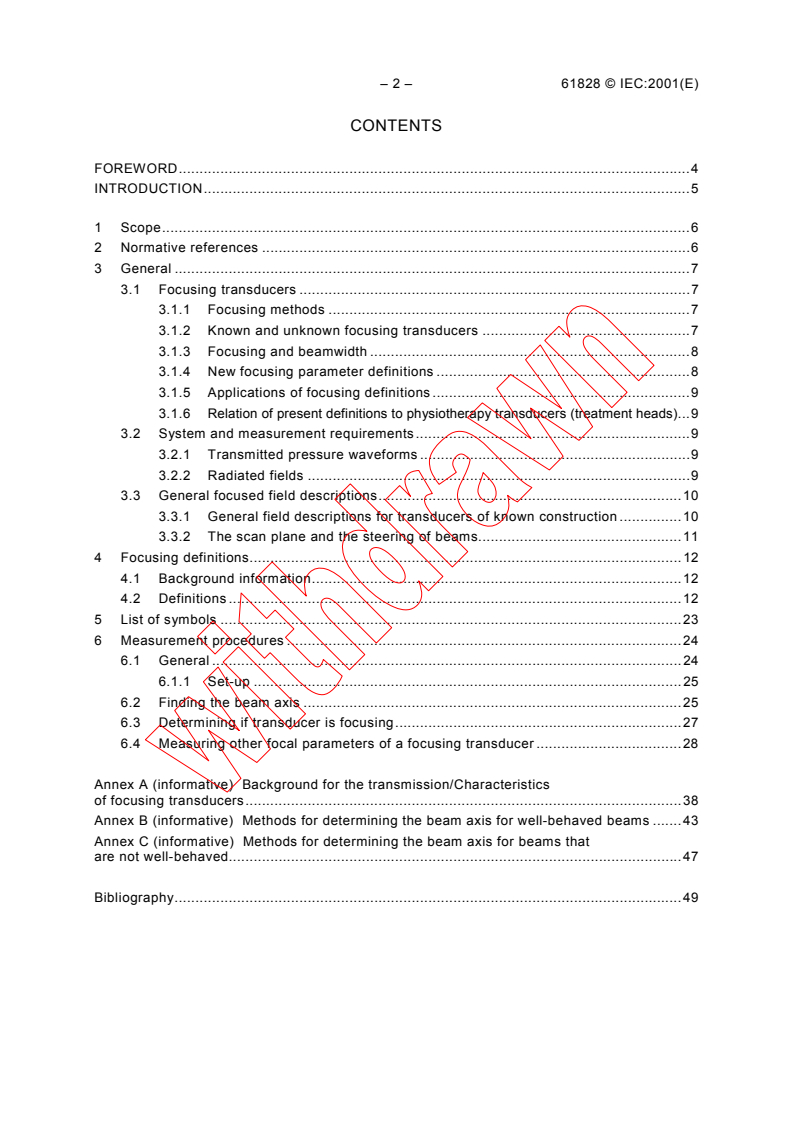
– 2 – 61828 © IEC:2001(E)
CONTENTS
FOREWORD.4
INTRODUCTION.5
1 Scope.6
2 Normative references .6
3 General .7
3.1 Focusing transducers .7
3.1.1 Focusing methods .7
3.1.2 Known and unknown focusing transducers .7
3.1.3 Focusing and beamwidth .8
3.1.4 New focusing parameter definitions .8
3.1.5 Applications of focusing definitions .9
3.1.6 Relation of present definitions to physiotherapy transducers (treatment heads).9
3.2 System and measurement requirements.9
3.2.1 Transmitted pressure waveforms .9
3.2.2 Radiated fields .9
3.3 General focused field descriptions.10
3.3.1 General field descriptions for transducers of known construction .10
3.3.2 The scan plane and the steering of beams.11
4 Focusing definitions.12
4.1 Background information.12
4.2 Definitions .12
5 List of symbols .23
6 Measurement procedures .24
6.1 General .24
6.1.1 Set-up .25
6.2 Finding the beam axis .25
6.3 Determining if transducer is focusing.27
6.4 Measuring other focal parameters of a focusing transducer .28
Annex A (informative) Background for the transmission/Characteristics
of focusing transducers.38
Annex B (informative) Methods for determining the beam axis for well-behaved beams .43
Annex C (informative) Methods for determining the beam axis for beams that
are not well-behaved.47
Bibliography.49
61828 © IEC:2001(E) – 3 –
Figure 1 – Transducer options – Top: Transducer with a radius of curvature R and a focal
length equal to R – Middle: Transducer with a plano-concave lens – Bottom: Transducer
with a plano-convex lens.29
Figure 2 – Definitions for focusing measurements when the transducer geometry is
unknown .30
Figure 3 – Field parameters for non-focusing and focusing transducers .31
Figure 4 – Beam contour plot – Contours at –6, –12, and –20 dB for a 5 MHz transducer
with a diameter of 25 mm and a radius of curvature of 50 mm centred at location 0,0
(bottom centre of graph) .32
Figure 5 – Parameters for describing a focusing transducer of a known geometry.33
Figure 6 – Path difference parameters for describing a focusing transducer of a known
geometry .34
Figure 7 – Beamwidth focus in a principal longitudinal plane.35
Figure 8 –Types of geometric focusing.36
Figure 9 – Pressure focus in a principal longitudinal plane.37
Figure B.1 – X-axis scan at 9 cm depth for the first focal zone with beam centre.44
Figure B.2 – X-axis scan at 4,4 cm depth for the second focal zone.45
Figure C.1 – Asymmetric beam showing beamwidth midpoint method .48
Table B.1 – Standard deviations for x and y scans using three methods of determining
the centre of the beam .43
Table B.2 – –dB beamwidth levels for determining midpoints .46
– 4 – 61828 © IEC:2001(E)
INTERNATIONAL ELECTROTECHNICAL COMMISSION
____________
ULTRASONICS – FOCUSING TRANSDUCERS –
DEFINITIONS AND MEASUREMENT METHODS
FOR THE TRANSMITTED FIELDS
FOREWORD
1) The IEC (International Electrotechnical Commission) is a worldwide organization for standardization comprising
all national electrotechnical committees (IEC National Committees). The object of the IEC is to promote
international co-operation on all questions concerning standardization in the electrical and electronic fields. To
this end and in addition to other activities, the IEC publishes International Standards. Their preparation is
entrusted to technical committees; any IEC National Committee interested in the subject dealt with may
participate in this preparatory work. International, governmental and non-governmental organizations liaising
with the IEC also participate in this preparation. The IEC collaborates closely with the International
Organization for Standardization (ISO) in accordance with conditions determined by agreement between the
two organizations.
2) The formal decisions or agreements of the IEC on technical matters express, as nearly as possible, an
international consensus of opinion on the relevant subjects since each technical committee has representation
from all interested National Committees.
3) The documents produced have the form of recommendations for international use and are published in the form
of standards, technical specifications, technical reports or guides and they are accepted by the National
Committees in that sense.
4) In order to promote international unification, IEC National Committees undertake to apply IEC International
Standards transparently to the maximum extent possible in their national and regional standards. Any
divergence between the IEC Standard and the corresponding national or regional standard shall be clearly
indicated in the latter.
5) The IEC provides no marking procedure to indicate its approval and cannot be rendered responsible for any
equipment declared to be in conformity with one of its standards.
6) Attention is drawn to the possibility that some of the elements of this International Standard may be the subject
of patent rights. The IEC shall not be held responsible for identifying any or all such patent rights.
International Standard IEC 61828 has been prepared by IEC technical committee 87:
Ultrasonics.
The text of this standard is based on the following documents:
FDIS Report on voting
87/196/FDIS 87/204/RVD
Full information on the voting for the approval of this standard can be found in the report on
voting indicated in the above table.
This publication has been drafted in accordance with the ISO/IEC Directives, Part 3.
Annexes A, B and C are for information only.
The committee has decided that the contents of this publication will remain unchanged
until 2005. At this date, the publication will be
• reconfirmed;
• withdrawn;
• replaced by a revised edition, or
• amended.
61828 © IEC:2001(E) – 5 –
INTRODUCTION
Focusing transducers are essential in medical applications for obtaining high-resolution
images, Doppler and flow data and for concentrating ultrasonic energy at desired sites for
therapy. Present terminology for focusing transducers is inadequate for communicating
precisely the characteristics of the focused fields of the wide variety of transducers and
transducer array types and focusing means in common usage.
This International Standard provides specific definitions appropriate for describing the
focused field from a theoretical viewpoint for transducers with known characteristics intended
by design. Other specific definitions included in this standard, based on measurement
methods, provide a means of determining focusing properties, if any, of a transducer of
unknown field characteristics. The measurement method and definitions provide criteria for
determining if the transducer is focusing, as well as a means of describing the focusing
properties of the field. Beam axis alignment methods are given for focusing transducers.
– 6 – 61828 © IEC:2001(E)
ULTRASONICS – FOCUSING TRANSDUCERS –
DEFINITIONS AND MEASUREMENT METHODS
FOR THE TRANSMITTED FIELDS
1 Scope
This International Standard
− provides definitions for the transmitted field characteristics of focusing transducers for
applications in medical ultrasound;
− relates these definitions to theoretical descriptions, design, and measurement of the
transmitted fields of focusing transducers;
− gives measurement methods for obtaining defined characteristics of focusing transducers;
− specifies beam axis alignment methods appropriate for focusing transducers.
This International Standard relates to focusing ultrasonic transducers operating in the
frequency range appropriate to medical ultrasound (0,5 MHz to 40 MHz) for both therapeutic
and diagnostic applications. It shows how the characteristics of the transmitted field of
transducers may be described from the point of view of design, as well as measured by
someone with no prior knowledge of the construction details of a particular device. The
radiated ultrasound field for a specified excitation is measured by a hydrophone in either a
standard test medium (for example, water) or in a given medium. The standard applies only to
media where the field behaviour is essentially like that in a fluid (i.e. where the influence of
shear waves and elastic anisotropy is small), including soft tissues and tissue-mimicking gels.
Any aspects of the field that affect their theoretical description or are important in design are
also included. These definitions would have use in scientific communications, system design
and description of the performance and safety of systems using these devices.
This standard incorporates definitions from other related standards
where possible, and
supplies new, more specific terminology, both for defining focusing characteristics and for
providing a basis for measurement of these characteristics.
2 Normative references
The following normative documents contain provisions which, through reference in this text,
constitute provisions of this International Standard. For dated references, subsequent
amendments to, or revisions of, any of these publications do not apply. However parties to
agreements based on this International Standard are encouraged to investigate the possibility
of applying the most recent editions of the normative documents indicated below. For undated
references, the latest edition of the normative document referred to applies. Members of ISO
and IEC maintain registers of currently valid International Standards.
IEC 60050(801):1994, International Electrotechnical Vocabulary (IEV) – Chapter 801:
Acoustics and electroacoustics
IEC 61102:1991, Measurement and characterization of ultrasonic fields using hydrophones in
the frequency range 0,5 MHz to 15 MHz
___________
Specifically, IEC 61102 and IEC 61157 (see clause 2).
61828 © IEC:2001(E) – 7 –
IEC 61157:1992, Requirements for the declaration of the acoustic output of medical
diagnostic ultrasonic equipment
IEC 61689:1996, Ultrasonics – Physiotherapy systems – Performance requirements and
methods of measurement in the frequency range 0,5 MHz to 5 MHz
3 General
The information contained in this clause is an introduction to the definitions given in clause 4
and the measurement methods given in clause 6.
3.1 Focusing transducers
The term "focusing transducer" is commonly used for a device which has a smaller
beamwidth in some regions of the field than a device which is "non-focusing". A "non-
focusing transducer" can still have a natural focus, so it is necessary to distinguish a
focusing transducer as having a greater concentration of pressure amplitude (for a given
power output) than a non-focusing transducer at its natural focus. For example, a non-
focusing transducer made of a simple disc of uniformly poled piezoelectric material has a
beam whose intensity at its natural focus can be as much as four times the average intensity
at the source, and whose –6 dB beamwidth can be approximately half of that at the source. A
definition of a focusing transducer is given in 4.2.33 to make a quantitative distinction
between focusing and non-focusing transducers.
3.1.1 Focusing methods
The simplest means of intentionally focusing an ultrasonic transducer, borrowed from
analogous optical principles, is that of shaping the ultrasonic transducer into a concave form
or adding to it a physical lens as illustrated in figure 1. In the top part of this figure, a
transducer curved with a radius R is shown focusing to the centre of curvature, where R is
positive by convention. By the geometrical-optics approximation, the focal length F is equal to
R and hence is also positive. In the middle of figure 1 is shown a transducer with a plano-
concave lens made of a material with longitudinal velocity, c , which is curved on one side
L
with a radius, R , and radiates into a medium in which the velocity is c . In acoustics, c
LENS W W
is typically less than c , i.e., the index of refraction n (equal to c /c ) is less than 1. When
L W L
this is true, the radius is considered to be negative and the focal length, given by the
geometric-acoustics approximation as R divided by (n – 1), is positive. At the bottom of
LENS
the figure, for comparison, the typical situation for a convex lens in optics is shown: n is
greater than 1 and the radius is considered to be positive, so the focal length is positive.
3.1.2 Known and unknown focusing transducers
For ultrasonic transducers currently used in medical ultrasound applications, it is difficult to
determine from physical observation if an ultrasonic transducer is focusing, because
additionally many other focusing methods such as geometric shaping and arrangement,
reflectors, arrays with electronic phasing and delay, Fresnel lenses, shading, etc. may be
used singly or in combination. Because of inherent natural focusing and the potential
complexity of additional focusing means used, any generally useful definition of a focusing
transducer must be in terms of its field rather than its construction. If a focusing source were
to be defined in terms of its pressure field, then this would be relatively easy to apply in
practice, since the pressure can be measured directly with a hydrophone.
___________
Terms in bold print are defined in clause 4.
– 8 – 61828 © IEC:2001(E)
A distinction is also made between ultrasonic transducers whose construction is known and
transducers about which very little information is available. For the first category of ultrasonic
transducers, certain theoretical definitions, such as geometric focal length, are useful for
describing and modelling focusing characteristics. Ultrasonic transducers falling in the
second category function as an unknown "black box" and only the field may be accessible.
In the latter case, and in general, focusing parameters are determined from measurements,
and the measurement procedures of clause 6 are appropriate. In clause 6, measurement
methods are given for determining if a transducer system radiating into known propagation
media under specified excitation conditions is "focusing". Because of the lack of knowledge of
ultrasonic transducer construction and limited access to the ultrasonic transducer field, the
focusing definitions shown in figure 2 are required. These definitions are given in clause 4
and their use is explained in 3.1.5.
3.1.3 Focusing and beamwidth
Previously, hydrophone measurements of beam characteristics were based on regions of axial
peak pressure. For example, definitions for a depth-of-field were based on the fall-off in
intensity on either the near side or the far side of an axial peak on the beam axis. For axially
symmetric beams, this axial peak can be related to the geometric focal length. For typical
rectangular arrays, azimuthal plane electronic focusing and elevational plane mechanical lens
focusing can cause peaks of axial pressure at different locations along a beam axis. These
individual peaks can be dealt with separately by beamwidth measurements made in the
corresponding orthogonal planes: therefore, new definitions are based on beamwidths in a
specified longitudinal plane (refer to figure 7). Focusing definitions must also distinguish
between natural and intentional focusing.
3.1.4 New focusing parameter definitions
This document introduces new focusing parameters and provides more specific contexts for
existing terminology. For example, the terms "near field" and "far field" are often misapplied
to focusing transducers, though they have traditionally been defined for non-focusing
transducers only. The definitions near Fresnel zone, far Fresnel zone and focal
Fraunhofer zone, apply to focusing transducers. These definitions, explained in more detail
in 3.3 and derived from annex A, are illustrated in figure 3b and are applied to a strongly
focusing circular aperture in figure 4. Other concepts such as focusing in a particular plane
are also necessary to reduce ambiguity in usage.
For the purposes of this document, the following definitions for a focusing transducer will be
used.
For ultrasonic transducers of known construction (refer to figure 5 for transducer geometry
and terms), a focusing transducer is an electro-acoustic device that produces, at any
distance less than one-half of the transition distance from the transducer aperture, a –6 dB
beamwidth in a longitudinal plane that is less than half the transducer aperture width in
that plane. For measurement purposes and cases (see figure 2) where the geometry of the
ultrasonic transducer is not known or where there is no direct access to the ultrasonic
transducer (because of the device being used in some stand-off arrangement), a definition of
focusing based on data is more appropriate. For this second case, a focusing transducer is
an electro-acoustic device that produces, at any distance less than half of the transition
distance from the source aperture, a –6 dB beamwidth in a longitudinal plane that is less
than one-half the –20 dB source aperture width (measured in a plane as close as possible to
the ultrasonic transducer) in that plane. For arrays with a rectangular geometry, a specified
longitudinal plane is either an xz or yz plane with z along the beam axis. Non-focusing
transducers are those not meeting the conditions specified above.
61828 © IEC:2001(E) – 9 –
3.1.5 Applications of focusing definitions
Two definitions of focusing are given in 3.1.4, which apply in two cases.
a) For transducers for which the construction is known, an ideal definition is given for
describing, modeling or design purposes.
b) A second definition applies to measurements of the focusing characteristics of real
transducers which either have an unknown construction or imperfect realization.
Use of the first definition is not a substitute for actual measurement. Whether or not a
transducer is focusing in practice must be determined by the second definition for transducers
of unknown construction and by the measurement procedures of clause 6. Knowledge about
the transducer (first definition) may be helpful in guiding measurements. If measurements
meet the criteria of the second definition, the transducer is focusing, irrespective of whether
focusing was intentional or accidental.
3.1.6 Relation of present definitions to physiotherapy transducers (treatment heads)
The definition of focusing in the present document is not related to the definitions of
“divergent, collimated and convergent” beams as described in IEC 61689. The definition of
beam type is based on energy and area considerations that are more important for
physiotherapy transducers. The definition of focusing in the present document is based on a
different parameter: –6 dB beamwidth. This definition is useful in identifying the existence and
location of the highest field concentrations. When the current document is applied to
physiotherapy transducers, focusing can be understood to correspond to high-beam non-
uniformity ratio “hot-spot” transducers.
3.2 System and measurement requirements
In 3.1 it was shown that the radiating device has to be considered as a whole, because it is
not possible to define a focusing transducer in terms of the properties of its component
elements. For clinical ultrasound systems, each of the measured focusing definitions only
applies for the field of a selected scan line generated by given electrical excitation conditions
and for a given medium.
3.2.1 Transmitted pressure waveforms
Because a wide variety of transmitted pressure waveforms are possible in an ultrasonic
transducer field, a measure of these waveforms must be robust enough to accommodate broad-
band or narrowband pulses, continuous-wave signals or even waveforms distorted by non-linear
propagation. For this reason, the pulse-pressure-squared-integral (see 3.33 of IEC 61102) will
be the field measurement used throughout this document. For certain types of waveforms under
the conditions of linear propagation, the pulse-pressure-squared-integral can be related to more
familiar pressure terminology. For example, for linear, continuous-wave signals, the pulse-
pressure-squared-integral divided by the period of one cycle is the root-mean-square acoustic
pressure squared. In other cases, when ratios of these integrals are involved, these ratios can be
thought of as ratios of equivalent squared pressures. In such cases, ratios of the square roots of
the pulse-pressure-squared-integral are analogous to ratios of equivalent pressures.
3.2.2 Radiated fields
The radiated field of an ultrasonic transducer is dependent on the bandwidth of the ultrasonic
transducer as well as the type of excitation used. Frequently used models for beam simulation
such as that described in annex A are appropriate only for continuous-wave excitation. For
simulating the pulsed excitation of an ultrasonic transducer, the driving waveform and the
impulse response of the ultrasonic transducer element as well as the boundary conditions need
to be considered. As the bandwidth of a pressure acoustic pulse waveform launched by an
element increases, the resulting field becomes smoother compared to a field from a continuous-
wave signal.
– 10 – 61828 © IEC:2001(E)
In addition to the field depending on the waveform of the electrical driving function and the
propagation medium, it will also depend on the amplitude of the electrical input. This feature
is due to non-linear propagation, which is frequently present in the type of field being
considered. A parameter called the non-linear propagation parameter (3.25 of IEC 61102)
has been previously defined and, in general, the assumption of linearity can be made
provided that this parameter is less than approximately 0,2.
3.3 General focused field descriptions
New terms for describing the transmitted focused field of an ultrasonic transducer of known
construction are introduced in 4.2. Refer to figure 1, which shows the primary geometrical
relationships for the definitions. Background information for these definitions can be found
in annex A.
Measured focusing definitions, also in 4.2, can be used to characterize the focusing acoustic
field of an unknown acoustic source through measurements. In this case a measurement
plane, the source aperture plane, is chosen as close as possible to the source. An
equivalent acoustic aperture, the source aperture on this plane, is used for determining the
effective focusing characteristics of the field. As with the focusing definitions for an ultrasonic
transducer of known design, the ultrasonic transducer is considered as an ultrasonic
transducer system with a specified set of operating conditions and medium of propagation and
offset distance. Conditions of acoustic linearity are desirable but not necessary for these
measurements, and the non-linear propagation parameter must be specified. Figure 2
shows the relationship among several of these measurement definitions.
3.3.1 General field descriptions for transducers of known construction
From the fields of focusing transducers of known construction, it is possible to determine
general characteristics of focused fields. Ultrasound focusing is not well described by
geometric optics because of beam diffraction resulting from transducer sizes on the order of
wavelengths. Natural focusing of the beam is combined with the focusing of a lens or other
focusing device. The resulting combined effect is that the narrowest –6 dB beamwidth does
not in general occur at the geometric focal length of the focusing device, but approximately
at a distance
z F
T
z = (1)
min
z + F
T
where
z is the transition distance, the natural focal length;
T
F is the geometric focal length (as explained in annex A, equation (A.11c)).
This equation shows that the distance to the location of the minimum beamwidth cannot
exceed the transition distance even when the geometric focal length is greater than the
transition distance.
An approximate relation exists between the characteristics of focused fields and non-focused
fields. In a longitudinal plane, beam profiles at an axial distance z in a focused field are
similar in shape to a beam profile in a non-focused field occurring at an equivalent depth, z
e
(see annex A for the approximations used in the derivation of equation (A.8)),
z
z = (valid for z ≠ F, and F positive) (2)
e
z
1−
F
61828 © IEC:2001(E) – 11 –
This equation indicates that to a good approximation, the field of a focusing transducer
(within a longitudinal plane) takes on all of the near-field and far-field beam profile shapes
of a non-focusing transducer of the same size in the distance between the ultrasonic
transducer and the geometric focus. At the geometric focus, the equivalent distance
becomes infinite and equation (2) no longer holds: the shape of the beam profile is the same
as that obtained in the far field of an identically sized non-focusing transducer.
The evolution of the field of a focusing transducer is accelerated by the scaling of equation
(2) compared to the field of a non-focusing transducer, and the transverse width of the
beam becomes narrower than that of a non-focusing transducer at distances close to the
geometric focus.
In a manner consistent with the determination of the transition distance, the distance
separating the near field and far field of a non-focusing transducer, transition distances
can be found for similar descriptions of a focused field. The focused field can be divided into
three regions, the near Fresnel zone, the focal Franhofer zone and the far Fresnel zone,
as shown in figure 3b. The corresponding distances separating these zones are the near
transition distance, z ,
NTD
1 1 1
= + (3)
z z F
NTD T
and the far transition distance, z ,
FTD
1 1 1
= − + (4)
z z F
FTD T
More information about these distances can be found in annex A (equation (A.11)).
3.3.2 The scan plane and the steering of beams
In addition to being focused, beams can also be made to change direction. This direction
corresponds to a scan line, the beam axis for a particular ultrasonic transducer element
group. The scan plane (or surface) is the plane or surface containing all the ultrasonic scan
lines. The scan plane is also known as the azimuth plane. For most cases, the elevation
plane is orthogonal to the azimuth plane and contains the central scan line – the beam
direction corresponding to an undeflected or unsteered beam.
The pattern of scan lines depends on the image format, the geometry of the ultrasonic
transducer and the method of transducer excitation. Several examples of scanning are
described below: sector (angular), linear (translation), and two-dimensional arrays.
Sector (angular) scanning is accomplished by either mechanically sweeping a single trans-
ducer in an arc or by changing the electronic excitation of active transducer elements, an
ultrasonic transducer element group, to produce angular deflections of the beam. The
resulting pattern of scan lines has a fan-like appearance and results in a sector image format.
An unsteered beam is one selected to be in the forward propagation direction without angular
deflection. The direction of this beam corresponds to the central scan line of a sector scan.
For the usual case in which the ultrasonic transducer is symmetric, the unsteered beam
may be chosen to be near the symmetry axis or a symmetry plane of the ultrasonic
transducer.
Linear scanning is the translation of active transducer elements, an ultrasonic transducer
element group, along the array surface (or by mechanically translating a single transducer).
– 12 – 61828 © IEC:2001(E)
When the array is flat and linear, a pattern of parallel scan lines forms a rectangular image
format. When a curved linear array geometry is used, the translation of the ultrasonic
transducer element groups results in scan lines which have an angular separation and
result in a sector type image format. In this case, angular deflection is caused by the
transducer geometry and not electronic steering.
In the most general case, a combination of methods for steering and focusing the beam
simultaneously may be used. In the situations described above, a mechanical lens with a
fixed focal length is applied to focus in the elevation plane. For a two-dimensional array, the
scan plane is not simply related to the shape or geometry of the array. Azimuth and elevation
focusing are coincident. Diagonal segments of the array or all elements of the array can be
employed to steer and focus the beam simultaneously at an arbitrary angle to the transducer
aperture. In the most common method used to form a three-dimensional image, the array
sweeps through a series of planes to fill a volume to be imaged. In this case, the position of
each scan plane is time-dependent, and by definition there is a corresponding orthogonal
elevation plane. Just as there is a central scan line in a scan plane, a central scan plane
can often be identified near the symmetry axis or a symmetry plane of the ultrasonic
transducer.
4 Focusing definitions
4.1 Background information
Definitions listed below fall into three general categories. The first are those definitions directly
applicable to describing and modelling focused fields. The second group of definitions relates to
measurements of focused fields. Some of the terms in the second group overlap with those of
the first. Third, additional commonly used terms about focusing have been included. Previously
used definitions have been modified or made more specific to remove ambiguity in usage.
Definitions related to focusing in 4.2 are not grouped but follow an alphabetical order.
4.2 Definitions
For the purposes of this International Standard, the following definitions apply.
4.2.1
acoustic pulse waveform
temporal waveform of the instantaneous acoustic pressure at a specified position in an
acoustic field and displayed over a period sufficiently long to include all significant acoustic
information in a single pulse, a single tone-burst, or one cycle of a continuous wave
[IEC 61102, definition 3.2]
NOTE In some cases such as an amplitude-modulated pulse, the overall pulse train may appear as a group of
nearly contiguous pulses with spacings much smaller than the overall pulse repetition time.
4.2.2
annular array
any ultrasonic transducer element group having radiating elements in the same plane or
curved surface and consisting of concentric elements which are electrically phased to control
the characteristics of an acoustic beam
4.2.3
aperture path difference
difference in path lengths from a specified geometric focus to the periphery of the
transducer aperture and to the intersection of the beam axis with the transducer aperture
plane for a specified longitudinal plane and for an unsteered beam
(See figure 6 and annex A for details.)
Symbol: Δ
Unit: metre, m
61828 © IEC:2001(E) – 13 –
4.2.4
apodization
amplitude weighting or shading of the transducer aperture
4.2.5
arithmetic-mean working frequency
arithmetic mean of the frequencies f and f at which the amplitude of the acoustic pressure
1 2
spectrum is 3 dB below the peak amplitude,
[IEC 61102, definition 3.4.2, modified]
Symbol: f
awf
Unit: hertz, Hz
4.2.6
axial field-point path difference
difference in path lengths from a specified field point on the beam axis to the periphery of the
transducer aperture and to the intersection of the beam axis with the transducer aperture
plane. It is specified in the same longitudinal plane as the aperture path difference
(See figure 6.)
/
Symbol: Δ
Unit: metre, m
4.2.7
azimuth axis
axis formed by the junction of the azimuth plane and the source aperture plane
(measurement) or transducer aperture plane (design)
(Refer to figure 7.)
4.2.8
azimuth plane
for a scanning ultrasonic transducer: the scan plane, for a non-scanning ultrasonic
transducer: the principal longitudinal plane
NOTE Usually the principal longitudinal plane is chosen to coincide with the azimuth plane.
4.2.9
beam area
area in a specified plane perpendicular to the beam axis consisting of all points at which the
pulse-pressure-squared integral is greater than a specified fraction of the maximum value
of the pulse-pressure-squared integral in that plane. If the position of the plane is not
specified, it is the plane passing through the point corresponding to the spatial-peak temporal-
peak acoustic pressure in the whole acoustic field
[IEC 61102, definition 3.6]
NOTE The beam area may be composed of several sections.
Symbol: A
b
Unit: metre squared, m
4.2.10
beam area focal plane
plane perpendicular to the beam axis and containing the beam area focus
4.2.11
beam area focus
point on the beam axis at which the –6 dB beam area is a minimum
– 14 – 61828 © IEC:2001(E)
4.2.12
beam axis
straight line that passes through the pulse-pressure-squared-integral centroids (or beam
centrepoints) of two planes. The location of the first plane is the location of the pressure
focal plane (plane containing the maximum pulse-pressure-squared-integral) or, alterna-
tively, is one containing a single main lobe which is in the focal Fraunhofer zone. The
location of the second plane is as far as is practicable from the first plane and parallel to the
first with the same two orthogonal scan lines (x and y axes) used for the first plane
NOTE This definition is appropriate for focusing transducers, whereas the beam-alignment axis in 3.5 of
IEC 61102 is more appropriate for non-focusing transducers. See 6.2 and figure 2.
4.2.13
beam centrepoint
position determined by the intersection of two lines passing through the beamwidth
midpoints of two orthogonal planes, xz and yz
4.2.14
beamwidth
greatest transverse distance between two points on a specified axis perpendicular to the
beam axis where the pulse-pressure-squared-integral falls below its maximum on the
beam axis by a specified amount
(Refer to figures 4 and 7.)
NOTE Commonly used beamwidths are specified at –6 dB, –10 dB and –20 dB levels below the maximum. The
decibel calculation implies taking 10 times the logarithm of the ratios of the integrals. Refer to figure 7.
Symbol: w , w , w
6 10 20
Unit: metre, m
4.2.15
beamwidth focal line
in a specified longitudinal plane, the line perpendicular to the beam axis which passes
through the beamwidth focus
(Refer to figure 7.)
4.2.16
beamwidth focus
in a specified longitudinal plane, the point on the beam axis for which the –6 dB beamwidth
measured perpendicular to the axis is a minimum. When two-dimensional focusing has been
used for different longitudinal planes, the beamwidths can, in general, be different
(Refer to figure 7.)
4.2.17
beamwidth midpoint
linear average of the location of the centres of beamwidths in a plane. The average is taken
over as many beamwidth levels given in table B.2 as signal level permits
(See B.2, annex B.)
4.2.18
broadband signal
signal with per cent –3 dB fractional bandwidth greater than 25 % where per cent –3 dB
fractional bandwidth = (bandwidth *100)/ arithmetic-mean working frequency
NOTE For “bandwidth”, see 3.5 of IEC 61157.
4.2.19
continuous-wave signal
signal that is monochromatic (single frequency) and is not amplitude-modulated
61828 © IEC:2001(E) – 15 –
4.2.20
curvilinear array
array or ultrasonic transducer element group consisting of in-line ultrasonic transducer
elements which are mounted on a curved surface and can be electrically controlled to alter
the characteristics and/or direction of an acoustic beam
4.2.21
depth-of-field
depth-of-focus
focal depth
focal zone depth
in a specified longitudinal plane, the distance between two points along the beam axis
which are defined by the locations on either side of the beamwidth focus where the –6 dB
beamwidths increase by a factor of two
NOTE In a design, if no such point exists between the beamwidth focus and the transducer aperture plane, the
location of the depth-of-field point closest to the ultrasonic transducer is taken to be the transducer aperture
plane. In a measurement, if no such point exists between the beamwidth focus and the source aperture plane,
the location of the depth-of-field point closest to the ultrasonic transducer is taken to be the source aperture
plane (refer to figure 7).
Symbol: Δ
DOF
Unit: metre, m
4.2.22
effective focusing surface
surface of constant phase whose periphery is coincident with the transducer aperture
NOTE In the case of arrays, the surface of constant phase is the surface formed by the time excitations applied to
each element of an array to produce focusing and steering of a scan line.
4.2.23
effective path length
distance that is the equivalent total acoustical path length (between a specified field point and
a specified point on the effective focusing surface of a transducer). In the case of a
transducer with a lens, the part of the path through the lens is multiplied by the ratio
c /c where c is lens speed of sound and c is water (or measurement medium) speed of
W L L W
sound
NOTE In most cases, this definition applies to transducers of known construction; otherwise, it can be measured
as time delay between the two points specified above divided by the water (or measurement medium) speed of
sound. See also geometric focus and effective focusing surface.
Symbol: d
eff
Unit: metre, m
4.2.24
effective wavelength
longitudinal speed of sound in the propagation medium divided by the arithmetic-mean
working frequency
Symbol: λ
Unit: metre, m
4.2.25
elevation axis
line in
...
IEC 61828
Edition 1.0 2001-05
INTERNATIONAL
STANDARD
NORME
INTERNATIONALE
Ultrasonics – Focusing transducers – Definitions and measurement methods for
the transmitted fields
Ultrasons – Transducteurs focalisants – Définitions et méthodes de mesurage
pour les champs transmis
All rights reserved. Unless otherwise specified, no part of this publication may be reproduced or utilized in any form or by
any means, electronic or mechanical, including photocopying and microfilm, without permission in writing from either IEC or
IEC's member National Committee in the country of the requester.
If you have any questions about IEC copyright or have an enquiry about obtaining additional rights to this publication,
please contact the address below or your local IEC member National Committee for further information.
Droits de reproduction réservés. Sauf indication contraire, aucune partie de cette publication ne peut être reproduite
ni utilisée sous quelque forme que ce soit et par aucun procédé, électronique ou mécanique, y compris la photocopie
et les microfilms, sans l'accord écrit de la CEI ou du Comité national de la CEI du pays du demandeur.
Si vous avez des questions sur le copyright de la CEI ou si vous désirez obtenir des droits supplémentaires sur cette
publication, utilisez les coordonnées ci-après ou contactez le Comité national de la CEI de votre pays de résidence.
IEC Central Office
3, rue de Varembé
CH-1211 Geneva 20
Switzerland
Email: inmail@iec.ch
Web: www.iec.ch
About the IEC
The International Electrotechnical Commission (IEC) is the leading global organization that prepares and publishes
International Standards for all electrical, electronic and related technologies.
About IEC publications
The technical content of IEC publications is kept under constant review by the IEC. Please make sure that you have the
latest edition, a corrigenda or an amendment might have been published.
ƒ Catalogue of IEC publications: www.iec.ch/searchpub
The IEC on-line Catalogue enables you to search by a variety of criteria (reference number, text, technical committee,…).
It also gives information on projects, withdrawn and replaced publications.
ƒ IEC Just Published: www.iec.ch/online_news/justpub
Stay up to date on all new IEC publications. Just Published details twice a month all new publications released. Available
on-line and also by email.
ƒ Electropedia: www.electropedia.org
The world's leading online dictionary of electronic and electrical terms containing more than 20 000 terms and definitions
in English and French, with equivalent terms in additional languages. Also known as the International Electrotechnical
Vocabulary online.
ƒ Customer Service Centre: www.iec.ch/webstore/custserv
If you wish to give us your feedback on this publication or need further assistance, please visit the Customer Service
Centre FAQ or contact us:
Email: csc@iec.ch
Tel.: +41 22 919 02 11
Fax: +41 22 919 03 00
A propos de la CEI
La Commission Electrotechnique Internationale (CEI) est la première organisation mondiale qui élabore et publie des
normes internationales pour tout ce qui a trait à l'électricité, à l'électronique et aux technologies apparentées.
A propos des publications CEI
Le contenu technique des publications de la CEI est constamment revu. Veuillez vous assurer que vous possédez
l’édition la plus récente, un corrigendum ou amendement peut avoir été publié.
ƒ Catalogue des publications de la CEI: www.iec.ch/searchpub/cur_fut-f.htm
Le Catalogue en-ligne de la CEI vous permet d’effectuer des recherches en utilisant différents critères (numéro de référence,
texte, comité d’études,…). Il donne aussi des informations sur les projets et les publications retirées ou remplacées.
ƒ Just Published CEI: www.iec.ch/online_news/justpub
Restez informé sur les nouvelles publications de la CEI. Just Published détaille deux fois par mois les nouvelles
publications parues. Disponible en-ligne et aussi par email.
ƒ Electropedia: www.electropedia.org
Le premier dictionnaire en ligne au monde de termes électroniques et électriques. Il contient plus de 20 000 termes et
définitions en anglais et en français, ainsi que les termes équivalents dans les langues additionnelles. Egalement appelé
Vocabulaire Electrotechnique International en ligne.
ƒ Service Clients: www.iec.ch/webstore/custserv/custserv_entry-f.htm
Si vous désirez nous donner des commentaires sur cette publication ou si vous avez des questions, visitez le FAQ du
Service clients ou contactez-nous:
Email: csc@iec.ch
Tél.: +41 22 919 02 11
Fax: +41 22 919 03 00
IEC 61828
Edition 1.0 2001-05
INTERNATIONAL
STANDARD
NORME
INTERNATIONALE
Ultrasonics – Focusing transducers – Definitions and measurement methods for
the transmitted fields
Ultrasons – Transducteurs focalisants – Définitions et méthodes de mesurage
pour les champs transmis
INTERNATIONAL
ELECTROTECHNICAL
COMMISSION
COMMISSION
ELECTROTECHNIQUE
PRICE CODE
INTERNATIONALE
XA
CODE PRIX
ICS 17.140.50 ISBN 2-8318-5793-7
– 2 – 61828 © CEI:2001
SOMMAIRE
AVANT-PROPOS.6
INTRODUCTION.10
1 Domaine d’application .12
2 Références normatives.12
3 Généralités.14
3.1 Transducteurs focalisants.14
3.2 Exigences pour le système et les mesures .18
3.3 Descriptions générales du champ focalisé.20
4 Définitions de focalisation.24
4.1 Informations générales .24
4.2 Définitions .24
5 Liste des symboles.50
6 Procédures de mesure .52
6.1 Généralités.52
6.2 Déterminer l’axe du faisceau .52
6.3 Déterminer si le transducteur est focalisant .56
6.4 Mesurage d’autres paramètres de focalisation d’un transducteur focalisant.58
Annexe A (informative) Informations générales concernant la transmission /
Caractéristiques des transducteurs focalisants .80
Annexe B (informative) Méthodes de détermination de l’axe du faisceau pour des
faisceaux réguliers.90
Annexe C (informative) Méthodes de détermination de l’axe du faisceau pour des
faisceaux non réguliers .98
Bibliographie.102
Figure 1 – Options de transducteur – En haut: transducteur avec un rayon de courbure
R et une longueur focale égale à R – Au milieu: transducteur à lentille plano-concave –
En bas: transducteur à lentille plano-convexe .62
Figure 2 – Définitions pour mesurages de focalisation lorsque la géométrie du
transducteur est inconnue.64
Figure 3 – Paramètres de champ pour des transducteurs non focalisants et focalisants.66
Figure 4 – Graphe de contour du faisceau – Contours à –6 dB, –12 dB et –20 dB pour
un transducteur de 5 MHz avec un rayon de 25 mm et un rayon de courbure de 50 mm
centré à la position 0,0 (au centre de l’axe inférieur du graphe) .68
Figure 5 – Paramètres de description d’un transducteur focalisant de géométrie
connue.70
Figure 6 – Paramètres de différence de trajectoire pour la description d’un
transducteur focalisant de géométrie connue .72
Figure 7 – Foyer de largeur de faisceau dans un plan longitudinal principal.74
Figure 8 – Types de focalisations géométriques.76
Figure 9 – Foyer pression dans un plan longitudinal principal .78
61828 © IEC:2001 – 3 –
CONTENTS
FOREWORD.7
INTRODUCTION.11
1 Scope.13
2 Normative references .13
3 General .15
3.1 Focusing transducers .15
3.2 System and measurement requirements.19
3.3 General focused field descriptions.21
4 Focusing definitions.25
4.1 Background information.25
4.2 Definitions .25
5 List of symbols .51
6 Measurement procedures .53
6.1 General .53
6.2 Finding the beam axis .53
6.3 Determining if transducer is focusing.57
6.4 Measuring other focal parameters of a focusing transducer .59
Annex A (informative) Background for the transmission/ Characteristics of focusing
transducers .81
Annex B (informative) Methods for determining the beam axis for well-behaved
beams .91
Annex C (informative) Methods for determining the beam axis for beams that are not
well-behaved .99
Bibliography.103
Figure 1 – Transducer options – Top: Transducer with a radius of curvature R and a focal
length equal to R – Middle: Transducer with a plano-concave lens – Bottom: Transducer
with a plano-convex lens.63
Figure 2 – Definitions for focusing measurements when the transducer geometry is
unknown .65
Figure 3 – Field parameters for non-focusing and focusing transducers .67
Figure 4 – Beam contour plot – Contours at –6, –12, and –20 dB for a 5 MHz transducer
with a diameter of 25 mm and a radius of curvature of 50 mm centred at location 0,0
(bottom centre of graph) .69
Figure 5 – Parameters for describing a focusing transducer of a known geometry.71
Figure 6 – Path difference parameters for describing a focusing transducer of a known
geometry .73
Figure 7 – Beamwidth focus in a principal longitudinal plane.75
Figure 8 –Types of geometric focusing.77
Figure 9 – Pressure focus in a principal longitudinal plane.79
– 4 – 61828 © CEI:2001
Figure B.1 – Balayage selon l’axe X à 9 cm de profondeur pour la première zone
focale à centre de faisceau .92
Figure B.2 – Balayage selon l’axe X à 4,4 cm de profondeur pour la seconde zone
focale .94
Figure C.1 – Faisceau asymétrique montrant la méthode du point médian de largeur de
faisceau.100
Tableau B.1 – Écarts types pour les balayages x et y en employant trois méthodes de
détermination du centre du faisceau .92
Tableau B.2 – Niveaux –dB de largeur de faisceau pour la détermination des points
médians.96
61828 © IEC:2001 – 5 –
Figure B.1 – X-axis scan at 9 cm depth for the first focal zone with beam centre .93
Figure B.2 – X-axis scan at 4,4 cm depth for the second focal zone.95
Figure C.1 – Asymmetric beam showing beamwidth midpoint method .101
Table B.1 – Standard deviations for x and y scans using three methods of determining
the centre of the beam .93
Table B.2 – –dB beamwidth levels for determining midpoints .97
– 6 – 61828 © CEI:2001
COMMISSION ÉLECTROTECHNIQUE INTERNATIONALE
____________
ULTRASONS – TRANSDUCTEURS FOCALISANTS –
DÉFINITIONS ET MÉTHODES DE MESURAGE
POUR LES CHAMPS TRANSMIS
AVANT-PROPOS
1) La Commission Électrotechnique Internationale (CEI) est une organisation mondiale de normalisation
composée de l'ensemble des comités électrotechniques nationaux (Comités nationaux de la CEI). La CEI a
pour objet de favoriser la coopération internationale pour toutes les questions de normalisation dans les
domaines de l'électricité et de l'électronique. A cet effet, la CEI – entre autres activités – publie des Normes
internationales, des Spécifications techniques, des Rapports techniques, des Spécifications accessibles au
public (PAS) et des Guides (ci-après dénommés «Publication(s) de la CEI»). Leur élaboration est confiée à des
comités d'études, aux travaux desquels tout Comité national intéressé par le sujet traité peut participer. Les
organisations internationales, gouvernementales et non gouvernementales, en liaison avec la CEI, participent
également aux travaux. La CEI collabore étroitement avec l'Organisation Internationale de Normalisation (ISO),
selon des conditions fixées par accord entre les deux organisations.
2) Les décisions ou accords officiels de la CEI concernant les questions techniques représentent, dans la mesure
du possible, un accord international sur les sujets étudiés, étant donné que les Comités nationaux de la CEI
intéressés sont représentés dans chaque comité d’études.
3) Les Publications de la CEI se présentent sous la forme de recommandations internationales et sont agréées
comme telles par les Comités nationaux de la CEI. Tous les efforts raisonnables sont entrepris afin que la CEI
s'assure de l'exactitude du contenu technique de ses publications; la CEI ne peut pas être tenue responsable
de l'éventuelle mauvaise utilisation ou interprétation qui en est faite par un quelconque utilisateur final.
4) Dans le but d'encourager l'uniformité internationale, les Comités nationaux de la CEI s'engagent, dans toute la
mesure possible, à appliquer de façon transparente les Publications de la CEI dans leurs publications
nationales et régionales. Toutes divergences entre toutes Publications de la CEI et toutes publications
nationales ou régionales correspondantes doivent être indiquées en termes clairs dans ces dernières.
5) La CEI n’a prévu aucune procédure de marquage valant indication d’approbation et n'engage pas sa
responsabilité pour les équipements déclarés conformes à une de ses Publications.
6) Tous les utilisateurs doivent s'assurer qu'ils sont en possession de la dernière édition de cette publication.
7) Aucune responsabilité ne doit être imputée à la CEI, à ses administrateurs, employés, auxiliaires ou
mandataires, y compris ses experts particuliers et les membres de ses comités d'études et des Comités
nationaux de la CEI, pour tout préjudice causé en cas de dommages corporels et matériels, ou de tout autre
dommage de quelque nature que ce soit, directe ou indirecte, ou pour supporter les coûts (y compris les frais
de justice) et les dépenses découlant de la publication ou de l'utilisation de cette Publication de la CEI ou de
toute autre Publication de la CEI, ou au crédit qui lui est accordé.
8) L'attention est attirée sur les références normatives citées dans cette publication. L'utilisation de publications
référencées est obligatoire pour une application correcte de la présente publication.
9) L’attention est attirée sur le fait que certains des éléments de la présente Publication de la CEI peuvent faire
l’objet de droits de propriété intellectuelle ou de droits analogues. La CEI ne saurait être tenue pour
responsable de ne pas avoir identifié de tels droits de propriété et de ne pas avoir signalé leur existence.
La Norme internationale CEI 61828 a été établie par le comité d'études 87 de la CEI:
Ultrasons.
Cette version bilingue, publiée en 2006-07, correspond à la version anglaise.
Le texte anglais de cette norme est issu des documents 87/196/FDIS et 87/204/RVD. Le
rapport de vote 87/204/RVD donne toute information sur le vote ayant abouti à l’approbation
de cette norme.
La version française de cette norme n’a pas été soumise au vote.
Cette publication a été rédigée selon les Directives ISO/CEI, Partie 2.
61828 © IEC:2001 – 7 –
INTERNATIONAL ELECTROTECHNICAL COMMISSION
____________
ULTRASONICS – FOCUSING TRANSDUCERS –
DEFINITIONS AND MEASUREMENT METHODS
FOR THE TRANSMITTED FIELDS
FOREWORD
1) The International Electrotechnical Commission (IEC) is a worldwide organization for standardization comprising
all national electrotechnical committees (IEC National Committees). The object of IEC is to promote
international co-operation on all questions concerning standardization in the electrical and electronic fields. To
this end and in addition to other activities, IEC publishes International Standards, Technical Specifications,
Technical Reports, Publicly Available Specifications (PAS) and Guides (hereafter referred to as “IEC
Publication(s)”). Their preparation is entrusted to technical committees; any IEC National Committee interested
in the subject dealt with may participate in this preparatory work. International, governmental and non-
governmental organizations liaising with the IEC also participate in this preparation. IEC collaborates closely
with the International Organization for Standardization (ISO) in accordance with conditions determined by
agreement between the two organizations.
2) The formal decisions or agreements of IEC on technical matters express, as nearly as possible, an international
consensus of opinion on the relevant subjects since each technical committee has representation from all
interested IEC National Committees.
3) IEC Publications have the form of recommendations for international use and are accepted by IEC National
Committees in that sense. While all reasonable efforts are made to ensure that the technical content of IEC
Publications is accurate, IEC cannot be held responsible for the way in which they are used or for any
misinterpretation by any end user.
4) In order to promote international uniformity, IEC National Committees undertake to apply IEC Publications
transparently to the maximum extent possible in their national and regional publications. Any divergence
between any IEC Publication and the corresponding national or regional publication shall be clearly indicated in
the latter.
5) IEC provides no marking procedure to indicate its approval and cannot be rendered responsible for any
equipment declared to be in conformity with an IEC Publication.
6) All users should ensure that they have the latest edition of this publication.
7) No liability shall attach to IEC or its directors, employees, servants or agents including individual experts and
members of its technical committees and IEC National Committees for any personal injury, property damage or
other damage of any nature whatsoever, whether direct or indirect, or for costs (including legal fees) and
expenses arising out of the publication, use of, or reliance upon, this IEC Publication or any other IEC
Publications.
8) Attention is drawn to the Normative references cited in this publication. Use of the referenced publications is
indispensable for the correct application of this publication.
9) Attention is drawn to the possibility that some of the elements of this IEC Publication may be the subject of
patent rights. IEC shall not be held responsible for identifying any or all such patent rights.
International Standard IEC 61828 has been prepared by IEC technical committee 87:
Ultrasonics.
This bilingual version, published in 2006-07, corresponds to the English version.
The text of this standard is based on the following documents:
FDIS Report on voting
87/196/FDIS 87/204/RVD
Full information on the voting for the approval of this standard can be found in the report on
voting indicated in the above table.
The French version of this standard has not been voted upon.
This publication has been drafted in accordance with the ISO/IEC Directives, Part 2.
– 8 – 61828 © CEI:2001
Le comité a décidé que le contenu de cette publication ne sera pas modifié avant la date de
maintenance indiquée sur le site web de la CEI sous «http://webstore.iec.ch» dans les
données relatives à la publication recherchée. A cette date, la publication sera
• reconduite;
• supprimée;
• remplacée par une édition révisée, ou
• amendée.
61828 © IEC:2001 – 9 –
The committee has decided that the contents of this publication will remain unchanged until
the maintenance result date indicated on the IEC web site under "http://webstore.iec.ch" in
the data related to the specific publication. At this date, the publication will be
• reconfirmed;
• withdrawn;
• replaced by a revised edition, or
• amended.
– 10 – 61828 © CEI:2001
INTRODUCTION
Les transducteurs focalisants sont essentiels dans les applications médicales pour l'obtention
d'images à haute résolution, de données Doppler et de débit, ainsi que pour concentrer
l'énergie ultrasonore sur des endroits déterminés pour la thérapie. La terminologie actuelle
concernant les transducteurs focalisants est inadaptée pour la description précise des
caractéristiques des champs focalisés de la diversité de transducteurs, de réseaux de
transducteurs et de dispositifs de focalisation utilisés couramment.
La présente Norme internationale fournit des définitions spécifiques appropriées pour la
description du champ focalisé d'un point de vue théorique pour des transducteurs possédant
des caractéristiques connues déterminées par leur conception. D'autres définitions
spécifiques incluses dans la présente norme, basées sur des méthodes de mesurage,
permettent de déterminer les éventuelles propriétés de focalisation d'un transducteur dont les
caractéristiques de champs sont inconnues. La méthode de mesurage et les définitions
procurent des critères pour déterminer si le transducteur focalise effectivement, ainsi qu'un
moyen de description des propriétés de focalisation du champ. Des méthodes d'alignement
de l'axe du faisceau sont données pour les transducteurs focalisants.
61828 © IEC:2001 – 11 –
INTRODUCTION
Focusing transducers are essential in medical applications for obtaining high-resolution
images, Doppler and flow data and for concentrating ultrasonic energy at desired sites for
therapy. Present terminology for focusing transducers is inadequate for communicating
precisely the characteristics of the focused fields of the wide variety of transducers and
transducer array types and focusing means in common usage.
This International Standard provides specific definitions appropriate for describing the
focused field from a theoretical viewpoint for transducers with known characteristics intended
by design. Other specific definitions included in this standard, based on measurement
methods, provide a means of determining focusing properties, if any, of a transducer of
unknown field characteristics. The measurement method and definitions provide criteria for
determining if the transducer is focusing, as well as a means of describing the focusing
properties of the field. Beam axis alignment methods are given for focusing transducers.
– 12 – 61828 © CEI:2001
ULTRASONS – TRANSDUCTEURS FOCALISANTS –
DÉFINITIONS ET MÉTHODES DE MESURAGE
POUR LES CHAMPS TRANSMIS
1 Domaine d’application
La présente Norme internationale spécifie:
− des définitions des caractéristiques du champ transmis de transducteurs focalisants pour
des applications ultrasonores médicales;
− la relation entre ces définitions et les descriptions théoriques, la conception et le
mesurage des champs transmis par des transducteurs focalisants;
− des méthodes de mesurage pour l'obtention de caractéristiques définies de transducteurs
focalisants;
− des méthodes d'alignement de l'axe du faisceau adaptées aux transducteurs focalisants.
La présente Norme internationale se réfère à des transducteurs ultrasonores focalisants
fonctionnant dans la plage de fréquences appropriée pour des applications ultrasonores
médicales (soit de 0,5 MHz à 40 MHz) aussi bien thérapeutiques que diagnostiques. La
présente norme montre comment les caractéristiques du champ transmis par les
transducteurs peuvent être décrites du point de vue de la conception et mesurées par une
personne n'ayant aucune connaissance préalable des détails de construction d'un appareil
spécifique. Le champ ultrasonore émis pour une excitation spécifiée est mesuré par un
hydrophone soit dans un milieu d'essai standard (par exemple de l'eau), soit dans un autre
milieu donné. La Norme s'applique uniquement à des milieux où le comportement du champ
est essentiellement similaire à celui constaté dans un fluide (c'est-à-dire où l'influence des
ondes de cisaillement et de l'anisotropie élastique est faible), cela comprenant les tissus
mous et les gels imitant un tissu. Tous les aspects du champ affectant leur description
théorique ou qui sont importants pour la conception sont aussi inclus. Ces définitions peuvent
être utiles dans des communications scientifiques, pour la conception d'appareils et pour la
description du rendement et de la sécurité de systèmes utilisant ces dispositifs.
La présente norme a repris, lorsque c’était possible, quelques définitions d'autres normes
connexes et fournit une terminologie nouvelle et plus spécifique, aussi bien pour la définition
des caractéristiques de focalisation que pour procurer une base pour le mesurage de ces
caractéristiques.
2 Références normatives
Les documents de référence suivants sont indispensables pour l'application du présent
document. Pour les références datées, seule l'édition citée s'applique. Pour les références
non datées, la dernière édition du document de référence s'applique (y compris les éventuels
amendements).
CEI 60050(801):1994, Vocabulaire Électrotechnique International (VEI) – Chapitre 801:
Acoustique et électroacoustique
CEI 61102:1991, Mesurage et caractérisation des champs ultrasonores à l'aide d'hydro-
phones dans la gamme de fréquences de 0,5 MHz à 15 MHz
___________
Plus spécifiquemet les normes CEI 61102 et CEI 61157 (voir l'Article 2).
61828 © IEC:2001 – 13 –
ULTRASONICS – FOCUSING TRANSDUCERS –
DEFINITIONS AND MEASUREMENT METHODS
FOR THE TRANSMITTED FIELDS
1 Scope
This International Standard
− provides definitions for the transmitted field characteristics of focusing transducers for
applications in medical ultrasound;
− relates these definitions to theoretical descriptions, design, and measurement of the
transmitted fields of focusing transducers;
− gives measurement methods for obtaining defined characteristics of focusing transducers;
− specifies beam axis alignment methods appropriate for focusing transducers.
This International Standard relates to focusing ultrasonic transducers operating in the
frequency range appropriate to medical ultrasound (0,5 MHz to 40 MHz) for both therapeutic
and diagnostic applications. It shows how the characteristics of the transmitted field of
transducers may be described from the point of view of design, as well as measured by
someone with no prior knowledge of the construction details of a particular device. The
radiated ultrasound field for a specified excitation is measured by a hydrophone in either a
standard test medium (for example, water) or in a given medium. The standard applies only to
media where the field behaviour is essentially like that in a fluid (i.e. where the influence of
shear waves and elastic anisotropy is small), including soft tissues and tissue-mimicking gels.
Any aspects of the field that affect their theoretical description or are important in design are
also included. These definitions would have use in scientific communications, system design
and description of the performance and safety of systems using these devices.
This standard incorporates definitions from other related standards where possible, and
supplies new, more specific terminology, both for defining focusing characteristics and for
providing a basis for measurement of these characteristics.
2 Normative references
The following referenced documents are indispensable for the application of this document.
For dated references, only the edition cited applies. For undated references, the latest edition
of the referenced document (including any amendments) applies.
IEC 60050(801):1994, International Electrotechnical Vocabulary (IEV) – Chapter 801:
Acoustics and electroacoustics
IEC 61102:1991, Measurement and characterization of ultrasonic fields using hydrophones in
the frequency range 0,5 MHz to 15 MHz
___________
Specifically, IEC 61102 and IEC 61157 (see clause 2).
– 14 – 61828 © CEI:2001
CEI 61157:1992, Critères pour la déclaration des émissions acoustiques des appareils de
diagnostic médical à ultrasons
CEI 61689:1996, Ultrasons – Systèmes de physiothérapie – Prescriptions de performance et
méthodes de mesure dans la gamme de fréquences de 0,5 MHz à 5 MHz
3 Généralités
Les informations contenues dans cet article constituent une introduction aux définitions de
l'Article 4 et aux méthodes de mesurage de l'Article 6.
3.1 Transducteurs focalisants
Le terme «transducteur focalisant» est employé communément pour les appareils dont le
faisceau est plus étroit en certains endroits du champ que pour un appareil «non focalisant».
Un «transducteur non focalisant» peut présenter une focalisation naturelle, de sorte qu'il
est nécessaire de préciser qu'un transducteur focalisant possède une concentration
d'amplitude de pression plus importante (pour une puissance d'émission donnée) qu'un
transducteur non focalisant au point de focalisation naturelle. Par exemple, un
transducteur non focalisant constitué d'un simple disque de matériau piézoélectrique
polarisé uniformément possède un faisceau dont l'intensité au point de focalisation naturelle
peut atteindre quatre fois l'intensité moyenne à la source et dont la largeur de
faisceau –6 dB peut valoir approximativement la moitié de celle à la source. Une définition
d'un transducteur focalisant est donnée en 4.2.33, faisant une distinction quantitative entre
des transducteurs focalisants et non focalisants.
3.1.1 Méthodes de focalisation
Le moyen le plus simple de focalisation intentionnelle d'un transducteur ultrasonore, dérivé
de principes optiques analogues, consiste à conférer au transducteur ultrasonore une forme
concave ou à lui ajouter une lentille physique comme illustré à la Figure 1. Dans la partie
supérieure de la figure, un transducteur courbe présentant un rayon R est représenté,
focalisant au centre de courbure, où R est positif par convention. Selon l'approximation
géométrique-optique, la longueur focale F est égale à R et est donc également positive. Au
milieu de la Figure 1, un transducteur est représenté avec une lentille plano-concave
constituée d'un matériau présentant une vitesse longitudinale c , courbé selon une direction
L
avec un rayon R et émettant dans un milieu dans lequel la vitesse est c . En acoustique,
LENS W
c est typiquement inférieur à c , c’est-à-dire que l'index de réfraction n (égal à c /c ) est
W L W L
inférieur à 1. Quand cette condition est remplie, le rayon est considéré négatif et la longueur
focale, fournie par l'approximation géométrique-acoustique comme étant R divisé par
LENS
(n – 1), est positive. Au bas de la figure, la situation typique pour une lentille optique convexe
est représentée à titre de comparaison: n est supérieur à 1 et le rayon est considéré positif,
de telle sorte que la longueur focale est positive.
3.1.2 Transducteurs focalisants connus et inconnus
Pour les transducteurs ultrasonores utilisés actuellement dans les applications médicales
ultrasonores, il est difficile de déterminer à partir de l'observation physique si un
transducteur ultrasonore est focalisant, car beaucoup d'autres méthodes de focalisation
peuvent être utilisées seules ou en combinaison, telles que la conformation ou la disposition
géométrique, l’utilisation de réflecteurs, les réseaux à phasage et retard électroniques, les
lentilles de Fresnel, l’atténuation, etc. Du fait de la focalisation naturelle inhérente et de la
complexité potentielle de moyens de focalisation additionnels utilisés, toute définition d'usage
général d'un transducteur focalisant doit être exprimée en termes de champ plutôt qu'en
fonction de sa construction. La définition d'une source focalisante en fonction de son champ
de pression est relativement facile à appliquer en pratique, car la pression peut être mesurée
directement au moyen d'un hydrophone.
___________
Les mots en caractères gras dans le texte sont définis à l'Article 4.
61828 © IEC:2001 – 15 –
IEC 61157:1992, Requirements for the declaration of the acoustic output of medical
diagnostic ultrasonic equipment
IEC 61689:1996, Ultrasonics – Physiotherapy systems – Performance requirements and
methods of measurement in the frequency range 0,5 MHz to 5 MHz
3 General
The information contained in this clause is an introduction to the definitions given in clause 4
and the measurement methods given in clause 6.
3.1 Focusing transducers
The term "focusing transducer" is commonly used for a device which has a smaller
beamwidth in some regions of the field than a device which is "non-focusing". A "non-
focusing transducer" can still have a natural focus, so it is necessary to distinguish a
focusing transducer as having a greater concentration of pressure amplitude (for a given
power output) than a non-focusing transducer at its natural focus. For example, a non-
focusing transducer made of a simple disc of uniformly poled piezoelectric material has a
beam whose intensity at its natural focus can be as much as four times the average intensity
at the source, and whose –6 dB beamwidth can be approximately half of that at the source. A
definition of a focusing transducer is given in 4.2.33 to make a quantitative distinction
between focusing and non-focusing transducers.
3.1.1 Focusing methods
The simplest means of intentionally focusing an ultrasonic transducer, borrowed from
analogous optical principles, is that of shaping the ultrasonic transducer into a concave form
or adding to it a physical lens as illustrated in figure 1. In the top part of this figure, a
transducer curved with a radius R is shown focusing to the centre of curvature, where R is
positive by convention. By the geometrical-optics approximation, the focal length F is equal to
R and hence is also positive. In the middle of figure 1 is shown a transducer with a plano-
concave lens made of a material with longitudinal velocity, c , which is curved on one side
L
with a radius, R , and radiates into a medium in which the velocity is c . In acoustics, c
LENS W W
is typically less than c , i.e., the index of refraction n (equal to c /c ) is less than 1. When
L W L
this is true, the radius is considered to be negative and the focal length, given by the
geometric-acoustics approximation as R divided by (n – 1), is positive. At the bottom of
LENS
the figure, for comparison, the typical situation for a convex lens in optics is shown: n is
greater than 1 and the radius is considered to be positive, so the focal length is positive.
3.1.2 Known and unknown focusing transducers
For ultrasonic transducers currently used in medical ultrasound applications, it is difficult to
determine from physical observation if an ultrasonic transducer is focusing, because
additionally many other focusing methods such as geometric shaping and arrangement,
reflectors, arrays with electronic phasing and delay, Fresnel lenses, shading, etc. may be
used singly or in combination. Because of inherent natural focusing and the potential
complexity of additional focusing means used, any generally useful definition of a focusing
transducer must be in terms of its field rather than its construction. If a focusing source were
to be defined in terms of its pressure field, then this would be relatively easy to apply in
practice, since the pressure can be measured directly with a hydrophone.
___________
Terms in bold print are defined in clause 4.
– 16 – 61828 © CEI:2001
Une distinction est aussi réalisée entre des transducteurs ultrasonores dont la construction
est connue et des transducteurs pour lesquels très peu d'information est disponible. Pour la
première catégorie de transducteurs ultrasonores, certaines définitions théoriques telles
que la longueur focale géométrique sont utiles pour décrire et modéliser les
caractéristiques de focalisation. Les transducteurs ultrasonores de la seconde catégorie
fonctionnent comme des «boîtes noires» inconnues, dont seul le champ est accessible.
Dans ce dernier cas et de manière générale, les paramètres de focalisation sont déterminés à
partir de mesures et les procédures de mesurage de l'Article 6 sont appropriées. Des
méthodes de mesurage sont fournies à l'Article 6 pour déterminer si un système transducteur
émettant dans un milieu de propagation connu et sous des conditions d'excitation spécifiées
est «focalisant». Du fait du manque d'information concernant la construction du transducteur
ultrasonore et de l'accès limité au champ du transducteur ultrasonore, les définitions de
focalisation représentées à la Figure 2 sont requises. Ces définitions sont données à l'Article
4 et leur emploi est décrit en 3.1.5.
3.1.3 Focalisation et largeur de faisceau
Auparavant, les mesures à l'hydrophone des caractéristiques de faisceau étaient basées sur
des zones de pression axiale de crête. Par exemple, des définitions de profondeur de
champ étaient basées sur la chute d'intensité soit du côté proche, soit du côté éloigné d'un
pic axial sur l'axe du faisceau. Pour les faisceaux à symétrie axiale, ce pic axial peut être
associé à la longueur focale géométrique. Pour les réseaux rectangulaires typiques, la
focalisation électronique dans un plan azimutal et la focalisation mécanique par lentille dans
un plan vertical peuvent provoquer des pics de pression axiale en différents endroits le long
de l'axe du faisceau. Ces pics individuels peuvent être traités séparément par des mesures
de largeur de faisceau effectuées dans les plans orthogonaux correspondants: de nouvelles
définitions sont par conséquent basées sur des largeurs de faisceau dans un plan
longitudinal spécifié (Voir la Figure 7). Les définitions de focalisation doivent aussi distinguer
la focalisation naturelle de la focalisation intentionnelle.
3.1.4 Nouvelles définitions de paramètres de focalisation
Ce document introduit de nouveaux paramètres de focalisation et procure des contextes plus
spécifiques pour la terminologie existante. Par exemple, les termes «champ proche» et
«champ lointain» sont souvent appliqués de façon inappropriée à des transducteurs
focalisants, bien qu'ils aient été traditionnellement définis uniquement pour des
transducteurs non focalisants. Les définitions de zone de Fresnel proche, zone de
Fresnel lointaine et de zone focale de Fraunhofer s'appliquent à des transducteurs
focalisants. Ces définitions sont dérivées de l'Annexe A et expliquées plus en détail en 3.3.
Elles sont illustrées à la Figure 3b et sont appliquées à une ouverture circulaire fortement
focalisante à la Figure 4. D'autres concepts tels que la focalisation dans un plan particulier
sont aussi nécessaires pour réduire l'ambiguïté d'usage.
Les définitions qui suivent, relatives à un transdu
...