

IEC TR 60721-4-0:2002
(Main)Classification of environmental conditions - Part 4-0: Guidance for the correlation and transformation of the environmental condition classes of IEC 60721-3 to the environmental tests of IEC 60068 - Introduction
General Information
- Abstract
A technical report dealing with the correlation and transformation of the conditions given in IEC 60721-3 to the environmental tests defined in IEC 60068-2. It is an introduction to the series of publications IEC 60721-4 which aims at providing the specification writer with guidance together with a set of easy-to-use tables to help correlate and transform these conditions. The purpose of this technical report is to recommend the environmental tests which may be chosen to demonstrate the capability of a product to function or survive satisfactorily as specified in the relevant specification when subjected to the climatic and dynamic conditions given by IEC 60721-3. These test severities, including their suggested duration, are not intended to demonstrate the reliability of the product, guidance for which should be sought from the publications concerning the field of availability, reliability, maintainability and maintenance support. Whilst it may not be possible to recommend severities for all types of product, locations and applications, it is possible to suggest tests which are adequate for the majority. Guidance information has been included with the suggested tests which describes how the severities have been chosen. The rationale contained in this guidance may also be used to help modify test severities when the conditions found in IEC 60721-3 do not adequately describe a particular environment or application.
- Status
- Published
- Publication Date
- 15-Aug-2002
- Technical Committee
- TC 104 - Environmental conditions, classification and methods of test
- Drafting Committee
- MT 19 - TC 104/MT 19
- Current Stage
- PPUB - Publication issued
- Start Date
- 16-Aug-2002
- Completion Date
- 31-Jul-2002
Buy Documents
IEC TR 60721-4-0:2002 - Classification of environmental conditions - Part 4-0: Guidance for the correlation and transformation of the environmental condition classes of IEC 60721-3 to the environmental tests of IEC 60068 - Introduction Released:8/16/2002
Overview
IEC TR 60721-4-0:2002 is a technical report published by the International Electrotechnical Commission (IEC). It serves as an introductory guide to the correlation and transformation of environmental condition classes defined in IEC 60721-3 with environmental tests specified by IEC 60068-2. This report is aimed at specification writers and engineering professionals seeking to ensure that products are tested to withstand climatic and dynamic environmental conditions encountered during their lifecycle. By providing practical guidance and easy-to-use reference tables, IEC TR 60721-4-0 helps users choose suitable environmental tests to demonstrate the capability of products to function or survive as required in real-world operating conditions.
Key Topics
- Environmental Condition Classification: Details the categorization of climatic and dynamic (mechanical) environmental stresses as outlined in IEC 60721-3.
- Test Correlation and Transformation: Focuses on methods for mapping environmental classes to specific test methods and severities described in IEC 60068-2.
- Guidance for Specification Writers: Offers recommendations for selecting environmental tests that reflect the actual conditions products may face, such as temperature, humidity, vibration, and solar radiation.
- Adjustment and Modification: Explains the rationale for selecting certain test severities and provides guidance on how to adapt or modify them when standard conditions do not fit particular applications.
- Scope of Application: Emphasizes that while the guidance addresses most common conditions, it may not cover all product types, locations, or use scenarios.
Applications
The information and methodologies provided by IEC TR 60721-4-0 are utilized in a range of sectors including:
Product Design and Development
- Ensuring products are robust against environmental stresses likely to be encountered in transport, storage, and operational phases.
- Providing a framework for selecting appropriate environmental test procedures during the development phase.
Specification and Standardization
- Assisting in the creation of technical specifications that reference standardized environmental classifications and corresponding test methods.
- Enabling harmonization of product qualification processes across international markets.
Quality Assurance and Compliance
- Supporting manufacturers and test laboratories in demonstrating compliance with international standards for environmental durability.
- Facilitating consistent evaluation of products for resilience against climatic (temperature, humidity, solar radiation) and dynamic (vibration, shock) conditions.
Lifecycle Assessment
- Informing risk management and reliability engineering by correlating environmental exposure classes with meaningful test data and field performance.
Related Standards
The technical report references several key IEC standards fundamental to environmental testing and condition classification:
- IEC 60721-3 Series: Classification of environmental conditions (various parts).
- IEC 60068-1/2 Series: Environmental testing - Part 1: General and guidance; Part 2: Specific test methods (including vibration, shock, temperature, humidity, solar radiation).
- IEC 60721-2 Series: Classification of environmental conditions appearing in nature.
Additional related standards include:
- IEC 60721-4 Series: Further parts providing transformation guidance for specific use cases (e.g., storage, transportation, stationary or portable use).
- Publications on Reliability and Maintainability: While IEC TR 60721-4-0 focuses on demonstrating functional capability under environmental stress, reliability testing guidance is found in other IEC and ISO documents.
Practical Value
IEC TR 60721-4-0:2002 enables effective selection and adaptation of environmental test methods, contributing to:
- Improved product reliability and customer satisfaction.
- Streamlined compliance with international regulatory and market entry requirements.
- Enhanced interchangeability and comparability of products subject to environmental testing.
Through structured guidance on the correlation and transformation of environmental conditions to test procedures, this report helps ensure products are adequately tested for the environments in which they will be used, stored, or transported.
Buy Documents
IEC TR 60721-4-0:2002 - Classification of environmental conditions - Part 4-0: Guidance for the correlation and transformation of the environmental condition classes of IEC 60721-3 to the environmental tests of IEC 60068 - Introduction Released:8/16/2002
Get Certified
Connect with accredited certification bodies for this standard

IMP NDT d.o.o.
Non-destructive testing services. Radiography, ultrasonic, magnetic particle, penetrant, visual inspection.
Inštitut za kovinske materiale in tehnologije
Institute of Metals and Technology. Materials testing, metallurgical analysis, NDT.
Q Techna d.o.o.
NDT and quality assurance specialist. 30+ years experience. NDT personnel certification per ISO 9712, nuclear and thermal power plant inspections, QA/
Sponsored listings
Frequently Asked Questions
IEC TR 60721-4-0:2002 is a technical report published by the International Electrotechnical Commission (IEC). Its full title is "Classification of environmental conditions - Part 4-0: Guidance for the correlation and transformation of the environmental condition classes of IEC 60721-3 to the environmental tests of IEC 60068 - Introduction". This standard covers: A technical report dealing with the correlation and transformation of the conditions given in IEC 60721-3 to the environmental tests defined in IEC 60068-2. It is an introduction to the series of publications IEC 60721-4 which aims at providing the specification writer with guidance together with a set of easy-to-use tables to help correlate and transform these conditions. The purpose of this technical report is to recommend the environmental tests which may be chosen to demonstrate the capability of a product to function or survive satisfactorily as specified in the relevant specification when subjected to the climatic and dynamic conditions given by IEC 60721-3. These test severities, including their suggested duration, are not intended to demonstrate the reliability of the product, guidance for which should be sought from the publications concerning the field of availability, reliability, maintainability and maintenance support. Whilst it may not be possible to recommend severities for all types of product, locations and applications, it is possible to suggest tests which are adequate for the majority. Guidance information has been included with the suggested tests which describes how the severities have been chosen. The rationale contained in this guidance may also be used to help modify test severities when the conditions found in IEC 60721-3 do not adequately describe a particular environment or application.
A technical report dealing with the correlation and transformation of the conditions given in IEC 60721-3 to the environmental tests defined in IEC 60068-2. It is an introduction to the series of publications IEC 60721-4 which aims at providing the specification writer with guidance together with a set of easy-to-use tables to help correlate and transform these conditions. The purpose of this technical report is to recommend the environmental tests which may be chosen to demonstrate the capability of a product to function or survive satisfactorily as specified in the relevant specification when subjected to the climatic and dynamic conditions given by IEC 60721-3. These test severities, including their suggested duration, are not intended to demonstrate the reliability of the product, guidance for which should be sought from the publications concerning the field of availability, reliability, maintainability and maintenance support. Whilst it may not be possible to recommend severities for all types of product, locations and applications, it is possible to suggest tests which are adequate for the majority. Guidance information has been included with the suggested tests which describes how the severities have been chosen. The rationale contained in this guidance may also be used to help modify test severities when the conditions found in IEC 60721-3 do not adequately describe a particular environment or application.
IEC TR 60721-4-0:2002 is classified under the following ICS (International Classification for Standards) categories: 19.040 - Environmental testing. The ICS classification helps identify the subject area and facilitates finding related standards.
IEC TR 60721-4-0:2002 is available in PDF format for immediate download after purchase. The document can be added to your cart and obtained through the secure checkout process. Digital delivery ensures instant access to the complete standard document.
Standards Content (Sample)
RAPPORT CEI
TECHNIQUE IEC
TR 60721-4-0
TECHNICAL
Première édition
REPORT
First edition
2002-08
Classification des conditions d'environnement –
Partie 4-0:
Guide pour la corrélation et la transformation
des classes de conditions d'environnement
de la CEI 60721-3 en essais d'environnement de
la CEI 60068 – Introduction
Classification of environmental conditions –
Part 4-0:
Guidance for the correlation and transformation
of environmental condition classes of IEC 60721-3
to the environmental tests of IEC 60068 –
Introduction
Numéro de référence
Reference number
CEI/IEC/TR 60721-4-0:2002
Numérotation des publications Publication numbering
Depuis le 1er janvier 1997, les publications de la CEI As from 1 January 1997 all IEC publications are
sont numérotées à partir de 60000. Ainsi, la CEI 34-1 issued with a designation in the 60000 series. For
devient la CEI 60034-1. example, IEC 34-1 is now referred to as IEC 60034-1.
Editions consolidées Consolidated editions
Les versions consolidées de certaines publications de la The IEC is now publishing consolidated versions of its
CEI incorporant les amendements sont disponibles. Par publications. For example, edition numbers 1.0, 1.1
exemple, les numéros d’édition 1.0, 1.1 et 1.2 indiquent and 1.2 refer, respectively, to the base publication,
respectivement la publication de base, la publication de the base publication incorporating amendment 1 and
base incorporant l’amendement 1, et la publication de the base publication incorporating amendments 1
base incorporant les amendements 1 et 2. and 2.
Informations supplémentaires Further information on IEC publications
sur les publications de la CEI
Le contenu technique des publications de la CEI est The technical content of IEC publications is kept
constamment revu par la CEI afin qu'il reflète l'état under constant review by the IEC, thus ensuring that
actuel de la technique. Des renseignements relatifs à the content reflects current technology. Information
cette publication, y compris sa validité, sont dispo- relating to this publication, including its validity, is
nibles dans le Catalogue des publications de la CEI available in the IEC Catalogue of publications
(voir ci-dessous) en plus des nouvelles éditions, (see below) in addition to new editions, amendments
amendements et corrigenda. Des informations sur les and corrigenda. Information on the subjects under
sujets à l’étude et l’avancement des travaux entrepris consideration and work in progress undertaken by the
par le comité d’études qui a élaboré cette publication, technical committee which has prepared this
ainsi que la liste des publications parues, sont publication, as well as the list of publications issued,
également disponibles par l’intermédiaire de: is also available from the following:
• Site web de la CEI (www.iec.ch) • IEC Web Site (www.iec.ch)
• Catalogue des publications de la CEI • Catalogue of IEC publications
Le catalogue en ligne sur le site web de la CEI The on-line catalogue on the IEC web site
(http://www.iec.ch/searchpub/cur_fut.htm) vous permet (http://www.iec.ch/searchpub/cur_fut.htm) enables
de faire des recherches en utilisant de nombreux you to search by a variety of criteria including text
critères, comprenant des recherches textuelles, par searches, technical committees and date of
comité d’études ou date de publication. Des publication. On-line information is also available
informations en ligne sont également disponibles sur on recently issued publications, withdrawn and
les nouvelles publications, les publications rempla- replaced publications, as well as corrigenda.
cées ou retirées, ainsi que sur les corrigenda.
• IEC Just Published • IEC Just Published
Ce résumé des dernières publications parues This summary of recently issued publications
(http://www.iec.ch/online_news/justpub/jp_entry.htm) (http://www.iec.ch/online_news/justpub/jp_entry.htm)
est aussi disponible par courrier électronique. is also available by email. Please contact the
Veuillez prendre contact avec le Service client Customer Service Centre (see below) for further
(voir ci-dessous) pour plus d’informations. information.
• Service clients • Customer Service Centre
Si vous avez des questions au sujet de cette If you have any questions regarding this
publication ou avez besoin de renseignements publication or need further assistance, please
supplémentaires, prenez contact avec le Service contact the Customer Service Centre:
clients:
Email: custserv@iec.ch Email: custserv@iec.ch
Tél: +41 22 919 02 11 Tel: +41 22 919 02 11
Fax: +41 22 919 03 00 Fax: +41 22 919 03 00
.
RAPPORT CEI
TECHNIQUE IEC
TR 60721-4-0
TECHNICAL
Première édition
REPORT
First edition
2002-08
Classification des conditions d'environnement –
Partie 4-0:
Guide pour la corrélation et la transformation
des classes de conditions d'environnement
de la CEI 60721-3 en essais d'environnement de
la CEI 60068 – Introduction
Classification of environmental conditions –
Part 4-0:
Guidance for the correlation and transformation
of environmental condition classes of IEC 60721-3
to the environmental tests of IEC 60068 –
Introduction
IEC 2002 Droits de reproduction réservés Copyright - all rights reserved
Aucune partie de cette publication ne peut être reproduite ni No part of this publication may be reproduced or utilized in any
utilisée sous quelque forme que ce soit et par aucun procédé, form or by any means, electronic or mechanical, including
électronique ou mécanique, y compris la photocopie et les photocopying and microfilm, without permission in writing from
microfilms, sans l'accord écrit de l'éditeur. the publisher.
International Electrotechnical Commission, 3, rue de Varembé, PO Box 131, CH-1211 Geneva 20, Switzerland
Telephone: +41 22 919 02 11 Telefax: +41 22 919 03 00 E-mail: inmail@iec.ch Web: www.iec.ch
CODE PRIX
R
Commission Electrotechnique Internationale
PRICE CODE
International Electrotechnical Commission
Международная Электротехническая Комиссия
Pour prix, voir catalogue en vigueur
For price, see current catalogue
– 2 – TR 60721-4-0 © CEI:2002
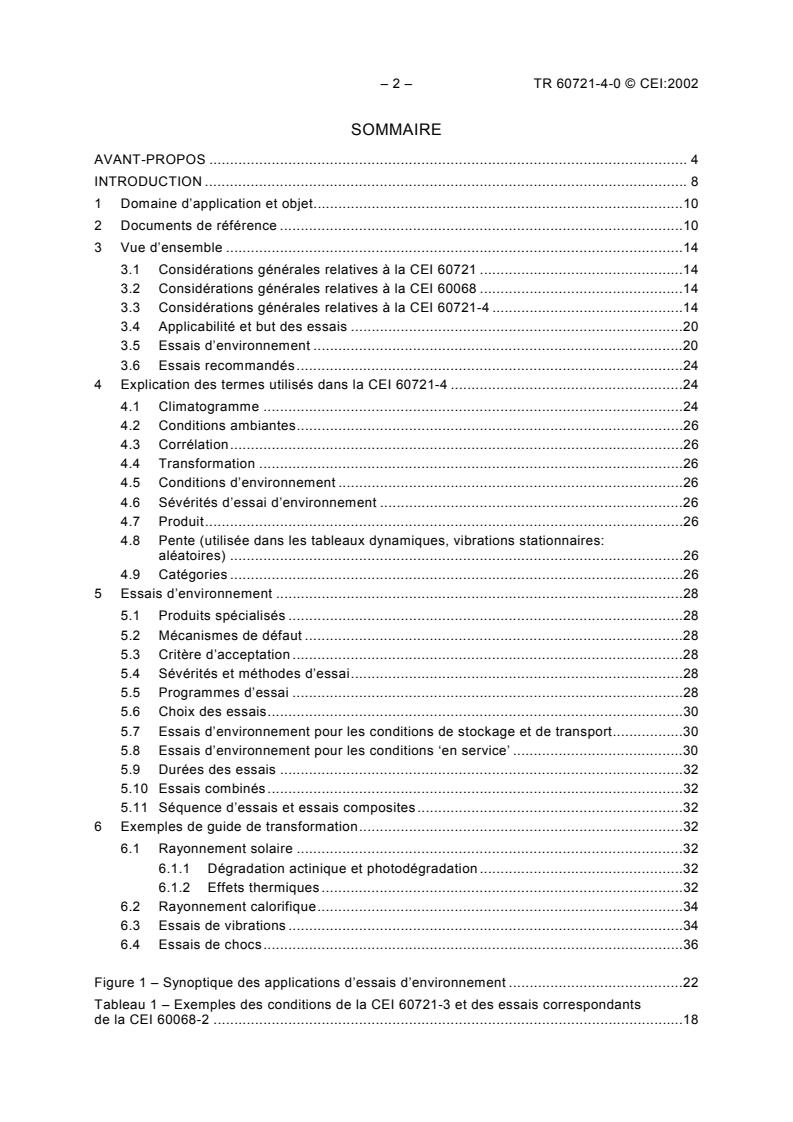
SOMMAIRE
AVANT-PROPOS . 4
INTRODUCTION .8
1 Domaine d’application et objet.10
2 Documents de référence .10
3 Vue d’ensemble .14
3.1 Considérations générales relatives à la CEI 60721 .14
3.2 Considérations générales relatives à la CEI 60068 .14
3.3 Considérations générales relatives à la CEI 60721-4 .14
3.4 Applicabilité et but des essais .20
3.5 Essais d’environnement .20
3.6 Essais recommandés.24
4 Explication des termes utilisés dans la CEI 60721-4 .24
4.1 Climatogramme .24
4.2 Conditions ambiantes.26
4.3 Corrélation.26
4.4 Transformation .26
4.5 Conditions d’environnement .26
4.6 Sévérités d’essai d’environnement .26
4.7 Produit.26
4.8 Pente (utilisée dans les tableaux dynamiques, vibrations stationnaires:
aléatoires) .26
4.9 Catégories .26
5 Essais d’environnement .28
5.1 Produits spécialisés .28
5.2 Mécanismes de défaut .28
5.3 Critère d’acceptation .28
5.4 Sévérités et méthodes d’essai.28
5.5 Programmes d’essai .28
5.6 Choix des essais.30
5.7 Essais d’environnement pour les conditions de stockage et de transport.30
5.8 Essais d’environnement pour les conditions ‘en service’ .30
5.9 Durées des essais .32
5.10 Essais combinés.32
5.11 Séquence d’essais et essais composites.32
6 Exemples de guide de transformation.32
6.1 Rayonnement solaire .32
6.1.1 Dégradation actinique et photodégradation .32
6.1.2 Effets thermiques .32
6.2 Rayonnement calorifique.34
6.3 Essais de vibrations .34
6.4 Essais de chocs.36
Figure 1 – Synoptique des applications d’essais d’environnement .22
Tableau 1 – Exemples des conditions de la CEI 60721-3 et des essais correspondants
de la CEI 60068-2 .18
TR 60721-4-0 © IEC:2002 – 3 –
CONTENTS
FOREWORD . 5
INTRODUCTION .9
1 Scope and object . 11
2 Reference documents . 11
3 Overview. 15
3.1 General remarks concerning IEC 60721 . 15
3.2 General remarks concerning IEC 60068 . 15
3.3 General remarks concerning IEC 60721-4 . 15
3.4 Applicability and purpose of the tests. 21
3.5 Environmental testing. 21
3.6 Recommended tests . 25
4 Explanation of terms used in IEC 60721-4 . 25
4.1 Climatogram . 25
4.2 Ambient . 27
4.3 Correlation. 27
4.4 Transformation. 27
4.5 Environmental conditions . 27
4.6 Environmental test severities. 27
4.7 Product . 27
4.8 Slope (used in the dynamic tables, stationary vibration: random) . 27
4.9 Classes. 27
5 Environmental tests. 29
5.1 Specialized products . 29
5.2 Failure mechanisms . 29
5.3 Acceptance criteria . 29
5.4 Severities and test methods . 29
5.5 Test programmes. 29
5.6 Selection of tests . 31
5.7 Environmental tests for storage and transportation conditions. 31
5.8 Environmental tests for ‘in-use’ condition. 31
5.9 Test durations. 33
5.10 Combined tests . 33
5.11 Sequence of tests and composite tests. 33
6 Examples of transformation guidance . 33
6.1 Solar radiation. 33
6.1.1 Actinic/photo-degradation . 33
6.1.2 Thermal effects . 33
6.2 Heat irradiation . 35
6.3 Vibration testing . 35
6.4 Shock testing . 37
Figure 1 – Outline of environmental testing applications . 23
Table 1 – Example of IEC 60721-3 conditions and corresponding IEC 60068-2 tests . 19
– 4 – TR 60721-4-0 © CEI:2002
COMMISSION ÉLECTROTECHNIQUE INTERNATIONALE
____________
CLASSIFICATION DES CONDITIONS D’ENVIRONNEMENT –
Partie 4-0: Guide pour la corrélation et la transformation
des classes de conditions d’environnement de la CEI 60721-3
en essais d’environnement de la CEI 60068 – Introduction
AVANT-PROPOS
1) La CEI (Commission Electrotechnique Internationale) est une organisation mondiale de normalisation composée
de l'ensemble des comités électrotechniques nationaux (Comités nationaux de la CEI). La CEI a pour objet
de favoriser la coopération internationale pour toutes les questions de normalisation dans les domaines de
l'électricité et de l'électronique. A cet effet, la CEI, entre autres activités, publie des Normes internationales.
Leur élaboration est confiée à des comités d'études, aux travaux desquels tout Comité national intéressé par le
sujet traité peut participer. Les organisations internationales, gouvernementales et non gouvernementales, en
liaison avec la CEI, participent également aux travaux. La CEI collabore étroitement avec l'Organisation
Internationale de Normalisation (ISO), selon des conditions fixées par accord entre les deux organisations.
2) Les décisions ou accords officiels de la CEI concernant les questions techniques représentent, dans la mesure
du possible un accord international sur les sujets étudiés, étant donné que les Comités nationaux intéressés
sont représentés dans chaque comité d’études.
3) Les documents produits se présentent sous la forme de recommandations internationales. Ils sont publiés
comme normes, spécifications techniques, rapports techniques, ou guides et agréés comme tels par les
Comités nationaux.
4) Dans le but d'encourager l'unification internationale, les Comités nationaux de la CEI s'engagent à appliquer de
façon transparente, dans toute la mesure possible, les Normes internationales de la CEI dans leurs normes
nationales et régionales. Toute divergence entre la norme de la CEI et la norme nationale ou régionale
correspondante doit être indiquée en termes clairs dans cette dernière.
5) La CEI n’a fixé aucune procédure concernant le marquage comme indication d’approbation et sa responsabilité
n’est pas engagée quand un matériel est déclaré conforme à l’une de ses normes.
6) L’attention est attirée sur le fait que certains des éléments du présent rapport technique peuvent faire l’objet de
droits de propriété intellectuelle ou de droits analogues. La CEI ne saurait être tenue pour responsable de ne
pas avoir identifié de tels droits de propriété et de ne pas avoir signalé leur existence.
La tâche principale des comités d’études de la CEI est l’élaboration des Normes
internationales. Toutefois, un comité d’études peut proposer la publication d’un rapport
technique lorsqu’il a réuni des données de nature différente de celles qui sont normalement
publiées comme Normes internationales, cela pouvant comprendre, par exemple, des infor-
mations sur l’état de la technique.
Un rapport technique ne doit pas nécessairement être révisé avant que les données qu’il
contient ne soient plus jugées valables ou utiles.
La CEI 60721-4-0, qui est un rapport technique, a été établie par le comité d’études 104 de
la CEI: Conditions, classification et essais d'environnement.
Le texte de ce rapport technique est issu des documents suivants:
Projet d’enquête Rapport de vote
104/143/CDV 104/173A/RVC
Le rapport de vote indiqué dans le tableau ci-dessus donne toute information sur le vote ayant
abouti à l'approbation de ce rapport technique.
Cette publication a été rédigée selon les Directives ISO/CEI. Partie 2.
TR 60721-4-0 © IEC:2002 – 5 –
INTERNATIONAL ELECTROTECHNICAL COMMISSION
____________
CLASSIFICATION OF ENVIRONMENTAL CONDITIONS –
Part 4-0: Guidance for the correlation and transformation
of environmental condition classes of IEC 60721-3 to
the environmental tests of IEC 60068 – Introduction
FOREWORD
1) The IEC (International Electrotechnical Commission) is a worldwide organization for standardization comprising
all national electrotechnical committees (IEC National Committees). The object of the IEC is to promote
international co-operation on all questions concerning standardization in the electrical and electronic fields. To
this end and in addition to other activities, the IEC publishes International Standards. Their preparation is
entrusted to technical committees; any IEC National Committee interested in the subject dealt with may
participate in this preparatory work. International, governmental and non-governmental organizations liaising
with the IEC also participate in this preparation. The IEC collaborates closely with the International Organization
for Standardization (ISO) in accordance with conditions determined by agreement between the two
organizations.
2) The formal decisions or agreements of the IEC on technical matters express, as nearly as possible, an
international consensus of opinion on the relevant subjects since each technical committee has representation
from all interested National Committees.
3) The documents produced have the form of recommendations for international use and are published in the form
of standards, technical specifications, technical reports or guides and they are accepted by the National
Committees in that sense.
4) In order to promote international unification, IEC National Committees undertake to apply IEC International
Standards transparently to the maximum extent possible in their national and regional standards. Any
divergence between the IEC Standard and the corresponding national or regional standard shall be clearly
indicated in the latter.
5) The IEC provides no marking procedure to indicate its approval and cannot be rendered responsible for any
equipment declared to be in conformity with one of its standards.
6) Attention is drawn to the possibility that some of the elements of this technical report may be the subject of
patent rights. The IEC shall not be held responsible for identifying any or all such patent rights.
The main task of IEC technical committees is to prepare International Standards. However, a
technical committee may propose the publication of a technical report when it has collected
data of a different kind from that which is normally published as an International Standard, for
example “state of the art”.
Technical reports do not necessarily have to be reviewed until the data they provide are
considered to be no longer valid or useful by the maintenance team.
IEC 60721-4-0, which is a technical report, has been prepared by IEC technical
committee 104: Environmental conditions, classification and methods of test.
The text of this technical report is based on the following documents:
Enquiry draft Report on voting
104/143/CDV 104/173A/RVC
Full information on the voting for the approval of this technical report can be found in the report
on voting indicated in the above table.
This publication has been drafted in accordance with the ISO/IEC Directives, Part 2.
– 6 – TR 60721-4-0 © CEI:2002
Ce document, purement informatif ne doit pas être considéré comme une Norme
internationale.
Le comité a décidé que le contenu de cette publication ne sera pas modifié avant 2006. A cette
date, la publication sera
• reconduite;
• supprimée;
• remplacée par une édition révisée, ou
• amendée.
TR 60721-4-0 © IEC:2002 – 7 –
This document which is purely informative is not to be regarded as an International Standard.
The committee has decided that the contents of this publication will remain unchanged until
2006. At this date, the publication will be
• reconfirmed;
• withdrawn;
• replaced by a revised edition, or
• amended.
– 8 – TR 60721-4-0 © CEI:2002
INTRODUCTION
L’environnement auxquel les produits sont exposés de manière typique est constitué d’un
certain nombre de conditions. Celles-ci sont spécifiées dans la CEI 60721-3 telles que les
effets climatiques, dynamiques, biologiques et autres effets dus aux substances chimiquement
et mécaniquement actives. Dans la CEI 60721-4 seules les conditions dynamiques et
climatiques ont été prises en compte.
Dans ce rapport technique, il est fait référence à
– la série CEI 60721-3 (parties 3-1 à 3-7),
– la série CEI 60721-4 (parties 4-1 à 4-7),
– la série CEI 60068-2 (différentes parties),
Ces normes seront ci-après respectivement désignées par CEI 60721-3, CEI 60721-4 et
CEI 60068-2, en l’absence de référence particulière.
Il est essentiel d’insister sur l’aspect guide de la CEI 60721-4, car il est pratiquement
impossible de spécifier des exigences obligatoires pour une utilisation universelle. Cependant
pour les cas qui ne sont pas nécessairement couverts par la CEI 60721-4, le présent rapport
technique (CEI 60721-4-0) établit en fait les principes et la méthodologie pour déterminer des
essais de remplacement. Ni la CEI 60721-3 ni la CEI 60721-4 ne traitent de questions telles que
les marges de sécurité, les facteurs d’accélération, etc., qui sont davantage du ressort du
concepteur, du fabricant, du consultant d’essais ou de l’utilisateur final.
Les indications de transformation sont fournies quand les agents utilisés pour définir les
conditions de la CEI 60721-3 sont différents de ceux utilisés pour définir les essais et/ou
les sévérités de la CEI 60068-2.
Les raisons de cette corrélation sont indiquées dans la CEI 60721-4 pour permettre aux
rédacteurs des spécifications de modifier un essai si son application le justifie. Si la valeur des
agents est différente dans la CEI 60721-3 et la CEI 60068-2, les sévérités des procédures
d’essai de la CEI 60068-2 sont utilisées. S’il est recommandé de s’écarter d’une sévérité de
la CEI 60068-2, les raisons sont données dans le détail et des essais de remplacement
sont recommandés.
La CEI 60721-4 traite des conditions climatiques et mécaniques (ci-après désignées par
conditions dynamiques) pour les catégories les plus communément utilisées de la
CEI 60721-3. Une base de données des sévérités d’environnement en vigueur est en
cours d’élaboration. Les sévérités couramment indiquées dans la CEI 60721-3 seront
alors régulièrement confirmées ou mises à jour, ce qui conduira à une mise à jour de la
CEI 60721-4.
TR 60721-4-0 © IEC:2002 – 9 –
INTRODUCTION
The environment to which products are typically exposed consists of a number of conditions.
These are specified in IEC 60721-3 as climatic, dynamic, biological and other effects due to
chemically and mechanically active substances. In IEC 60721-4 only climatic and dynamic
conditions have been considered.
Throughout this technical report, reference is made to
– the IEC 60721-3 series (parts 3-1 to 3-7),
– the IEC 60721-4 series (parts 4-1 to 4-7),
– the IEC 60068-2 series (various parts).
These will hereinafter be called IEC 60721-3, IEC 60721-4 and IEC 60068-2, respectively
unless a specific reference is being made.
It is essential to emphasize the guidance nature of IEC 60721-4 since it is virtually impossible
to specify mandatory requirements for worldwide use. However, for those cases not necessarily
covered by IEC 60721-4, this technical report (IEC 60721-4-0) does establish principles and
methodology to determine alternative tests. Neither IEC 60721-3 nor IEC 60721-4 address
issues such as safety margins, acceleration factors, etc., which are best left to the judgement
of the designer, manufacturer, test consultant or end user.
Transformation guidance is provided where the parameters used to define conditions in
IEC 60721-3 differ from those used to define the tests and/or the severities in IEC 60068-2.
The reasons for correlation are given in IEC 60721-4 to enable specification writers to modify a
test if their application warrants it. Where differences in values of parameters exist between
IEC 60721-3 and IEC 60068-2, the severities of the IEC 60068-2 test procedures are used. If it
is recommended to deviate from an IEC 60068-2 severity, the reasons are detailed and
alternative tests recommended.
IEC 60721-4 deals with climatic and mechanical conditions (hereinafter known as dynamic
conditions) for the most commonly used classes of IEC 60721-3. A database of validated
environmental severities is being developed. The severities currently given in IEC 60721-3 will,
in time, therefore, be either confirmed or updated which will result in an update to IEC 60721-4.
– 10 – TR 60721-4-0 © CEI:2002
CLASSIFICATION DES CONDITIONS D’ENVIRONNEMENT –
Partie 4-0: Guide pour la corrélation et la transformation
des classes de conditions d’environnement de la CEI 60721-3
en essais d’environnement de la CEI 60068 – Introduction
1 Domaine d’application et objet
Cette partie de la CEI 60721 est un rapport technique qui traite de la corrélation et de la
transformation des conditions de la CEI 60721-3 en essais d’environnement définis dans la
CEI 600682. Il constitue une introduction à la série de publications IEC 60721-4 qui vise à
fournir aux rédacteurs de spécifications un guide comportant un ensemble de tableaux faciles
à utiliser pour permettre la corrélation et la transformation de ces conditions.
Le présent rapport technique a pour objet de recommander les essais d’environnement qui
peuvent être choisis pour démontrer l’aptitude d’un produit à fonctionner et à perdurer de
manière satisfaisante, comme cela est précisé dans la spécification particulière, quand il est
soumis aux conditions climatiques et dynamiques données par la CEI 60721-3. Ces sévérités
d’essais, y compris leurs durées suggérées, ne sont pas destinées à démontrer la fiabilité du
produit (orientations qu’il convient de rechercher dans les publications concernant le domaine
de la disponibilité, de la fiabilité, de la maintenabilité et de la logistique de maintenance).
Alors qu’il n’est pas possible de recommander des sévérités pour tous les types de produits,
d’emplacements et d’applications, il est possible de suggérer des essais qui se révèlent
adaptés à la majorité des cas. Des conseils sont proposés avec les essais suggérés, décrivant
comment les sévérités ont été choisies. La raison d’être contenue dans ce guide peut
également être utilisée pour permettre la modification des sévérités d’essai quand il a été
considéré que les conditions de la CEI 60721-3 ne décrivent pas correctement un
environnement ou une application particulière.
2 Documents de référence
CEI 60068-1:1988, Essais d’environnement – Première partie: Généralités et guide
CEI 60068-2 ( toutes les parties), Essais d’environnement – Deuxième partie: Essais
CEI 60068-2-5:1975, Essais d'environnement – Deuxième partie: Essais. Essai Sa: Rayon-
nement solaire artificiel au niveau du sol
CEI 60068-2-6:1995, Essais d'environnement – Partie 2: Essais – Essai Fc: Vibrations
(sinusoïdales)
CEI 60068-2-64:1993, Essais d'environnement – Partie 2: Méthodes d'essai – Essai Fh:
Vibrations aléatoires à large bande, (asservissement numérique) et guide
CEI 60721-2 (toutes les parties), Classification des conditions d'environnement – Deuxième
partie: Conditions d'environnement présentes dans la nature
CEI 60721-2-1:1982, Classification des conditions d'environnement – Deuxième partie:
Conditions d'environnement présentes dans la nature. Température et humidité
TR 60721-4-0 © IEC:2002 – 11 –
CLASSIFICATION OF ENVIRONMENTAL CONDITIONS –
Part 4-0: Guidance for the correlation and transformation
of environmental condition classes of IEC 60721-3 to
the environmental tests of IEC 60068 – Introduction
1 Scope and object
This part of IEC 60721 is a technical report dealing with the correlation and transformation of
the conditions given in IEC 60721-3 to the environmental tests defined in IEC 60068-2. It is an
introduction to the series of publications IEC 60721-4 which aims at providing the specification
writer with guidance together with a set of easy-to-use tables to help correlate and transform
these conditions.
The purpose of this technical report is to recommend the environmental tests which may be
chosen to demonstrate the capability of a product to function or survive satisfactorily as
specified in the relevant specification when subjected to the climatic and dynamic conditions
given by IEC 60721-3. These test severities, including their suggested duration, are not
intended to demonstrate the reliability of the product, guidance for which should be sought from
the publications concerning the field of availability, reliability, maintainability and maintenance
support.
Whilst it may not be possible to recommend severities for all types of product, locations and
applications, it is possible to suggest tests which are adequate for the majority. Guidance
information has been included with the suggested tests which describes how the severities
have been chosen. The rationale contained in this guidance may also be used to help modify
test severities when the conditions found in IEC 60721-3 do not adequately describe a
particular environment or application.
2 Reference documents
IEC 60068-1:1988, Environmental testing – Part 1: General and guidance
IEC 60068-2 (all parts), Environmental testing – Part 2: Test methods
IEC 60068-2-5:1975, Environmental testing – Part 2: Tests. Test Sa: Simulated solar radiation
at ground level
IEC 60068-2-6:1995, Environmental testing – Part 2: Tests. Test Fc: Vibration (sinusoidal)
IEC 60068-2-64:1993, Environmental testing – Part 2: Test methods – Test Fh: Vibration,
broadband, random (digital control) and guidance
IEC 60721-2 (all parts), Classification of environmental conditions – Part 2: Environmental
conditions appearing in nature
IEC 60721-2-1:1982, Classification of environmental conditions – Part 2-1: Environmental
conditions appearing in nature – Temperature and humidity
– 12 – TR 60721-4-0 © CEI:2002
CEI 60721-2-3:1987, Classification des conditions d'environnement – Deuxième partie:
Conditions d'environnement présentes dans la nature. Pression atmosphérique
CEI 60721-2-4:1987, Classification des conditions d'environnement – Deuxième partie:
Conditions d'environnement présentes dans la nature. Rayonnement solaire et température
CEI 60721-3 (toutes les parties), Classification des conditions d'environnement – Partie 3:
Classification des groupements des agents d'environnement et de leurs sévérités
CEI 60721-3-0:1984, Classification des conditions d'environnement – Partie 3: Classification
des groupements des agents d'environnement et de leurs sévérités – Introduction
CEI 60721-3-1:1997, Classification des conditions d'environnement – Partie 3: Classification
des groupements des agents d'environnement et de leurs sévérités – Section 1: Stockage
CEI 60721-3-2:1997, Classification des conditions d'environnement – Partie 3: Classification
des groupements des agents d'environnement et de leurs sévérités – Section 2: Transport
CEI 60721-3-3:1994, Classification des conditions d'environnement – Partie 3: Classification
des groupements des agents d'environnement et de leurs sévérités – Section 3: Utilisation à
poste fixe, protégé contre les intempéries
CEI 60721-3-4:1995, Classification des conditions d'environnement – Partie 3: Classification
des groupements des agents d'environnement et de leurs sévérités – Section 4: Utilisation à
poste fixe, non protégé contre les intempéries
CEI 60721-3-5:1997, Classification des conditions d'environnement – Partie 3: Classification
des groupements des agents d'environnement et de leurs sévérités – Section 5: Installation
des véhicules terrestres
CEI 60721-3-6:1987, Classification des conditions d'environnement – Troisième partie:
Classification des groupements des agents d'environnement et de leurs sévérités –
Environnement des navires
CEI 60721-3-7:1995, Classification des conditions d'environnement – Partie 3: Classification
des groupements des agents d'environnement et de leurs sévérités – Section 7: Utilisation en
déplacement
CEI 60721-4-1:2001, Classification des conditions d'environnement – Partie 4-1: Guide pour la
corrélation et la transformation des classes de conditions d'environnement de la CEI 60721-3
en essais d'environnement de la CEI 60068 – Stockage
CEI 60721-4-2:2001, Classification des conditions d'environnement – Partie 4-1: Guide pour la
corrélation et la transformation des classes de conditions d'environnement de la CEI 60721-3
en essais d'environnement de la CEI 60068 –Transport
CEI 60721-4-3:2001, Classification des conditions d'environnement – Partie 4-1:Guide pour la
corrélation et la transformation des classes de conditions d'environnement de la CEI 60721-3
en essais d'environnement de la CEI 60068 – Utilisation à poste fixe, protégé contre les
intempéries
CEI 60721-4-4:2001, Classification des conditions d'environnement – Partie 4-1: Guide pour la
corrélation et la transformation des classes de conditions d'environnement de la CEI 60721-3
en essais d'environnement de la CEI 60068 – Utilisation à poste fixe, non protégé contre les
intempéries
TR 60721-4-0 © IEC:2002 – 13 –
IEC 60721-2-3:1987; Classification of environmental conditions – Part 2-3: Environmental
conditions appearing in nature – Air pressure
IEC 60721-2-4:1987, Classification of environmental conditions – Part 2-4: Environmental
conditions appearing in nature – Solar radiation and temperature
IEC 60721-3 (all parts), Classification of environmental conditions – Part 3: Classification of
groups of environmental parameters and their severities
IEC 60721-3-0:1984, Classification of environmental conditions – Part 3: Classification of
groups of environmental parameters and their severities – Introduction
IEC 60721-3-1:1997, Classification of environmental conditions – Part 3: Classification
of groups of environmental parameters and their severities – Section 1: Storage
IEC 60721-3-2:1997, Classification of environmental conditions – Part 3: Classification of
groups of environmental parameters and their severities – Section 2: Transportation
IEC 60721-3-3:1994, Classification of environmental conditions – Part 3: Classification
of groups of environmental parameters and their severities – Section 3: Stationary use at
weather-protected locations
IEC 60721-3-4:1995, Classification of environmental conditions – Part 3: Classification of
groups of environmental parameters and their severities – Section 4: Stationary use at non-
weather-protected locations
IEC 60721-3-5:1997, Classification of environmental conditions – Part 3: Classification
of groups of environmental parameters and their severities – Section 5: Ground vehicle
installations
IEC 60721-3-6:1987, Classification of environmental conditions – Part 3: Classification of
groups of environmental parameters and their severities – Ship environment
IEC 60721-3-7:1995, Classification of environmental conditions – Part 3: Classification
of groups of environmental parameters and their severities – Section 7: Portable and non-
stationary use
IEC 60721-4-1:2001, Classification of environmental conditions – Part 4-1: Guidance for
the correlation and transformation of environmental condition classes of IEC 60721-3 to the
environmental tests of IEC 60068 – Storage
IEC 60721-4-2:2001, Classification of environmental conditions – Part 4-2: Guidance for the
correlation and transformation of the environmental condition classes of IEC 60721-3 to
the environmental tests of IEC 60068 – Transportation
IEC 60721-4-3:2001, Classification of environmental conditions – Part 4-3: Guidance for
the correlation and transformation of the environmental condition classes of IEC 60721-3 to the
environmental tests of IEC 60068 – Stationary use at weather-protected locations
IEC 60721-4-4:2001, Classification of environmental conditions – Part 4-4: Guidance for the
correlation and transformation of the environmental condition classes of IEC 60721-3 to
the environmental tests of IEC 60068 – Stationary use at non-weather-protected locations
– 14 – TR 60721-4-0 © CEI:2002
CEI 60721-4-5:2001, Classification des conditions d'environnement – Partie 4-1: Guide pour la
corrélation et la transformation des classes de conditions d'environnement de la CEI 60721-3
en essais d'environnement de la CEI 60068 – Installation des véhicules terrestres
CEI 60721-4-6:2001, Classification des conditions d'environnement – Partie 4-1: Guide pour la
corrélation et la transformation des classes de conditions d'environnement de la CEI 60721-3
en essais d'environnement de la CEI 60068 – Environnement des navires
CEI 60721-4-7:2001, Classification des conditions d'environnement – Partie 4-1: Guide pour la
corrélation et la transformation des classes de conditions d'environnement de la CEI 60721-3
en essais d'environnement de la CEI 60068 – Utilisation en déplacement
ISO 554:1976, Atmosphères normales de conditionnement et/ou d’essai – Spécifications
ISO 2533:1975, Atmosphère type
Additif 1(1985) , Tables hypsométriques
Additif 2 (1997), Extension à – 5 000 m, et atmosphère type en fonction de l'altitude, en feet
ISO 4180-2:1980, Emballages d’expédition complets et pleins – Règles générales pour
l’établissement des programmes d’essais d’aptitude à l’emploi – Partie 2: Données
quantitatives
ISO 12048:1994, Emballages – Emballages d’expédition complets et pleins – Essais de
compression et de gerbage à l’aide d’une machine d’essai de compression
3 Vue d’ensemble
3.1 Considérations générales relatives à la CEI 60721
La CEI 60721-3 établit des catégories de conditions d’environnement pour différents emplace-
ments auxquelles les produits peuvent être exposés pendant leur stockage, leur transport et
leur utilisation. Chaque catégorie décrit les conditions spécifiques de chaque agent d’environ-
nement comme la haute température et les chocs. Chaque agent dans ces classes est
détaillé individuellement, mais les produits peuvent être exposés à plusieurs d’entre eux
simultanément. Certains de ces agents sont indépendants alors que d’autres sont fortement
corrélés entre eux (par exemple le rayonnement solaire et la température).
3.2 Considérations générales relatives à la CEI 60068
La CEI 60068-2 établit une série de procédures d’essai d’environnement et les sévérités
d’essai correspondantes. Le choix des sévérités d’essai dépend des conséquences du défaut
sur le produit. Deux types de produits peuvent être mis à des emplacements couverts par la
même catégorie d’environnement. Cependant un type de produit peut être essayé avec des
conditions beaucoup plus sévères que l’autre en raison des différentes conséquences du
défaut. Ce rapport traite uniquement des conséquences normales des défauts. Pour des
conséquences plus importantes, il peut être nécessaire d’augmenter la sévérité d’essai à partir
de la connaissance du produit qu’en a un spécialiste. Pour d’autres orientations, il convient de
faire référence à la CEI 60068-1.
3.3 Considérations générales relatives à la CEI 60721-4
La CEI 60721-4 fournit les méthodes de corrélation et de transformation de la CEI 60068-2 en
ce qui concerne l’évaluation du produit vis à vis des conditions de la CEI 60721-3. Les sous-
parties correspondent à ce qui suit:
TR 60721-4-0 © IEC:2002 – 15 –
IEC 60721-4-5:2001, Classification of environmental conditions – Part 4-5: Guidance for the
correlation and transformation of the environmental condition classes of IEC 60721-3 to
the environmental tests of IEC 60068 – Ground vehicle installations
IEC 60721-4-6:2001, Classification of environmental conditions – Part 4-6: Guidance for
the correlation and transformation of the environmental condition classes of IEC 60721-3
to the environmental tests of IEC 60068 – Ship environment
IEC 60721-4-7:2001, Classification of environmental conditions – Part 4-7: Guidance for the
correlation and transformation of the environmental condition classes of IEC 60721-3 to
the environmental tests of IEC 60068 – Portable and non-statio
...