

IEC TS 62556:2014
(Main)Ultrasonics - Field characterization - Specification and measurement of field parameters for high intensity therapeutic ultrasound (HITU) transducers and systems
General Information
- Abstract
IEC TS 62556:2014 is a technical specification applicable to high intensity therapeutic ultrasound (HITU) devices. It specifies the relevant parameters for quantifying the field; the measurement methods at relatively low output levels and methodology for extrapolating these to higher therapeutic level fields; some considerations of sidelobes and pre-focal maxima; and parameters relevant to HITU transducers of different construction and geometry, including non-focusing, focusing with or without lenses, collimated, diverging and convergent transducers, multi-element transducers, scanning transducers and multiple sources. This technical specification is intended to support the ultrasonic measurement requirements given in IEC 60601-2-62. These specifications would have use in quality assurance, safety testing, and the standardization of communications regarding the clinical performance of HITU systems. Where possible, this technical specification incorporates specifications from other related standards. This technical specification does not apply to the following types of devices, which are covered by other standards: lithotripters (see IEC 61846); surgical equipment (see IEC 61847); and physiotherapy devices (see IEC 61689).
- Status
- Published
- Publication Date
- 23-Apr-2014
- Technical Committee
- TC 87 - Ultrasonics
- Drafting Committee
- WG 6 - TC 87/WG 6
- Current Stage
- PPUB - Publication issued
- Start Date
- 24-Apr-2014
- Completion Date
- 15-Jul-2014
Buy Documents
IEC TS 62556:2014 - Ultrasonics - Field characterization - Specification and measurement of field parameters for high intensity therapeutic ultrasound (HITU) transducers and systems Released:4/24/2014
Overview
IEC TS 62556:2014 - "Ultrasonics - Field characterization - Specification and measurement of field parameters for high intensity therapeutic ultrasound (HITU) transducers and systems" - is a technical specification that defines how to quantify and measure acoustic fields produced by HITU (high intensity therapeutic ultrasound) devices. It prescribes relevant field parameters, measurement methods at low output levels and procedures to extrapolate to therapeutic levels, and offers guidance for diverse transducer geometries (focusing, non‑focusing, multi‑element, scanning, collimated/diverging/convergent). The specification supports the ultrasonic measurement requirements in IEC 60601‑2‑62 and is intended for quality assurance, safety testing, and standardized communication of clinical performance.
Key topics and requirements
- Field parameter definitions: Parameters required to describe HITU acoustic fields, including sidelobes and pre‑focal maxima.
- Measurement approach: Procedures for hydrophone‑based measurements at relatively low outputs and methodologies for linear extrapolation to higher therapeutic levels.
- Hydrophone guidance: Selection, sensitivity, directional response, effective element size, pressure/intensity limits and calibration considerations.
- Positioning and water bath: Requirements for positioning systems, scanning rigs and water bath conditions for reproducible field mapping.
- Data acquisition & analysis: Requirements for acquisition systems, signal processing and uncertainty assessment.
- Scan and reconstruction methods: Planar hydrophone scanning to determine total acoustic output power and propagation/back‑propagation methods (Fourier projection, Rayleigh integral) for field reconstruction.
- Uncertainty and rationale: Annexes covering uncertainty assessment, measurement limitations (nonlinear propagation, hydrophone damage) and rationale for chosen metrics.
- Reporting: Recommended reporting items and procedures to ensure consistent documentation of HITU field measurements.
Practical applications and users
Who uses IEC TS 62556:
- Medical device manufacturers developing HITU transducers and treatment systems.
- Metrology laboratories performing acoustic output power and field characterization.
- Regulatory and clinical engineers conducting safety testing and quality assurance.
- Research groups studying focused ultrasound therapy performance and dosimetry.
Practical uses:
- Standardizing field measurements for device certification and regulatory submissions.
- Designing test setups (hydrophone selection, scanner configuration, water properties).
- Comparing clinical device performance and communicating acoustic output consistently across vendors.
Related standards
- Supports: IEC 60601‑2‑62 (medical electrical equipment - HITU systems)
- Not applicable to devices covered by: IEC 61846 (lithotripters), IEC 61847 (surgical ultrasound), IEC 61689 (physiotherapy)
Keywords: IEC TS 62556, HITU, high intensity therapeutic ultrasound, field characterization, hydrophone measurement, acoustic output, planar scanning, propagation methods, IEC 60601‑2‑62.
Relations
- Effective Date
- 10-Feb-2026
- Effective Date
- 10-Feb-2026
Buy Documents
IEC TS 62556:2014 - Ultrasonics - Field characterization - Specification and measurement of field parameters for high intensity therapeutic ultrasound (HITU) transducers and systems Released:4/24/2014
Get Certified
Connect with accredited certification bodies for this standard

BSMI (Bureau of Standards, Metrology and Inspection)
Taiwan's standards and inspection authority.
Sponsored listings
Frequently Asked Questions
IEC TS 62556:2014 is a technical specification published by the International Electrotechnical Commission (IEC). Its full title is "Ultrasonics - Field characterization - Specification and measurement of field parameters for high intensity therapeutic ultrasound (HITU) transducers and systems". This standard covers: IEC TS 62556:2014 is a technical specification applicable to high intensity therapeutic ultrasound (HITU) devices. It specifies the relevant parameters for quantifying the field; the measurement methods at relatively low output levels and methodology for extrapolating these to higher therapeutic level fields; some considerations of sidelobes and pre-focal maxima; and parameters relevant to HITU transducers of different construction and geometry, including non-focusing, focusing with or without lenses, collimated, diverging and convergent transducers, multi-element transducers, scanning transducers and multiple sources. This technical specification is intended to support the ultrasonic measurement requirements given in IEC 60601-2-62. These specifications would have use in quality assurance, safety testing, and the standardization of communications regarding the clinical performance of HITU systems. Where possible, this technical specification incorporates specifications from other related standards. This technical specification does not apply to the following types of devices, which are covered by other standards: lithotripters (see IEC 61846); surgical equipment (see IEC 61847); and physiotherapy devices (see IEC 61689).
IEC TS 62556:2014 is a technical specification applicable to high intensity therapeutic ultrasound (HITU) devices. It specifies the relevant parameters for quantifying the field; the measurement methods at relatively low output levels and methodology for extrapolating these to higher therapeutic level fields; some considerations of sidelobes and pre-focal maxima; and parameters relevant to HITU transducers of different construction and geometry, including non-focusing, focusing with or without lenses, collimated, diverging and convergent transducers, multi-element transducers, scanning transducers and multiple sources. This technical specification is intended to support the ultrasonic measurement requirements given in IEC 60601-2-62. These specifications would have use in quality assurance, safety testing, and the standardization of communications regarding the clinical performance of HITU systems. Where possible, this technical specification incorporates specifications from other related standards. This technical specification does not apply to the following types of devices, which are covered by other standards: lithotripters (see IEC 61846); surgical equipment (see IEC 61847); and physiotherapy devices (see IEC 61689).
IEC TS 62556:2014 is classified under the following ICS (International Classification for Standards) categories: 17.140.50 - Electroacoustics. The ICS classification helps identify the subject area and facilitates finding related standards.
IEC TS 62556:2014 has the following relationships with other standards: It is inter standard links to EN 60601-2-62:2015, EN IEC 61828:2021. Understanding these relationships helps ensure you are using the most current and applicable version of the standard.
IEC TS 62556:2014 is available in PDF format for immediate download after purchase. The document can be added to your cart and obtained through the secure checkout process. Digital delivery ensures instant access to the complete standard document.
Standards Content (Sample)
IEC TS 62556 ®
Edition 1.0 2014-04
TECHNICAL
SPECIFICATION
colour
inside
Ultrasonics – Field characterization – Specification and measurement of field
parameters for high intensity therapeutic ultrasound (HITU) transducers and
systems
All rights reserved. Unless otherwise specified, no part of this publication may be reproduced or utilized in any form
or by any means, electronic or mechanical, including photocopying and microfilm, without permission in writing from
either IEC or IEC's member National Committee in the country of the requester. If you have any questions about IEC
copyright or have an enquiry about obtaining additional rights to this publication, please contact the address below or
your local IEC member National Committee for further information.
IEC Central Office Tel.: +41 22 919 02 11
3, rue de Varembé Fax: +41 22 919 03 00
CH-1211 Geneva 20 info@iec.ch
Switzerland www.iec.ch
About the IEC
The International Electrotechnical Commission (IEC) is the leading global organization that prepares and publishes
International Standards for all electrical, electronic and related technologies.
About IEC publications
The technical content of IEC publications is kept under constant review by the IEC. Please make sure that you have the
latest edition, a corrigenda or an amendment might have been published.
IEC Catalogue - webstore.iec.ch/catalogue Electropedia - www.electropedia.org
The stand-alone application for consulting the entire The world's leading online dictionary of electronic and
bibliographical information on IEC International Standards, electrical terms containing more than 30 000 terms and
Technical Specifications, Technical Reports and other definitions in English and French, with equivalent terms in 14
documents. Available for PC, Mac OS, Android Tablets and additional languages. Also known as the International
iPad. Electrotechnical Vocabulary (IEV) online.
IEC publications search - www.iec.ch/searchpub IEC Glossary - std.iec.ch/glossary
The advanced search enables to find IEC publications by a More than 55 000 electrotechnical terminology entries in
variety of criteria (reference number, text, technical English and French extracted from the Terms and Definitions
committee,…). It also gives information on projects, replaced clause of IEC publications issued since 2002. Some entries
and withdrawn publications. have been collected from earlier publications of IEC TC 37,
77, 86 and CISPR.
IEC Just Published - webstore.iec.ch/justpublished
Stay up to date on all new IEC publications. Just Published IEC Customer Service Centre - webstore.iec.ch/csc
details all new publications released. Available online and If you wish to give us your feedback on this publication or
also once a month by email. need further assistance, please contact the Customer Service
Centre: csc@iec.ch.
IEC TS 62556 ®
Edition 1.0 2014-04
TECHNICAL
SPECIFICATION
colour
inside
Ultrasonics – Field characterization – Specification and measurement of field
parameters for high intensity therapeutic ultrasound (HITU) transducers and
systems
INTERNATIONAL
ELECTROTECHNICAL
COMMISSION
PRICE CODE
XD
ICS 17.140.50 ISBN 978-2-8322-1505-0
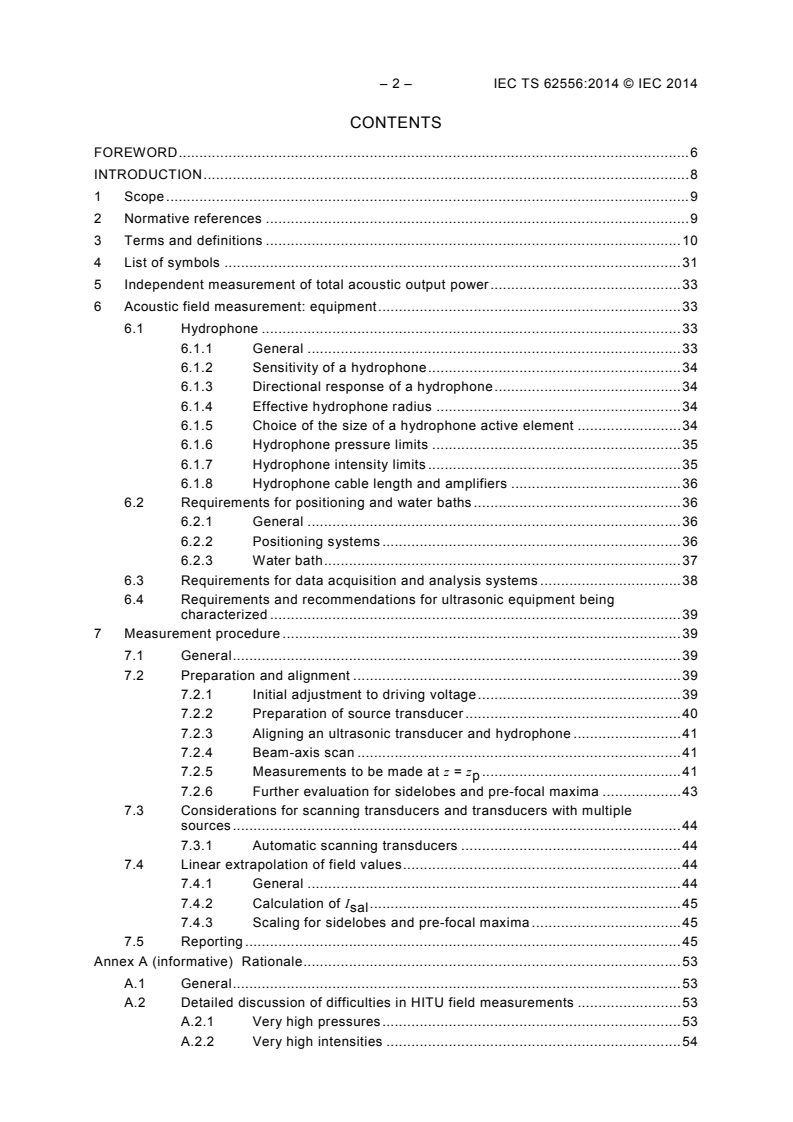
– 2 – IEC TS 62556:2014 © IEC 2014
CONTENTS
FOREWORD . 6
INTRODUCTION . 8
1 Scope . 9
2 Normative references . 9
3 Terms and definitions . 10
4 List of symbols . 31
5 Independent measurement of total acoustic output power . 33
6 Acoustic field measurement: equipment . 33
6.1 Hydrophone . 33
6.1.1 General . 33
6.1.2 Sensitivity of a hydrophone . 34
6.1.3 Directional response of a hydrophone . 34
6.1.4 Effective hydrophone radius . 34
6.1.5 Choice of the size of a hydrophone active element . 34
6.1.6 Hydrophone pressure limits . 35
6.1.7 Hydrophone intensity limits . 35
6.1.8 Hydrophone cable length and amplifiers . 36
6.2 Requirements for positioning and water baths . 36
6.2.1 General . 36
6.2.2 Positioning systems . 36
6.2.3 Water bath . 37
6.3 Requirements for data acquisition and analysis systems . 38
6.4 Requirements and recommendations for ultrasonic equipment being
characterized . 39
7 Measurement procedure . 39
7.1 General . 39
7.2 Preparation and alignment . 39
7.2.1 Initial adjustment to driving voltage . 39
7.2.2 Preparation of source transducer . 40
7.2.3 Aligning an ultrasonic transducer and hydrophone . 41
7.2.4 Beam-axis scan . 41
7.2.5 Measurements to be made at z = z . 41
p
7.2.6 Further evaluation for sidelobes and pre-focal maxima . 43
7.3 Considerations for scanning transducers and transducers with multiple
sources . 44
7.3.1 Automatic scanning transducers . 44
7.4 Linear extrapolation of field values . 44
7.4.1 General . 44
7.4.2 Calculation of I . 45
sal
7.4.3 Scaling for sidelobes and pre-focal maxima . 45
7.5 Reporting . 45
Annex A (informative) Rationale . 53
A.1 General . 53
A.2 Detailed discussion of difficulties in HITU field measurements . 53
A.2.1 Very high pressures . 53
A.2.2 Very high intensities . 54
A.2.3 Strong focusing . 54
A.2.4 Nonlinear harmonics . 54
A.2.5 Acoustic saturation and nonlinear loss . 55
A.2.6 Damage to hydrophones may only be apparent at high
pressures . 55
A.3 Approach of this technical specification . 55
Annex B (informative) Assessment of uncertainty in the acoustic quantities obtained
by hydrophone measurements . 57
B.1 General . 57
B.2 Overall (expanded) uncertainty . 57
B.3 Common sources of uncertainty . 57
Annex C (informative) Transducer and hydrophone positioning systems . 59
Annex D (informative) Rationale for I . 60
sal
D.1 General rationale . 60
D.2 Determination of P using hydrophone measurements and
c,6
extrapolation from linear measurements. 60
D.3 Alternative determination of P using an aperture in combination with a
c,6
measurement of total acoustic output power . 60
D.4 Special case of uniformly vibrating spherically shaped transducers . 61
Annex E (normative) Propagation and back-propagation methods for field
reconstruction: basic formulae and requirements . 62
E.1 Motivation and background . 62
E.2 Theory . 62
E.2.1 General . 62
E.2.2 Fourier projection approach . 64
E.2.3 Rayleigh integral approach . 67
E.3 Implementation . 68
E.3.1 General . 68
E.3.2 Recommendations for hydrophone . 68
E.3.3 Recommendation for planar scan parameters . 69
E.4 Assessment of uncertainties . 71
Annex F (informative) Propagation and back-propagation methods for field
reconstruction: examples and uses . 73
F.1 Examples . 73
F.1.1 Fourier projection example . 73
F.1.2 Rayleigh integral projection example . 77
F.2 Other propagation method applications . 81
Annex G (normative) Planar scanning of a hydrophone to determine acoustic output
power . 82
G.1 Introduction . 82
G.2 General principle. 82
G.3 Hydrophone scanning methodology . 83
G.3.1 General methodology . 83
G.3.2 Particular considerations for implementation for HITU fields . 84
G.4 Corrections and sources of measurement uncertainty . 84
G.4.1 Uncertainty in the hydrophone calibration . 84
G.4.2 Planar scanning . 84
G.4.3 Attenuation factor of water: unfocusing transducers . 85
G.4.4 Attenuation factor of water: focusing transducers . 85
G.4.5 Received hydrophone signal . 85
– 4 – IEC TS 62556:2014 © IEC 2014
G.4.6 Integration . 86
G.4.7 Finite size of the hydrophone . 86
G.4.8 partial extent of integration . 86
G.4.9 Non-linear propagation . 86
G.4.10 Directional response . 87
G.4.11 Noise . 87
G.4.12 Intensity approximated by derived intensity . 87
Annex H (informative) Properties of water . 88
H.1 General . 88
H.2 Attenuation coefficient for propagation in water . 89
Annex I (informative) Propagation medium and degassing . 90
Bibliography . 91
Figure 1 – Schematic diagram of the different planes and lines in an ultrasonic field for
a rectangular HITU transducer . 47
Figure 2 – Schematic diagram of the different planes and lines in an ultrasonic field for
a circularly symmetric HITU transducer . 48
Figure 3 – Schematic diagram of the different planes and lines in an ultrasonic field for
a circularly symmetric HITU transducer with a circular hole in its center. 49
Figure 4 – Schematic diagram of the different planes and lines in an ultrasonic field for
a circularly symmetric HITU transducer with a rectangular hole in its center for a
diagnostic transducer (HITU transducer azimuth axis aligned with azimuth scan axis of
diagnostic transducer) . 50
Figure 5 – Parameters for describing a focusing transducer of an unknown geometry
(IEC 61828) . 51
Figure 6 – Overall measurement scheme . 52
Figure C.1 – Schematic diagram of the ultrasonic transducer and hydrophone degrees
of freedom. X, Y and Z denote the axis directions relative to the mounted hydrophone
and ultrasonic transducer. . 59
Figure E.1 – Geometry of problem for forward and backward projection techniques. . 63
Figure E.2 – Transducer focused at –15mm, y = 48,16 mm, z = 56,85 mm . 66
Figure E.3 – Selection of acquisition window . 70
Figure E.4 – Scanned field compared to its reconstruction from a finite window . 71
Figure F.1 – Transducer inside 2-axis scanner setup . 73
Figure F.2 – Pressure amplitude as scanned . 74
Figure F.3 – Reconstructed pressure amplitude distribution in 3 orthogonal planes that
contain the focal point . 75
Figure F.4 – 3D representation of the focal beam for nominal focus at x = –0,85 mm,
y = –0,25 mm, z = 58,95 mm . 76
Figure F.5 – Reconstruction of pressure amplitudes on the transducer surface
(transducer aperture plane). 77
Figure F.6 – Experimental arrangement . 78
Figure F.7 – Amplitude and phase distribution of acoustic pressure measured at the
scanning region . 79
Figure F.8 – Amplitude and phase distribution of acoustic pressure reconstructed at
the transducer aperture plane . 79
Figure F.9 – Comparison of the axial distribution of pressure amplitudes as projected
from the aperture plane (red) and as measured (blue) . 80
Figure F.10 –Comparison of the schlieren image (A) and the corresponding YZ
distribution of acoustic pressure amplitudes projected from the transducer aperture
plane (B) . 81
Table H.1 – Speed of sound c [, ] and characteristic acoustic impedance, ρ c, as a
function of temperature, for propagation in water . 88
– 6 – IEC TS 62556:2014 © IEC 2014
INTERNATIONAL ELECTROTECHNICAL COMMISSION
____________
ULTRASONICS – FIELD CHARACTERIZATION – SPECIFICATION
AND MEASUREMENT OF FIELD PARAMETERS FOR HIGH INTENSITY
THERAPEUTIC ULTRASOUND (HITU) TRANSDUCERS AND SYSTEMS
FOREWORD
1) The International Electrotechnical Commission (IEC) is a worldwide organization for standardization comprising
all national electrotechnical committees (IEC National Committees). The object of IEC is to promote
international co-operation on all questions concerning standardization in the electrical and electronic fields. To
this end and in addition to other activities, IEC publishes International Standards, Technical Specifications,
Technical Reports, Publicly Available Specifications (PAS) and Guides (hereafter referred to as “IEC
Publication(s)”). Their preparation is entrusted to technical committees; any IEC National Committee interested
in the subject dealt with may participate in this preparatory work. International, governmental and non-
governmental organizations liaising with the IEC also participate in this preparation. IEC collaborates closely
with the International Organization for Standardization (ISO) in accordance with conditions determined by
agreement between the two organizations.
2) The formal decisions or agreements of IEC on technical matters express, as nearly as possible, an international
consensus of opinion on the relevant subjects since each technical committee has representation from all
interested IEC National Committees.
3) IEC Publications have the form of recommendations for international use and are accepted by IEC National
Committees in that sense. While all reasonable efforts are made to ensure that the technical content of IEC
Publications is accurate, IEC cannot be held responsible for the way in which they are used or for any
misinterpretation by any end user.
4) In order to promote international uniformity, IEC National Committees undertake to apply IEC Publications
transparently to the maximum extent possible in their national and regional publications. Any divergence
between any IEC Publication and the corresponding national or regional publication shall be clearly indicated in
the latter.
5) IEC itself does not provide any attestation of conformity. Independent certification bodies provide conformity
assessment services and, in some areas, access to IEC marks of conformity. IEC is not responsible for any
services carried out by independent certification bodies.
6) All users should ensure that they have the latest edition of this publication.
7) No liability shall attach to IEC or its directors, employees, servants or agents including individual experts and
members of its technical committees and IEC National Committees for any personal injury, property damage or
other damage of any nature whatsoever, whether direct or indirect, or for costs (including legal fees) and
expenses arising out of the publication, use of, or reliance upon, this IEC Publication or any other IEC
Publications.
8) Attention is drawn to the Normative references cited in this publication. Use of the referenced publications is
indispensable for the correct application of this publication.
9) Attention is drawn to the possibility that some of the elements of this IEC Publication may be the subject of
patent rights. IEC shall not be held responsible for identifying any or all such patent rights.
The main task of IEC technical committees is to prepare International Standards. In
exceptional circumstances, a technical committee may propose the publication of a technical
specification when
• the required support cannot be obtained for the publication of an International Standard,
despite repeated efforts, or
• the subject is still under technical development or where, for any other reason, there is the
future but no immediate possibility of an agreement on an International Standard.
Technical specifications are subject to review within three years of publication to decide
whether they can be transformed into International Standards.
IEC/TS 62556, which is a technical specification, has been prepared by IEC technical
committee 87: Ultrasonics
The text of this technical specification is based on the following documents:
Enquiry draft Report on voting
87/521/DTS 87/545/RVC
Full information on the voting for the approval of this technical specification can be found in
the report on voting indicated in the above table.
This publication has been drafted in accordance with the ISO/IEC Directives, Part 2.
NOTE 1 The following point types are used:
– Requirements: in roman type
– Notes: small roman type
– Words in bold in the text are defined in Clause 3
– Symbols and formulae: in Times New Roman + Italic.
NOTE 2 There are some inconsistencies in font type for symbols and formulae between some of the normative
references and this technical specification. They will be resolved in a future revision of the normative references.
The committee has decided that the contents of this publication will remain unchanged until
the stability date indicated on the IEC web site under "http://webstore.iec.ch" in the data
related to the specific publication. At this date, the publication will be
− transformed into an International standard,
− reconfirmed,
− withdrawn,
− replaced by a revised edition, or
− amended.
A bilingual version of this publication may be issued at a later date.
IMPORTANT – The 'colour inside' logo on the cover page of this publication indicates
that it contains colours which are considered to be useful for the correct
understanding of its contents. Users should therefore print this document using a
colour printer.
– 8 – IEC TS 62556:2014 © IEC 2014
INTRODUCTION
The use of high intensity therapeutic ultrasound (HITU) has advanced to the point where
systems have achieved clinical approval for general use in numerous countries. Medical
applications and product development are continuing rapidly. Fast development in preclinical
medicine, clinical medicine, and product manufacture has created an urgent need to
standardize measurements of the basic acoustic parameters and the field characteristics of
HITU. In order to promote the further development of HITU and to ensure its safe and
effective use, common technical Specifications are required.
This technical specification is relevant to the measurement and specification of ultrasound
fields intended for medical therapeutic purposes. It addresses the requirements for high
intensity therapeutic ultrasound (HITU) fields, including those generally referred to as high
intensity focused ultrasound (HIFU). Lithotripsy and physiotherapy are excluded, since
there are existing International Standards for these applications.
As described in Annex A, because measurement at full output power from HITU systems still
presents technical challenges, this standard specifies measurement methods at relatively low
output levels and methodology for extrapolating these to higher therapeutic level fields.
ULTRASONICS – FIELD CHARACTERIZATION – SPECIFICATION
AND MEASUREMENT OF FIELD PARAMETERS FOR HIGH INTENSITY
THERAPEUTIC ULTRASOUND (HITU) TRANSDUCERS AND SYSTEMS
1 Scope
This technical specification is applicable to high intensity therapeutic ultrasound (HITU)
devices, specifying:
– relevant parameters for quantifying the field;
– measurement methods at relatively low output levels and methodology for extrapolating
these to higher therapeutic level fields;
– consideration of sidelobes and pre-focal maxima;
– parameters relevant to HITU transducers of different construction and geometry, including
non-focusing, focusing with or without lenses, collimated, diverging and convergent
transducers, multi-element transducers, scanning transducers and multiple sources.
This technical specification is intended to support the ultrasonic measurement requirements
given in IEC 60601-2-62.
These specifications would have use in quality assurance, safety testing, and the
standardization of communications regarding the clinical performance of HITU systems.
Where possible, this technical specification incorporates specifications from other related
standards.
This technical specification does not apply to the following types of devices, which are
covered by other standards:
– lithotripters (see IEC 61846);
– surgical equipment (see IEC 61847);
– physiotherapy devices (see IEC 61689).
Throughout this technical specification SI units are used. In the specification of certain
parameters, such as beam-areas and intensities, it may be convenient to use decimal
multiples or sub-multiples. For example, beam-area may be specified in cm and intensities in
2 2
W/cm or mW/cm .
2 Normative references
The following documents, in whole or in part, are normatively referenced in this document and
are indispensable for its application. For dated references, only the edition cited applies. For
undated references, the latest edition of the referenced document (including any
amendments) applies.
IEC 60050 (all parts), International Electrotechnical Vocabulary (available at
)
IEC 60601-2-62, Medical electrical equipment – Particular requirements for the basic safety
and essential performance of high intensity therapeutic ultrasound (HITU) equipment
IEC 61161, Ultrasonics – Power measurement – Radiation force balances and performance
requirements
– 10 – IEC TS 62556:2014 © IEC 2014
IEC 61689, Ultrasonics – Physiotherapy systems – Field specifications and methods of
measurement in the frequency range 0,5 MHz to 5 MHz
IEC 61828:2001, Ultrasonics – Focusing transducers – Definitions and measurement methods
for the transmitted fields
IEC 62127-1:2007, Ultrasonics – Hydrophones – Part 1: Measurement and characterization of
medical ultrasonic fields up to 40 MHz
IEC 62127-1:2007/AMD1:2013
IEC 62127-2, Ultrasonics – Hydrophones – Part 2: Calibration for ultrasonic fields up to
40 MHz
IEC 62127-3, Ultrasonics – Hydrophones – Part 3: Properties of hydrophones for ultrasonic
fields up to 40 MHz
IEC 62555, Ultrasonics – Power measurement –High intensity therapeutic ultrasound (HITU)
transducers and systems
ISO/IEC Guide 98-3:2008: Guide to the expression of uncertainty in measurement
(GUM:1995)
3 Terms and definitions
For the purposes of this document the following terms and definitions apply.
3.1
acoustic pulse waveform
temporal waveform of the instantaneous acoustic pressure at a specified position in an
acoustic field and displayed over a period sufficiently long to include all significant acoustic
information in a single pulse or tone-burst, or one or more cycles in a continuous wave
Note 1 to entry: Temporal waveform is a representation (e.g oscilloscope presentation or equation) of the
instantaneous acoustic pressure.
[SOURCE: IEC 62127-1:2007, 3.1]
3.2
acoustic repetition period
arp
pulse repetition period for non-automatic scanning systems and the scan repetition period for
automatic scanning systems, equal to the time interval between corresponding points of
consecutive cycles for continuous wave systems
Note 1 to entry: The acoustic repetition period is expressed in seconds (s).
[SOURCE: IEC 62127-1:2007, 3.2]
3.3
acoustic frequency
acoustic-working frequency
frequency of an acoustic signal based on the observation of the output of a hydrophone
placed in an acoustic field at the position corresponding to the spatial-peak temporal-peak
acoustic pressure
Note 1 to entry: The signal is analysed using either the zero-crossing acoustic-working frequency technique or
a spectrum analysis method. Acoustic-working frequencies are defined in 3.3.1 and 3.3.2.
Note 2 to entry: In a number of cases the present definition is not very helpful or convenient, especially for
broadband transducers. In that case a full description of the frequency spectrum should be given in order to
enable any frequency-dependent correction to the signal.
Note 3 to entry: Acoustic frequency is expressed in hertz (Hz).
[SOURCE: IEC 62127-1:2007, 3.3]
3.3.1
zero-crossing acoustic-working frequency
f
awf
n, of consecutive half-cycles (irrespective of polarity) divided by twice the time
number,
between the commencement of the first half-cycle and the end of the n-th half-cycle
Note 1 to entry: None of the n consecutive half-cycles should show evidence of phase change.
Note 2 to entry: This frequency is intended for continuous-wave systems only.
[SOURCE: IEC 62127-1:2007/AMD 1:2013, 3.3.1, modified – The second and third notes in
the original definition have been deleted.]
3.3.2
arithmetic-mean acoustic-working frequency
f
awf
arithmetic mean of the most widely separated frequencies f and f , within the range of three
1 2
times f , at which the magnitude of the acoustic pressure spectrum is 3 dB below the peak
magnitude
Note 1 to entry: This frequency is intended for pulse-wave systems only.
Note 2 to entry: It is assumed that f < f .
1 2
Note 3 to entry: If f is not found within the range < 3 f , f is to be understood as the lowest frequency above this
2 1 2
range at which the spectrum magnitude is 3 dB below the peak magnitude.
Note 4 to entry: See IEC 62127-1 for methods of determining the arithmetic-mean acoustic working frequency.
[SOURCE: IEC 62127-1:2007/AMD 1:2013, 3.3.2, modified – A fourth note to entry has been
added to the definition.]
3.4
azimuth axis
axis formed by the junction of the azimuth plane and the source aperture plane
(measurement) or transducer aperture plane (design)
SEE: Figures 1 to 4.
Note 1 to entry: The selection of this axis is arbitrary for a circularly-symmetric HITU transducer without a hole in
its centre but is perpendicular to the elevation axis.
Note 2 to entry: If a HITU transducer has a hole in its centre, within which is a diagnostic imaging transducer,
then this axis is aligned with the azimuth axis of the imaging transducer.
[SOURCE: IEC 61828:2001, 4.2.7, modified – Two notes to entry have been added.]
3.5
azimuth plane
for a scanning ultrasonic transducer: this is the scan plane; for a non-scanning ultrasonic
transducer: this is the principal longitudinal plane
SEE: Figure 1.
[SOURCE: IEC 61828:2001, 4.2.8, modified – A note in the original has been deleted.]
– 12 – IEC TS 62556:2014 © IEC 2014
3.6
bandwidth
BW
difference in the most widely separated frequencies f and f at which the magnitude of the
1 2
acoustic pressure spectrum becomes 3 dB below the peak magnitude, at a specified point in
the acoustic field
Note 1 to entry: Bandwidth is expressed in hertz (Hz).
[SOURCE: IEC 62127-1:2007, 3.6]
3.7
beam area
A A A
b,6, b,12, b,20
area in a specified plane perpendicular to the beam axis consisting of all points at which the
pulse-pressure-squared integral is greater than a specified fraction of the maximum value
of the pulse-pressure-squared integral in that plane
Note 1 to entry: If the position of the plane is not specified, it is the plane passing through the point
corresponding to the maximum value of the pulse-pressure-squared integral in the whole acoustic field.
Note 2 to entry: In a number of cases, the term pulse-pressure-squared integral is replaced everywhere in the
above definition by any linearly related quantity, e.g.:
a) in the case of a continuous wave signal the term pulse-pressure-squared integral is replaced by mean square
acoustic pressure as defined in IEC 61689,
b) in cases where signal synchronisation with the scanframe is not available the term pulse-pressure-squared
integral may be replaced by temporal average intensity.
Note 3 to entry: Some specified fractions are 0,25 and 0,01 for the -6 dB and -20 dB beam areas, respectively.
Note 4 to entry: Beam area is expressed in square metres (m ).
[SOURCE: IEC 62127-1:2007/AMD 1:2013, 3.7, modified – the symbol has been modified to
include A .]
b,12
3.8
beam axis
straight line that passes through the beam centrepoints of two planes perpendicular to the
line which connects the point of maximal pulse-pressure-squared integral with the centre of
the external transducer surface plane
SEE: Figure 1.
Note 1 to entry: The location of the first plane is the location of the plane containing the maximum
pulse-pressure-squared integral or, alternatively, is one containing a single main lobe which is in the focal
Fraunhofer zone. The location of the second plane is as far as is practicable from the first plane and parallel to the
first with the same two orthogonal scan lines (x and y axes) used for the first plane.
Note 2 to entry: In a number of cases, the term pulse-pressure-squared integral is replaced in the above
definition by any linearly related quantity, e.g.:
a) in the case of a continuous wave signal the term pulse-pressure-squared integral is replaced by mean square
acoustic pressure as defined in IEC 61689,
b) in cases where signal synchronisation with the scanframe is not available the term pulse-pressure-squared
integral may be replaced by temporal average intensity.
[SOURCE: IEC 62127-1:2007, 3.7]
3.9
beam centrepoint
position determined by the intersection of two lines passing through the beamwidth
midpoints of two orthogonal planes, xz and yz
[SOURCE: IEC 61828:2001, 4.2.13.]
3.10
beam maximum
bm
maximum measured pulse-pressure-squared integral on the beam axis
3.11
beam maximum depth
L
bm
smallest distance between two points on the beam axis where the pulse-pressure-squared
integral falls below its maximum on the beam axis by 6 dB
Note 1 to entry: In a number of cases, the term pulse-pressure-squared integral is replaced in the above
definition by any linearly related quantity, e.g.: in the case of a continuous wave signal the term pulse-pressure-
squared integral is replaced by mean square acoustic pressure as defined in IEC 61689.
Note 2 to entry: Beam maximum depth is expressed in metres (m).
3.12
beam maximum point
position on the beam axis where the maximum pulse-pressure-squared integral is
measured
Note 1 to entry: In a number of cases, the term pulse-pressure-squared integral is replaced in the above
definition by any linearly related quantity, e.g.: in the case of a continuous wave by the mean square acoustic
pressure as defined in IEC 61689.
3.13
beam maximum volume
V
bm
volume in a specified space consisting of all points at which the pulse-pressure-squared
integral is greater than –6 dB of the pulse-pressure-squared integral value at the beam
maximum point
Note 1 to entry: In a number of cases, the term pulse-pressure-squared integral is replaced in the above
definition by any linearly related quantity, e.g.: in the case of a continuous wave signal the term pulse-pressure-
squared integral is replaced by mean square acoustic pressure as defined in IEC 61689.
Note 2 to entry: Beam maximum volume is expressed in cubic metres (m ).
3.14
beamwidth midpoint
linear average of the location of the centres of beamwidths in a plane
Note 1 to entry: The average is taken over as many beamwidth levels given in Table B.2 of IEC 61828:2001, as
signal level permits.
[SOURCE: IEC 61828:2001, 4.2.17, modified – The second sentence of the original definition
has been transformed into a note to entry here.]
3.15
beamwidth
w , w , w
6 12 20
greatest distance between two points on a specified axis perpendicular to the beam axis
where the pulse-pressure-squared integral falls below its maximum on the specified axis by
a specified amount
– 14 – IEC TS 62556:2014 © IEC 2014
Note 1 to entry: In a number of cases, the term pulse-pressure-squared integral is replaced in the above
definition by any linearly related quantity, e.g.:
a) in the case of a continuous wave signal the term pulse-pressure-squared integral is replaced by mean square
acoustic pressure as defined in IEC 61689,
b) in cases where signal synchronisation with the scanframe is not available, the term pulse-pressure-squared
integral may be replaced by temporal average intensity.
Note 2 to entry: Commonly used beamwidths are specified at –6 dB, –12 dB and –20 dB levels below the
maximum. The decibel calculation implies taking 10 times the logarithm of the ratios of the integrals.
Note 3 to entry: Beamwidth is expressed in metre (m).
[SOURCE: IEC 62127-1:2007, 3.11]
3.16
central scan line
for automatic scanning systems, the ultrasonic scan line closest to the symmetry axis of the
scan plane
[SOURCE: IEC 62127-1:2007, 3.13]
3.17
clinical driving conditions
settings of duty factor and transducer driving voltage when an ultrasonic transducer is
operated for purposes of treatment
3.18
diametrical beam scan
set of measurements of the hydrophone output voltage made while moving the hydrophone
in a straight line passing through a point on the beam axis and in a direction normal to the
beam axis
Note 1 to entry: The diametrical beam scan may extend to different distances on either side of the beam axis.
[SOURCE: IEC 62127-1:2007, 3.14]
3.19
distance z
e
z
e
distance along the beam axis between the patient entry plane and the external transducer
surface plane
Note 1 to entry: Distance z is expressed in metres (m).
e
3.20
distance z
slpta
z
slpta
distance along the beam axis between the plane containing the side-lobe peak temporal
average intensity and the source aperture plane
Note 1 to entry: Distance z is expressed in metres (m).
slpta
3.21
distance z
p
z
p
distance along the beam axis between the plane containing the focal point (or for non-
focusing transducers, to the plane containing the beam maximum), and the source aperture
plane
Note 1 to entry: Distance z is expressed in metre (m).
p
3.22
duty factor
F
d
ratio of the pulse duration to the pulse repetition period
[SOURCE: IEC 60469:2013, 3.2.9, modified – Reference to the specific context of a periodic
pulse train has been removed and the original note has been deleted.]
3.23
effective focusing surface
surface of constant phase whose periphery intersects the external transducer surface plane
Note 1 to entry: In the case of arrays, focusing results from applying a phase delay to the electrical excitation
applied to each element of an array to produce focusing and steering of a scan line. In this case, a total phase
delay along a line normal to each element may be calculated by adding the excitation’s phase delay to the
propagation delay along that line corresponding to the sound speed and distance along the line. A surface of
constant phase may then be defined as a surface intersecting all such normals, such that all points of intersection
have the same total phase.
3.24
effective hydrophone radius
a , a , a
h h3 h6
radius of a stiff disc receiver hydrophone that has a predicted directional response function
with an angular width equal to the observed angular width
Note 1 to entry: The angular width is determined at a specified level below the peak of the directional response
function. For the specified levels of 3 dB and 6 dB, the radii are denoted by a and a respectively.
h3 h6
Note 2 to entry: The radius is usually the function of frequency. For representative experimental data, see [1 ]
Note 3 to entry: Effective hydrophone radius is expressed in metres (m).
[SOURCE: IEC 62127-3, 3.2.]
3.25
effective path length
d
eff
distance that is the equivalent total acoustical path length (between a specified field point and
a specified point on the effective focusing surface of a transducer)
Note 1 to entry: In the case of a transducer with a lens, the part of the path through the lens is multiplied by the
ratio c / c where c is lens speed of sound and c is water (or measurement medium) speed of sound
W L L W
Note 2 to entry:: In most cases, this definition applies to transducers of known construction; otherwise, it can be
measured as time delay between the two points specified above divided by the water (or measurement medium)
speed of sound. See also geometric focus and effective focusing surface.
Note 3 to entry: Effective path length is expressed in metres, (m).
3.26
effective radius of a non-focusing ultrasonic transducer
a
t
ra
...