


IEC 62020:1998
(Main)Electrical accessories - Residual current monitors for household and similar uses (RCMs)
General Information
- Abstract
Applies to residual current monitors having rated voltages not exceeding 440 V a.c. and rated currents not exceeding 125 A for household and similar purposes. This standard applies to monitors performing simultaneously the functions of detection of the residual current, or comparison of the value of this current with the residual operating current of the device and of providing the prescribed warning signal(s) when the residual current exceeds this value.
- Status
- Replaced
- Publication Date
- 20-Nov-2003
- Technical Committee
- SC 23E - Circuit-breakers and similar equipment for household use
- Drafting Committee
- WG 2 - TC 23/SC 23E/WG 2
- Current Stage
- DELPUB - Deleted Publication
- Start Date
- 21-Apr-2020
- Completion Date
- 28-Aug-2026
Buy Documents
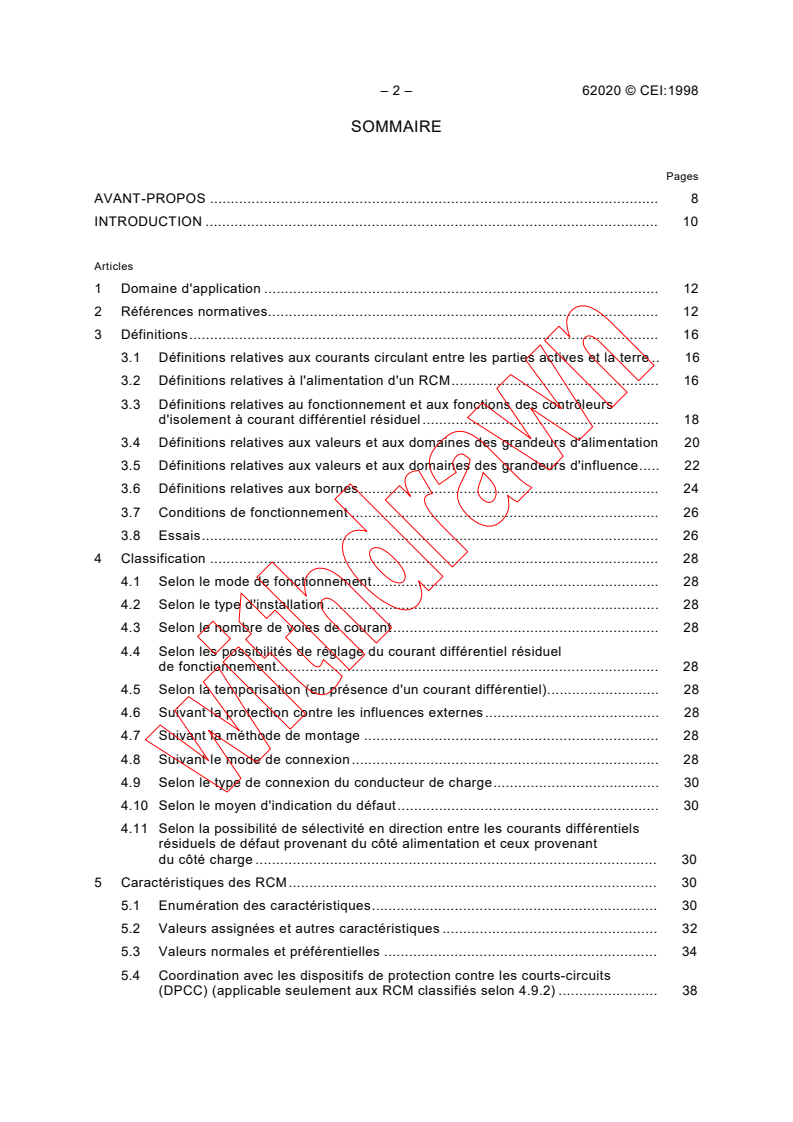
IEC 62020:1998 - Electrical accessories - Residual current monitors for household and similar uses (RCMs) Released:8/19/1998
IEC 62020:1998+AMD1:2003 CSV - Electrical accessories - Residual current monitors for household and similar uses (RCMs) Released:11/21/2003
Relations
- Effective Date
- 05-Sep-2023
- Effective Date
- 05-Sep-2023
Buy Documents
IEC 62020:1998 - Electrical accessories - Residual current monitors for household and similar uses (RCMs) Released:8/19/1998
IEC 62020:1998+AMD1:2003 CSV - Electrical accessories - Residual current monitors for household and similar uses (RCMs) Released:11/21/2003
Get Certified
Connect with accredited certification bodies for this standard

IMQ S.p.A. (Certification)
Italian electrical product certification.

SLG Prüf- und Zertifizierungs GmbH
German testing and certification body.

UL Solutions
Global safety science company with testing, inspection and certification.
Sponsored listings
Frequently Asked Questions
IEC 62020:1998 is a standard published by the International Electrotechnical Commission (IEC). Its full title is "Electrical accessories - Residual current monitors for household and similar uses (RCMs)". This standard covers: Applies to residual current monitors having rated voltages not exceeding 440 V a.c. and rated currents not exceeding 125 A for household and similar purposes. This standard applies to monitors performing simultaneously the functions of detection of the residual current, or comparison of the value of this current with the residual operating current of the device and of providing the prescribed warning signal(s) when the residual current exceeds this value.
Applies to residual current monitors having rated voltages not exceeding 440 V a.c. and rated currents not exceeding 125 A for household and similar purposes. This standard applies to monitors performing simultaneously the functions of detection of the residual current, or comparison of the value of this current with the residual operating current of the device and of providing the prescribed warning signal(s) when the residual current exceeds this value.
IEC 62020:1998 is classified under the following ICS (International Classification for Standards) categories: 29.120.50 - Fuses and other overcurrent protection devices. The ICS classification helps identify the subject area and facilitates finding related standards.
IEC 62020:1998 has the following relationships with other standards: It is inter standard links to IEC 62020-1:2020, IEC 62020:1998/AMD1:2003. Understanding these relationships helps ensure you are using the most current and applicable version of the standard.
IEC 62020:1998 is available in PDF format for immediate download after purchase. The document can be added to your cart and obtained through the secure checkout process. Digital delivery ensures instant access to the complete standard document.
Standards Content (Sample)
NORME
CEI
INTERNATIONALE
IEC
INTERNATIONAL
STANDARD
Première édition
First edition
1998-08
Petit appareillage électrique –
Contrôleurs d’isolement à courant différentiel
résiduel (RCM) pour usages domestiques
et analogues
Electrical accessories –
Residual current monitors for household
and similar uses (RCMs)
Numéro de référence
Reference number
CEI / IEC 62020:1998
Numéros des publications Numbering
Depuis le 1er janvier 1997, les publications de la CEI As from 1 January 1997 all IEC publications are
sont numérotées à partir de 60000. issued with a designation in the 60000 series.
Publications consolidées Consolidated publications
Les versions consolidées de certaines publications de Consolidated versions of some IEC publications
la CEI incorporant les amendements sont disponibles. including amendments are available. For example,
Par exemple, les numéros d’édition 1.0, 1.1 et 1.2 edition numbers 1.0, 1.1 and 1.2 refer, respectively, to
indiquent respectivement la publication de base, la the base publication, the base publication incor-
publication de base incorporant l’amendement 1, et porating amendment 1 and the base publication
la publication de base incorporant les amendements 1 incorporating amendments 1 and 2.
et 2.
Validité de la présente publication Validity of this publication
Le contenu technique des publications de la CEI est The technical content of IEC publications is kept under
constamment revu par la CEI afin qu'il reflète l'état constant review by the IEC, thus ensuring that the
actuel de la technique. content reflects current technology.
Des renseignements relatifs à la date de re- Information relating to the date of the reconfirmation of
confirmation de la publication sont disponibles dans le the publication is available in the IEC catalogue.
Catalogue de la CEI.
Les renseignements relatifs à des questions à l’étude et Information on the subjects under consideration and
des travaux en cours entrepris par le comité technique work in progress undertaken by the technical com-
qui a établi cette publication, ainsi que la liste des mittee which has prepared this publication, as well as
publications établies, se trouvent dans les documents ci- the list of publications issued, is to be found at the
dessous: following IEC sources:
• «Site web» de la CEI* • IEC web site*
• Catalogue des publications de la CEI • Catalogue of IEC publications
Publié annuellement et mis à jour régulièrement Published yearly with regular updates
(Catalogue en ligne)* (On-line catalogue)*
• Bulletin de la CEI • IEC Bulletin
Disponible à la fois au «site web» de la CEI* Available both at the IEC web site* and
et comme périodique imprimé as a printed periodical
Terminologie, symboles graphiques Terminology, graphical and letter
et littéraux symbols
En ce qui concerne la terminologie générale, le lecteur For general terminology, readers are referred to
se reportera à la CEI 60050: Vocabulaire Electro- IEC 60050: International Electrotechnical Vocabulary
technique International (VEI). (IEV).
Pour les symboles graphiques, les symboles littéraux For graphical symbols, and letter symbols and signs
et les signes d'usage général approuvés par la CEI, le approved by the IEC for general use, readers are
lecteur consultera la CEI 60027: Symboles littéraux à referred to publications IEC 60027: Letter symbols to
utiliser en électrotechnique, la CEI 60417: Symboles be used in electrical technology, IEC 60417: Graphical
graphiques utilisables sur le matériel. Index, relevé et symbols for use on equipment. Index, survey and
compilation des feuilles individuelles, et la CEI 60617: compilation of the single sheets and IEC 60617:
Symboles graphiques pour schémas. Graphical symbols for diagrams.
* Voir adresse «site web» sur la page de titre. * See web site address on title page.
NORME
CEI
INTERNATIONALE
IEC
INTERNATIONAL
STANDARD
Première édition
First edition
1998-08
Petit appareillage électrique –
Contrôleurs d’isolement à courant différentiel
résiduel (RCM) pour usages domestiques
et analogues
Electrical accessories –
Residual current monitors for household
and similar uses (RCMs)
IEC 1998 Droits de reproduction réservés Copyright - all rights reserved
Aucune partie de cette publication ne peut être reproduite ni No part of this publication may be reproduced or utilized in
utilisée sous quelque forme que ce soit et par aucun any form or by any means, electronic or mechanical,
procédé, électronique ou mécanique, y compris la photo- including photocopying and microfilm, without permission in
copie et les microfilms, sans l'accord écrit de l'éditeur. writing from the publisher.
International Electrotechnical Commission 3, rue de Varembé Geneva, Switzerland
Telefax: +41 22 919 0300 e-mail: inmail@iec.ch IEC web site http: //www.iec.ch
CODE PRIX
Commission Electrotechnique Internationale
PRICE CODE XC
International Electrotechnical Commission
Pour prix, voir catalogue en vigueur
For price, see current catalogue
– 2 – 62020 © CEI:1998
SOMMAIRE
Pages
AVANT-PROPOS . 8
INTRODUCTION . 10
Articles
1 Domaine d'application. 12
2 Références normatives. 12
3 Définitions. 16
3.1 Définitions relatives aux courants circulant entre les parties actives et la terre . 16
3.2 Définitions relatives à l'alimentation d'un RCM. 16
3.3 Définitions relatives au fonctionnement et aux fonctions des contrôleurs
d'isolement à courant différentiel résiduel. 18
3.4 Définitions relatives aux valeurs et aux domaines des grandeurs d'alimentation 20
3.5 Définitions relatives aux valeurs et aux domaines des grandeurs d'influence. 22
3.6 Définitions relatives aux bornes. 24
3.7 Conditions de fonctionnement . 26
3.8 Essais. 26
4 Classification. 28
4.1 Selon le mode de fonctionnement. 28
4.2 Selon le type d'installation . 28
4.3 Selon le nombre de voies de courant. 28
4.4 Selon les possibilités de réglage du courant différentiel résiduel
de fonctionnement. 28
4.5 Selon la temporisation (en présence d'un courant différentiel). 28
4.6 Suivant la protection contre les influences externes. 28
4.7 Suivant la méthode de montage . 28
4.8 Suivant le mode de connexion. 28
4.9 Selon le type de connexion du conducteur de charge. 30
4.10 Selon le moyen d'indication du défaut. 30
4.11 Selon la possibilité de sélectivité en direction entre les courants différentiels
résiduels de défaut provenant du côté alimentation et ceux provenant
du côté charge . 30
5 Caractéristiques des RCM. 30
5.1 Enumération des caractéristiques. 30
5.2 Valeurs assignées et autres caractéristiques . 32
5.3 Valeurs normales et préférentielles . 34
5.4 Coordination avec les dispositifs de protection contre les courts-circuits
(DPCC) (applicable seulement aux RCM classifiés selon 4.9.2) . 38
62020 © IEC:1998 − 3 −
CONTENTS
Page
FOREWORD . 9
INTRODUCTION . 11
Clause
1 Scope. 13
2 Normative references. 13
3 Definitions. 17
3.1 Definitions relating to currents flowing from live parts to earth . 17
3.2 Definitions relating to the energization of an RCM . 17
3.3 Definitions relating to the operation and to the functions of residual
current monitors . 19
3.4 Definitions relating to values and ranges of energizing quantities . 21
3.5 Definitions relating to values and ranges of influencing quantities. 23
3.6 Definitions relating to terminals . 25
3.7 Conditions of operation. 27
3.8 Test. 27
4 Classification. 29
4.1 According to the method of operation. 29
4.2 According to the type of installation. 29
4.3 According to the number of current paths. 29
4.4 According to the ability to adjust the residual operating current. 29
4.5 According to the possibility of adjusting the time-delay . 29
4.6 According to the protection against external influences . 29
4.7 According to the method of mounting . 29
4.8 According to the method of connection. 29
4.9 According to the type of connection of the load conductors. 29
4.10 According to fault indicating means. 31
4.11 According to ability to directionally discriminate between supply side
and load side residual currents . 31
5 Characteristics of RCMs. 31
5.1 Summary of characteristics. 31
5.2 Rated quantities and other characteristics. 33
5.3 Standard and preferred values . 35
5.4 Coordination with short-circuit protective devices (SCPDs)
(only valid for RCMs classified according to 4.9.2) . 39
– 4 – 62020 © CEI:1998
Articles Pages
6 Marques et autres indications sur le produit. 38
7 Conditions normales de fonctionnement en service et d'installation. 40
7.1 Conditions normales. 40
7.2 Conditions d'installation. 42
8 Prescriptions de construction et de fonctionnement . 42
8.1 Conception mécanique. 42
8.2 Protection contre les chocs électriques. 52
8.3 Propriétés diélectriques. 54
8.4 Echauffement. 54
8.5 Caractéristiques de fonctionnement. 56
8.6 Sélectivité directionnelle. 56
8.7 Endurance fonctionnelle. 56
8.8 Capacité de tenue aux courants de court-circuit . 56
8.9 Résistance aux impacts mécaniques . 56
8.10 Résistance à la chaleur . 58
8.11 Résistance à la chaleur anormale et au feu . 58
8.12 Dispositif de contrôle. 58
8.13 Fonctionnement correct des RCM dans la plage de la tension d'alimentation . 58
8.14 Comportement des RCM en cas de surintensité dans le circuit principal . 60
8.15 Tenue des RCM aux activations indésirables dues aux ondes de courant
causées par des ondes de surtension. 60
8.16 Comportement du RCM en cas d'un courant de défaut à la terre
comprenant une composante continue . 60
8.17 Fiabilité. 60
8.18 Prescriptions CEM. 60
8.19 Raccordement d'un transformateur de courant externe (TC) . 60
9 Essais. 60
9.1 Généralités. 60
9.2 Conditions d'essais. 62
9.3 Vérification de l'indélébilité du marquage. 64
9.4 Vérification de la sûreté des vis, des parties transportant le courant et des
connexions . 64
9.5 Vérification de la sûreté des bornes pour conducteurs externes . 68
9.6 Vérification de la protection contre les chocs électriques . 70
9.7 Essai des propriétés diélectriques . 72
9.8 Essais d'échauffement. 78
9.9 Vérification de la caractéristique de fonctionnement . 80
9.10 Vérification de l'endurance en fonctionnement . 84
9.11 Vérification de la capacité de tenue en court-circuit . 86
9.12 Vérification de la résistance aux impacts mécaniques. 96
62020 © IEC:1998 − 5 −
Clause Page
6 Marking and other product information. 39
7 Standard conditions for operation in service and for installation . 41
7.1 Standard conditions. 41
7.2 Conditions of installation. 43
8 Requirements for construction and operation . 43
8.1 Mechanical design. 43
8.2 Protection against electric shock . 53
8.3 Dielectric properties. 55
8.4 Temperature rise. 55
8.5 Operating characteristic. 57
8.6 Directional discrimination. 57
8.7 Operational endurance. 57
8.8 Performance at short-circuit currents . 57
8.9 Resistance to mechanical impact. 57
8.10 Resistance to heat. 59
8.11 Resistance to abnormal heat and to fire. 59
8.12 Test device. 59
8.13 Correct operation of RCMs within the supply voltage range . 59
8.14 Behaviour of RCMs in case of overcurrents in the main circuit . 61
8.15 Resistance of RCMs to unwanted tripping due to current surges
caused by impulse voltages . 61
8.16 Behaviour of RCMs in case of earth fault currents comprising
d.c. components. 61
8.17 Reliability. 61
8.18 EMC requirements. 61
9 Tests. 61
9.1 General. 61
9.2 Test conditions. 63
9.3 Test of indelibility of marking . 65
9.4 Test of reliability of screws, current-carrying parts and connections. 65
9.5 Test of reliability of terminals for external conductors. 69
9.6 Verification of protection against electric shock. 71
9.7 Test of dielectric properties . 73
9.8 Test of temperature rise . 79
9.9 Verification of the operating characteristics. 81
9.10 Verification of operational endurance. 85
9.11 Verification of short-circuit withstand capability . 87
9.12 Verification of resistance to mechanical impact. 97
– 6 – 62020 © CEI:1998
Articles Pages
9.13 Vérification de résistance à la chaleur . 100
9.14 Vérification de résistance à la chaleur anormale et au feu. 102
9.15 Vérification du fonctionnement du dispositif de contrôle aux limites de la tension
assignée . 104
9.16 Vérification des valeurs limites du courant de non-fonctionnement en cas de
surintensité . 104
9.17 Vérification de la résistance aux déclenchements intempestifs dus à une onde
de surtension . 106
9.18 Vérification de la résistance de l'isolation à une onde de surtension. 108
9.19 Vérification du fonctionnement correct aux courants différentiels résiduels
avec composante continue . 108
9.20 Vérification de la fiabilité . 112
9.21 Vérification du vieillissement des composants électroniques. 116
9.22 Vérification des prescriptions de CEM . 116
Figures. 118
Annexe A (normative) Séquences d'essais et nombre d'échantillons à essayer
pour vérifier la conformité à la présente norme . 160
Annexe B (normative) Détermination des distances d'isolement dans l'air et
des lignes de fuite . 168
62020 © IEC:1998 − 7 −
Clause Page
9.13 Test of resistance to heat . 101
9.14 Test of resistance to abnormal heat and to fire . 103
9.15 Verification of the operation of the test device at the limits of rated voltage . 105
9.16 Verification of limiting values of the non-operating current under overcurrent
conditions. 105
9.17 Verification of resistance against unwanted tripping due to current surges
caused by impulse voltages . 107
9.18 Verification of resistance of the insulation against impulse voltages . 109
9.19 Verification of the correct operation at residual currents with d.c. components 109
9.20 Verification of reliability . 113
9.21 Verification of ageing of electronic components . 117
9.22 Verification of EMC requirements . 117
Figures. 119
Annex A (normative) Test sequence and number of samples to be submitted
for verification of conformity to the standard. 161
Annex B (normative) Determination of clearances and creepage distances . 169
– 8 – 62020 © CEI:1998
COMMISSION ÉLECTROTECHNIQUE INTERNATIONALE
___________
PETIT APPAREILLAGE ÉLECTRIQUE –
CONTRÔLEURS D'ISOLEMENT À COURANT DIFFÉRENTIEL RÉSIDUEL
(RCM) POUR USAGES DOMESTIQUES ET ANALOGUES
AVANT-PROPOS
1) La CEI (Commission Electrotechnique Internationale) est une organisation mondiale de normalisation composée
de l'ensemble des comités électrotechniques nationaux (Comités nationaux de la CEI). La CEI a pour objet de
favoriser la coopération internationale pour toutes les questions de normalisation dans les domaines de
l'électricité et de l'électronique. A cet effet, la CEI, entre autres activités, publie des Normes Internationales.
Leur élaboration est confiée à des comités d'études, aux travaux desquels tout Comité national intéressé par le
sujet traité peut participer. Les organisations internationales, gouvernementales et non gouvernementales, en
liaison avec la CEI, participent également aux travaux. La CEI collabore étroitement avec l'Organisation
Internationale de Normalisation (ISO), selon des conditions fixées par accord entre les deux organisations.
2) Les décisions ou accords officiels de la CEI concernant les questions techniques, représentent, dans la mesure
du possible un accord international sur les sujets étudiés, étant donné que les Comités nationaux intéressés
sont représentés dans chaque comité d’études.
3) Les documents produits se présentent sous la forme de recommandations internationales. Ils sont publiés
comme normes, rapports techniques ou guides et agréés comme tels par les Comités nationaux.
4) Dans le but d'encourager l'unification internationale, les Comités nationaux de la CEI s'engagent à appliquer de
façon transparente, dans toute la mesure possible, les Normes internationales de la CEI dans leurs normes
nationales et régionales. Toute divergence entre la norme de la CEI et la norme nationale ou régionale
correspondante doit être indiquée en termes clairs dans cette dernière.
5) La CEI n’a fixé aucune procédure concernant le marquage comme indication d’approbation et sa responsabilité
n’est pas engagée quand un matériel est déclaré conforme à l’une de ses normes.
6) L’attention est attirée sur le fait que certains des éléments de la présente Norme internationale peuvent faire
l’objet de droits de propriété intellectuelle ou de droits analogues. La CEI ne saurait être tenue pour
responsable de ne pas avoir identifié de tels droits de propriété et de ne pas avoir signalé leur existence.
La Norme internationale CEI 62020 a été établie par le sous-comité 23E: Disjoncteurs et
appareillage similaire pour usage domestique, du comité d’études 23 de la CEI: Petit
appareillage.
Le texte de cette norme est issu des documents suivants:
FDIS Rapport de vote
23E/337/FDIS 23E/353/RVD
Le rapport de vote indiqué dans le tableau ci-dessus donne toute information sur le vote ayant
abouti à l'approbation de cette norme.
Dans la présente norme, les caractères d'imprimerie suivants sont employés:
– Prescriptions proprement dites: caractères romains.
– Modalités d'essais: caractères italiques.
– NOTES: petits caractères romains.
62020 © IEC:1998 − 9 −
INTERNATIONAL ELECTROTECHNICAL COMMISSION
___________
ELECTRICAL ACCESSORIES –
RESIDUAL CURRENT MONITORS
FOR HOUSEHOLD AND SIMILAR USES (RCMs)
FOREWORD
1) The IEC (International Electrotechnical Commission) is a worldwide organization for standardization comprising
all national electrotechnical committees (IEC National Committees). The object of the IEC is to promote
international co-operation on all questions concerning standardization in the electrical and electronic fields. To
this end and in addition to other activities, the IEC publishes International Standards. Their preparation is
entrusted to technical committees; any IEC National Committee interested in the subject dealt with may
participate in this preparatory work. International, governmental and non-governmental organizations liaising
with the IEC also participate in this preparation. The IEC collaborates closely with the International Organization
for Standardization (ISO) in accordance with conditions determined by agreement between the two
organizations.
2) The formal decisions or agreements of the IEC on technical matters express, as nearly as possible, an
international consensus of opinion on the relevant subjects since each technical committee has representation
from all interested National Committees.
3) The documents produced have the form of recommendations for international use and are published in the form
of standards, technical reports or guides and they are accepted by the National Committees in that sense.
4) In order to promote international unification, IEC National Committees undertake to apply IEC International
Standards transparently to the maximum extent possible in their national and regional standards. Any
divergence between the IEC Standard and the corresponding national or regional standard shall be clearly
indicated in the latter.
5) The IEC provides no marking procedure to indicate its approval and cannot be rendered responsible for any
equipment declared to be in conformity with one of its standards.
6) Attention is drawn to the possibility that some of the elements of this International Standard may be the subject
of patent rights. The IEC shall not be held responsible for identifying any or all such patent rights.
International Standard IEC 62020 has been prepared by subcommittee 23E: Circuit-breakers
and similar equipment for household use, of IEC technical committee 23: Electrical
accessories.
The text of this standard is based on the following documents:
FDIS Report on voting
23E/337/FDIS 23E/353/RVD
Full information on the voting for the approval of this standard can be found in the report on
voting indicated in the above table.
In this standard, the following print types are used:
– Requirements proper: in roman type.
– Test specifications: in italic type.
– NOTES: in smaller roman type.
– 10 – 62020 © CEI:1998
INTRODUCTION
Le rôle d'un contrôleur d'isolement à courant différentiel résiduel (désigné RCM par la suite)
est de surveiller, dans une installation électrique ou un circuit, la présence d'un courant
différentiel résiduel, et d'indiquer au moyen d'une alarme, la présence d'un tel courant
différentiel résiduel lorsqu'il excède un niveau prédéterminé.
Un RCM peut être utilisé en association avec des dispositifs de protection (voir la
CEI 60364-4).
Des règles d’installation et d’application sont données dans la CEI 60364.
62020 © IEC:1998 − 11 −
INTRODUCTION
The purpose of a residual current monitor (hereinafter referred to as RCM) is to monitor an
electrical installation or circuit for the presence of an unbalanced earth fault current and to
indicate, by means of an alarm, the presence of such a residual current when it exceeds a
predetermined level.
An RCM may be used in conjunction with protective devices (see IEC 60364-4).
Installation and application rules are given in IEC 60364.
– 12 – 62020 © CEI:1998
PETIT APPAREILLAGE ÉLECTRIQUE–
CONTRÔLEURS D'ISOLEMENT À COURANT DIFFÉRENTIEL RÉSIDUEL
(RCM) POUR USAGES DOMESTIQUES ET ANALOGUES
1 Domaine d'application
La présente norme internationale s'applique aux contrôleurs d'isolement à courant résiduel
pour usages domestiques et analogues ayant une tension assignée n’excédant pas 440 V
alternatifs et un courant assigné n’excédant pas 125 A.
Ces appareils sont destinés à surveiller le courant résiduel de l'installation et à donner l'alarme
si le courant résiduel entre une partie active et une partie conductrice accessible ou la terre
dépasse un niveau prédéterminé.
Les RCM détectent les courants résiduels alternatifs et les courants résiduels continus pulsés
qu'ils soient appliqués brusquement ou qu'ils croissent lentement (voir 8.16).
La présente norme s'applique aux contrôleurs remplissant à la fois les fonctions de détection
du courant résiduel, de comparaison de la valeur de ce courant à une valeur de
fonctionnement différentiel et d'activation d'une alarme quand le courant différentiel résiduel
dépasse cette valeur.
Les RCM comportant des piles ou batteries internes ne sont pas couverts par cette norme.
Les présentes spécifications s'appliquent pour des conditions d'environnement normales (voir
7.1). Des prescriptions complémentaires peuvent être nécessaires pour des RCM utilisés dans
des emplacements présentant des conditions sévères d'environnement.
Cette norme ne s'applique pas aux contrôleurs permanents d'isolement (CPI) qui sont du
domaine d'application de la CEI 61557-8.
NOTE – Un RCM se distingue d’un CPI en ce qu’il est passif dans sa fonction de surveillance et répond seulement
à un courant de défaut déséquilibré dans l’installation surveillée. Un CPI est actif dans ses fonctions de mesure et
de surveillance en ce qu’il peut mesurer une résistance d’isolement ou impédance équilibrée aussi bien que
déséquilibrée dans l’installation (voir la CEI 61557-8).
2 Références normatives
Les documents normatifs suivants contiennent des dispositions qui, par suite de la référence
qui y est faite, constituent des dispositions valables pour la présente Norme internationale. Au
moment de sa publication, les éditions indiquées étaient en vigueur et les parties prenantes
aux accords fondés sur la présente Norme internationale sont invitées à rechercher la
possibilité d'appliquer les éditions les plus récentes des documents normatifs indiqués ci-
après. Les membres de la CEI et de l'ISO possèdent le registre des Normes internationales en
vigueur.
CEI 60038:1983, Tensions normales de la CEI
CEI 60050-101:1998, Vocabulaire Electrotechnique International (VEI) – Partie 101:
Mathématiques
62020 © IEC:1998 − 13 −
ELECTRICAL ACCESSORIES –
RESIDUAL CURRENT MONITORS
FOR HOUSEHOLD AND SIMILAR USES (RCMs)
1 Scope
This International Standard applies to residual current monitors having rated voltages not
exceeding 440 V a.c. and rated currents not exceeding 125 A for household and similar
purposes.
These devices are intended to monitor the residual current of the installation and to give a
warning if the residual current between a live part and an exposed conductive part or earth
exceeds a predetermined level.
RCMs detect residual alternating currents and residual pulsating direct currents whether
suddenly applied or slowly rising (see 8.16).
This standard applies to monitors performing simultaneously the functions of detection of the
residual current, of comparison of the value of this current with the residual operating current of
the device and of providing the prescribed warning signal(s) when the residual current exceeds
this value.
RCMs having internal batteries are not covered by this standard.
The requirements of this standard apply for normal environmental conditions (see 7.1).
Additional requirements may be necessary for RCMs used in locations having severe
environmental conditions.
This standard does not cover Insulation Monitoring Devices (IMDs) which are covered by the
scope of IEC 61557-8.
NOTE – An RCM is distinguished from an IMD in that it is passive in its monitoring function and only responds to an
unbalanced fault current in the installation being monitored. An IMD is active in its monitoring and measuring
functions in that it can measure the balanced and unbalanced insulation resistance or impedance in the installation
(see IEC 61557-8).
2 Normative references
The following normative documents contain requirements which, through reference in this text,
form an integral part of this International Standard. At the time of publication, the editions
indicated were valid. All standards are subject to revision, and product committees using this
International Standard are encouraged to investigate the possibility of applying the most recent
editions of the standards listed below. Members of IEC and ISO maintain registers of currently
valid International Standards.
IEC 60038:1983, IEC standard voltages
IEC 60050-101:1998, International Electrotechnical Vocabulary (IEV) – Part 101: Mathematics
– 14 – 62020 © CEI:1998
CEI 60050(151):1978, Vocabulaire Electrotechnique International (VEI): Chapitre 151:
Dispositifs électriques et magnétiques
CEI 60050(441):1984, Vocabulaire Electrotechnique International (VEI): Chapitre 441:
Appareillage et fusibles
CEI 60051 (toutes les parties), Appareils mesureurs électriques indicateurs analogiques à
action directe et leurs accessoires
CEI 60068-2-28:1990, Essais d’environnement – Partie 2: Essais – Guide pour les essais de
chaleur humide
CEI 60068-2-30:1980, Essais d’environnement – Partie 2: Essai Db et guide – Essai cyclique
de chaleur humide (cycle de 12 + 12 h)
CEI 60364-4-443:1995, Installations électriques des bâtiments – Partie 4: Protection pour
assurer la sécurité – Chapitre 44: Protection contre les surtensions – Section 443 – Protection
contre les surtensions d'origine atmosphérique ou dues à des manoeuvres
CEI 60364-5-53:1994, Installations électriques des bâtiments – Partie 5: Choix et mise en
oeuvre des matériels électriques – Chapitre 53: Appareillage
CEI 60417-2:1998, Symboles graphiques utilisables sur le matériel – Partie 2: Dessins
originaux
CEI 60529:1989, Degrés de protection procurés par les enveloppes (code IP)
CEI 60664-1:1992, Coordination de l'isolement des matériels dans les systèmes (réseaux) à
basse tension – Partie 1: Principes, prescriptions et essais
CEI 60695-2-1/0:1994, Essais relatifs aux risques du feu – Partie 2: Méthodes d'essais –
Section 1/Feuille 0: Méthode d'essai au fil incandescent – Généralités
CEI 60755:1983, Règles générales pour les dispositifs de protection à courant différentiel
résiduel
CEI 61008-1:1996, Interrupteurs automatiques à courant différentiel résiduel pour usages
domestiques et analogues sans dispositif de protection contre les surintensités incorporé (ID) –
Partie 1: Règles générales
CEI 61543:1995, Dispositifs différentiels résiduels (DDR) pour usages domestiques et
analogues – Compatibilité électromagnétique
CEI 61557-8:1997, Sécurité électrique dans les réseaux de distribution basse tension de
1000 V c.a. et 1500 V c.c. – Dispositifs de contrôle, de mesure ou de surveillance des mesures
de protection – Partie 8 : Contrôleurs d’isolement pour réseaux IT
ISO/CEI Guide 2:1991, Termes généraux et leurs définitions concernant la normalisation et les
activités connexes
62020 © IEC:1998 − 15 −
IEC 60050(151):1978, International Electrotechnical Vocabulary (IEV) – Chapter 151: Electrical
and magnetic devices
IEC 60050(441):1984, International Electrotechnical Vocabulary (IEV) – Chapter 441:
Switchgear, controlgear and fuses
IEC 60051(all parts), Direct acting indicating analogue electrical measuring instruments and
their accessories
IEC 60068-2-28:1990, Environmental testing – Part 2: Tests – Guidance for damp heat tests
IEC 60068-2-30:1980, Environmental testing – Part 2: Tests – Test Db and guidance: Damp
heat, cyclic (12 + 12-hour cycle)
IEC 60364-4-443:1995, Electrical installations of buildings – Part 4: Protection for safety –
Chapter 44: Protection against overvoltages – Section 443: Protection against overvoltages of
atmospheric origin or due to switching
IEC 60364-5-53:1994, Electrical installations of buildings – Part 5: Selection and erection of
electrical equipment – Chapter 53: Switchgear and controlgear
IEC 60417-2:1998, Graphical symbols for use on equipment – Part 2: Symbol originals
IEC 60529:1989, Degrees of protection provided by enclosures (IP Code)
IEC 60664-1:1992, Insulation coordination for equipment within low-voltage systems – Part 1:
Principles, requirements and tests
IEC 60695-2-1/0:1994, Fire hazard testing – Part 2: Test methods – Section 1/sheet 0: Glow-
wire test methods – General
IEC 60755:1983, General requirements for residual current operated protective devices
IEC 61008-1:1996, Residual current operated circuit-breakers without integral overcurrent
protection for household and similar uses (RCCBs) – Part 1: General rules
IEC 61543:1995, Residual current-operated protective devices (RCDs) for household and
similar use – Electromagnetic compatibility
IEC 61557-8:1997, Electrical safety in low-voltage distribution systems up to 1 000 V a.c. and
1 500 V d.c. – Equipment for testing, measuring or monitoring of protective measures – Part 8:
Insulation monitoring devices for IT systems
ISO/IEC Guide 2:1991, General terms and their definitions concerning standardization and
related activities
– 16 – 62020 © CEI:1998
3 Définitions
Pour les besoins de la présente norme, les définitions suivantes s'appliquent.
Quand les termes «tension» ou «courant» sont utilisés, ils impliquent les valeurs efficaces,
sauf spécification contraire.
3.1 Définitions relatives aux courants circulant entre les parties actives et la terre
3.1.1
courant de défaut à la terre
courant qui s'écoule à la terre lors d'un défaut d'isolement
3.1.2
courant de fuite
courant qui s'écoule des parties actives de l'installation à la terre, en l'absence de tout défaut
d'isolement
3.1.3
courant continu pulsé
courant de forme ondulatoire pulsé (VEI 101-14-31) prenant à chaque période de la fréquence
assignée la valeur 0 ou une valeur ne dépassant pas 0,006 A en courant continu pendant un
intervalle de temps, exprimé en mesure angulaire, d'au moins 150°
3.1.4
αα de retard de conduction
angle
intervalle de temps, exprimé en mesure angulaire, pendant lequel le point de départ de la
conduction est retardé par commande de phase
3.2 Définitions relatives à l'alimentation d'un RCM
3.2.1
grandeur d'alimentation
grandeur électrique d'excitation qui, seule ou en combinaison avec d'autres grandeurs
électriques, doit être appliquée à un RCM pour qu'il puisse fonctionner dans des conditions
spécifiées
3.2.2
grandeur d'alimentation d'entrée
grandeur d'alimentation par laquelle le RCM est mis en action, lorsqu'elle est appliquée dans
des conditions spécifiées.
Ces conditions peuvent impliquer, par exemple, l'alimentation de certains organes auxiliaires.
3.2.3
courant différentiel résiduel (I )
Δ
somme vectorielle des valeurs instantanées des courants circulant dans le circuit principal de
l'interrupteur différentiel (exprimé en valeur efficace)
3.2.4
courant différentiel résiduel de fonctionnement
valeur de courant différentiel résiduel qui fait fonctionner le RCM dans des conditions
spécifiées
62020 © IEC:1998 − 17 −
3 Definitions
For the purpose of this standard, the following definitions apply.
Where the terms "voltage" or "current" are used, they imply r.m.s. values, unless otherwise
specified.
3.1 Definitions relating to currents flowing from live parts to earth
3.1.1
earth fault current
current flowing to earth due to an insulation fault
3.1.2
earth leakage current
current flowing from the live parts of the installation to earth in the absence of an insulation
fault
3.1.3
pulsating direct current
current of pulsating wave form (IEV 101-14-31) which assumes, in each period of the rated
power frequency, the value 0 or a value not exceeding 0,006 A d.c. during
...
NORME CEI
INTERNATIONALE
IEC
INTERNATIONAL
Edition 1.1
STANDARD
2003-11
Edition 1:1998 consolidée par l’amendement 1:2003
Edition 1:1998 consolidated with amendment 1:2003
Petit appareillage électrique –
Contrôleurs d’isolement à courant différentiel
résiduel (RCM) pour usages domestiques
et analogues
Electrical accessories –
Residual current monitors for household
and similar uses (RCMs)
Numéro de référence
Reference number
CEI/IEC 62020:1998+A1:2003
Numérotation des publications Publication numbering
Depuis le 1er janvier 1997, les publications de la CEI As from 1 January 1997 all IEC publications are
sont numérotées à partir de 60000. Ainsi, la CEI 34-1 issued with a designation in the 60000 series. For
devient la CEI 60034-1. example, IEC 34-1 is now referred to as IEC 60034-1.
Editions consolidées Consolidated editions
Les versions consolidées de certaines publications de la The IEC is now publishing consolidated versions of its
CEI incorporant les amendements sont disponibles. Par publications. For example, edition numbers 1.0, 1.1
exemple, les numéros d’édition 1.0, 1.1 et 1.2 indiquent and 1.2 refer, respectively, to the base publication,
respectivement la publication de base, la publication de the base publication incorporating amendment 1 and
base incorporant l’amendement 1, et la publication de the base publication incorporating amendments 1
base incorporant les amendements 1 et 2. and 2.
Informations supplémentaires Further information on IEC publications
sur les publications de la CEI
Le contenu technique des publications de la CEI est The technical content of IEC publications is kept
constamment revu par la CEI afin qu'il reflète l'état under constant review by the IEC, thus ensuring that
actuel de la technique. Des renseignements relatifs à the content reflects current technology. Information
cette publication, y compris sa validité, sont dispo- relating to this publication, including its validity, is
nibles dans le Catalogue des publications de la CEI available in the IEC Catalogue of publications
(voir ci-dessous) en plus des nouvelles éditions, (see below) in addition to new editions, amendments
amendements et corrigenda. Des informations sur les and corrigenda. Information on the subjects under
sujets à l’étude et l’avancement des travaux entrepris consideration and work in progress undertaken by the
par le comité d’études qui a élaboré cette publication, technical committee which has prepared this
ainsi que la liste des publications parues, sont publication, as well as the list of publications issued,
également disponibles par l’intermédiaire de: is also available from the following:
• Site web de la CEI (www.iec.ch) • IEC Web Site (www.iec.ch)
• Catalogue des publications de la CEI • Catalogue of IEC publications
Le catalogue en ligne sur le site web de la CEI The on-line catalogue on the IEC web site
(www.iec.ch/searchpub) vous permet de faire des (www.iec.ch/searchpub) enables you to search by a
recherches en utilisant de nombreux critères, variety of criteria including text searches,
comprenant des recherches textuelles, par comité technical committees and date of publication. On-
d’études ou date de publication. Des informations en line information is also available on recently
ligne sont également disponibles sur les nouvelles issued publications, withdrawn and replaced
publications, les publications remplacées ou retirées, publications, as well as corrigenda.
ainsi que sur les corrigenda.
• IEC Just Published • IEC Just Published
Ce résumé des dernières publications parues This summary of recently issued publications
(www.iec.ch/online_news/justpub) est aussi dispo- (www.iec.ch/online_news/justpub) is also available
nible par courrier électronique. Veuillez prendre by email. Please contact the Customer Service
contact avec le Service client (voir ci-dessous) Centre (see below) for further information.
pour plus d’informations.
• Service clients • Customer Service Centre
Si vous avez des questions au sujet de cette If you have any questions regarding this
publication ou avez besoin de renseignements publication or need further assistance, please
supplémentaires, prenez contact avec le Service contact the Customer Service Centre:
clients:
Email: custserv@iec.ch Email: custserv@iec.ch
Tél: +41 22 919 02 11 Tel: +41 22 919 02 11
Fax: +41 22 919 03 00 Fax: +41 22 919 03 00
.
NORME CEI
INTERNATIONALE
IEC
INTERNATIONAL
Edition 1.1
STANDARD
2003-11
Edition 1:1998 consolidée par l’amendement 1:2003
Edition 1:1998 consolidated with amendment 1:2003
Petit appareillage électrique –
Contrôleurs d’isolement à courant différentiel
résiduel (RCM) pour usages domestiques
et analogues
Electrical accessories –
Residual current monitors for household
and similar uses (RCMs)
IEC 2003 Droits de reproduction réservés Copyright - all rights reserved
Aucune partie de cette publication ne peut être reproduite ni No part of this publication may be reproduced or utilized in any
utilisée sous quelque forme que ce soit et par aucun procédé, form or by any means, electronic or mechanical, including
électronique ou mécanique, y compris la photocopie et les photocopying and microfilm, without permission in writing from
microfilms, sans l'accord écrit de l'éditeur. the publisher.
International Electrotechnical Commission, 3, rue de Varembé, PO Box 131, CH-1211 Geneva 20, Switzerland
Telephone: +41 22 919 02 11 Telefax: +41 22 919 03 00 E-mail: inmail@iec.ch Web: www.iec.ch
CODE PRIX
CT
Commission Electrotechnique Internationale
PRICE CODE
International Electrotechnical Commission
МеждународнаяЭлектротехническаяКомиссия
Pour prix, voir catalogue en vigueur
For price, see current catalogue
– 2 – 62020 © CEI:1998+A1:2003
SOMMAIRE
AVANT-PROPOS .10
INTRODUCTION.14
1 Domaine d'application.16
2 Références normatives.16
3 Définitions.20
3.1 Définitions relatives aux courants circulant entre les parties actives et la terre.20
3.2 Définitions relatives à l'alimentation d'un RCM .20
3.3 Définitions relatives au fonctionnement et aux fonctions des contrôleurs
d'isolement à courant différentiel résiduel .22
3.4 Définitions relatives aux valeurs et aux domaines des grandeurs
d'alimentation .24
3.5 Définitions relatives aux valeurs et aux domaines des grandeurs d'influence .26
3.6 Définitions relatives aux bornes .28
3.7 Conditions de fonctionnement.30
3.8 Essais.30
4 Classification.32
4.1 Selon le mode de fonctionnement .32
4.2 Selon le type d'installation.32
4.3 Selon le nombre de voies de courant .32
4.4 Selon les possibilités de réglage du courant différentiel résiduel de
fonctionnement.32
4.5 Selon la temporisation (en présence d'un courant différentiel) .32
4.6 Suivant la protection contre les influences externes .32
4.7 Suivant la méthode de montage .32
4.8 Suivant le mode de connexion .32
4.9 Selon le type de connexion du conducteur de charge .34
4.10 Selon le moyen d'indication du défaut .34
4.11 Selon la possibilité de sélectivité en direction entre les courants différentiels
résiduels de défaut provenant du côté alimentation et ceux provenant du
côté charge .34
5 Caractéristiques des RCM .34
5.1 Enumération des caractéristiques .34
5.2 Valeurs assignées et autres caractéristiques.36
5.3 Valeurs normales et préférentielles .38
5.4 Coordination avec les dispositifs de protection contre les courts-circuits
(DPCC) (applicable seulement aux RCM classifiés selon 4.9.2).42
6 Marques et autres indications sur le produit .42
7 Conditions normales de fonctionnement en service et d'installation .46
7.1 Conditions normales.46
7.2 Conditions d'installation.46
62020 © IEC:1998+A1:2003 − 3 −
CONTENTS
FOREWORD.11
INTRODUCTION.15
1 Scope.17
2 Normative references.17
3 Definitions.21
3.1 Definitions relating to currents flowing from live parts to earth .21
3.2 Definitions relating to the energization of an RCM .21
3.3 Definitions relating to the operation and to the functions of residual current
monitors .23
3.4 Definitions relating to values and ranges of energizing quantities .25
3.5 Definitions relating to values and ranges of influencing quantities.27
3.6 Definitions relating to terminals .29
3.7 Conditions of operation.31
3.8 Test.31
4 Classification.33
4.1 According to the method of operation.33
4.2 According to the type of installation.33
4.3 According to the number of current paths.33
4.4 According to the ability to adjust the residual operating current.33
4.5 According to the possibility of adjusting the time-delay .33
4.6 According to the protection against external influences .33
4.7 According to the method of mounting .33
4.8 According to the method of connection.33
4.9 According to the type of connection of the load conductors.35
4.10 According to fault indicating means.35
4.11 According to ability to directionally discriminate between supply side and load
side residual currents .35
5 Characteristics of RCMs .35
5.1 Summary of characteristics.35
5.2 Rated quantities and other characteristics.37
5.3 Standard and preferred values .39
5.4 Coordination with short-circuit protective devices (SCPDs) (only valid for
RCMs classified according to 4.9.2) .43
6 Marking and other product information .43
7 Standard conditions for operation in service and for installation.47
7.1 Standard conditions.47
7.2 Conditions of installation.47
– 4 – 62020 © CEI:1998+A1:2003
8 Prescriptions de construction et de fonctionnement .46
8.1 Conception mécanique.46
8.2 Protection contre les chocs électriques .58
8.3 Propriétés diélectriques.58
8.4 Echauffement.60
8.5 Caractéristiques de fonctionnement .60
8.6 Sélectivité directionnelle.60
8.7 Endurance fonctionnelle.60
8.8 Capacité de tenue aux courants de court-circuit .62
8.9 Résistance aux impacts mécaniques.62
8.10 Résistance à la chaleur.62
8.11 Résistance à la chaleur anormale et au feu.62
8.12 Dispositif de contrôle .62
8.13 Fonctionnement correct des RCM dans la plage de la tension d'alimentation.64
8.14 Comportement des RCM en cas de surintensité dans le circuit principal.64
8.15 Tenue des RCM aux activations indésirables dues aux ondes de courant
causées par des ondes de surtension .64
8.16 Comportement du RCM en cas d'un courant de défaut à la terre comprenant
une composante continue .64
8.17 Fiabilité.64
8.18 Compatibilité électromagnétique (basée sur la CEI 61543) .64
8.19 Raccordement d'un transformateur de courant externe (TC).68
9 Essais.68
9.1 Généralités.68
9.2 Conditions d'essais.70
9.3 Vérification de l'indélébilité du marquage .72
9.4 Vérification de la sûreté des vis, des parties transportant le courant et des
connexions .72
9.5 Vérification de la sûreté des bornes pour conducteurs externes .74
9.6 Vérification de la protection contre les chocs électriques .76
9.7 Essai des propriétés diélectriques.78
9.8 Essais d'échauffement.84
9.9 Vérification de la caractéristique de fonctionnement .86
9.10 Vérification de l'endurance en fonctionnement .92
9.11 Vérification de la capacité de tenue en court-circuit.94
9.12 Vérification de la résistance aux impacts mécaniques . 104
9.13 Vérification de résistance à la chaleur. 108
9.14 Vérification de résistance à la chaleur anormale et au feu . 110
9.15 Vérification du fonctionnement du dispositif de contrôle aux limites de la
tension assignée. 112
9.16 Vérification des valeurs limites du courant de non-fonctionnement en cas de
surintensité. 112
9.17 Vérification de la résistance aux fonctionnements intempestifs dus à une
onde de surtension . 116
9.18 Vérification de la résistance de l'isolation à une onde de surtension . 116
9.19 Vérification du fonctionnement correct aux courants différentiels résiduels
avec composante continue. 118
62020 © IEC:1998+A1:2003 − 5 −
8 Requirements for construction and operation .47
8.1 Mechanical design.47
8.2 Protection against electric shock.59
8.3 Dielectric properties.59
8.4 Temperature rise.61
8.5 Operating characteristic.61
8.6 Directional discrimination.61
8.7 Operational endurance.61
8.8 Performance at short-circuit currents .63
8.9 Resistance to mechanical impact .63
8.10 Resistance to heat.63
8.11 Resistance to abnormal heat and to fire .63
8.12 Test device.63
8.13 Correct operation of RCMs within the supply voltage range .65
8.14 Behaviour of RCMs in case of overcurrents in the main circuit.65
8.15 Resistance of RCMs to unwanted tripping due to current surges caused by
impulse voltages.65
8.16 Behaviour of RCMs in case of earth fault currents comprising d.c.
components.65
8.17 Reliability.65
8.18 Electromagnetic compatibility (based on IEC 61543) .65
8.19 Connection of an external current transformer (CT).69
9 Tests.69
9.1 General.69
9.2 Test conditions.71
9.3 Test of indelibility of marking .73
9.4 Test of reliability of screws, current-carrying parts and connections.73
9.5 Test of reliability of terminals for external conductors .75
9.6 Verification of protection against electric shock .77
9.7 Test of dielectric properties.79
9.8 Test of temperature rise.85
9.9 Verification of the operating characteristics .87
9.10 Verification of operational endurance .93
9.11 Verification of short-circuit withstand capability .95
9.12 Verification of resistance to mechanical impact . 105
9.13 Test of resistance to heat . 109
9.14 Test of resistance to abnormal heat and to fire. 111
9.15 Verification of the operation of the test device at the limits of rated voltage. 113
9.16 Verification of limiting values of the non-operating current under overcurrent
conditions. 113
9.17 Verification of resistance against unwanted operation due to current surges
caused by impulse voltages . 117
9.18 Verification of resistance of the insulation against impulse voltages. 117
9.19 Verification of the correct operation at residual currents with d.c. components. 119
– 6 – 62020 © CEI:1998+A1:2003
9.20 Vérification de la fiabilité. 120
9.21 Vérification du vieillissement des composants électroniques . 124
9.22 Vérification des prescriptions de CEM. 126
9.23 Réponse du RCM à des surtensions temporaires côté basse tension dues à
des conditions de défaut côté haute tension. 126
Annexe A (normative) Séquences d'essai et nombre d'échantillons à essayer pour
vérifier la conformité à la présente norme. 174
Annexe B (normative) Détermination des distances d'isolement dans l'air et des lignes
de fuite . 182
Figure 1 – Doigt d'épreuve normalisé . 128
Figure 2a – Circuit d'essai pour la vérification des caractéristiques de fonctionnement
des RCM utilisés dans les systèmes TT et TN . 130
Figure 2b – Circuit d'essai pour la vérification de la sélectivité en direction dans les
systèmes IT pour les RCM classifiés selon 4.11 . 132
Figure 3 – Circuit d'essai pour la vérification du fonctionnement correct du RCM en cas
de courant différentiel résiduel continu pulsé . 134
Figure 4 – Circuit d'essai pour la vérification du fonctionnement correct du RCM en
cas de courant différentiel résiduel continu pulsé avec composante continue lissée
de 0,006 A superposée . 136
Figure 5 – Circuit d’essai pour la vérification de la coordination du RCM à deux voies
de courant avec un DPCC . 140
Figure 6 – Circuit d’essai pour la vérification de la coordination d’un RCM triphasé
à trois voies de courant avec un DPCC. 142
Figure 7 – Circuit d’essai pour la vérification de la coordination du RCM à quatre voies
de courant avec un DPCC dans le cas d’un circuit triphasé avec neutre. 144
t et de I que
Figure 8 – Appareil d'essai pour la vérification des valeurs minimales de I
p
le RCM doit supporter . 146
Figure 9 – Appareil d'essai de choc mécanique . 148
Figure 10 – Pièce de frappe pour pendule d'essai de choc. 148
Figure 11 – Support de montage de l'échantillon pour l'essai de choc mécanique. 150
Figure 12 – Exemple de fixation d'un RCM ouvert pour l'essai de choc mécanique. 152
Figure 13 – Exemple de fixation d'un RCM pour montage en tableau pour l'essai de
choc mécanique. 154
Figure 14 – Application de la force dans l'essai mécanique des RCM pour montage sur rail . 156
Figure 15 – Appareil d'essai à la bille . 156
Figure 16a – Circuit d'essai pour la vérification de la valeur limite de la surintensité dans
le cas d'une charge monophasée à travers un RCM triphasé . 158
Figure 16b – Circuit d'essai pour la vérification de la valeur limite de la surintensité dans
le cas d'une charge monophasée à travers un RCM ayant un dispositif de détection
externe . 158
Figure 17 – Onde de courant oscillatoire amortie 0,5 μs/100 kHz . 160
Figure 18 – Circuit d'essai des RCM à l'onde oscillatoire amortie. 162
Figure 19 – Période de stabilisation pour l'essai de fiabilité. 164
Figure 20 – Cycle d'essai de fiabilité. 166
62020 © IEC:1998+A1:2003 − 7 −
9.20 Verification of reliability. 121
9.21 Verification of ageing of electronic components. 125
9.22 Verification of EMC requirements. 127
9.23 Response of the RCM to temporary overvoltages on the LV-side, due to fault
conditions on the HV-side . 127
Annex A (normative) Test sequence and number of samples to be submitted for
verification of conformity to the standard . 175
Annex B (normative) Determination of clearances and creepage distances . 183
Figure 1 – Standard test finger . 129
Figure 2a – Test circuit for the verification of the operating characteristics for RCMs for
use in TT and TN-systems . 131
Figure 2b – Test circuit for the verification of directional discrimination in IT systems for
RCMs classified according to 4.11. 133
Figure 3 – Test circuit for the verification of the correct operation of RCMs in the case
of residual pulsating direct currents . 135
Figure 4 – Test circuit for the verification of the correct operation of RCMs in the case
of residual pulsating direct currents superimposed by smooth direct current of 0,006 A. 137
Figure 5 – Test circuit for the verification of the co-ordination with a SCPD of a RCM
with two current paths . 141
Figure 6 – Test circuit for the verification of the co-ordination with a SCPD of a RCM
with three current paths in a three-phase circuit. 143
Figure 7 – Test circuit for the verification of the co-ordination with a SCPD of a RCM
with four current paths on a three-phase circuit with neutral. 145
Figure 8 – Test apparatus for the verification of the minimum I t and I values to be
p
withstood by the RCM . 147
Figure 9 – Mechanical impact test apparatus . 149
Figure 10 – Striking element for pendulum impact test apparatus. 149
Figure 11 – Mounting support for sample for mechanical impact test. 151
Figure 12 – Example of mounting an unenclosed RCM for mechanical impact test . 153
Figure 13 – Example of mounting of panel mounting type RCM for the mechanical
impact test . 155
Figure 14 – Application of force for mechanical test of rail-mounted RCM . 157
Figure 15 – Ball-pressure test apparatus . 157
Figure 16a – Test circuit for the verification of the limiting value of overcurrent in the
case of single phase load through a three-phase RCM . 159
Figure 16b – Test circuit for the verification of the limiting value of overcurrent in the
case of single phase load through an RCM with an external detecting device . 159
Figure 17 – Current ring wave 0,5 μs/100 kHz . 161
Figure 18 – Test circuit for the ring-wave test at RCMs . 163
Figure 19 – Stabilizing period for reliability test . 165
Figure 20 – Reliability test cycle . 167
– 8 – 62020 © CEI:1998+A1:2003
Figure 21 – Exemple de circuit d'essai pour la vérification du vieillissement des
composants électroniques. 168
Figure 22a – RCM sans lignes surveillées connectées. 170
Figure 22b – RCM avec lignes surveillées connectées . 172
Figures B.1 à B.10 – Illustrations de l'application des lignes de fuite . 184
Figures B.1 à B.10 – Illustrations de l'application des lignes de fuite . 186
Tableau 1 – Conditions normales de fonctionnement en service .46
Tableau 2 – Distances d'isolement dans l'air et lignes de fuite .50
Tableau 3 – Sections des conducteurs de cuivre à connecter pour bornes à vis .54
Tableau 4 – Valeurs des échauffements .60
Tableau 15 – Essais CEM .66
Tableau 5 – Liste des essais de type selon la classification .68
Tableau 6 – Conducteurs d'essais en cuivre correspondant aux courants assignés.70
Tableau 7 – Diamètres des filetages et couples à appliquer .72
Tableau 8 – Forces de traction .74
Tableau 9 – Dimensions du conducteur .76
Tableau 16 – Résumé des essais contenus en 9.7.2, 9.7.3 et 9.7.4 .84
Tableau 11 – Diamètre du fil d'argent en fonction du courant assigné et des courants de
court-circuit.96
Tableau 12 – Valeurs minimales de I t et I .98
p
Tableau 13 – Facteurs de puissance pour les essais de court-circuit . 100
Tableau 14 – Valeur du courant d'activation . 118
Tableau A.1 – Séquences d'essais . 174
Tableau A.2 – Nombre d'échantillons à soumettre aux essais . 176
Tableau A.3 – Essais avec un nombre réduit d'échantillons . 180
62020 © IEC:1998+A1:2003 − 9 −
Figure 21 – Example for test circuit for verification of ageing of electronic components . 169
Figure 22a – RCMs without monitored lines connected . 171
Figure 22b – RCMs with monitored lines connected . 173
Figures B.1 to B.10 – Illustrations of the application of creepage distances . 185
Figures B.1 to B.10 – Illustrations of the application of creepage distances . 187
Table 1 – Standard conditions for operation in service .47
Table 2 – Clearances and creepage distances.51
Table 3 – Connectable cross-sections of copper conductors for screw-type terminals .55
Table 4 – Temperature-rise values .61
Table 15 – EMC Tests.67
Table 5 – List of type tests depending on RCM classification .69
Table 6 – Test copper conductors corresponding to the rated currents.71
Table 7 – Screw thread diameters and applied torques .73
Table 8 – Pulling forces.75
Table 9 – Conductor dimensions .77
Table 16 – Summary of the tests contained in 9.7.2, 9.7.3 and 9.7.4.85
Table 11 – Silver wire diameter as a function of rated current and short-circuit currents .97
Table 12 – Minimum values of I t and I .99
p
Table 13 – Power factors for short-circuit tests . 101
Table 14 – Actuating current ranges . 119
Table A.1 – Test sequences . 175
Table A.2 – Number of samples submitted to tests . 177
Table A.3 – Tests with reduced number of samples . 181
– 10 – 62020 © CEI:1998+A1:2003
COMMISSION ÉLECTROTECHNIQUE INTERNATIONALE
___________
PETIT APPAREILLAGE ÉLECTRIQUE –
CONTRÔLEURS D'ISOLEMENT À COURANT DIFFÉRENTIEL RÉSIDUEL
(RCM) POUR USAGES DOMESTIQUES ET ANALOGUES
AVANT-PROPOS
1) La Commission Electrotechnique Internationale (CEI) est une organisation mondiale de normalisation composée
de l'ensemble des comités électrotechniques nationaux (Comités nationaux de la CEI). La CEI a pour objet de
favoriser la coopération internationale pour toutes les questions de normalisation dans les domaines de
l'électricité et de l'électronique. A cet effet, la CEI – entre autres activités – publie des Normes internationales,
des Spécifications techniques, des Rapports techniques, des Spécifications accessibles au public (PAS) et des
Guides (ci-après dénommés "Publication(s) de la CEI"). Leur élaboration est confiée à des comités d'études,
aux travaux desquels tout Comité national intéressé par le sujet traité peut participer. Les organisations
internationales, gouvernementales et non gouvernementales, en liaison avec la CEI, participent également aux
travaux. La CEI collabore étroitement avec l'Organisation Internationale de Normalisation (ISO), selon des
conditions fixées par accord entre les deux organisations.
2) Les décisions ou accords officiels de la CEI concernant les questions techniques représentent, dans la mesure
du possible, un accord international sur les sujets étudiés, étant donné que les Comités nationaux de la CEI
intéressés sont représentés dans chaque comité d’études.
3) Les Publications de la CEI se présentent sous la forme de recommandations internationales et sont agréées
comme telles par les Comités nationaux de la CEI. Tous les efforts raisonnables sont entrepris afin que la CEI
s'assure de l'exactitude du contenu technique de ses publications; la CEI ne peut pas être tenue responsable de
l'éventuelle mauvaise utilisation ou interprétation qui en est faite par un quelconque utilisateur final.
4) Dans le but d'encourager l'uniformité internationale, les Comités nationaux de la CEI s'engagent, dans toute la
mesure possible, à appliquer de façon transparente les Publications de la CEI dans leurs publications
nationales et régionales. Toutes divergences entre toutes Publications de la CEI et toutes publications
nationales ou régionales correspondantes doivent être indiquées en termes clairs dans ces dernières.
5) La CEI n’a prévu aucune procédure de marquage valant indication d’approbation et n'engage pas sa
responsabilité pour les équipements déclarés conformes à une de ses Publications.
6) Tous les utilisateurs doivent s'assurer qu'ils sont en possession de la dernière édition de cette publication.
7) Aucune responsabilité ne doit être imputée à la CEI, à ses administrateurs, employés, auxiliaires ou
mandataires, y compris ses experts particuliers et les membres de ses comités d'études et des Comités
nationaux de la CEI, pour tout préjudice causé en cas de dommages corporels et matériels, ou de tout autre
dommage de quelque nature que ce soit, directe ou indirecte, ou pour supporter les coûts (y compris les frais
de justice) et les dépenses découlant de la publication ou de l'utilisation de cette Publication de la CEI ou de
toute autre Publication de la CEI, ou au crédit qui lui est accordé.
8) L'attention est attirée sur les références normatives citées dans cette publication. L'utilisation de publications
référencées est obligatoire pour une application correcte de la présente publication.
9) L’attention est attirée sur le fait que certains des éléments de la présente Publication de la CEI peuvent faire
l’objet de droits de propriété intellectuelle ou de droits analogues. La CEI ne saurait être tenue pour
responsable de ne pas avoir identifié de tels droits de propriété et de ne pas avoir signalé leur existence.
La Norme internationale CEI 62020 a été établie par le sous-comité 23E: Disjoncteurs et
appareillage similaire pour usage domestique, du comité d’études 23 de la CEI: Petit
appareillage.
La présente version consolidée de la CEI 62020 comprend la première édition (1998)
[documents 23E/337/FDIS et 23E/353/RVD] et son amendement 1 (2003) [documents
23E/531/FDIS et 23E/532/RVD].
Le contenu technique de cette version consolidée est donc identique à celui de l'édit
...