

IEC 63438:2024
(Main)Railway applications - Fixed installations - Protection principles for AC and DC electric traction power supply systems
General Information
- Abstract
IEC 63438:2024 applies to the electrical protection system, provided for AC and DC electric traction power supply systems. It:
– establishes railway specific protection principles;
– describes the railway specific protection system functionality;
– specifies minimum functional requirements and informative examples of their application;
– establishes limitations of the protection system and the acceptability of residual risks;
– specifies principles for design verification.
This document is applicable to:
– railways;
– guided mass transport systems, such as tramways, elevated and underground railways, mountain railways, trolleybus systems, and magnetically levitated systems which use a contact line system.
This document can also be applied to electrified road traffic with a contact line, such as truck-trolley systems.
This document applies to new electric traction power supply systems and can be applied to changes of existing systems.
This document does not apply to:
– underground mine traction systems;
– cranes, transportable platforms and similar transportation equipment on rails, temporary structures (e.g. exhibition structures) in so far as these are not supplied directly or via transformers from the contact line system and are not endangered by the traction power supply system;
– suspended cable cars;
– funicular railways;
– magnetic levitated systems (without a contact line system);
– railways with an inductive power supply without contact system;
– railways with a buried contact system that is required to be energized only below the train to ensure safety.
This document does not cover:
– technical requirements for products, e.g. protection devices;
– rules for maintenance of protection systems.
- Status
- Published
- Publication Date
- 09-Dec-2024
- Technical Committee
- TC 9 - Electrical equipment and systems for railways
- Drafting Committee
- PT 63438 - TC 9/PT 63438
- Current Stage
- PPUB - Publication issued
- Start Date
- 10-Dec-2024
- Completion Date
- 25-Oct-2024
Buy Documents
IEC 63438:2024 - Railway applications - Fixed installations - Protection principles for AC and DC electric traction power supply systems Released:12/10/2024
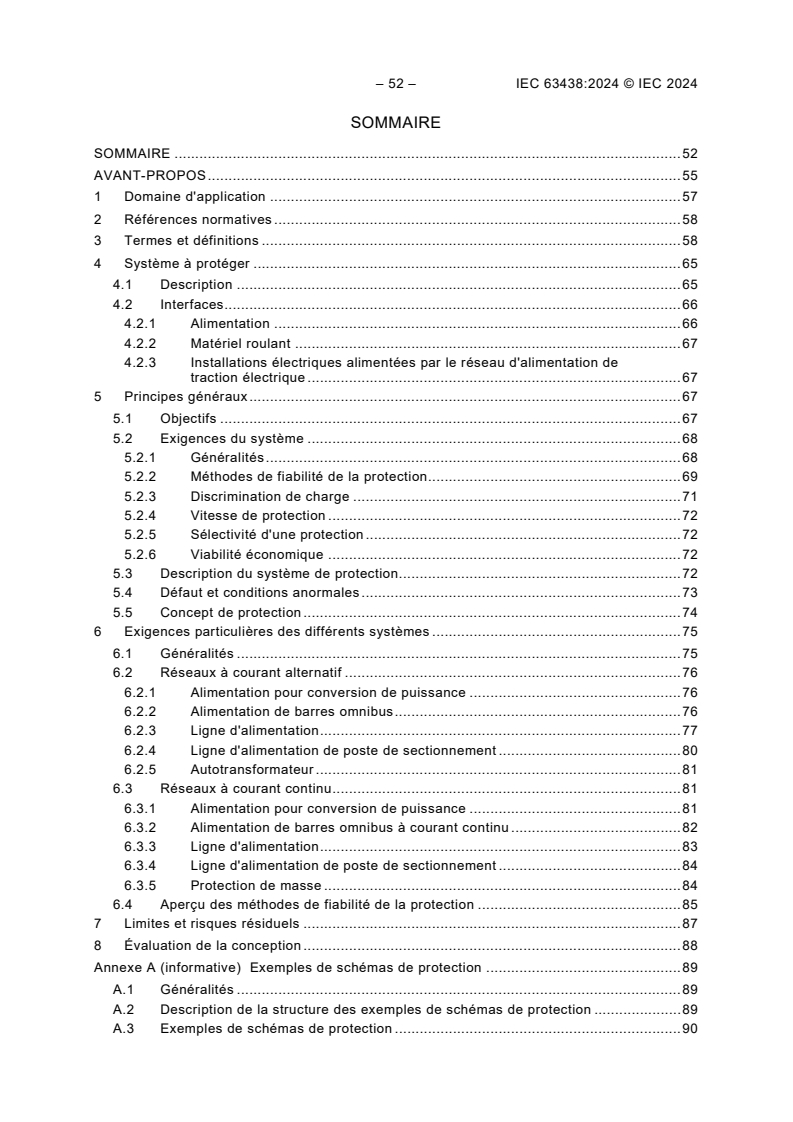
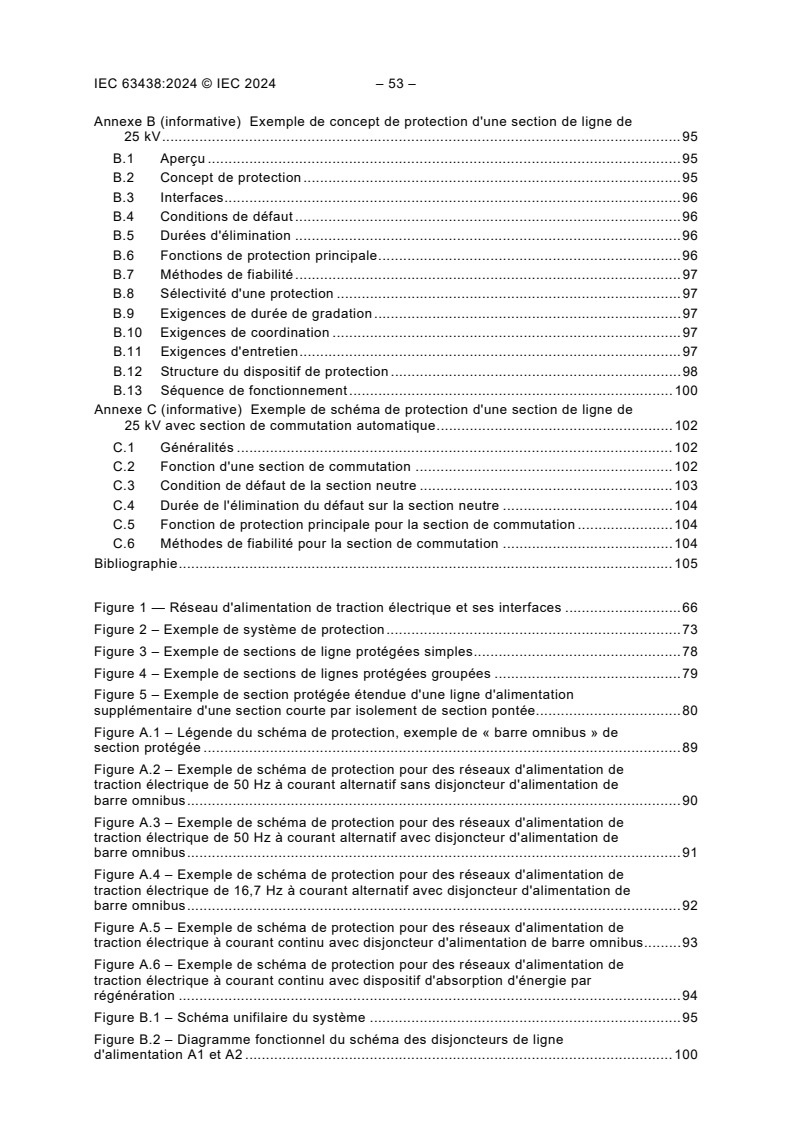
IEC 63438:2024 - Applications ferroviaires - Installations fixes - Principes de protection pour les réseaux d’alimentation de traction électrique à courant alternatif et à courant continu/10/2024
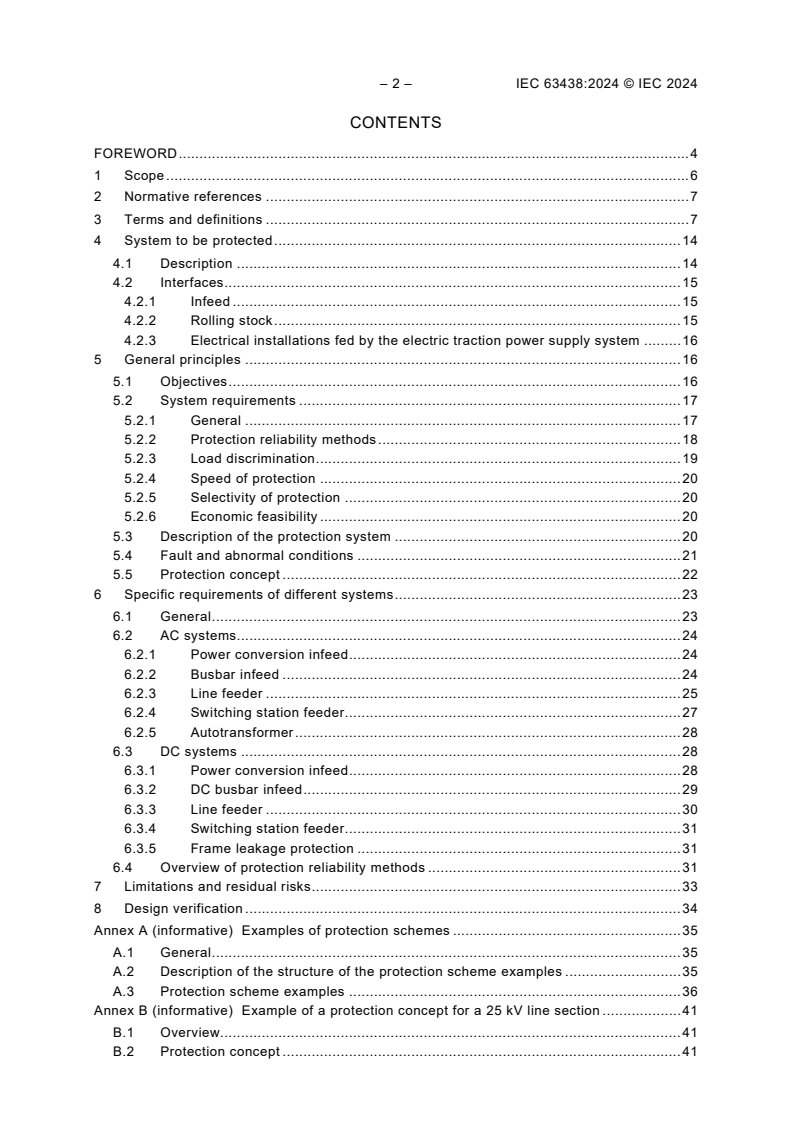
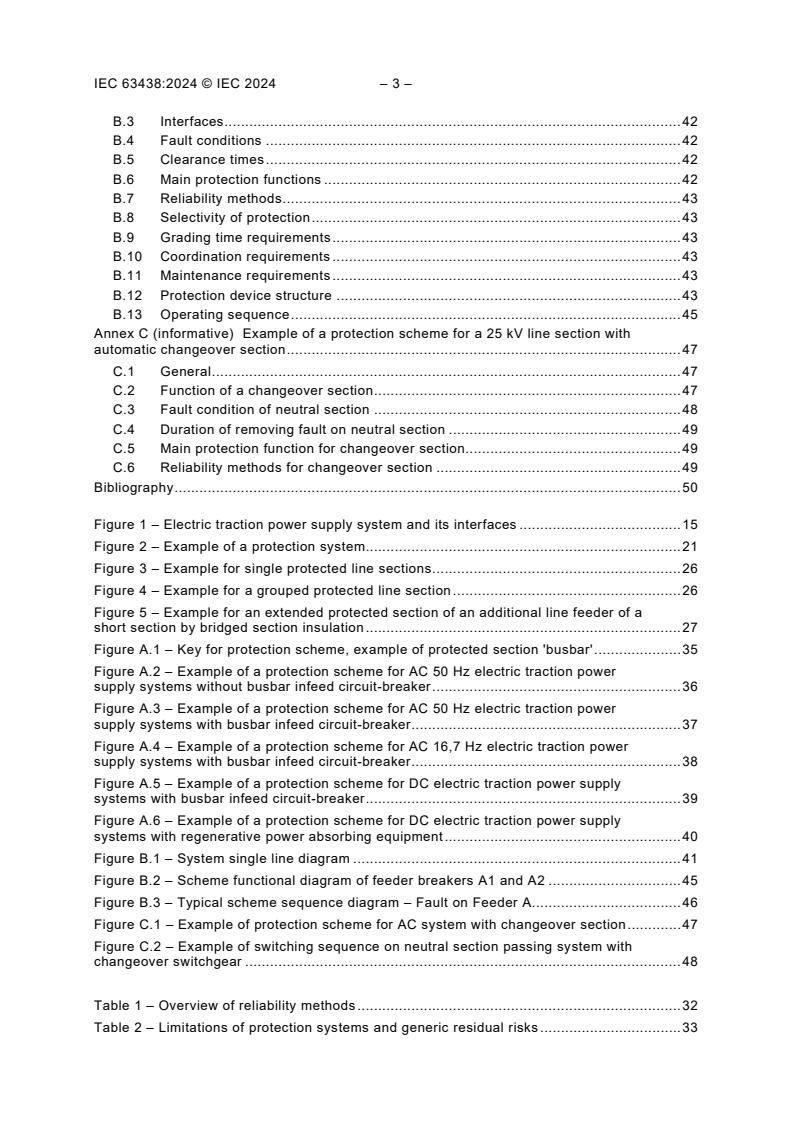
IEC 63438:2024 - Railway applications - Fixed installations - Protection principles for AC and DC electric traction power supply systems/10/2024
Overview
IEC 63438:2024 - "Railway applications – Fixed installations – Protection principles for AC and DC electric traction power supply systems" is an international standard published by the IEC that defines protection principles and minimum functional requirements for electrical protection systems used with AC and DC traction power supplies. The standard establishes railway‑specific protection concepts, describes protection system functionality, specifies design verification principles, and identifies limitations and acceptable residual risks. It applies to railways and guided mass‑transport systems that use a contact line (tramways, metro, mountain railways, trolleybuses, maglev with contact line) and can be applied to electrified road traffic with a contact line (e.g., truck‑trolley).
Key topics and technical requirements
- Protection principles and concepts tailored to electric traction systems (AC and DC).
- System description and interfaces (infeed, rolling stock, connected electrical installations).
- General protection objectives: reliability, speed, selectivity, load discrimination and economic feasibility.
- Protection reliability methods and an overview of available strategies to meet continuity and safety goals.
- Specific requirements for different system types:
- AC systems (power conversion infeed, busbar/feeder protection, autotransformer arrangements).
- DC systems (converter infeed, DC busbar, feeder protection, frame leakage).
- Fault and abnormal condition handling, including functional requirements for detecting and clearing faults.
- Limitations and residual risks to help stakeholders understand what is not covered and acceptable risk boundaries.
- Design verification principles to confirm the protection scheme meets functional requirements.
- Informative annexes with example protection schemes and case studies (e.g., 25 kV line section, changeover sections).
Note: IEC 63438 does not cover product‑level technical specifications (individual devices) or maintenance rules, and excludes certain systems (underground mine traction, suspended cable cars, funiculars, maglev without contact line, inductive or buried contact power systems).
Practical applications and users
Who benefits from IEC 63438:
- Railway protection and power engineers designing traction power protection schemes.
- System integrators and infrastructure owners planning new electrification or modifying existing systems.
- Safety assessors and regulators evaluating protection functionality and residual risks.
- Consultants and project managers preparing specifications and verification plans.
- Manufacturers and vendors (for aligning system‑level functionality, not device specs).
Practical uses:
- Defining protection functional requirements during procurement and design.
- Guiding coordination and selectivity studies for traction feeders, busbars and infeed points.
- Structuring design verification and risk acceptance documentation for electrified transport projects.
Related standards
- EN 50633:2016 served as a basis for IEC 63438.
- Prepared by IEC Technical Committee 9 (Electrical equipment and systems for railways).
Buy Documents
IEC 63438:2024 - Railway applications - Fixed installations - Protection principles for AC and DC electric traction power supply systems Released:12/10/2024
IEC 63438:2024 - Applications ferroviaires - Installations fixes - Principes de protection pour les réseaux d’alimentation de traction électrique à courant alternatif et à courant continu/10/2024
IEC 63438:2024 - Railway applications - Fixed installations - Protection principles for AC and DC electric traction power supply systems/10/2024
Get Certified
Connect with accredited certification bodies for this standard

IRIS Certification (UNIFE)
International Railway Industry Standard certification.

TÜV SÜD Rail GmbH
TÜV SÜD railway certification services.

Bureau Veritas Railway Certification
Railway and transportation certification.
Sponsored listings
Frequently Asked Questions
IEC 63438:2024 is a standard published by the International Electrotechnical Commission (IEC). Its full title is "Railway applications - Fixed installations - Protection principles for AC and DC electric traction power supply systems". This standard covers: IEC 63438:2024 applies to the electrical protection system, provided for AC and DC electric traction power supply systems. It: – establishes railway specific protection principles; – describes the railway specific protection system functionality; – specifies minimum functional requirements and informative examples of their application; – establishes limitations of the protection system and the acceptability of residual risks; – specifies principles for design verification. This document is applicable to: – railways; – guided mass transport systems, such as tramways, elevated and underground railways, mountain railways, trolleybus systems, and magnetically levitated systems which use a contact line system. This document can also be applied to electrified road traffic with a contact line, such as truck-trolley systems. This document applies to new electric traction power supply systems and can be applied to changes of existing systems. This document does not apply to: – underground mine traction systems; – cranes, transportable platforms and similar transportation equipment on rails, temporary structures (e.g. exhibition structures) in so far as these are not supplied directly or via transformers from the contact line system and are not endangered by the traction power supply system; – suspended cable cars; – funicular railways; – magnetic levitated systems (without a contact line system); – railways with an inductive power supply without contact system; – railways with a buried contact system that is required to be energized only below the train to ensure safety. This document does not cover: – technical requirements for products, e.g. protection devices; – rules for maintenance of protection systems.
IEC 63438:2024 applies to the electrical protection system, provided for AC and DC electric traction power supply systems. It: – establishes railway specific protection principles; – describes the railway specific protection system functionality; – specifies minimum functional requirements and informative examples of their application; – establishes limitations of the protection system and the acceptability of residual risks; – specifies principles for design verification. This document is applicable to: – railways; – guided mass transport systems, such as tramways, elevated and underground railways, mountain railways, trolleybus systems, and magnetically levitated systems which use a contact line system. This document can also be applied to electrified road traffic with a contact line, such as truck-trolley systems. This document applies to new electric traction power supply systems and can be applied to changes of existing systems. This document does not apply to: – underground mine traction systems; – cranes, transportable platforms and similar transportation equipment on rails, temporary structures (e.g. exhibition structures) in so far as these are not supplied directly or via transformers from the contact line system and are not endangered by the traction power supply system; – suspended cable cars; – funicular railways; – magnetic levitated systems (without a contact line system); – railways with an inductive power supply without contact system; – railways with a buried contact system that is required to be energized only below the train to ensure safety. This document does not cover: – technical requirements for products, e.g. protection devices; – rules for maintenance of protection systems.
IEC 63438:2024 is classified under the following ICS (International Classification for Standards) categories: 45.060.01 - Railway rolling stock in general. The ICS classification helps identify the subject area and facilitates finding related standards.
IEC 63438:2024 is available in PDF format for immediate download after purchase. The document can be added to your cart and obtained through the secure checkout process. Digital delivery ensures instant access to the complete standard document.
Standards Content (Sample)
IEC 63438 ®
Edition 1.0 2024-12
INTERNATIONAL
STANDARD
Railway applications – Fixed installations – Protection principles for AC and DC
electric traction power supply systems
All rights reserved. Unless otherwise specified, no part of this publication may be reproduced or utilized in any form
or by any means, electronic or mechanical, including photocopying and microfilm, without permission in writing from
either IEC or IEC's member National Committee in the country of the requester. If you have any questions about IEC
copyright or have an enquiry about obtaining additional rights to this publication, please contact the address below or
your local IEC member National Committee for further information.
IEC Secretariat Tel.: +41 22 919 02 11
3, rue de Varembé info@iec.ch
CH-1211 Geneva 20 www.iec.ch
Switzerland
About the IEC
The International Electrotechnical Commission (IEC) is the leading global organization that prepares and publishes
International Standards for all electrical, electronic and related technologies.
About IEC publications
The technical content of IEC publications is kept under constant review by the IEC. Please make sure that you have the
latest edition, a corrigendum or an amendment might have been published.
IEC publications search - webstore.iec.ch/advsearchform IEC Products & Services Portal - products.iec.ch
The advanced search enables to find IEC publications by a Discover our powerful search engine and read freely all the
variety of criteria (reference number, text, technical publications previews, graphical symbols and the glossary.
committee, …). It also gives information on projects, replaced With a subscription you will always have access to up to date
and withdrawn publications. content tailored to your needs.
IEC Just Published - webstore.iec.ch/justpublished
Electropedia - www.electropedia.org
Stay up to date on all new IEC publications. Just Published
The world's leading online dictionary on electrotechnology,
details all new publications released. Available online and once
containing more than 22 500 terminological entries in English
a month by email.
and French, with equivalent terms in 25 additional languages.
Also known as the International Electrotechnical Vocabulary
IEC Customer Service Centre - webstore.iec.ch/csc
(IEV) online.
If you wish to give us your feedback on this publication or need
further assistance, please contact the Customer Service
Centre: sales@iec.ch.
IEC 63438 ®
Edition 1.0 2024-12
INTERNATIONAL
STANDARD
Railway applications – Fixed installations – Protection principles for AC and DC
electric traction power supply systems
INTERNATIONAL
ELECTROTECHNICAL
COMMISSION
ICS 45.060.01 ISBN 978-2-8327-0063-1
– 2 – IEC 63438:2024 © IEC 2024
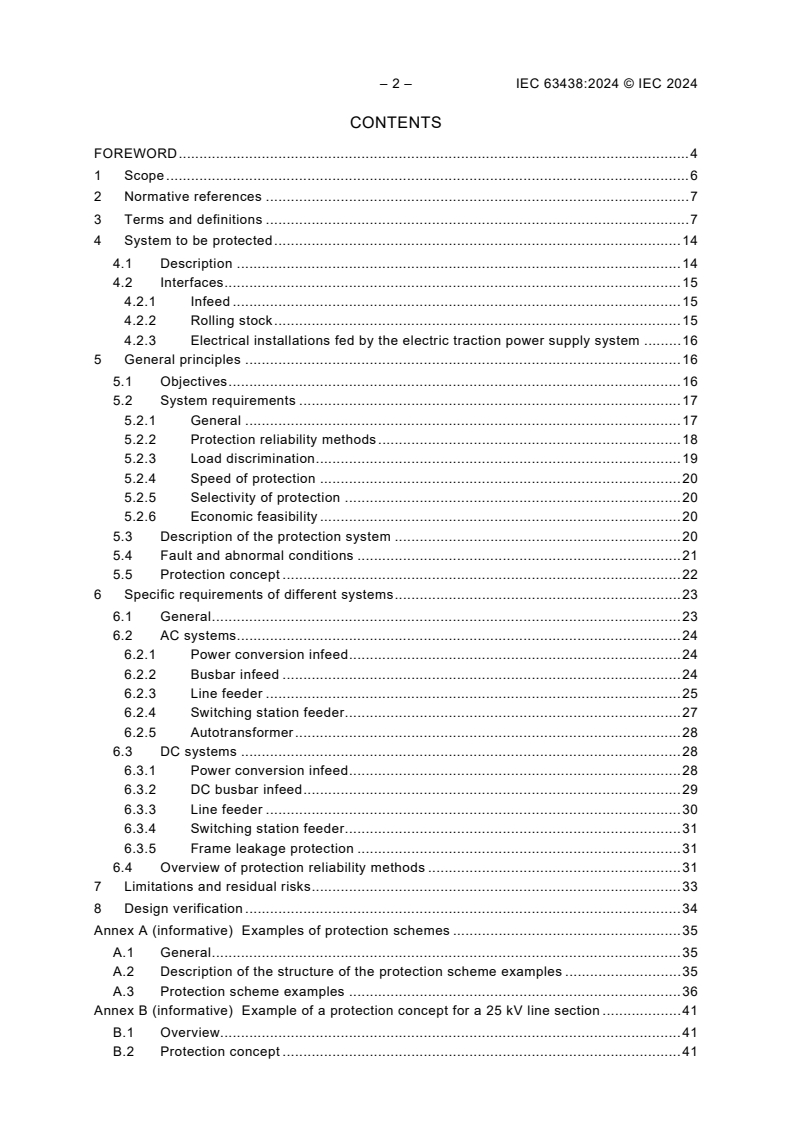
CONTENTS
FOREWORD . 4
1 Scope . 6
2 Normative references . 7
3 Terms and definitions . 7
4 System to be protected . 14
4.1 Description . 14
4.2 Interfaces . 15
4.2.1 Infeed . 15
4.2.2 Rolling stock . 15
4.2.3 Electrical installations fed by the electric traction power supply system . 16
5 General principles . 16
5.1 Objectives . 16
5.2 System requirements . 17
5.2.1 General . 17
5.2.2 Protection reliability methods . 18
5.2.3 Load discrimination . 19
5.2.4 Speed of protection . 20
5.2.5 Selectivity of protection . 20
5.2.6 Economic feasibility . 20
5.3 Description of the protection system . 20
5.4 Fault and abnormal conditions . 21
5.5 Protection concept . 22
6 Specific requirements of different systems . 23
6.1 General . 23
6.2 AC systems. 24
6.2.1 Power conversion infeed . 24
6.2.2 Busbar infeed . 24
6.2.3 Line feeder . 25
6.2.4 Switching station feeder. 27
6.2.5 Autotransformer . 28
6.3 DC systems . 28
6.3.1 Power conversion infeed . 28
6.3.2 DC busbar infeed . 29
6.3.3 Line feeder . 30
6.3.4 Switching station feeder. 31
6.3.5 Frame leakage protection . 31
6.4 Overview of protection reliability methods . 31
7 Limitations and residual risks . 33
8 Design verification . 34
Annex A (informative) Examples of protection schemes . 35
A.1 General . 35
A.2 Description of the structure of the protection scheme examples . 35
A.3 Protection scheme examples . 36
Annex B (informative) Example of a protection concept for a 25 kV line section . 41
B.1 Overview. 41
B.2 Protection concept . 41
B.3 Interfaces . 42
B.4 Fault conditions . 42
B.5 Clearance times . 42
B.6 Main protection functions . 42
B.7 Reliability methods . 43
B.8 Selectivity of protection . 43
B.9 Grading time requirements . 43
B.10 Coordination requirements . 43
B.11 Maintenance requirements . 43
B.12 Protection device structure . 43
B.13 Operating sequence . 45
Annex C (informative) Example of a protection scheme for a 25 kV line section with
automatic changeover section . 47
C.1 General . 47
C.2 Function of a changeover section . 47
C.3 Fault condition of neutral section . 48
C.4 Duration of removing fault on neutral section . 49
C.5 Main protection function for changeover section. 49
C.6 Reliability methods for changeover section . 49
Bibliography . 50
Figure 1 – Electric traction power supply system and its interfaces . 15
Figure 2 – Example of a protection system. 21
Figure 3 – Example for single protected line sections. 26
Figure 4 – Example for a grouped protected line section . 26
Figure 5 – Example for an extended protected section of an additional line feeder of a
short section by bridged section insulation . 27
Figure A.1 – Key for protection scheme, example of protected section 'busbar' . 35
Figure A.2 – Example of a protection scheme for AC 50 Hz electric traction power
supply systems without busbar infeed circuit-breaker . 36
Figure A.3 – Example of a protection scheme for AC 50 Hz electric traction power
supply systems with busbar infeed circuit-breaker . 37
Figure A.4 – Example of a protection scheme for AC 16,7 Hz electric traction power
supply systems with busbar infeed circuit-breaker . 38
Figure A.5 – Example of a protection scheme for DC electric traction power supply
systems with busbar infeed circuit-breaker . 39
Figure A.6 – Example of a protection scheme for DC electric traction power supply
systems with regenerative power absorbing equipment . 40
Figure B.1 – System single line diagram . 41
Figure B.2 – Scheme functional diagram of feeder breakers A1 and A2 . 45
Figure B.3 – Typical scheme sequence diagram – Fault on Feeder A. 46
Figure C.1 – Example of protection scheme for AC system with changeover section . 47
Figure C.2 – Example of switching sequence on neutral section passing system with
changeover switchgear . 48
Table 1 – Overview of reliability methods . 32
Table 2 – Limitations of protection systems and generic residual risks . 33
– 4 – IEC 63438:2024 © IEC 2024
INTERNATIONAL ELECTROTECHNICAL COMMISSION
____________
RAILWAY APPLICATIONS – FIXED INSTALLATIONS –
PROTECTION PRINCIPLES FOR AC AND DC ELECTRIC
TRACTION POWER SUPPLY SYSTEMS
FOREWORD
1) The International Electrotechnical Commission (IEC) is a worldwide organization for standardization comprising
all national electrotechnical committees (IEC National Committees). The object of IEC is to promote international
co-operation on all questions concerning standardization in the electrical and electronic fields. To this end and
in addition to other activities, IEC publishes International Standards, Technical Specifications, Technical Reports,
Publicly Available Specifications (PAS) and Guides (hereafter referred to as "IEC Publication(s)"). Their
preparation is entrusted to technical committees; any IEC National Committee interested in the subject dealt with
may participate in this preparatory work. International, governmental and non-governmental organizations liaising
with the IEC also participate in this preparation. IEC collaborates closely with the International Organization for
Standardization (ISO) in accordance with conditions determined by agreement between the two organizations.
2) The formal decisions or agreements of IEC on technical matters express, as nearly as possible, an international
consensus of opinion on the relevant subjects since each technical committee has representation from all
interested IEC National Committees.
3) IEC Publications have the form of recommendations for international use and are accepted by IEC National
Committees in that sense. While all reasonable efforts are made to ensure that the technical content of IEC
Publications is accurate, IEC cannot be held responsible for the way in which they are used or for any
misinterpretation by any end user.
4) In order to promote international uniformity, IEC National Committees undertake to apply IEC Publications
transparently to the maximum extent possible in their national and regional publications. Any divergence between
any IEC Publication and the corresponding national or regional publication shall be clearly indicated in the latter.
5) IEC itself does not provide any attestation of conformity. Independent certification bodies provide conformity
assessment services and, in some areas, access to IEC marks of conformity. IEC is not responsible for any
services carried out by independent certification bodies.
6) All users should ensure that they have the latest edition of this publication.
7) No liability shall attach to IEC or its directors, employees, servants or agents including individual experts and
members of its technical committees and IEC National Committees for any personal injury, property damage or
other damage of any nature whatsoever, whether direct or indirect, or for costs (including legal fees) and
expenses arising out of the publication, use of, or reliance upon, this IEC Publication or any other IEC
Publications.
8) Attention is drawn to the Normative references cited in this publication. Use of the referenced publications is
indispensable for the correct application of this publication.
9) IEC draws attention to the possibility that the implementation of this document may involve the use of (a)
patent(s). IEC takes no position concerning the evidence, validity or applicability of any claimed patent rights in
respect thereof. As of the date of publication of this document, IEC had not received notice of (a) patent(s), which
may be required to implement this document. However, implementers are cautioned that this may not represent
the latest information, which may be obtained from the patent database available at https://patents.iec.ch. IEC
shall not be held responsible for identifying any or all such patent rights.
IEC 63438 has been prepared by IEC technical committee 9: Electrical equipment and systems
for railways. It is an International Standard.
EN 50633 (2016) has served as a basis for the elaboration of this document.
The text of this International Standard is based on the following documents:
Draft Report on voting
9/3114/FDIS 9/3143/RVD
Full information on the voting for its approval can be found in the report on voting indicated in
the above table.
The language used for the development of this International Standard is English.
This document was drafted in accordance with ISO/IEC Directives, Part 2, and developed in
accordance with ISO/IEC Directives, Part 1 and ISO/IEC Directives, IEC Supplement, available
at www.iec.ch/members_experts/refdocs. The main document types developed by IEC are
described in greater detail at www.iec.ch/publications.
The committee has decided that the contents of this document will remain unchanged until the
stability date indicated on the IEC website under webstore.iec.ch in the data related to the
specific document. At this date, the document will be
• reconfirmed,
• withdrawn, or
• revised.
IMPORTANT – The "colour inside" logo on the cover page of this document indicates
that it contains colours which are considered to be useful for the correct understanding
of its contents. Users should therefore print this document using a colour printer.
– 6 – IEC 63438:2024 © IEC 2024
RAILWAY APPLICATIONS – FIXED INSTALLATIONS –
PROTECTION PRINCIPLES FOR AC AND DC ELECTRIC
TRACTION POWER SUPPLY SYSTEMS
1 Scope
This International Standard applies to the electrical protection system, provided for AC and DC
electric traction power supply systems. It:
– establishes railway specific protection principles;
– describes the railway specific protection system functionality;
– specifies minimum functional requirements and informative examples of their application;
– establishes limitations of the protection system and the acceptability of residual risks;
– specifies principles for design verification.
This document is applicable to:
– railways;
– guided mass transport systems, such as tramways, elevated and underground railways,
mountain railways, trolleybus systems, and magnetically levitated systems which use a
contact line system.
This document can also be applied to electrified road traffic with a contact line, such as truck-
trolley systems.
This document applies to new electric traction power supply systems and can be applied to
changes of existing systems.
This document does not apply to:
– underground mine traction systems;
– cranes, transportable platforms and similar transportation equipment on rails, temporary
structures (e.g. exhibition structures) in so far as these are not supplied directly or via
transformers from the contact line system and are not endangered by the traction power
supply system;
– suspended cable cars;
– funicular railways;
– magnetic levitated systems (without a contact line system);
– railways with an inductive power supply without contact system;
– railways with a buried contact system that is required to be energized only below the train
to ensure safety.
This document does not cover:
– technical requirements for products, e.g. protection devices;
– rules for maintenance of protection systems.
2 Normative references
The following documents are referred to in the text in such a way that some or all of their content
constitutes requirements of this document. For dated references, only the edition cited applies.
For undated references, the latest edition of the referenced document (including any
amendments) applies.
IEC 61991:2019, Railway applications – Rolling stock – Protective provisions against electrical
hazards
IEC 61992-1:2006, Railway applications – Fixed installations – DC switchgear – Part 1: General
IEC 61992-1:2006/AMD1:2014
IEC 61992-7-1:2006, Railway applications – Fixed installations – DC switchgear – Part 7-1:
Measurement, control and protection devices for specific use in d.c. traction systems –
Application guide
IEC 62128-1:2013, Railway applications – Fixed installations – Electrical safety, earthing and
the return circuit – Part 1: Protective provisions against electric shock
IEC 62128-3:2013, Railway applications – Fixed installations – Electrical safety, earthing and
the return circuit – Part 3: Mutual interaction of a.c. and d.c. traction systems
IEC 62590:2019, Railway applications – Fixed installations – Electronic power converters for
substations
IEC 62313:2009, Railway applications – Power supply and rolling stock – Technical criteria for
the coordination between power supply (substation) and rolling stock
3 Terms and definitions
For the purposes of this document, the following terms and definitions apply.
ISO and IEC maintain terminology databases for use in standardization at the following
addresses:
• IEC Electropedia: available at https://www.electropedia.org/
• ISO Online browsing platform: available at https://www.iso.org/obp
3.1
contact line system
support system and contact line supplying electric energy to vehicles through current-collecting
equipment
Note 1 to entry: The contact line system can comprise
– the contact line;
– masts and foundations;
– supports and any components registering the conductors,
– cross-spans or cables,
– tensioners,
– other along track conductors such as feeders, earth wires and return conductors when supported from the same
masts as the contact line,
– conductors connected permanently to the contact line for supplying other electrical equipment such as lighting,
signal operation, point control and point heating.
[SOURCE: IEC 60050-811:2017, 811-33-59]
– 8 – IEC 63438:2024 © IEC 2024
3.2
electric traction power supply system
railway electrical distribution network used to provide energy for rolling stock
Note 1 to entry: The system includes:
– contact line systems;
– return circuit of electric traction power supply systems;
– electrical installations in power plants and substations, which are utilized solely for distribution of power directly
to the contact line;
– electrical installations of switching stations.
[SOURCE: IEC 60050-811: 2017, 811-36-21, modified – "power supply" added in the term for
enhancing clarity since electric traction is typically used for onboard power supply. Also, running
rails of non-electrified lines in the vicinity of, and conductively connected to the running rails of
an electric traction power supply system, and electrical installations which are supplied from
contact lines either directly or via a transformer have been excluded from Note 1 to entry.]
3.3
traction substation
substation
substation, the main function of which is to supply an electric traction power supply system
Note 1 to entry: The synonym substation is used only when the context is clear
[SOURCE: IEC 60050-811:2017, 811-36-02]
3.4
switching station
traction switching station
installation from which electrical energy can be distributed to different feeding sections or from
which different feeding sections can be switched on and off or can be interconnected
[SOURCE: IEC 60050-811:2017, 811-36-22]
3.5
feeding section
electrical section of the route fed by individual track feeder circuit-breakers within the area
supplied by one or more substations
[SOURCE: IEC 60050-811:2017, 811-36-25]
3.6
electrical safety
freedom from risk that is not tolerable and which is caused by electricity
[SOURCE: IEC 60050-195:2021, 195-01-20]
3.7
electric shock
physiological effect resulting from an electric current passing through a human body or livestock
[SOURCE: IEC 60050-195:2021, 195-01-04]
3.8
return circuit
all conductors which form the intended path for the traction return current and the current under
fault conditions
Note 1 to entry: The conductors can be for example:
– running rails;
– return conductor rails;
– return conductors;
– return cables.
[SOURCE: IEC 60050-811:2017, 811-35-01]
3.9
switchgear
switching devices and their combination with associated control, measuring, protective and
regulating equipment, also assemblies of such devices and equipment with associated
interconnections, accessories, enclosures and supporting structures, intended in principle for
use in connection with generation, transmission, distribution and conversion of electric energy
[SOURCE: IEC 60050-441:1984, 441-11-02]
3.10
protection operating time
interval of time between the fault inception and the instant of initiation of the opening operation
of a switching device, e.g. circuit-breaker
Note 1 to entry: This time includes measurement, communication and protection device operation.
3.11
opening time
interval of time between the specified instant of initiation of the opening operation and the
instant when the arcing contacts have separated in all poles
Note 1 to entry: The instant of initiation of the opening operation, i.e. the application of the opening command (e.g.
energizing the release, etc.), is given in the relevant specifications.
[SOURCE: IEC 60050-441:1984, 441-17-36]
3.12
break-time
interval of time between the beginning of the opening time of a mechanical switching device (or
the pre-arcing time of a fuse) and the end of the arcing time
[SOURCE: IEC 60050-441:1984, 441-17-39]
3.13
fault clearance time
time interval between the fault inception and the fault clearance
Note 1 to entry: This time is the longest fault current interruption time of the associated circuit-breaker(s) for
elimination of fault current on the faulty item of plant.
Note 2 to entry: Fault clearance time is the total of the protection operating time, the (mechanical) opening time
and the arc extinction time. The latter two are included in break-time, IEC 60050-441–17–39.
[SOURCE: IEC 60050-448:1995, 448-13-15, modified – Note 2 to entry has been added.]
– 10 – IEC 63438:2024 © IEC 2024
3.14
touch voltage
voltage between conductive parts when touched simultaneously by a human being or livestock
Note 1 to entry: The value of the touch voltage is influenced by the impedance of the human being or the livestock
in electric contact with these conductive parts.
[SOURCE: IEC 60050-195:2021, 195-05-11]
3.15
fault condition
non intended condition caused by short-circuit, whilst the time duration is terminated by the
correct function of the protection devices and circuit-breakers
Note 1 to entry: For the relevant fault duration the correct operation of protection devices and circuit-breakers is
taken into account.
[SOURCE: IEC 62128-1:2013, 3.4.5, modified – "Whilst" added so as to link the sentence "The
time duration …" with the rest of the definition.]
3.16
low resistance fault
fault condition where the resistance of the fault is sufficiently low that the fault current has a
similar magnitude to that which would flow if the fault resistance were zero
Note 1 to entry: The resistance of the fault is typically dominated by the resistance of the power arc.
Note 2 to entry: In this definition, resistance will be understood as also being impedance for AC fault currents.
3.17
high resistance fault
shunt fault with high resistance at the fault location, where the resistance of the fault is
sufficiently high that the fault current has a substantially different magnitude to that which would
flow with a low resistance fault
Note 1 to entry: In this definition, resistance will be understood as also being impedance for AC fault currents.
[SOURCE: IEC 60050-448:1995, 448-13-08, modified – Definition amended to enhance clarity
for the application in electric traction power supply systems. Note 1 added.]
3.18
abnormal operating condition
condition where the system operates beyond its intended capabilities such that damage or
reduced life expectancy can be anticipated
3.19
short-circuit
accidentdal or intentional conductive path between two or more conductive parts forcing the
electric potential differences between these conductive parts to be equal to or close to zero
[SOURCE: IEC 60050-151:2001, 151-12-04]
3.20
current collector
equipment fitted to a vehicle and intended to collect current from a contact wire or conductor
rail
[SOURCE: IEC 60050-811:2017, 811-32-01]
3.21
protection
provisions for detecting faults or other abnormal operating conditions in a power system, for
enabling fault clearance, for terminating abnormal operating conditions, and for initiating signals
or indications
Note 1 to entry: The term "protection" is a generic term for protection equipment or protection systems.
Note 2 to entry: The term "protection" may be used to describe the protection of a complete power system or the
protection of individual plant items in a power system e.g. transformer protection, line protection, generator
protection.
Note 3 to entry: Protection does not include items of power system plant provided, for example, to limit overvoltages
on the power system. However, it includes items provided to control the power system voltage or frequency deviations
such as automatic reactor switching, load-shedding, etc.
[SOURCE: IEC 60050-448:1995, 448-11-01, modified – "abnormal condition" becomes
"abnormal operating conditions".]
3.22
protection system
arrangement of one or more protection equipments, and other devices intended to perform one
or more specified protection functions
Note 1 to entry: A protection system includes one or more protection equipment, intelligent electronic devices (IED),
instrument transformer(s), wiring, tripping circuit(s), auxiliary supply(s) and, where provided, communication
system(s). Depending upon the principle(s) of the protection system, it may include one end or all ends of the
protected section and, possibly, automatic reclosing equipment.
Note 2 to entry: The circuit-breaker(s) are excluded.
Note 3 to entry: The circuit-breaker protection functions are included, e.g. direct overcurrent or falling voltage
release of dc-circuit-breaker(s).
[SOURCE: IEC 60050-448:1995, 448-11-04, modified – Note 3 to entry added.]
3.23
protection equipment
equipment incorporating one or more protection relays and, if necessary, logic elements
intended to perform one or more specified protection functions
Note 1 to entry: A protection equipment is part of a protection system.
[SOURCE: IEC 60050-448:1995, 448-11-03, modified – Example omitted.]
3.24
protection relay
measuring relay which, either solely or in combination with other relays, is a constituent of a
protection equipment
[SOURCE IEC 60050-448:1995, 448-11-02]
3.25
protected section
part of a power system network, or circuit within a network, to which specified protection has
been applied
Note 1 to entry: The protected section normally originates from a point of automatic disconnection to at least the
next point of automatic disconnection or the end of the circuit.
Note 2 to entry: An electric traction power supply system is a form of power system network.
[SOURCE: IEC 60050-448:1995, 448-11-05, modified – Notes to entry added.]
– 12 – IEC 63438:2024 © IEC 2024
3.26
selectivity of protection
ability of a protection to identify the faulty section and/or phase(s) of a power system
Note 1 to entry: The synonym selectivity is used only when the context is clear.
[SOURCE: IEC 60050-448:1995, 448-11-06, modified – Note 1 to entry added.]
3.27
reliability of protection
probability that a protection can perform a required function under given conditions for a given
time interval
Note 1 to entry: The required function for protection is to operate when required to do so and not to operate when
not required to do so.
[SOURCE: IEC 60050-448:1995, 448-12-05]
3.28
redundancy
in an item, existence of more than one means for performing a required function
[SOURCE: IEC 60050-448:1995, 448-12-08]
3.29
sensitivity
minimum operating level (e.g. current, voltage, frequency, temperature) in a process that can
be detected for the purpose of protection
EXAMPLE Sensitivity of a protection system can be expressed by minimum fault current or maximum fault
impedance coverage.
3.30
main protection
protection expected to have priority in initiating fault clearance or an action to terminate an
abnormal condition in a power system
Note 1 to entry: For a given item of plant, two or more main protections may be provided.
[SOURCE: IEC 60050-448:1995, 448-11-13]
3.31
backup protection
protection which is intended to operate when a system fault is not cleared, or abnormal condition
not detected, in the required time because of failure or inability of other protection to operate
or failure of the appropriate circuit-breaker(s) to trip
[SOURCE: IEC 60050-448:1995, 448-11-14, modified – Note to entry omitted.]
3.32
circuit local backup protection
backup protection where the input is either from those transducers which are used by the main
protection or from transducers associated with the same primary circuit as the main protection
[SOURCE: IEC 60050-448:1995, 448-11-15 modified – "which is energised either from those
instrument transformers which energize"" replaced with "where the input is either from those
transducers which are used by". "instrument transformers" replaced with "a transducer" to make
it more generic. Note to entry omitted.]
3.33
substation local backup protection
backup protection where the input is taken from a transducer located within the same substation
as the corresponding main protection and not associated with the same primary circuit
Note 1 to entry: Substation local backup also extends to switching station local backup where appropriate.
[SOURCE: IEC 60050-448:1995, 448-11-16 modified – 'which is energized" replaced with
"where the input is taken". "instrument transformers" replaced with "a transducer" to make it
more generic. Note 1 to entry added.]
3.34
remote backup protection
backup protection located in a substation remote from that substation in which the
corresponding main protection is located
[SOURCE: IEC 60050-448:1995, 448-11-17]
3.35
circuit-breaker failure protection
protection which is designed to clear a system fault by initiating tripping of other circuit-
breaker(s) in the case of failure to trip of the appropriate circuit-breaker
[SOURCE: IEC 60050-448:1995, 448-11-18]
3.36
tripping
opening of a circuit-breaker by either manual or automatic control or by protective devices
[SOURCE: IEC 60050-448:1995, 448-11-31]
3.37
direct overcurrent release
overcurrent release directly energized by the current in the main circuit of a mechanical
switching device
[SOURCE: IEC 60050-441:1984, 441-16-36]
3.38
indirect overcurrent release
overcurrent release energized by the current in the main circuit of a mechanical switching device
through a current transformer or a shunt
[SOURCE: IEC 60050-441:1984, 441-16-37]
– 14 – IEC 63438:2024 © IEC 2024
4 System to be protected
4.1 Description
The system to be protected within the scope of this document is the electric traction power
supply system, within the limits set out in Figure 1. The electric traction power supply system
comprises:
– infeed to traction power conversion;
– traction power conversion (e.g. converter, transformer);
– infeed to secondary distribution busbar (including bus coupler);
– infeed to power absorbing equipment (e.g. energy storage system or braking resistor unit);
– line feeder, traction power distribution to the contact line system;
– interconnecting feeders between secondary distribution busbars, e.g. between two
substations or switching stations;
– switching station (including switching station feeder and bus coupler);
– autotransformers;
– contact line;
– return circuit.
Not every electric traction power supply system necessarily has all of the above mentioned
parts.
NOTE 1 The operational responsibility of the above mentioned components can be split among different operators
(owners). However, the protection principles described hereafter are valid for all installations.
The electric traction power supply system has interfaces to other parts of the railway system.
These interfaces can include:
– infeed to the primary distribution busbar;
– rolling stock;
– electrical installations fed by the contact line system or busbar (e.g. auxiliary transformers).
Other subsystems or equipment, e.g. signalling and communication can be influenced by the
electric traction power supply system but their protection is not within the scope of this
document.
Transmission and distribution power lines which are in parallel to or in the railway boundary are
not considered to be part of the electric traction power supply system. These are considered to
be covered by the protection principles for general transmission and distribution systems.
Figure 1 – Electric traction power supply system and its interfaces
NOTE 2 For DC systems the infeed to the secondary distribution busbar as shown in figure 1 can either be a circuit-
breaker or a disconnector. See 6.3.2.
Figure 1 shows a traction substation, however it also applies to the relevant parts of a switching
station, for example with a switching station feeder instead of a line feeder.
4.2 Interfaces
4.2.1 Infeed
The interface between the electric traction power supply system and the transmission /
distribution system is the feeder circuit-breaker at the infeed to the traction power conversion.
The upstream installations are considered to be covered by the protection principles for general
transmission and distribution systems, taking into account the following aspects at the interface:
• protection coordination;
• communication;
• automatic reclosure;
• direction of power flow (consumption and regeneration).
4.2.2 Rolling stock
The interface between the electric traction power supply system and the electric rolling stock is
the traction unit circuit-breaker.
For internal faults within a traction unit (i.e. faults occurring downstream of the traction unit
circuit-breaker) the requirements of IEC 62313:2009, Table 5, apply.
– 16 – IEC 63438:2024 © IEC 2024
Protection of electric rolling stock against faults downstream of the traction unit circuit-breaker
is not the primary function of the protection system of the electric traction power supply system,
however it can provide some degree of remote backup protection for such faults.
The protection in the traction substation shall be able to detect faults which include a maximum
vehicle impedance as set out in IEC 61991.
NOTE According to IEC 62313 internal faults on electric rolling stock are preferably cleared by the circuit-breaker
on the vehicle. The vehicle circuit-breaker is not intentionally delayed. The substation circuit-breaker is also tripped
without intentional delay in the main protection, i.e. there is no selectivity between vehicle and substation other than
by current magnitude. Even when considering the outage of one of these circuit-breakers the other provides limited
backup protection. Due to their non-selectivity there is no intentional delay in the clearance time.
In case of vehicles with regenerative braking the requirements of IEC 62313:2009, Clause 12
normally apply. Accordingly compliant vehicles will not continue to regenerate if there is a loss
of supply voltage or a contact line-rail/earth fault condition. In cases where rolling stock is not
IEC 62313 compliant, the arrangements for protection in case of regenerative braking shall be
agreed with the responsible entity.
4.2.3 Electrical installations fed by the electric traction power supply system
Electrical installations not directly related to traction power, for example auxiliary power supply,
are not part of the electric traction power supply system, although they may be fed by the
electric traction power supply system.
The interface between the electric traction power supply system and the electrical installations
which are fed by the contact line is the disconnecting device between the connection to the
contact line, i.e. overhead contact line or conductor rail, and the connection to the return circuit.
The interface of the electric traction power supply system to the electrical installations which
are fed by the substation busbar is the disconnecting device between the substation busbar
and the electrical installation where the downstream protection takes over.
The protection of the electric traction power supply system shall be coordinated with the
protection of the electrical installation. However, detection of internal faults within the electrical
installations fed by the electric traction power supply system is not the primary function of the
electric traction power supply system's protection system.
5 General principles
5.1 Objectives
The function of the protection system is to provide protection in the event of fault conditions
and abnormal operating conditions. This protection is provided by monitoring certain process
values such as current, voltage, frequency and temperature and by the initiation of
interventions, such as tripping of circuit-breakers.
The major objectives for protection systems are:
• continuation of service and performance of the electric traction power supply system and
minimizing the disturbance to operations as far as practicable;
• limitation of the impact and damage to the affected equipment;
• avoidance of cascading effects and expanding to other network areas;
• minimization of arcing effects and energy released during faults;
• contribution to the protection of persons against indirect elect
...
IEC 63438 ®
Edition 1.0 2024-12
NORME
INTERNATIONALE
Applications ferroviaires - Installations fixes - Principes de protection pour les
réseaux d’alimentation de traction électrique à courant alternatif et à courant
continu
ICS 45.060.01 ISBN 978-2-8327-0807-1
Droits de reproduction réservés. Sauf indication contraire, aucune partie de cette publication ne peut être reproduite ni
utilisée sous quelque forme que ce soit et par aucun procédé, électronique ou mécanique, y compris la photocopie et
les microfilms, sans l'accord écrit de l'IEC ou du Comité national de l'IEC du pays du demandeur. Si vous avez des
questions sur le copyright de l'IEC ou si vous désirez obtenir des droits supplémentaires sur cette publication, utilisez
les coordonnées ci-après ou contactez le Comité national de l'IEC de votre pays de résidence.
IEC Secretariat Tel.: +41 22 919 02 11
3, rue de Varembé info@iec.ch
CH-1211 Geneva 20 www.iec.ch
Switzerland
A propos de l'IEC
La Commission Electrotechnique Internationale (IEC) est la première organisation mondiale qui élabore et publie des
Normes internationales pour tout ce qui a trait à l'électricité, à l'électronique et aux technologies apparentées.
A propos des publications IEC
Le contenu technique des publications IEC est constamment revu. Veuillez vous assurer que vous possédez l’édition la
plus récente, un corrigendum ou amendement peut avoir été publié.
Recherche de publications IEC - IEC Products & Services Portal - products.iec.ch
webstore.iec.ch/advsearchform Découvrez notre puissant moteur de recherche et consultez
La recherche avancée permet de trouver des publications gratuitement tous les aperçus des publications, symboles
IEC en utilisant différents critères (numéro de référence, graphiques et le glossaire. Avec un abonnement, vous aurez
texte, comité d’études, …). Elle donne aussi des toujours accès à un contenu à jour adapté à vos besoins.
informations sur les projets et les publications remplacées
ou retirées. Electropedia - www.electropedia.org
Le premier dictionnaire d'électrotechnologie en ligne au
IEC Just Published - webstore.iec.ch/justpublished monde, avec plus de 22 500 articles terminologiques en
Restez informé sur les nouvelles publications IEC. Just anglais et en français, ainsi que les termes équivalents
dans 25 langues additionnelles. Egalement appelé
Published détaille les nouvelles publications parues.
Disponible en ligne et une fois par mois par email. Vocabulaire Electrotechnique International (IEV) en ligne.
Service Clients - webstore.iec.ch/csc
Si vous désirez nous donner des commentaires sur cette
publication ou si vous avez des questions contactez-
nous: sales@iec.ch.
– 52 – IEC 63438:2024 © IEC 2024
SOMMAIRE
SOMMAIRE . 52
AVANT-PROPOS . 55
1 Domaine d'application . 57
2 Références normatives . 58
3 Termes et définitions . 58
4 Système à protéger . 65
4.1 Description . 65
4.2 Interfaces . 66
4.2.1 Alimentation . 66
4.2.2 Matériel roulant . 67
4.2.3 Installations électriques alimentées par le réseau d'alimentation de
traction électrique . 67
5 Principes généraux . 67
5.1 Objectifs . 67
5.2 Exigences du système . 68
5.2.1 Généralités . 68
5.2.2 Méthodes de fiabilité de la protection . 69
5.2.3 Discrimination de charge . 71
5.2.4 Vitesse de protection . 72
5.2.5 Sélectivité d'une protection . 72
5.2.6 Viabilité économique . 72
5.3 Description du système de protection . 72
5.4 Défaut et conditions anormales . 73
5.5 Concept de protection . 74
6 Exigences particulières des différents systèmes . 75
6.1 Généralités . 75
6.2 Réseaux à courant alternatif . 76
6.2.1 Alimentation pour conversion de puissance . 76
6.2.2 Alimentation de barres omnibus . 76
6.2.3 Ligne d'alimentation . 77
6.2.4 Ligne d'alimentation de poste de sectionnement . 80
6.2.5 Autotransformateur . 81
6.3 Réseaux à courant continu . 81
6.3.1 Alimentation pour conversion de puissance . 81
6.3.2 Alimentation de barres omnibus à courant continu . 82
6.3.3 Ligne d'alimentation . 83
6.3.4 Ligne d'alimentation de poste de sectionnement . 84
6.3.5 Protection de masse . 84
6.4 Aperçu des méthodes de fiabilité de la protection . 85
7 Limites et risques résiduels . 87
8 Évaluation de la conception . 88
Annexe A (informative) Exemples de schémas de protection . 89
A.1 Généralités . 89
A.2 Description de la structure des exemples de schémas de protection . 89
A.3 Exemples de schémas de protection . 90
Annexe B (informative) Exemple de concept de protection d'une section de ligne de
25 kV . 95
B.1 Aperçu . 95
B.2 Concept de protection . 95
B.3 Interfaces . 96
B.4 Conditions de défaut . 96
B.5 Durées d'élimination . 96
B.6 Fonctions de protection principale . 96
B.7 Méthodes de fiabilité . 97
B.8 Sélectivité d'une protection . 97
B.9 Exigences de durée de gradation . 97
B.10 Exigences de coordination . 97
B.11 Exigences d'entretien . 97
B.12 Structure du dispositif de protection . 98
B.13 Séquence de fonctionnement . 100
Annexe C (informative) Exemple de schéma de protection d'une section de ligne de
25 kV avec section de commutation automatique . 102
C.1 Généralités . 102
C.2 Fonction d'une section de commutation . 102
C.3 Condition de défaut de la section neutre . 103
C.4 Durée de l'élimination du défaut sur la section neutre . 104
C.5 Fonction de protection principale pour la section de commutation . 104
C.6 Méthodes de fiabilité pour la section de commutation . 104
Bibliographie . 105
Figure 1 — Réseau d'alimentation de traction électrique et ses interfaces . 66
Figure 2 – Exemple de système de protection . 73
Figure 3 – Exemple de sections de ligne protégées simples . 78
Figure 4 – Exemple de sections de lignes protégées groupées . 79
Figure 5 – Exemple de section protégée étendue d'une ligne d'alimentation
supplémentaire d'une section courte par isolement de section pontée. 80
Figure A.1 – Légende du schéma de protection, exemple de « barre omnibus » de
section protégée . 89
Figure A.2 – Exemple de schéma de protection pour des réseaux d'alimentation de
traction électrique de 50 Hz à courant alternatif sans disjoncteur d'alimentation de
barre omnibus . 90
Figure A.3 – Exemple de schéma de protection pour des réseaux d'alimentation de
traction électrique de 50 Hz à courant alternatif avec disjoncteur d'alimentation de
barre omnibus . 91
Figure A.4 – Exemple de schéma de protection pour des réseaux d'alimentation de
traction électrique de 16,7 Hz à courant alternatif avec disjoncteur d'alimentation de
barre omnibus . 92
Figure A.5 – Exemple de schéma de protection pour des réseaux d'alimentation de
traction électrique à courant continu avec disjoncteur d'alimentation de barre omnibus . 93
Figure A.6 – Exemple de schéma de protection pour des réseaux d'alimentation de
traction électrique à courant continu avec dispositif d'absorption d'énergie par
régénération . 94
Figure B.1 – Schéma unifilaire du système . 95
Figure B.2 – Diagramme fonctionnel du schéma des disjoncteurs de ligne
d'alimentation A1 et A2 . 100
– 54 – IEC 63438:2024 © IEC 2024
Figure B.3 – Schéma de séquence du schéma classique – Défaut sur la Ligne A . 101
Figure C.1 – Exemple de schéma de protection pour un réseau à courant alternatif
avec section de commutation . 102
Figure C.2 – Exemple de séquence de commutation sur un système de passage de la
section neutre avec appareillage de commutation . 103
Tableau 1 – Aperçu des méthodes de fiabilité . 85
Tableau 2 – Limites des systèmes de protection et risques résiduels génériques . 87
COMMISSION ELECTROTECHNIQUE INTERNATIONALE
____________
APPLICATIONS FERROVIAIRES – INSTALLATIONS FIXES –
PRINCIPES DE PROTECTION POUR LES RESEAUX D'ALIMENTATION DE
TRACTION ELECTRIQUE
A COURANT ALTERNATIF ET A COURANT CONTINU
AVANT-PROPOS
1) La Commission électrotechnique internationale (IEC, en anglais) est une organisation mondiale de normalisation
comprenant tous les comités électrotechniques nationaux (comités nationaux IEC). L'IEC a pour objet de
promouvoir la coopération internationale sur toutes les questions relatives à la normalisation dans les domaines
électrique et électronique. À cette fin et en plus d'autres activités, l'IEC publie des Normes internationales, des
spécifications techniques, des rapports techniques, des spécifications accessibles au public (PAS) et des guides
(ci-après dénommés « Publication(s) de l'IEC »). Leur préparation est confiée à des comités techniques; tout
comité national de l'IEC intéressé par le sujet traité peut participer à ces travaux préparatoires. Les organisations
internationales, gouvernementales et non gouvernementales en liaison avec l'IEC participent également à cette
préparation. L'IEC collabore étroitement avec l'Organisation internationale de normalisation (ISO) selon des
conditions déterminées par accord entre les deux organisations.
2) Les décisions ou accords formels de l'IEC sur des questions techniques expriment, autant que possible, un
consensus international d'opinion sur les sujets pertinents puisque chaque comité technique est représenté par
tous les comités nationaux de l'IEC intéressés.
3) Les publications de l'IEC ont la forme de recommandations à usage international et sont acceptées par les
comités nationaux de l'IEC en ce sens. Bien que tous les efforts raisonnables soient faits pour garantir l'exactitude
du contenu technique des publications de l'IEC, l'IEC ne peut être tenue responsable de la manière dont elles
sont utilisées ou de mauvaise interprétation par tout utilisateur final.
4) Afin de promouvoir l'uniformité internationale, les Comités nationaux de l'IEC s'engagent à appliquer les
publications de l'IEC de manière transparente dans toute la mesure du possible dans leurs publications nationales
et régionales. Toute divergence entre une publication de l'IEC et la publication nationale ou régionale
correspondante doit être clairement indiquée dans cette dernière.
5) L'IEC elle-même ne fournit aucune attestation de conformité. Les organismes de certification indépendants
fournissent des services d'évaluation de la conformité et, dans certains domaines, l'accès aux marques de
conformité IEC. L'IEC n'est pas responsable des services fournis par des organismes de certification
indépendants.
6) Il convient que tous les utilisateurs s'assurent qu'ils disposent de la dernière édition de cette publication.
7) Aucune responsabilité ne peut être engagée envers l'IEC ou ses directeurs, employés, préposés ou agents, y
compris les experts individuels et les membres de ses comités techniques et comités nationaux de l'IEC, pour
tout dommage corporel, dommage matériel ou autre dommage de quelque nature que ce soit, direct ou indirect,
ou pour les frais (y compris les frais juridiques) et les dépenses découlant de la publication, de l'utilisation ou du
recours à cette Publication IEC ou à toute autre Publication IEC.
8) L'attention est attirée sur les références normatives citées dans cette publication. L'utilisation des publications
référencées est indispensable pour l'application correcte de cette publication.
9) L'IEC attire l'attention sur le fait que la mise en application du présent document peut entraîner l'utilisation d'un
ou de plusieurs brevets. L'IEC ne prend pas position quant à la preuve, à la validité et à l'applicabilité de tout
droit de brevet revendiqué à cet égard. À la date de publication du présent document, l'IEC n'avait pas reçu
notification qu'un ou plusieurs brevets pouvaient être nécessaires à sa mise en application. Toutefois, il y a lieu
d'avertir les responsables de la mise en application du présent document que des informations plus récentes
sont susceptibles de figurer dans la base de données de brevets, disponible à l'adresse https://patents.iec.ch.
L'IEC ne saurait être tenue pour responsable de ne pas avoir identifié de tels droits de propriété et averti de leur
existence.
L'IEC 63438 a été établi par le comité d'études 9 de l'IEC : Matériels et systèmes électriques
ferroviaires. Il s'agit d'une Norme internationale.
L'EN 50633 (2016) a servi de base pour la préparation du présent document.
La présente version bilingue (2025-11) correspond à la version anglaise monolingue publiée en
2024-12.
La version française de cette norme n'a pas été soumise au vote.
– 56 – IEC 63438:2024 © IEC 2024
La langue utilisée pour l'élaboration de cette Norme internationale est l'anglais.
Le présent document a été rédigé selon les Directives ISO/IEC, Partie 2, et élaboré selon les
Directives ISO/IEC, Partie 1 et aux Directives ISO/IEC, Supplément IEC, disponibles à l'adresse
suivante : www.iec.ch/members_experts/refdocs. Les principaux types de documents élaborés
par l'IEC sont décrits plus en détail sur le site internet : www.iec.ch/publications.
Le comité a décidé que le contenu du présent document ne sera pas modifié avant la date de
maintenance indiquée sur le site internet de l'IEC à l'adresse suivante : webstore.iec.ch, dans
les données relatives au document spécifique. À cette date, le document sera :
• reconduit,
• supprimé, ou
• révisé.
IMPORTANT – Le logo « colour inside » qui se trouve sur la page de couverture de cette
publication indique qu'elle contient des couleurs qui sont considérées comme utiles à
une bonne compréhension de son contenu. Les utilisateurs devraient, par conséquent,
imprimer cette publication en utilisant une imprimante couleur.
APPLICATIONS FERROVIAIRES – INSTALLATIONS FIXES –
PRINCIPES DE PROTECTION POUR LES RESEAUX D'ALIMENTATION DE
TRACTION ÉLECTRIQUE À COURANT ALTERNATIF ET À COURANT
CONTINU
1 Domaine d'application
La présente Norme internationale s'applique au système de protection électrique qui équipe les
réseaux d'alimentation de traction électrique à courant alternatif et à courant continu. Elle :
– établit les principes de protection spécifiques au domaine ferroviaire ;
– décrit la fonctionnalité du système de protection spécifique au domaine ferroviaire ;
– spécifie les exigences fonctionnelles minimales et les exemples informatifs de leur
application ;
– établit les limites du système de protection et l'acceptabilité des risques résiduels ;
– spécifie les principes de la vérification de la conception.
Le présent document s'applique aux :
– chemins de fer ;
– aux réseaux de transport en commun guidés tels que les tramways, les chemins de fer
aériens et souterrains, les chemins de fer de montagne, les trolleybus et les systèmes à
sustentation magnétique qui utilisent un système de ligne de contact.
Le présent document peut également être appliqué au trafic routier électrifié avec une ligne de
contact (les systèmes de lorry, par exemple).
Le présent document s'applique également aux nouveaux réseaux d'alimentation de traction
électrique et peut être appliquée aux modifications des systèmes existants.
Le présent document ne s'applique pas aux :
– systèmes de traction miniers souterrains ;
– grues, plateformes transportables et matériels de transport similaires sur rails, structures
temporaires (dans les foires et expositions, par exemple) dans la mesure où elles ne sont
pas alimentées par les lignes de contact, directement ou par des transformateurs, ni
affectées par le réseau d'alimentation de traction ;
– téléphériques ;
– funiculaires ;
– systèmes à sustentation magnétique (sans système de ligne de contact) ;
– chemins de fer équipés d'une alimentation inductive sans système de contact ;
– chemins de fer équipés d'un système de contact enterré qui ne doit être alimenté que sous
le train afin de garantir la sécurité.
Le présent document ne couvre pas :
– les exigences techniques pour les produits (les dispositifs de protection, par exemple) ;
– les règles de maintenance des systèmes de protection.
– 58 – IEC 63438:2024 © IEC 2024
2 Références normatives
Les documents suivants sont cités dans le texte de telle sorte que tout ou partie de leur contenu
constitue une exigence du présent document. Pour les références datées, seule l'édition citée
s'applique. Pour les références non datées, la dernière édition du document de référence
s'applique (y compris les éventuels amendements).
IEC 61991:2019, Applications ferroviaires – Matériel roulant – Dispositions de protection
contre les dangers électriques
IEC 61992-1:2006, Applications ferroviaires – Installations fixes – Appareillage à courant
continu – Partie 1: General
IEC 61992-1:2006/AMD1:2014
IEC 61992-7-1:2006, Applications ferroviaires – Installations fixes – Appareillage à courant
continu – Partie 7-1: Appareils de mesure, de commande et de protection pour usage spécifique
dans les systèmes de traction à courant continu – Guide d'application
IEC 62128-1:2013, Applications ferroviaires – Installations fixes - Sécurité électrique, mise à la
terre et circuit de retour – Partie 1: Mesures de protection contre les chocs électriques
IEC 62128-3:2013, Applications ferroviaires – Installations fixes - Sécurité électrique, mise à la
terre et circuit de retour – Partie 3: Interactions mutuelles entre systèmes de traction en courant
alternatif et en courant continu
IEC 62590:2019, Applications ferroviaires – Installations fixes - Convertisseurs électroniques
de puissance pour sous-stations
IEC 62313:2009, Applications ferroviaires – Alimentation électrique et matériel
roulant – Critères techniques pour la coordination entre le système d'alimentation (sous-
station) et le matériel roulant
3 Termes et définitions
Pour les besoins du présent document, les termes et définitions suivants s'appliquent.
L'ISO et l'IEC tiennent à jour des bases de données terminologiques destinées à être utilisées
en normalisation, consultables aux adresses suivantes :
• IEC Electropedia : disponible à l'adresse https://www.electropedia.org/
• ISO Online browsing platform : disponible à l'adresse https://www.iso.org/obp
3.1
système de ligne de contact
système de support et ligne de contact fournissant de l'énergie électrique aux véhicules par
l'intermédiaire d'un organe de captage de courant
Note 1 à l'article: Le système de ligne de contact peut comprendre :
– la ligne de contact ;
– des poteaux et des fondations ;
– des supports et tous composants soutenant ou positionnant les conducteurs ;
– des suspensions transversales et des câbles ;
– des tendeurs ;
– d'autres conducteurs le long de la voie, tels que les lignes d'alimentation, les câbles de terre et les conducteurs
de retour de courant, lorsqu'ils sont supportés par les mêmes poteaux que la ligne de contact ;
– des conducteurs reliés en permanence à la ligne de contact pour alimenter d'autres appareils électriques tels
que l'éclairage, la signalisation, le contrôle et le chauffage.
[SOURCE: IEC 60050-811:2017, 811-33-59]
3.2
réseau d'alimentation de traction électrique
réseau de distribution électrique destiné à l'alimentation en énergie du matériel roulant
ferroviaire
Note 1 à l'article: Le système comprend :
– des systèmes de lignes de contact ;
– un circuit de retour des réseaux d'alimentation de traction électrique ;
– des installations électriques dans les centrales et les sous-stations utilisées uniquement pour la distribution
d'énergie directement aux lignes de contact ;
– des installations électriques de postes de sectionnement.
[SOURCE: IEC 60050-811: 2017, 811-36-21, modifié — le terme « alimentation » a été ajouté
pour plus de clarté, car la traction électrique est généralement utilisée pour l'alimentation
électrique à bord. En outre, des rails de roulement de réseaux de traction autres qu'électriques,
qui sont placés au voisinage et électriquement reliés aux rails de roulement d'un réseau
d'alimentation de traction électrique, et des installations électriques alimentées par des lignes
de contact soit directement soit par un transformateur ont été exclus de la Note 1 à l'article.]
3.3
sous-station de traction
sous-station
poste dont la fonction principale consiste à alimenter un réseau d'alimentation de traction
électrique
Note 1 à l'article: Le synonyme sous-station n'est utilisé que lorsque le contexte est clair.
[SOURCE: IEC 60050-811:2017, 811-36-02]
3.4
poste de sectionnement
poste de sectionnement de traction
installation à partir de laquelle l'énergie électrique peut être distribuée à différentes sections
d'alimentation ou à partir de laquelle ces sections peuvent être alimentées, mises hors tension
ou interconnectées
[SOURCE: IEC 60050-811:2017, 811-36-22]
3.5
section d'alimentation
section électrique de l'itinéraire alimentée par des disjoncteurs individuels du circuit de voie à
l'intérieur de la zone alimentée par une ou plusieurs sous-stations
[SOURCE: IEC 60050-811:2017, 811-36-25]
3.6
sécurité électrique
protection contre tout risque non tolérable causé par l'électricité
[SOURCE: IEC 60050-195:2021, 195-01-20]
– 60 – IEC 63438:2024 © IEC 2024
3.7
choc électrique
effet physiologique résultant du passage d'un courant électrique à travers le corps humain ou
celui d'un animal
[SOURCE: IEC 60050-195:2021, 195-01-04]
3.8
circuit de retour
ensemble des conducteurs destinés à écouler le courant de retour de traction et le courant dans
des conditions de défaut
Note 1 à l'article: Les conducteurs peuvent être, par exemple :
– les rails de roulement ;
– les rails de retour de courant ;
– les conducteurs de retour ;
– les câbles de retour.
[SOURCE: IEC 60050-811:2017, 811-35-01]
3.9
appareillage de connexion
appareils de connexion et à leur combinaison avec des appareils de commande, de mesure, de
protection et de réglage qui leur sont associés, ainsi qu'aux ensembles de tels appareils avec
les connexions, les accessoires, les enveloppes et les supports correspondants, destinés en
principe à être utilisés dans le domaine de la production, du transport, de la distribution et de
la transformation de l'énergie électrique
[SOURCE: IEC 60050-441:1984, 441-11-02]
3.10
durée de fonctionnement de protection
intervalle de temps entre l'apparition d'un défaut et le début de la manœuvre d'ouverture d'un
appareil de connexion (un disjoncteur, par exemple)
Note 1 à l'article: Cette durée inclut le fonctionnement du dispositif de mesure, de communication et de protection.
3.11
durée d'ouverture
intervalle de temps entre l'instant spécifié de début de la manœuvre d'ouverture et l'instant de
la séparation des contacts d'arc sur tous les pôles
Note 1 à l'article: L'instant de début de la manœuvre d'ouverture, c'est-à-dire l'émission de l'ordre d'ouverture (par
exemple: l'alimentation d'un déclencheur, etc.) est donné dans les spécifications particulières.
[SOURCE: IEC 60050-441:1984, 441-17-36]
3.12
durée de coupure
intervalle de temps entre le début de la durée d'ouverture d'un appareil mécanique de
connexion, ou le début de la durée de préarc d'un fusible, et la fin de la durée d'arc
[SOURCE: IEC 60050-441:1984, 441-17-39]
3.13
durée d'élimination d'un défaut
intervalle de temps entre l'apparition d'un défaut et son élimination
Note 1 à l'article: Cette durée est la plus longue durée avant interruption du courant de défaut par le ou les
disjoncteurs concernés par l'élimination du courant de défaut dans l'ouvrage en défaut.
Note 2 à l'article: La durée d'élimination d'un défaut est la somme de la durée de fonctionnement de protection, de
la durée d'ouverture (mécanique) et de la durée d'extinction d'arc. Les deux derniers éléments sont inclus dans la
durée de coupure, IEC 60050-441–17–39.
[SOURCE: IEC 60050-448:1995, 448-13-15, modifiée – La Note 2 à l'article a été ajoutée]
3.14
Tension de contact
tension entre des parties conductrices touchées simultanément par une personne ou un animal
Note 1 à l'article: La valeur de la tension de contact est influencée par l'impédance de la personne ou de l'animal
en contact électrique avec ces parties conductrices.
[SOURCE: IEC 60050-195:2021, 195-05-11]
3.15
condition de défaut
condition non intentionnelle causée par un court-circuit, tandis que sa durée s'achève avec le
fonctionnement correct des dispositifs de protection et des disjoncteurs
Note 1 à l'article: Pour la durée du défaut à considérer, il est tenu compte du bon fonctionnement des dispositifs
de protection et des disjoncteurs.
[SOURCE: IEC 62128-1:2013, 3.4.5, modifiée — « tandis que » a été ajouté pour lier la phrase
« Sa durée… » avec le reste de la définition.]
3.16
défaut peu résistant
condition de défaut dans laquelle la résistance du défaut est suffisamment basse pour que le
courant de défaut a une amplitude analogue à celle qui circulerait si la résistance de défaut
était nulle
Note 1 à l'article: La résistance du défaut est en général dominée par la résistance de l'arc de puissance.
Note 2 à l'article: Dans cette définition, la résistance sera également comprise comme étant l'impédance des
courants de défaut alternatifs.
3.17
défaut très résistant
défaut shunt à la position de défaut dans laquelle la résistance du défaut est suffisamment
élevée pour que le courant de défaut a une amplitude sensiblement différente de celle qui
circulerait avec un défaut peu résistant
Note 1 à l'article: Dans cette définition, la résistance sera également comprise comme étant l'impédance des
courants de défaut alternatifs.
[SOURCE: IEC 60050-448:1995, 448-13-08, modifiée – La définition a été modifiée pour
améliorer la clarté de l'application aux réseaux d'alimentation de traction électrique. La note 1
a été ajoutée.]
3.18
condition anormale de fonctionnement
électrique>
condition dans laquelle le système fonctionne au-delà de ses capacités prévues, ce qui permet
d'anticiper les dommages ou l'espérance de vie réduite
– 62 – IEC 63438:2024 © IEC 2024
3.19
court-circuit
chemin conducteur accidentel ou intentionnel entre deux ou plusieurs parties conductrices
forçant les différences de potentiel électriques entre ces parties conductrices à être nulles ou
proches de zéro
[SOURCE: IEC 60050-151:2001, 151-12-04]
3.20
appareil de prise de courant
appareil porté par un véhicule et destiné à capter le courant sur le fil ou le rail de contact
[SOURCE: IEC 60050-811:2017, 811-32-01]
3.21
protection
ensemble des dispositions destinées à détecter les défauts ou les autres conditions anormales
de fonctionnement dans un réseau d'énergie, à permettre l'élimination des défauts, à mettre fin
aux conditions anormales de fonctionnement et à lancer des ordres ou des signalisations
Note 1 à l'article: Le terme « protection » est un terme générique pour les dispositifs de protection ou les systèmes
de protection.
Note 2 à l'article: Le terme « protection » peut être utilisé pour décrire la protection d'un réseau d'énergie dans son
ensemble ou la protection d'ouvrages individuels d'un réseau d'énergie, par exemple la protection d'un
transformateur, la protection d'une ligne, la protection d'un générateur.
Note 3 à l'article: La protection ne comprend pas les dispositifs d'un réseau d'énergie destinés, par exemple, à
limiter les surtensions dans le réseau d'énergie. Toutefois, elle comprend les dispositifs destinés à contrôler les
variations de tension ou de fréquence du réseau d'énergie tels que la connexion automatique d'une bobine
d'inductance, le délestage, etc.
[SOURCE: IEC 60050-448:1995, 448-11-01, modifiée – « Situations anormales » remplacé par
« conditions anormales de fonctionnement ».]
3.22
système de protection
ensemble d'un ou de plusieurs dispositifs de protection et autres appareils destinés à assurer
une ou plusieurs fonctions spécifiées de protection
Note 1 à l'article: Un système de protection comprend un ou plusieurs dispositifs de protection, des dispositifs
électroniques intelligents (IED), un ou des transformateurs de mesure, une filerie, un ou plusieurs circuits de
déclenchement, une ou plusieurs alimentations auxiliaires ainsi que, le cas échéant, une ou plusieurs liaisons de
transmission. Selon le ou les principes du système de protection, celui-ci peut comprendre une seule extrémité ou
toutes les extrémités de la section protégée et, éventuellement, un dispositif de réenclenchement automatique.
Note 2 à l'article: Les disjoncteurs sont exclus de cette définition.
Note 3 à l'article: Les fonctions de protection du disjoncteur sont incluses (déclencheur direct à maximum de
courant ou de chute de tension des disjoncteurs à courant continu, par exemple).
[SOURCE: IEC 60050-448:1995, 448-11-04, modifiée – La Note 3 à l'article a été ajoutée.]
3.23
dispositif de protection
dispositif comportant un ou plusieurs relais de protection ainsi que, si nécessaire, un ou
plusieurs éléments logiques, et destiné à assurer une ou plusieurs fonctions spécifiées de
protection
Note 1 à l'article: Un dispositif de protection fait partie d'un système de protection.
[SOURCE: IEC 60050-448:1995, 448-11-03, modifiée – L'exemple a été supprimé.]
3.24
relais de protection
relais de mesure qui, seul ou en combinaison avec d'autres relais, est un composant d'un
dispositif de protection
[SOURCE IEC 60050-448:1995, 448-11-02]
3.25
section protégée
partie d'un réseau d'énergie, ou circuit à l'intérieur d'un réseau, à laquelle, ou auquel, une
protection spécifiée a été affectée
Note 1 à l'article: En principe, la section protégée part d'un point de coupure automatique vers au moins le point
de coupure automatique suivant ou vers l'extrémité du circuit.
Note 2 à l'article: Un réseau d'alimentation de traction électrique est une forme de réseau d'énergie.
[SOURCE : IEC 60050-448:1995, 448-11-05, modifiée – Les Notes à l'article ont été ajoutées.]
3.26
sélectivité d'une protection
aptitude d'une protection à identifier la section et/ou la ou les phases qui sont en défaut dans
un réseau d'énergie
Note 1 à l'article: Le synonyme sélectivité n'est utilisé que lorsque le contexte est clair.
[SOURCE : IEC 60050-448:1995, 448-11-06, modifiée – La Note 1 à l'article a été ajoutée.]
3.27
fiabilité d'une protection
probabilité pour qu'une protection puisse accomplir une fonction requise, dans des conditions
données, pendant un intervalle de temps donné
Note 1 à l'article: La fonction requise pour la protection est de fonctionner lorsque cela est nécessaire et de ne pas
fonctionner lorsque cela n'est pas nécessaire.
[SOURCE : IEC 60050-448:1995, 448-12-05]
3.28
redondance
existence, dans une entité, de plus d'un moyen pour accomplir une fonction requise
[SOURCE : IEC 60050-448:1995, 448-12-08]
3.29
sensibilité
niveau minimal de fonctionnement (par exemple, courant, tension, fréquence, température)
dans un processus qui peut être détecté pour assurer la protection
EXEMPLE La sensibilité d'un système de protection peut être exprimée par un courant de défaut minimal ou une
couverture d'impédance de défaut maximale.
3.30
protection principale
protection supposée avoir la priorité pour commander l'élimination du défaut ou une action
destinée à mettre fin à une situation anormale dans un réseau d'énergie
Note 1 à l'article: Note – Pour un ouvrage donné, deux ou plusieurs protections principales peuvent être prévues.
[SOURCE : IEC 60050-448:1995, 448-11-13]
– 64 – IEC 63438:2024 © IEC 2024
3.31
protection de secours
protection destinée à fonctionner lorsqu'un défaut n'est pas éliminé, ou qu'une situation
anormale n'est pas détectée, dans le délai imparti, à cause d'une défaillance ou d'une inaptitude
à fonctionner d'une autre protection, ou du non-déclenchement du ou des disjoncteurs
appropriés, par suite d'une défaillance
[SOURCE : IEC 60050-448:1995, 448-11-14, modifiée – La note à l'article a été supprimée.]
3.32
protection de secours locale de cellule
protection de secours dont l'entrée provient soit des transducteurs utilisés par la protection
principale, soit des transducteurs associés à la même cellule que la protection principale
[SOURCE : IEC 60050-448:1995, 448-11-15, modifiée : « alimentée, soit par les mêmes
transformateurs de mesure que » a été remplacé par « dont l'entrée provient soit des
transducteurs utilisés par ». « Transformateurs de mesure » a été remplacé par « transducteurs
» et la définition a été reformulée pour être plus générique. La note à l'article a été supprimée.]
3.33
protection de secours locale de poste
protection de secours dont l'entrée provient d'un transducteur situé dans le même poste que la
protection principale correspondante mais non raccordé dans la même cellule
Note 1 à l'article: La protection de secours locale de poste s'étend également à la sauvegarde locale de poste de
sectionnement, selon le cas.
[SOURCE : IEC 60050-448:1995, 448-11-16, modifiée : « alimentée par » a été remplacé par
« dont l'entrée provient ». « Transformateurs de mesure » a été remplacé par « transducteurs
» et la définition a été reformulée pour être plus générique. La Note 1 à l'article a été ajoutée.]
3.34
protection de secours éloignée
protection de secours installée dans un poste éloigné de celui où se trouve la protection
principale correspondante
[SOURCE: IEC 60050-448:1995, 448-11-17]
3.35
protection contre la défaillance d'un disjoncteur
protection destinée à éliminer un défaut dans le réseau, en commandant le déclenchement d'un
autre ou d'autres disjoncteurs, en cas de non-déclenchement du disjoncteur approprié par suite
d'une défaillance
[SOURCE: IEC 60050-448:1995, 448-11-18]
3.36
déclenchement
ouverture d'un disjoncteur sous l'action d'une commande soit manuelle, soit automatique ou
sous l'action de dispositifs de protection
[SOURCE: IEC 60050-448:1995, 448-11-31]
3.37
déclencheur direct à maximum de courant
déclencheur à maximum de courant alimenté directement par le courant dans le circuit principal
d'un appareil mécanique de connexion
[SOURCE: IEC 60050-441:1984, 441-16-36]
3.38
déclencheur indirect à maximum de courant
déclencheur à maximum de courant alimenté par le courant dans le circuit principal d'un
appareil mécanique de connexion par l'intermédiaire d'un transformateur de courant ou d'un
shunt
[SOURCE: IEC 60050-441:1984, 441-16-37]
4 Système à protéger
4.1 Description
Le système à protéger relevant du domaine d'application du présent document est un réseau
d'alimentation de traction électrique, dans les limites définies à la Figure 1. Le réseau
d'alimentation de traction électrique est composé :
– d'une alimentation pour la conversion de puissance de traction ;
– d'une conversion de puissance de traction (convertisseur, transformateur, par exemple) ;
– d'une alimentation pour le jeu de barres de distribution secondaire (y compris le coupleur
de bus) ;
– d'une alimentation pour le dispositif d'absorption d'énergie (par exemple, un système de
stockage d'énergie ou une unité de résistance de freinage) ;
– d'une ligne d'alimentation, distribution de puissance de traction vers le système de ligne de
contact ;
– de lignes d'alimentation d'interconnexion entre les jeux de barres de distribution
secondaires (entre deux postes ou postes de sectionnement, par exemple) ;
– d'un poste de sectionnement (y compris sa ligne d'alimentation et son coupleur de bus) ;
– d'autotransformateurs ;
– d'une ligne de contact ;
– d'un circuit de retour.
Tous les réseaux d'alimentation de traction électrique ne comportent pas nécessairement tous
les éléments mentionnés ci-dessus.
NOTE 1 La responsabilité opérationnelle des composants mentionnés ci-dessus peut être répartie entre les
différents opérateurs (propriétaires). Toutefois, les principes de protection décrits ci-après sont valables pour toutes
les installations.
Le réseau d'alimentation de traction électrique est équipé d'interfaces vers d'autres éléments
du système ferroviaire. Ces interfaces peuvent inclure:
– l'alimentation pour le jeu de barres de distribution primaire ;
– le matériel roulant ;
– les installations électriques alimentées par le système de ligne de contact ou la barre
omnibus (transformateurs auxiliaires, etc.).
Les autres sous-systèmes ou matériels (de signalisation et de communication, par exemple)
peuvent être influencés par le réseau d'alimentation de traction électrique, mais leur protection
ne relève pas du domaine d'application du présent document.
– 66 – IEC 63438:2024 © IEC 2024
Les lignes d'alimentation pour la transmission et la distribution installées en parallèle ou dans
les limites du système ferroviaire ne sont pas définies comme faisant partie du réseau
d'alimentation de traction électrique. Elles sont considérées comme étant couvertes par les
principes de protection pour les systèmes
...
IEC 63438 ®
Edition 1.0 2024-12
INTERNATIONAL
STANDARD
NORME
INTERNATIONALE
Railway applications - Fixed installations - Protection principles for AC and DC
electric traction power supply systems
Applications ferroviaires - Installations fixes - Principes de protection pour les
réseaux d’alimentation de traction électrique à courant alternatif et à courant
continu
ICS 45.060.01 ISBN 978-2-8327-0807-1
All rights reserved. Unless otherwise specified, no part of this publication may be reproduced or utilized in any form or
by any means, electronic or mechanical, including photocopying and microfilm, without permission in writing from either
IEC or IEC's member National Committee in the country of the requester. If you have any questions about IEC copyright
or have an enquiry about obtaining additional rights to this publication, please contact the address below or your local
IEC member National Committee for further information.
Droits de reproduction réservés. Sauf indication contraire, aucune partie de cette publication ne peut être reproduite ni
utilisée sous quelque forme que ce soit et par aucun procédé, électronique ou mécanique, y compris la photocopie et
les microfilms, sans l'accord écrit de l'IEC ou du Comité national de l'IEC du pays du demandeur. Si vous avez des
questions sur le copyright de l'IEC ou si vous désirez obtenir des droits supplémentaires sur cette publication, utilisez
les coordonnées ci-après ou contactez le Comité national de l'IEC de votre pays de résidence.
IEC Secretariat Tel.: +41 22 919 02 11
3, rue de Varembé info@iec.ch
CH-1211 Geneva 20 www.iec.ch
Switzerland
About the IEC
The International Electrotechnical Commission (IEC) is the leading global organization that prepares and publishes
International Standards for all electrical, electronic and related technologies.
About IEC publications
The technical content of IEC publications is kept under constant review by the IEC. Please make sure that you have the
latest edition, a corrigendum or an amendment might have been published.
IEC publications search - IEC Products & Services Portal - products.iec.ch
webstore.iec.ch/advsearchform Discover our powerful search engine and read freely all the
The advanced search enables to find IEC publications by a publications previews, graphical symbols and the glossary.
variety of criteria (reference number, text, technical With a subscription you will always have access to up to date
committee, …). It also gives information on projects, content tailored to your needs.
replaced and withdrawn publications.
Electropedia - www.electropedia.org
IEC Just Published - webstore.iec.ch/justpublished The world's leading online dictionary on electrotechnology,
Stay up to date on all new IEC publications. Just Published containing more than 22 500 terminological entries in English
details all new publications released. Available online and and French, with equivalent terms in 25 additional languages.
once a month by email. Also known as the International Electrotechnical Vocabulary
(IEV) online.
IEC Customer Service Centre - webstore.iec.ch/csc
If you wish to give us your feedback on this publication or
need further assistance, please contact the Customer
Service Centre: sales@iec.ch.
A propos de l'IEC
La Commission Electrotechnique Internationale (IEC) est la première organisation mondiale qui élabore et publie des
Normes internationales pour tout ce qui a trait à l'électricité, à l'électronique et aux technologies apparentées.
A propos des publications IEC
Le contenu technique des publications IEC est constamment revu. Veuillez vous assurer que vous possédez l’édition la
plus récente, un corrigendum ou amendement peut avoir été publié.
Recherche de publications IEC - IEC Products & Services Portal - products.iec.ch
webstore.iec.ch/advsearchform Découvrez notre puissant moteur de recherche et consultez
La recherche avancée permet de trouver des publications gratuitement tous les aperçus des publications, symboles
IEC en utilisant différents critères (numéro de référence, graphiques et le glossaire. Avec un abonnement, vous aurez
texte, comité d’études, …). Elle donne aussi des toujours accès à un contenu à jour adapté à vos besoins.
informations sur les projets et les publications remplacées
ou retirées. Electropedia - www.electropedia.org
Le premier dictionnaire d'électrotechnologie en ligne au
IEC Just Published - webstore.iec.ch/justpublished monde, avec plus de 22 500 articles terminologiques en
Restez informé sur les nouvelles publications IEC. Just anglais et en français, ainsi que les termes équivalents
Published détaille les nouvelles publications parues. dans 25 langues additionnelles. Egalement appelé
Disponible en ligne et une fois par mois par email. Vocabulaire Electrotechnique International (IEV) en ligne.
Service Clients - webstore.iec.ch/csc
Si vous désirez nous donner des commentaires sur cette
publication ou si vous avez des questions contactez-
nous: sales@iec.ch.
– 2 – IEC 63438:2024 © IEC 2024
CONTENTS
FOREWORD . 4
1 Scope . 6
2 Normative references . 7
3 Terms and definitions . 7
4 System to be protected . 14
4.1 Description . 14
4.2 Interfaces . 15
4.2.1 Infeed . 15
4.2.2 Rolling stock . 15
4.2.3 Electrical installations fed by the electric traction power supply system . 16
5 General principles . 16
5.1 Objectives . 16
5.2 System requirements . 17
5.2.1 General . 17
5.2.2 Protection reliability methods . 18
5.2.3 Load discrimination . 19
5.2.4 Speed of protection . 20
5.2.5 Selectivity of protection . 20
5.2.6 Economic feasibility . 20
5.3 Description of the protection system . 20
5.4 Fault and abnormal conditions . 21
5.5 Protection concept . 22
6 Specific requirements of different systems . 23
6.1 General . 23
6.2 AC systems. 24
6.2.1 Power conversion infeed . 24
6.2.2 Busbar infeed . 24
6.2.3 Line feeder . 25
6.2.4 Switching station feeder. 27
6.2.5 Autotransformer . 28
6.3 DC systems . 28
6.3.1 Power conversion infeed . 28
6.3.2 DC busbar infeed . 29
6.3.3 Line feeder . 30
6.3.4 Switching station feeder. 31
6.3.5 Frame leakage protection . 31
6.4 Overview of protection reliability methods . 31
7 Limitations and residual risks . 33
8 Design verification . 34
Annex A (informative) Examples of protection schemes . 35
A.1 General . 35
A.2 Description of the structure of the protection scheme examples . 35
A.3 Protection scheme examples . 36
Annex B (informative) Example of a protection concept for a 25 kV line section . 41
B.1 Overview. 41
B.2 Protection concept . 41
B.3 Interfaces . 42
B.4 Fault conditions . 42
B.5 Clearance times . 42
B.6 Main protection functions . 42
B.7 Reliability methods . 43
B.8 Selectivity of protection . 43
B.9 Grading time requirements . 43
B.10 Coordination requirements . 43
B.11 Maintenance requirements . 43
B.12 Protection device structure . 43
B.13 Operating sequence . 45
Annex C (informative) Example of a protection scheme for a 25 kV line section with
automatic changeover section . 47
C.1 General . 47
C.2 Function of a changeover section . 47
C.3 Fault condition of neutral section . 48
C.4 Duration of removing fault on neutral section . 49
C.5 Main protection function for changeover section. 49
C.6 Reliability methods for changeover section . 49
Bibliography . 50
Figure 1 – Electric traction power supply system and its interfaces . 15
Figure 2 – Example of a protection system. 21
Figure 3 – Example for single protected line sections. 26
Figure 4 – Example for a grouped protected line section . 26
Figure 5 – Example for an extended protected section of an additional line feeder of a
short section by bridged section insulation . 27
Figure A.1 – Key for protection scheme, example of protected section 'busbar' . 35
Figure A.2 – Example of a protection scheme for AC 50 Hz electric traction power
supply systems without busbar infeed circuit-breaker . 36
Figure A.3 – Example of a protection scheme for AC 50 Hz electric traction power
supply systems with busbar infeed circuit-breaker . 37
Figure A.4 – Example of a protection scheme for AC 16,7 Hz electric traction power
supply systems with busbar infeed circuit-breaker . 38
Figure A.5 – Example of a protection scheme for DC electric traction power supply
systems with busbar infeed circuit-breaker . 39
Figure A.6 – Example of a protection scheme for DC electric traction power supply
systems with regenerative power absorbing equipment . 40
Figure B.1 – System single line diagram . 41
Figure B.2 – Scheme functional diagram of feeder breakers A1 and A2 . 45
Figure B.3 – Typical scheme sequence diagram – Fault on Feeder A. 46
Figure C.1 – Example of protection scheme for AC system with changeover section . 47
Figure C.2 – Example of switching sequence on neutral section passing system with
changeover switchgear . 48
Table 1 – Overview of reliability methods . 32
Table 2 – Limitations of protection systems and generic residual risks . 33
– 4 – IEC 63438:2024 © IEC 2024
INTERNATIONAL ELECTROTECHNICAL COMMISSION
____________
RAILWAY APPLICATIONS – FIXED INSTALLATIONS –
PROTECTION PRINCIPLES FOR AC AND DC ELECTRIC
TRACTION POWER SUPPLY SYSTEMS
FOREWORD
1) The International Electrotechnical Commission (IEC) is a worldwide organization for standardization comprising
all national electrotechnical committees (IEC National Committees). The object of IEC is to promote international
co-operation on all questions concerning standardization in the electrical and electronic fields. To this end and
in addition to other activities, IEC publishes International Standards, Technical Specifications, Technical Reports,
Publicly Available Specifications (PAS) and Guides (hereafter referred to as "IEC Publication(s)"). Their
preparation is entrusted to technical committees; any IEC National Committee interested in the subject dealt with
may participate in this preparatory work. International, governmental and non-governmental organizations liaising
with the IEC also participate in this preparation. IEC collaborates closely with the International Organization for
Standardization (ISO) in accordance with conditions determined by agreement between the two organizations.
2) The formal decisions or agreements of IEC on technical matters express, as nearly as possible, an international
consensus of opinion on the relevant subjects since each technical committee has representation from all
interested IEC National Committees.
3) IEC Publications have the form of recommendations for international use and are accepted by IEC National
Committees in that sense. While all reasonable efforts are made to ensure that the technical content of IEC
Publications is accurate, IEC cannot be held responsible for the way in which they are used or for any
misinterpretation by any end user.
4) In order to promote international uniformity, IEC National Committees undertake to apply IEC Publications
transparently to the maximum extent possible in their national and regional publications. Any divergence between
any IEC Publication and the corresponding national or regional publication shall be clearly indicated in the latter.
5) IEC itself does not provide any attestation of conformity. Independent certification bodies provide conformity
assessment services and, in some areas, access to IEC marks of conformity. IEC is not responsible for any
services carried out by independent certification bodies.
6) All users should ensure that they have the latest edition of this publication.
7) No liability shall attach to IEC or its directors, employees, servants or agents including individual experts and
members of its technical committees and IEC National Committees for any personal injury, property damage or
other damage of any nature whatsoever, whether direct or indirect, or for costs (including legal fees) and
expenses arising out of the publication, use of, or reliance upon, this IEC Publication or any other IEC
Publications.
8) Attention is drawn to the Normative references cited in this publication. Use of the referenced publications is
indispensable for the correct application of this publication.
9) IEC draws attention to the possibility that the implementation of this document may involve the use of (a)
patent(s). IEC takes no position concerning the evidence, validity or applicability of any claimed patent rights in
respect thereof. As of the date of publication of this document, IEC had not received notice of (a) patent(s), which
may be required to implement this document. However, implementers are cautioned that this may not represent
the latest information, which may be obtained from the patent database available at https://patents.iec.ch. IEC
shall not be held responsible for identifying any or all such patent rights.
IEC 63438 has been prepared by IEC technical committee 9: Electrical equipment and systems
for railways. It is an International Standard.
EN 50633 (2016) has served as a basis for the elaboration of this document.
The text of this International Standard is based on the following documents:
Draft Report on voting
9/3114/FDIS 9/3143/RVD
Full information on the voting for its approval can be found in the report on voting indicated in
the above table.
The language used for the development of this International Standard is English.
This document was drafted in accordance with ISO/IEC Directives, Part 2, and developed in
accordance with ISO/IEC Directives, Part 1 and ISO/IEC Directives, IEC Supplement, available
at www.iec.ch/members_experts/refdocs. The main document types developed by IEC are
described in greater detail at www.iec.ch/publications.
The committee has decided that the contents of this document will remain unchanged until the
stability date indicated on the IEC website under webstore.iec.ch in the data related to the
specific document. At this date, the document will be
• reconfirmed,
• withdrawn, or
• revised.
IMPORTANT – The "colour inside" logo on the cover page of this document indicates
that it contains colours which are considered to be useful for the correct understanding
of its contents. Users should therefore print this document using a colour printer.
– 6 – IEC 63438:2024 © IEC 2024
RAILWAY APPLICATIONS – FIXED INSTALLATIONS –
PROTECTION PRINCIPLES FOR AC AND DC ELECTRIC
TRACTION POWER SUPPLY SYSTEMS
1 Scope
This International Standard applies to the electrical protection system, provided for AC and DC
electric traction power supply systems. It:
– establishes railway specific protection principles;
– describes the railway specific protection system functionality;
– specifies minimum functional requirements and informative examples of their application;
– establishes limitations of the protection system and the acceptability of residual risks;
– specifies principles for design verification.
This document is applicable to:
– railways;
– guided mass transport systems, such as tramways, elevated and underground railways,
mountain railways, trolleybus systems, and magnetically levitated systems which use a
contact line system.
This document can also be applied to electrified road traffic with a contact line, such as truck-
trolley systems.
This document applies to new electric traction power supply systems and can be applied to
changes of existing systems.
This document does not apply to:
– underground mine traction systems;
– cranes, transportable platforms and similar transportation equipment on rails, temporary
structures (e.g. exhibition structures) in so far as these are not supplied directly or via
transformers from the contact line system and are not endangered by the traction power
supply system;
– suspended cable cars;
– funicular railways;
– magnetic levitated systems (without a contact line system);
– railways with an inductive power supply without contact system;
– railways with a buried contact system that is required to be energized only below the train
to ensure safety.
This document does not cover:
– technical requirements for products, e.g. protection devices;
– rules for maintenance of protection systems.
2 Normative references
The following documents are referred to in the text in such a way that some or all of their content
constitutes requirements of this document. For dated references, only the edition cited applies.
For undated references, the latest edition of the referenced document (including any
amendments) applies.
IEC 61991:2019, Railway applications – Rolling stock – Protective provisions against electrical
hazards
IEC 61992-1:2006, Railway applications – Fixed installations – DC switchgear – Part 1: General
IEC 61992-1:2006/AMD1:2014
IEC 61992-7-1:2006, Railway applications – Fixed installations – DC switchgear – Part 7-1:
Measurement, control and protection devices for specific use in d.c. traction systems –
Application guide
IEC 62128-1:2013, Railway applications – Fixed installations – Electrical safety, earthing and
the return circuit – Part 1: Protective provisions against electric shock
IEC 62128-3:2013, Railway applications – Fixed installations – Electrical safety, earthing and
the return circuit – Part 3: Mutual interaction of a.c. and d.c. traction systems
IEC 62590:2019, Railway applications – Fixed installations – Electronic power converters for
substations
IEC 62313:2009, Railway applications – Power supply and rolling stock – Technical criteria for
the coordination between power supply (substation) and rolling stock
3 Terms and definitions
For the purposes of this document, the following terms and definitions apply.
ISO and IEC maintain terminology databases for use in standardization at the following
addresses:
• IEC Electropedia: available at https://www.electropedia.org/
• ISO Online browsing platform: available at https://www.iso.org/obp
3.1
contact line system
support system and contact line supplying electric energy to vehicles through current-collecting
equipment
Note 1 to entry: The contact line system can comprise
– the contact line;
– masts and foundations;
– supports and any components registering the conductors,
– cross-spans or cables,
– tensioners,
– other along track conductors such as feeders, earth wires and return conductors when supported from the same
masts as the contact line,
– conductors connected permanently to the contact line for supplying other electrical equipment such as lighting,
signal operation, point control and point heating.
[SOURCE: IEC 60050-811:2017, 811-33-59]
– 8 – IEC 63438:2024 © IEC 2024
3.2
electric traction power supply system
railway electrical distribution network used to provide energy for rolling stock
Note 1 to entry: The system includes:
– contact line systems;
– return circuit of electric traction power supply systems;
– electrical installations in power plants and substations, which are utilized solely for distribution of power directly
to the contact line;
– electrical installations of switching stations.
[SOURCE: IEC 60050-811: 2017, 811-36-21, modified – "power supply" added in the term for
enhancing clarity since electric traction is typically used for onboard power supply. Also, running
rails of non-electrified lines in the vicinity of, and conductively connected to the running rails of
an electric traction power supply system, and electrical installations which are supplied from
contact lines either directly or via a transformer have been excluded from Note 1 to entry.]
3.3
traction substation
substation
substation, the main function of which is to supply an electric traction power supply system
Note 1 to entry: The synonym substation is used only when the context is clear
[SOURCE: IEC 60050-811:2017, 811-36-02]
3.4
switching station
traction switching station
installation from which electrical energy can be distributed to different feeding sections or from
which different feeding sections can be switched on and off or can be interconnected
[SOURCE: IEC 60050-811:2017, 811-36-22]
3.5
feeding section
electrical section of the route fed by individual track feeder circuit-breakers within the area
supplied by one or more substations
[SOURCE: IEC 60050-811:2017, 811-36-25]
3.6
electrical safety
freedom from risk that is not tolerable and which is caused by electricity
[SOURCE: IEC 60050-195:2021, 195-01-20]
3.7
electric shock
physiological effect resulting from an electric current passing through a human body or livestock
[SOURCE: IEC 60050-195:2021, 195-01-04]
3.8
return circuit
all conductors which form the intended path for the traction return current and the current under
fault conditions
Note 1 to entry: The conductors can be for example:
– running rails;
– return conductor rails;
– return conductors;
– return cables.
[SOURCE: IEC 60050-811:2017, 811-35-01]
3.9
switchgear
switching devices and their combination with associated control, measuring, protective and
regulating equipment, also assemblies of such devices and equipment with associated
interconnections, accessories, enclosures and supporting structures, intended in principle for
use in connection with generation, transmission, distribution and conversion of electric energy
[SOURCE: IEC 60050-441:1984, 441-11-02]
3.10
protection operating time
interval of time between the fault inception and the instant of initiation of the opening operation
of a switching device, e.g. circuit-breaker
Note 1 to entry: This time includes measurement, communication and protection device operation.
3.11
opening time
interval of time between the specified instant of initiation of the opening operation and the
instant when the arcing contacts have separated in all poles
Note 1 to entry: The instant of initiation of the opening operation, i.e. the application of the opening command (e.g.
energizing the release, etc.), is given in the relevant specifications.
[SOURCE: IEC 60050-441:1984, 441-17-36]
3.12
break-time
interval of time between the beginning of the opening time of a mechanical switching device (or
the pre-arcing time of a fuse) and the end of the arcing time
[SOURCE: IEC 60050-441:1984, 441-17-39]
3.13
fault clearance time
time interval between the fault inception and the fault clearance
Note 1 to entry: This time is the longest fault current interruption time of the associated circuit-breaker(s) for
elimination of fault current on the faulty item of plant.
Note 2 to entry: Fault clearance time is the total of the protection operating time, the (mechanical) opening time
and the arc extinction time. The latter two are included in break-time, IEC 60050-441–17–39.
[SOURCE: IEC 60050-448:1995, 448-13-15, modified – Note 2 to entry has been added.]
– 10 – IEC 63438:2024 © IEC 2024
3.14
touch voltage
voltage between conductive parts when touched simultaneously by a human being or livestock
Note 1 to entry: The value of the touch voltage is influenced by the impedance of the human being or the livestock
in electric contact with these conductive parts.
[SOURCE: IEC 60050-195:2021, 195-05-11]
3.15
fault condition
non intended condition caused by short-circuit, whilst the time duration is terminated by the
correct function of the protection devices and circuit-breakers
Note 1 to entry: For the relevant fault duration the correct operation of protection devices and circuit-breakers is
taken into account.
[SOURCE: IEC 62128-1:2013, 3.4.5, modified – "Whilst" added so as to link the sentence "The
time duration …" with the rest of the definition.]
3.16
low resistance fault
fault condition where the resistance of the fault is sufficiently low that the fault current has a
similar magnitude to that which would flow if the fault resistance were zero
Note 1 to entry: The resistance of the fault is typically dominated by the resistance of the power arc.
Note 2 to entry: In this definition, resistance will be understood as also being impedance for AC fault currents.
3.17
high resistance fault
shunt fault with high resistance at the fault location, where the resistance of the fault is
sufficiently high that the fault current has a substantially different magnitude to that which would
flow with a low resistance fault
Note 1 to entry: In this definition, resistance will be understood as also being impedance for AC fault currents.
[SOURCE: IEC 60050-448:1995, 448-13-08, modified – Definition amended to enhance clarity
for the application in electric traction power supply systems. Note 1 added.]
3.18
abnormal operating condition
condition where the system operates beyond its intended capabilities such that damage or
reduced life expectancy can be anticipated
3.19
short-circuit
accidentdal or intentional conductive path between two or more conductive parts forcing the
electric potential differences between these conductive parts to be equal to or close to zero
[SOURCE: IEC 60050-151:2001, 151-12-04]
3.20
current collector
equipment fitted to a vehicle and intended to collect current from a contact wire or conductor
rail
[SOURCE: IEC 60050-811:2017, 811-32-01]
3.21
protection
provisions for detecting faults or other abnormal operating conditions in a power system, for
enabling fault clearance, for terminating abnormal operating conditions, and for initiating signals
or indications
Note 1 to entry: The term "protection" is a generic term for protection equipment or protection systems.
Note 2 to entry: The term "protection" may be used to describe the protection of a complete power system or the
protection of individual plant items in a power system e.g. transformer protection, line protection, generator
protection.
Note 3 to entry: Protection does not include items of power system plant provided, for example, to limit overvoltages
on the power system. However, it includes items provided to control the power system voltage or frequency deviations
such as automatic reactor switching, load-shedding, etc.
[SOURCE: IEC 60050-448:1995, 448-11-01, modified – "abnormal condition" becomes
"abnormal operating conditions".]
3.22
protection system
arrangement of one or more protection equipments, and other devices intended to perform one
or more specified protection functions
Note 1 to entry: A protection system includes one or more protection equipment, intelligent electronic devices (IED),
instrument transformer(s), wiring, tripping circuit(s), auxiliary supply(s) and, where provided, communication
system(s). Depending upon the principle(s) of the protection system, it may include one end or all ends of the
protected section and, possibly, automatic reclosing equipment.
Note 2 to entry: The circuit-breaker(s) are excluded.
Note 3 to entry: The circuit-breaker protection functions are included, e.g. direct overcurrent or falling voltage
release of dc-circuit-breaker(s).
[SOURCE: IEC 60050-448:1995, 448-11-04, modified – Note 3 to entry added.]
3.23
protection equipment
equipment incorporating one or more protection relays and, if necessary, logic elements
intended to perform one or more specified protection functions
Note 1 to entry: A protection equipment is part of a protection system.
[SOURCE: IEC 60050-448:1995, 448-11-03, modified – Example omitted.]
3.24
protection relay
measuring relay which, either solely or in combination with other relays, is a constituent of a
protection equipment
[SOURCE IEC 60050-448:1995, 448-11-02]
3.25
protected section
part of a power system network, or circuit within a network, to which specified protection has
been applied
Note 1 to entry: The protected section normally originates from a point of automatic disconnection to at least the
next point of automatic disconnection or the end of the circuit.
Note 2 to entry: An electric traction power supply system is a form of power system network.
[SOURCE: IEC 60050-448:1995, 448-11-05, modified – Notes to entry added.]
– 12 – IEC 63438:2024 © IEC 2024
3.26
selectivity of protection
ability of a protection to identify the faulty section and/or phase(s) of a power system
Note 1 to entry: The synonym selectivity is used only when the context is clear.
[SOURCE: IEC 60050-448:1995, 448-11-06, modified – Note 1 to entry added.]
3.27
reliability of protection
probability that a protection can perform a required function under given conditions for a given
time interval
Note 1 to entry: The required function for protection is to operate when required to do so and not to operate when
not required to do so.
[SOURCE: IEC 60050-448:1995, 448-12-05]
3.28
redundancy
in an item, existence of more than one means for performing a required function
[SOURCE: IEC 60050-448:1995, 448-12-08]
3.29
sensitivity
minimum operating level (e.g. current, voltage, frequency, temperature) in a process that can
be detected for the purpose of protection
EXAMPLE Sensitivity of a protection system can be expressed by minimum fault current or maximum fault
impedance coverage.
3.30
main protection
protection expected to have priority in initiating fault clearance or an action to terminate an
abnormal condition in a power system
Note 1 to entry: For a given item of plant, two or more main protections may be provided.
[SOURCE: IEC 60050-448:1995, 448-11-13]
3.31
backup protection
protection which is intended to operate when a system fault is not cleared, or abnormal condition
not detected, in the required time because of failure or inability of other protection to operate
or failure of the appropriate circuit-breaker(s) to trip
[SOURCE: IEC 60050-448:1995, 448-11-14, modified – Note to entry omitted.]
3.32
circuit local backup protection
backup protection where the input is either from those transducers which are used by the main
protection or from transducers associated with the same primary circuit as the main protection
[SOURCE: IEC 60050-448:1995, 448-11-15 modified – "which is energised either from those
instrument transformers which energize"" replaced with "where the input is either from those
transducers which are used by". "instrument transformers" replaced with "a transducer" to make
it more generic. Note to entry omitted.]
3.33
substation local backup protection
backup protection where the input is taken from a transducer located within the same substation
as the corresponding main protection and not associated with the same primary circuit
Note 1 to entry: Substation local backup also extends to switching station local backup where appropriate.
[SOURCE: IEC 60050-448:1995, 448-11-16 modified – 'which is energized" replaced with
"where the input is taken". "instrument transformers" replaced with "a transducer" to make it
more generic. Note 1 to entry added.]
3.34
remote backup protection
backup protection located in a substation remote from that substation in which the
corresponding main protection is located
[SOURCE: IEC 60050-448:1995, 448-11-17]
3.35
circuit-breaker failure protection
protection which is designed to clear a system fault by initiating tripping of other circuit-
breaker(s) in the case of failure to trip of the appropriate circuit-breaker
[SOURCE: IEC 60050-448:1995, 448-11-18]
3.36
tripping
opening of a circuit-breaker by either manual or automatic control or by protective devices
[SOURCE: IEC 60050-448:1995, 448-11-31]
3.37
direct overcurrent release
overcurrent release directly energized by the current in the main circuit of a mechanical
switching device
[SOURCE: IEC 60050-441:1984, 441-16-36]
3.38
indirect overcurrent release
overcurrent release energized by the current in the main circuit of a mechanical switching device
through a current transformer or a shunt
[SOURCE: IEC 60050-441:1984, 441-16-37]
– 14 – IEC 63438:2024 © IEC 2024
4 System to be protected
4.1 Description
The system to be protected within the scope of this document is the electric traction power
supply system, within the limits set out in Figure 1. The electric traction power supply system
comprises:
– infeed to traction power conversion;
– traction power conversion (e.g. converter, transformer);
– infeed to secondary distribution busbar (including bus coupler);
– infeed to power absorbing equipment (e.g. energy storage system or braking resistor unit);
– line feeder, traction power distribution to the contact line system;
– interconnecting feeders between secondary distribution busbars, e.g. between two
substations or switching stations;
– switching station (including switching station feeder and bus coupler);
– autotransformers;
– contact line;
– return circuit.
Not every electric traction power supply system necessarily has all of the above mentioned
parts.
NOTE 1 The operational responsibility of the above mentioned components can be split among different operators
(owners). However, the protection principles described hereafter are valid for all installations.
The electric traction power supply system has interfaces to other parts of the railway system.
These interfaces can include:
– infeed to the primary distribution busbar;
– rolling stock;
– electrical installations fed by the contact line system or busbar (e.g. auxiliary transformers).
Other subsystems or equipment, e.g. signalling and communication can be influenced by the
electric traction power supply system but their protection is not within the scope of this
document.
Transmission and distribution power lines which are in parallel to or in the railway boundary are
not considered to be part of the electric traction power supply system. These are considered to
be covered by the protection principles for general transmission and distribution systems.
Figure 1 – Electric traction power supply system and its interfaces
NOTE 2 For DC systems the infeed to the secondary distribution busbar as shown in figure 1 can either be a circuit-
breaker or a disconnector. See 6.3.2.
Figure 1 shows a traction substation, however it also applies to the relevant parts of a switching
station, for example with a switching station feeder instead of a line feeder.
4.2 Interfaces
4.2.1 Infeed
The interface between the electric traction power supply system and the transmission /
distribution system is the feeder circuit-breaker at the infeed to the traction power conversion.
The upstream installations are considered to be covered by the protection principles for general
transmission and distribution systems, taking into account the following aspects at the interface:
• protection coordination;
• communication;
• automatic reclosure;
• direction of power flow (consumption and regeneration).
4.2.2 Rolling stock
The interface between the electric traction power supply system and the electric rolling stock is
the traction unit circuit-breaker.
For internal faults within a traction unit (i.e. faults occurring downstream of the traction unit
circuit-breaker) the requirements of IEC 62313:2009, Table 5, apply.
– 16 – IEC 63438:2024 © IEC 2024
Protection of electric rolling stock against faults downstream of the traction unit circuit-breaker
is not the primary function of the protection system of the electric traction power supply system,
however it can provide some degree of remote backup protection for such faults.
The protection in the traction substation shall be able to detect faults which include a maximum
vehicle impedance as set out in IEC 61991.
NOTE According to IEC 62313 internal faults on electric rolling stock are preferably cleared by the circuit-breaker
on the vehicle. The vehicle circuit-breaker is not intentionally delayed. The substation circuit-breaker is also tripped
without intentional delay in the main protection, i.e. there is no selectivity between vehicle and substation other than
by current magnitude. Even when considering the outage of one of these circuit-breakers the other provides limited
backup protection. Due to their non-selectivity there is no intentional delay in the clearance time.
In case of vehicles with regenerative braking the requirements of IEC 62313:2009, Clause 12
normally apply. Accordingly compliant vehicles will not continue to regenerate if there is a loss
of supply voltage or a contact line-rail/earth fault condition. In cases where rolling stock is not
IEC 62313 compliant, the arrangements for protection in case of regener
...